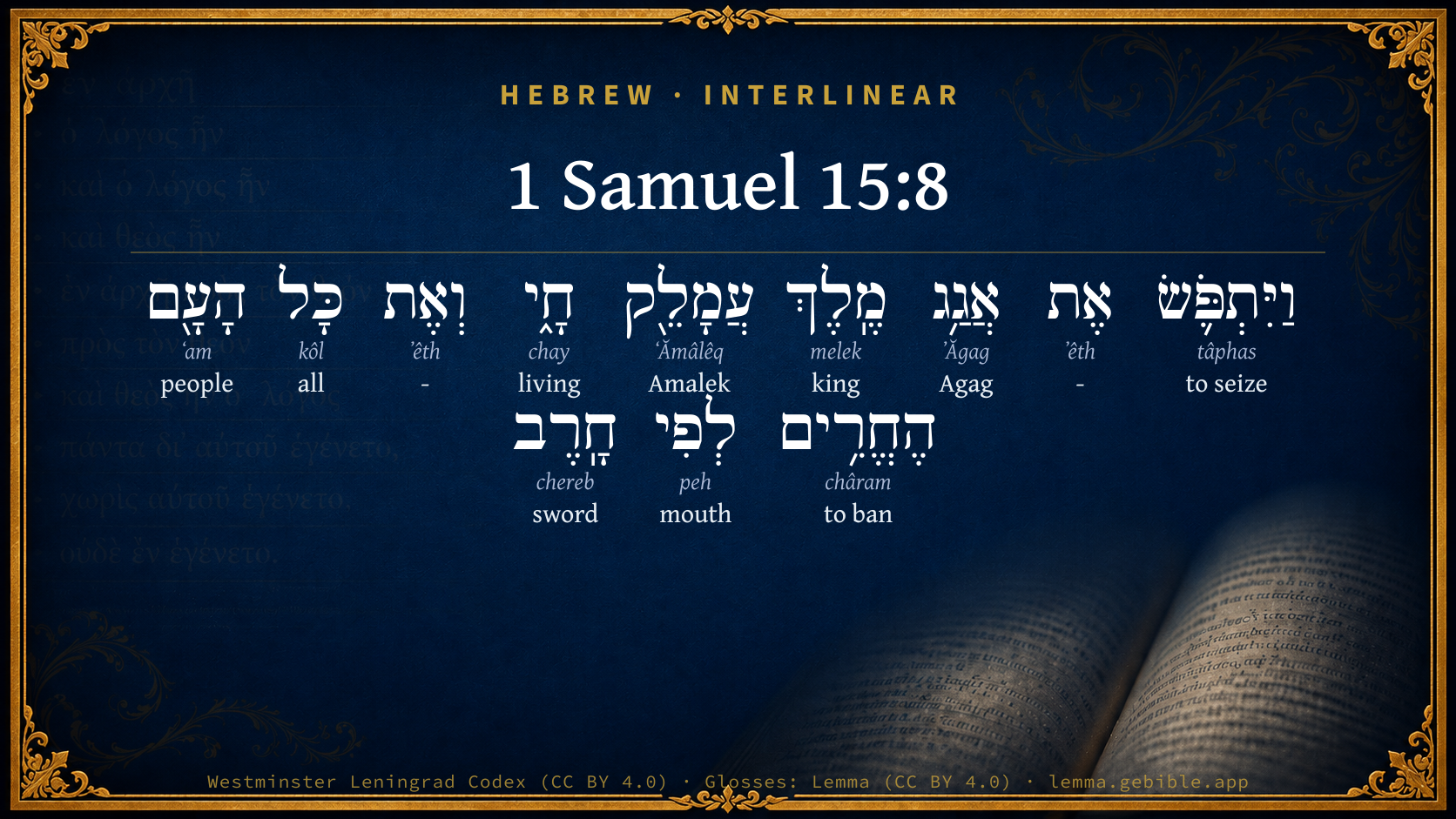
1 Samuel 15:8

Hebrew (Westminster Leningrad Codex) 1 Samuel 15:8 appears in the Hebrew Old Testament. The text above is from the Westminster Leningrad Codex. Each word links to its Strong’s number, a concise gloss, and parsing drawn from the Open Scriptures Hebrew Bible morphology. Click any word for its full Brown-Driver-Briggs (BDB) entry.
Download image
Cite this verse

1 Samuel 15:8 (World English Bible). Public Domain. Lemma interlinear Bible study tool, https://lemma.gebible.app/v/1-samuel/15/8.

Show BibTeX & RIS
BibTeX
RIS
English Translation
He took Agag the king of the Amalekites alive, and utterly destroyed all the people with the edge of the sword.
World English Bible · Public Domain
Download a study sheet

One document with this verse’s original text, its word-by-word gloss line, the meaning frame, cross-references with their text, attributed commentary, and full source and license credits — printable, and it pastes into notes with its structure intact.

This verse Autodidact and up

Study sheet (.html) Plain text (.txt)

A passage Seminary Student

Up to 50 verses in one chapter. A passage sheet keeps up to 6 commentary sources and 12 cross-references per verse, in the order this page ranks them, and says so on the sheet whenever that leaves anything out. Ask for a single verse and you get the Autodidact verse sheet above.

Everything on this page stays free to read, with no account — the sheet is a download of what is already on screen, not access to it.

Want to remove ads? Support Godless Engineer
Compare translations 3

The same verse in 3 English versions, stacked beneath the original-language interlinear above. Click any original word for its lexicon entry.

Each is an independent rendering of the whole verse — the interlinear is not word-aligned to these translations.

Highlighted words mark where these versions differ — a whole-verse word diff, not a word-by-word alignment.

  • World English Bible Public Domain
    He took Agag the king of the Amalekites alive, and utterly destroyed all the people with the edge of the sword.
  • King James Version Public Domain
    And he took Agag the king of the Amalekites alive, and utterly destroyed all the people with the edge of the sword.
  • unfoldingWord Literal Text CC BY-SA 4.0
    Now he seized Agag, the king of Amalek, alive, but he devoted all of the people to the mouth of the sword.

unfoldingWord Literal Text — © unfoldingWord, licensed CC BY-SA 4.0. Word-aligned USFM3 via Door43 (git.door43.org/unfoldingWord/en_ult).

Versions to compare (up to 4)

3 of 4 selected

Show all 18 translations

Every available English version of this verse, each an independent rendering of the whole verse.

  • World English Bible Public Domain
    He took Agag the king of the Amalekites alive, and utterly destroyed all the people with the edge of the sword.
  • Berean Standard Bible Public Domain
    He captured Agag king of Amalek alive, but devoted all the others to destruction with the sword.
  • Majority Standard Bible Public Domain
    He captured Agag king of Amalek alive, but devoted all the others to destruction with the sword.
  • King James Version Public Domain
    And he took Agag the king of the Amalekites alive, and utterly destroyed all the people with the edge of the sword.
  • American Standard Version (1901) Public Domain
    And he took Agag the king of the Amalekites alive, and utterly destroyed all the people with the edge of the sword.
  • Revised Version (1885) Public Domain
    And he took Agag the king of the Amalekites alive, and utterly destroyed all the people with the edge of the sword.
  • Geneva Bible (1599) Public Domain
    And tooke Agag the King of the Amalekites aliue, and destroyed all the people with the edge of the sword.
  • Douay-Rheims (1899) Public Domain
    And he took Agag the king of Amalec alive: but all the common people he slew with the edge of the sword.
  • Young's Literal Translation Public Domain
    and he catcheth Agag king of Amalek alive, and all the people he hath devoted by the mouth of the sword;
  • Literal Standard Version CC BY-SA 4.0
    and he catches Agag king of Amalek alive, and he has devoted all the people by the mouth of the sword;
  • Unlocked Literal Bible CC BY-SA 4.0
    Then he took Agag the king of the Amalekites alive; he completely destroyed all the people with the edge of the sword.
  • unfoldingWord Literal Text CC BY-SA 4.0
    Now he seized Agag, the king of Amalek, alive, but he devoted all of the people to the mouth of the sword.
  • Darby Bible Public Domain
    And he took Agag the king of Amalek alive, and utterly destroyed all the people with the edge of the sword.
  • World Messianic Bible Public Domain
    He took Agag the king of the Amalekites alive, and utterly destroyed all the people with the edge of the sword.
  • Webster's Bible Public Domain
    And he took Agag the king of the Amalekites alive, and utterly destroyed all the people with the edge of the sword.
  • Free Bible Version CC BY-SA 4.0
    He captured Agag, king of Amalek, alive, but exterminated all the people by the sword.
  • Bible in Basic English Public Domain
    He took Agag, king of the Amalekites, prisoner, and put all the people to the sword without mercy.
  • JPS Tanakh (1917) Public Domain
    And he took Agag the king of the Amalekites alive, and utterly destroyed all the people with the edge of the sword.

Literal Standard Version (2020), Covenant Press — licensed CC BY-SA 4.0. Text via the HelloAO Bible API (eBible.org). Unlocked Literal Bible (unfoldingWord) — licensed CC BY-SA 4.0. Text via the HelloAO Bible API (eBible.org). unfoldingWord Literal Text — © unfoldingWord, licensed CC BY-SA 4.0. Word-aligned USFM3 via Door43 (git.door43.org/unfoldingWord/en_ult). Free Bible Version, Dr. Jonathan Gallagher — licensed CC BY-SA 4.0. Text via the HelloAO Bible API (eBible.org).

Word by word

More ways to search: Search by grammar → Find every occurrence → Compare this word →

Practice this passage: Drill this verse → Learn its vocabulary →

About this verse

These counts appear in no published source. They are computed here, from the morphology-tagged text and Lemma’s own curated glosses. What Lemma adds →

12
words
11
distinct lemmas
Historical
section

Notable vocabulary

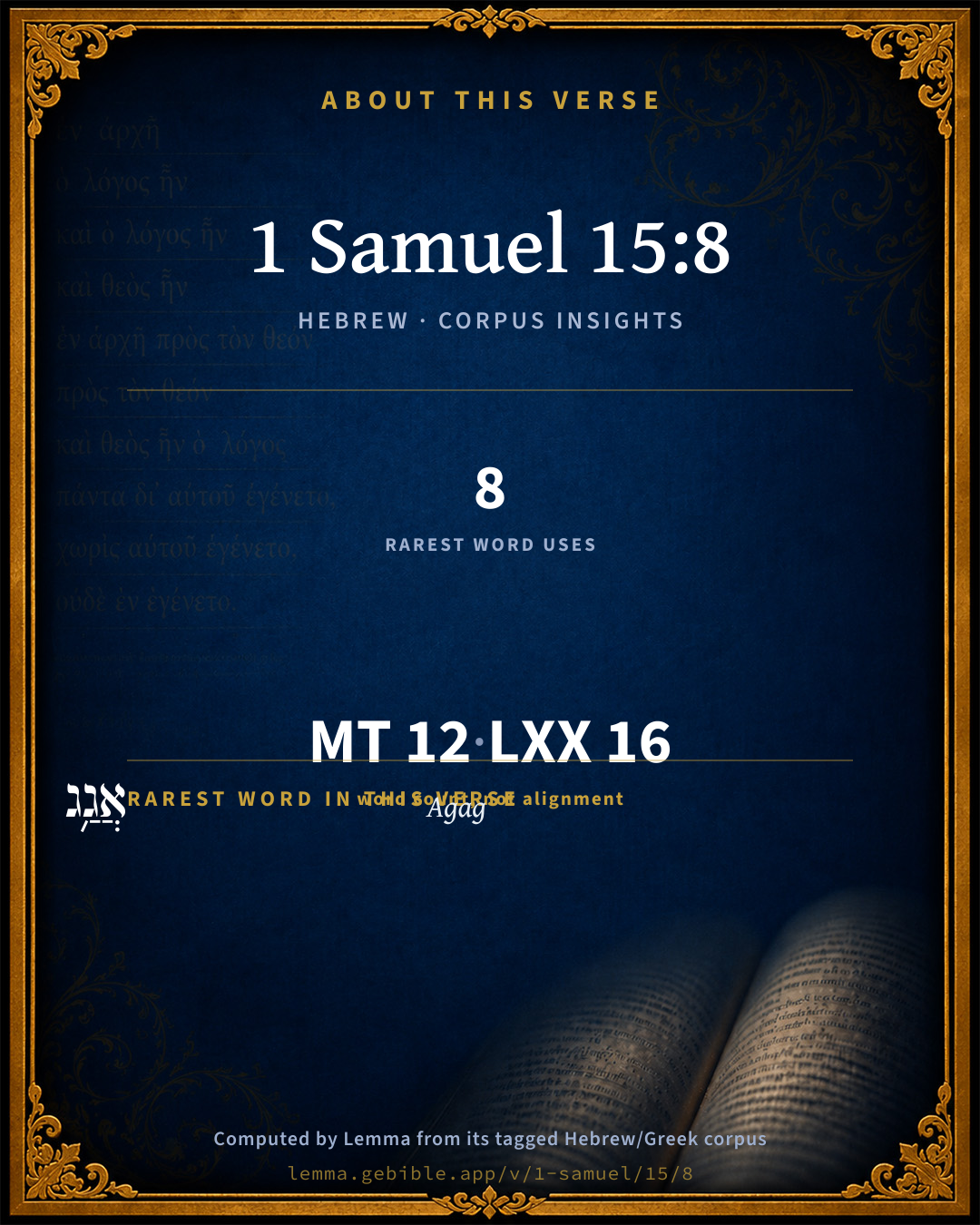
The rarest word here is אֲגַ֥ג Agag H90 — appearing just 8 times in the whole Hebrew Bible.

Shared distinctive vocabulary

אֲגַ֥ג Agag H90 occurs in 6 verses of the Hebrew Bible. Also found in:

Grammatical profile

  • 2 verbs
  • 7 nouns
  • 1 adjective
  • 2 particles

Verb forms

  • וַיִּתְפֹּ֛שׂ Qal · Sequential Imperfect
  • הֶחֱרִ֥ים Hiphil · Perfect

Hebrew & Septuagint length

In English translation the verse runs 21 words from the Hebrew and 23 from the Septuagint (LXX English) — closely comparable.

A rough comparison of the two English renderings, which tokenize alike — not a word-level alignment.

Word counts can differ between the Hebrew and the Greek without any difference in meaning — e.g. the Hebrew direct-object marker אֵת has no separate Greek word, and Greek often adds the article ὁ.

In the original languages it is 12 Hebrew tokens and 16 Greek tokens — but the two are counted differently (Hebrew bundles its prefixes and suffixes into one token; the Greek is in lemma form), so that isn’t a like-for-like length.

Cross-references

9

Topical passages linked to 1 Samuel 15:8 in the Treasury of Scripture Knowledge — connected by theme and wording, ordered by reader-vote popularity; previews shown in the World English Bible.

  • 1 Samuel 30:1 It happened, when David and his men were come to Ziklag on the third day, that the Amalekites had made a raid on the South, and on Ziklag, and had struck Ziklag, and burned it with fire,
  • Numbers 24:7 Water shall flow from his buckets, His seed shall be in many waters, His king shall be higher than Agag, His kingdom shall be exalted.
  • Esther 3:1 After these things did king Ahasuerus promote Haman the son of Hammedatha the Agagite, and advanced him, and set his seat above all the princes who were with him.
  • Joshua 10:39 and he took it, and the king of it, and all the cities of it; and they struck them with the edge of the sword, and utterly destroyed all the souls who were therein; he left none remaining: as he had done to Hebron, so he did to Debir, and to the king of it; as he had done also to Libnah, and to the king of it.
  • Joshua 11:12 All the cities of those kings, and all the kings of them, did Joshua take, and he struck them with the edge of the sword, and utterly destroyed them; as Moses the servant of Yahweh commanded.
  • 1 Samuel 15:3 Now go and strike Amalek, and utterly destroy all that they have, and don't spare them; but kill both man and woman, infant and suckling, ox and sheep, camel and donkey.
  • 1 Kings 20:30 But the rest fled to Aphek, into the city; and the wall fell on twenty-seven thousand men who were left. Ben Hadad fled, and came into the city, into an inner chamber.
  • 1 Kings 20:34–42 [Ben Hadad] said to him, The cities which my father took from your father I will restore; and you shall make streets for you in Damascus, as my father made in Samaria. I, [said Ahab], will let you go with this covenant. So he made a covenant with him, and let him go.
  • 1 Samuel 27:8–9 David and his men went up, and made a raid on the Geshurites, and the Girzites, and the Amalekites; for those [nations] were the inhabitants of the land, who were of old, as you go to Shur, even to the land of Egypt.

Cross-references courtesy of OpenBible.info (CC BY 4.0).

Hebrew and Greek witnesses Masoretic Hebrew ↔ Greek Septuagint

The same verse in the two great witnesses to the Old Testament, shown verse-for-verse.

These are two independent witnesses, not word-aligned to each other, and the Septuagint is shown in lemma (dictionary) form.

Hebrew 1 Samuel 15:8 Masoretic · Westminster Leningrad Codex

וַיִּתְפֹּ֛שׂ אֶת אֲגַ֥ג מֶֽלֶךְ עֲמָלֵ֖ק חָ֑י וְאֶת כָּל הָעָ֖ם הֶחֱרִ֥ים לְפִי חָֽרֶב

He took Agag the king of the Amalekites alive, and utterly destroyed all the people with the edge of the sword.

World English Bible · Public Domain

Greek LXX 1 Samuel 15:8 Septuagint · lemma form

καί συνλαμβάνω ὁ αγαγ βασιλεύς αμαληκ ζάω καί πᾶς ὁ λαός ιεριμ ἀποκτείνω ἐν στόμα ῥομφαία

And he took Agag the king of Amalec alive, and he killed all the people and Hierim with the edge of the sword.

LXX2012 (modern English Septuagint) · Public Domain

Hebrew: Westminster Leningrad Codex (CC BY 4.0). Greek: Septuagint (public domain); English from LXX2012 (modern English Septuagint) (Public Domain). How the Septuagint differs from the Hebrew →

Targum (Aramaic paraphrase)

1

The Targum is the ancient Jewish Aramaic paraphrase of the Hebrew Scriptures — an interpretive translation, not the Hebrew text itself. Onkelos (literal) and Pseudo-Jonathan (expansive) render the Torah, and Jonathan the Prophets. Coverage is partial: where no permissively-licensed English translation exists for a verse, only the Aramaic is shown. This is verse-level text, not a word-by-word alignment to the Hebrew.

  1. Targum Jonathan Prophets (Joshua–Malachi)
    וְאַחַד יַת אֲגַג מַלְכָּא דְבֵית עֲמָלֵק כַּד חָי וְיַת כָּל עַמָא גַמַר לְפִתְגַם דְחָרֶב:

    (no public-domain English translation for this verse)

    Targum Jonathan — Aramaic: “Mikraot Gedolot” (public domain). English: “Sefaria Community Translation” (CC0 1.0 (public-domain dedication)); “London "Chaldee Paraphrase," 1871” (public domain). Text via Sefaria.

Commentary

Notes on 1 Samuel 15:8 from classic Christian and Jewish commentators (each source and its license shown beneath its notes). The classic Christian expositions comment on the surrounding passage and are grouped to its opening verse, so a note may address several verses; the Jewish commentaries on the Tanakh (Rashi and others) are per-verse, so they appear only where the commentator wrote on this verse.

Lemma curates 59 commentaries, every one of them public domain or Creative Commons licensed, each selected and text-cleaned for this edition rather than reprinted as found. About our sources →

Trapp's Complete Commentary

John Trapp

1Sa 15:8 And he took Agag the king of the Amalekites alive, and utterly destroyed all the people with the edge of the sword.

Ver. 8. And he took Agag the king of the Amalekites alive.] Captans laudem clementiae, that he might be cried up for a clement conqueror: or that he might put him to his ransom, or rather out of a foolish and preposterous pity to his fellowking; as Ahab afterwards dealt by Benhadad. {a}

And utterly destroyed all the people.] All that he met with, as those that were devoted to destruction. The Jews at this day think they may kill any idolaters; and they have a saying, Optimus qui inter gentes, dignus est cui caput conteratur tanquam serpenti. The very best man among the Gentiles is as worthy as the old serpent to be knocked on the head.

{a} Ob fortanae regiae similitudinem. - Joseph.;

John Trapp, A Commentary or Exposition upon All the Books of the Old and New Testament (1647–1656) — public domain. Text from a community e-Sword module.

Tyndale Open Study Notes

Tyndale Open Resources

15:8 Agag was probably the descendant of an earlier king by the same name (see Num 24:7; cp. Esth 3:1).

Tyndale Open Study Notes — © Tyndale Open Resources, licensed CC BY-SA 4.0. Text via the HelloAO Bible API.

Jamieson, Fausset & Brown

Robert Jamieson, A. R. Fausset & David Brown

he took Agag . . . alive--This was the common title of the Amalekite kings. He had no scruple about the apparent cruelty of it, for he made fierce and indiscriminate havoc of the people. But he spared Agag, probably to enjoy the glory of displaying so distinguished a captive, and, in like manner, the most valuable portions of the booty, as the cattle. By this wilful and partial obedience to a positive command [Sa1 15:3], complying with it in some parts and violating it in others, as suited his own taste and humor, Saul showed his selfish, arbitrary temper, and his love of despotic power, and his utter unfitness to perform the duties of a delegated king in Israel.

Jamieson, Fausset & Brown — Commentary Critical and Explanatory on the Whole Bible (1871) — public domain (CC PDM 1.0). Text via the HelloAO Bible API.

The Cambridge Bible for Schools and Colleges

gen. ed. J. J. S. Perowne

8. Agag] Agag perhaps means “fiery.” As the name is found in Num_24:7, it was probably an hereditary title, like Pharaoh among the Egyptians.

utterly destroyed all the people] All who fell into their bands. Some survived, and continued a guerilla warfare against the Israelites (1Sa_27:8, 1Sa_30:1; 2Sa_8:12). The last remnant of them was destroyed by a band of Simeonites in the reign of Hezekiah (1Ch_4:43).

The Cambridge Bible for Schools and Colleges (gen. ed. J. J. S. Perowne; Cambridge University Press, 1878–1918) — public domain. Text from a community e-Sword module.

John Gill's Exposition

And he took Agag the king of the Amalekites alive,.... This name seems to be a common name of the kings of these people, as Pharaoh was of the Egyptians, see Num 24:2. When this king fell into the hands of Saul, he did not put him to death, as he should have done, but preserved him; for what reasons, see in the following verse:

and utterly destroyed all the people with the edge of the sword; that is, all that came in his way, or fell into his hands; all between Havilah and Shur; all excepting those that made their escape, for we after read of Amalekites, and that in large bodies, Sa1 27:8.

John Gill's Exposition of the Whole Bible (1746–1763) — public domain (CC PDM 1.0). Text via the HelloAO Bible API.

Albert Barnes' Notes on the Bible

The saving Agag alive was in direct violation of the devotion to destruction.

Albert Barnes' Notes on the Bible (1834–1885) — public domain. Text from a community e-Sword/MySword module.

Matthew Poole's English Annotations

Saul spared

Agag, either out of foolish pity for the goodliness of his person, which Josephus notes; or for his respect to his royal majesty, in the preservation of which he thought himself concerned; or for the glory of his triumph: compare 1Sa 15:12.

All the people, to wit, the body of the people, but not every individual person, as hath been showed. Universal particles are commonly thus understood, as is confessed.

Matthew Poole's English Annotations on the Holy Bible (1683–1685) — public domain. Text from a community e-Sword/MySword module.

Whedon's Commentary on the Bible

Daniel D. Whedon

8. Agag — This was the common title of the Amalekite, as Pharaoh was of the Egyptian, and Abimelech of the Philistine kings.

Utterly destroyed all the people — “That is, all that fell into the hands of the Israelites; for it follows from the very nature of the case that many escaped, and consequently there is nothing striking in the fact that Amalekites are mentioned again at a later period. 1Sa_27:8; 1Sa_30:1; 2Sa_8:12.” — Keil.

Daniel D. Whedon (gen. ed.), Commentary on the Old and New Testaments (1874–1909) — public domain. Text from a community e-Sword module.

The Pulpit Commentary

He took Agag. This was the official name of the Amalekite kings, (see Num_24:7) as Pharaoh was that of the kings of Egypt. For its meaning we must wait till we know more about the language of this race. Agag, however, from ver. 32, seems to have been able to speak Hebrew. He utterly destroyedi.e. put under the banall the people. They appear, however, again in 1Sa_27:8, and with so vast a wilderness in which to take refuge, it would be impossible really to exterminate a people used to lead a wandering life. Moreover, as soon as Israel began to lay hands on the spoil the pursuit would flag, as the cattle would be killed by over driving.

Vers. 8-11.

The limits of patience.

The facts are

1. Saul, in disobedience to the command of God, spares Agag and the best of the spoil.

2. God declares to Samuel that he can endure with Saul as king no longer.

3. Samuel, in his grief, cries unto God all night. It is never said that Godchanges his purpose absolutely. Where promises are given conditional on conduct they are revoked when conduct fails. We cannot ascribe human feelings to God; yet it is only by the analogy of human feelings that we can know anything of the mind of God. The setting aside from kingly office of Saul was an act of the Divine mind conformable with the original purpose of making him king, since the condition of permanence had not been fulfilled. Saul had been borne with so long; now he is to be borne with no longer. Patience yields to judgment.

I THERE IS A LIMIT TO DIVINE PATIENCE. Patience bears relation to wrongdoing, or the sufferance of ill. In God it relates to the restraint he puts on himself in the presence of that which merits his displeasure. That there is such a limit to Divine patience is clear.

1. The language of Scripture indicates it. The heart of God is represented as being under pressure of a moral force which can scarcely be resisted. "How shall I give thee up, Ephraim?". (Hos_11:8) The retrospect of the past brings into view the overpowering considerations which withheld good and allowed calamity to come. "He should have fed them with the finest of the wheat". (Psa_81:16) "O that my people had hearkened unto me!" (ibid. ver. 13). The persistence of men in sin, despite all counsel and mercy, raises the question of the length of time during which the hand of justice can be stayed. "How long shall I bear with this evil congregation?". (Num_14:27) A reference to love, tenderness, and care is set in sad contrast with the doom which the ingratitude so long endured is about to bring. (Mat_23:37, Mat_23:38)

2. Recorded facts illustrate it. The vices of the antediluvians were long endured, and it was after the Spirit had striven long with men, and they had refused the warnings of Noah, that patience yielded to the execution of judgment. (1Pe_3:20) The repeated warnings given to Pharaoh reveal a patience which terminated in the overthrow in the Red Sea. Patience was "grieved" with the perverse generation in the wilderness, but grief gave place to a "wrath" which barred their entrance into rest. (Heb_3:9-12) God endured long with some of the seven Churches in Asia, but at last judgment came, and the candlesticks were removed from their place.

3. The close of the Christian dispensation in a day of judgment is the most awful illustration of the limit to God"s patience. The plain teaching of that great event is that here men have time to repent and obtain through Christ all that will qualify for a perfect life that for the term of our earthly life God bears with our sins and provocations, and proves by thousands of favours that he "is slow to anger;" but that the end of all this must come, and judgment on the whole life ensue. His long suffering is great. But "it is appointed to men once to die, and after this the judgment". (Heb_9:27)

II THE GROUND OF THE LIMIT OF GOD"S PATIENCE. The yielding of patience to judgment in the case of Saul was on the occasion of his clear and deliberate breach of the command (vers. 1-3, 8, 9), and this too after other opportunities of obedience had been abused. But the question arises how it is that a certain degree or persistence in wrong is the occasion of the cessation of patience. There is a vague impression in some minds that because God is perfectly tender and loving his patience need and ought never to fail. This kind of thinking springs from very defective views of the character of God and of his relation to a moral order. It may not be possible for us to give a perfect rationale of Divine procedure; but there is perhaps light enough to indicate the wisdom and goodness of even a limit to God"s patience.

1. The privileges of responsible beings imply a probation for their use. The primary notion of a responsible being is one blessed with privilege, and able to use or abuse it at will But men are constituted so as to derive much wisdom from experience, and hence failure in the use of privilege, in a few instances, may possibly create an experience that will constrain to a more careful observance of duty when newly imposed. Life is full of helps to obedience as well as of hindrances. But as time is required for the development of responsibility, so it is obvious that the possession of privilege involves a limit to the period for use or abuse. Government without a reckoning would be no government. Everlasting patience is inconsistent with responsibility attendant on privilege.

2. In a moral order, where beings are closely interrelated, breach of dutyaffects others. Saul"s conduct could not end in himself. He, as fount of authority and influence, would damage his people by every act of disobedience to the Divine command. The repeated sins of men are so many attacks on the common welfare of the universe. God "desireth not the death of a sinner," but that he should "turn and live;" but he is the Guardian of right, of good, of peace, and of all that enters into the true welfare of the entire universe, and hence there is a love most deep and a wisdom unsearchable in not allowing the wilful sinner any longer to be exempt from the restraints which judgment imposes.

3. Repeated acts of disobedience reveal to God a state of mind which will not benefit by further favours. Every act of sin brings man lower in the moral scale. But while mercy and gentleness afford the sinner every possible chance to recover what is lost, it is possible for the habit of sin to gain such power over the entire man that to the eye of the Eternal his last chance of improving additional opportunities is clean gone. Samuel"s distress at the abandonment of Saul (ver. 11) was natural, and if his cry all night Was intercession, it was only what might be expected of a good man who knows only in part. The intercession of Moses (Num_14:15-23) was for pardon, and was partially successful. Samuel"s would appear to have been for pardon in the form of Saul"s continuance in the kingly office with the usual Divine sanctions. It is, however, obvious that the judgment of God was based on his perfect knowledge that the heart of Saul was too far gone to be trusted any further. It is an awful fact that a man may, by transgression, work himself into such a condition that all is lost on him, and will be lost. God, knowing this, may cease to be long suffering, and reject him as "nigh unto cursing". (Heb_6:6-8)

4 . The holiness of God requires vindication. Every pang which followed Saul s earlier sins and every rebuke from Samuel was some vindication of the holiness of God. The private and subjective recognition by the sinner of an insulted holiness is not all that the government of God requires. He is a jealous God; he will be honoured in the eyes of all people. Continued long suffering followed by judgment renders holiness more conspicuous than when judgment forestalls long suffering.

General lessons:

1. We should never forget that every day affords us new opportunities of keeping God"s commands.

2. It will repay the effort if we endeavour to form an estimate of theprivileges conferred on us in the past, and the extent to which we have drawn on the patience of God.

3. If we are deliberately disobedient in any office of trust, we may someday look for a grave judgment.

4. We are not always competent to see the wisdom of God"s severity, andmay possibly pray for what is not to be granted.

The Pulpit Commentary (1880–1919), ed. H.D.M. Spence-Jones & Joseph S. Exell — public domain. Text from a community e-Sword module.

unfoldingWord translationNotes

Door43 World Missions Community

General Information:

Yahweh had told Saul to destroy everything, but here Saul disobeys Yahweh's command.

he took Agag

Here Saul represents himself accompanied by his army. AT: "Saul and his army took Agag" or "Saul and his army captured Agag" (See: Synecdoche)

he completely destroyed all the people with the edge of the sword

The "edge of the sword" represents the swords and other weapons that soldiers used in battle. Here Saul represents himself accompanied by his army. AT: "they completely destroyed all of the people with their swords" or "they killed all of the people with their swords" (See: Synecdoche)

Saul ... spared Agag

Saul disobeyed God by letting Agag live.

as well as the best of the sheep

Saul disobeyed God by keeping the best of the livestock.

translationWords

Amalek

life

sword

cow

lamb

worthy

unfoldingWord translationNotes — © Distant Shores Media and the Door43 World Missions Community, licensed CC BY-SA 4.0. Source: git.door43.org/Door43/en_tn.

Lesson kit

Teaching starters — assembled from the data on this page, not authored interpretation. Every prompt links to the verse data it draws on. Edit before teaching.

1 Samuel, in the Historical, opens this verse with 12 words (11 distinct Hebrew lemmas). Its most distinctive word is ʼĂgag (“Agag”). A historical commentator’s framing appears above. Read the whole chapter for the surrounding context.

Discussion questions

  1. What does “Agag” (ʼĂgag) contribute to the verse as a whole?
  2. Numbers 24:7 shares the word «Agag» with this verse. How do the two illuminate each other?
  3. The translations on this page render this verse differently — a whole-verse word diff, not a word-by-word alignment. What might account for the different wordings?
  4. The verb «וַיִּתְפֹּ֛שׂ» is Qal Sequential Imperfect. How does its form color the action?
  5. Reading how Trapp's Complete Commentary and Tyndale Open Study Notes read this verse, where do the two commentators agree and where do they part?

Things to notice

Reading settings

Reading text

Shown beneath each verse's original-language words.

Old Testament
Old Testament edition

Read the OT as the Masoretic Hebrew (MT) or the Greek Septuagint (LXX).

English shown for the Greek Septuagint (in the Hebrew ↔ Greek comparison).

Comparing translations? Open the Compare panel on any verse page to stack up to four side by side.