
Amos 4:10

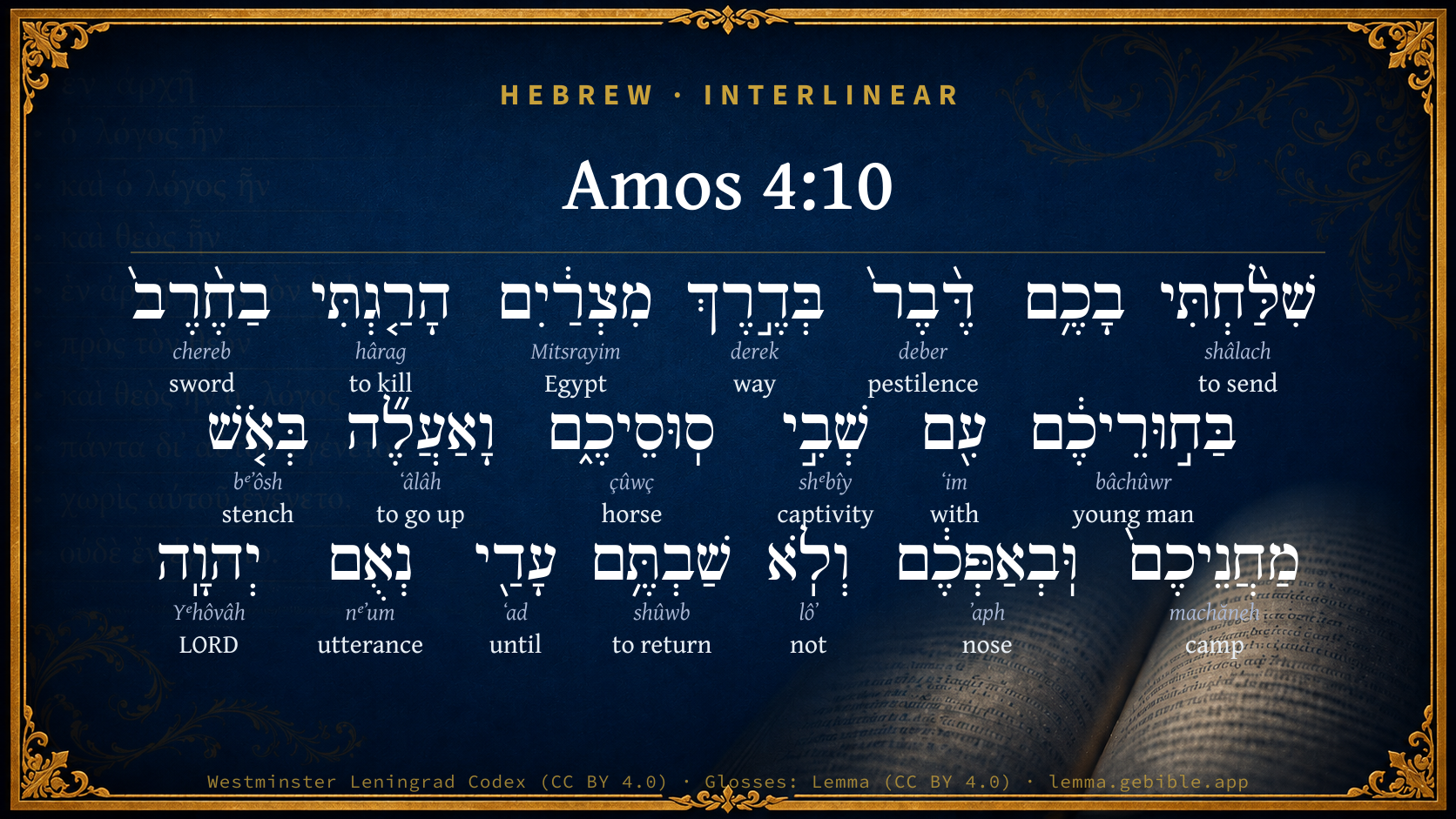
Hebrew (Westminster Leningrad Codex) Amos 4:10 appears in the Hebrew Old Testament. The text above is from the Westminster Leningrad Codex. Each word links to its Strong’s number, a concise gloss, and parsing drawn from the Open Scriptures Hebrew Bible morphology. Click any word for its full Brown-Driver-Briggs (BDB) entry.
Download image
Cite this verse

Amos 4:10 (World English Bible). Public Domain. Lemma interlinear Bible study tool, https://lemma.gebible.app/v/amos/4/10.

Show BibTeX & RIS
BibTeX
RIS
English Translation
I sent plagues among you like I did Egypt. I have slain your young men with the sword, And have carried away your horses; And I filled your nostrils with the stench of your camp Yet you haven't returned to me," says Yahweh.
World English Bible · Public Domain
Download a study sheet

One document with this verse’s original text, its word-by-word gloss line, the meaning frame, cross-references with their text, attributed commentary, and full source and license credits — printable, and it pastes into notes with its structure intact.

This verse Autodidact and up

Study sheet (.html) Plain text (.txt)

A passage Seminary Student

Up to 50 verses in one chapter. A passage sheet keeps up to 6 commentary sources and 12 cross-references per verse, in the order this page ranks them, and says so on the sheet whenever that leaves anything out. Ask for a single verse and you get the Autodidact verse sheet above.

Everything on this page stays free to read, with no account — the sheet is a download of what is already on screen, not access to it.

Want to remove ads? Support Godless Engineer
Compare translations 3

The same verse in 3 English versions, stacked beneath the original-language interlinear above. Click any original word for its lexicon entry.

Each is an independent rendering of the whole verse — the interlinear is not word-aligned to these translations.

Highlighted words mark where these versions differ — a whole-verse word diff, not a word-by-word alignment.

  • World English Bible Public Domain
    I sent plagues among you like I did Egypt. I have slain your young men with the sword, And have carried away your horses; And I filled your nostrils with the stench of your camp Yet you haven't returned to me," says Yahweh.
  • King James Version Public Domain
    I have sent among you the pestilence after the manner of Egypt: your young men have I slain with the sword, and have taken away your horses; and I have made the stink of your camps to come up unto your nostrils: yet have ye not returned unto me, saith the LORD.
  • unfoldingWord Literal Text CC BY-SA 4.0
    I sent a plague on you in the manner of Egypt. I killed your young men with the sword, carried away your horses, and made the stench of your camp come up to your nostrils. Yet you have not returned to me— this is Yahweh’s declaration.

unfoldingWord Literal Text — © unfoldingWord, licensed CC BY-SA 4.0. Word-aligned USFM3 via Door43 (git.door43.org/unfoldingWord/en_ult).

Versions to compare (up to 4)

3 of 4 selected

Show all 18 translations

Every available English version of this verse, each an independent rendering of the whole verse.

  • World English Bible Public Domain
    I sent plagues among you like I did Egypt. I have slain your young men with the sword, And have carried away your horses; And I filled your nostrils with the stench of your camp Yet you haven't returned to me," says Yahweh.
  • Berean Standard Bible Public Domain
    “I sent plagues among you like those of Egypt; I killed your young men with the sword, along with your captured horses. I filled your nostrils with the stench of your camp, yet you did not return to Me,” declares the LORD.
  • Majority Standard Bible Public Domain
    “I sent plagues among you like those of Egypt; I killed your young men with the sword, along with your captured horses. I filled your nostrils with the stench of your camp, yet you did not return to Me,” declares the LORD.
  • King James Version Public Domain
    I have sent among you the pestilence after the manner of Egypt: your young men have I slain with the sword, and have taken away your horses; and I have made the stink of your camps to come up unto your nostrils: yet have ye not returned unto me, saith the LORD.
  • American Standard Version (1901) Public Domain
    I have sent among you the pestilence after the manner of Egypt: your young men have I slain with the sword, and have carried away your horses; and I have made the stench of your camp to come up even into your nostrils: yet have ye not returned unto me, saith Jehovah.
  • Revised Version (1885) Public Domain
    I have sent among you the pestilence after the manner of Egypt: your young men have I slain with the sword, and have carried away your horses; and I have made the stink of your camp to come up even into your nostrils: yet have ye not returned unto me, saith the LORD.
  • Geneva Bible (1599) Public Domain
    Pestilence haue I sent among you, after the maner of Egypt: your yong men haue I slaine with the sworde, and haue taken away your horses: and I haue made the stinke of your tentes to come vp euen into your nostrels: yet haue yee not returned vnto me, saith the Lord.
  • Douay-Rheims (1899) Public Domain
    I sent death upon you in the way of Egypt, I slew your young men with the sword, even to the captivity of your horses: and I made the stench of your camp to come up into your nostrils: yet you returned not to me, saith the Lord.
  • Young's Literal Translation Public Domain
    I have sent among you pestilence by the way of Egypt, I have slain by sword your choice ones, With your captive horses, And I cause the stink of your camps to come up -- even into your nostrils, And ye have not turned back unto Me, An affirmation of Jehovah.
  • Literal Standard Version CC BY-SA 4.0
    “I have sent among you pestilence by the way of Egypt, || I have slain your choice ones by sword, || With your captive horses, || And I cause the stink of your camps to come up—Even into your nostrils, || And you have not turned back to Me,” || A declaration of YHWH.
  • Unlocked Literal Bible CC BY-SA 4.0
    I sent a plague on you as on Egypt. I killed your young men with the sword, carried away your horses, and made the stench of your camp come up to your nostrils. Yet you have not returned to me —this is Yahweh's declaration.
  • unfoldingWord Literal Text CC BY-SA 4.0
    I sent a plague on you in the manner of Egypt. I killed your young men with the sword, carried away your horses, and made the stench of your camp come up to your nostrils. Yet you have not returned to me— this is Yahweh’s declaration.
  • Darby Bible Public Domain
    I have sent among you the pestilence after the manner of Egypt: your young men have I slain with the sword, taking away captive your horses; and I made the stench of your camps to come up, even into your nostrils: yet have ye not returned unto me, saith Jehovah.
  • World Messianic Bible Public Domain
    “I sent plagues among you like I did Egypt. I have slain your young men with the sword, and have carried away your horses. I filled your nostrils with the stench of your camp, yet you haven’t returned to me,” says the LORD.
  • Webster's Bible Public Domain
    I have sent among you the pestilence after the manner of Egypt: your young men have I slain with the sword, and have taken away your horses; and I have made the ill savor of your camps to come up to your nostrils: yet have ye not returned to me, saith the LORD.
  • Free Bible Version CC BY-SA 4.0
    I sent a plague on you like I did in Egypt. I killed your young men in battle; I took away your horses; I made you smell the stench of dead bodies in your camps. But still you did not return to me, declares the Lord.
  • Bible in Basic English Public Domain
    I have sent disease among you, as it was in Egypt: I have put your young men to the sword, and have taken away your horses; I have made the evil smell from your tents come up to your noses: and still you have not come back to me, says the Lord.
  • JPS Tanakh (1917) Public Domain
    I have sent among you the pestilence in the way of Egypt; your young men have I slain with the sword, and have carried away your horses; and I have made the stench of your camp to come up even into your nostrils; yet have ye not returned unto Me, saith the LORD.

Literal Standard Version (2020), Covenant Press — licensed CC BY-SA 4.0. Text via the HelloAO Bible API (eBible.org). Unlocked Literal Bible (unfoldingWord) — licensed CC BY-SA 4.0. Text via the HelloAO Bible API (eBible.org). unfoldingWord Literal Text — © unfoldingWord, licensed CC BY-SA 4.0. Word-aligned USFM3 via Door43 (git.door43.org/unfoldingWord/en_ult). Free Bible Version, Dr. Jonathan Gallagher — licensed CC BY-SA 4.0. Text via the HelloAO Bible API (eBible.org).

Word by word

More ways to search: Search by grammar → Find every occurrence → Compare this word →

Practice this passage: Drill this verse → Learn its vocabulary →

בְּאֹ֤שׁ
bᵉʼôsh
H889
“stench of”
Noun, Common, Masculine, Singular, Construct
Part of Speech
Noun
Type
Common
Gender
Masculine
Number
Singular
State
Construct
Full BDB Definition

Origin: from H877

TWOT: 195a

stench, foul odour
  1. שִׁלַּ֨חְתִּי shâlach H7971 “to send” Verb, Piel, Perfect, 1st Person, Common, Singular
  2. דֶּ֨בֶר֙ deber H1698 “pestilence” Noun, Common, Masculine, Singular, Absolute
  3. בְּדֶ֣רֶךְ derek H1870 “in/at · way of” Preposition + Noun, Common, Both, Singular, Construct
  4. מִצְרַ֔יִם Mitsrayim H4714 “Egypt” Noun, Proper
  5. הָרַ֤גְתִּי hârag H2026 “to kill” Verb, Qal, Perfect, 1st Person, Common, Singular
  6. בַחֶ֨רֶב֙ chereb H2719 “in/at the · sword” Preposition, Determined + Noun, Common, Feminine, Singular, Absolute
  7. בַּח֣וּרֵיכֶ֔ם bâchûwr H970 “young men · your” Noun, Common, Masculine, Plural, Construct + Suffix, Personal, 2nd Person, Masculine, Plural
  8. עִ֖ם ʻim H5973 “with” Preposition
  9. שְׁבִ֣י shᵉbîy H7628 “captivity of” Noun, Common, Both, Singular, Construct
  10. סֽוּסֵיכֶ֑ם çûwç H5483 “horses · your” Noun, Common, Masculine, Plural, Construct + Suffix, Personal, 2nd Person, Masculine, Plural
  11. וָאַעֲלֶ֞ה ʻâlâh H5927 “and · to go up” Conjunction + Verb, Hiphil, Sequential Imperfect, 1st Person, Common, Singular
  12. מַחֲנֵיכֶם֙ machăneh H4264 “camp · your” Noun, Common, Both, Singular, Construct + Suffix, Personal, 2nd Person, Masculine, Plural
  13. וּֽבְאַפְּכֶ֔ם ʼaph H639 “and · in/at · nose · your” Conjunction + Preposition + Noun, Common, Masculine, Singular, Construct + Suffix, Personal, 2nd Person, Masculine, Plural
  14. וְלֹֽא lôʼ H3808 “and · not” Conjunction + Particle, Negative
  15. שַׁבְתֶּ֥ם shûwb H7725 “to return” Verb, Qal, Perfect, 2nd Person, Masculine, Plural
  16. עָדַ֖י ʻad H5704 “until · me” Preposition + Suffix, Personal, 1st Person, Common, Singular
  17. נְאֻם nᵉʼum H5002 “utterance of” Noun, Common, Masculine, Singular, Construct
  18. יְהוָֽה Yᵉhôvâh H3068 “LORD” Noun, Proper

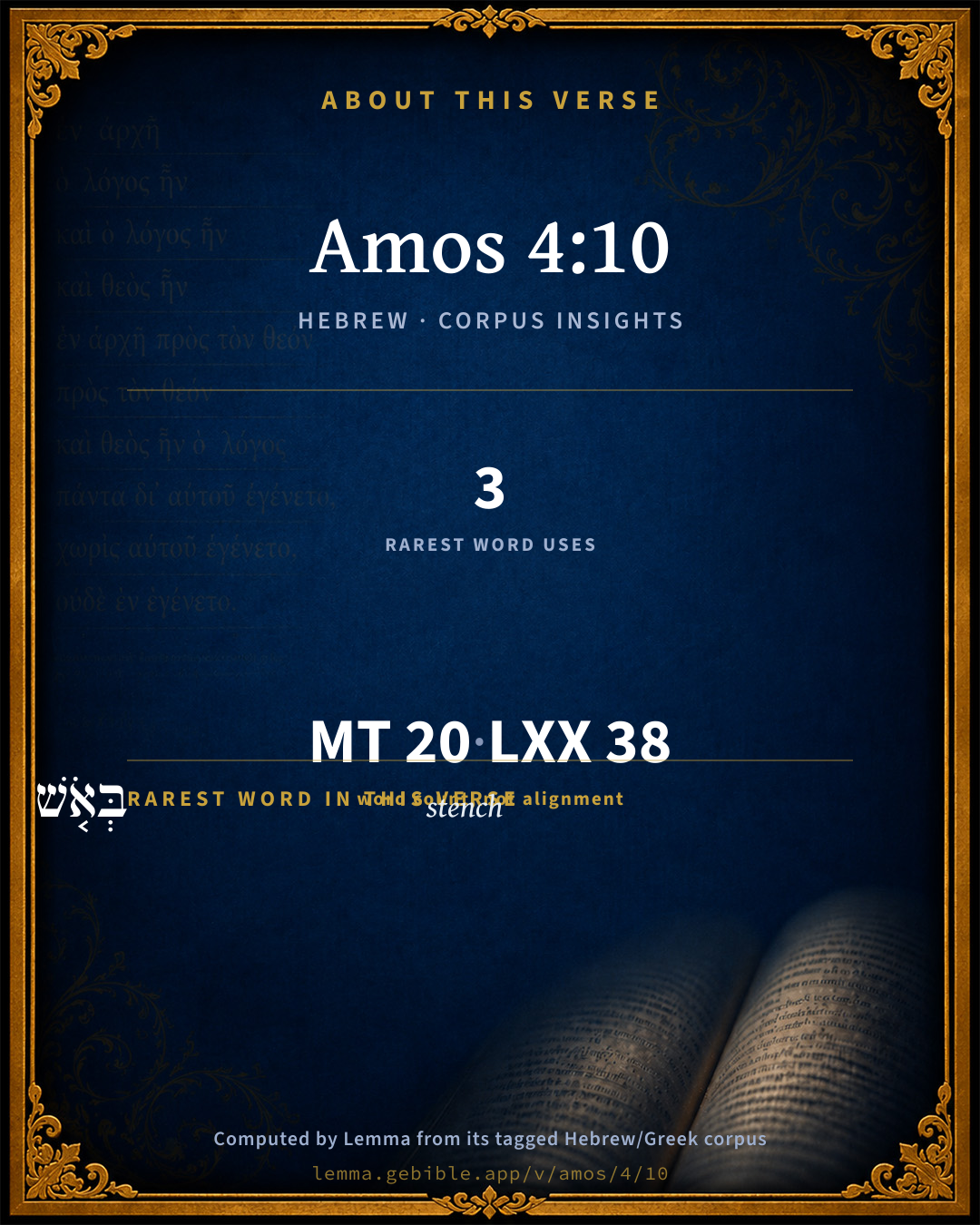
About this verse

These counts appear in no published source. They are computed here, from the morphology-tagged text and Lemma’s own curated glosses. What Lemma adds →

20
words
19
distinct lemmas
Prophets
section

Notable vocabulary

The rarest word here is בְּאֹ֤שׁ stench H889 — appearing just 3 times in the whole Hebrew Bible.

Shared distinctive vocabulary

בְּאֹ֤שׁ stench H889 occurs in 3 verses of the Hebrew Bible. Also found in:

Grammatical profile

  • 4 verbs
  • 12 nouns
  • 3 prepositions
  • 1 particle

Verb forms

  • שִׁלַּ֨חְתִּי Piel · Perfect
  • הָרַ֤גְתִּי Qal · Perfect
  • וָאַעֲלֶ֞ה Hiphil · Sequential Imperfect
  • שַׁבְתֶּ֥ם Qal · Perfect

Hebrew & Septuagint length

In English translation the verse runs 43 words from the Hebrew and 50 from the Septuagint (LXX English) — closely comparable.

A rough comparison of the two English renderings, which tokenize alike — not a word-level alignment.

Word counts can differ between the Hebrew and the Greek without any difference in meaning — e.g. the Hebrew direct-object marker אֵת has no separate Greek word, and Greek often adds the article ὁ.

In the original languages it is 20 Hebrew tokens and 38 Greek tokens — but the two are counted differently (Hebrew bundles its prefixes and suffixes into one token; the Greek is in lemma form), so that isn’t a like-for-like length.

Cross-references

33

Topical passages linked to Amos 4:10 in the Treasury of Scripture Knowledge — connected by theme and wording, ordered by reader-vote popularity; previews shown in the World English Bible.

  • Deuteronomy 28:60 He will bring on you again all the diseases of Egypt, which you were afraid of; and they shall cleave to you.
  • Leviticus 26:25 I will bring a sword upon you, that will execute the vengeance of the covenant; and you will be gathered together within your cities: and I will send the pestilence among you; and you will be delivered into the hand of the enemy.
  • 2 Kings 13:7 For he didn't leave to Jehoahaz of the people save fifty horsemen, and ten chariots, and ten thousand footmen; for the king of Syria destroyed them, and made them like the dust in threshing.
  • Joel 2:20 But I will remove the northern army far away from you, And will drive it into a barren and desolate land, Its front into the eastern sea, And its back into the western sea; And its stench will come up, And its bad smell will rise." Surely he has done great things.
  • Exodus 9:3–6 behold, the hand of Yahweh is on your cattle which are in the field, on the horses, on the donkeys, on the camels, on the herds, and on the flocks with a very grievous pestilence.
  • Deuteronomy 7:15 Yahweh will take away from you all sickness; and none of the evil diseases of Egypt, which you know, will he put on you, but will lay them on all those who hate you.
  • Deuteronomy 28:26–27 Your dead body shall be food to all birds of the sky, and to the animals of the earth; and there shall be none to frighten them away.
  • Psalms 78:49–50 He threw on them the fierceness of his anger, Wrath, indignation, and trouble, And a band of angels of evil.
  • Exodus 8:19 Then the magicians said to Pharaoh, "This is the finger of God:" and Pharaoh's heart was hardened, and he didn't listen to them; as Yahweh had spoken.
  • Leviticus 26:16 I also will do this to you: I will appoint terror over you, even consumption and fever, that shall consume the eyes, and make the soul to pine away; and you will sow your seed in vain, for your enemies will eat it.
  • Deuteronomy 28:22 Yahweh will strike you with consumption, and with fever, and with inflammation, and with fiery heat, and with the sword, and with blasting, and with mildew; and they shall pursue you until you perish.
  • 2 Kings 13:3 The anger of Yahweh was kindled against Israel, and he delivered them into the hand of Hazael king of Syria, and into the hand of Benhadad the son of Hazael, continually.
  • Jeremiah 11:22 therefore thus says Yahweh of hosts, Behold, I will punish them: the young men shall die by the sword; their sons and their daughters shall die by famine;
  • Jeremiah 18:21 Therefore deliver up their children to the famine, and give them over to the power of the sword; and let their wives become childless, and widows; and let their men be slain of death, [and] their young men struck of the sword in battle.
  • Amos 4:6 "I also have given you cleanness of teeth in all your cities, And lack of bread in every town; Yet you haven't returned to me," says Yahweh.
  • Amos 8:3 The songs of the temple will be wailings in that day," says the Lord Yahweh. "The dead bodies will be many. In every place they will throw them out with silence.
  • Exodus 9:12 Yahweh hardened the heart of Pharaoh, and he didn't listen to them, as Yahweh had spoken to Moses.
  • Exodus 9:17 as you still exalt yourself against my people, that you won't let them go.
  • Exodus 9:34–35 When Pharaoh saw that the rain and the hail and the thunders were ceased, he sinned yet more, and hardened his heart, he and his servants.
  • Exodus 10:3 Moses and Aaron went in to Pharaoh, and said to him, "This is what Yahweh, the God of the Hebrews, says: 'How long will you refuse to humble yourself before me? Let my people go, that they may serve me.
  • Exodus 10:27 But Yahweh hardened Pharaoh's heart, and he wouldn't let them go.
  • Exodus 12:29–30 It happened at midnight, that Yahweh struck all the firstborn in the land of Egypt, from the firstborn of Pharaoh who sat on his throne to the firstborn of the captive who was in the dungeon; and all the firstborn of cattle.
  • Exodus 14:4 I will harden Pharaoh's heart, and he will follow after them; and I will get honor over Pharaoh, and over all his host; and the Egyptians shall know that I am Yahweh." They did so.
  • Exodus 15:26 and he said, "If you will diligently listen to the voice of Yahweh your God, and will do that which is right in his eyes, and will pay attention to his commandments, and keep all his statutes, I will put none of the diseases on you, which I have put on the Egyptians; for I am Yahweh who heals you."
  • 2 Kings 8:12 Hazael said, Why weeps my lord? He answered, Because I know the evil that you will do to the children of Israel: their strongholds will you set on fire, and their young men will you kill with the sword, and will dash in pieces their little ones, and rip up their women with child.
  • 2 Kings 10:32 In those days Yahweh began to cut off from Israel: and Hazael struck them in all the borders of Israel;
  • Isaiah 9:13 Yet the people have not turned to him who struck them, neither have they sought Yahweh of Hosts.
  • Jeremiah 6:11 Therefore I am full of the wrath of Yahweh; I am weary with holding in: pour it out on the children in the street, and on the assembly of young men together; for even the husband with the wife shall be taken, the aged with him who is full of days.
  • Jeremiah 8:1–2 At that time, says Yahweh, they shall bring out the bones of the kings of Judah, and the bones of his princes, and the bones of the priests, and the bones of the prophets, and the bones of the inhabitants of Jerusalem, out of their graves;
  • Jeremiah 9:22 Speak, Thus says Yahweh, The dead bodies of men shall fall as dung on the open field, and as the handful after the harvester; and none shall gather [them].
  • Jeremiah 15:3 I will appoint over them four kinds, says Yahweh: the sword to kill, and the dogs to tear, and the birds of the sky, and the animals of the earth, to devour and to destroy.
  • Jeremiah 16:4 They shall die grievous deaths: they shall not be lamented, neither shall they be buried; they shall be as dung on the surface of the ground; and they shall be consumed by the sword, and by famine; and their dead bodies shall be food for the birds of the sky, and for the animals of the earth.
  • Jeremiah 48:15 Moab is laid waste, and they are gone up into his cities, and his chosen young men are gone down to the slaughter, says the King, whose name is Yahweh of Hosts.

Cross-references courtesy of OpenBible.info (CC BY 4.0).

Hebrew and Greek witnesses Masoretic Hebrew ↔ Greek Septuagint

The same verse in the two great witnesses to the Old Testament, shown verse-for-verse.

These are two independent witnesses, not word-aligned to each other, and the Septuagint is shown in lemma (dictionary) form.

Hebrew Amos 4:10 Masoretic · Westminster Leningrad Codex

שִׁלַּ֨חְתִּי בָכֶ֥ם דֶּ֨בֶר֙ בְּדֶ֣רֶךְ מִצְרַ֔יִם הָרַ֤גְתִּי בַחֶ֨רֶב֙ בַּח֣וּרֵיכֶ֔ם עִ֖ם שְׁבִ֣י סֽוּסֵיכֶ֑ם וָאַעֲלֶ֞ה בְּאֹ֤שׁ מַחֲנֵיכֶם֙ וּֽבְאַפְּכֶ֔ם וְלֹֽא שַׁבְתֶּ֥ם עָדַ֖י נְאֻם יְהוָֽה

I sent plagues among you like I did Egypt. I have slain your young men with the sword, And have carried away your horses; And I filled your nostrils with the stench of your camp Yet you haven't returned to me," says Yahweh.

World English Bible · Public Domain

Greek LXX Amos 4:10 Septuagint · lemma form

ἐκ ἀποστέλλω εἰς σύ θάνατος ἐν ὁδός αἴγυπτος καί ἀποκτείνω ἐν ῥομφαία ὁ νεανίσκος σύ μετά αἰχμαλωσία ἵππος σύ καί ἀναἄγω ἐν πῦρ ὁ παρεμβολή σύ ἐν ὁ ὀργή ἐγώ καί οὐδέ ὥς ἐπιστρέφω πρός ἐγώ λέγω κύριος

I sent pestilence among you by the way of Egypt, and killed your young men with the sword, together with your horses that were taken captive; and in my wrath against you I set fire to your camps: yet not even thus did you⌃ return to me, says the Lord.

LXX2012 (modern English Septuagint) · Public Domain

On this verse, Whedon's Commentary on the Bible discusses the Septuagint’s reading. Read the note in Commentary ↓

Hebrew: Westminster Leningrad Codex (CC BY 4.0). Greek: Septuagint (public domain); English from LXX2012 (modern English Septuagint) (Public Domain). How the Septuagint differs from the Hebrew →

Targum (Aramaic paraphrase)

1

The Targum is the ancient Jewish Aramaic paraphrase of the Hebrew Scriptures — an interpretive translation, not the Hebrew text itself. Onkelos (literal) and Pseudo-Jonathan (expansive) render the Torah, and Jonathan the Prophets. Coverage is partial: where no permissively-licensed English translation exists for a verse, only the Aramaic is shown. This is verse-level text, not a word-by-word alignment to the Hebrew.

  1. Targum Jonathan Prophets (Joshua–Malachi)
    שְׁלָחֵית בְּכוֹן מוֹתָא כַּד בְּאוֹרַח מִצְרַיִם קְטָלֵית בְּחַרְבָּא עוּלֵימֵיכוֹן עִם שְׁבִי סוּסְוַתְכוֹן וְאַסְקֵית סְרוּת מַשִׁרְיָתֵיכוֹן וּבְאַפֵּיכוֹן וְלָא תַבְתּוּן לְפוּלְחָנִי אֲמַר יְיָ:

    (no public-domain English translation for this verse)

    Targum Jonathan — Aramaic: “Mikraot Gedolot” (public domain). English: “Sefaria Community Translation” (CC0 1.0 (public-domain dedication)); “London "Chaldee Paraphrase," 1871” (public domain). Text via Sefaria.

Commentary

Notes on Amos 4:10 from classic Christian and Jewish commentators (each source and its license shown beneath its notes). The classic Christian expositions comment on the surrounding passage and are grouped to its opening verse, so a note may address several verses; the Jewish commentaries on the Tanakh (Rashi and others) are per-verse, so they appear only where the commentator wrote on this verse.

Lemma curates 59 commentaries, every one of them public domain or Creative Commons licensed, each selected and text-cleaned for this edition rather than reprinted as found. About our sources →

Trapp's Complete Commentary

John Trapp

Amo 4:10 I have sent among you the pestilence after the manner of Egypt: your young men have I slain with the sword, and have taken away your horses; and I have made the stink of your camps to come up unto your nostrils: yet have ye not returned unto me, saith the LORD.

Ver. 10. I have sent among you the pestilence] That evil angel, Psa 78:49, that το θειον, eminent hand of God, as Hippocrates calleth it; that destruction that walketh in darkness and wasteth at noon day, as the Psalmist styleth it, Psa 91:6. This God sent; for it is a messenger of his sending, an arrow of his shooting, 2Sa 24:15, and may better be called morbus sacer than the falling sickness; as being an extraordinary hand of God, such as was that Sudor Anglicus, in the days of Edward VI the sweating sickness that raged very violently for forty years together here in England (as Sennertus testifieth), and slew so many, that strangers wondered how this island could be so populous as to bear and bury such incredible multitudes. No stranger in England was touched with this disease; and yet the English were chased therewith not only here, but in other countries abroad; which made them, like tyrants, both feared and avoided wherever they came. So long as the ferventness of this plague lasted, there was crying, Peccavi, Peccavi; I have sinned, I have sinned, and some pretences of turning to the Lord. The ministers were sought for in every corner (saith Mr Bradford), Oh, you must come to my lord, you must come to my lady. Thus, "when he slew them, then they sought him: and they returned and inquired early after God. Nevertheless they did flatter him with their mouth, and lied unto him with their tongues," Psa 78:34; Psa 78:36; as the fox, when taken in a snare, looks pitifully, but it is only that he may get out; as ice melts in the day and hardeneth again in the night; or as iron is very soft and malleable while in the fire, but soon after returneth to its former hardness.

After the manner of Egypt] In the way to Egypt (so some read it), as you were trudging down to Egypt for help against enemies, or for corn in time of famine (for Egypt was the world’s granary), I have stretched my net over you: Egypt hath gathered you up, Memphis hath buried you, Hos 9:6. But taking the words as we translate them, "After the manner of Egypt," i.e. so as I plagued the Egyptians, when you were among them {see Exo 12:29} with mortality of men and murrain of cattle, Exo 9:15. The plague of Athens is graphically described by Thucydides; whence Ovid and Virgil are thought to have borrowed their descriptions of the pestilence. The plague of Italy is set forth in lively colours by Dionys. Halicarnass. lib. xi. Antiq. That of Constantinople by Nicephorus and Sigebertus.

Your young men have I slain with the sword] Iuvenes a iuvando, saith Varro: because they are able and apt by arms to defend the commonwealth, and to help it at a dead lift. In Hebrew they have their name a delectu; because they are chosen to fight and do business, as fittest for the purpose, Exo 17:9 2Sa 6:1. These God had slain with the sword, which cutteth its way through a wood of men, and heweth down the youngest and strongest; spareth neither lord nor losel, as they say; is despatched with confused noise, and garments rolled in blood, Isa 9:5.

And I have made the stink of your camps] By means of the slain, both men and horses, that lie unburied, and poison the air; see Joe 2:20 Isa 34:3.

And yet have ye not returned] Nec sic tamen: Vide contumaciam, saith Mercer here. Obstinate men will sooner break than bend. Monoceros interimi potest, non capi. The unicorn is able to be kiiled but not captured.

John Trapp, A Commentary or Exposition upon All the Books of the Old and New Testament (1647–1656) — public domain. Text from a community e-Sword module.

The Biblical Illustrator

Joseph S. Exell

Amo_4:10

Your young men have I slain with the sword . . . yet have ye not returned unto Me, saith the Lord.

Gods dealings with us nationally, and their object

While we are in this state of trial and probation God does not punish us, individually or nationally, in the spirit of vindictiveness or vengeance, but out of love and compassion, and with the view of working in us that which is needful for our temporal prosperity and eternal welfare, and which His good gifts and past mercies have failed to effect.

I. The parties here addressed. Primarily the children of Israel. If we can trace a resemblance between our conduct and theirs, we must undoubtedly consider the words of the text equally addressed to us.

1. Pride was a striking characteristic of Gods people of old. What was the return they made for all the signal blessings bestowed on them? Jeshurun waxed fat and kicked. Have not we, nationally and individually, acted like them in this particular? How have we requited the good and gracious Benefactor for His great mercies? Have we not been lifted up in pride? Is it not the prevailing sentiment that it is to our own wisdom we owe our constitution, to our own exertions our wealth, and to our superior institutions our freedom from rebellion and revolution?

2. Israel had drawn down Gods judgments for their hypocrisy. They were very zealous in the profession of their religion. But their hearts went after their idols, and their hands were full of blood. Therefore God refused their worthless profession. And, nowadays, there is a vast deal of outward profession of religion, yet but very little real, practical, influential religion. Where is the self-discipline, the self-denial, the self-sacrifice which our holy religion calls upon us for?

3. Forgetfulness of God, their great Benefactor, was a striking characteristic of the Israelites of old. And do we acknowledge Gods hand in the productiveness of our land, or in the failure of our crops?

4. Our sin and rebellion against God fix us with the applicability of these words to ourselves. Who can fathom the demoralisation and wickedness of the dense masses of our great cities, etc.!

II. Gods dealings with them in like connection with his dealings with us. Unexampled favours demand a higher standard of holiness and devoted obedience, and proportionately increase the heinousness of guilt. Trace the dealings with which God had visited the Israelites, in chastisement for their sins, which are referred to in this chapter. Scarcity, disease, war, etc.

III. What is the object of these dealings of God towards us? His yearning over us is that we should become a people fearing Him, and working righteousness. The nation is made up of individuals; and as far as individual responsibility is concerned, it will be by individual practice, example, and influence that we must severally promote that reformation amongst us which is needful to restore us to the Divine favour. (Edward T. Cardale.)

The Biblical Illustrator, edited by Joseph S. Exell (c. 1880s–1900s) — public domain. Text from a community e-Sword module.

Joseph Benson's Commentary

Amo 4:10-11. I have sent among you the pestilence after the manner of Egypt — I have sent such pestilence among you as I formerly sent upon Egypt: Or, such as has frequently taken place in Egypt. “The unwholesome effluvia, on the subsiding of the Nile, caused some peculiarly malignant diseases in this country.” — Newcome. Maillet also tells us, (Lett. 1. page 14,) that “the air is bad in those parts, where, when the inundations of the Nile have been very great, this river, in retiring to its channel, leaves marshy places, which infect the country round about. The dew is also very dangerous in Egypt.” Your young men have I slain, &c. — I have caused your young men to fall in battle with your enemies. And have taken away your horses — Have enabled your enemies to take them from you. Horses being very scarce in the land of Israel, the loss of them was a great affliction. I have made the stink of your camps, &c. — I have sent diseases into your camps; so that they have been rendered quite noisome by the smell of the dead carcasses, or so great has been the slaughter in your camps, that there were not a sufficient number left alive to bury the slain. The Syrians made frequent incursions on the Israelites, which obliged the latter to be often encamped. I have overthrown some of you, &c. — Some of your cities I have caused to be burned with fire and utterly consumed, as Sodom and Gomorrah were. And ye were as a firebrand plucked out of the burning — Those that remained very narrowly escaped. A proverbial expression, used both by sacred and profane authors, to signify a narrow escape out of imminent danger.

Joseph Benson's Commentary on the Old and New Testaments (1811–1818) — public domain. Text from a community e-Sword module.

Tyndale Open Study Notes

Tyndale Open Resources

4:10 God had used plagues to convince Egypt to let Israel go (Exod 7:14–12:30; 9:2-3; Ps 91:6; Hab 3:5); he promised to bring the plagues of Egypt on Israel if they continued to turn away from him to worship pagan gods (Deut 28:27, 60).

Tyndale Open Study Notes — © Tyndale Open Resources, licensed CC BY-SA 4.0. Text via the HelloAO Bible API.

Geneva Bible (1599)

Geneva Bible translators

As I plagued the Egyptians, Exod. 9:10.

Geneva Bible (1599) marginal notes — public domain. Text via Bolls.life.

Jamieson, Fausset & Brown

Robert Jamieson, A. R. Fausset & David Brown

pestilence after the manner of Egypt--such as I formerly sent on the Egyptians (Exo 9:3, Exo 9:8, &c.; Exo 12:29; Deu 28:27, Deu 28:60). Compare the same phrase, Isa 10:24.

have taken away your horses--literally, "accompanied with the captivity of your horses"; I have given up your young men to be slain, and their horses to be taken by the foe (compare Kg2 13:7).

stink of your camps--that is, of your slain men (compare Isa 34:3; Joe 2:20).

to come up unto your nostrils--The Hebrew is more emphatic, "to come up, and that unto your nostrils."

Jamieson, Fausset & Brown — Commentary Critical and Explanatory on the Whole Bible (1871) — public domain (CC PDM 1.0). Text via the HelloAO Bible API.

Adam Clarke's Commentary

Verse 10. I have sent - the pestilence] After the blasting and the mildew, the pestilence came; and it acted among them as one of the plagues of Egypt. Besides this, he had suffered their enemies to attack and prevail against them; alluding to the time in which the Syrians besieged Samaria, and reduced it to the most extreme necessity, when the head of an ass was sold for eighty pieces of silver, and the fourth part of a cab of dove's dung for five; and mothers ate the flesh of their children that had died through hunger, 2Kg 6:25. And the people were miraculously relieved by the total slaughter of the Syrians by the unseen hand of God, 2Kg 7:1, &c. And yet, after all those signal judgments, and singular mercies, "they did not return unto the Lord!"

Adam Clarke's Commentary on the Bible (1810–1826) — public domain. Text from a community e-Sword/MySword module.

John Calvin's Commentaries

God now expostulates with the people, because their perverseness had not been subdued even by additional punishments; for he had in vain exhorted and stimulated them to repentance. He says, that they had been smitten with pestilence. The Prophet has hitherto spoken only of the sterility of the land, and of the fruit being destroyed by infections; he has hitherto mentioned want only with its causes; this only has been stated: but now he adds that the people had been afflicted with pestilence, and also with war, and that they had still persevered in their wickedness. Whatever measures then God had adopted to correct the vices of the people, the Prophet now complains and deplores, that they all had been tried in vain. But so many upbraidings are mentioned, that God might show that there was no more any hope of pardon, inasmuch as they thus continued to be untractable and perverse.

He then says that he had sent pestilence according to the manner of Egypt דרך, darec, means a way, but is taken for mode or manners as the 10th chapter of Isaiah ‘I will smite him according to the manner of Egypt,’ says God, speaking of Sennacherib, as though he said, “Ye know how formerly I checked the fury of Pharaoh; I will now put on the same armor, that I may drive far from you your energy Sennacherib.” But the Prophet says here, that God had exercised towards the Israelites the same extreme rigor which he had used towards the Egyptians; as though he said, “I have been forced by your obstinacy to turn my power against you: ye know how Egypt was formerly smitten by me from kindness to your fathers; I then showed how dear to me was your preservation, by putting forth my strength to destroy the Egyptians: how is it that I now turn my weapons against you for your destruction? I have been indeed always ready to oppose your enemies, and kindly to cherish you in my paternal bosom. As then ye are become to me like the Egyptians, how is this and whence this change, except that ye have constrained me by your irreclaimable wickedness?”

We now then see why the Prophet speaks here expressly of the Egyptians. He intimates that God could not show favor to the Israelites, which he would have continued to show, had they not closed the door against it; as though he said, “I had chosen you from other nations; but now I chastise you, not as I do the uncircumcised Gentiles, but I avowedly carry on war with you, as though ye were Egyptians.” We see how much it serves for amplification, when Amos compares the Israelites to the Egyptians, as though he had said that they, by their perverse wickedness, had extinguished all God’s favor, so that the memory of their gratuitous adoption was of no more avail to them. I have therefore sent among you pestilence after the manner of Egypt.

And he adds, I slew with the sword your strong men. It was a different kind of punishment, that all the strong had been slain, that their horses had been led into captivity, and that, finally, the foetor of dead bodies had ascended to suffocate them. These were certainly unusual tokens of God’s wrath. As the people had not repented, it became now again quite evident, that their diseases were not healable; for God had effected nothing by the application of so many remedies. These different kinds of punishments ought to be carefully noticed, because the Lord has collected them together, as so many arguments to prove the contumacy of the people.

By saying that the foetor of camps had ascended to their nostrils, it was the same as if he had said, “There has been no need of external force; though no enemy had been hostile to you, ye have yet been suffocated by your own foetor; for this came up from your own camps into your nostrils, and deprived you of life. Since God then had raised up this intestine putridity, ought you not to have been at length seriously affected, and to have returned to a right mind? Inasmuch then as no fruit followed, who does not see, that you have been in vain chastised, and that what alone remains for you is utter destruction? As God has hitherto stimulated you in vain by punishments, were he to proceed, he would lose all his labor. Since then God has hitherto to no purpose visited you with his scourges, there is no reason why he should chastise you more moderately: you must now then be utterly destroyed.” This is the meaning: and he further adds —

John Calvin's Commentaries (1540-1563) — public domain. Text from the Calvin Translation Society English edition (1840s-50s) via the Christian Classics Ethereal Library (ccel.org). Calvin's coverage is partial (roughly two-thirds of the Bible); uncommented books and verses are honest gaps, never fabricated. The 19th-century editor's footnotes and remarks are omitted so the notes are faithfully Calvin's own voice.

Ellicott's Commentary for English Readers

(10) With the captivity of your horses.—This, the marginal reading, is more exact. Egypt is the birthplace of the plague or black death, and the circumstances augmenting its horror are here terribly portrayed. G. Baur thinks, that since the drought is mentioned after the famine as its true cause, so here the prophet explains the cause of the pestilence, or the way in which it would be brought about, viz., by the hosts of slaughtered warriors scattered over the camp.

A Bible Commentary for English Readers, edited by Charles John Ellicott (1878–1897) — public domain. Text from a community e-Sword module.

The Cambridge Bible for Schools and Colleges

gen. ed. J. J. S. Perowne

10. Pestilence and the sword. By the pestilence (déber) is meant what we should term an epidemic accompanied by great mortality, such as under the insalubrious sanitary conditions of Eastern life, are of frequent occurrence: it is often mentioned in the Old Testament, and frequently threatened as a judgement, especially as the concomitant of a siege; e.g. Lev_26:25; Deu_28:21; 1Ki_8:37; 2Sa_24:15; Psa_91:3; Psa_91:6 (“the pestilence that walketh in darkness”); and often in Jeremiah (“the sword, the famine, and the pestilence”), as Jer_14:12; Jer_21:7; Jer_21:9; Jer_24:10; Jer_29:17-18 &c., cf. Jer_28:8; so in Eze_5:12; Eze_6:11-12; Eze_7:15 (“the sword without, the pestilence and the famine within”), Eze_14:21 (one of Jehovah’s ‘four sore judgements’).

in the manner of Egypt] i.e. in the manner in which it is wont to visit Egypt (Isa_10:26 b), with the same severity and malignity. The climate of Egypt was proverbially insalubrious (Deu_7:15; Deu_28:60, cf. Deu_28:27, “the boil of Egypt,” probably some malignant pestilential boil); and “throughout antiquity the north-east corner of the Delta was regarded with reason as the home of the Plague,” whence often, it is probable, it was brought into Israel by Philistine traders (see G. A. Smith, Geogr., pp. 157–160). Even in modern times, according to Sir G. Wilkinson (quoted by Dr Pusey), “a violent plague used formerly to occur about once in ten or twelve years. It was always less frequent at Cairo than at Alexandria.”

your young men have I slain &c.] alluding, doubtless, to the many defeats which, until Jeroboam’s accession brought a change of fortune, Israel had sustained during the Syrian wars: comp. 2Ki_10:32-33; 2Ki_13:3; 2Ki_13:7; 2Ki_13:22; 2Ki_14:26.

and have taken away your horses] together with the captivity of your horses (= your captive horses); i.e. your captured horses were slaughtered, as well as your young men (cf. 2Ki_13:7). Wellh. interprets as is done by A.V., though allowing that the construction is more Arabic than Hebrew.

I have made the stink of your camps to come up &c.] cf. Isa_34:3. The corpses of the slain soldiers were so numerous that they lay unburied on the ground, defiling the air with pestilential vapours.

The Cambridge Bible for Schools and Colleges (gen. ed. J. J. S. Perowne; Cambridge University Press, 1878–1918) — public domain. Text from a community e-Sword module.

John Gill's Exposition

I have sent among you the pestilence, after the manner of Egypt,.... Like that which was sent among the firstborn of Egypt, and cut them off in one night; or when in the way of Egypt, as the Targum; either as in the wilderness, when they came out of Egypt, so Jarchi interprets it; see Num 16:46; or the Lord sent the pestilence as they went in the way to Egypt for help and assistence, or for shelter, for food in time of famine; for they went thither, as Kimchi says, because of the famine, to fetch food, from thence; and this was displeasing to the Lord, and he sent the plague among them, which cut them off in the way:

your young men have I slain with the sword; of the enemy in battle; or as they were in the way to Egypt, being sent there to fetch food, but were intercepted by the enemy:

and have taken away your horses; on which they rode to Egypt on the above errand; or rather which they brought up from thence, contrary to the command of God:

and have made the stink of your camps to come up unto your nostrils; such numbers of their armies being slain, and these lying unburied, the smell of them was very noisome:

yet have ye not returned unto me saith the Lord; still they continued obstinate and impenitent; See Gill on Amo 4:6.

John Gill's Exposition of the Whole Bible (1746–1763) — public domain (CC PDM 1.0). Text via the HelloAO Bible API.

Albert Barnes' Notes on the Bible

I have sent among you the pestilence after the manner of Egypt - that is, after the way in which God had dealt with Egypt . God had twice promised, when the memory of the plagues which He sent on Egypt was still fresh “if thou wilt diligently hearken to the voice of the Lord thy God - I will put none of the diseases upon thee which I have brought upon the Egyptians” Exo 15:26; Deu 7:15. Contrariwise, God had forewarned them in that same prophecy of Moses, that, if they disobeyed Him, “He will bring upon thee all the diseases of Egypt which thou was afraid of, and they shall cleave unto thee” (Deu 28:60, add Deu 28:27). Egypt was, at times, subject to great visitations of the plague ; it is said to be its birthplace . Palestine was by nature healthy. Hence, and on account of the terribleness of the scourge, God so often speaks of it, as of His own special sending. He had threatened in the law; “I will sold a pestilence upon you” Lev 26:25; “the Lord thy God will make the pestilence cleave unto you” Deu 28:21. Jeremiah says to the false prophet Hananiah; “The prophets that have been before me and before thee of old prophesied both against many countries and against great kingdoms, of war and of evil and of pestilence” Jer 28:8. Amos bears witness that those visitations came. Jeremiah Jer 14:12; Jer 29:17-18; Jer 34:17 and Ezekiel (Eze 5:12; Eze 6:11, etc.) prophesied them anew, together with the sword and with famine. Israel, having sinned like Egypt, was to be punished like Egypt.

And have taken away your horses - Literally, as English margin. “with the captivity of your horses.” After famine, drought, locust, pestilence, followed that worst scourge of all, that through man. The possessions of the plain of Jezreel, so well suited for cavalry, probably induced israel to break in this respect the law of Moses. Hazael “left to Jehoahaz but 50 horsemen and 10 chariots and 10,000 footmen, for the king of Syria had destroyed them, and had made them like the dust by threshing.” Their armies, instead of being a defense, lay unburied on the ground, a fresh source of pestilence.

Albert Barnes' Notes on the Bible (1834–1885) — public domain. Text from a community e-Sword/MySword module.

Haydock's Catholic Bible Commentary

Egypt, as I published the Egyptians, (Calmet) or the Hebrews, when they came thence, and wished to return. (Chaldean; St. Cyril) --- Horses. I have deprived you of them, (Haydock) under Achab and Joachaz, 4 Kings vi. and xiii. --- Nostrils. Hazael slew many subjects of Jehu, 4 Kings x. 32. (Calmet) --- The stench of their carcasses and of the locusts caused death or the plague. (Haydock)

George Leo Haydock (1774–1849), Haydock's Catholic Family Bible and Commentary, 1859 edition — public domain. Excludes Psalms (Douay-Rheims chapter numbering differs from Protestant) and Deuterocanonical books (Catholic canon only).

Matthew Poole's English Annotations

I have sent; you have died of plague, but I commissioned the disease, I sent it, and it swept you away in such manner that any observant eye might have seen the hand of God against you in it, and might have read the commission.

The pestilence; arrow of God, that walketh in the dark, that wasteth at noon-day.

After the manner of Egypt; in which there was somewhat extraordinary, it swept away both men and beasts, say some; probably it was this disease which by the stroke of the angel seized the first-born in Egypt. Others interpret this with particular respect to the death of them in going down to seek aid of Egypt, or in their return from Egypt, as if the prophet minded them of many that died on the way to or from Egypt; but the phrase in the way is better rendered by our translators after the manner.

Your young men have I slain; God was their enemy, and slew their young men, the choice of their strength and hope.

With the sword; in war, and by their neighbouring enemies in Jehoahaz’s time, and Syrians since that too, 2Ki 13:3, and 2Ki 15; 2Ki 16, and 2Ki 17 compared.

Have taken away your horses; not by murrain, but by what was worse to you, by the hand of those who did ride them; and these being slain the horses were taken by the enemy, and added to their strength, and your danger.

I have made the stink of our camps to come up unto your nostrils; so great slaughter hath been made in your camp, that there were not sufficient to bury the slain before they stunk and offended you.

Matthew Poole's English Annotations on the Holy Bible (1683–1685) — public domain. Text from a community e-Sword/MySword module.

Whedon's Commentary on the Bible

Daniel D. Whedon

10. Pestilence and war.

Pestilence — “What we should term an epidemic accompanied by great mortality.”

After the manner of Egypt — Of the many interpretations suggested the two most probable are, (1) with the severity with which the plagues fell upon Egypt at the time of the Exodus (compare Exo_15:26; Deu_7:15; Deu_28:60); and (2) with the severity with which pestilence is accustomed to visit Egypt. The latter interpretation sees no specific historical allusion in the phrase. Violent plagues were not infrequent in the Nile lands; it is said that “a violent plague used to occur formerly about once in ten or twelve years.” The Hebrew is literally in the way of Egypt, which has been interpreted also as equivalent to from Egypt, or, from the direction of Egypt, indicating not a comparison but the direction from which the pestilence came. It is a matter of history that the northeast corner of the Nile Delta, which is “in the way of Egypt,” has always been a nursery of epidemics (compare G.A. Smith, Historical Geography of the Holy Land, 157ff.).

Slain with the sword — In battle. War is thought to come from Jehovah (Amo_1:4; Amo_1:7, etc.).

Young men — The strength and flower of the nation. 2 Kings 9 ff. records how bloody the wars, and how great the losses during the century preceding the time of Amos.

Have taken away your horses — Literally, with the captivity of your horses, that is, with your captured horses, the words connecting with the verb “have slain” (2Ki_13:7). Since horses were scarce in Palestine, their destruction would be an additional calamity.

Stink — R.V., “stench.”

Camps — After the defeat (Isa_34:3). The slaughter was so great that the bodies of the dead soldiers and the carcasses of the beasts could not be buried; in a short time they filled the air with a sickening stench. LXX., “I caused your camp to go up in fire in my anger.” Again the effect was disappointing.

Daniel D. Whedon (gen. ed.), Commentary on the Old and New Testaments (1874–1909) — public domain. Text from a community e-Sword module.

The Pulpit Commentary

The fourth visitation is pestilence and the sword. (Deu_28:60) After the manner of Egypt. In the manner in which Egypt is stricken. (comp. Isa_10:24, Isa_10:26; Eze_20:30) There is here no reference to the plague of Exo_9:3, etc., or 12:29. The allusion is to the plague which was reckoned to be epidemic inEgypt, and to other loathsome diseases for which that country was notorious (see Deu_7:15 Deu_28:27, Deu_28:60) Sir G. Wilkinson notes that the plague used to occur about every ten years ("Handbook," p. 7). Your young men have I slain with the sword. Pestilence and wax are allied scourges in Lev_26:25. A reference may here be made to the wars with the Syrians, wherein the Israelites suffered heavy losses. (2Ki_6:25 2Ki_8:12 2Ki_13:3, 2Ki_13:7, 2Ki_13:22) And have taken away your horses; rather, together with your captive horses, still under the regimen of "I have slain." The destruction of men and horses is mentioned in 2Ki_13:7. The stink of your camps. These unburied caresses caused pestilence in the district. Septuagint, Kaigagon ejn puri tav parembolav ejn th ojrgh uJmwn, or, according to the Alexandrian manuscript, parembolav uJmwn ejn th ojrgh mou, "In my wrath against you I set fire to your camps."

The Pulpit Commentary (1880–1919), ed. H.D.M. Spence-Jones & Joseph S. Exell — public domain. Text from a community e-Sword module.

John Wesley's Explanatory Notes

Your horses - The riders being killed. The stink - So great slaughter hath been made in your camp that there were not sufficient to bury the slain.

John Wesley, Explanatory Notes Upon the Whole Bible (1754–1765) — public domain. Text via the GEBible commentary corpus.

unfoldingWord translationNotes

Door43 World Missions Community

I sent a plague on you as on Egypt

"I sent a plague on you as I did on Egypt" or "I sent a plague on you as I sent plagues on Egypt"

I sent a plague on you

"I caused terrible things to happen to you"

I killed your young men with the sword

Here "the sword" represents battle. God killed them by sending enemies to fight against them. AT: "I made your enemies kill your men in battle" (See: Metonymy)

carried away your horses

God speaks of causing the enemies to steal their horses as if he carried the horses away. AT: "I made your enemies take away your horses" (See: Metonymy)

made the stench of your camp come up to your nostrils

A stench is a bad smell. The stench coming up to their nostrils represents them smelling something terrible. It can be stated clearly that the smell was from the dead bodies of those who were killed. AT: "I made you smell the terrible odor of the dead bodies in your camp" (See: Metonymy and Assumed Knowledge and Implicit Information)

You were like a burning stick snatched out of the fire

God speaks of those who survived the plague and war as if they were a burning stick that someone pulled out of a fire. AT: "Some of you survived, like a burning stick that someone pulls out of a fire" (See: Metaphor and Active or Passive)

you have not returned to me

Returning to God represents submitting again to him. See how you translated this in Amos 4:6. AT: "you have not submitted again to me" (See: Metaphor)

this is Yahweh's declaration

Yahweh speaks of himself by name to express the certainty of what he is declaring. See how you translated these words in Amos 2:11. AT: "this is what Yahweh has declared" or "this is what I, Yahweh, have declared" (See: First, Second, or Third Person)

translationWords

plague

Egypt

sword

horse

declare

Sodom

Gomorrah

unfoldingWord translationNotes — © Distant Shores Media and the Door43 World Missions Community, licensed CC BY-SA 4.0. Source: git.door43.org/Door43/en_tn.

Rashi

Rabbi Shlomo Yitzchaki (Rashi)

after the manner of Egypt—Just as I sent upon you in the desert when you left Egypt.

with the captivity of your horses—For they slay the horses as well.

and I caused the stench of your camps to rise—The smell of your corpses would raise a stench, and I caused it to rise into your nostrils.

Rashi on the Tanakh — English translations: “The Judaica Press complete Tanach with Rashi, translated by A. J. Rosenberg” (CC BY 4.0); “Pentateuch with Rashi's commentary by M. Rosenbaum and A.M. Silbermann, 1929-1934” (public domain); “The Metsudah Tanach series, Lakewood, N.J” (CC BY 4.0); and “The Book of Joshua, Metsudah Publications, 1997” (CC BY 4.0). Text via Sefaria.

Lesson kit

Teaching starters — assembled from the data on this page, not authored interpretation. Every prompt links to the verse data it draws on. Edit before teaching.

Amos, in the Prophets, opens this verse with 20 words (19 distinct Hebrew lemmas). Its most distinctive word is bᵉʼôsh (“stench”). A historical commentator’s framing appears above. Read the whole chapter for the surrounding context.

Discussion questions

  1. What does “stench” (bᵉʼôsh) contribute to the verse as a whole?
  2. How does Isaiah 34:3, which shares the word «stench», read alongside this verse?
  3. The translations on this page render this verse differently — a whole-verse word diff, not a word-by-word alignment. What might account for the different wordings?
  4. «שִׁלַּ֨חְתִּי» is a Piel Perfect verb. How does that grammatical form shape the action described?
  5. Compare how Trapp's Complete Commentary and The Biblical Illustrator read this verse. Where do they agree or differ?

Things to notice

Reading settings

Reading text

Shown beneath each verse's original-language words.

Old Testament
Old Testament edition

Read the OT as the Masoretic Hebrew (MT) or the Greek Septuagint (LXX).

English shown for the Greek Septuagint (in the Hebrew ↔ Greek comparison).

Comparing translations? Open the Compare panel on any verse page to stack up to four side by side.