
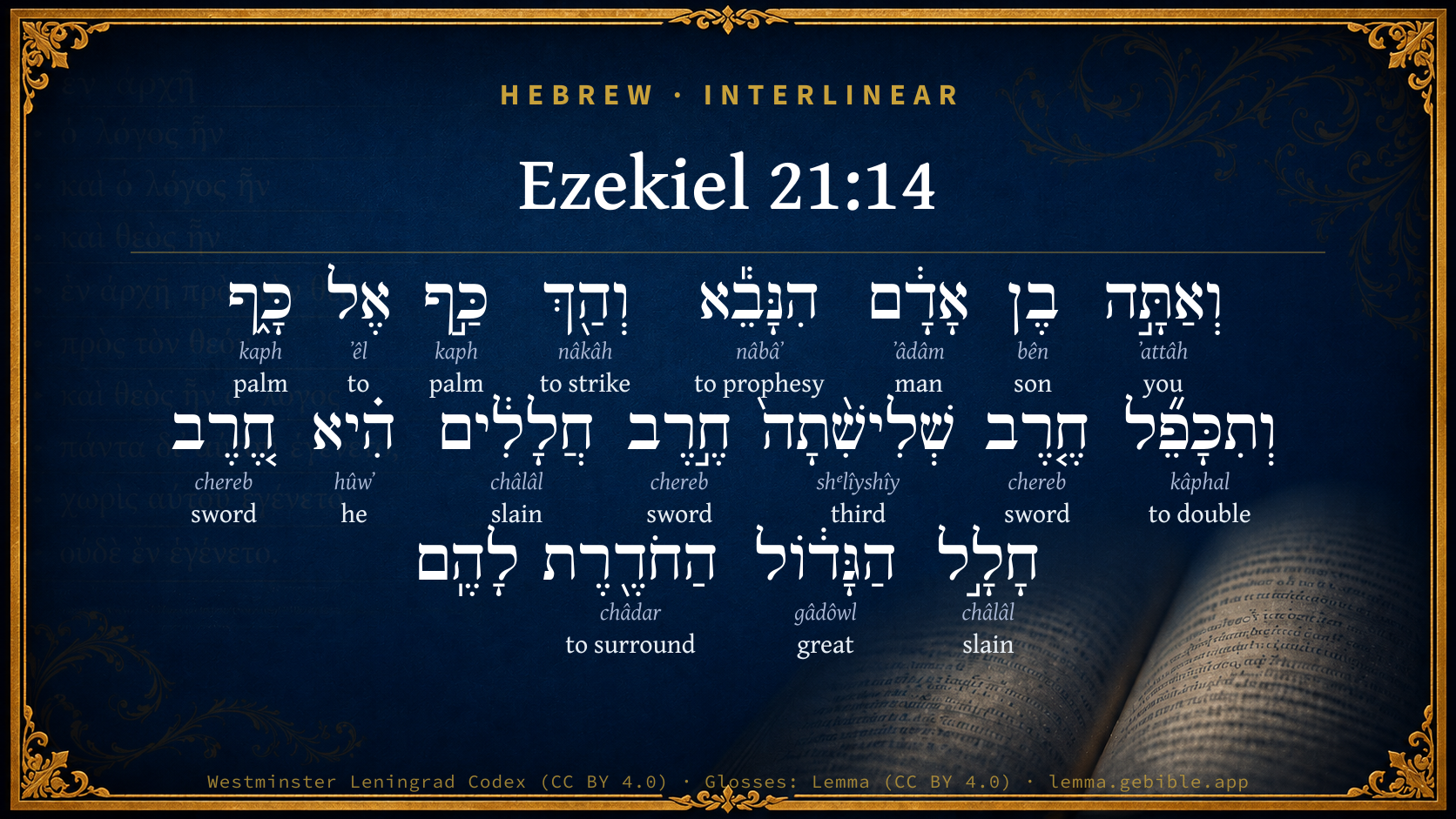
Ezekiel 21:14

Hebrew (Westminster Leningrad Codex) Ezekiel 21:14 appears in the Hebrew Old Testament. The text above is from the Westminster Leningrad Codex. Each word links to its Strong’s number, a concise gloss, and parsing drawn from the Open Scriptures Hebrew Bible morphology. Click any word for its full Brown-Driver-Briggs (BDB) entry.
Download image
Cite this verse

Ezekiel 21:14 (World English Bible). Public Domain. Lemma interlinear Bible study tool, https://lemma.gebible.app/v/ezekiel/21/14.

Show BibTeX & RIS
BibTeX
RIS
English Translation
You therefore, son of man, prophesy, and strike your hands together; and let the sword be doubled the third time, the sword of the deadly wounded: it is the sword of the great one who is deadly wounded, which enters into their chambers.
World English Bible · Public Domain
Highlights
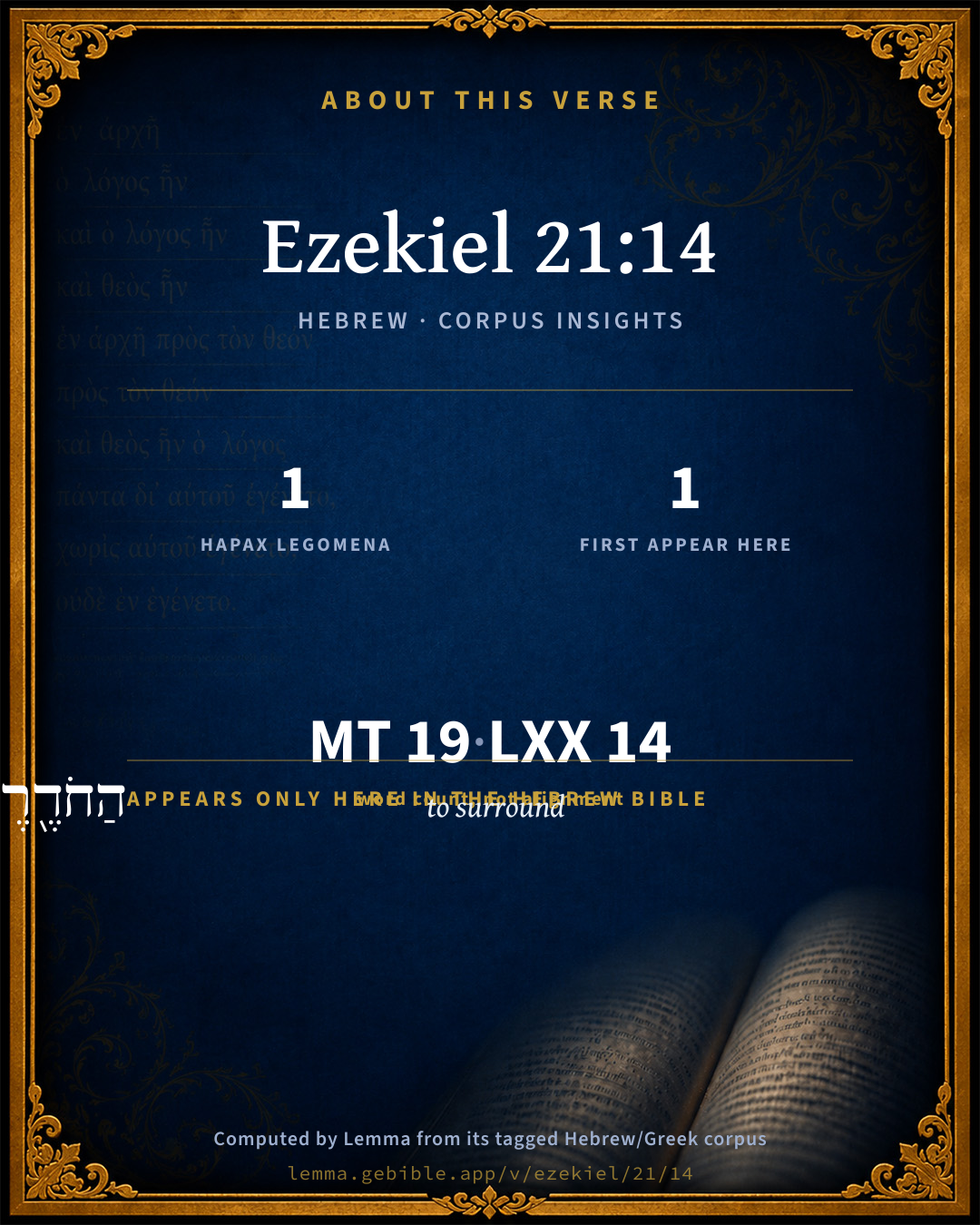
  • 1 hapax legomenon — only here in the Hebrew Bible
  • 1 first appearance in the Hebrew Bible
Full analysis ↓
Download a study sheet

One document with this verse’s original text, its word-by-word gloss line, the meaning frame, cross-references with their text, attributed commentary, and full source and license credits — printable, and it pastes into notes with its structure intact.

This verse Autodidact and up

Study sheet (.html) Plain text (.txt)

A passage Seminary Student

Up to 50 verses in one chapter. A passage sheet keeps up to 6 commentary sources and 12 cross-references per verse, in the order this page ranks them, and says so on the sheet whenever that leaves anything out. Ask for a single verse and you get the Autodidact verse sheet above.

Everything on this page stays free to read, with no account — the sheet is a download of what is already on screen, not access to it.

Want to remove ads? Support Godless Engineer
Compare translations 3

The same verse in 3 English versions, stacked beneath the original-language interlinear above. Click any original word for its lexicon entry.

Each is an independent rendering of the whole verse — the interlinear is not word-aligned to these translations.

Highlighted words mark where these versions differ — a whole-verse word diff, not a word-by-word alignment.

  • World English Bible Public Domain
    You therefore, son of man, prophesy, and strike your hands together; and let the sword be doubled the third time, the sword of the deadly wounded: it is the sword of the great one who is deadly wounded, which enters into their chambers.
  • King James Version Public Domain
    Thou therefore, son of man, prophesy, and smite thine hands together. and let the sword be doubled the third time, the sword of the slain: it is the sword of the great men that are slain, which entereth into their privy chambers.
  • unfoldingWord Literal Text CC BY-SA 4.0
    Now you, son of man, prophesy and hit your two hands together, for the sword will attack even a third time! A sword for the ones to be slaughtered! It is a sword for the many to be slaughtered, piercing them everywhere!

unfoldingWord Literal Text — © unfoldingWord, licensed CC BY-SA 4.0. Word-aligned USFM3 via Door43 (git.door43.org/unfoldingWord/en_ult).

Versions to compare (up to 4)

3 of 4 selected

Show all 18 translations

Every available English version of this verse, each an independent rendering of the whole verse.

  • World English Bible Public Domain
    You therefore, son of man, prophesy, and strike your hands together; and let the sword be doubled the third time, the sword of the deadly wounded: it is the sword of the great one who is deadly wounded, which enters into their chambers.
  • Berean Standard Bible Public Domain
    ‘So then, son of man, prophesy and strike your hands together. Let the sword strike two times, even three. It is a sword that slays, a sword of great slaughter closing in on every side!
  • Majority Standard Bible Public Domain
    ‘So then, son of man, prophesy and strike your hands together. Let the sword strike two times, even three. It is a sword that slays, a sword of great slaughter closing in on every side!
  • King James Version Public Domain
    Thou therefore, son of man, prophesy, and smite thine hands together. and let the sword be doubled the third time, the sword of the slain: it is the sword of the great men that are slain, which entereth into their privy chambers.
  • American Standard Version (1901) Public Domain
    Thou therefore, son of man, prophesy, and smite thy hands together; and let the sword be doubled the third time, the sword of the deadly wounded: it is the sword of the great one that is deadly wounded, which entereth into their chambers.
  • Revised Version (1885) Public Domain
    Thou therefore, son of man, prophesy, and smite thine hands together; and let the sword be doubled the third time, the sword of the deadly wounded: it is the sword of the great one that is deadly wounded, which entereth into their chambers.
  • Geneva Bible (1599) Public Domain
    Thou therefore, sonne of man, prophecie, and smite hand to hand, and let the sworde be doubled: let the sworde that hath killed, returne the third time: it is the sword of the great slaughter entring into their priuie chambers.
  • Douay-Rheims (1899) Public Domain
    Thou therefore, O son of man, prophesy, and strike thy hands together, and let the sword be doubled, and let the sword of the slain be tripled: this is the sword of a great slaughter, that maketh them stand amazed,
  • Young's Literal Translation Public Domain
    And thou, son of man, prophesy, And smite hand on hand, And bent is the sword a third time, The sword of the wounded! It `is' the sword of the wounded -- the great one, That is entering the inner chamber to them.
  • Literal Standard Version CC BY-SA 4.0
    And you, son of man, prophesy, || And strike hand on hand, || And the sword is bent a third time, || The sword of the wounded! It [is] the sword of the wounded—the great one, || That is entering the inner chamber to them.
  • Unlocked Literal Bible CC BY-SA 4.0
    Now you, son of man, prophesy and hit your two hands together, for the sword will attack even a third time! A sword for the ones to be slaughtered! It is a sword for the many to be slaughtered, piercing them everywhere!
  • unfoldingWord Literal Text CC BY-SA 4.0
    Now you, son of man, prophesy and hit your two hands together, for the sword will attack even a third time! A sword for the ones to be slaughtered! It is a sword for the many to be slaughtered, piercing them everywhere!
  • Darby Bible Public Domain
    And thou, son of man, prophesy, and smite thy hands together; for [the strokes of] the sword shall be doubled the third time: it is the sword of the slain, the sword that hath slain the great one, which encompasseth them privily.
  • World Messianic Bible Public Domain
    “You therefore, son of man, prophesy, and strike your hands together. Let the sword be doubled the third time, the sword of the fatally wounded. It is the sword of the great one who is fatally wounded, which enters into their rooms.
  • Webster's Bible Public Domain
    Thou therefore, son of man, prophesy, and smite thy hands together, and let the sword be doubled the third time, the sword of the slain: it is the sword of the great men that are slain, which entereth into their private chambers.
  • Free Bible Version CC BY-SA 4.0
    So son of man, prophesy and clap your hands. The sword will attack twice, and then a third time. It is a sword of death, killing many people by coming at them from every direction.
  • Bible in Basic English Public Domain
    So then, son of man, be a prophet, and put your hands together with a loud sound, and give two blows with the sword, and even three; it is the sword of those who are wounded, even the sword of the wounded; the great sword which goes round about them.
  • JPS Tanakh (1917) Public Domain
    (21-19) Thou therefore, son of man, prophesy, and smite thy hands together; and let the sword be doubled the third time, the sword of those to be slain; it is the sword of the great one that is to be slain, which compasseth them about.

Literal Standard Version (2020), Covenant Press — licensed CC BY-SA 4.0. Text via the HelloAO Bible API (eBible.org). Unlocked Literal Bible (unfoldingWord) — licensed CC BY-SA 4.0. Text via the HelloAO Bible API (eBible.org). unfoldingWord Literal Text — © unfoldingWord, licensed CC BY-SA 4.0. Word-aligned USFM3 via Door43 (git.door43.org/unfoldingWord/en_ult). Free Bible Version, Dr. Jonathan Gallagher — licensed CC BY-SA 4.0. Text via the HelloAO Bible API (eBible.org).

Word by word

More ways to search: Search by grammar → Find every occurrence → Compare this word →

Practice this passage: Drill this verse → Learn its vocabulary →

הַחֹדֶ֖רֶת
châdar
H2314
“the · surrounding”
Particle, Definite Article + Verb, Qal, Participle Active, Feminine, Singular, Absolute
Part of Speech
Particle + Verb
Stem
Qal
Form
Participle Active
Gender
Feminine
Number
Singular
State
Absolute
Full BDB Definition

Origin: a primitive root

TWOT: 612

(Qal) to encompass, surround, enclose
  1. וְאַתָּ֣ה ʼattâh H859 “and · you” Conjunction + Pronoun, Personal, 2nd Person, Masculine, Singular
  2. בֶן bên H1121 “son of” Noun, Common, Masculine, Singular, Construct
  3. אָדָ֔ם ʼâdâm H120 “man” Noun, Common, Masculine, Singular, Absolute
  4. הִנָּבֵ֕א nâbâʼ H5012 “prophesy” Verb, Niphal, Imperative, 2nd Person, Masculine, Singular
  5. וְהַ֖ךְ nâkâh H5221 “and · strike” Conjunction + Verb, Hiphil, Imperative, 2nd Person, Masculine, Singular
  6. כַּ֣ף kaph H3709 “palm” Noun, Common, Feminine, Singular, Absolute
  7. אֶל ʼêl H413 “to” Preposition
  8. כָּ֑ף kaph H3709 “palm” Noun, Common, Feminine, Singular, Absolute
  9. וְתִכָּפֵ֞ל kâphal H3717 “and · to double” Conjunction + Verb, Niphal, Jussive, 3rd Person, Feminine, Singular
  10. חֶ֤רֶב chereb H2719 “sword” Noun, Common, Feminine, Singular, Absolute
  11. שְׁלִישִׁ֨תָה֙ shᵉlîyshîy H7992 “third” Adjective, Ordinal number, Feminine, Singular, Absolute + Suffix, h
  12. חֶ֣רֶב chereb H2719 “sword of” Noun, Common, Feminine, Singular, Construct
  13. חֲלָלִ֔ים châlâl H2491 “slain” Adjective, Adjective, Masculine, Plural, Absolute
  14. הִ֗יא hûwʼ H1931 “he” Pronoun, Personal, 3rd Person, Feminine, Singular
  15. חֶ֚רֶב chereb H2719 “sword of” Noun, Common, Feminine, Singular, Construct
  16. חָלָ֣ל châlâl H2491 “slain” Adjective, Adjective, Masculine, Singular, Absolute
  17. הַגָּד֔וֹל gâdôwl H1419 “the · great” Particle, Definite Article + Adjective, Adjective, Masculine, Singular, Absolute

About this verse

These counts appear in no published source. They are computed here, from the morphology-tagged text and Lemma’s own curated glosses. What Lemma adds →

19
words
14
distinct lemmas
Prophets
section

Notable vocabulary

1 hapax legomenon — a word that appears only here in the entire Hebrew Bible:

  • הַחֹדֶ֖רֶת to surround H2314

First appearance in Scripture

This word makes its first canonical appearance in the Hebrew Bible here:

  • הַחֹדֶ֖רֶת to surround H2314

Shared distinctive vocabulary

וְתִכָּפֵ֞ל to double H3717 occurs in 4 verses of the Hebrew Bible. Also found in:

Grammatical profile

  • 4 verbs
  • 7 nouns
  • 4 adjectives
  • 2 pronouns
  • 2 prepositions

Verb forms

  • הִנָּבֵ֕א Niphal · Imperative
  • וְהַ֖ךְ Hiphil · Imperative
  • וְתִכָּפֵ֞ל Niphal · Jussive
  • הַחֹדֶ֖רֶת Qal · Participle Active

Repetition

Words recur within this verse — often emphatic in Hebrew:

  • חֶ֤רֶב sword H2719 ×3
  • כַּ֣ף palm H3709 ×2
  • חֲלָלִ֔ים slain H2491 ×2

Hebrew & Septuagint length

In English translation the verse runs 43 words from the Hebrew and 42 from the Septuagint (LXX English) — closely comparable.

A rough comparison of the two English renderings, which tokenize alike — not a word-level alignment.

Word counts can differ between the Hebrew and the Greek without any difference in meaning — e.g. the Hebrew direct-object marker אֵת has no separate Greek word, and Greek often adds the article ὁ.

In the original languages it is 19 Hebrew tokens and 14 Greek tokens — but the two are counted differently (Hebrew bundles its prefixes and suffixes into one token; the Greek is in lemma form), so that isn’t a like-for-like length.

Cross-references

13

Topical passages linked to Ezekiel 21:14 in the Treasury of Scripture Knowledge — connected by theme and wording, ordered by reader-vote popularity; previews shown in the World English Bible.

  • Numbers 24:10 Balak's anger was kindled against Balaam, and he struck his hands together; and Balak said to Balaam, I called you to curse my enemies, and, behold, you have altogether blessed them these three times.
  • 2 Kings 24:1 In his days Nebuchadnezzar king of Babylon came up, and Jehoiakim became his servant three years: then he turned and rebelled against him.
  • Leviticus 26:21 "'If you walk contrary to me, and won't listen to me, then I will bring seven times more plagues on you according to your sins.
  • Leviticus 26:24 then I will also walk contrary to you; and I will strike you, even I, seven times for your sins.
  • 2 Kings 24:10–16 At that time the servants of Nebuchadnezzar king of Babylon came up to Jerusalem, and the city was besieged.
  • Ezekiel 6:11 Thus says the Lord Yahweh: Smite with your hand, and stamp with your foot, and say, Alas! because of all the evil abominations of the house of Israel; for they shall fall by the sword, by the famine, and by the pestilence.
  • 1 Kings 20:30 But the rest fled to Aphek, into the city; and the wall fell on twenty-seven thousand men who were left. Ben Hadad fled, and came into the city, into an inner chamber.
  • 1 Kings 22:25 Micaiah said, Behold, you shall see on that day, when you shall go into an inner chamber to hide yourself.
  • 2 Kings 25:1–7 It happened in the ninth year of his reign, in the tenth month, in the tenth day of the month, that Nebuchadnezzar king of Babylon came, he and all his army, against Jerusalem, and encamped against it; and they built forts against it round about.
  • Ezekiel 8:12 Then said he to me, Son of man, have you seen what the elders of the house of Israel do in the dark, every man in his chambers of imagery? for they say, Yahweh doesn't see us; Yahweh has forsaken the land.
  • Ezekiel 21:17 I will also strike my hands together, and I will cause my wrath to rest: I, Yahweh, have spoken it.
  • Daniel 3:19 Then was Nebuchadnezzar full of fury, and the form of his visage was changed against Shadrach, Meshach, and Abednego: [therefore] he spoke, and commanded that they should heat the furnace seven times more than it was wont to be heated.
  • Amos 9:2 Though they dig into Sheol, there my hand will take them; and though they climb up to heaven, there I will bring them down.

Cross-references courtesy of OpenBible.info (CC BY 4.0).

Hebrew and Greek witnesses Masoretic Hebrew ↔ Greek Septuagint

The same verse in the two great witnesses to the Old Testament, shown verse-for-verse.

These are two independent witnesses, not word-aligned to each other, and the Septuagint is shown in lemma (dictionary) form.

Hebrew Ezekiel 21:14 Masoretic · Westminster Leningrad Codex

וְאַתָּ֣ה בֶן אָדָ֔ם הִנָּבֵ֕א וְהַ֖ךְ כַּ֣ף אֶל כָּ֑ף וְתִכָּפֵ֞ל חֶ֤רֶב שְׁלִישִׁ֨תָה֙ חֶ֣רֶב חֲלָלִ֔ים הִ֗יא חֶ֚רֶב חָלָ֣ל הַגָּד֔וֹל הַחֹדֶ֖רֶת לָהֶֽם

You therefore, son of man, prophesy, and strike your hands together; and let the sword be doubled the third time, the sword of the deadly wounded: it is the sword of the great one who is deadly wounded, which enters into their chambers.

World English Bible · Public Domain

Greek LXX Ezekiel 21:14 Septuagint · lemma form

υἱός ἄνθρωπος προφητεύω καί εἶπον ὅδε λέγω κύριος εἶπον ῥομφαία ῥομφαία ὀξύνω καί θυμόω

And you, son of man, prophesy, and clap your hands, and take a second sword: the third sword is the sword of the slain, the great sword of the slain: and you shall strike them with amazement, lest the heart should faint

LXX2012 (modern English Septuagint) · Public Domain

Hebrew: Westminster Leningrad Codex (CC BY 4.0). Greek: Septuagint (public domain); English from LXX2012 (modern English Septuagint) (Public Domain). How the Septuagint differs from the Hebrew →

Targum (Aramaic paraphrase)

1

The Targum is the ancient Jewish Aramaic paraphrase of the Hebrew Scriptures — an interpretive translation, not the Hebrew text itself. Onkelos (literal) and Pseudo-Jonathan (expansive) render the Torah, and Jonathan the Prophets. Coverage is partial: where no permissively-licensed English translation exists for a verse, only the Aramaic is shown. This is verse-level text, not a word-by-word alignment to the Hebrew.

  1. Targum Jonathan Prophets (Joshua–Malachi)
    בַּר אָדָם אִתְנַבֵּי וְתֵימַר כִּדְנַן אֲמַר יְיָ אֱלֹהִים אֲמַר חַרְבָּא דְמַלְכָּא דְבָבֶל תִּקְטוֹל וְחַרְבָּא דִבְנֵי עַמוֹן תִּתְּנֵי וּתְשֵׁיצֵי:

    (no public-domain English translation for this verse)

    Targum Jonathan — Aramaic: “Mikraot Gedolot” (public domain). English: “Sefaria Community Translation” (CC0 1.0 (public-domain dedication)); “London "Chaldee Paraphrase," 1871” (public domain). Text via Sefaria.

Commentary

Notes on Ezekiel 21:14 from classic Christian and Jewish commentators (each source and its license shown beneath its notes). The classic Christian expositions comment on the surrounding passage and are grouped to its opening verse, so a note may address several verses; the Jewish commentaries on the Tanakh (Rashi and others) are per-verse, so they appear only where the commentator wrote on this verse.

Lemma curates 59 commentaries, every one of them public domain or Creative Commons licensed, each selected and text-cleaned for this edition rather than reprinted as found. About our sources →

Trapp's Complete Commentary

John Trapp

Eze 21:14 Thou therefore, son of man, prophesy, and smite [thine] hands together, and let the sword be doubled the third time, the sword of the slain: it [is] the sword of the great [men that are] slain, which entereth into their privy chambers.

Ver. 14. Smite thy hands together.] So to show what I will do shortly. {Eze 21:17}

Let the sword be doubled the third time.] Doubled and trebled, till it hath made an utter end of this untoward generation.

Which entereth into their privy chambers.] Ferreting and fetching them out of their lurking holes.

John Trapp, A Commentary or Exposition upon All the Books of the Old and New Testament (1647–1656) — public domain. Text from a community e-Sword module.

Joseph Benson's Commentary

Eze 21:14; Eze 21:17. Prophesy, and smite thy hands together — In token of amazement and sorrow. And let the sword be doubled the third time — Bishop Newcome reads, Bring the sword twice; yea, bring it thrice; namely, that God’s judgments might be fully executed, and his justice satisfied. It is probable that the three great slaughters which should be made of the inhabitants of Judea and Jerusalem are here intended, namely, 1st, During the siege, in which, undoubtedly, great numbers fell who were without the walls of the city, and many within: 2dly, When the city was taken by assault, which certainly was not without great slaughter: and 3dly, The massacre of Gedaliah, and those that sided with him. The sword of the slain — Wherewith many shall be slain. It is the sword of the great men, &c. — Appointed for the slaughter of the great men, namely, the princes, rulers, and captains; which entereth into their privy chambers — Where they were hidden in hopes of escaping. I have set the point of the sword against all their gates — I have gathered together the Chaldeans round about Jerusalem, with their swords sharpened and drawn at every gate, to meet and slay all that shall attempt to come out, or to slay all they find on entering the city. Ah! it is made bright — Hebrew, עשׂויה לברק, is made like lightning. The same metaphor which occurs in Virgil:

“Vaginaque eripit, ensem fulmineum.” — ÆN. 4. 50:579.

“He drew his sword, which did like lightning blaze.”

It is wrapped — Or rather, It is sharpened for the slaughter. So Kimchius and some others translate מעשׂה, deriving the word from עשׂ, a style, or iron pen: see Buxtorf. Go thee one way or other — God is here represented as speaking, by way of apostrophe, to the sword, and giving it an unlimited commission to destroy wherever it should be drawn. I will also smite my hands together — In token of my approbation. I will animate and encourage the slayers to go on. And I will cause my fury to rest — I will satisfy my anger by a full execution of my judgments.

Joseph Benson's Commentary on the Old and New Testaments (1811–1818) — public domain. Text from a community e-Sword module.

Tyndale Open Study Notes

Tyndale Open Resources

21:14-17 As the representative of the Lord, Ezekiel was to clap his hands in a threatening gesture and take the sword and brandish it . . . three times to represent the completeness of the coming massacre. There would be nowhere to run and nowhere to hide from the slashing sword of judgment when the Lord was ready to satisfy his fury by destroying his people. Their hearts would melt with terror at the awful massacre.

Tyndale Open Study Notes — © Tyndale Open Resources, licensed CC BY-SA 4.0. Text via the HelloAO Bible API.

Geneva Bible (1599)

Geneva Bible translators

That is, encourage the sword.

Geneva Bible (1599) marginal notes — public domain. Text via Bolls.life.

Jamieson, Fausset & Brown

Robert Jamieson, A. R. Fausset & David Brown

smite . . . hands together-- (Num 24:10), indicative of the indignant fury with which God will "smite" the people.

sword . . . doubled the third time--referring to the threefold calamity:--(1) The taking of Zedekiah (to whom the "rod," or scepter, may refer); (2) the taking of the city; (3) the removal of all those who remained with Gedaliah. "Doubled" means "multiplied" or "repeated." The stroke shall be doubled and even trebled.

of the slain--that is, by which many are slain. As the Hebrew is singular, FAIRBAIRN makes it refer to the king, "the sword of the great one that is slain," or "pierced through."

entereth . . . privy chambers-- (Jer 9:21). The sword shall overtake them, not merely in the open battlefield, but in the chambers whither they flee to hide themselves (Kg1 20:30; Kg1 22:25). MAURER translates, "which besieged them"; FAIRBAIRN, "which penetrates to them." English Version is more literal.

Jamieson, Fausset & Brown — Commentary Critical and Explanatory on the Whole Bible (1871) — public domain (CC PDM 1.0). Text via the HelloAO Bible API.

Adam Clarke's Commentary

Verse 14. Let the sword be doubled the third time] The sword has been doubled, and it shall come the third time. Nebuchadnezzar came against Judea THRICE.

1. Against Jehoiakim.

2. Against Jeconiah.

3. Against Zedekiah.

The sword had already been doubled; it is to come now the third time, i.e., against Zedekiah.

The sword of the slain] חרב חללים chereb chalalim, "the sword of the soldiers," of the Chaldeans. So in the next clause, היא חרב חלל הגדול hi chereb chalal haggadol, "it is the sword of that great soldier," that eminent king and conqueror. This is the meaning of the word חלל chalal, that is so ill rendered in almost every place of its occurrence, in our Version. See Dr. Kennicott.

Adam Clarke's Commentary on the Bible (1810–1826) — public domain. Text from a community e-Sword/MySword module.

Ellicott's Commentary for English Readers

(14) Smite thine hands together.—A gesture of strong emotion (see Eze_21:17, Eze_22:13, and comp. Note on Eze_6:11; Num_24:10).

Let the sword be doubled the third time.—The exact translation is here also obscure and difficult, but the meaning is plain that the activity of the sword is to be intensified to the utmost.

The sword of the slain: it is the sword of the great men that are slain.—Literally, the sword of the overthrown (plural), it is the sword of the overthrown (sing.), of the great one. The word translated slain does not necessarily mean actually killed, but is used in a moral as well as physical sense; and in Eze_20:16; Eze_20:21; Eze_20:24, as often, the verb from which this adjective is formed is translated polluted. The sword is called “the sword of the overthrown” because it is the means of their overthrow, and “the sword of the great one overthrown,” with especial reference to the king.

Which entereth into their privy chambers.—Rather, which begirts them round about, so that none can escape.

A Bible Commentary for English Readers, edited by Charles John Ellicott (1878–1897) — public domain. Text from a community e-Sword module.

The Cambridge Bible for Schools and Colleges

gen. ed. J. J. S. Perowne

14. doubled the third time] The reading must mean: let the sword be doubled, tripled! lit. unto a third (sword), i.e. till it be three-fold. Of course there were not to be three swords or even two; what is called for is a double and triple intensity and operation of the one sword (cf. Eze_21:16).

great men that are slain] Rather: the great one that is slain, i.e. doomed to be slain—ref. being to king Zedekiah, cf. Eze_21:25. A different division of letters gives: the great sword of the slain (collective)—which is less probable as “slain” is plur. immediately before.

entereth … privy chambers] Rather: which compasseth them about—still descriptive of the sword.

The Cambridge Bible for Schools and Colleges (gen. ed. J. J. S. Perowne; Cambridge University Press, 1878–1918) — public domain. Text from a community e-Sword module.

John Gill's Exposition

Go thee one way or another,.... Go to some one place: or "unite thyself" (a); to other swords, or join other soldiers holding swords; the address is to the sword, to steer its course some one way, and slay as it goes along, sparing none:

either on the right, or on the left; or south, or north; so the Targum,

"unsheathe, and slay on the south, and destroy on the north:''

whithersoever thy face is set; or prepared, as the Targum, or appointed for destruction; this is the usual interpretation: but why may not the words be an apostrophe to the prophet, to go alone or single, either to the right or left, south or north, as his face was set, Eze 21:2, sighing and crying, smiting his hands together, in order to affect the minds of the people with the sense of their calamities coming upon them?

(a) "unito Montanus", Piscator, Polanus; "unitor te", Starckius; "in unum dirigitor", Cocceius.

John Gill's Exposition of the Whole Bible (1746–1763) — public domain (CC PDM 1.0). Text via the HelloAO Bible API.

Haydock's Catholic Bible Commentary

Tripled. Let the war be very bloody. Nabuchodonosor often invaded Judea. (Calmet) --- He raised the siege, but returned. (Vatable)

George Leo Haydock (1774–1849), Haydock's Catholic Family Bible and Commentary, 1859 edition — public domain. Excludes Psalms (Douay-Rheims chapter numbering differs from Protestant) and Deuterocanonical books (Catholic canon only).

Matthew Poole's English Annotations

Smite thine hands together; either in token of amazement and sorrow, or else to signify what pleasure it should be to see justice executed on obstinate rebels; or rather, as Eze 21:17, clap thy hands, to awaken and hearten the Babylonians on to the slaughter.

Let the sword be doubled the third time: perhaps it is too curious to search out what particular calamities are pointed out by this trebled sword; whether,

1. Zedekiah’s captivity with many of the princes. And,

2. Taking of the city.

3. Killing of Gedaliah and those with him: to be sure it speaks both the certainty of the thing, and the greatness of the affliction.

Sword of the slain; wherewith many shall be slain.

The great men; which were princes, and captains, and rulers.

Entereth into their privy chambers; searcheth the most secret rooms, where they slew such as they found hidden in hope to escape.

Matthew Poole's English Annotations on the Holy Bible (1683–1685) — public domain. Text from a community e-Sword/MySword module.

Whedon's Commentary on the Bible

Daniel D. Whedon

14. Smite thine hands together — Eze_21:17; see notes Eze_6:11.

Let the sword be doubled the third time — Let it fall with a doubled and tripled power.

Great men that are slain — Rather, “the great one that is slain;” that is, Zedekiah.

Entereth into their privy chambers — Rather, compasseth them about.

Daniel D. Whedon (gen. ed.), Commentary on the Old and New Testaments (1874–1909) — public domain. Text from a community e-Sword module.

The Pulpit Commentary

Smite thine hands together, etc. Another gesture follows, either of horror and lamentation, or perhaps, looking to ver. 17, of imperative command. The sword is to do its thrice-redoubled work (the words emphasize generally the intensity, and are scarcely to be taken numerically, of the repeated invasions of the Chaldeans); it is "the sword of the slain" (better, pierced ones, or, with Revised Version, the deadly wounded). The next clause should be taken, with the Revised Version, in the singularthe sword of the great one that is deadly wounded; sc. the sword should smite the king as well as the people. For entereth into their privy chambers, read, with the Revised Version (margin), Ewald, and Keil, it compasseth them about.

The Pulpit Commentary (1880–1919), ed. H.D.M. Spence-Jones & Joseph S. Exell — public domain. Text from a community e-Sword module.

John Wesley's Explanatory Notes

And smite - In token of amazement and sorrow. Of the slain - Wherewith many shall be slain. Privy chambers - Where they were hidden in hope to escape.

John Wesley, Explanatory Notes Upon the Whole Bible (1754–1765) — public domain. Text via the GEBible commentary corpus.

unfoldingWord translationNotes

Door43 World Missions Community

Connecting Statement:

Yahweh continues to describe the sword of Yahweh which is a metaphor for the enemy army that Yahweh will use to attack Jerusalem. (See: Metaphor)

hit your two hands together

This means for him to clap his hands as a sign of his grief. AT: "clap your hands to show that you are very sad" (See: Symbolic Action)

even a third time

This is an idiom that means multiple times. AT: "again and again" (See: Ordinal Numbers and Idiom)

A sword for the ones to be slaughtered

This can be stated in active form. AT: "It is a sword for slaughtering people" (See: Active or Passive)

It is a sword for the many to be slaughtered

This can be stated in active form. AT: "It is a sword for slaughtering many people" (See: Active or Passive)

piercing them everywhere

"attacking them from every side." Some Bibles translate this as "which enters into their rooms." This means no matter where they hide, the sword will kill them.

piercing them

The word "them" refers to the people of Jerusalem and of the land of Israel.

translationWords

Son of Man

prophet

sword

slaughter

unfoldingWord translationNotes — © Distant Shores Media and the Door43 World Missions Community, licensed CC BY-SA 4.0. Source: git.door43.org/Door43/en_tn.

Rashi

Rabbi Shlomo Yitzchaki (Rashi)

A sword, a sword Two swords: the sword of the king of Babylon first, and afterwards the sword of the children of Ammon in the hand of Ishmael the son of Nethaniah, who will slay Gedaliah and those gathered to him of the survivors of the sword, as is delineated in Jeremiah (41:1-10).

furbished Heb. מְרוּטָה, forbide in Old French, furbished, polished. Menachem (p. 120), however, associated it as an expression of drawing. Likewise (verse 16): “and He gave it to draw (לְמָרְטָה),” and so all of them.

Rashi on the Tanakh — English translations: “The Judaica Press complete Tanach with Rashi, translated by A. J. Rosenberg” (CC BY 4.0); “Pentateuch with Rashi's commentary by M. Rosenbaum and A.M. Silbermann, 1929-1934” (public domain); “The Metsudah Tanach series, Lakewood, N.J” (CC BY 4.0); and “The Book of Joshua, Metsudah Publications, 1997” (CC BY 4.0). Text via Sefaria.

Lesson kit

Teaching starters — assembled from the data on this page, not authored interpretation. Every prompt links to the verse data it draws on. Edit before teaching.

Ezekiel, in the Prophets, opens this verse with 19 words (14 distinct Hebrew lemmas). Its most distinctive word is châdar (“to surround”). A historical commentator’s framing appears above. Read the whole chapter for the surrounding context.

Discussion questions

  1. The word châdar carries the sense “to surround.” How does it shape the verse?
  2. 1 word here appears nowhere else in the Hebrew Bible. Why might the author reach for such rare wording?
  3. This is the first place “to surround” appears in Scripture (first appears here). What does its debut here establish?
  4. How does Exodus 26:9, which shares the word «to double», read alongside this verse?
  5. What does the repetition of “sword” (3× in this one verse) do in this verse?
  6. These translations render this verse differently. What is at stake in choosing one wording over another?
  7. «הִנָּבֵ֕א» is a Niphal Imperative verb. How does that grammatical form shape the action described?
  8. Compare how Trapp's Complete Commentary and Joseph Benson's Commentary read this verse. Where do they agree or differ?

Things to notice

  • 1 word in this verse appears nowhere else in the Hebrew Bible.
  • 1 word makes its first canonical appearance in Scripture here.
  • This verse counts 19 Hebrew ↔ 14 Greek words.
  • These translations choose different wording for 30 words in this verse.
  • “sword” occurs 3× in this single verse.

Reading settings

Reading text

Shown beneath each verse's original-language words.

Old Testament
Old Testament edition

Read the OT as the Masoretic Hebrew (MT) or the Greek Septuagint (LXX).

English shown for the Greek Septuagint (in the Hebrew ↔ Greek comparison).

Comparing translations? Open the Compare panel on any verse page to stack up to four side by side.