
Ezekiel 5:1

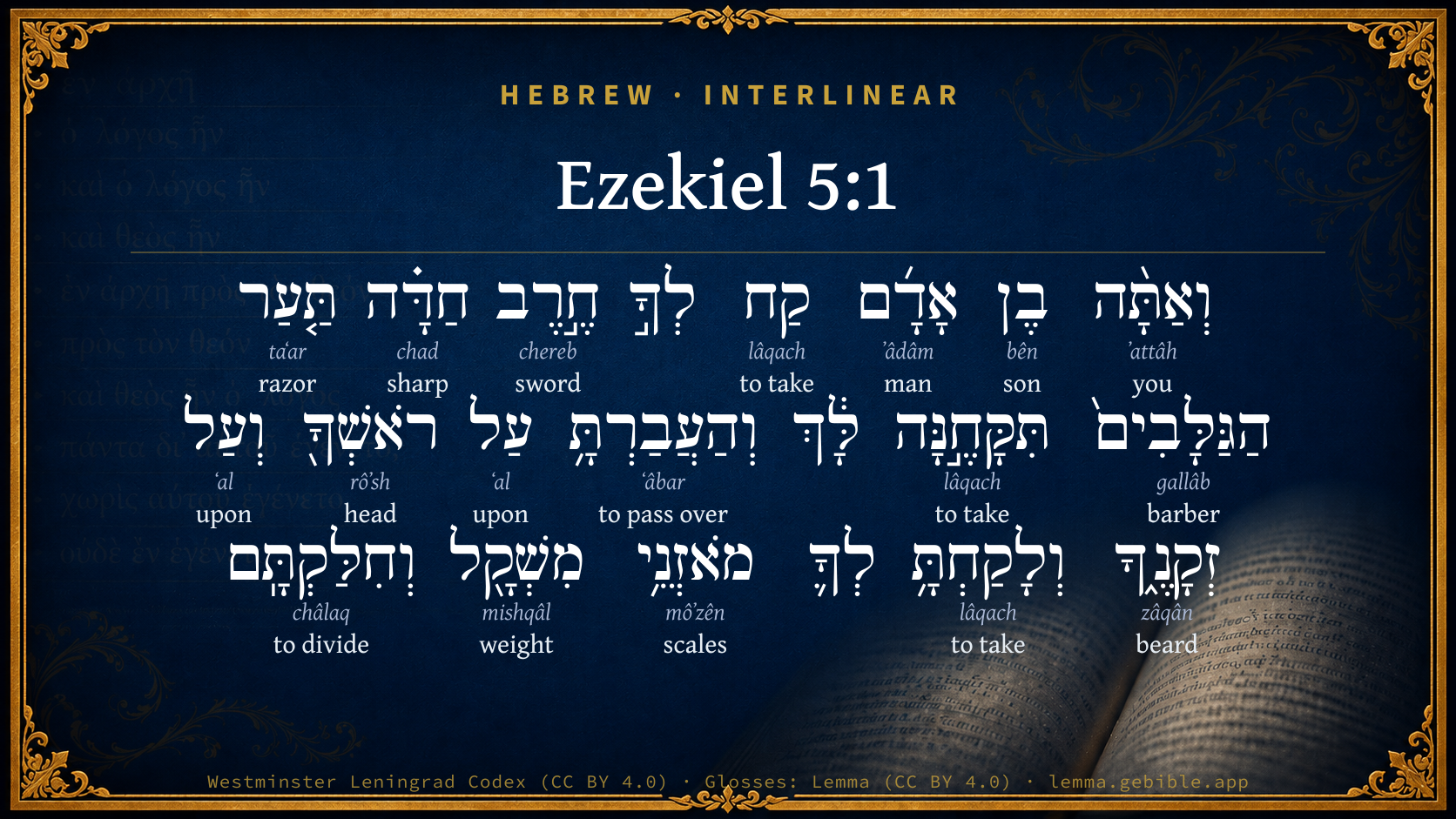
Hebrew (Westminster Leningrad Codex) Ezekiel 5:1 appears in the Hebrew Old Testament. The text above is from the Westminster Leningrad Codex. Each word links to its Strong’s number, a concise gloss, and parsing drawn from the Open Scriptures Hebrew Bible morphology. Click any word for its full Brown-Driver-Briggs (BDB) entry.
Download image
Cite this verse

Ezekiel 5:1 (World English Bible). Public Domain. Lemma interlinear Bible study tool, https://lemma.gebible.app/v/ezekiel/5/1.

Show BibTeX & RIS
BibTeX
RIS
English Translation
You, son of man, take a sharp sword; [as] a barber's razor shall you take it to you, and shall cause it to pass on your head and on your beard: then take balances to weigh, and divide the hair.
World English Bible · Public Domain
Highlights
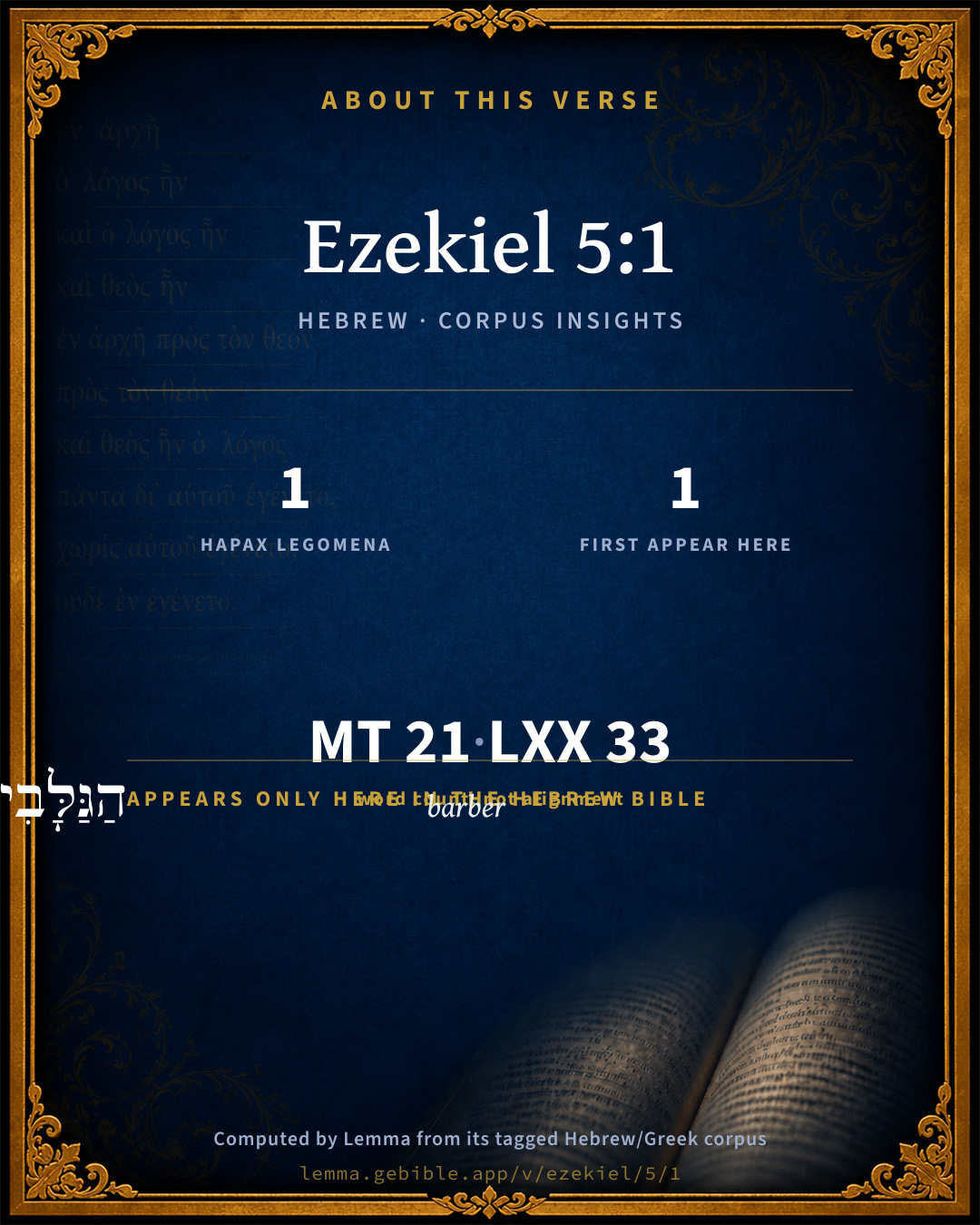
  • 1 hapax legomenon — only here in the Hebrew Bible
  • 1 first appearance in the Hebrew Bible
Full analysis ↓
Download a study sheet

One document with this verse’s original text, its word-by-word gloss line, the meaning frame, cross-references with their text, attributed commentary, and full source and license credits — printable, and it pastes into notes with its structure intact.

This verse Autodidact and up

Study sheet (.html) Plain text (.txt)

A passage Seminary Student

Up to 50 verses in one chapter. A passage sheet keeps up to 6 commentary sources and 12 cross-references per verse, in the order this page ranks them, and says so on the sheet whenever that leaves anything out. Ask for a single verse and you get the Autodidact verse sheet above.

Everything on this page stays free to read, with no account — the sheet is a download of what is already on screen, not access to it.

Want to remove ads? Support Godless Engineer
Compare translations 3

The same verse in 3 English versions, stacked beneath the original-language interlinear above. Click any original word for its lexicon entry.

Each is an independent rendering of the whole verse — the interlinear is not word-aligned to these translations.

Highlighted words mark where these versions differ — a whole-verse word diff, not a word-by-word alignment.

  • World English Bible Public Domain
    You, son of man, take a sharp sword; [as] a barber's razor shall you take it to you, and shall cause it to pass on your head and on your beard: then take balances to weigh, and divide the hair.
  • King James Version Public Domain
    And thou, son of man, take thee a sharp knife, take thee a barber's razor, and cause it to pass upon thine head and upon thy beard: then take thee balances to weigh, and divide the hair.
  • unfoldingWord Literal Text CC BY-SA 4.0
    “Then you, son of man, take a sharp sword as a barber’s razor for yourself, and pass the razor over your head and your beard, then take scales to weigh and divide your hair.

unfoldingWord Literal Text — © unfoldingWord, licensed CC BY-SA 4.0. Word-aligned USFM3 via Door43 (git.door43.org/unfoldingWord/en_ult).

Versions to compare (up to 4)

3 of 4 selected

Show all 18 translations

Every available English version of this verse, each an independent rendering of the whole verse.

  • World English Bible Public Domain
    You, son of man, take a sharp sword; [as] a barber's razor shall you take it to you, and shall cause it to pass on your head and on your beard: then take balances to weigh, and divide the hair.
  • Berean Standard Bible Public Domain
    “As for you, son of man, take a sharp sword, use it as a barber’s razor, and shave your head and beard. Then take a set of scales and divide the hair.
  • Majority Standard Bible Public Domain
    “As for you, son of man, take a sharp sword, use it as a barber’s razor, and shave your head and beard. Then take a set of scales and divide the hair.
  • King James Version Public Domain
    And thou, son of man, take thee a sharp knife, take thee a barber's razor, and cause it to pass upon thine head and upon thy beard: then take thee balances to weigh, and divide the hair.
  • American Standard Version (1901) Public Domain
    And thou, son of man, take thee a sharp sword; `as' a barber's razor shalt thou take it unto thee, and shalt cause it to pass upon thy head and upon thy beard: then take thee balances to weigh, and divide the hair.
  • Revised Version (1885) Public Domain
    And thou, son of man, take thee a sharp sword, as a barber’s razor shalt thou take it unto thee, and shalt cause it to pass upon thine head and upon thy beard: then take thee balances to weigh, and divide the hair.
  • Geneva Bible (1599) Public Domain
    And thou sonne of man, take thee a sharpe knife, or take thee a barbours rasor and cause it to passe vpon thine head, and vpon thy beard: then take thee balances to weigh, and deuide the heare.
  • Douay-Rheims (1899) Public Domain
    And thou, son of man, take thee a sharp knife that shaveth the hair: and cause it to pass over thy head, and over thy beard: and take thee a balance to weigh in, and divide the hair.
  • Young's Literal Translation Public Domain
    `And thou, son of man, take to thee a sharp weapon, the barber's razor thou dost take to thee, and thou hast caused `it' to pass over thy head, and over thy beard, and thou hast taken to thee weighing scales, and apportioned them.
  • Literal Standard Version CC BY-SA 4.0
    “And you, son of man, take a sharp weapon for yourself, take the barber’s razor for yourself, and you have caused [it] to pass over your head, and over your beard, and you have taken weighing scales for yourself, and apportioned them.
  • Unlocked Literal Bible CC BY-SA 4.0
    “Then you, son of man, take a sharp sword as a barber's razor for yourself, and pass the razor over your head and your beard, then take scales to weigh and divide your hair.
  • unfoldingWord Literal Text CC BY-SA 4.0
    “Then you, son of man, take a sharp sword as a barber’s razor for yourself, and pass the razor over your head and your beard, then take scales to weigh and divide your hair.
  • Darby Bible Public Domain
    And thou, son of man, take thee a sharp knife; a barber's razor shalt thou take; and cause it to pass upon thy head and upon thy beard: and thou shalt take balances to weigh, and divide the [hair].
  • World Messianic Bible Public Domain
    “You, son of man, take a sharp sword. You shall take it as a barber’s razor to yourself, and shall cause it to pass over your head and over your beard. Then take balances to weigh and divide the hair.
  • Webster's Bible Public Domain
    And thou, son of man, take thee a sharp knife, take thee a barber's razor, and cause it to pass upon thy head and upon thy beard: then take to thee balances to weigh, and divide the hair.
  • Free Bible Version CC BY-SA 4.0
    “Son of man, go and shave your head and your beard using a sharp sword like a barber's razor. Then divide up the hair using a set of scales.
  • Bible in Basic English Public Domain
    And you, son of man, take a sharp sword, using it like a haircutter's blade, and making it go over your head and the hair of your chin: and take scales for separating the hair by weight.
  • JPS Tanakh (1917) Public Domain
    And thou, son of man, take thee a sharp sword, as a barber's razor shalt thou take it unto thee, and cause it to pass upon thy head and upon thy beard; then take thee balances to weigh, and divide the hair.

Literal Standard Version (2020), Covenant Press — licensed CC BY-SA 4.0. Text via the HelloAO Bible API (eBible.org). Unlocked Literal Bible (unfoldingWord) — licensed CC BY-SA 4.0. Text via the HelloAO Bible API (eBible.org). unfoldingWord Literal Text — © unfoldingWord, licensed CC BY-SA 4.0. Word-aligned USFM3 via Door43 (git.door43.org/unfoldingWord/en_ult). Free Bible Version, Dr. Jonathan Gallagher — licensed CC BY-SA 4.0. Text via the HelloAO Bible API (eBible.org).

Word by word

More ways to search: Search by grammar → Find every occurrence → Compare this word →

Practice this passage: Drill this verse → Learn its vocabulary →

הַגַּלָּבִים֙
gallâb
H1532
“the · barbers”
Particle, Definite Article + Noun, Common, Masculine, Plural, Absolute
Part of Speech
Particle + Noun
Type
Common
Gender
Masculine
Number
Plural
State
Absolute
Full BDB Definition

Origin: from an unused root meaning to shave

TWOT: 348

barber
  1. וְאַתָּ֨ה ʼattâh H859 “and · you” Conjunction + Pronoun, Personal, 2nd Person, Masculine, Singular
  2. בֶן bên H1121 “son of” Noun, Common, Masculine, Singular, Construct
  3. אָדָ֜ם ʼâdâm H120 “man” Noun, Common, Masculine, Singular, Absolute
  4. קַח lâqach H3947 “take” Verb, Qal, Imperative, 2nd Person, Masculine, Singular
  5. חֶ֣רֶב chereb H2719 “sword” Noun, Common, Feminine, Singular, Absolute
  6. חַדָּ֗ה chad H2299 “sharp” Adjective, Adjective, Feminine, Singular, Absolute
  7. תַּ֤עַר taʻar H8593 “razor of” Noun, Common, Both, Singular, Construct
  8. תִּקָּחֶ֣נָּה lâqach H3947 “to take · her” Verb, Qal, Imperfect, 2nd Person, Masculine, Singular + Suffix, Personal, 3rd Person, Feminine, Singular
  9. וְהַעֲבַרְתָּ֥ ʻâbar H5674 “and · to pass over” Conjunction + Verb, Hiphil, Sequential Perfect, 2nd Person, Masculine, Singular
  10. עַל ʻal H5921 “upon” Preposition
  11. רֹאשְׁךָ֖ rôʼsh H7218 “head · your” Noun, Common, Masculine, Singular, Construct + Suffix, Personal, 2nd Person, Masculine, Singular
  12. וְעַל ʻal H5921 “and · upon” Conjunction + Preposition
  13. זְקָנֶ֑ךָ zâqân H2206 “beard · your” Noun, Common, Both, Singular, Construct + Suffix, Personal, 2nd Person, Masculine, Singular
  14. וְלָקַחְתָּ֥ lâqach H3947 “and · to take” Conjunction + Verb, Qal, Sequential Perfect, 2nd Person, Masculine, Singular
  15. מֹאזְנֵ֥י môʼzên H3976 “scales of” Noun, Common, Masculine, Dual, Construct
  16. מִשְׁקָ֖ל mishqâl H4948 “weight” Noun, Common, Masculine, Singular, Absolute
  17. וְחִלַּקְתָּֽם châlaq H2505 “and · to divide · them” Conjunction + Verb, Piel, Sequential Perfect, 2nd Person, Masculine, Singular + Suffix, Personal, 3rd Person, Masculine, Plural

About this verse

These counts appear in no published source. They are computed here, from the morphology-tagged text and Lemma’s own curated glosses. What Lemma adds →

21
words
15
distinct lemmas
Prophets
section

Notable vocabulary

1 hapax legomenon — a word that appears only here in the entire Hebrew Bible:

  • הַגַּלָּבִים֙ barber H1532

First appearance in Scripture

This word makes its first canonical appearance in the Hebrew Bible here:

  • הַגַּלָּבִים֙ barber H1532

Shared distinctive vocabulary

חַדָּ֗ה sharp H2299 occurs in 4 verses of the Hebrew Bible. Also found in:

Grammatical profile

  • 5 verbs
  • 9 nouns
  • 1 adjective
  • 1 pronoun
  • 5 prepositions

Verb forms

  • קַח Qal · Imperative
  • תִּקָּחֶ֣נָּה Qal · Imperfect
  • וְהַעֲבַרְתָּ֥ Hiphil · Sequential Perfect
  • וְלָקַחְתָּ֥ Qal · Sequential Perfect
  • וְחִלַּקְתָּֽם Piel · Sequential Perfect

Repetition

Words recur within this verse — often emphatic in Hebrew:

Hebrew & Septuagint length

In English translation the verse runs 40 words from the Hebrew and 44 from the Septuagint (LXX English) — closely comparable.

A rough comparison of the two English renderings, which tokenize alike — not a word-level alignment.

Word counts can differ between the Hebrew and the Greek without any difference in meaning — e.g. the Hebrew direct-object marker אֵת has no separate Greek word, and Greek often adds the article ὁ.

In the original languages it is 21 Hebrew tokens and 33 Greek tokens — but the two are counted differently (Hebrew bundles its prefixes and suffixes into one token; the Greek is in lemma form), so that isn’t a like-for-like length.

Cross-references

4

Topical passages linked to Ezekiel 5:1 in the Treasury of Scripture Knowledge — connected by theme and wording, ordered by reader-vote popularity; previews shown in the World English Bible.

  • Leviticus 21:5 "'They shall not shave their heads, neither shall they shave off the corners of their beards, nor make any cuttings in their flesh.
  • Isaiah 7:20 In that day the Lord will shave with a razor that is hired in the parts beyond the River, even with the king of Assyria, the head and the hair of the feet; and it shall also consume the beard.
  • Ezekiel 44:20 Neither shall they shave their heads, nor allow their locks to grow long; they shall only cut off the hair of their heads.
  • Daniel 5:27 TEKEL; you are weighed in the balances, and are found wanting.

Cross-references courtesy of OpenBible.info (CC BY 4.0).

Hebrew and Greek witnesses Masoretic Hebrew ↔ Greek Septuagint

The same verse in the two great witnesses to the Old Testament, shown verse-for-verse.

These are two independent witnesses, not word-aligned to each other, and the Septuagint is shown in lemma (dictionary) form.

Hebrew Ezekiel 5:1 Masoretic · Westminster Leningrad Codex

וְאַתָּ֨ה בֶן אָדָ֜ם קַח לְךָ֣ חֶ֣רֶב חַדָּ֗ה תַּ֤עַר הַגַּלָּבִים֙ תִּקָּחֶ֣נָּה לָּ֔ךְ וְהַעֲבַרְתָּ֥ עַל רֹאשְׁךָ֖ וְעַל זְקָנֶ֑ךָ וְלָקַחְתָּ֥ לְךָ֛ מֹאזְנֵ֥י מִשְׁקָ֖ל וְחִלַּקְתָּֽם

You, son of man, take a sharp sword; [as] a barber's razor shall you take it to you, and shall cause it to pass on your head and on your beard: then take balances to weigh, and divide the hair.

World English Bible · Public Domain

Greek LXX Ezekiel 5:1 Septuagint · lemma form

καί σύ υἱός ἄνθρωπος λαμβάνω σεαυτοῦ ῥομφαία ὀξύς ὑπέρ ξυρόν κουρεύς κτάομαι αὐτός σεαυτοῦ καί ἐπιἄγω αὐτός ἐπί ὁ κεφαλή σύ καί ἐπί ὁ πώγων σύ καί λαμβάνω ζυγός στάθμιον καί διαἵστημι αὐτός

And you, son of man, take you a sword sharper than a barber's razor; you shall procure it for yourself, and shall bring it upon your head, and upon your beard: and you shall take a pair of scales, and shall separate the hair.

LXX2012 (modern English Septuagint) · Public Domain

On this verse, Lange's Commentary on the Holy Scriptures discusses the Septuagint’s reading. Read the note in Commentary ↓

Hebrew: Westminster Leningrad Codex (CC BY 4.0). Greek: Septuagint (public domain); English from LXX2012 (modern English Septuagint) (Public Domain). How the Septuagint differs from the Hebrew →

Targum (Aramaic paraphrase)

1

The Targum is the ancient Jewish Aramaic paraphrase of the Hebrew Scriptures — an interpretive translation, not the Hebrew text itself. Onkelos (literal) and Pseudo-Jonathan (expansive) render the Torah, and Jonathan the Prophets. Coverage is partial: where no permissively-licensed English translation exists for a verse, only the Aramaic is shown. This is verse-level text, not a word-by-word alignment to the Hebrew.

  1. Targum Jonathan Prophets (Joshua–Malachi)
    וְאַתְּ בַּר אָדָם סַב לָךְ חַרְבָּא חֲרִיפָא מַסְפַּר גַלְבַיָא תִּסַב לָךְ וְתַעְבֵּד עַל רֵישֵׁךְ וְעַל דִקְנָךְ וְתִסֵב לָךְ מוֹזְנָיָן דְמַתְקַל וְתַפְלְגִינוּן:

    (no public-domain English translation for this verse)

    Targum Jonathan — Aramaic: “Mikraot Gedolot” (public domain). English: “Sefaria Community Translation” (CC0 1.0 (public-domain dedication)); “London "Chaldee Paraphrase," 1871” (public domain). Text via Sefaria.

Commentary

Notes on Ezekiel 5:1 from classic Christian and Jewish commentators (each source and its license shown beneath its notes). The classic Christian expositions comment on the surrounding passage and are grouped to its opening verse, so a note may address several verses; the Jewish commentaries on the Tanakh (Rashi and others) are per-verse, so they appear only where the commentator wrote on this verse.

Lemma curates 59 commentaries, every one of them public domain or Creative Commons licensed, each selected and text-cleaned for this edition rather than reprinted as found. About our sources →

Matthew Henry's Commentary

We have here the sign by which the utter destruction of Jerusalem is set forth; and here, as before, the prophet is himself the sign, that the people might see how much he affected himself with, and interested himself in, the case of Jerusalem, and how it lay to his heart, even when he foretold the desolations of it. he was so much concerned about it as to take what was done to it as done to himself, so far was he from desiring the woeful day.

I. He must shave off the hair of his head and beard (Eze 5:1), which signified God's utter rejecting and abandoning that people, as a useless worthless generation, such as could well be spared, nay, such as it would be his honour to part with; his judgments, and all the instruments he made use of in cutting them off, were this sharp knife and this razor, that were proper to be made use of, and would do execution. Jerusalem had been the head, but, having degenerated, had become as the hair, which, when it grows thick and long, is but a burden which a man wishes to get clear of, as God of the sinners in Zion. Ah! I will ease me of my adversaries, Isa 1:24. Ezekiel must not cut off that hair only which was superfluous, but cut it all off, denoting the full end that God would make of Jerusalem. The hair that would not be trimmed and kept neat and clean by the admonitions of the prophets must be all shaved off by utter destruction. Those will be ruined that will not be reformed.

II. He must weigh the hair and divide it into three parts. This intimates the very exact directing of God's judgments according to equity (by him men and their actions are weighed in the unerring balance of truth and righteousness) and the proportion which divine justice observes in punishing some by one judgment and others by another; one way or other, they shall all be met with. Some make the shaving of the hair to denote the loss of their liberty and of their honour: it was looked upon as a mark of ignominy, as in the disgrace Hanun put on David's ambassadors. It denotes also the loss of their joy, for they shaved their heads upon occasion of great mourning; I may add the loss of their Nazariteship, for the shaving of the head was a period to that vow (Num 6:18), and Jerusalem was now no longer looked upon as a holy city.

III. He must dispose of the hair so that it might all be destroyed or dispersed, Eze 5:2. 1. One third part must be burnt in the midst of the city, denoting the multitudes that should perish by famine and pestilence, and perhaps many in the conflagration of the city, when the days of the siege were fulfilled. Or the laying of that glorious city in ashes might well be looked upon as a third part of the destruction threatened. 2. Another third part was to be cut in pieces with a knife, representing the many who, during the siege, were slain by the sword, in their sallies out upon the besiegers, and especially when the city was taken by storm, the Chaldeans being then most furious and the Jews most feeble. 3. Another third part was to be scattered in the wind, denoting the carrying away of some into the land of the conqueror and the flight of others into the neighbouring countries for shelter; so that they were hurried, some one way and some another, like loose hairs in the wind. But, lest they should think that this dispersion would be their escape, God adds, I will draw out a sword after them, so that wherever they go evil shall pursue them. Note, God has variety of judgments wherewith to accomplish the destruction of a sinful people and to make an end when he begins.

IV. He must preserve a small quantity of the third sort that were to be scattered in the wind, and bind them in his skirts, as one would bind that which he is very mindful and careful of, Eze 5:3. This signified perhaps that little handful of people which were left under the government of Gedaliah, who, it was hoped, would keep possession of the land when the body of the people was carried into captivity. Thus God would have done well for them if they would have done well for themselves. But these few that were reserved must be taken and cast into the fire, Eze 5:4. When Gedaliah and his friends were slain the people that put themselves under his protection were scattered, some gone into Egypt, others carried off by the Chaldeans, and in short the land totally cleared of them; then this was fulfilled, for out of those combustions a fire came forth into all the house of Israel, who, as fuel upon the fire, kindled and consumed one another. Note, It is ill with a people when those are taken away in wrath that seemed to be marked for monuments of mercy; for then there is no remnant or escaping, none shut up or left.

Matthew Henry's Commentary on the Whole Bible (1708–1710) — public domain (CC PDM 1.0). Text via the HelloAO Bible API.

Adam Clarke's Commentary

CHAPTER V

In this chapter the prophet shows, under the type of hair, the

judgments which God was about to execute on the inhabitants of

Jerusalem by famine, sword, and dispersion, 14.

The type or allegory is then dropped, and God is introduced

declaring in plain terms the vengeance that was coming on the

whole nation which had proved so unworthy of those mercies with

which they had hitherto been distinguished, 5-17.

NOTES ON CHAP. V

Verse 1. - 4. Take thee a sharp knife] Among the Israelites, and indeed among most ancient nations, there were very few edge-tools. The sword was the chief; and this was used as a knife, a razor, c., according to its different length and sharpness. It is likely that only one kind of instrument is here intended a knife or short sword, to be employed as a razor.

Here is a new emblem produced, in order to mark out the coming evils.

1. The prophet represents the Jewish nation.

2. His hair, the people.

3. The razor, the Chaldeans.

4. The cutting the beard and hair, the calamities, sorrows, and disgrace coming upon the people. Cutting off the hair was a sign of mourning; see on Jer 45:5; Jer 48:37; and also a sign of great disgrace; see 2Sa 10:4.

5. He is ordered to divide the hair, Eze 5:2, into three equal parts, to intimate the different degrees and kinds of punishment which should fall upon the people.

6. The balances, Eze 5:1, were to represent the Divine justice, and the exactness with which God's judgments should be distributed among the offenders.

7. This hair, divided into three parts, is to be disposed of thus:

1. A third part is to be burnt in the midst of the city, to show that so many should perish by famine and pestilence during the siege.

2. Another third part he was to cut in small portions about the city, (that figure which he had pourtrayed upon the brick,) to signify those who should perish in different sorties, and in defending the walls.

3. And the remaining third part he was to scatter in the wind, to point out those who should be driven into captivity. And,

4. The sword following them was intended to show that their lives should be at the will of their captors, and that many of them should perish by the sword in their dispersions.

5. The few hairs which he was to take in his skirts, Eze 5:3, was intended to represent those few Jews that should be left in the land under Gedaliah, after the taking of the city.

6. The throwing a part of these last into the fire, Eze 5:4, was intended to show the miseries that these suffered in Judea, in Egypt, and finally in their being also carried away into Babylon on the conquest of Egypt by Nebuchadnezzar. See these transactions particularly pointed out in the notes on Jeremiah, Jer 40, Jer 41, Jer 42. Some think that this prophecy may refer to the persecution of the Jews by Antiochus Epiphanes.

Adam Clarke's Commentary on the Bible (1810–1826) — public domain. Text from a community e-Sword/MySword module.

The Cambridge Bible for Schools and Colleges

gen. ed. J. J. S. Perowne

1. a sharp knife] lit. sword. The term may suggest the devouring divine sword, ch. Eze_21:8 seq.

take thee a barber’s rasor] With R.V., as a barber’s razor shalt thou take it unto thee. Two weapons are not to be taken, the sword is to be used as a razor. Isaiah (ch. Isa_7:20) had already said: “In that day shall the Lord shave with the razor that is hired, even with the king of Assyria, the beard and the hair of the feet.” The land is likened to a man; the enemy sweeps off the population clean as the razor does the hair of the body.

balances to weigh] The divine justice is accurate, assigning to each part its destined chastisement; Jer_15:2, “Such as are for death to death; and such as are for the sword to the sword; and such as are for the famine to the famine; and such as are for the captivity to the captivity.”

Ch. Eze_5:1-4. Symbol shewing the fate of the population during the siege and after it, and their dispersion among the nations

The prophet is commanded to take a sharp sword and use it as a barber’s razor. With this he is to shave off the hair of his head and beard. He is then to take balances in order accurately to weigh the hair into three parts. One third is to be burned in the fire within the city; a second third to be cut to pieces with the sword round about the city; and the last third is to be strewn to all the winds, and pursued by the sword. Of these last a few were to be taken and bound in the skirts of the prophet’s garment; though of these again some were to be thrown into the fire and consumed. The sense of the symbol is clear; a third part of the population shall be consumed by pestilence and famine within the city (Eze_5:12); a third shall fall by the sword round about the city, on its capture; and a third shall be scattered among all nations, pursued by the sword. Of these a few shall meantime escape, but shall be subjected anew to consuming judgments.

The Cambridge Bible for Schools and Colleges (gen. ed. J. J. S. Perowne; Cambridge University Press, 1878–1918) — public domain. Text from a community e-Sword module.

Trapp's Complete Commentary

John Trapp

Eze 5:1 And thou, son of man, take thee a sharp knife, take thee a barber’s razor, and cause [it] to pass upon thine head and upon thy beard: then take thee balances to weigh, and divide the [hair].

Ver. 1. And thou, son of man.] See on Eze 2:1.

Take thee a sharp knife.] This was the King of Babylon. {as Isa 7:20} The Turk is at this day such another. Mohammed I was, in his time, the death of 800,000 men. Selymus II, in revenge of the loss received at Lepanto, would have put to death all the Christians in his dominions. {a}

Take thee a barber’s razor.] Not a "deceitful razor," {as Psa 52:2} but one that will do the deed - sharp and sure. Pliny {b} telleth us, out of Varo, that the Romans had no barbers till 454 years after the city was built; ante intonsi fuere.

And cause it to pass upon thy head and upon thy beard.] As hairs are an ornament to the head and beard, so are people to a city. But, as when they begin to be a burden or trouble to either, they are cut off and cast away; so are people by God’s judgments, when by their sins they are offensive to him; dealing as Dionysius did by his god Aesculapius, from whom he presumed to pull his golden beard. David felt himself shaved in his ambassadors; so doth God in his servants - whose very hairs are numbered {Mat 10:30} - in his ministers especially - who, by a specialty, are called God’s men {1Ti 6:11 2Ti 3:17} - with whom to meddle is more dangerous than to take a lion by the beard or a bear by the hair.

Then take the balances to weigh.] This showeth that God’s judgments are just to a hair’s weight: and capillus unus suam habet umbram, saith Mimus.

And divide the hair.] Dii nos quasi pilas habent, saith Plautus; Imo quasi pilos, saith another.

{a} Turkish History, 885.

{b} Lib. vii. cap. 59.

John Trapp, A Commentary or Exposition upon All the Books of the Old and New Testament (1647–1656) — public domain. Text from a community e-Sword module.

The Biblical Illustrator

Joseph S. Exell

Eze_5:1-4

Take thee a sharp knife.

Gods judgments upon the wicked

1. Wicked men are of little worth; take a whole city of them, they are of no more account with God than a little hair of the head or beard.

2. It is the privilege of Christ to appoint whom and what instruments He pleases to execute His pleasure upon sinners.

3. When God hath been long provoked by a people, He comes with sharp and sweeping judgments amongst them.

4. There is no standing out against God; whatever our number or strength is, His judgments are irresistible.

5. The judgments and proceedings of God with sinners are not rash, but most carefully weighed.

6. There is no escaping of Gods judgments for hard-hearted sinners.

7. In great judgments and general destructions, God of His infinite mercy spares some few. Ezekiel must take a few and bind up in his skirts, all must not be destroyed; the fire and sword devoureth many, but the dispersion preserved some, and some few are left in Judah. God is just, and yet when He is in the way of His judgments, he forgets not mercy: a little of the hair shall be preserved, when the rest goes to the fire, sword, and wind.

8. The paucity preserved in common calamities are not all precious, truly godly. Reprobates for the present escape as well as elect vessels; some choice ones may be cut off, and some vile ones may be kept. In a storm cedars and oaks are smitten, when bushes and briers are spared; and yet after they are cut up and cast into the fire. Sinners may escape present wrath, but there is wrath to come (Luk_3:7).

9. God may take occasion, from the sin of some, to bring in judgment upon all. He must take of the remnant preserved, and throw into the fire, and out of that fire went forth fire into all the house of Israel. (W. Greenhill, M. A.)

The Biblical Illustrator, edited by Joseph S. Exell (c. 1880s–1900s) — public domain. Text from a community e-Sword module.

Joseph Benson's Commentary

Eze 5:1. Take thee a sharp knife, take thee a barber’s razor — The latter expression explains the former; and cause it to pass upon thy head, &c. — Hair being then accounted an ornament, and baldness a token of sorrow, therefore shaving denoted calamity or desolation. “Among the Arabs,” says Harmer, chap. 6. observ. 23, “there cannot be a greater stamp of infamy than to cut off any one’s beard: and many among them would prefer death to this kind of punishment. And as they would think it a grievous calamity to lose it, so they carry things so far as to beg for the sake of it, ‘By your beard, by the life of your beard, do.’ In like manner some of the benedictions are, ‘God preserve your blessed beard, God pour his blessings on your beard.’ And when they would express their value for a thing, they say, ‘It is worth more than his beard.’ I never had so clear an apprehension, I must confess, as after I had read these accounts, of the intended energy of that thought of Ezekiel, where the inhabitants are compared to the hair of the prophet’s head and beard. The passage seems to signify, that though the inhabitants of Jerusalem had been dear to God, as the hair of an eastern beard to its owner, yet that they should be taken away and consumed, one part by pestilence and famine, another part by the sword, and a third by the calamities of an exile.” See note on 2Sa 10:4. And then take the balances, &c. — A symbol of God’s justice, as the razor was of his wrath; to weigh and divide the hair — What the prophet is here commanded to do was by way of another emblematical representation of what was to happen to the inhabitants of Judea and Jerusalem. The hair signified the Jewish people; shaving the hair with a razor, the divine vengeance; the weighing of the hair in the balances, the divine equity, which metes out to every one what is just and right; the dividing of the hair, the punishments allotted to different persons of them.

Joseph Benson's Commentary on the Old and New Testaments (1811–1818) — public domain. Text from a community e-Sword module.

The Preacher's Complete Homiletical Commentary

Joseph S. Exell (gen. ed.)

The last methods of punishment symbolised and interpreted (chap. Eze_5:1-17)

EXEGETICAL NOTES.—The requirements made of Ezekiel still proceed in his house. Already he has been a sign that Jerusalem would undergo a thorough siege; that specified periods of stringent suffering should be allotted to both portions of the house of Israel; that hunger, anxiety, and defilement would be encountered; and furthermore, he is to be a sign of the various forms of penalty which should be incurred as the closing manifestations of the Lord’s dealing justly with iniquities. In this case, as in the preceding three, we appear necessitated, by the very conditions of the requirement, to suppose that Ezekiel could not be expected to carry on literally the processes assigned to him. How could he, in the disabled state to which he must have been reduced if he had externally obeyed the previous requirements, shave his head and beard with a sword, or burn the appointed part of hair in Jerusalem itself? Even if it were certain that he could do so, it would be unbecoming to believe that the Lord Himself literally drew a sword after the third part of hair which was scattered to the wind. Notwithstanding these difficulties, we are sure that the actuality of the things signified was somehow conveyed to the minds of his captive countrymen—the method of doing so being unknown.

Eze_5:1. “And thou, son of man, take thee a sharp knife”—rather sword, as in the end of Eze_5:2. He was not, besides the sword, to “take a barber’s razor,” but he was to use the sword as a barber’s razor. A closer rendering of the Hebrew warrants this explanation. “A razor of barbers thou shalt take it”—i.e., the sword, as the gender intimates—“to thee;” “and cause it to pass upon thine head and thy beard.” In the hands of an earlier prophet the use of a razor had already been made significant of punishment by the Lord. “In the same day shall the Lord shave with a razor that is hired … the head and the hair of the feet; and it shall also consume the beard” (Isa_7:20). Moreover, in accordance with biblical representations, shaving off the hair of the head and beard was one of the signs of mourning and reproach, and, besides, it was forbidden to priests (Lev_21:5). God, enjoining a priest to reverse his own ritual observance, would give additional emphasis to the keenness of the calamity shadowed forth: “then take thee balances to weigh and divide” (lit.) “them,” i.e., the hair. An apportionment of distinct sufferings is to be carefully measured out, so that all may feel “the judiciary providence of God.” We modify the words of an old Latin commentator, and say, “The sword or razor signifies divine vengeance, the head the city, the balances its equity, and the hair the people to whom punishments shall be distributed.” Or, as Theodoret says, “The sword indicates avenging power, the shaving of the beard the removal of grace and glory, the scales and weights the determination of divine justice.”

Eze_5:2. Ezekiel is commanded to arrange the hair in proportionate parts, and to dispose of each. “Thou shalt burn with fire”—in a flame—“a third part in the midst of the city”—in the midst of the model of the besieged city which lay before him—“when the days of the siege are fulfilled”—when the days for his symbolical completion of the siege had come to an end; “and thou shalt take a third part and smite about it”—i.e., the city—“with a knife,” or sword, as Eze_5:1; “and a third part thou shalt scatter in the wind.” The rest of the people have perished; this third alone survives. It must, therefore, include within itself both the poor, who might be left unsettled in Judea, as well as the numbers who had been dispersed among other countries. And there seems no valid objection against considering that it included the people of a more distant future than that which would be passed through by the living generation. The lot of the nation, as a nation, is involved in the action of the Lord. The next words show the symbol passing into a reality, while an intimation of sufferings in the land of exile is made: “and I will draw out a sword after them.” They shall not escape because of change of locality. By this procedure of Ezekiel three kinds of punishment are set forth. One part of the people dies in flames—Eze_5:12 interprets this of famine and disease; a second part dies in flight, sallies, battles; the surviving part becomes “tribe of the wandering foot and weary breast.” But the people will not be absorbed or obliterated.

Eze_5:3. “Thou shalt also take thereof”—from that scattered portion—“a few in number, and bind them”—this “very small remnant” of hairs—“in thy skirts,” ends of his garment. God has to fulfil His covenant of mercy; seed must be preserved as the instruments of His purposes; and Ezekiel is required to signify, by caring for the safety of a few, the eternal purpose of God. But even of this few not all would be delivered.

Eze_5:4. “Then take of them again, and cast them into the midst of the fire”—a different word from that of Eze_5:2, and signifying a somewhat diverse mode of suffering about to befall the reduced number of people. They were not all right in heart, the best were tainted and needed a purgation, a proof of how deplorable was the spiritual condition of the surviving people. This infliction would not be confined to the unfaithful among the gathered ones: “thereof”—from this consuming fire—“shall a fire come forth into all the house of Israel:” the doom of the few involves the doom of the whole people as such. “Judgment must begin at the house of God, and what shall the end be of them that obey not the gospel of God?” A striking parallel to this declaration to Ezekiel is found in Isaiah. “And if there should yet be a tenth in it, this shall again be consumed; (yet), as the terebinth and the oak, though cut down, have their stock remaining, (even so) a sacred seed (shall be) the stock thereof” (Eze_6:13).—Cheyne.

A divine interpretation of his symbolical action is given to Ezekiel. He hears words describing the guilt of and the judgments which shall fall upon Jerusalem and his people; and, first of all, there is conveyed a meaning which is to be attached to Jerusalem.

Eze_5:5. “Thus saith the Lord God; This Jerusalem”—it is unnecessary to supply is—“I have set it” her, “in the midst of the nations and countries that are round about her.” It has been common for nations, whose means of locomotion are neither convenient nor rapid, to consider their country the central point around which other countries are clustered. Such a notion might have been accepted by the Jews in reference to Judea; but it is not with such a reference-that the situation of Jerusalem is specified here. In explaining this reference it is not requisite to point out how the Holy Land stands in relation to Egypt and Syria, to Assyria and the Isles of the Gentiles. We decline the merely local limitations as not expressive of the fact intimated, while we still perceive, in the then active influences of the world, certain advantages adhering to the site which Jerusalem occupied. The true interpretation is elsewhere. It is thus stated by Keil: “Jerusalem is described as forming the central point of the earth, neither in an external, geographical, nor in a purely typical sense, as the city that is blessed more than any other, but in a historical sense, in so far as ‘God’s people and city actually stand in the central point of the God-directed world-development and its movements;’ or, in relation to the history of salvation, as the city in which God hath set up His throne of grace, from which shall go forth the law and the statutes for all nations, in order that the salvation of the whole world may be accomplished.”

Eze_5:6. “And she hath changed”—the ordinary usage of the word changed refers to murmuring, opposing, rebelling against, or some such action, and often with a statement of the object, as here, against which the act operates—she rebelled against “my judgments”—though they were known, yet were they so disregarded as to incur the crime of turning them “into wickedness more than the nations”—to a degree of evil which even the heathen could not be charged with, “and” she rebelled against “my statutes more than the countries that are round about her; for they”—of this Jerusalem—“have refused my judgments”—with a kind of disdain—“and my statutes they have not walked in them.” The penalty of such a course follows.

Eze_5:7. “Therefore thus saith the Lord God;” but before announcing the doom an emphatic presentation of their unhallowed conduct is made: “Because ye multiplied”—a somewhat infelicitous rendering of a difficult term, for which a translation like “ye raged” is better, i.e., made a turmoil in acting as rebels—“more than the nations that are round about you,” and “have not walked in my statutes, neither have kept my judgments, neither have done according to the judgments”—laws and ways of living and worshipping—“of the nations that” are “round about you.” Further on (chap. Eze_11:12) Ezekiel accuses the people thus, “Ye have done after the manners (lit. judgments) of the heathen that are round about you.” There is no real contradiction between the two representations. The heathen pursued courses which were opposed to God’s will, and Israel did the same; but the former showed also that the word of the law was written in their heart, and, so far as they had obeyed that transcript, they had done that which Israel had not done. Israel had resisted both revealed and natural obligations.

Eze_5:8. “Therefore thus saith the Lord God”—the suspended threatening is now pronounced—“Behold I, even I, am against thee”—a solemn asseveration that the covenanted relationship to the Lord, however boasted of, would not shield from the punishment due to Israel for their violation of the covenant. He would prove that He was not a dead God—a mere name of power and holiness—“and will execute judgments in the midst of them”—the means of punishment shall be forthcoming and effective “in the sight of the” heathen “nations.” Thus one aspect of retributive justice is unfolded—it will be public: the heathen shall know that He is Lord by the judgment which He executeth. Another is presented—it is exceptional.

Eze_5:9. “And I will do in thee that which I have not done, and whereunto I will not do any more the like”—there would be peculiarities in the woes which should befall Israel that would be marked as unique throughout all time. If acts as shocking as those referred to in next verse are observed in the distressed periods of other nations, we must remember that when a wife or child is expelled from the home, the calamity, though similar, is far worse than when a guest or servant is expelled. Such was the relation of Israel to God that their punishment had elements of horror in it which the same suffering happening to another people had not. The primary reference of the threatening is clearly to the then existing Israel, but seems to be applied by the Lord Jesus to that generation of the Jews who were subjected to terrible calamities when Jerusalem was besieged and destroyed by the Romans. “Then the tribulation shall be such as was not since the beginning of the world, nor ever shall be” (Mat_24:21)—“because of all thine abominations”—a frequently used word, expressing actions and habits which, however common and palliated, were such as the Lord could not endure to hear and see in His professed people—each sin had done harm and each would be reckoned in.

Eze_5:10. The punishment will be characterised by such intensity of suffering that family ties will be ruthlessly disrupted. “The fathers shall eat the sons,” as had been predicted should come to pass if they would not hearken to the Lord, but walked contrary to Him (Lev_26:29), “and the sons shall eat their fathers,” and all who survive “will I scatter into all the winds.”

Eze_5:11. From this verse to the end of the chapter the punishment is more fully announced as from the Lord. The emphatic “therefore” (Heb.), which is prefixed to several of the declarations of this chapter, is here followed by the solemn oath, “As I live, saith the Lord God.” I, the Living One, shall die if these judgments are not executed. This oath is sustained by His self-existence—that which is the basis of all truth and reality, and a guarantee that there will be no revocation, no reversion: “He can swear by no greater.” “Surely because thou hast defiled my sanctuary.” They had entered into the place where His honour tabernacled, and taken a course there which proved how completely they had cast off His supremacy. They had not been restrained by any reverence or attachment. They had occupied it “with all thy detestable things and with all thine abominations”—wickedness of all kinds had been practised, and the way in which it was carried on is shown in chap. 8. We shall mistake this accusation if we confine its reference solely to the employment of the Temple for idolatrous proceedings. The Temple was the ideal heart of the theocracy. All spiritual energy proceeded from it; all objects of that energy reacted on it. So that if the people indulged in evil elsewhere, and came impenitent into the courts of the Lord’s house, they defiled the sanctuary, and their ears were made to tingle with the indignant remonstrance of Isaiah, “Who hath required this at your hands to tread my courts?” or with that of Ezekiel afterwards, “Should I be inquired of at all by them?” The glory due unto the name of the Lord had been polluted, and He will take steps to clear it. “I will also diminish,” our English version supplies thee. In comparing Deu_4:2, where this same Hebrew word is employed, “Ye shall not add to this word which I command you and ye shall not diminish from it,” the expression seems sufficient without adding thee. As the Israelites had taken away from the rights of God to His sanctuary, so He will diminish the benefits He had hitherto bestowed on them.

Eze_5:12. An explanation is now given of the symbolical actions prescribed in Eze_5:2. From this it is made clear that the fire there is to represent disease and starvation as among the destructive agencies affecting the sinful people.

Eze_5:13. The menaced penalties being carried out, “mine anger shall be accomplished;” its full force will be brought to act so as to inflict every item of the penalties due to such transgressors. “And I will cause my fury to rest upon them;” it will find its goal in those who suffer from it, and there come to an end: it will have finished “His strange work.” “And I will be comforted.” We might translate, in accordance with another signification of the Hebrew, I repent myself. It is preferable to retain the translation of our version, as better expressing the idea that the old has ended and that the ground for a new procedure will be laid. (Vide Isa_10:24-27, in reference to Assyria.) This betokens one mode of the divine life. It is a highly figurative, and, of course, imperfect token; but, so far as we can explain, it shows that the Lord receives satisfaction in vengeance accomplished, since the violators of His honour are fairly punished and His rights are fully vindicated. A God who could not assert and maintain, at any cost, His own just and perfect authority, would be only an idol-god. Nor is it Himself alone whom the finished punishment concerns. “They,” the next verse is proof that it is other nations who “shall know that I the Lord have spoken in my zeal,” and not the prophet in over-eagerness or factiousness. The words are again repeated in Eze_5:15; Eze_5:17, and show that Ezekiel was speaking by direction of the living God of Israel, who would not allow His righteous laws to be trampled under men’s feet. History has become a guarantee for the divine origin of the threatenings.

Eze_5:14 is a further statement of the penalty which was to be executed on the devoted city. “Waste and a reproach,” a reproach “among the nations that are round about,” and waste “in the sight of all that pass by.”

Eze_5:15. “So it”—Jerusalem—“shall be a reproach,” &c. Inferences of several kinds will be drawn from the sad and ruined state of the punished people, and lessons of moral worth become distincter.

Eze_5:16. According to the ground-text, Deu_32:23, “the evil arrows” here are those “of famine,” which shall be bitter and destructive and accumulative in its horrors: “I will increase the famine;” hunger upon hunger will come “upon you.”

Eze_5:17. Another element of terror is mentioned for the first time, “evil beasts.” We may suppose that they are to be taken literally; but it is difficult to see how they could be a noticeable ingredient in the cup of misery which was to be drank by a beleaguered city, and Hengstenberg is probably right in referring the phrase to the heathen, on the ground that the designation of brutalised men, who have no breath from God, as beasts is deeply rooted in the Scriptures. “And pestilence and blood”—some terrific diseases—“shall pass through thee.” A solemn appeal to the certainty of the accomplishment comes in, as already, on the ground of the Lord being the speaker in reality. Repetition of the same expression is a characteristic of Ezekiel’s style.

HOMILETICS

WHERE MUCH IS GIVEN, MUCH IS REQUIRED (Eze_5:5-17)

As each stage of a physical process manifests another condition of the materials which are under the action of forces, so each stage in national affairs expresses a changed aspect of the relations between the Creator and the creature, the great King and His subjects, the Holy and the unholy. If the punitive treatment of the Jews was painfully startling, the presentation of it, which the prophet is commissioned to make, is meant to unfold, to the existing and other generations, a fresh development of the thoughts and ways of God. These verses may be held to show that the sorest penalties will be a consequence of privileges set at naught. In them observe—

I. The advantages conferred.

1. A favourable position: “Set in the midst of the nations.” It is obvious that certain countries, certain cities, are distinguished above others by climate, materials for traffic, openings to surrounding people. In some such beneficial conditions the ancient Jerusalem was situated; but above them, and of greater importance still, was the fact that there was His sanctuary—the place where His honour dwelt. Both temporal and spiritual benefits come from God, and each advantage should be regarded as enforcing a higher obligation.

2. The personal interest of God. It is He who condescends to speak to them, to punish them Himself. He did not treat them on the same lines as He did the other tribes of men. No nation had God so nigh it as this people. They were the children of Abraham, His friend. He bare them and carried them all the days of old. Whosoever touched them touched the apple of His eye. Their offences were offences against Him—not against some vague “accusation” of their own consciences. It is well to come to that position from which we see that God is with us in a wider sense than Israel surmised, that in Christ He reconciles the world unto Himself, that we stand amid the light of that life which is given to “whosoever will.”

3. Opportunity for influencing others. To fancy that this Jewish people was chosen simply to be the worshippers of the only true God is to suppose that which would not accord with other manifestations in His realm. His sun exhales vapour from water, the vapour is turned into showers, the showers fall upon the earth and make it bring forth and bud. So is it that every person is to contribute to the good of others, and so His chosen nation was to be instrumental in making known His way and saving health among the people sitting in darkness. His purposes to bless that we may be blessings are not changed. He works to form vessels fit for His use, and one of the most potent influences, with souls which have been made alive to God through Jesus Christ, should be this—the Lord my God supplies me with grace, and I should live so as to promote His holy and good claims over men. Alas! so many do not realise their position as stewards of God, and many, like the Jews, cause His name to be blasphemed instead of honoured. Yet much has been given.

II. The unhallowed disposition cherished by the advantaged. That they who have known the true God should “change His judgments into wickedness and should not walk in His statutes,” evidences their disposition to be—

1. Marked with contempt for God. Their own judgments are preferred to His. And even where there might be a formal agreement with His revealed will, it is, on their part, no submission to Him, but a carrying out of their own desires. They act as if God were of less consideration than themselves. They will not have Him to reign over them. They feel at liberty to make that which He intended for good into a means for doing wickedly. Prayers will be repeated, public worship will be patronised, and still the heart will continue to cherish its selfish, worldly pursuits, as if God could be mocked and overcome.

2. More guilty than that of the heathen. The Jews gloated over the ignorance and low hopes of the uncovenanted peoples, and yet the latter had been more faithful to their streaks of light than the Jews to their dayspring. There is no monopoly by the Jewish people of this inconsistency. Not a few among Christians take pleasure in telling of the cruelties, falsehoods, lusts which are observed among the tribes and people who are not Christian, and turn such sad aspects into a means of setting off how much purer and better a state is their own. The comparison is often very unfairly made. And even if it were not—if the sins of heathendom were gross and numerous beyond those of Christendom—the rules of Christ are too often toned down and laid aside, both in the practice of Churches and the conduct of individuals. Their guilt in tampering with duty is far more offensive than that of the heathen can be. “Woe unto thee, Chorazin! woe unto thee, Bethsaida!”

III. The severe punishment which manifests the guiltiness of those who have received much. When favoured children go out of the ways of their Holy Father, they walk upon hard, thorny, desolate tracts, where they perish.

1. In those troubles they are treated by the Lord Himself. “Behold I, even I, am against thee.” Secondary agents will be employed, but in poverty or losses, diseases or hostile actions by other people, are to be recognised weapons wielded by the Lord against whom we have sinned. He does not abdicate His authority to things which cause pain and ruin, so that they do their will. We receive evil from His hand as well as good. And emphatically so if we have been living in open sins against Him. It is always a difficult matter to say what the sins are which bring about special stripes from the Lord; but there need be no difficulty in acknowledging that He “will execute judgments in anger and in fury and in furious rebukes,” and that those judgments need not be the same for the same sins. Dishonesties, untruths, intemperance, will produce misery sooner or later, but the misery which comes in consequence of such transgressions is very different in its actions upon the individual sinners and their families. God knows how to deal out in perfect wisdom the sufferings appropriate to the several cases, and the keenest pang of their suffering ought to be this, “My King, my Father, has become mine enemy, and fights against me.”

2. The punishment is intense. “I will do that which I have not done, and whereunto I will not do any more the like. Neither shall mine eye spare, neither will I have any pity.” There will not be a grain of excessiveness in the punishment: it will be balanced to a hair’s weight by the amount of sin. The perfect Judge alone can so accurately poise the scales; but none who know the right will fail to see that, however unparalleled the severity may seem, it is altogether proportioned to the offences, and will exhibit the magnitude of the guilt incurred.

3. The lesson is intended to be widely taught. The Lord will not do “His strange work” in secret. Other souls must be made to hear and fear, and His judgments shall be shown to “the nations round about in the sight of all that pass by.” They will be differently affected by the lesson. Some will utter reproaches, others will frame taunts, and others will be instructed; but in some sort of dim form those proceedings against sin will make their principle enter into the thoughts of men, and contribute to the shaping of that unwritten law, with its penalty for wrong-doing, which has become established among nations who have lived in different spheres of growth. Where do we not find the maxim, that the heavier the punishment, the greater the guilt?

IV. The continued maintenance of the justice of God’s rule. “I the Lord have spoken it”—however unlike it may appear that He should punish so, however awful the sufferings inflicted may be. “The divine righteousness remains always equally energetic.”—Heng. Ezekiel is a medium for conveying the denunciations, but below those denunciations it is to be believed that righteousness and truth stand. They will not be moved by the assaults of men, let men beat against them as they will. And the prophet is a pattern from whom all preachers and teachers may learn to let the thoughts of God so enter into them, that when they do tell, as tell they must if they will be faithful servants, of the “weeping and wailing and gnashing of teeth” which shall be endured by those who make light of the Son of God, they should do it, not with extravagance or with mitigation, but with the strictest adherence to the manifestation made of the terror of the Lord. The gospel enters into no terms with those who forsake the Lord; it insists on repentance or destruction. If He is “not willing that any should perish,” He would sooner see them perishing than that they should continue persistently to defile His holy presence. In Churches and out of them the solemn asseveration holds sway, “He that despised Moses’ law died without mercy under two or three witnesses; of how much sorer punishment, suppose ye, shall he be thought worthy who hath trodden underfoot the Son of God, and hath counted the blood of the covenant, wherewith he was sanctified, an unholy thing, and hath done despite to the Spirit of grace?”

GOD’S COMFORT IN PUNISHMENT ACHIEVED

“I will cause my fury to rest upon them, and I will be comforted” (Eze_5:13)

There are conventional ideas about God, just as there are about what is proper procedure in society. Conventionalisms cannot hold their ground in the latter when a strong, clear impulse from the realities of life breaks upon them; and, in the former, superficial conceptions regarding divine procedure will be tested and remodelled when men, who see visions of God, set forth their impressions of Him “who ruleth by His power for ever.” Their utterances may sound as if bordering on what is harsh and untenable, or as if altogether too familiar; but they will lay open aspects of the Almighty which, from one cause or other, have been dimmed and disturbed. Thus it might happen that deep convictions of the pity of the Lord for suffering, and His patience with wrong-doers, would foster a mode of speaking of His dealings with people whom He had favoured, as if He could be nothing but soft and soothing and pleading, as if in His nature there were no materials for an unflinching resolution to see right done, even though the punishment of the wrong-doers was unexampled. Then a holy man will exclaim, in the word of the Lord, “I will laugh at your calamity, I will mock when your fear cometh;” or, “Ah! I will ease me of mine adversaries.” Lax notions are shaken off, and we learn to think that “our God is a consuming fire,” who is comforted when His fury has found a resting-place. Making allowance for the somewhat figurative turn of these words, we can perceive in them—

I. All punishments are measured. He that maketh the stormy wind to fulfil His word, that says to the sea, “Hitherto thou shalt come and no further,” He says to every consequence of sin, “Thou shalt not put a hair’s weight of distress more than I appoint.” Men may talk of the germs of disease which settle upon a vine as if they will increase so as to destroy it, unless checked by human appliances; politicians may speak of armies invading a country as if they would ravage it till it was made waste, unless human diplomacy intervene. It is not often considered that behind every disease and every army the Divine Will means to control each, and exactly fix what it shall do. We are under a Lawgiver whose prerogative can never be contravened, and who claims to define every event by His hidden or revealed decree. Every sufferer may believe that he bears just what and just as is suitable to perfect righteousness and wisdom.

II. Right is vindicated. When the evil ways of men have taken them into woe then the Judge of the earth is satisfied, for they have received the due reward of their deeds. This means more than is often understood by the expression, “Sin is its own punishment.” If that were all the punishment, then every prosperous tyrant, every unconfessing murderer, every successful mercantile swindler, every unabashed liar would have endured all possible suffering. The sin, the very thing which stands out as the worst of evils to a holy mind, being regarded as an advantageous proceeding by the unholy, could hardly be punished in the actor, since he delights in it or is unimpressed by its vileness. Thus viewed there would be little in sin to fear; it could be made a subject for despisal; and the moral order would be abandoned. It is not, however. God’s rule is not so feeble and uncertain in its operation as to let it be. “He sitteth on the throne judging right,” and He executes punishments which prove that there are retributions attached to the committal of sin entirely independent of the thoughts of sinners about their conduct. These retributions will find out their appropriate objects, as a resting-place is found, and will remain till the just award has been measured off. It is an awful fact for those who have sinned and have not repented. To neglect its bearing, to refuse to face its reality may be common, but the sentence against evil will not be annulled. Let those who reject Christ Jesus realise the solemn contents of the words, “He that believeth not, the wrath of God abideth on him”—His fury rests upon them. Then, when bitter wrong has been righted, when vengeance has placed its marks upon the rebellious, when the hideous past has been swept over by an obliterating storm of justice, then the Holy One sees that right has proved its power to crush wrong and maintain its supremacy, and He is comforted.

III. The ground is cleared for a new movement. The Lord is not comforted merely because He sees the flaunting edifices of wrong utterly in ruins. Withered, scattered leaves form materials for the growth of a coming spring; the refuse of fallen buildings becomes a location in which plants and insects make a home, and the desolation of a country or the depression of a people gives an opening through which stirring influences may enter. Gibbon’s statement in “The Decline and Fall”—that when “the fierce giants of the North broke in” upon an enervated people who were but “a race of pigmies,” they “mended the puny brood”—asserts this principle. By Ezekiel’s time the Israelites had become boasters, sensual, hypocrites; the covenant God made with their fathers had been shivered into fragments; what good could accrue from the continuance of such a state of things? Abolish it or suspend it, and a way will be opened for operating in new methods of righteousness, wisdom, and grace. That opening is a comfort to the Lord. He will enter upon a course from which higher and better results will be attained. The old has vanished, the new will arrive. So the Lord Jesus refers to Jerusalem and says, “Behold, your house is left unto you desolate”—that is the close of the bad past—and He goes on to add, “Ye shall not see Me henceforth till ye shall say, Blessed is he that cometh in the name of the Lord”—that is the pledge of better movements.

1. “The Lord reigneth, let the people tremble.” He “will execute judgment upon all, and convince all that are ungodly of all their ungodly deeds which they have ungodly committed.”

2. “The Lord reigneth, let the earth rejoice.” However long His will may be disobeyed, yet a King shall reign in righteousness. “Also unto Thee, O Lord, belongeth mercy, for Thou renderest to every man according to his work.” Judgment and mercy shall complete the purposes of Him who inhabiteth eternity, whose name is Holy.

The Preacher's Complete Homiletical Commentary (gen. ed. Joseph S. Exell; Funk & Wagnalls, c. 1892) — public domain (pre-1929). A full-Bible homiletical/sermon-outline anthology covering 65 of 66 books (2 John is absent from the source module). Text from a community e-Sword module.

Lange's Commentary on the Holy Scriptures

CHAPTER 5

1And thou, son of man, take thee a sharp sword; as a barber’s razor shalt thou take it; and thou causest it to pass over thine head and over thy chin, and 2takest thee weighing-balances, and dividest them [the hair]. A third part thou burnest in the flame in the midst of the city, as the days of the siege are fulfilled [when they are complete]; and thou takest the [second] third part, with the sword shalt thou smite round about it [the city]; and the [third] third part shalt thou 3scatter to the wind; and I will draw out the sword after them. And thou takest 4thereof a few in number, and bindest them in thy skirts. And thou shalt take of them farther, and thou castest them into the midst of the fire, and burnest them in the fire; therefrom shall fire go forth to the whole house of Israel. 5Thus saith the Lord Jehovah: This [city] Jerusalem, in the midst of the [heathen] 6nations I placed her, and the countries round about her. And she quarrelled with My judgments more wickedly than the [heathen] nations, and with My statutes more than the countries which are round about her; for they despised My judgments, and walked not in My statutes. 7Therefore thus saith the Lord Jehovah: Because ye raged more than the [heathen] nations which are round about you, walked not in My statutes, and did not My judgments, and [also] did not after the judgments of the [heathen] nations which are round about you. 8Therefore thus saith the Lord Jehovah: Behold, I am against thee, even I, and I 9execute judgments in thy midst before the eyes of the [heathen] nations. And I do in thee what I have not done, and the like of which I will not do any more, 10because of all thine abominations. Therefore fathers shall eat sons in thy midst, and sons shall eat their fathers; and I execute judgments in thee, and scatter 11thy whole remnant to every wind. Therefore, as I live, sentence of the Lord Jehovah: Surely, because thou didst defile My sanctuary with all thy detestable things, and with all thine abominations, I also will cut off; neither shall Mine eye spare, neither will I show pity. 12A third part of thee—of the pestilence shall they die, and with the famine shall they perish in the midst of thee; and the [second] third part—by the sword shall they fall round about thee; and the [third] third part will I scatter to every wind, and the sword will I draw out after 13them. And Mine anger is accomplished, and I cause My fury to rest upon them, and I breathe again; and they shall know that I, Jehovah, have spoken in My 14zeal, while I accomplish My fury on them. And I will give thee to desolation and to mockery among the [heathen] nations which are round about thee, before 15the eyes of every passer-by. And it is a reproach and a taunt, a warning and an astonishment, to the [heathen] nations which are round about thee, when I execute judgments in thee in anger and in fury, and in furious rebukes: I, Jehovah, have 16spoken. When I send upon them the evil arrows of famine, which are for destruction, which I will send to destroy you, and I will increase famine upon 17you, and I break for you the staff of bread; And I send upon you famine and evil beasts, and they make thee childless; and pestilence and blood press upon thee; and a sword will I cause to come upon thee. I, Jehovah, have spoken.

Eze_5:2. Sept.: To τεταρτον..., κ. ληψη τ. τεταρτον κ. κατακαυσεις αὐτο ἐν μεσω αὐτης, κ. τ. τεταρτον κατακοψεις—

Eze_5:4. ...πυρ. Κ. ἐρεις παντι οἰκω Ἰσρ.

Eze_5:6. K. ἐρεις τκ δικαιωματα μου τη ἀνομω ἐκ των ἐθνων, κ. τα νομιμα μου ἐκ των κωρων των κυκλω αὐτης

Eze_5:7. Sept.: ...ἀνθ̓ ὠν ἡ ἀφορμη ὑμων ἐκ τ. ἐθνων—(Anoth. read.: עשיתם without לא Syr.)

Eze_5:11. Anoth. read.: אגדע.

Eze_5:12. To τεταρτον σου …κ. τ. τεταρτ. σου ἐν λιμω κ. τ. τετ. σ. εἰς παντα ἀνεμον … κ. τ. τετ. σ. ἐν ῥομφαια … κ. μαχαιραν—

Eze_5:14. ... ἐρημον κ. τας θυγατερας σου κυκλω—

Eze_5:15. Anoth. read.: בגוים; Sept., Arab., Vulg.: in gentibus.

Eze_5:17. … et bestias pessimas usque ad internecionem—

EXEGETICAL REMARKS

Eze_5:1-4.—The Fourth Sign. Eze_5:5-17.—The Divine Interpretation of the same

What follows may be called a second sign, inasmuch as the three preceding symbolical acts fit into each other as parts of one symbolical whole. There is also the indication of the new section, just as in Eze_4:1 : And thou, son of man. Eze_5:1-4, however, is not without reference to Ezekiel 4. If, then, Eze_4:13 already carried us beyond the siege of Jerusalem as such, so much the more readily may the (numerically) fourth sign which the prophet is to perform place us in the midst of the conquest of the city. For it is with this that Eze_5:1 begins. The whole of the lively action revolves round the sword, which now does its work victoriously; what follows is a threefold act of the sword. Comp. Deu_32:41. Ezekiel, just as in Ezekiel 4, also represents therein both God and the people. What he is to take to himself is what God will take to Himself in the person of the king of Babylon, whose sword of execution is that of God, here that of Ezekiel. Comp. Isa_7:20. (“The mere image becomes a symbolically isolating action; where others only speak of shaving the head as a sign of deepest grief, Ezekiel takes a sword,” etc.—Umbreit.) Ewald’s translation appears to invert the matter, where, namely, the razor is to serve as a sharp sword. Ezekiel is rather to take a sharp sword as a razor. (The purposely-emphasized sharpness of the sword ought to relieve Hengst. of the difficulty which the outward execution causes him. Of smooth shaving, so that no hairs at all are left, nothing is said; and what shall one say, when Hengst. makes the task still more difficult by adding: “especially for a man of predominant subjectivity, who is usually not skilled in such manipulations.” Such a thing sounds ridiculous, but not what Ezekiel is to do.) חרב is the instrument that “devastates,” “destroys,” not (at all events, in the context of our chapter): a cutting tool in general, knife (Hitzig), although it has to serve as a barber’s razor.—Head and bearded chin come into consideration, neither as being the capital nor as being the head of the nation, the king, in contrast with the land or the people, but solely in reference to the hair, which, therefore, we are also to understand in the clause: and dividest them: they mean the innumerable (Psa_40:12) individuals of Israel,—in its fulness (the flowing ornament, just as it is the manly strength, of the oriental) the ornament and the strength of a nation,—conceived of especially as inhabitants of Jerusalem. (In Lev_21:5, the shaving off of the hair is specially forbidden to the priest, Häv.)—The weighing balances (dual) symbolize the divine justice, as it weighs out the punishment (Isa_28:17), and render possible the division into three parts of equal weight which follows.

Eze_5:2 puts us back into Ezekiel 4 : the prophet is to burn a third part of his hair which he has cut off באור, in the flame of a fire kindled for this purpose. The flame as an emblem represents, not Jerusalem rising up in flames (as Hengst.), but, according to Eze_5:12, the consuming violence of the pestilence and the famine (Lam_5:10). Hengst. gives himself unnecessary trouble to make the dead bodies be consumed by the flames. Keil correctly refers בתוך העיר to that Jerusalem which is portrayed upon the brick which Ezekiel is besieging (Eze_4:1 sqq.). Klief.: he is to burn this third part upon the stone. The fourth symbolical action has a common sphere with the three preceding ones. The fulfilling of the days of the siege is thereby put in connection with (במלאת, Jer_25:12) Eze_4:6-8—comp. there—so that we have to think of the remainder of the time, specially the 40 days. In this period, as the 390 days of the siege are at an end, he has to perform what is here commanded him. The lying on the right side is therefore, according to this statement also (comp. on Eze_4:12), to be understood in a looser sense.—סביבותיה refers to the portrayed city, round about which, as respects the second third part, Ezekiel is to smite with the sword (comp. Eze_5:12), in this way (while, for the first third part, the siege was still kept hold of) forming a transition to the subject which follows, viz. the capture of Jerusalem. Either in general: what is slaughtered at the capture in the environs of the city, when fleeing out of the same, or more specially: with reference to the flight of Zedekiah (Jer_52:7-8) and his attendants (?). Grot.: during the various sallies of the besieged. Hengst.: while seeking for subsistence or attempting flight (?).—The action with the last third symbolizes (Eze_5:12) the scattering in the fullest sense, and that alike to all the four winds, and in such a way that the wind can make its sport therewith as it will (לרוח), Isa_41:16.—אריק אחריהם (Exo_15:9) constructio prœgnans, a quotation from Lev_26:33, consequently not the hairs, but what is signified by them: the Jews, partly those who can flee, in still larger number those who are taken prisoners. Ewald: “even then still pursued by the sword, so that only very few after repeated testings (?) ultimately remain over, Isa_6:13.” (Jer_42:15 sqq., Eze_43:10 sqq., Eze_44:11 sqq.) The LXX. have from Eze_5:12—where pestilence, famine, sword, and wind occur—introduced a fourfold division here, against which both the text—that they had a better before them does not appear—and the symbolical meaning of the number three for the divine recompense testify, as also, besides, Zec_13:8-9; Revelation 8.

Eze_5:3-4 contain a continuation (Keil) or rather the completion of the symbolical transaction. מאם, “from there,” because the last third, remaining as it does in life, is conceived of as locally somewhere in the figure and in the reality. It is the third part scattered to the wind that is spoken of, as in every case of such scattering, some part remains lying on the ground, another part comes to rest somewhere farther on.—A few in number. This even indicates a certain care, but still more the symbolic binding (not a collecting, but a preserving) of the hairs in the skirt of the garment. (Hos_4:19 does not belong to this category.) That “the Lord will gather the remnant of His people from their dispersion, and lead them back to their native land” (Hengst.) is not said: on the contrary, in Eze_5:4 there is also another (עוד) taking of them (ומהם), i.e. of those that were taken, the few, counted hairs; and, in fact, not only are those thus taken cast into the midst of the fire and burnt therein, but ממנו, i.e. from the midst of the fire (תוך), in which they are burning, there shall fire go forth to the whole house of Israel. Neither in connection with these words nor from Eze_5:13 sqq. can the thought arise of testings, of a fire of purification. Nor is it, as Umbreit: “that the most pungent grief over the mournful lot of the besieged of Jerusalem shall seize all Israel.” The fire symbolizes throughout the judgment of the wrath of God, at last annihilating the people as a whole. (Jer_4:4; Zep_3:8.) Jer_29:21-22 is not to be quoted here as Raschi does; but we must rather go back with Grot. to Jeremiah 40 sqq.: these fugitives gathering together in the land may at least easily be compared to the hairs which fell to the earth immediately around the prophet (Eze_5:3); and their destiny also corresponds (Jer_52:30). Häv., Hengst. think of those brought back from Babylon down to the burning of Jerusalem by the Romans. It is still farther fetched, with Kliefoth, Keil, to drag in Luk_12:49 here: where, pray, has a “cleansing, purifying, and quickening power gone forth from Christ over the whole house of Israel”? There remains certainly a remnant from Eze_5:3-4, only it is neither characterized as a holy seed (Isa_6:13), nor even as in Eze_6:8 sqq.: it is left between the lines. [Ewald (1st edit.) translated: from me shall a fire, etc., as if it were ממני. Keil, after Hitzig, would refer it (“therefrom”) to the whole transaction described in Eze_5:3-4. But Hitzig makes the sin to be a fire (Job_31:12), and also the prophecy threatening destruction a fire pent up (Jer_23:29), which breaks forth into flame at the moment of its accomplishment. To refer ממנו directly to אש is prevented, of course, by the feminine construction תצא אש. Hengst.: “from it, i.e. from them, the numerical multiplicity being combined into an ideal unity with reference to the uniting bond of the evil disposition.” Have the LXX. with their ἐξ αὐτῆς thought of the city?] Comp. besides, Jdg_9:15; Jdg_9:20.

Inasmuch now as in Eze_5:5 the divine interpretation begins with בה אמר־, what is said in Eze_3:26 (comp. Eze_3:27), as well as a purely symbolical prophesying in Eze_4:7, is thereby modified. “To prophesy” (comp. Ezekiel 37) is also, primarily, to speak in the spirit, as that usually takes place by divine direction. But the divine interpretation begins with the meaning of Jerusalem. This city portrayed upon the tile, viz. Jerusalem, the word of Jehovah points out as placed by Him in the midst of the heathen nations, of course not in a local sense, like Delphi, the navel of the earth. Already the Chinese empire of the centre points as such to the maxims as to the ethical equilibrium prevailing in the Chinese system. But this is the central position as regards the history of salvation of Israel—represented by its capital, hence in local symbolism—for the history of the world, so that from it all the rays go forth to the world as a circumference. Joh_4:22. (Lam_2:15.) In its position, so distinguished by God’s grace, we get the measure of the guilt of Jerusalem, i.e. of those whom it represents, inasmuch as they have come so far short of the obligation therein implied, that

Eze_5:6—in God’s sight they appear even more wicked than the heathen (2Ki_21:9). Ewald reads unnecessarily (because of מן) וַתָּמֶר, from מוּר ,יָמַר, which in Hiph. is read with ב; and הֵמִיר, according to him, means originally: to cause to totter, hence: to exchange something against (כון) something else, so that it gives way before this latter. (Raschi: “changed My judgments into wickedness.” Similarly Chald. and Syr.) וַתֶּמֶר is simply imperf. apoc. from מרה Hiph. (an allusion to Exo_15:23 sqq., the first resistance of the newly-saved people.) Comp. Deu_1:26; Deu_1:43; Deu_9:7; Deu_9:24, etc. Like a technical term for Israel’s rebelliousness.—מן, in a comparative sense: more than, leaving the heathen behind them. לרשעה, unto wickedness; as an adverb: wickedly. (Hitz. infin.: so that they sinned more grievously.) לרשעה brings into prominence the condition which makes Israel appear worse comparatively than the heathen; hence מן is most connected with it. Unsuitably, Hengst. compares 1 Corinthians 5., where the question is not about the what, but about a how. Neither have Isa_2:6 and Jer_2:10 any connection with this passage. But the more wicked character of Israel is intelligible, partly as contrasted with the grace of God which they have experienced, partly therefore from the circumstance that they were acting contrary to the express will of God. The comparison is, in a general sense, possible, because the heathen also, by means of conscience, know about the divine will, have a law written in their hearts. Rom_2:14-15. בי inasmuch as they so acted, they were rebels convicted by law and statute, apart from conscience, common to them with the heathen.

Eze_5:7. לבן (on account of such things), as usual, at the beginning of a weighty, and, for the most part, of a threatening consequence. But before the threatening of punishment there is a second emphasizing of their greater guilt. [Instead of הֲמָנְבֶם Ewald reads הִמָּנֵבֶם, from מנה, to count; Hitz.: it stands for הֲמָמְכֶם, “because of your driving;” Häv., after the Syr.: because ye were more careless than the heathen (?). Most simply, as also Ges., from הָמַן, or as Fürst, from הָמוֹן, going back to המה: “because of your raging,” with significant reference to Psa_2:1.]—With בחקותי there is inserted an energetic parenthesis of direct address, taking up again the close of Eze_5:6 backwards, in which the מאסו (to push away, to reject) is changed into לא עשיתם, and in this way occasion is given for the following statement with לא. Ewald and others strike out the latter, and that also because of Eze_11:12. If Eze_5:9 manifestly threatens Israel with a heavier punishment than ever before the eyes of the heathen, then it is but too plain we must understand Eze_5:6-7 of a wickedness on the part of Israel greater than that of the heathen; and such acting more wickedly than the heathen is intensified in Eze_5:7 merely with respect to the natural law of conscience; in other words, this reference still left unexpressed in Eze_5:6 is expressly brought in afterwards. God’s laws and statutes they rejected, neither did they act in accordance with the natural laws belonging to the standpoint of the heathen conscience. In yet another application, Eze_16:47. In Eze_11:12 the connection and the reproof is a different one; there is nothing said there of a being worse than the heathen.

In Eze_5:8 we have, with לבן (Eze_5:7) repeated, the threatening of punishment, first of all generally, then, in what follows, in a form more and more concrete.—הנני עליך; comp. Amo_7:9; Rev_2:5.—גם־אני marks out the interposition of God as being a retribution: hitherto, thou, now I, yes, even I, with a mode of acting corresponding to thine own (Mat_10:33; 2Ti_2:12).—As in Eze_5:7, so also here: עשׂה, illustrated by the fundamental passage Exo_12:12 (Num_33:4).—Because Israel has not made itself a pattern to the heathen, an example in what is right and becoming (the negative side to Eze_5:6 is brought in afterwards), God on His part makes it a spectacle for the heathen. The laws (Rechte) of God become judgments (Gerichte) of God. This is the one element of retribution; the other in Eze_5:9 : because Israel has gone beyond the heathen in wickedness, His punishment also will go beyond anything in the past or future.—בָךְ is the resumption of בְתֶוֹכֵךְ (Eze_5:8).—כמוהו עוד = the like of which I will not do again (Mat_24:21).

Eze_5:10 A more concrete exemplification of what is thus threatened. The thought thereby expressed is the breaking up alike of natural family ties and of the theocratic bond of Israel as a nation, this being what has never taken place in the past, and, having once happened, what is not to be repeated in the future. Comp. Lev_26:29; Deu_28:53; Jer_19:9; Lam_2:20; Lam_4:10; 2Ki_6:28-29 (Luk_12:53).—שפטים (Eze_5:15), penal judgments, more exactly defined as משפטים in Eze_5:8.—וזריתי; comp. Eze_5:2; Eze_5:12.

Eze_5:11. The repeated לכן is exceedingly impressive. חי־אני, the adjective being made to precede, properly: living I. Deu_32:40. He will show Himself to them as being the Living One. Corresponding to the climax of the discourse in the oath, there is the solemn earnestness of the נאם part. pass. constr. from נאם (המה נהם), low, secret speaking; therefore: utterance = speaks a. parenthetical noun-clause.—The desecration with which Israel is charged in Ezekiel 8 has respect to the temple, but to that as being the abode of Jehovah’s glory. The avenging judgment (with a reference to Eze_5:1) holds out in prospect the cutting off (another reading: אגדע, Isa_15:2) of this noblest ornament of the people, where Jehovah meets with His people, and they with Him. [גרע, in this its simplest sense, too readily suggests itself for us to have recourse, with Hengst., to the fundamental passage Deu_4:2 (Eze_13:1): to take therefrom of that which God has promised to give them, or, like Häv.: I also will withdraw from the people what is theirs, or, with Ges., to supply the following עֵיגי: I also will draw off mine eye, or, like Ewald, to read, from Eze_24:14, לא אפרע: “I will not neglect.” Hitz.: I also will sweep you away (גרף, 2Ki_21:13), or (אפרע): I also will let myself alone, leave myself scope to do as I please. Keil, like Ges. (Job_36:7), takes ולא תחום adverbially: that it may not feel compassion, and understands the last וגם־עני accordingly.] אגרע stands emphatically without an object; if it is allowable to refer it to the temple, the following transition (Jer_13:14) to Eze_5:12-13 sqq. announces certainly something more general, more comprehensive. Comp. Eze_9:6.

Eze_5:12. After this reference to Eze_5:1, as already in Eze_5:10, we have now the more detailed divine interpretation of Eze_5:2. Comp. besides, Jer_29:17; Jer_16:4; Jer_15:7. By means of what is threatened, the anger of God is accomplished

Eze_5:13—inasmuch as it is fully poured out. The full realization is its accomplishment. Up to the point of “causing it to rest upon them,” and, at the same time, in them, so that they have the consciousness thereof, comp. Joh_3:36. [To give vent to His fury upon them suits badly, after the anger is accomplished.] Comp. besides, Eze_16:42; Eze_21:22 [17].—והנחמתי perf. Hithp., by syncope for והתנחמתי. The meaning of the Niphal (to have compassion) does not suit the context, especially in what follows. נָחַם is properly: to take draughts of air, to draw in and send forth the breath, whence the Piel: to comfort, Hithp.: to comfort oneself (so also the Niphal). The meaning: “to be revenged,” does not suit here. Comp. Isa_1:24. The accomplishing of anger comes therefore to mean also the bringing of it to an end; one might say: grace recovers breath again. The extremely anthropomorphic style of our passage is a highly figurative mode of representing the personal life and acting of God.—וידעו, knowledge as the result of experience.—דברתי twice again (Eze_5:15; Eze_5:17). In the word spoken in zeal we have a guarantee of the certainty of the deed. [The different division of the words by Ew., who takes בְּ־ as a formula of swearing, is unjustifiable.]

Eze_5:14. Like חֶרֶב, the “devastator” (in this section of the sword of God), חרבח is the “devastation,” the desert, wilderness. Lev_26:31; Lev_26:33; Jer_7:34; Lam_2:1 sqq. Alliteratively therewith, חרפה: the tearing in pieces; in other words: the dishonouring, derision. Jer_24:9; Eze_36:34. The divine interpretation from here onwards touches on what is said in Eze_5:4—the national annihilation of Israel.

Eze_5:15. והיתה, viz. Jerusalem, to which the discourse returns, as in Eze_5:8 (Eze_5:5). (Deu_28:37; Lam_5:1.). Declamatorily in the third person.—ובתכחות חמה, rebukes in actual fact, from יכח, to reprove, to chastise. Comp. besides, Deu_29:24.

Eze_5:16. Famine is the predominating element. Because sent forth among them by the Lord, its operations are compared to the arrows of a bow. Deu_32:23; Deu_32:42; Lam_3:12-13.—As in Eze_5:15 היתה, so now בהם.—The evil arrows, because they are למשחית, from שחת, which is explained by what follows.—The description of the famine rises to a climax; first it strikes like single arrows—destruction is present; then it increases, accumulates—the arrows from all sides become thicker; at length the staff of bread is broken (comp. Eze_4:16).

Eze_5:17. The famine is again referred to, in order to connect with it what remains, after the manner of the Pentateuch and of Jeremiah; comp. Eze_14:15; Deu_32:24; Lev_26:22; Lev_26:25; Eze_28:23. Hengst. understands the evil beasts figuratively of the heathen. Isa_56:9; Jer_12:9. Famine and evil beasts, in parallel with pestilence and blood (not = amp; bloody pestilence, as Ew.). Correspondingly with the beginning of the chapter, it comes to an end at last with the sword.

DOCTRINAL REFLECTIONS

1. It belongs to the prevailing aspect of judgment, that those who are to be saved appear like a minimum, which is indicated, indeed, but not described more fully. This also is characteristic, that their salvation is made dependent wholly on their being concealed and spared (Eze_5:4), without any reference to their subjective state. As judgment reigns on the one hand, so unconditional free grace on the other.

2. Judgment must prevail where the national standpoint is that of the law. This lies as a consequence in the character of the law. It is only his having a certain position towards, or betaking himself to, the person of the Lawgiver that can preserve the transgressor, the sinner, from the sentence of death pronounced by the law. But Israel as a whole stands in opposition to Jehovah, not merely with its unlawful outward conduct, but as regards its thorough ungodliness of heart. Thus compassion ceases, as is expressly mentioned in Eze_5:11. That Jehovah is engaged in the most personal way is attested by the very form of the expression in Eze_5:13.

3. The lost condition morally of the people as such is significantly brought before us, in Eze_5:11, in the profanation of the sanctuary. For this is the most express local symbol of the personal presence of Jehovah in the midst of Israel, with which, besides, the most perfect indwelling of God in the fulfilment (Joh_2:19 sqq.) is identified.

4. The judgment threatens the national existence of Israel. But if the nationality of Israel is the holy nationality of the people of God, then it is as intelligible, that the peculiar form, the symbolical body, of this idea which is to be realized may perish in the judgment of God, as it is certain that the idea will be realized, in however few it may be; in reality, there has been but One Israel, that was alike sacrifice and priest, people and king.

5. Häv., Hengst., and others find in our chapter the announcement of yet a second penal judgment, viz. the last by the hand of the Romans, as already Theodoret, Jerome. The truth is, that the more complete (the expulsion of the ten tribes was a partial thing) unfolding of judgment involved in the Chaldean destruction of Jerusalem is not finished till the judgment of the world on the last day (Mat_24:21). The judgment which still farther diminishes the small number in the skirt of the garment in Eze_5:3 thus finds in the context—where a transition is made from the numerical element to the substance of the matter—its goal in the consuming of the whole of Israel (Eze_5:4). In the Chaldean judgment, Israel’s nationality perished; at that early period, not first by the hand of the Romans. “We have no king but Cæsar” is the answer of the leading men of Israel already in John 19.

6. On Eze_5:9 Häv. remarks: “Alone of its kind, and to be compared with nothing else, is the judgment of the Lord which runs through the history of the kingdom of God; it is a judgment continually rising higher and higher, as compared with which what goes before always appears an insignificant one, and in this its unceasing progress paving the way for the culminating point of the last judgment.” Hengst. calls the judgment on Israel “a thing unique in the history of the world.” Only one must not choose to read the true fulfilment in Josephus first, but as and because the Chaldean destruction of Jerusalem was the first judgment of the kind, so it remains, as to its essence also, the only one. For where is there a second nation, to which God has stood so near, driven forth in such a way from its land of promise since the days of the fathers, judged and, as being judged, preserved? But as this political mummification serves the world-purpose of the Anointed One, so it is in the same direction that we are to seek the meaning of the destruction of Jerusalem by the Romans, viz. not as a repetition, but merely as an application of the Chaldean judgment to the last period of the world beginning with Christ, to the last day. Hence the general eschatological character of the discourses of Jesus in the Gospels bearing on the subject.

7. For the central position of Jerusalem, in a theological point of view, Hengstenberg quotes “Jeshurun, the congregation of the upright, the pattern nation prepared by God, which was to send forth its light into the surrounding heathen darkness, to honour its God, and to draw others to Him. Deu_4:5-6; Isa_42:19. Comp. Mat_5:14; 1Pe_2:9.”

8. Judgment is, in every decisive moment of the history of salvation (in the history of the world), the goal, the end. “Crisis” is the name given to it when one contemplates history from a remedio-pathological point of view.

HOMILETIC HINTS

Eze_5:1 sqq. “By means of the similitude of the hair, the Lord would intimate His exact connection with Israel, how they have received from Him all nourishment and supplies; from which fellowship He now cuts them off like hair” (B.B.).—“On account of its much hair, i. e. its great population, Jerusalem was so proud and full of vain confidence” (C).—“And what an impression must it make, when Ezekiel, who was of the priestly class, contrary to Leviticus 21, shaved head and beard!” (L.)—“The judgments of God have their stages, and come at last, when the measure of sins is full, in a crowd, so that he who escapes the one falls into the other” (Tüb. B.). “Men and all creatures become sharp swords, when God makes use of them in judgment” (Stck.).—“Behold an example of divine providence! God does not strike blindly in His judgments, but, in the midst of the greatest confusion of human affairs, weighs, as it were with scales, all that is to happen to every one” (W.).—“Not even a hair shall be wanting to us; but neither shall a hair escape with the just God” (B. B.).—“God is just, but He is also merciful: let us betake ourselves to His mercy” (L.).—“If one does not himself in time cut off his vanities and bad habits, then must a razor belonging to another make the eyes water, and cut in such a way, that of skin and hair nothing remains” (B. B.).—“In the judgment learn God’s justice, in the foretelling of it His goodness; but sin’s loathsomeness brings on the judgment” (Stck.).—“If one does not fear before the sword of the Spirit or God’s word (Ephesians 6.; Hebrews 4), then must the sword of the enemy come and hew down the barren trees” (B. B.).—God’s judgments: (1) sharp, (2) without respect of persons, but (3) just.

Eze_5:2. “Exile is honourable if it happens to us for Christ’s sake; the man who has to endure it because of sin cannot comfort himself therewith” (Stck.).—“These were certainly thoroughly scattered sheep, because they had forsaken their Shepherd! He that will not allow himself to be gathered under the wings of Jesus, will be carried away by the wind of the divine wrath down to hell. And let a man flee whither he will, if he wants a good conscience, then the vengeance of God follows; there is no possibility of escape from Him” (B. B).—Under the sword of God: (1) the man whom the flame in the inner man, the fire of conscience, does not consume, (2) is struck down by the outward calamities of life, (3) or he is carried away by every gust of wind—of pleasure, of opinion, etc., in the world, and so is lost.

Eze_5:3. “Divine providence and goodness remembers mercy in the midst of wrath, because of the Messiah, who was to be born of this seed” (Stck.).—“Otherwise it would have happened as in the case of Sodom and Gomorrah” (L.).—Think how we are first bound up in the skirt of the righteousness of Jesus Christ! And no one will pluck us out of His hand.

Eze_5:4. “This is not to be literal fire, but something much more real even than this, the fire of the wrath of God, when He gives them over to the curse, and to the everlasting torment of an evil conscience; and this fire is to take hold of all Israel, with the exception of those preserved in the skirt of the garment” (Cocc.).

Eze_5:5 sqq. The greater the benefit, the greater ought to be the gratitude.—“In the Church, greater sins are often committed than outside of it” (St.).—After the manner of Jerusalem, those cities acted in later times, where most of Jesus’ miracles were wrought (Matthew 11).—Outward advantages, without the inward disposition to correspond, are tow for the fire.—“We have therefore to see to it, that we bear the pleasure (the burden) of prosperity with a strong mind” (C.).—To whom much is given, of him much may be required, and much is required; and yet there shall only be required faithfulness in stewardship, and that gratitude which is so easily understood of itself.—“He that knows his Lord’s will, and does it not, sins more grievously, and has more grievous punishment to expect, Luk_12:47” (O.).—“Perversion of the true doctrine and of the true worship and unholy living draw the judgments of God after them” (Tüb. Bib.).

Eze_5:6 sqq. “The heterodox often show in their worship more zeal, earnestness, and stedfastness than the orthodox” (St.).—“Their vices we often adopt from the heathen, and in what is good allow them the advantage. They ought to have learnt from us, and we may learn even from them” (B. B.).

Eze_5:8 sqq. “As it is the comfort of the pious: if God be for us, who can be against us? so it is the terror of the ungodly: since God is against you, who will be for you?” (Stck.)—The divine judgments in the world are a mirror for the world.

Eze_5:9. The individuality of the judgments of God an interesting historical theme.

Eze_5:10. “Famine has no eyes, no ears, no hands, but teeth. It has no respect of persons, nor does it listen to anything, nor does it give, but is cruel and unmerciful” (Stck.).—Fathers often enough devour their children by the bad example which they give them. And children devour their fathers by their covetousness, want of affection, disobedience, by the grief which they prepare for them.

Eze_5:11. In him that does not sanctify God, God sanctifies Himself.—I live, and ye shall live also. But it is a fearful thing to fall into the hands of the living God. These are contrasts.—How many profane the sanctuary of God by sleep, by extravagance in dress, by their distracted worldly thoughts!

Eze_5:13. There thou seest how zealous love can be. This causes the jealousy of Him who is Israel’s Husband.—Therefore we ought to hear betimes, lest we be compelled to feel when it is too late.

Eze_5:14. How many such monuments of divine retribution stand on our life-path! We walk past, yes, alas! past them. Into the mirror of the judgments of God we look in vain, just as into that of the divine law.—“If love cannot improve us, then must we feel the iron sceptre” (B. B.).

Eze_5:17. “All the creatures are ready for vengeance, and wait merely for God’s command” (Stck.).—“If men do not terrify us, then there are the beasts” (Stck.).—Thus there is a chain of divine punishments; one takes the other’s hand.—“In the end, it is God with whom we have to do. Be not, then, like the dog which bites the stone, and not the hand which threw it!” (Stck.)—“God subscribes the threatening with the royal monogram of His name” (a L.).

Lange's Commentary on the Holy Scriptures (Critical, Doctrinal, and Homiletical), ed. John Peter Lange, English translation edited by Philip Schaff (1864–1880) — public domain. Text from a community e-Sword module.

Fairbairn on Ezekiel, Jonah & the Pastoral Epistles

Patrick Fairbairn

CHAPTER 5-6.

THE VISION OF THE SHORN HAIR AND ITS FORESHADOWING DESOLATIONS.

Eze 5:1. And thou, son of man, take thee a sharp sword; a barber’s razor shalt thou take to thee, and cause it to pass over thy head, and over thy beard; and take the weighing-balances, and divide them (i.e. the hairs).

Eze 5:2. A third part thou shalt burn with fire in the midst of the city, when the days of the siege are accomplished; and thou shalt take the third part, to smite with the sword round about it; and the third part (viz. the remaining third part) thou shalt scatter in the wind: and I will draw out a sword after them.

Eze 5:3. And take of them a few in number, and bind them in thy skirts.

Eze 5:4. And take of them again, and cast them in the midst of the fire, and burn them in the fire; from it (i.e. from the fire, emblem of God’s righteous judgment) shall go forth a fire to all the house of Israel.

Eze 5:5. Thus saith the Lord Jehovah, This is Jerusalem; in the midst of the nations did I set her, and the countries were round about her.

Eze 5:6. And she rebelled against my judgments, for wickedness (The Authorized Version, along with some, both ancient and modern, expositors, have rendered this clause, “And hath changed my judgments into wickedness.” But the verb מָרָה never signifies to change; it is always used in the sense of resisting, rebelling against, or something similar, and is often, as here, coupled with the accusative of the object against which the resistance is made,—the Lord’s word or statutes, Num 20:24; 1Sa 12:15; Jer 4:17, etc. The sin of the Israelites lay, not in changing the Lord’s statutes, but, from their prevailing wickedness, setting them aside, and so exceeding the heathen in guilt.) (i.e. to increase their wickedness, to practise it) above the heathen, and against my statutes, more than the countries that were round about her; for they have refused my judgments, and in my statutes they have not walked.

Eze 5:7. Therefore thus saith the Lord Jehovah, Because ye have acted more outrageously than the heathen (Probably the precise meaning of הֲמָנְכֶם here is that given by Gesenius in his Thes.: “tumultuamini,” ye tumultuate; and this sense we substantially adopt, though the meaning given in the received translation is entitled to regard, and makes an intelligible sense. The children of Israel had “multiplied,” or heaped up, in the line here referred to by the prophet, above the heathen; that it had outdone them in iniquity. The verb certainly is not found in this sense, but its derivative הָמוֹן is often used for multitude or heaps, only with the collateral idea of noise or turmoil. And as it seems probable that the tendency of a multitude to cause such noise or turmoil was the reason of the noun coming to have the sense of multitude, we rather incline to take the verb in the same sense. It also agrees well with what was said before about their doing the part of rebels; as such they raged, or did outrageously.) which were round about you, have not walked in my statutes, and my judgments have not kept, nor have done according to the judgments of the nations that were round about you;

Eze 5:8. Therefore thus saith the Lord Jehovah, Behold, I am against thee, even I, and I will execute judgments in the midst of thee, in the sight of the heathen.

Eze 5:9. And I will do in thee that which I have not done, and the like of which I shall not do any more, because of all thine abominations.

Eze 5:10. Therefore, fathers shall eat their sons in the midst of thee, and sons shall eat their fathers; and I shall execute judgments upon thee, and the whole remnant of thee I will scatter to every wind.

Eze 5:11. Therefore, as I live, saith the Lord Jehovah, surely because thou hast defiled my sanctuary with all thy detestable things, and with all thine abominations, I also will with draw, (This is the proper meaning of the verb נָּרַע; and though it may seem here to be used somewhat abruptly, yet if viewed, as it should be, with reference to Deu 4:2, where the people were forbidden to withdraw anything from God’s statutes, its propriety and force will be manifest. They had now withdrawn from God’s sanctuary all its sacredness, and in return he withdraws from them—namely, his favour and protection, life and blessing.) and mine eyes shall not spare, neither also will I have any pity.

Eze 5:12. A third part of thee shall die of the pestilence, and with famine they shall be consumed in the midst of thee: and the third part shall fall by the sword roundabout thee; and the third part will I scatter to every wind, and will draw out the sword after them.

Eze 5:13. And mine anger is accomplished, and I will make my fury to rest upon them, and am comforted; and they know that I Jehovah have spoken in my zeal, while I expend my fury upon them.

Eze 5:14. And I will make thee a desolation, and a reproach among the nations which are round about thee, in the sight of all that pass by.

Eze 5:15. And it shall be a reproach and a taunt, an instruction and an astonishment, to the nations that are round about thee, when I shall have executed in thee judgments in anger, and in fury, and in vehement rebukes I, Jehovah, have spoken it.

Eze 5:16. When I shall send upon them the evil arrows of famine which are for their destruction, which I will send to destroy you; and I will increase famine upon you, and will break for you the staff of bread.

Eze 5:17. And I will send upon you famine and evil beasts, and they shall bereave thee; and pestilence and blood shall pass through thee; and I will bring the sword upon thee—I, Jehovah, have spoken it. (Very characteristic, in the latter part of this chapter, of Ezekiel’s style, are the frequent transitions from the objective to the subjective, and inversely,—they and you, it and thou, alternating with each other; also the tendency to repeat over and over again the same thought, and even the same expressions, for the sake of deepening the impression.)

Eze 6:1. And the word of Jehovah came to me saying,

Eze 6:2. Son of man, set thy face toward the mountains of Israel, and prophecy against them and say, o. Ye mountains of Israel, hear the word of the Lord Jehovah; thus saith the Lord Jehovah to the mountains and to the hills, to the rivers and to the valleys, Behold I, even I, am bringing a sword upon you, and I will destroy your high places;

Eze 6:4. And your altars shall be desolate, and your images shall be broken; and I will make your slain to fall before your idols.

Eze 6:5. And I will lay the carcases of the children of Israel before their idols, and scatter their bones round about your altars.

Eze 6:6. In all the places of your abode the cities shall be laid waste, and the high places shall be desolate: that your altars may be laid waste and made desolate, and your idols be broken and abolished, and your images be cut down, and your works be extirpated,

Eze 6:7. And the slain shall fall in the midst of you; and ye shall know that I am Jehovah.

Eze 6:8. And I will leave a remnant, in that there shall be some escaped to you from the sword among the nations, when ye are scattered among the countries.

Eze 6:9. And those of you that escape shall remember me among the heathen whither they shall be led captive, whose wanton heart, that departeth from me, I will break, and their eyes that lust after their idols; and they shall loathe themselves for the evils which they have done in respect to all their abominations.

Eze 6:10. And they shall know that I, Jehovah, have not in vain declared that I would bring this evil upon them.

Eze 6:11. Thus saith the Lord Jehovah, smite with thy hand and stamp with thy foot, and say, Ah! to all the vile abominations of the house of Israel! that they shall fall by the sword, by the famine, and the pestilence.

Eze 6:12. He that is far off shall die by the pestilence, and he that is near shall fall by the sword, and he that remains and is besieged shall die by the famine; and I will accomplish my fury upon them.

Eze 6:13. And ye shall know that I am Jehovah when their slain shall be among their idols, round about their altars, at every high hill, upon all the tops of the mountains, and under every green tree, and under every thick oak; the place where they offered sweet savour to all their idols.

Eze 6:14. And I stretch out my hand upon them, and make the land desolate, and a desolation more than the wilderness toward Diblath, (It is not certain what precise district is referred to by the name of Diblath. We read elsewhere of the cities that had Diblathaim as part of their names (Num 33:46; Jer 48:22), but not of any wilderness so designated. It is needless to notice the different conjectures which have been thrown out upon the subject, for no certain result has been attained.) in all the places of their abode; and they shall know that I am Jehovah.

IN the vision of the siege and the iniquity-bearing, a heavy burden of troubles, partly in progress, and partly still impending, had been announced by the prophet as determined against the covenant-people. The afflictions of Egypt and the trials of the wilderness were, in a manner, to pass over them again. But even that was not enough; for as their guilt exceeded the guilt of their forefathers, so the chastisement now to be received from the hand of God was to surpass all that had been experienced in the history of the past. This more severe message is unfolded in the next vision, that recorded in these chapters,—in which the prophet is commanded (after having finished the days of the siege, i.e. spent in vision, not in real life, the time during which it was to be prosecuted) to take a sharp sword, and also a razor, to shave off the whole hair of his head and beard,—itself a symbol of violent and humiliating treatment. For the priests were enjoined to nourish their hair, and avoid baldness, in token of their peculiar consecration to the Lord (Lev 21:5). Therefore, to have this hair, which was at once the natural ornament of the head and the symbol of sacredness, cut off by an instrument of war, plainly bespoke a work of severe and desolating judgment. But the same was still more strikingly indicated by the use to be made of the hair,—of which one-third part was to be burned in the fire, another smitten about with a sword, and the last scattered to the winds and pursued by a drawn sword. A few of this last division the prophet was instructed to bind in the skirts of his garment, in token of safe preservation,—for even of these, a portion only were to be saved,—while others were to be again cast into the fire and burned, a flame issuing from the conflagration which was to “come forth against all the house of Israel.”

In these last words, which form the conclusion of Eze 5:4, the description of the symbol, as sometimes happens in the prophets, passes into the reality, the house of Israel being substituted for the hairs which represented it. This is followed, however, by an express and pointed application of the different parts of the vision to the circumstances and prospects of the covenant-people. Jerusalem, we are again told, was the object of the whole; but Jerusalem, as in the former vision, standing for the people at large, of which it was the proper centre and natural representative. For the prophet presently proceeds to speak of this Jerusalem as a people set in the midst of surrounding heathen; and in the two following chapters, which are merely a continuation and further enlargement of what is contained in Ezekiel 5, we find substituted for the name of Jerusalem, “the mountains of Israel,” the “land of Israel,” and “the children of Israel.” There can be no doubt, therefore, that the prophecy has the most extensive bearing, and that we are no more in this case, than in that of the siege, to think of the single city Jerusalem,—though, from being the appointed centre of the whole, both the city itself, and that portion of the people more immediately connected with it, might expect their full share in the judgments announced.

The judgments themselves are distributed into three classes, according to the threefold division of the hair: the sword was to devour one-third of the people; famine and pestilence, another; and that which remained was to be scattered among the nations. The strongest language is employed to describe the calamities indicated under these various heads, and everything is introduced that might have the effect of conveying the most appalling idea of the coming future. Amid the horrors to be produced by famine and pestilence, the dreadful words of Moses, that “their fathers should eat their sons in the midst of them,” are reiterated, with the addition of the still darker feature, that “the sons should also eat their fathers” (Eze 5:10). The wild beasts of the field, too, were to embitter by their ravages the calamities produced by the evil arrows of famine; and the sword was to pass through the land in such fury that none should be able to escape, rendering all a desolate wilderness (Eze 6:14), destroying also their idols, and scattering around them the dead carcases of the people, so that the things in which they had foolishly trusted should only in the day of evil prove the witnesses and companions of their ruin (chap. Eze 6:3-6). Finally, in respect to those who should escape the more immediate evils, not only should they be scattered far and wide among the nations, but should there also meet with taunting and reproaches; nay, a sword should be drawn out after them, as had already been predicted by Moses (Eze 5:12; Lev 26:33); they too were to be for burning (so also Isa 6:13); for the anger of the Lord was still to pursue after them with “furious rebukes,” until he had completely broken their rebellious hearts, and wrought in them a spirit of true contrition for sin and perfect reconciliation of heart with God (Eze 6:9).

Nothing of a definite nature is mentioned as to time and place in this dark outline of revealed judgments. That the doom of evil was by no means to be exhausted by the troubles connected with the Chaldean conquest is manifest; for that portion of the people who were to go into exile and be dispersed among the nations were appointed to other and still future tribulations. There was to be a germinating evil in their destiny, because there would be, as the Lord clearly foresaw, a germinating evil in their character; and so long as this root of bitterness should still be springing up into acts of rebellion against God, it should never cease to be recoiling upon them with strokes of chastisement in providence. In this there was nothing absolutely singular as to the principle on which the Divine government proceeded; only, as God had connected himself with Israel in a manner he never had done with any nation before, nor would with any other again, there should be a certain singularity in their case as to the actual experience of suffering on account of sin. In their history as a people, the footsteps of God’s righteous judgment would leave impressions behind it of unexampled severity, according to the word here uttered: “And I will do in thee that which I have not done, and whereunto I will not do any more the like, because of all thine abominations.”

But there is no caprice in the dealings of God. When he afflicts with the rod of chastisement and rebuke, it is only because the righteous principles of his government demand it; and the fearful burden of evils here suspended over the heads of ancient Israel sounds also a warning note of judgment to all nations and all ages of the world. There have been, it is true, such changes introduced into the outward administration of God’s kingdom as render it, for the most part, impossible to trace the execution of his judgments with the same ease and certainty with which we can mark their course in the history of ancient Israel. But it is not the less certain that the principles which produced such marked effects then are in active operation still; and whenever Israel’s guilt is incurred anew, there will infallibly be experienced a renewal of Israel’s doom. For the gospel has brought no suspension of God’s justice any more than of his mercy. It contains the most glorious exhibition of his grace to sinners, but along with this it contains the most affecting and awful display of his righteous indignation against sin. Both features, indeed, of the Divine character have reached under the gospel a higher stage of development; and so far has the introduction of the new covenant been from laying an arrest on the severity of God, that not till it appeared did the Jews themselves experience the heaviest portion of the evils threatened against them; then only did the wrath begin to fall upon them to the uttermost, and the days of darkness and tribulation come, such as had not hitherto been known. This vision of woe, therefore, extends alike over both dispensations, and speaks to men of every age and clime; it is a mirror in which the justice of God reflects itself for the world at large, with no further alteration for gospel times than such as is implied in the words of the apostle: “Of how much sorer punishment, suppose ye, shall he be thought worthy who hath trodden under foot the Son of God, and hath counted the blood of the covenant, wherewith he was sanctified, an unholy thing, and hath done despite unto the Spirit of grace?”

Such being the case in respect to the execution of Divine judgment, it becomes the more necessary that we should mark distinctly the nature of the guilt on account of which the judgment was to be executed. We are the rather called to be particular in marking this, as the prophet so emphatically and repeatedly presses the circumstance, that the treatment to be given to Israel in the way of punishment was to be a dealing with them after their own ways, or a meting back to them of their own measure. The passages which more particularly refer to this portion of the subject are the following:—“This is Jerusalem: in the midst of the nations I set her, and the countries were round about her. And she rebelled against my judgments, for wickedness above the heathen and against my statutes more than the countries that are round about her,” etc. And again: “Surely because thou hast denied my sanctuary with all thy detestable things, and with all thine abominations, therefore will I also withdraw, neither shall mine eye spare, neither will I have any pity.”

The stress laid here upon defilement of the sanctuary is intended to single out this profanation as the very climax of the prevailing iniquity, and the sign that it had now reached the last stage of Heaven-daring wickedness. But the grand charge which the prophet evidently means to bring against them, was the utter discordance which appeared between their conduct and their calling; they had failed to maintain the position and fulfil the ends for which more especially they had been settled in Canaan, and had acted so as to cause the name of God to be blasphemed in them rather than honoured. Let us glance for a little both at what the calling itself was, and at this unfaithfulness in regard to it, that we may thus more clearly perceive the reasonableness of this severity which the Lord exercised toward them, and discern the lessons of instruction which the whole furnishes to future times.

1. In respect to the peculiar calling of the Israelites, the prophet represents them as having been placed by God, with the charge of his statutes and judgments, in the midst of the nations. This is not, certainly, to be understood in the sense adopted by some of the earlier commentators, that Jerusalem stood precisely in the centre of the natural world, and on this account was chosen to be the peculiar dwelling-place of God. But neither is it to be understood, with many later ones, as simply meaning that Israel in Canaan alone possessed as a nation the true knowledge of God, and that the surrounding nations were all plunged in heathenish darkness and corruption. It rather indicates that the land of Canaan did form a kind of centre for the nations of heathen antiquity, and was designed on that account to be a position of power and influence in respect to the knowledge and worship of God. Viewing the world as it existed at the time of Israel’s settlement in Canaan, and for a thousand years afterwards, we believe it would be impossible to fix upon a single region so admirably fitted at once to serve as a suitable dwelling-place for such a people, and to enable them, as from a central and well-chosen vantage-ground, to act with success upon the heathenism of the world. It lay nearly midway between, the oldest and most influential states of antiquity, on the one side Egypt and Ethiopia, with their dependencies; on the other, Babylon, Nineveh, India,—the seats of art and civilisation when the rest of the world still lay in comparative barbarism, and to which the much later, but ultimately more powerful, commonwealths of Europe were primarily indebted for their skill, and even their philosophy and religion. Then, in the immediate neighbourhood were the Phoenician mariners, whose sails frequented every harbour of the civilised world; and all around, the Ishmaelite tribes, the great inland traders, who kept up a perpetual and most extensive intercourse among the different communities of southern Asia and northern Africa. So that, isolated as the land of Canaan in some respects was, it was the very reverse of being withdrawn to a corner; and no region in the whole ancient world could have been selected that afforded more obvious and varied facilities for exerting a beneficial and commanding influence on the mind of ancient heathendom.

That the children of Israel, by being appointed to occupy such a central position, were also called to take advantage of it for making known the character and extending the worship of Jehovah, was to be understood of itself from their being the chosen depositories of God’s will, and the peculiar seed “in whom all the families of the earth were to be blessed.” The distinguished marks of Divine favour they were to enjoy, and the political ascendancy that was to be granted them, over the nations of the earth, were made expressly to depend upon their remaining stedfast to the covenant of God, and being faithful witnesses of its truth and holiness. “This,” said Moses, in Deu 4:6, when urging them to fidelity in keeping God’s statutes and judgments, “this is your wisdom and your understanding in the sight of the nations, which shall hear all these statutes, and say, Surely this great nation is a wise and understanding people.” And again, in Deu 28:1, he holds out to them the elevated prospect, if they would only keep the commandments of God and walk in his ways, of being “the head only and not the tail, above only and not beneath,” and of causing “all the people of the earth to see that Jehovah had established them to be an holy people to himself, and called them by his name.” How thoroughly David and other pious men in the better periods of Israel’s history understood the high calling they thus held of God, is evident from many passages in the Psalms. For example, in Psalms 9 : “Thou hast rebuked the heathen, thou hast destroyed the wicked. . . . Sing praises to the Lord, which dwelleth in Zion, declare among the people his doings.” In Psalms 59, perhaps one of the earliest of David’s compositions: “O Lord God of hosts, the God of Israel, awake to visit all the heathen. . . . Consume them (mine enemies) in wrath; consume them that they may not be; and let them know that God ruleth in Jacob unto the ends of the earth.” So again in Psalms 68, probably one of his latest, “Because of thy temple in Jerusalem shall kings bring presents unto thee. Princes shall come out of Egypt; Ethiopia shall soon stretch out her hands to God. Sing unto God, ye kingdoms of the earth,” etc. And in the Psalm immediately before this, the inspired writer, in the name of the true Israel, and in the most enlarged spirit of philanthropy, entreats God to make his face to shine upon them, that so his way might be known upon earth, and his saving health among all nations. He desired an increased manifestation of Divine goodness, not so much for its own sake, as for the ulterior good of which it might be productive: “God shall I, and I shall fear him.” Undoubtedly this wide-spreading effect may, in such cases, have been contemplated as very much a result that was to grow spontaneously out of the good that should appear in Israel, the mere exhibition of God’s rich blessing upon them being expected to prompt and allure the nations of the earth to seek that the same might be realized also in their own experience. But still the personal good for Israel was viewed as strictly subservient to the more general good for the nations; and such desires and expectations toward the world at large could not possibly be cherished without the obligation being recognised and felt to employ every available means for extending the true knowledge of God in the world. So utterly false is the idea—the spurious brood of an unscriptural and exclusive Pharisaism—that the Israelites were placed in Canaan for their exclusive benefit, and in a sort of unfriendly antagonism to the other nations of the earth! On the contrary, they were placed there as on a high vantage-ground, for acting the part of the world’s benefactors; placed aloft as God’s lights in the earth, that through them the nations around might learn his will, and come to obtain an interest in his blessing.

This calling of Israel in respect to the nations of the world is precisely that which now rests upon the Christian Church. There is no difference between the two in nature, though, in regard to the manner of its execution, the change that has meanwhile entered into the character of God’s kingdom, and the general aspect of the world’s condition, naturally gives rise to corresponding differences. It was necessary that the impulse should be communicated more nationally before, more individually now. And as the religion of God’s ancient people was predominantly of a symbolical, outward, and national character, so, in the manner of its propagation in the world, fleshly weapons, outward prosperity, the visible sunshine of Heaven’s favour and loving-kindness, necessarily played an essential and prominent part. But now, on the other hand, when the discoveries of the gospel have laid open Divine realities themselves to the eye of faith, and thereby given a more spiritual and elevated tone to the true religion, there is greatly less need of those external appliances. The grand element of power now lies in the truth itself; and by means of this, exhibited in the lives of God’s people, and plied on every hand by their instrumentality, is the triumph of righteousness chiefly to be sped forward in the world. With such differences, however, as to the method of working, the obligation itself remains substantially the same. The Christian Church is now, just as Israel was of old, set in the midst of the nations, and charged in all her members to give faithful testimony to the truth, by which she has herself been blessed, that others may come and partake of the blessing. What a noble function! and, as the result of its faithful discharge, what an unspeakable good has to be realized! Nothing less than the possession of the world under Christ as the field which the Lord doth bless! The right to this possession is Christ’s, who has received from the Father the heritage of the earth; and he commits it to his Church, as the instrument of his working, to make good the title. With her people, therefore, lies the weighty responsibility of the world’s regeneration; they are individually and collectively the light of the world; they are the salt of the earth. Happy if they are so in reality! but if not, heavy above all others must be their condemnation.

2. In the case of ancient Israel, it was their misfortune to incur the condemnation. They failed to take advantage of their favourable position for extending the knowledge and glory of God among the nations; but, imbibing the corruptions they should have striven to abolish, they dealt more treacherously toward the true religion than the surrounding nations did toward their false ones. That, in charging them with an excess over these very nations, the prophet meant that they went absolutely beyond them in the practice of abominable idolatries, we can scarcely suppose. But in sinning against such privileges and obligations, their guilt was unquestionably much greater; and in going so readily over to the corruptions of heathenism, they so far did worse than others, that they betrayed a looser attachment to their religion than those heathens did to their respective idolatries. “They have not walked in my statutes, neither have kept my judgments, neither have done according to the judgments of the nations that are round about you;” neither adhered to the one, nor wholly espoused the other,—therefore inferior in point of religious principle to those wretched idolaters who cling with inveterate fondness to their several superstitions. Jeremiah had already called attention to this singular fact, and mourned over the amazing infatuation it displayed: “Pass over the isles of Chittim, and see; and send unto Kedar, and consider diligently, and see if there be such a thing: Hath a nation changed her gods, which yet are no gods? but my people have changed their glory for that which doth not profit” (chap. Jer 2:10-11).

There must have been some ground in the nature of things for this apparent anomaly,—some very powerful and constraining impulse which so incessantly led Israel, in the face of all remonstrances and warnings in providence, to prefer and fall in with the Gentile superstitions—where shall we seek it? Undoubtedly the main and fundamental reason is to be sought in their own prevailing carnality and corruption of heart, which the mere nature-religions of heathenism did nothing to check, but rather fostered and sanctioned. Outward and carnal as the Jewish worship was in its character compared with the Christian, it still was immeasurably less so than the idolatrous religions of Paganism, in which not only every god had its representation in a visible idol, but the gods themselves were precisely such as the natural heart desires,—gods “whose attributes were pride, revenge, and lust.” In Judaism, on the contrary, amid all that was outward and showy in its observances, there still was in the bosom of every service a spiritual and holy God as the sole object of veneration, and a conformity to his righteous will as the one great end to be aimed at. Therefore, whenever the people lost the true spirit of piety, they of necessity lost, at the same time, their relish for the pure service of Jehovah; they became at once unfit for its duties and ashamed of its sanctity, and gladly accepted from the hands of their neighbours what might render their religion more palatable to their ungodly dispositions.

Shall we wonder at such behaviour in Israel? We may, indeed, wonder at it when we think of their singular advantages, and the astonishing things which God had done in their behalf; but the same perversity which ran such a career of wickedness in them, lives still in the Christian Church; nor is there a country in Christendom where Israel’s folly is not on a large scale perpetually repeating itself. What are the corruptions of Popery but so many accommodations of the pure spirit of the gospel to the grovelling tendencies of the flesh? And even in Protestant lands, with by far the greater proportion of worshippers, the religion actually embraced is not that of the Bible, but this moulded and shaped into a form more agreeable to the natural heart. It borrows from the thoughts and maxims of the world fully as much as it derives from the gospel; and gathers up from the two such a compound of flesh and spirit, purity and corruption, as the natural man finds little occasion either to quarrel with or to be ashamed of. Hence the spiritual languor, the worldly-mindedness, the numberless forms of vanity and pollution, which are so commonly seen going hand in hand with a religious profession, and which have at once robbed the Church of her power to conquer and bless the world, and miserably curtailed her own inheritance of good. The spiritual adversary who sought in vain to strangle Christianity in her birth has too well succeeded in impeding her progress, by corrupting the purity of her worship, and replenishing her with the means of worldly honour and enjoyment. Nor can she ever fulfil aright her destiny, or be safe from the rod of chastisement and rebuke, till the foul admixtures she has contracted from the world are purged out, and, in the simple spirit of an implicit reliance on the Divine word, and an unswerving adherence to the cause of truth and righteousness, she goes forth to resist and put down whatever is opposed to the will of Heaven.

It may be proper, before closing our remarks on the vision contained in these three chapters, to refer to a style of interpretation which is unhappily too current in the present times, and which is equally remarkable for the groundlessness and the confidence of its assertions. “Look,” says a popular writer, in a discourse on Eze 9:4-6, “into the fifth chapter of Ezekiel, Eze 5:12, and you will see a passage which was not fulfilled in the days of Zedekiah. There it was predicted that a third part of the nation should die by pestilence, that a third part should die by the sword, and that another third part of the nation should be scattered unto all the winds, and a sword sent after them. In the days of Zedekiah no such thing occurred. There was nothing of famine or pestilence; there was no destruction of a third part with the sword; and those that were carried captive, instead of being scattered unto all the winds, were taken into one country, and were kept in one country all the time of their captivity.”

It is not saying too much of this passage, that it contains as many errors as sentences. For, (1) in regard to the threefold destination of the people to the pestilence, the sword, and dispersion, it might be as correct to affirm that no such thing was spoken by Ezekiel of the days of Zedekiah, as that no such thing occurred then. The prophet, as we have already shown, is not here speaking of Jerusalem alone, or even of the people of Judah alone, but of the covenant-people at large, as inhabitants of the land of Canaan; so that we are to take in not simply what happened in the days of Zedekiah, but what all Israel had been suffering, or were still to suffer, by means of the calamities which the Lord sent against them for their sins. (2) It is a rash and utterly groundless affirmation to say, even of those who lived in the days of Zedekiah, that a third part were not destroyed by pestilence, and a third by the sword; for that vast numbers perished by both causes is manifest from the face of the history—and where did the author learn that it was less than two-thirds? As for the remaining third being all carried captive to one country, and kept there, we have simply to ask whence, then, came the Jews mentioned in the book of Esther, who were scattered through all the provinces of the Persian empire? Or how should the decree of Cyrus, authorizing their return to Palestine, have been addressed to the seed of Israel throughout the whole kingdom, to “every man in the place where he sojourneth”? Or why should a special curse have been pronounced over Edom, because they sought to cut off, and to some extent did cut off, the miserable fugitives from the land of Israel, who, in the day of their calamity, fled from the face of the adversary? (Oba 1:14.) In short, it is a mere assertion, and utterly opposed to the well-known facts of history, to affirm that all who survived the Chaldean desolation were carried to the region of Babylonia and kept there. The larger portion were so, but by no means the whole; there was a scattering to the winds of heaven. (See also Eze 17:21, where the remnant of the people of the very king that Nebuchadnezzar was to carry to Babylon is expressly said to be scattered to all the winds of heaven.) (3) It is quite untenable, and is in fact betraying the truthfulness of the prophet into the enemies hands, to assert, regarding such a vision as this, that the infliction of those calamities, which it marks as presently to be expected, was to be postponed for many centuries, and not to take place till an entirely different state of things had entered. For, in the prophecy, the calamities announced are not merely predicted as events, but threatened as Divine judgments for the sins of that particular period; and if they were not inflicted in connection with that period, they were plainly not inflicted at all; the penalties threatened against the prevailing sinfulness were not enforced; the prophecy, as it stands here, lies unfulfilled. Besides, when the prophet so distinctly indicates a certain series of judgments, and so solemnly and repeatedly declares that the time was close at hand for their taking effect,—if, after all, they were not to take effect till seven hundred years had elapsed, and the condition of things in Israel had become so essentially changed that the special characteristics here given—the copying after the ways of the heathen, and the erection of many altars—were precisely those most carefully avoided at that later period,—then it is manifest we must have different rules for interpreting such portions of Scripture from those we would adopt in regard to any other book. The process of interpretation, in short, becomes a matter of caprice, and the manner of fulfilment is simply what the interpreter himself thinks fit, not what the writing itself seems to indicate. If the prophetical scriptures really needed such arbitrariness of interpretation to preserve their conformity with the course of things, sceptics would require nothing more to justify their unbelief. But in the present case it is merely the interpreter, and not the prophetic word, that is at fault. Amid the desolations of long sieges and bloody conquest, produced by the invading hosts of the Assyrians and Chaldeans, beyond all doubt one large portion of the people perished by famine and pestilence, and another large portion by the sword; and that the remaining portion was scattered into many countries, and even amid these was subjected to ever-recurring troubles and calamities, is as certain as anything of which a credible record has been handed down to us from ancient times. To deny this is at once to throw discredit on the plainest utterances of prophecy, and bring into doubt the most unquestionable facts of history.

Patrick Fairbairn — An Exposition of Ezekiel (1851), Jonah (1849), and The Pastoral Epistles (1874) — public domain. Text from a community e-Sword module.

The Annotated Bible

Arno C. Gaebelein

Eze 5:1-4. The sharp knife is the symbol of the king of Babylon. (See Isa 7:20.) He was God’s instrument in the execution of His wrath; the people are represented by the hair. The third part of the hair burned with fire pictures the fate of a part of the people during the siege. The pestilence and the famine were also to consume them. Only a few in number, a small remnant, were to be preserved, as indicated when Ezekiel took a few hairs and bound them in his skirt.

Eze 5:5-17. These solemn words should be carefully read. In connection with them there ought to be read Jeremiah’s lamentations, for Jeremiah’s outburst of sorrow shows the literal fulfillment of this message. (See Eze 5:10 and compare with Lam 4:10.)

Arno C. Gaebelein, The Annotated Bible (1913–1922) — public domain. Text from a community e-Sword module.

Tyndale Open Study Notes

Tyndale Open Resources

5:1-4 The prophet was required to perform two further sign acts. First, he used a sharp sword . . . as a razor to shave his head and beard, tangibly demonstrating the destruction described in ch 4 (cp. Isa 7:20). Shaving off a man’s hair implied the loss of his manhood and was a gesture of dishonor (see 2 Sam 10:4-5). Second, Ezekiel weighed the hair he had shaved off into three equal parts to show that God’s measured judgment would take three different forms.

Tyndale Open Study Notes — © Tyndale Open Resources, licensed CC BY-SA 4.0. Text via the HelloAO Bible API.

Geneva Bible (1599)

Geneva Bible translators

To shave thine head and thy beard.

Geneva Bible (1599) marginal notes — public domain. Text via Bolls.life.

John Calvin's Commentaries

By another vision God confirms what he had lately taught concerning the siege of Jerusalem. For he orders the Prophet to shave the hairs off his head and his beard, then to distribute them into three parts, and to weigh them in a balance. He mentions a just balance, that equity may be preserved, and that one portion may not surpass another. There is no doubt that by the hairs he understands the inhabitants of Jerusalem, as by the head he understands the seat itself of their dwelling-place. Then the application will follow; but this I shall pass by today, because I cannot proceed farther. It is sufficient to hold briefly, that men are here designated by hairs, for hair can scarcely be counted, indeed that of the beard is countless; such was the multitude at Jerusalem, for we know that the city was very populous. We know, again, that it took occasion for pride from this; when they saw that they were strong in the multitude of their people, they thought themselves equal, if not superior, to all enemies, and hence their foolish confidence, which destroyed them. God then commanded the Prophet to shave off all the hairs of his head and of his beard. Thus he taught that not even one man should escape the slaughter, because he says, make the sword pass, or pass it, over thy head, then over thy chin, so that nothing may remain. We see, then, how far the passing of the razor is to go — until no hair remains entire on either the head or beard. Whence it follows, that God will take vengeance on the whole nation, so that not one of them shall survive. As to his ordering three parts to be weighed, and a proportion to be kept between them, in this way he signifies what we have often seen in Jeremiah, (Jeremiah 15:2) — Whosoever shall have escaped the sword shall perish by famine, and whosoever shall escape the famine shall perish by some other means. But here God explains at length the manner in which he was about to destroy all the Jews, although they were distributed into various ranks. For their condition might seem different when some had been put to flight, and others had betaken themselves to Egypt. But in this variety God shows that it detracts nothing from his power or intention of destroying them to a man.

Let us come to the words make a razor pass over thy head and over, thy beard; and then take scales מאזנים, maznim, is properly called a balance on account of its two ears. Take, therefore, a balance, or scales for weighing, and divide the hair. What this division means I have already explained, because all the Jews were not consumed by the same punishment,, and therefore those who had escaped one kind of destruction boasted that they were safe. Hence they were enraged against God. But this foolish confidence is taken away, when the Prophet is ordered to divide the hair extracted from his head and beard, Divide them, he says; afterwards he adds, a third part. As to God’s distributing the people into three parts, it is not done without the best reason for it; for a part was consumed by famine and distress before the city was taken. But because God marks all miseries by fire, therefore he orders a third part to be cast into the fire, and consumed there. Now because there were two parts remaining, every one promised himself life; for he who escapes present death thinks himself free from all danger, and hence confidence is increased; for we too often think ourselves safe when we have overcome one kind of death. For this reason, therefore, it is added, after thou hast burnt a third part in the fire, he says, take a third part and strike it with the sword Besides, he orders a third part to be burnt in the midst of the city. Ezekiel was then in Chaldea, and not near the city; but we said that all this took place by a prophetic vision. What is here said answers to the wrath of God, because before the siege of the city, a third part was consumed by pestilence, and famine, and distress, and other evils and slaughters; and all these miseries are here denoted by fire. For after the city had been taken, God orders a third part to be struck with the sword. We know this to have been fulfilled when the king with all his company was seized, as he was flying over the plain of Jericho, (2 Kings 25) when meeting with the hostile army; because very many were killed there, the king himself was carried off, his sons murdered in his sight, while his eyes were put out, and he was dragged to Babylon bound in chains. Hence this is the third part, which he commanded the Prophet to strike with the sword, because that slaughter represented the slaughter of the city.

Now it is added, that he should take a third part and cast it to the wind: then follows the threat, I will unsheathe my sword after them Here it is spoken as well of the fugitives who had gone into various countries, as of the poor, who being dispersed after the slaughter of the city, protracted their life but a short time. For we know that some lay hid in the land of Moab, others in that of Ammon, more in Egypt, and that others fled to various hiding-places. This dispersion was as if any one should cast the shorn-off hairs to the wind. But God pronounces that their flight and dispersion would not profit them, because he will draw his sword against them and follow them up to the very last. We see therefore, although at first sight the citizens of Jerusalem differ, as if they were divided into three classes, yet the wrath of God hangs over all, and destroys the whole multitude.

John Calvin's Commentaries (1540-1563) — public domain. Text from the Calvin Translation Society English edition (1840s-50s) via the Christian Classics Ethereal Library (ccel.org). Calvin's coverage is partial (roughly two-thirds of the Bible); uncommented books and verses are honest gaps, never fabricated. The 19th-century editor's footnotes and remarks are omitted so the notes are faithfully Calvin's own voice.

Ellicott's Commentary for English Readers

(1) Take thee a sharp knife, take thee a barber’s razor.—Rather, take thee a sharp sword, as a barber’s razor shalt thou take it to thee. The word knife is the same as that used twice in Eze_5:2, and translated once by knife and once by sword. It is occasionally used for any sharp-cutting instrument, but is most commonly taken, as here, for a sword. The English version also neglects to notice the pronoun in the second clause. The thought is plainly that the prophet is to take a sword, on account of its symbolism, and use it instead of a razor.

Upon thine head, and upon thy beard.—The cutting off the hair was a common mark of mourning (see Job_1:20; Isa_22:12; Jer_7:29); but the allusion here seems to be rather to Isa_7:20, in which God describes his coming judgments upon Israel as a shaving, “with a razor that is hired . . . by the king of Assyria,” of the head and the beard. The symbolism was the more marked because Ezekiel was a priest, and the priests were expressly forbidden in the law to shave either the head or the beard (Lev_21:5). The shaving, therefore, of a priest’s head and beard with a sword betokened a most desolating judgment.

Then take thee balances to weigh is not a mere detail introduced to give vividness to the symbolism, but seems designed to show the absolute certainty of the impending judgment.

A Bible Commentary for English Readers, edited by Charles John Ellicott (1878–1897) — public domain. Text from a community e-Sword module.

John Gill's Exposition

And thou, son of man, take thee a sharp knife,.... Or, "sword" (m). The word signifies any sharp instrument, by which anything is cut off, or cut asunder; what is here meant is explained by the following:

take thee a barber's razor. The Septuagint and Arabic versions read this in conjunction with the former, thus, "take thee a knife", or "sword, sharper than a barber's razor"; and so the Syriac version, "take thee a sword sharp as a barber's razor"; this sharp knife, sword, or razor, signifies, as Jarchi interprets it, Nebuchadnezzar; and very rightly; so the king of Assyria is called in Isa 7:20,

and cause it to pass upon thine head, and upon thy beard; the "head" was a symbol of the city of Jerusalem, the metropolis of Judea; the "beard", of the cities, towns, and villages about it; and the "hair" of both, of the common people; compared to hair for their numbers, for their levity and unsteadiness, and for their being the beauty and ornament of the places where they lived; and the shaving of them denotes their disgrace and destruction, and mourning on account thereof:

then take thee balances to weigh and divide the hair. The Syriac version adds, "into three parts"; signifying, that several distinct punishments would be inflicted on them, and these according to the righteous judgment of God; balances being a symbol of justice.

(m) "gladium", V. L. Pagninus, Montanus, Junius & Tremellius, Polanus, Starckius.

John Gill's Exposition of the Whole Bible (1746–1763) — public domain (CC PDM 1.0). Text via the HelloAO Bible API.

Albert Barnes' Notes on the Bible

Translate it: take thee a sharp sword, for a barber’s razor thou shalt take it thee. Even if the action were literal, the use of an actual sword would best enforce the symbolic meaning. The “head” represents the chief city, the “hair” the inhabitants - its ornament and glory - the “hair cut from the head” the exiles cast forth from their homes. It adds to the force of the representation that “to shave the head” was a token of mourning Job 1:20, and was forbidden to the priests Lev 21:5. Thus, in many ways, this action of Ezekiel “the priest” is significant of calamity and ruin. The sword indicates the avenging power; the shaving of the head the removal of grace and glory; the scales and weights the determination of divine justice. Compare Zec 13:8-9.

Albert Barnes' Notes on the Bible (1834–1885) — public domain. Text from a community e-Sword/MySword module.

Haydock's Catholic Bible Commentary

That. Hebrew, "the scissors of clippers." The same term is used for clipping sheep as for cutting hair. Shaving was not probably then in use. --- Beard, as in mourning or for ignominy, 2 Kings x. 4., and Jeremias xlvii. 5. --- Balance, to shew that God does nothing unjustly. (Calmet) --- The hair. Literally, "them." (Haydock) --- This was to be done before he lay down. Hew was to burn, cut, and divide the hair as the siege represented on the tile advanced, to denote that some should perish in the city by famine, others by the sword, while a few should be scattered among the nations: yet of these a small number should be gathered round Godolias, and perish with him, or in Egypt, &c., and the rest be thence led captive to Babylon.

George Leo Haydock (1774–1849), Haydock's Catholic Family Bible and Commentary, 1859 edition — public domain. Excludes Psalms (Douay-Rheims chapter numbering differs from Protestant) and Deuterocanonical books (Catholic canon only).

Matthew Poole's English Annotations

It is not unlikely that this command was given to the prophet so soon as he had understood the former chapter’s vision.

Son of man: see Eze 2:1.

Take thee; procure it by any means.

A sharp knife; a sword or knife very sharp, as the Hebrew; so the grievous judgment is expressed Eze 21:9-11,14-16, and here the speedy, irresistible, and sweeping judgment against this people is aptly set forth.

A barber’s razor: this in different words is the same thing, and explains the former, and makes the emblem more exact, for by hair shaved and destroyed is the destruction of Jerusalem and its people represented to us, Now, that this may appear in the certainty of it, both a sword for strength, and sharp for cutting, nay, a razor much sharper, that shaves close, leaves nothing behind it, and cannot be resisted by the weak hair, so shall it be here with this people.

Cause it to pass; a Hebraism, shave close with it.

Thy head; the chief, as king and rulers, the city.

Thy beard; the common citizens; or, the towns round about.

Balances; just and exact scales, an emblem of Divine justice and equity.

To weigh: the prophet’s weighing represents God weighing these men and their ways.

The hair; these light, vain, and worthless ones, inhabitants of this sinful city, 2Sa 10:4,5; Jer 41:5; 48:37. Thus foretell them their mourning, reproach, and deformity that is coming, for all this is signified by this shaving head and beard.

Matthew Poole's English Annotations on the Holy Bible (1683–1685) — public domain. Text from a community e-Sword/MySword module.

Whedon's Commentary on the Bible

Daniel D. Whedon

1. A sharp knife,… a barber’s razor — The prophet uses a knife (literally, sword) as a razor — or, less probably, his razor is called a sword (Ewald) — to make the meaning more plain that the people are to be cut off by the sword, which Isaiah previously in this connection had actually called “a razor” (Isa_7:20). The hair in all oriental symbolism stands for the life. To sacrifice the hair is to symbolically sacrifice the life. (See note Eze_16:21, and Oneil’s Night of the Gods, 1:312.) The priests were forbidden by law to shave (Lev_19:27; Lev_21:5); this therefore was another act which, when he saw it in the future, had made him “hot” and “bitter” (Eze_3:14).

Balances to weigh — No slightest inaccuracy is permitted. The exact judicial punishment must be executed (Deu_16:20; Dan_5:27).

Daniel D. Whedon (gen. ed.), Commentary on the Old and New Testaments (1874–1909) — public domain. Text from a community e-Sword module.

The Pulpit Commentary

Take thee a barber"s razor, etc. The series of symbolic acts is carried further. Recollections of Isaiah and Leviticus mingle strangely in the prophet"s mind. The former had made the "razor" the symbol of the devastation wrought by an invading army. (Isa_7:20) The latter had forbidden its use for the head and beard of the priests. (Lev_19:27 Lev_21:5) Once again Ezekiel is commanded to do a forbidden thing as a symbolic act. He is, for the moment, the representative of the people of Jerusalem, and there is to be, as of old, a great destruction of that people as "by a razor that is hired." The word for "barber" (perhaps "hair cutter") does not occur elsewhere in the Old Testament, but its use may be noted as showing that then, as now, the "barber" was a recognized institution in every Eastern town. The word for "knife". (Jos_5:2; 1Ki_18:28) is used in ver. 2, and commonly throughout the Old Testament, for "sword," and is so translated here by the LXX and Vulgate. The prophet is to take a "sword" and use it as a razor, to make the symbolism more effective.

Vers. 1-4. A barber"s razor.

The coming siege and destruction of Jerusalem are described under the image of the prophet shaving his head and then disposing of his hair in various ways. The razor stands for the Divine judgment, the hair for the people, the different treatment of the hair for the difference in the doom of the people.

I DIVINE JUDGMENT IS KEEN AS A RAZOR. Some judgments crush, others cut. The latter do not dispose of their victims at a blow. More is reserved for the hair that has been shaved off; for it is to be burnt, etc. But first of all the head is shorn. Thus judgment is progressive. Now, the first stage throws down pride, breaks up the established order, and casts the miserable sufferers into a state of dismay. This is irresistible. Slender hair cannot resist sharp steel. Feeble man cannot stand up against the penetrating judgment of Heaven.

II IN PUNISHING A NATION GOD PUNISHES INDIVIDUALS. Each hair is a separate growth, and in shaving the whole head the razor cuts through individual hairs. It is too commonly imagined that burdens can be shifted from the individual to the nation. But if this were universally done there would be no gain, as the tuition is nothing more than the aggregate of the individuals that compose it; and if it were only partially done, injustice would be inflicted on the many for the relief of the few. In Divine judgments there is no escaping on account of the wholesale and national character of what happens. Great general wars lay homesteads desolate, bring mourning to separate households, impoverish private businesses, kill individual men.

III IN A GENERAL JUDGMENT THERE ARE VARIETIES OF DOOM. The hair is to be divided out, and the several portions are then to be dealt with in different ways. The siege of Jerusalem results in a variety of dreadful calamities. Some of the citizens perish from fire, famine, or disease; some are killed by the sword; some are driven into exile. No doubt there will be varieties of doom in the future world. All will not suffer the same penalties, and yet the just punishment of sin must be unspeakably awful in every instance.

IV IN THE MOST HEAVY JUDGMENT SOME ARE SPARED. Ezekiel is to take a few hairs and bind them in his skirts. Eight people were saved from the Flood. Three were saved from the destruction of Sodom and Gomorrah. The Christians who fled to Pella escaped the horrors of the Roman siege of Jerusalem. Thus the doctrine of the "remnant" is repeatedly exemplified. None are so obscure as to be overlooked by God. He is not indiscriminate in his judgment. The faithful are safe in the most overwhelming destruction. Those who are God"s true people are well guarded and cared for by him. Such have no occasion to fear any future judgment day.

V ESCAPE FROM ONE JUDGMENT IS NO ASSURANCE OF FINAL SAFETY. Ver. 4 seems to teach that some who escaped from the horrors of the siege would yet be cut off by some later calamity. God"s forbearance is no excuse for man"s indifference. Judgment deferred is not judgment destroyed. It is possible to turn aside from God in one"s later days after serving him truly in one"s earlier life, and then the safety of the Fast must give place to peril

HOMILIES BY J.D. DAVIES Vers. 1-4. The prophetic office involves self-sacrifice.

The prophet in every age has to be himself a sign. It is not so much what he says, not so much what he does, but what he is, that impresses others. In this enterprise character is everything. Ezekiel was a servant of God to the very core. He completely identified himself with the nation. Its misery became his misery. Thus he became a type and symbol of the Saviour; and, in his measure, suffered vicariously for the people.

I THE SURRENDER OF PERSONAL BEAUTY A SIGN OF NATIONAL DEGRADATION. The hair and beard are man"s natural adornments. To be shorn of these, in earlier times, was a signal mark of dishonour. No greater contempt could the King of Ammon have cast upon King David, than to despoil his ambassadors of their beards. But the ornaments of nature may well be sacrificed for moral advantages. It is an act of genuine wisdom to make the body servant to the soul. If bodily mortifications will deepen our sense of sin, sever the roots of pride and worldliness, or impress others with our zeal for righteousness, it is a wise expenditure. To save men from sin, it is worth while to sacrifice much that we hold dear.

II THE SENSE OF GRIEF WAS DEEPENED BY THE DESTINATION OF HIS HAIR. Every hair had been the workmanship of God, and all the hairs of his head had been numbered by God. They were not lightly to be sacrificed. Every hair was to be a sermon. It declared that God was willing to sacrifice what was of lesser value, if thereby he could save what was incomparably more precious. The various destinations of the prophet"s hair were pregnant with moral significance. We cannot too much admire the condescension of God in employing such simple methods for instructing and impressing men. If, to any modern readers, these methods should seem childish, we can only say that other methods would have missed the end. The methods by which God seeks to educate and bless men now may equally seem condescensions to other races of intelligent life. To fire, to the sword, to dispersion, was the bulk of the nation doomed!

III THE ACCURATE ALLOTMENT OF RIGHTEOUS PENALTY WAS FORESHADOWED. Even amid the hurly-burly of war, there is no miscarriage of Divine justice. With an invisible shield, God covers, in the day of battle, those whom he designs to save. Those who are destined for the flame will not perish by the sword, and those who may escape from Nebuchadnezzar"s hand do not escape from the hand of Almighty justice. The eye of man may not be keen enough to detect the exact admeasurements of God"s penalties; this matters not. But a clearer eye might discern that there was an accurate weighing out of desert to unrighteousness. In the invisible hand of God there is a balance exquisitely true, absolutely exact; and the day will yet dawn when human intelligence having developed, and human conscience being quickened in its action, men will join in saying, "Just and true are thy ways, thou King of saints.

IV PRESENT PROTECTION DOES NOT SECURE FINAL SAFETY. The prophet was enjoined to deal in a different manner with a few of these hairs. They were to be bound carefully in the skirt of his robe. This would be understood by all to imply that, in the midst of judgment, God would not forget mercy. A remnant should be spared. Yet this was only a temporary and an external privilege. So long as the hearts of the people remained rebellious and obdurate, deliverance was impossible. Prosperity cannot last that does not spring from the root of righteousness. To be spared in the day of general disaster, and then to be overtaken by a worse calamity, is tenfold more grievous. This is equivalent to being first lifted up and then thrown down. Yet the intention was to bless. God will not neglect any possibility of doing good to men. If there be on our part the least disposition to receive, there is on his part the readiest disposition to give. But take heed! To spare now does not secure, of necessity, final salvation! D.

HOMILIES BY W. JONES Vers. 1-4. The sword of the Divine judgment.

thou, son of man, take thee a sharp knife, take thee a barber"s razor," etc. In this paragraph the prophet represents both Jehovah and the people. In taking the sharp sword he represents the former; and in having his hair shaved off, the latter. Notice

I THE EXERCISE OF THE DIVINE JUDGMENT. "And thou, son of man, take thee a sharp sword, as a barber"s razor thou shalt take it, and cause it to pass upon thy head and upon thy beard." Here is a picture of She judgment of God upon his sinful people. (cf. Deu_32:41, "If I whet my glittering sword, and mine hand take hold on judgment, I will Vender vengeance to mine enemies, and will reward them that hate me When God"s will has long been set at nought by any people, and his forbearance has long been exercised towards them, and they still persist in rebellion against him, he will arise to the exercise of judgment upon them. There are stern aspects of the Divine character, which we are sometimes in danger of overlooking. God is good and kind; he is also just and terrible. We may see this in nature. We have the beautiful and the beneficent the warm and brilliant sun, genial airs, lovely flowers, enchanting scenes, and bountiful harvests. We have also the dreary and the destructive wintry skies, dreadful tempests, devastating floods, engulfing earthquakes, and depopulating famines. If we turn to the providence of God, here also we discover evidences not only of his goodness, but also of his severity. The sword of Divine justice has sharply smitten corrupt nations. Inveterate moral depravity has born quickly succeeded by national ruin. History abounds in examples of the stern exercise of the judgment of God. And his judgments are awful and irresistible. He executes them with a sharp sword. "Thou, even thou, art to be feared; and who may stand in thy sight when once thou art angry?" "Who can stand before his indignation?" etc.. (Nah_1:6; Rom_2:2-11)

II THE SUBJECTS OF THE DIVINE JUDGMENT. The judgments of the text were to be inflicted upon the house of Israel. The head of the prophet which was to be shaved probably represents Jerusalem; and the hair certainly represents those of the people who yet remained in their own land. Upon them the avenging hand of God was about to descend. If the people of God become obstinate in rebellion against him, he will not fail to send against them the the sword of punishment. "If his children forsake my Law, and walk not in my judgments; if they break my statutes, and keep not my commandments; then will I visit their transgression with the rod, and their iniquity with stripes". (Psa_89:30-32) When those who have been exalted in privileges become persistent in wickedness, their exaltation, so far from protecting them from punishment, renders their fall the greater and the doom the more terrible. (cf. Mat_11:20-24) Religious privileges should prove an incentive and aid to holiness of character and usefulness of life, and not an encouragement to presumption and sin.

III THE EQUITABLE DISTRIBUTION OF THE DIVINE JUDGMENT. "Then take thee balances to weigh, and divide the hair. Thou shalt burn with fire a third part in the midst of the city," etc. The balances to weigh symbolize the righteousness with which the punishment is allotted. (cf. Isa_28:17) And as to the three portions into which the hair was divided, the third part which was to be burnt in the midst of the city represents those who perished in Jerusalem during the siege. In those days famine and pestilence claimed many for their prey (ver. 12). The second third part, which was to be smitten about by the prophet with the sword, represents those who were slain in fight during the siege, or in the endeavour to escape when the city was taken. (Jer_52:5-11) And the last third part, which was to be scattered to the wind, represents those who, after Jerusalem was taken, were dispersed in foreign lands; some of them fled and escaped, and many others were taken as captives by the Chaldeans. Of this part some are represented by a few hairs bound ib the skirts of the prophet"s garment. These are they who were left in the land by their conquerors. "Nebuzar-adan the captain of the guard left of the poor of the land for vine dressers and for husbandmen". (Jer_52:16) Over these the King of Babylon made Gedaliah governor. But even of this poor remnant some were to be "cast into the midst of the fire;" i.e. they had yet to pass through severe trials; they had not yet done with the judgment of the Lord. The fulfilment of this is recorded in Jeremiah 40-43; and is thus briefly stated by Dr. Milman: "The miserable remnant of the people were placed under the command of Gedaliah, as a pasha of the great Assyrian monarch; the seat of government was fixed at Mizpeh. Yet ambition could Look with envy even on this eminence. Gedaliah was assassinated by Ishmael, a man of royal blood. Johanan attempted to avenge his death. Ishmael, discomfited, took refuge with the Ammonites; but Johanan and the rest of the Jews, apprehensive lest they should be called in question for the murder of Gedaliah, fled to Egypt, and carried Jeremiah with them." And even they were doomed to sufferings and shame and death. (Jer_44:11-14) Now, in this distribution of punishment the Lord acted righteously. The hair was weighed; the triple division was accurately made; and the appropriate retribution assigned to each portion. We cannot always discover the equitableness of the Divine judgments in individual cases. But let us remember that there is much of suffering in this world which is not of the character of judgment or punishment; and in this the good often share as largely, or even more largely, than the wicked. There is also a suffering with others and for others; and in this Christians, like their great Lord and Exemplar, deeply participate. And if there be painful retributions, which involve saint and sinner in one common outward doom, let us give due weight to the precious fact that such outward suffering comes to them with essentially different spiritual significance. And for the rest, we rejoice that though "clouds and darkness are round about the Lord, righteousness and judgment are the habitation of his throne." And in the distribution of awards in the great future, God "will render to every man according to his deeds. W.J. (Rom_2:6: cf. Mat_16:27; Luk_12:47, Luk_12:48; 2Co_5:10)

The Pulpit Commentary (1880–1919), ed. H.D.M. Spence-Jones & Joseph S. Exell — public domain. Text from a community e-Sword module.

John Wesley's Explanatory Notes

The destruction of Jerusalem, represented by a sign, the cutting and burning and scattering of hair, ver. 1-4. Sin, the cause of this destruction, ver. 5-7. Wrath, misery and ruin threatened, ver. 8-15.

Take - Thus foretel the mourning, reproach, and deformity that are coming, for all this is signified by shaving the head and beard.

John Wesley, Explanatory Notes Upon the Whole Bible (1754–1765) — public domain. Text via the GEBible commentary corpus.

Kretzmann's Popular Commentary

Paul E. Kretzmann

The Sign Itself

v. 1. And thou, son of man, take thee a sharp knife, a sword such as was used in war, take thee a barber’s razor, the sword itself being used like the razor of a barber, and cause it to pass upon thine head and upon thy beard, Ezekiel here representing Jerusalem besieged and his shaving the severe straits in which the capital would find itself shortly; then take the balances to weigh, as symbolizing the divine justice, and divide the hair.

v. 2. Thou shalt burn with fire a third part, namely, of the hair thus set apart by his careful division, in the midst of the city, when the days of the siege are fulfilled, when the city is taken by the Chaldeans; and thou shalt take a third part and smite about it with a knife, striking and felling it with a sword; and a third part thou shalt scatter in the wind, so as to leave no two hairs together, and I will draw out a sword after them.

v. 3. Thou shalt also take thereof, of the last third of the mass of hair, a few in number and bind them in thy skirts, thus preserving a few in the midst of the general calamity.

v. 4. Then take of them again, of the few thus saved, and cast them into the midst of the fire and burn them in the fire, the fire being considered a purifying agent; for thereof shall a fire come forth into all the house of Israel. The thought underlying this last statement is that of the refiner’s fire, for it was this phase of the matter which was brought to bear upon Israel, so that a remnant at least was saved. Cf Isa 6:12-13; Luk 12:49. God poured out His loving-kindness upon the Jews in an ever-increasing measure.

Paul E. Kretzmann, Popular Commentary of the Bible (1921–1924) — public domain. Text from a community e-Sword module.

unfoldingWord translationNotes

Door43 World Missions Community

General Information:

Yahweh continues speaking to Ezekiel. All instances of "the city" refer to the "city" that Ezekiel carved onto the brick (Ezekiel 4:1).

son of man

"son of a human being" or "son of humanity." God calls Ezekiel this to emphasize that Ezekiel is only a human being. God is eternal and powerful, but humans are not. See how you translated this in Ezekiel 2:1. AT: "mortal person" or "human"

barber's razor

"blade for cutting hair"

pass the razor over your head and your beard

"shave your head and your face" or "remove the hair from your head and the beard from your face"

Burn a third of it

"Burn a third of your hair" (See: Fractions)

midst

middle

when the days of the siege are completed

"when the days of Jerusalem's siege have ended" or "when the days have ended that you show how Jerusalem will put under siege"

take a third of the hair

"take one of the three piles of hair" (See: Fractions)

strike it with the sword all around the city

"hit it with your sword all over the city"

scatter a third of it to the wind

"let the wind blow the last third of your hair in different directions" (See: Fractions)

I will draw out a sword to chase after the people

The word "sword" is a metonym for enemy soldiers who will attack with their swords, and to "draw out a sword" is to send the soldiers into battle. AT: "I will cause their enemies to pursue them and attack them with swords" (See: Metonymy)

I will draw out a sword

"I will pull a sword out of its container"

translationWords

Son of Man

sword

unfoldingWord translationNotes — © Distant Shores Media and the Door43 World Missions Community, licensed CC BY-SA 4.0. Source: git.door43.org/Door43/en_tn.

Rashi

Rabbi Shlomo Yitzchaki (Rashi)

a sharp sword symbolizing the sword of Nebuchadnezzar.

a cobbler’s razor Heb. הַגַלָבִים, the cobblers. It is Greek, and some say that it is parcheminer in Old French, cobbler, saddler. However, Menachem (p. 56) defines תַעַר הַגַלָבִים as, the barber’s razor. No similar word exists in Scripture.

Rashi on the Tanakh — English translations: “The Judaica Press complete Tanach with Rashi, translated by A. J. Rosenberg” (CC BY 4.0); “Pentateuch with Rashi's commentary by M. Rosenbaum and A.M. Silbermann, 1929-1934” (public domain); “The Metsudah Tanach series, Lakewood, N.J” (CC BY 4.0); and “The Book of Joshua, Metsudah Publications, 1997” (CC BY 4.0). Text via Sefaria.

Lesson kit

Teaching starters — assembled from the data on this page, not authored interpretation. Every prompt links to the verse data it draws on. Edit before teaching.

Ezekiel, in the Prophets, opens this verse with 21 words (15 distinct Hebrew lemmas). Its most distinctive word is gallâb (“barber”). A historical commentator’s framing appears above. Read the whole chapter for the surrounding context.

Discussion questions

  1. The word gallâb carries the sense “barber.” How does it shape the verse?
  2. 1 word here appears nowhere else in the Hebrew Bible. Why might the author reach for such rare wording?
  3. This is the first place “barber” appears in Scripture (first appears here). What does its debut here establish?
  4. How does Psalms 57:4, which shares the word «sharp», read alongside this verse?
  5. What does the repetition of “to take” (3× in this one verse) do in this verse?
  6. These translations render this verse differently. What is at stake in choosing one wording over another?
  7. «קַח» is a Qal Imperative verb. How does that grammatical form shape the action described?
  8. Compare how Matthew Henry's Commentary and Adam Clarke's Commentary read this verse. Where do they agree or differ?

Things to notice

  • 1 word in this verse appears nowhere else in the Hebrew Bible.
  • 1 word makes its first canonical appearance in Scripture here.
  • This verse counts 21 Hebrew ↔ 33 Greek words.
  • These translations choose different wording for 12 words in this verse.
  • “to take” occurs 3× in this single verse.

Reading settings

Reading text

Shown beneath each verse's original-language words.

Old Testament
Old Testament edition

Read the OT as the Masoretic Hebrew (MT) or the Greek Septuagint (LXX).

English shown for the Greek Septuagint (in the Hebrew ↔ Greek comparison).

Comparing translations? Open the Compare panel on any verse page to stack up to four side by side.