
Psalms 76:3

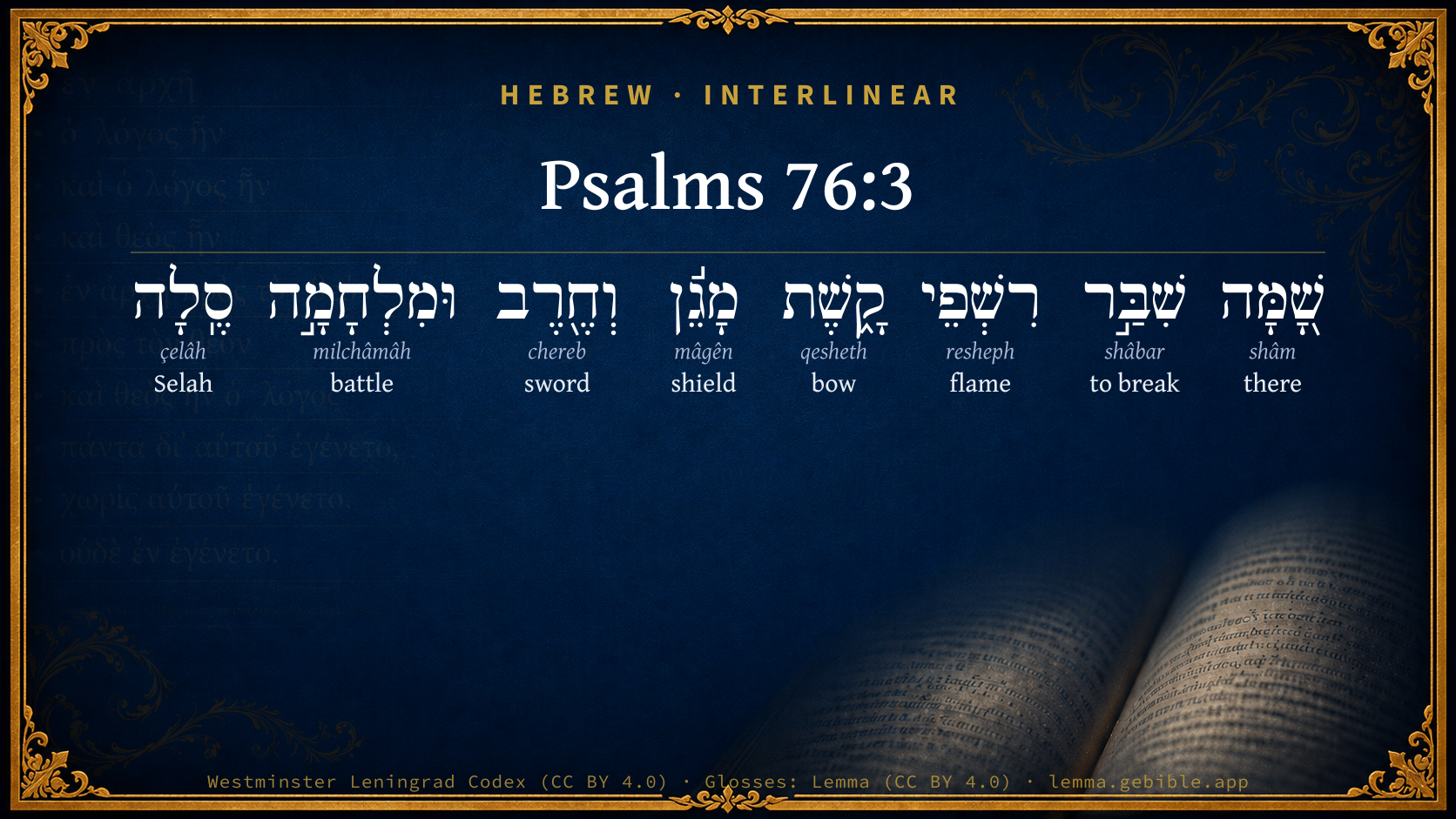
Hebrew (Westminster Leningrad Codex) Psalms 76:3 appears in the Hebrew Old Testament. The text above is from the Westminster Leningrad Codex. Each word links to its Strong’s number, a concise gloss, and parsing drawn from the Open Scriptures Hebrew Bible morphology. Click any word for its full Brown-Driver-Briggs (BDB) entry.
Download image
Cite this verse

Psalms 76:3 (World English Bible). Public Domain. Lemma interlinear Bible study tool, https://lemma.gebible.app/v/psalms/76/3.

Show BibTeX & RIS
BibTeX
RIS
English Translation
There he broke the flaming arrows of the bow, The shield, and the sword, and the weapons of war. Selah.
World English Bible · Public Domain
Download a study sheet

One document with this verse’s original text, its word-by-word gloss line, the meaning frame, cross-references with their text, attributed commentary, and full source and license credits — printable, and it pastes into notes with its structure intact.

This verse Autodidact and up

Study sheet (.html) Plain text (.txt)

A passage Seminary Student

Up to 50 verses in one chapter. A passage sheet keeps up to 6 commentary sources and 12 cross-references per verse, in the order this page ranks them, and says so on the sheet whenever that leaves anything out. Ask for a single verse and you get the Autodidact verse sheet above.

Everything on this page stays free to read, with no account — the sheet is a download of what is already on screen, not access to it.

Want to remove ads? Support Godless Engineer
Compare translations 3

The same verse in 3 English versions, stacked beneath the original-language interlinear above. Click any original word for its lexicon entry.

Each is an independent rendering of the whole verse — the interlinear is not word-aligned to these translations.

Highlighted words mark where these versions differ — a whole-verse word diff, not a word-by-word alignment.

  • World English Bible Public Domain
    There he broke the flaming arrows of the bow, The shield, and the sword, and the weapons of war. Selah.
  • King James Version Public Domain
    There brake he the arrows of the bow, the shield, and the sword, and the battle. Selah.
  • unfoldingWord Literal Text CC BY-SA 4.0
    There he broke the flames of the bow, the shield, and the sword, and the battle. Selah q1

unfoldingWord Literal Text — © unfoldingWord, licensed CC BY-SA 4.0. Word-aligned USFM3 via Door43 (git.door43.org/unfoldingWord/en_ult).

Versions to compare (up to 4)

3 of 4 selected

Show all 18 translations

Every available English version of this verse, each an independent rendering of the whole verse.

  • World English Bible Public Domain
    There he broke the flaming arrows of the bow, The shield, and the sword, and the weapons of war. Selah.
  • Berean Standard Bible Public Domain
    There He shattered the flaming arrows, the shield and sword and weapons of war. Selah
  • Majority Standard Bible Public Domain
    There He shattered the flaming arrows, the shield and sword and weapons of war. Selah
  • King James Version Public Domain
    There brake he the arrows of the bow, the shield, and the sword, and the battle. Selah.
  • American Standard Version (1901) Public Domain
    There he brake the arrows of the bow; The shield, and the sword, and the battle. Selah
  • Revised Version (1885) Public Domain
    There he brake the arrows of the bow; the shield, and the sword, and the battle. Selah
  • Geneva Bible (1599) Public Domain
    There brake he the arrowes of the bowe, the shielde and the sword and the battell. Selah.
  • Douay-Rheims (1899) Public Domain
    And his place is in peace: and his abode in Sion:
  • Young's Literal Translation Public Domain
    There he hath shivered arrows of a bow, Shield, and sword, and battle. Selah.
  • Literal Standard Version CC BY-SA 4.0
    There He has shattered arrows of a bow, || Shield, and sword, and battle. Selah.
  • Unlocked Literal Bible CC BY-SA 4.0
    There he broke the arrows of the bow, the shield, the sword, and the other weapons of war. Selah
  • unfoldingWord Literal Text CC BY-SA 4.0
    There he broke the flames of the bow, the shield, and the sword, and the battle. Selah q1
  • Darby Bible Public Domain
    There broke he the flashings of the bow, shield and sword and battle. Selah.
  • World Messianic Bible Public Domain
    There he broke the flaming arrows of the bow, the shield, and the sword, and the weapons of war. Selah.
  • Webster's Bible Public Domain
    \\76:2\\In Salem also is his tabernacle, and his dwelling place in Zion.
  • Free Bible Version CC BY-SA 4.0
    There he broke the flaming arrows, the shields, the swords, and the weapons of war. Selah.
  • Bible in Basic English Public Domain
    There were the arrows of the bow broken, there he put an end to body-cover, sword, and fight. (Selah.)
  • JPS Tanakh (1917) Public Domain
    (76-4) There He broke the fiery shafts of the bow; the shield, and the sword, and the battle. Selah

Literal Standard Version (2020), Covenant Press — licensed CC BY-SA 4.0. Text via the HelloAO Bible API (eBible.org). Unlocked Literal Bible (unfoldingWord) — licensed CC BY-SA 4.0. Text via the HelloAO Bible API (eBible.org). unfoldingWord Literal Text — © unfoldingWord, licensed CC BY-SA 4.0. Word-aligned USFM3 via Door43 (git.door43.org/unfoldingWord/en_ult). Free Bible Version, Dr. Jonathan Gallagher — licensed CC BY-SA 4.0. Text via the HelloAO Bible API (eBible.org).

Word by word

More ways to search: Search by grammar → Find every occurrence → Compare this word →

Practice this passage: Drill this verse → Learn its vocabulary →

About this verse

These counts appear in no published source. They are computed here, from the morphology-tagged text and Lemma’s own curated glosses. What Lemma adds →

8
words
8
distinct lemmas
Wisdom
section

Notable vocabulary

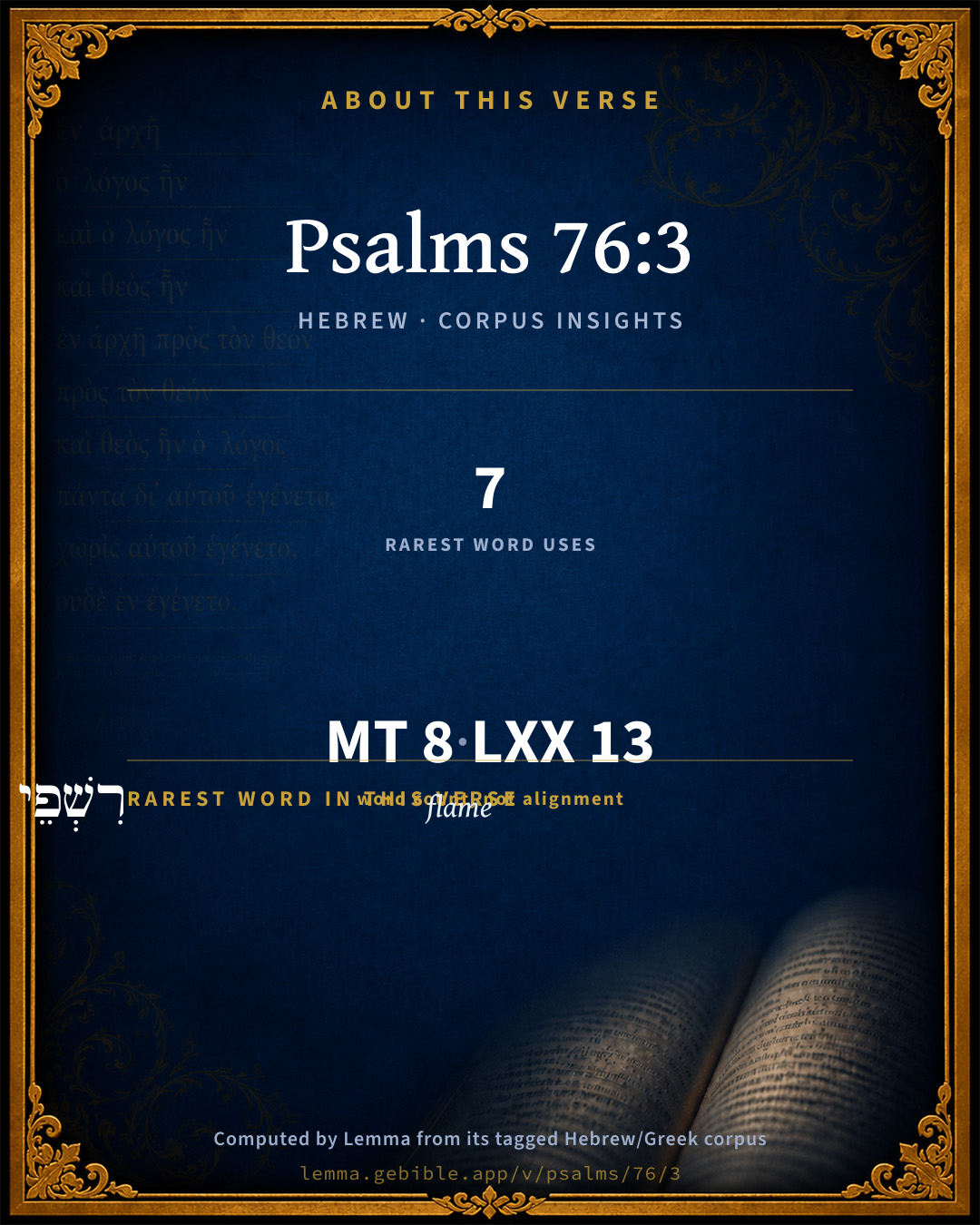
The rarest word here is רִשְׁפֵי flame H7565 — appearing just 7 times in the whole Hebrew Bible.

Shared distinctive vocabulary

רִשְׁפֵי flame H7565 occurs in 6 verses of the Hebrew Bible. Also found in:

Grammatical profile

  • 1 verb
  • 5 nouns
  • 1 adverb
  • 1 particle

Verb forms

  • שִׁבַּ֣ר Piel · Perfect

Hebrew & Septuagint length

In English translation the verse runs 20 words from the Hebrew and 17 from the Septuagint (LXX English) — closely comparable.

A rough comparison of the two English renderings, which tokenize alike — not a word-level alignment.

Word counts can differ between the Hebrew and the Greek without any difference in meaning — e.g. the Hebrew direct-object marker אֵת has no separate Greek word, and Greek often adds the article ὁ.

In the original languages it is 8 Hebrew tokens and 13 Greek tokens — but the two are counted differently (Hebrew bundles its prefixes and suffixes into one token; the Greek is in lemma form), so that isn’t a like-for-like length.

Cross-references

7

Topical passages linked to Psalms 76:3 in the Treasury of Scripture Knowledge — connected by theme and wording, ordered by reader-vote popularity; previews shown in the World English Bible.

  • Psalms 46:9 He makes wars cease to the end of the earth. He breaks the bow, and shatters the spear. He burns the chariots in the fire.
  • Ezekiel 39:3–4 and I will strike your bow out of your left hand, and will cause your arrows to fall out of your right hand.
  • Ezekiel 39:9–10 Those who dwell in the cities of Israel shall go forth, and shall make fires of the weapons and burn them, both the shields and the bucklers, the bows and the arrows, and the war clubs, and the spears, and they shall make fires of them seven years;
  • 2 Chronicles 14:12–13 So Yahweh struck the Ethiopians before Asa, and before Judah; and the Ethiopians fled.
  • 2 Chronicles 20:25 When Jehoshaphat and his people came to take the spoil of them, they found among them in abundance both riches and dead bodies, and precious jewels, which they stripped off for themselves, more than they could carry away: and they were three days in taking the spoil, it was so much.
  • 2 Chronicles 32:21 Yahweh sent an angel, who cut off all the mighty men of valor, and the leaders and captains, in the camp of the king of Assyria. So he returned with shame of face to his own land. When he was come into the house of his god, those who came forth from his own bowels killed him there with the sword.
  • Isaiah 37:35–36 For I will defend this city to save it, for my own sake, and for my servant David's sake.

Cross-references courtesy of OpenBible.info (CC BY 4.0).

Hebrew and Greek witnesses Masoretic Hebrew ↔ Greek Septuagint

The same verse in the two great witnesses to the Old Testament, shown verse-for-verse.

You’re reading Greek Psalm 75 (Hebrew Psalm 76). The Septuagint counts the superscription, so verse numbers can differ from the Hebrew — chapter-level alignment, not verse-by-verse. Numbering follows Rahlfs.

These are two independent witnesses, not word-aligned to each other, and the Septuagint is shown in lemma (dictionary) form.

Hebrew Psalms 76:3 Masoretic · Westminster Leningrad Codex

שָׁ֭מָּה שִׁבַּ֣ר רִשְׁפֵי קָ֑שֶׁת מָגֵ֬ן וְחֶ֖רֶב וּמִלְחָמָ֣ה סֶֽלָה

There he broke the flaming arrows of the bow, The shield, and the sword, and the weapons of war. Selah.

World English Bible · Public Domain

Greek LXX Greek Psalm 75:3 Septuagint · lemma form

καί γίγνομαι ἐν εἰρήνη ὁ τόπος αὐτός καί ὁ κατοικητήριον αὐτός ἐν σιων

There he broke the power of the bows, the shield, and the sword, and the battle. Pause.

LXX2012 (modern English Septuagint) · Public Domain

Hebrew: Westminster Leningrad Codex (CC BY 4.0). Greek: Septuagint (public domain); English from LXX2012 (modern English Septuagint) (Public Domain). How the Septuagint differs from the Hebrew →

Commentary

Notes on Psalms 76:3 from classic Christian and Jewish commentators (each source and its license shown beneath its notes). The classic Christian expositions comment on the surrounding passage and are grouped to its opening verse, so a note may address several verses; the Jewish commentaries on the Tanakh (Rashi and others) are per-verse, so they appear only where the commentator wrote on this verse.

Lemma curates 59 commentaries, every one of them public domain or Creative Commons licensed, each selected and text-cleaned for this edition rather than reprinted as found. About our sources →

Trapp's Complete Commentary

John Trapp

Psa 76:3 There brake he the arrows of the bow, the shield, and the sword, and the battle. Selah.

Ver. 3. There brake he the arrows of the bolt,] There? Where? Surely in Zion, in the holy assemblies where the saints were praying, there the arrow, shield, spear, &c., were broken. This made the queen-mother of Scotland say, that she more feared the prayers of John Knox than an army of thirty thousand fighting soldiers. The king of Sweden, as soon as he set foot in Germany, fell down to prayer, and what great things did he in a little time! Now for the fruit of prayer, cried those great gallants at Edgehill fight, and did great exploits. The word here rended arrows signifieth fiery darts, see Eph 6:16; a burning coal, Job 5:7; a lightening bolt, Psa 78:48; the plague, or carbuncle, Deu 32:24 Hab 3:5. Strabo saith that Orites, Gynmetes, and Ethiopians shot fiery arrows: so might the Assyrians. Confer Psa 120:4.

The shield, and the sword, and the battle] Both the men and the munition. This Herodotus had heard of, but misrelates the history, lib. 2.

John Trapp, A Commentary or Exposition upon All the Books of the Old and New Testament (1647–1656) — public domain. Text from a community e-Sword module.

Joseph Benson's Commentary

Psa 76:3. There brake he, &c. — That is, in Judah, or at or near Jerusalem; the arrows of the bow — Hebrew, רשׁפי קשׁת, rishpee kasheth, the sparks of the bow, the sparkling arrows, bright and shining, swift and piercing, like sparks of fire. Some render it, the fiery arrows of the bow, the shield and the sword — Both offensive and defensive weapons, so that they could neither hurt God’s people nor save themselves from ruin; and the battle — The force and fury of the battle, and all the power of the army put in battle array.

Joseph Benson's Commentary on the Old and New Testaments (1811–1818) — public domain. Text from a community e-Sword module.

J. A. Alexander on Psalms

Joseph Addison Alexander

4. (Psa 76:3). Thither he shattered the bolts of the bow—buckler and sword and battle. Selah. Some translate the first word there, but there is no clear instance of the Hebrew adverb being so used, and the best interpreters suppose the sense to be that he destroyed them on their way there, while in motion towards the Holy City. The word translated shattered is an intensive species of the common verb which means to break. Both forms occur together in Psa 29:5. See also Psa 3:7. The ambiguous word bolts is used to represent a Hebrew one, which properly means thunderbolts or flashes of lightning, but is here applied to the flight of arrows, with or without allusion to the practice of igniting them (Eph 6:16). To the shield and sword, as the most important pieces of offensive and defensive armour, he adds, by a bold and striking figure, war itself, perhaps as a residuary aggregate of all other arms and weapons.

Joseph Addison Alexander, The Psalms Translated and Explained (1850) — public domain. Text from a community e-Sword module.

Tyndale Open Study Notes

Tyndale Open Resources

76:3 God brings an end to the attacks of his enemies (see 46:9).

Tyndale Open Study Notes — © Tyndale Open Resources, licensed CC BY-SA 4.0. Text via the HelloAO Bible API.

Adam Clarke's Commentary

Verse 3. There brake he the arrows of the bow] רשפי rishphey, the fiery arrows. Arrows, round the heads of which inflammable matter was rolled, and then ignited, were used by the ancients, and shot into towns to set them on fire; and were discharged among the towers and wooden works of besiegers. The Romans called them phalaricae; and we find them mentioned by Virgil, AEn. lib. ix., ver. 705: -

Sed magnum stridens contorta phalarica venit,

Fulminis acta modo.

On this passage Servius describes the phalarica as a dart or spear with a spherical leaden head to which fire was attached. Thrown by a strong hand, it killed those whom it hit, and set fire to buildings, &c. It was called phalarica from the towers called phalae from which it was generally projected. In allusion to these St. Paul speaks of the fiery darts of the devil, Eph 6:16, to the note on which the reader is requested to refer.

The shield and the sword] If this refers to the destruction of Sennacherib's army, it may be truly said that God rendered useless all their warlike instruments, his angel having destroyed 185,000 of them in one night.

Adam Clarke's Commentary on the Bible (1810–1826) — public domain. Text from a community e-Sword/MySword module.

John Calvin's Commentaries

3. There he broke the arrows of the bow. We have here stated the particular way in which God was known in Judah. He was known by the wonderful proofs of his power, which he exhibited in preserving the city. Under these figures is described the destruction of the enemies of the chosen people. They could not otherwise have been overthrown than by being despoiled of their armor and weapons of war. It is therefore said, that the arrows, the swords, and the shields, were broken, yea, all the implements of war; implying that these impious enemies of the Church were deprived of the power of doing harm. The fact indeed is, that they were wounded and slain, while their weapons remained uninjured; but this metonymy, by which what befell themselves is represented as happening to their implements of war, is not improper. Some translate the word רשפים, reshaphim, points of weapons! Properly, it should be rendered fires; but it is more accurate to take it for arrows. Even birds are sometimes metaphorically so called, on account of their swiftness; and flying is attributed to arrows in Psalm 91:6

John Calvin's Commentaries (1540-1563) — public domain. Text from the Calvin Translation Society English edition (1840s-50s) via the Christian Classics Ethereal Library (ccel.org). Calvin's coverage is partial (roughly two-thirds of the Bible); uncommented books and verses are honest gaps, never fabricated. The 19th-century editor's footnotes and remarks are omitted so the notes are faithfully Calvin's own voice.

Ellicott's Commentary for English Readers

(3) There.—This word in Psa_14:5 does not appear to have a strictly definite local sense; and here may refer to time, possibly to some event, which we are not able with certainty to recover.

Arrows.—Literally, flashes. (See Note, Son_8:6.) The image may be derived from the lightning speed of the flight of arrows, or from the custom of shooting bolts tipped with flame (see Note, Psa_7:13), or the connection may be from the metaphor in Psa_91:5-6, since the Hebrew word here used denotes pestilence in Hab_3:5.

The shield, the sword, and the battle—Hos_2:18 is the original of this. (Comp. Psa_46:9.) Notice the fine poetic touch in the climactic use of battle to sum up all the weapons of war.

A Bible Commentary for English Readers, edited by Charles John Ellicott (1878–1897) — public domain. Text from a community e-Sword module.

The Cambridge Bible for Schools and Colleges

gen. ed. J. J. S. Perowne

3. There hath he broken the lightnings of the bow. The destruction of Sennacherib’s army apparently took place at some distance from Jerusalem, but Jerusalem is naturally spoken of as the scene of God’s action, because it was the seat of His presence (Psa_46:5 ff.) and it was on her behalf that He put forth His power.

For broken cp. Psa_46:9; Hos_2:18; Isa_9:4; Jer_49:35; and more generally, Isa_14:25. Arrows are called lightnings from the swiftness of their flight, rather than from any reference to fire-laden darts (Psa_7:13, note). The battle includes all instruments and equipments for war.

The Cambridge Bible for Schools and Colleges (gen. ed. J. J. S. Perowne; Cambridge University Press, 1878–1918) — public domain. Text from a community e-Sword module.

John Gill's Exposition

There brake he the arrows of the bow.... The Targum is,

"there brake he the arrows and the bows of the people that make war;''

the word translated "arrows", signifies "sparks or coals of fire"; see Job 5:7 and is used of arrows, because they fly swiftly, as sparks do, or because of their brightness, or because fiery; so we read of "the fiery darts of Satan", Eph 6:16, and perhaps they may be meant here: when Christ our Lord suffered near Jerusalem, he spoiled principalities and powers, and broke their strength and might, and made peace by the blood of his cross, in which he triumphed over them; for the destroying of these instruments of war with what follow:

the shield, and the sword, and the battle, is expressive of making wars to cease, and causing peace; and may include the peace which was all the world over at the birth of Christ, and was foretold and expressed in much such language as here, Zac 9:9, and also that which was made by his sufferings and death, and which was published in his Gospel by his apostles, whom he sent forth unarmed, whose weapons were not carnal, but spiritual; and likewise the spiritual peace he gives to his people, quenching the fiery darts of Satan, and delivering them from the archers that shoot at them, and sorely grieve them; as well as that peace which shall be in the world and churches in the latter day; see Psa 46:11,

Selah. See Gill on Psa 3:2.

John Gill's Exposition of the Whole Bible (1746–1763) — public domain (CC PDM 1.0). Text via the HelloAO Bible API.

Albert Barnes' Notes on the Bible

There brake he the arrows of the bow - That is, in Salem, or near Salem. The language is such as would be used in reference to invaders, or to armies that came up to storm the city. The occasion is unknown; but the meaning is, that God drove the invading army back, and showed his power in defending the city. The phrase “the arrows of the bow,” is literally, “the lightnings of the bow,” the word rendered “arrows” meaning properly “flame;” and then, “lightning.” The idea is, that the arrows sped from the bow with the rapidity of lightning.

The shield - Used for defense in war. See Psa 5:12; Psa 33:20; compare the notes at Eph 6:16.

And the sword - That is, he disarmed his enemies, or made them as powerless as if their swords were broken.

And the battle - He broke the force of the battle; the strength of the armies drawn up for conflict.

Albert Barnes' Notes on the Bible (1834–1885) — public domain. Text from a community e-Sword/MySword module.

Matthew Poole's English Annotations

There, i.e. in Judah, or at or near Jerusalem.

The arrows, Heb. the sparks; the sparkling arrows, bright and shining, swift and piercing, like sparks of fire. The bow, the shield, and the sword; both offensive and defensive weapons, so as they could neither hurt God’s people, nor save themselves from ruin.

The battle; the force and fury of the battle, and all the power of the army, which was put in battle-array.

Matthew Poole's English Annotations on the Holy Bible (1683–1685) — public domain. Text from a community e-Sword/MySword module.

The Treasury of David

Charles H. Spurgeon

Ver. 3. There brake he the arrows of the bow. Without leaving his tranquil abode, he sent forth his word and snapped the arrows of his enemies before they could shoot them. The idea is sublime, and marks the ease, completeness, and rapidity of the divine action.

The shield, and the sword, and the battle. Every weapon, offensive and defensive, the Lord dashed in pieces; death bearing bolts and life preserving armour were alike of no avail when the Breaker sent forth his word of power. In the spiritual conflicts of this and every age, the like will be seen; no weapon that is formed against the church shall prosper, and every tongue that rises against her in judgment, she shall condemn.

Selah. It is meet that we should dwell on so soul stirring a theme, and give the Lord our grateful adoration, --hence a pause is inserted.

Whole Psalm. No Psalm has a greater right to follow Psalm 75 than this, which is inscribed To the Precentor, with accompaniment of stringed instruments (vid. iv. 1), a Psalm by Asaph, a song. Similar expressions (God of Jacob, Ps 75:10 77:7; saints, wicked of the earth, Ps 75:9 76:10), and the same impress throughout speak in favour of unity of authorship. In other respects too, they form a pair: Psalm 75 prepares the way for the divine deed of judgments as imminent, which Psalm 76 celebrates as having taken place. Franz Delitzsch.

Ver. 3. There. Observe how it is said, There he brake, namely, in his temple, his habitation there. For unto that his temple doth the coherence in the verse afore carry it, for that was last in mention, and with the greatest emphasis. In the story we read how that Sennacherib's overthrow was from Hezekiah's prayer in the temple; for upon Sennacherib's letter, and Hezekiah's hearsay of the blasphemy, he took himself thither, went instantly into the temple, and began his prayer thus: "O thou God of Israel, that dwellest between the cherubims." He invocates him under that style of his dwelling in the holiest, and so hearing prayers there. Thus you have it recorded both in Isaiah and in 2Ki 19:15. And how suitably, in answer hereunto, it is said here in the Psalm, that God gave forth sentence presently out of his tabernacle, yea, and that so suddenly too, as that the very execution is said to be done there, that is, from thence. And yet again, in the eighth verse of the Psalm, it is said to be a sentence from heaven too; Thou didst cause judgment (so called because it was the sentence of God as a judge) to be heard from heaven. Thus Hezekiah prayed, and thus God heard; and both as in the temple. Thomas Goodwin.

Ver. 3. There. These men, to wit the King of Asshur and his accomplices, came to cast out God out of his dwelling place; but he stood to the defence of his own house, and showed them that he would not remove for their pleasure. Robert Bruce.

Ver. 3. Christian glories, or the victories vouchsafed to the church over heathenism, heresy, persecution, etc.

Ver. 3.

I. Where enemies are conquered; "There; "not on the

battlefield so much as in the house of God; as Amalek

by Moses on the Mount; Sennacherib by Hezekiah in the

Sanctuary.

II. How there?

1. By faith.

2. By prayer. "The weapons of our warfare, "etc.

Psalms 76:4*

Charles H. Spurgeon's The Treasury of David (1869–1885) — public domain. Psalms only. Text from a community e-Sword/MySword module.

Whedon's Commentary on the Bible

Daniel D. Whedon

3. There brake he the arrows—The adverbial particle, שׁם, (sham,) “there,” is not to be understood of the place where the miracle of destruction was wrought, but of that whence the miraculous power emanated, namely Zion, or Salem, and should be translated thence, from thence. Thus, “His dwelling-place in Zion. Thence brake he,” etc. So the word is used, Gen_11:8, “The Lord scattered them abroad from thence;” and Gen_26:17, “Isaac departed thence.” It is from his dwelling-place God hears and answers prayer. It is a lofty conception of Zion as the throne of Deity.

Arrows of the bow—Hebrew, Flames, or lightnings of the bow, that is, flaming or flashing arrows, a description not uncommon of furbished weapons. Job_39:23; Nah_3:3. Comp. Eph_6:16.

And the battle—Either poetically for the weapons of war, or directly the war itself. This latter is the true idea. He shivered the battle; that is, ended the war by one stroke, in destroying the warriors. See Hos_2:18, (Hebrews 76:20,) and the parallel passage, Psa_46:9

Daniel D. Whedon (gen. ed.), Commentary on the Old and New Testaments (1874–1909) — public domain. Text from a community e-Sword module.

The Pulpit Commentary

There brake he the arrows of the bow. The expression "there" seems certainly to show that the deliverance celebrated took place at, or very near to, Jerusalem. This would sufficiently suit the destruction of Sennacherib"s army, which certainly occurred in the neighbourhood, though not very close to the city. (see 2Ki_19:32, 2Ki_19:33) The word translated "arrows" (ypvr) means properly "lightnings", (comp. Psa_78:48) and expresses the swift flight of the arrow, not actual "fiery darts." The shield, and the sword, and the battle; rather, the war equipment (Kay, Cheyne).

The Pulpit Commentary (1880–1919), ed. H.D.M. Spence-Jones & Joseph S. Exell — public domain. Text from a community e-Sword module.

John Wesley's Explanatory Notes

There - At Jerusalem. Sword - Both offensive and defensive weapons. Battle - All the power of the army, which was put in battle-array.

John Wesley, Explanatory Notes Upon the Whole Bible (1754–1765) — public domain. Text via the GEBible commentary corpus.

Lesson kit

Teaching starters — assembled from the data on this page, not authored interpretation. Every prompt links to the verse data it draws on. Edit before teaching.

Psalms, in the Wisdom, opens this verse with 8 words (8 distinct Hebrew lemmas). Its most distinctive word is resheph (“flame”). A historical commentator’s framing appears above. Read the whole chapter for the surrounding context.

Discussion questions

  1. The word resheph carries the sense “flame.” How does it shape the verse?
  2. Deuteronomy 32:24 shares the word «flame» with this verse. How do the two illuminate each other?
  3. These translations render this verse differently. What is at stake in choosing one wording over another?
  4. The verb «שִׁבַּ֣ר» is Piel Perfect. How does its form color the action?
  5. Reading how Trapp's Complete Commentary and Joseph Benson's Commentary read this verse, where do the two commentators agree and where do they part?

Things to notice

Reading settings

Reading text

Shown beneath each verse's original-language words.

Old Testament
Old Testament edition

Read the OT as the Masoretic Hebrew (MT) or the Greek Septuagint (LXX).

English shown for the Greek Septuagint (in the Hebrew ↔ Greek comparison).

Comparing translations? Open the Compare panel on any verse page to stack up to four side by side.