
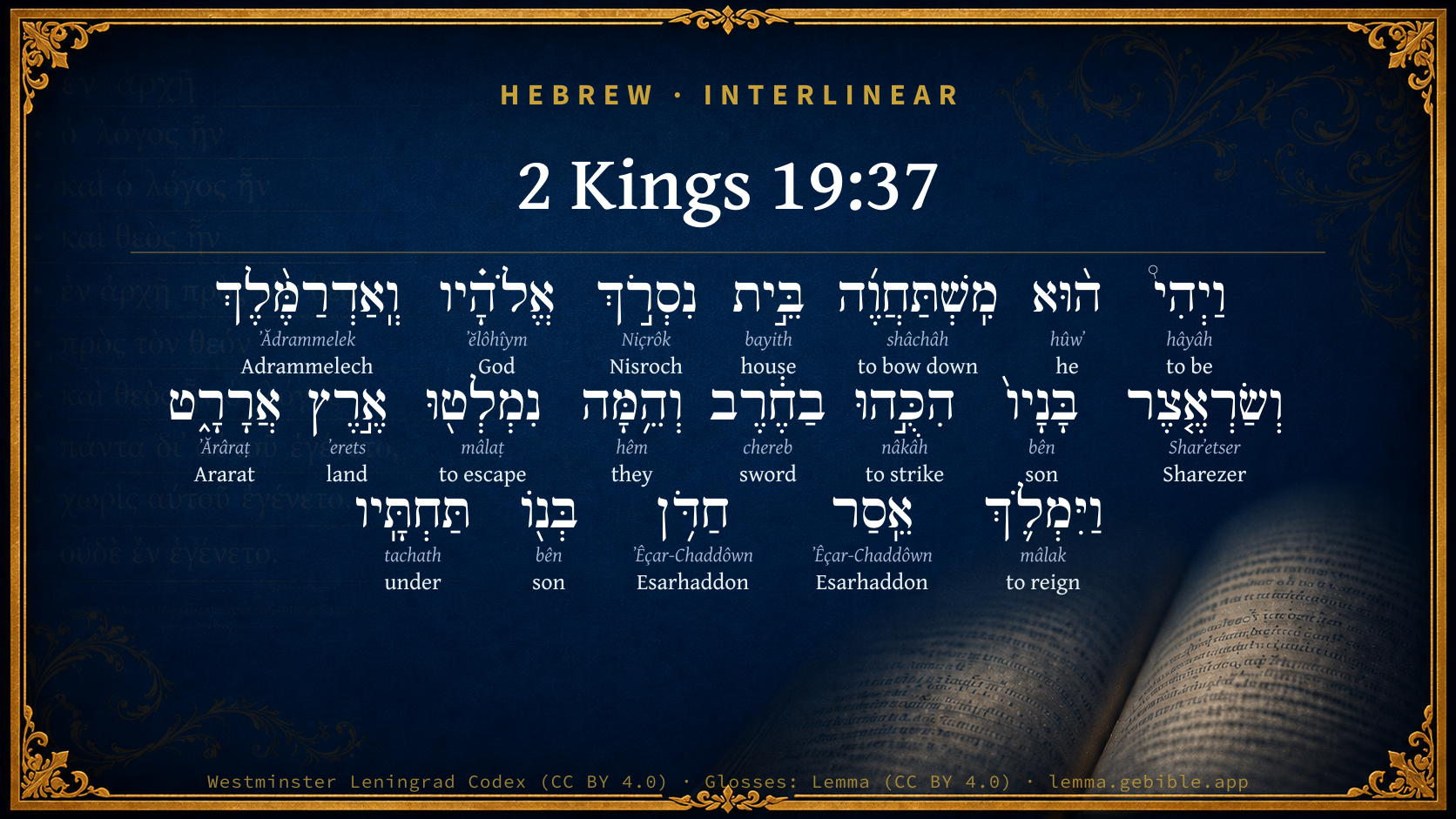
2 Kings 19:37

Hebrew (Westminster Leningrad Codex) 2 Kings 19:37 appears in the Hebrew Old Testament. The text above is from the Westminster Leningrad Codex. Each word links to its Strong’s number, a concise gloss, and parsing drawn from the Open Scriptures Hebrew Bible morphology. Click any word for its full Brown-Driver-Briggs (BDB) entry.
Download image
Cite this verse

2 Kings 19:37 (World English Bible). Public Domain. Lemma interlinear Bible study tool, https://lemma.gebible.app/v/2-kings/19/37.

Show BibTeX & RIS
BibTeX
RIS
English Translation
It happened, as he was worshipping in the house of Nisroch his god, that Adrammelech and Sharezer struck him with the sword: and they escaped into the land of Ararat. Esar Haddon his son reigned in his place.
World English Bible · Public Domain
Highlights
  • 3 first appearances in the Hebrew Bible
Full analysis ↓
Download a study sheet

One document with this verse’s original text, its word-by-word gloss line, the meaning frame, cross-references with their text, attributed commentary, and full source and license credits — printable, and it pastes into notes with its structure intact.

This verse Autodidact and up

Study sheet (.html) Plain text (.txt)

A passage Seminary Student

Up to 50 verses in one chapter. A passage sheet keeps up to 6 commentary sources and 12 cross-references per verse, in the order this page ranks them, and says so on the sheet whenever that leaves anything out. Ask for a single verse and you get the Autodidact verse sheet above.

Everything on this page stays free to read, with no account — the sheet is a download of what is already on screen, not access to it.

Want to remove ads? Support Godless Engineer
Compare translations 3

The same verse in 3 English versions, stacked beneath the original-language interlinear above. Click any original word for its lexicon entry.

Each is an independent rendering of the whole verse — the interlinear is not word-aligned to these translations.

Highlighted words mark where these versions differ — a whole-verse word diff, not a word-by-word alignment.

  • World English Bible Public Domain
    It happened, as he was worshipping in the house of Nisroch his god, that Adrammelech and Sharezer struck him with the sword: and they escaped into the land of Ararat. Esar Haddon his son reigned in his place.
  • King James Version Public Domain
    And it came to pass, as he was worshipping in the house of Nisroch his god, that Adrammelech and Sharezer his sons smote him with the sword: and they escaped into the land of Armenia. And Esarhaddon his son reigned in his stead.
  • unfoldingWord Literal Text CC BY-SA 4.0
    And it happened, he was prostrating himself the house of Nisroch his god, and Adrammelech and Sharezer struck him with the sword, and they, they escaped the land of Ararat. And Esarhaddon his son reigned in his place.

unfoldingWord Literal Text — © unfoldingWord, licensed CC BY-SA 4.0. Word-aligned USFM3 via Door43 (git.door43.org/unfoldingWord/en_ult).

Versions to compare (up to 4)

3 of 4 selected

Show all 18 translations

Every available English version of this verse, each an independent rendering of the whole verse.

  • World English Bible Public Domain
    It happened, as he was worshipping in the house of Nisroch his god, that Adrammelech and Sharezer struck him with the sword: and they escaped into the land of Ararat. Esar Haddon his son reigned in his place.
  • Berean Standard Bible Public Domain
    One day, while he was worshiping in the temple of his god Nisroch, his sons Adrammelech and Sharezer put him to the sword and escaped to the land of Ararat. And his son Esar-haddon reigned in his place.
  • Majority Standard Bible Public Domain
    One day, while he was worshiping in the temple of his god Nisroch, his sons Adrammelech and Sharezer put him to the sword and escaped to the land of Ararat. And his son Esar-haddon reigned in his place.
  • King James Version Public Domain
    And it came to pass, as he was worshipping in the house of Nisroch his god, that Adrammelech and Sharezer his sons smote him with the sword: and they escaped into the land of Armenia. And Esarhaddon his son reigned in his stead.
  • American Standard Version (1901) Public Domain
    And it came to pass, as he was worshipping in the house of Nisroch his god, that Adrammelech and Sharezer smote him with the sword: and they escaped into the land of Ararat. And Esar-haddon his son reigned in his stead.
  • Revised Version (1885) Public Domain
    And it came to pass, as he was worshipping in the house of Nisroch his god, that Adrammelech and Sharezer smote him with the sword: and they escaped into the land of Ararat. And Esar-haddon his son reigned in his stead.
  • Geneva Bible (1599) Public Domain
    And as he was in the Temple worshipping Nisroch his god, Adramelech and Sharezer his sonnes slewe him with the sworde: and they escaped into the land of Ararat, and Esarhaddon his sonne reigned in his steade.
  • Douay-Rheims (1899) Public Domain
    And as he was worshipping in the temple of Nesroch his god, Adramelech and Sarasar his sons slew him with the sword, and they fled into the land of the Armenians, and Asarhaddon his son reigned in his stead.
  • Young's Literal Translation Public Domain
    and it cometh to pass, he is bowing himself in the house of Nisroch his god, and Adramelech and Sharezar `his sons' have smitten him with the sword, and they have escaped to the land of Ararat, and Esar-Haddon his son reigneth in his stead.
  • Literal Standard Version CC BY-SA 4.0
    and it comes to pass, he is bowing himself in the house of his god Nisroch, and [his sons] Adramelech and Sharezar have struck him with the sword, and they have escaped to the land of Ararat, and his son Esar-Haddon reigns in his stead.
  • Unlocked Literal Bible CC BY-SA 4.0
    Later, as he was worshiping in the house of Nisrok his god, his sons Adrammelek and Sharezer killed him with the sword. Then they escaped into the land of Ararat. Then Esarhaddon his son became king in his place.
  • unfoldingWord Literal Text CC BY-SA 4.0
    And it happened, he was prostrating himself the house of Nisroch his god, and Adrammelech and Sharezer struck him with the sword, and they, they escaped the land of Ararat. And Esarhaddon his son reigned in his place.
  • Darby Bible Public Domain
    And it came to pass, as he was worshipping in the house of Nisroch his god, that Adrammelech and Sharezer [his sons] smote him with the sword; and they escaped into the land of Ararat. And Esarhaddon his son reigned in his stead.
  • World Messianic Bible Public Domain
    As he was worshiping in the house of Nisroch his god, Adrammelech and Sharezer struck him with the sword; and they escaped into the land of Ararat. Esar Haddon his son reigned in his place.
  • Webster's Bible Public Domain
    And it came to pass, as he was worshiping in the house of Nisroch his god, that Adrammelech and Sharezer his sons smote him with the sword: and they escaped into the land of Armenia. And Esar-haddon his son reigned in his stead.
  • Free Bible Version CC BY-SA 4.0
    While he was worshiping in the temple of his god Nisroch, his sons Adrammelech and Sharezer killed him with the sword and then ran away to the land of Ararat. His son Esar-haddon succeeded him as king.
  • Bible in Basic English Public Domain
    And it came about, when he was worshipping in the house of Nisroch his god, that his sons Adrammelech and Sharezer put him to death with the sword; and they went in flight into the land of Ararat. And Esar-haddon his son became king in his place.
  • JPS Tanakh (1917) Public Domain
    And it came to pass, as he was worshipping in the house of Nisroch his god, that Adrammelech and Sarezer his sons smote him with the sword; and they escaped into the land of Ararat. And Esarhaddon his son reigned in his stead.

Literal Standard Version (2020), Covenant Press — licensed CC BY-SA 4.0. Text via the HelloAO Bible API (eBible.org). Unlocked Literal Bible (unfoldingWord) — licensed CC BY-SA 4.0. Text via the HelloAO Bible API (eBible.org). unfoldingWord Literal Text — © unfoldingWord, licensed CC BY-SA 4.0. Word-aligned USFM3 via Door43 (git.door43.org/unfoldingWord/en_ult). Free Bible Version, Dr. Jonathan Gallagher — licensed CC BY-SA 4.0. Text via the HelloAO Bible API (eBible.org).

Word by word

More ways to search: Search by grammar → Find every occurrence → Compare this word →

Practice this passage: Drill this verse → Learn its vocabulary →

נִסְרֹ֣ךְ
Niçrôk
H5268
“Nisroch”
Noun, Proper
Part of Speech
Noun
Type
Proper
Full BDB Definition

Origin: of foreign origin

TWOT: 1382

Nisroch = "the great eagle" - an idol of Nineveh worshipped by Sennacherib; symbolised by the eagle-headed human figure
  1. וַיְהִי֩ hâyâh H1961 “and · to be” Conjunction + Verb, Qal, Sequential Imperfect, 3rd Person, Masculine, Singular
  2. ה֨וּא hûwʼ H1931 “he” Pronoun, Personal, 3rd Person, Masculine, Singular
  3. מִֽשְׁתַּחֲוֶ֜ה shâchâh H7812 “bowing down” Verb, Hishtaphel, Participle Active, Masculine, Singular, Absolute
  4. בֵּ֣ית bayith H1004 “house of” Noun, Common, Masculine, Singular, Construct
  5. אֱלֹהָ֗יו ʼĕlôhîym H430 “God(s) · his” Noun, Common, Masculine, Plural, Construct + Suffix, Personal, 3rd Person, Masculine, Singular
  6. וְֽאַדְרַמֶּ֨לֶךְ ʼĂdrammelek H152 “and · Adrammelech” Conjunction + Noun, Proper
  7. וְשַׂרְאֶ֤צֶר Sharʼetser H8272 “and · Sharezer” Conjunction + Noun, Proper
  8. בָּנָיו֙ bên H1121 “sons · his” Noun, Common, Masculine, Plural, Construct + Suffix, Personal, 3rd Person, Masculine, Singular
  9. הִכֻּ֣הוּ nâkâh H5221 “to strike · him” Verb, Hiphil, Perfect, 3rd Person, Common, Plural + Suffix, Personal, 3rd Person, Masculine, Singular
  10. בַחֶ֔רֶב chereb H2719 “in/at the · sword” Preposition, Determined + Noun, Common, Feminine, Singular, Absolute
  11. וְהֵ֥מָּה hêm H1992 “and · they” Conjunction + Pronoun, Personal, 3rd Person, Masculine, Plural
  12. נִמְלְט֖וּ mâlaṭ H4422 “to escape” Verb, Niphal, Perfect, 3rd Person, Common, Plural
  13. אֶ֣רֶץ ʼerets H776 “land of” Noun, Common, Both, Singular, Construct
  14. אֲרָרָ֑ט ʼĂrâraṭ H780 “Ararat” Noun, Proper
  15. וַיִּמְלֹ֛ךְ mâlak H4427 “and · to reign” Conjunction + Verb, Qal, Sequential Imperfect, 3rd Person, Masculine, Singular
  16. אֵֽסַר ʼÊçar-Chaddôwn H634 “Esarhaddon” Noun, Proper
  17. חַדֹּ֥ן ʼÊçar-Chaddôwn H634 “Esarhaddon” Noun, Proper
  18. בְּנ֖וֹ bên H1121 “son · his” Noun, Common, Masculine, Singular, Construct + Suffix, Personal, 3rd Person, Masculine, Singular
  19. תַּחְתָּֽיו tachath H8478 “under · him” Preposition + Suffix, Personal, 3rd Person, Masculine, Singular

About this verse

These counts appear in no published source. They are computed here, from the morphology-tagged text and Lemma’s own curated glosses. What Lemma adds →

20
words
18
distinct lemmas
Historical
section

Notable vocabulary

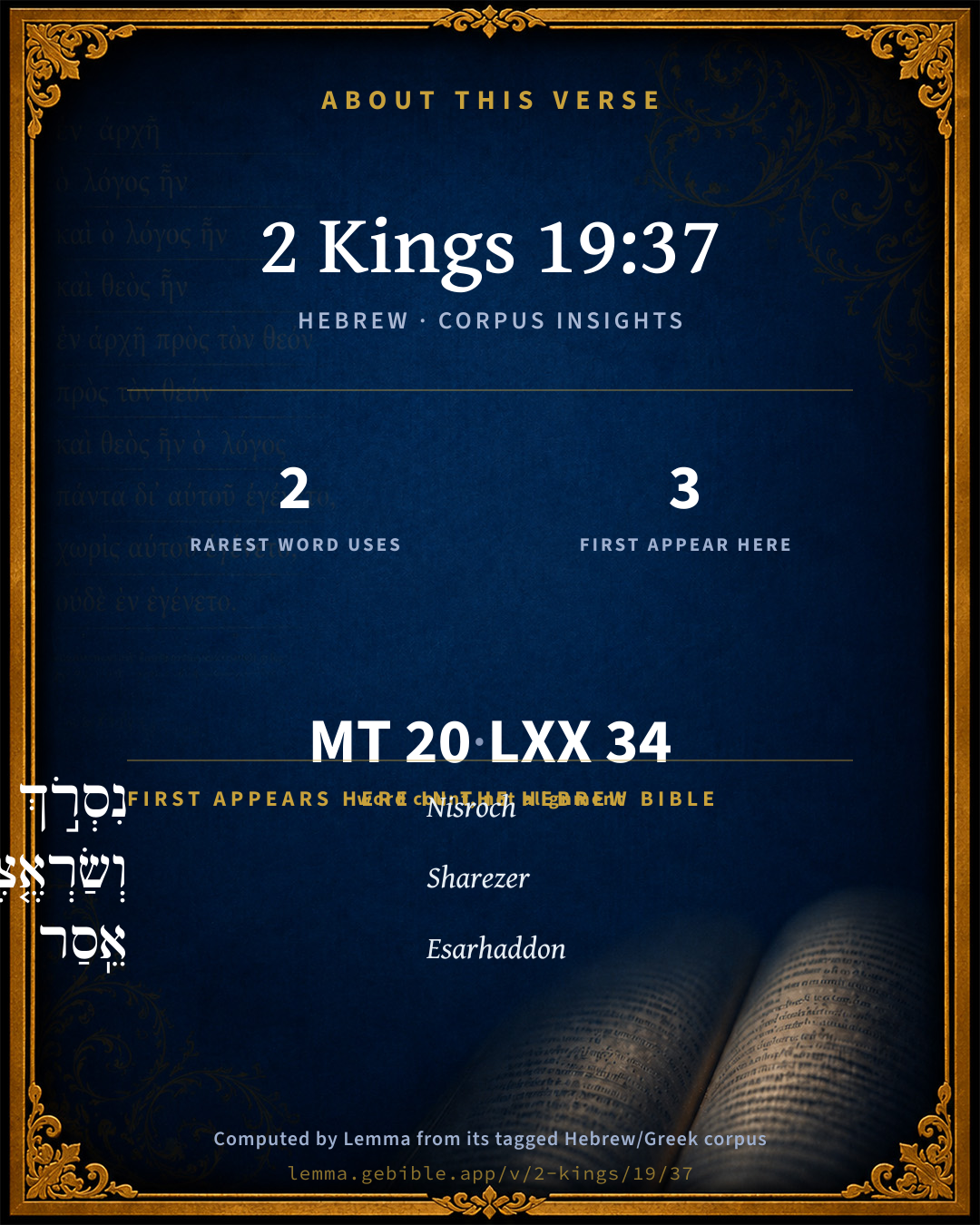
The rarest word here is נִסְרֹ֣ךְ Nisroch H5268 — appearing just 2 times in the whole Hebrew Bible.

First appearance in Scripture

These words make their first canonical appearance in the Hebrew Bible here:

  • נִסְרֹ֣ךְ Nisroch H5268
  • וְשַׂרְאֶ֤צֶר Sharezer H8272
  • אֵֽסַר Esarhaddon H634

Shared distinctive vocabulary

נִסְרֹ֣ךְ Nisroch H5268 occurs in 2 verses of the Hebrew Bible. Also found in:

Grammatical profile

  • 5 verbs
  • 12 nouns
  • 2 pronouns
  • 1 preposition

Verb forms

  • וַיְהִי֩ Qal · Sequential Imperfect
  • מִֽשְׁתַּחֲוֶ֜ה Hishtaphel · Participle Active
  • הִכֻּ֣הוּ Hiphil · Perfect
  • נִמְלְט֖וּ Niphal · Perfect
  • וַיִּמְלֹ֛ךְ Qal · Sequential Imperfect

Repetition

Words recur within this verse — often emphatic in Hebrew:

  • בָּנָיו֙ son H1121 ×2
  • אֵֽסַר Esarhaddon H634 ×2

Hebrew & Septuagint length

In English translation the verse runs 38 words from the Hebrew and 43 from the Septuagint (LXX English) — closely comparable.

A rough comparison of the two English renderings, which tokenize alike — not a word-level alignment.

Word counts can differ between the Hebrew and the Greek without any difference in meaning — e.g. the Hebrew direct-object marker אֵת has no separate Greek word, and Greek often adds the article ὁ.

In the original languages it is 20 Hebrew tokens and 34 Greek tokens — but the two are counted differently (Hebrew bundles its prefixes and suffixes into one token; the Greek is in lemma form), so that isn’t a like-for-like length.

Cross-references

12

Topical passages linked to 2 Kings 19:37 in the Treasury of Scripture Knowledge — connected by theme and wording, ordered by reader-vote popularity; previews shown in the World English Bible.

  • Genesis 8:4 The ark rested in the seventh month, on the seventeenth day of the month, on Ararat's mountains.
  • Ezra 4:2 then they drew near to Zerubbabel, and to the heads of fathers' [houses], and said to them, Let us build with you; for we seek your God, as you do; and we sacrifice to him since the days of Esar Haddon king of Assyria, who brought us up here.
  • 2 Kings 19:7 Behold, I will put a spirit in him, and he shall hear news, and shall return to his own land; and I will cause him to fall by the sword in his own land.
  • Jeremiah 51:27 Set up a standard in the land, blow the trumpet among the nations, prepare the nations against her, call together against her the kingdoms of Ararat, Minni, and Ashkenaz: appoint a marshal against her; cause the horses to come up as the rough canker-worm.
  • Deuteronomy 32:31 For their rock is not as our Rock, Even our enemies themselves being judges.
  • 2 Kings 18:5 He trusted in Yahweh, the God of Israel; so that after him was none like him among all the kings of Judah, nor [among them] that were before him.
  • 2 Kings 18:30 neither let Hezekiah make you trust in Yahweh, saying, Yahweh will surely deliver us, and this city shall not be given into the hand of the king of Assyria.
  • 2 Kings 19:10 Thus shall you speak to Hezekiah king of Judah, saying, Don't let your God in whom you trust deceive you, saying, Jerusalem shall not be given into the hand of the king of Assyria.
  • 2 Chronicles 32:14 Who was there among all the gods of those nations which my fathers utterly destroyed, that could deliver his people out of my hand, that your God should be able to deliver you out of my hand?
  • 2 Chronicles 32:19 They spoke of the God of Jerusalem, as of the gods of the peoples of the earth, which are the work of men's hands.
  • 2 Chronicles 32:21 Yahweh sent an angel, who cut off all the mighty men of valor, and the leaders and captains, in the camp of the king of Assyria. So he returned with shame of face to his own land. When he was come into the house of his god, those who came forth from his own bowels killed him there with the sword.
  • Isaiah 37:37–38 So Sennacherib king of Assyria departed, and went and returned, and lived at Nineveh.

Cross-references courtesy of OpenBible.info (CC BY 4.0).

Hebrew and Greek witnesses Masoretic Hebrew ↔ Greek Septuagint

The same verse in the two great witnesses to the Old Testament, shown verse-for-verse.

These are two independent witnesses, not word-aligned to each other, and the Septuagint is shown in lemma (dictionary) form.

Hebrew 2 Kings 19:37 Masoretic · Westminster Leningrad Codex

וַיְהִי֩ ה֨וּא מִֽשְׁתַּחֲוֶ֜ה בֵּ֣ית נִסְרֹ֣ךְ אֱלֹהָ֗יו וְֽאַדְרַמֶּ֨לֶךְ וְשַׂרְאֶ֤צֶר בָּנָיו֙ הִכֻּ֣הוּ בַחֶ֔רֶב וְהֵ֥מָּה נִמְלְט֖וּ אֶ֣רֶץ אֲרָרָ֑ט וַיִּמְלֹ֛ךְ אֵֽסַר חַדֹּ֥ן בְּנ֖וֹ תַּחְתָּֽיו

It happened, as he was worshipping in the house of Nisroch his god, that Adrammelech and Sharezer struck him with the sword: and they escaped into the land of Ararat. Esar Haddon his son reigned in his place.

World English Bible · Public Domain

Greek LXX 2 Kings 19:37 Septuagint · lemma form

καί γίγνομαι αὐτός προςκυνέω ἐν οἶκος νεσεραχ θεός αὐτός καί αδραμελεχ καί σαρασαρ ὁ υἱός αὐτός πατάσσω αὐτός ἐν μάχαιρα καί αὐτός σώζω εἰς γῆ αραρατ καί βασιλεύω ασορδαν ὁ υἱός αὐτός ἀντί αὐτός

And it came to pass, while he was worshipping in the house of Meserach his god, that Adramelech and Sarasar his sons struck him with the sword: and they escaped into the land of Ararath; and Asordan his son reigned in his stead.

LXX2012 (modern English Septuagint) · Public Domain

On this verse, Ellicott's Commentary for English Readers discusses the Septuagint’s reading. Read the note in Commentary ↓

Hebrew: Westminster Leningrad Codex (CC BY 4.0). Greek: Septuagint (public domain); English from LXX2012 (modern English Septuagint) (Public Domain). How the Septuagint differs from the Hebrew →

Targum (Aramaic paraphrase)

1

The Targum is the ancient Jewish Aramaic paraphrase of the Hebrew Scriptures — an interpretive translation, not the Hebrew text itself. Onkelos (literal) and Pseudo-Jonathan (expansive) render the Torah, and Jonathan the Prophets. Coverage is partial: where no permissively-licensed English translation exists for a verse, only the Aramaic is shown. This is verse-level text, not a word-by-word alignment to the Hebrew.

  1. Targum Jonathan Prophets (Joshua–Malachi)
    וַהֲוָה הוּא סְגִיד בֵּית נִסְרוֹךְ טַעֲוָתֵיהּ וַאֲדְרַמֶלֶךְ וְשַׁרְאֶצֶר בְּנוֹהִי קַטְלוֹהִי בְחַרְבָּא וְאִינוּן אִשְׁתֵּיזָבוּ לְאַרְעָא קַרְדוּ וּמְלַךְ אֵסַרְחַדוֹן בְּרֵיהּ תְּחוֹתוֹהִי:

    (no public-domain English translation for this verse)

    Targum Jonathan — Aramaic: “Mikraot Gedolot” (public domain). English: “Sefaria Community Translation” (CC0 1.0 (public-domain dedication)); “London "Chaldee Paraphrase," 1871” (public domain). Text via Sefaria.

Commentary

Notes on 2 Kings 19:37 from classic Christian and Jewish commentators (each source and its license shown beneath its notes). The classic Christian expositions comment on the surrounding passage and are grouped to its opening verse, so a note may address several verses; the Jewish commentaries on the Tanakh (Rashi and others) are per-verse, so they appear only where the commentator wrote on this verse.

Lemma curates 59 commentaries, every one of them public domain or Creative Commons licensed, each selected and text-cleaned for this edition rather than reprinted as found. About our sources →

Jamieson, Fausset & Brown

Robert Jamieson, A. R. Fausset & David Brown

SENNACHERIB SLAIN. (Kg2 19:37)

as he was worshipping in the house of Nisroch--Assarae, or Asshur, the head of the Assyrian Pantheon, represented not as a vulture-headed figure (that is now ascertained to be a priest), but as a winged figure in a circle, which was the guardian deity of Assyria. The king is represented on the monuments standing or kneeling beneath this figure, his hand raised in sign of prayer or adoration.

his sons smote him with the sword--Sennacherib's temper, exasperated probably by his reverses, displayed itself in the most savage cruelty and intolerable tyranny over his subjects and slaves, till at length he was assassinated by his two sons, whom, it is said, he intended to sacrifice to pacify the gods and dispose them to grant him a return of prosperity. The parricides taking flight into Armenia, a third son, Esar-haddon, ascended the throne.

Next: 2 Kings Chapter 20

Jamieson, Fausset & Brown — Commentary Critical and Explanatory on the Whole Bible (1871) — public domain (CC PDM 1.0). Text via the HelloAO Bible API.

Trapp's Complete Commentary

John Trapp

2Ki 19:37 And it came to pass, as he was worshipping in the house of Nisroch his god, that Adrammelech and Sharezer his sons smote him with the sword: and they escaped into the land of Armenia. And Esarhaddon his son reigned in his stead.

Ver. 37. In the house of Nisroch his god.] Jupiter Belus haply, whom Sennacherib worshipped under this name, which signifieth Tender to those that flee and escape out of battle.

That Adrammelech and Sharezer his sons smote him.] Upon what discontent, is uncertain. Some say, because he preferred their younger brother Esarhaddon to the kingdom; others, because he vowed to sacrifice these his two sons, in imitation of Abraham’s sacrificing his Isaac, and purchasing thereby God’s favour and protection to his progeny, &c. {a}

{a} Castalio.

John Trapp, A Commentary or Exposition upon All the Books of the Old and New Testament (1647–1656) — public domain. Text from a community e-Sword module.

The Biblical Illustrator

Joseph S. Exell

2Ki_19:37

His sons smote him with the sword.

The death of Sennacherib

Why are we told of this fact? Holy Scripture, as a general rule, passes over the lives and deaths and exploits of the mere great men of the world in a most cursory way. Only one incident, for example, is mentioned in the life of Herod the Great. Nothing is told us of the Roman Emperor, Augustus, except his office and name; and not so much even as that of his successor, Tiberius. Why then have we related to us so particularly the death of this king, taking place, as it did, so far to one side of the usual path of Gods word? The answer will be found by a reference to the past. If we consider,

I. The character of his life. Two things had distinguished it towards man--excessive violence and much pride. You have seen pictures from those Assyrian palaces brought to light again of late years. A favourite subject in most is the victorious king, commanding his captives to be slain, or himself blinding them perhaps with his spear. These pictures, we may be quite certain, are only too correct. What the artist portrayed with such vigour had frequently been in his sight. That almost brutal bodily strength, those stiff and barbarous adornments, those merciless and unrelenting features, were observable, in that ferocious dynasty, to the life. And this Sennacherib, perhaps, of all these sovereigns, was the most successful, and so, the worst.

II. The character of Sennacheribs death.

1. We have seen the nature of his challenge. We have now to notice the reply. God replied, first, to his pride. Who can stand, the king had said, before me? God answered him, not in battle, not by spoken rebuke, but, as it was prophesied, by a blast.

2. God replied, next, to his violence and bloodshed. With what measure ye mete, etc. (Mat_7:2; see also Jdg_1:7; 1Sa_15:13; Mat_26:52). The same kind of rule seems to have been observed in this case. After the king had returned to his own kingdom and city, the weapon he had so often employed was employed on himself.

3. Jehovah answered the mans blasphemy and profaneness. The challenge had been delivered, if not within hearing, certainly within sight, of Gods house, in the ears and language of the people who sat on the wall. No answer came at the time. God, who sometimes waits to be gracious, often delays to destroy. (Homilist.)

.

The Biblical Illustrator, edited by Joseph S. Exell (c. 1880s–1900s) — public domain. Text from a community e-Sword module.

Joseph Benson's Commentary

2Ki 19:37. He was worshipping in the house of Nisroch his god — The God of Israel had done enough to convince him that he was the only true God, yet he persists in his idolatry: justly then is his blood mingled with his sacrifices, who will not be convinced, by so dear-bought a demonstration, of his folly in worshipping idols. His sons smote him — Smote their own father, (whom they were bound to protect at the hazard of their own lives,) and that when they saw him engaged in the very act of his devotion!

Monstrous villany! But God was righteous in it. Justly are the sons suffered to rebel against their father that begat them, when he was in rebellion against the God that made him. They, whose children are undutiful to them, ought to consider whether they have not been so to their Father in heaven. They escaped into the land of Armenia — Which was a country most fit for that purpose, because it was near to that part of Assyria, and was very mountainous, and inaccessible by armies; and the people were stout and warlike, and constant enemies to the Assyrians. And Esar- haddon his son reigned in his stead — Who, according to Ezra, (Ezr 4:2,) sent great supplies to his new colony at Samaria; fearing, probably, lest Hezekiah should improve the last great advantage to disturb his late conquest there.

Joseph Benson's Commentary on the Old and New Testaments (1811–1818) — public domain. Text from a community e-Sword module.

Tyndale Open Study Notes

Tyndale Open Resources

19:37 his sons . . . killed him: Although Sennacherib’s assassination took place twenty years later in 681 BC, the narrator includes it here to conclude his discussion of the Assyrian king and to point out the irony in his death. He had boasted that no gods were able to rescue the peoples he attacked, yet his god failed to defend him against assassins from his own family! • At Sennacherib’s death, his son, Esarhaddon, succeeded him and reigned until 669 BC.

Tyndale Open Study Notes — © Tyndale Open Resources, licensed CC BY-SA 4.0. Text via the HelloAO Bible API.

Geneva Bible (1599)

Geneva Bible translators

This was the just judgment of God for his blasphemy, that he should be slain before that idol, whom he preferred to the living God, and by them, by whom ought by nature to have been defended.

Geneva Bible (1599) marginal notes — public domain. Text via Bolls.life.

Adam Clarke's Commentary

Verse 37. Nisroch his god] We know nothing of this deity; he is nowhere else mentioned.

Smote him with the sword] The rabbins say that his sons had learned that he intended to sacrifice them to this god, and that they could only prevent this by slaying him.

The same writers add, that he consulted his wise men how it was that such miracles should be wrought for the Israelites; who told him that it was because of the merit of Abraham who had offered his only son to God: he then said, I will offer to him my two sons; which when they heard, they rose up and slew him. When a rabbin cannot untie a knot, he feels neither scruple nor difficulty to cut it.

Adam Clarke's Commentary on the Bible (1810–1826) — public domain. Text from a community e-Sword/MySword module.

Ellicott's Commentary for English Readers

(37) And it came to pass.—Twenty years afterwards.

Nisroch.—This name appears to be corrupt. The LXX. gives Νεσεραχ and Μεσορὰχ; Josephus, ἐν Αράσαη, “in Araskè,” as if the name were that of the temple rather than the god. The Hebrew version of Tobit (1:21) gives Dagon as the god. Dagon (Da-kan, Da-gan-nu) was worshipped at an early date in Babylonia, and later in Assyria; but no stress can be laid on the evidence of a late version of an Apochryphon. Wellhausen thinks the original reading of the LXX. must have been Άσσαρὰχ, which seems to involve the name of Asshur, the supreme god of the Assyrians.

Adrammelech and Sharezer his sons smote him.—The Assyrian monuments are silent on the subject of the death of Sennacherib. For Adrammelech, see the Note on 2Ki_17:31. Sharezer, in Assyrian, Sar-uçur, “protect the king,” is only part of a name. The other half is found in Abydenus (apud Eusebius), who records that Sennacherib was slain by his son Adramelos, and succeeded by Nergilos (i.e., Nergal), who was slain by Axerdis (Esarhaddon). From this it appears that the full name was Nergal-sar-uçur, “Nergal protect the king!” (the Greek Neriglissar.) (See Jer_39:3; Jer_39:13.)

And they escaped into the land of Armenia.—Ararat, the Assyrian Urartu, was the name of the great plain through which the Araxes flowed. The battle in which Esarhaddon defeated his brothers was fought somewhere in Little Armenia, near the Euphrates, according to Schrader, who gives a fragment of an inscription apparently relating thereto.

Esarhaddon.—The Assyrian Assur-aha-iddina, “Asshur gave a brother,” who reigned 681-668 B.C.

A Bible Commentary for English Readers, edited by Charles John Ellicott (1878–1897) — public domain. Text from a community e-Sword module.

The Cambridge Bible for Schools and Colleges

gen. ed. J. J. S. Perowne

37. in the house of Nisroch] The LXX. gives the name as Μεσεράχ. Of Nisroch we have no information except this passage, and it is uncertain whether the name be rightly represented in the Hebrew. Some have connected the word with the Hebrew nesher = an eagle, and because on the Assyrian monuments one most conspicuous figure is an eagle-headed man have thought that the name given to the god by the Hebrews refers to this representation. Probably the name is incorrect either because the Jews did not learn it correctly, or connected it with a false etymology. Josephus (Ant. x. 1, 5) says Sennacherib was murdered ‘in his own temple Arasce’ (ἐν τῷ ἰδίῳ ναῷ Ἀράσκῃ), which looks as if he had had some different name before him.

Adrammclech and Sharezer his sons] Just as in verse 31 the Massoretic text had an omission of consonants and gave only the vowels of the word, so it is done with ‘his sons’ here. The consonants as well as vowels are written in the parallel place in Isaiah. The Chronicler (2Ch_32:21) says ‘they that came forth of his own bowels slew him with the sword’.

into the land of Armenia] R.V. Ararat. The change is in accordance with the Hebrew text. But the interpretation of Ararat as Armenia is found in the Vulgate of Gen_8:4, where ‘upon the mountains of Ararat’ is represented by super montes Armeniœ. Then in the verse of Isaiah parallel to this of 2 Kings, the LXX. translates by εἰς Ἀρμενίαν, and the Vulgate by in terram Armeniorum. That Ararat, though unknown to the Greeks and Romans, was the name of a part of Armenia is made evident by the name Araratia being given by Moses of Khorene to the central province of that country (Hist. Armen. Whiston, p. 361). In Tob_1:21 where we have a notice of this king Sennacherib and his death, the name of the land of refuge is given as Ararath.

Esarhaddon] According to the Assyrian canon this king came to the throne in b.c. 681, and reigned till 668. In consequence of disaffection in Babylonia, he united it to the Assyrian kingdom and was the first (and only) Assyrian who had two capital cities. For he resided now in Nineveh and now in Babylon. On his dwelling at Babylon, cf. 2Ch_33:11. Esarhaddon was famous for the number and grandeur of his buildings, having erected in Mesopotamia and Assyria no fewer than thirty temples. His palace at Nimrûd has been discovered and excavated in recent times.

The Cambridge Bible for Schools and Colleges (gen. ed. J. J. S. Perowne; Cambridge University Press, 1878–1918) — public domain. Text from a community e-Sword module.

Albert Barnes' Notes on the Bible

The death of Sennacherib, which took place many years afterward (680 B.C.), is related here, as, from the divine point of view, the sequel to his Syrian expeditions.

Nisroch his god - Nisroch has not been as yet identified with any known Assyrian deity. The word may not be the name of a god at all but the name of the temple, as Josephus understood it. Assyrian temples were almost all distinguished by special names. If this be the true solution, the translation should run - “As he was worshipping his god in the house Nisroch.”

They escaped into the land of Armenia - literally, “the land of Ararat,” or the northeastern portion of Armenia, where it adjoined Media. The Assyrian inscriptions show that Armenia was at this time independent of Assyria, and might thus afford a safe refuge to the rebels.

Esar-haddon (or Esar-chaddon), is beyond a doubt the Asshur-akh-iddin of the inscriptions, who calls himself the son, and appears to be the successor of Sin-akh-irib. He commenced his reign by a struggle with his brother Adrammelech, and occupied the throne for only thirteen years, when he was succeeded by his son, Sardanapalus or Asshur-bani-pal. He warred with Phoenicia, Syria, Arabia, Egypt, and Media, and built three palaces, one at Nineveh, and the others at Calah and Babylon.

Albert Barnes' Notes on the Bible (1834–1885) — public domain. Text from a community e-Sword/MySword module.

Haydock's Catholic Bible Commentary

CHAPTER XIX.

Nesroch. Jospehus calls both the idol and the temple Araskes. Sennacherib persecuted the Israelites for 45 (Greek 55) days. (Tobias i. 21.) --- Sons, as the Jews suppose they were destined for victims by their father, and got beforehand with him. (St. Jerome, in Isaias x.) (Calmet) --- Armenia. So the Protestant translate Ararath, (Haydock) where Noe’s[Noah’s] ark rested. This nation has been esteemed very warlike, and has always asserted its liberty. --- Asarhaddon. His two elder brothers were excluded, on account of their parricide. (Josephus) --- This prince is called Sargon in Isaias xx. 1., and Achirdon in Tobias i. 24.

George Leo Haydock (1774–1849), Haydock's Catholic Family Bible and Commentary, 1859 edition — public domain. Excludes Psalms (Douay-Rheims chapter numbering differs from Protestant) and Deuterocanonical books (Catholic canon only).

Matthew Poole's English Annotations

The land of Armenia was a place most fit for their purpose, because it was near to that part of Assyria, and was very mountainous and inaccessible by armies, and the people more stout and warlike, and constant enemies to the Assyrians.

Esarhaddon; who sent great supplies to his new colony in Samaria, Ezr 4:2, fearing, it seems, lest Hezekiah should improve the last great advantage to disturb his new conquests there.

Matthew Poole's English Annotations on the Holy Bible (1683–1685) — public domain. Text from a community e-Sword/MySword module.

Whedon's Commentary on the Bible

Daniel D. Whedon

37. Nisroch — The rank and character of this god in the Assyrian pantheon is not yet determined. Gesenius suggests that the word comes from the Hebrew root נשׁר, eagle; and Layard proposes to identify Nisroch with the eagle-headed human figure, which is one of the most prominent on the earliest Assyrian monuments. Keil says, “the eagle was worshipped as a god by the Arabs, was regarded as sacred to Melkarth by the Phenicians, and according to a statement of Philo, (that Zoroaster taught that the supreme deity was represented with an eagle’s head,) was also a symbol of Ormuzd among the Persians; consequently Movers regards Nisroch as the supreme deity or the Assyrians. It is not improbable that it was also connected with the constellation of the eagle.” But all the above suppositions concerning the Assyrian deity are largely conjectural.

Adrammelech was the name of one of the gods of Sepharvaim, (see 2Ki_17:31, note,) and Sharezer was doubtless the name of some other deity. It was a common and widespread custom in the East to name princes after the gods. The following summary of Rawlinson, gathered from the monuments and other sources, is the best commentary on this verse: “Our various sources of information make it clear that Sennacherib had a large family of sons. Adrammelech and Sharezer, anxious to obtain the throne for themselves, plotted against the life of their father, and having slain him in a temple as he was worshipping, proceeded further to remove their brother Nergilus, who claimed the crown and wore it for a brief space after Sennacherib’s death. Having murdered him, they expected to obtain the throne without further difficulty; but Esar-haddon, who at the time commanded the army which watched the Armenian frontier, now came forward, assumed the title of king, and prepared to march upon Nineveh. It was winter, and the inclemency of the weather precluded immediate movement. For some months, probably, the two assassins were recognised as monarchs at the capital, while the northern army regarded Esar-haddon as the rightful successor of his father. Thus died the great Sennacherib, a victim to the ambition of his sons. Esar-haddon’s inscriptions show that he was engaged for some time after his accession in a war with his half-brothers, who, at the head of a large body of troops, disputed his right to the crown. According to Abydenus, Adrammelech fell in the battle; but better authorities state that both he and his brother, Sharezer, escaped into Armenia, where they were kindly treated by the reigning monarch, who gave them lands, which long continued in the possession of their posterity.” — Anc. Mon., vol. ii, pp. 185, ff.

Daniel D. Whedon (gen. ed.), Commentary on the Old and New Testaments (1874–1909) — public domain. Text from a community e-Sword module.

The Pulpit Commentary

And it came to pass seventeen or eighteen years afterwards; not "fifty-five days" after, as the author of Tobit (1. 21) says as he was worshipping in the house of Nisroch his god. The word Nisroch offers considerable difficulty. It has been connected with nesher (rvn), "eagle," and explained as a reference to the eagle-headed genius sometimes seen in the Assyrian sculptures ("Ancient Monarchies," vol. 2. p. 265). But there is no evidence that the genii were ever worshipped in Assyria, much less that they had temples of their own, nor is any name resembling "Nisroch" attached to any of them. The word itself is somewhat doubtful, and different manuscripts of the Septuagint, here and in Isa_37:38, have the variants of Nasaraeh, Esorach, Meserach, and Asarach, while Josephus has Araskas. Asarach might conceivably be a strengthened form of Asshur; but the substitution of samech for shin is against this explanation. Still, Asshur was certainly Sennacherib"s favorite god, the deity whom he principally worshipped. Josephus regards the name as belonging, not to the god, but to the temple (ejn tw ijdi) naw Araskh legomenw), which is perhaps the true solution of the difficulty. Translate he was worshipping his god in the house Nisroch." That Adrammelech and Sharezer his sons. Adram-melech is called "Adrammeles" by Aby-denus, "Ardamazanes" by Polyhistor. Neither form resembles any known Assyrian name, but Adrammelech has a good Semitic derivation. (see the comment on 2Ki_18:31) "Sharezer" is probably a shortened form of Nergal-shar-ozer (comp. "Shalman,", (Hos_10:14) which was a name in use at the time ("Eponym Canon," p. 68). Abydenus seems to have called him Nergilus. Smote him with the sword. So Josephus ("Ant. Jud:," 10:1. and Mos. Chor. ("Hist. Armen.," 1:22). A mutilated inscription of Esarhaddon"s seems to have described his war with his brothers ("Records of the Past," vol. 3. p. 103) at the commencement of his reign, but the earlier part is wanting. And they escaped into the land of Armenia; literally, of Ararat. The Hebrew "Ararat" is the Assyrian "Urarda the ordinary name for the country about Lakes Van and Urumiyeh. The name "Armenia" is not found earlier than the inscriptions of Darius Hystaspis. And Esarhaddon his son reigned in his stead. Esarhaddon (the Sarchedon of RAPC Tob 1:21, and the Asshur-akh-iddin of the Assyrian inscriptions) succeeded his father in B.C. 681, and was engaged for some time in a war with his brothers on the Upper Euphrates, after which he made himself master of Nineveh. He reigned from B.C. 681 to B.C. 669, when he was succeeded by his son, Asshur-bani-pal. Assyria reached the acme of her prosperity in his time.

The Pulpit Commentary (1880–1919), ed. H.D.M. Spence-Jones & Joseph S. Exell — public domain. Text from a community e-Sword module.

John Wesley's Explanatory Notes

Was worshipping, &c. - The God of Israel had done enough to convince him, that he was the only true God. Yet he persists in his idolatry. Justly then is his blood mingled with his sacrifices, who will not be convinced by so dear-bought a demonstration, of his folly in worshipping idols.

John Wesley, Explanatory Notes Upon the Whole Bible (1754–1765) — public domain. Text via the GEBible commentary corpus.

Rashi

Rabbi Shlomo Yitzchaki (Rashi)

In the temple of Nisroch his god. A board from Noach's ark.

Slew him with a sword. They heard him that he said he would slaughter them before him if they would spare him, so that they would not kill him---the princes of the kingdom, whose sons perished on account of him.

Rashi on the Tanakh — English translations: “The Judaica Press complete Tanach with Rashi, translated by A. J. Rosenberg” (CC BY 4.0); “Pentateuch with Rashi's commentary by M. Rosenbaum and A.M. Silbermann, 1929-1934” (public domain); “The Metsudah Tanach series, Lakewood, N.J” (CC BY 4.0); and “The Book of Joshua, Metsudah Publications, 1997” (CC BY 4.0). Text via Sefaria.

Lesson kit

Teaching starters — assembled from the data on this page, not authored interpretation. Every prompt links to the verse data it draws on. Edit before teaching.

2 Kings, in the Historical, opens this verse with 20 words (18 distinct Hebrew lemmas). Its most distinctive word is Niçrôk (“Nisroch”). A historical commentator’s framing appears above. Read the whole chapter for the surrounding context.

Discussion questions

  1. What does “Nisroch” (Niçrôk) contribute to the verse as a whole?
  2. 3 words here appear for the first time in Scripture. What is being introduced at this debut?
  3. Isaiah 37:38 shares the word «Nisroch» with this verse. How do the two illuminate each other?
  4. “son” occurs 2× in this one verse. What is the effect of the repetition?
  5. The translations on this page render this verse differently — a whole-verse word diff, not a word-by-word alignment. What might account for the different wordings?
  6. The verb «וַיְהִי֩» is Qal Sequential Imperfect. How does its form color the action?
  7. Reading how Jamieson, Fausset & Brown and Trapp's Complete Commentary read this verse, where do the two commentators agree and where do they part?

Things to notice

Reading settings

Reading text

Shown beneath each verse's original-language words.

Old Testament
Old Testament edition

Read the OT as the Masoretic Hebrew (MT) or the Greek Septuagint (LXX).

English shown for the Greek Septuagint (in the Hebrew ↔ Greek comparison).

Comparing translations? Open the Compare panel on any verse page to stack up to four side by side.