Psalms 57:4

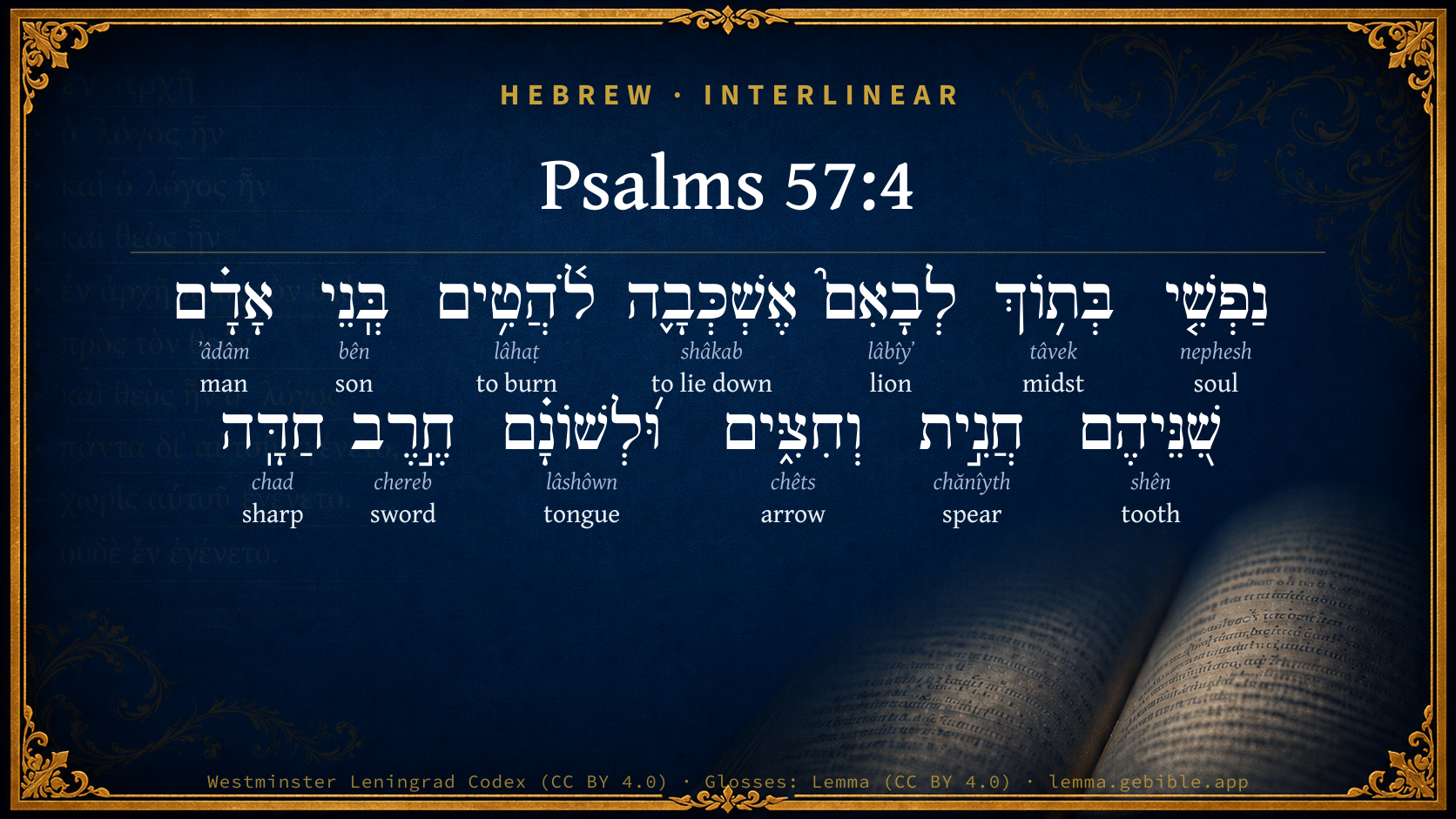
Hebrew (Westminster Leningrad Codex) Psalms 57:4 appears in the Hebrew Old Testament. The text above is from the Westminster Leningrad Codex. Each word links to its Strong’s number, a concise gloss, and parsing drawn from the Open Scriptures Hebrew Bible morphology. Click any word for its full Brown-Driver-Briggs (BDB) entry.
Download image
Cite this verse

Psalms 57:4 (World English Bible). Public Domain. Lemma interlinear Bible study tool, https://lemma.gebible.app/v/psalms/57/4.

Show BibTeX & RIS
BibTeX
RIS
English Translation
My soul is among lions. I lie among those who are set on fire, Even the sons of men, whose teeth are spears and arrows, And their tongue a sharp sword.
World English Bible · Public Domain
Highlights
  • 1 first appearance in the Hebrew Bible
Full analysis ↓
Download a study sheet

One document with this verse’s original text, its word-by-word gloss line, the meaning frame, cross-references with their text, attributed commentary, and full source and license credits — printable, and it pastes into notes with its structure intact.

This verse Autodidact and up

Study sheet (.html) Plain text (.txt)

A passage Seminary Student

Up to 50 verses in one chapter. A passage sheet keeps up to 6 commentary sources and 12 cross-references per verse, in the order this page ranks them, and says so on the sheet whenever that leaves anything out. Ask for a single verse and you get the Autodidact verse sheet above.

Everything on this page stays free to read, with no account — the sheet is a download of what is already on screen, not access to it.

Want to remove ads? Support Godless Engineer
Compare translations 3

The same verse in 3 English versions, stacked beneath the original-language interlinear above. Click any original word for its lexicon entry.

Each is an independent rendering of the whole verse — the interlinear is not word-aligned to these translations.

Highlighted words mark where these versions differ — a whole-verse word diff, not a word-by-word alignment.

  • World English Bible Public Domain
    My soul is among lions. I lie among those who are set on fire, Even the sons of men, whose teeth are spears and arrows, And their tongue a sharp sword.
  • King James Version Public Domain
    My soul is among lions: and I lie even among them that are set on fire, even the sons of men, whose teeth are spears and arrows, and their tongue a sharp sword.
  • unfoldingWord Literal Text CC BY-SA 4.0
    My soul in the midst of lions; I must lie down blazing ones, sons of man. Their teeth a spear and arrows, and their tongue a sharp sword.

unfoldingWord Literal Text — © unfoldingWord, licensed CC BY-SA 4.0. Word-aligned USFM3 via Door43 (git.door43.org/unfoldingWord/en_ult).

Versions to compare (up to 4)

3 of 4 selected

Show all 18 translations

Every available English version of this verse, each an independent rendering of the whole verse.

  • World English Bible Public Domain
    My soul is among lions. I lie among those who are set on fire, Even the sons of men, whose teeth are spears and arrows, And their tongue a sharp sword.
  • Berean Standard Bible Public Domain
    My soul is among the lions; I lie down with ravenous beasts—with men whose teeth are spears and arrows, whose tongues are sharp swords.
  • Majority Standard Bible Public Domain
    My soul is among the lions; I lie down with ravenous beasts—with men whose teeth are spears and arrows, whose tongues are sharp swords.
  • King James Version Public Domain
    My soul is among lions: and I lie even among them that are set on fire, even the sons of men, whose teeth are spears and arrows, and their tongue a sharp sword.
  • American Standard Version (1901) Public Domain
    My soul is among lions; I lie among them that are set on fire, Even the sons of men, whose teeth are spears and arrows, And their tongue a sharp sword.
  • Revised Version (1885) Public Domain
    My soul is among lions; I lie among them that are set on fire, even the sons of men, whose teeth are spears and arrows, and their tongue a sharp sword.
  • Geneva Bible (1599) Public Domain
    My soule is among lions: I lie among the children of men, that are set on fire: whose teeth are speares and arrowes, and their tongue a sharpe sworde.
  • Douay-Rheims (1899) Public Domain
    He hath sent from heaven and delivered me: he hath made them a reproach that trod upon me. God hath sent his mercy and his truth,
  • Young's Literal Translation Public Domain
    My soul `is' in the midst of lions, I lie down `among' flames -- sons of men, Their teeth `are' a spear and arrows, And their tongue a sharp sword.
  • Literal Standard Version CC BY-SA 4.0
    My soul [is] in the midst of lions, || I lie down [among] flames—sons of men, || Their teeth [are] a spear and arrows, || And their tongue a sharp sword.
  • Unlocked Literal Bible CC BY-SA 4.0
    My life is among lions; I am among those who are ready to devour me. I am among people whose teeth are spears and arrows, and whose tongues are sharp swords.
  • unfoldingWord Literal Text CC BY-SA 4.0
    My soul in the midst of lions; I must lie down blazing ones, sons of man. Their teeth a spear and arrows, and their tongue a sharp sword.
  • Darby Bible Public Domain
    My soul is in the midst of lions; I lie down [among] them that breathe out flames, the sons of men, whose teeth are spears and arrows, and their tongue a sharp sword.
  • World Messianic Bible Public Domain
    My soul is among lions. I lie among those who are set on fire, even the sons of men, whose teeth are spears and arrows, and their tongue a sharp sword.
  • Webster's Bible Public Domain
    \\57:3\\He shall send from heaven, and save me from the reproach of him that would swallow me up. Selah. God shall send forth his mercy and his truth.
  • Free Bible Version CC BY-SA 4.0
    I am surrounded by man-eating lions—I am forced to live with them! Their teeth are spears and arrows, and their tongues are swords.
  • Bible in Basic English Public Domain
    My soul is among lions; I am stretched out among those who are on fire, even the sons of men, whose teeth are spears and arrows, and whose tongue is a sharp sword.
  • JPS Tanakh (1917) Public Domain
    (57-5) My soul is among lions, I do lie down among them that are aflame; even the sons of men, whose teeth are spears and arrows, and their tongue a sharp sword.

Literal Standard Version (2020), Covenant Press — licensed CC BY-SA 4.0. Text via the HelloAO Bible API (eBible.org). Unlocked Literal Bible (unfoldingWord) — licensed CC BY-SA 4.0. Text via the HelloAO Bible API (eBible.org). unfoldingWord Literal Text — © unfoldingWord, licensed CC BY-SA 4.0. Word-aligned USFM3 via Door43 (git.door43.org/unfoldingWord/en_ult). Free Bible Version, Dr. Jonathan Gallagher — licensed CC BY-SA 4.0. Text via the HelloAO Bible API (eBible.org).

Word by word

More ways to search: Search by grammar → Find every occurrence → Compare this word →

Practice this passage: Drill this verse → Learn its vocabulary →

חַדָּֽה
chad
H2299
“sharp”
Adjective, Adjective, Feminine, Singular, Absolute
Part of Speech
Adjective
Type
Adjective
Gender
Feminine
Number
Singular
State
Absolute
Full BDB Definition

Origin: from H2300

TWOT: 605a

sharp
  1. נַפְשִׁ֤י nephesh H5315 “soul · my” Noun, Common, Both, Singular, Construct + Suffix, Personal, 1st Person, Common, Singular
  2. בְּת֥וֹךְ tâvek H8432 “in/at · midst of” Preposition + Noun, Common, Masculine, Singular, Construct
  3. לְבָאִם֮ lâbîyʼ H3833 “lions” Noun, Common, Both, Plural, Absolute
  4. אֶשְׁכְּבָ֪ה shâkab H7901 “to lie down” Verb, Qal, Cohortative, 1st Person, Common, Singular
  5. לֹ֫הֲטִ֥ים lâhaṭ H3857 “burning” Verb, Qal, Participle Active, Masculine, Plural, Absolute
  6. בְּֽנֵי bên H1121 “sons of” Noun, Common, Masculine, Plural, Construct
  7. אָדָ֗ם ʼâdâm H120 “man” Noun, Common, Masculine, Singular, Absolute
  8. שִׁ֭נֵּיהֶם shên H8127 “teeth · their” Noun, Common, Both, Dual, Construct + Suffix, Personal, 3rd Person, Masculine, Plural
  9. חֲנִ֣ית chănîyth H2595 “spear” Noun, Common, Feminine, Singular, Absolute
  10. וְחִצִּ֑ים chêts H2671 “and · arrows” Conjunction + Noun, Common, Masculine, Plural, Absolute
  11. וּ֝לְשׁוֹנָ֗ם lâshôwn H3956 “and · tongue · their” Conjunction + Noun, Common, Both, Singular, Construct + Suffix, Personal, 3rd Person, Masculine, Plural
  12. חֶ֣רֶב chereb H2719 “sword” Noun, Common, Feminine, Singular, Absolute

About this verse

These counts appear in no published source. They are computed here, from the morphology-tagged text and Lemma’s own curated glosses. What Lemma adds →

13
words
13
distinct lemmas
Wisdom
section

Notable vocabulary

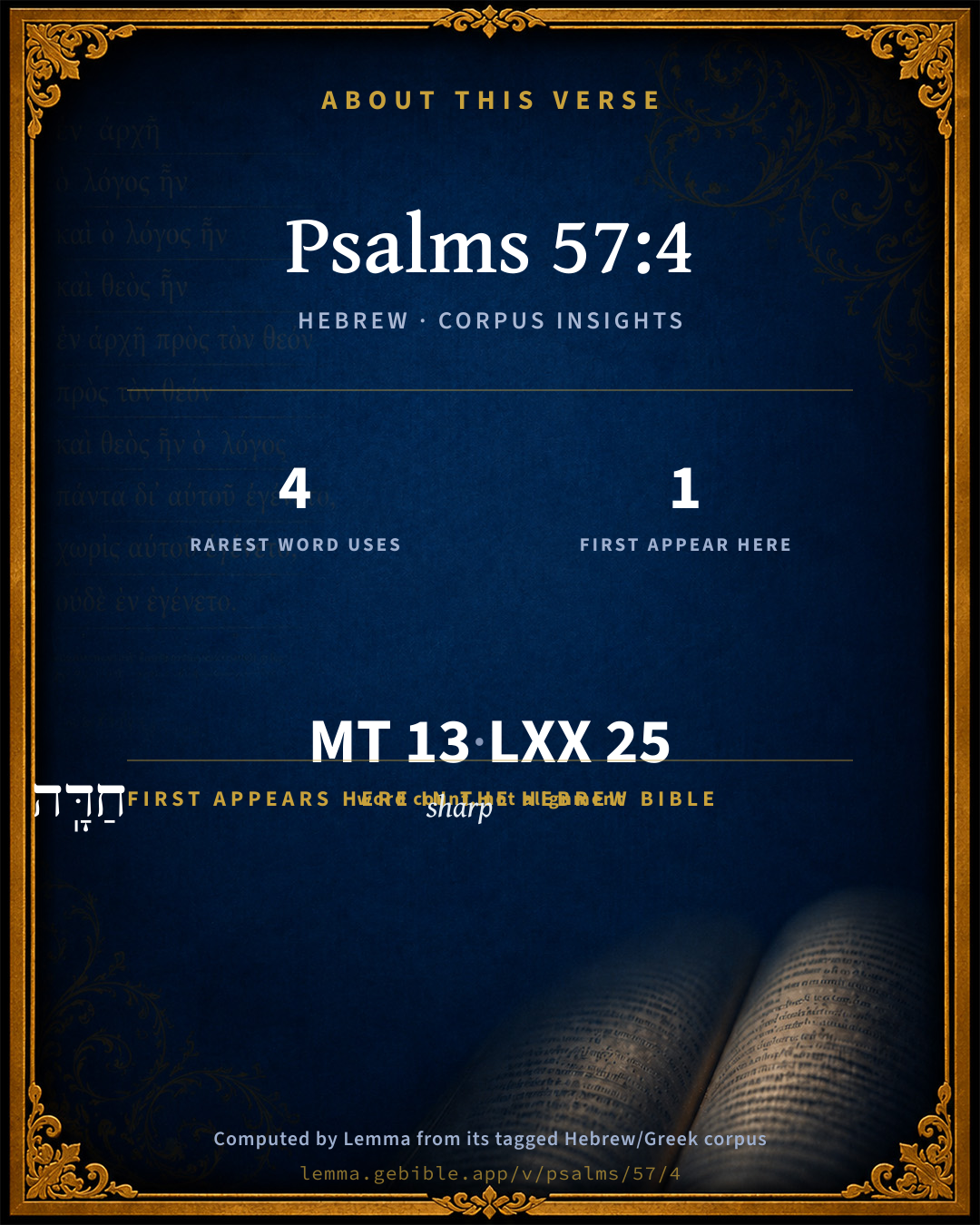
The rarest word here is חַדָּֽה sharp H2299 — appearing just 4 times in the whole Hebrew Bible.

First appearance in Scripture

This word makes its first canonical appearance in the Hebrew Bible here:

  • חַדָּֽה sharp H2299

Shared distinctive vocabulary

חַדָּֽה sharp H2299 occurs in 4 verses of the Hebrew Bible. Also found in:

Grammatical profile

  • 2 verbs
  • 10 nouns
  • 1 adjective

Verb forms

  • אֶשְׁכְּבָ֪ה Qal · Cohortative
  • לֹ֫הֲטִ֥ים Qal · Participle Active

Hebrew & Septuagint length

In English translation the verse runs 31 words from the Hebrew and 37 from the Septuagint (LXX English) — closely comparable.

A rough comparison of the two English renderings, which tokenize alike — not a word-level alignment.

Word counts can differ between the Hebrew and the Greek without any difference in meaning — e.g. the Hebrew direct-object marker אֵת has no separate Greek word, and Greek often adds the article ὁ.

In the original languages it is 13 Hebrew tokens and 25 Greek tokens — but the two are counted differently (Hebrew bundles its prefixes and suffixes into one token; the Greek is in lemma form), so that isn’t a like-for-like length.

Cross-references

18

Topical passages linked to Psalms 57:4 in the Treasury of Scripture Knowledge — connected by theme and wording, ordered by reader-vote popularity; previews shown in the World English Bible.

  • Psalms 58:6 Break their teeth, God, in their mouth. Break out the great teeth of the young lions, Yahweh.
  • Proverbs 30:14 There is a generation whose teeth are like swords, And their jaws like knives, To devour the poor from the earth, and the needy from among men.
  • Psalms 35:17 Lord, how long will you look on? Rescue my soul from their destruction, My precious life from the lions.
  • Psalms 55:21 His mouth was smooth as butter, But his heart was war. His words were softer than oil, Yet they were drawn swords.
  • Psalms 64:3 Who sharpen their tongue like a sword, And aim their arrows, deadly words,
  • Proverbs 12:18 There is one who speaks rashly like the piercing of a sword, But the tongue of the wise heals.
  • Psalms 52:2 Your tongue plots destruction, Like a sharp razor, working deceitfully.
  • Daniel 6:22–24 My God has sent his angel, and has shut the lions' mouths, and they have not hurt me; because as before him innocence was found in me; and also before you, O king, have I done no hurt.
  • John 4:10–11 Jesus answered her, "If you knew the gift of God, and who it is who says to you, 'Give me a drink,' you would have asked him, and he would have given you living water."
  • Judges 9:20 but if not, let fire come out from Abimelech, and devour the men of Shechem, and the house of Millo; and let fire come out from the men of Shechem, and from the house of Millo, and devour Abimelech.
  • Psalms 10:9 He lurks in secret as a lion in his ambush. He lies in wait to catch the helpless. He catches the helpless, when he draws him in his net.
  • Psalms 17:12–13 He is like a lion that is greedy of his prey, As it were a young lion lurking in secret places.
  • Psalms 59:7 Behold, they spew with their mouth. Swords are in their lips, "For," they say, "who hears us?"
  • Proverbs 25:18 A man who gives false testimony against his neighbor Is like a club, a sword, or a sharp arrow.
  • Proverbs 28:15 As a roaring lion or a charging bear, So is a wicked ruler over helpless people.
  • James 3:6 And the tongue is a fire. The world of iniquity among our members is the tongue, which defiles the whole body, and sets on fire the course of nature, and is set on fire by Gehenna.
  • Psalms 22:13–16 They open their mouths wide against me, Lions tearing prey and roaring.
  • Revelation 19:15 Out of his mouth proceeds a sharp, double-edged sword, that with it he should strike the nations. He will rule them with a rod of iron. He treads the winepress of the fierceness of the wrath of God, the Almighty.

Cross-references courtesy of OpenBible.info (CC BY 4.0).

Hebrew and Greek witnesses Masoretic Hebrew ↔ Greek Septuagint

The same verse in the two great witnesses to the Old Testament, shown verse-for-verse.

You’re reading Greek Psalm 56 (Hebrew Psalm 57). The Septuagint counts the superscription, so verse numbers can differ from the Hebrew — chapter-level alignment, not verse-by-verse. Numbering follows Rahlfs.

These are two independent witnesses, not word-aligned to each other, and the Septuagint is shown in lemma (dictionary) form.

Hebrew Psalms 57:4 Masoretic · Westminster Leningrad Codex

נַפְשִׁ֤י בְּת֥וֹךְ לְבָאִם֮ אֶשְׁכְּבָ֪ה לֹ֫הֲטִ֥ים בְּֽנֵי אָדָ֗ם שִׁ֭נֵּיהֶם חֲנִ֣ית וְחִצִּ֑ים וּ֝לְשׁוֹנָ֗ם חֶ֣רֶב חַדָּֽה

My soul is among lions. I lie among those who are set on fire, Even the sons of men, whose teeth are spears and arrows, And their tongue a sharp sword.

World English Bible · Public Domain

Greek LXX Greek Psalm 56:4 Septuagint · lemma form

ἐκ ἀποστέλλω ἐκ οὐρανός καί σώζω ἐγώ δίδωμι εἰς ὄνειδος ὁ καταπατέω ἐγώ διάψαλμα ἐκ ἀποστέλλω ὁ θεός ὁ ἔλεος αὐτός καί ὁ ἀλήθεια αὐτός

and he has delivered my soul from the midst of lions'whelps: I lay down to sleep, though troubled. As for the sons of men, their teeth are arms and missile weapons, and their tongue a sharp sword.

LXX2012 (modern English Septuagint) · Public Domain

On this verse, Ellicott's Commentary for English Readers discusses the Septuagint’s reading. Read the note in Commentary ↓

Hebrew: Westminster Leningrad Codex (CC BY 4.0). Greek: Septuagint (public domain); English from LXX2012 (modern English Septuagint) (Public Domain). How the Septuagint differs from the Hebrew →

Commentary

Notes on Psalms 57:4 from classic Christian and Jewish commentators (each source and its license shown beneath its notes). The classic Christian expositions comment on the surrounding passage and are grouped to its opening verse, so a note may address several verses; the Jewish commentaries on the Tanakh (Rashi and others) are per-verse, so they appear only where the commentator wrote on this verse.

Lemma curates 59 commentaries, every one of them public domain or Creative Commons licensed, each selected and text-cleaned for this edition rather than reprinted as found. About our sources →

Trapp's Complete Commentary

John Trapp

Psa 57:4 My soul [is] among lions: [and] I lie [even among] them that are set on fire, [even] the sons of men, whose teeth [are] spears and arrows, and their tongue a sharp sword.

Ver. 4. My soul is among lions] And so is a lively picture of the Church in all ages. Would any man take the Church’s picture, saith Luther? then let him paint a silly poor maid sitting in a wood or wilderness, compassed about with hungry lions, wolves, boars, and bears, &c. Talis est ecclesia in hac vita, sicut et in historia Danielis pingitur.

And I lie even among them that are set on fire] sc. With rage and hellish hatred. Others expound it actively, of those Ardeliones aulici, those court incendiaries, who enraged Saul and the nobles against David, as a traitor and pest. See 1Sa 24:10.

Even the sons of men] i.e. Carnal men, that, being in their pure naturals, have no goodness at all in them.

Whose teeth are spears and arrows] Such was Doeg, that dead dog, and others void of the Spirit, which is neque mendax, neque mordax.

John Trapp, A Commentary or Exposition upon All the Books of the Old and New Testament (1647–1656) — public domain. Text from a community e-Sword module.

The Biblical Illustrator

Joseph S. Exell

Psa_57:4

My soul is among lions.

Among lions

Some of you cannot say this, and you ought to be very thankful that you cannot. You live under very favourable circumstances. But there are many that are far less happily placed, and we are bound to remember them, and to sympathize with them. Now, when may a Christian man truly say, My soul is among lions? lie may say this when he is surrounded by those, whether in his home or place of business, who reproach and rebuke, jest and jeer at him, for Jesus Christs sake. Many are so placed. Now, I would speak to such as are amongst these lions--dogs would be almost a better name for them.

I. By way of comfort.

1. You will have fellowship with your Lord and His Church. He and they had to bear what you have, and far worse.

2. You should thereby be driven nearer to God. Be sure that you live near to God.

3. Endeavour to be very calm and happy. Take as little notice of the scoff as ever you can. Very seldom defend yourselves. The hammer strikes hard upon the anvil, but the anvil wears out many hammers.

4. Remember that the lions are chained. See the history of Daniel.

5. If your soul is among lions, there is another lion there--the lion of the tribe of Judah. The Covenanters have said that they never had such Sabbaths in Scotland as when they were hunted amongst the crags and glens by Claverhouses dragoons. Great power, then, attended the Word.

6. You will come out of the lions den unharmed. 7, And soon you shall be among the angels.

II. By way of advice.

1. If you dwell among lions do not irritate them. Some Christians do, and so have made matters bad for themselves. You cannot ram religion down peoples throats, or scold people into it.

2. Do not roar yourself. Do not meet railing with railing, hard words with hard words. Do not get soured in spirits. Overcome evil with good.

3. But do not be cowardly. A lion is afraid of a man if he looks him steadily in the face. Courage is what is wanted.

4. Do not go out alone among them--take your Lord with you.

5. If you feel very weak about it you may pray the Lord in His providence to move you to quieter quarters. But, better still--

6. Ask for grace to stop with the lions and tame them. Sometimes the Christian should say, God has made me strong, I will stop here and fight it out. My Master would have me go where I am most wanted, and so I will stay here. Do not be afraid of sinners, but seek to save them. (C. H. Spurgeon.)

The Biblical Illustrator, edited by Joseph S. Exell (c. 1880s–1900s) — public domain. Text from a community e-Sword module.

Joseph Benson's Commentary

Psa 57:4. My soul is among lions — I live in the midst of a generation of fierce and bloody men; I lie — That is, I have my abode; among them that are set on fire — Namely, of, or from hell, Jas 3:6, who are mere firebrands and incendiaries, that are continually breathing out their wrath and threatenings. Even the sons of men — Whereby he explains what he meant by lions, and tells us that they were beasts in the shape of men; whose teeth — With which they gnash upon me, and with which they would, as it were, tear me to pieces, or eat me up; are spears and arrows — Fitted for mischiefs and murders; and their tongue — With which they wound my reputation, and load me with their curses, is a sharp sword — To cut and give deadly wounds.

Joseph Benson's Commentary on the Old and New Testaments (1811–1818) — public domain. Text from a community e-Sword module.

J. A. Alexander on Psalms

Joseph Addison Alexander

5. (Psa 57:4). My soul (is) in the midst of lions; I will lie down (among) burning ones, sons of man, (whose) teeth (are) spears and arrows, and their tongue a sharp sword. By his soul he means himself, or rather his endangered life. Lions, as often elsewhere, means ferocious enemies. See above, on Psa 7:2; Psa 22:12-13. The form of the verb which follows is the one denoting fixed determination. "Though surrounded by lions I will fearlessly lie down," etc. Among or upon them. Burning may posibly refer to lions and mean raging; but the indefinite application is more natural. Sons of man is added to chew that what precedes is to be figuratively understood; but in the very next clause, the writer relapses into language still more highly metaphorical. In likening their teeth to swords he presents the double image of a wild beast and a warrior. The mention of the tongue has reference, no doubt, to the slander and abuse, which entered so largely into the Sauline persecutions. These had already been referred to in the middle clause of Psa 57:3, of which this may be regarded as an amplification.

Joseph Addison Alexander, The Psalms Translated and Explained (1850) — public domain. Text from a community e-Sword module.

Geneva Bible (1599)

Geneva Bible translators

He meaneth their calumnies and false reports.

Geneva Bible (1599) marginal notes — public domain. Text via Bolls.life.

Jamieson, Fausset & Brown

Robert Jamieson, A. R. Fausset & David Brown

The mingled figures of wild beasts (Psa 10:9; Psa 17:12) and weapons of war (Psa 11:2) heighten the picture of danger.

whose . . . tongue--or slanders.

Jamieson, Fausset & Brown — Commentary Critical and Explanatory on the Whole Bible (1871) — public domain (CC PDM 1.0). Text via the HelloAO Bible API.

Adam Clarke's Commentary

Verse 4. My soul is among lions] לבאם bethoch lebaim. I agree with Dr. Kennicott that this should be translated, "My soul dwells in parched places," from לאב laab, he thirsted. And thus the Chaldee seems to have understood the place, though it be not explicit.

I lie even among them that are set on fire] I seem to be among coals. It is no ordinary rage and malice by which I am pursued: each of my enemies seems determined to have my life.

Adam Clarke's Commentary on the Bible (1810–1826) — public domain. Text from a community e-Sword/MySword module.

John Calvin's Commentaries

4. My soul is among lions. He again insists upon the cruelty of his enemies as a plea to prevail with God for his speedier interposition. He compares them to lions, speaks of them as inflamed with fury or implacable hatred, and likens their teeth to spears and arrows. In what he says of their tongue, he alludes to the virulent calumnies which are vended by the wicked, and which inflict a deeper wound than any sword upon the innocent party who suffers from them. David, as is well known, encountered no heavier trial than the false and calumnious charges which were levelled against him by his enemies. When we hear of the cruel persecution of different kinds which this saint was called upon to endure, we should account it no hardship to be involved in the same conflict, but be satisfied so long as we may bring our complaints to the Lord, who can bridle the false tongue, and put an arrest upon the hand of violence.

John Calvin's Commentaries (1540-1563) — public domain. Text from the Calvin Translation Society English edition (1840s-50s) via the Christian Classics Ethereal Library (ccel.org). Calvin's coverage is partial (roughly two-thirds of the Bible); uncommented books and verses are honest gaps, never fabricated. The 19th-century editor's footnotes and remarks are omitted so the notes are faithfully Calvin's own voice.

Ellicott's Commentary for English Readers

(4) Them that are set on fire.—Rather, greedy ones (literally, lickers) in apposition to lions. The verse expresses the insecurity of the poet, who, his dwelling being in the midst of foes, must go to sleep every night with the sense of danger all round him. (See LXX.) How grandly the refrain in Psa_57:8 rises from such a situation.

A Bible Commentary for English Readers, edited by Charles John Ellicott (1878–1897) — public domain. Text from a community e-Sword module.

The Cambridge Bible for Schools and Colleges

gen. ed. J. J. S. Perowne

4. A difficult verse, the text of which is perhaps corrupt. Adhering to the punctuation (in the modern sense) of the Massoretic accents, we may render with R.V.,

My soul is among lions;

I lie among them that are set on fire,

Even the sons of men, &c.

i.e. virtually, as the marg., I must lie, an expression of despondent resignation. But the note of despair is out of harmony with the generally courageous and confident tone of the Psalm; and it is more in accordance with the usual force of the Heb. tense (the ‘cohortative’ or ‘voluntative’) to take I will lie down as expressive of strong resolution:

My soul is among lions;

I will lie down to rest among fiery foes,

Even the sons of men, &c.

Though my life is in momentary danger from savage enemies, I will lie down to rest (cp. Psa_4:8) among these fiery foes, secure under God’s protection. The Psalm is an evening hymn, for the Psalmist contemplates ‘waking the dawn’ with his praises (Psa_57:8). He lies down in danger, he awakes in safety: the night of trouble ends in the dawn of deliverance.

Delitzsch, rightly understanding the words as an expression of confidence, thinks that actual wild beasts are meant, among which he feels more secure than among his deadly foes; but this is scarcely probable.

Neglecting the accents we may render somewhat differently, With my life in my hands (so the idiomatic apposition ‘my soul, I’ may be paraphrased) I must lie down (or, I will lie down) among lions: fiery are the sons of men &c.; but the sense will be substantially the same. For lions as a metaphor for fierce and dangerous enemies cp. Psa_7:2 : Psa_10:9; Psa_17:12.

whose teeth] The language is suggested by the comparison of his enemies to lions.

their tongue &c.] The reference may be not so much to slander, as to the blasphemy of which he speaks in Psa_57:3, which pierces him to the heart. Cp. Psa_42:10. See also Psa_52:2 note; Psa_58:6; Psa_64:3; Pro_30:14.

The Cambridge Bible for Schools and Colleges (gen. ed. J. J. S. Perowne; Cambridge University Press, 1878–1918) — public domain. Text from a community e-Sword module.

John Gill's Exposition

My soul is among lions,.... Not literally understood; though such there might be in the wildernesses where he sometimes was; but figuratively, men comparable to lions, for their stoutness, courage, strength, fierceness, and cruelty; meaning not his own men, as some think, who were fierce, and of keen resentment against Saul, and would fain have killed him when he was in the cave, had they not been restrained by David, Sa1 24:4; but Saul, and those with him, who were three thousand chosen men, stout, courageous, fierce, and furious. It is usual in scripture to describe powerful princes, and especially persecuting ones, by the name of lions, Pro 28:15. Achilles, in Homer (o), is compared to a lion for his cruelty. The soul of Christ was among such, when he was apprehended by the band of men that came with Judas to take him; when he was in the high priest's hall buffeted and spit upon; and when he was in the common hall of Pilate, surrounded by the Roman soldiers; and when he was encircled on the cross with the crowd of the common people, priests and elders, Mat 26:55; and so the souls of his people are often among lions, persecuting men, and Satan and his principalities, who is compared to a roaring lion, Pe1 5:8; and among whom they are as wonderfully preserved as Daniel in the lion's den;

and I lie even among them that are set on fire; of hell, as the tongue is said to be in Jam 3:6; by the devil, who stirred up Saul against David, filled him with wrath and fury, so that he breathed out nothing but flaming vengeance, threatening and slaughter, against him; and by wicked men his courtiers, who kindled and stirred up the fire of contention between them; among these incendiaries, as Junius renders the word (p), David was, who inflamed the mind of Saul against him, which he suggests in Sa1 24:10;

even the sons of men, whose teeth are spears and arrows; whose words, formed by means of their teeth, were very devouring ones, Psa 52:4; were very piercing and wounding; calumnies, detractions, and backbitings, speaking against him when absent and at a distance, may be meant; see Pro 30:14;

and their tongue a sharp sword; See Gill on Psa 52:2; and there was a sort of swords called "lingulae", because in the shape of a tongue (q).

(o) Iliad. 24. v. 40, 41. (p) "incendiarios", Junius & Tremellius, Piscator; "flammantes", Gejerus, Michaelis; so Ainsworth, Cocceius, Vatablus, Musculus. (q) A. Gell. Noct. Attic. l. 10. c. 25.

John Gill's Exposition of the Whole Bible (1746–1763) — public domain (CC PDM 1.0). Text via the HelloAO Bible API.

Albert Barnes' Notes on the Bible

My soul is among lions - That is, among people who resemble lions; men, fierce, savage, ferocious.

And I lie even among them that are set on fire - We have a term of similar import in common use now, when we say that one is “inflamed” with passion, referring to one who is infuriated and enraged. So we speak of “burning” with rage or wrath - an expression derived, perhaps, from the inflamed “appearance” of a man in anger. The idea here is not that he “would” lie down calmly among those persons, as Prof. Alexander suggests, but that he actually “did” thus lie down. When he laid himself down at night, when he sought repose in sleep, he was surrounded by such persons, and seemed to be sleeping in the midst of them.

Even the sons of men - Yet they are not wild beasts, but “men” who seem to have the ferocious nature of wild beasts. The phrase, “sons of men,” is often used to denote men themselves.

Whose teeth are spears and arrows - Spears and arrows in their hands are what the teeth of wild beasts are.

And their tongue a sharp sword - The mention of the tongue here has reference, probably, to the abuse and slander to which he was exposed, and which was like a sharp sword that pierced even to the seat of life. See the notes at Psa 55:21.

Albert Barnes' Notes on the Bible (1834–1885) — public domain. Text from a community e-Sword/MySword module.

Matthew Poole's English Annotations

I live in the midst of a generation of fierce and bloody men; which both in Scripture and other authors are oft called lions.

I lie, I have my abode and conversation, even among (which particle is easily borrowed out of the foregoing clause)

them that are set on fire, to wit, of or from hell, as is fully expressed, Jam 3:6; who are mere fire-brands and incendiaries, that are continually breathing out their wrath and threatenings, and incensing Saul against me. The sons of men; whereby he explains what he meant by lions, and tells us they were beasts in the shape of men.

Teeth; which may be considered, either,

1. As instruments of destruction, as they are in lions. Or rather,

2. As instruments of speech, as they are in men; for it here follows by way of explication, as the manner is, and their tongue. And both seem to signify their wicked and pernicious calumnies, of which he every where complains, and particularly in the history to which this Psalm seems to relate, 1Sa 24:10, and by which they designed to promote his destruction.

Are spears and arrows, i.e. they grievously wound my name, and are devised to do me mischief.

Matthew Poole's English Annotations on the Holy Bible (1683–1685) — public domain. Text from a community e-Sword/MySword module.

The Treasury of David

Charles H. Spurgeon

Ver. 4. My soul is among lions. He was a very Daniel. Howled at, hunted, wounded, but not slain. His place was in itself one of extreme peril, and yet faith made him feel himself secure, so that he could lie down. The cave may have reminded him of a lion's den, and Saul and his band shouting and yelling in their disappointment at missing him, were the lions; yet beneath the divine shelter he finds himself safe.

And I lie even among them that are set on fire. Perhaps Saul and his band kindled a fire in the cavern while they halted in it, and David was thus reminded of the fiercer fire of their hate which burned within their hearts. Like the bush in Horeb, the believer is often in the midst of flames, but never consumed. It is a mighty triumph of faith when we can lie down even among firebrands and find rest, because God is our defence.

Even the sons of men, whose teeth are spears and arrows, and their tongue a sharp sword. Malicious men carry a whole armoury in their mouths; they have not harmless mouths, whose teeth grind their own food as in a mill, but their jaws are as mischievous as if every tooth were a javelin or an arrow. They have no molars, all their teeth are canines, and their nature is canine, leonine, wolfish, devilish. As for that busy member the tongue, in the case of the malicious, it is a two edged, keen, cutting, killing sword. The tongue, which is here compared to a sword, has the adjective sharp added to it, which is not used in reference to the teeth, which are compared to spears, as if to show that if men were actually to tear us with their teeth, like wild beasts, they could not thereby wound us so severely as they can do with their tongues. No weapon is so terrible as a tongue sharpened on the devil's grindstone; yet even this we need not fear, for "No weapon that is formed against thee shall prosper, and every tongue that riseth against thee in judgment thou shalt condemn."

Ver. 4. My soul is among lions. This may also be construed of the church, and that both in respect of her spiritual enemies and temporal. As for her ghostly foes, the devil is a roaring lion (1Pe 5:8), and our sins are the whelps of lions, ready to devour us. And concerning outward enemies, the church in this world is like Daniel in the lion's den, or as "the sucking child playing upon the hole of the asp." Isa 11:8. She hath here no visible power or outward help to fly to for succour, all her trust is in the Lord, and "under the shadow of his wings is her refuge, till this evil is overpast."... And surely, beloved, if the church had not any other enemies, but only these monstrous Antichrists of Rome, yet she might truly complain with our prophet here, My soul is among lions. Eleven popes had that name, whereof all, excepting two or three, were roaring lions in their Bulls, and ravening lions in seeking after their prey. Leo the tenth so pilled (Pill--peel, to pillage, plunder, strip) and polled (Poll, used synonymously with peel) the goodly nations of Germany with his unpardonable pardons and merciless indulgences, as that his insupportable cruelty gave the first occasion of the Reformation of religion in that country. John Boys.

Ver. 4. (first clause). Mudge translates literally, I lie with my soul amidst lionesses. This agrees with the opinion of Bochart, who thinks that the animals here intended are lionesses, properly, when giving suck to their young, a time when they are peculiarly fierce and dangerous, "nor need we wonder, "he observes, "that the lioness is reckoned among the fiercest lions; for the lioness equals, or even exceeds, the lion in strength and fierceness; "and this he proves from the testimonies of ancient writers. James Anderson's Note to Calvin in loc, 1846.

Ver. 4. And I lie even among them that are set on fire. The whole pith lies in the word hbkva, I will recline, which denotes a tranquil and secure condition of body and mind, like a man reclining and sleeping, as Ps 3:5; I laid me down and slept, I awaked; and lived composedly; Ps 4:9; I will both lay me down in peace, etc. Hermann Venema.

Ver. 4. The horrors of a lion's den, the burning of a fiery furnace, and the cruel onset of war, are the striking images by which David here describes the peril and wretchedness of his present condition. John Morison.

Ver. 4. My soul is among lions. How came I there? If for God's sake, then I may remember--

1. So was my Lord in the wilderness.

2. The lions are chained.

3. Their howling is all they can do.

4. I shall come out of their den alive, unhurt, honoured.

5. The Lion of Judah is with me.

6. I shall soon be among the angels.

Psalms 57:5*

Charles H. Spurgeon's The Treasury of David (1869–1885) — public domain. Psalms only. Text from a community e-Sword/MySword module.

Whedon's Commentary on the Bible

Daniel D. Whedon

4. Among lions— “Saul and his courtiers are here ‘lions’ to David, as were the kings of Asshur and Babel afterwards to Israel, (Jer_1:17,) the Roman emperor to Paul, (2Ti_4:17,) and all wicked rulers over the poor people, (Pro_28:15.)”—Ainsworth. The imagery of this verse is not unusual to David.

I lie—That is, I lie down to sleep.

Among them that are set on fire—Men inflamed with jealousy, envy, and malice. To lie down for rest in sorrow and fear was the emblem of calamity, (Job_7:4; Isa_50:11,) and the opposite of peace and happiness, (Lev_26:6; Job_11:19; Pro_3:24.)

Sharp sword—Malicious words cut deeper than the flesh.

Daniel D. Whedon (gen. ed.), Commentary on the Old and New Testaments (1874–1909) — public domain. Text from a community e-Sword module.

The Pulpit Commentary

My soul is among lions. (comp. Psa_7:2 Psa_10:9 Psa_17:12 Psa_22:21, etc.) And I lie even among them that are set on fire, even the sons of men literally, I lie on firebands, sons of menwhose teeth are spears and arrows, and their tongue a sharp sword. David occupies the cave (of Adullam?), while around him prowl lion-like men, whose fury is like that of firebrands, who threaten to devour him with their sharp teeth, and to pierce his soul with their cruel tongues.

The Pulpit Commentary (1880–1919), ed. H.D.M. Spence-Jones & Joseph S. Exell — public domain. Text from a community e-Sword module.

John Wesley's Explanatory Notes

Lions - Fierce and bloody men. I lie - I have my abode. On fire - From hell. Who are mere fire-brands, breathing out wrath and threatenings, and incensing Saul against me.

John Wesley, Explanatory Notes Upon the Whole Bible (1754–1765) — public domain. Text via the GEBible commentary corpus.

unfoldingWord translationNotes

Door43 World Missions Community

My life is among lions

The psalmist speaks of his enemies as if they were lions. AT: "I live among fierce enemies" or "Fierce enemies surround me like lions" (See: Metaphor)

those who are ready to devour me

Destroying is spoken of as devouring or eating something up. Some versions understand the Hebrew text to mean "fiery beasts." Both images speak of his enemies as if they were wild beasts. AT: "those who are ready to destroy me" (See: Metaphor)

people whose teeth are spears and arrows

The enemies' spears and arrows are spoken of as if they were lions' teeth. The psalmist continues to speak of his enemies as if they were lions. AT: "people who kill others with spears and arrows as lions kill with their sharp teeth" (See: Metaphor)

spears and arrows

Since both of these terms are weapons, if your culture knows only one, it is acceptable to use it alone. (See: Doublet)

whose tongues are sharp swords

The tongue represents what someone says, and the enemies' cruel words are spoken of as if they were swords. AT: "whose cruel words are like sharp swords" or "who cause terrible trouble for me by what they say" (See: Metaphor)

Be exalted, God, above the heavens

The psalmist is asking God to show that he is exalted. Being exalted above the heavens represents being great. AT: "God, show that you are exalted above the heavens" or "God, show that you are great in the heavens" (See: Metaphor)

let your glory be above all the earth

The psalmist is asking God to show his glory. AT: "show your glory over all the earth"

translationWords

life

lions

devour

spear

bow and arrow

tongue

sword

exalt

heaven

glory

earth

unfoldingWord translationNotes — © Distant Shores Media and the Door43 World Missions Community, licensed CC BY-SA 4.0. Source: git.door43.org/Door43/en_tn.

Rashi

Rabbi Shlomo Yitzchaki (Rashi)

from the disgrace of him who yearns to swallow me up And He will save me from the disgrace of ֹשֹאַפִי, who says to swallow me up, golosa moy in Old French, longs to swallow me up. (See above 56: 2.)

Rashi on the Tanakh — English translations: “The Judaica Press complete Tanach with Rashi, translated by A. J. Rosenberg” (CC BY 4.0); “Pentateuch with Rashi's commentary by M. Rosenbaum and A.M. Silbermann, 1929-1934” (public domain); “The Metsudah Tanach series, Lakewood, N.J” (CC BY 4.0); and “The Book of Joshua, Metsudah Publications, 1997” (CC BY 4.0). Text via Sefaria.

Lesson kit

Teaching starters — assembled from the data on this page, not authored interpretation. Every prompt links to the verse data it draws on. Edit before teaching.

Psalms, in the Wisdom, opens this verse with 13 words (13 distinct Hebrew lemmas). Its most distinctive word is chad (“sharp”). A historical commentator’s framing appears above. Read the whole chapter for the surrounding context.

Discussion questions

  1. How does “sharp” (chad) shape what this verse is saying?
  2. The word “sharp” first appears here in Scripture. What is being introduced at this debut?
  3. Proverbs 5:4 shares the word «sharp» with this verse. How do the two illuminate each other?
  4. These translations render this verse differently; the difference is in the English rendering, not the original. What questions does that raise?
  5. The verb «אֶשְׁכְּבָ֪ה» is Qal Cohortative. How does its form color the action?
  6. Reading how Trapp's Complete Commentary and The Biblical Illustrator read this verse, where do the two commentators agree and where do they part?

Things to notice

Reading settings

Reading text

Shown beneath each verse's original-language words.

Old Testament
Old Testament edition

Read the OT as the Masoretic Hebrew (MT) or the Greek Septuagint (LXX).

English shown for the Greek Septuagint (in the Hebrew ↔ Greek comparison).

Comparing translations? Open the Compare panel on any verse page to stack up to four side by side.