
1 Kings 19:10

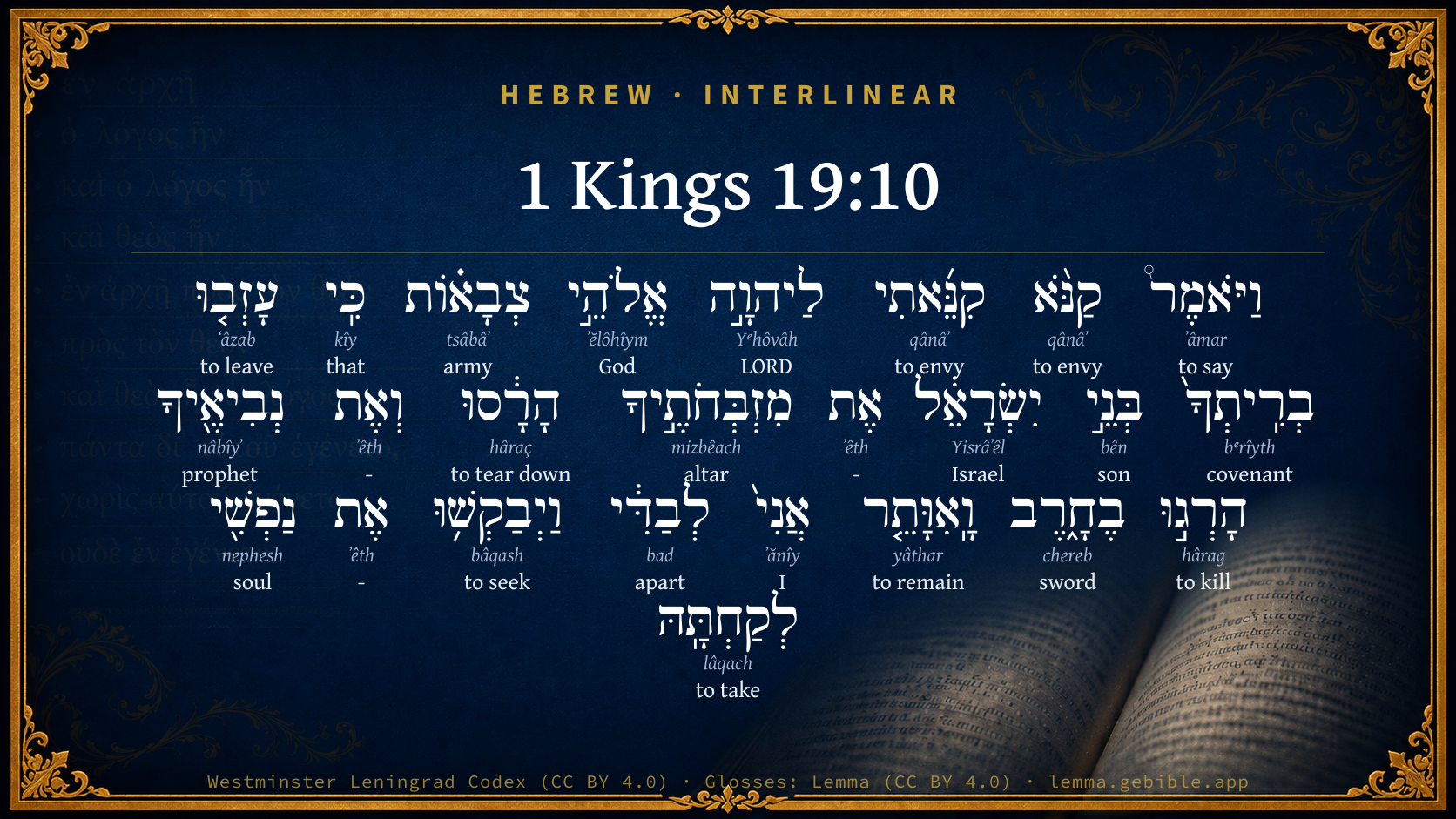
Hebrew (Westminster Leningrad Codex) 1 Kings 19:10 appears in the Hebrew Old Testament. The text above is from the Westminster Leningrad Codex. Each word links to its Strong’s number, a concise gloss, and parsing drawn from the Open Scriptures Hebrew Bible morphology. Click any word for its full Brown-Driver-Briggs (BDB) entry.
Download image
Cite this verse

1 Kings 19:10 (World English Bible). Public Domain. Lemma interlinear Bible study tool, https://lemma.gebible.app/v/1-kings/19/10.

Show BibTeX & RIS
BibTeX
RIS
English Translation
He said, I have been very jealous for Yahweh, the God of hosts; for the children of Israel have forsaken your covenant, thrown down your altars, and slain your prophets with the sword: and I, even I only, am left; and they seek my life, to take it away.
World English Bible · Public Domain
Download a study sheet

One document with this verse’s original text, its word-by-word gloss line, the meaning frame, cross-references with their text, attributed commentary, and full source and license credits — printable, and it pastes into notes with its structure intact.

This verse Autodidact and up

Study sheet (.html) Plain text (.txt)

A passage Seminary Student

Up to 50 verses in one chapter. A passage sheet keeps up to 6 commentary sources and 12 cross-references per verse, in the order this page ranks them, and says so on the sheet whenever that leaves anything out. Ask for a single verse and you get the Autodidact verse sheet above.

Everything on this page stays free to read, with no account — the sheet is a download of what is already on screen, not access to it.

Want to remove ads? Support Godless Engineer
Compare translations 3

The same verse in 3 English versions, stacked beneath the original-language interlinear above. Click any original word for its lexicon entry.

Each is an independent rendering of the whole verse — the interlinear is not word-aligned to these translations.

Highlighted words mark where these versions differ — a whole-verse word diff, not a word-by-word alignment.

  • World English Bible Public Domain
    He said, I have been very jealous for Yahweh, the God of hosts; for the children of Israel have forsaken your covenant, thrown down your altars, and slain your prophets with the sword: and I, even I only, am left; and they seek my life, to take it away.
  • King James Version Public Domain
    And he said, I have been very jealous for the LORD God of hosts: for the children of Israel have forsaken thy covenant, thrown down thine altars, and slain thy prophets with the sword; and I, even I only, am left; and they seek my life, to take it away.
  • unfoldingWord Literal Text CC BY-SA 4.0
    And he said, “Being jealous, I have been jealous for Yahweh, the God of Armies, for the sons of Israel have forsaken your covenant, they have torn down your altars, and they have killed your prophets with the sword. And I am left, I alone, and they seek my life, to take it.”

unfoldingWord Literal Text — © unfoldingWord, licensed CC BY-SA 4.0. Word-aligned USFM3 via Door43 (git.door43.org/unfoldingWord/en_ult).

Versions to compare (up to 4)

3 of 4 selected

Show all 18 translations

Every available English version of this verse, each an independent rendering of the whole verse.

  • World English Bible Public Domain
    He said, I have been very jealous for Yahweh, the God of hosts; for the children of Israel have forsaken your covenant, thrown down your altars, and slain your prophets with the sword: and I, even I only, am left; and they seek my life, to take it away.
  • Berean Standard Bible Public Domain
    “I have been very zealous for the LORD, the God of Hosts,” he replied, “but the Israelites have forsaken Your covenant, torn down Your altars, and killed Your prophets with the sword. I am the only one left, and they are seeking my life as well.”
  • Majority Standard Bible Public Domain
    “I have been very zealous for the LORD, the God of Hosts,” he replied, “but the Israelites have forsaken Your covenant, torn down Your altars, and killed Your prophets with the sword. I am the only one left, and they are seeking my life as well.”
  • King James Version Public Domain
    And he said, I have been very jealous for the LORD God of hosts: for the children of Israel have forsaken thy covenant, thrown down thine altars, and slain thy prophets with the sword; and I, even I only, am left; and they seek my life, to take it away.
  • American Standard Version (1901) Public Domain
    And he said, I have been very jealous for Jehovah, the God of hosts; for the children of Israel have forsaken thy covenant, thrown down thine altars, and slain thy prophets with the sword: and I, even I only, am left; and they seek my life, to take it away.
  • Revised Version (1885) Public Domain
    And he said, I have been very jealous for the LORD, the God of hosts; for the children of Israel have forsaken thy covenant, thrown down thine altars, and slain thy prophets with the sword: and I, even I only, am left; and they seek my life, to take it away.
  • Geneva Bible (1599) Public Domain
    And he answered, I haue bene very ielous for the Lord God of hostes: for the children of Israel haue forsaken thy couenant, broken downe thine altars, and slayne thy Prophets with the sword, and I onely am left, and they seeke my life to take it away.
  • Douay-Rheims (1899) Public Domain
    And he answered: With zeal have I been zealous for the Lord God of hosts: for the children of Israel have forsaken thy covenant: they have thrown down thy altars, they have slain thy prophets with the sword, and I alone am left, and they seek my life to take it away.
  • Young's Literal Translation Public Domain
    And he saith, `I have been very zealous for Jehovah, God of Hosts, for the sons of Israel have forsaken Thy covenant -- Thine altars they have thrown down, and Thy prophets they have slain by the sword, and I am left, I, by myself, and they seek my life -- to take it.'
  • Literal Standard Version CC BY-SA 4.0
    And he says, “I have been very zealous for YHWH, God of Hosts, for the sons of Israel have forsaken Your covenant—they have thrown down Your altars, and they have slain Your prophets by the sword, and I am left, I, by myself, and they seek my life—to take it.”
  • Unlocked Literal Bible CC BY-SA 4.0
    Elijah replied, “I have been very zealous for Yahweh, God of hosts, for the people of Israel have forsaken your covenant, destroyed your altars, and killed your prophets with the sword. Now I, only I, am left and they are also trying to take my life.”
  • unfoldingWord Literal Text CC BY-SA 4.0
    And he said, “Being jealous, I have been jealous for Yahweh, the God of Armies, for the sons of Israel have forsaken your covenant, they have torn down your altars, and they have killed your prophets with the sword. And I am left, I alone, and they seek my life, to take it.”
  • Darby Bible Public Domain
    And he said, I have been very jealous for Jehovah the God of hosts; for the children of Israel have forsaken thy covenant, thrown down thine altars, and slain thy prophets with the sword; and I am left, I alone, and they seek my life, to take it away.
  • World Messianic Bible Public Domain
    He said, “I have been very jealous for the LORD, the God of Hosts; for the children of Israel have forsaken your covenant, thrown down your altars, and killed your prophets with the sword. I, even I only, am left; and they seek my life, to take it away.”
  • Webster's Bible Public Domain
    And he said, I have been very jealous for the LORD God of hosts: for the children of Israel have forsaken thy covenant, thrown down thy altars, and slain thy prophets with the sword; and I, I only, am left; and they seek my life to take it away.
  • Free Bible Version CC BY-SA 4.0
    “I have worked passionately for the Lord God Almighty,” he replied. “But the Israelites have abandoned your agreement, torn down your altars, and killed your prophets with the sword. I am the only one who's left, and they are trying to kill me as well.”
  • Bible in Basic English Public Domain
    And he said, I have been burning for the honour of the Lord, the God of armies; for the children of Israel have not kept your agreement; they have made destruction of your altars, and have put your prophets to death with the sword: till I, even I, am the only one living; and now they are attempting to take away my life.
  • JPS Tanakh (1917) Public Domain
    And he said: 'I have been very jealous for the LORD, the God of hosts; for the children of Israel have forsaken Thy covenant, thrown down Thine altars, and slain Thy prophets with the sword; and I, even I only, am left; and they seek my life, to take it away.'

Literal Standard Version (2020), Covenant Press — licensed CC BY-SA 4.0. Text via the HelloAO Bible API (eBible.org). Unlocked Literal Bible (unfoldingWord) — licensed CC BY-SA 4.0. Text via the HelloAO Bible API (eBible.org). unfoldingWord Literal Text — © unfoldingWord, licensed CC BY-SA 4.0. Word-aligned USFM3 via Door43 (git.door43.org/unfoldingWord/en_ult). Free Bible Version, Dr. Jonathan Gallagher — licensed CC BY-SA 4.0. Text via the HelloAO Bible API (eBible.org).

Word by word

More ways to search: Search by grammar → Find every occurrence → Compare this word →

Practice this passage: Drill this verse → Learn its vocabulary →

קַנֹּ֨א
qânâʼ
H7065
“to envy”
Verb, Piel, Infinitive Absolute
Part of Speech
Verb
Stem
Piel
Form
Infinitive Absolute
Full BDB Definition

Origin: a primitive root

TWOT: 2038

to envy, be jealous, be envious, be zealous - (Piel) - to be jealous of - to be envious of - to be zealous for - to excite to jealous anger - (Hiphil) to provoke to jealous anger, cause jealousy
  1. וַיֹּאמֶר֩ ʼâmar H559 “and · to say” Conjunction + Verb, Qal, Sequential Imperfect, 3rd Person, Masculine, Singular
  2. קִנֵּ֜אתִי qânâʼ H7065 “to envy” Verb, Piel, Perfect, 1st Person, Common, Singular
  3. לַיהוָ֣ה Yᵉhôvâh H3068 “to/for · LORD” Preposition + Noun, Proper
  4. אֱלֹהֵ֣י ʼĕlôhîym H430 “God(s) of” Noun, Common, Masculine, Plural, Construct
  5. צְבָא֗וֹת tsâbâʼ H6635 “armies” Noun, Common, Both, Plural, Absolute
  6. כִּֽי kîy H3588 “that” Conjunction
  7. עָזְב֤וּ ʻâzab H5800 “to leave” Verb, Qal, Perfect, 3rd Person, Common, Plural
  8. בְרִֽיתְךָ֙ bᵉrîyth H1285 “covenant · your” Noun, Common, Feminine, Singular, Construct + Suffix, Personal, 2nd Person, Masculine, Singular
  9. בְּנֵ֣י bên H1121 “sons of” Noun, Common, Masculine, Plural, Construct
  10. יִשְׂרָאֵ֔ל Yisrâʼêl H3478 “Israel” Noun, Proper
  11. אֶת ʼêth H853 “-” Particle, Direct Object
  12. מִזְבְּחֹתֶ֣יךָ mizbêach H4196 “altars · your” Noun, Common, Masculine, Plural, Construct + Suffix, Personal, 2nd Person, Masculine, Singular
  13. הָרָ֔סוּ hâraç H2040 “to tear down” Verb, Qal, Perfect, 3rd Person, Common, Plural
  14. וְאֶת ʼêth H853 “and · -” Conjunction + Particle, Direct Object
  15. נְבִיאֶ֖יךָ nâbîyʼ H5030 “prophets · your” Noun, Common, Masculine, Plural, Construct + Suffix, Personal, 2nd Person, Masculine, Singular
  16. הָרְג֣וּ hârag H2026 “to kill” Verb, Qal, Perfect, 3rd Person, Common, Plural
  17. בֶחָ֑רֶב chereb H2719 “in/at the · sword” Preposition, Determined + Noun, Common, Feminine, Singular, Absolute
  18. וָֽאִוָּתֵ֤ר yâthar H3498 “and · to remain” Conjunction + Verb, Niphal, Sequential Imperfect, 1st Person, Common, Singular
  19. אֲנִי֙ ʼănîy H589 “I” Pronoun, Personal, 1st Person, Common, Singular
  20. לְבַדִּ֔י bad H905 “to/for · apart · my” Preposition + Noun, Common, Masculine, Singular, Construct + Suffix, Personal, 1st Person, Common, Singular
  21. וַיְבַקְשׁ֥וּ bâqash H1245 “and · to seek” Conjunction + Verb, Piel, Sequential Imperfect, 3rd Person, Masculine, Plural
  22. אֶת ʼêth H853 “-” Particle, Direct Object
  23. נַפְשִׁ֖י nephesh H5315 “soul · my” Noun, Common, Both, Singular, Construct + Suffix, Personal, 1st Person, Common, Singular
  24. לְקַחְתָּֽהּ lâqach H3947 “to take · her” Preposition + Verb, Qal, Infinitive Construct + Suffix, Personal, 3rd Person, Feminine, Singular

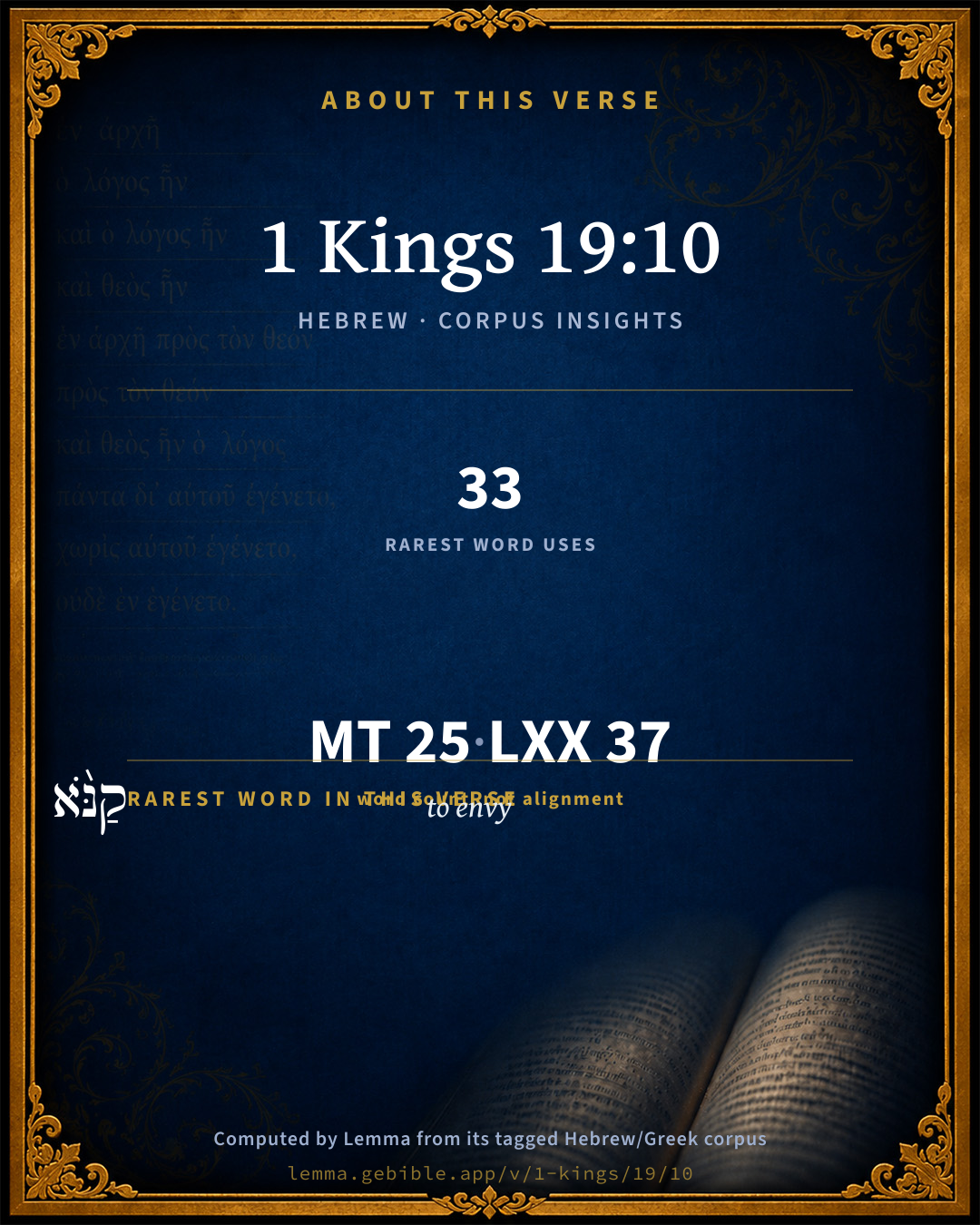
About this verse

These counts appear in no published source. They are computed here, from the morphology-tagged text and Lemma’s own curated glosses. What Lemma adds →

25
words
22
distinct lemmas
Historical
section

Shared distinctive vocabulary

קַנֹּ֨א to envy H7065 occurs in 28 verses of the Hebrew Bible. Also found in:

Grammatical profile

  • 9 verbs
  • 11 nouns
  • 1 pronoun
  • 1 conjunction
  • 3 particles

Verb forms

  • וַיֹּאמֶר֩ Qal · Sequential Imperfect
  • קַנֹּ֨א Piel · Infinitive Absolute
  • קִנֵּ֜אתִי Piel · Perfect
  • עָזְב֤וּ Qal · Perfect
  • הָרָ֔סוּ Qal · Perfect
  • הָרְג֣וּ Qal · Perfect
  • וָֽאִוָּתֵ֤ר Niphal · Sequential Imperfect
  • וַיְבַקְשׁ֥וּ Piel · Sequential Imperfect
  • לְקַחְתָּֽהּ Qal · Infinitive Construct

Repetition

A word recurs within this verse — often emphatic in Hebrew:

  • קַנֹּ֨א to envy H7065 ×2

Hebrew & Septuagint length

In English translation the verse runs 49 words from the Hebrew and 48 from the Septuagint (LXX English) — closely comparable.

A rough comparison of the two English renderings, which tokenize alike — not a word-level alignment.

Word counts can differ between the Hebrew and the Greek without any difference in meaning — e.g. the Hebrew direct-object marker אֵת has no separate Greek word, and Greek often adds the article ὁ.

In the original languages it is 25 Hebrew tokens and 37 Greek tokens — but the two are counted differently (Hebrew bundles its prefixes and suffixes into one token; the Greek is in lemma form), so that isn’t a like-for-like length.

Cross-references

25

Topical passages linked to 1 Kings 19:10 in the Treasury of Scripture Knowledge — connected by theme and wording, ordered by reader-vote popularity; previews shown in the World English Bible.

  • 1 Kings 18:4 for it was so, when Jezebel cut off the prophets of Yahweh, that Obadiah took one hundred prophets, and hid them by fifty in a cave, and fed them with bread and water.)
  • Exodus 34:14 for you shall worship no other god: for Yahweh, whose name is Jealous, is a jealous God.
  • Exodus 20:5 you shall not bow yourself down to them, nor serve them, for I, Yahweh your God, am a jealous God, visiting the iniquity of the fathers on the children, on the third and on the fourth generation of those who hate me,
  • 1 Kings 18:22 Then Elijah said to the people, "I, even I only, am left a prophet of Yahweh; but Baal's prophets are four hundred fifty men.
  • 1 Kings 18:30 Elijah said to all the people, Come near to me; and all the people came near to him. He repaired the altar of Yahweh that was thrown down.
  • Romans 11:2–4 God didn't reject his people, which he foreknew. Or don't you know what the Scripture says about Elijah? How he pleads with God against Israel:
  • Numbers 25:11 Phinehas, the son of Eleazar, the son of Aaron the priest, has turned my wrath away from the children of Israel, in that he was jealous with my jealousy among them, so that I didn't consume the children of Israel in my jealousy.
  • Numbers 25:13 and it shall be to him, and to his seed after him, the covenant of an everlasting priesthood; because he was jealous for his God, and made atonement for the children of Israel.
  • 1 Kings 18:10 As Yahweh your God lives, there is no nation or kingdom, where my lord has not sent to seek you: and when they said, He is not here, he took an oath of the kingdom and nation, that they didn't find you.
  • 1 Kings 18:17 It happened, when Ahab saw Elijah, that Ahab said to him, Is it you, you troubler of Israel?
  • 1 Kings 18:20 So Ahab sent to all the children of Israel, and gathered the prophets together to Mount Carmel.
  • 1 Kings 19:2 Then Jezebel send a messenger to Elijah, saying, So let the gods do to me, and more also, if I don't make your life as the life of one of them by tomorrow about this time.
  • 1 Kings 19:14 He said, I have been very jealous for Yahweh, the God of hosts; for the children of Israel have forsaken your covenant, thrown down your altars, and slain your prophets with the sword; and I, even I only, am left; and they seek my life, to take it away.
  • 1 Kings 20:41–42 He hurried, and took the headband away from his eyes; and the king of Israel discerned him that he was of the prophets.
  • 1 Kings 22:8 The king of Israel said to Jehoshaphat, there is yet one man by whom we may inquire of Yahweh, Micaiah the son of Imlah: but I hate him; for he does not prophesy good concerning me, but evil. Jehoshaphat said, "Don't let the king say so."
  • Psalms 69:9 For the zeal of your house consumes me. The reproaches of those who reproach you have fallen on me.
  • Psalms 119:139 My zeal wears me out, Because my enemies ignore your words.
  • Jeremiah 2:30 In vain have I struck your children; they received no correction: your own sword has devoured your prophets, like a destroying lion.
  • Hosea 5:11 Ephraim is oppressed, He is crushed in judgment; Because he is intent in his pursuit of idols.
  • Micah 6:16 For the statutes of Omri are kept, And all the works of the house of Ahab. You walk in their counsels, That I may make you a ruin, And her inhabitants a hissing; And you will bear the reproach of my people."
  • Micah 7:2 The godly man has perished out of the earth, And there is no one upright among men. They all lie in wait for blood; Every man hunts his brother with a net.
  • John 2:17 His disciples remembered that it was written, "Zeal for your house will eat me up."
  • 1 Kings 20:13 Behold, a prophet came near to Ahab king of Israel, and said, Thus says Yahweh, Have you seen all this great multitude? behold, I will deliver it into your hand this day; and you shall know that I am Yahweh.
  • 1 Kings 20:22 The prophet came near to the king of Israel, and said to him, Go, strengthen yourself, and mark, and see what you do; for at the return of the year the king of Syria will come up against you.
  • 1 Kings 20:35 A certain man of the sons of the prophets said to his fellow by the word of Yahweh, Please strike me. The man refused to strike him.

Cross-references courtesy of OpenBible.info (CC BY 4.0).

Hebrew and Greek witnesses Masoretic Hebrew ↔ Greek Septuagint

The same verse in the two great witnesses to the Old Testament, shown verse-for-verse.

These are two independent witnesses, not word-aligned to each other, and the Septuagint is shown in lemma (dictionary) form.

Hebrew 1 Kings 19:10 Masoretic · Westminster Leningrad Codex

וַיֹּאמֶר֩ קַנֹּ֨א קִנֵּ֜אתִי לַיהוָ֣ה אֱלֹהֵ֣י צְבָא֗וֹת כִּֽי עָזְב֤וּ בְרִֽיתְךָ֙ בְּנֵ֣י יִשְׂרָאֵ֔ל אֶת מִזְבְּחֹתֶ֣יךָ הָרָ֔סוּ וְאֶת נְבִיאֶ֖יךָ הָרְג֣וּ בֶחָ֑רֶב וָֽאִוָּתֵ֤ר אֲנִי֙ לְבַדִּ֔י וַיְבַקְשׁ֥וּ אֶת נַפְשִׁ֖י לְקַחְתָּֽהּ

He said, I have been very jealous for Yahweh, the God of hosts; for the children of Israel have forsaken your covenant, thrown down your altars, and slain your prophets with the sword: and I, even I only, am left; and they seek my life, to take it away.

World English Bible · Public Domain

Greek LXX 1 Kings 19:10 Septuagint · lemma form

καί εἶπον ηλιου ζνλόω ζηλόω ὁ κύριος παντοκράτωρ ὅτι ἐν καταλείπω σύ ὁ υἱός ἰσραήλ ὁ θυσιαστήριον σύ κατασκάπτω καί ὁ προφήτης σύ ἀποκτείνω ἐν ῥομφαία καί ὑπολείπω ἐγώ μόνος καί ζητέω ὁ ψυχή ἐγώ λαμβάνω αὐτός

And Eliu said, I have been very jealous for the Lord Almighty, because the children of Israel have forsaken you: they have digged down your altars, and have slain your prophets with the sword; and I only am left alone, and they seek my life to take it.

LXX2012 (modern English Septuagint) · Public Domain

On this verse, The Cambridge Bible for Schools and Colleges discusses the Septuagint’s reading. Read the note in Commentary ↓

Hebrew: Westminster Leningrad Codex (CC BY 4.0). Greek: Septuagint (public domain); English from LXX2012 (modern English Septuagint) (Public Domain). How the Septuagint differs from the Hebrew →

Targum (Aramaic paraphrase)

1

The Targum is the ancient Jewish Aramaic paraphrase of the Hebrew Scriptures — an interpretive translation, not the Hebrew text itself. Onkelos (literal) and Pseudo-Jonathan (expansive) render the Torah, and Jonathan the Prophets. Coverage is partial: where no permissively-licensed English translation exists for a verse, only the Aramaic is shown. This is verse-level text, not a word-by-word alignment to the Hebrew.

  1. Targum Jonathan Prophets (Joshua–Malachi)
    וַאֲמַר קַנָאָה קַנֵיתִי קֳדָם יְיָ אֱלָהָא צְבָאוֹת אֲרֵי שְׁבַקוּ קְיָמָךְ בְּנֵי יִשְׂרָאֵל יַת מַדְבְּחָךְ פָּגָרוּ וְיַת נְבִיָיךְ קְטַלוּ בְּחַרְבָּא וְאִשְׁתַּאֲרִית אֲנָא בִלְחוֹדִי וּבְעוֹ יַת נַפְשִׁי לְמִקְטְלָהּ:

    (no public-domain English translation for this verse)

    Targum Jonathan — Aramaic: “Mikraot Gedolot” (public domain). English: “Sefaria Community Translation” (CC0 1.0 (public-domain dedication)); “London "Chaldee Paraphrase," 1871” (public domain). Text via Sefaria.

Commentary

Notes on 1 Kings 19:10 from classic Christian and Jewish commentators (each source and its license shown beneath its notes). The classic Christian expositions comment on the surrounding passage and are grouped to its opening verse, so a note may address several verses; the Jewish commentaries on the Tanakh (Rashi and others) are per-verse, so they appear only where the commentator wrote on this verse.

Lemma curates 59 commentaries, every one of them public domain or Creative Commons licensed, each selected and text-cleaned for this edition rather than reprinted as found. About our sources →

Trapp's Complete Commentary

John Trapp

1Ki 19:10 And he said, I have been very jealous for the LORD God of hosts: for the children of Israel have forsaken thy covenant, thrown down thine altars, and slain thy prophets with the sword; and I, [even] I only, am left; and they seek my life, to take it away.

Ver. 10. And he said, I have been very jealous.] Or, Zealous. Zelando zelavi: vel crucior in honorem Dei quadam quasi zelotypia: it irketh me to see God’s spouse so play the harlot. Where it is well observed, {a} that the prophet - herein also too much a man - had rather say, I have been jealous for the Lord God of hosts, than I have been fearful of Jezebel; and here I hide my head from her malicious pursuit. We are all willing to make the best of our own case.

For the children of Israel have forsaken thy covenant.] Here, Elijah maketh "intercession to God against Israel." {Rom 11:2} Woe be to that people that putteth a godly minister to this unpleasing task: and to sing as the poet, -

“ Eheu quam pingui macer est mihi taurus in arvo! ”

{a} Bp. Hall.

John Trapp, A Commentary or Exposition upon All the Books of the Old and New Testament (1647–1656) — public domain. Text from a community e-Sword module.

The Biblical Illustrator

Joseph S. Exell

1Ki_19:10

I have been very jealous for the Lord God of Hosts.

Impatience of results

In moments of depression the wisest may fall into it, but it is nevertheless a mistake, as the following observations by Dr. Storrs suggest: I do not see the cathedral as yet, when I go into the confused quarry-yard and see there the half-wrought stones, the clumsy blocks that are by and by to be decorated capitals. But when at last they are finished in form and brought together, the mighty building rises in the air, an ever-enduring psalm in rock. I do not see the picture yet, when I look upon the palette, with its blotches and stains and lumps of colour. By and by, when the skilful brush of the painter has distributed those colours, I see the radiant beauty of the Madonna, the pathos of the Magdalene. I do not see yet the perfect kingdom of God upon the earth, but I see the colours which are to blend in it. I see the already half-chiselled rock out of which it shall be wrought, and I am not going to despond now, when so much already has been accomplished.

I, even I only, am left.--

Gods cure for depression

That is how God encouraged a brave worker in his moment of depression. The signs of the time were ominous. Ahab sat upon the throne, with an unscrupulous and powerful queen by his side. A corrupt court had produced a corrupt nation. Israel had denied her high and singular election, and had vaunted her infidelity in the face of Heaven. No wonder the prophet seeks the end of his pathetic and apparently ineffective ministry. I, even I only, am left. But he was mistaken. There was more goodness in the nation than he perceived. Gods reply was, I have left Me seven thousand in Israel. A needed word this for worked in every age, perhaps never more needed than to-day. This is a great age for publicity. Our work is done on the platform as never before. In politics, in social reform, in philanthropy, we estimate our strength by the number who join our processions and attend our demonstrations. It can scarcely be said of organised religion, It does not cry, nor lift up, nor cause its voice to be heard in the street. But let us not imagine that spiritual religion is confined to that which parades itself before, the public eye, nor try to estimate Christian progress by a Church census. God s work goes on when the prophet has ceased to preach, and retires in deep despondency from the world. I have left Me seven thousand. In face of all the scandal which disgraced Italy and the Church in the fifteenth century, Savonarola could still point to a living witness to the Divine power which might be constantly seen in the lives of humble disciples. Contemporary with our English Restoration, with all its abominations, we find Herbert, Vaughan, Crashaw, Milton, and some of the sweetest spiritual singers God has given to our nation. It is easy to see the power of the Baalim in England to-day--the practical denial of God found in high places; the corruption and fraud which now and again manifest their deep-seated power in the commercial world; the selfishness, the heartlessness, of many of our pleasures and pursuits; the timidity, the wrongful compromise, the inconsistencies of the churches and churchgoers. These things, alas, are very obvious. What then! God preserves His remnant, and never forgets the seven thousand. Virtue is not so sensational as vice, nor does it attract the same attention, but it is stronger and more substantial. London should not be judged by Piccadilly at night. Out of sight of the casual visitor you have the purity and peace of thousands of homes where parents live and pray, and where brothers and sisters learn the joy of mutual help. Goodness appears in unexpected places. Heartened by this, each soul is to return to the duty of the moment. Go thou thy way. The seven thousand belong to God--duty belongs to us. In the presence of the powerful Baalim I can do the duty that lies next to me. We may not be able to shatter the idol to pieces in the Senate, or the market-place, but we can now shatter its power within our own lives. None the less, remember that our own loyalty to God will help others, though we may be unconscious of this. Seven thousand hearts were encouraged by that brave stand upon Carmel, but Elijah knew nothing of it. Our cities to-day frequently draw their water from distant lakes. In deep underground channels the precious stream is conveyed to rise in our homes. Elijah conceived himself as a solitary lake embosomed among the hills. But out from him proceeded streams of living waters which cleansed and refreshed human hearts in distant places. Loyalty to God does not cease with itself; it finds an indestructible ally within every soul. A brave stand for the right frequently brings those to decision who were halting between two opinions, while it rebukes the evil and heartens the good. (Trevor H. Davies.)

The strength and weakness of human sympathy

This was the darkest hour in the prophets history, and this a sad revelation of the weakness to be found in a character possessing so many elements of strength. There are two truths we propose to illustrate here.

I. The blessedness of human sympathy. God has not designed that we should live alone. He gathers men into families. He collects His people into churches that they may afford mutual help, take their respective parts in a common work, and together share a common reward. He requires that we all be as links in this grand chain of love, adding some strength to it, and yet receiving strength from it in our turn.

II. The limits of human sympathy. Though its power to aid and comfort be great, there are bounds to its influence. It is only within a certain range, and that range comparatively narrow, that it can carry on its ministry of love. There is a vast region of spiritual experiences, some bright and joyous, but more of the sad and sombre character, closely fenced against it by barriers which it can never pass. Emphatically is it true that there is a bitterness which each heart must taste for Itself, and that it has joys with which no stranger can intermeddle.

1. More particularly, we observe lifes most serious perplexities must generally be solved by ourselves.

2. Again, lifes severest conflicts must be fought by ourselves. Another mans temptations are not mine--another mans doubts are not mine--another mans perplexities are not mine--and therefore independently I must stand and struggle.

3. So with the heaviest sorrows we have to endure. They are those which no friend, however beloved, can fully understand or share.

4. So in some of lifes greatest works, we have to stand alone. The world has always been slow to recognise her best benefactors, and even the men who by their discoveries in science have contributed most to the advance of civilisation and the increase of wealth, have generally had a solitary and toilsome, often a dangerous path to tread, their teachings distrusted, their aims described as utopian, themselves despised as foolish visionaries. (J. G. Rogers, B. A.)

Alone, yet not atone

Behold a real and a right bravery. In the British Museum I saw the MS. of a letter from General Gordon to his sister, dated Khartoum, February 27th, 1884--I have sent Stewart off to scour the river White Nile, and another expedition to push back rebels on the Blue Nile. With Stewart has gone Power, the British consul and Times correspondent; so I am left alone in the vast palace, but not alone, for I feel great confidence in my Saviours presence. I trust and stay myself in the fact that not one sparrow falls to the ground without our Lords permission; also that enough for the day is the evil. All things are ruled by Him for His glory, and it is rebellion to murmur against His will A real bravery springs out of oneness with God. Do we not all need that sort of courage for this new year?

The Biblical Illustrator, edited by Joseph S. Exell (c. 1880s–1900s) — public domain. Text from a community e-Sword module.

Joseph Benson's Commentary

1Ki 19:10. And he said, I have been very jealous for the Lord of hosts — I have not been wholly wanting to my vocation; but have executed my office with zeal for thy honour and service, and with the hazard of my life; and am fled hither, not being able to endure to see the dishonour done to thy name by their obstinate idolatry and wickedness. They have thrown down thine altars — Not only deserted them, and suffered them to go to decay, but, in their zeal for the worship of Baal, have wilfully demolished them. The private altars, which the prophets of the Lord had, and which good people attended who could not go up to Jerusalem, and would not worship the calves nor Baal; these separate altars, though breaking in upon the unity of the church, yet being erected and intended by those that sincerely aimed at the glory of God, and served him faithfully, God was pleased to own for his altars, as well as that at Jerusalem, and the pulling of them down is charged upon Israel as a crying sin. I only am left — Of all thy prophets, who boldly and publicly plead thy cause: for the rest of thy prophets, who are not slain, hide themselves, and dare not appear to do thee service. And they seek my life — I despair of doing them any good; for, instead of receiving my testimony, they hunt for my life.

Joseph Benson's Commentary on the Old and New Testaments (1811–1818) — public domain. Text from a community e-Sword module.

Geneva Bible (1599)

Geneva Bible translators

He complaineth that the more zealous that he showed himself to maintain God’s glory, the more cruelly was he persecuted.

Geneva Bible (1599) marginal notes — public domain. Text via Bolls.life.

Adam Clarke's Commentary

Verse 10. I have been very jealous for the Lord] The picture which he draws here of apostate Israel is very affecting:-

1. They have forsaken thy covenant] They have now cleaved to and worshipped other gods.

2. Thrown down thine altars] Endeavoured, as much as they possibly could, to abolish thy worship, and destroy its remembrance from the land.

3. And slain thy prophets] That there might be none to reprove their iniquity, or teach the truth; so that the restoration of the true worship might be impossible.

4. I only, am left] They have succeeded in destroying all the rest of the prophets, and they are determined not to rest till they slay me.

Adam Clarke's Commentary on the Bible (1810–1826) — public domain. Text from a community e-Sword/MySword module.

Ellicott's Commentary for English Readers

(10) And he said.—The reply to the implied reproof is one of impatient self-exculpation and even remonstrance. He himself (it says) had been very jealous for the Lord; yet the Lord had not been jealous for Himself, suffering this open rebellion of the people, the slaughter of His prophets, the persecution to death of the one solitary champion left. What use is there in further striving, if he is left unsupported and alone? The complaint is like that of Isaiah (Isa_64:1), “O that thou wouldest rend the heavens and come down!” The zeal for God’s glory, as imperilled by His long-suffering, is like that of Jonah (Jon_4:1-3); the impatience of the mysterious permission of evil, like that rebuked in the celebrated story of Abraham and the Fire-worshipper. In the Elias of the New Testament there is something of the same despondent impatience shown in the message from prison to our Lord: “Art Thou He that should come, or look we for another?”

A Bible Commentary for English Readers, edited by Charles John Ellicott (1878–1897) — public domain. Text from a community e-Sword module.

The Cambridge Bible for Schools and Colleges

gen. ed. J. J. S. Perowne

10. I have been very jealous] There is no boastfulness in these words. Elijah only opens his grief, and sets forth that he has done his utmost, but that, in spite of all, both king and people are still unrepentant.

have forsaken thy covenant] For ‘thy covenant’ the LXX. reads, in this verse but not in 14, ‘Thee.’ The portion of the covenant here referred to is Exo_20:3, ‘Thou shalt have none other gods but Me.’ So forsaking the covenant is the same as forsaking God.

thrown down thine altars] Elijah’s language here implies that acceptable sacrifices had been offered to God in more places than one. In 1Ki_18:30 the altar of Carmel is called ‘the altar of the Lord that was broken down.’ And there were probably many similar ones.

slain thy prophets] The people appear to have assented to such acts of Jezebel and her agents as are mentioned in 1Ki_18:4. Elijah also immediately includes them with Jezebel as seeking his life to take it away.

I only, am left] Elijah speaks according to his own knowledge. No one had stood with him on Carmel. His words on that occasion (1Ki_18:12) are the same as here.

Elijah’s reply seems to indicate that he saw nothing more which could be done, and for this reason had sought solitude and refuge in flight.

The Cambridge Bible for Schools and Colleges (gen. ed. J. J. S. Perowne; Cambridge University Press, 1878–1918) — public domain. Text from a community e-Sword module.

John Gill's Exposition

And he said, I have been jealous for the Lord God of hosts,.... Through zeal for the glory of God he had slain four hundred and fifty prophets of Baal, and this had stirred up the malice and revenge of Jezebel against him, who sought his life, and which had obliged him to flee, and come to this place for shelter; this is the first part of his answer, others follow:

for the children of Israel have forsaken thy covenant; the law, especially the two first commandments delivered in this very place; and therefore he could hope for no protection from them, but was forced to leave his country:

thrown down thy altars: which had been built in times past for the worship of God, to sacrifice thereon to him, but were now demolished, that those that would not bow the knee to Baal, and could not go to Jerusalem, might make no use of them:

and slain thy prophets with the sword; which was done by Jezebel, the Israelites conniving at it, and consenting to it, and not daring to oppose her; slain all she had knowledge of, or even were known by the prophet: hence it follows,

and I, even I only am left, and they seek my life to take it away: all this Elijah said, as it seems, not only to excuse himself for fleeing, and taking up his abode where he was, but to stir up the indignation of God against Israel for their idolatries and murders, and to put him upon inflicting his judgments on them for the same.

John Gill's Exposition of the Whole Bible (1746–1763) — public domain (CC PDM 1.0). Text via the HelloAO Bible API.

Albert Barnes' Notes on the Bible

I, even I only, am left - The same statement as in 1Ki 18:22, but the sense is different. There Elijah merely said that he alone remained to execute the prophet’s office, which was true; here he implies that he is the only prophet left alive, whereas a hundred had been saved by Obadiah 1Ki 18:4.

Albert Barnes' Notes on the Bible (1834–1885) — public domain. Text from a community e-Sword/MySword module.

Haydock's Catholic Bible Commentary

Zeal; ordering the idolatrous prophets to be destroyed, (Menochius) which has enkindled the rage of Jezabel against me. I cannot bear to see the general corruption. (Calmet) --- Covenant; neglecting circumcision, (Rabbins) and almost the whole law. (Haydock) --- Altars. Some had been erected by the prophets, (Estius) as the king would suffer none to go to Jerusalem. (Haydock) --- The idolaters there them down, chap. xviii. 30. Such altars would have been unlawful in Juda. (Calmet) --- I alone am left; viz., of the prophets in the kingdom of Israel, or of the ten tribes; for in the kingdom of Juda, religion was at that time in a very flourishing condition, under the kings Asa and Josaphat. And even in Israel there remained several prophets, though not then known to Elias. See chap. xx. 13, 28, 35. (Challoner) (Worthington) --- Hebrew repeats I, as [in] ver. 14, and chap. xviii. 22. He might justly fear that those had been destroyed at last, whom Abdias had protected. At any rate, none durst appear in public to assist Elias. (Haydock) --- God informs him (ver. 18.) that all is not yet lost.

George Leo Haydock (1774–1849), Haydock's Catholic Family Bible and Commentary, 1859 edition — public domain. Excludes Psalms (Douay-Rheims chapter numbering differs from Protestant) and Deuterocanonical books (Catholic canon only).

Matthew Poole's English Annotations

I have been very jealous for the Lord God of hosts; I have not been wholly wanting to my vocation, but have executed my office with zeal for God’s honour and service, and with the hazard of my own life; and am fled hither, not being able to endure to see the dishonour done to thy name by their obstinate idolatry and wickedness.

Thrown down thine altars; those which were erected for thy worship in high places, which they did not destroy because they were to be abolished by thy command, Deu 12, but out of mere contempt and opposition against thee, and therefore they suffered the altars of Baal to stand.

I only am left, to wit, of all thy prophets, I mean, which do boldly and publicly plead thy cause; for the rest of thy prophets who are not slain hide themselves, and dare not appear to do thee any service.

They seek my life to take it away: I despair of doing them any good; for instead of receiving my testimony, they hunt for my life.

Matthew Poole's English Annotations on the Holy Bible (1683–1685) — public domain. Text from a community e-Sword/MySword module.

Whedon's Commentary on the Bible

Daniel D. Whedon

10. I have been very jealous — Zealously avenging Jehovah’s honour by slaying those who have brought idolatry into Israel, and thus imitating the zeal of Phinehas the son of Eleazar. Num_25:1-13. This answer of Elijah betrays in him what some have called a “spirit of pious faultfinding,” and also a disposition to exalt himself above measure. He does not accuse Jehovah, but his words imply that he himself was the only saint in Israel, and it was too bad that Divine power had allowed idolatry so far to triumph. Elijah’s notions of the Divine government were manifestly shaped too much by external displays of awful power, and he needed to learn a profounder lesson of the Divine nature. This we must observe in order to understand the significance of the symbolical events that follow.

Daniel D. Whedon (gen. ed.), Commentary on the Old and New Testaments (1874–1909) — public domain. Text from a community e-Sword module.

The Pulpit Commentary

And he said, I have been very jealous Cf. Num_25:11, which the prophet may have had in his mind. But the jealousy of Phinehas was in harmony with that of God (ver. 13) for the Lord God of hosts "The title of Lord God of hosts is first heard in the mouth of Elijah the prophet, who had been very jealous for Jehovah in opposition to Baal and Ashtaroth Ash-toreth? the Phoenician deifies; of.: 2Ki_23:5, "Baal, the sun, and moon, and planets, and all the host of heaven (Wordsworth) for the children of Israel have forsaken thy covenant he had memories of the covenant all around him, thrown down thine altars cf., 1Ki_18:30, note. It is clear that many altars, similar to that on Carmel, had been built, and had been overturned and slain thy prophets with the sword If the "hundred prophets" of; 1Ki_18:15 escaped, of which we cannot be certain, others did not and I, even I only, am left See note on 1Ki_18:22. It must be confessed that the prima facie view is that the prophets had been well nigh exterminated. But we must take into account the deep despondency with which Elijah spoke, and remember the correction which his words received (ver. 18); they seek my life, to take it away. The commentators are hopelessly divided as to the spirit and temper with which these words were spoken. Bahr, as before, is very positive that there is no complaint or murmuring against God on Elijah"s part. He contends that the prophet has been led to Sinai simply by the earnest longing for a disclosure concerning the dealings of God, and for instructions as to his future conduct; and this view has the support of other weighty authorities. But it is extremely difficult to resist the conclusion that we have here at the least a "tacit reproof that God had looked on so quietly for such a length of time, and had suffered things to come to such an extremity" (Keil). St. Paul speaks of him as pleading with God against Israel (ejntugcanei tw qew kata tou jIsa 11:2), said certainly represents the crhmatismov he received as a connection. And the ides which this verse, taken in connexion with the prophet"s flight (ver. 3) and his prayer (ver. 4), leaves on the unbiassed mind certainly is that in his zeal for God he resented not only the growing corruption of the age, but above all the frustration of his efforts to stay it. What burdened and vexed his righteous soul was that in the very hour of victory, when the people had confessed that Jehovah alone was God, he, the one solitary witness for the truth, should be driven from his post to escape as best he might, and to leave the covenant people to the baneful influence of Jezebel and her army of false prophets. It is the cry which we hear over and over again in the Old Testament, the complaint of the silence and apparent indifference of God, of the persecution of the righteous, and the impunity of evil doers.

I have been very jealous." We often confound zeal for our own ends and purposes with zeal for God; often misread our own motives. Jehu cried, "Come and see my zeal for the Lord"; (2Ki_10:16) "but Jehu took no heed to walk in the law of the Lord God of Israel," etc. (vers. 29, 31). Saul"s "zeal for the children of Israel and Judah" (2Sa_21:2) procured the impalemant of seven of his sons. St. Paul bears witness of the Jews, that" they have a zeal of God, but not according to knowledge," and testifies of himself," concerning zeal, persecuting the Church" (Php_3:6; cf. Act_26:9, Act_26:11) We can understand the cynical warning. Surtout, point de zele, when we remember what crimes have been committed in its name. The spirit of Elias, the spirit of fire and (2Ki_1:10; 1Ki_19:1) is not the spirit of our Lord or His Church. (Luk_9:55, Luk_9:56) There was not improbably in this complaint something of the resentment which James and John felt when the Samaritans did not receive them. Was it not in part pique at his rejection by Israel led to Elijah"s intercession against them? (Rom_11:2) It is true, he begins, "They have rejected thee," but he ends, "They have rejected me". (1Sa_8:7) And our lamentations over the nonsuccess of our ministry, are they inspired by the dishonour done to God, or the indifference manifested towards ourselves? There may be both pride and temper in the complaint, "He followeth not us". (Mar_9:38)

The Pulpit Commentary (1880–1919), ed. H.D.M. Spence-Jones & Joseph S. Exell — public domain. Text from a community e-Sword module.

John Wesley's Explanatory Notes

I have been, &c. - I have executed my office with zeal for God's honour, and with the hazard of my own life, and am fled hither, not being able to endure to see the dishonour done to thy name by their obstinate idolatry and wickedness. I only - Of all thy prophets, who boldly and publickly plead thy cause: for the rest of thy prophets who are not slain, hide themselves, and dare not appear to do thee any service. They seek my life - I despair of doing them any good: for instead of receiving my testimony, they hunt for my life. It does by no means appear, that he was at all to blame, for fleeing from Jezebel. If they persecute you in one city flee into another. Besides, the angels feeding and preparing him for his journey, and the peculiar blessing of God upon that food, indicated the divine approbation.

John Wesley, Explanatory Notes Upon the Whole Bible (1754–1765) — public domain. Text via the GEBible commentary corpus.

Rashi

Rabbi Shlomo Yitzchaki (Rashi)

They have demolished Your Altars. [I.e.,] the private altars that were built in the Name of Heaven, for the altar of the Beis [Hamikdosh] was in Yerusholayim.

Rashi on the Tanakh — English translations: “The Judaica Press complete Tanach with Rashi, translated by A. J. Rosenberg” (CC BY 4.0); “Pentateuch with Rashi's commentary by M. Rosenbaum and A.M. Silbermann, 1929-1934” (public domain); “The Metsudah Tanach series, Lakewood, N.J” (CC BY 4.0); and “The Book of Joshua, Metsudah Publications, 1997” (CC BY 4.0). Text via Sefaria.

Lesson kit

Teaching starters — assembled from the data on this page, not authored interpretation. Every prompt links to the verse data it draws on. Edit before teaching.

1 Kings, in the Historical, opens this verse with 25 words (22 distinct Hebrew lemmas). Its most distinctive word is qânâʼ (“to envy”). A historical commentator’s framing appears above. Read the whole chapter for the surrounding context.

Discussion questions

  1. How does “to envy” (qânâʼ) shape what this verse is saying?
  2. Genesis 26:14 shares the word «to envy» with this verse. How do the two illuminate each other?
  3. “to envy” occurs 2× in this one verse. What is the effect of the repetition?
  4. These translations render this verse differently. What is at stake in choosing one wording over another?
  5. The verb «וַיֹּאמֶר֩» is Qal Sequential Imperfect. How does its form color the action?
  6. Reading how Trapp's Complete Commentary and The Biblical Illustrator read this verse, where do the two commentators agree and where do they part?

Things to notice

Reading settings

Reading text

Shown beneath each verse's original-language words.

Old Testament
Old Testament edition

Read the OT as the Masoretic Hebrew (MT) or the Greek Septuagint (LXX).

English shown for the Greek Septuagint (in the Hebrew ↔ Greek comparison).

Comparing translations? Open the Compare panel on any verse page to stack up to four side by side.