
Joshua 8:24

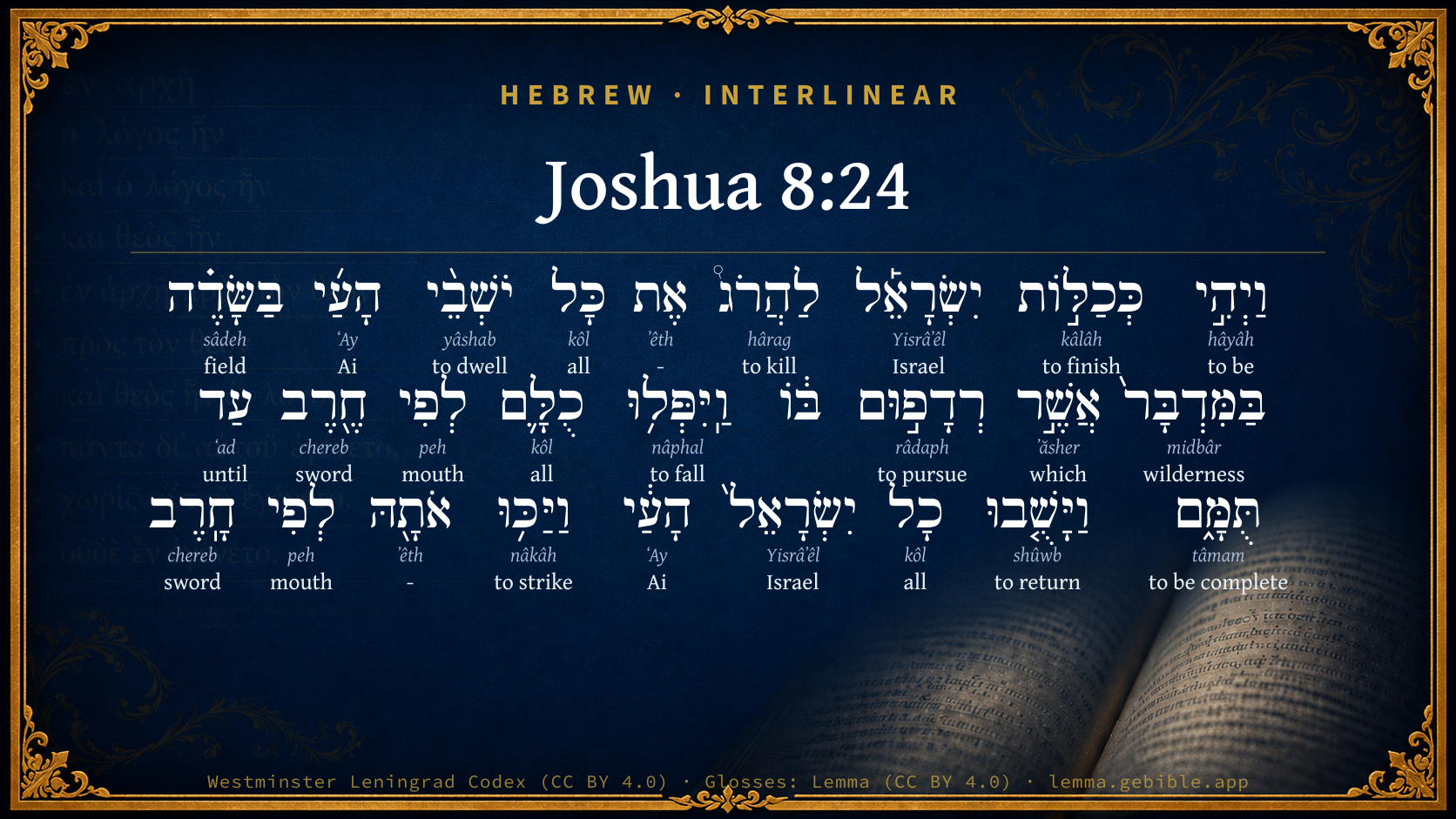
Hebrew (Westminster Leningrad Codex) Joshua 8:24 appears in the Hebrew Old Testament. The text above is from the Westminster Leningrad Codex. Each word links to its Strong’s number, a concise gloss, and parsing drawn from the Open Scriptures Hebrew Bible morphology. Click any word for its full Brown-Driver-Briggs (BDB) entry.
Download image
Cite this verse

Joshua 8:24 (World English Bible). Public Domain. Lemma interlinear Bible study tool, https://lemma.gebible.app/v/joshua/8/24.

Show BibTeX & RIS
BibTeX
RIS
English Translation
It happened, when Israel had made an end of killing all the inhabitants of Ai in the field, in the wilderness in which they pursued them, and they were all fallen by the edge of the sword, until they were consumed, that all Israel returned to Ai, and struck it with the edge of the sword.
World English Bible · Public Domain
Download a study sheet

One document with this verse’s original text, its word-by-word gloss line, the meaning frame, cross-references with their text, attributed commentary, and full source and license credits — printable, and it pastes into notes with its structure intact.

This verse Autodidact and up

Study sheet (.html) Plain text (.txt)

A passage Seminary Student

Up to 50 verses in one chapter. A passage sheet keeps up to 6 commentary sources and 12 cross-references per verse, in the order this page ranks them, and says so on the sheet whenever that leaves anything out. Ask for a single verse and you get the Autodidact verse sheet above.

Everything on this page stays free to read, with no account — the sheet is a download of what is already on screen, not access to it.

Want to remove ads? Support Godless Engineer
Compare translations 3

The same verse in 3 English versions, stacked beneath the original-language interlinear above. Click any original word for its lexicon entry.

Each is an independent rendering of the whole verse — the interlinear is not word-aligned to these translations.

Highlighted words mark where these versions differ — a whole-verse word diff, not a word-by-word alignment.

  • World English Bible Public Domain
    It happened, when Israel had made an end of killing all the inhabitants of Ai in the field, in the wilderness in which they pursued them, and they were all fallen by the edge of the sword, until they were consumed, that all Israel returned to Ai, and struck it with the edge of the sword.
  • King James Version Public Domain
    And it came to pass, when Israel had made an end of slaying all the inhabitants of Ai in the field, in the wilderness wherein they chased them, and when they were all fallen on the edge of the sword, until they were consumed, that all the Israelites returned unto Ai, and smote it with the edge of the sword.
  • unfoldingWord Literal Text CC BY-SA 4.0
    And it happened, when Israel had made an end of slaying all of the dwellers of Ai in the field, in the wilderness in which they pursued them, and all of them had fallen to the mouth of the sword unto their ceasing, that all of Israel returned to Ai and struck it to the mouth of the sword.

unfoldingWord Literal Text — © unfoldingWord, licensed CC BY-SA 4.0. Word-aligned USFM3 via Door43 (git.door43.org/unfoldingWord/en_ult).

Versions to compare (up to 4)

3 of 4 selected

Show all 18 translations

Every available English version of this verse, each an independent rendering of the whole verse.

  • World English Bible Public Domain
    It happened, when Israel had made an end of killing all the inhabitants of Ai in the field, in the wilderness in which they pursued them, and they were all fallen by the edge of the sword, until they were consumed, that all Israel returned to Ai, and struck it with the edge of the sword.
  • Berean Standard Bible Public Domain
    When Israel had finished killing all the men of Ai who had pursued them into the field and wilderness, and when every last one of them had fallen by the sword, all the Israelites returned to Ai and put it to the sword as well.
  • Majority Standard Bible Public Domain
    When Israel had finished killing all the men of Ai who had pursued them into the field and wilderness, and when every last one of them had fallen by the sword, all the Israelites returned to Ai and put it to the sword as well.
  • King James Version Public Domain
    And it came to pass, when Israel had made an end of slaying all the inhabitants of Ai in the field, in the wilderness wherein they chased them, and when they were all fallen on the edge of the sword, until they were consumed, that all the Israelites returned unto Ai, and smote it with the edge of the sword.
  • American Standard Version (1901) Public Domain
    And it came to pass, when Israel had made an end of slaying all the inhabitants of Ai in the field, in the wilderness wherein they pursued them, and they were all fallen by the edge of the sword, until they were consumed, that all Israel returned unto Ai, and smote it with the edge of the sword.
  • Revised Version (1885) Public Domain
    And it came to pass, when Israel had made an end of slaying all the inhabitants of Ai in the field, in the wilderness wherein they pursued them, and they were all fallen by the edge of the sword, until they were consumed, that all Israel returned unto Ai, and smote it with the edge of the sword.
  • Geneva Bible (1599) Public Domain
    And when Israel had made an ende of slaying all the inhabitants of Ai in the fielde, that is, in the wildernesse, where they chased them, and when they were all fallen on the edge of the sworde, vntill they were consumed, all the Israelites returned vnto Ai, and smote it with the edge of the sworde.
  • Douay-Rheims (1899) Public Domain
    So all being slain that had pursued after Israel in his flight to the wilderness, and tailing by the sword in the same place, the children of Israel returned and laid waste the city.
  • Young's Literal Translation Public Domain
    And it cometh to pass, at Israel's finishing to slay all the inhabitants of Ai in the field, in the wilderness in which they pursued them (and they fall all of them by the mouth of the sword till their consumption), that all Israel turn back to Ai, and smite it by the mouth of the sword;
  • Literal Standard Version CC BY-SA 4.0
    And it comes to pass, at Israel’s finishing to slay all the inhabitants of Ai in the field, in the wilderness in which they pursued them (and all of them fall by the mouth of the sword until their consumption), that all of Israel turns back to Ai, and strikes it by the mouth of the sword;
  • Unlocked Literal Bible CC BY-SA 4.0
    It came about when Israel had finished killing all the inhabitants of Ai in the field near the wilderness where they pursued them, and when all of them, to the very last one, had fallen by the edge of the sword, all Israel returned to Ai. They attacked it with the edge of the sword.
  • unfoldingWord Literal Text CC BY-SA 4.0
    And it happened, when Israel had made an end of slaying all of the dwellers of Ai in the field, in the wilderness in which they pursued them, and all of them had fallen to the mouth of the sword unto their ceasing, that all of Israel returned to Ai and struck it to the mouth of the sword.
  • Darby Bible Public Domain
    And it came to pass when Israel had ended slaying all the inhabitants of Ai in the field, in the wilderness wherein they had chased them, and they had all fallen by the edge of the sword, until they were consumed, that all Israel returned to Ai, and smote it with the edge of the sword.
  • World Messianic Bible Public Domain
    When Israel had finished killing all the inhabitants of Ai in the field, in the wilderness in which they pursued them, and they had all fallen by the edge of the sword until they were consumed, all Israel returned to Ai and struck it with the edge of the sword.
  • Webster's Bible Public Domain
    And it came to pass when Israel had made an end of slaying all the inhabitants of Ai in the field, in the wilderness in which they chased them, and when they had all fallen on the edge of the sword, until they were consumed, that all the Israelites returned to Ai, and smote it with the edge of the sword.
  • Free Bible Version CC BY-SA 4.0
    When the Israelites had finished killing the men of Ai who had chased them towards the wilderness—once they had all been cut down by the sword—the whole Israelite army returned to the town and killed everyone living there.
  • Bible in Basic English Public Domain
    Then, after the destruction of all the people of Ai in the field and in the waste land where they went after them, and when all the people had been put to death without mercy, all Israel went back to Ai, and put to death all who were in it without mercy.
  • JPS Tanakh (1917) Public Domain
    And it came to pass, when Israel had made an end of slaying all the inhabitants of Ai in the field, even in the wilderness wherein they pursued them, and they were all fallen by the edge of the sword, until they were consumed, that all Israel returned unto Ai, and smote it with the edge of the sword.

Literal Standard Version (2020), Covenant Press — licensed CC BY-SA 4.0. Text via the HelloAO Bible API (eBible.org). Unlocked Literal Bible (unfoldingWord) — licensed CC BY-SA 4.0. Text via the HelloAO Bible API (eBible.org). unfoldingWord Literal Text — © unfoldingWord, licensed CC BY-SA 4.0. Word-aligned USFM3 via Door43 (git.door43.org/unfoldingWord/en_ult). Free Bible Version, Dr. Jonathan Gallagher — licensed CC BY-SA 4.0. Text via the HelloAO Bible API (eBible.org).

Word by word

More ways to search: Search by grammar → Find every occurrence → Compare this word →

Practice this passage: Drill this verse → Learn its vocabulary →

הָעַ֜י
ʻAy
H5857
“the · Ai”
Particle, Definite Article + Noun, Proper
Part of Speech
Particle + Noun
Type
Proper
Full BDB Definition

Origin: for H5856

TWOT: None

Ai or Aija or Aiath or Hai = "heap of ruins" - a city lying east of Bethel and beside Bethaven near Jericho and the 2nd city taken on the invasion of Canaan - a city of the Ammonites on the east of the Jordan and apparently attached to Heshbon
  1. וַיְהִ֣י hâyâh H1961 “and · to be” Conjunction + Verb, Qal, Sequential Imperfect, 3rd Person, Masculine, Singular
  2. כְּכַלּ֣וֹת kâlâh H3615 “like/as · to finish” Preposition + Verb, Piel, Infinitive Construct
  3. יִשְׂרָאֵ֡ל Yisrâʼêl H3478 “Israel” Noun, Proper
  4. לַהֲרֹג֩ hârag H2026 “to kill” Preposition + Verb, Qal, Infinitive Construct
  5. אֶת ʼêth H853 “-” Particle, Direct Object
  6. כָּל kôl H3605 “all of” Noun, Common, Masculine, Singular, Construct
  7. יֹשְׁבֵ֨י yâshab H3427 “dwelling” Verb, Qal, Participle Active, Masculine, Plural, Construct
  8. בַּשָּׂדֶ֗ה sâdeh H7704 “in/at the · field” Preposition, Determined + Noun, Common, Masculine, Singular, Absolute
  9. בַּמִּדְבָּר֙ midbâr H4057 “in/at the · wilderness” Preposition, Determined + Noun, Common, Masculine, Singular, Absolute
  10. אֲשֶׁ֣ר ʼăsher H834 “which” Particle, Relative
  11. רְדָפ֣וּם râdaph H7291 “to pursue · them” Verb, Qal, Perfect, 3rd Person, Common, Plural + Suffix, Personal, 3rd Person, Masculine, Plural
  12. וַֽיִּפְּל֥וּ nâphal H5307 “and · to fall” Conjunction + Verb, Qal, Sequential Imperfect, 3rd Person, Masculine, Plural
  13. כֻלָּ֛ם kôl H3605 “all · their” Noun, Common, Masculine, Singular, Construct + Suffix, Personal, 3rd Person, Masculine, Plural
  14. לְפִי peh H6310 “to/for · mouth of” Preposition + Noun, Common, Masculine, Singular, Construct
  15. חֶ֖רֶב chereb H2719 “sword” Noun, Common, Feminine, Singular, Absolute
  16. עַד ʻad H5704 “until” Preposition
  17. תֻּמָּ֑ם tâmam H8552 “to be complete · them” Verb, Qal, Infinitive Construct + Suffix, Personal, 3rd Person, Masculine, Plural
  18. וַיָּשֻׁ֤בוּ shûwb H7725 “and · to return” Conjunction + Verb, Qal, Sequential Imperfect, 3rd Person, Masculine, Plural
  19. כָל kôl H3605 “all of” Noun, Common, Masculine, Singular, Construct
  20. יִשְׂרָאֵל֙ Yisrâʼêl H3478 “Israel” Noun, Proper
  21. הָעַ֔י ʻAy H5857 “the · Ai” Particle, Definite Article + Noun, Proper
  22. וַיַּכּ֥וּ nâkâh H5221 “and · to strike” Conjunction + Verb, Hiphil, Sequential Imperfect, 3rd Person, Masculine, Plural
  23. אֹתָ֖הּ ʼêth H853 “- · her” Particle, Direct Object + Suffix, Personal, 3rd Person, Feminine, Singular
  24. לְפִי peh H6310 “to/for · mouth of” Preposition + Noun, Common, Masculine, Singular, Construct
  25. חָֽרֶב chereb H2719 “sword” Noun, Common, Feminine, Singular, Absolute

About this verse

These counts appear in no published source. They are computed here, from the morphology-tagged text and Lemma’s own curated glosses. What Lemma adds →

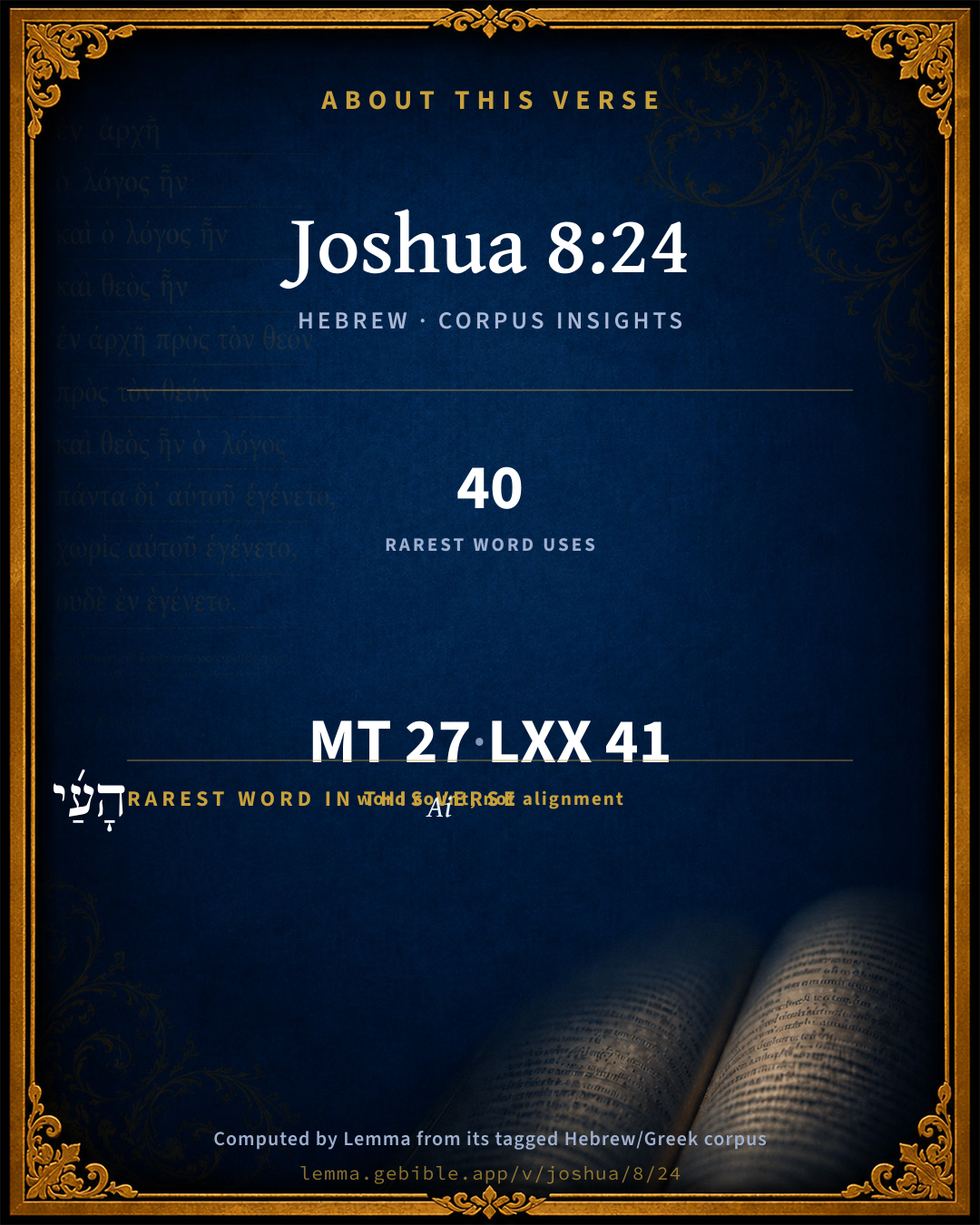
27
words
19
distinct lemmas
Historical
section

Shared distinctive vocabulary

הָעַ֜י Ai H5857 occurs in 34 verses of the Hebrew Bible. Also found in:

Grammatical profile

  • 9 verbs
  • 13 nouns
  • 2 prepositions
  • 3 particles

Verb forms

  • וַיְהִ֣י Qal · Sequential Imperfect
  • כְּכַלּ֣וֹת Piel · Infinitive Construct
  • לַהֲרֹג֩ Qal · Infinitive Construct
  • יֹשְׁבֵ֨י Qal · Participle Active
  • רְדָפ֣וּם Qal · Perfect
  • וַֽיִּפְּל֥וּ Qal · Sequential Imperfect
  • תֻּמָּ֑ם Qal · Infinitive Construct
  • וַיָּשֻׁ֤בוּ Qal · Sequential Imperfect
  • וַיַּכּ֥וּ Hiphil · Sequential Imperfect

Repetition

Words recur within this verse — often emphatic in Hebrew:

  • כָּל all H3605 ×3
  • יִשְׂרָאֵ֡ל Israel H3478 ×2
  • הָעַ֜י Ai H5857 ×2
  • לְפִי mouth H6310 ×2
  • חֶ֖רֶב sword H2719 ×2

Hebrew & Septuagint length

In English translation the verse runs 56 words from the Hebrew and 48 from the Septuagint (LXX English) — closely comparable.

A rough comparison of the two English renderings, which tokenize alike — not a word-level alignment.

Word counts can differ between the Hebrew and the Greek without any difference in meaning — e.g. the Hebrew direct-object marker אֵת has no separate Greek word, and Greek often adds the article ὁ.

In the original languages it is 27 Hebrew tokens and 41 Greek tokens — but the two are counted differently (Hebrew bundles its prefixes and suffixes into one token; the Greek is in lemma form), so that isn’t a like-for-like length.

Cross-references

3

Topical passages linked to Joshua 8:24 in the Treasury of Scripture Knowledge — connected by theme and wording, ordered by reader-vote popularity; previews shown in the World English Bible.

  • Joshua 11:10–14 Joshua turned back at that time, and took Hazor, and struck the king of it with the sword: for Hazor before was the head of all those kingdoms.
  • Numbers 21:24 Israel struck him with the edge of the sword, and possessed his land from the Arnon to the Jabbok, even to the children of Ammon; for the border of the children of Ammon was strong.
  • Joshua 10:30–41 and Yahweh delivered it also, and the king of it, into the hand of Israel; and he struck it with the edge of the sword, and all the souls who were therein; he left none remaining in it; and he did to the king of it as he had done to the king of Jericho.

Cross-references courtesy of OpenBible.info (CC BY 4.0).

Hebrew and Greek witnesses Masoretic Hebrew ↔ Greek Septuagint

The same verse in the two great witnesses to the Old Testament, shown verse-for-verse.

These are two independent witnesses, not word-aligned to each other, and the Septuagint is shown in lemma (dictionary) form.

Hebrew Joshua 8:24 Masoretic · Westminster Leningrad Codex

וַיְהִ֣י כְּכַלּ֣וֹת יִשְׂרָאֵ֡ל לַהֲרֹג֩ אֶת כָּל יֹשְׁבֵ֨י הָעַ֜י בַּשָּׂדֶ֗ה בַּמִּדְבָּר֙ אֲשֶׁ֣ר רְדָפ֣וּם בּ֔וֹ וַֽיִּפְּל֥וּ כֻלָּ֛ם לְפִי חֶ֖רֶב עַד תֻּמָּ֑ם וַיָּשֻׁ֤בוּ כָל יִשְׂרָאֵל֙ הָעַ֔י וַיַּכּ֥וּ אֹתָ֖הּ לְפִי חָֽרֶב

It happened, when Israel had made an end of killing all the inhabitants of Ai in the field, in the wilderness in which they pursued them, and they were all fallen by the edge of the sword, until they were consumed, that all Israel returned to Ai, and struck it with the edge of the sword.

World English Bible · Public Domain

Greek LXX Joshua 8:24 Septuagint · lemma form

καί ὡς παύω ὁ υἱός ἰσραήλ ἀποκτείνω πᾶς ὁ ἐν ὁ γαι ὁ ἐν ὁ πεδίον καί ἐν ὁ ὄρος ἐπί ὁ κατάβασις οὗ καταδιώκω αὐτός ἀπό αὐτός εἰς τέλος καί ἀποστρέφω ἰησοῦς εἰς γαι καί πατάσσω αὐτός ἐν στόμα ῥομφαία

And when the children of Israel had ceased slaying all that were in Gai, and in the fields, and in the mountain on the descent, from whence they pursued them even to the end, then Joshua returned to Gai, and struck it with the edge of the sword.

LXX2012 (modern English Septuagint) · Public Domain

On this verse, The Pulpit Commentary discusses the Septuagint’s reading. Read the note in Commentary ↓

Hebrew: Westminster Leningrad Codex (CC BY 4.0). Greek: Septuagint (public domain); English from LXX2012 (modern English Septuagint) (Public Domain). How the Septuagint differs from the Hebrew →

Targum (Aramaic paraphrase)

1

The Targum is the ancient Jewish Aramaic paraphrase of the Hebrew Scriptures — an interpretive translation, not the Hebrew text itself. Onkelos (literal) and Pseudo-Jonathan (expansive) render the Torah, and Jonathan the Prophets. Coverage is partial: where no permissively-licensed English translation exists for a verse, only the Aramaic is shown. This is verse-level text, not a word-by-word alignment to the Hebrew.

  1. Targum Jonathan Prophets (Joshua–Malachi)
    וַהֲוָה כַּד שֵׁיצֵי יִשְׂרָאֵל לְקַטָלָא יַת כָּל יַתְבֵי עַי בְּחַקְלָא בְּמַדְבְּרָא דִי רְדָפוּנוּן בֵּיהּ וְאִתְקְטָלוּ כּוּלְהוֹן לְפִתְגַם דְחָרֶב עַד דִשְׁלִימוּ וְתָבוּ כָל יִשְׂרָאֵל לְעַי וּמְחוֹ יָתָהּ לְפִתְגַם דְחָרֶב:

    (no public-domain English translation for this verse)

    Targum Jonathan — Aramaic: “Mikraot Gedolot” (public domain). English: “Sefaria Community Translation” (CC0 1.0 (public-domain dedication)); “London "Chaldee Paraphrase," 1871” (public domain). Text via Sefaria.

Commentary

Notes on Joshua 8:24 from classic Christian and Jewish commentators (each source and its license shown beneath its notes). The classic Christian expositions comment on the surrounding passage and are grouped to its opening verse, so a note may address several verses; the Jewish commentaries on the Tanakh (Rashi and others) are per-verse, so they appear only where the commentator wrote on this verse.

Lemma curates 59 commentaries, every one of them public domain or Creative Commons licensed, each selected and text-cleaned for this edition rather than reprinted as found. About our sources →

Trapp's Complete Commentary

John Trapp

Jos 8:24 And it came to pass, when Israel had made an end of slaying all the inhabitants of Ai in the field, in the wilderness wherein they chased them, and when they were all fallen on the edge of the sword, until they were consumed, that all the Israelites returned unto Ai, and smote it with the edge of the sword.

Ver. 24. Returned unto Ai, and smote it.] Diruendi sunt corvorum nidi, crows’ nests are to be destroyed, lest they nest and lay there again the next year. If this city had been suffered to stand, the Canaanites might have fortified it again against them, while they were led farther to mount Ebal, and mount Gerizim.

John Trapp, A Commentary or Exposition upon All the Books of the Old and New Testament (1647–1656) — public domain. Text from a community e-Sword module.

Joseph Benson's Commentary

Jos 8:24-25. The Israelites returned unto Ai, and smote it — That is, the inhabitants of it, the men who, through age and infirmity, were unfit for war, and the women, Jos 8:25. Twelve thousand, even all the men of Ai — Not strictly, but largely so called; all who were now in Ai, either as constant and settled inhabitants, or as sojourners, and such as came to them for their help.

Joseph Benson's Commentary on the Old and New Testaments (1811–1818) — public domain. Text from a community e-Sword module.

Geneva Bible (1599)

Geneva Bible translators

For the fire, which they had before set in the city, was not to consume it, but to signify unto Joshua that they were entered.

Geneva Bible (1599) marginal notes — public domain. Text via Bolls.life.

Jamieson, Fausset & Brown

Robert Jamieson, A. R. Fausset & David Brown

all the Israelites returned unto Ai, and smote it with the edge of the sword--the women, children, and old persons left behind, amounting, in all, to twelve thousand people [Jos 8:25].

Jamieson, Fausset & Brown — Commentary Critical and Explanatory on the Whole Bible (1871) — public domain (CC PDM 1.0). Text via the HelloAO Bible API.

Adam Clarke's Commentary

Verse 24. Returned unto Ai, and smote it with the edge of the sword.] This must refer to the women, children, and old persons, left behind; for it is likely that all the effective men had sallied out when they imagined the Israelites had fled. See Jos 8:16.

Adam Clarke's Commentary on the Bible (1810–1826) — public domain. Text from a community e-Sword/MySword module.

John Gill's Exposition

And it came to pass, when Israel had made an end of slaying all the inhabitants of Ai,.... That came out against them:

in the field, in the wilderness wherein they chased them; both in the arable lands that were sown with corn, and now clothed with it, the wheat especially, not being gathered in, as not yet ripe, and in the pasture ground, designed by the wilderness, see Jos 8:15; so Kimchi and Ben Melech interpret it:

and when they were all fallen on the edge of the sword; and were slain by it:

until they were consumed; and not one left:

that all the Israelites returned unto Ai; both the ambush that came out of it, and the army that came against it:

and smote it with the edge of the sword; that is, the inhabitants that were left in it unfit for war, as old men, infirm persons, women and children, as follows.

John Gill's Exposition of the Whole Bible (1746–1763) — public domain (CC PDM 1.0). Text via the HelloAO Bible API.

Matthew Poole's English Annotations

i.e. The inhabitants of it, the men, who through age or infirmity were unfit for war, and the women, Jos 8:25.

Matthew Poole's English Annotations on the Holy Bible (1683–1685) — public domain. Text from a community e-Sword/MySword module.

Whedon's Commentary on the Bible

Daniel D. Whedon

24. Smote it with the edge of the sword — The non-combatant population, without regard to age or sex, were indiscriminately slain. For several considerations in justification of the total excision of the Canaanites, see note on Jos_6:21.

Daniel D. Whedon (gen. ed.), Commentary on the Old and New Testaments (1874–1909) — public domain. Text from a community e-Sword module.

The Pulpit Commentary

In the wilderness. The LXX must have read drwOMb in the going down, or descent. Returned unto Ai and smote it. According to God"s command, the defenceless inhabitants must share the fate of the army. (see Deu_20:17)

The Pulpit Commentary (1880–1919), ed. H.D.M. Spence-Jones & Joseph S. Exell — public domain. Text from a community e-Sword module.

John Wesley's Explanatory Notes

Smote it - That is, the inhabitants of it, the men, who through age or infirmity were unfit for war, and the women, ver. 25.

John Wesley, Explanatory Notes Upon the Whole Bible (1754–1765) — public domain. Text via the GEBible commentary corpus.

unfoldingWord translationNotes

Door43 World Missions Community

when Israel had finished killing all the inhabitants ... when all of them ... had fallen by the edge of the sword

The writer uses both of these sentences, which mean almost the same thing, to strongly say that the Israelites had obeyed God's command to kill everyone in Ai. (See: Parallelism)

had fallen by the edge of the sword

Here "fallen" is a euphemism for dying. Also, "the edge of the sword" represents whole swords, and swords represent either battle or the army of Israel. AT: "had died in battle" or "had died when the army of Israel attacked them" (See: Euphemism and Metaphor)

twelve thousand

"12,000" (See: Numbers)

translationWords

Israel

Ai

desert

sword

Joshua

spear

unfoldingWord translationNotes — © Distant Shores Media and the Door43 World Missions Community, licensed CC BY-SA 4.0. Source: git.door43.org/Door43/en_tn.

Lesson kit

Teaching starters — assembled from the data on this page, not authored interpretation. Every prompt links to the verse data it draws on. Edit before teaching.

Joshua, in the Historical, opens this verse with 27 words (19 distinct Hebrew lemmas). Its most distinctive word is ʻAy (“Ai”). A historical commentator’s framing appears above. Read the whole chapter for the surrounding context.

Discussion questions

  1. The word ʻAy carries the sense “Ai.” How does it shape the verse?
  2. Genesis 12:8 shares the word «Ai» with this verse. How do the two illuminate each other?
  3. “all” occurs 3× in this one verse. What is the effect of the repetition?
  4. The translations on this page render this verse differently — a whole-verse word diff, not a word-by-word alignment. What might account for the different wordings?
  5. The verb «וַיְהִ֣י» is Qal Sequential Imperfect. How does its form color the action?
  6. Reading how Trapp's Complete Commentary and Joseph Benson's Commentary read this verse, where do the two commentators agree and where do they part?

Things to notice

Reading settings

Reading text

Shown beneath each verse's original-language words.

Old Testament
Old Testament edition

Read the OT as the Masoretic Hebrew (MT) or the Greek Septuagint (LXX).

English shown for the Greek Septuagint (in the Hebrew ↔ Greek comparison).

Comparing translations? Open the Compare panel on any verse page to stack up to four side by side.