
Joshua 11:12

Hebrew (Westminster Leningrad Codex) Joshua 11:12 appears in the Hebrew Old Testament. The text above is from the Westminster Leningrad Codex. Each word links to its Strong’s number, a concise gloss, and parsing drawn from the Open Scriptures Hebrew Bible morphology. Click any word for its full Brown-Driver-Briggs (BDB) entry.
Download image
Cite this verse

Joshua 11:12 (World English Bible). Public Domain. Lemma interlinear Bible study tool, https://lemma.gebible.app/v/joshua/11/12.

Show BibTeX & RIS
BibTeX
RIS
English Translation
All the cities of those kings, and all the kings of them, did Joshua take, and he struck them with the edge of the sword, and utterly destroyed them; as Moses the servant of Yahweh commanded.
World English Bible · Public Domain
Download a study sheet

One document with this verse’s original text, its word-by-word gloss line, the meaning frame, cross-references with their text, attributed commentary, and full source and license credits — printable, and it pastes into notes with its structure intact.

This verse Autodidact and up

Study sheet (.html) Plain text (.txt)

A passage Seminary Student

Up to 50 verses in one chapter. A passage sheet keeps up to 6 commentary sources and 12 cross-references per verse, in the order this page ranks them, and says so on the sheet whenever that leaves anything out. Ask for a single verse and you get the Autodidact verse sheet above.

Everything on this page stays free to read, with no account — the sheet is a download of what is already on screen, not access to it.

Want to remove ads? Support Godless Engineer
Compare translations 3

The same verse in 3 English versions, stacked beneath the original-language interlinear above. Click any original word for its lexicon entry.

Each is an independent rendering of the whole verse — the interlinear is not word-aligned to these translations.

Highlighted words mark where these versions differ — a whole-verse word diff, not a word-by-word alignment.

  • World English Bible Public Domain
    All the cities of those kings, and all the kings of them, did Joshua take, and he struck them with the edge of the sword, and utterly destroyed them; as Moses the servant of Yahweh commanded.
  • King James Version Public Domain
    And all the cities of those kings, and all the kings of them, did Joshua take, and smote them with the edge of the sword, and he utterly destroyed them, as Moses the servant of the LORD commanded.
  • unfoldingWord Literal Text CC BY-SA 4.0
    And Joshua captured all of the cities of these kings and all of their kings, and he struck them to the mouth of the sword. He devoted them just as Moses, the servant of Yahweh, had commanded.

unfoldingWord Literal Text — © unfoldingWord, licensed CC BY-SA 4.0. Word-aligned USFM3 via Door43 (git.door43.org/unfoldingWord/en_ult).

Versions to compare (up to 4)

3 of 4 selected

Show all 18 translations

Every available English version of this verse, each an independent rendering of the whole verse.

  • World English Bible Public Domain
    All the cities of those kings, and all the kings of them, did Joshua take, and he struck them with the edge of the sword, and utterly destroyed them; as Moses the servant of Yahweh commanded.
  • Berean Standard Bible Public Domain
    Joshua captured all these kings and their cities and put them to the sword. He devoted them to destruction, as Moses the LORD’s servant had commanded.
  • Majority Standard Bible Public Domain
    Joshua captured all these kings and their cities and put them to the sword. He devoted them to destruction, as Moses the LORD’s servant had commanded.
  • King James Version Public Domain
    And all the cities of those kings, and all the kings of them, did Joshua take, and smote them with the edge of the sword, and he utterly destroyed them, as Moses the servant of the LORD commanded.
  • American Standard Version (1901) Public Domain
    And all the cities of those kings, and all the kings of them, did Joshua take, and he smote them with the edge of the sword, and utterly destroyed them; as Moses the servant of Jehovah commanded.
  • Revised Version (1885) Public Domain
    And all the cities of those kings, and all the kings of them, did Joshua take, and he smote them with the edge of the sword, and utterly destroyed them; as Moses the servant of the LORD commanded.
  • Geneva Bible (1599) Public Domain
    So all ye cities of those Kings, and all the kings of them did Ioshua take, and smote them with the edge of the sword, and vtterly destroyed them, as Moses the seruant of the Lord had commanded.
  • Douay-Rheims (1899) Public Domain
    And he took and put to the sword and destroyed all the cities round about, and their kings, as Moses the servant of God had commanded him.
  • Young's Literal Translation Public Domain
    and all the cities of these kings, and all their kings, hath Joshua captured, and he smiteth them by the mouth of the sword; he devoted them, as Moses, servant of Jehovah, commanded.
  • Literal Standard Version CC BY-SA 4.0
    and all the cities of these kings, and all their kings, Joshua has captured, and he strikes them by the mouth of the sword; he devoted them, as Moses, servant of YHWH, commanded.
  • Unlocked Literal Bible CC BY-SA 4.0
    Joshua captured all the cities of these kings. He also captured all their kings and struck them with the edge of the sword. He completely destroyed them with the edge of the sword, just as Moses the servant of Yahweh had commanded.
  • unfoldingWord Literal Text CC BY-SA 4.0
    And Joshua captured all of the cities of these kings and all of their kings, and he struck them to the mouth of the sword. He devoted them just as Moses, the servant of Yahweh, had commanded.
  • Darby Bible Public Domain
    And all the cities of those kings and all their kings did Joshua take; and he smote them with the edge of the sword, destroying them utterly, as Moses the servant of Jehovah had commanded.
  • World Messianic Bible Public Domain
    Joshua captured all the cities of those kings, with their kings, and he struck them with the edge of the sword, and utterly destroyed them, as Moses the servant of the LORD commanded.
  • Webster's Bible Public Domain
    And all the cities of those kings, and all the kings of them, Joshua took, and smote them with the edge of the sword, and he utterly destroyed them, as Moses the servant of the LORD commanded.
  • Free Bible Version CC BY-SA 4.0
    Joshua captured all these towns and killed their kings. He set them apart and completely destroyed them, as Moses the servant of the Lord had ordered.
  • Bible in Basic English Public Domain
    And all the towns of these kings, and all the kings, Joshua took, and put them to the sword: he gave them up to the curse, as Moses, the servant of the Lord, had said.
  • JPS Tanakh (1917) Public Domain
    And all the cities of those kings, and all the kings of them, did Joshua take, and he smote them with the edge of the sword, and utterly destroyed them; as Moses the servant of the LORD commanded.

Literal Standard Version (2020), Covenant Press — licensed CC BY-SA 4.0. Text via the HelloAO Bible API (eBible.org). Unlocked Literal Bible (unfoldingWord) — licensed CC BY-SA 4.0. Text via the HelloAO Bible API (eBible.org). unfoldingWord Literal Text — © unfoldingWord, licensed CC BY-SA 4.0. Word-aligned USFM3 via Door43 (git.door43.org/unfoldingWord/en_ult). Free Bible Version, Dr. Jonathan Gallagher — licensed CC BY-SA 4.0. Text via the HelloAO Bible API (eBible.org).

Word by word

More ways to search: Search by grammar → Find every occurrence → Compare this word →

Practice this passage: Drill this verse → Learn its vocabulary →

הֶחֱרִ֣ים
châram
H2763
“to ban”
Verb, Hiphil, Perfect, 3rd Person, Masculine, Singular
Part of Speech
Verb
Stem
Hiphil
Form
Perfect
Person
3rd Person
Gender
Masculine
Number
Singular
Full BDB Definition

Origin: a primitive root

TWOT: 744 , 745

to ban, devote, destroy utterly, completely destroy, dedicate for destruction, exterminate - (Hiphil) - to prohibit (for common use), ban - to consecrate, devote, dedicate for destruction - to exterminate, completely destroy - (Hophal) - to be put under the ban, be devoted to destruction - to be devoted, be forfeited - to be completely destroyed - to split, slit, mutilate (a part of the body) - (Qal) to mutilate - (Hiphil) to divide
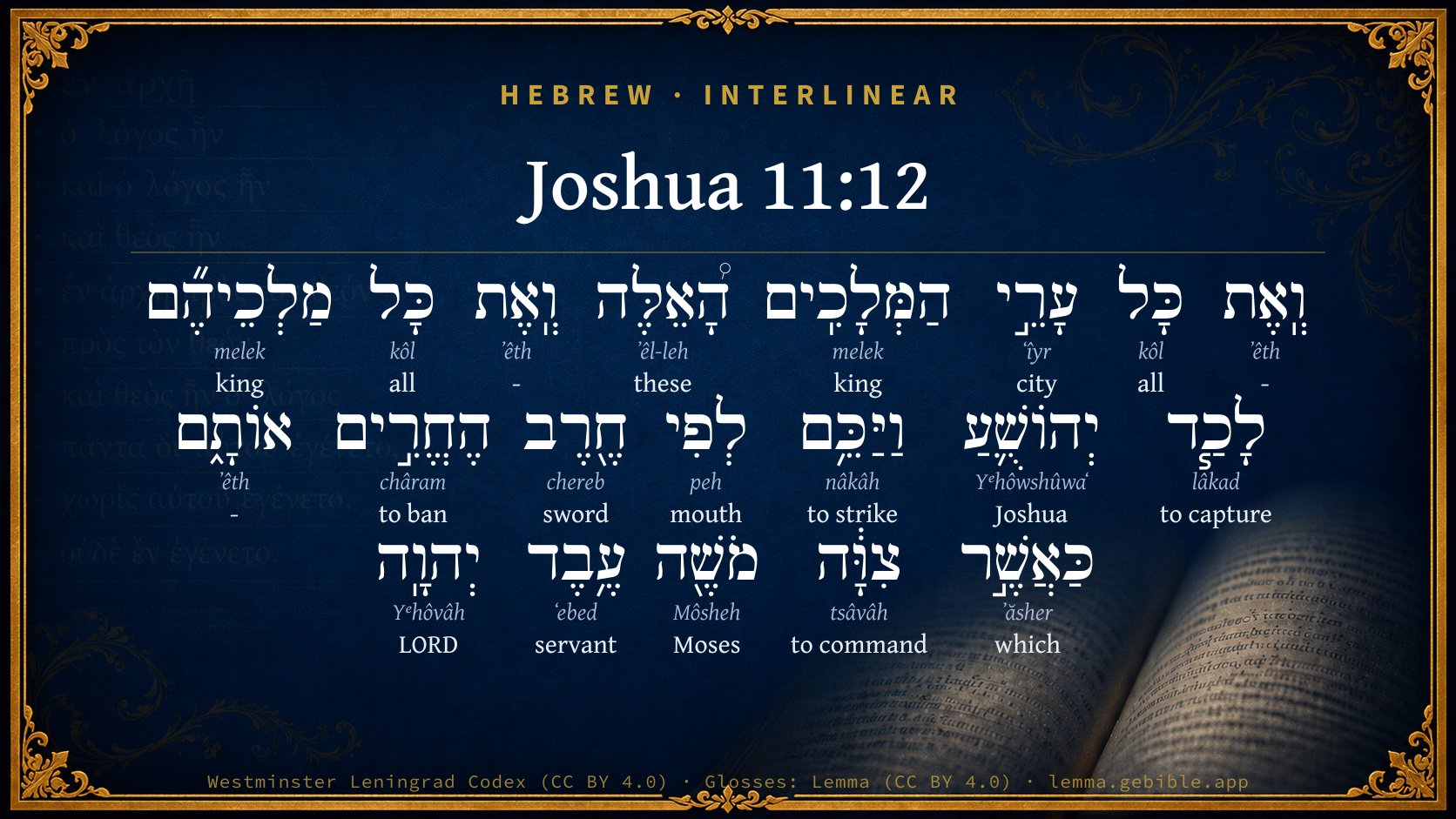
  1. וְֽאֶת ʼêth H853 “and · -” Conjunction + Particle, Direct Object
  2. כָּל kôl H3605 “all of” Noun, Common, Masculine, Singular, Construct
  3. עָרֵ֣י ʻîyr H5892 “cities of” Noun, Common, Feminine, Plural, Construct
  4. הַמְּלָכִֽים melek H4428 “the · kings” Particle, Definite Article + Noun, Common, Masculine, Plural, Absolute
  5. הָ֠אֵלֶּה ʼêl-leh H428 “the · these” Particle, Definite Article + Pronoun, Demonstrative, Common, Plural
  6. וְֽאֶת ʼêth H853 “and · -” Conjunction + Particle, Direct Object
  7. כָּל kôl H3605 “all of” Noun, Common, Masculine, Singular, Construct
  8. מַלְכֵיהֶ֞ם melek H4428 “kings · their” Noun, Common, Masculine, Plural, Construct + Suffix, Personal, 3rd Person, Masculine, Plural
  9. לָכַ֧ד lâkad H3920 “to capture” Verb, Qal, Perfect, 3rd Person, Masculine, Singular
  10. יְהוֹשֻׁ֛עַ Yᵉhôwshûwaʻ H3091 “Joshua” Noun, Proper
  11. וַיַּכֵּ֥ם nâkâh H5221 “and · to strike · them” Conjunction + Verb, Hiphil, Sequential Imperfect, 3rd Person, Masculine, Singular + Suffix, Personal, 3rd Person, Masculine, Plural
  12. לְפִי peh H6310 “to/for · mouth of” Preposition + Noun, Common, Masculine, Singular, Construct
  13. חֶ֖רֶב chereb H2719 “sword” Noun, Common, Feminine, Singular, Absolute
  14. אוֹתָ֑ם ʼêth H853 “- · them” Particle, Direct Object + Suffix, Personal, 3rd Person, Masculine, Plural
  15. כַּאֲשֶׁ֣ר ʼăsher H834 “like/as · which” Preposition + Particle, Relative
  16. צִוָּ֔ה tsâvâh H6680 “to command” Verb, Piel, Perfect, 3rd Person, Masculine, Singular
  17. מֹשֶׁ֖ה Môsheh H4872 “Moses” Noun, Proper
  18. עֶ֥בֶד ʻebed H5650 “servant of” Noun, Common, Masculine, Singular, Construct
  19. יְהוָֽה Yᵉhôvâh H3068 “LORD” Noun, Proper

About this verse

These counts appear in no published source. They are computed here, from the morphology-tagged text and Lemma’s own curated glosses. What Lemma adds →

20
words
16
distinct lemmas
Historical
section

Shared distinctive vocabulary

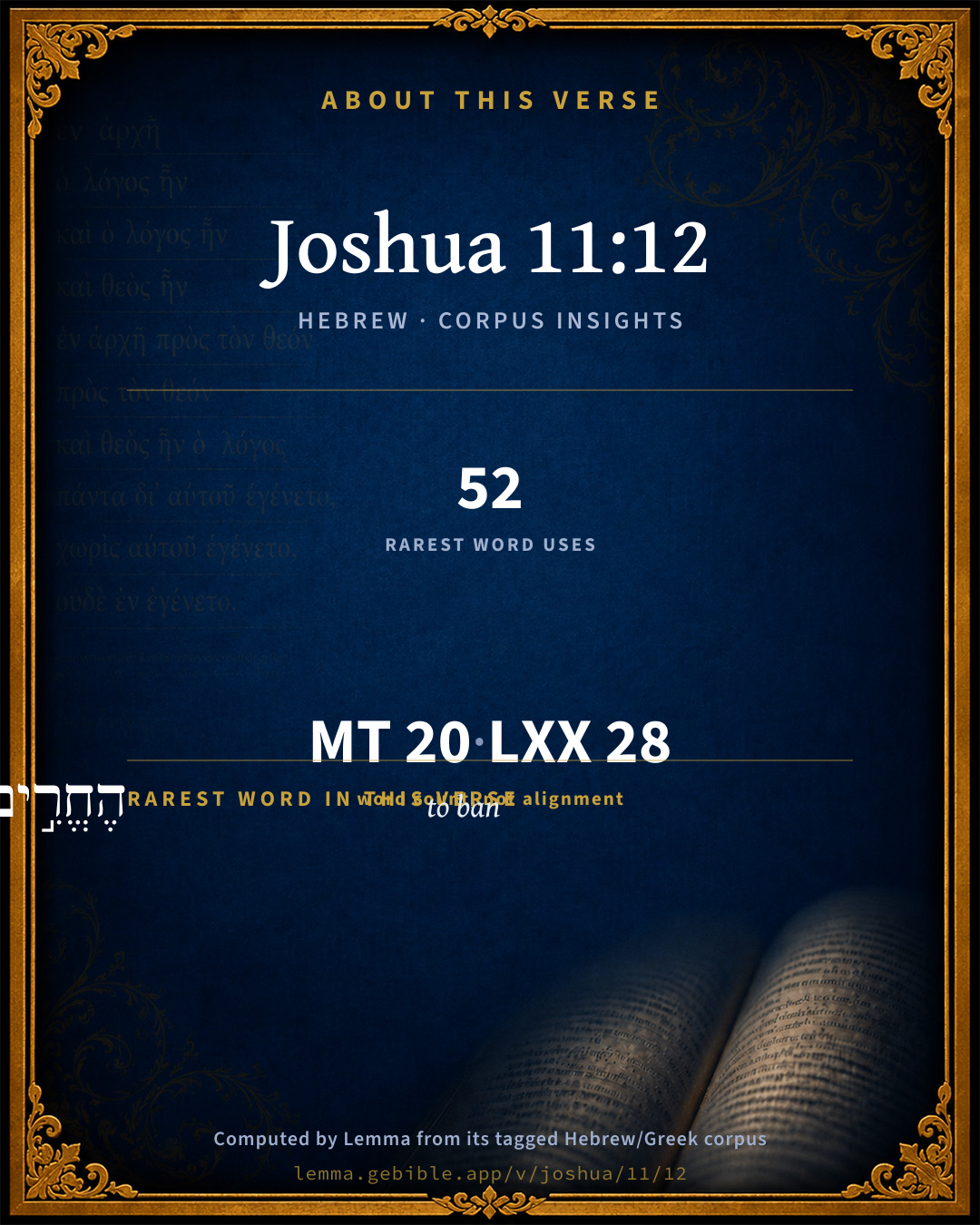
הֶחֱרִ֣ים to ban H2763 occurs in 48 verses of the Hebrew Bible. Also found in:

Grammatical profile

  • 4 verbs
  • 11 nouns
  • 1 pronoun
  • 4 particles

Verb forms

  • לָכַ֧ד Qal · Perfect
  • וַיַּכֵּ֥ם Hiphil · Sequential Imperfect
  • הֶחֱרִ֣ים Hiphil · Perfect
  • צִוָּ֔ה Piel · Perfect

Repetition

Words recur within this verse — often emphatic in Hebrew:

  • כָּל all H3605 ×2
  • הַמְּלָכִֽים king H4428 ×2

Hebrew & Septuagint length

In English translation the verse runs 36 words from the Hebrew and 33 from the Septuagint (LXX English) — closely comparable.

A rough comparison of the two English renderings, which tokenize alike — not a word-level alignment.

Word counts can differ between the Hebrew and the Greek without any difference in meaning — e.g. the Hebrew direct-object marker אֵת has no separate Greek word, and Greek often adds the article ὁ.

In the original languages it is 20 Hebrew tokens and 28 Greek tokens — but the two are counted differently (Hebrew bundles its prefixes and suffixes into one token; the Greek is in lemma form), so that isn’t a like-for-like length.

Cross-references

13

Topical passages linked to Joshua 11:12 in the Treasury of Scripture Knowledge — connected by theme and wording, ordered by reader-vote popularity; previews shown in the World English Bible.

  • Deuteronomy 7:2 and when Yahweh your God shall deliver them up before you, and you shall strike them; then you shall utterly destroy them: you shall make no covenant with them, nor show mercy to them;
  • Deuteronomy 20:16–17 But of the cities of these peoples, that Yahweh your God gives you for an inheritance, you shall save alive nothing that breathes;
  • Numbers 33:50–53 Yahweh spoke to Moses in the plains of Moab by the Jordan at Jericho, saying,
  • Joshua 8:8 It shall be, when you have seized on the city, that you shall set the city on fire; according to the word of Yahweh shall you do: behold, I have commanded you.
  • Joshua 8:31 as Moses the servant of Yahweh commanded the children of Israel, as it is written in the book of the law of Moses, an altar of uncut stones, on which no man had lifted up any iron: and they offered thereon burnt offerings to Yahweh, and sacrificed peace-offerings.
  • Joshua 9:24 They answered Joshua, and said, Because it was certainly told your servants, how that Yahweh your God commanded his servant Moses to give you all the land, and to destroy all the inhabitants of the land from before you; therefore we were sore afraid for our lives because of you, and have done this thing.
  • Joshua 10:28 Joshua took Makkedah on that day, and struck it with the edge of the sword, and the king of it: he utterly destroyed them and all the souls who were therein; he left none remaining; and he did to the king of Makkedah as he had done to the king of Jericho.
  • Joshua 10:30 and Yahweh delivered it also, and the king of it, into the hand of Israel; and he struck it with the edge of the sword, and all the souls who were therein; he left none remaining in it; and he did to the king of it as he had done to the king of Jericho.
  • Joshua 10:32 and Yahweh delivered Lachish into the hand of Israel; and he took it on the second day, and struck it with the edge of the sword, and all the souls who were therein, according to all that he had done to Libnah.
  • Joshua 10:35 and they took it on that day, and struck it with the edge of the sword; and all the souls who were therein he utterly destroyed that day, according to all that he had done to Lachish.
  • Joshua 10:37 and they took it, and struck it with the edge of the sword, and the king of it, and all the cities of it, and all the souls who were therein; he left none remaining, according to all that he had done to Eglon; but he utterly destroyed it, and all the souls who were therein.
  • Joshua 10:39–40 and he took it, and the king of it, and all the cities of it; and they struck them with the edge of the sword, and utterly destroyed all the souls who were therein; he left none remaining: as he had done to Hebron, so he did to Debir, and to the king of it; as he had done also to Libnah, and to the king of it.
  • Joshua 11:15 As Yahweh commanded Moses his servant, so did Moses command Joshua: and so did Joshua; he left nothing undone of all that Yahweh commanded Moses.

Cross-references courtesy of OpenBible.info (CC BY 4.0).

Hebrew and Greek witnesses Masoretic Hebrew ↔ Greek Septuagint

The same verse in the two great witnesses to the Old Testament, shown verse-for-verse.

These are two independent witnesses, not word-aligned to each other, and the Septuagint is shown in lemma (dictionary) form.

Hebrew Joshua 11:12 Masoretic · Westminster Leningrad Codex

וְֽאֶת כָּל עָרֵ֣י הַמְּלָכִֽים הָ֠אֵלֶּה וְֽאֶת כָּל מַלְכֵיהֶ֞ם לָכַ֧ד יְהוֹשֻׁ֛עַ וַיַּכֵּ֥ם לְפִי חֶ֖רֶב הֶחֱרִ֣ים אוֹתָ֑ם כַּאֲשֶׁ֣ר צִוָּ֔ה מֹשֶׁ֖ה עֶ֥בֶד יְהוָֽה

All the cities of those kings, and all the kings of them, did Joshua take, and he struck them with the edge of the sword, and utterly destroyed them; as Moses the servant of Yahweh commanded.

World English Bible · Public Domain

Greek LXX Joshua 11:12 Septuagint · lemma form

καί πᾶς ὁ πόλις ὁ βασιλεύς καί ὁ βασιλεύς αὐτός λαμβάνω ἰησοῦς καί ἀνααἱρέω αὐτός ἐν στόμα ξίφος καί ἐκὀλεθρεύω αὐτός ὅς τρόπος συντάσσω μωυσῆς ὁ παῖς κύριος

And Joshua took all the cities of the kingdoms, and their kings, and killed them with the edge of the sword; and utterly killed them, as Moses the servant of the Lord commanded.

LXX2012 (modern English Septuagint) · Public Domain

Hebrew: Westminster Leningrad Codex (CC BY 4.0). Greek: Septuagint (public domain); English from LXX2012 (modern English Septuagint) (Public Domain). How the Septuagint differs from the Hebrew →

Targum (Aramaic paraphrase)

1

The Targum is the ancient Jewish Aramaic paraphrase of the Hebrew Scriptures — an interpretive translation, not the Hebrew text itself. Onkelos (literal) and Pseudo-Jonathan (expansive) render the Torah, and Jonathan the Prophets. Coverage is partial: where no permissively-licensed English translation exists for a verse, only the Aramaic is shown. This is verse-level text, not a word-by-word alignment to the Hebrew.

  1. Targum Jonathan Prophets (Joshua–Malachi)
    וְיַת כָּל קִרְוֵי מַלְכַיָא הָאִילֵין וְיַת כָּל מַלְכֵיהוֹן כְּבַשׁ יְהוֹשֻׁעַ וּמְחָנוּן לְפִתְגַם דְחָרֶב גַמַר יַתְהוֹן כְּמָא דְפַקֵד מֹשֶׁה עַבְדָא דַיָי:

    (no public-domain English translation for this verse)

    Targum Jonathan — Aramaic: “Mikraot Gedolot” (public domain). English: “Sefaria Community Translation” (CC0 1.0 (public-domain dedication)); “London "Chaldee Paraphrase," 1871” (public domain). Text via Sefaria.

Commentary

Notes on Joshua 11:12 from classic Christian and Jewish commentators (each source and its license shown beneath its notes). The classic Christian expositions comment on the surrounding passage and are grouped to its opening verse, so a note may address several verses; the Jewish commentaries on the Tanakh (Rashi and others) are per-verse, so they appear only where the commentator wrote on this verse.

Lemma curates 59 commentaries, every one of them public domain or Creative Commons licensed, each selected and text-cleaned for this edition rather than reprinted as found. About our sources →

Trapp's Complete Commentary

John Trapp

Jos 11:12 And all the cities of those kings, and all the kings of them, did Joshua take, and smote them with the edge of the sword, [and] he utterly destroyed them, as Moses the servant of the LORD commanded.

Ver. 12. And all the kings of them.] Herodotus saith of the Thracians, that if they had been all of one mind, or under one king, they had been invincible.

“εις κοιρανος εστω” - Homer.

John Trapp, A Commentary or Exposition upon All the Books of the Old and New Testament (1647–1656) — public domain. Text from a community e-Sword module.

John Calvin's Commentaries

12. And all the cities of those kings, etc Having routed the army, they began to plunder and lay waste the country, and to take and demolish the towns. From its being said that the cities which remained entire were not burned, it may be inferred with some probability, that some were taken by force and assault, and so razed. Hazor, alone, after the siege was over, and the heat of the struggle had cooled, was destroyed by fire, because it had held forth the torch which enkindled the war. But in accordance with the explanation already given, it is repeatedly and more clearly stated in this passage, that Joshua did not give loose reins to his passion, when he slew all from the least to the greatest. For there is now a distinct statement of what had not yet been expressed, namely, that Joshua faithfully performed his part, by fulfilling everything which the Lord had enjoined by Moses. It is just as if he had placed his hands at the disposal of God, when he destroyed those nations according to his command. And so ought we to hold that, though the whole world should condemn us, it is sufficient to free us from all blame, that we have the authority of God. Meanwhile, it becomes us prudently to consider what each man’s vocation requires, lest any one, by giving license to his zeal, as wishing to imitate Joshua, may be judged cruel and sanguinary, rather than a strict servant of God.

John Calvin's Commentaries (1540-1563) — public domain. Text from the Calvin Translation Society English edition (1840s-50s) via the Christian Classics Ethereal Library (ccel.org). Calvin's coverage is partial (roughly two-thirds of the Bible); uncommented books and verses are honest gaps, never fabricated. The 19th-century editor's footnotes and remarks are omitted so the notes are faithfully Calvin's own voice.

The Cambridge Bible for Schools and Colleges

gen. ed. J. J. S. Perowne

12. as Moses the servant of the Lord commanded] See Deu_7:2; Deu_20:16-17.

The Cambridge Bible for Schools and Colleges (gen. ed. J. J. S. Perowne; Cambridge University Press, 1878–1918) — public domain. Text from a community e-Sword module.

John Gill's Exposition

And all the cities of those kings, and all the kings of them did Joshua take,.... As particularly Madon, Shimron, and Achshaph, with others which he marched unto, after he had burnt Hazor; in which he took their kings, whither they had fled, or else he had taken them before in the pursuit:

and smote them with the edge of the sword; both the kings and the inhabitants of those cities:

and he utterly destroyed them, as Moses the servant of the Lord commanded; so that, in doing what he did, he did not indulge a spirit of revenge, cruelty, and avarice, but had regard purely to the command of Moses, which was of God, Deu 7:1.

John Gill's Exposition of the Whole Bible (1746–1763) — public domain (CC PDM 1.0). Text via the HelloAO Bible API.

Haydock's Catholic Bible Commentary

Him. (Deuteronomy vii. 22.) all the Chanaanites in arms, are ordered to be slain. (Calmet) --- Josue took the greatest part of the strong cities, and indeed all which he attacked. (Menochius)

George Leo Haydock (1774–1849), Haydock's Catholic Family Bible and Commentary, 1859 edition — public domain. Excludes Psalms (Douay-Rheims chapter numbering differs from Protestant) and Deuterocanonical books (Catholic canon only).

unfoldingWord translationNotes

Door43 World Missions Community

struck them with the edge of the sword

"killed them"

cities built on mounds

"cities built on small hills"

translationWords

Joshua

king

sword

Moses

servant

Yahweh

command

Israel

unfoldingWord translationNotes — © Distant Shores Media and the Door43 World Missions Community, licensed CC BY-SA 4.0. Source: git.door43.org/Door43/en_tn.

Lesson kit

Teaching starters — assembled from the data on this page, not authored interpretation. Every prompt links to the verse data it draws on. Edit before teaching.

Joshua, in the Historical, opens this verse with 20 words (16 distinct Hebrew lemmas). Its most distinctive word is châram (“to ban”). A historical commentator’s framing appears above. Read the whole chapter for the surrounding context.

Discussion questions

  1. What does “to ban” (châram) contribute to the verse as a whole?
  2. How does Exodus 22:20, which shares the word «to ban», read alongside this verse?
  3. What does the repetition of “all” (2× in this one verse) do in this verse?
  4. The translations on this page render this verse differently — a whole-verse word diff, not a word-by-word alignment. What might account for the different wordings?
  5. «לָכַ֧ד» is a Qal Perfect verb. How does that grammatical form shape the action described?
  6. Compare how Trapp's Complete Commentary and John Calvin's Commentaries read this verse. Where do they agree or differ?

Things to notice

Reading settings

Reading text

Shown beneath each verse's original-language words.

Old Testament
Old Testament edition

Read the OT as the Masoretic Hebrew (MT) or the Greek Septuagint (LXX).

English shown for the Greek Septuagint (in the Hebrew ↔ Greek comparison).

Comparing translations? Open the Compare panel on any verse page to stack up to four side by side.