
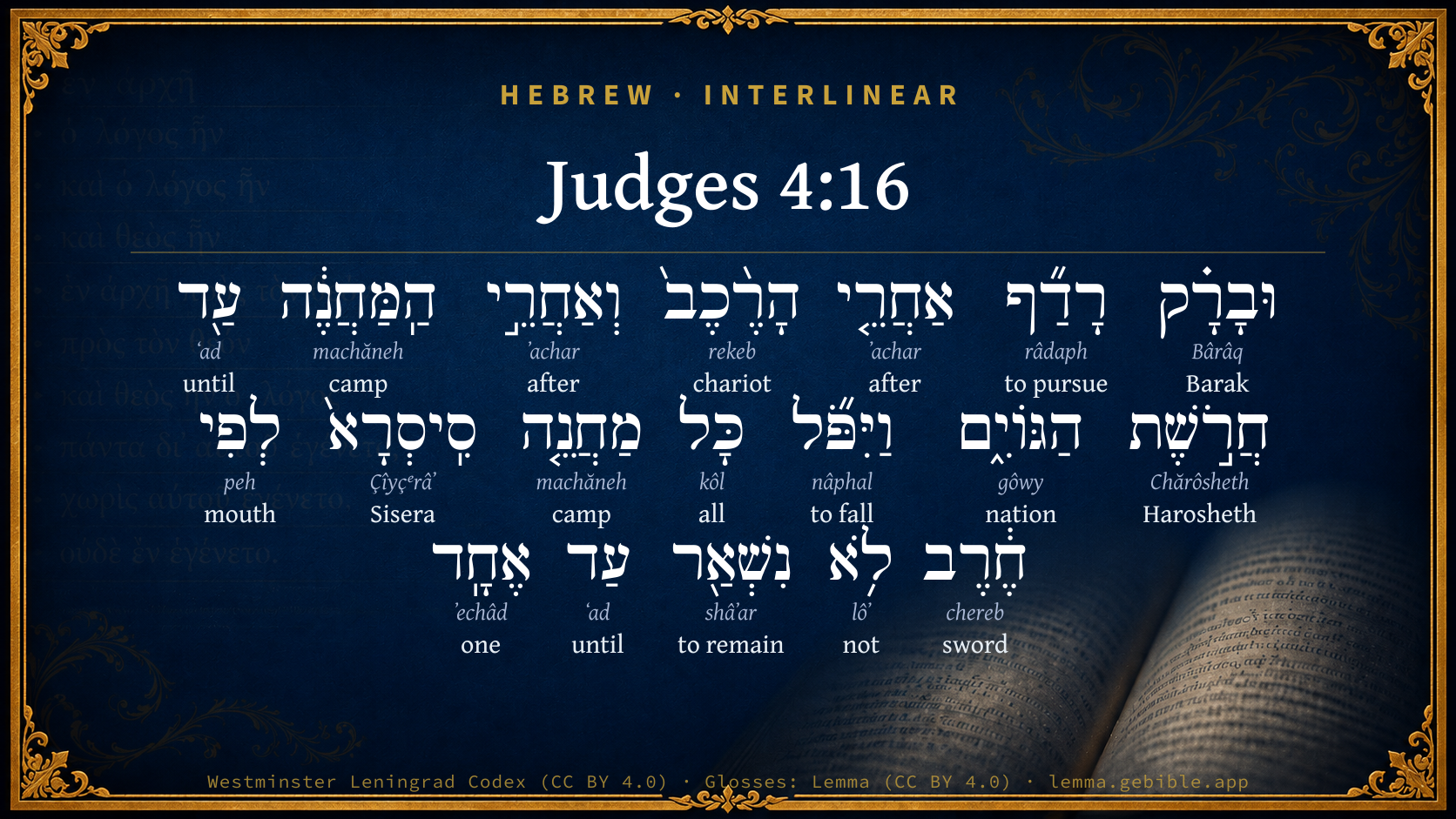
Judges 4:16

Hebrew (Westminster Leningrad Codex) Judges 4:16 appears in the Hebrew Old Testament. The text above is from the Westminster Leningrad Codex. Each word links to its Strong’s number, a concise gloss, and parsing drawn from the Open Scriptures Hebrew Bible morphology. Click any word for its full Brown-Driver-Briggs (BDB) entry.
Download image
Cite this verse

Judges 4:16 (World English Bible). Public Domain. Lemma interlinear Bible study tool, https://lemma.gebible.app/v/judges/4/16.

Show BibTeX & RIS
BibTeX
RIS
English Translation
But Barak pursued after the chariots, and after the host, to Harosheth of the Gentiles: and all the host of Sisera fell by the edge of the sword; there was not a man left.
World English Bible · Public Domain
Download a study sheet

One document with this verse’s original text, its word-by-word gloss line, the meaning frame, cross-references with their text, attributed commentary, and full source and license credits — printable, and it pastes into notes with its structure intact.

This verse Autodidact and up

Study sheet (.html) Plain text (.txt)

A passage Seminary Student

Up to 50 verses in one chapter. A passage sheet keeps up to 6 commentary sources and 12 cross-references per verse, in the order this page ranks them, and says so on the sheet whenever that leaves anything out. Ask for a single verse and you get the Autodidact verse sheet above.

Everything on this page stays free to read, with no account — the sheet is a download of what is already on screen, not access to it.

Want to remove ads? Support Godless Engineer
Compare translations 3

The same verse in 3 English versions, stacked beneath the original-language interlinear above. Click any original word for its lexicon entry.

Each is an independent rendering of the whole verse — the interlinear is not word-aligned to these translations.

Highlighted words mark where these versions differ — a whole-verse word diff, not a word-by-word alignment.

  • World English Bible Public Domain
    But Barak pursued after the chariots, and after the host, to Harosheth of the Gentiles: and all the host of Sisera fell by the edge of the sword; there was not a man left.
  • King James Version Public Domain
    But Barak pursued after the chariots, and after the host, unto Harosheth of the Gentiles: and all the host of Sisera fell upon the edge of the sword; and there was not a man left.
  • unfoldingWord Literal Text CC BY-SA 4.0
    But Barak pursued after the chariotry and after the army unto Harosheth Haggoyim, and all of the army of Sisera fell by the mouth of the sword. Not even one remained.

unfoldingWord Literal Text — © unfoldingWord, licensed CC BY-SA 4.0. Word-aligned USFM3 via Door43 (git.door43.org/unfoldingWord/en_ult).

Versions to compare (up to 4)

3 of 4 selected

Show all 18 translations

Every available English version of this verse, each an independent rendering of the whole verse.

  • World English Bible Public Domain
    But Barak pursued after the chariots, and after the host, to Harosheth of the Gentiles: and all the host of Sisera fell by the edge of the sword; there was not a man left.
  • Berean Standard Bible Public Domain
    Then Barak pursued the chariots and army as far as Harosheth-hagoyim, and the whole army of Sisera fell by the sword; not a single man was left.
  • Majority Standard Bible Public Domain
    Then Barak pursued the chariots and army as far as Harosheth-hagoyim, and the whole army of Sisera fell by the sword; not a single man was left.
  • King James Version Public Domain
    But Barak pursued after the chariots, and after the host, unto Harosheth of the Gentiles: and all the host of Sisera fell upon the edge of the sword; and there was not a man left.
  • American Standard Version (1901) Public Domain
    But Barak pursued after the chariots, and after the host, unto Harosheth of the Gentiles: and all the host of Sisera fell by the edge of the sword; there was not a man left.
  • Revised Version (1885) Public Domain
    But Barak pursued after the chariots, and after the host, unto Harosheth of the Gentiles: and all the host of Sisera fell by the edge of the sword; there was not a man left.
  • Geneva Bible (1599) Public Domain
    But Barak pursued after the charets, and after the hoste vnto Harosheth of the Gentiles: and all the hoste of Sisera fel vpon the edge of the sworde: there was not a man left.
  • Douay-Rheims (1899) Public Domain
    And Barac pursued after the fleeing chariots and the army unto Haroseth of the Gentiles, and all the multitude of the enemies was utterly destroyed.
  • Young's Literal Translation Public Domain
    And Barak hath pursued after the chariots and after the camp, unto Harosheth of the Goyim, and all the camp of Sisera falleth by the mouth of the sword -- there hath not been left even one.
  • Literal Standard Version CC BY-SA 4.0
    And Barak has pursued after the chariots and after the camp, to Harosheth of the nations, and all the camp of Sisera falls by the mouth of the sword—there has not been left even one.
  • Unlocked Literal Bible CC BY-SA 4.0
    But Barak pursued the chariots and the army to Harosheth Haggoyim, and the whole army of Sisera was killed by the edge of the sword, and not a man survived.
  • unfoldingWord Literal Text CC BY-SA 4.0
    But Barak pursued after the chariotry and after the army unto Harosheth Haggoyim, and all of the army of Sisera fell by the mouth of the sword. Not even one remained.
  • Darby Bible Public Domain
    And Barak pursued the chariots and the army to Haro'sheth-ha-goiim, and all the army of Sis'era fell by the edge of the sword; not a man was left.
  • World Messianic Bible Public Domain
    But Barak pursued the chariots and the army to Harosheth of the Gentiles; and all the army of Sisera fell by the edge of the sword. There was not a man left.
  • Webster's Bible Public Domain
    But Barak pursued the chariots, and the host, to Harosheth of the Gentiles: and all the host of Sisera fell upon the edge of the sword; and there was not a man left.
  • Free Bible Version CC BY-SA 4.0
    Barak chased after the chariots and troops all the way to Harosheth-hagoyim. The whole of Sisera's army was killed—not a single man survived.
  • Bible in Basic English Public Domain
    But Barak went after the war-carriages and the army as far as Harosheth of the Gentiles; and all Sisera's army was put to the sword; not a man got away.
  • JPS Tanakh (1917) Public Domain
    But Barak pursued after the chariots, and after the host, unto Harosheth-goiim; and all the host of Sisera fell by the edge of the sword; there was not a man left.

Literal Standard Version (2020), Covenant Press — licensed CC BY-SA 4.0. Text via the HelloAO Bible API (eBible.org). Unlocked Literal Bible (unfoldingWord) — licensed CC BY-SA 4.0. Text via the HelloAO Bible API (eBible.org). unfoldingWord Literal Text — © unfoldingWord, licensed CC BY-SA 4.0. Word-aligned USFM3 via Door43 (git.door43.org/unfoldingWord/en_ult). Free Bible Version, Dr. Jonathan Gallagher — licensed CC BY-SA 4.0. Text via the HelloAO Bible API (eBible.org).

Word by word

More ways to search: Search by grammar → Find every occurrence → Compare this word →

Practice this passage: Drill this verse → Learn its vocabulary →

חֲרֹ֣שֶׁת
Chărôsheth
H2800
“Harosheth”
Noun, Proper
Part of Speech
Noun
Type
Proper
Full BDB Definition

Origin: the same as H2799

TWOT: None

Harosheth = "woodland" - a city in the north of the land of Canaan on the west coast of the lake Merom
  1. וּבָרָ֗ק Bârâq H1301 “and · Barak” Conjunction + Noun, Proper
  2. רָדַ֞ף râdaph H7291 “to pursue” Verb, Qal, Perfect, 3rd Person, Masculine, Singular
  3. אַחֲרֵ֤י ʼachar H310 “after” Preposition
  4. הָרֶ֨כֶב֙ rekeb H7393 “the · chariot” Particle, Definite Article + Noun, Common, Masculine, Singular, Absolute
  5. וְאַחֲרֵ֣י ʼachar H310 “and · after” Conjunction + Preposition
  6. הַֽמַּחֲנֶ֔ה machăneh H4264 “the · camp” Particle, Definite Article + Noun, Common, Both, Singular, Absolute
  7. עַ֖ד ʻad H5704 “until” Preposition
  8. הַגּוֹיִ֑ם gôwy H1471 “nation” Noun, Proper
  9. וַיִּפֹּ֞ל nâphal H5307 “and · to fall” Conjunction + Verb, Qal, Sequential Imperfect, 3rd Person, Masculine, Singular
  10. כָּל kôl H3605 “all of” Noun, Common, Masculine, Singular, Construct
  11. מַחֲנֵ֤ה machăneh H4264 “camp of” Noun, Common, Both, Singular, Construct
  12. סִֽיסְרָא֙ Çîyçᵉrâʼ H5516 “Sisera” Noun, Proper
  13. לְפִי peh H6310 “to/for · mouth of” Preposition + Noun, Common, Masculine, Singular, Construct
  14. חֶ֔רֶב chereb H2719 “sword” Noun, Common, Feminine, Singular, Absolute
  15. לֹ֥א lôʼ H3808 “not” Particle, Negative
  16. נִשְׁאַ֖ר shâʼar H7604 “to remain” Verb, Niphal, Perfect, 3rd Person, Masculine, Singular
  17. עַד ʻad H5704 “until” Preposition
  18. אֶחָֽד ʼechâd H259 “one” Adjective, Cardinal number, Masculine, Singular, Absolute

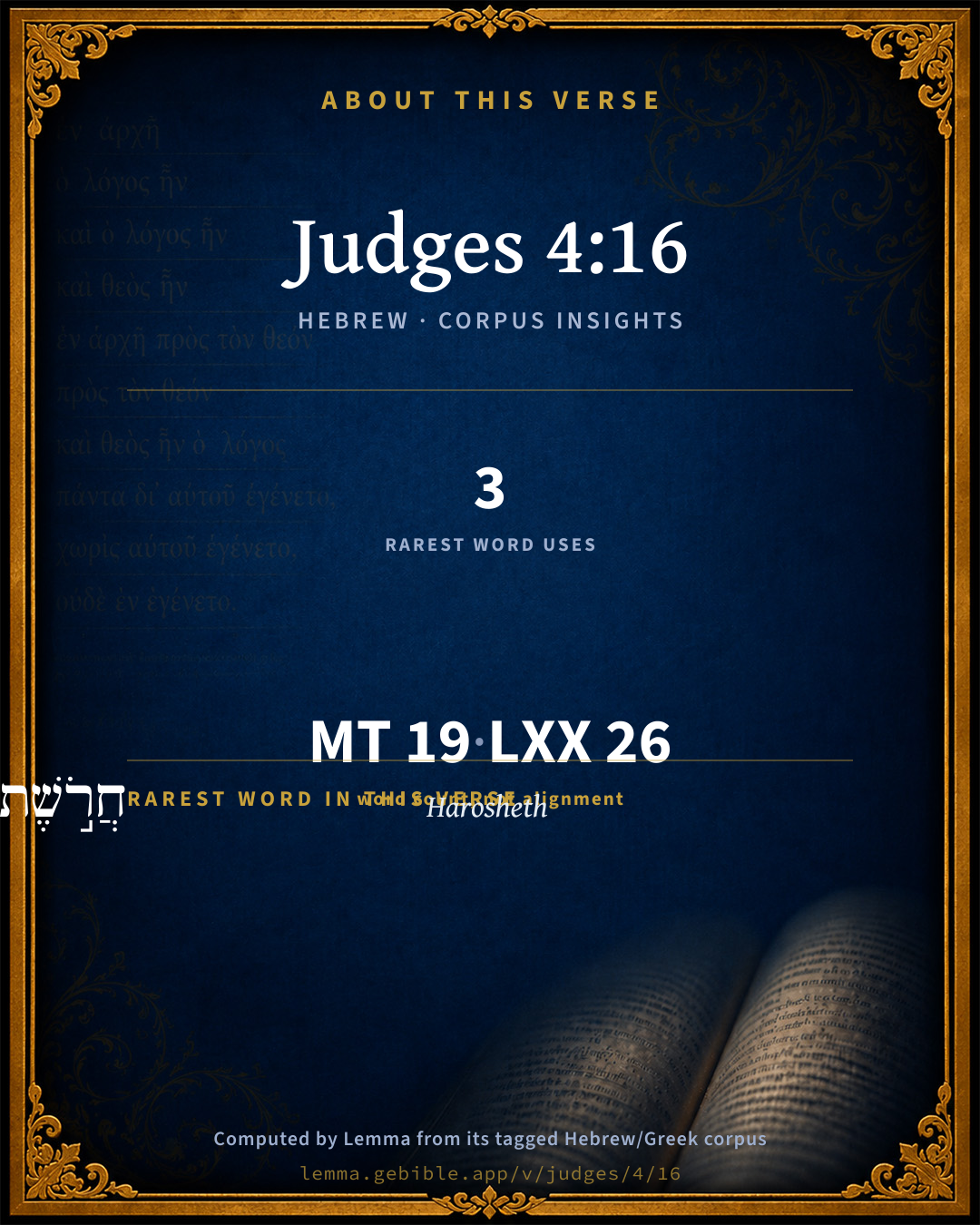
About this verse

These counts appear in no published source. They are computed here, from the morphology-tagged text and Lemma’s own curated glosses. What Lemma adds →

19
words
16
distinct lemmas
Historical
section

Notable vocabulary

The rarest word here is חֲרֹ֣שֶׁת Harosheth H2800 — appearing just 3 times in the whole Hebrew Bible.

Shared distinctive vocabulary

חֲרֹ֣שֶׁת Harosheth H2800 occurs in 3 verses of the Hebrew Bible. Also found in:

Grammatical profile

  • 3 verbs
  • 10 nouns
  • 1 adjective
  • 4 prepositions
  • 1 particle

Verb forms

  • רָדַ֞ף Qal · Perfect
  • וַיִּפֹּ֞ל Qal · Sequential Imperfect
  • נִשְׁאַ֖ר Niphal · Perfect

Repetition

Words recur within this verse — often emphatic in Hebrew:

  • אַחֲרֵ֤י after H310 ×2
  • הַֽמַּחֲנֶ֔ה camp H4264 ×2
  • עַ֖ד until H5704 ×2

Hebrew & Septuagint length

In English translation the verse runs 34 words from the Hebrew and 33 from the Septuagint (LXX English) — closely comparable.

A rough comparison of the two English renderings, which tokenize alike — not a word-level alignment.

Word counts can differ between the Hebrew and the Greek without any difference in meaning — e.g. the Hebrew direct-object marker אֵת has no separate Greek word, and Greek often adds the article ὁ.

In the original languages it is 19 Hebrew tokens and 26 Greek tokens — but the two are counted differently (Hebrew bundles its prefixes and suffixes into one token; the Greek is in lemma form), so that isn’t a like-for-like length.

Cross-references

8

Topical passages linked to Judges 4:16 in the Treasury of Scripture Knowledge — connected by theme and wording, ordered by reader-vote popularity; previews shown in the World English Bible.

  • Romans 2:12 For as many as have sinned without law will also perish without the law. As many as have sinned under the law will be judged by the law.
  • James 2:13 For judgment is without mercy to him who has shown no mercy. Mercy triumphs over judgment.
  • Leviticus 26:7–8 You shall chase your enemies, and they shall fall before you by the sword.
  • Joshua 10:19–20 but don't stay; pursue after your enemies, and strike the hindmost of them; don't allow them to enter into their cities: for Yahweh your God has delivered them into your hand.
  • Joshua 11:8 Yahweh delivered them into the hand of Israel, and they struck them, and chased them to great Sidon, and to Misrephoth Maim, and to the valley of Mizpeh eastward; and they struck them, until they left them none remaining.
  • Psalms 83:9 Do to them as you did to Midian, As to Sisera, as to Jabin, at the river Kishon;
  • Psalms 104:35 Let sinners be consumed out of the earth. Let the wicked be no more. Bless Yahweh, my soul. Praise Yah!
  • Isaiah 43:17 who brings forth the chariot and horse, the army and the mighty man (they lie down together, they shall not rise; they are extinct, they are quenched as a wick):

Cross-references courtesy of OpenBible.info (CC BY 4.0).

Hebrew and Greek witnesses Masoretic Hebrew ↔ Greek Septuagint

The same verse in the two great witnesses to the Old Testament, shown verse-for-verse.

These are two independent witnesses, not word-aligned to each other, and the Septuagint is shown in lemma (dictionary) form.

Hebrew Judges 4:16 Masoretic · Westminster Leningrad Codex

וּבָרָ֗ק רָדַ֞ף אַחֲרֵ֤י הָרֶ֨כֶב֙ וְאַחֲרֵ֣י הַֽמַּחֲנֶ֔ה עַ֖ד חֲרֹ֣שֶׁת הַגּוֹיִ֑ם וַיִּפֹּ֞ל כָּל מַחֲנֵ֤ה סִֽיסְרָא֙ לְפִי חֶ֔רֶב לֹ֥א נִשְׁאַ֖ר עַד אֶחָֽד

But Barak pursued after the chariots, and after the host, to Harosheth of the Gentiles: and all the host of Sisera fell by the edge of the sword; there was not a man left.

World English Bible · Public Domain

Greek LXX Judges 4:16 Septuagint · lemma form

καί βαρακ διώκω ὀπίσω ὁ ἅρμα καί ὀπίσω ὁ παρεμβολή ἕως αρισωθ ὁ ἔθνος καί πίπτω πᾶς παρεμβολή σισαρα ἐν στόμα ῥομφαία οὐ καταλείπω ἕως εἷς

And Barac pursued after the chariots and after the army, into Arisoth of the Gentiles; and the whole army of Sisara fell by the edge of the sword, there was not one left.

LXX2012 (modern English Septuagint) · Public Domain

Hebrew: Westminster Leningrad Codex (CC BY 4.0). Greek: Septuagint (public domain); English from LXX2012 (modern English Septuagint) (Public Domain). How the Septuagint differs from the Hebrew →

Targum (Aramaic paraphrase)

1

The Targum is the ancient Jewish Aramaic paraphrase of the Hebrew Scriptures — an interpretive translation, not the Hebrew text itself. Onkelos (literal) and Pseudo-Jonathan (expansive) render the Torah, and Jonathan the Prophets. Coverage is partial: where no permissively-licensed English translation exists for a verse, only the Aramaic is shown. This is verse-level text, not a word-by-word alignment to the Hebrew.

  1. Targum Jonathan Prophets (Joshua–Malachi)
    וּבָרָק רְדַף בָּתַר רְתִיכָא וּבָתַר מַשְׁרִיתָא עַד תְּקוֹף כְּרַכֵּי עַמְמַיָא וְאִתְקְטָלָא כָּל מַשִׁרְיַת סִיסְרָא לְפִתְגַם דְחָרֶב לָא אִשְׁתָּאַר עַד חָד:

    (no public-domain English translation for this verse)

    Targum Jonathan — Aramaic: “Mikraot Gedolot” (public domain). English: “Sefaria Community Translation” (CC0 1.0 (public-domain dedication)); “London "Chaldee Paraphrase," 1871” (public domain). Text via Sefaria.

Commentary

Notes on Judges 4:16 from classic Christian and Jewish commentators (each source and its license shown beneath its notes). The classic Christian expositions comment on the surrounding passage and are grouped to its opening verse, so a note may address several verses; the Jewish commentaries on the Tanakh (Rashi and others) are per-verse, so they appear only where the commentator wrote on this verse.

Lemma curates 59 commentaries, every one of them public domain or Creative Commons licensed, each selected and text-cleaned for this edition rather than reprinted as found. About our sources →

Trapp's Complete Commentary

John Trapp

Jdg 4:16 But Barak pursued after the chariots, and after the host, unto Harosheth of the Gentiles: and all the host of Sisera fell upon the edge of the sword; [and] there was not a man left.

Ver. 16. There was not a man left.] Heb., Unto one. Ne ignifer quidem relictus est, as the Latin proverb hath it, {a} scarce one left to bring the sad news of a πανολεθρια.

“ Desinat elatis quisquam confidere rebus:

Magna repente ruunt, summa cadunt subito. ”

{a} Claudian.

John Trapp, A Commentary or Exposition upon All the Books of the Old and New Testament (1647–1656) — public domain. Text from a community e-Sword module.

Joseph Benson's Commentary

Jdg 4:16-17. There was not a man left — In the field; for there were some who fled away, as Sisera did. The tent of Jael — For women had their tents apart from their husbands. And here he probably thought he would be more secret and secure than in her husband’s tent, or in any other place in that encampment, as it would have been a much greater insult to Heber for any Israelite to search for him there than in any other of his tents. For there was peace between Jabin and the house of Heber — Not a covenant of friendship, which they were forbidden to make with the Canaanites, but a cessation of hostilities, which Jabin granted them, because they were peaceable people, abhorring war, and wholly minding pasturage, and were not Israelites, with whom his principal quarrel was. Add to this, that God disposed his heart to favour those who were careful to shun idolatry, and other sins wherewith Israel had corrupted themselves.

Joseph Benson's Commentary on the Old and New Testaments (1811–1818) — public domain. Text from a community e-Sword module.

Jamieson, Fausset & Brown

Robert Jamieson, A. R. Fausset & David Brown

But Barak pursued . . . unto Harosheth--Broken and routed, the main body of Sisera's army fled northward; others were forced into the Kishon and drowned (see on Jdg 5:21).

Jamieson, Fausset & Brown — Commentary Critical and Explanatory on the Whole Bible (1871) — public domain (CC PDM 1.0). Text via the HelloAO Bible API.

Ellicott's Commentary for English Readers

(16) There was not a man left.—The massacre in all battles in which the fugitives have to escape over a river and contend with a storm is always specially fatal. The memory of this terrible carnage was preserved for years, together with the circumstance that the soil was enriched by the dead bodies (Psa_83:10). Similarly at Waterloo, the year after the battle a blaze of crimson poppies burst out over the plain, and the harvests of the subsequent years were specially rich.

“The earth is covered thick with other clay,

Which her own clay shall cover.”

The scene of the battle of Marius at Aquæ Sextiæ was long called Fourrières (a corruption of Campi Putridi) for the same reason; and the site of Cannæ is still known as Pezzo di Sangue.

A Bible Commentary for English Readers, edited by Charles John Ellicott (1878–1897) — public domain. Text from a community e-Sword module.

The Cambridge Bible for Schools and Colleges

gen. ed. J. J. S. Perowne

16. The Canaanites fled in a westerly direction to their base, pursued by Barak, and not one escaped; cf. Exo_14:28.

The Cambridge Bible for Schools and Colleges (gen. ed. J. J. S. Perowne; Cambridge University Press, 1878–1918) — public domain. Text from a community e-Sword module.

John Gill's Exposition

But Barak pursued after the chariots, and after the host, unto Harosheth of the Gentiles,.... The place from whence they came, and to which they endeavoured to escape: but he followed them, so close all that way, and made such havoc of them, that

all the host of Sisera fell upon the edge of the sword, and there was not a man left; no, not one, excepting Sisera, as in Jdg 4:17; or "even to one" (l), as in the original text; not one escaped to Hazor to acquaint Jabin of the loss of his army. Philo Byblius says, that nine hundred and ninety seven thousand of Sisera's army were slain.

(l) "usque ad unum", Montanus.

John Gill's Exposition of the Whole Bible (1746–1763) — public domain (CC PDM 1.0). Text via the HelloAO Bible API.

Albert Barnes' Notes on the Bible

What with the overflowing of the Kishon Jdg 5:21, by which numbers were drowned, and the panic which had seized the defeated army, and made them an easy prey to the sword of the pursuing Israelites, Sisera’s whole force was cut to pieces and broken up.

Albert Barnes' Notes on the Bible (1834–1885) — public domain. Text from a community e-Sword/MySword module.

Haydock's Catholic Bible Commentary

Multitude. Josephus allots Sisara the same number of horse and foot as he did to Jabin, whom Josue defeated and slew, chap. xi. 4. But instead of 20,000 chariots, he only gives Sisara 3000, which number appears to be far too great, and unauthorized by the Scripture. (Haydock)

George Leo Haydock (1774–1849), Haydock's Catholic Family Bible and Commentary, 1859 edition — public domain. Excludes Psalms (Douay-Rheims chapter numbering differs from Protestant) and Deuterocanonical books (Catholic canon only).

Matthew Poole's English Annotations

To wit, in the field; for there were some who fled away, as Sisera did.

Matthew Poole's English Annotations on the Holy Bible (1683–1685) — public domain. Text from a community e-Sword/MySword module.

Whedon's Commentary on the Bible

Daniel D. Whedon

16. Barak pursued — The footmen had the advantage of the enemy’s chariots, which, after the rain, must have stuck in the softened soil.

Not a man left — A hyperbolical expression to denote the utter ruin of Sisera’s army. Jdg_5:12, intimates that some captives were taken.

Daniel D. Whedon (gen. ed.), Commentary on the Old and New Testaments (1874–1909) — public domain. Text from a community e-Sword module.

The Pulpit Commentary

Barak pursued after the chariots. Barak, supposing Sisera still to be with the chariots, pursued after them, and seems to have overtaken them, as they were embarrassed in the rotten, boggy ground which had been suddenly overflowed by the swollen waters of Kishon. Many were swept away by the flood and drowned, the rest put to the sword while their horses were floundering in the bog. (Jud_1:5:21, 22) But Sisera had meanwhile escaped on foot unnoticed, and fled to the tents of the friendly Kenites.

The Pulpit Commentary (1880–1919), ed. H.D.M. Spence-Jones & Joseph S. Exell — public domain. Text from a community e-Sword module.

John Wesley's Explanatory Notes

Left - In the field; for there were some who fled away, as Sisera did.

John Wesley, Explanatory Notes Upon the Whole Bible (1754–1765) — public domain. Text via the GEBible commentary corpus.

Lesson kit

Teaching starters — assembled from the data on this page, not authored interpretation. Every prompt links to the verse data it draws on. Edit before teaching.

Judges, in the Historical, opens this verse with 19 words (16 distinct Hebrew lemmas). Its most distinctive word is Chărôsheth (“Harosheth”). A historical commentator’s framing appears above. Read the whole chapter for the surrounding context.

Discussion questions

  1. How does “Harosheth” (Chărôsheth) shape what this verse is saying?
  2. How does Judges 4:2, which shares the word «Harosheth», read alongside this verse?
  3. What does the repetition of “after” (2× in this one verse) do in this verse?
  4. These translations render this verse differently; the difference is in the English rendering, not the original. What questions does that raise?
  5. «רָדַ֞ף» is a Qal Perfect verb. How does that grammatical form shape the action described?
  6. Compare how Trapp's Complete Commentary and Joseph Benson's Commentary read this verse. Where do they agree or differ?

Things to notice

Reading settings

Reading text

Shown beneath each verse's original-language words.

Old Testament
Old Testament edition

Read the OT as the Masoretic Hebrew (MT) or the Greek Septuagint (LXX).

English shown for the Greek Septuagint (in the Hebrew ↔ Greek comparison).

Comparing translations? Open the Compare panel on any verse page to stack up to four side by side.