
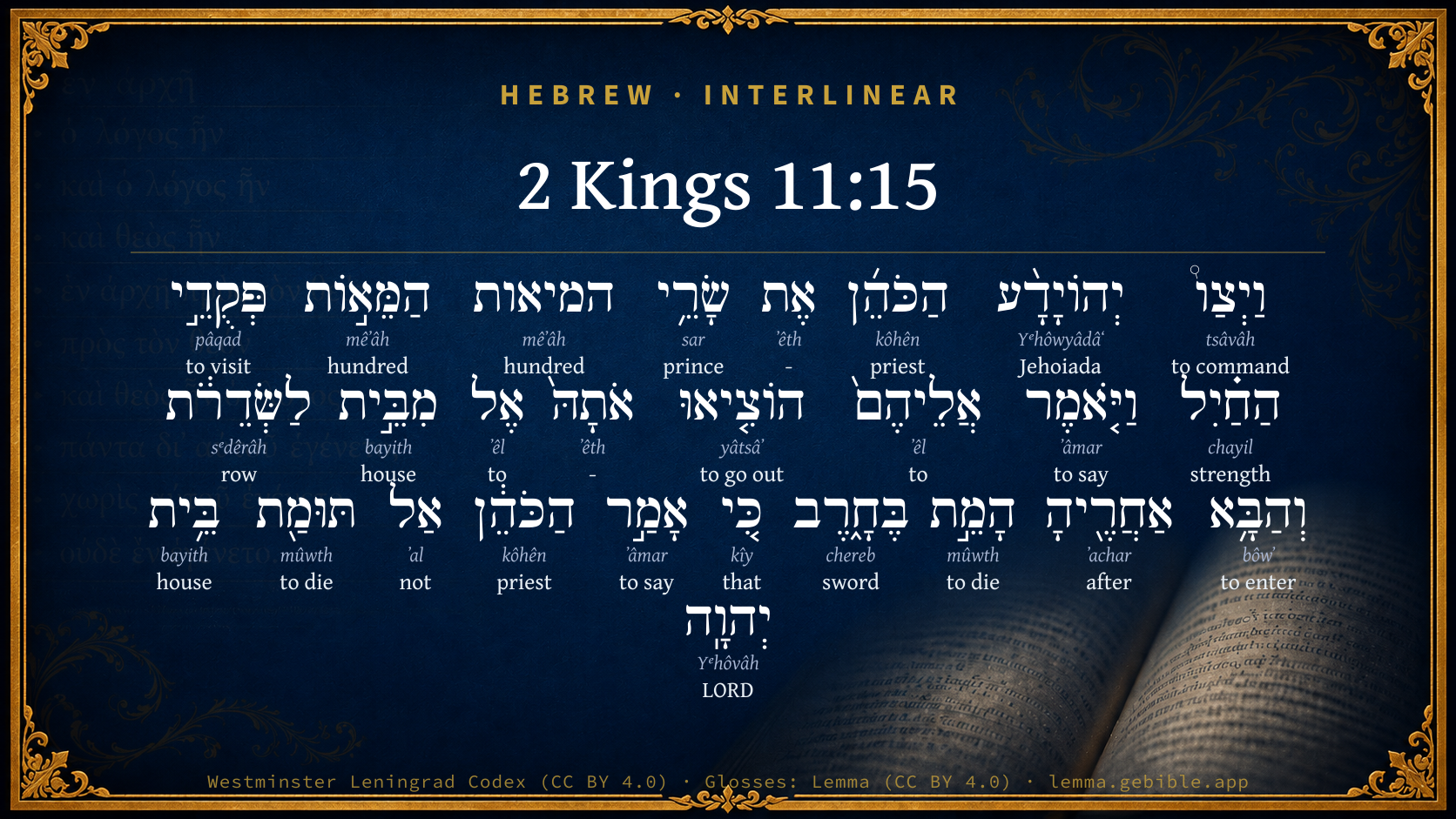
2 Kings 11:15

Hebrew (Westminster Leningrad Codex) 2 Kings 11:15 appears in the Hebrew Old Testament. The text above is from the Westminster Leningrad Codex. Each word links to its Strong’s number, a concise gloss, and parsing drawn from the Open Scriptures Hebrew Bible morphology. Click any word for its full Brown-Driver-Briggs (BDB) entry.
Download image
Cite this verse

2 Kings 11:15 (World English Bible). Public Domain. Lemma interlinear Bible study tool, https://lemma.gebible.app/v/2-kings/11/15.

Show BibTeX & RIS
BibTeX
RIS
English Translation
Jehoiada the priest commanded the captains of hundreds who were set over the host, and said to them, Have her forth between the ranks; and him who follows her kill with the sword. For the priest said, Don't let her be slain in the house of Yahweh.
World English Bible · Public Domain
Download a study sheet

One document with this verse’s original text, its word-by-word gloss line, the meaning frame, cross-references with their text, attributed commentary, and full source and license credits — printable, and it pastes into notes with its structure intact.

This verse Autodidact and up

Study sheet (.html) Plain text (.txt)

A passage Seminary Student

Up to 50 verses in one chapter. A passage sheet keeps up to 6 commentary sources and 12 cross-references per verse, in the order this page ranks them, and says so on the sheet whenever that leaves anything out. Ask for a single verse and you get the Autodidact verse sheet above.

Everything on this page stays free to read, with no account — the sheet is a download of what is already on screen, not access to it.

Want to remove ads? Support Godless Engineer
Compare translations 3

The same verse in 3 English versions, stacked beneath the original-language interlinear above. Click any original word for its lexicon entry.

Each is an independent rendering of the whole verse — the interlinear is not word-aligned to these translations.

Highlighted words mark where these versions differ — a whole-verse word diff, not a word-by-word alignment.

  • World English Bible Public Domain
    Jehoiada the priest commanded the captains of hundreds who were set over the host, and said to them, Have her forth between the ranks; and him who follows her kill with the sword. For the priest said, Don't let her be slain in the house of Yahweh.
  • King James Version Public Domain
    But Jehoiada the priest commanded the captains of the hundreds, the officers of the host, and said unto them, Have her forth without the ranges: and him that followeth her kill with the sword. For the priest had said, Let her not be slain in the house of the LORD.
  • unfoldingWord Literal Text CC BY-SA 4.0
    And Jehoiada the priest commanded the commanders of hundreds, the officers of the force, and said to them, “Bring her from the house to the ranks. And the one coming after her, kill with the sword.” For the priest said, “Let her not be killed in the house of Yahweh.”

unfoldingWord Literal Text — © unfoldingWord, licensed CC BY-SA 4.0. Word-aligned USFM3 via Door43 (git.door43.org/unfoldingWord/en_ult).

Versions to compare (up to 4)

3 of 4 selected

Show all 18 translations

Every available English version of this verse, each an independent rendering of the whole verse.

  • World English Bible Public Domain
    Jehoiada the priest commanded the captains of hundreds who were set over the host, and said to them, Have her forth between the ranks; and him who follows her kill with the sword. For the priest said, Don't let her be slain in the house of Yahweh.
  • Berean Standard Bible Public Domain
    And Jehoiada the priest ordered the commanders of hundreds in charge of the army, “Bring her out between the ranks, and put to the sword anyone who follows her.” For the priest had said, “She must not be put to death in the house of the LORD.”
  • Majority Standard Bible Public Domain
    And Jehoiada the priest ordered the commanders of hundreds in charge of the army, “Bring her out between the ranks, and put to the sword anyone who follows her.” For the priest had said, “She must not be put to death in the house of the LORD.”
  • King James Version Public Domain
    But Jehoiada the priest commanded the captains of the hundreds, the officers of the host, and said unto them, Have her forth without the ranges: and him that followeth her kill with the sword. For the priest had said, Let her not be slain in the house of the LORD.
  • American Standard Version (1901) Public Domain
    And Jehoiada the priest commanded the captains of hundreds that were set over the host, and said unto them, Have her forth between the ranks; and him that followeth her slay with the sword. For the priest said, Let her not be slain in the house of Jehovah.
  • Revised Version (1885) Public Domain
    And Jehoiada the priest commanded the captains of hundreds that were set over the host, and said unto them, Have her forth between the ranks; and him that followeth her slay with the sword: for the priest said, Let her not be slain in the house of the LORD.
  • Geneva Bible (1599) Public Domain
    But Iehoiada the Priest commanded the captaines of the hundreths that had the rule of the hoste, and sayde vnto them, Haue her forth of the ranges, and he that followeth her, let him die by the sworde: for the Priest had sayd, Let her not be slaine in the house of the Lord.
  • Douay-Rheims (1899) Public Domain
    But Joiada commended the centurions that were over the army, and said to them: Have her forth without the precinct of the temple, and whosoever shall follow her, let him be slain with the sword. For the priest had said: Let her not be slain in the temple of the Lord.
  • Young's Literal Translation Public Domain
    And Jehoiada the priest commandeth the heads of the hundreds, inspectors of the force, and saith unto them, `Bring her out unto the outside of the ranges, and him who is going after her, put to death by the sword:' for the priest had said, `Let her not be put to death in the house of Jehovah.'
  • Literal Standard Version CC BY-SA 4.0
    And Jehoiada the priest commands the heads of the hundreds, inspectors of the force, and says to them, “Bring her out to the outside of the ranges, and him who is going after her, put to death by the sword”: for the priest had said, “Do not let her be put to death in the house of YHWH.”
  • Unlocked Literal Bible CC BY-SA 4.0
    Then Jehoiada the priest ordered the commanders of hundreds who were over the army, saying, “Bring her out between the ranks. Anyone who follows her, kill him with the sword.” For the priest had said, “Do not let her be killed in the house of Yahweh.”
  • unfoldingWord Literal Text CC BY-SA 4.0
    And Jehoiada the priest commanded the commanders of hundreds, the officers of the force, and said to them, “Bring her from the house to the ranks. And the one coming after her, kill with the sword.” For the priest said, “Let her not be killed in the house of Yahweh.”
  • Darby Bible Public Domain
    And Jehoiada the priest commanded the captains of the hundreds that were set over the host, and said to them, Lead her forth without the ranks; and whosoever follows her, slay with the sword; for the priest said, Let her not be put to death in the house of Jehovah.
  • World Messianic Bible Public Domain
    Jehoiada the priest commanded the captains of hundreds who were set over the army, and said to them, “Bring her out between the ranks. Kill anyone who follows her with the sword.” For the priest said, “Don’t let her be slain in the LORD’s house.”
  • Webster's Bible Public Domain
    But Jehoiada the priest commanded the captains of the hundreds, the officers of the host, and said to them, Have her forth without the ranges: and him that followeth her kill with the sword. For the priest had said, Let her not be slain in the house of the LORD.
  • Free Bible Version CC BY-SA 4.0
    Jehoiada ordered the army commanders, “Bring her to the men standing in front of the Temple, and kill anyone who follows her.” Earlier the priest had made it clear, “She must not be killed in the Lord's Temple.”
  • Bible in Basic English Public Domain
    Then Jehoiada the priest gave orders to those who were placed in authority over the army, saying, Take her outside the lines, and let anyone who goes after her be put to death with the sword, for he said, Let her not be put to death in the house of the Lord.
  • JPS Tanakh (1917) Public Domain
    And Jehoiada the priest commanded the captains of hundreds, the officers of the host, and said unto them: 'Have her forth between the ranks; and him that followeth her slay with the sword'; for the priest said: 'Let her not be slain in the house of the LORD.'

Literal Standard Version (2020), Covenant Press — licensed CC BY-SA 4.0. Text via the HelloAO Bible API (eBible.org). Unlocked Literal Bible (unfoldingWord) — licensed CC BY-SA 4.0. Text via the HelloAO Bible API (eBible.org). unfoldingWord Literal Text — © unfoldingWord, licensed CC BY-SA 4.0. Word-aligned USFM3 via Door43 (git.door43.org/unfoldingWord/en_ult). Free Bible Version, Dr. Jonathan Gallagher — licensed CC BY-SA 4.0. Text via the HelloAO Bible API (eBible.org).

Word by word

More ways to search: Search by grammar → Find every occurrence → Compare this word →

Practice this passage: Drill this verse → Learn its vocabulary →

לַשְּׂדֵרֹ֔ת
sᵉdêrâh
H7713
“to/for the · rows”
Preposition, Determined + Noun, Common, Feminine, Plural, Absolute
Part of Speech
Preposition + Noun
Type
Common
Gender
Feminine
Number
Plural
State
Absolute
Full BDB Definition

Origin: from an unused root meaning to regulate

TWOT: 1467b

row, rank (of soldiers) - rows, ranks - technical term of building - meaning unknown
  1. וַיְצַו֩ tsâvâh H6680 “and · to command” Conjunction + Verb, Piel, Sequential Imperfect, 3rd Person, Masculine, Singular
  2. יְהוֹיָדָ֨ע Yᵉhôwyâdâʻ H3077 “Jehoiada” Noun, Proper
  3. הַכֹּהֵ֜ן kôhên H3548 “the · priest” Particle, Definite Article + Noun, Common, Masculine, Singular, Absolute
  4. אֶת ʼêth H853 “-” Particle, Direct Object
  5. שָׂרֵ֥י sar H8269 “princes of” Noun, Common, Masculine, Plural, Construct
  6. המיאות mêʼâh H3967 “the · hundred” Particle, Definite Article + Adjective, Cardinal number, Both, Plural, Absolute
  7. הַמֵּא֣וֹת mêʼâh H3967 “the · hundred” Particle, Definite Article + Adjective, Cardinal number, Both, Plural, Absolute
  8. פְּקֻדֵ֣י pâqad H6485 “visited” Verb, Qal, Participle Passive, Masculine, Plural, Construct
  9. הַחַ֗יִל chayil H2428 “the · strength” Particle, Definite Article + Noun, Common, Masculine, Singular, Absolute
  10. וַיֹּ֤אמֶר ʼâmar H559 “and · to say” Conjunction + Verb, Qal, Sequential Imperfect, 3rd Person, Masculine, Singular
  11. אֲלֵיהֶם֙ ʼêl H413 “to · them” Preposition + Suffix, Personal, 3rd Person, Masculine, Plural
  12. הוֹצִ֤יאוּ yâtsâʼ H3318 “go out” Verb, Hiphil, Imperative, 2nd Person, Masculine, Plural
  13. אֹתָהּ֙ ʼêth H853 “- · her” Particle, Direct Object + Suffix, Personal, 3rd Person, Feminine, Singular
  14. אֶל ʼêl H413 “to” Preposition
  15. מִבֵּ֣ית bayith H1004 “from · house of” Preposition + Noun, Common, Masculine, Singular, Construct
  16. וְהַבָּ֥א bôwʼ H935 “and · the · entering” Conjunction + Particle, Definite Article + Verb, Qal, Participle Active, Masculine, Singular, Absolute
  17. אַחֲרֶ֖יהָ ʼachar H310 “after · her” Preposition + Suffix, Personal, 3rd Person, Feminine, Singular
  18. הָמֵ֣ת mûwth H4191 “to die” Verb, Hiphil, Infinitive Absolute
  19. בֶּחָ֑רֶב chereb H2719 “in/at the · sword” Preposition, Determined + Noun, Common, Feminine, Singular, Absolute
  20. כִּ֚י kîy H3588 “that” Conjunction
  21. אָמַ֣ר ʼâmar H559 “to say” Verb, Qal, Perfect, 3rd Person, Masculine, Singular
  22. הַכֹּהֵ֔ן kôhên H3548 “the · priest” Particle, Definite Article + Noun, Common, Masculine, Singular, Absolute
  23. אַל ʼal H408 “not” Particle, Negative
  24. תּוּמַ֖ת mûwth H4191 “to die” Verb, Hophal, Jussive, 3rd Person, Feminine, Singular
  25. בֵּ֥ית bayith H1004 “house of” Noun, Common, Masculine, Singular, Construct
  26. יְהוָֽה Yᵉhôvâh H3068 “LORD” Noun, Proper

About this verse

These counts appear in no published source. They are computed here, from the morphology-tagged text and Lemma’s own curated glosses. What Lemma adds →

27
words
20
distinct lemmas
Historical
section

Notable vocabulary

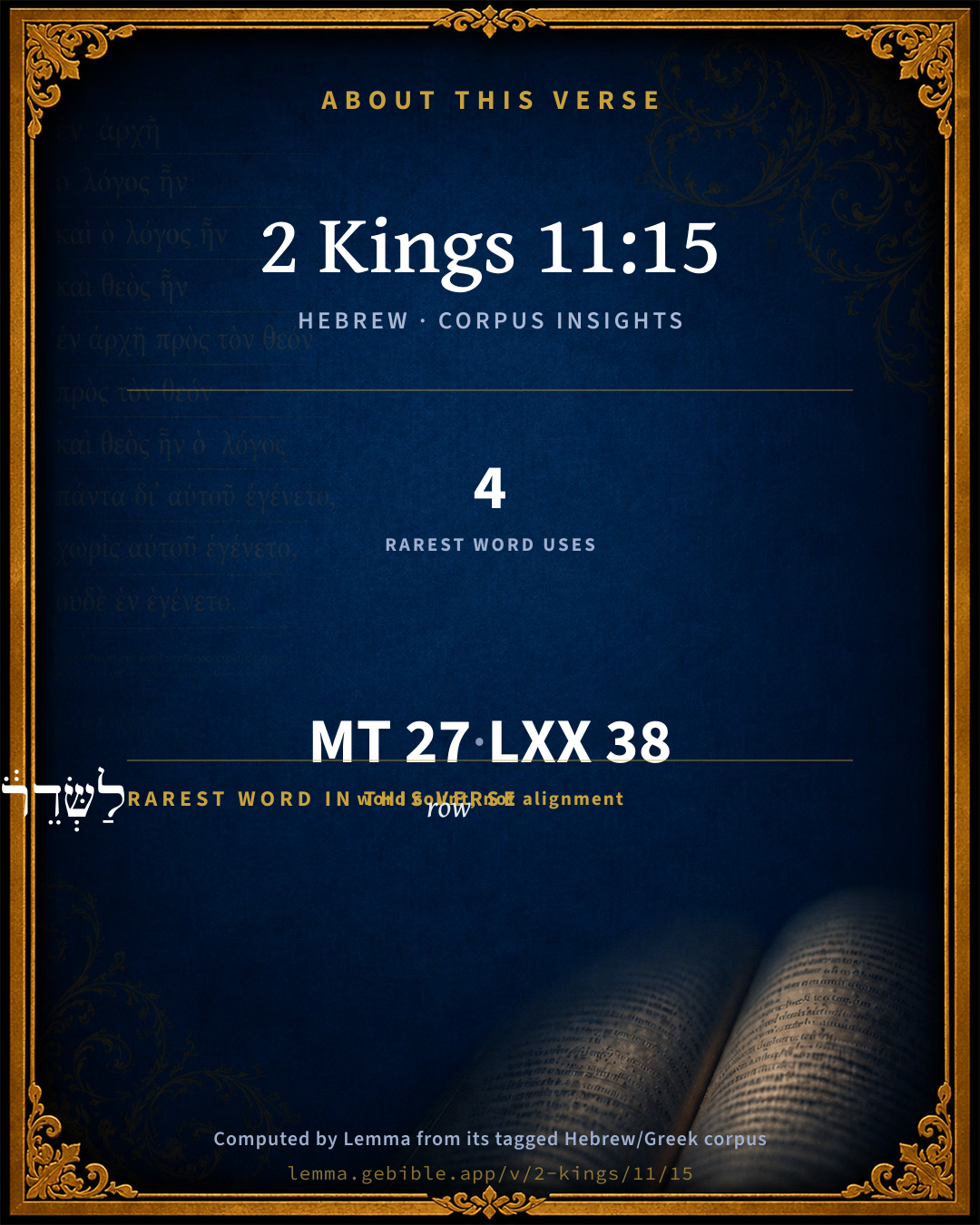
The rarest word here is לַשְּׂדֵרֹ֔ת row H7713 — appearing just 4 times in the whole Hebrew Bible.

Shared distinctive vocabulary

לַשְּׂדֵרֹ֔ת row H7713 occurs in 4 verses of the Hebrew Bible. Also found in:

Grammatical profile

  • 8 verbs
  • 10 nouns
  • 2 adjectives
  • 3 prepositions
  • 1 conjunction
  • 3 particles

Verb forms

  • וַיְצַו֩ Piel · Sequential Imperfect
  • פְּקֻדֵ֣י Qal · Participle Passive
  • וַיֹּ֤אמֶר Qal · Sequential Imperfect
  • הוֹצִ֤יאוּ Hiphil · Imperative
  • וְהַבָּ֥א Qal · Participle Active
  • הָמֵ֣ת Hiphil · Infinitive Absolute
  • אָמַ֣ר Qal · Perfect
  • תּוּמַ֖ת Hophal · Jussive

Repetition

Words recur within this verse — often emphatic in Hebrew:

  • הַכֹּהֵ֜ן priest H3548 ×2
  • המיאות hundred H3967 ×2
  • וַיֹּ֤אמֶר to say H559 ×2
  • מִבֵּ֣ית house H1004 ×2
  • הָמֵ֣ת to die H4191 ×2
  • אֲלֵיהֶם֙ to H413 ×2

Hebrew & Septuagint length

In English translation the verse runs 47 words from the Hebrew and 53 from the Septuagint (LXX English) — closely comparable.

A rough comparison of the two English renderings, which tokenize alike — not a word-level alignment.

Word counts can differ between the Hebrew and the Greek without any difference in meaning — e.g. the Hebrew direct-object marker אֵת has no separate Greek word, and Greek often adds the article ὁ.

In the original languages it is 27 Hebrew tokens and 38 Greek tokens — but the two are counted differently (Hebrew bundles its prefixes and suffixes into one token; the Greek is in lemma form), so that isn’t a like-for-like length.

Cross-references

6

Topical passages linked to 2 Kings 11:15 in the Treasury of Scripture Knowledge — connected by theme and wording, ordered by reader-vote popularity; previews shown in the World English Bible.

  • 2 Kings 11:4 In the seventh year Jehoiada sent and fetched the captains over hundreds of the Carites and of the guard, and brought them to him into the house of Yahweh; and he made a covenant with them, and took an oath of them in the house of Yahweh, and shown them the king's son.
  • 2 Kings 11:9–10 The captains over hundreds did according to all that Jehoiada the priest commanded; and they took every man his men, those who were to come in on the Sabbath, with those who were to go out on the Sabbath, and came to Jehoiada the priest.
  • 2 Chronicles 23:9 Jehoiada the priest delivered to the captains of hundreds the spears, and bucklers, and shields, that had been king David's, which were in the house of God.
  • 2 Chronicles 23:14 Jehoiada the priest brought out the captains of hundreds who were set over the host, and said to them, Have her forth between the ranks; and whoever follows her, let him be slain with the sword: for the priest said, Don't kill her in the house of Yahweh.
  • Ezekiel 9:7 He said to them, Defile the house, and fill the courts with the slain: go you forth. They went forth, and struck in the city.
  • Ezekiel 21:14 You therefore, son of man, prophesy, and strike your hands together; and let the sword be doubled the third time, the sword of the deadly wounded: it is the sword of the great one who is deadly wounded, which enters into their chambers.

Cross-references courtesy of OpenBible.info (CC BY 4.0).

Hebrew and Greek witnesses Masoretic Hebrew ↔ Greek Septuagint

The same verse in the two great witnesses to the Old Testament, shown verse-for-verse.

These are two independent witnesses, not word-aligned to each other, and the Septuagint is shown in lemma (dictionary) form.

Hebrew 2 Kings 11:15 Masoretic · Westminster Leningrad Codex

וַיְצַו֩ יְהוֹיָדָ֨ע הַכֹּהֵ֜ן אֶת שָׂרֵ֥י המיאות הַמֵּא֣וֹת פְּקֻדֵ֣י הַחַ֗יִל וַיֹּ֤אמֶר אֲלֵיהֶם֙ הוֹצִ֤יאוּ אֹתָהּ֙ אֶל מִבֵּ֣ית לַשְּׂדֵרֹ֔ת וְהַבָּ֥א אַחֲרֶ֖יהָ הָמֵ֣ת בֶּחָ֑רֶב כִּ֚י אָמַ֣ר הַכֹּהֵ֔ן אַל תּוּמַ֖ת בֵּ֥ית יְהוָֽה

Jehoiada the priest commanded the captains of hundreds who were set over the host, and said to them, Have her forth between the ranks; and him who follows her kill with the sword. For the priest said, Don't let her be slain in the house of Yahweh.

World English Bible · Public Domain

Greek LXX 2 Kings 11:15 Septuagint · lemma form

καί ἐντέλλομαι ιωδαε ὁ ἱερεύς ὁ ἑκατοντάρχης ὁ ἐπισκοπός ὁ δύναμις καί εἶπον πρός αὐτός ἐκἄγω αὐτός ἔσωθεν ὁ σαδηρωθ καί ὁ εἰςπορεύομαι ὀπίσω αὐτός θάνατος θανατόω ῥομφαία ὅτι εἶπον ὁ ἱερεύς καί μή ἀποθνήσκω ἐν οἶκος κύριος

And Jodae the priest commanded the captains of hundreds who were over the host, and said to them, Bring her forth without the ranges, and he that goes in after her shall certainly die by the sword. For the priest said, Let her not however be slain in the house of the Lord.

LXX2012 (modern English Septuagint) · Public Domain

On this verse, Haydock's Catholic Bible Commentary discusses the Septuagint’s reading. Read the note in Commentary ↓

Hebrew: Westminster Leningrad Codex (CC BY 4.0). Greek: Septuagint (public domain); English from LXX2012 (modern English Septuagint) (Public Domain). How the Septuagint differs from the Hebrew →

Targum (Aramaic paraphrase)

1

The Targum is the ancient Jewish Aramaic paraphrase of the Hebrew Scriptures — an interpretive translation, not the Hebrew text itself. Onkelos (literal) and Pseudo-Jonathan (expansive) render the Torah, and Jonathan the Prophets. Coverage is partial: where no permissively-licensed English translation exists for a verse, only the Aramaic is shown. This is verse-level text, not a word-by-word alignment to the Hebrew.

  1. Targum Jonathan Prophets (Joshua–Malachi)
    וּפַקֵיד יְהוֹיָדָע כַּהֲנָא יַת רַבָּנֵי מַאֲוָתָא דִמְמַנָן עַל חֵילָא וַאֲמַר לְהוֹן אֲפִּיקוּ יָתָהּ לְגָיו מִן סִדְרָא וּדְיֵיעוּל בַּתְרָהָא יִתְקְטֵיל בְּחַרְבָּא אֲרֵי אֲמַר כַּהֲנָא לָא תִתְקְטֵיל בְּבֵית מַקְדְשָׁא דַיְיָ:

    (no public-domain English translation for this verse)

    Targum Jonathan — Aramaic: “Mikraot Gedolot” (public domain). English: “Sefaria Community Translation” (CC0 1.0 (public-domain dedication)); “London "Chaldee Paraphrase," 1871” (public domain). Text via Sefaria.

Commentary

Notes on 2 Kings 11:15 from classic Christian and Jewish commentators (each source and its license shown beneath its notes). The classic Christian expositions comment on the surrounding passage and are grouped to its opening verse, so a note may address several verses; the Jewish commentaries on the Tanakh (Rashi and others) are per-verse, so they appear only where the commentator wrote on this verse.

Lemma curates 59 commentaries, every one of them public domain or Creative Commons licensed, each selected and text-cleaned for this edition rather than reprinted as found. About our sources →

Trapp's Complete Commentary

John Trapp

2Ki 11:15 But Jehoiada the priest commanded the captains of the hundreds, the officers of the host, and said unto them, Have her forth without the ranges: and him that followeth her kill with the sword. For the priest had said, Let her not be slain in the house of the LORD.

Ver. 15. And him that followeth her,] sc., To defend her and adhere to her; which none did, for they were all weary of her tyrannical government, and glad to be rid of her.

John Trapp, A Commentary or Exposition upon All the Books of the Old and New Testament (1647–1656) — public domain. Text from a community e-Sword module.

Joseph Benson's Commentary

2Ki 11:15. Jehoiada commanded the officers of the host — Of those companies of Levites, who are elsewhere called the Lord’s host, and now were the king’s host. Have her forth without the ranges — Through which they had suffered her to come. If she will not go out of them of her own accord, force her out of them. And him that followeth her, kill with the sword — If any of the people that shall come hither on this occasion, shall stand up for her help, let them be slain. Let her not be slain in the house of the Lord — That is, in the court of the temple, lest it be polluted with her blood.

Joseph Benson's Commentary on the Old and New Testaments (1811–1818) — public domain. Text from a community e-Sword module.

Geneva Bible (1599)

Geneva Bible translators

To take her part.

Or, out of the Temple.

Geneva Bible (1599) marginal notes — public domain. Text via Bolls.life.

Jamieson, Fausset & Brown

Robert Jamieson, A. R. Fausset & David Brown

without the ranges--that is, fences, that the sacred place might not be stained with human blood.

Jamieson, Fausset & Brown — Commentary Critical and Explanatory on the Whole Bible (1871) — public domain (CC PDM 1.0). Text via the HelloAO Bible API.

Adam Clarke's Commentary

Verse 15. Have her forth] She had pressed in among the guards into the temple.

And him that followeth] The person who takes her part, let him instantly be slain.

Adam Clarke's Commentary on the Bible (1810–1826) — public domain. Text from a community e-Sword/MySword module.

Ellicott's Commentary for English Readers

(15) The captains of the hundreds, the officers of the host.—The centurions of the royal guard are called “the officers of the host” (comp. Num_31:14) to signify that it was they who gave effect to the high priest’s orders by communicating them to their troops.

Have her forth without the ranges.—Rather, Cause her to go out between the ranks—i.e., escort her out of the sacred precincts with a guard on both sides.

Him that followeth her—i.e., whoever shows any sympathy with her, or attempts to take her part. There might have been some of her partisans in the large gathering in the Temple court.

For the priest had said.—This is a parenthetic statement accounting for the order just given; and “had said” may mean “thought.”

A Bible Commentary for English Readers, edited by Charles John Ellicott (1878–1897) — public domain. Text from a community e-Sword module.

The Cambridge Bible for Schools and Colleges

gen. ed. J. J. S. Perowne

15. But [R.V. And] Jehoiada the priest commanded the captains of the [R.V. omits the] hundreds, the officers of the host] R.V. that were set over the host. The changes bring the version into close agreement with 2 Chron. By the ‘host’ is meant the combined body who had been gathered by Jehoiada, and put under the direction of the five captains.

Have her forth without the ranges] R.V. between the ranks. That the meaning is ‘within’ and not ‘without’ the ranks is manifest from Lev_16:15 where the same prepositional form is found and cannot be otherwise translated than ‘within’. The object of Jehoiada’s order is plain. He would keep Athaliah surrounded by his own guards, but get her removed beyond the precincts of the temple. This harmonizes with the order recorded at the end of this verse, that she should not be slain in the house of the Lord.

and him that followeth her kill [R.V. slay] with the sword] The verb is the same as in the next clause. The persons who might perhaps be expected lo follow her, when she was led away guarded from the temple, would be those of her own attendants, who had not been allowed to come between the lines of the guard, yet now might think it their duty to try and rescue their mistress.

The Cambridge Bible for Schools and Colleges (gen. ed. J. J. S. Perowne; Cambridge University Press, 1878–1918) — public domain. Text from a community e-Sword module.

John Gill's Exposition

And they laid hands on her,.... Or rather,"set a place for her'',as the Targum; so Jarchi and Kimchi; made a space, opened a way for her to come out of the temple into their ranks, that she might be there taken and slain, and not in the temple:

and she went by the way by the which the horses came into the king's house; either the high road in which the horses and carriages went to the palace, or the way to the king's stables near the palace: and there was she slain; they let her go so far, which was far enough from the temple, and then they slew her.

John Gill's Exposition of the Whole Bible (1746–1763) — public domain (CC PDM 1.0). Text via the HelloAO Bible API.

Albert Barnes' Notes on the Bible

Have her forth without the ranges - Rather, “Conduct her out between your ranks.” Guard her, i. e., on all sides, that the people may not fall upon her and kill her as she passes through the court, thereby polluting the temple.

Albert Barnes' Notes on the Bible (1834–1885) — public domain. Text from a community e-Sword/MySword module.

Haydock's Catholic Bible Commentary

Precinct. Hebrew sederoth, (untranslated by the Septuagint and (Haydock) improperly supposed by Josephus to be the torrent Cedron) means, "the ranks" of the guards, (Calmet) or, "ranges" of the sacred buildings, which her impure blood must not defile. (Haydock) --- Follow her, as an accomplice. (Menochius)

George Leo Haydock (1774–1849), Haydock's Catholic Family Bible and Commentary, 1859 edition — public domain. Excludes Psalms (Douay-Rheims chapter numbering differs from Protestant) and Deuterocanonical books (Catholic canon only).

Matthew Poole's English Annotations

The officers of the host; of these companies of Levites, who are elsewhere called the Lord’s host, and now were the king’s host.

Without the ranges; of which see above, 2Ki 11:8. If she will not go out of them of her own accord, force her out of them.

Him that followeth her; if any of the people, come hither upon this occasion, shall stand up for her help.

In the house of the Lord, i.e. in the court of the temple, lest it bc polluted with her blood.

Matthew Poole's English Annotations on the Holy Bible (1683–1685) — public domain. Text from a community e-Sword/MySword module.

Whedon's Commentary on the Bible

Daniel D. Whedon

15. Without the ranges — See 2Ki_11:8.

Him that followeth her — That is, him that presumes to take her part and defend her.

Not be slain in… house of the Lord — The high priest would not have the temple stained with human blood.

Daniel D. Whedon (gen. ed.), Commentary on the Old and New Testaments (1874–1909) — public domain. Text from a community e-Sword module.

The Pulpit Commentary

But Jehoiada the priest commanded the captains literally, princesof the hundreds, the officers of the host the commanders, i.e. , of the small "army" assembled in the temple courtand said unto them, Have her forth without the ranges; rather, have her forth, or conduct her out between your ranks. The object was probably to preserve her from suffering violence at the hands of any of the people within the temple precincts, which Jehoiada desired to preserve free from pollution. And him that followeth her kill with the sword; i.e. if any come after her out of the temple, to attempt a rescue, slay them with the sword. The order, given aloud, was sufficient to deter persons from making the attempt. For the priest had said, Let her not be slain in the house of the Lord. Jehoiada had previously given an order that her execution should take place outside the temple.

Vers. 15-17. God"s judgments not infrequently fall in this life, though sometimes they are deferred to the life beyond the grave.

The Athaliahs and Mattans of history seldom come to a good end. Though the wicked man be often seen in prosperity, though he "flourishes as a green bay tree," yet it is not often that he continues flourishing to the close of his days, or dies in comfort, peace, and happiness. The psalmist was satisfied when he saw "the end" of the man whose long-continued prosperity had vexed and grieved him. (Psa_73:2-22) Heathen wisdom bade men never to pronounce any one happy before his death," since in human life changes were of continual occurrence, and the higher a man"s exaltation above his fellows at a given time, the lower was likely to be his depression and degradation at another. The rationale of the matter seems to be

I GOD HAS ATTACHED PENALTIES TO VICE IN THE WAY OF NATURAL CONSEQUENCE, WHICH TAKE EFFECT IF TIME BE ALLOWED. Tyrants lay up for themselves a constantly increasing amount of hatred and resentment, which naturally bursts forth and sweeps them away after a while; e.g. Hipparchus, Tarquin, Dionysius, Caligula, Nero. Drunkards, gluttons, and profligate persons destroy their health. Reckless spendthrifts reduce themselves to poverty and want. Unfaithfulness strips men of their friends, and leaves them weak and defenseless against their adversaries. The prosperity of the wicked is naturally but for a time give them the full term of human life, and, before they die, their sin will, to a certainty, find them out, and they will cease to prosper.

II GOD DOES, ON OCCASION, VISIT HIGH-PLACED, PROSPEROUS SINNERS WITH SUDDEN, SIGNAL PUNISHMENTS DEALT BY HIS OWN HAND. Scripture gives us a certain number of examples, as those of the Pharaoh of the Exodus, Saul, Jezebel, Sennacherib, Nebuchadnezzar, Herod Agrippa, and the like, whose afflictions are distinctly declared to have been sent upon them by God himself in the way of punishment. While, no doubt, great caution is necessary in applying the principle thus indicated to other persons in history, and especially to living persons, we need not shrink from some application of it. God speaks to us in history, not only in his Word. When selfish usurpers, who have deluged whole continents in blood, and sacrificed tens or hundreds of thousands of lives to gratify their ambition, are cast down from their thrones, and die in exile or banishment, it is almost impossible not to see his hand in the occurrences, executing judgment. When an Arius, bent on the disruption of the Church, and seemingly at the point of triumph, expires silently in the night, or a Galerius, the most cruel of persecutors, perishes in most horrible agonies, there is no want of charity or of reverence in once more recognizing his finger interposed to save has Church or to avenge his martyred ones. "Some men"s sins are open beforehand, going before to judgment"; (1Ti_5:24) and, when the judgment falls, it would be willful blindness on our part not to recognize it. We must be cautious, and remember that those on whom the tower in Siloam fell, and slew them, were not sinners above the other dwellers in Jerusalem; (Luk_13:4) but, if it was God"s vengeance that destroyed the cities of the plain, and that visited Nadab and Abihu, Korah, Dathan, and Abiram, Sihon and Og, Balaam, Adonizedek and his brother kings, Eglon, Sisera, Zebah, Zalmunna, Abimelech, Agag, Doeg, Shimei, Jezebel, Haman, Ananias, Sapphira, Herod Agrippa, Elymas, so we may be sure that it has fallen on hundreds of others whose names do not occur in Scripture, coming suddenly upon them, and cutting them off in their iniquities, generally when neither they nor others were in the least expecting it. God is still, as he has ever been, "the great, the mighty God, the Lord of hosts, great in counsel and mighty in work; his eyes are open upon all the ways of the sons of men, to give every one according to his ways and according to the fruit of his doings". (Jer_32:18, Jer_32:19) Either m this life or in the life to come he will execute vengeance upon evil-doers. Well for them if it is in this life, and if they so escape the dreadful lot of those "to whom is reserved the blackness of darkness forever". (Jud_1:13)

The Pulpit Commentary (1880–1919), ed. H.D.M. Spence-Jones & Joseph S. Exell — public domain. Text from a community e-Sword module.

John Wesley's Explanatory Notes

Host - Of these companies of Levites, who are elsewhere called the Lord's host, and now were the king's host.

John Wesley, Explanatory Notes Upon the Whole Bible (1754–1765) — public domain. Text via the GEBible commentary corpus.

unfoldingWord translationNotes

Door43 World Missions Community

the commanders of hundreds

The phrase "commander of hundreds" is probably an official title for a military officer. Possible meanings are 1) the word "hundreds" represents the exact amount of soldiers that each of these commanders led. AT: "the commanders of 100 soldiers" or 2) the word translated as "hundreds" does not represent an exact number, but is the name of a military division. AT: "the commanders of military divisions" See how you translated this in 2 Kings 11:4. (See: Numbers)

Bring her out between the ranks

"Take her away between two rows of guards" or "Lead her away with a row of soldiers on each side of her." Ranks are lines or rows of soldiers.

Anyone who follows her

It is implied that a person who followed her would be trying to help her. AT: "Anyone who follows to try to rescue her" (See: Assumed Knowledge and Implicit Information)

they seized her as she reached the place where the horses enter the palace grounds

Some versions translate this as "the guards seized her and took her to the palace, to the place where horses enter the courtyard."

translationWords

priest

sword

house of God

horse

unfoldingWord translationNotes — © Distant Shores Media and the Door43 World Missions Community, licensed CC BY-SA 4.0. Source: git.door43.org/Door43/en_tn.

Rashi

Rabbi Shlomo Yitzchaki (Rashi)

“Remove her.” Out of the Beis Hamikdosh to the ranks [=שְׂדֵרוֹת] [i.e.,] and bring her by way of the שְׂדֵרוֹת to the king’s palace, but do not allow her to leave through the exit of the Temple court through the city, where she might find allies who will join her.

And anyone who follows her. To help her.

Kill with the sword. To slay with a sword.

Rashi on the Tanakh — English translations: “The Judaica Press complete Tanach with Rashi, translated by A. J. Rosenberg” (CC BY 4.0); “Pentateuch with Rashi's commentary by M. Rosenbaum and A.M. Silbermann, 1929-1934” (public domain); “The Metsudah Tanach series, Lakewood, N.J” (CC BY 4.0); and “The Book of Joshua, Metsudah Publications, 1997” (CC BY 4.0). Text via Sefaria.

Lesson kit

Teaching starters — assembled from the data on this page, not authored interpretation. Every prompt links to the verse data it draws on. Edit before teaching.

2 Kings, in the Historical, opens this verse with 27 words (20 distinct Hebrew lemmas). Its most distinctive word is sᵉdêrâh (“row”). A historical commentator’s framing appears above. Read the whole chapter for the surrounding context.

Discussion questions

  1. What does “row” (sᵉdêrâh) contribute to the verse as a whole?
  2. 1 Kings 6:9 shares the word «row» with this verse. How do the two illuminate each other?
  3. “priest” occurs 2× in this one verse. What is the effect of the repetition?
  4. These translations render this verse differently; the difference is in the English rendering, not the original. What questions does that raise?
  5. The verb «וַיְצַו֩» is Piel Sequential Imperfect. How does its form color the action?
  6. Reading how Trapp's Complete Commentary and Joseph Benson's Commentary read this verse, where do the two commentators agree and where do they part?

Things to notice

Reading settings

Reading text

Shown beneath each verse's original-language words.

Old Testament
Old Testament edition

Read the OT as the Masoretic Hebrew (MT) or the Greek Septuagint (LXX).

English shown for the Greek Septuagint (in the Hebrew ↔ Greek comparison).

Comparing translations? Open the Compare panel on any verse page to stack up to four side by side.