
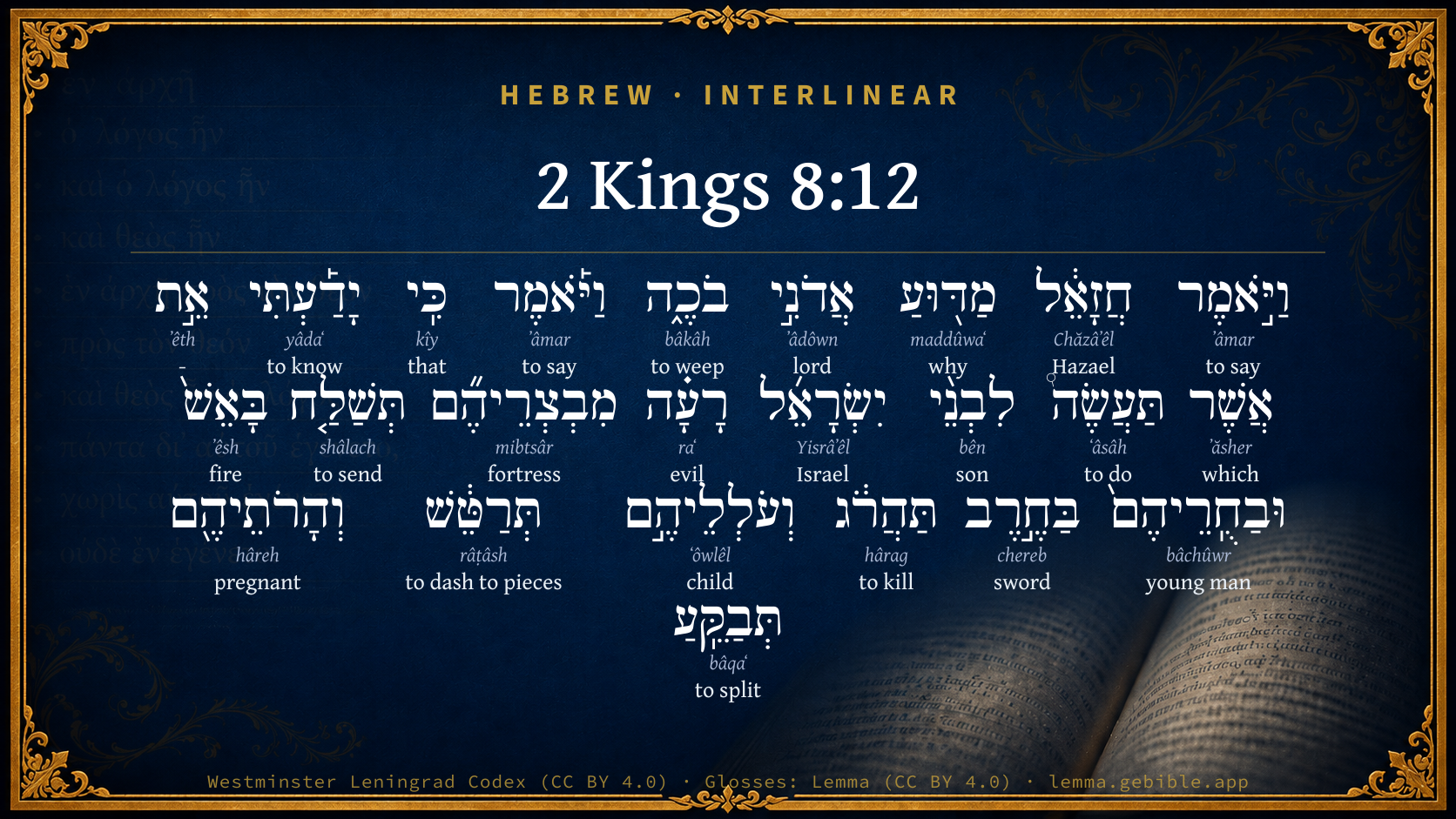
2 Kings 8:12

Hebrew (Westminster Leningrad Codex) 2 Kings 8:12 appears in the Hebrew Old Testament. The text above is from the Westminster Leningrad Codex. Each word links to its Strong’s number, a concise gloss, and parsing drawn from the Open Scriptures Hebrew Bible morphology. Click any word for its full Brown-Driver-Briggs (BDB) entry.
Download image
Cite this verse

2 Kings 8:12 (World English Bible). Public Domain. Lemma interlinear Bible study tool, https://lemma.gebible.app/v/2-kings/8/12.

Show BibTeX & RIS
BibTeX
RIS
English Translation
Hazael said, Why weeps my lord? He answered, Because I know the evil that you will do to the children of Israel: their strongholds will you set on fire, and their young men will you kill with the sword, and will dash in pieces their little ones, and rip up their women with child.
World English Bible · Public Domain
Highlights
  • 1 first appearance in the Hebrew Bible
Full analysis ↓
Download a study sheet

One document with this verse’s original text, its word-by-word gloss line, the meaning frame, cross-references with their text, attributed commentary, and full source and license credits — printable, and it pastes into notes with its structure intact.

This verse Autodidact and up

Study sheet (.html) Plain text (.txt)

A passage Seminary Student

Up to 50 verses in one chapter. A passage sheet keeps up to 6 commentary sources and 12 cross-references per verse, in the order this page ranks them, and says so on the sheet whenever that leaves anything out. Ask for a single verse and you get the Autodidact verse sheet above.

Everything on this page stays free to read, with no account — the sheet is a download of what is already on screen, not access to it.

Want to remove ads? Support Godless Engineer
Compare translations 3

The same verse in 3 English versions, stacked beneath the original-language interlinear above. Click any original word for its lexicon entry.

Each is an independent rendering of the whole verse — the interlinear is not word-aligned to these translations.

Highlighted words mark where these versions differ — a whole-verse word diff, not a word-by-word alignment.

  • World English Bible Public Domain
    Hazael said, Why weeps my lord? He answered, Because I know the evil that you will do to the children of Israel: their strongholds will you set on fire, and their young men will you kill with the sword, and will dash in pieces their little ones, and rip up their women with child.
  • King James Version Public Domain
    And Hazael said, Why weepeth my lord? And he answered, Because I know the evil that thou wilt do unto the children of Israel: their strong holds wilt thou set on fire, and their young men wilt thou slay with the sword, and wilt dash their children, and rip up their women with child.
  • unfoldingWord Literal Text CC BY-SA 4.0
    And Hazael said, “Why is my lord weeping?” And he said, “Because I know what harm you will do to the sons of Israel. Their fortresses, you will send into fire, and their choice youths, you will kill with the sword, and their infants, you will dash to pieces, and their pregnant women, you will rip open.”

unfoldingWord Literal Text — © unfoldingWord, licensed CC BY-SA 4.0. Word-aligned USFM3 via Door43 (git.door43.org/unfoldingWord/en_ult).

Versions to compare (up to 4)

3 of 4 selected

Show all 18 translations

Every available English version of this verse, each an independent rendering of the whole verse.

  • World English Bible Public Domain
    Hazael said, Why weeps my lord? He answered, Because I know the evil that you will do to the children of Israel: their strongholds will you set on fire, and their young men will you kill with the sword, and will dash in pieces their little ones, and rip up their women with child.
  • Berean Standard Bible Public Domain
    “Why is my lord weeping?” asked Hazael. “Because I know the evil you will do to the Israelites,” Elisha replied. “You will set fire to their fortresses, kill their young men with the sword, dash their little ones to pieces, and rip open their pregnant women.”
  • Majority Standard Bible Public Domain
    “Why is my lord weeping?” asked Hazael. “Because I know the evil you will do to the Israelites,” Elisha replied. “You will set fire to their fortresses, kill their young men with the sword, dash their little ones to pieces, and rip open their pregnant women.”
  • King James Version Public Domain
    And Hazael said, Why weepeth my lord? And he answered, Because I know the evil that thou wilt do unto the children of Israel: their strong holds wilt thou set on fire, and their young men wilt thou slay with the sword, and wilt dash their children, and rip up their women with child.
  • American Standard Version (1901) Public Domain
    And Hazael said, Why weepeth my lord? And he answered, Because I know the evil that thou wilt do unto the children of Israel: their strongholds wilt thou set on fire, and their young men wilt thou slay with the sword, and wilt dash in pieces their little ones, and rip up their women with child.
  • Revised Version (1885) Public Domain
    And Hazael said, Why weepeth my lord? And he answered, Because I know the evil that thou wilt do unto the children of Israel: their strong holds wilt thou set on fire, and their young men wilt thou slay with the sword, and wilt dash in pieces their little ones, and rip up their women with child.
  • Geneva Bible (1599) Public Domain
    And Hazael sayde, Why weepeth my lord? And he answered, Because I knowe the euill that thou shalt do vnto the children of Israel: for their strong cities shalt thou set on fire, and their yong men shalt thou slay with the sworde, and shalt dash their infantes against the stones, and rent in pieces their women with child.
  • Douay-Rheims (1899) Public Domain
    And Hazael said to him: Why doth my lord weep? And he said: Because I know the evil that thou wilt do to the children of Israel. Their strong cities then wilt burn with fire, and their young men thou wilt kill with the sword, and thou wilt dash their children, and rip up their pregnant women.
  • Young's Literal Translation Public Domain
    And Hazael saith, `Wherefore is my lord weeping?' and he saith, `Because I have known the evil that thou dost to the sons of Israel -- their fenced places thou dost send into fire, and their young men with sword thou dost slay, and their sucklings thou dost dash to pieces, and their pregnant women thou dost rip up.'
  • Literal Standard Version CC BY-SA 4.0
    And Hazael says, “Why is my lord weeping?” And he says, “Because I have known the evil that you do to the sons of Israel—you send their fortifications into fire, and you slay their young men with sword, and you dash their sucklings to pieces, and you rip up their pregnant women.”
  • Unlocked Literal Bible CC BY-SA 4.0
    Hazael asked, “Why do you weep, my master?” He answered, “Because I know the evil that you will do to the people of Israel. You will set their strongholds on fire, and you will kill their young men with the sword, dash in pieces their little ones, and rip open their pregnant women.”
  • unfoldingWord Literal Text CC BY-SA 4.0
    And Hazael said, “Why is my lord weeping?” And he said, “Because I know what harm you will do to the sons of Israel. Their fortresses, you will send into fire, and their choice youths, you will kill with the sword, and their infants, you will dash to pieces, and their pregnant women, you will rip open.”
  • Darby Bible Public Domain
    And Hazael said, Why does my lord weep? And he said, Because I know the evil that thou wilt do to the children of Israel: their strongholds wilt thou set on fire, and their young men wilt thou kill with the sword, and wilt dash in pieces their children, and rip up their women with child.
  • World Messianic Bible Public Domain
    Hazael said, “Why do you weep, my lord?” He answered, “Because I know the evil that you will do to the children of Israel. You will set their strongholds on fire, and you will kill their young men with the sword, and will dash their little ones in pieces, and rip up their pregnant women.”
  • Webster's Bible Public Domain
    And Hazael said, Why weepeth my lord? And he answered, Because I know the evil that thou wilt do to the children of Israel: their strong holds wilt thou set on fire, and their young men wilt thou slay with the sword, and wilt dash their children, and rip up their women with child.
  • Free Bible Version CC BY-SA 4.0
    “Why are you crying, my lord?” asked Hazael. “Because I know the evil things you are going to do to the Israelites,” Elisha replied. “You will set their fortresses on fire, kill their young men with the sword, dash to pieces their little ones, and rip open their pregnant women.”
  • Bible in Basic English Public Domain
    And Hazael said, Why is my lord weeping? Then he said in answer, Because I see the evil which you will do to the children of Israel: burning down their strong towns, putting their young men to death with the sword, smashing their little ones against the stones, and cutting open the women who are with child.
  • JPS Tanakh (1917) Public Domain
    And Hazael said: 'Why weepeth my lord?' And he answered: 'Because I know the evil that thou wilt do unto the children of Israel: their strongholds wilt thou set on fire, and their young men wilt thou slay with the sword, and wilt dash in pieces their little ones, and rip up their women with child.'

Literal Standard Version (2020), Covenant Press — licensed CC BY-SA 4.0. Text via the HelloAO Bible API (eBible.org). Unlocked Literal Bible (unfoldingWord) — licensed CC BY-SA 4.0. Text via the HelloAO Bible API (eBible.org). unfoldingWord Literal Text — © unfoldingWord, licensed CC BY-SA 4.0. Word-aligned USFM3 via Door43 (git.door43.org/unfoldingWord/en_ult). Free Bible Version, Dr. Jonathan Gallagher — licensed CC BY-SA 4.0. Text via the HelloAO Bible API (eBible.org).

Word by word

More ways to search: Search by grammar → Find every occurrence → Compare this word →

Practice this passage: Drill this verse → Learn its vocabulary →

תְּרַטֵּ֔שׁ
râṭâsh
H7376
“to dash to pieces”
Verb, Piel, Imperfect, 2nd Person, Masculine, Singular
Part of Speech
Verb
Stem
Piel
Form
Imperfect
Person
2nd Person
Gender
Masculine
Number
Singular
Full BDB Definition

Origin: a primitive root

TWOT: 2158

to dash to pieces - (Piel) to dash in pieces - (Pual) to be dashed in pieces
  1. וַיֹּ֣אמֶר ʼâmar H559 “and · to say” Conjunction + Verb, Qal, Sequential Imperfect, 3rd Person, Masculine, Singular
  2. חֲזָאֵ֔ל Chăzâʼêl H2371 “Hazael” Noun, Proper
  3. מַדּ֖וּעַ maddûwaʻ H4069 “why” Particle, Interrogative
  4. אֲדֹנִ֣י ʼâdôwn H113 “lord · my” Noun, Common, Masculine, Singular, Construct + Suffix, Personal, 1st Person, Common, Singular
  5. בֹכֶ֑ה bâkâh H1058 “weeping” Verb, Qal, Participle Active, Masculine, Singular, Absolute
  6. וַיֹּ֡אמֶר ʼâmar H559 “and · to say” Conjunction + Verb, Qal, Sequential Imperfect, 3rd Person, Masculine, Singular
  7. כִּֽי kîy H3588 “that” Conjunction
  8. יָדַ֡עְתִּי yâdaʻ H3045 “to know” Verb, Qal, Perfect, 1st Person, Common, Singular
  9. אֵ֣ת ʼêth H853 “-” Particle, Direct Object
  10. אֲשֶׁר ʼăsher H834 “which” Particle, Relative
  11. תַּעֲשֶׂה֩ ʻâsâh H6213 “to do” Verb, Qal, Imperfect, 2nd Person, Masculine, Singular
  12. לִבְנֵ֨י bên H1121 “to/for · sons of” Preposition + Noun, Common, Masculine, Plural, Construct
  13. יִשְׂרָאֵ֜ל Yisrâʼêl H3478 “Israel” Noun, Proper
  14. רָעָ֗ה raʻ H7451 “evil” Noun, Common, Feminine, Singular, Absolute
  15. מִבְצְרֵיהֶ֞ם mibtsâr H4013 “fortresses · their” Noun, Common, Masculine, Plural, Construct + Suffix, Personal, 3rd Person, Masculine, Plural
  16. תְּשַׁלַּ֤ח shâlach H7971 “to send” Verb, Piel, Imperfect, 2nd Person, Masculine, Singular
  17. בָּאֵשׁ֙ ʼêsh H784 “in/at the · fire” Preposition, Determined + Noun, Common, Both, Singular, Absolute
  18. וּבַחֻֽרֵיהֶם֙ bâchûwr H970 “and · young men · their” Conjunction + Noun, Common, Masculine, Plural, Construct + Suffix, Personal, 3rd Person, Masculine, Plural
  19. בַּחֶ֣רֶב chereb H2719 “in/at the · sword” Preposition, Determined + Noun, Common, Feminine, Singular, Absolute
  20. תַּהֲרֹ֔ג hârag H2026 “to kill” Verb, Qal, Imperfect, 2nd Person, Masculine, Singular
  21. וְעֹלְלֵיהֶ֣ם ʻôwlêl H5768 “and · children · their” Conjunction + Noun, Common, Masculine, Plural, Construct + Suffix, Personal, 3rd Person, Masculine, Plural
  22. וְהָרֹתֵיהֶ֖ם hâreh H2030 “and · pregnant · their” Conjunction + Adjective, Adjective, Feminine, Plural, Construct + Suffix, Personal, 3rd Person, Masculine, Plural
  23. תְּבַקֵּֽעַ bâqaʻ H1234 “to split” Verb, Piel, Imperfect, 2nd Person, Masculine, Singular

About this verse

These counts appear in no published source. They are computed here, from the morphology-tagged text and Lemma’s own curated glosses. What Lemma adds →

24
words
23
distinct lemmas
Historical
section

Notable vocabulary

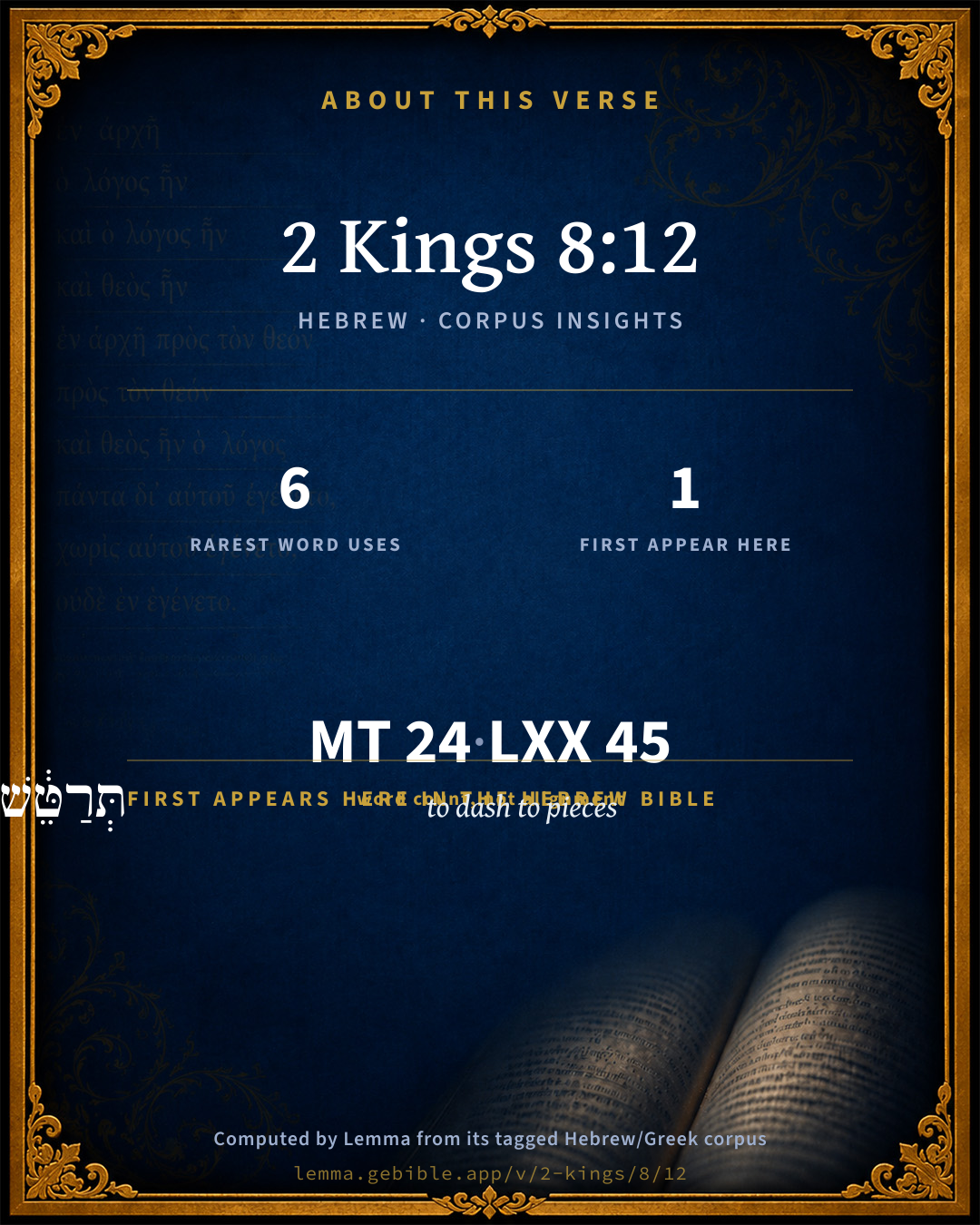
The rarest word here is תְּרַטֵּ֔שׁ to dash to pieces H7376 — appearing just 6 times in the whole Hebrew Bible.

First appearance in Scripture

This word makes its first canonical appearance in the Hebrew Bible here:

  • תְּרַטֵּ֔שׁ to dash to pieces H7376

Shared distinctive vocabulary

תְּרַטֵּ֔שׁ to dash to pieces H7376 occurs in 6 verses of the Hebrew Bible. Also found in:

Grammatical profile

  • 9 verbs
  • 10 nouns
  • 1 adjective
  • 1 conjunction
  • 3 particles

Verb forms

  • וַיֹּ֣אמֶר Qal · Sequential Imperfect
  • בֹכֶ֑ה Qal · Participle Active
  • וַיֹּ֡אמֶר Qal · Sequential Imperfect
  • יָדַ֡עְתִּי Qal · Perfect
  • תַּעֲשֶׂה֩ Qal · Imperfect
  • תְּשַׁלַּ֤ח Piel · Imperfect
  • תַּהֲרֹ֔ג Qal · Imperfect
  • תְּרַטֵּ֔שׁ Piel · Imperfect
  • תְּבַקֵּֽעַ Piel · Imperfect

Repetition

A word recurs within this verse — often emphatic in Hebrew:

  • וַיֹּ֣אמֶר to say H559 ×2

Hebrew & Septuagint length

In English translation the verse runs 54 words from the Hebrew and 63 from the Septuagint (LXX English) — closely comparable.

A rough comparison of the two English renderings, which tokenize alike — not a word-level alignment.

Word counts can differ between the Hebrew and the Greek without any difference in meaning — e.g. the Hebrew direct-object marker אֵת has no separate Greek word, and Greek often adds the article ὁ.

In the original languages it is 24 Hebrew tokens and 45 Greek tokens — but the two are counted differently (Hebrew bundles its prefixes and suffixes into one token; the Greek is in lemma form), so that isn’t a like-for-like length.

Cross-references

15

Topical passages linked to 2 Kings 8:12 in the Treasury of Scripture Knowledge — connected by theme and wording, ordered by reader-vote popularity; previews shown in the World English Bible.

  • Hosea 13:16 Samaria will bear her guilt; For she has rebelled against her God. They will fall by the sword. Their infants will be dashed in pieces, And their pregnant women will be ripped open."
  • Nahum 3:10 Yet was she carried away. She went into captivity. Her young children also were dashed in pieces at the head of all the streets, and they cast lots for her honorable men, and all her great men were bound in chains.
  • 2 Kings 15:16 Then Menahem struck Tiphsah, and all who were therein, and the borders of it, from Tirzah: because they didn't open to him, therefore he struck it; and all the women therein who were with child he ripped up.
  • 2 Kings 12:17 Then Hazael king of Syria went up, and fought against Gath, and took it; and Hazael set his face to go up to Jerusalem.
  • 2 Kings 13:3 The anger of Yahweh was kindled against Israel, and he delivered them into the hand of Hazael king of Syria, and into the hand of Benhadad the son of Hazael, continually.
  • Isaiah 13:16 Their infants also shall be dashed in pieces before their eyes; their houses shall be rifled, and their wives ravished.
  • Amos 1:13 Thus says Yahweh: "For three transgressions of the children of Ammon, yes, for four, I will not turn away its punishment; Because they have ripped open the pregnant women of Gilead, That they may enlarge their border.
  • 2 Kings 13:7 For he didn't leave to Jehoahaz of the people save fifty horsemen, and ten chariots, and ten thousand footmen; for the king of Syria destroyed them, and made them like the dust in threshing.
  • 2 Kings 10:32–33 In those days Yahweh began to cut off from Israel: and Hazael struck them in all the borders of Israel;
  • Isaiah 13:18 [Their] bows shall dash the young men in pieces; and they shall have no pity on the fruit of the womb; their eye shall not spare children.
  • Hosea 10:14 Therefore a battle roar will arise among your people, And all your fortresses will be destroyed, As Shalman destroyed Beth Arbel in the day of battle. The mother was dashed in pieces with her children.
  • 1 Kings 18:13 Wasn't it told my lord what I did when Jezebel killed the prophets of Yahweh, how I hid one hundred men of Yahweh's prophets by fifty in a cave, and fed them with bread and water?
  • 2 Kings 4:28 Then she said, Did I desire a son of my lord? Didn't I say, Do not deceive me?
  • Psalms 137:8–9 Daughter of Babylon, doomed to destruction, He will be happy who rewards you, As you have served us.
  • Amos 1:3–5 Thus says Yahweh: "For three transgressions of Damascus, yes, for four, I will not turn away its punishment; Because they have threshed Gilead with threshing instruments of iron;

Cross-references courtesy of OpenBible.info (CC BY 4.0).

Hebrew and Greek witnesses Masoretic Hebrew ↔ Greek Septuagint

The same verse in the two great witnesses to the Old Testament, shown verse-for-verse.

These are two independent witnesses, not word-aligned to each other, and the Septuagint is shown in lemma (dictionary) form.

Hebrew 2 Kings 8:12 Masoretic · Westminster Leningrad Codex

וַיֹּ֣אמֶר חֲזָאֵ֔ל מַדּ֖וּעַ אֲדֹנִ֣י בֹכֶ֑ה וַיֹּ֡אמֶר כִּֽי יָדַ֡עְתִּי אֵ֣ת אֲשֶׁר תַּעֲשֶׂה֩ לִבְנֵ֨י יִשְׂרָאֵ֜ל רָעָ֗ה מִבְצְרֵיהֶ֞ם תְּשַׁלַּ֤ח בָּאֵשׁ֙ וּבַחֻֽרֵיהֶם֙ בַּחֶ֣רֶב תַּהֲרֹ֔ג וְעֹלְלֵיהֶ֣ם תְּרַטֵּ֔שׁ וְהָרֹתֵיהֶ֖ם תְּבַקֵּֽעַ

Hazael said, Why weeps my lord? He answered, Because I know the evil that you will do to the children of Israel: their strongholds will you set on fire, and their young men will you kill with the sword, and will dash in pieces their little ones, and rip up their women with child.

World English Bible · Public Domain

Greek LXX 2 Kings 8:12 Septuagint · lemma form

καί εἶπον αζαηλ τίς ὅτι ὁ κύριος ἐγώ κλαίω καί εἶπον ὅτι οἶδα ὅσος ποιέω ὁ υἱός ἰσραήλ κακός ὁ ὀχύρωμα αὐτός ἐκ ἀποστέλλω ἐν πῦρ καί ὁ ἐκλεκτός αὐτός ἐν ῥομφαία ἀποκτείνω καί ὁ νήπιος αὐτός ἐνσείω καί ὁ ἐν γαστήρ ἔχω αὐτός ἀναῥήγνυμι

And Azael said, Why does my lord weep? And he said, Because I know all the evil that you will do to the children of Israel: you will utterly destroy their strong holds with fire, and you will kill their choice men with the sword, and you will dash their infants against the ground, and their women with child you will rip up.

LXX2012 (modern English Septuagint) · Public Domain

Hebrew: Westminster Leningrad Codex (CC BY 4.0). Greek: Septuagint (public domain); English from LXX2012 (modern English Septuagint) (Public Domain). How the Septuagint differs from the Hebrew →

Targum (Aramaic paraphrase)

1

The Targum is the ancient Jewish Aramaic paraphrase of the Hebrew Scriptures — an interpretive translation, not the Hebrew text itself. Onkelos (literal) and Pseudo-Jonathan (expansive) render the Torah, and Jonathan the Prophets. Coverage is partial: where no permissively-licensed English translation exists for a verse, only the Aramaic is shown. This is verse-level text, not a word-by-word alignment to the Hebrew.

  1. Targum Jonathan Prophets (Joshua–Malachi)
    וַאֲמַר חֲזָאֵל מָא דֵין רִבּוֹנִי בְּכֵי וַאֲמַר אֲרֵי יָדַעְנָא יַת דְתַעְבֵּיד לִבְנֵי יִשְׂרָאֵל בִּישָׁא כְּרַכֵּיהוֹן תּוֹקִיד בְּנוּרָא וְעוּלֵימֵיהוֹן בְּחַרְבָּא תִקְטֵיל וְעוּלֵימֵיהוֹן תְּטַרַף וּמְעַדְיָתֵיהוֹן תְּבַזַע:

    (no public-domain English translation for this verse)

    Targum Jonathan — Aramaic: “Mikraot Gedolot” (public domain). English: “Sefaria Community Translation” (CC0 1.0 (public-domain dedication)); “London "Chaldee Paraphrase," 1871” (public domain). Text via Sefaria.

Commentary

Notes on 2 Kings 8:12 from classic Christian and Jewish commentators (each source and its license shown beneath its notes). The classic Christian expositions comment on the surrounding passage and are grouped to its opening verse, so a note may address several verses; the Jewish commentaries on the Tanakh (Rashi and others) are per-verse, so they appear only where the commentator wrote on this verse.

Lemma curates 59 commentaries, every one of them public domain or Creative Commons licensed, each selected and text-cleaned for this edition rather than reprinted as found. About our sources →

Trapp's Complete Commentary

John Trapp

2Ki 8:12 And Hazael said, Why weepeth my lord? And he answered, Because I know the evil that thou wilt do unto the children of Israel: their strong holds wilt thou set on fire, and their young men wilt thou slay with the sword, and wilt dash their children, and rip up their women with child.

Ver. 12. Because I know the evil, &c.] This pained the prophet at the very heart, and drew tears from him. "Weep with those that weep," saith the apostle. Cum singulis pectus meum copulo, saith Cyprian, moerores et funeris pondera luctuosa participo, &c. Ambrose wished to God that all the Church’s adversaries would turn upon himself, and satisfy their thirst with his blood.

John Trapp, A Commentary or Exposition upon All the Books of the Old and New Testament (1647–1656) — public domain. Text from a community e-Sword module.

Joseph Benson's Commentary

2Ki 8:12. I know the evil thou wilt do unto the children of Israel — It was not in Hazael’s countenance that Elisha read what he would do; but God did at this time reveal it to him, and gave him such a clear and full view of it, that it greatly affected him. The sins of Israel provoked God to give them up into the hands of their cruel enemies: yet Elisha wept to think that ever Israelites should be so abused as he foresaw they would be by Hazael. For though he foretold, he did not desire, the woful day. Their strong holds wilt thou set on fire, &c. — See what havoc and destruction war makes! what destruction sin makes! and how the nature of man is changed by the fall, and stripped even of humanity itself! Wilt dash their children — That dashing young children against the stones was one piece of barbarous cruelty which the people of the East were apt to run into, in the prosecution of their wars, is plainly intimated Psa 137:8-9. Nor was this inhuman practice out of use among nations pretending to more politeness; for, according to the remains of ancient fame, the Grecians, when they became masters of Troy, were so cruel as to throw Astyanax, Hector’s son, a child in his mother’s arms, headlong from one of the towers of the city. The ripping up of women with child is the highest degree of brutal cruelty; but there is reason to believe that Hazael, in his war with the Gileadites, (2Ki 10:32-33,) verified this part of the prophet’s prediction concerning him; for, what Amos, complaining of his cruelty to this people, calls thrashing Gilead with thrashing instruments of iron, both the Seventy and Arabic versions read, He sawed the pregnant women with iron saws. — Le Clerc and Calmet.

Joseph Benson's Commentary on the Old and New Testaments (1811–1818) — public domain. Text from a community e-Sword module.

Adam Clarke's Commentary

Verse 12. I know the evil that thou wilt do] We may see something of the accomplishment of this prediction, 2Kg 10:32-33; 2Kg 13:3; 2Kg 13:7.

Adam Clarke's Commentary on the Bible (1810–1826) — public domain. Text from a community e-Sword/MySword module.

Ellicott's Commentary for English Readers

(12) The evil that thou wilt do unto the children of Israel.—Fulfilled in 2Ki_10:32-33; 2Ki_13:3-4. The cruelties enumerated here were the ordinary concomitants of warfare in that age. (Comp. Amo_1:3-4; Amo_1:13; Hos_10:14; Hos_13:16; 2Ki_15:16.)

Set on fire.—Literally, send into the fire (Jdg_1:8).

Young men.—Chosen warriors.

Dash.—Dash in pieces.

A Bible Commentary for English Readers, edited by Charles John Ellicott (1878–1897) — public domain. Text from a community e-Sword module.

The Cambridge Bible for Schools and Colleges

gen. ed. J. J. S. Perowne

12. and wilt dash their children] R.V. and wilt dash in pieces their little ones. We have no details of Hazael’s cruelty in the future, but hints of it are found. In 2Ki_10:32 it is said ‘Hazael smote them in all the coasts of Israel’, and in 2Ki_13:3 we read ‘the Lord delivered Israel into the hand of Hazael’, and in verse 22 of that chapter ‘Hazael king of Syria oppressed Israel all the days of Jehoahaz’. The special instances of cruelty mentioned in this verse were those perpetrated among all the Eastern nations of Hazael’s time, and examples are to be found in several places in Scripture. Cf. Isa_13:15-16; Hos_10:14; Hos_13:16; Nah_3:10.

The Cambridge Bible for Schools and Colleges (gen. ed. J. J. S. Perowne; Cambridge University Press, 1878–1918) — public domain. Text from a community e-Sword module.

John Gill's Exposition

And Hazael said, Why weepeth my lord?.... Imagining it was for the death of Benhadad he had predicted, for which he could see no reason; of the title, "my lord", see Kg1 18:7.

and he answered, because I know the evil that thou wilt do unto the children of Israel; which he foresaw by a spirit of prophecy; and Israel being his own people, he sympathized in their calamities before they came:

their strong holds wilt thou set on fire; which should be taken by him, see Kg2 10:32

and their young men wilt thou slay with the sword; in battle:

and wilt dash their children; against rocks and stones, or stone walls, or upon the ground, floor, or pavement, as was usual in war (g), see Psa 137:9,

and rip up their women with child: which was the height of barbarity and cruelty. Ben Gersom and Ben Melech interpret this of breaking down the walls of fortified cities, built strong, like hills and mountains; but this is supposed in the first clause.

(g) Vid. Homer. Iliad. 22. ver. 63, 64.

John Gill's Exposition of the Whole Bible (1746–1763) — public domain (CC PDM 1.0). Text via the HelloAO Bible API.

Albert Barnes' Notes on the Bible

The evil that thou wilt do - The intention is not to tax Hazael with special cruelty, but only to enumerate the ordinary horrors of war, as it was conducted among the Oriental nations of the time. Compare the marginal references.

Albert Barnes' Notes on the Bible (1834–1885) — public domain. Text from a community e-Sword/MySword module.

Matthew Poole's English Annotations

So here was a double cause of his grief and tears, the evil of sin in Hazael, and the evil of suffering upon Israel.

Matthew Poole's English Annotations on the Holy Bible (1683–1685) — public domain. Text from a community e-Sword/MySword module.

Whedon's Commentary on the Bible

Daniel D. Whedon

12. I know the evil that thou wilt do — All that long and steadfast gaze had been a fathoming of Hazael’s heart, and a kenning of his future life and destiny. It had already been foretold in the word of the Lord to Elijah, 1Ki_19:17. The burning of Israelitish fortresses, and the other cruelties here named, which Hazael would perpetrate, all doubtless came to pass in the wars which this usurper carried on with Israel. See 2Ki_8:28-29; 2Ki_10:32-33; 2Ki_12:17-18; 2Ki_13:3-7; 2Ki_13:22; and 2Ch_24:23-24. Hazael reigned more than forty years, and seems generally to have had the advantage over the Israelites, and greatly oppressed them.

Daniel D. Whedon (gen. ed.), Commentary on the Old and New Testaments (1874–1909) — public domain. Text from a community e-Sword module.

The Pulpit Commentary

And Hazael said, Why weepeth my lord? While inwardly contemplating an act of audacious wickedness in defiance of the prophet"s implied rebuke, Hazael preserves towards him outwardly an attitude of extreme deference and respect. "My lord" was the phrase with which slaves addressed their masters, and subjects their monarchs. (see 2Ki_5:3 2Ki_6:12, etc.) And he answered, Because I know the evil that thou wilt do unto the children of Israel: their strongholds wilt thou set on fire, and their young men wilt thou slay with the sword, and wilt dash their children, and rip up their women with child. The prophet does not intend to tax Hazael with any special cruelty, tie only means to say, "Thou wilt wage long and bloody wars with Israel, in which will occur all those customary horrors that make war so terrible the burning of cities, the slaughter of the flower of the youth, the violent death of children, and even the massacre of women in a state of pregnancy. These horrors belonged, more or less, to all Oriental wars, and are touched on in Psa_137:9; 2Ki_15:16; Isa_13:16, Isa_13:18; Hos_10:14; Nah_3:10; Amo_1:13, etc. The wars of Hazael with the Israelites are mentioned in 2Ki_10:32, 33 13:3-7; and Amo_1:3, Amo_1:4.

The Pulpit Commentary (1880–1919), ed. H.D.M. Spence-Jones & Joseph S. Exell — public domain. Text from a community e-Sword module.

Keil & Delitzsch

C. F. Keil & F. Delitzsch

When Hazael asked him the cause of his weeping, Elisha replied: "I know the evil which thou wilt do to the sons of Israel: their fortresses wilt thou set on fire (בּאשׁ שׁלּח, see at Jdg 1:8), their youths wilt thou slay with the sword, and wilt dash their children to pieces, and cut asunder their women with child" (בּקּע, split, cut open the womb). This cruel conduct towards Israel which is here predicted of Hazael, was only a special elaboration of the brief statement made by the Lord to Elijah concerning Hazael (Kg1 19:17). The fulfilment of this prediction is indicated generally in Kg2 10:32-33, and Kg2 13:3.; and we may infer with certainty from Hos 10:14 and Hos 14:1, that Hazael really practised the cruelties mentioned.

Keil & Delitzsch — Biblical Commentary on the Old Testament (1861–1891) — public domain (CC PDM 1.0). Text via the HelloAO Bible API. (Old Testament only.)

Rashi

Rabbi Shlomo Yitzchaki (Rashi)

You will dash. An expression of splitting the intestines. The original source [for the meaning of תרטש is], “and bows will split [תְּרַטַּשְׁנָה] young men.”

And their pregnant women. Their pregnant women.

Rashi on the Tanakh — English translations: “The Judaica Press complete Tanach with Rashi, translated by A. J. Rosenberg” (CC BY 4.0); “Pentateuch with Rashi's commentary by M. Rosenbaum and A.M. Silbermann, 1929-1934” (public domain); “The Metsudah Tanach series, Lakewood, N.J” (CC BY 4.0); and “The Book of Joshua, Metsudah Publications, 1997” (CC BY 4.0). Text via Sefaria.

Lesson kit

Teaching starters — assembled from the data on this page, not authored interpretation. Every prompt links to the verse data it draws on. Edit before teaching.

2 Kings, in the Historical, opens this verse with 24 words (23 distinct Hebrew lemmas). Its most distinctive word is râṭâsh (“to dash to pieces”). A historical commentator’s framing appears above. Read the whole chapter for the surrounding context.

Discussion questions

  1. What does “to dash to pieces” (râṭâsh) contribute to the verse as a whole?
  2. This is the first place “to dash to pieces” appears in Scripture (first appears here). What does its debut here establish?
  3. How does Isaiah 13:16, which shares the word «to dash to pieces», read alongside this verse?
  4. What does the repetition of “to say” (2× in this one verse) do in this verse?
  5. The translations on this page render this verse differently — a whole-verse word diff, not a word-by-word alignment. What might account for the different wordings?
  6. «וַיֹּ֣אמֶר» is a Qal Sequential Imperfect verb. How does that grammatical form shape the action described?
  7. Compare how Trapp's Complete Commentary and Joseph Benson's Commentary read this verse. Where do they agree or differ?

Things to notice

Reading settings

Reading text

Shown beneath each verse's original-language words.

Old Testament
Old Testament edition

Read the OT as the Masoretic Hebrew (MT) or the Greek Septuagint (LXX).

English shown for the Greek Septuagint (in the Hebrew ↔ Greek comparison).

Comparing translations? Open the Compare panel on any verse page to stack up to four side by side.