
Judges 18:27

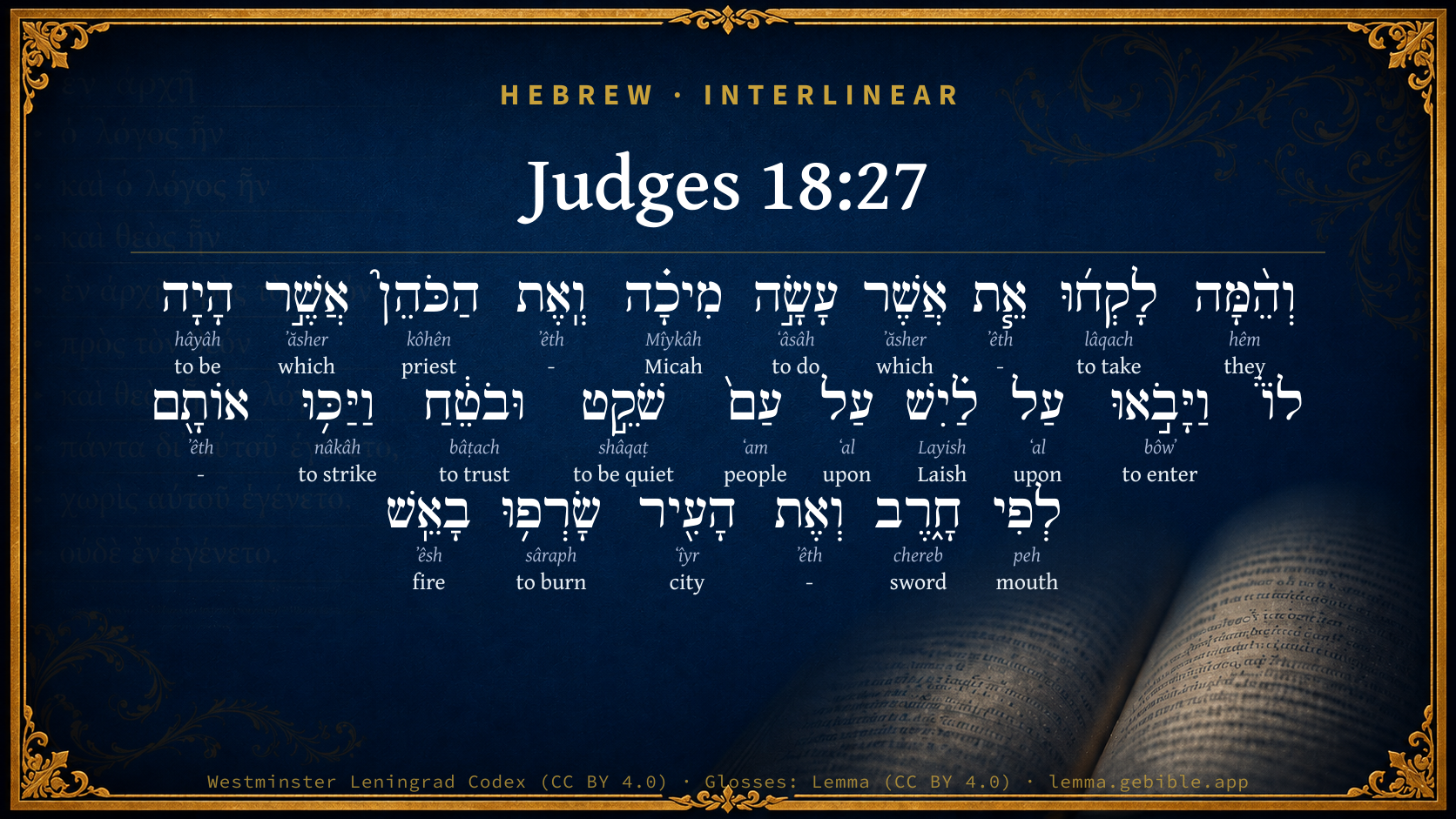
Hebrew (Westminster Leningrad Codex) Judges 18:27 appears in the Hebrew Old Testament. The text above is from the Westminster Leningrad Codex. Each word links to its Strong’s number, a concise gloss, and parsing drawn from the Open Scriptures Hebrew Bible morphology. Click any word for its full Brown-Driver-Briggs (BDB) entry.
Download image
Cite this verse

Judges 18:27 (World English Bible). Public Domain. Lemma interlinear Bible study tool, https://lemma.gebible.app/v/judges/18/27.

Show BibTeX & RIS
BibTeX
RIS
English Translation
They took that which Micah had made, and the priest whom he had, and came to Laish, to a people quiet and secure, and struck them with the edge of the sword; and they burnt the city with fire.
World English Bible · Public Domain
Download a study sheet

One document with this verse’s original text, its word-by-word gloss line, the meaning frame, cross-references with their text, attributed commentary, and full source and license credits — printable, and it pastes into notes with its structure intact.

This verse Autodidact and up

Study sheet (.html) Plain text (.txt)

A passage Seminary Student

Up to 50 verses in one chapter. A passage sheet keeps up to 6 commentary sources and 12 cross-references per verse, in the order this page ranks them, and says so on the sheet whenever that leaves anything out. Ask for a single verse and you get the Autodidact verse sheet above.

Everything on this page stays free to read, with no account — the sheet is a download of what is already on screen, not access to it.

Want to remove ads? Support Godless Engineer
Compare translations 3

The same verse in 3 English versions, stacked beneath the original-language interlinear above. Click any original word for its lexicon entry.

Each is an independent rendering of the whole verse — the interlinear is not word-aligned to these translations.

Highlighted words mark where these versions differ — a whole-verse word diff, not a word-by-word alignment.

  • World English Bible Public Domain
    They took that which Micah had made, and the priest whom he had, and came to Laish, to a people quiet and secure, and struck them with the edge of the sword; and they burnt the city with fire.
  • King James Version Public Domain
    And they took the things which Micah had made, and the priest which he had, and came unto Laish, unto a people that were at quiet and secure: and they smote them with the edge of the sword, and burnt the city with fire.
  • unfoldingWord Literal Text CC BY-SA 4.0
    But they themselves took what Micah had made and the priest who was to him. And they came to Laish, to a people reposing and being secure. And they struck them to the mouth of the sword, and they burned the city with fire.

unfoldingWord Literal Text — © unfoldingWord, licensed CC BY-SA 4.0. Word-aligned USFM3 via Door43 (git.door43.org/unfoldingWord/en_ult).

Versions to compare (up to 4)

3 of 4 selected

Show all 18 translations

Every available English version of this verse, each an independent rendering of the whole verse.

  • World English Bible Public Domain
    They took that which Micah had made, and the priest whom he had, and came to Laish, to a people quiet and secure, and struck them with the edge of the sword; and they burnt the city with fire.
  • Berean Standard Bible Public Domain
    After they had taken Micah’s idols and his priest, they went to Laish, to a tranquil and unsuspecting people, and they struck them with their swords and burned down the city.
  • Majority Standard Bible Public Domain
    After they had taken Micah’s idols and his priest, they went to Laish, to a quiet and unsuspecting people, and they struck them with their swords and burned down the city.
  • King James Version Public Domain
    And they took the things which Micah had made, and the priest which he had, and came unto Laish, unto a people that were at quiet and secure: and they smote them with the edge of the sword, and burnt the city with fire.
  • American Standard Version (1901) Public Domain
    And they took that which Micah had made, and the priest whom he had, and came unto Laish, unto a people quiet and secure, and smote them with the edge of the sword; and they burnt the city with fire.
  • Revised Version (1885) Public Domain
    And they took that which Micah had made, and the priest which he had, and came unto Laish, unto a people quiet and secure, and smote them with the edge of the sword; and they burnt the city with fire.
  • Geneva Bible (1599) Public Domain
    And they tooke the things which Michah had made, and the Priest which he had, and came vnto Laish, vnto a quiet people and without mistrust, and smote them with the edge of the sworde, and burnt the citie with fire:
  • Douay-Rheims (1899) Public Domain
    And the six hundred men took the priest, and the things we spoke of before, and came to Lais to a people that was quiet and secure, and smote them with the edge of the sword: and the city was burnt with fire,
  • Young's Literal Translation Public Domain
    And they have taken that which Micah had made, and the priest whom he had, and come in against Laish, against a people quiet and confident, and smite them by the mouth of the sword, and the city have burnt with fire,
  • Literal Standard Version CC BY-SA 4.0
    And they have taken that which Micah had made, and the priest whom he had, and come in against Laish, against a people quiet and confident, and strike them by the mouth of the sword, and have burned the city with fire,
  • Unlocked Literal Bible CC BY-SA 4.0
    The people of Dan took what Micah had made, as well as his priest, and they came to Laish, to a people who were undisturbed and secure and they struck them with the edge of the sword and burned the city.
  • unfoldingWord Literal Text CC BY-SA 4.0
    But they themselves took what Micah had made and the priest who was to him. And they came to Laish, to a people reposing and being secure. And they struck them to the mouth of the sword, and they burned the city with fire.
  • Darby Bible Public Domain
    And taking what Micah had made, and the priest who belonged to him, the Danites came to La'ish, to a people quiet and unsuspecting, and smote them with the edge of the sword, and burned the city with fire.
  • World Messianic Bible Public Domain
    They took that which Micah had made, and the priest whom he had, and came to Laish, to a people quiet and unsuspecting, and struck them with the edge of the sword; then they burned the city with fire.
  • Webster's Bible Public Domain
    And they took the things which Micah had made, and the priest which he had, and came to Laish, to a people that were at quiet and secure: and they smote them with the edge of the sword, and burnt the city with fire.
  • Free Bible Version CC BY-SA 4.0
    So the Danites took with them the idols that Micah had made, as well as his priest. They attacked Laish with its peaceful and unsuspecting people, killed them with swords, and burned down the town.
  • Bible in Basic English Public Domain
    And they took that which Micah had made, and his priest, and came to Laish, to a people living quietly and without thought of danger, and they put them to the sword without mercy, burning down their town.
  • JPS Tanakh (1917) Public Domain
    And they took that which Micah had made, and the priest whom he had, and came unto Laish, unto a people quiet and secure, and smote them with the edge of the sword; and they burnt the city with fire.

Literal Standard Version (2020), Covenant Press — licensed CC BY-SA 4.0. Text via the HelloAO Bible API (eBible.org). Unlocked Literal Bible (unfoldingWord) — licensed CC BY-SA 4.0. Text via the HelloAO Bible API (eBible.org). unfoldingWord Literal Text — © unfoldingWord, licensed CC BY-SA 4.0. Word-aligned USFM3 via Door43 (git.door43.org/unfoldingWord/en_ult). Free Bible Version, Dr. Jonathan Gallagher — licensed CC BY-SA 4.0. Text via the HelloAO Bible API (eBible.org).

Word by word

More ways to search: Search by grammar → Find every occurrence → Compare this word →

Practice this passage: Drill this verse → Learn its vocabulary →

לַ֗יִשׁ
Layish
H3919
“Laish”
Noun, Proper
Part of Speech
Noun
Type
Proper
Full BDB Definition

Origin: the same as H3918

TWOT: None

Laish = "lion" - father of Phaltiel, the man to whom king Saul gave his daughter Michal in marriage even though she was already married to David (noun proper masculine) - an early name for Dan, a town in northern Israel (noun proper locative) - a place north of Jerusalem; site unknown (noun proper locative)
  1. וְהֵ֨מָּה hêm H1992 “and · they” Conjunction + Pronoun, Personal, 3rd Person, Masculine, Plural
  2. לָקְח֜וּ lâqach H3947 “to take” Verb, Qal, Perfect, 3rd Person, Common, Plural
  3. אֵ֧ת ʼêth H853 “-” Particle, Direct Object
  4. אֲשֶׁר ʼăsher H834 “which” Particle, Relative
  5. עָשָׂ֣ה ʻâsâh H6213 “to do” Verb, Qal, Perfect, 3rd Person, Masculine, Singular
  6. מִיכָ֗ה Mîykâh H4318 “Micah” Noun, Proper
  7. וְֽאֶת ʼêth H853 “and · -” Conjunction + Particle, Direct Object
  8. הַכֹּהֵן֮ kôhên H3548 “the · priest” Particle, Definite Article + Noun, Common, Masculine, Singular, Absolute
  9. אֲשֶׁ֣ר ʼăsher H834 “which” Particle, Relative
  10. הָיָה hâyâh H1961 “to be” Verb, Qal, Perfect, 3rd Person, Masculine, Singular
  11. וַיָּבֹ֣אוּ bôwʼ H935 “and · to enter” Conjunction + Verb, Qal, Sequential Imperfect, 3rd Person, Masculine, Plural
  12. עַל ʻal H5921 “upon” Preposition
  13. עַל ʻal H5921 “upon” Preposition
  14. עַם֙ ʻam H5971 “people” Noun, Common, Masculine, Singular, Absolute
  15. שֹׁקֵ֣ט shâqaṭ H8252 “being quiet” Verb, Qal, Participle Active, Masculine, Singular, Absolute
  16. וּבֹטֵ֔חַ bâṭach H982 “and · trusting” Conjunction + Verb, Qal, Participle Active, Masculine, Singular, Absolute
  17. וַיַּכּ֥וּ nâkâh H5221 “and · to strike” Conjunction + Verb, Hiphil, Sequential Imperfect, 3rd Person, Masculine, Plural
  18. אוֹתָ֖ם ʼêth H853 “- · them” Particle, Direct Object + Suffix, Personal, 3rd Person, Masculine, Plural
  19. לְפִי peh H6310 “to/for · mouth of” Preposition + Noun, Common, Masculine, Singular, Construct
  20. חָ֑רֶב chereb H2719 “sword” Noun, Common, Feminine, Singular, Absolute
  21. וְאֶת ʼêth H853 “and · -” Conjunction + Particle, Direct Object
  22. הָעִ֖יר ʻîyr H5892 “the · city” Particle, Definite Article + Noun, Common, Feminine, Singular, Absolute
  23. שָׂרְפ֥וּ sâraph H8313 “to burn” Verb, Qal, Perfect, 3rd Person, Common, Plural
  24. בָאֵֽשׁ ʼêsh H784 “in/at the · fire” Preposition, Determined + Noun, Common, Both, Singular, Absolute

About this verse

These counts appear in no published source. They are computed here, from the morphology-tagged text and Lemma’s own curated glosses. What Lemma adds →

26
words
20
distinct lemmas
Historical
section

Notable vocabulary

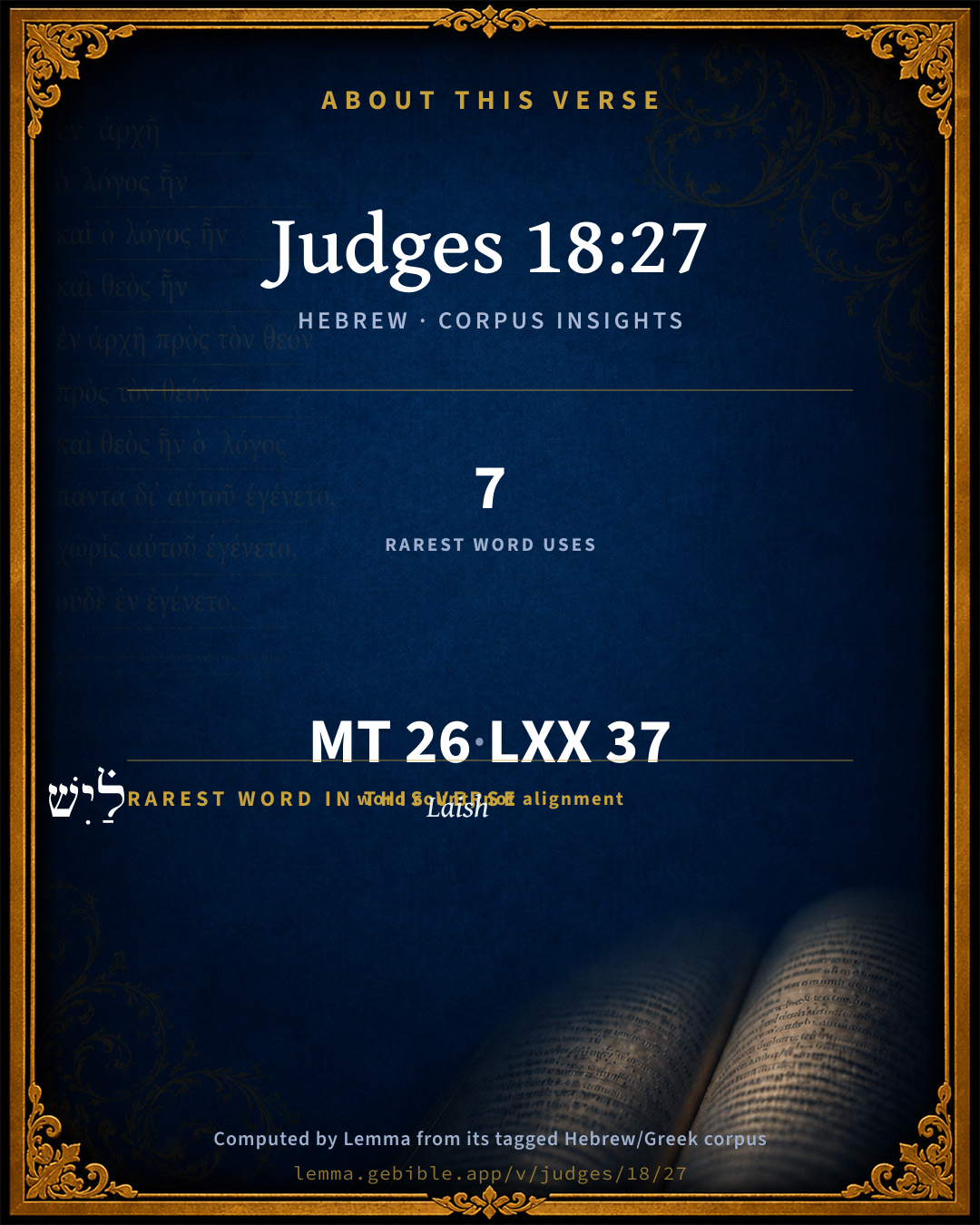
The rarest word here is לַ֗יִשׁ Laish H3919 — appearing just 7 times in the whole Hebrew Bible.

Shared distinctive vocabulary

לַ֗יִשׁ Laish H3919 occurs in 7 verses of the Hebrew Bible. Also found in:

Grammatical profile

  • 8 verbs
  • 8 nouns
  • 1 pronoun
  • 3 prepositions
  • 6 particles

Verb forms

  • לָקְח֜וּ Qal · Perfect
  • עָשָׂ֣ה Qal · Perfect
  • הָיָה Qal · Perfect
  • וַיָּבֹ֣אוּ Qal · Sequential Imperfect
  • שֹׁקֵ֣ט Qal · Participle Active
  • וּבֹטֵ֔חַ Qal · Participle Active
  • וַיַּכּ֥וּ Hiphil · Sequential Imperfect
  • שָׂרְפ֥וּ Qal · Perfect

Repetition

Words recur within this verse — often emphatic in Hebrew:

  • עַל upon H5921 ×2
  • אֲשֶׁר which H834 ×2

Hebrew & Septuagint length

In English translation the verse runs 39 words from the Hebrew and 43 from the Septuagint (LXX English) — closely comparable.

A rough comparison of the two English renderings, which tokenize alike — not a word-level alignment.

Word counts can differ between the Hebrew and the Greek without any difference in meaning — e.g. the Hebrew direct-object marker אֵת has no separate Greek word, and Greek often adds the article ὁ.

In the original languages it is 26 Hebrew tokens and 37 Greek tokens — but the two are counted differently (Hebrew bundles its prefixes and suffixes into one token; the Greek is in lemma form), so that isn’t a like-for-like length.

Cross-references

5

Topical passages linked to Judges 18:27 in the Treasury of Scripture Knowledge — connected by theme and wording, ordered by reader-vote popularity; previews shown in the World English Bible.

  • Joshua 19:47 The border of the children of Dan went out beyond them; for the children of Dan went up and fought against Leshem, and took it, and struck it with the edge of the sword, and possessed it, and lived therein, and called Leshem, Dan, after the name of Dan their father.
  • Judges 18:7 Then the five men departed, and came to Laish, and saw the people who were therein, how they lived in security, after the manner of the Sidonians, quiet and secure; for there was none in the land, possessing authority, that might put [them] to shame in anything, and they were far from the Sidonians, and had no dealings with any man.
  • Judges 18:10 When you go, you shall come to a people secure, and the land is large; for God has given it into your hand, a place where there is no want of anything that is in the earth.
  • Deuteronomy 33:22 Of Dan he said, Dan is a lion's cub, That leaps forth from Bashan.
  • Joshua 11:11 They struck all the souls who were therein with the edge of the sword, utterly destroying them; there was none left who breathed: and he burnt Hazor with fire.

Cross-references courtesy of OpenBible.info (CC BY 4.0).

Hebrew and Greek witnesses Masoretic Hebrew ↔ Greek Septuagint

The same verse in the two great witnesses to the Old Testament, shown verse-for-verse.

These are two independent witnesses, not word-aligned to each other, and the Septuagint is shown in lemma (dictionary) form.

Hebrew Judges 18:27 Masoretic · Westminster Leningrad Codex

וְהֵ֨מָּה לָקְח֜וּ אֵ֧ת אֲשֶׁר עָשָׂ֣ה מִיכָ֗ה וְֽאֶת הַכֹּהֵן֮ אֲשֶׁ֣ר הָיָה לוֹ֒ וַיָּבֹ֣אוּ עַל לַ֗יִשׁ עַל עַם֙ שֹׁקֵ֣ט וּבֹטֵ֔חַ וַיַּכּ֥וּ אוֹתָ֖ם לְפִי חָ֑רֶב וְאֶת הָעִ֖יר שָׂרְפ֥וּ בָאֵֽשׁ

They took that which Micah had made, and the priest whom he had, and came to Laish, to a people quiet and secure, and struck them with the edge of the sword; and they burnt the city with fire.

World English Bible · Public Domain

Greek LXX Judges 18:27 Septuagint · lemma form

καί ὁ υἱός δαν λαμβάνω ὅς ποιέω μιχαιας καί ὁ ἱερεύς ὅς εἰμί αὐτός καί ἔρχομαι ἐπί λαις ἐπί λαός ἡσυχάζω καί πείθω ἐπί ἐλπίς καί πατάσσω αὐτός ἐν στόμα ῥομφαία καί ὁ πόλις ἐνπίμπρημι ἐν πῦρ

And the children of Dan took what Michaias had made, and the priest that he had, and they came to Laisa, to a people quiet and secure; and they struck them with the edge of the sword, and burnt the city with fire.

LXX2012 (modern English Septuagint) · Public Domain

Hebrew: Westminster Leningrad Codex (CC BY 4.0). Greek: Septuagint (public domain); English from LXX2012 (modern English Septuagint) (Public Domain). How the Septuagint differs from the Hebrew →

Targum (Aramaic paraphrase)

1

The Targum is the ancient Jewish Aramaic paraphrase of the Hebrew Scriptures — an interpretive translation, not the Hebrew text itself. Onkelos (literal) and Pseudo-Jonathan (expansive) render the Torah, and Jonathan the Prophets. Coverage is partial: where no permissively-licensed English translation exists for a verse, only the Aramaic is shown. This is verse-level text, not a word-by-word alignment to the Hebrew.

  1. Targum Jonathan Prophets (Joshua–Malachi)
    וְאִינוּן נְסִיבוּ יַת דַעֲבַד מִיכָה וְדַבֵּרוּ יַת כַּהֲנָא דִי הֲוָה לֵיהּ וַאֲתוֹ לְלַיִשׁ לְעַמָא דְשָׁקְטִין וְשָׁרָן לְרוֹחֲצָן וּמְחוֹ יַתְהוֹן לְפִּתְגָם דְחָרֶב וְיַת קַרְתָּא אוֹקִידוּ בְּנוּרָא:

    (no public-domain English translation for this verse)

    Targum Jonathan — Aramaic: “Mikraot Gedolot” (public domain). English: “Sefaria Community Translation” (CC0 1.0 (public-domain dedication)); “London "Chaldee Paraphrase," 1871” (public domain). Text via Sefaria.

Commentary

Notes on Judges 18:27 from classic Christian and Jewish commentators (each source and its license shown beneath its notes). The classic Christian expositions comment on the surrounding passage and are grouped to its opening verse, so a note may address several verses; the Jewish commentaries on the Tanakh (Rashi and others) are per-verse, so they appear only where the commentator wrote on this verse.

Lemma curates 59 commentaries, every one of them public domain or Creative Commons licensed, each selected and text-cleaned for this edition rather than reprinted as found. About our sources →

Matthew Henry's Commentary

Here is, I. Laish conquered by the Danites. They proceeded on their march, and, because they met with no disaster, perhaps concluded they had not done amiss in robbing Micah. Many justify themselves in their impiety by their prosperity. Observe, 1. What posture they found the people of Laish in, both those of the city and those of the country about. They were quiet and secure, not jealous of the five spies that had been among them to search out the land, nor had they any intelligence of the approach of this enemy, which made them a very easy prey to this little handful of men that came upon them, Jdg 18:27. Note, Many are brought to destruction by their security. Satan gets advantage against us when we are careless and off our watch. Happy therefore is the man that feareth always. 2. What a complete victory they obtained over them: They put all the people to the sword, and burnt down so much of the city as they thought fit to rebuild (Jdg 18:27, Jdg 18:28), and, for aught that appears, herein they met with no resistance; for the measure of the iniquity of the Canaanites was full, that of the Danites was but beginning to fill. 3. How the conquerors settled themselves in their room, Jdg 18:28, Jdg 18:29. They built the city, or much of it, anew (the old buildings having gone to decay), and called the name of it Dan, to be a witness for them that, though separated so far off from their brethren, they were nevertheless Danites by birth, which might hereafter, by reason of their distance, be called in question. We should feel concerned not to lose the privilege of our relation to God's Israel, and therefore should take all occasions to own it and preserve the remembrance of it to ours after us.

II. Idolatry immediately set up there. God had graciously performed his promise, in putting them in possession of that which fell to their lot, obliging them thereby to be faithful to him who had been so to them. They inherited the labour of the people, that they might observe his statues, Psa 105:44, Psa 105:45. But the first thing they do after they are settled is to break his statues. As soon as they began to settle themselves they set up the graven image (Jdg 18:30), perversely attributing their success to that idol which, if God had not been infinitely patient, would have been their ruin. Thus a prosperous idolater goes on to offend, imputing this his power unto his god, Hab 1:11. Their Levite, who officiated as priest, is at length named here - Jonathan, the son of Gershom, the son of Manasseh. The word Manasseh, in the original, has the letter n, set over the head, which, some of the Jewish rabbin say, is an intimation that it should be left out, and then Manasseh will be Moses, and this Levite, they say, was grandson to the famous Moses, who indeed had a son named Gershom; but, say they, the historian, in honour of Moses, by a half interposition of that letter, turned the name into Manasseh. The vulgar Latin reads it Moses. And if indeed Moses had a grandson that was rakish, and was picked up as a fit tool to be made use of in the setting up of idolatry, it is not the only instance (would to God it were!) of the unhappy degenerating of the posterity of great and good men. Children's children are not always the crown of old men. But the learned bishop Patrick takes this to be an idle conceit of the rabbin, and supposes this Jonathan to be of some other family of the Levites. How long these corruptions continued we are told in the close. 1. That the posterity of this Jonathan continued to act as priests to this family of Dan that was seated at Laish, and in the country about, till the captivity, Jdg 18:30. After Micah's image was removed this family retained the character of priests, and had respect paid them as such by that city, and it is very probable that Jeroboam had an eye to them when he set up one of his calves there (which they could welcome at Can, and put some reputation upon, when the priests of the Lord would have nothing to do with them), and that this family officiated as some of his priests. 2. That these images continued till Samuel's time, for so long the ark of God was at Shiloh; and it is probable that in him time effectual care was taken to suppress and abolish this idolatry. See how dangerous it is to admit an infection, for spiritual distempers are not so soon cured as caught.

Matthew Henry's Commentary on the Whole Bible (1708–1710) — public domain (CC PDM 1.0). Text via the HelloAO Bible API.

Jamieson, Fausset & Brown

Robert Jamieson, A. R. Fausset & David Brown

THEY WIN LAISH. (Jdg 18:27-29)

they . . . came unto Laish . . . smote them--the inhabitants.

and burnt the city--"We are revolted by this inroad and massacre of a quiet and secure people. Nevertheless, if the original grant of Canaan to the Israelites gave them the warrant of a divine commission and command for this enterprise, that sanctifies all and legalizes all" [CHALMERS]. This place seems to have been a dependency of Zidon, the distance of which, however, rendered it impossible to obtain aid thence in the sudden emergency.

Jamieson, Fausset & Brown — Commentary Critical and Explanatory on the Whole Bible (1871) — public domain (CC PDM 1.0). Text via the HelloAO Bible API.

Trapp's Complete Commentary

John Trapp

Jdg 18:27 And they took [the things] which Micah had made, and the priest which he had, and came unto Laish, unto a people [that were] at quiet and secure: and they smote them with the edge of the sword, and burnt the city with fire.

Ver. 27. And they took the things.] Chuckering themselves, to think what happiness they should have in them, and little considering that there would be "bitterness in the end." {Jer 2:19}

Unto a people that were at quiet and secure.] See Jdg 18:10. This is often repeated, as the root of their wretchedness. Security ushereth in destruction. {1Th 5:3}

And they smote them.] God oft punisheth the wicked by the wicked: and when he hath worn his rod to the stumps, as that martyr said, he casteth it into the fire. Vice may correct sin.

And burnt the city with fire.] Here we have much in few: as in that of Virgil, so much admired by Macrobius for fulness of matter in fewness of words, Iam seges est ubi Troia fuit.

John Trapp, A Commentary or Exposition upon All the Books of the Old and New Testament (1647–1656) — public domain. Text from a community e-Sword module.

Joseph Benson's Commentary

Jdg 18:27-29. And burned the city with fire — Not wholly, but in a great measure, to make their conquest more easy. They built a city — Or, rather, repaired and enlarged that which they found there. After the name of Dan — That it might be manifest they belonged to the tribe of Dan, though they were settled at a great distance from them in the most northerly part of the land; whereas the lot of their tribe was in the southern part of Canaan.

Joseph Benson's Commentary on the Old and New Testaments (1811–1818) — public domain. Text from a community e-Sword module.

Geneva Bible (1599)

Geneva Bible translators

Meaning, the idols, as verse 18.

Geneva Bible (1599) marginal notes — public domain. Text via Bolls.life.

Adam Clarke's Commentary

Verse 27. Unto a people - at quiet and secure] They found the report given by the spies to be correct. The people were apprehensive of no danger, and were unprepared for resistance; hence they were all put to the sword, and their city burnt up.

Adam Clarke's Commentary on the Bible (1810–1826) — public domain. Text from a community e-Sword/MySword module.

Ellicott's Commentary for English Readers

(27) Burnt the city with fire.—This was unusual, for we are told that Hazor was the only city which Joshua burnt (Jos_11:13). Perhaps they had devoted the city by a ban, as Jericho was devoted (Jos_6:24); or the burning may have been due to policy or to accident. Probably the notion that such conduct was cruel and unjustifiable never occurred to them; nor must we judge them by the standard of Christian times. But Dan was no gainer. His name disappears from the records of 1Ch_4:1, and he is not mentioned among the elected tribes in Revelation 7. Blunt (Undesigned Coincidences, pt. 2, 4) conjectures, from 2Ch_2:14, that the cause of their disappearance from Israelite records—the latest mention of them as a tribe being in 1Ch_27:22—was due to their intermarriages with the Phœnicians.

A Bible Commentary for English Readers, edited by Charles John Ellicott (1878–1897) — public domain. Text from a community e-Sword module.

The Cambridge Bible for Schools and Colleges

gen. ed. J. J. S. Perowne

27. that which Micah had made] Perhaps originally the God which … as in Jdg_18:24. The form of the sentence suggests that the objectionable expression has been modified.

The Cambridge Bible for Schools and Colleges (gen. ed. J. J. S. Perowne; Cambridge University Press, 1878–1918) — public domain. Text from a community e-Sword module.

John Gill's Exposition

And they took the things which Micah had made,.... The ephod, teraphim, and the two images, the Danites took them, or having taken them kept them, and went on with them:

and the priest which he had; him also they took, and who was willing enough to go with them:

and came unto Laish, unto a people that were quiet and secure; having no sentinels placed at any distance to give them warning of an enemy, nor any watchmen on their walls to discover one; and perhaps their gates not shut, nor any guard at any of their passes and avenues, having no apprehension at all of being visited by an enemy, especially from Israel, not being apprized that they had any pretensions to their city, and the land about it:

and they smote them with the edge of the sword; entered their city, and fell on them suddenly, and cut them to pieces:

and burnt the city with fire; to strike terror to all about; or it may be only they set fire to some part of it, as they entered, only to frighten the inhabitants, and throw them into the greater confusion, that they might become a more easy prey to them; for their intention was to inhabit it, and it seems to be the same city still, though they rebuilt it, and called it by another name.

John Gill's Exposition of the Whole Bible (1746–1763) — public domain (CC PDM 1.0). Text via the HelloAO Bible API.

Albert Barnes' Notes on the Bible

The things which Micah had made - Rather, from Jdg 18:24, “the gods which Micah had made.” See Jdg 18:31; Deu 27:15; Exo 20:4.

Albert Barnes' Notes on the Bible (1834–1885) — public domain. Text from a community e-Sword/MySword module.

Haydock's Catholic Bible Commentary

And, &c. Hebrew, "and they took what Michas had made, and the priest,....and came." (Haydock) --- Fire, as they could not make themselves masters of it otherwise. They were forced afterwards to rebuild it. Some Rabbins have supposed, that Sidon and its colonies were not given by God to Israel: but their proofs are unsatisfactory. Lais was inhabited by the Chanaanites; and though it was in the territory of Aser, as the people of Dan had made the conquest, they were suffered to keep quiet possession of it. See Josue xvii. 10.

George Leo Haydock (1774–1849), Haydock's Catholic Family Bible and Commentary, 1859 edition — public domain. Excludes Psalms (Douay-Rheims chapter numbering differs from Protestant) and Deuterocanonical books (Catholic canon only).

Matthew Poole's English Annotations

Not wholly, but in great measure, to strike the greater terror into the inhabitants, and to make their conquest of the place more easy.

Matthew Poole's English Annotations on the Holy Bible (1683–1685) — public domain. Text from a community e-Sword/MySword module.

The Pulpit Commentary

And they. In the Hebrew the they is emphatic. It would be better expressed in English by repeating The children of Dan. The repetition of the epithets quiet and secure, as applied to the people of Laish, rather seems to indicate the writer"s reprobation of the deed as cruel, like that of Simeon and Levi in slaying Hamor and Shechem. They smote them with the edge of the sword a phrase denoting an exterminating slaughter. (Exo_34:26 Jos_19:47 1Sa_15:8, etc.) And they burnt the city, etc. Perhaps they had made the people and city a cherem, a devoted thing, and therefore slew the one and burnt the other; (cf. Num 21:3Jo Num_8:19 Num_11:11, etc.) or the burning of the city may have been one of the means by which they destroyed the people.

The Pulpit Commentary (1880–1919), ed. H.D.M. Spence-Jones & Joseph S. Exell — public domain. Text from a community e-Sword module.

John Wesley's Explanatory Notes

Burnt - Not wholly, but in great measure, to make their conquest more easy.

John Wesley, Explanatory Notes Upon the Whole Bible (1754–1765) — public domain. Text via the GEBible commentary corpus.

Keil & Delitzsch

C. F. Keil & F. Delitzsch

And they (the Danites) had taken what Micah had made, i.e., his idols and his priest, and they fell upon Laish (על כּוא, to come over a person, to fall upon him, as in Gen 34:25), a people living quietly and free from care (vid., Jdg 18:7), smote them with the edge of the sword (see at Gen 34:26), and burned down the city (cf. Jos 6:24), as it had no deliverer in its isolated condition (Jdg 18:28; cf. Jdg 18:7). It was situated "in the valley which stretches to Beth-rehob." This valley is the upper part of the Huleh lowland, through which the central source of the Jordan (Leddan) flows, and by which Laish-Dan, the present Tell el Kadi, stood (see at Jos 19:47). Beth-rehob is most probably the same place as the Rehob mentioned in Num 13:21, and the Beth-rehob of Sa2 10:6, which is there used to designate a part of Syria, and for which Rehob only is also used in Jdg 18:8. Robinson (Bibl. Res. pp. 371ff.) supposes it to be the castle of Hunin or Honin, on the south-west of Tell el Kadi; but this is hardly correct (see the remarks on Num 13:21, Pent. p. 709). The city, which lay in ashes, was afterwards rebuilt by the Danites, and called Dan, from the name of the founder of their tribe; and the ruins are still to be seen, as already affirmed, on the southern slope of the Tell el Kadi (see Rob. Bibl. Res. pp. 391-2, and the comm. on Jos 19:47).

Keil & Delitzsch — Biblical Commentary on the Old Testament (1861–1891) — public domain (CC PDM 1.0). Text via the HelloAO Bible API. (Old Testament only.)

unfoldingWord translationNotes

Door43 World Missions Community

what Micah had made

Micah did not make his gods, rather a craftsman made them for him. Also, this can be stated in active form. AT: "the things that had been made for Micah" or "Micah's things" (See: Metonymy and Active or Passive)

Laish

See how you translated this in Judges 18:7.

with the edge of the sword

"with their swords." Here "the sword" represents the swords and other weapons that the soldiers used in battle. (See: Synecdoche)

they had no dealings with anyone

this means they lived far enough away from any other city, that they lived secluded from other people. See how you translated this phrase in Judges 18:7.

Beth Rehob

This is a name of a town. (See: How to Translate Names)

translationWords

Dan

priest

people group

sword

Sidon

Israel

unfoldingWord translationNotes — © Distant Shores Media and the Door43 World Missions Community, licensed CC BY-SA 4.0. Source: git.door43.org/Door43/en_tn.

Rashi

Rabbi Shlomo Yitzchaki (Rashi)

Laish. The city's name. The book of Yehoshua entitles it "Leshem," because they discovered, there, a precious gem called "leshem." This was inlaid in the Choshen plate, and symbolized the tribe of Don, whose name was inscribed on it. Thus, they were certain that this was actually their ancestral property.

Rashi on the Tanakh — English translations: “The Judaica Press complete Tanach with Rashi, translated by A. J. Rosenberg” (CC BY 4.0); “Pentateuch with Rashi's commentary by M. Rosenbaum and A.M. Silbermann, 1929-1934” (public domain); “The Metsudah Tanach series, Lakewood, N.J” (CC BY 4.0); and “The Book of Joshua, Metsudah Publications, 1997” (CC BY 4.0). Text via Sefaria.

Lesson kit

Teaching starters — assembled from the data on this page, not authored interpretation. Every prompt links to the verse data it draws on. Edit before teaching.

Judges, in the Historical, opens this verse with 26 words (20 distinct Hebrew lemmas). Its most distinctive word is Layish (“Laish”). A historical commentator’s framing appears above. Read the whole chapter for the surrounding context.

Discussion questions

  1. What does “Laish” (Layish) contribute to the verse as a whole?
  2. Judges 18:7 shares the word «Laish» with this verse. How do the two illuminate each other?
  3. “upon” occurs 2× in this one verse. What is the effect of the repetition?
  4. These translations render this verse differently. What is at stake in choosing one wording over another?
  5. The verb «לָקְח֜וּ» is Qal Perfect. How does its form color the action?
  6. Reading how Matthew Henry's Commentary and Jamieson, Fausset & Brown read this verse, where do the two commentators agree and where do they part?

Things to notice

Reading settings

Reading text

Shown beneath each verse's original-language words.

Old Testament
Old Testament edition

Read the OT as the Masoretic Hebrew (MT) or the Greek Septuagint (LXX).

English shown for the Greek Septuagint (in the Hebrew ↔ Greek comparison).

Comparing translations? Open the Compare panel on any verse page to stack up to four side by side.