Leviticus 26:33

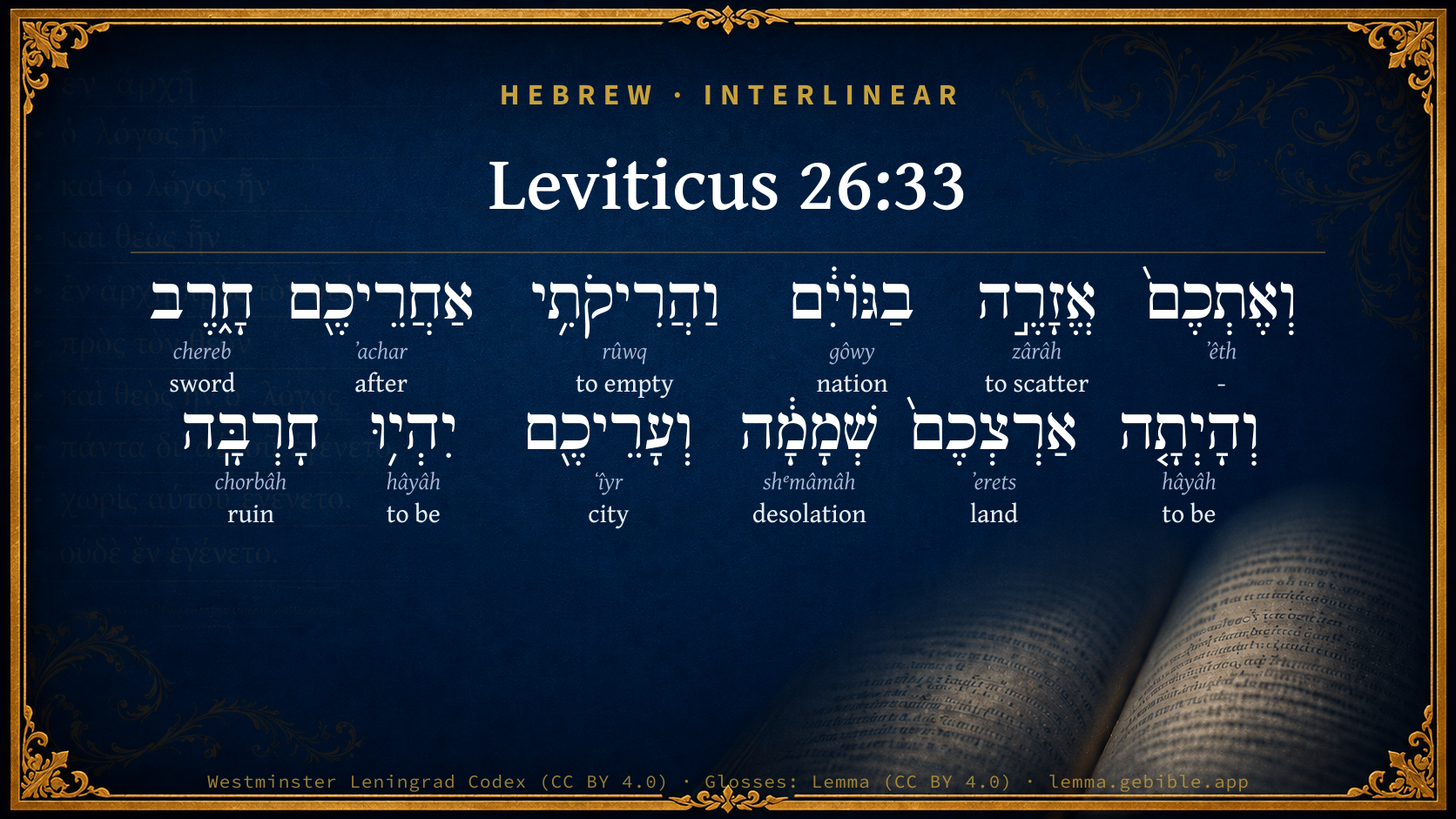
Hebrew (Westminster Leningrad Codex) Leviticus 26:33 appears in the Hebrew Old Testament. The text above is from the Westminster Leningrad Codex. Each word links to its Strong’s number, a concise gloss, and parsing drawn from the Open Scriptures Hebrew Bible morphology. Click any word for its full Brown-Driver-Briggs (BDB) entry.
Download image
Cite this verse

Leviticus 26:33 (World English Bible). Public Domain. Lemma interlinear Bible study tool, https://lemma.gebible.app/v/leviticus/26/33.

Show BibTeX & RIS
BibTeX
RIS
English Translation
I will scatter you among the nations, and I will draw out the sword after you: and your land will be a desolation, and your cities shall be a waste.
World English Bible · Public Domain
Download a study sheet

One document with this verse’s original text, its word-by-word gloss line, the meaning frame, cross-references with their text, attributed commentary, and full source and license credits — printable, and it pastes into notes with its structure intact.

This verse Autodidact and up

Study sheet (.html) Plain text (.txt)

A passage Seminary Student

Up to 50 verses in one chapter. A passage sheet keeps up to 6 commentary sources and 12 cross-references per verse, in the order this page ranks them, and says so on the sheet whenever that leaves anything out. Ask for a single verse and you get the Autodidact verse sheet above.

Everything on this page stays free to read, with no account — the sheet is a download of what is already on screen, not access to it.

Want to remove ads? Support Godless Engineer
Compare translations 3

The same verse in 3 English versions, stacked beneath the original-language interlinear above. Click any original word for its lexicon entry.

Each is an independent rendering of the whole verse — the interlinear is not word-aligned to these translations.

Highlighted words mark where these versions differ — a whole-verse word diff, not a word-by-word alignment.

  • World English Bible Public Domain
    I will scatter you among the nations, and I will draw out the sword after you: and your land will be a desolation, and your cities shall be a waste.
  • King James Version Public Domain
    And I will scatter you among the heathen, and will draw out a sword after you: and your land shall be desolate, and your cities waste.
  • unfoldingWord Literal Text CC BY-SA 4.0
    And you I will scatter among the nations, and I will draw out a sword after you, and your land will be a desolation, and your cities will be a waste.

unfoldingWord Literal Text — © unfoldingWord, licensed CC BY-SA 4.0. Word-aligned USFM3 via Door43 (git.door43.org/unfoldingWord/en_ult).

Versions to compare (up to 4)

3 of 4 selected

Show all 18 translations

Every available English version of this verse, each an independent rendering of the whole verse.

  • World English Bible Public Domain
    I will scatter you among the nations, and I will draw out the sword after you: and your land will be a desolation, and your cities shall be a waste.
  • Berean Standard Bible Public Domain
    But I will scatter you among the nations and will draw out a sword after you as your land becomes desolate and your cities are laid waste.
  • Majority Standard Bible Public Domain
    But I will scatter you among the nations and will draw out a sword after you as your land becomes desolate and your cities are laid waste.
  • King James Version Public Domain
    And I will scatter you among the heathen, and will draw out a sword after you: and your land shall be desolate, and your cities waste.
  • American Standard Version (1901) Public Domain
    And you will I scatter among the nations, and I will draw out the sword after you: and your land shall be a desolation, and your cities shall be a waste.
  • Revised Version (1885) Public Domain
    And you will I scatter among the nations, and I will draw out the sword after you: and your land shall be a desolation, and your cities shall be a waste.
  • Geneva Bible (1599) Public Domain
    Also I wil scatter you among the heathen, and will drawe out a sworde after you, and your land shalbe waste, and your cities shalbe desolate.
  • Douay-Rheims (1899) Public Domain
    And I will scatter you among the Gentiles, and I will draw out the sword after you, and your land shall be desert, and your cities destroyed.
  • Young's Literal Translation Public Domain
    And you I scatter among nations, and have drawn out after you a sword, and your land hath been a desolation, and your cities are a waste.
  • Literal Standard Version CC BY-SA 4.0
    And I scatter you among nations, and have drawn out a sword after you, and your land has been a desolation, and your cities are a ruin.
  • Unlocked Literal Bible CC BY-SA 4.0
    I will scatter you among the nations, and I will draw out my sword and follow you. Your land will be abandoned, and your cities will be ruined.
  • unfoldingWord Literal Text CC BY-SA 4.0
    And you I will scatter among the nations, and I will draw out a sword after you, and your land will be a desolation, and your cities will be a waste.
  • Darby Bible Public Domain
    And I will scatter you among the nations, and will draw out the sword after you; and your land shall be desolation, and your cities waste.
  • World Messianic Bible Public Domain
    I will scatter you among the nations, and I will draw out the sword after you. Your land will be a desolation, and your cities shall be a waste.
  • Webster's Bible Public Domain
    And I will scatter you among the heathen, and will draw out a sword after you: and your land shall be desolate, and your cities waste.
  • Free Bible Version CC BY-SA 4.0
    I'm going to scatter you among the nations. You will be chased out by armies with swords as your land is ruined and your towns are destroyed.
  • Bible in Basic English Public Domain
    And I will send you out in all directions among the nations, and my sword will be uncovered against you, and your land will be without any living thing, and your towns will be made waste.
  • JPS Tanakh (1917) Public Domain
    And you will I scatter among the nations, and I will draw out the sword after you; and your land shall be a desolation, and your cities shall be a waste.

Literal Standard Version (2020), Covenant Press — licensed CC BY-SA 4.0. Text via the HelloAO Bible API (eBible.org). Unlocked Literal Bible (unfoldingWord) — licensed CC BY-SA 4.0. Text via the HelloAO Bible API (eBible.org). unfoldingWord Literal Text — © unfoldingWord, licensed CC BY-SA 4.0. Word-aligned USFM3 via Door43 (git.door43.org/unfoldingWord/en_ult). Free Bible Version, Dr. Jonathan Gallagher — licensed CC BY-SA 4.0. Text via the HelloAO Bible API (eBible.org).

Word by word

More ways to search: Search by grammar → Find every occurrence → Compare this word →

Practice this passage: Drill this verse → Learn its vocabulary →

וַהֲרִיקֹתִ֥י
rûwq
H7324
“and · to empty”
Conjunction + Verb, Hiphil, Sequential Perfect, 1st Person, Common, Singular
Part of Speech
Conjunction + Verb
Stem
Hiphil
Form
Sequential Perfect
Person
1st Person
Gender
Common
Number
Singular
Full BDB Definition

Origin: a primitive root

TWOT: 2161

to make empty, empty out - (Hiphil) - to empty, keep empty or hungry - to pour out or down - to empty out - (Hophal) to be emptied out
  1. וְאֶתְכֶם֙ ʼêth H853 “and · - · you” Conjunction + Particle, Direct Object + Suffix, Personal, 2nd Person, Masculine, Plural
  2. אֱזָרֶ֣ה zârâh H2219 “to scatter” Verb, Piel, Imperfect, 1st Person, Common, Singular
  3. בַגּוֹיִ֔ם gôwy H1471 “in/at the · nations” Preposition, Determined + Noun, Common, Masculine, Plural, Absolute
  4. אַחֲרֵיכֶ֖ם ʼachar H310 “after · you” Preposition + Suffix, Personal, 2nd Person, Masculine, Plural
  5. חָ֑רֶב chereb H2719 “sword” Noun, Common, Feminine, Singular, Absolute
  6. וְהָיְתָ֤ה hâyâh H1961 “and · to be” Conjunction + Verb, Qal, Sequential Perfect, 3rd Person, Feminine, Singular
  7. אַרְצְכֶם֙ ʼerets H776 “land · your” Noun, Common, Both, Singular, Construct + Suffix, Personal, 2nd Person, Masculine, Plural
  8. שְׁמָמָ֔ה shᵉmâmâh H8077 “desolation” Noun, Common, Feminine, Singular, Absolute
  9. וְעָרֵיכֶ֖ם ʻîyr H5892 “and · cities · your” Conjunction + Noun, Common, Feminine, Plural, Construct + Suffix, Personal, 2nd Person, Masculine, Plural
  10. יִהְי֥וּ hâyâh H1961 “to be” Verb, Qal, Imperfect, 3rd Person, Masculine, Plural
  11. חָרְבָּֽה chorbâh H2723 “ruin” Noun, Common, Feminine, Singular, Absolute

About this verse

These counts appear in no published source. They are computed here, from the morphology-tagged text and Lemma’s own curated glosses. What Lemma adds →

12
words
11
distinct lemmas
Pentateuch
section

Notable vocabulary

The rarest word here is וַהֲרִיקֹתִ֥י to empty H7324 — appearing just 19 times in the whole Hebrew Bible.

Shared distinctive vocabulary

וַהֲרִיקֹתִ֥י to empty H7324 occurs in 19 verses of the Hebrew Bible. Also found in:

Grammatical profile

  • 4 verbs
  • 6 nouns
  • 1 preposition
  • 1 particle

Verb forms

  • אֱזָרֶ֣ה Piel · Imperfect
  • וַהֲרִיקֹתִ֥י Hiphil · Sequential Perfect
  • וְהָיְתָ֤ה Qal · Sequential Perfect
  • יִהְי֥וּ Qal · Imperfect

Repetition

A word recurs within this verse — often emphatic in Hebrew:

  • וְהָיְתָ֤ה to be H1961 ×2

Hebrew & Septuagint length

In English translation the verse runs 30 words from the Hebrew and 30 from the Septuagint (LXX English) — the same length.

A rough comparison of the two English renderings, which tokenize alike — not a word-level alignment.

Word counts can differ between the Hebrew and the Greek without any difference in meaning — e.g. the Hebrew direct-object marker אֵת has no separate Greek word, and Greek often adds the article ὁ.

Cross-references

12

Topical passages linked to Leviticus 26:33 in the Treasury of Scripture Knowledge — connected by theme and wording, ordered by reader-vote popularity; previews shown in the World English Bible.

  • Deuteronomy 4:27 Yahweh will scatter you among the peoples, and you shall be left few in number among the nations, where Yahweh shall lead you away.
  • Deuteronomy 28:64–66 Yahweh will scatter you among all peoples, from the one end of the earth even to the other end of the earth; and there you shall serve other gods, which you have not known, you nor your fathers, even wood and stone.
  • Ezekiel 20:23 Moreover I swore to them in the wilderness, that I would scatter them among the nations, and disperse them through the countries;
  • Zechariah 7:14 "but I will scatter them with a whirlwind among all the nations which they have not known. Thus the land was desolate after them, so that no man passed through nor returned: for they made the pleasant land desolate."
  • Psalms 44:11 You have made us like sheep for food, And have scattered us among the nations.
  • Ezekiel 22:15 I will scatter you among the nations, and disperse you through the countries; and I will consume your filthiness out of you.
  • Jeremiah 9:16 I will scatter them also among the nations, whom neither they nor their fathers have known; and I will send the sword after them, until I have consumed them.
  • Lamentations 4:15 Depart you, they cried to them, Unclean! depart, depart, don't touch! When they fled away and wandered, men said among the nations, They shall no more sojourn [here].
  • Luke 21:24 They will fall by the edge of the sword, and will be led captive into all the nations. Jerusalem will be trampled down by the Gentiles, until the times of the Gentiles are fulfilled.
  • Lamentations 1:3 Judah is gone into captivity because of affliction, and because of great servitude; She dwells among the nations, she finds no rest: All her persecutors overtook her within the straits.
  • Ezekiel 12:14–16 I will scatter toward every wind all who are round about him to help him, and all his bands; and I will draw out the sword after them.
  • James 1:1 James, a servant of God and of the Lord Jesus Christ, to the twelve tribes which are in the Dispersion: Greetings.

Cross-references courtesy of OpenBible.info (CC BY 4.0).

Hebrew and Greek witnesses Masoretic Hebrew ↔ Greek Septuagint

The same verse in the two great witnesses to the Old Testament, shown verse-for-verse.

These are two independent witnesses, not word-aligned to each other, and the Septuagint is shown in lemma (dictionary) form.

Hebrew Leviticus 26:33 Masoretic · Westminster Leningrad Codex

וְאֶתְכֶם֙ אֱזָרֶ֣ה בַגּוֹיִ֔ם וַהֲרִיקֹתִ֥י אַחֲרֵיכֶ֖ם חָ֑רֶב וְהָיְתָ֤ה אַרְצְכֶם֙ שְׁמָמָ֔ה וְעָרֵיכֶ֖ם יִהְי֥וּ חָרְבָּֽה

I will scatter you among the nations, and I will draw out the sword after you: and your land will be a desolation, and your cities shall be a waste.

World English Bible · Public Domain

Greek LXX Leviticus 26:33 Septuagint · lemma form

καί διασπείρω σύ εἰς ὁ ἔθνος καί ἐκ ἀναἁλίσκω σύ ἐπιπορεύομαι ὁ μάχαιρα καί εἰμί ὁ γῆ σύ ἔρημος καί ὁ πόλις σύ εἰμί ἔρημος

And I will scatter you among the nations, and the sword shall come upon you and consume you; and your land shall be desolate, and your cities shall be desolate.

LXX2012 (modern English Septuagint) · Public Domain

Hebrew: Westminster Leningrad Codex (CC BY 4.0). Greek: Septuagint (public domain); English from LXX2012 (modern English Septuagint) (Public Domain). How the Septuagint differs from the Hebrew →

Targum (Aramaic paraphrase)

2

The Targum is the ancient Jewish Aramaic paraphrase of the Hebrew Scriptures — an interpretive translation, not the Hebrew text itself. Onkelos (literal) and Pseudo-Jonathan (expansive) render the Torah, and Jonathan the Prophets. Coverage is partial: where no permissively-licensed English translation exists for a verse, only the Aramaic is shown. This is verse-level text, not a word-by-word alignment to the Hebrew.

  1. Targum Onkelos Torah (Genesis–Deuteronomy)
    וְיָתְכוֹן אֲבַדַר בֵּינֵי עַמְמַיָא וֶאֱגָרֵי בַתְרֵיכוֹן דְקַטְלִין בְּחַרְבָּא וּתְהֵי אַרְעֲכוֹן צָדְיָא וְקִרְוֵיכוֹן יְהוֹן חָרְבָּא

    (no public-domain English translation for this verse)

    Targum Onkelos — Aramaic: “Onkelos Genesis” (public domain); “Onkelos Exodus” (public domain); “Onkelos Leviticus” (public domain); “Onkelos Numbers” (public domain); “Onkelos Deuteronomy” (public domain). English: “Sefaria Community Translation” (CC0 1.0 (public-domain dedication)); “J.W. Etheridge. The Targums of Onkelos and Jonathan Ben Uzziel on the Pentateuch. London: Longmans, Green, 1862” (public domain). Text via Sefaria.

  2. Targum Pseudo-Jonathan Torah (Genesis–Deuteronomy)
    וְיַתְכוֹן אַדְרֵי בֵּינֵי עַמְמַיָא וְאַגְרֵי בַּתְרֵיכוֹן עַם שְׁלוּפֵי חֶרֶב וּתְהֵי אַרְעֲכוֹן צַדְיָיא וְקוּרְיֵיכוֹן יֶהֶוְויָין צַדִיאָן

    And you will I disperse among the nations; for I will stir up against you a people who draw the sword, and your country shall be devastated, and your cities be solitary.

    Targum Pseudo-Jonathan — Aramaic: “Targum Jonathan on Genesis” (public domain); “Targum Jonathan on Exodus” (public domain); “Targum Jonathan on Leviticus” (public domain); “Targum Jonathan on Numbers” (public domain); “Targum Jonathan on Deuteronomy” (public domain). English: “The Targum of Jonathan ben Uzziel, trans. J. W. Etheridge, London, 1862” (public domain). Text via Sefaria.

Commentary

Notes on Leviticus 26:33 from classic Christian and Jewish commentators (each source and its license shown beneath its notes). The classic Christian expositions comment on the surrounding passage and are grouped to its opening verse, so a note may address several verses; the Jewish commentaries on the Tanakh (Rashi and others) are per-verse, so they appear only where the commentator wrote on this verse.

Lemma curates 59 commentaries, every one of them public domain or Creative Commons licensed, each selected and text-cleaned for this edition rather than reprinted as found. About our sources →

Trapp's Complete Commentary

John Trapp

Lev 26:33 And I will scatter you among the heathen, and will draw out a sword after you: and your land shall be desolate, and your cities waste.

Ver. 33. And I will scatter you.] As chaff. Compare Psa 44:11 Zec 7:14. Therefore "fan you, fan you, O nation, not to be desired before the day pass as the chaff," &c. {Zep 2:1-2} {See Trapp on "Zep 2:1"} {See Trapp on "Zep 2:2"}

John Trapp, A Commentary or Exposition upon All the Books of the Old and New Testament (1647–1656) — public domain. Text from a community e-Sword module.

Geneva Bible (1599)

Geneva Bible translators

Signifying that no enemy can come without God’s sending.

Geneva Bible (1599) marginal notes — public domain. Text via Bolls.life.

Jamieson, Fausset & Brown

Robert Jamieson, A. R. Fausset & David Brown

I will scatter you among the heathen, &c.--as was done when the elite of the nation were removed into Assyria and placed in various parts of the kingdom.

Jamieson, Fausset & Brown — Commentary Critical and Explanatory on the Whole Bible (1871) — public domain (CC PDM 1.0). Text via the HelloAO Bible API.

Ellicott's Commentary for English Readers

(33) And I will scatter you among the heathen.—They will not even be permitted to tarry among the ruins of their favoured places, but God Himself, who brings about the desolation, will disperse the surviving inhabitants far and wide.

And will draw out a sword after you.—To show how complete this dispersion is to be, God is represented with a drawn sword in His hand pursuing them and scattering them, so that both their land and every city in it should be denuded of them, and that there should be no possibility of any of them turning back. Thus the sword which God promised should not go through their land (see Lev_26:6) if they walk according to the Divine commandments, will now be wielded by Himself to bring about their utter dispersion from the land. A similar appalling scene is described by Jeremiah: “I will scatter them also among the heathen, whom neither they nor their fathers hare known: and I will send a sword after them, till I have consumed them” (Jer_9:16, with Jer_42:16-18; Eze_12:14).

A Bible Commentary for English Readers, edited by Charles John Ellicott (1878–1897) — public domain. Text from a community e-Sword module.

The Cambridge Bible for Schools and Colleges

gen. ed. J. J. S. Perowne

33. will draw out the sword] For this expression, as implying the hot pursuit of fugitives, see Eze_5:2; Eze_5:12; Eze_12:14.

The Cambridge Bible for Schools and Colleges (gen. ed. J. J. S. Perowne; Cambridge University Press, 1878–1918) — public domain. Text from a community e-Sword module.

John Gill's Exposition

Then shall the land enjoy her sabbaths,.... The sabbatical years, or seventh year sabbaths, when, according to the law in the preceding chapter, it was to rest from tillage, Lev 25:2,

as long as it lieth desolate, and ye be in your enemies' land; so long it should lie uncultivated, at least in part, there not being a sufficient number left to till it in general, or as it should be; this was the case during the seventy years' captivity in Babylon:

even then shall the land rest, and enjoy her sabbaths; or complete them, as Aben Ezra, which is a bitter sarcasm upon them for their neglect of observance of the law concerning the sabbatical years; but now the land should have its sabbaths of rest whether they would or not; and it seems as if it was on account of this sin, as well as others, that they were carried captive; and it is remarkable, if what Maimonides (x) says is right, that it was at the going out or end of a sabbatical year, that the first temple was destroyed, and the Jews carried captive, and endured a seventy years' captivity; which some say was because they had neglected seventy sabbatical years; see Ch2 36:21.

(x) Hilchot Shemitah Vejobel, c. 10. sect. 3.

John Gill's Exposition of the Whole Bible (1746–1763) — public domain (CC PDM 1.0). Text via the HelloAO Bible API.

Matthew Poole's English Annotations

The sword shall follow you into strange lands, and you shall have no rest there.

Matthew Poole's English Annotations on the Holy Bible (1683–1685) — public domain. Text from a community e-Sword/MySword module.

Whedon's Commentary on the Bible

Daniel D. Whedon

33. I will scatter you — This admonitory prophecy looks beyond the captivity of Israel in Babylon, its first fulfilment, to that world-wide dispersion which began at the destruction of Jerusalem and continues to this day, a miracle of national life perpetuated in spite of all opposing forces and destructive agencies, a people “scattered and peeled,” dwelling in every nation, yet resisting absorption and assimilation. “THE DISPERSION” was the general title applied to those Jews who remained in foreign countries after the return from Babylon, during the period of the second temple. Most of them were in bondage, and shut out from the full privileges of the chosen race. Joh_7:35; Jas_1:1, notes. There are legends pointing to settlements of Jews in Arabia, Ethiopia and Abyssinia. At the beginning of the Christian era the “dispersion” was divided into three great sections — the Babylonian, the Syrian, and the Egyptian. For the breadth of the dispersion, see Act_2:9-11, note. Its influence on the rapid promulgation of Christianity can scarcely be overrated. The course of apostolic preaching follows, in a regular progress, the line of Jewish settlements. Thus the wickedness of Israel was overruled for the furtherance of the Gospel.

Daniel D. Whedon (gen. ed.), Commentary on the Old and New Testaments (1874–1909) — public domain. Text from a community e-Sword module.

John Wesley's Explanatory Notes

After you - The sword shall follow you into strange lands, and you shall have no rest there.

John Wesley, Explanatory Notes Upon the Whole Bible (1754–1765) — public domain. Text via the GEBible commentary corpus.

Rashi

Rabbi Shlomo Yitzchaki (Rashi)

ואתכם אזרה בגוים AND I WILL SCATTER YOU AMONG THE NATIONS — This again was a harsh measure; because when the inhabitants of a country go into exile in one and the same place they have the opportunity to see each other and so find consolation for their bad lot. Israel, however, was scattered as though by a winnowing fan — as when a man winnows barley with a fan — when not even one grain of them adheres to the other (not even two grains remain in the same place; cf. Jeremiah 25:7) (Sifra, Bechukotai, Chapter 6 6).

והריקתי — (lit., I shall empty out) — This term may be used for drawing the sword because when one draws the sword the scabbard becomes empty (cf. Rashi on Ex 15:9). A Midrashic explanation (referring the word והריקתי to the sword itself not to the scabbard) is the sword once drawn to pursue you will not soon return unto the scabbard — as a man pours out water and it can never return to the vessel that once contained it (i. e. I will, as it were, empty out the scabbard — pour forth the sword from it, and it shall never return, but always follow you) (Sifra, Bechukotai, Chapter 6 7).

והיתה ארצכם שממה AND YOUR LAND WILL BE (REMAIN) DESOLATE — This implies that you will not soon return unto it, and on that account עריכם יהיו חריבה YOUR CITIES WILL BE WASTE, i. e. they will seem to you waste; for when a man is exiled from his house, or from his vineyard, or from his city, knowing that he is ultimately to return to it, it appears to him as though his vineyard or his house were not waste. —Thus is it explained in Torat Cohanim (Sifra, Bechukotai, Chapter 7 1).

Rashi on the Tanakh — English translations: “The Judaica Press complete Tanach with Rashi, translated by A. J. Rosenberg” (CC BY 4.0); “Pentateuch with Rashi's commentary by M. Rosenbaum and A.M. Silbermann, 1929-1934” (public domain); “The Metsudah Tanach series, Lakewood, N.J” (CC BY 4.0); and “The Book of Joshua, Metsudah Publications, 1997” (CC BY 4.0). Text via Sefaria.

Lesson kit

Teaching starters — assembled from the data on this page, not authored interpretation. Every prompt links to the verse data it draws on. Edit before teaching.

Leviticus, in the Pentateuch, opens this verse with 12 words (11 distinct Hebrew lemmas). Its most distinctive word is rûwq (“to empty”). A historical commentator’s framing appears above. Read the whole chapter for the surrounding context.

Discussion questions

  1. The word rûwq carries the sense “to empty.” How does it shape the verse?
  2. Genesis 14:14 shares the word «to empty» with this verse. How do the two illuminate each other?
  3. “to be” occurs 2× in this one verse. What is the effect of the repetition?
  4. These translations render this verse differently. What is at stake in choosing one wording over another?
  5. The verb «אֱזָרֶ֣ה» is Piel Imperfect. How does its form color the action?
  6. Reading how Trapp's Complete Commentary and Geneva Bible (1599) read this verse, where do the two commentators agree and where do they part?

Things to notice

Reading settings

Reading text

Shown beneath each verse's original-language words.

Old Testament
Old Testament edition

Read the OT as the Masoretic Hebrew (MT) or the Greek Septuagint (LXX).

English shown for the Greek Septuagint (in the Hebrew ↔ Greek comparison).

Comparing translations? Open the Compare panel on any verse page to stack up to four side by side.