
Ezekiel 28:23

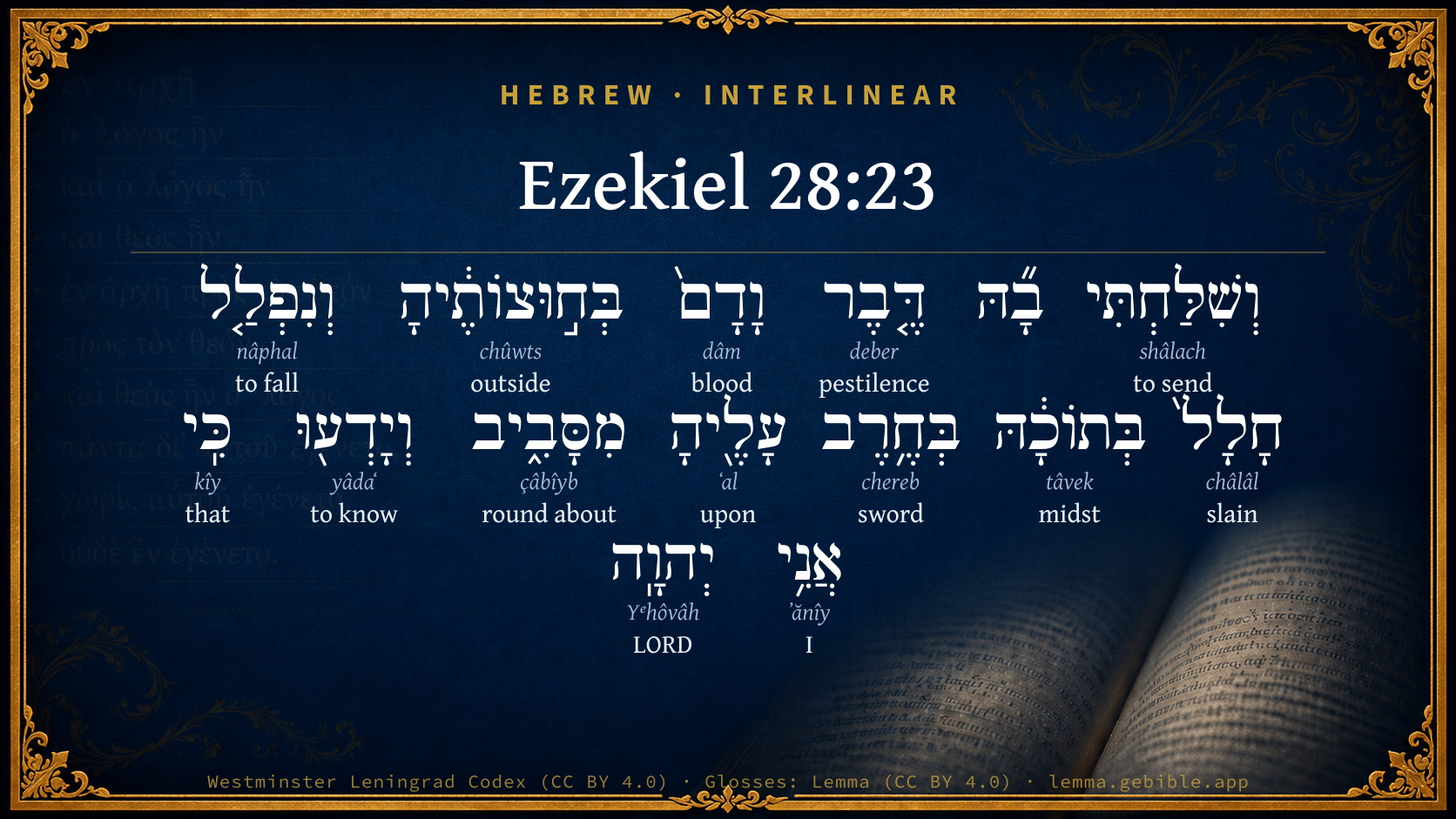
Hebrew (Westminster Leningrad Codex) Ezekiel 28:23 appears in the Hebrew Old Testament. The text above is from the Westminster Leningrad Codex. Each word links to its Strong’s number, a concise gloss, and parsing drawn from the Open Scriptures Hebrew Bible morphology. Click any word for its full Brown-Driver-Briggs (BDB) entry.
Download image
Cite this verse

Ezekiel 28:23 (World English Bible). Public Domain. Lemma interlinear Bible study tool, https://lemma.gebible.app/v/ezekiel/28/23.

Show BibTeX & RIS
BibTeX
RIS
English Translation
For I will send pestilence into her, and blood into her streets; and the wounded shall fall in the midst of her, with the sword on her on every side; and they shall know that I am Yahweh.
World English Bible · Public Domain
Download a study sheet

One document with this verse’s original text, its word-by-word gloss line, the meaning frame, cross-references with their text, attributed commentary, and full source and license credits — printable, and it pastes into notes with its structure intact.

This verse Autodidact and up

Study sheet (.html) Plain text (.txt)

A passage Seminary Student

Up to 50 verses in one chapter. A passage sheet keeps up to 6 commentary sources and 12 cross-references per verse, in the order this page ranks them, and says so on the sheet whenever that leaves anything out. Ask for a single verse and you get the Autodidact verse sheet above.

Everything on this page stays free to read, with no account — the sheet is a download of what is already on screen, not access to it.

Want to remove ads? Support Godless Engineer
Compare translations 3

The same verse in 3 English versions, stacked beneath the original-language interlinear above. Click any original word for its lexicon entry.

Each is an independent rendering of the whole verse — the interlinear is not word-aligned to these translations.

Highlighted words mark where these versions differ — a whole-verse word diff, not a word-by-word alignment.

  • World English Bible Public Domain
    For I will send pestilence into her, and blood into her streets; and the wounded shall fall in the midst of her, with the sword on her on every side; and they shall know that I am Yahweh.
  • King James Version Public Domain
    For I will send into her pestilence, and blood into her streets; and the wounded shall be judged in the midst of her by the sword upon her on every side; and they shall know that I am the LORD.
  • unfoldingWord Literal Text CC BY-SA 4.0
    I will send out a plague in you and blood in your streets, and the slain will fall in your midst. When the sword comes against you from all around, then you will know that I am Yahweh.

unfoldingWord Literal Text — © unfoldingWord, licensed CC BY-SA 4.0. Word-aligned USFM3 via Door43 (git.door43.org/unfoldingWord/en_ult).

Versions to compare (up to 4)

3 of 4 selected

Show all 18 translations

Every available English version of this verse, each an independent rendering of the whole verse.

  • World English Bible Public Domain
    For I will send pestilence into her, and blood into her streets; and the wounded shall fall in the midst of her, with the sword on her on every side; and they shall know that I am Yahweh.
  • Berean Standard Bible Public Domain
    I will send a plague against her and shed blood in her streets; the slain will fall within her, while the sword is against her on every side. Then they will know that I am the LORD.
  • Majority Standard Bible Public Domain
    I will send a plague against her and shed blood in her streets; the slain will fall within her, while the sword is against her on every side. Then they will know that I am the LORD.
  • King James Version Public Domain
    For I will send into her pestilence, and blood into her streets; and the wounded shall be judged in the midst of her by the sword upon her on every side; and they shall know that I am the LORD.
  • American Standard Version (1901) Public Domain
    For I will send pestilence into her, and blood into her streets; and the wounded shall fall in the midst of her, with the sword upon her on every side; and they shall know that I am Jehovah.
  • Revised Version (1885) Public Domain
    For I will send into her pestilence and blood in her streets; and the wounded shall fall in the midst of her, with the sword upon her on every side; and they shall know that I am the LORD.
  • Geneva Bible (1599) Public Domain
    For I wil send into her pestilence, and blood into her streetes, and the slaine shall fall in the middes of her: the enemie shall come against her with the sword on euery side, and they shall know that I am the Lord.
  • Douay-Rheims (1899) Public Domain
    And I will send into her pestilence, and blood in her streets: and they shall fall being slain by the sword on all sides in the midst thereof: and they shall know that I am the Lord.
  • Young's Literal Translation Public Domain
    And I have sent into her pestilence, And blood into her out-places, The wounded hath been judged in her midst, By the sword upon her round about, And they have known that I `am' Jehovah.
  • Literal Standard Version CC BY-SA 4.0
    And I have sent pestilence into her, || And blood into her out-places, || The wounded has been judged in her midst, || By the sword on her all around, || And they have known that I [am] YHWH.
  • Unlocked Literal Bible CC BY-SA 4.0
    I will send out a plague in you and blood in your streets, and the slain will fall in your midst. When the sword comes against you from all around, then you will know that I am Yahweh.
  • unfoldingWord Literal Text CC BY-SA 4.0
    I will send out a plague in you and blood in your streets, and the slain will fall in your midst. When the sword comes against you from all around, then you will know that I am Yahweh.
  • Darby Bible Public Domain
    And I will send into her the pestilence, and blood in her streets; and the wounded shall fall in the midst of her, by the sword upon her on every side: and they shall know that I [am] Jehovah.
  • World Messianic Bible Public Domain
    For I will send pestilence into her, and blood into her streets. The wounded will fall within her, with the sword on her on every side. Then they will know that I am the LORD.
  • Webster's Bible Public Domain
    For I will send into her pestilence, and blood into her streets; and the wounded shall be judged in the midst of her by the sword upon her on every side; and they shall know that I am the LORD.
  • Free Bible Version CC BY-SA 4.0
    I'm going to send a disease to plague her, and have people killed in her streets. Those who are killed will fall inside the city as the enemy attacks with swords from every side. Then they will know that I am the Lord.
  • Bible in Basic English Public Domain
    And I will send on her disease and blood in her streets; and the wounded will be falling in the middle of her, and the sword will be against her on every side; and they will be certain that I am the Lord.
  • JPS Tanakh (1917) Public Domain
    For I will send into her pestilence and blood in her streets; and the wounded shall fall in the midst of her by the sword upon her on every side; and they shall know that I am the LORD.

Literal Standard Version (2020), Covenant Press — licensed CC BY-SA 4.0. Text via the HelloAO Bible API (eBible.org). Unlocked Literal Bible (unfoldingWord) — licensed CC BY-SA 4.0. Text via the HelloAO Bible API (eBible.org). unfoldingWord Literal Text — © unfoldingWord, licensed CC BY-SA 4.0. Word-aligned USFM3 via Door43 (git.door43.org/unfoldingWord/en_ult). Free Bible Version, Dr. Jonathan Gallagher — licensed CC BY-SA 4.0. Text via the HelloAO Bible API (eBible.org).

Word by word

More ways to search: Search by grammar → Find every occurrence → Compare this word →

Practice this passage: Drill this verse → Learn its vocabulary →

דֶּ֤בֶר
deber
H1698
“pestilence”
Noun, Common, Masculine, Singular, Absolute
Part of Speech
Noun
Type
Common
Gender
Masculine
Number
Singular
State
Absolute
Full BDB Definition

Origin: from H1696 (in the sense of destroying)

TWOT: 399b

pestilence, plague - murrain, cattle disease, cattle-plague
  1. וְשִׁלַּחְתִּי shâlach H7971 “and · to send” Conjunction + Verb, Piel, Sequential Perfect, 1st Person, Common, Singular
  2. וָדָם֙ dâm H1818 “and · blood” Conjunction + Noun, Common, Masculine, Singular, Absolute
  3. בְּח֣וּצוֹתֶ֔יהָ chûwts H2351 “in/at · streets · her” Preposition + Noun, Common, Masculine, Plural, Construct + Suffix, Personal, 3rd Person, Feminine, Singular
  4. וְנִפְלַ֤ל nâphal H5307 “and · to fall” Conjunction + Verb, Pilpel, Sequential Perfect, 3rd Person, Masculine, Singular
  5. חָלָל֙ châlâl H2491 “slain” Adjective, Adjective, Masculine, Singular, Absolute
  6. בְּתוֹכָ֔הּ tâvek H8432 “in/at · midst · her” Preposition + Noun, Common, Masculine, Singular, Construct + Suffix, Personal, 3rd Person, Feminine, Singular
  7. בְּחֶ֥רֶב chereb H2719 “in/at · sword” Preposition + Noun, Common, Feminine, Singular, Absolute
  8. עָלֶ֖יהָ ʻal H5921 “upon · her” Preposition + Suffix, Personal, 3rd Person, Feminine, Singular
  9. מִסָּבִ֑יב çâbîyb H5439 “from · round about” Preposition + Noun, Common, Both, Singular, Absolute
  10. וְיָדְע֖וּ yâdaʻ H3045 “and · to know” Conjunction + Verb, Qal, Sequential Perfect, 3rd Person, Common, Plural
  11. כִּֽי kîy H3588 “that” Conjunction
  12. אֲנִ֥י ʼănîy H589 “I” Pronoun, Personal, 1st Person, Common, Singular
  13. יְהוָֽה Yᵉhôvâh H3068 “LORD” Noun, Proper

About this verse

These counts appear in no published source. They are computed here, from the morphology-tagged text and Lemma’s own curated glosses. What Lemma adds →

15
words
14
distinct lemmas
Prophets
section

Shared distinctive vocabulary

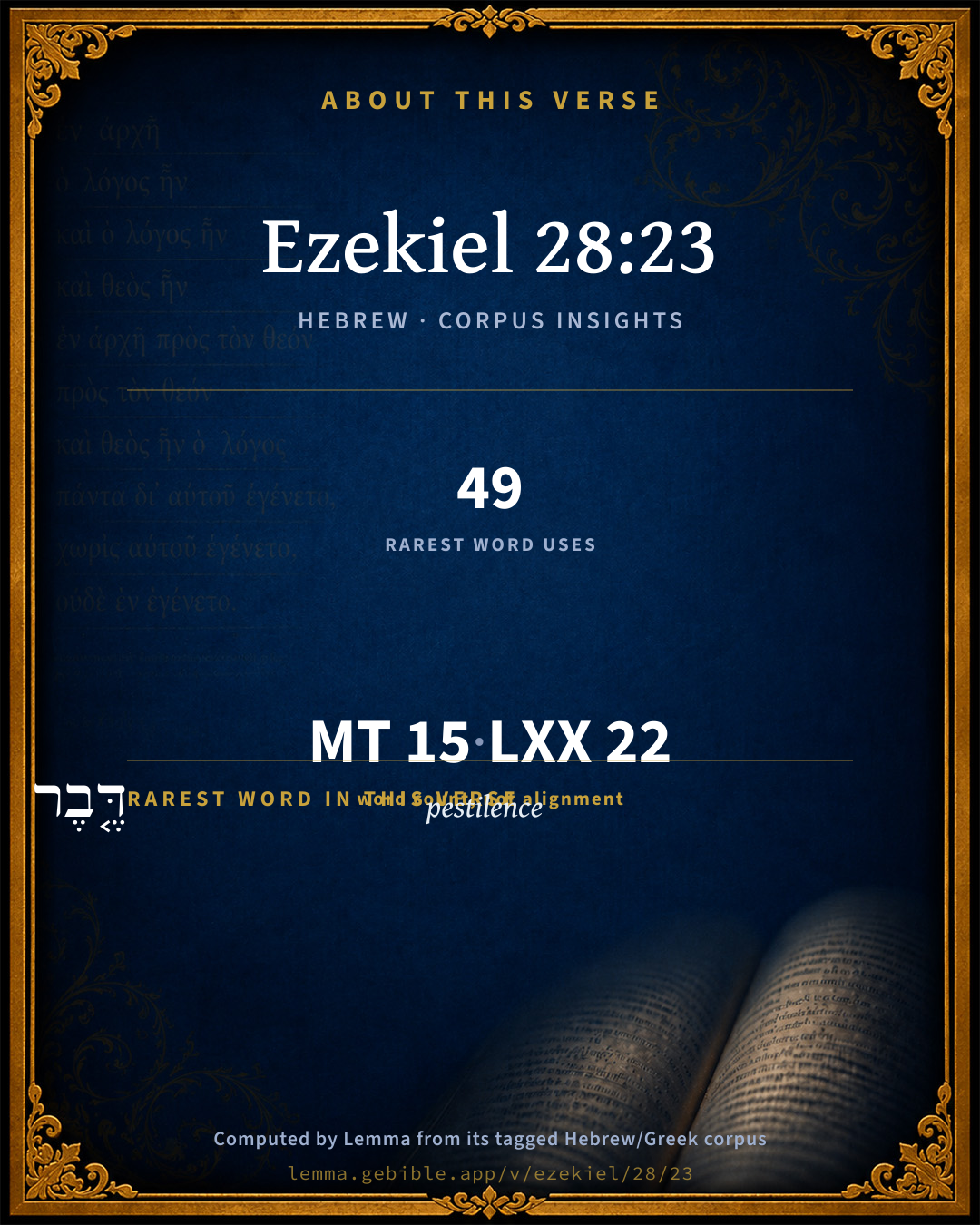
דֶּ֤בֶר pestilence H1698 occurs in 48 verses of the Hebrew Bible. Also found in:

Grammatical profile

  • 3 verbs
  • 7 nouns
  • 1 adjective
  • 1 pronoun
  • 2 prepositions
  • 1 conjunction

Verb forms

  • וְשִׁלַּחְתִּי Piel · Sequential Perfect
  • וְנִפְלַ֤ל Pilpel · Sequential Perfect
  • וְיָדְע֖וּ Qal · Sequential Perfect

Hebrew & Septuagint length

In English translation the verse runs 38 words from the Hebrew and 32 from the Septuagint (LXX English) — closely comparable.

A rough comparison of the two English renderings, which tokenize alike — not a word-level alignment.

Word counts can differ between the Hebrew and the Greek without any difference in meaning — e.g. the Hebrew direct-object marker אֵת has no separate Greek word, and Greek often adds the article ὁ.

In the original languages it is 15 Hebrew tokens and 22 Greek tokens — but the two are counted differently (Hebrew bundles its prefixes and suffixes into one token; the Greek is in lemma form), so that isn’t a like-for-like length.

Cross-references

7

Topical passages linked to Ezekiel 28:23 in the Treasury of Scripture Knowledge — connected by theme and wording, ordered by reader-vote popularity; previews shown in the World English Bible.

  • Ezekiel 38:22 With pestilence and with blood will I enter into judgment with him; and I will rain on him, and on his hordes, and on the many peoples who are with him, an overflowing shower, and great hailstones, fire, and sulfur.
  • Jeremiah 15:2 It shall happen, when they tell you, Where shall we go forth? then you shall tell them, Thus says Yahweh: Such as are for death, to death; and such as are for the sword, to the sword; and such as are for the famine, to the famine; and such as are for captivity, to captivity.
  • Ezekiel 5:12 A third part of you shall die with the pestilence, and with famine shall they be consumed in the midst of you; and a third part shall fall by the sword round about you; and a third part I will scatter to all the winds, and will draw out a sword after them.
  • Ezekiel 25:7 therefore, behold, I have stretched out my hand on you, and will deliver you for a spoil to the nations; and I will cut you off from the peoples, and I will cause you to perish out of the countries: I will destroy you; and you shall know that I am Yahweh.
  • Ezekiel 25:11 and I will execute judgments on Moab; and they shall know that I am Yahweh.
  • Ezekiel 25:17 I will execute great vengeance on them with wrathful rebukes; and they shall know that I am Yahweh, when I shall lay my vengeance on them.
  • Ezekiel 26:6 Her daughters who are in the field shall be slain with the sword: and they shall know that I am Yahweh.

Cross-references courtesy of OpenBible.info (CC BY 4.0).

Hebrew and Greek witnesses Masoretic Hebrew ↔ Greek Septuagint

The same verse in the two great witnesses to the Old Testament, shown verse-for-verse.

These are two independent witnesses, not word-aligned to each other, and the Septuagint is shown in lemma (dictionary) form.

Hebrew Ezekiel 28:23 Masoretic · Westminster Leningrad Codex

וְשִׁלַּחְתִּי בָ֞הּ דֶּ֤בֶר וָדָם֙ בְּח֣וּצוֹתֶ֔יהָ וְנִפְלַ֤ל חָלָל֙ בְּתוֹכָ֔הּ בְּחֶ֥רֶב עָלֶ֖יהָ מִסָּבִ֑יב וְיָדְע֖וּ כִּֽי אֲנִ֥י יְהוָֽה

For I will send pestilence into her, and blood into her streets; and the wounded shall fall in the midst of her, with the sword on her on every side; and they shall know that I am Yahweh.

World English Bible · Public Domain

Greek LXX Ezekiel 28:23 Septuagint · lemma form

αἷμα καί θάνατος ἐν ὁ πλατύς σύ καί πίπτω τραυματίζω ἐν μάχαιρα ἐν σύ περικύκλῳ σύ καί γιγνώσκω διότι ἐγώ εἰμί κύριος

Blood and death shall be in your streets; and men wounded with swords shall fall in you and on every side of you; and they shall know that I am the Lord.

LXX2012 (modern English Septuagint) · Public Domain

Hebrew: Westminster Leningrad Codex (CC BY 4.0). Greek: Septuagint (public domain); English from LXX2012 (modern English Septuagint) (Public Domain). How the Septuagint differs from the Hebrew →

Targum (Aramaic paraphrase)

1

The Targum is the ancient Jewish Aramaic paraphrase of the Hebrew Scriptures — an interpretive translation, not the Hebrew text itself. Onkelos (literal) and Pseudo-Jonathan (expansive) render the Torah, and Jonathan the Prophets. Coverage is partial: where no permissively-licensed English translation exists for a verse, only the Aramaic is shown. This is verse-level text, not a word-by-word alignment to the Hebrew.

  1. Targum Jonathan Prophets (Joshua–Malachi)
    וַאֲשַׁלַח בָּהּ מוֹתָא וּקְטָלָא בְשׁוּקָהָא כַּד יִתְרְמוּן קְטִילִין בְּגַוָהּ בְּאַיְתָיוּתִי עֲלָהּ דְקָטְלִין בְּחַרְבָּא מִסְחוֹר סְחוֹר וְיֵדְעוּן אֲרֵי אֲנָא יְיָ:

    (no public-domain English translation for this verse)

    Targum Jonathan — Aramaic: “Mikraot Gedolot” (public domain). English: “Sefaria Community Translation” (CC0 1.0 (public-domain dedication)); “London "Chaldee Paraphrase," 1871” (public domain). Text via Sefaria.

Commentary

Notes on Ezekiel 28:23 from classic Christian and Jewish commentators (each source and its license shown beneath its notes). The classic Christian expositions comment on the surrounding passage and are grouped to its opening verse, so a note may address several verses; the Jewish commentaries on the Tanakh (Rashi and others) are per-verse, so they appear only where the commentator wrote on this verse.

Lemma curates 59 commentaries, every one of them public domain or Creative Commons licensed, each selected and text-cleaned for this edition rather than reprinted as found. About our sources →

Trapp's Complete Commentary

John Trapp

Eze 28:23 For I will send into her pestilence, and blood into her streets; and the wounded shall be judged in the midst of her by the sword upon her on every side; and they shall know that I [am] the LORD.

Ver. 23. For I will send into her.] These are God’s evil angels.

And the wounded shall be judged in the midst of her.] This was done likely by Nebuchadnezzar; but certainly by Artaxerxes Ochus the Persian, as the prophet Zechariah had foretold, {Zec 9:3-5} and as Diodorus Siculus hath left upon record.

John Trapp, A Commentary or Exposition upon All the Books of the Old and New Testament (1647–1656) — public domain. Text from a community e-Sword module.

Geneva Bible (1599)

Geneva Bible translators

That is, Nebuchadnezzar.

Geneva Bible (1599) marginal notes — public domain. Text via Bolls.life.

Adam Clarke's Commentary

Verse 23. And the wounded] חלל chalal, the soldiery. All its supports shall be taken away, and its defenders destroyed.

Adam Clarke's Commentary on the Bible (1810–1826) — public domain. Text from a community e-Sword/MySword module.

The Cambridge Bible for Schools and Colleges

gen. ed. J. J. S. Perowne

23. wounded … be judged] Rather: shall fall, or, fall thick, if the word be read as an intensive. The judgments on Zidon shall bring home to her that there is a great God and that He has sent them. This God is Jehovah God of Israel, God alone. The prophet speaks from his own belief.

The Cambridge Bible for Schools and Colleges (gen. ed. J. J. S. Perowne; Cambridge University Press, 1878–1918) — public domain. Text from a community e-Sword module.

John Gill's Exposition

And I will send into her pestilence, and blood into her streets,.... The plague and the sword, which are two of God's sore judgments, and often go together; the pestilence slays them that are within, and the sword those the enemy meets with in the streets:

and the wounded shall be judged; that is, punished; or "shall fall" (w), die and perish:

in the midst of her by the sword upon her on every side; this was literally fulfilled in Zidon, either by Nebuchadnezzar and the Chaldean army, which besieged it on every side; or by Artaxerxes Ochus the Persian, who took it, and destroyed it; and will have its accomplishment on the antichristian states, eastern and western, when the vials shall be poured out upon them, Rev 16:1,

and they shall know that I am the Lord God; who am able to foretell things to come, and to accomplish them.

(w) Sept.; "corruent", Pagninus, Vatablus; "cadet", Montanus; so Kimchi and Ben Melech; and which is approved of by Gussetius.

John Gill's Exposition of the Whole Bible (1746–1763) — public domain (CC PDM 1.0). Text via the HelloAO Bible API.

Matthew Poole's English Annotations

I will send; the pestilence is one of God’s arrows, and he sends it wheresoever it walks; it is one of his sore judgments, and wasteth where it cometh.

Pestilence; the most dreadful of diseases, because most deadly, swift, and comes so immediately from the wrath of God offended with men; this pestilence attends on war, and seldom faileth to make havoc in besieged towns or cities.

Blood; bloody war by an enemy, that shall bring the war to the gates, nay, into the streets of Zidon.

Be judged; fall, be cast down, punished, in the midst of the city.

By the sword; by her enemy’s sword prevailing and conquering.

On every side; a description either of the siege that Zidon should suffer by, or pointing out the multitude of her enemies on every side agreeing against her.

Matthew Poole's English Annotations on the Holy Bible (1683–1685) — public domain. Text from a community e-Sword/MySword module.

Whedon's Commentary on the Bible

Daniel D. Whedon

23. Be judged — R.V., “fall.” (See on “pestilence and blood,” Eze_5:12, Eze_14:19.)

Daniel D. Whedon (gen. ed.), Commentary on the Old and New Testaments (1874–1909) — public domain. Text from a community e-Sword module.

The Pulpit Commentary

Pestilence was the natural accompaniment of a siege. As in Eze_14:19, blood probably points to death from this cause, as distinct from the slaughter threatened in the following clause.

The Pulpit Commentary (1880–1919), ed. H.D.M. Spence-Jones & Joseph S. Exell — public domain. Text from a community e-Sword module.

John Wesley's Explanatory Notes

And blood - Bloody war by an enemy, that shall bring the war to the gates, nay into the streets of Zidon. Judged - Be punished in the midst of the city. The sword - By the sword of her enemies.

John Wesley, Explanatory Notes Upon the Whole Bible (1754–1765) — public domain. Text via the GEBible commentary corpus.

unfoldingWord translationNotes

Door43 World Missions Community

Connecting Statement:

Yahweh continues giving Ezekiel his message to Sidon.

General Information:

The words "you" and "your" in these verses refer to Sidon.

blood in your streets

Here "blood" refers to the blood of the people of Sidon and represents those whom their enemies would kill. (See: Metaphor)

the slain will fall

Here "the slain" means the people of Sidon whom their enemies would kill. AT: "the slain people will fall" (See: Nominal Adjectives)

When the sword comes against you

Here "sword" is a metonym for an attacking enemy army. AT: "When enemy armies attack you" (See: Metonymy)

pricking briars and painful thorns for the house of Israel from all those around her who despise her people

Here the briars and thorns represent what would cause suffering and pain. AT: "people anywhere around the house of Israel who wound them like briars, hurt them like thorns, and despise them" (See: Metaphor)

the house of Israel

The word "house" is a metonym for the family that lives in the house. In this case it refers to Israel's descendants. See how you translated this in Ezekiel 3:1. AT: "the Israelites" or "the Israelite people group" (See: Metonymy)

translationWords

plague

blood

slay

sword

Lord Yahweh

unfoldingWord translationNotes — © Distant Shores Media and the Door43 World Missions Community, licensed CC BY-SA 4.0. Source: git.door43.org/Door43/en_tn.

Rashi

Rabbi Shlomo Yitzchaki (Rashi)

and they will judge themselves as slain in her midst by the sword [coming] upon her from all around Because they will see the sword surrounding [them] from outside, the people of the city will assess [the situation] and be sure that they will be slain in her midst.

[Heb. וְנִפְלַל,] like (Gen. 48:11): “I did not think (פִלָּלְתִּי),” and like (Deut. 32:31): “and our enemies judge (פְּלִילִים).” They will judge themselves to be slain in her midst.

Rashi on the Tanakh — English translations: “The Judaica Press complete Tanach with Rashi, translated by A. J. Rosenberg” (CC BY 4.0); “Pentateuch with Rashi's commentary by M. Rosenbaum and A.M. Silbermann, 1929-1934” (public domain); “The Metsudah Tanach series, Lakewood, N.J” (CC BY 4.0); and “The Book of Joshua, Metsudah Publications, 1997” (CC BY 4.0). Text via Sefaria.

Lesson kit

Teaching starters — assembled from the data on this page, not authored interpretation. Every prompt links to the verse data it draws on. Edit before teaching.

Ezekiel, in the Prophets, opens this verse with 15 words (14 distinct Hebrew lemmas). Its most distinctive word is deber (“pestilence”). A historical commentator’s framing appears above. Read the whole chapter for the surrounding context.

Discussion questions

  1. How does “pestilence” (deber) shape what this verse is saying?
  2. Exodus 5:3 shares the word «pestilence» with this verse. How do the two illuminate each other?
  3. These translations render this verse differently; the difference is in the English rendering, not the original. What questions does that raise?
  4. The verb «וְשִׁלַּחְתִּי» is Piel Sequential Perfect. How does its form color the action?
  5. Reading how Trapp's Complete Commentary and Geneva Bible (1599) read this verse, where do the two commentators agree and where do they part?

Things to notice

Reading settings

Reading text

Shown beneath each verse's original-language words.

Old Testament
Old Testament edition

Read the OT as the Masoretic Hebrew (MT) or the Greek Septuagint (LXX).

English shown for the Greek Septuagint (in the Hebrew ↔ Greek comparison).

Comparing translations? Open the Compare panel on any verse page to stack up to four side by side.