
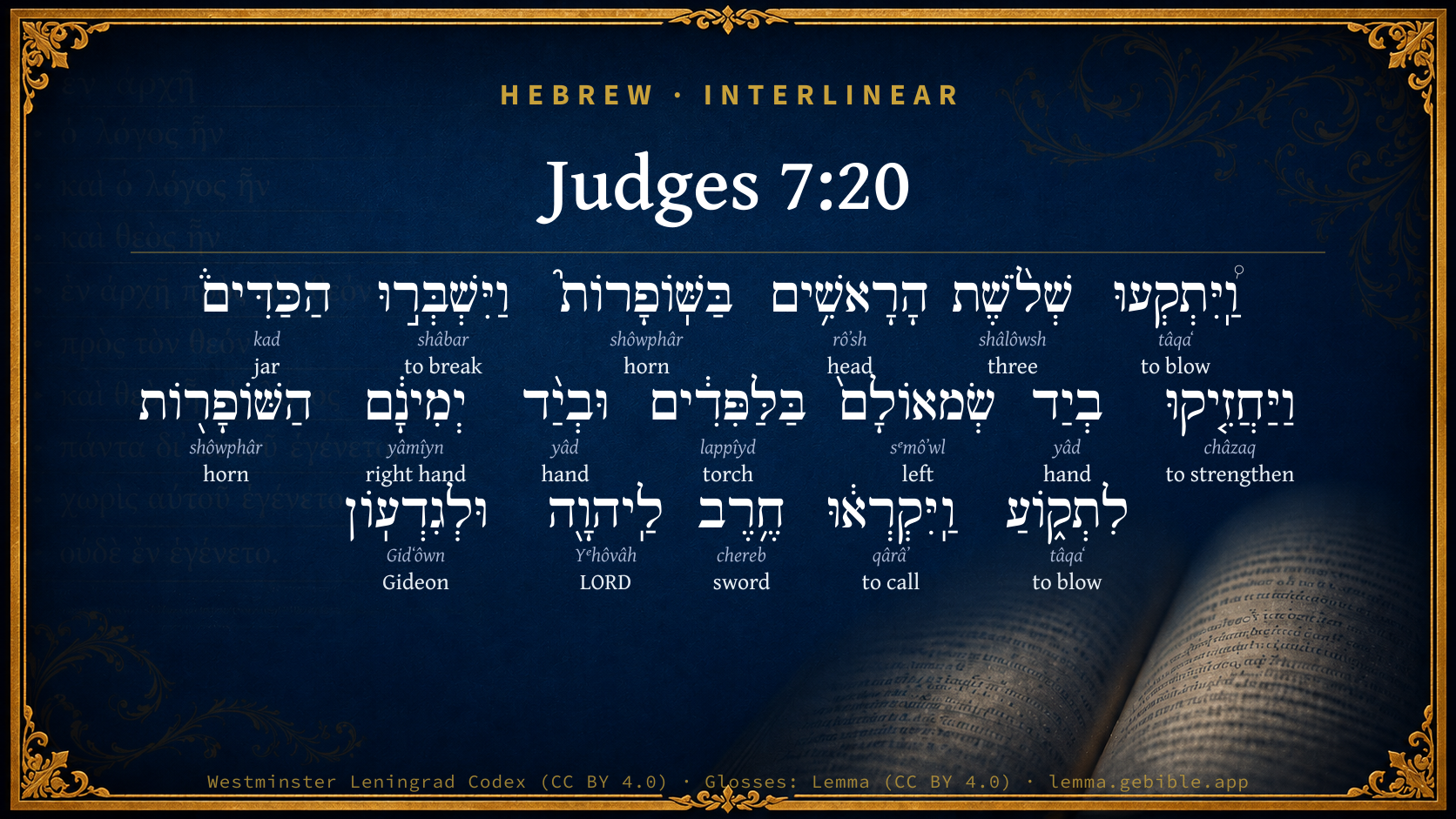
Judges 7:20

Hebrew (Westminster Leningrad Codex) Judges 7:20 appears in the Hebrew Old Testament. The text above is from the Westminster Leningrad Codex. Each word links to its Strong’s number, a concise gloss, and parsing drawn from the Open Scriptures Hebrew Bible morphology. Click any word for its full Brown-Driver-Briggs (BDB) entry.
Download image
Cite this verse

Judges 7:20 (World English Bible). Public Domain. Lemma interlinear Bible study tool, https://lemma.gebible.app/v/judges/7/20.

Show BibTeX & RIS
BibTeX
RIS
English Translation
The three companies blew the trumpets, and broke the pitchers, and held the torches in their left hands, and the trumpets in their right hands with which to blow; and they cried, The sword of Yahweh and of Gideon.
World English Bible · Public Domain
Download a study sheet

One document with this verse’s original text, its word-by-word gloss line, the meaning frame, cross-references with their text, attributed commentary, and full source and license credits — printable, and it pastes into notes with its structure intact.

This verse Autodidact and up

Study sheet (.html) Plain text (.txt)

A passage Seminary Student

Up to 50 verses in one chapter. A passage sheet keeps up to 6 commentary sources and 12 cross-references per verse, in the order this page ranks them, and says so on the sheet whenever that leaves anything out. Ask for a single verse and you get the Autodidact verse sheet above.

Everything on this page stays free to read, with no account — the sheet is a download of what is already on screen, not access to it.

Want to remove ads? Support Godless Engineer
Compare translations 3

The same verse in 3 English versions, stacked beneath the original-language interlinear above. Click any original word for its lexicon entry.

Each is an independent rendering of the whole verse — the interlinear is not word-aligned to these translations.

Highlighted words mark where these versions differ — a whole-verse word diff, not a word-by-word alignment.

  • World English Bible Public Domain
    The three companies blew the trumpets, and broke the pitchers, and held the torches in their left hands, and the trumpets in their right hands with which to blow; and they cried, The sword of Yahweh and of Gideon.
  • King James Version Public Domain
    And the three companies blew the trumpets, and brake the pitchers, and held the lamps in their left hands, and the trumpets in their right hands to blow withal: and they cried, The sword of the LORD, and of Gideon.
  • unfoldingWord Literal Text CC BY-SA 4.0
    Then the three companies blew on the shofars and broke the jars. And they held the torches in their left hand and the shofars in their right hand to blow. And they called out, “A sword for Yahweh and for Gideon.”

unfoldingWord Literal Text — © unfoldingWord, licensed CC BY-SA 4.0. Word-aligned USFM3 via Door43 (git.door43.org/unfoldingWord/en_ult).

Versions to compare (up to 4)

3 of 4 selected

Show all 18 translations

Every available English version of this verse, each an independent rendering of the whole verse.

  • World English Bible Public Domain
    The three companies blew the trumpets, and broke the pitchers, and held the torches in their left hands, and the trumpets in their right hands with which to blow; and they cried, The sword of Yahweh and of Gideon.
  • Berean Standard Bible Public Domain
    The three companies blew their horns and shattered their jars. Holding the torches in their left hands and the horns in their right hands, they shouted, “A sword for the LORD and for Gideon!”
  • Majority Standard Bible Public Domain
    The three companies blew their horns and shattered their jars. Holding the torches in their left hands and the horns in their right hands, they shouted, “A sword for the LORD and for Gideon!”
  • King James Version Public Domain
    And the three companies blew the trumpets, and brake the pitchers, and held the lamps in their left hands, and the trumpets in their right hands to blow withal: and they cried, The sword of the LORD, and of Gideon.
  • American Standard Version (1901) Public Domain
    And the three companies blew the trumpets, and brake the pitchers, and held the torches in their left hands, and the trumpets in their right hands wherewith to blow; and they cried, The sword of Jehovah and of Gideon.
  • Revised Version (1885) Public Domain
    And the three companies blew the trumpets, and brake the pitchers, and held the torches in their left hands, and the trumpets in their right hands to blow withal: and they cried, The sword of the LORD and of Gideon.
  • Geneva Bible (1599) Public Domain
    And the three companies blew with trumpets and brake the pitchers, and helde the lampes in their left hands, and the trumpets in their right. handes to blowe withall: and they cryed, The sword of the Lord and of Gideon.
  • Douay-Rheims (1899) Public Domain
    And when they sounded their trumpets in three places round about the camp, and had broken their pitchers, they held their lamps in their left hands, and with their right hands the trumpets which they blew, and they cried out: The sword of the Lord and of Gedeon;
  • Young's Literal Translation Public Domain
    and the three detachments blow with trumpets, and break the pitchers, and keep hold with their left hand on the lamps, and with their right hand on the trumpets to blow, and they cry, `The sword of Jehovah and of Gideon.'
  • Literal Standard Version CC BY-SA 4.0
    and the three detachments blow with horns, and break the pitchers, and keep hold with their left hand on the lamps, and with their right hand on the horns to blow, and they cry, “The sword of YHWH and of Gideon!”
  • Unlocked Literal Bible CC BY-SA 4.0
    The three companies blew the trumpets and broke the jars. They held the torches in their left hands and the trumpets in their right hands to blow them. They shouted out, “The sword of Yahweh and of Gideon.”
  • unfoldingWord Literal Text CC BY-SA 4.0
    Then the three companies blew on the shofars and broke the jars. And they held the torches in their left hand and the shofars in their right hand to blow. And they called out, “A sword for Yahweh and for Gideon.”
  • Darby Bible Public Domain
    And the three companies blew the trumpets and broke the jars, holding in their left hands the torches, and in their right hands the trumpets to blow; and they cried, "A sword for the LORD and for Gideon!"
  • World Messianic Bible Public Domain
    The three companies blew the shofars, broke the pitchers, and held the torches in their left hands and the shofars in their right hands with which to blow; and they shouted, “The sword of the LORD and of Gideon!”
  • Webster's Bible Public Domain
    And the three companies blew the trumpets, and broke the pitchers, and held the lamps in their left hands, and the trumpets in their right hands to blow with: and they cried, The sword of the LORD, and of Gideon.
  • Free Bible Version CC BY-SA 4.0
    All three companies blew their trumpets and smashed their jars. They held the torches in their left hands and the trumpets in their right hands, and they shouted, “A sword for the Lord and for Gideon!”
  • Bible in Basic English Public Domain
    So the three bands all gave a loud note on their horns, and when the vessels had been broken, they took the flaming branches in their left hands, and the horns in their right hands ready for blowing, crying out, For the Lord and for Gideon.
  • JPS Tanakh (1917) Public Domain
    And the three companies blew the horns, and broke the pitchers, and held the torches in their left hands, and the horns in their right hands wherewith to blow; and they cried: 'The sword for the LORD and for Gideon!'

Literal Standard Version (2020), Covenant Press — licensed CC BY-SA 4.0. Text via the HelloAO Bible API (eBible.org). Unlocked Literal Bible (unfoldingWord) — licensed CC BY-SA 4.0. Text via the HelloAO Bible API (eBible.org). unfoldingWord Literal Text — © unfoldingWord, licensed CC BY-SA 4.0. Word-aligned USFM3 via Door43 (git.door43.org/unfoldingWord/en_ult). Free Bible Version, Dr. Jonathan Gallagher — licensed CC BY-SA 4.0. Text via the HelloAO Bible API (eBible.org).

Word by word

More ways to search: Search by grammar → Find every occurrence → Compare this word →

Practice this passage: Drill this verse → Learn its vocabulary →

בַּלַּפִּדִ֔ים
lappîyd
H3940
“in/at the · torches”
Preposition, Determined + Noun, Common, Masculine, Plural, Absolute
Part of Speech
Preposition + Noun
Type
Common
Gender
Masculine
Number
Plural
State
Absolute
Full BDB Definition

Origin: from an unused root probably meaning to shine

TWOT: 1122a

torch
  1. וַֽ֠יִּתְקְעוּ tâqaʻ H8628 “and · to blow” Conjunction + Verb, Qal, Sequential Imperfect, 3rd Person, Masculine, Plural
  2. שְׁלֹ֨שֶׁת shâlôwsh H7969 “three” Adjective, Cardinal number, Masculine, Singular, Construct
  3. הָרָאשִׁ֥ים rôʼsh H7218 “the · heads” Particle, Definite Article + Noun, Common, Masculine, Plural, Absolute
  4. בַּשּֽׁוֹפָרוֹת֮ shôwphâr H7782 “in/at the · horns” Preposition, Determined + Noun, Common, Masculine, Plural, Absolute
  5. וַיִּשְׁבְּר֣וּ shâbar H7665 “and · to break” Conjunction + Verb, Qal, Sequential Imperfect, 3rd Person, Masculine, Plural
  6. הַכַּדִּים֒ kad H3537 “the · jars” Particle, Definite Article + Noun, Common, Feminine, Plural, Absolute
  7. וַיַּחֲזִ֤יקוּ châzaq H2388 “and · to strengthen” Conjunction + Verb, Hiphil, Sequential Imperfect, 3rd Person, Masculine, Plural
  8. בְיַד yâd H3027 “in/at · hand of” Preposition + Noun, Common, Both, Singular, Construct
  9. שְׂמאוֹלָם֙ sᵉmôʼwl H8040 “left · their” Noun, Common, Masculine, Singular, Construct + Suffix, Personal, 3rd Person, Masculine, Plural
  10. וּבְיַ֨ד yâd H3027 “and · in/at · hand of” Conjunction + Preposition + Noun, Common, Both, Singular, Construct
  11. יְמִינָ֔ם yâmîyn H3225 “right hand · their” Noun, Common, Feminine, Singular, Construct + Suffix, Personal, 3rd Person, Masculine, Plural
  12. הַשּׁוֹפָר֖וֹת shôwphâr H7782 “the · horns” Particle, Definite Article + Noun, Common, Masculine, Plural, Absolute
  13. לִתְק֑וֹעַ tâqaʻ H8628 “to blow” Preposition + Verb, Qal, Infinitive Construct
  14. וַֽיִּקְרְא֔וּ qârâʼ H7121 “and · to call” Conjunction + Verb, Qal, Sequential Imperfect, 3rd Person, Masculine, Plural
  15. חֶ֥רֶב chereb H2719 “sword” Noun, Common, Feminine, Singular, Absolute
  16. לַֽיהוָ֖ה Yᵉhôvâh H3068 “to/for · LORD” Preposition + Noun, Proper
  17. וּלְגִדְעֽוֹן Gidʻôwn H1439 “and · to/for · Gideon” Conjunction + Preposition + Noun, Proper

About this verse

These counts appear in no published source. They are computed here, from the morphology-tagged text and Lemma’s own curated glosses. What Lemma adds →

18
words
15
distinct lemmas
Historical
section

Notable vocabulary

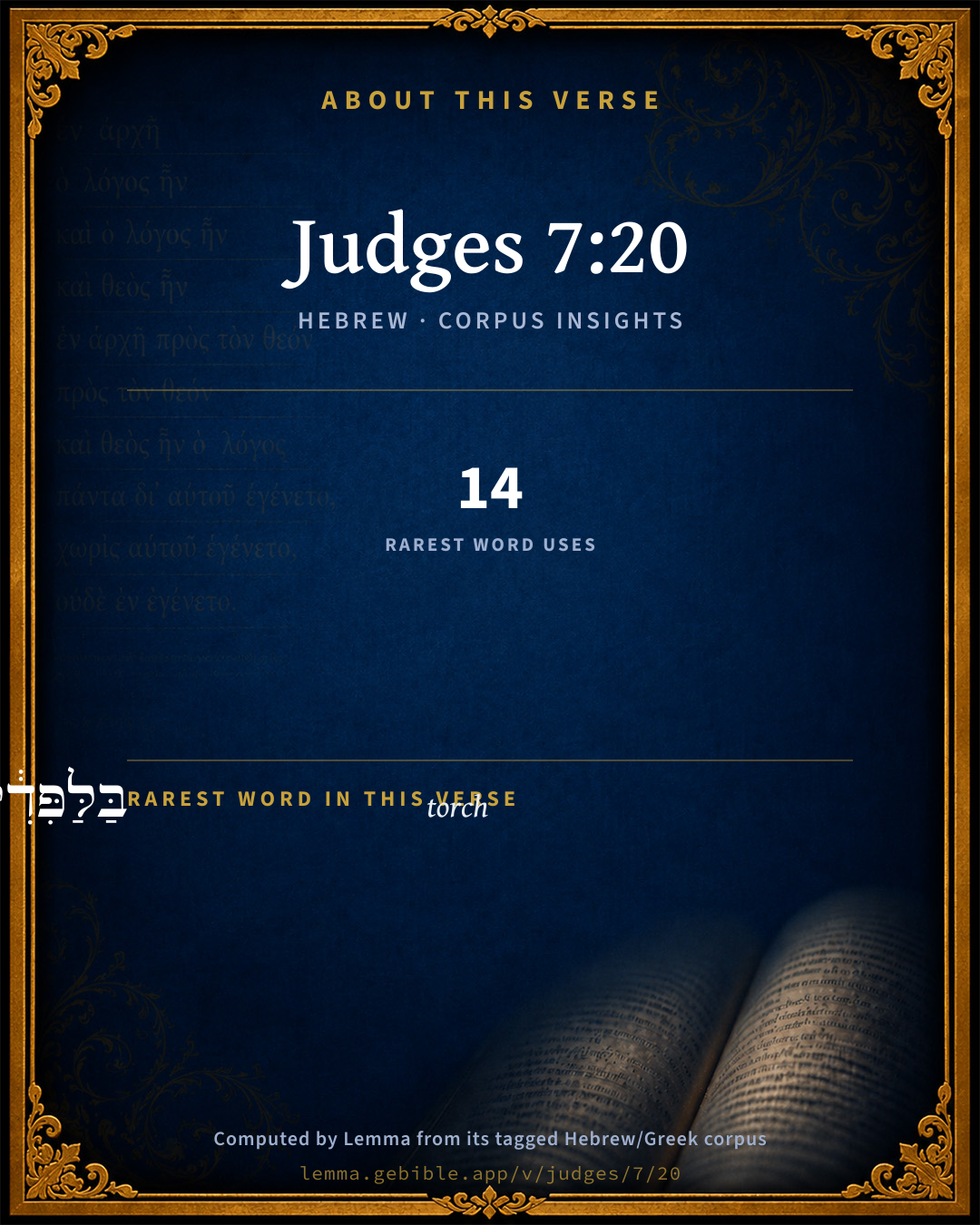
The rarest word here is בַּלַּפִּדִ֔ים torch H3940 — appearing just 14 times in the whole Hebrew Bible.

Shared distinctive vocabulary

בַּלַּפִּדִ֔ים torch H3940 occurs in 13 verses of the Hebrew Bible. Also found in:

Grammatical profile

  • 5 verbs
  • 12 nouns
  • 1 adjective

Verb forms

  • וַֽ֠יִּתְקְעוּ Qal · Sequential Imperfect
  • וַיִּשְׁבְּר֣וּ Qal · Sequential Imperfect
  • וַיַּחֲזִ֤יקוּ Hiphil · Sequential Imperfect
  • לִתְק֑וֹעַ Qal · Infinitive Construct
  • וַֽיִּקְרְא֔וּ Qal · Sequential Imperfect

Repetition

Words recur within this verse — often emphatic in Hebrew:

  • וַֽ֠יִּתְקְעוּ to blow H8628 ×2
  • בַּשּֽׁוֹפָרוֹת֮ horn H7782 ×2
  • בְיַד hand H3027 ×2

Hebrew & Septuagint length

In English translation the verse runs 39 words from the Hebrew and 42 from the Septuagint (LXX English) — closely comparable.

A rough comparison of the two English renderings, which tokenize alike — not a word-level alignment.

Word counts can differ between the Hebrew and the Greek without any difference in meaning — e.g. the Hebrew direct-object marker אֵת has no separate Greek word, and Greek often adds the article ὁ.

Cross-references

9

Topical passages linked to Judges 7:20 in the Treasury of Scripture Knowledge — connected by theme and wording, ordered by reader-vote popularity; previews shown in the World English Bible.

  • Joshua 6:16 It happened at the seventh time, when the priests blew the trumpets, Joshua said to the people, Shout; for Yahweh has given you the city.
  • Isaiah 27:13 It shall happen in that day, that a great trumpet shall be blown; and they shall come who were ready to perish in the land of Assyria, and those who were outcasts in the land of Egypt; and they shall worship Yahweh in the holy mountain at Jerusalem.
  • 1 Corinthians 15:52 in a moment, in the twinkling of an eye, at the last trumpet. For the trumpet will sound, and the dead will be raised incorruptible, and we will be changed.
  • Joshua 6:20 So the people shouted, and [the priests] blew the trumpets; and it happened, when the people heard the sound of the trumpet, that the people shouted with a great shout, and the wall fell down flat, so that the people went up into the city, every man straight before him, and they took the city.
  • 2 Corinthians 4:7 But we have this treasure in clay vessels, that the exceeding greatness of the power may be of God, and not from ourselves.
  • Numbers 10:1–10 Yahweh spoke to Moses, saying,
  • Joshua 6:4 Seven priests shall bear seven trumpets of rams' horns before the ark: and the seventh day you shall compass the city seven times, and the priests shall blow the trumpets.
  • 1 Thessalonians 4:16 For the Lord himself will descend from heaven with a shout, with the voice of the archangel, and with God's trumpet. The dead in Christ will rise first,
  • Hebrews 11:4 By faith, Abel offered to God a more excellent sacrifice than Cain, through which he had testimony given to him that he was righteous, God bearing witness with respect to his gifts; and through it he, being dead, still speaks.

Cross-references courtesy of OpenBible.info (CC BY 4.0).

Hebrew and Greek witnesses Masoretic Hebrew ↔ Greek Septuagint

The same verse in the two great witnesses to the Old Testament, shown verse-for-verse.

These are two independent witnesses, not word-aligned to each other, and the Septuagint is shown in lemma (dictionary) form.

Hebrew Judges 7:20 Masoretic · Westminster Leningrad Codex

וַֽ֠יִּתְקְעוּ שְׁלֹ֨שֶׁת הָרָאשִׁ֥ים בַּשּֽׁוֹפָרוֹת֮ וַיִּשְׁבְּר֣וּ הַכַּדִּים֒ וַיַּחֲזִ֤יקוּ בְיַד שְׂמאוֹלָם֙ בַּלַּפִּדִ֔ים וּבְיַ֨ד יְמִינָ֔ם הַשּׁוֹפָר֖וֹת לִתְק֑וֹעַ וַֽיִּקְרְא֔וּ חֶ֥רֶב לַֽיהוָ֖ה וּלְגִדְעֽוֹן

The three companies blew the trumpets, and broke the pitchers, and held the torches in their left hands, and the trumpets in their right hands with which to blow; and they cried, The sword of Yahweh and of Gideon.

World English Bible · Public Domain

Greek LXX Judges 7:20 Septuagint · lemma form

καί σαλπίζω ὁ τρεῖς ἀρχή ἐν ὁ κερατίνη καί συντρίβω ὁ ὑδρία καί κρατέω ἐν χείρ ἀριστερός αὐτός ὁ λαμπάς καί ἐν χείρ δεξιός αὐτός ὁ κερατίνη ὁ σαλπίζω καί ἀνακράζω ῥομφαία ὁ κύριος καί ὁ γεδεων

and the three companies sounded with the horns, and broke the pitchers, and held the torches in their left hands, and in their right hands their horns to sound with; and they cried out, A sword for the Lord and for Gedeon.

LXX2012 (modern English Septuagint) · Public Domain

Hebrew: Westminster Leningrad Codex (CC BY 4.0). Greek: Septuagint (public domain); English from LXX2012 (modern English Septuagint) (Public Domain). How the Septuagint differs from the Hebrew →

Targum (Aramaic paraphrase)

1

The Targum is the ancient Jewish Aramaic paraphrase of the Hebrew Scriptures — an interpretive translation, not the Hebrew text itself. Onkelos (literal) and Pseudo-Jonathan (expansive) render the Torah, and Jonathan the Prophets. Coverage is partial: where no permissively-licensed English translation exists for a verse, only the Aramaic is shown. This is verse-level text, not a word-by-word alignment to the Hebrew.

  1. Targum Jonathan Prophets (Joshua–Malachi)
    וּתְקָעוּ תְּלַת מַשִׁרְיָן בְּשׁוֹפָרַיָא וְתַבָּרוּ כַדַיָא וְאַתְקִיפוּ בְּיַד סְמָלְהוֹן בִּבְעוּרַיָא וּבְיַד יְמִינְהוֹן בְּשׁוֹפָרַיָא לְמִתְקַע וַאֲמַרוּ חַרְבָּא מִן קֳדָם יְיָ וְנַצְחָנָא עַל יְדֵי גִדְעוֹן:

    (no public-domain English translation for this verse)

    Targum Jonathan — Aramaic: “Mikraot Gedolot” (public domain). English: “Sefaria Community Translation” (CC0 1.0 (public-domain dedication)); “London "Chaldee Paraphrase," 1871” (public domain). Text via Sefaria.

Commentary

Notes on Judges 7:20 from classic Christian and Jewish commentators (each source and its license shown beneath its notes). The classic Christian expositions comment on the surrounding passage and are grouped to its opening verse, so a note may address several verses; the Jewish commentaries on the Tanakh (Rashi and others) are per-verse, so they appear only where the commentator wrote on this verse.

Lemma curates 59 commentaries, every one of them public domain or Creative Commons licensed, each selected and text-cleaned for this edition rather than reprinted as found. About our sources →

The Cambridge Bible for Schools and Colleges

gen. ed. J. J. S. Perowne

20. Gideon’s company having given the signal (Jdg_7:19), the two others reply, and all three together (Jdg_7:20) carry out the preconcerted plan.

The sentence ‘and the trumpets in their right hands to blow withal’ seems to be, either in whole or in part, an addition, possibly from the ‘trumpet-story’; but the original form of the verse is past recovery.

The sword etc.] A sword for Jehovah and Gideon! The battle-cry as agreed was simply ‘For Jehovah and Gideon,’ Jdg_7:18; a sword has been added.

The Cambridge Bible for Schools and Colleges (gen. ed. J. J. S. Perowne; Cambridge University Press, 1878–1918) — public domain. Text from a community e-Sword module.

Trapp's Complete Commentary

John Trapp

Jdg 7:20 And the three companies blew the trumpets, and brake the pitchers, and held the lamps in their left hands, and the trumpets in their right hands to blow [withal]: and they cried, The sword of the LORD, and of Gideon.

Ver. 20. Blew the trumpets, and brake the pitchers.] By the sound of trumpets and shining of lamps out of earthen broken vessels, Gideon overcame his enemies: so Christ, by the trumpet of his word, and light of the gospel, carried through the world by weak instruments, hath confounded his enemies. {1Jn 2:14}

The sword of the Lord, and of Gideon.] Under the conduct of Germanus here in Britain, who came over from France to subdue the Pelagian heresy, which then prevailed amongst us, against a mighty army of Saxons and Picts, the Britains prevailed only by the three times pronouncing the word Hallelujah: which voice echoing and redoubling from the acclamation of his followers among the mountains, nigh to which the enemy had encamped, frightened them, and won the conquest: upon which it was called Victoria Halleluiatica. {a}

{a} Arch. Ussher., De Britan. Eccles. Primord.

John Trapp, A Commentary or Exposition upon All the Books of the Old and New Testament (1647–1656) — public domain. Text from a community e-Sword module.

Geneva Bible (1599)

Geneva Bible translators

Shall destroy the enemies.

Geneva Bible (1599) marginal notes — public domain. Text via Bolls.life.

Adam Clarke's Commentary

Verse 20. Blew the trumpets, and brake the pitchers] How astonishing must the effect be, in a dark night, of the sudden glare of three hundred torches, darting their splendour, in the same instant, on the half-awakened eyes of the terrified Midianites, accompanied with the clangour of three hundred trumpets, alternately mingled with the thundering shout of חרב ליהוה ולגדעון chereb layhovah ulegidon, "A sword for the Lord and for Gideon!"

Origen, in his ninth homily on this book, makes these three hundred men types of the preachers of the Gospel; their trumpets of the preaching of Christ crucified; and their lights or torches, of the holy conduct of righteous men. In some verses of an ancient author, attributed to Tertullian, and written against the heretic Marcion, Gideon's three hundred men are represented as horsemen; and in this number he finds the mystery of the cross; because the Greek letter T, tau which is the numeral for 300, is itself the sign of the cross. The verses, which may be found in vol. v. of the Pisaurian Collection of the Latin heathen and Christian poets, Advers, Marcion., lib. 3, ver. 18, as being very curious, and not often to be met with, I shall here subjoin: -

Ex quibus ut Gideon dux agminis, acer in hostem,

Non virtute sua tutelam acquirere genti,

Firmatusque fide signum petit excita menti,

Quo vel non posset, vel posset vincere bellum,

Vellus ut in noctem positum de rore maderet,

Et tellus omnis circum siccata jaceret,

Hoc inimicorum palmam coalescere mundo;

Atque iterum solo remanenti vellere sicco,

Hoc eadem tellus roraret nocte liquore,

Hoc etenim signo praedonum stravit acervos.

Congressus populo Christi, sine milite multo:

Tercenteno equite (numerus Tau littera Graeca)

Armatis facibusque et cornibus ore canentum.

Vellus erat populus ovium de semine sancto.

Nam tellus variae gentes fusaeque per orbem,

Verbum quod nutrit, sed nox est mortis imago.

Tau signum crucis et cornu praeconia vitae,

Lucentesque faces in lychno spiritus ardens.

"Gideon, keen in arms, was captain of the host,

And acquired redemption for his people, but not by his own

power.

Being strengthened in faith, his heart was influenced to ask a

sign

By which he might know whether or not he should be successful

in battle.

A fleece was so placed by night, that it might be wet with dew;

And all the surrounding earth remain dry.

By this he was to learn that he should gain the victory over

his enemies.

The sign was reversed; the fleece remaining dry while all the

ground was moist;

And by this sign he was to know that he should slaughter those

troops of robbers.

The people of Christ conquer without any military force;

Three hundred horsemen, (for the Greek letter T, tau, is the

emblem of the number,)

Armed with torches, and blowing with trumpets.

The fleece of the sheep are the people sprung from the Messiah,

And the earth are the various nations dispersed over the world.

It is the word which nourishes; but might is the image of

death.

Tau is the sign of the cross; and the trumpets, the emblems of

the heralds of life;

And the burning torches in the pitchers, the emblems of the Holy

Spirit."

We see here what abstruse meanings a strong imagination, assisted by a little piety, may extract from what was never intended to be understood as a mystery.

Adam Clarke's Commentary on the Bible (1810–1826) — public domain. Text from a community e-Sword/MySword module.

Ellicott's Commentary for English Readers

(20) The trumpets in their right hands . . .—Thus they were comparatively defenceless, though, if they had any armour at all, doubtless they could still hold the shield on the left arm, while the sword was girded on the thigh. The effect of the sudden crash and glare and shout upon the vast unwieldy host of the Bedouins may be imagined. Startled from sleep in a camp which, like Oriental camps, must have been most imperfectly protected and disciplined, they would see on every side blazing torches, and hear on every side the rams’ horns and the terrible shout of the Israelites. (Comp. Tac. Ann. i. 68.) The instant result was a wild panic, such as that which seized the camp of the Persians at Platæe. The first thought which would rise in their minds would be that there was some treachery at work among the motley elements of the camp itself. Even a well-disciplined camp is liable to these outbursts of panic. One such occurred among the Greeks in the camp of the Ten Thousand during their retreat. To shame these groundless alarms, Klearchus next morning caused a reward to be proclaimed for any one who would give information “who had let the ass loose;” and this seems to have been a standing joke to shame Greek soldiers from such panics (Xen. Anab. ii. 2, 20). Several stratagems similar to that of Gideon are recorded in history. Polyænus, in his book on the “Art of War,” tells us that Diœtas, when attacking Heræa, “ordered the trumpeters to stand apart, and sound a charge opposite to many quarters of the city; and that the Heræans, hearing the blasts of many trumpets from many directions, thinking that the whole region was crowded with enemies, abandoned the city.” Frontinus also tells us that the Tarquinians and Faliscans tried to frighten the Romans with torches, and Minucius Rufus terrified the Scordisci by trumpets blown among the rocks (Strateg. ii. 3). Hannibal on one occasion escaped from Fabius Maximus by tying torches to the heads of cattle, and having them driven about the hills. The Druids waved torches to repel the attack of Suetonius Paulinus on the island of Mona (Tac. Ann. xiv. 30). An Arab chief (Bel-Arab) in the eighteenth century used trumpets in exactly the same manner as Gideon did on this occasion, and with the same success (Niebuhr, Beschr. von Arabien, p. 304). Ewald alludes to similar stratagems in Neapolitan and Hungarian wars, the latter so recently as 1849 (Gesch. ii. 503).

A Bible Commentary for English Readers, edited by Charles John Ellicott (1878–1897) — public domain. Text from a community e-Sword module.

John Gill's Exposition

And the three companies blew the trumpets, and brake the pitchers,.... The other two, observing what Gideon and his company did, followed their example, and at the same time blew their trumpets, and broke their pitchers; for that there were four companies, three besides Gideon's, as Kimchi and Ben Melech suggest, there is no reason to believe:

and held the lamps in their left hands; which they took out of the pitchers when they broke them, and holding them up in their left hands, gave a great blaze of light, which must be very surprising to the host of Midian, just awaked out of their sleep:

and the trumpets in their right hands to blow withal; and which they continued blowing, the sound of which must be very dreadful, since it might be concluded, from such a number of trumpets, that there must be a vast army:

and they cried, the sword of the Lord and of Gideon; signifying that was drawn against the Midianites, and they must expect to be cut in pieces by it, since the sword was Jehovah's, sent and commissioned by him, and was put into the hand of Gideon as an instrument, with which execution would be done, the Lord helping him. The Targum is,"the sword of the Lord, and victory by the hand of Gideon''which victory was to be ascribed to the sword and power of God. This was an emblem of the efficacy of the word of God, accompanied with his power, to the destruction of the kingdom of Satan; the blowing of the trumpets may denote the ministration of the Gospel, the great trumpet to be blown by the apostles and ministers of the word; the holding forth the lamps may signify the same, the light of the divine word in the ministers of it, and the holding forth of it to others; and which is carried in earthen vessels, frail mortal men; and done that the excellency of the power may appear to be of God, and not of men; and the sword of the Lord is the word of God in the mouths of ministers, accompanied by the power of God; for it can only be through God that such weapons of warfare can become mighty to do the execution that is done by them; see Co2 4:7 blowing of trumpets, and then a cry or shout of the soldiers to terrify the enemy, were used in later times (k).

(k) "At tuba terribilem sonitum", &c. Virgil Aeneid. 9.

John Gill's Exposition of the Whole Bible (1746–1763) — public domain (CC PDM 1.0). Text via the HelloAO Bible API.

Matthew Poole's English Annotations

Held the lamps and the trumpets, that they might be thought to be a mighty host, having as many troops or companies as there were trumpets and lights.

Matthew Poole's English Annotations on the Holy Bible (1683–1685) — public domain. Text from a community e-Sword/MySword module.

Whedon's Commentary on the Bible

Daniel D. Whedon

20. Sword of the Lord — In Jdg_7:18 the word sword is supplied from this passage. The battle cry as there given is, literally, For Jehovah and for Gideon. This cry, ringing out from the three companies on different sides of the camp, together with the sound of the trumpets and the crashing of the pitchers, and the sudden glare of three hundred torches in the midnight darkness, might well bewilder and confound an army just waking out of sleep.

Daniel D. Whedon (gen. ed.), Commentary on the Old and New Testaments (1874–1909) — public domain. Text from a community e-Sword module.

Keil & Delitzsch

C. F. Keil & F. Delitzsch

According to the command which they had received (Jdg 7:17), the other two tribes followed his example. "Then the three companies blew the trumpets, broke the pitchers, and held the torches in their left hands, and the trumpets in their right to blow, and cried, Sword to the Lord and Gideon! And they stood every one his place round about the camp," sc., without moving, so that the Midianites necessarily thought that there must be a numerous army advancing behind the torch-bearers. וגו ויּרץ, "and the whole army ran," i.e., there began a running hither and thither in the camp of the enemy, who had been frightened out of their night's rest by the unexpected blast of the trumpets, the noise, and the war-cry of the Israelitish warriors; "and they (the enemy) lifted up a cry (of anguish and alarm), and caused to fly" (carried off), sc., their tents (i.e., their families) and their herds, or all their possessions (cf. Jdg 6:11; Exo 9:20). The Chethibh יניסוּ is the original reading, and the Keri ינוּסוּ a bad emendation.

Keil & Delitzsch — Biblical Commentary on the Old Testament (1861–1891) — public domain (CC PDM 1.0). Text via the HelloAO Bible API. (Old Testament only.)

unfoldingWord translationNotes

Door43 World Missions Community

The sword of Yahweh and of Gideon

Here "sword" refers to their fighting. AT: "We fight for Yahweh and for Gideon" (See: Metonymy)

translationWords

trumpet

sword

Yahweh

Gideon

Midian

run

unfoldingWord translationNotes — © Distant Shores Media and the Door43 World Missions Community, licensed CC BY-SA 4.0. Source: git.door43.org/Door43/en_tn.

Lesson kit

Teaching starters — assembled from the data on this page, not authored interpretation. Every prompt links to the verse data it draws on. Edit before teaching.

Judges, in the Historical, opens this verse with 18 words (15 distinct Hebrew lemmas). Its most distinctive word is lappîyd (“torch”). A historical commentator’s framing appears above. Read the whole chapter for the surrounding context.

Discussion questions

  1. What does “torch” (lappîyd) contribute to the verse as a whole?
  2. How does Genesis 15:17, which shares the word «torch», read alongside this verse?
  3. What does the repetition of “to blow” (2× in this one verse) do in this verse?
  4. These translations render this verse differently; the difference is in the English rendering, not the original. What questions does that raise?
  5. «וַֽ֠יִּתְקְעוּ» is a Qal Sequential Imperfect verb. How does that grammatical form shape the action described?
  6. Compare how The Cambridge Bible for Schools and Colleges and Trapp's Complete Commentary read this verse. Where do they agree or differ?

Things to notice

Reading settings

Reading text

Shown beneath each verse's original-language words.

Old Testament
Old Testament edition

Read the OT as the Masoretic Hebrew (MT) or the Greek Septuagint (LXX).

English shown for the Greek Septuagint (in the Hebrew ↔ Greek comparison).

Comparing translations? Open the Compare panel on any verse page to stack up to four side by side.