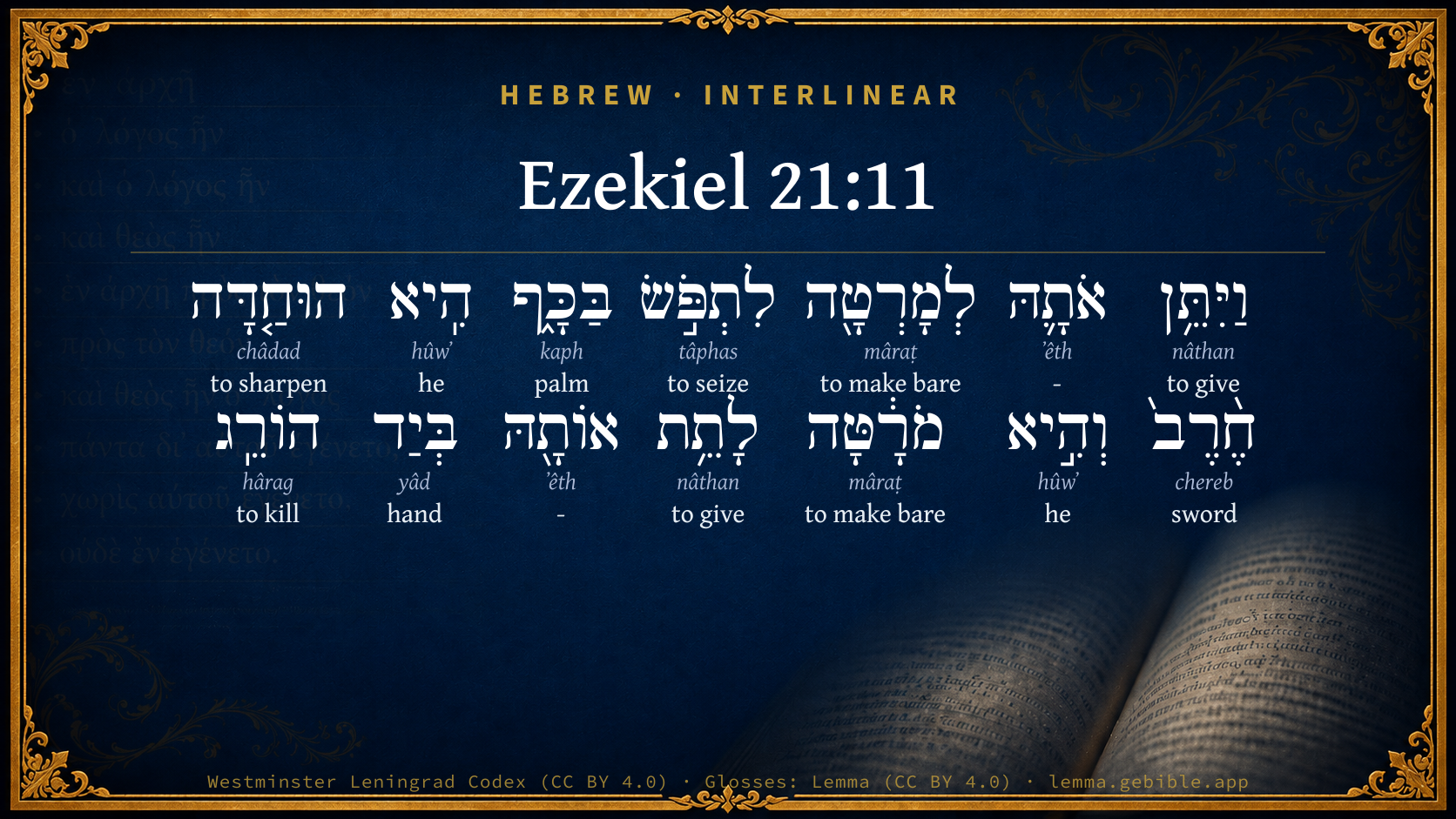
Ezekiel 21:11

Hebrew (Westminster Leningrad Codex) Ezekiel 21:11 appears in the Hebrew Old Testament. The text above is from the Westminster Leningrad Codex. Each word links to its Strong’s number, a concise gloss, and parsing drawn from the Open Scriptures Hebrew Bible morphology. Click any word for its full Brown-Driver-Briggs (BDB) entry.
Download image
Cite this verse

Ezekiel 21:11 (World English Bible). Public Domain. Lemma interlinear Bible study tool, https://lemma.gebible.app/v/ezekiel/21/11.

Show BibTeX & RIS
BibTeX
RIS
English Translation
It is given to be furbished, that it may be handled: the sword, it is sharpened, yes, it is furbished, to give it into the hand of the killer.
World English Bible · Public Domain
Download a study sheet

One document with this verse’s original text, its word-by-word gloss line, the meaning frame, cross-references with their text, attributed commentary, and full source and license credits — printable, and it pastes into notes with its structure intact.

This verse Autodidact and up

Study sheet (.html) Plain text (.txt)

A passage Seminary Student

Up to 50 verses in one chapter. A passage sheet keeps up to 6 commentary sources and 12 cross-references per verse, in the order this page ranks them, and says so on the sheet whenever that leaves anything out. Ask for a single verse and you get the Autodidact verse sheet above.

Everything on this page stays free to read, with no account — the sheet is a download of what is already on screen, not access to it.

Want to remove ads? Support Godless Engineer
Compare translations 3

The same verse in 3 English versions, stacked beneath the original-language interlinear above. Click any original word for its lexicon entry.

Each is an independent rendering of the whole verse — the interlinear is not word-aligned to these translations.

Highlighted words mark where these versions differ — a whole-verse word diff, not a word-by-word alignment.

  • World English Bible Public Domain
    It is given to be furbished, that it may be handled: the sword, it is sharpened, yes, it is furbished, to give it into the hand of the killer.
  • King James Version Public Domain
    And he hath given it to be furbished, that it may be handled: this sword is sharpened, and it is furbished, to give it into the hand of the slayer.
  • unfoldingWord Literal Text CC BY-SA 4.0
    So the sword will be given to be polished, and then to be grasped by the hand! The sword is sharpened and it is polished and it is to be given into the hand of the one who kills!”’”

unfoldingWord Literal Text — © unfoldingWord, licensed CC BY-SA 4.0. Word-aligned USFM3 via Door43 (git.door43.org/unfoldingWord/en_ult).

Versions to compare (up to 4)

3 of 4 selected

Show all 18 translations

Every available English version of this verse, each an independent rendering of the whole verse.

  • World English Bible Public Domain
    It is given to be furbished, that it may be handled: the sword, it is sharpened, yes, it is furbished, to give it into the hand of the killer.
  • Berean Standard Bible Public Domain
    The sword is appointed to be polished, to be grasped in the hand. It is sharpened and polished, to be placed in the hand of the slayer.
  • Majority Standard Bible Public Domain
    The sword is appointed to be polished, to be grasped in the hand. It is sharpened and polished, to be placed in the hand of the slayer.
  • King James Version Public Domain
    And he hath given it to be furbished, that it may be handled: this sword is sharpened, and it is furbished, to give it into the hand of the slayer.
  • American Standard Version (1901) Public Domain
    And it is given to be furbished, that it may be handled: the sword, it is sharpened, yea, it is furbished, to give it into the hand of the slayer.
  • Revised Version (1885) Public Domain
    And it is given to be furbished, that it may be handled: the sword, it is sharpened, yea, it is furbished, to give it into the hand of the slayer.
  • Geneva Bible (1599) Public Domain
    And he hath giuen it to be fourbished, that he may handle it: this sword is sharpe, and is fourbished, that he may giue it into ye hand of the slayer.
  • Douay-Rheims (1899) Public Domain
    And I have given it to be furbished, that it may be handled: this sword is sharpened, and it is furbished, that it may be in the hand of the slayer.
  • Young's Literal Translation Public Domain
    And he giveth it for polishing, For laying hold of by the hand. It is sharpened -- the sword -- and polished, To give it into the hand of a slayer.
  • Literal Standard Version CC BY-SA 4.0
    And He gives it for polishing, || For laying hold of by the hand. It is sharpened—the sword—and polished, || To give it into the hand of a slayer.
  • Unlocked Literal Bible CC BY-SA 4.0
    So the sword will be given to be polished, and then to be grasped by the hand! The sword is sharpened and it is polished and it is to be given into the hand of the one who kills!”'”
  • unfoldingWord Literal Text CC BY-SA 4.0
    So the sword will be given to be polished, and then to be grasped by the hand! The sword is sharpened and it is polished and it is to be given into the hand of the one who kills!”’”
  • Darby Bible Public Domain
    And he hath given it to be furbished that it may be handled. The sword, -- it is sharpened, and it is furbished to give it into the hand of the slayer.
  • World Messianic Bible Public Domain
    It is given to be polished, that it may be handled. The sword is sharpened. Yes, it is polished to give it into the hand of the killer.”’
  • Webster's Bible Public Domain
    And he hath given it to be furbished, that it may be handled: the sword is sharpened, and it is furbished, to give it into the hand of the slayer.
  • Free Bible Version CC BY-SA 4.0
    The sword is being polished right now, ready to be used. It's sharp and polished, ready to be handed over to the killer.
  • Bible in Basic English Public Domain
    And I have given it to the polisher so that it may be taken in the hand: he has made the sword sharp, he has had it polished, to put it into the hand of him who gives death.
  • JPS Tanakh (1917) Public Domain
    (21-16) And it is given to be furbished, that it may be handled; the sword, it is sharpened, yea, it is furbished, to give it into the hand of the slayer.

Literal Standard Version (2020), Covenant Press — licensed CC BY-SA 4.0. Text via the HelloAO Bible API (eBible.org). Unlocked Literal Bible (unfoldingWord) — licensed CC BY-SA 4.0. Text via the HelloAO Bible API (eBible.org). unfoldingWord Literal Text — © unfoldingWord, licensed CC BY-SA 4.0. Word-aligned USFM3 via Door43 (git.door43.org/unfoldingWord/en_ult). Free Bible Version, Dr. Jonathan Gallagher — licensed CC BY-SA 4.0. Text via the HelloAO Bible API (eBible.org).

Word by word

More ways to search: Search by grammar → Find every occurrence → Compare this word →

Practice this passage: Drill this verse → Learn its vocabulary →

הוּחַ֤דָּה
châdad
H2300
“to sharpen”
Verb, Hophal, Perfect, 3rd Person, Feminine, Singular
Part of Speech
Verb
Stem
Hophal
Form
Perfect
Person
3rd Person
Gender
Feminine
Number
Singular
Full BDB Definition

Origin: a primitive root

TWOT: 605

to be sharp, be alert, be keen - (Qal) to be sharp, be keen - (Hiphil) to sharpen - (Hophal) to be sharpened
  1. וַיִּתֵּ֥ן nâthan H5414 “and · to give” Conjunction + Verb, Qal, Sequential Imperfect, 3rd Person, Masculine, Singular
  2. אֹתָ֛הּ ʼêth H853 “- · her” Particle, Direct Object + Suffix, Personal, 3rd Person, Feminine, Singular
  3. לְמָרְטָ֖ה mâraṭ H4803 “to make bare” Preposition + Verb, Qal, Infinitive Construct
  4. לִתְפֹּ֣שׂ tâphas H8610 “to seize” Preposition + Verb, Qal, Infinitive Construct
  5. בַּכָּ֑ף kaph H3709 “in/at the · palm” Preposition, Determined + Noun, Common, Feminine, Singular, Absolute
  6. הִֽיא hûwʼ H1931 “he” Pronoun, Personal, 3rd Person, Feminine, Singular
  7. חֶ֨רֶב֙ chereb H2719 “sword” Noun, Common, Feminine, Singular, Absolute
  8. וְהִ֣יא hûwʼ H1931 “and · he” Conjunction + Pronoun, Personal, 3rd Person, Feminine, Singular
  9. מֹרָ֔טָּה mâraṭ H4803 “to make bare” Verb, Pual, Perfect, 3rd Person, Feminine, Singular
  10. לָתֵ֥ת nâthan H5414 “to give” Preposition + Verb, Qal, Infinitive Construct
  11. אוֹתָ֖הּ ʼêth H853 “- · her” Particle, Direct Object + Suffix, Personal, 3rd Person, Feminine, Singular
  12. בְּיַד yâd H3027 “in/at · hand of” Preposition + Noun, Common, Both, Singular, Construct
  13. הוֹרֵֽג hârag H2026 “killing” Verb, Qal, Participle Active, Masculine, Singular, Absolute

About this verse

These counts appear in no published source. They are computed here, from the morphology-tagged text and Lemma’s own curated glosses. What Lemma adds →

14
words
10
distinct lemmas
Prophets
section

Notable vocabulary

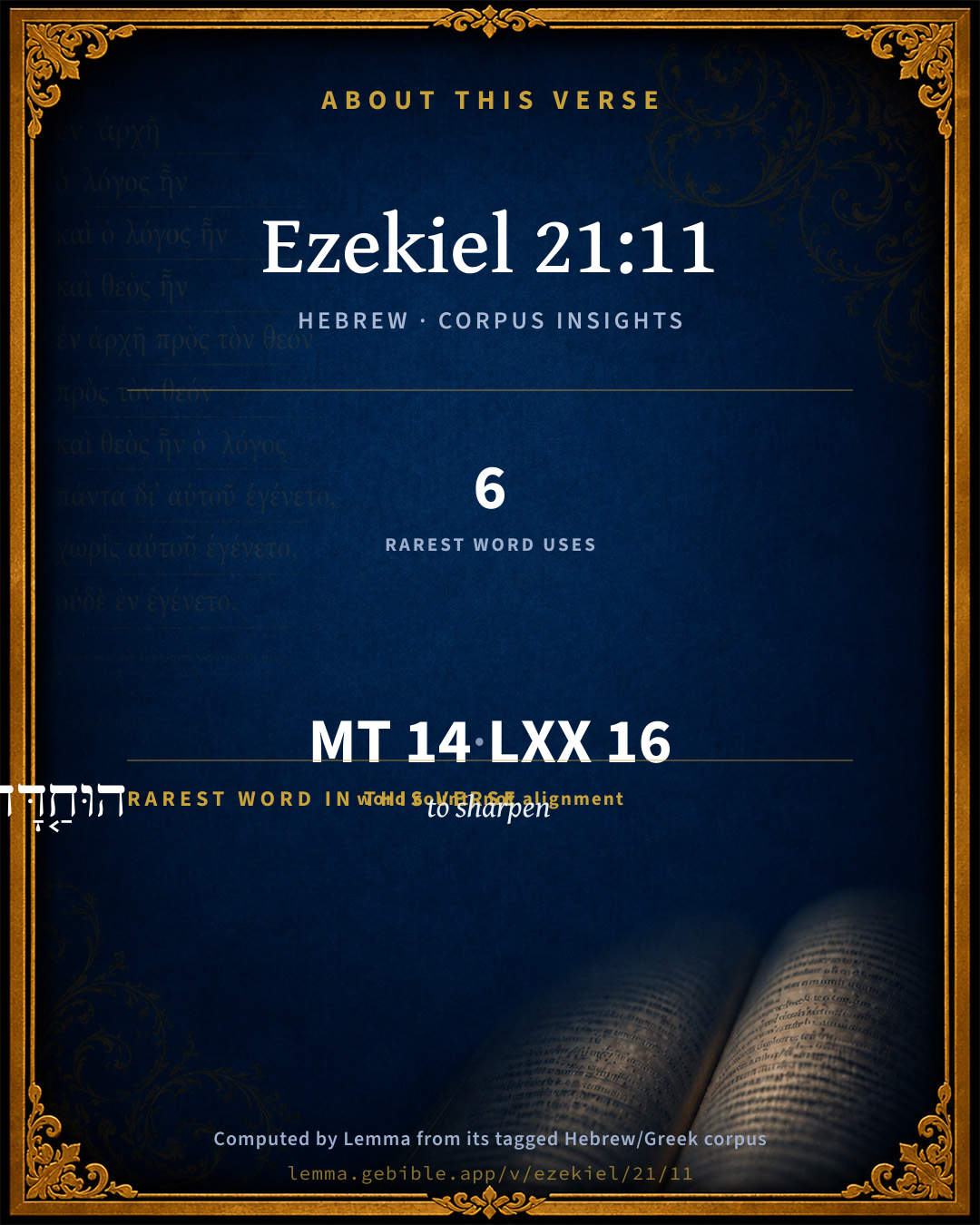
The rarest word here is הוּחַ֤דָּה to sharpen H2300 — appearing just 6 times in the whole Hebrew Bible.

Shared distinctive vocabulary

הוּחַ֤דָּה to sharpen H2300 occurs in 5 verses of the Hebrew Bible. Also found in:

Grammatical profile

  • 7 verbs
  • 3 nouns
  • 2 pronouns
  • 2 particles

Verb forms

  • וַיִּתֵּ֥ן Qal · Sequential Imperfect
  • לְמָרְטָ֖ה Qal · Infinitive Construct
  • לִתְפֹּ֣שׂ Qal · Infinitive Construct
  • הוּחַ֤דָּה Hophal · Perfect
  • מֹרָ֔טָּה Pual · Perfect
  • לָתֵ֥ת Qal · Infinitive Construct
  • הוֹרֵֽג Qal · Participle Active

Repetition

Words recur within this verse — often emphatic in Hebrew:

  • וַיִּתֵּ֥ן to give H5414 ×2
  • לְמָרְטָ֖ה to make bare H4803 ×2
  • הִֽיא he H1931 ×2

Hebrew & Septuagint length

In English translation the verse runs 29 words from the Hebrew and 25 from the Septuagint (LXX English) — closely comparable.

A rough comparison of the two English renderings, which tokenize alike — not a word-level alignment.

Word counts can differ between the Hebrew and the Greek without any difference in meaning — e.g. the Hebrew direct-object marker אֵת has no separate Greek word, and Greek often adds the article ὁ.

In the original languages it is 14 Hebrew tokens and 16 Greek tokens — but the two are counted differently (Hebrew bundles its prefixes and suffixes into one token; the Greek is in lemma form), so that isn’t a like-for-like length.

Cross-references

4

Topical passages linked to Ezekiel 21:11 in the Treasury of Scripture Knowledge — connected by theme and wording, ordered by reader-vote popularity; previews shown in the World English Bible.

  • Ezekiel 21:19 Also, you son of man, appoint two ways, that the sword of the king of Babylon may come; they both shall come forth out of one land: and mark out a place, mark it out at the head of the way to the city.
  • Jeremiah 25:9 behold, I will send and take all the families of the north, says Yahweh, and [I will send] to Nebuchadrezzar the king of Babylon, my servant, and will bring them against this land, and against the inhabitants of it, and against all these nations round about; and I will utterly destroy them, and make them an astonishment, and a hissing, and perpetual desolations.
  • Jeremiah 25:33 The slain of Yahweh shall be at that day from one end of the earth even to the other end of the earth: they shall not be lamented, neither gathered, nor buried; they shall be dung on the surface of the ground.
  • Jeremiah 51:20–23 You are my battle-axe and weapons of war: and with you will I break in pieces the nations; and with you will I destroy kingdoms;

Cross-references courtesy of OpenBible.info (CC BY 4.0).

Hebrew and Greek witnesses Masoretic Hebrew ↔ Greek Septuagint

The same verse in the two great witnesses to the Old Testament, shown verse-for-verse.

These are two independent witnesses, not word-aligned to each other, and the Septuagint is shown in lemma (dictionary) form.

Hebrew Ezekiel 21:11 Masoretic · Westminster Leningrad Codex

וַיִּתֵּ֥ן אֹתָ֛הּ לְמָרְטָ֖ה לִתְפֹּ֣שׂ בַּכָּ֑ף הִֽיא הוּחַ֤דָּה חֶ֨רֶב֙ וְהִ֣יא מֹרָ֔טָּה לָתֵ֥ת אוֹתָ֖הּ בְּיַד הוֹרֵֽג

It is given to be furbished, that it may be handled: the sword, it is sharpened, yes, it is furbished, to give it into the hand of the killer.

World English Bible · Public Domain

Greek LXX Ezekiel 21:11 Septuagint · lemma form

καί σύ υἱός ἄνθρωπος καταστενάζω ἐν συντριβή ὀσφύς σύ καί ἐν ὀδύνη στενάζω κατά ὀφθαλμός αὐτός

And he made it ready for his hand to hold: the sword is sharpened, it is ready to put into the hand of the slayer.

LXX2012 (modern English Septuagint) · Public Domain

Hebrew: Westminster Leningrad Codex (CC BY 4.0). Greek: Septuagint (public domain); English from LXX2012 (modern English Septuagint) (Public Domain). How the Septuagint differs from the Hebrew →

Targum (Aramaic paraphrase)

1

The Targum is the ancient Jewish Aramaic paraphrase of the Hebrew Scriptures — an interpretive translation, not the Hebrew text itself. Onkelos (literal) and Pseudo-Jonathan (expansive) render the Torah, and Jonathan the Prophets. Coverage is partial: where no permissively-licensed English translation exists for a verse, only the Aramaic is shown. This is verse-level text, not a word-by-word alignment to the Hebrew.

  1. Targum Jonathan Prophets (Joshua–Malachi)
    וְאַתְּ בַּר אָדָם אִתְאַנַח בְּזִיעַ חַרְצִין וּבְמֶרֶר תִּתְאַנַח לְעֵינֵיהוֹן:

    (no public-domain English translation for this verse)

    Targum Jonathan — Aramaic: “Mikraot Gedolot” (public domain). English: “Sefaria Community Translation” (CC0 1.0 (public-domain dedication)); “London "Chaldee Paraphrase," 1871” (public domain). Text via Sefaria.

Commentary

Notes on Ezekiel 21:11 from classic Christian and Jewish commentators (each source and its license shown beneath its notes). The classic Christian expositions comment on the surrounding passage and are grouped to its opening verse, so a note may address several verses; the Jewish commentaries on the Tanakh (Rashi and others) are per-verse, so they appear only where the commentator wrote on this verse.

Lemma curates 59 commentaries, every one of them public domain or Creative Commons licensed, each selected and text-cleaned for this edition rather than reprinted as found. About our sources →

Trapp's Complete Commentary

John Trapp

Eze 21:11 And he hath given it to be furbished, that it may be handled: this sword is sharpened, and it is furbished, to give it into the hand of the slayer.

Ver. 11. To give it into the hand of the slayer.] Nebuchadnezzar, who will therewith lay about him lustily, as Eleazar once did till his hand clave unto the sword, {2Sa 23:10} or as since Scanderbeg, who killed many hundred Turks with his own hand, and fought oft with so much eagerness, that the very blood brake forth at his lips. {a}

{a} Turkish History.

John Trapp, A Commentary or Exposition upon All the Books of the Old and New Testament (1647–1656) — public domain. Text from a community e-Sword module.

Geneva Bible (1599)

Geneva Bible translators

To wit, unto the army of the Chaldeans.

Geneva Bible (1599) marginal notes — public domain. Text via Bolls.life.

Jamieson, Fausset & Brown

Robert Jamieson, A. R. Fausset & David Brown

the slayer--the Babylonian king in this case; in general, all the instruments of God's wrath (Rev 19:15).

Jamieson, Fausset & Brown — Commentary Critical and Explanatory on the Whole Bible (1871) — public domain (CC PDM 1.0). Text via the HelloAO Bible API.

Adam Clarke's Commentary

Verse 11. This sword is sharpened] It is prepared for the slaughter, it is furbished; from the French, foubir, to polish, brighten. He shall have splendid victories every where. Some complain of corruption in the original in this place; but I think without sufficient reason.

Adam Clarke's Commentary on the Bible (1810–1826) — public domain. Text from a community e-Sword/MySword module.

Ellicott's Commentary for English Readers

(11) The slayer is here mentioned indefinitely, but in the next and more circumstantial prophecy (Eze_21:19) is declared to be the king of Babylon.

A Bible Commentary for English Readers, edited by Charles John Ellicott (1878–1897) — public domain. Text from a community e-Sword module.

John Gill's Exposition

Because it is a trial,.... As all afflictions and calamities are, especially to the people of God they try their faith and patience, and every other grace; and also to wicked men, they try them, whether they will repent or not:

and what if the sword contemn even the rod? the sceptre: the king of Judah, and his family; not only come upon and cut off the people and the princes, but the royal family also; and even overturn the tribe of Judah, as the word also signifies; and subvert the government of it, of which the rod or sceptre is an ensign; this would be a sore trial indeed, and yet it is intimated that so it should be:

it shall be no more, saith the Lord God; the rod or sceptre shall be no more in one of David's line, of the tribe Judah, until the Messiah comes, Eze 21:27. I should choose to render the words thus, "for it is a trial, but what?" (w) what an one is it? or for what is it? what will be the fruit, effect, and issue of it?

if also the sceptre despises; the king despises the trial, the affliction, the calamity, and is not brought to repentance by it:

it shall be no more, or "it shall not be" (x),

saith the Lord God; it, the sceptre, shall be taken away, and not restored to the house of David, until the Messiah comes.

(w) "quum fuit probatio quid tandem fuit?" Junius & Tremellius, Polanus. (x) , "non erit", V. L. "scilicet sceptrum", Mariana.

John Gill's Exposition of the Whole Bible (1746–1763) — public domain (CC PDM 1.0). Text via the HelloAO Bible API.

Haydock's Catholic Bible Commentary

Slayer. He had conquered many nations before he attacked Israel. Let none boast of being the scourges of the Lord.

George Leo Haydock (1774–1849), Haydock's Catholic Family Bible and Commentary, 1859 edition — public domain. Excludes Psalms (Douay-Rheims chapter numbering differs from Protestant) and Deuterocanonical books (Catholic canon only).

Matthew Poole's English Annotations

He hath given it; either God, whose sword it is; or Nebuchadnezzar, God’s servant herein. Some refer it to Christ, who is Lord and Sovereign of his church, and Governor of the world.

That it may be handled; be the fitter for use in the hand of the slayer, i.e. the Chaldean.

Matthew Poole's English Annotations on the Holy Bible (1683–1685) — public domain. Text from a community e-Sword/MySword module.

Lesson kit

Teaching starters — assembled from the data on this page, not authored interpretation. Every prompt links to the verse data it draws on. Edit before teaching.

Ezekiel, in the Prophets, opens this verse with 14 words (10 distinct Hebrew lemmas). Its most distinctive word is châdad (“to sharpen”). A historical commentator’s framing appears above. Read the whole chapter for the surrounding context.

Discussion questions

  1. The word châdad carries the sense “to sharpen.” How does it shape the verse?
  2. Proverbs 27:17 shares the word «to sharpen» with this verse. How do the two illuminate each other?
  3. “to give” occurs 2× in this one verse. What is the effect of the repetition?
  4. The translations on this page render this verse differently — a whole-verse word diff, not a word-by-word alignment. What might account for the different wordings?
  5. The verb «וַיִּתֵּ֥ן» is Qal Sequential Imperfect. How does its form color the action?
  6. Reading how Trapp's Complete Commentary and Geneva Bible (1599) read this verse, where do the two commentators agree and where do they part?

Things to notice

Reading settings

Reading text

Shown beneath each verse's original-language words.

Old Testament
Old Testament edition

Read the OT as the Masoretic Hebrew (MT) or the Greek Septuagint (LXX).

English shown for the Greek Septuagint (in the Hebrew ↔ Greek comparison).

Comparing translations? Open the Compare panel on any verse page to stack up to four side by side.