
Job 5:15

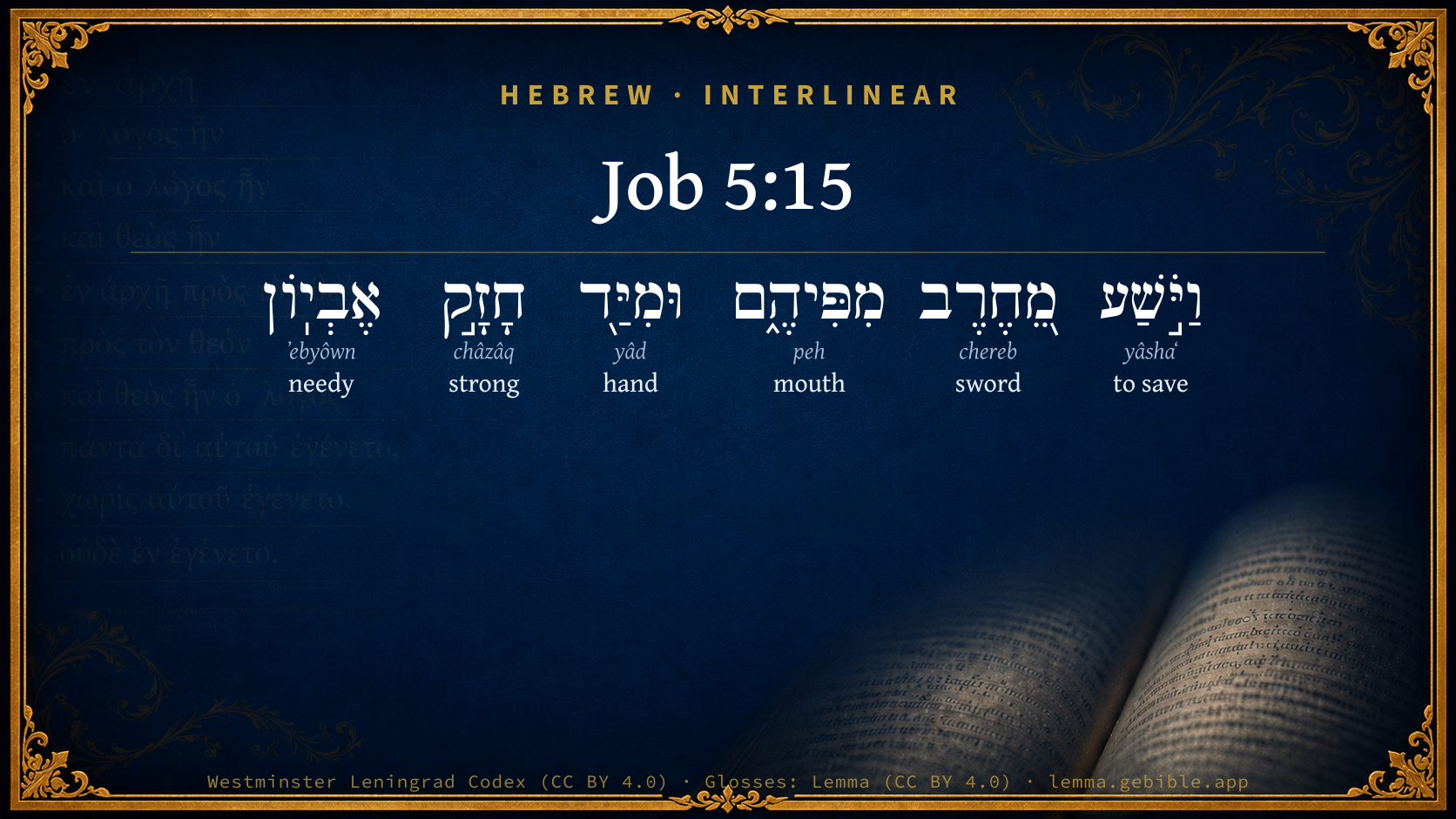
Hebrew (Westminster Leningrad Codex) Job 5:15 appears in the Hebrew Old Testament. The text above is from the Westminster Leningrad Codex. Each word links to its Strong’s number, a concise gloss, and parsing drawn from the Open Scriptures Hebrew Bible morphology. Click any word for its full Brown-Driver-Briggs (BDB) entry.
Download image
Cite this verse

Job 5:15 (World English Bible). Public Domain. Lemma interlinear Bible study tool, https://lemma.gebible.app/v/job/5/15.

Show BibTeX & RIS
BibTeX
RIS
English Translation
But he saves from the sword of their mouth, Even the needy from the hand of the mighty.
World English Bible · Public Domain
Download a study sheet

One document with this verse’s original text, its word-by-word gloss line, the meaning frame, cross-references with their text, attributed commentary, and full source and license credits — printable, and it pastes into notes with its structure intact.

This verse Autodidact and up

Study sheet (.html) Plain text (.txt)

A passage Seminary Student

Up to 50 verses in one chapter. A passage sheet keeps up to 6 commentary sources and 12 cross-references per verse, in the order this page ranks them, and says so on the sheet whenever that leaves anything out. Ask for a single verse and you get the Autodidact verse sheet above.

Everything on this page stays free to read, with no account — the sheet is a download of what is already on screen, not access to it.

Want to remove ads? Support Godless Engineer
Compare translations 3

The same verse in 3 English versions, stacked beneath the original-language interlinear above. Click any original word for its lexicon entry.

Each is an independent rendering of the whole verse — the interlinear is not word-aligned to these translations.

Highlighted words mark where these versions differ — a whole-verse word diff, not a word-by-word alignment.

  • World English Bible Public Domain
    But he saves from the sword of their mouth, Even the needy from the hand of the mighty.
  • King James Version Public Domain
    But he saveth the poor from the sword, from their mouth, and from the hand of the mighty.
  • unfoldingWord Literal Text CC BY-SA 4.0
    But he saves the poor from the sword in their mouths and from the hand of the mighty.

unfoldingWord Literal Text — © unfoldingWord, licensed CC BY-SA 4.0. Word-aligned USFM3 via Door43 (git.door43.org/unfoldingWord/en_ult).

Versions to compare (up to 4)

3 of 4 selected

Show all 18 translations

Every available English version of this verse, each an independent rendering of the whole verse.

  • World English Bible Public Domain
    But he saves from the sword of their mouth, Even the needy from the hand of the mighty.
  • Berean Standard Bible Public Domain
    He saves the needy from the sword in their mouth and from the clutches of the powerful.
  • Majority Standard Bible Public Domain
    He saves the needy from the sword in their mouth and from the clutches of the powerful.
  • King James Version Public Domain
    But he saveth the poor from the sword, from their mouth, and from the hand of the mighty.
  • American Standard Version (1901) Public Domain
    But he saveth from the sword of their mouth, Even the needy from the hand of the mighty.
  • Revised Version (1885) Public Domain
    But he saveth from the sword of their mouth, even the needy from the hand of the mighty.
  • Geneva Bible (1599) Public Domain
    But he saueth the poore from the sword, from their mouth, and from the hande of the violent man,
  • Douay-Rheims (1899) Public Domain
    But he shall save the needy from the sword of their mouth, and the poor from the hand of the violent.
  • Young's Literal Translation Public Domain
    And He saveth the wasted from their mouth, And from a strong hand the needy,
  • Literal Standard Version CC BY-SA 4.0
    He saves the needy from the sword in their mouth, || And from a strong hand,
  • Unlocked Literal Bible CC BY-SA 4.0
    But he saves the poor person from the sword in their mouths and the needy person from the hand of mighty people.
  • unfoldingWord Literal Text CC BY-SA 4.0
    But he saves the poor from the sword in their mouths and from the hand of the mighty.
  • Darby Bible Public Domain
    And he saveth the needy from the sword, from their mouth, and from the hand of the mighty.
  • World Messianic Bible Public Domain
    But he saves from the sword of their mouth, even the needy from the hand of the mighty.
  • Webster's Bible Public Domain
    But he saveth the poor from the sword, from their mouth, and from the hand of the mighty.
  • Free Bible Version CC BY-SA 4.0
    But God is the one who saves from their cutting remarks, and the poor from the actions of the powerful.
  • Bible in Basic English Public Domain
    But he keeps safe from their sword those who have no father, and the poor from the power of the strong.
  • JPS Tanakh (1917) Public Domain
    But He saveth from the sword of their mouth, even the needy from the hand of the mighty.

Literal Standard Version (2020), Covenant Press — licensed CC BY-SA 4.0. Text via the HelloAO Bible API (eBible.org). Unlocked Literal Bible (unfoldingWord) — licensed CC BY-SA 4.0. Text via the HelloAO Bible API (eBible.org). unfoldingWord Literal Text — © unfoldingWord, licensed CC BY-SA 4.0. Word-aligned USFM3 via Door43 (git.door43.org/unfoldingWord/en_ult). Free Bible Version, Dr. Jonathan Gallagher — licensed CC BY-SA 4.0. Text via the HelloAO Bible API (eBible.org).

Word by word

More ways to search: Search by grammar → Find every occurrence → Compare this word →

Practice this passage: Drill this verse → Learn its vocabulary →

About this verse

These counts appear in no published source. They are computed here, from the morphology-tagged text and Lemma’s own curated glosses. What Lemma adds →

6
words
6
distinct lemmas
Wisdom
section

Shared distinctive vocabulary

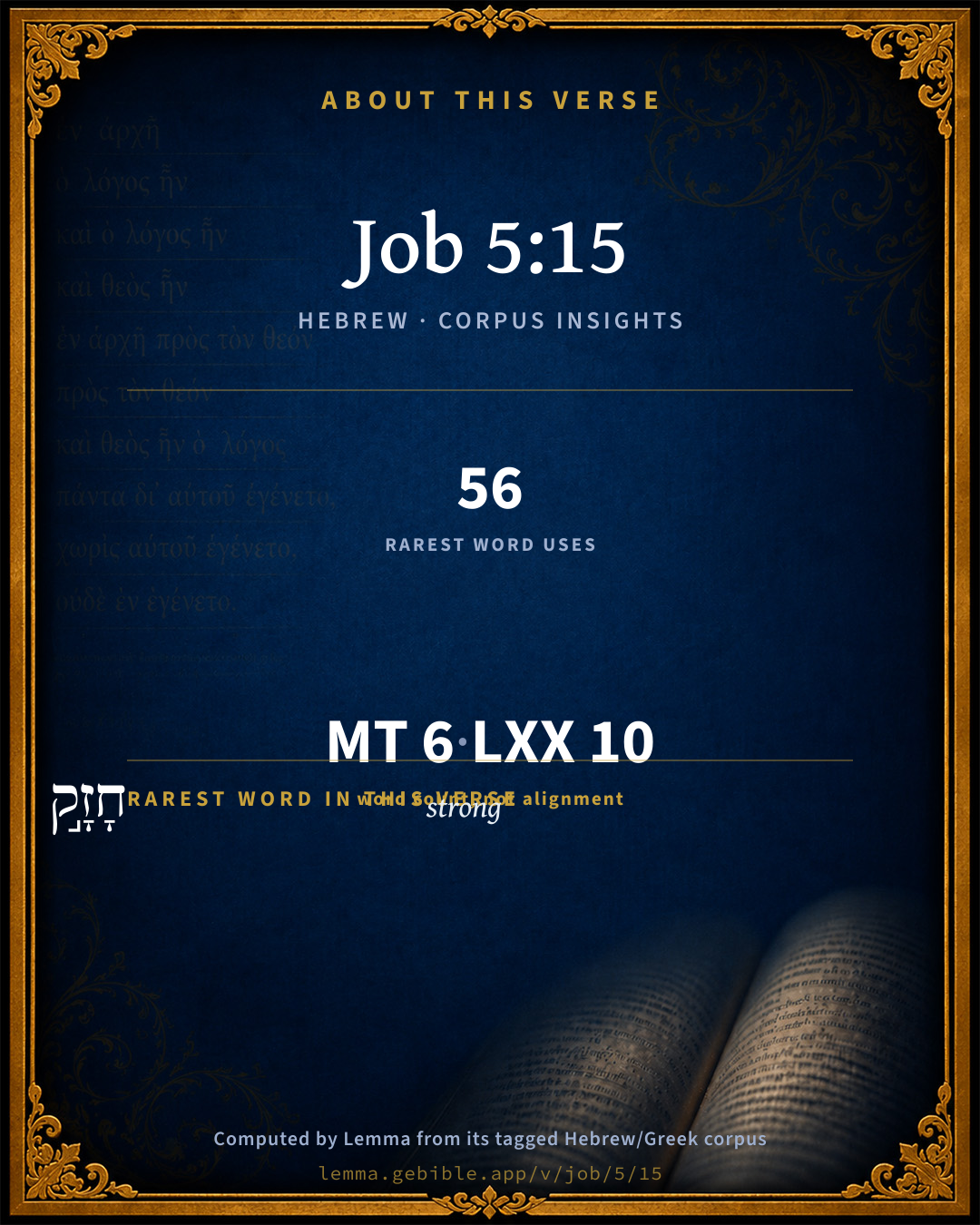
חָזָ֣ק strong H2389 occurs in 54 verses of the Hebrew Bible. Also found in:

Grammatical profile

  • 1 verb
  • 3 nouns
  • 2 adjectives

Verb forms

  • וַיֹּ֣שַׁע Hiphil · Sequential Imperfect

Hebrew & Septuagint length

In English translation the verse runs 18 words from the Hebrew and 17 from the Septuagint (LXX English) — closely comparable.

A rough comparison of the two English renderings, which tokenize alike — not a word-level alignment.

Word counts can differ between the Hebrew and the Greek without any difference in meaning — e.g. the Hebrew direct-object marker אֵת has no separate Greek word, and Greek often adds the article ὁ.

In the original languages it is 6 Hebrew tokens and 10 Greek tokens — but the two are counted differently (Hebrew bundles its prefixes and suffixes into one token; the Greek is in lemma form), so that isn’t a like-for-like length.

Cross-references

9

Topical passages linked to Job 5:15 in the Treasury of Scripture Knowledge — connected by theme and wording, ordered by reader-vote popularity; previews shown in the World English Bible.

  • Psalms 35:10 All my bones shall say, "Yahweh, who is like you, Who delivers the poor from him who is too strong for him, Yes, the poor and the needy from him who robs him?"
  • Psalms 140:12 I know that Yahweh will maintain the cause of the afflicted, And justice for the needy.
  • Psalms 109:31 For he will stand at the right hand of the needy, To save him from those who judge his soul.
  • Job 4:10 The roaring of the lion, and the voice of the fierce lion, The teeth of the young lions, are broken.
  • Psalms 10:14 But you do see trouble and grief; You consider it to take it into your hand. You help the victim and the fatherless.
  • Psalms 10:17 Yahweh, you have heard the desire of the humble. You will prepare their heart. You will cause your ear to hear,
  • Psalms 72:4 He will judge the poor of the people. He will save the children of the needy, And will break the oppressor in pieces.
  • Psalms 107:41 Yet he lifts the needy out of their affliction, And increases their families like a flock.
  • Psalms 72:12–13 For he will deliver the needy when he cries; The poor, who has no helper.

Cross-references courtesy of OpenBible.info (CC BY 4.0).

Hebrew and Greek witnesses Masoretic Hebrew ↔ Greek Septuagint

The same verse in the two great witnesses to the Old Testament, shown verse-for-verse.

These are two independent witnesses, not word-aligned to each other, and the Septuagint is shown in lemma (dictionary) form.

Hebrew Job 5:15 Masoretic · Westminster Leningrad Codex

וַיֹּ֣שַׁע מֵ֭חֶרֶב מִפִּיהֶ֑ם וּמִיַּ֖ד חָזָ֣ק אֶבְיֽוֹן

But he saves from the sword of their mouth, Even the needy from the hand of the mighty.

World English Bible · Public Domain

Greek LXX Job 5:15 Septuagint · lemma form

ἀποὀλλύω δέ ἐν πόλεμος ἀδύνατος δέ ἐκἔρχομαι ἐκ χείρ δυνάστης

and let them perish in war, and let the weak escape from the hand of the mighty.

LXX2012 (modern English Septuagint) · Public Domain

Hebrew: Westminster Leningrad Codex (CC BY 4.0). Greek: Septuagint (public domain); English from LXX2012 (modern English Septuagint) (Public Domain). How the Septuagint differs from the Hebrew →

Commentary

Notes on Job 5:15 from classic Christian and Jewish commentators (each source and its license shown beneath its notes). The classic Christian expositions comment on the surrounding passage and are grouped to its opening verse, so a note may address several verses; the Jewish commentaries on the Tanakh (Rashi and others) are per-verse, so they appear only where the commentator wrote on this verse.

Lemma curates 59 commentaries, every one of them public domain or Creative Commons licensed, each selected and text-cleaned for this edition rather than reprinted as found. About our sources →

Trapp's Complete Commentary

John Trapp

Job 5:15 But he saveth the poor from the sword, from their mouth, and from the hand of the mighty.

Ver. 15. But he saveth the poor from the sword] From the woe of war, from the hurt of it, not always from the smart of it; for all such promises as this of temporal deliverance are ever to be taken with exception of the cross, which yet shall be so sanctified, that the saints shall say, It was good for us to have been afflicted; provided that they may be poor in spirit (for God will save the humble person, Job 22:29), and sue in forma pauperis, as spiritual beggars, such as get their living by begging; the word signifieth needy and desirous of relief, very indigent, and therefore humbly suppliant for supply of things necessary. "This poor man cried, and the Lord heard him (meaning himself), and saved him out of all his troubles," Psa 34:6. "Forget not the congregation of thy poor for ever," Psa 74:19. He will not, he cannot, for they are written upon the palms of his hands, so that he cannot look beside them. Who hath not heard bow graciously poor Geneva hath been preserved? Rochel relieved, as it were, by a miracle? A. D. 1573; Leyden rescued from the duke of Alva’s sword: that very night that he thought to have stormed it, the winds turned, the tide swelled, and the waters came in, and forced him to raise the siege. How well might these poor saved ones sit and sing with David, Psa 68:20, "He that is our God is the God of salvation; and unto God the Lord belong the issues from death."

From their mouth] Which is a sword, so some sense it; God saveth his poor from the sword of their enemies’ mouth, or the sword that comes out of their mouth. A gladio oris eorum, saith the Vulgate. David felt the false tongues of his enemies as a murdering weapon in his bones, Psa 42:10. The tongue is thin, broad, and long, like a sword, it is also red like a flaming sword; by calumnies and false testimonies many are those that fall down wounded, Pro 12:6; Pro 18:8; Pro 26:22. Korah and his complices stick not to object to the meekest of men with one breath, pride, ambition, and usurpation of authority, but; God vindicated his reputation. Mary was accused three times; the Pharisees accused her of presumption, Luk 7:39; Martha of carelessness, Luk 10:40; Judas of wastefulness, Joh 12:5; but Christ ever answered for her, and took her part. And was it not so with Job? Job 42:12-17; is there not a promise to all saints? Psa 37:6.

From the hand of the mighty] God sayeth his, not only from the virulent tongues, but from the violent hands also of the mighty, that might overcome not right, that the poor fall not by his strong ones, or into his strong paws and parts, Psa 10:10, where oppressors are fitly compared to lions lying in wait for their prey. Now to be thus saved from the slaying sword, the slandering tongue, and the oppressing hand, is complete salvation.

John Trapp, A Commentary or Exposition upon All the Books of the Old and New Testament (1647–1656) — public domain. Text from a community e-Sword module.

Joseph Benson's Commentary

Job 5:15. But he saveth the poor, &c. — According to the order in which the words stand in the Hebrew, the translation is, But he saveth from the sword, from their mouth, and from the hand of the mighty, the poor. Schultens thinks it should be interpreted, from the sword which proceedeth out of their mouth, meaning, their cutting and killing reproaches. A sense this which is approved by Buxtorf, and which receives no small confirmation from divers passages of Scripture, in which reproachful language is stigmatized by the name of a sword. See Psa 57:4; Psa 64:3. Dr. Waterland’s translation of the verse is to the same purpose. But he saveth the poor from destruction by their mouth, and from the hand of the mighty. The general sense undoubtedly is, that God saveth such as, being poor, are defenceless, and therefore flee to him for refuge, from the censures, slanders, threatenings, and deceitful insinuations of their enemies; from the false swearing of witnesses, and the unrighteous sentences of corrupt judges, by which things their characters, or estates, or lives, may be exposed to great hazards.

Joseph Benson's Commentary on the Old and New Testaments (1811–1818) — public domain. Text from a community e-Sword module.

Geneva Bible (1599)

Geneva Bible translators

That is, he that humbleth himself before God.

He compareth the slander of the wicked to sharp swords.

Geneva Bible (1599) marginal notes — public domain. Text via Bolls.life.

Jamieson, Fausset & Brown

Robert Jamieson, A. R. Fausset & David Brown

"From the sword" which proceedeth "from their mouth" (Psa 59:7; Psa 57:4).

Jamieson, Fausset & Brown — Commentary Critical and Explanatory on the Whole Bible (1871) — public domain (CC PDM 1.0). Text via the HelloAO Bible API.

Adam Clarke's Commentary

Verse 15. He saveth the poor from the sword, from their mouth] This is rather a harsh construction. To avoid this, some have proposed to render מחרב mechereb, which we translate from the sword, the persecuted, but, I am afraid, on very slender authority. Instead of מחרב מפיהם mechereb mippihem, "from the sword, from their mouth," eleven of Kennicott and De Rossi's MSS. read מחרב פיהם mechereb pihem, from the sword of their mouth; and with these MSS. the Chaldee, Vulgate, Syriac, and Arabic agree. The verse, therefore, may be translated thus: -

He saveth from the sword of their mouth;

The poor from the hand of the mighty.

Or thus:-

He saveth from the sword of their mouth;

And with a strong hand the impoverished.

Adam Clarke's Commentary on the Bible (1810–1826) — public domain. Text from a community e-Sword/MySword module.

Ellicott's Commentary for English Readers

(15) From the sword, from their mouth.—It is merely a matter of grammatical nicety whether we regard the sword as coming forth from their mouth, or as identical with what comes forth from it, or as the first of three things from which the poor are delivered. It is worthy of special note that the Lord is thus conceived of and represented, as the Saviour, and the Saviour of them who have no saviour. Is not this an idea confined to the circle of the sacred writings? At all events, it so abounds and predominates in them as to be pre-eminently, if not exclusively, characteristic of them.

A Bible Commentary for English Readers, edited by Charles John Ellicott (1878–1897) — public domain. Text from a community e-Sword module.

The Cambridge Bible for Schools and Colleges

gen. ed. J. J. S. Perowne

15. but He saveth] Rather, so He saveth. The salvation of the poor is the consequence of defeating the devices of the crafty, as it is the object in view.

from the sword, from their mouth] It is evident that this verse wants the usual balance of clauses, and probably there is some corruption in it. Some mss omit from before mouth, “from the sword of their mouth.” The omission wants support, but the sense is probably that of the words as they stand: from the sword (which cometh) from their mouth; or the two expressions may be in apposition: from the sword even from their mouth. Others have proposed to point the word from-the-sword differently, making it to mean the desolate. This restores balance to the verse: thus he saveth the desolate from their mouth, and the poor from the hand of the mighty. The word “desolate” occurs Eze_29:12, said of cities, and the verb is often applied to lands, mountains, &c., but does not seem used of persons.

The Cambridge Bible for Schools and Colleges (gen. ed. J. J. S. Perowne; Cambridge University Press, 1878–1918) — public domain. Text from a community e-Sword module.

John Gill's Exposition

But he saveth the poor,.... Who are so in a literal sense, and whom the Lord saves with a temporal salvation; these being the butt of the crafty, wise, and cunning, on whom their eyes are, for whom they lay snares, and lie in wait to draw them in; and these being helpless and without friends, God takes notice of them, appears for them, and arises for their help, and saves them:

from the sword; of their enemies, drawn against them and ready to be sheathed in them:

from their mouth; from their reproaches, calumnies, detraction, and evil speaking; or "from the sword, their mouth" (w), as some; or "from the sword of their mouth" (x), as others; or which comes out of it; whose mouths and tongues are as sharp swords, which destroy their credit and reputation, and threaten them with ruin; the Targum is,"from the slaughter of their mouth:"

and from the hand of the mighty; their mighty enemies, that, are mightier than they; the Targum is,"from the hand of a mighty king;''such an one as Pharaoh, which the same paraphrase makes mention of in Job 5:14, and from whom the poor Israelites were delivered: this may be applied to the poor in a spiritual sense, who are poor in spirit, and are sensible of their spiritual poverty, whom the Lord looks unto, has a regard for, and saves them from "the sword" of avenging justice; that being awaked against the man, his fellow, and so warded off from them, and from the mouth of a cursing and condemning law, and from Satan the accuser of the brethren; and of wicked men, whose tongue rising up in judgment against them, he condemns; and from the "hand" of Satan the strong man armed, and who is stronger than they; and of all their spiritual enemies.

(w) So some in Michaelis. (x) "A gladio oris eorum", V. L. "a gladio qui ex ore eorum", De Dieu, Schultens.

John Gill's Exposition of the Whole Bible (1746–1763) — public domain (CC PDM 1.0). Text via the HelloAO Bible API.

Albert Barnes' Notes on the Bible

But he saveth the poor from the sword - He shows himself to be the friend and protector of the defenseless. The phrase “from the sword, from their mouth,” has been variously interpreted. Dr. Good renders it,

So he saveth the persecutors from their mouth,

And the helpless from the hand of the violent.”

Noyes,

So he saveth the persecuted from their mouth,

The oppressed from the hand of the mighty.”

This rendering is obtained by changing the points in the word מחרב mēchereb, “from the sword,” to מחרב māchĕrāb, making it the Hophal participle from חרב chârab, to make desolate. This was proposed by Capellus, and has been adopted by Durell, Michaelis, Dathe, Doederlein, and others. Rosenmuller pronounces it wholly unauthorized. Jerome renders it, a gladio otis eorum - “from the sword of their mouth.” It seems to me that the whole verse may be literally rendered, “he saveth from the sword, from their mouth, and from the hand of the strong, the poor.” According to this version, the phrase “from their mouth” may either mean from the mouth, i. e. the edge of the sword, using the plural for the singular, or from the mouth of oppressors, using it to represent their violence, and their disposition to devour the poor. The latter is more probably the true interpretation, and there is no need of a ehange in the points in the Hebrew. Thus, interpreted, the sense is, that God preserves the poor from oppression; or, in other words, that he befriends them, and is therefore worthy of confidence. This sentiment accords with what is found everywhere in the Bible.

Albert Barnes' Notes on the Bible (1834–1885) — public domain. Text from a community e-Sword/MySword module.

Haydock's Catholic Bible Commentary

Mouth; detraction and calumny. (Calmet)

George Leo Haydock (1774–1849), Haydock's Catholic Family Bible and Commentary, 1859 edition — public domain. Excludes Psalms (Douay-Rheims chapter numbering differs from Protestant) and Deuterocanonical books (Catholic canon only).

Matthew Poole's English Annotations

The poor, or helpless; who therefore flee to God for refuge.

From their mouth, or,

from the sword which cometh out of their mouth, i.e. from all their censures, slanders, threatenings, deceitful insinuations, false swearings of witnesses, unrighteous sentences of corrupt judges, whereby their good names, or estates, or lives may be exposed to the utmost hazards. And this is fitly opposed to the sword of the hand, implied in the next branch of the verse. Or, from the sword by their mouths, i.e. by those wicked men’s own words against the godly, which God wonderfully overruleth to the working out of their deliverance.

Matthew Poole's English Annotations on the Holy Bible (1683–1685) — public domain. Text from a community e-Sword/MySword module.

Whedon's Commentary on the Bible

Daniel D. Whedon

15. From the sword — מחרב. Doderlein, Michaelis, and Conant propose to change the pointing of the original, in order to make a direct object of the verb; thus, מחרב, desolated, and read, “So he rescues the victim from their mouth, and the needy from the hand of the strong.” Dr. Adam Clarke adduces eleven of Kennicott’s and De Rossi’s manuscripts as reading, “from the sword of their mouth,” with which agree the Vulgate, Syriac, and Arabic. The rendering of Zockler, Umbreit, and most moderns, accords with that of Delitzsch — from the sword, (that) of their mouth, that is, that proceeds from their mouth — who also remarks that the text is sound and beautiful. Compare Psa_64:3, “who whet their tongue like a sword.” The shape of the tongue may have led to its comparison to a sword; certainly its power to cut, to wound, has ever led the Oriental to associate the two together.

Daniel D. Whedon (gen. ed.), Commentary on the Old and New Testaments (1874–1909) — public domain. Text from a community e-Sword module.

The Pulpit Commentary

But he sayeth the poor from the sword, from their mouth; rather, from the sword of their mouth; i.e. from their cruel and destructive, (Psa_57:4 Psa_64:3 Pro_12:18) which cut "like a sharp razor". (Psa_52:2) By calumny, innuendos, lies, fraudulent representations, and the like, the ungodly work, perhaps, more injury than by their actions. And from the hand of the mighty. God delivers the poor both from their words and from their deeds.

The Pulpit Commentary (1880–1919), ed. H.D.M. Spence-Jones & Joseph S. Exell — public domain. Text from a community e-Sword module.

John Wesley's Explanatory Notes

Mouth - Which was ready to swallow them up.

John Wesley, Explanatory Notes Upon the Whole Bible (1754–1765) — public domain. Text via the GEBible commentary corpus.

Rashi

Rabbi Shlomo Yitzchaki (Rashi)

And He saved the stumblers.

from the sword. From what sword? From their mouth, for they thought to swallow them and longed to destroy them.

and... from the hand of the mighty He saves the needy.

Rashi on the Tanakh — English translations: “The Judaica Press complete Tanach with Rashi, translated by A. J. Rosenberg” (CC BY 4.0); “Pentateuch with Rashi's commentary by M. Rosenbaum and A.M. Silbermann, 1929-1934” (public domain); “The Metsudah Tanach series, Lakewood, N.J” (CC BY 4.0); and “The Book of Joshua, Metsudah Publications, 1997” (CC BY 4.0). Text via Sefaria.

Lesson kit

Teaching starters — assembled from the data on this page, not authored interpretation. Every prompt links to the verse data it draws on. Edit before teaching.

Job, in the Wisdom, opens this verse with 6 words (6 distinct Hebrew lemmas). Its most distinctive word is châzâq (“strong”). A historical commentator’s framing appears above. Read the whole chapter for the surrounding context.

Discussion questions

  1. How does “strong” (châzâq) shape what this verse is saying?
  2. Exodus 3:19 shares the word «strong» with this verse. How do the two illuminate each other?
  3. These translations render this verse differently. What is at stake in choosing one wording over another?
  4. The verb «וַיֹּ֣שַׁע» is Hiphil Sequential Imperfect. How does its form color the action?
  5. Reading how Trapp's Complete Commentary and Joseph Benson's Commentary read this verse, where do the two commentators agree and where do they part?

Things to notice

Reading settings

Reading text

Shown beneath each verse's original-language words.

Old Testament
Old Testament edition

Read the OT as the Masoretic Hebrew (MT) or the Greek Septuagint (LXX).

English shown for the Greek Septuagint (in the Hebrew ↔ Greek comparison).

Comparing translations? Open the Compare panel on any verse page to stack up to four side by side.