
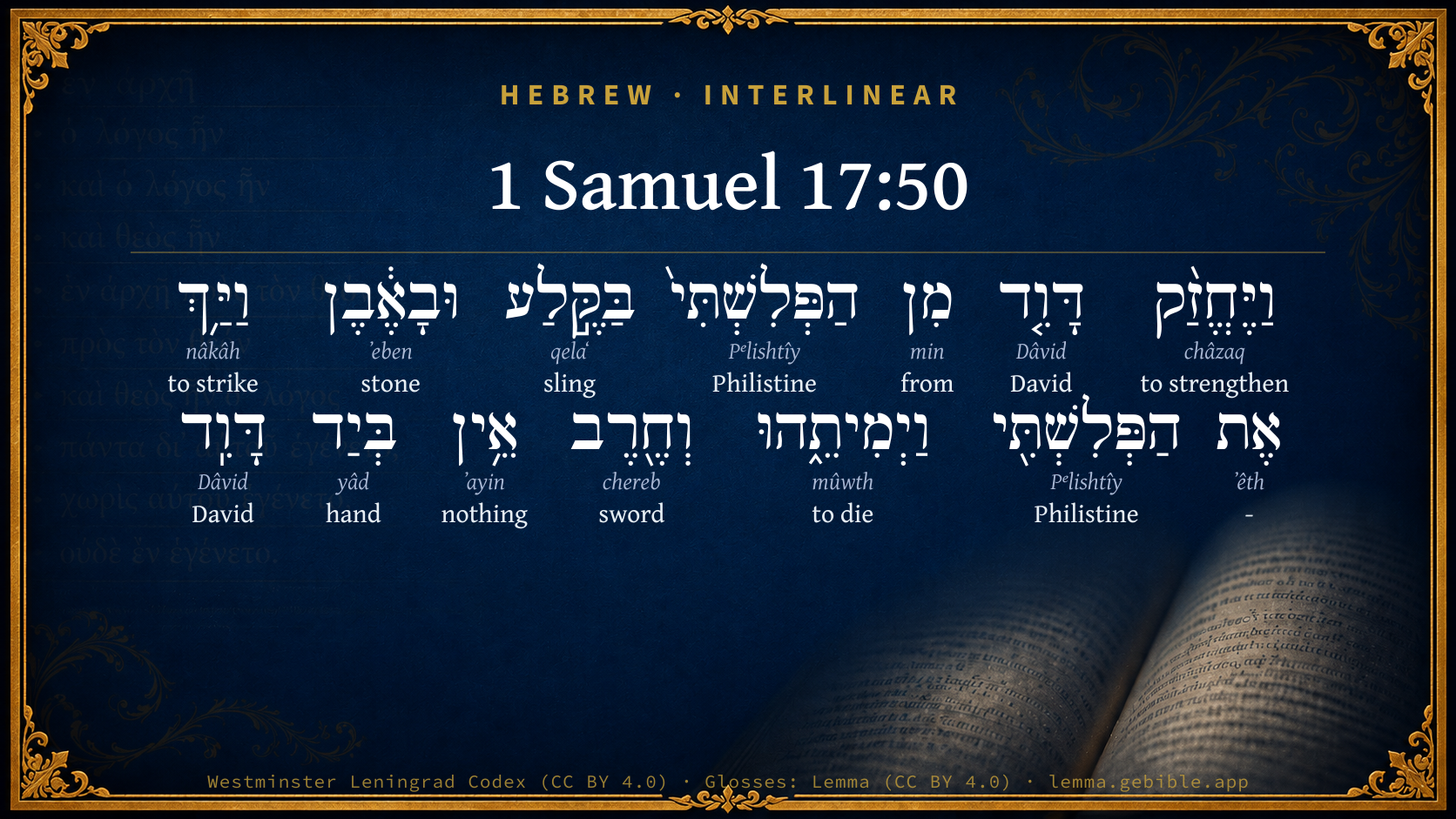
1 Samuel 17:50

Hebrew (Westminster Leningrad Codex) 1 Samuel 17:50 appears in the Hebrew Old Testament. The text above is from the Westminster Leningrad Codex. Each word links to its Strong’s number, a concise gloss, and parsing drawn from the Open Scriptures Hebrew Bible morphology. Click any word for its full Brown-Driver-Briggs (BDB) entry.
Download image
Cite this verse

1 Samuel 17:50 (World English Bible). Public Domain. Lemma interlinear Bible study tool, https://lemma.gebible.app/v/1-samuel/17/50.

Show BibTeX & RIS
BibTeX
RIS
English Translation
So David prevailed over the Philistine with a sling and with a stone, and struck the Philistine, and killed him; but there was no sword in the hand of David.
World English Bible · Public Domain
Download a study sheet

One document with this verse’s original text, its word-by-word gloss line, the meaning frame, cross-references with their text, attributed commentary, and full source and license credits — printable, and it pastes into notes with its structure intact.

This verse Autodidact and up

Study sheet (.html) Plain text (.txt)

A passage Seminary Student

Up to 50 verses in one chapter. A passage sheet keeps up to 6 commentary sources and 12 cross-references per verse, in the order this page ranks them, and says so on the sheet whenever that leaves anything out. Ask for a single verse and you get the Autodidact verse sheet above.

Everything on this page stays free to read, with no account — the sheet is a download of what is already on screen, not access to it.

Want to remove ads? Support Godless Engineer
Compare translations 3

The same verse in 3 English versions, stacked beneath the original-language interlinear above. Click any original word for its lexicon entry.

Each is an independent rendering of the whole verse — the interlinear is not word-aligned to these translations.

Highlighted words mark where these versions differ — a whole-verse word diff, not a word-by-word alignment.

  • World English Bible Public Domain
    So David prevailed over the Philistine with a sling and with a stone, and struck the Philistine, and killed him; but there was no sword in the hand of David.
  • King James Version Public Domain
    So David prevailed over the Philistine with a sling and with a stone, and smote the Philistine, and slew him; but there was no sword in the hand of David.
  • unfoldingWord Literal Text CC BY-SA 4.0
    So David was stronger than the Philistine with the sling and with the stone. And he struck the Philistine and killed him. Now no sword in the hand of David.

unfoldingWord Literal Text — © unfoldingWord, licensed CC BY-SA 4.0. Word-aligned USFM3 via Door43 (git.door43.org/unfoldingWord/en_ult).

Versions to compare (up to 4)

3 of 4 selected

Show all 18 translations

Every available English version of this verse, each an independent rendering of the whole verse.

  • World English Bible Public Domain
    So David prevailed over the Philistine with a sling and with a stone, and struck the Philistine, and killed him; but there was no sword in the hand of David.
  • Berean Standard Bible Public Domain
    Thus David prevailed over the Philistine with a sling and a stone; without a sword in his hand he struck down the Philistine and killed him.
  • Majority Standard Bible Public Domain
    Thus David prevailed over the Philistine with a sling and a stone; without a sword in his hand he struck down the Philistine and killed him.
  • King James Version Public Domain
    So David prevailed over the Philistine with a sling and with a stone, and smote the Philistine, and slew him; but there was no sword in the hand of David.
  • American Standard Version (1901) Public Domain
    So David prevailed over the Philistine with a sling and with a stone, and smote the Philistine, and slew him; but there was no sword in the hand of David.
  • Revised Version (1885) Public Domain
    So David prevailed over the Philistine with a sling and with a stone, and smote the Philistine, and slew him; but there was no sword in the hand of David.
  • Geneva Bible (1599) Public Domain
    So Dauid ouercame the Philistim with a sling and with a stone, and smote the Philistim, and slew him, when Dauid had no sword in his hand.
  • Douay-Rheims (1899) Public Domain
    And David prevailed over the Philistine, with a sling and a stone, and he struck, and slew the Philistine. And as David had no sword in his hand,
  • Young's Literal Translation Public Domain
    And David is stronger than the Philistine with a sling and with a stone, and smiteth the Philistine, and putteth him to death, and there is no sword in the hand of David,
  • Literal Standard Version CC BY-SA 4.0
    And David is stronger than the Philistine with a sling and with a stone, and strikes the Philistine, and puts him to death, and there is no sword in the hand of David,
  • Unlocked Literal Bible CC BY-SA 4.0
    David defeated the Philistine with a sling and with a stone. He hit the Philistine and killed him. There was no sword in David's hand.
  • unfoldingWord Literal Text CC BY-SA 4.0
    So David was stronger than the Philistine with the sling and with the stone. And he struck the Philistine and killed him. Now no sword in the hand of David.
  • Darby Bible Public Domain
    So David overcame the Philistine with a sling and a stone, and smote the Philistine and killed him; and there was no sword in the hand of David.
  • World Messianic Bible Public Domain
    So David prevailed over the Philistine with a sling and with a stone, and struck the Philistine and killed him; but there was no sword in David’s hand.
  • Webster's Bible Public Domain
    So David prevailed over the Philistine with a sling and with a stone, and smote the Philistine, and slew him; but there was no sword in the hand of David.
  • Free Bible Version CC BY-SA 4.0
    This is how David defeated the Philistine with just a sling and a stone; with no sword in his hand David knocked the Philistine down and killed him.
  • Bible in Basic English Public Domain
    So David overcame the Philistine with his leather band and a stone, wounding the Philistine and causing his death: but David had no sword in his hand.
  • JPS Tanakh (1917) Public Domain
    So David prevailed over the Philistine with a sling and with a stone, and smote the Philistine, and slew him; but there was no sword in the hand of David.

Literal Standard Version (2020), Covenant Press — licensed CC BY-SA 4.0. Text via the HelloAO Bible API (eBible.org). Unlocked Literal Bible (unfoldingWord) — licensed CC BY-SA 4.0. Text via the HelloAO Bible API (eBible.org). unfoldingWord Literal Text — © unfoldingWord, licensed CC BY-SA 4.0. Word-aligned USFM3 via Door43 (git.door43.org/unfoldingWord/en_ult). Free Bible Version, Dr. Jonathan Gallagher — licensed CC BY-SA 4.0. Text via the HelloAO Bible API (eBible.org).

Word by word

More ways to search: Search by grammar → Find every occurrence → Compare this word →

Practice this passage: Drill this verse → Learn its vocabulary →

בַּקֶּ֣לַע
qelaʻ
H7050
“in/at the · sling”
Preposition, Determined + Noun, Common, Masculine, Singular, Absolute
Part of Speech
Preposition + Noun
Type
Common
Gender
Masculine
Number
Singular
State
Absolute
Full BDB Definition

Origin: from H7049

TWOT: 2030a , 2030c

sling, slingstones - curtain, drape, hanging
  1. וַיֶּחֱזַ֨ק châzaq H2388 “and · to strengthen” Conjunction + Verb, Qal, Sequential Imperfect, 3rd Person, Masculine, Singular
  2. דָּוִ֤ד Dâvid H1732 “David” Noun, Proper
  3. מִן min H4480 “from” Preposition
  4. הַפְּלִשְׁתִּי֙ Pᵉlishtîy H6430 “the · Philistine” Particle, Definite Article + Noun, Gentilic, Masculine, Singular, Absolute
  5. וּבָאֶ֔בֶן ʼeben H68 “and · in/at the · stone” Conjunction + Preposition, Determined + Noun, Common, Feminine, Singular, Absolute
  6. וַיַּ֥ךְ nâkâh H5221 “and · to strike” Conjunction + Verb, Hiphil, Sequential Imperfect, 3rd Person, Masculine, Singular
  7. אֶת ʼêth H853 “-” Particle, Direct Object
  8. הַפְּלִשְׁתִּ֖י Pᵉlishtîy H6430 “the · Philistine” Particle, Definite Article + Noun, Gentilic, Masculine, Singular, Absolute
  9. וַיְמִיתֵ֑הוּ mûwth H4191 “and · to die · him” Conjunction + Verb, Hiphil, Sequential Imperfect, 3rd Person, Masculine, Singular + Suffix, Personal, 3rd Person, Masculine, Singular
  10. וְחֶ֖רֶב chereb H2719 “and · sword” Conjunction + Noun, Common, Feminine, Singular, Absolute
  11. אֵ֥ין ʼayin H369 “nothing” Particle, Negative
  12. בְּיַד yâd H3027 “in/at · hand of” Preposition + Noun, Common, Both, Singular, Construct
  13. דָּוִֽד Dâvid H1732 “David” Noun, Proper

About this verse

These counts appear in no published source. They are computed here, from the morphology-tagged text and Lemma’s own curated glosses. What Lemma adds →

14
words
12
distinct lemmas
Historical
section

Notable vocabulary

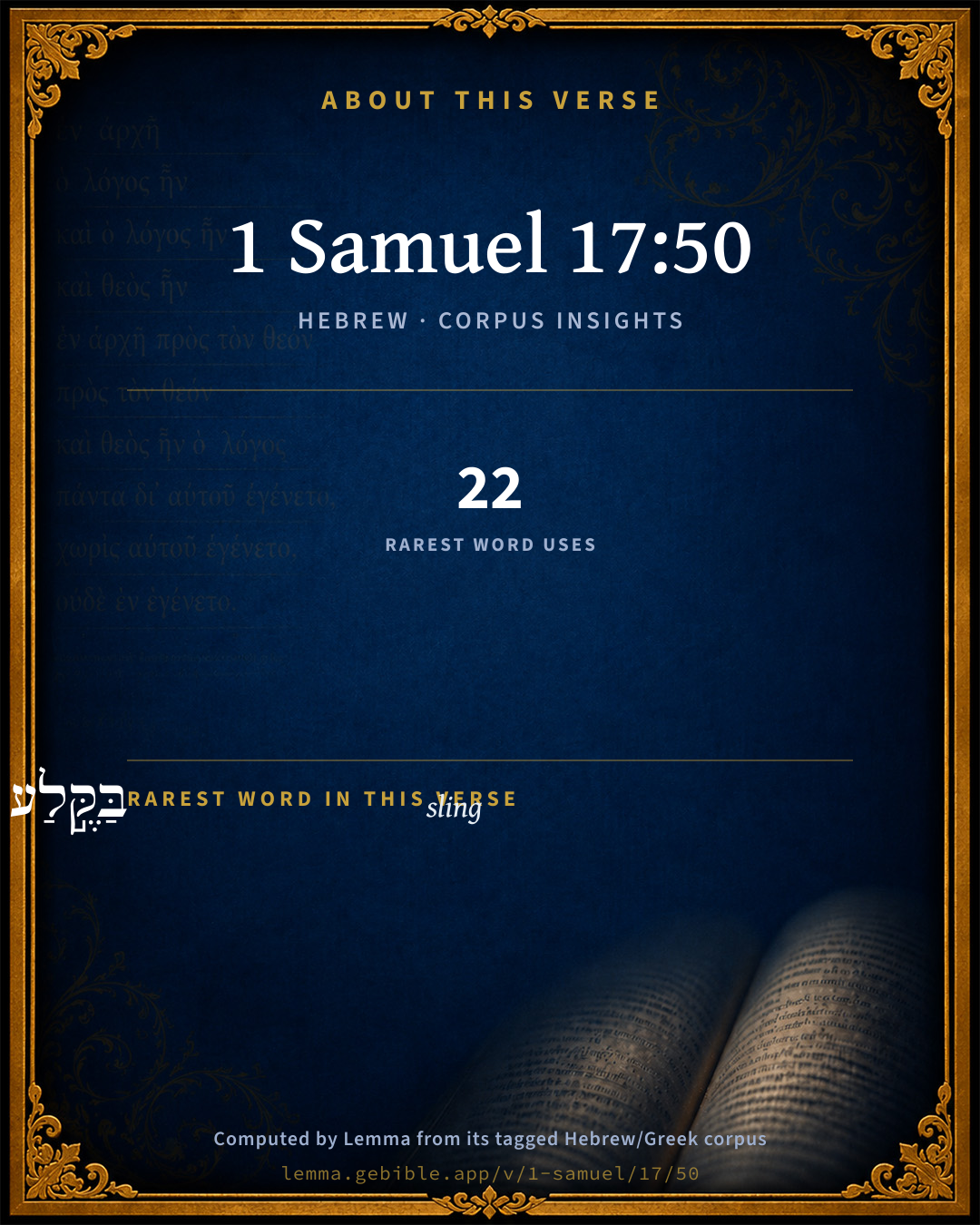
The rarest word here is בַּקֶּ֣לַע sling H7050 — appearing just 22 times in the whole Hebrew Bible.

Shared distinctive vocabulary

בַּקֶּ֣לַע sling H7050 occurs in 22 verses of the Hebrew Bible. Also found in:

Grammatical profile

  • 3 verbs
  • 8 nouns
  • 1 preposition
  • 2 particles

Verb forms

  • וַיֶּחֱזַ֨ק Qal · Sequential Imperfect
  • וַיַּ֥ךְ Hiphil · Sequential Imperfect
  • וַיְמִיתֵ֑הוּ Hiphil · Sequential Imperfect

Repetition

Words recur within this verse — often emphatic in Hebrew:

  • דָּוִ֤ד David H1732 ×2
  • הַפְּלִשְׁתִּי֙ Philistine H6430 ×2

Hebrew & Septuagint length

In English translation the verse runs 30 words from the Hebrew and 29 from the Septuagint (LXX English) — closely comparable.

A rough comparison of the two English renderings, which tokenize alike — not a word-level alignment.

Word counts can differ between the Hebrew and the Greek without any difference in meaning — e.g. the Hebrew direct-object marker אֵת has no separate Greek word, and Greek often adds the article ὁ.

Cross-references

6

Topical passages linked to 1 Samuel 17:50 in the Treasury of Scripture Knowledge — connected by theme and wording, ordered by reader-vote popularity; previews shown in the World English Bible.

  • Judges 15:15 He found a fresh jawbone of a donkey, and put forth his hand, and took it, and struck a thousand men therewith.
  • 1 Samuel 17:39 David girded his sword on his clothing, and he tried to go; for he had not proved it. David said to Saul, I can't go with these; for I have not proved them. David put them off him.
  • 1 Samuel 21:9 The priest said, The sword of Goliath the Philistine, whom you killed in the valley of Elah, behold, it is here wrapped in a cloth behind the ephod: if you will take that, take it; for there is no other except that here. David said, There is none like that; give it me.
  • 1 Samuel 23:21 Saul said, Blessed be you of Yahweh; for you have had compassion on me.
  • Judges 3:31 After him was Shamgar the son of Anath, who struck of the Philistines six hundred men with an ox-goad: and he also saved Israel.
  • 1 Samuel 13:22 So it came to pass in the day of battle, that there was neither sword nor spear found in the hand of any of the people who were with Saul and Jonathan: but with Saul and with Jonathan his son was there found.

Cross-references courtesy of OpenBible.info (CC BY 4.0).

Hebrew and Greek witnesses Masoretic Hebrew ↔ Greek Septuagint

The same verse in the two great witnesses to the Old Testament, shown verse-for-verse.

These are two independent witnesses, not word-aligned to each other, and the Septuagint is shown in lemma (dictionary) form.

Hebrew 1 Samuel 17:50 Masoretic · Westminster Leningrad Codex

וַיֶּחֱזַ֨ק דָּוִ֤ד מִן הַפְּלִשְׁתִּי֙ בַּקֶּ֣לַע וּבָאֶ֔בֶן וַיַּ֥ךְ אֶת הַפְּלִשְׁתִּ֖י וַיְמִיתֵ֑הוּ וְחֶ֖רֶב אֵ֥ין בְּיַד דָּוִֽד

So David prevailed over the Philistine with a sling and with a stone, and struck the Philistine, and killed him; but there was no sword in the hand of David.

World English Bible · Public Domain

Greek LXX 1 Samuel 17:50 Septuagint · lemma form
So David prevailed over the Philistine with a sling and a stone, and struck the Philistine and killed him, and there was no sword in the hand of David.

LXX2012 (modern English Septuagint) · Public Domain

Hebrew: Westminster Leningrad Codex (CC BY 4.0). Greek: Septuagint (public domain); English from LXX2012 (modern English Septuagint) (Public Domain). How the Septuagint differs from the Hebrew →

Targum (Aramaic paraphrase)

1

The Targum is the ancient Jewish Aramaic paraphrase of the Hebrew Scriptures — an interpretive translation, not the Hebrew text itself. Onkelos (literal) and Pseudo-Jonathan (expansive) render the Torah, and Jonathan the Prophets. Coverage is partial: where no permissively-licensed English translation exists for a verse, only the Aramaic is shown. This is verse-level text, not a word-by-word alignment to the Hebrew.

  1. Targum Jonathan Prophets (Joshua–Malachi)
    וּתְקֵיף דָוִד מִן פְּלִשְׁתָּאָה בְּקִלְעָא וּבְאַבְנָא וּמְחָא יַת פְּלִשְׁתָּאָה וְקַטְלֵיהּ וְחַרְבָּא לֵית בִּידָא דְדָוִד:

    (no public-domain English translation for this verse)

    Targum Jonathan — Aramaic: “Mikraot Gedolot” (public domain). English: “Sefaria Community Translation” (CC0 1.0 (public-domain dedication)); “London "Chaldee Paraphrase," 1871” (public domain). Text via Sefaria.

Commentary

Notes on 1 Samuel 17:50 from classic Christian and Jewish commentators (each source and its license shown beneath its notes). The classic Christian expositions comment on the surrounding passage and are grouped to its opening verse, so a note may address several verses; the Jewish commentaries on the Tanakh (Rashi and others) are per-verse, so they appear only where the commentator wrote on this verse.

Lemma curates 59 commentaries, every one of them public domain or Creative Commons licensed, each selected and text-cleaned for this edition rather than reprinted as found. About our sources →

Trapp's Complete Commentary

John Trapp

1Sa 17:50 So David prevailed over the Philistine with a sling and with a stone, and smote the Philistine, and slew him; but [there was] no sword in the hand of David.

Ver. 50. So David prevailed over the Philistine.] By the help of his God, and by the force of his faith. {Heb 11:32}

“ Traiectamque cavo terebravit vnlnere frontem. ” - Prudentius.

With a sling and with a stone,] Unlikely means to prostrate such a bulk. So Shamgar with an oxgoad, and Samson with the jaw bone of an ass, made great slaughters. So Christ by his cross destroyed the devil, yea, by death he foiled him that had the power of death, {Heb 2:14} as David cut off Goliath’s head with his own sword.

John Trapp, A Commentary or Exposition upon All the Books of the Old and New Testament (1647–1656) — public domain. Text from a community e-Sword module.

The Biblical Illustrator

Joseph S. Exell

1Sa_17:50

So David prevailed over the Philistine with a sling and with a stone.

Davids first victory

I. David was a type of our Lord Jesus Christ. The early fathers of the church were very great in opening up typical analogies. With regard to this particular transaction let us note, at the outset, that before he fought with Goliath, David was anointed of God. Samuel had gone down to Bethlehem and poured a horn of oil upon his head. The parallel will readily occur to you. Thus hath the Lord found out for Himself one whom He has chosen out of the people. With His holy oil hath He anointed him. Jesus, the antitype of David, is anointed with the oil of gladness above his fellows. Grace and truth came by Jesus Christ. The Spirit was not given by measure unto him. See how the correspondence goes on. Our Lord was sent by his Father to his brethren. As David was sent by Jesse to his brethren with suitable presents end comfortable words, in order to commune with them, even so in the fulness of time was our Lord commissioned to visit his brethren. Jesus was roughly handled by his brethren, whom He came to bless. David, you will remember, answered his brethren with great gentleness. He did not return railing for railing, but with much gentleness he endured their churlishness. In this he supplied us with but a faint picture of our beloved Master, who, when He was reviled, reviled not again. We pass on to observe that David was moved by intense love of his people, he saw them defied by the Philistine. The name of Jehovah was dishonoured! That braggart giant who stalked before the bests defied the armies of the living God! A further motive was present to stimulate his patriotic ambition. How could Davids bosom fail to glow with strong emotion when he was told that the man who should vanquish and slay that Philistine should be married to the kings daughter? Such a prize might well quicken his ardour. Now in all this he plainly foreshadowed our Lord Jesus Christ. He loved His own: He was always ready to lay down His life for the sheep. And then there was the joy that was set before Him that He should have the church for His spouse. Goliath is called in the Hebrew, not champion, as we read it in the English, but the middle-man, the mediator. If you put the whole case fairly before your own minds, you will readily see the fitness of the word that is used. There is the host of the Philistines on the one side, and there is the host of Israel on the other side. A valley lies between them. Goliath says, I will represent Philistia. I stand as the middle-man. Now, it is exactly upon that ground that the Lord Jesus Christ fought the battles of His people. We fell representatively in the first Adam, and our salvation now is by another representative--the second Adam. He is the Middleman, the one Mediator between God and man. Mark you well that David did smite Goliath, and he smote him effectually--not in the loins, or on the band, or on the foot--but in a vital point he delivered the stroke that laid him low. He smote him on the brow of his presumption, on the forehead of his pride. So when our Lord stood forth to contend with sin, He projected His atoning sacrifice as a stone that has smitten sin and all its powers upon the forehead. Thus, glory be to God, sin is slain. It is not wounded merely, but it is slain by the power of Jesus Christ. And remember that David cut off Goliaths head with his own sword. Augustine, in his comment on this passage, very well brings out the thought that the triumph of our Saviour Jesus Christ is here set forth in the history of David. He, through death, destroyed him that had the power of death, that is, the devil. You will find the analogy capable of much amplification. Make a picture of it at your leisure, and it may prove a beneficial study and a profitable meditation.

II. David as an example for every believer in Christ.

1. You cannot do Davids work if you have not Davids anointing. When you remember that your Divine Master tarried for the heavenly anointing, you can hardly expect to do without it.

2. David, too, stands before us as an example of the fact that our opportunity will come, if our efficiency has been bestowed, without our being very particular to seek it. David fell into position.

3. Learn from David, too, to return quiet answers to those who would roughly put you aside from your work.

4. Learn, again, from Davids example, the prudence of keeping to tried weapons.

5. Next, observe that from the work which David begun he ceased not till he had finished it. He had laid the giant prone upon the soil, but he was not satisfied till he had out off his head. I wish that some who work for Christ would be as thorough as this young volunteer was. (C. H. Spurgeon.)

The giants, and how to fight them

All young people like to hear and read stories about giants. I suppose there is hardly a person in this country who knows how go read, but who has read the famous history of Jack the Giant Killer. I remember, when a very little boy, reading it, and thinking what a wonderful history it was. Some people pretend to think that it was hardly possible for David to throw a stone with sufficient force to sink into the giants head. One of this class, a foolish young man, who pretended not to believe the Bible, was once riding in a stagecoach, which was full of passengers. He was trying to ridicule some of the Bible stories. Among others, he spoke of this one about David and the giant. He said he thought the giants head must have been too hard for a boy like David to send a stone into it; and, turning to an old Quaker gentleman, who sat in the corner of the coach, he asked, What do you think about it, sir? Friend, said the old gentleman, in a dry, quiet way, Ill tell thee what I think: if the giants head was as soft as thine it must have been very easy for the stone to get in. I want now to speak about five giants that we should all unite in trying to fight against.

I. The first giant I am to speak of is the giant heathenism. This giant doesnt live here. He is found in countries where the Gospel is not known. His castles may be seen in Africa, and in India, in China, and in the islands of the sea. He is a huge giant. This giant is very strong, and very cruel. Well, what are we to do to this giant? Why, we must fight him, as David did Goliath. The Bible is the brook to which we must go. The truths which it contains are the stones that we must use.

II. The second giant I would speak of is the giant selfishness. The giant selfishness never sees, or hears, or does anything for anyone but himself if you find that you are getting to think more of yourself than of others, then be sure the giant is after you. We must fight this giant by self-denial.

III. The third giant I want to speak about is the giant covetousness. This giant is very large in size, and very strong in limb; but he has the tiniest tittle bit of a heart you ever saw, might put it in a nutshell. The only wonder is how so huge a frame can be supported by so little a heart. But this is not all, for little as his heart is, it is hard as stone. He is ashamed of his name, and wont answer to it. He pretends that his right name is--frugality. But this is a great story. Frugality is a very different person. He is a good, true, honest fellow If you ask, How are you to fight him? I answer, by learning to give.

IV. The fourth giant of which I will speak is the giant ill-temper. But how are we to fight against, this giant? I answer, By trying to be like Jesus. We always think of Him as--the gentle Jesus, meek and mild. Do you suppose that this giant ever got a single link of his chain on Jesus? No.

V. The last giant I wish to speak about is the giant intemperance. He is a very ugly-looking fellow When he is in a good humour, and feels jolly, he puts on a silly face, and looks very foolish. But when he gets in a passion he is awful looking, and it makes one shudder to see him. (R. Newton, D. D.)

David and Goliath

The moment the words are read the instruction will be seen.

1. Helps may sometimes be so multiplied as to become hindrances. We reserve a measure of our pity for the modern Davids in the pulpit who imitate popular preachers, and in the classes who seek to reproduce the rare excellences of famous teachers more tall and more brilliant, and so fail because they stalk around in unnatural panoply, and are borne down by a greatness they cannot fill out to its full swell.

2. There is always room in the Divine purposes for proper originality in human methods.

3. The best instrument for Gods service is generally that which God has bestowed on the individual worker. It is simply silly for any spiritual martinet to bluster when he sees that Christians are doing well in winning souls, and insist that David shall put on armour like Sauls when he can accomplish far more in his own way as a slinger with his brook stones. Let all wise men and women take what Providence has put within their reach. Here comes again in a new history the old demand once made of Moses: What is that in thy hand? The crook he had used with the sheep in Horeb became the rod which divided the Red Sea. Shamgar took his ox goad, because he was accustomed to it. Samson seized the jaw bone of an ass, because he found it moist and ready when he put forth his hand. Dorcas did glorious good in Joppa with the needle her hand loved.

4. Giant killing is yet the chief calling of the Church. We may call the apparently mismatched combatants Good and Evil, Right and Wrong, Truth and Error; it is invariably the worse which seems colossal, and the better which appears insignificant. Error can generally find an obsequious armour bearer; Truth sometimes has to stand alone with a sling. Often great leaders will contribute their cast-off clothing, but they do not offer to put their extra height, into risk. And the lesson is full of counsel and cheer for chivalrous souls who are valiant for the truth, that they have patience, fight with courage, and trust God forever.

For the God of David still guides the pebble at His will:

There are giants yet to kill--wrongs unshriven;

But the battle to the strong is not given

While the Judge of right and wrong sits in heaven.

5. Here seems to be a register of the real worth of mere muscular Christianity. A few calm words from Canon Charles Kingsley might well be quoted here: Better would it be for any one of you, young men, to be the stupidest and the ugliest of mortals, to be the most diseased and abject of cripples, the most silly, nervous, incapable personage who ever was a laughing stock for the boys upon the streets, if only you lived, according to your powers, the life of the Spirit of God, than to be as perfectly gifted, as exquisitely organised in body and mind, as David himself, and not to live the life of the Spirit of God, the life of goodness, which is the only life fit for a human being wearing the human flesh and soul which Christ took upon Him on earth, and wears forever in heaven, a Man indeed in the midst of the throne of God.

6. It is the weakest sort of so-called honour which has to assert itself in bluster.

7. The calmness of faith is always resolute and self-possessed. The battle is the Lords. There is a motto for all Christian life. John Bunyan has mentioned some of our modern giants: giant Despair, and giant Grim; giant Pope, and giant Pagan. Perhaps we could think of a few more who have come nearer yet to our own experience, and might have been named in the history of Christiana and the children. There is giant Pride, and giant Profanity, giant Untruth, giant Envy, giant Appetite; all of these confront us and with some of them we have had fights. But we can stand before them quite calmly if only we remember we come in the name of the Lord of hosts.

8. The best defence against evil is found in a swift attack.

9. There can be no Providence in Gods government that is not in some sense truly special.

10. The weapons of the wicked are often at the last turned against themselves.

11. The victory of faith belongs only to Jehovah. (C. S. Robinson, D. D.)

Davids victory ever Goliath

I. Observe, first, from this account, that a humble station is no hindrance to the grace of God. David, unknown and unnoticed, feeding his fathers sheep at Bethlehem, was chosen by God to be an instrument to promote His glory, and to do great good in the world.

II. Observe, again, that faithfulness and diligence in appointed duties is the way to honour and respect. It was so with David. In the performance of his daily duties, in obedience to his father, in submission to man, be was prepared for great and noble deeds.

III. But the lesson especially taught us in this chapter is that which the Apostle Paul elsewhere enforces: My brethren, be strong in the Lord, and in the power of His might. If God be for us, who can be against us? If we trust in Him through the merits of Jesus Christ our Saviour, we need not fear our spiritual enemies--the enemies of our souls. (E. Blencowe, M. A.)

The victorious races

Look now with me, a moment, at another element of strength in the Missionary Church. Not only is the power of God promised to her fidelity, but the wisdom of God is visible in the choice of her materials. In our modern times, God has put His gospel faith into the best races on the globe. David has better blood in his veins than Goliath. The races to which God has intrusted His staff and five smooth stones of gospel truth are the same races that drew up Magna Charta and the declaration of Independence--the races that have made iron types to talk and iron ships to swim--that have strung the telegraphic nerves through humanitys limbs, and have woven out of revealed law the highest forms yet reached of Christian civilisation. For the spread of His gospel, God has made Great Britain strong, and Holland industrious, and Germany learned, and has saved the American Republic as by fire. The welfare of Christianity has God bound up with the welfare of certain races and nations. If this be so, how vitally important it is that those nations who essay to Christianise other nations should themselves be Christianised to the very coral. (T. L. Cuyler, D. D.)

The Biblical Illustrator, edited by Joseph S. Exell (c. 1880s–1900s) — public domain. Text from a community e-Sword module.

Ellicott's Commentary for English Readers

(50) But there was no sword in the hand of David.—The story of the daring of the son of Jesse dwells, and with good reason, on the extraordinary valour and skill of the young champion of Israel. Had his heart for one instant failed him—as, indeed, it well might; had he not possessed a confidence which nothing could shake in an unseen Helper—or had his skill as a marksman failed him in the slightest degree, the Philistine with one blow would have laid David lifeless at his feet; or had the active shepherd boy eluded his giant antagonist, it must have been by flight. In any case, the single combat upon which Israel had staked so much would have gone against the chosen people.

A Bible Commentary for English Readers, edited by Charles John Ellicott (1878–1897) — public domain. Text from a community e-Sword module.

The Cambridge Bible for Schools and Colleges

gen. ed. J. J. S. Perowne

50. This verse is not found in the Sept. (B).

The Cambridge Bible for Schools and Colleges (gen. ed. J. J. S. Perowne; Cambridge University Press, 1878–1918) — public domain. Text from a community e-Sword module.

John Gill's Exposition

So David prevailed over the Philistine with a sling and with a stone,.... And with them only, without any other warlike weapon:

and smote the Philistine, and slew him; smote him with the stone, which brought him to the ground, and then slew him with his own sword, as afterwards related:

but there was no sword in the hand of David; when he engaged with the Philistine, and smote him, for he had put off all his armour, Sa1 17:39.

John Gill's Exposition of the Whole Bible (1746–1763) — public domain (CC PDM 1.0). Text via the HelloAO Bible API.

The Pulpit Commentary

Vers. 50, 51. So David prevailed over the Philistine with a sling and with a stone. It is evident that the narrator regarded David"s victory as extraordinary; and no doubt it required not only great courage, but also perfect skill, as only the lower portion of the forehead would be exposed, and on no other part of the giant"s body would a blow have been of any avail. The narrator also calls attention to the fact that David relied upon his sling alone, for there was no sword in the hand of David. Slings probably were regarded as useful only to harass an enemy, while swords, which they had only lately been able to procure, (1Sa_13:22) were regarded as the real weapons of offence. David, therefore, completes his victory by killing Goliath with his own sword as he lay stunned upon the ground. As Ahimelech considered it fit for David"s own use, (1Sa_21:9) it was probably not so monstrous in size as Goliath"s other weapons. Champion is not the word so rendered in vers. 4, 23, but that used in 1Sa_16:18 for "a hero of valour."

The Pulpit Commentary (1880–1919), ed. H.D.M. Spence-Jones & Joseph S. Exell — public domain. Text from a community e-Sword module.

unfoldingWord translationNotes

Door43 World Missions Community

David defeated ... He hit ... killed ... There was no sword in David's hand

Verse 50 is a summary of David's amazing victory over Goliath. The details about how he hit and killed Goliath are in 1 Samuel 17:49 and 1Sa 17:51. Some languages do not use summary statements like this. In those situations, translators may restructure the verses as they are in the UDB.

Then David ran and stood over the Philistine

David did this after Goliath fell to the ground in 1 Samuel 17:49.

took his sword

"took the Philistine's sword." Here the word "his" refers to Goliath.

translationWords

David

Philistines

sword

unfoldingWord translationNotes — © Distant Shores Media and the Door43 World Missions Community, licensed CC BY-SA 4.0. Source: git.door43.org/Door43/en_tn.

Lesson kit

Teaching starters — assembled from the data on this page, not authored interpretation. Every prompt links to the verse data it draws on. Edit before teaching.

1 Samuel, in the Historical, opens this verse with 14 words (12 distinct Hebrew lemmas). Its most distinctive word is qelaʻ (“sling”). A historical commentator’s framing appears above. Read the whole chapter for the surrounding context.

Discussion questions

  1. How does “sling” (qelaʻ) shape what this verse is saying?
  2. How does Exodus 27:9, which shares the word «sling», read alongside this verse?
  3. What does the repetition of “David” (2× in this one verse) do in this verse?
  4. The translations on this page render this verse differently — a whole-verse word diff, not a word-by-word alignment. What might account for the different wordings?
  5. «וַיֶּחֱזַ֨ק» is a Qal Sequential Imperfect verb. How does that grammatical form shape the action described?
  6. Compare how Trapp's Complete Commentary and The Biblical Illustrator read this verse. Where do they agree or differ?

Things to notice

Reading settings

Reading text

Shown beneath each verse's original-language words.

Old Testament
Old Testament edition

Read the OT as the Masoretic Hebrew (MT) or the Greek Septuagint (LXX).

English shown for the Greek Septuagint (in the Hebrew ↔ Greek comparison).

Comparing translations? Open the Compare panel on any verse page to stack up to four side by side.