
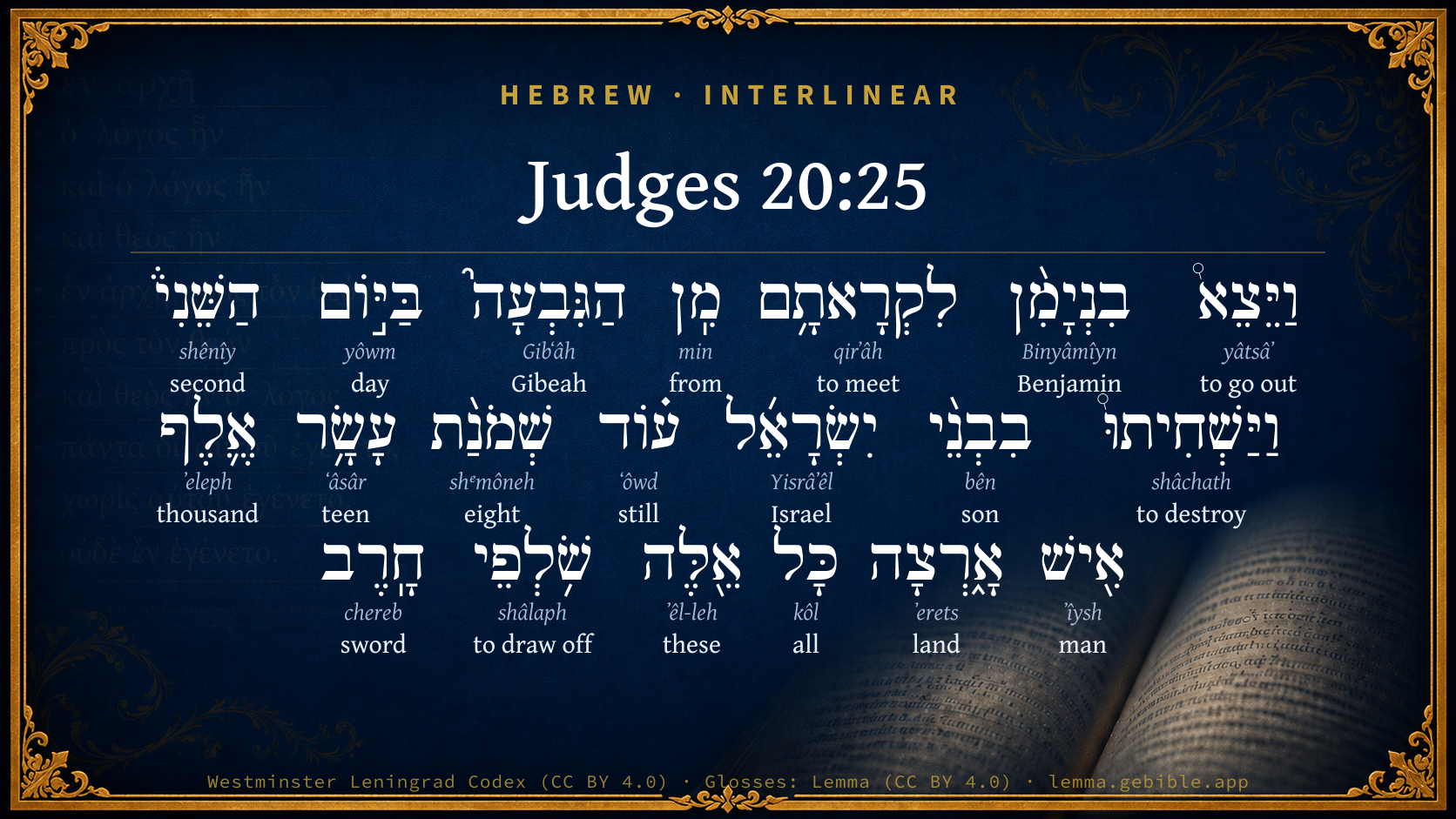
Judges 20:25

Hebrew (Westminster Leningrad Codex) Judges 20:25 appears in the Hebrew Old Testament. The text above is from the Westminster Leningrad Codex. Each word links to its Strong’s number, a concise gloss, and parsing drawn from the Open Scriptures Hebrew Bible morphology. Click any word for its full Brown-Driver-Briggs (BDB) entry.
Download image
Cite this verse

Judges 20:25 (World English Bible). Public Domain. Lemma interlinear Bible study tool, https://lemma.gebible.app/v/judges/20/25.

Show BibTeX & RIS
BibTeX
RIS
English Translation
Benjamin went forth against them out of Gibeah the second day, and destroyed down to the ground of the children of Israel again eighteen thousand men; all these drew the sword.
World English Bible · Public Domain
Download a study sheet

One document with this verse’s original text, its word-by-word gloss line, the meaning frame, cross-references with their text, attributed commentary, and full source and license credits — printable, and it pastes into notes with its structure intact.

This verse Autodidact and up

Study sheet (.html) Plain text (.txt)

A passage Seminary Student

Up to 50 verses in one chapter. A passage sheet keeps up to 6 commentary sources and 12 cross-references per verse, in the order this page ranks them, and says so on the sheet whenever that leaves anything out. Ask for a single verse and you get the Autodidact verse sheet above.

Everything on this page stays free to read, with no account — the sheet is a download of what is already on screen, not access to it.

Want to remove ads? Support Godless Engineer
Compare translations 3

The same verse in 3 English versions, stacked beneath the original-language interlinear above. Click any original word for its lexicon entry.

Each is an independent rendering of the whole verse — the interlinear is not word-aligned to these translations.

Highlighted words mark where these versions differ — a whole-verse word diff, not a word-by-word alignment.

  • World English Bible Public Domain
    Benjamin went forth against them out of Gibeah the second day, and destroyed down to the ground of the children of Israel again eighteen thousand men; all these drew the sword.
  • King James Version Public Domain
    And Benjamin went forth against them out of Gibeah the second day, and destroyed down to the ground of the children of Israel again eighteen thousand men; all these drew the sword.
  • unfoldingWord Literal Text CC BY-SA 4.0
    And Benjamin came forth to meet them from Gibeah on the second day, and they destroyed to the ground yet 18,000 men from the sons of Israel, all of these drawers of a sword.

unfoldingWord Literal Text — © unfoldingWord, licensed CC BY-SA 4.0. Word-aligned USFM3 via Door43 (git.door43.org/unfoldingWord/en_ult).

Versions to compare (up to 4)

3 of 4 selected

Show all 18 translations

Every available English version of this verse, each an independent rendering of the whole verse.

  • World English Bible Public Domain
    Benjamin went forth against them out of Gibeah the second day, and destroyed down to the ground of the children of Israel again eighteen thousand men; all these drew the sword.
  • Berean Standard Bible Public Domain
    That same day the Benjamites came out against them from Gibeah and cut down another 18,000 Israelites, all of them armed with swords.
  • Majority Standard Bible Public Domain
    That same day the Benjamites came out against them from Gibeah and cut down another 18,000 Israelites, all of them armed with swords.
  • King James Version Public Domain
    And Benjamin went forth against them out of Gibeah the second day, and destroyed down to the ground of the children of Israel again eighteen thousand men; all these drew the sword.
  • American Standard Version (1901) Public Domain
    And Benjamin went forth against them out of Gibeah the second day, and destroyed down to the ground of the children of Israel again eighteen thousand men; all these drew the sword.
  • Revised Version (1885) Public Domain
    And Benjamin went forth against them out of Gibeah the second day, and destroyed down to the ground of the children of Israel again eighteen thousand men; all these drew the sword.
  • Geneva Bible (1599) Public Domain
    Also the second day Beniamin came forth to meete them out of Gibeah, and slewe downe to the grounde of the children of Israel againe eighteene thousand men: all they could handle the sword.
  • Douay-Rheims (1899) Public Domain
    The children of Benjamin sallied forth out of the gates of Gabaa: and meeting them made so great a slaughter of them, as to kill eighteen thousand men that drew the sword.
  • Young's Literal Translation Public Domain
    and Benjamin cometh out to meet them from Gibeah on the second day, and destroy among the sons of Israel again eighteen thousand men -- to the earth; all these are drawing sword.
  • Literal Standard Version CC BY-SA 4.0
    and Benjamin comes out to meet them from Gibeah on the second day, and destroy eighteen thousand men among the sons of Israel again—to the earth; all these are drawing sword.
  • Unlocked Literal Bible CC BY-SA 4.0
    On the second day, Benjamin went out against them from Gibeah and they killed eighteen thousand men from the people of Israel. All were men who trained to fight with the sword.
  • unfoldingWord Literal Text CC BY-SA 4.0
    And Benjamin came forth to meet them from Gibeah on the second day, and they destroyed to the ground yet 18,000 men from the sons of Israel, all of these drawers of a sword.
  • Darby Bible Public Domain
    And Benjamin went against them out of Gib'e-ah the second day, and felled to the ground eighteen thousand men of the people of Israel; all these were men who drew the sword.
  • World Messianic Bible Public Domain
    Benjamin went out against them out of Gibeah the second day, and destroyed down to the ground of the children of Israel again eighteen thousand men. All these drew the sword.
  • Webster's Bible Public Domain
    And Benjamin went forth against them out of Gibeah the second day, and destroyed down to the ground of the children of Israel again eighteen thousand men; all these drew the sword.
  • Free Bible Version CC BY-SA 4.0
    However, Benjamites came out of Gibeah once more and slaughtered eighteen thousand Israelites, all armed with swords.
  • Bible in Basic English Public Domain
    And the second day Benjamin went out against them from Gibeah, cutting down eighteen thousand men of the children of Israel, all swordsmen.
  • JPS Tanakh (1917) Public Domain
    And Benjamin went forth against them out of Gibeah the second day, and destroyed down to the ground of the children of Israel again eighteen thousand men; all these drew the sword.

Literal Standard Version (2020), Covenant Press — licensed CC BY-SA 4.0. Text via the HelloAO Bible API (eBible.org). Unlocked Literal Bible (unfoldingWord) — licensed CC BY-SA 4.0. Text via the HelloAO Bible API (eBible.org). unfoldingWord Literal Text — © unfoldingWord, licensed CC BY-SA 4.0. Word-aligned USFM3 via Door43 (git.door43.org/unfoldingWord/en_ult). Free Bible Version, Dr. Jonathan Gallagher — licensed CC BY-SA 4.0. Text via the HelloAO Bible API (eBible.org).

Word by word

More ways to search: Search by grammar → Find every occurrence → Compare this word →

Practice this passage: Drill this verse → Learn its vocabulary →

שֹׁ֥לְפֵי
shâlaph
H8025
“drawing off”
Verb, Qal, Participle Active, Masculine, Plural, Construct
Part of Speech
Verb
Stem
Qal
Form
Participle Active
Gender
Masculine
Number
Plural
State
Construct
Full BDB Definition

Origin: a primitive root

TWOT: 2402

to draw out or off, take off - (Qal) - to draw out - to draw off - to shoot up, draw out (of blade of grass on roof)
  1. וַיֵּצֵא֩ yâtsâʼ H3318 “and · to go out” Conjunction + Verb, Qal, Sequential Imperfect, 3rd Person, Masculine, Singular
  2. בִנְיָמִ֨ן Binyâmîyn H1144 “Benjamin” Noun, Proper
  3. לִקְרָאתָ֥ם qirʼâh H7125 “to meet · them” Preposition + Verb, Qal, Infinitive Construct + Suffix, Personal, 3rd Person, Masculine, Plural
  4. מִֽן min H4480 “from” Preposition
  5. הַגִּבְעָה֮ Gibʻâh H1390 “the · Gibeah” Particle, Definite Article + Noun, Proper
  6. בַּיּ֣וֹם yôwm H3117 “in/at the · day” Preposition, Determined + Noun, Common, Masculine, Singular, Absolute
  7. הַשֵּׁנִי֒ shênîy H8145 “the · second” Particle, Definite Article + Adjective, Ordinal number, Masculine, Singular, Absolute
  8. וַיַּשְׁחִיתוּ֩ shâchath H7843 “and · to destroy” Conjunction + Verb, Hiphil, Sequential Imperfect, 3rd Person, Masculine, Plural
  9. בִבְנֵ֨י bên H1121 “in/at · sons of” Preposition + Noun, Common, Masculine, Plural, Construct
  10. יִשְׂרָאֵ֜ל Yisrâʼêl H3478 “Israel” Noun, Proper
  11. ע֗וֹד ʻôwd H5750 “still” Adverb
  12. שְׁמֹנַ֨ת shᵉmôneh H8083 “eight” Adjective, Cardinal number, Masculine, Singular, Construct
  13. עָשָׂ֥ר ʻâsâr H6240 “teen” Adjective, Cardinal number, Masculine, Singular, Absolute
  14. אֶ֛לֶף ʼeleph H505 “thousand” Adjective, Cardinal number, Both, Singular, Absolute
  15. אִ֖ישׁ ʼîysh H376 “man” Noun, Common, Masculine, Singular, Absolute
  16. אָ֑רְצָה ʼerets H776 “land · toward” Noun, Common, Both, Singular, Absolute + Suffix, Demonstrative
  17. כָּל kôl H3605 “all of” Noun, Common, Masculine, Singular, Construct
  18. אֵ֖לֶּה ʼêl-leh H428 “these” Pronoun, Demonstrative, Common, Plural
  19. חָֽרֶב chereb H2719 “sword” Noun, Common, Feminine, Singular, Absolute

About this verse

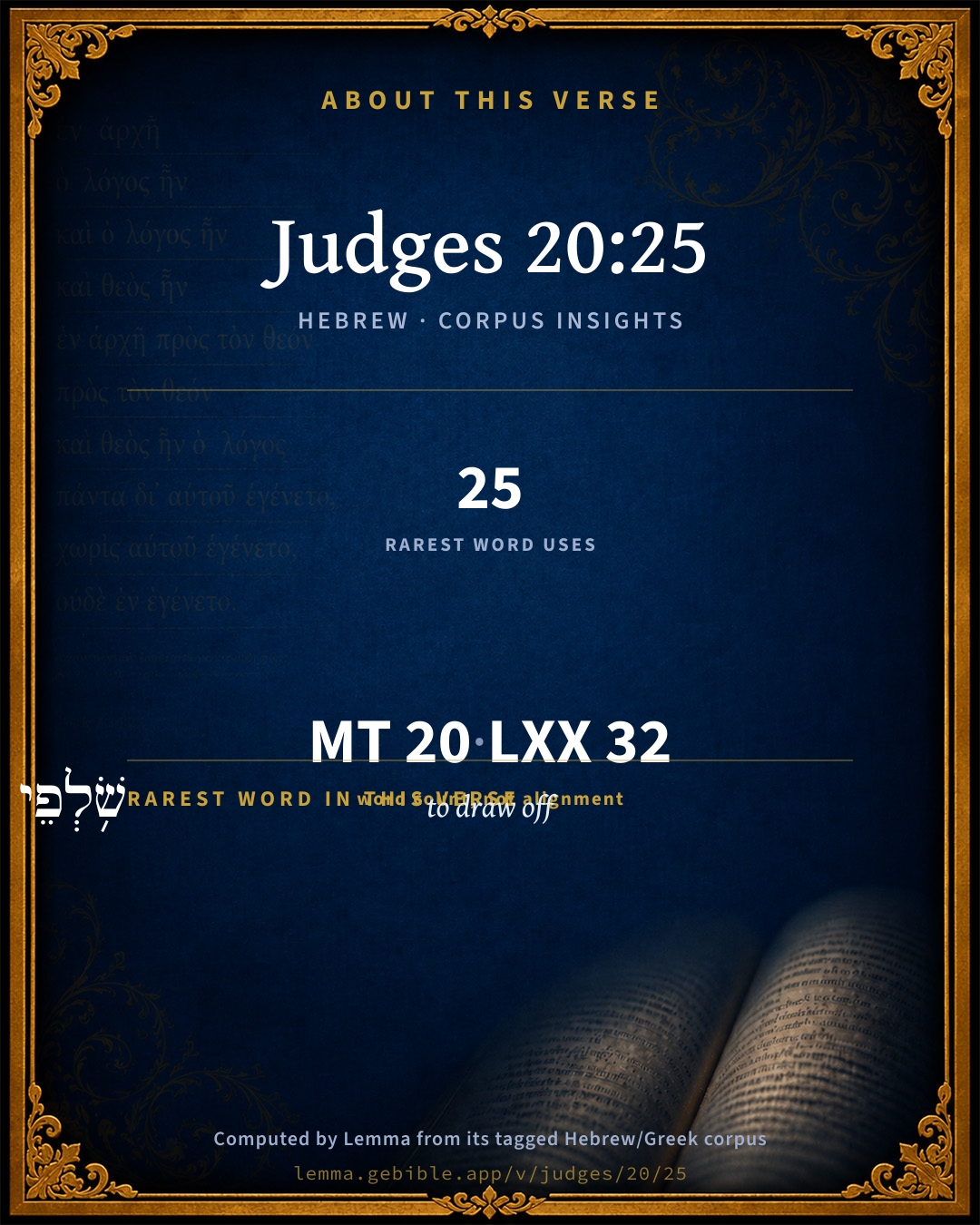
These counts appear in no published source. They are computed here, from the morphology-tagged text and Lemma’s own curated glosses. What Lemma adds →

20
words
20
distinct lemmas
Historical
section

Notable vocabulary

The rarest word here is שֹׁ֥לְפֵי to draw off H8025 — appearing just 25 times in the whole Hebrew Bible.

Shared distinctive vocabulary

שֹׁ֥לְפֵי to draw off H8025 occurs in 24 verses of the Hebrew Bible. Also found in:

Grammatical profile

  • 4 verbs
  • 9 nouns
  • 4 adjectives
  • 1 pronoun
  • 1 preposition
  • 1 adverb

Verb forms

  • וַיֵּצֵא֩ Qal · Sequential Imperfect
  • לִקְרָאתָ֥ם Qal · Infinitive Construct
  • וַיַּשְׁחִיתוּ֩ Hiphil · Sequential Imperfect
  • שֹׁ֥לְפֵי Qal · Participle Active

Hebrew & Septuagint length

In English translation the verse runs 31 words from the Hebrew and 36 from the Septuagint (LXX English) — closely comparable.

A rough comparison of the two English renderings, which tokenize alike — not a word-level alignment.

Word counts can differ between the Hebrew and the Greek without any difference in meaning — e.g. the Hebrew direct-object marker אֵת has no separate Greek word, and Greek often adds the article ὁ.

In the original languages it is 20 Hebrew tokens and 32 Greek tokens — but the two are counted differently (Hebrew bundles its prefixes and suffixes into one token; the Greek is in lemma form), so that isn’t a like-for-like length.

Cross-references

7

Topical passages linked to Judges 20:25 in the Treasury of Scripture Knowledge — connected by theme and wording, ordered by reader-vote popularity; previews shown in the World English Bible.

  • Judges 20:21 The children of Benjamin came forth out of Gibeah, and destroyed down to the ground of the Israelites on that day Twenty-two thousand men.
  • Romans 11:33 Oh the depth of the riches both of the wisdom and the knowledge of God! How unsearchable are his judgments, and his ways past tracing out!
  • Genesis 18:25 Be it far from you to do things like that, to kill the righteous with the wicked, that so the righteous should be as the wicked. May that be far from you. Shouldn't the Judge of all the earth do right?"
  • Job 9:12–13 Behold, he snatches away; who can hinder him? Who will ask him, 'What are you doing?'
  • Psalms 97:2 Clouds and darkness are around him. Righteousness and justice are the foundation of his throne.
  • Romans 2:5 But according to your hardness and unrepentant heart you are treasuring up for yourself wrath in the day of wrath, revelation, and of the righteous judgment of God;
  • Romans 3:5 But if our unrighteousness commends the righteousness of God, what will we say? Is God unrighteous who inflicts wrath? I speak like men do.

Cross-references courtesy of OpenBible.info (CC BY 4.0).

Hebrew and Greek witnesses Masoretic Hebrew ↔ Greek Septuagint

The same verse in the two great witnesses to the Old Testament, shown verse-for-verse.

These are two independent witnesses, not word-aligned to each other, and the Septuagint is shown in lemma (dictionary) form.

Hebrew Judges 20:25 Masoretic · Westminster Leningrad Codex

וַיֵּצֵא֩ בִנְיָמִ֨ן לִקְרָאתָ֥ם מִֽן הַגִּבְעָה֮ בַּיּ֣וֹם הַשֵּׁנִי֒ וַיַּשְׁחִיתוּ֩ בִבְנֵ֨י יִשְׂרָאֵ֜ל ע֗וֹד שְׁמֹנַ֨ת עָשָׂ֥ר אֶ֛לֶף אִ֖ישׁ אָ֑רְצָה כָּל אֵ֖לֶּה שֹׁ֥לְפֵי חָֽרֶב

Benjamin went forth against them out of Gibeah the second day, and destroyed down to the ground of the children of Israel again eighteen thousand men; all these drew the sword.

World English Bible · Public Domain

Greek LXX Judges 20:25 Septuagint · lemma form

καί ἐκἔρχομαι ὁ υἱός βενιαμίν εἰς συνάντησις αὐτός ἀπό ὁ γαβαα ἐν ὁ ἡμέρα ὁ δεύτερος καί διαφθείρω ἀπό υἱός ἰσραήλ ἔτι ὀκτωκαίδεκα χιλιάς ἀνήρ ἐπί ὁ γῆ πᾶς οὗτος ἕλκω ῥομφαία

And the children of Benjamin went forth to meet them from Gabaa on the second day, and destroyed of the children of Israel yet further eighteen thousand men down to the ground: all these drew sword.

LXX2012 (modern English Septuagint) · Public Domain

Hebrew: Westminster Leningrad Codex (CC BY 4.0). Greek: Septuagint (public domain); English from LXX2012 (modern English Septuagint) (Public Domain). How the Septuagint differs from the Hebrew →

Targum (Aramaic paraphrase)

1

The Targum is the ancient Jewish Aramaic paraphrase of the Hebrew Scriptures — an interpretive translation, not the Hebrew text itself. Onkelos (literal) and Pseudo-Jonathan (expansive) render the Torah, and Jonathan the Prophets. Coverage is partial: where no permissively-licensed English translation exists for a verse, only the Aramaic is shown. This is verse-level text, not a word-by-word alignment to the Hebrew.

  1. Targum Jonathan Prophets (Joshua–Malachi)
    וּנְפַק בִּנְיָמִין לִקֳדָמוּתְהוֹן מִן גִבְעֲתָא בְּיוֹמָא תִּנְיָנָא וְחַבִּילוּ בִּבְנֵי יִשְׂרָאֵל עוֹד תַּמְנַת עֲסַר אַלְפִין גַבְרָא קְטִילִין רְמָן לְאַרְעָא כָּל אִלֵין שַׁלְפֵי סַיְפָא:

    (no public-domain English translation for this verse)

    Targum Jonathan — Aramaic: “Mikraot Gedolot” (public domain). English: “Sefaria Community Translation” (CC0 1.0 (public-domain dedication)); “London "Chaldee Paraphrase," 1871” (public domain). Text via Sefaria.

Commentary

Notes on Judges 20:25 from classic Christian and Jewish commentators (each source and its license shown beneath its notes). The classic Christian expositions comment on the surrounding passage and are grouped to its opening verse, so a note may address several verses; the Jewish commentaries on the Tanakh (Rashi and others) are per-verse, so they appear only where the commentator wrote on this verse.

Lemma curates 59 commentaries, every one of them public domain or Creative Commons licensed, each selected and text-cleaned for this edition rather than reprinted as found. About our sources →

Trapp's Complete Commentary

John Trapp

Jdg 20:25 And Benjamin went forth against them out of Gibeah the second day, and destroyed down to the ground of the children of Israel again eighteen thousand men; all these drew the sword.

Ver. 25. Destroyed down to the ground … eighteen thousand men.] Here a Pompey would have denied a providence; Brutus would have cried out against virtue as a mere name; others against hard fortune, Ecquid hoc infortunii est? &c. "But God giveth his more grace; wherefore he saith, God resisteth the proud, but giveth grace to the humble. Submit yourselves therefore to God Be afflicted," or afflict yourselves with voluntary sorrows for your sins, "and mourn, and weep," &c. {Jas 4:6-7; Jas 4:9-10} These did so the next time, and had the day. Wit is best when dear bought.

John Trapp, A Commentary or Exposition upon All the Books of the Old and New Testament (1647–1656) — public domain. Text from a community e-Sword module.

Geneva Bible (1599)

Geneva Bible translators

All they drawing the sword.

Geneva Bible (1599) marginal notes — public domain. Text via Bolls.life.

Ellicott's Commentary for English Readers

(25) Destroyed . . . eighteen thousand men.—This second defeat seems to have been due, like the first, to overweening confidence and carelessness. Thus in two battles the eleven tribes lost 40,000 men—i.e., 13,300 more than the entire Benjamite army, which was only 26,700. Such a hideous massacre can only be accounted for by the supposition that the Benjamite slings did deadly execution from some vantage-ground. Similarly at Crecy “1,200 knights and 30,000 footmen—a number equal to the whole English force—lay dead upon the ground” (Green, 1:419).

A Bible Commentary for English Readers, edited by Charles John Ellicott (1878–1897) — public domain. Text from a community e-Sword module.

John Gill's Exposition

And Benjamin went forth against them out of Gibeah the second day,.... Flushed with the victory they had obtained the day before:

and destroyed down to the ground of the children of Israel again eighteen thousand men, all these drew the sword, were armed men; this, with the 22,000 slain the day preceding, made 40,000; the same number singled out from among them by lot to provide food for them, and is thought by some to be the case Deborah refers to, Jdg 5:8 and is what is certainly intended in Hos 10:9.

John Gill's Exposition of the Whole Bible (1746–1763) — public domain (CC PDM 1.0). Text via the HelloAO Bible API.

Haydock's Catholic Bible Commentary

Sword. In each battle the Benjamites kill almost as many as their whole army, in all 40,000 Israelites, without losing a man, ver. 15. (Haydock)

George Leo Haydock (1774–1849), Haydock's Catholic Family Bible and Commentary, 1859 edition — public domain. Excludes Psalms (Douay-Rheims chapter numbering differs from Protestant) and Deuterocanonical books (Catholic canon only).

Whedon's Commentary on the Bible

Daniel D. Whedon

25. The second day — Not necessarily the next day after the first conflict, but the second day of actual battle. Several days may have intervened between the two battles.

Eighteen thousand — Four thousand less than the loss of the first day’s battle; but Israel’s self-confidence was also less than then.

Daniel D. Whedon (gen. ed.), Commentary on the Old and New Testaments (1874–1909) — public domain. Text from a community e-Sword module.

The Pulpit Commentary

Of the children of Israel. We are not told upon which tribe the lot fell, or the answer was given, that they should go up the second day.

The Pulpit Commentary (1880–1919), ed. H.D.M. Spence-Jones & Joseph S. Exell — public domain. Text from a community e-Sword module.

Lesson kit

Teaching starters — assembled from the data on this page, not authored interpretation. Every prompt links to the verse data it draws on. Edit before teaching.

Judges, in the Historical, opens this verse with 20 words (20 distinct Hebrew lemmas). Its most distinctive word is shâlaph (“to draw off”). A historical commentator’s framing appears above. Read the whole chapter for the surrounding context.

Discussion questions

  1. The word shâlaph carries the sense “to draw off.” How does it shape the verse?
  2. How does Numbers 22:23, which shares the word «to draw off», read alongside this verse?
  3. These translations render this verse differently; the difference is in the English rendering, not the original. What questions does that raise?
  4. «וַיֵּצֵא֩» is a Qal Sequential Imperfect verb. How does that grammatical form shape the action described?
  5. Compare how Trapp's Complete Commentary and Geneva Bible (1599) read this verse. Where do they agree or differ?

Things to notice

Reading settings

Reading text

Shown beneath each verse's original-language words.

Old Testament
Old Testament edition

Read the OT as the Masoretic Hebrew (MT) or the Greek Septuagint (LXX).

English shown for the Greek Septuagint (in the Hebrew ↔ Greek comparison).

Comparing translations? Open the Compare panel on any verse page to stack up to four side by side.