
2 Kings 10:25

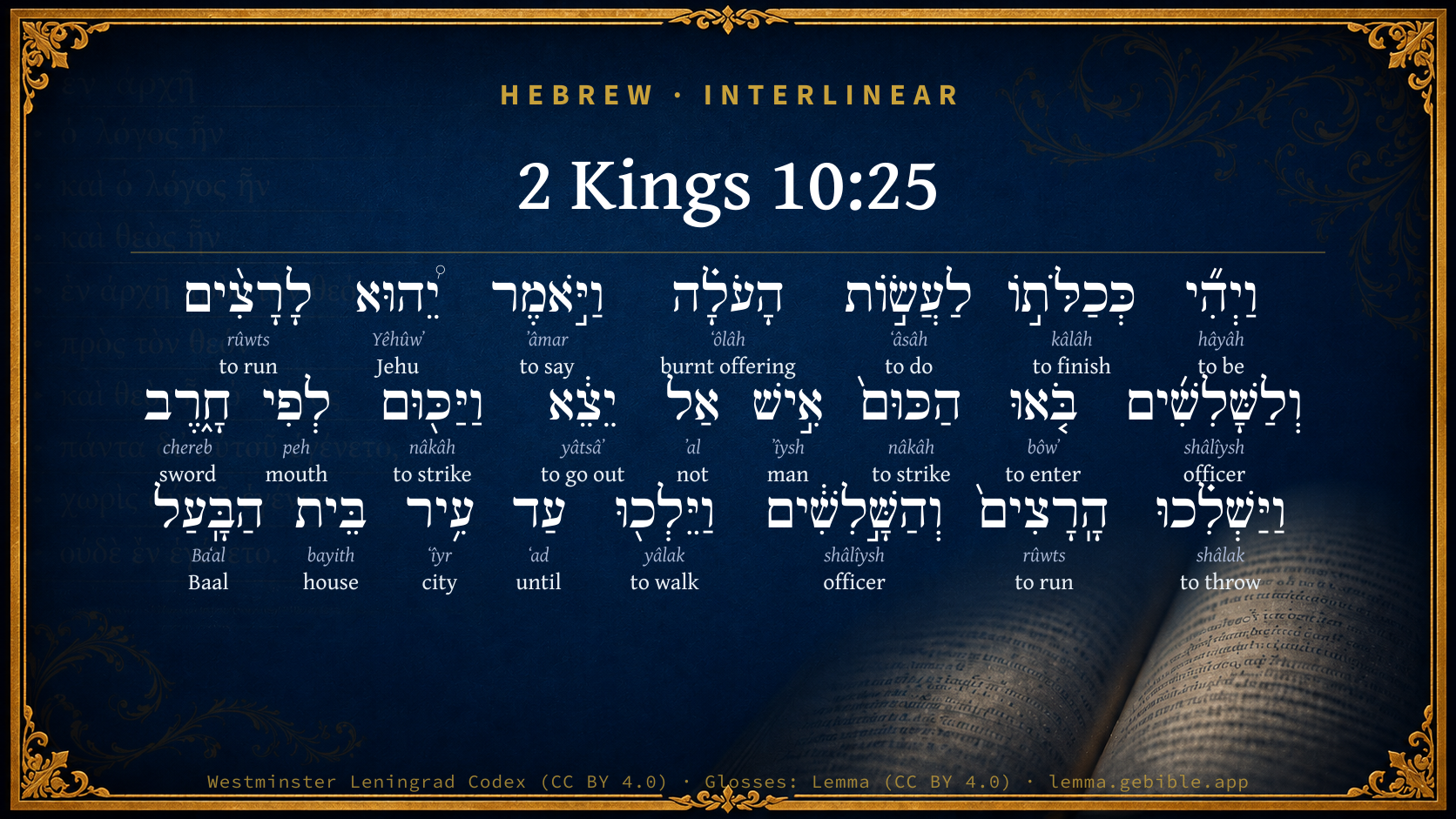
Hebrew (Westminster Leningrad Codex) 2 Kings 10:25 appears in the Hebrew Old Testament. The text above is from the Westminster Leningrad Codex. Each word links to its Strong’s number, a concise gloss, and parsing drawn from the Open Scriptures Hebrew Bible morphology. Click any word for its full Brown-Driver-Briggs (BDB) entry.
Download image
Cite this verse

2 Kings 10:25 (World English Bible). Public Domain. Lemma interlinear Bible study tool, https://lemma.gebible.app/v/2-kings/10/25.

Show BibTeX & RIS
BibTeX
RIS
English Translation
It happened, as soon as he had made an end of offering the burnt offering, that Jehu said to the guard and to the captains, Go in, and kill them; let none come forth. They struck them with the edge of the sword; and the guard and the captains cast them out, and went to the city of the house of Baal.
World English Bible · Public Domain
Download a study sheet

One document with this verse’s original text, its word-by-word gloss line, the meaning frame, cross-references with their text, attributed commentary, and full source and license credits — printable, and it pastes into notes with its structure intact.

This verse Autodidact and up

Study sheet (.html) Plain text (.txt)

A passage Seminary Student

Up to 50 verses in one chapter. A passage sheet keeps up to 6 commentary sources and 12 cross-references per verse, in the order this page ranks them, and says so on the sheet whenever that leaves anything out. Ask for a single verse and you get the Autodidact verse sheet above.

Everything on this page stays free to read, with no account — the sheet is a download of what is already on screen, not access to it.

Want to remove ads? Support Godless Engineer
Compare translations 3

The same verse in 3 English versions, stacked beneath the original-language interlinear above. Click any original word for its lexicon entry.

Each is an independent rendering of the whole verse — the interlinear is not word-aligned to these translations.

Highlighted words mark where these versions differ — a whole-verse word diff, not a word-by-word alignment.

  • World English Bible Public Domain
    It happened, as soon as he had made an end of offering the burnt offering, that Jehu said to the guard and to the captains, Go in, and kill them; let none come forth. They struck them with the edge of the sword; and the guard and the captains cast them out, and went to the city of the house of Baal.
  • King James Version Public Domain
    And it came to pass, as soon as he had made an end of offering the burnt offering, that Jehu said to the guard and to the captains, Go in, and slay them; let none come forth. And they smote them with the edge of the sword; and the guard and the captains cast them out, and went to the city of the house of Baal.
  • unfoldingWord Literal Text CC BY-SA 4.0
    And it happened, when he finished making the burnt offering, that Jehu said to the runners and to the captains, “Go, strike them! Let not a man go out!” And they struck them to the mouth of the sword, and the runners and the captains threw, and they went to the city of the house of Baal.

unfoldingWord Literal Text — © unfoldingWord, licensed CC BY-SA 4.0. Word-aligned USFM3 via Door43 (git.door43.org/unfoldingWord/en_ult).

Versions to compare (up to 4)

3 of 4 selected

Show all 18 translations

Every available English version of this verse, each an independent rendering of the whole verse.

  • World English Bible Public Domain
    It happened, as soon as he had made an end of offering the burnt offering, that Jehu said to the guard and to the captains, Go in, and kill them; let none come forth. They struck them with the edge of the sword; and the guard and the captains cast them out, and went to the city of the house of Baal.
  • Berean Standard Bible Public Domain
    When he had finished making the burnt offering, Jehu said to the guards and officers, “Go in and kill them. Do not let anyone out.” So the guards and officers put them to the sword, threw the bodies out, and went into the inner room of the temple of Baal.
  • Majority Standard Bible Public Domain
    When he had finished making the burnt offering, Jehu said to the guards and officers, “Go in and kill them. Do not let anyone out.” So the guards and officers put them to the sword, threw the bodies out, and went into the inner room of the temple of Baal.
  • King James Version Public Domain
    And it came to pass, as soon as he had made an end of offering the burnt offering, that Jehu said to the guard and to the captains, Go in, and slay them; let none come forth. And they smote them with the edge of the sword; and the guard and the captains cast them out, and went to the city of the house of Baal.
  • American Standard Version (1901) Public Domain
    And it came to pass, as soon as he had made an end of offering the burnt-offering, that Jehu said to the guard and to the captains, Go in, and slay them; let none come forth. And they smote them with the edge of the sword; and the guard and the captains cast them out, and went to the city of the house of Baal.
  • Revised Version (1885) Public Domain
    And it came to pass, as soon as he had made as end of offering the burnt offering, that Jehu said to the guard and to the captains, Go in, and slay them; let none come forth. And they smote them with the edge of the sword; and the guard and the captains cast them out, and went to the city of the house of Baal.
  • Geneva Bible (1599) Public Domain
    And when hee had made an ende of the burnt offring, Iehu sayde to the garde, and to the captaines, Goe in, slay them, let not a man come out. And they smote them with the edge of the sworde. And the garde, and the captaines cast them out, and went vnto the citie, where was the temple of Baal.
  • Douay-Rheims (1899) Public Domain
    And it came to pass, when the burnt offering was ended, that Jehu commanded his soldiers and captains, saying: Go in, and kill them, let none escape. And the soldiers and captains slew them with the edge of the sword, and cast them out: and they went into the city of the temple of Baal,
  • Young's Literal Translation Public Domain
    And it cometh to pass at his finishing to make the burnt-offering, that Jehu saith to the runners, and to the captains, `Go in, smite them, let none come out;' and they smite them by the mouth of the sword, and the runners and the captains cast `them' out; and they go unto the city, to the house of Baal,
  • Literal Standard Version CC BY-SA 4.0
    And it comes to pass, at his finishing to make the burnt-offering, that Jehu says to the runners and to the captains, “Go in, strike them, let none come out”; and they strike them by the mouth of the sword, and the runners and the captains cast [them] out; and they go to the city, to the house of Ba‘al,
  • Unlocked Literal Bible CC BY-SA 4.0
    So then as soon as Jehu finished offering the burnt offering, he said to the guard and to the captains, “Go in and kill them. Let no one come out.” So they killed them with the edge of the sword, and the guard and the captains threw them out and went into the inner room of the house of Baal.
  • unfoldingWord Literal Text CC BY-SA 4.0
    And it happened, when he finished making the burnt offering, that Jehu said to the runners and to the captains, “Go, strike them! Let not a man go out!” And they struck them to the mouth of the sword, and the runners and the captains threw, and they went to the city of the house of Baal.
  • Darby Bible Public Domain
    And it came to pass as soon as they had ended offering up the burnt-offering, that Jehu said to the couriers and to the captains, Go in, slay them; let none come forth. And they smote them with the edge of the sword; and the couriers and the captains cast [them] there. And they went to the city of the house of Baal,
  • World Messianic Bible Public Domain
    As soon as he had finished offering the burnt offering, Jehu said to the guard and to the captains, “Go in and kill them! Let no one escape.” So they struck them with the edge of the sword. The guard and the captains threw the bodies out, and went to the inner shrine of the house of Baal.
  • Webster's Bible Public Domain
    And it came to pass, as soon as he had made an end of offering the burnt-offering, that Jehu said to the guard and to the captains, Go in, and slay them; let none come forth. And they smote them with the edge of the sword; and the guard and the captains cast them out, and went to the city of the house of Baal.
  • Free Bible Version CC BY-SA 4.0
    As soon as Jehu had finished presenting the burnt offering, he ordered his guards and officers, “Go in and kill them all! Don't let even one escape!” So they killed them with their swords. The guards and officers threw their bodies outside, and then they went into the inner sanctuary of the temple of Baal.
  • Bible in Basic English Public Domain
    Then when the burned offering was ended, straight away Jehu said to the armed men and the captains, Go in and put them to death; let not one come out. So they put them to the sword; and, pulling the images to the earth, they went into the holy place of the house of Baal.
  • JPS Tanakh (1917) Public Domain
    And it came to pass, as soon as he had made an end of offering the burnt-offering, that Jehu said to the guard and to the captains: 'Go in, and slay them; let none come forth.' And they smote them with the edge of the sword; and the guard and the captains cast them out, and went to the city of the house of Baal.

Literal Standard Version (2020), Covenant Press — licensed CC BY-SA 4.0. Text via the HelloAO Bible API (eBible.org). Unlocked Literal Bible (unfoldingWord) — licensed CC BY-SA 4.0. Text via the HelloAO Bible API (eBible.org). unfoldingWord Literal Text — © unfoldingWord, licensed CC BY-SA 4.0. Word-aligned USFM3 via Door43 (git.door43.org/unfoldingWord/en_ult). Free Bible Version, Dr. Jonathan Gallagher — licensed CC BY-SA 4.0. Text via the HelloAO Bible API (eBible.org).

Word by word

More ways to search: Search by grammar → Find every occurrence → Compare this word →

Practice this passage: Drill this verse → Learn its vocabulary →

וְלַשָּׁלִשִׁ֜ים
shâlîysh
H7991
“and · to/for the · officers”
Conjunction + Preposition, Determined + Noun, Common, Masculine, Plural, Absolute
Part of Speech
Conjunction + Preposition + Noun
Type
Common
Gender
Masculine
Number
Plural
State
Absolute
Full BDB Definition

Origin: from H7969

TWOT: 2403e , 2403f , 2403g

third part - name of a measure - a musical instrument - maybe three-stringed, triangular shape, or three-barred - perhaps a sistrum or triangle - shield carrier, adjutant, officer, captain
  1. וַיְהִ֞י hâyâh H1961 “and · to be” Conjunction + Verb, Qal, Sequential Imperfect, 3rd Person, Masculine, Singular
  2. כְּכַלֹּת֣וֹ kâlâh H3615 “like/as · to finish · him” Preposition + Verb, Piel, Infinitive Construct + Suffix, Personal, 3rd Person, Masculine, Singular
  3. לַעֲשׂ֣וֹת ʻâsâh H6213 “to do” Preposition + Verb, Qal, Infinitive Construct
  4. הָעֹלָ֗ה ʻôlâh H5930 “the · burnt offering” Particle, Definite Article + Noun, Common, Feminine, Singular, Absolute
  5. וַיֹּ֣אמֶר ʼâmar H559 “and · to say” Conjunction + Verb, Qal, Sequential Imperfect, 3rd Person, Masculine, Singular
  6. יֵ֠הוּא Yêhûwʼ H3058 “Jehu” Noun, Proper
  7. לָרָצִ֨ים rûwts H7323 “to/for the · running” Preposition, Determined + Verb, Qal, Participle Active, Masculine, Plural, Absolute
  8. בֹּ֤אוּ bôwʼ H935 “enter” Verb, Qal, Imperative, 2nd Person, Masculine, Plural
  9. הַכּוּם֙ nâkâh H5221 “strike · them” Verb, Hiphil, Imperative, 2nd Person, Masculine, Plural + Suffix, Personal, 3rd Person, Masculine, Plural
  10. אִ֣ישׁ ʼîysh H376 “man” Noun, Common, Masculine, Singular, Absolute
  11. אַל ʼal H408 “not” Particle, Negative
  12. יֵצֵ֔א yâtsâʼ H3318 “to go out” Verb, Qal, Jussive, 3rd Person, Masculine, Singular
  13. וַיַּכּ֖וּם nâkâh H5221 “and · to strike · them” Conjunction + Verb, Hiphil, Sequential Imperfect, 3rd Person, Masculine, Plural + Suffix, Personal, 3rd Person, Masculine, Plural
  14. לְפִי peh H6310 “to/for · mouth of” Preposition + Noun, Common, Masculine, Singular, Construct
  15. חָ֑רֶב chereb H2719 “sword” Noun, Common, Feminine, Singular, Absolute
  16. וַיַּשְׁלִ֗כוּ shâlak H7993 “and · to throw” Conjunction + Verb, Hiphil, Sequential Imperfect, 3rd Person, Masculine, Plural
  17. הָֽרָצִים֙ rûwts H7323 “the · running” Particle, Definite Article + Verb, Qal, Participle Active, Masculine, Plural, Absolute
  18. וְהַשָּׁ֣לִשִׁ֔ים shâlîysh H7991 “and · the · officers” Conjunction + Particle, Definite Article + Noun, Common, Masculine, Plural, Absolute
  19. וַיֵּלְכ֖וּ yâlak H3212 “and · to walk” Conjunction + Verb, Qal, Sequential Imperfect, 3rd Person, Masculine, Plural
  20. עַד ʻad H5704 “until” Preposition
  21. עִ֥יר ʻîyr H5892 “city of” Noun, Common, Feminine, Singular, Construct
  22. בֵּית bayith H1004 “house of” Noun, Common, Masculine, Singular, Construct
  23. הַבָּֽעַל Baʻal H1168 “the · Baal” Particle, Definite Article + Noun, Proper

About this verse

These counts appear in no published source. They are computed here, from the morphology-tagged text and Lemma’s own curated glosses. What Lemma adds →

24
words
21
distinct lemmas
Historical
section

Notable vocabulary

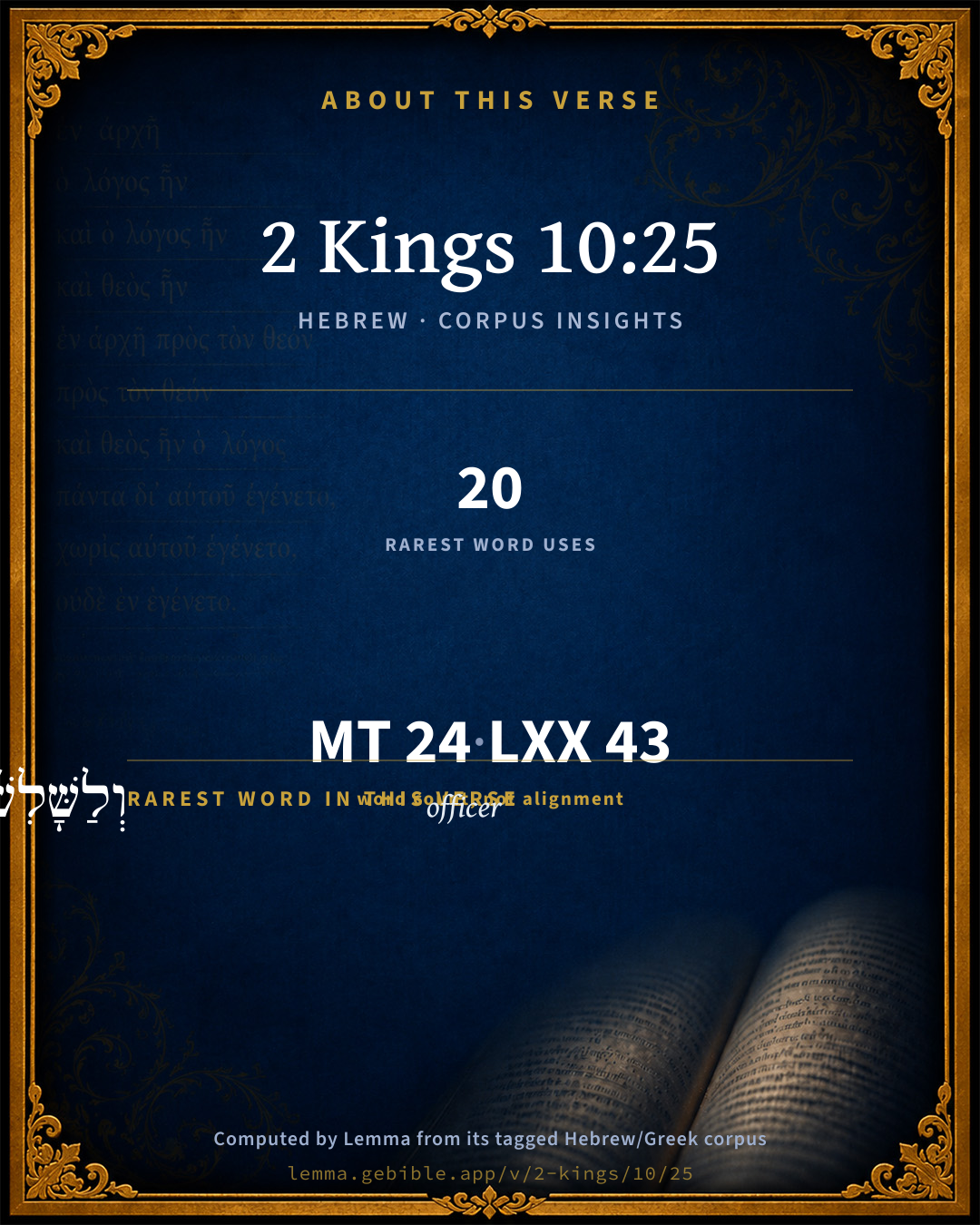
The rarest word here is וְלַשָּׁלִשִׁ֜ים officer H7991 — appearing just 20 times in the whole Hebrew Bible.

Shared distinctive vocabulary

וְלַשָּׁלִשִׁ֜ים officer H7991 occurs in 18 verses of the Hebrew Bible. Also found in:

Grammatical profile

  • 12 verbs
  • 10 nouns
  • 1 preposition
  • 1 particle

Verb forms

  • וַיְהִ֞י Qal · Sequential Imperfect
  • כְּכַלֹּת֣וֹ Piel · Infinitive Construct
  • לַעֲשׂ֣וֹת Qal · Infinitive Construct
  • וַיֹּ֣אמֶר Qal · Sequential Imperfect
  • לָרָצִ֨ים Qal · Participle Active
  • בֹּ֤אוּ Qal · Imperative
  • הַכּוּם֙ Hiphil · Imperative
  • יֵצֵ֔א Qal · Jussive
  • וַיַּכּ֖וּם Hiphil · Sequential Imperfect
  • וַיַּשְׁלִ֗כוּ Hiphil · Sequential Imperfect
  • הָֽרָצִים֙ Qal · Participle Active
  • וַיֵּלְכ֖וּ Qal · Sequential Imperfect

Repetition

Words recur within this verse — often emphatic in Hebrew:

  • לָרָצִ֨ים to run H7323 ×2
  • וְלַשָּׁלִשִׁ֜ים officer H7991 ×2
  • הַכּוּם֙ to strike H5221 ×2

Hebrew & Septuagint length

In English translation the verse runs 62 words from the Hebrew and 67 from the Septuagint (LXX English) — closely comparable.

A rough comparison of the two English renderings, which tokenize alike — not a word-level alignment.

Word counts can differ between the Hebrew and the Greek without any difference in meaning — e.g. the Hebrew direct-object marker אֵת has no separate Greek word, and Greek often adds the article ὁ.

In the original languages it is 24 Hebrew tokens and 43 Greek tokens — but the two are counted differently (Hebrew bundles its prefixes and suffixes into one token; the Greek is in lemma form), so that isn’t a like-for-like length.

Cross-references

6

Topical passages linked to 2 Kings 10:25 in the Treasury of Scripture Knowledge — connected by theme and wording, ordered by reader-vote popularity; previews shown in the World English Bible.

  • Revelation 16:6–7 For they poured out the blood of the saints and the prophets, and you have given them blood to drink. They deserve this."
  • 1 Kings 18:40 and Elijah said to them, Take the prophets of Baal; don't let one of them escape. They took them; and Elijah brought them down to the brook Kishon, and killed them there.
  • Ezekiel 22:21–22 Yes, I will gather you, and blow on you with the fire of my wrath, and you shall be melted in the midst of it.
  • Exodus 32:27 He said to them, "Thus says Yahweh, the God of Israel, 'Every man put his sword on his thigh, and go back and forth from gate to gate throughout the camp, and every man kill his brother, and every man his companion, and every man his neighbor."
  • Deuteronomy 13:6–11 If your brother, the son of your mother, or your son, or your daughter, or the wife of your bosom, or your friend, who is as your own soul, entice you secretly, saying, Let us go and serve other gods, which you have not known, you, nor your fathers;
  • Ezekiel 9:5–7 To the others he said in my hearing, Go you through the city after him, and strike: don't let your eye spare, neither have you pity;

Cross-references courtesy of OpenBible.info (CC BY 4.0).

Hebrew and Greek witnesses Masoretic Hebrew ↔ Greek Septuagint

The same verse in the two great witnesses to the Old Testament, shown verse-for-verse.

These are two independent witnesses, not word-aligned to each other, and the Septuagint is shown in lemma (dictionary) form.

Hebrew 2 Kings 10:25 Masoretic · Westminster Leningrad Codex

וַיְהִ֞י כְּכַלֹּת֣וֹ לַעֲשׂ֣וֹת הָעֹלָ֗ה וַיֹּ֣אמֶר יֵ֠הוּא לָרָצִ֨ים וְלַשָּׁלִשִׁ֜ים בֹּ֤אוּ הַכּוּם֙ אִ֣ישׁ אַל יֵצֵ֔א וַיַּכּ֖וּם לְפִי חָ֑רֶב וַיַּשְׁלִ֗כוּ הָֽרָצִים֙ וְהַשָּׁ֣לִשִׁ֔ים וַיֵּלְכ֖וּ עַד עִ֥יר בֵּית הַבָּֽעַל

It happened, as soon as he had made an end of offering the burnt offering, that Jehu said to the guard and to the captains, Go in, and kill them; let none come forth. They struck them with the edge of the sword; and the guard and the captains cast them out, and went to the city of the house of Baal.

World English Bible · Public Domain

Greek LXX 2 Kings 10:25 Septuagint · lemma form

καί γίγνομαι ὡς συντελέω ποῖος ὁ ὁλοκαύτωσις καί εἶπον ιου ὁ παρατρέχω καί ὁ τριστάτης εἰςἔρχομαι πατάσσω αὐτός ἀνήρ μή ἐκἔρχομαι ἐκ αὐτός καί πατάσσω αὐτός ἐν στόμα ῥομφαία καί ῥίπτω ὁ παρατρέχω καί ὁ τριστάτης καί πορεύομαι ἕως πόλις οἶκος ὁ βααλ

And it came to pass, when he had finished offering the whole burnt offering, that Ju said to the footmen and to the officers, Go you⌃ in and kill them; let not a man of them escape. So they struck them with the edge of the sword, and the footmen and the officers cast the bodies forth, and went to the city of the house of Baal.

LXX2012 (modern English Septuagint) · Public Domain

Hebrew: Westminster Leningrad Codex (CC BY 4.0). Greek: Septuagint (public domain); English from LXX2012 (modern English Septuagint) (Public Domain). How the Septuagint differs from the Hebrew →

Targum (Aramaic paraphrase)

1

The Targum is the ancient Jewish Aramaic paraphrase of the Hebrew Scriptures — an interpretive translation, not the Hebrew text itself. Onkelos (literal) and Pseudo-Jonathan (expansive) render the Torah, and Jonathan the Prophets. Coverage is partial: where no permissively-licensed English translation exists for a verse, only the Aramaic is shown. This is verse-level text, not a word-by-word alignment to the Hebrew.

  1. Targum Jonathan Prophets (Joshua–Malachi)
    וַהֲוָה כַד שֵׁיצֵי לְמֶעְבַּד עֲלָתָא וַאֲמַר יֵהוּא לְרָהֲטַיָא וּלְגִבָּרַיָא עוּלוּ מְחוֹנוּן אֱנַשׁ לָא יִפּוֹק וּמְחוֹנוּן לְפִתְגַם דְחָרֶב וּרְמוֹ רָהֲטַיָא וְגִבָּרַיָא קְטִילִין וַאֲזַלוּ עַד קִרְיַת בֵּית בְּעָלָא:

    (no public-domain English translation for this verse)

    Targum Jonathan — Aramaic: “Mikraot Gedolot” (public domain). English: “Sefaria Community Translation” (CC0 1.0 (public-domain dedication)); “London "Chaldee Paraphrase," 1871” (public domain). Text via Sefaria.

Commentary

Notes on 2 Kings 10:25 from classic Christian and Jewish commentators (each source and its license shown beneath its notes). The classic Christian expositions comment on the surrounding passage and are grouped to its opening verse, so a note may address several verses; the Jewish commentaries on the Tanakh (Rashi and others) are per-verse, so they appear only where the commentator wrote on this verse.

Lemma curates 59 commentaries, every one of them public domain or Creative Commons licensed, each selected and text-cleaned for this edition rather than reprinted as found. About our sources →

Trapp's Complete Commentary

John Trapp

2Ki 10:25 And it came to pass, as soon as he had made an end of offering the burnt offering, that Jehu said to the guard and to the captains, Go in, [and] slay them; let none come forth. And they smote them with the edge of the sword; and the guard and the captains cast [them] out, and went to the city of the house of Baal.

Ver. 25. Go in, and slay them.] This was lawful and warrantable; for idolaters were to die by the law. But the poor Protestants in France have been oft served in like sort by the Guises and other bloody persecutors, against all right and reason.

And went to the city of the house of Baal.] That is, To a certain city near to Samaria, where Baal had a choice temple, saith Vatablus.

John Trapp, A Commentary or Exposition upon All the Books of the Old and New Testament (1647–1656) — public domain. Text from a community e-Sword module.

Tyndale Open Study Notes

Tyndale Open Resources

10:25-26 innermost fortress . . . sacred pillar: Canaanite temples contained a recessed place in the wall that held an image of a sacred stone. The temple of Baal in Samaria contained a sacred altar to Baal and an Asherah pole that Jehu’s men destroyed. Josiah’s later purge of Baal worship in Judah similarly involved burning and demolishing the Asherah pole in the Temple in Jerusalem (23:6).

Tyndale Open Study Notes — © Tyndale Open Resources, licensed CC BY-SA 4.0. Text via the HelloAO Bible API.

Geneva Bible (1599)

Geneva Bible translators

Which city was near to Samaria.

Geneva Bible (1599) marginal notes — public domain. Text via Bolls.life.

Adam Clarke's Commentary

Verse 25. As soon as he had made an end of offering] Had Jehu been a man of any conscientious principle in religion, he would have finished the tragedy before he offered the burnt-offering; but to a man of no religion, the worship of Jehovah and of Baal are alike. If he prefers either, it is merely as a statesman, for political purposes.

To the guard and to the captains] לרצים ולשלשים leratsim uleshalashim; to the couriers or runners, and the shalashim, the men of the third rank, those officers who were next to the nobles, the king and these being only their superiors. The runners were probably a sort of light infantry.

The city of the house of Baal.] Does not this mean a sort of holy of holies, where the most sacred images of Baal were kept? A place separated from the temple of Baal, as the holy of holies in the temple of Jehovah was separated from what was called the holy place.

Adam Clarke's Commentary on the Bible (1810–1826) — public domain. Text from a community e-Sword/MySword module.

Ellicott's Commentary for English Readers

(25) As soon as he had made an end.—The Syriac has, when they (i.e., the Baal priests) had made an end. This is probably right. (Comp. the beginning of 2Ki_10:24). We can hardly suppose with Ewald that Jehu personally offered sacrifices in the character of an ardent Baal-worshipper. For the massacre Jehu chose the moment when all the assembly was absorbed in worship.

To the guard and to the captains.—Literally, to the runners (or couriers) and to the adjutants (or squires; 2Ki_9:25). (Comp. 1Ki_9:22.) The royal guardsmen and their officers are meant.

Cast them out.—That is, threw the dead bodies out of the temple. This is the explanation of the Targum and the other versions. Thenius asks why this should be specially mentioned, and proposes to understand the verb intransitively, “rushed out,” which suits very well with what follows.

And went to the city of the house of Baal.—The word city has here its original meaning, which is also that of the Greek πόλις—viz., citadel, stronghold; properly, a place surrounded by a ring-fence or rampart. Jehu’s guards, after the completion of their bloody work in the court of the temple, rushed up the steps into the sanctuary itself, which, like the temple of Solomon, resembled a fortress. (“Ex atrio irruperunt satellites Jehu in ipsam arcem templi.”—Sebastian Schmidt.) Gesenius explains the word as meaning the temenos or sacred enclosure of the temple, but that does not suit the context. (The origin of the word ‘îr, “city,” obscure in Hebrew, is revealed by the cuneiform inscriptions in the Accadian word erim or eri, meaning “foundation,” and Uru—i.e., Ur, a proper name, meaning “the city.”)

A Bible Commentary for English Readers, edited by Charles John Ellicott (1878–1897) — public domain. Text from a community e-Sword module.

The Cambridge Bible for Schools and Colleges

gen. ed. J. J. S. Perowne

25. as soon as he had made an end of offering] That is, when the priests had completed the offering. We are not to suppose that Jehu himself acted as priest on the occasion, only as he had been the convoker of the solemn assembly, the whole ceremony is referred to him.

Jehu said to the guard] The ‘guard’ is that body of ‘runners’ which appears in the history as soon as a king was appointed, and which played a part in all state parade. Thus both Adonijah and Absalom provided them with ‘fifty men to run before them’ when they aspired to the throne (2Sa_15:1; 1Ki_1:5). They are first spoken of in 1Sa_22:17, where the text of A.V. gives ‘footmen’ (R.V. guard) with ‘runners’ or ‘guard’ in the margin. Such men must necessarily be of great physical strength, and so well suited to do Jehu’s work on this occasion:

cast them out] There is no pronoun expressed in the Hebrew. And it is not easy to see why the dead bodies should have been cast out of a place which they wished to be thoroughly defiled. Hence it has been thought that the ‘casting’ here spoken of refers only to the throwing aside the dead to make their way through the courts towards the central portion of the building, where probably the more important sacrificing priests were stationed.

and went to the city of the house of Baal] The word rendered ‘city’ is applied to smaller enclosures than we usually understand by it now, and seems here to indicate some principal part of the temple edifice. In illustration of the use of this word for some small place, see Num_13:19, ‘What cities they be that they dwell in, whether in tents or in strongholds’. So too the desolate daughter of Zion is compared (Isa_1:8) to ‘a cottage in a vineyard, a lodge in a garden of cucumbers’, and then, in parallelism with these figures, to ‘a besieged city’. In such passages also as Gen_4:17 city can only signify some solid substantial dwelling-place in distinction to the tents of the nomad population.

For a similar change of sense we may compare our English word ‘town’, which in the earliest English tûn (and in Icelandic still) signifies an enclosure, generally a farm-stead with the necessary outbuildings surrounded by one fence.

The Cambridge Bible for Schools and Colleges (gen. ed. J. J. S. Perowne; Cambridge University Press, 1878–1918) — public domain. Text from a community e-Sword module.

John Gill's Exposition

And it came to pass, as soon as he had made an end of offering the burnt offering,.... The chief of the priests of Baal, whose office it was to do this service:

that Jehu said to the guard, and to the captains, go in and slay them, let none come forth; this he said to the eighty men set to guard the temple, and the officers over them; and perhaps they might also have a reinforcement, since such a number seems scarcely sufficient to destroy so many as were here; though indeed it must be considered they were armed men:

and they smote them with the edge of the sword; put them all to death:

and the guard and the captains cast them out; those that were slain, as the Targum, their dead bodies; but it can hardly be thought they would be at the trouble of casting them out, when the house was to be pulled down, and made a jakes (a common sewer or dung house) of, as follows; rather therefore it should be rendered, "they cast" or "flung themselves" (u) with great force, and in great haste, as Kimchi, and rushed out of the temple, being eager to do as follows:

and went to the city of the house of Baal; to pull it down; to some city near Samaria where was a temple of Baal; or rather this may design the buildings about the temple of Baal, in which the priests and their families lived, and were so large that they might be called a city of themselves.

(u) "et proripuerunt se", De Dicu.

John Gill's Exposition of the Whole Bible (1746–1763) — public domain (CC PDM 1.0). Text via the HelloAO Bible API.

Albert Barnes' Notes on the Bible

As soon as he had made an end of offering - The actual sacrificers were no doubt the priests of Baal; but Jehu is considered to have made the offering, since he furnished the victims. Compare 1Ki 8:62-63.

The guard - literally, “the runners.” This name seems to have been given to the royal body-guard as early as the time of Saul (1Sa 22:17, margin). It was their duty to run by the side of the king’s chariot as he moved from plaze to place.

Cast them out, and went - Rather, “the captains hasted and went,” or “went hastily;” which gives a satisfactory sense. That the soldiers should have troubled themselves to cast the bodies of the slain out of the temple enclosure is very unlikely.

The city of the house of Baal - i. e., the temple itself, as distinguished from the court in which it stood, is intended. The guard having slain all who were in the court, rushed on and entered the sanctuary, there no doubt completing the massacre, and further tearing down and bringing out the sacred objects mentioned in the next verse.

Albert Barnes' Notes on the Bible (1834–1885) — public domain. Text from a community e-Sword/MySword module.

Haydock's Catholic Bible Commentary

Soldiers. Hebrew, "runners, (or foot-guards, 3 Kings i. 5,) and chief officers," Exodus xiv. 7. --- Out. Hebrew, "cast out" their carcasses, or "rushed out (themselves) into the city," which was styled "the temple of Baal;" or "penetrated into the fortress" and inmost recesses of that structure. (Osiander.) --- We read of such a fortress, Judges ix. 46. (Haydock) --- In every city where there was a temple of Baal, the fabric and idols were demolished. (Salien)

George Leo Haydock (1774–1849), Haydock's Catholic Family Bible and Commentary, 1859 edition — public domain. Excludes Psalms (Douay-Rheims chapter numbering differs from Protestant) and Deuterocanonical books (Catholic canon only).

Matthew Poole's English Annotations

As soon as he, i.e. the chief priest of Baal: see 2Ch 23:17.

Made an end of offering the burnt-offerings; so far he suffered them to proceed; either because till then they were not all come into the house; or because having been taken in the very act of gross idolatry, their destruction was more just and reasonable.

To the guard, and to the captains, i.e. to the fourscore men and their officers.

Cast them out, i.e. cast their carcasses out of the city. But that was not proper work for the guard; nor could they so soon have done it; nor would they stay to do it, when they were going in haste to other work; nor indeed was it necessary to be done, because they intended to pull down the house, and bury them in its ruins, and turn it into a draught house, as it follows. This word therefore is and may be joined with the next, and both rendered, they went hastily and eagerly; properly, they flung themselves out, (hiphil for hithpahel, which is not unusual in the Hebrew language,) and went. The like expression is used Est 6:12, hasted, Heb. pushed himself on, or flung himself, i.e. went with great haste; and in the Greek text, Mar 14:72.

To the city of the house of Baal; either,

1. To some city near to Samaria, where another eminent temple of Baal was erected. But this seems not to agree with the context, there being but one house or temple of Baal mentioned, both in the foregoing and following verses. Or rather,

2. To some buildings belonging to this house of Baal, which may be here called the city, either for some particular reason now unknown, or because they were very numerous and capacious. For as there were divers chambers and rooms built without the temple, belonging to it, for the use of the priests and Levites, &c.; so it may properly be conceived that this famous temple of Baal had many such buildings, in some of which the priests of Baal, or of the groves, (whereof there were great numbers belonging to the king’s court, 1Ki 18:19) peradventure might dwell; and others of them might be for divers uses belonging to the house and service of Baal. And into these buildings the guard might go, and that hastily, to surprise and kill those inferior ministers of Baal, who were there employed in preparing things for the sacrifices which were to be offered, or in other services belonging to that house, or that solemnity.

Matthew Poole's English Annotations on the Holy Bible (1683–1685) — public domain. Text from a community e-Sword/MySword module.

Whedon's Commentary on the Bible

Daniel D. Whedon

25. He had made an end of offering — Here Jehu himself is said to do what in fact others did at his command. According to 2Ki_10:24 the worshippers of Baal offered the sacrifices, but here the act is attributed to Jehu. So in the popular language of all times and of all nations, what one does by the agency of others he does himself.

The guard and the captains — Literally, the runners and the third men; that is, the the immediate satellites of Jehu, composed of a distinguished and trusty class of warriors.

Cast them out — Cast them out of the temple in which they had been slain the dead bodies of the Baal worshippers.

The city of the house of Baal — Not that quarter of the city of Samaria where the temple of Baal was located, as many of the older interpreters explain; but the citadel, the enclosed inner sanctuary of the temple. The multitude of Baal worshippers assembled, and the sacrifices were offered in the atrium or fore-court of the temple, and there the slaughter took place; after which the victors went into the inner apartment or citadel of the house of Baal, and brought forth the images of the idol.

Daniel D. Whedon (gen. ed.), Commentary on the Old and New Testaments (1874–1909) — public domain. Text from a community e-Sword module.

The Pulpit Commentary

And it came to pass, as soon as he had made an end of offering the burnt offering. It has been concluded from this that Jehu" offered the sacrifices with his own hand, as though he were the most zealous of Baal"s adorers" (Ewald, "History of Israel," vol. 4. p. 100); but the conclusion does not follow necessarily from the expression used. The suffix wO in wOtLOkK may be used indefinitely, "when one finished," or "when they finished;" or Jehu may be said to have made the offerings, because he famished the victims, not because he immolated them with his own hand. Throughout heathendom, wherever there wore priests, it was the duty of the prints to slay the victims offered. That Jehu said to the guard literally, to the runners (see the comment on 1Ki_1:38) and to the captainsi.e. , the officers in command of the guardGo in, and slay them; let none come forth. We must suppose that some guarded the doors, while others advanced into the crowd and struck right and left. The unarmed multitude seems to have made no resistance. And they smote them with the edge of the swordi.e. cut them down unsparingly, smote and slew till none were left aliveand the guard and the captains cast them out. This is generally understood to mean that all the bodies were thrown by the guards out of the temple. Dean Stanley says, "The temple was strewn with corpses, which, "as fast as they fell, the guard and the officers threw out with their own hands" ("Jewish Church," vol. 2. p. 188). But it is not apparent why they should have taken this trouble. Perhaps Bahr is right in suggesting that no more is meant than that the guard and the officers thrust the bodies out of their way, as they pressed forward to enter the sanctuary which contained the sacred images. And went to the city of the house of Baal. "They made their way," as Ewald says, "into the inner sanctuary, the enclosure of which rose like a lofty fortress ry originally meant "fortress where Baal was enthroned, surrounded by the images of his fellow-gods" ("History of Israel," l.s.c.). It is to be remembered that the assembled multitude occupied the court or courts of the temple, within which, in a commanding position, was the "house" or "sanctuary perhaps reserved for the priests only.

The Pulpit Commentary (1880–1919), ed. H.D.M. Spence-Jones & Joseph S. Exell — public domain. Text from a community e-Sword module.

John Wesley's Explanatory Notes

City - To some buildings belonging to this house of Baal, which may be here called the city; because they were very numerous and capacious. For as there were divers chambers and rooms built without the temple, belonging to it, for the use of the priests, and Levites. So it may probably be conceived, That this famous temple of Baal had many such buildings; in some of which, the priests of Baal, or of the groves, (whereof there were great numbers belonging to the king's court, 1 Kings xviii, 19,) peradventure might dwell; and others of them might be for divers uses belonging to the house, and service of Baal.

John Wesley, Explanatory Notes Upon the Whole Bible (1754–1765) — public domain. Text via the GEBible commentary corpus.

Keil & Delitzsch

C. F. Keil & F. Delitzsch

כּכלּתו: when he (the sacrificing priest, not Jehu) had finished the burnt-offering (the singular suffix ו may also be taken as indefinite, when one had finished, vid., Ewald, 294, b.), Jehu commanded the runners and aides-de-camp: Come and smite them (the worshippers of Baal), without one coming out (escaping); whereupon they smote them with the edge of the sword, i.e., slew them unsparingly. ויּשׁליכוּ: and the runners and aides-de-camp threw (those who had been slain) away, and went into the citadel of the temple of Baal. בּית־הבּעל עיר cannot be the city of the temple of Baal, i.e., that part of the city in which the temple of Baal stood, for the runners were already in the court of the temple of Baal; but it is no doubt the temple-citadel, the true temple-house (עיר from עוּר, locus circumseptus) - templum Baalis magnifice exstructum instar arcis alicujus (Seb. Schm.).

Keil & Delitzsch — Biblical Commentary on the Old Testament (1861–1891) — public domain (CC PDM 1.0). Text via the HelloAO Bible API. (Old Testament only.)

unfoldingWord translationNotes

Door43 World Missions Community

he said to the guard and to the captains

You may need to state that Jehu came out of the temple before he spoke to the guard. AT: "he went back outside of the temple of Baal and said to the guards and captains" (See: Assumed Knowledge and Implicit Information)

with the edge of the sword

The men used swords to kill the worshipers of Baal. This phrase refers to their swords. AT: "with their swords" (See: Synecdoche)

threw them out

This means that threw the dead bodies of the people out of the temple. AT: "threw their dead bodies out of the temple" (See: Assumed Knowledge and Implicit Information)

made it a latrine

"made it a public toilet" A latrine is a bathroom, or a toilet area, usually for a camp or buildings used to house soldiers.

which it is to this day

This means that something has remained in a certain condition until the present time. AT: "and since then it has always been that way" (See: Idiom)

translationWords

sword

Baal

column

unfoldingWord translationNotes — © Distant Shores Media and the Door43 World Missions Community, licensed CC BY-SA 4.0. Source: git.door43.org/Door43/en_tn.

Rashi

Rabbi Shlomo Yitzchaki (Rashi)

Threw them out. [Targum Yonoson] (renders), “וְרָמוּ רָהֲטַיָּא וְגַבְרַיָּא קְטִילִין [=and the couriers and the mighty warriors cast cadavers],” they cast down the cadavers of the Baal worshipers.

Rashi on the Tanakh — English translations: “The Judaica Press complete Tanach with Rashi, translated by A. J. Rosenberg” (CC BY 4.0); “Pentateuch with Rashi's commentary by M. Rosenbaum and A.M. Silbermann, 1929-1934” (public domain); “The Metsudah Tanach series, Lakewood, N.J” (CC BY 4.0); and “The Book of Joshua, Metsudah Publications, 1997” (CC BY 4.0). Text via Sefaria.

Lesson kit

Teaching starters — assembled from the data on this page, not authored interpretation. Every prompt links to the verse data it draws on. Edit before teaching.

2 Kings, in the Historical, opens this verse with 24 words (21 distinct Hebrew lemmas). Its most distinctive word is shâlîysh (“officer”). A historical commentator’s framing appears above. Read the whole chapter for the surrounding context.

Discussion questions

  1. What does “officer” (shâlîysh) contribute to the verse as a whole?
  2. Exodus 14:7 shares the word «officer» with this verse. How do the two illuminate each other?
  3. “to run” occurs 2× in this one verse. What is the effect of the repetition?
  4. These translations render this verse differently; the difference is in the English rendering, not the original. What questions does that raise?
  5. The verb «וַיְהִ֞י» is Qal Sequential Imperfect. How does its form color the action?
  6. Reading how Trapp's Complete Commentary and Tyndale Open Study Notes read this verse, where do the two commentators agree and where do they part?

Things to notice

Reading settings

Reading text

Shown beneath each verse's original-language words.

Old Testament
Old Testament edition

Read the OT as the Masoretic Hebrew (MT) or the Greek Septuagint (LXX).

English shown for the Greek Septuagint (in the Hebrew ↔ Greek comparison).

Comparing translations? Open the Compare panel on any verse page to stack up to four side by side.