Numbers 22:29

Hebrew (Westminster Leningrad Codex) Numbers 22:29 appears in the Hebrew Old Testament. The text above is from the Westminster Leningrad Codex. Each word links to its Strong’s number, a concise gloss, and parsing drawn from the Open Scriptures Hebrew Bible morphology. Click any word for its full Brown-Driver-Briggs (BDB) entry.
Download image
Cite this verse

Numbers 22:29 (World English Bible). Public Domain. Lemma interlinear Bible study tool, https://lemma.gebible.app/v/numbers/22/29.

Show BibTeX & RIS
BibTeX
RIS
English Translation
Balaam said to the donkey, Because you have mocked me, I would there were a sword in my hand, for now I had killed you.
World English Bible · Public Domain
Download a study sheet

One document with this verse’s original text, its word-by-word gloss line, the meaning frame, cross-references with their text, attributed commentary, and full source and license credits — printable, and it pastes into notes with its structure intact.

This verse Autodidact and up

Study sheet (.html) Plain text (.txt)

A passage Seminary Student

Up to 50 verses in one chapter. A passage sheet keeps up to 6 commentary sources and 12 cross-references per verse, in the order this page ranks them, and says so on the sheet whenever that leaves anything out. Ask for a single verse and you get the Autodidact verse sheet above.

Everything on this page stays free to read, with no account — the sheet is a download of what is already on screen, not access to it.

Want to remove ads? Support Godless Engineer
Compare translations 3

The same verse in 3 English versions, stacked beneath the original-language interlinear above. Click any original word for its lexicon entry.

Each is an independent rendering of the whole verse — the interlinear is not word-aligned to these translations.

Highlighted words mark where these versions differ — a whole-verse word diff, not a word-by-word alignment.

  • World English Bible Public Domain
    Balaam said to the donkey, Because you have mocked me, I would there were a sword in my hand, for now I had killed you.
  • King James Version Public Domain
    And Balaam said unto the ass, Because thou hast mocked me: I would there were a sword in mine hand, for now would I kill thee.
  • unfoldingWord Literal Text CC BY-SA 4.0
    And Balaam said to the female donkey, “Because you have dealt mockingly with me! If only there were a sword in my hand, for now I would have killed you!”

unfoldingWord Literal Text — © unfoldingWord, licensed CC BY-SA 4.0. Word-aligned USFM3 via Door43 (git.door43.org/unfoldingWord/en_ult).

Versions to compare (up to 4)

3 of 4 selected

Show all 18 translations

Every available English version of this verse, each an independent rendering of the whole verse.

  • World English Bible Public Domain
    Balaam said to the donkey, Because you have mocked me, I would there were a sword in my hand, for now I had killed you.
  • Berean Standard Bible Public Domain
    Balaam answered the donkey, “You have made a fool of me! If I had a sword in my hand, I would kill you right now!”
  • Majority Standard Bible Public Domain
    Balaam answered the donkey, “You have made a fool of me! If I had a sword in my hand, I would kill you right now!”
  • King James Version Public Domain
    And Balaam said unto the ass, Because thou hast mocked me: I would there were a sword in mine hand, for now would I kill thee.
  • American Standard Version (1901) Public Domain
    And Balaam said unto the ass, Because thou hast mocked me, I would there were a sword in my hand, for now I had killed thee.
  • Revised Version (1885) Public Domain
    And Balaam said unto the ass, Because thou hast mocked me: I would there were a sword in mine hand, for now I had killed thee.
  • Geneva Bible (1599) Public Domain
    And Balaam saide vnto the asse, Because thou hast mocked me: I woulde there were a sworde in mine hand, for nowe would I kill thee.
  • Douay-Rheims (1899) Public Domain
    Balaam answered: Because thou hast deserved it, and hast served me ill: I would I had a sword that I might kill thee.
  • Young's Literal Translation Public Domain
    and Balaam saith to the ass, `Because thou hast rolled thyself against me; oh that there were a sword in my hand, for now I had slain thee;'
  • Literal Standard Version CC BY-SA 4.0
    And Balaam says to the donkey, “Because you have rolled yourself against me; oh that there were a sword in my hand, for now I had slain you”;
  • Unlocked Literal Bible CC BY-SA 4.0
    Balaam replied to the donkey, “It was because you acted so stupidly with me. I wish there were a sword in my hand. If there were, by now I would have killed you.”
  • unfoldingWord Literal Text CC BY-SA 4.0
    And Balaam said to the female donkey, “Because you have dealt mockingly with me! If only there were a sword in my hand, for now I would have killed you!”
  • Darby Bible Public Domain
    And Balaam said to the ass, Because thou hast mocked me: I would there were a sword in my hand, for now would I kill thee!
  • World Messianic Bible Public Domain
    Balaam said to the donkey, “Because you have mocked me, I wish there were a sword in my hand, for now I would have killed you.”
  • Webster's Bible Public Domain
    And Balaam said to the ass, Because thou hast mocked me: I would there were a sword in my hand, for now would I kill thee.
  • Free Bible Version CC BY-SA 4.0
    “You made me look stupid!” Balaam told the donkey. “If I was holding a sword, I'd kill you now!”
  • Bible in Basic English Public Domain
    And Balaam said to the ass, You have made me seem foolish: if only I had a sword in my hand I would put you to death.
  • JPS Tanakh (1917) Public Domain
    And Balaam said unto the ass: 'Because thou hast mocked me; I would there were a sword in my hand, for now I had killed thee.'

Literal Standard Version (2020), Covenant Press — licensed CC BY-SA 4.0. Text via the HelloAO Bible API (eBible.org). Unlocked Literal Bible (unfoldingWord) — licensed CC BY-SA 4.0. Text via the HelloAO Bible API (eBible.org). unfoldingWord Literal Text — © unfoldingWord, licensed CC BY-SA 4.0. Word-aligned USFM3 via Door43 (git.door43.org/unfoldingWord/en_ult). Free Bible Version, Dr. Jonathan Gallagher — licensed CC BY-SA 4.0. Text via the HelloAO Bible API (eBible.org).

Word by word

More ways to search: Search by grammar → Find every occurrence → Compare this word →

Practice this passage: Drill this verse → Learn its vocabulary →

הִתְעַלַּ֖לְתְּ
ʻâlal
H5953
“to act severely”
Verb, Hithpael, Perfect, 2nd Person, Feminine, Singular
Part of Speech
Verb
Stem
Hithpael
Form
Perfect
Person
2nd Person
Gender
Feminine
Number
Singular
Full BDB Definition

Origin: a primitive root

TWOT: 1627 , 1627b , 1628

to act severely, deal with severely, make a fool of someone - (Poel) to act severely - (Poal) to be severely dealt with - (Hithpael) to busy oneself, divert oneself, deal wantonly, deal - (Hithpoel) to practise practices, thrust forth (in wickedness) - (Poel) to glean - (Poel) to act or play the child - (Poel) to insert, thrust, thrust in, thrust upon ruthlessly, abuse (by thrusting through)
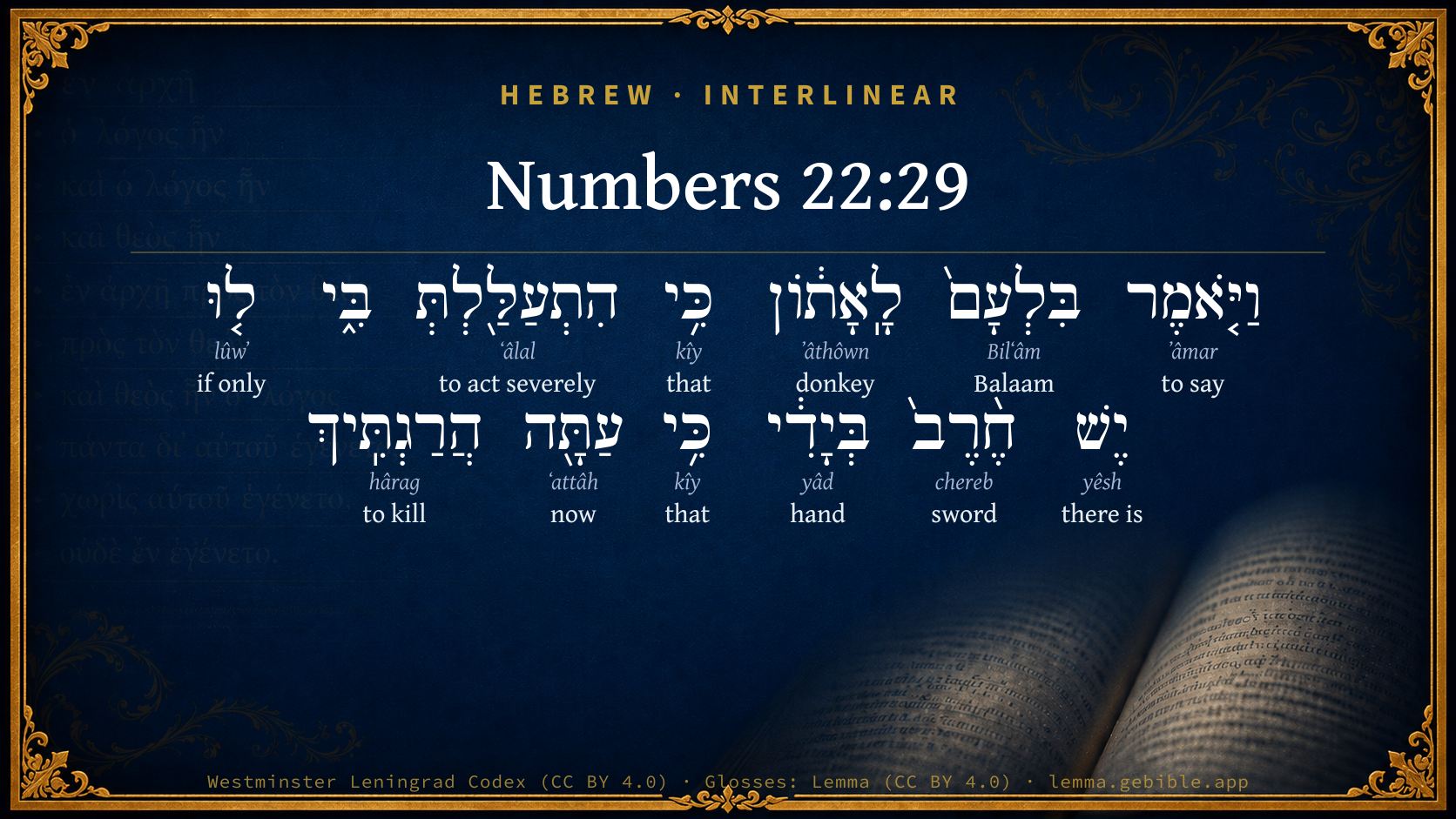
  1. וַיֹּ֤אמֶר ʼâmar H559 “and · to say” Conjunction + Verb, Qal, Sequential Imperfect, 3rd Person, Masculine, Singular
  2. בִּלְעָם֙ Bilʻâm H1109 “Balaam” Noun, Proper
  3. לָֽאָת֔וֹן ʼâthôwn H860 “to/for the · donkey” Preposition, Determined + Noun, Common, Feminine, Singular, Absolute
  4. כִּ֥י kîy H3588 “that” Conjunction
  5. ל֤וּ lûwʼ H3863 “if only” Conjunction
  6. יֶשׁ yêsh H3426 “there is” Particle, Demonstrative
  7. חֶ֨רֶב֙ chereb H2719 “sword” Noun, Common, Feminine, Singular, Absolute
  8. בְּיָדִ֔י yâd H3027 “in/at · hand · my” Preposition + Noun, Common, Both, Singular, Construct + Suffix, Personal, 1st Person, Common, Singular
  9. כִּ֥י kîy H3588 “that” Conjunction
  10. עַתָּ֖ה ʻattâh H6258 “now” Adverb
  11. הֲרַגְתִּֽיךְ hârag H2026 “to kill · you” Verb, Qal, Perfect, 1st Person, Common, Singular + Suffix, Personal, 2nd Person, Feminine, Singular

About this verse

These counts appear in no published source. They are computed here, from the morphology-tagged text and Lemma’s own curated glosses. What Lemma adds →

13
words
11
distinct lemmas
Pentateuch
section

Notable vocabulary

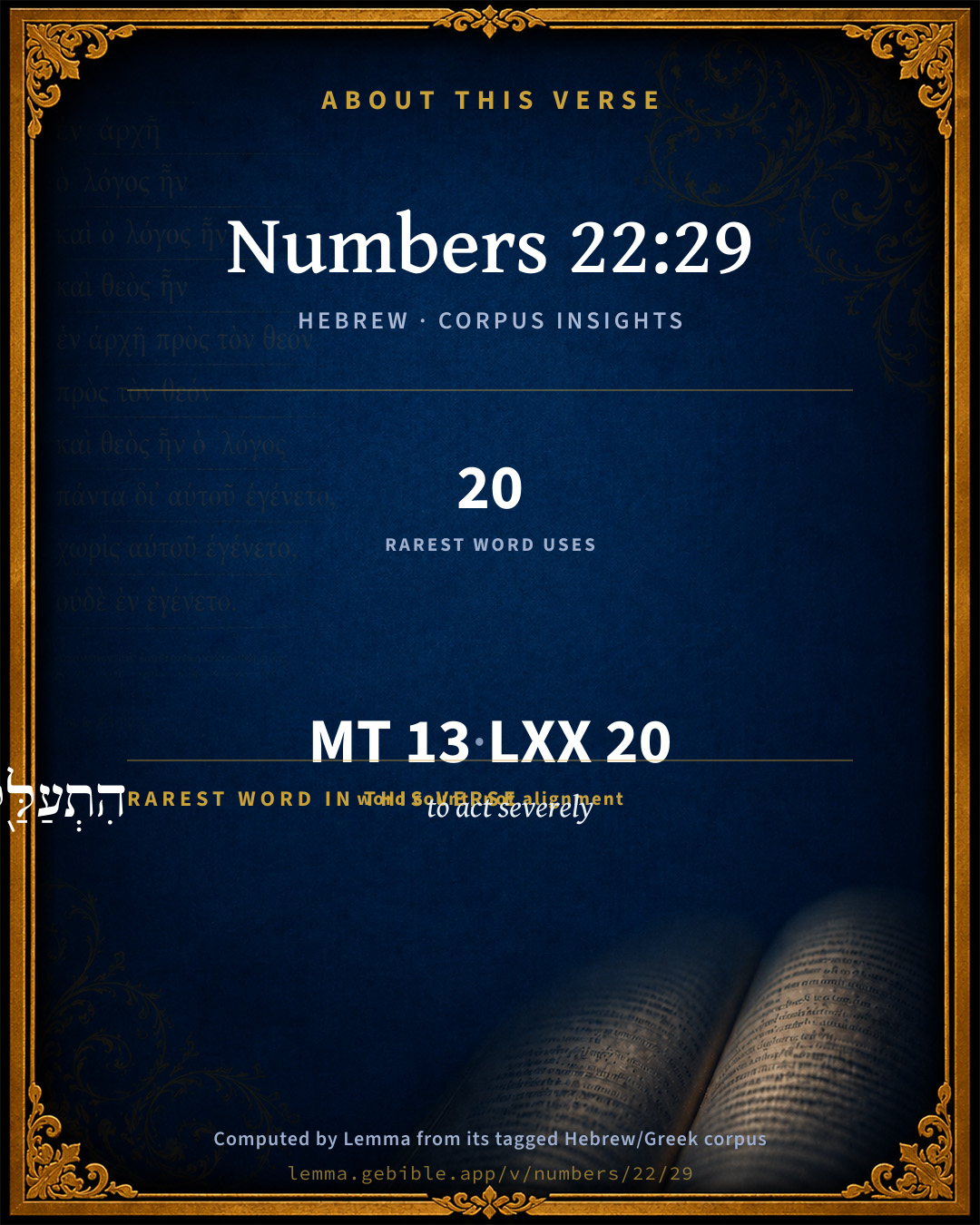
The rarest word here is הִתְעַלַּ֖לְתְּ to act severely H5953 — appearing just 20 times in the whole Hebrew Bible.

Shared distinctive vocabulary

הִתְעַלַּ֖לְתְּ to act severely H5953 occurs in 18 verses of the Hebrew Bible. Also found in:

Grammatical profile

  • 3 verbs
  • 4 nouns
  • 1 preposition
  • 3 conjunctions
  • 1 adverb
  • 1 particle

Verb forms

  • וַיֹּ֤אמֶר Qal · Sequential Imperfect
  • הִתְעַלַּ֖לְתְּ Hithpael · Perfect
  • הֲרַגְתִּֽיךְ Qal · Perfect

Repetition

A word recurs within this verse — often emphatic in Hebrew:

  • כִּ֥י that H3588 ×2

Hebrew & Septuagint length

In English translation the verse runs 25 words from the Hebrew and 27 from the Septuagint (LXX English) — closely comparable.

A rough comparison of the two English renderings, which tokenize alike — not a word-level alignment.

Word counts can differ between the Hebrew and the Greek without any difference in meaning — e.g. the Hebrew direct-object marker אֵת has no separate Greek word, and Greek often adds the article ὁ.

In the original languages it is 13 Hebrew tokens and 20 Greek tokens — but the two are counted differently (Hebrew bundles its prefixes and suffixes into one token; the Greek is in lemma form), so that isn’t a like-for-like length.

Cross-references

4

Topical passages linked to Numbers 22:29 in the Treasury of Scripture Knowledge — connected by theme and wording, ordered by reader-vote popularity; previews shown in the World English Bible.

  • Proverbs 12:10 A righteous man regards the life of his animal, But the tender mercies of the wicked are cruel.
  • Proverbs 12:16 A fool shows his annoyance the same day, But one who overlooks an insult is prudent.
  • Matthew 15:19 For out of the heart come forth evil thoughts, murders, adulteries, sexual sins, thefts, false testimony, and blasphemies.
  • Ecclesiastes 9:3 This is an evil in all that is done under the sun, that there is one event to all: yes also, the heart of the sons of men is full of evil, and madness is in their heart while they live, and after that they go to the dead.

Cross-references courtesy of OpenBible.info (CC BY 4.0).

Hebrew and Greek witnesses Masoretic Hebrew ↔ Greek Septuagint

The same verse in the two great witnesses to the Old Testament, shown verse-for-verse.

These are two independent witnesses, not word-aligned to each other, and the Septuagint is shown in lemma (dictionary) form.

Hebrew Numbers 22:29 Masoretic · Westminster Leningrad Codex

וַיֹּ֤אמֶר בִּלְעָם֙ לָֽאָת֔וֹן כִּ֥י הִתְעַלַּ֖לְתְּ בִּ֑י ל֤וּ יֶשׁ חֶ֨רֶב֙ בְּיָדִ֔י כִּ֥י עַתָּ֖ה הֲרַגְתִּֽיךְ

Balaam said to the donkey, Because you have mocked me, I would there were a sword in my hand, for now I had killed you.

World English Bible · Public Domain

Greek LXX Numbers 22:29 Septuagint · lemma form

καί εἶπον βαλααμ ὁ ὄνος ὅτι ἐνπαίζω ἐγώ καί εἰ ἔχω μάχαιρα ἐν ὁ χείρ ἐγώ ἤδη ἄν ἐκκεντέω σύ

And Balaam said to the ass, Because you have mocked me; and if I had had a sword in my hand, I would now have killed you.

LXX2012 (modern English Septuagint) · Public Domain

Hebrew: Westminster Leningrad Codex (CC BY 4.0). Greek: Septuagint (public domain); English from LXX2012 (modern English Septuagint) (Public Domain). How the Septuagint differs from the Hebrew →

Targum (Aramaic paraphrase)

2

The Targum is the ancient Jewish Aramaic paraphrase of the Hebrew Scriptures — an interpretive translation, not the Hebrew text itself. Onkelos (literal) and Pseudo-Jonathan (expansive) render the Torah, and Jonathan the Prophets. Coverage is partial: where no permissively-licensed English translation exists for a verse, only the Aramaic is shown. This is verse-level text, not a word-by-word alignment to the Hebrew.

  1. Targum Onkelos Torah (Genesis–Deuteronomy)
    וַאֲמַר בִּלְעָם לַאֲתָּנָא אֲרֵי חַיִיכְתְּ בִּי אִלוּפוֹן אִית חַרְבָּא בִּידִי אֲרֵי כְעָן קְטַלְתִּיךְ

    (no public-domain English translation for this verse)

    Targum Onkelos — Aramaic: “Onkelos Genesis” (public domain); “Onkelos Exodus” (public domain); “Onkelos Leviticus” (public domain); “Onkelos Numbers” (public domain); “Onkelos Deuteronomy” (public domain). English: “Sefaria Community Translation” (CC0 1.0 (public-domain dedication)); “J.W. Etheridge. The Targums of Onkelos and Jonathan Ben Uzziel on the Pentateuch. London: Longmans, Green, 1862” (public domain). Text via Sefaria.

  2. Targum Pseudo-Jonathan Torah (Genesis–Deuteronomy)
    וַאֲמַר בִּלְעָם לְאַתְנָא אֲרוּם שְׁקַרְתְּ בִּי אִילוּ אִית סַיְיפָא בִידִי אֲרוּם כְּדוֹן קְטַלְתִּיךְ

    And Bileam said to the ass, Because thou hast been false to me; if there was now but a sword in in hand, I would kill thee.

    Targum Pseudo-Jonathan — Aramaic: “Targum Jonathan on Genesis” (public domain); “Targum Jonathan on Exodus” (public domain); “Targum Jonathan on Leviticus” (public domain); “Targum Jonathan on Numbers” (public domain); “Targum Jonathan on Deuteronomy” (public domain). English: “The Targum of Jonathan ben Uzziel, trans. J. W. Etheridge, London, 1862” (public domain). Text via Sefaria.

Commentary

Notes on Numbers 22:29 from classic Christian and Jewish commentators (each source and its license shown beneath its notes). The classic Christian expositions comment on the surrounding passage and are grouped to its opening verse, so a note may address several verses; the Jewish commentaries on the Tanakh (Rashi and others) are per-verse, so they appear only where the commentator wrote on this verse.

Lemma curates 59 commentaries, every one of them public domain or Creative Commons licensed, each selected and text-cleaned for this edition rather than reprinted as found. About our sources →

Trapp's Complete Commentary

John Trapp

Num 22:29 And Balaam said unto the ass, Because thou hast mocked me: I would there were a sword in mine hand, for now would I kill thee.

Ver. 29. I would there were a sword.] Pity but a madman should have a sword! How much fitter for him were that rod that Solomon speaks of. {Pro 26:3}

John Trapp, A Commentary or Exposition upon All the Books of the Old and New Testament (1647–1656) — public domain. Text from a community e-Sword module.

The Cambridge Bible for Schools and Colleges

gen. ed. J. J. S. Perowne

29. thou hast mocked me] thou hast made sport of me; i.e. purposely caused me annoyance for your own pleasure.

The Cambridge Bible for Schools and Colleges (gen. ed. J. J. S. Perowne; Cambridge University Press, 1878–1918) — public domain. Text from a community e-Sword module.

John Gill's Exposition

And the angel of the Lord said unto him,.... When risen up, and standing before him:

wherefore hast thou smitten thine ass these three times? the brute creatures are not to be beaten without cause, nor to be misused and abused by men, even their owners:

behold, I went out to withstand thee; the ass was not to be blamed, nor to be beaten for turning aside, or lying down, it was I that stood in the way, and hindered its going forward, and this was done by me on purpose to oppose and stop thee:

because thy way is perverse before me; the journey he took was not with his good liking and approbation, and especially seeing he went with an intention, if possible, to serve Balak, and curse Israel; the way of his heart was bad, which the Lord knew; it was not directed according to his will, but swerved from it; the Targum of Jonathan is,"it is manifest before me that thou seekest to go and curse the people, and the thing is not agreeable to me.''

John Gill's Exposition of the Whole Bible (1746–1763) — public domain (CC PDM 1.0). Text via the HelloAO Bible API.

Matthew Poole's English Annotations

Balaam, was not much terrified with the ass’s speaking, because he was much accustomed to converse with evil spirits, which oft appeared to him and discoursed with him in the shape of such creatures.

Matthew Poole's English Annotations on the Holy Bible (1683–1685) — public domain. Text from a community e-Sword/MySword module.

Whedon's Commentary on the Bible

Daniel D. Whedon

29. Because thou hast mocked me — It has been remarked that there are no evidences of surprise or alarm in Balaam at this wonderful phenomenon, and that his calmness proves that it was not a real speaking by the ass. Argumentum e silentio, the argument from silence, is the least cogent of all proofs. The mind is incapable of being swayed by two different emotions at the same time. While anger was dominant terror was in abeyance. There is no need of supposing that Balaam was accustomed to such prodigies.

Now would I kill thee — Note the madness of the wicked, who with words and blows persecute their monitors.

Daniel D. Whedon (gen. ed.), Commentary on the Old and New Testaments (1874–1909) — public domain. Text from a community e-Sword module.

The Pulpit Commentary

And Balaam said unto the ass. That Beldam should answer the ass without expressing any astonishment is certainly more marvelous than that the ass should speak to him. It must, however, in fairness be considered

1. That Balaam was a prophet. He was accustomed to hear Divine voices speaking to him when no man was near. He had a large and unquestioning faith, and a peculiar familiarity with the unseen.

2. Balaam was a sorcerer. It was part of his profession to show signs and wonders such as even now in those countries confound the most experienced and skeptical beholders. It is likely that he had often made dumb animals speak in order to bewilder others. He must indeed have been conscious to some extent of imposture, but he would not draw any sharp line in his own mind between the marvels which really happened to him and the marvels he displayed to others. Both as prophet and as sorcerer, he must have lived, more than any other even of that age, in an atmosphere of the supernatural. If, therefore, this portent was really given, it was certainly given to the very man of all that ever lived to whom it was most suitable. Just as one cannot imagine the miracle of the stater (Mat_17:27) happening to any one of less simple and childlike faith than St. Peter, so one could not think of the ass as speaking to any one in the Bible but the wizard prophet, for whom both on his good and on his bad side the boundary lines between the natural and supernatural were almost obliterated.

3. Balaam was at this moment intensely angry., and nothing blunts the edge of natural surprise so much as rage. Things which afterwards, when calmly recollected, cause the utmost astonishment, notoriously produce no effect at the moment upon a mind which is thoroughly exasperated.

The Pulpit Commentary (1880–1919), ed. H.D.M. Spence-Jones & Joseph S. Exell — public domain. Text from a community e-Sword module.

John Wesley's Explanatory Notes

Balaam said - Balaam was not much terrified with the ass's speaking, because perhaps he was accustomed to converse with evil spirits, who appeared to him and discoursed with him in the shape of such creatures. Perhaps he was so blinded by passion, that he did not consider the strangeness of the thing.

John Wesley, Explanatory Notes Upon the Whole Bible (1754–1765) — public domain. Text via the GEBible commentary corpus.

Rashi

Rabbi Shlomo Yitzchaki (Rashi)

התעללת — Understand this as the Targum does: an expression denoting scorn and disdain — [THOU HAST MADE SPORT OF ME].

לו יש חרב בידי I WOULD THERE WERE A SWORD IN MY HAND — This utterance was a great shame for him in the sight of the princes: this man was going for the purpose of slaying a whole nation by his mouth, and for this animal he required a weapon! (cf. Midrash Tanchuma, Balak 9).

Rashi on the Tanakh — English translations: “The Judaica Press complete Tanach with Rashi, translated by A. J. Rosenberg” (CC BY 4.0); “Pentateuch with Rashi's commentary by M. Rosenbaum and A.M. Silbermann, 1929-1934” (public domain); “The Metsudah Tanach series, Lakewood, N.J” (CC BY 4.0); and “The Book of Joshua, Metsudah Publications, 1997” (CC BY 4.0). Text via Sefaria.

Lesson kit

Teaching starters — assembled from the data on this page, not authored interpretation. Every prompt links to the verse data it draws on. Edit before teaching.

Numbers, in the Pentateuch, opens this verse with 13 words (11 distinct Hebrew lemmas). Its most distinctive word is ʻâlal (“to act severely”). A historical commentator’s framing appears above. Read the whole chapter for the surrounding context.

Discussion questions

  1. The word ʻâlal carries the sense “to act severely.” How does it shape the verse?
  2. How does Exodus 10:2, which shares the word «to act severely», read alongside this verse?
  3. What does the repetition of “that” (2× in this one verse) do in this verse?
  4. These translations render this verse differently. What is at stake in choosing one wording over another?
  5. «וַיֹּ֤אמֶר» is a Qal Sequential Imperfect verb. How does that grammatical form shape the action described?
  6. Compare how Trapp's Complete Commentary and The Cambridge Bible for Schools and Colleges read this verse. Where do they agree or differ?

Things to notice

Reading settings

Reading text

Shown beneath each verse's original-language words.

Old Testament
Old Testament edition

Read the OT as the Masoretic Hebrew (MT) or the Greek Septuagint (LXX).

English shown for the Greek Septuagint (in the Hebrew ↔ Greek comparison).

Comparing translations? Open the Compare panel on any verse page to stack up to four side by side.