
Psalms 59:7

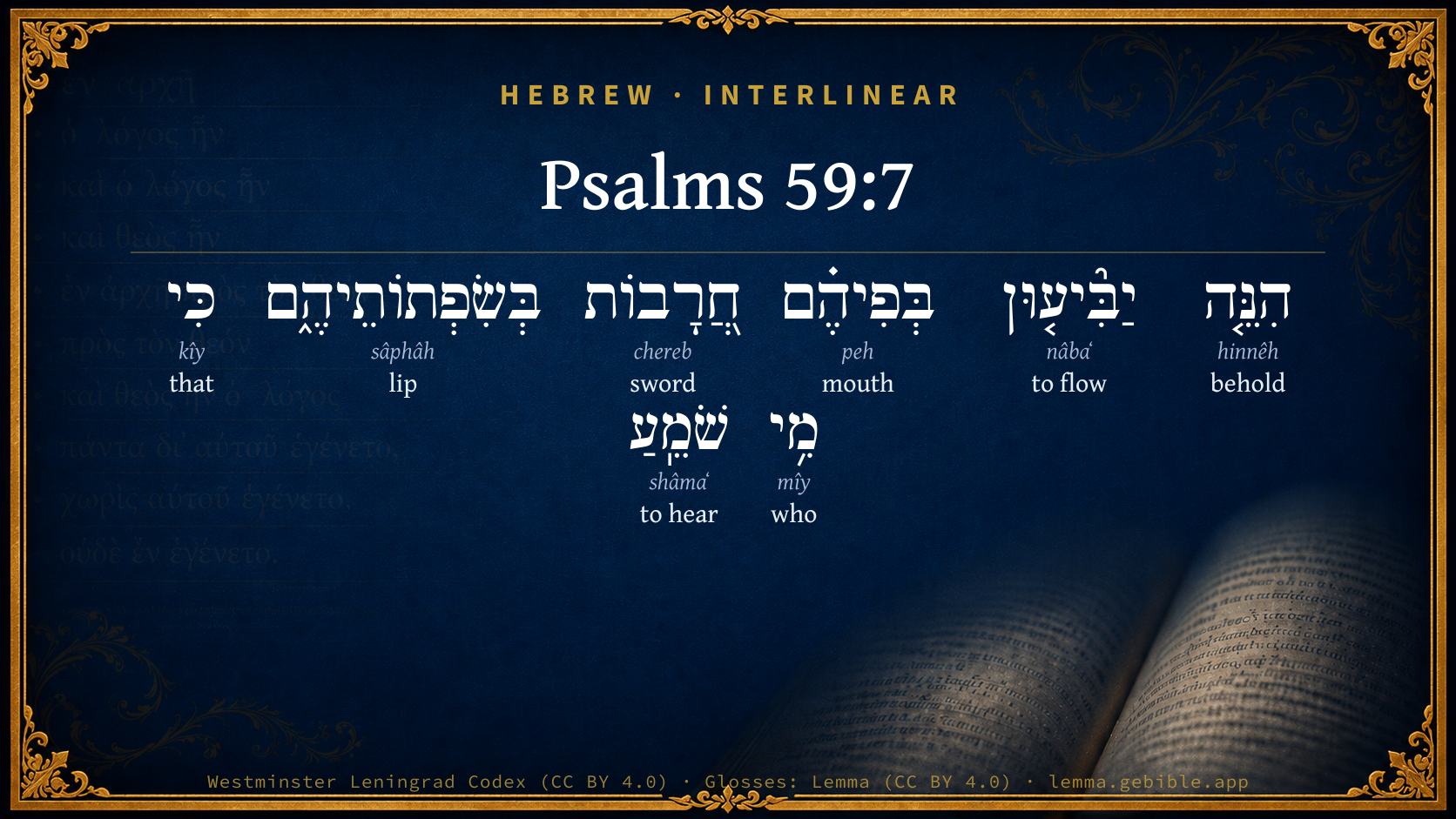
Hebrew (Westminster Leningrad Codex) Psalms 59:7 appears in the Hebrew Old Testament. The text above is from the Westminster Leningrad Codex. Each word links to its Strong’s number, a concise gloss, and parsing drawn from the Open Scriptures Hebrew Bible morphology. Click any word for its full Brown-Driver-Briggs (BDB) entry.
Download image
Cite this verse

Psalms 59:7 (World English Bible). Public Domain. Lemma interlinear Bible study tool, https://lemma.gebible.app/v/psalms/59/7.

Show BibTeX & RIS
BibTeX
RIS
English Translation
Behold, they spew with their mouth. Swords are in their lips, "For," they say, "who hears us?"
World English Bible · Public Domain
Download a study sheet

One document with this verse’s original text, its word-by-word gloss line, the meaning frame, cross-references with their text, attributed commentary, and full source and license credits — printable, and it pastes into notes with its structure intact.

This verse Autodidact and up

Study sheet (.html) Plain text (.txt)

A passage Seminary Student

Up to 50 verses in one chapter. A passage sheet keeps up to 6 commentary sources and 12 cross-references per verse, in the order this page ranks them, and says so on the sheet whenever that leaves anything out. Ask for a single verse and you get the Autodidact verse sheet above.

Everything on this page stays free to read, with no account — the sheet is a download of what is already on screen, not access to it.

Want to remove ads? Support Godless Engineer
Compare translations 3

The same verse in 3 English versions, stacked beneath the original-language interlinear above. Click any original word for its lexicon entry.

Each is an independent rendering of the whole verse — the interlinear is not word-aligned to these translations.

Highlighted words mark where these versions differ — a whole-verse word diff, not a word-by-word alignment.

  • World English Bible Public Domain
    Behold, they spew with their mouth. Swords are in their lips, "For," they say, "who hears us?"
  • King James Version Public Domain
    Behold, they belch out with their mouth: swords are in their lips: for who, say they, doth hear?
  • unfoldingWord Literal Text CC BY-SA 4.0
    Behold, they belch out with their mouth, swords in their lips, for, “Who is hearing?”

unfoldingWord Literal Text — © unfoldingWord, licensed CC BY-SA 4.0. Word-aligned USFM3 via Door43 (git.door43.org/unfoldingWord/en_ult).

Versions to compare (up to 4)

3 of 4 selected

Show all 18 translations

Every available English version of this verse, each an independent rendering of the whole verse.

  • World English Bible Public Domain
    Behold, they spew with their mouth. Swords are in their lips, "For," they say, "who hears us?"
  • Berean Standard Bible Public Domain
    See what they spew from their mouths—sharp words from their lips: “For who can hear us?”
  • Majority Standard Bible Public Domain
    See what they spew from their mouths—sharp words from their lips: “For who can hear us?”
  • King James Version Public Domain
    Behold, they belch out with their mouth: swords are in their lips: for who, say they, doth hear?
  • American Standard Version (1901) Public Domain
    Behold, they belch out with their mouth; Swords are in their lips: For who, `say they', doth hear?
  • Revised Version (1885) Public Domain
    Behold, they belch out with their mouth; swords are in their lips: for who, say they, doth hear?
  • Geneva Bible (1599) Public Domain
    Behold, they brag in their talke, and swords are in their lips: for, Who, say they, doeth heare?
  • Douay-Rheims (1899) Public Domain
    They shall return at evening, and shall suffer hunger like dogs: and shall go round about the city.
  • Young's Literal Translation Public Domain
    Lo, they belch out with their mouths, Swords `are' in their lips, for `Who heareth?'
  • Literal Standard Version CC BY-SA 4.0
    Behold, they belch out with their mouths, || Swords [are] in their lips, for “Who hears?”
  • Unlocked Literal Bible CC BY-SA 4.0
    See, they belch out with their mouths; swords are in their lips, for they say, “Who hears us?”
  • unfoldingWord Literal Text CC BY-SA 4.0
    Behold, they belch out with their mouth, swords in their lips, for, “Who is hearing?”
  • Darby Bible Public Domain
    Behold, they belch out with their mouth; swords are in their lips: for who [say they] doth hear?
  • World Messianic Bible Public Domain
    Behold, they spew with their mouth. Swords are in their lips, “For”, they say, “who hears us?”
  • Webster's Bible Public Domain
    \\59:6\\They return at evening: they make a noise like a dog, and go about the city.
  • Free Bible Version CC BY-SA 4.0
    See what evil talk comes pouring out of their mouths! Words sharp as swords, for they say to themselves, “Who can hear us?”
  • Bible in Basic English Public Domain
    See, hate is dropping from their lips; curses are on their tongues: they say, Who gives attention to it?
  • JPS Tanakh (1917) Public Domain
    (59-8) Behold, they belch out with their mouth; swords are in their lips: 'For who doth hear?'

Literal Standard Version (2020), Covenant Press — licensed CC BY-SA 4.0. Text via the HelloAO Bible API (eBible.org). Unlocked Literal Bible (unfoldingWord) — licensed CC BY-SA 4.0. Text via the HelloAO Bible API (eBible.org). unfoldingWord Literal Text — © unfoldingWord, licensed CC BY-SA 4.0. Word-aligned USFM3 via Door43 (git.door43.org/unfoldingWord/en_ult). Free Bible Version, Dr. Jonathan Gallagher — licensed CC BY-SA 4.0. Text via the HelloAO Bible API (eBible.org).

Word by word

More ways to search: Search by grammar → Find every occurrence → Compare this word →

Practice this passage: Drill this verse → Learn its vocabulary →

יַבִּ֘יע֤וּן
nâbaʻ
H5042
“to flow”
Verb, Hiphil, Imperfect, 3rd Person, Masculine, Plural + Suffix, n
Part of Speech
Verb
Stem
Hiphil
Form
Imperfect
Person
3rd Person
Gender
Masculine
Number
Plural
Full BDB Definition

Origin: a primitive root

TWOT: 1287

to flow, pour out, pour, gush forth, spring, bubble up, ferment - (Qal) to flow - (Hiphil) to pour out, emit, cause to bubble, belch forth - to pour out - to cause to bubble, ferment - to pour forth, emit, belch forth
  1. הִנֵּ֤ה hinnêh H2009 “behold” Particle, Demonstrative
  2. בְּפִיהֶ֗ם peh H6310 “in/at · mouth · their” Preposition + Noun, Common, Masculine, Singular, Construct + Suffix, Personal, 3rd Person, Masculine, Plural
  3. חֲ֭רָבוֹת chereb H2719 “swords” Noun, Common, Feminine, Plural, Absolute
  4. בְּשִׂפְתוֹתֵיהֶ֑ם sâphâh H8193 “in/at · lips · their” Preposition + Noun, Common, Feminine, Plural, Construct + Suffix, Personal, 3rd Person, Masculine, Plural
  5. כִּי kîy H3588 “that” Conjunction
  6. מִ֥י mîy H4310 “who” Particle, Interrogative
  7. שֹׁמֵֽעַ shâmaʻ H8085 “hearing” Verb, Qal, Participle Active, Masculine, Singular, Absolute

About this verse

These counts appear in no published source. They are computed here, from the morphology-tagged text and Lemma’s own curated glosses. What Lemma adds →

8
words
8
distinct lemmas
Wisdom
section

Notable vocabulary

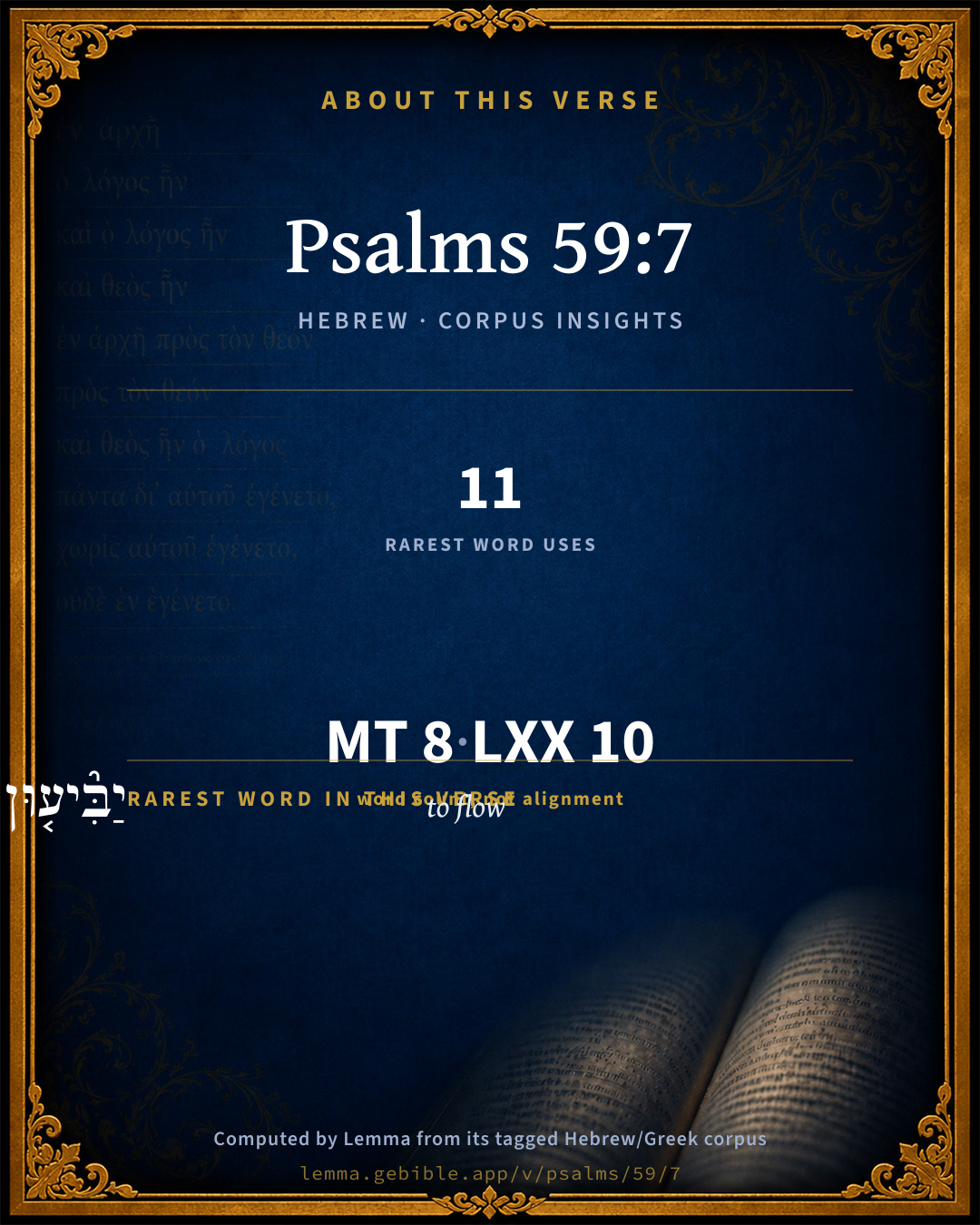
The rarest word here is יַבִּ֘יע֤וּן to flow H5042 — appearing just 11 times in the whole Hebrew Bible.

Shared distinctive vocabulary

יַבִּ֘יע֤וּן to flow H5042 occurs in 11 verses of the Hebrew Bible. Also found in:

Grammatical profile

  • 2 verbs
  • 3 nouns
  • 1 conjunction
  • 2 particles

Verb forms

  • יַבִּ֘יע֤וּן Hiphil · Imperfect
  • שֹׁמֵֽעַ Qal · Participle Active

Hebrew & Septuagint length

In English translation the verse runs 17 words from the Hebrew and 22 from the Septuagint (LXX English) — closely comparable.

A rough comparison of the two English renderings, which tokenize alike — not a word-level alignment.

Word counts can differ between the Hebrew and the Greek without any difference in meaning — e.g. the Hebrew direct-object marker אֵת has no separate Greek word, and Greek often adds the article ὁ.

In the original languages it is 8 Hebrew tokens and 10 Greek tokens — but the two are counted differently (Hebrew bundles its prefixes and suffixes into one token; the Greek is in lemma form), so that isn’t a like-for-like length.

Cross-references

15

Topical passages linked to Psalms 59:7 in the Treasury of Scripture Knowledge — connected by theme and wording, ordered by reader-vote popularity; previews shown in the World English Bible.

  • Psalms 57:4 My soul is among lions. I lie among those who are set on fire, Even the sons of men, whose teeth are spears and arrows, And their tongue a sharp sword.
  • Psalms 10:11 He says in his heart, "God has forgotten. He hides his face. He will never see it."
  • Proverbs 15:2 The tongue of the wise commends knowledge, But the mouth of fools gush out folly.
  • Psalms 73:11 They say, "How does God know? Is there knowledge in the Most High?"
  • Psalms 10:13 Why does the wicked person condemn God, And say in his heart, "God won't call me into account?"
  • Psalms 55:21 His mouth was smooth as butter, But his heart was war. His words were softer than oil, Yet they were drawn swords.
  • Psalms 64:3–5 Who sharpen their tongue like a sword, And aim their arrows, deadly words,
  • Psalms 94:7–9 They say, "Yah will not see, Neither will Jacob's God consider."
  • Proverbs 12:18 There is one who speaks rashly like the piercing of a sword, But the tongue of the wise heals.
  • Proverbs 15:28 The heart of the righteous weighs answers, But the mouth of the wicked gushes out evil.
  • Job 22:12–13 "Isn't God in the heights of heaven? See the height of the stars, how high they are!
  • Psalms 94:4 They pour out arrogant words. All the evil-doers boast.
  • Psalms 109:2–3 For they have opened the mouth of the wicked and the mouth of deceit against me. They have spoken to me with a lying tongue.
  • Jeremiah 33:24 Don't you consider what this people has spoken, saying, The two families which Yahweh did choose, he has cast them off? thus do they despise my people, that they should be no more a nation before them.
  • Matthew 12:34 You offspring of vipers, how can you, being evil, speak good things? For out of the abundance of the heart, the mouth speaks.

Cross-references courtesy of OpenBible.info (CC BY 4.0).

Hebrew and Greek witnesses Masoretic Hebrew ↔ Greek Septuagint

The same verse in the two great witnesses to the Old Testament, shown verse-for-verse.

You’re reading Greek Psalm 58 (Hebrew Psalm 59). The Septuagint counts the superscription, so verse numbers can differ from the Hebrew — chapter-level alignment, not verse-by-verse. Numbering follows Rahlfs.

These are two independent witnesses, not word-aligned to each other, and the Septuagint is shown in lemma (dictionary) form.

Hebrew Psalms 59:7 Masoretic · Westminster Leningrad Codex

הִנֵּ֤ה יַבִּ֘יע֤וּן בְּפִיהֶ֗ם חֲ֭רָבוֹת בְּשִׂפְתוֹתֵיהֶ֑ם כִּי מִ֥י שֹׁמֵֽעַ

Behold, they spew with their mouth. Swords are in their lips, "For," they say, "who hears us?"

World English Bible · Public Domain

Greek LXX Greek Psalm 58:7 Septuagint · lemma form

ἐπιστρέφω εἰς ἑσπέρα καί λιμώσσω ὡς κύων καί κυκλόω πόλις

Behold, they shall utter a voice with their mouth, and a sword is in their lips; for who, say they, has heard?

LXX2012 (modern English Septuagint) · Public Domain

Hebrew: Westminster Leningrad Codex (CC BY 4.0). Greek: Septuagint (public domain); English from LXX2012 (modern English Septuagint) (Public Domain). How the Septuagint differs from the Hebrew →

Commentary

Notes on Psalms 59:7 from classic Christian and Jewish commentators (each source and its license shown beneath its notes). The classic Christian expositions comment on the surrounding passage and are grouped to its opening verse, so a note may address several verses; the Jewish commentaries on the Tanakh (Rashi and others) are per-verse, so they appear only where the commentator wrote on this verse.

Lemma curates 59 commentaries, every one of them public domain or Creative Commons licensed, each selected and text-cleaned for this edition rather than reprinted as found. About our sources →

Trapp's Complete Commentary

John Trapp

Psa 59:7 Behold, they belch out with their mouth: swords [are] in their lips: for who, [say they], doth hear?

Ver. 7. Behold, they belch out with their mouth] Calling me traitor wherever they come, and seeking to double murder him, viz. by detraction, and by deadly practice. As a fountain casteth out waters, so do graceless men wickedness, Jer 6:7.

Swords are in their lips] Or, to their lips they add swords; they word it not only, but are armed and well-appointed. But it is well that they blurt out their bloody purposes, and so give warning, Hunc tibi pugionem mittit Senatus; detexit facinus fatuus, et non implevit.

For who, say they, doth hear?] i.e. Who, that we need care for? David’s friends, they thought, durst not utter their discontent; and for God they took no great thought, Psa 10:3; Psa 55:20.

John Trapp, A Commentary or Exposition upon All the Books of the Old and New Testament (1647–1656) — public domain. Text from a community e-Sword module.

J. A. Alexander on Psalms

Joseph Addison Alexander

8. (Psa 59:7). Lo, they pour out with their mouths; swords (are) in their lips; for who (is) hearing? He here reverts to his description and complaint of his enemies. The first verb is expressive of a constant flow or gush. See above, on Psa 19:2. What it is that they thus pour out, although not expressed, may be readily gathered from the context, namely, slanders and reproaches. The swords in their lips are significant of sharp and cutting speeches. Compare Psa 52:3. The English version, by supplying "say they," makes the last clause the language of these wicked foes, who are then to be understood as denying God's omniscience or his justice. See above, on Psa 10:11; Psa 10:13, and compare Psa 14:1; Psa 42:10. But a still more striking sense may be obtained by making this clause the complaint of the Psalmist himself, as if he had said: no wonder that they thus pour out their bitter words; for who is there to observe and punish them? The question implies that God himself had ceased to notice their offences, and the participial form, that this neglect had now become habitual.

Joseph Addison Alexander, The Psalms Translated and Explained (1850) — public domain. Text from a community e-Sword module.

Geneva Bible (1599)

Geneva Bible translators

They boast openly in their wicked devices, and every word is as a sword: for they neither fear God nor are ashamed of men.

Geneva Bible (1599) marginal notes — public domain. Text via Bolls.life.

Jamieson, Fausset & Brown

Robert Jamieson, A. R. Fausset & David Brown

for who, say they--For the full expression with the supplied words, compare Psa 64:5.

Jamieson, Fausset & Brown — Commentary Critical and Explanatory on the Whole Bible (1871) — public domain (CC PDM 1.0). Text via the HelloAO Bible API.

Adam Clarke's Commentary

Verse 7. They belch out with their mouth] They use the lowest insult, the basest abuse. They deal in sarcasm, ridicule, slander, and lies.

Adam Clarke's Commentary on the Bible (1810–1826) — public domain. Text from a community e-Sword/MySword module.

John Calvin's Commentaries

In the verse which follows, he describes their fierceness. The expression, prating, or belching out with their mouth, denotes that they proclaimed their infamous counsels openly, and without affecting concealment. The Hebrew word נבע, nabang, means, metaphorically, to speak, but properly, it signifies to gush out, and here denotes more than simply speaking. He would inform us, that not content with plotting the destruction of the innocent secretly amongst themselves, they published their intentions abroad, and boasted of them. Accordingly, when he adds, that swords were in their lips, he means that they breathed out slaughter, and that every word they spoke was a sword to slay the oppressed. He assigns as the cause of their rushing to such excess of wickedness, that they had no reason to apprehend disgrace. It may be sufficiently probable, that David adverts here, as in many other places, to the gross stupidity of the wicked, who, in order to banish fear from their minds, conceive of God as if he were asleep in heaven; but I am of opinion that he rather traces the security with which they prosecuted their counsels, and openly proclaimed them, to the fact, that they had long ere now been in possession of the uncontrolled power of inflicting injury. They had succeeded so completely in deceiving the people, and rendering David odious by their calumnies, that none had the courage to utter a word in his defense. Nay, the more atrociously that any man might choose to persecute this victim of distress, from no other motive than to secure the good graces of the king, the more did he rise in estimation as a true friend to the commonwealth.

John Calvin's Commentaries (1540-1563) — public domain. Text from the Calvin Translation Society English edition (1840s-50s) via the Christian Classics Ethereal Library (ccel.org). Calvin's coverage is partial (roughly two-thirds of the Bible); uncommented books and verses are honest gaps, never fabricated. The 19th-century editor's footnotes and remarks are omitted so the notes are faithfully Calvin's own voice.

Ellicott's Commentary for English Readers

(7) Behold.—Without question this word should, as Mr. Burgess suggests, be emended to “spears” (chanîth instead of hinneh), to give—

“Spears they pour out with their mouths,

Swords with their lips.”

(Comp. Psa_57:5, and

“She speaks poniards.”—As You Like It.

A Bible Commentary for English Readers, edited by Charles John Ellicott (1878–1897) — public domain. Text from a community e-Sword module.

The Cambridge Bible for Schools and Colleges

gen. ed. J. J. S. Perowne

7. The figure of Psa_59:6 is dropped. A flood of cursing and falsehood (Psa_59:12) pours from their mouth (Pro_15:2; Pro_15:28); they menace him with death, or openly boast that he will soon be got rid of; cp. Psa_52:2, note.

‘Say they’ is rightly inserted. ‘Who doth hear’? is not the Psalmist’s complaint that there is no one to take his part, but the scornful sneer of his enemies, who do not believe that God cares for His servant. Cp. Psa_10:4; Psa_10:11; Psa_10:13; Psa_64:5; Psa_73:11; Psa_94:7.

The Cambridge Bible for Schools and Colleges (gen. ed. J. J. S. Perowne; Cambridge University Press, 1878–1918) — public domain. Text from a community e-Sword module.

John Gill's Exposition

Behold, they belch out with their mouth,.... Bark like dogs, so Aben Ezra; or "bubble out" (u), as a fountain bubbles out with water; so they cast out their wickedness in great abundance; see Jer 6:7; the phrase denotes the abundance of evil things and wicked speeches that came out of their mouths, which showed the naughtiness of their hearts; so David's enemies blustered and threatened what they would do to him could they find him; and Christ's enemies poured out their wicked charges of blasphemy and sedition against him, in great plenty, and without proof;

swords are in their lips; the words of their lips were like sharp swords; see Psa 55:21; threatening the most severe and cruel things: or, besides their lips, and what they belched out with their mouths, they took swords in their hands in a literal sense; as Saul's messengers did to kill David, and as Judas and his band of men, who came to take Christ as a thief, with swords and staves, Mat 26:55;

for who, say they, doth hear? what they uttered with their mouths and lips, in a blustering and threatening manner; though they were overheard by men, who carried what they said and designed to do to Michal, David's wife. The meaning may be, they would say what they pleased, and did not care who heard them, having nothing to fear from any, they having their orders from the king; see Psa 12:4; and so the Targum,

"behold they belch out with their mouths words which are sharp as swords, and with their lips saying, we shall prevail; for who is he that hears, and can punish?''

Aben Ezra's note is,

"they thought that God did not hear their counsels;''

and therefore the next words are in direct opposition to them; but so to think is monstrous stupidity and brutishness, Psa 94:4; some take the words to be the words of David, complaining that the civil magistrate, none of the judges, took notice of or punished such who belched out their lies and calumnies against him, saying, "for who doth hear?" no man.

(u) "scaturient", Montanus; "copiose eructant", Gejerus.

John Gill's Exposition of the Whole Bible (1746–1763) — public domain (CC PDM 1.0). Text via the HelloAO Bible API.

Albert Barnes' Notes on the Bible

Behold, they belch out with their mouth - The word rendered “belch out” means properly to boil forth; to gush out, to flow; and then, to pour forth copiously, or in a running stream, as a fountain does. Hence, the word means also to pour out “words” - words that flow freely - words of folly, abuse, or reproach. Pro 15:2, “the mouth of fools poureth out (Margin, belcheth or babbleth) foolishness.” Pro 15:28, “the mouth of the wicked poureth out evil things;” that is, “gushes over” with wicked things - as a fountain overflows. In this place, the word means that the enemies of David who were in pursuit of his life, poured out reproaches and threatenings like a gushing fountain.

Swords are in their lips - Their words are as sharp swords. See the notes at Psa 57:4.

For who, say they, doth hear? - That is, no one hears who will be able to punish us. They dread no man; and they have no fear of God. Compare the notes at Psa 10:11. The words “say they” are, however, supplied here by the translators, and are not in the original; and the language “may” be understood as that of David himself, “as if” no one heard; that is, It is no wonder that they thus pour out words of reproach, for who “is” there to hear and to punish them? The former interpretation, however, is to be preferred. The language expresses the feelings of the enemies of David, who indulged freely in language of abuse and reproach “as if” there were none to hear.

Albert Barnes' Notes on the Bible (1834–1885) — public domain. Text from a community e-Sword/MySword module.

Matthew Poole's English Annotations

They belch out; or, they pour forth, (to wit, words, for what else should come out of the mouth? even sharp and bitter words, as the next clause explains it,) abundantly and vehemently, as a fountain doth waters, as this word signifies. See Pro 15:28; Jer 6:7.

Swords, i.e. words as keen and mischievous as swords, as Psa 55:21; 57:4.

Who, say they, doth hear? David doth not hear us, either to discover, and so to prevent our plots; Or to punish us for them; and God either doth not hear or not regard what we say and do against David; and therefore we may speak and act what we think fit.

Matthew Poole's English Annotations on the Holy Bible (1683–1685) — public domain. Text from a community e-Sword/MySword module.

The Treasury of David

Charles H. Spurgeon

Ver. 7. Behold they belch out with their mouth. The noisy creatures are so remarkable in their way, that attention is called to them with a behold. Ecce homines, might we not say, Ecce canes! Their malicious speech gushes from them as from a bubbling fountain. The wicked are voluble in slander; their vocabulary of abuse is copious, and as detestable as it is abundant. What torrents of wrathful imprecation will they pour on the godly! They need no prompters, their feelings force for themselves their own vent, and fashion their own expressions.

Swords are in their lips. They speak daggers. Their words pierce like rapiers, and cleave like cutlasses. As the cushion of a lions's paw conceals his claw, so their soft ruby lips contain bloody words.

For who, say they, doth hear? They are free from all restraint, they fear no God in heaven, and the government on earth is with them. When men have none to call them to account, there is no accounting for what they will do. He who neither fears God nor regards man sets out on errands of oppression with gusto, and uses language concerning it of the most atrociously cruel sort. David must have been in a singular plight when he could hear the foul talk and hideous braggings of Saul's black guards around the house. After the style in which a Cavalier would have cursed a Puritan, or Claverhouse a Coventanter, the Saulites swore at the upstarts whom the king's majesty had sent them to arrest. David called them dogs, and no doubt a pretty pack they were, a cursed cursing company of curs. When they said, "Who doth hear?" God was listening, and this David knew, and therefore took courage.

Ver. 7. Behold, they belch out with their mouth, etc. Bark like dogs, so Aben Ezra; or, bubble out, as a fountain bubbles out with water; so they cast out their wickedness in great abundance (see Jer 6:7); the phrase denotes the abundance of evil things and wicked speeches that come out of their mouths, which showed the naughtiness of their hearts; so David's enemies blustered and threatened what they would do to him could they find him; and Christ's enemies poured out their wicked charges of blasphemy and sedition against him in great plenty, and without proof. John Gill.

None.

Psalms 59:8*

Charles H. Spurgeon's The Treasury of David (1869–1885) — public domain. Psalms only. Text from a community e-Sword/MySword module.

Whedon's Commentary on the Bible

Daniel D. Whedon

7. They belch out with their mouth—A continuation of the figure, Psa_59:6. As applied to David’s enemies it is an expression of the lowest contempt.

Daniel D. Whedon (gen. ed.), Commentary on the Old and New Testaments (1874–1909) — public domain. Text from a community e-Sword module.

The Pulpit Commentary

Behold, they belch out with their mouth. All night long they keep uttering abuse and execrations and threats. (comp. Psa_94:4) Swords are in their lips. (comp. Psa_57:4) Speeches that wound and cut to the heart. For who, say they, doth hear!. (comp. Psa_10:11-13 Psa_64:5 Psa_73:11 Psa_94:7) They think themselves irresponsible for their words. No one will hear or know what they say.

The Pulpit Commentary (1880–1919), ed. H.D.M. Spence-Jones & Joseph S. Exell — public domain. Text from a community e-Sword module.

John Wesley's Explanatory Notes

Pour out - Sharp and bitter word's, abundantly and vehemently, as a fountain doth waters, as this word signifies. Swords - Words as keen and mischievous as swords. For who - David doth not hear us, and God either doth not hear, or not regard what we say.

John Wesley, Explanatory Notes Upon the Whole Bible (1754–1765) — public domain. Text via the GEBible commentary corpus.

Rashi

Rabbi Shlomo Yitzchaki (Rashi)

They return in the evening, etc... Behold, they spew forth with their mouth The interpretation of these two verses connects one to the other. They return in the evening What they did by day does not suffice them; in the evening they repeat their evil: guarding me that I do not escape and leave the city Now what did they do by day? Behold, all day they spew forth with their mouth, to spy on me to Saul.

Rashi on the Tanakh — English translations: “The Judaica Press complete Tanach with Rashi, translated by A. J. Rosenberg” (CC BY 4.0); “Pentateuch with Rashi's commentary by M. Rosenbaum and A.M. Silbermann, 1929-1934” (public domain); “The Metsudah Tanach series, Lakewood, N.J” (CC BY 4.0); and “The Book of Joshua, Metsudah Publications, 1997” (CC BY 4.0). Text via Sefaria.

Lesson kit

Teaching starters — assembled from the data on this page, not authored interpretation. Every prompt links to the verse data it draws on. Edit before teaching.

Psalms, in the Wisdom, opens this verse with 8 words (8 distinct Hebrew lemmas). Its most distinctive word is nâbaʻ (“to flow”). A historical commentator’s framing appears above. Read the whole chapter for the surrounding context.

Discussion questions

  1. How does “to flow” (nâbaʻ) shape what this verse is saying?
  2. How does Psalms 19:2, which shares the word «to flow», read alongside this verse?
  3. These translations render this verse differently. What is at stake in choosing one wording over another?
  4. «יַבִּ֘יע֤וּן» is a Hiphil Imperfect verb. How does that grammatical form shape the action described?
  5. Compare how Trapp's Complete Commentary and J. A. Alexander on Psalms read this verse. Where do they agree or differ?

Things to notice

Reading settings

Reading text

Shown beneath each verse's original-language words.

Old Testament
Old Testament edition

Read the OT as the Masoretic Hebrew (MT) or the Greek Septuagint (LXX).

English shown for the Greek Septuagint (in the Hebrew ↔ Greek comparison).

Comparing translations? Open the Compare panel on any verse page to stack up to four side by side.