
Numbers 21:24

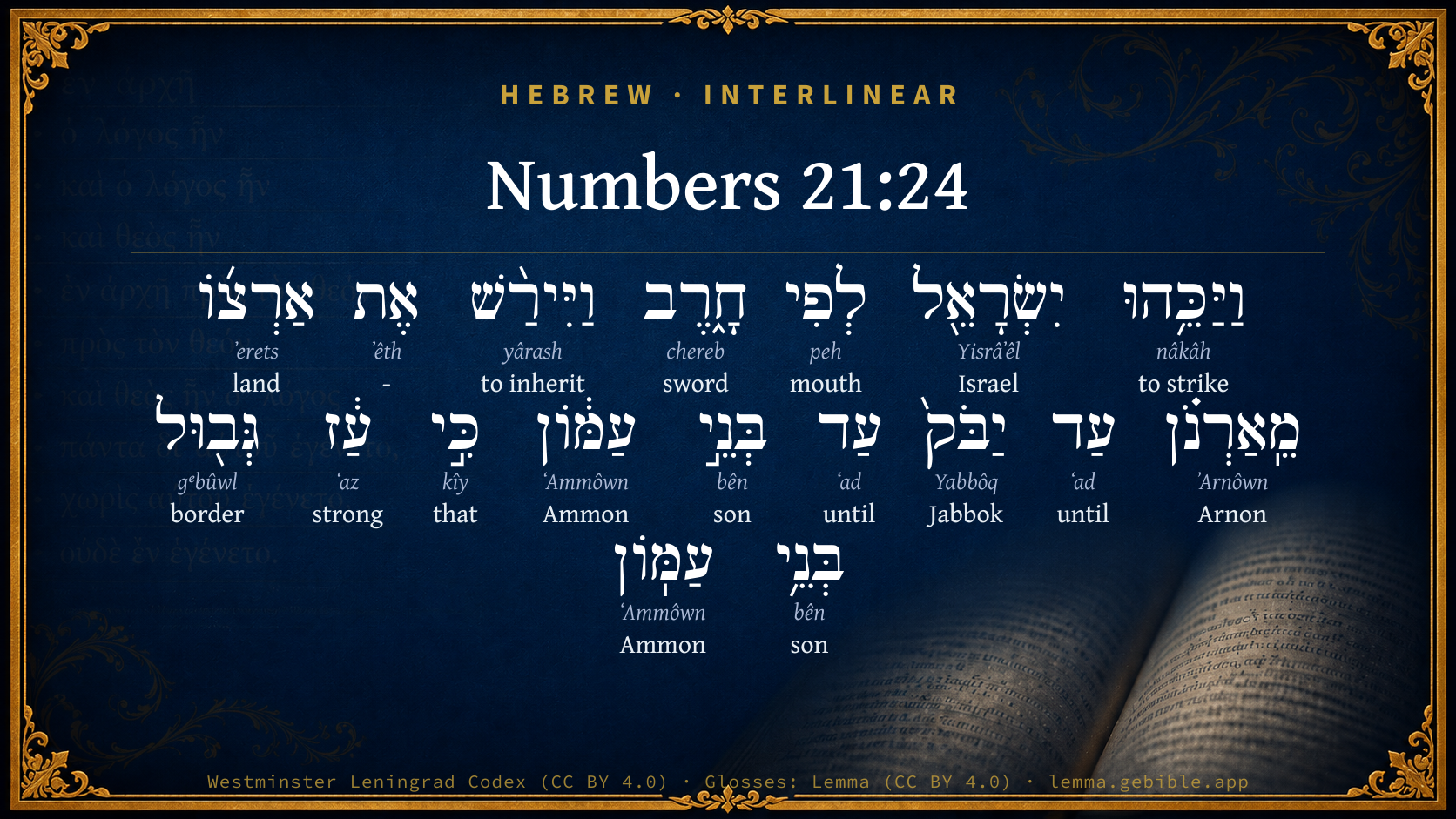
Hebrew (Westminster Leningrad Codex) Numbers 21:24 appears in the Hebrew Old Testament. The text above is from the Westminster Leningrad Codex. Each word links to its Strong’s number, a concise gloss, and parsing drawn from the Open Scriptures Hebrew Bible morphology. Click any word for its full Brown-Driver-Briggs (BDB) entry.
Download image
Cite this verse

Numbers 21:24 (World English Bible). Public Domain. Lemma interlinear Bible study tool, https://lemma.gebible.app/v/numbers/21/24.

Show BibTeX & RIS
BibTeX
RIS
English Translation
Israel struck him with the edge of the sword, and possessed his land from the Arnon to the Jabbok, even to the children of Ammon; for the border of the children of Ammon was strong.
World English Bible · Public Domain
Download a study sheet

One document with this verse’s original text, its word-by-word gloss line, the meaning frame, cross-references with their text, attributed commentary, and full source and license credits — printable, and it pastes into notes with its structure intact.

This verse Autodidact and up

Study sheet (.html) Plain text (.txt)

A passage Seminary Student

Up to 50 verses in one chapter. A passage sheet keeps up to 6 commentary sources and 12 cross-references per verse, in the order this page ranks them, and says so on the sheet whenever that leaves anything out. Ask for a single verse and you get the Autodidact verse sheet above.

Everything on this page stays free to read, with no account — the sheet is a download of what is already on screen, not access to it.

Want to remove ads? Support Godless Engineer
Compare translations 3

The same verse in 3 English versions, stacked beneath the original-language interlinear above. Click any original word for its lexicon entry.

Each is an independent rendering of the whole verse — the interlinear is not word-aligned to these translations.

Highlighted words mark where these versions differ — a whole-verse word diff, not a word-by-word alignment.

  • World English Bible Public Domain
    Israel struck him with the edge of the sword, and possessed his land from the Arnon to the Jabbok, even to the children of Ammon; for the border of the children of Ammon was strong.
  • King James Version Public Domain
    And Israel smote him with the edge of the sword, and possessed his land from Arnon unto Jabbok, even unto the children of Ammon: for the border of the children of Ammon was strong.
  • unfoldingWord Literal Text CC BY-SA 4.0
    And Israel struck him by the mouth of the sword and possessed his land from the Arnon as far as the Jabbok, as far as the sons of Ammon, for the border of the sons of Ammon strong.

unfoldingWord Literal Text — © unfoldingWord, licensed CC BY-SA 4.0. Word-aligned USFM3 via Door43 (git.door43.org/unfoldingWord/en_ult).

Versions to compare (up to 4)

3 of 4 selected

Show all 18 translations

Every available English version of this verse, each an independent rendering of the whole verse.

  • World English Bible Public Domain
    Israel struck him with the edge of the sword, and possessed his land from the Arnon to the Jabbok, even to the children of Ammon; for the border of the children of Ammon was strong.
  • Berean Standard Bible Public Domain
    And Israel put him to the sword and took possession of his land, from the Arnon to the Jabbok—but only up to the border of the Ammonites, because it was fortified.
  • Majority Standard Bible Public Domain
    And Israel put him to the sword and took possession of his land, from the Arnon to the Jabbok—but only up to the border of the Ammonites, because it was fortified.
  • King James Version Public Domain
    And Israel smote him with the edge of the sword, and possessed his land from Arnon unto Jabbok, even unto the children of Ammon: for the border of the children of Ammon was strong.
  • American Standard Version (1901) Public Domain
    And Israel smote him with the edge of the sword, and possessed his land from the Arnon unto the Jabbok, even unto the children of Ammon; for the border of the children of Ammon was strong.
  • Revised Version (1885) Public Domain
    And Israel smote him with the edge of the sword, and possessed his land from Arnon unto Jabbok, even unto the children of Ammon: for the border of the children of Ammon was strong.
  • Geneva Bible (1599) Public Domain
    But Israel smote him with the edge of the sword, and conquered his land, from Arnon vnto Iabok, euen vnto ye children of Ammon: for the border of the children of Ammon was strong.
  • Douay-Rheims (1899) Public Domain
    And he was slain by them with the edge of the sword, and they possessed his land from the Arnon unto the Jeboc, and to the confines of the children of Ammon: for the borders of the Ammonites, were kept with a strong garrison.
  • Young's Literal Translation Public Domain
    And Israel smiteth him by the mouth of the sword, and possesseth his land from Arnon unto Jabbok -- unto the sons of Ammon; for the border of the sons of Ammon `is' strong.
  • Literal Standard Version CC BY-SA 4.0
    And Israel strikes him by the mouth of the sword, and possesses his land from Arnon to Jabbok—to the sons of Ammon; for the border of the sons of Ammon [is] strong.
  • Unlocked Literal Bible CC BY-SA 4.0
    Israel attacked the army of Sihon with the edge of the sword and took their land from the Arnon to the Jabbok river, as far as the land of the people of Ammon. Now the border of the people of Ammon was fortified.
  • unfoldingWord Literal Text CC BY-SA 4.0
    And Israel struck him by the mouth of the sword and possessed his land from the Arnon as far as the Jabbok, as far as the sons of Ammon, for the border of the sons of Ammon strong.
  • Darby Bible Public Domain
    And Israel smote him with the edge of the sword, and took possession of his land from the Arnon to the Jabbok, even unto the children of Ammon; for the border of the children of Ammon was strong.
  • World Messianic Bible Public Domain
    Israel struck him with the edge of the sword, and possessed his land from the Arnon to the Jabbok, even to the children of Ammon; for the border of the children of Ammon was fortified.
  • Webster's Bible Public Domain
    And Israel smote him with the edge of the sword, and possessed his land from Arnon to Jabbok, even to the children of Ammon: for the border of the children of Ammon was strong.
  • Free Bible Version CC BY-SA 4.0
    The Israelites defeated them, killing them with their swords. They took over his land from the Arnon River to the Jabbok River —but only as far as the border of the Ammonites, because it was well defended.
  • Bible in Basic English Public Domain
    But Israel overcame him, and took all his land from the Arnon to the Jabbok, as far as the country of the children of Ammon, for the country of the children of Ammon was strongly armed.
  • JPS Tanakh (1917) Public Domain
    And Israel smote him with the edge of the sword, and possessed his land from the Arnon unto the Jabbok, even unto the children of Ammon; for the border of the children of Ammon was strong.

Literal Standard Version (2020), Covenant Press — licensed CC BY-SA 4.0. Text via the HelloAO Bible API (eBible.org). Unlocked Literal Bible (unfoldingWord) — licensed CC BY-SA 4.0. Text via the HelloAO Bible API (eBible.org). unfoldingWord Literal Text — © unfoldingWord, licensed CC BY-SA 4.0. Word-aligned USFM3 via Door43 (git.door43.org/unfoldingWord/en_ult). Free Bible Version, Dr. Jonathan Gallagher — licensed CC BY-SA 4.0. Text via the HelloAO Bible API (eBible.org).

Word by word

More ways to search: Search by grammar → Find every occurrence → Compare this word →

Practice this passage: Drill this verse → Learn its vocabulary →

יַבֹּק֙
Yabbôq
H2999
“Jabbok”
Noun, Proper
Part of Speech
Noun
Type
Proper
Full BDB Definition

Origin: probably from H1238

TWOT: None

Jabbok = "emptying" - a stream which intersects the mountain range of Gilead, and falls into the Jordan on the east about midway between the Sea of Galilee and the Dead Sea
  1. וַיַּכֵּ֥הוּ nâkâh H5221 “and · to strike · him” Conjunction + Verb, Hiphil, Sequential Imperfect, 3rd Person, Masculine, Singular + Suffix, Personal, 3rd Person, Masculine, Singular
  2. יִשְׂרָאֵ֖ל Yisrâʼêl H3478 “Israel” Noun, Proper
  3. לְפִי peh H6310 “to/for · mouth of” Preposition + Noun, Common, Masculine, Singular, Construct
  4. חָ֑רֶב chereb H2719 “sword” Noun, Common, Feminine, Singular, Absolute
  5. וַיִּירַ֨שׁ yârash H3423 “and · to inherit” Conjunction + Verb, Qal, Sequential Imperfect, 3rd Person, Masculine, Singular
  6. אֶת ʼêth H853 “-” Particle, Direct Object
  7. אַרְצ֜וֹ ʼerets H776 “land · his” Noun, Common, Both, Singular, Construct + Suffix, Personal, 3rd Person, Masculine, Singular
  8. מֵֽאַרְנֹ֗ן ʼArnôwn H769 “from · Arnon” Preposition + Noun, Proper
  9. עַד ʻad H5704 “until” Preposition
  10. עַד ʻad H5704 “until” Preposition
  11. בְּנֵ֣י bên H1121 “sons of” Noun, Common, Masculine, Plural, Construct
  12. עַמּ֔וֹן ʻAmmôwn H5983 “Ammon” Noun, Proper
  13. כִּ֣י kîy H3588 “that” Conjunction
  14. עַ֔ז ʻaz H5794 “strong” Adjective, Adjective, Masculine, Singular, Absolute
  15. גְּב֖וּל gᵉbûwl H1366 “border of” Noun, Common, Masculine, Singular, Construct
  16. בְּנֵ֥י bên H1121 “sons of” Noun, Common, Masculine, Plural, Construct
  17. עַמּֽוֹן ʻAmmôwn H5983 “Ammon” Noun, Proper

About this verse

These counts appear in no published source. They are computed here, from the morphology-tagged text and Lemma’s own curated glosses. What Lemma adds →

18
words
15
distinct lemmas
Pentateuch
section

Notable vocabulary

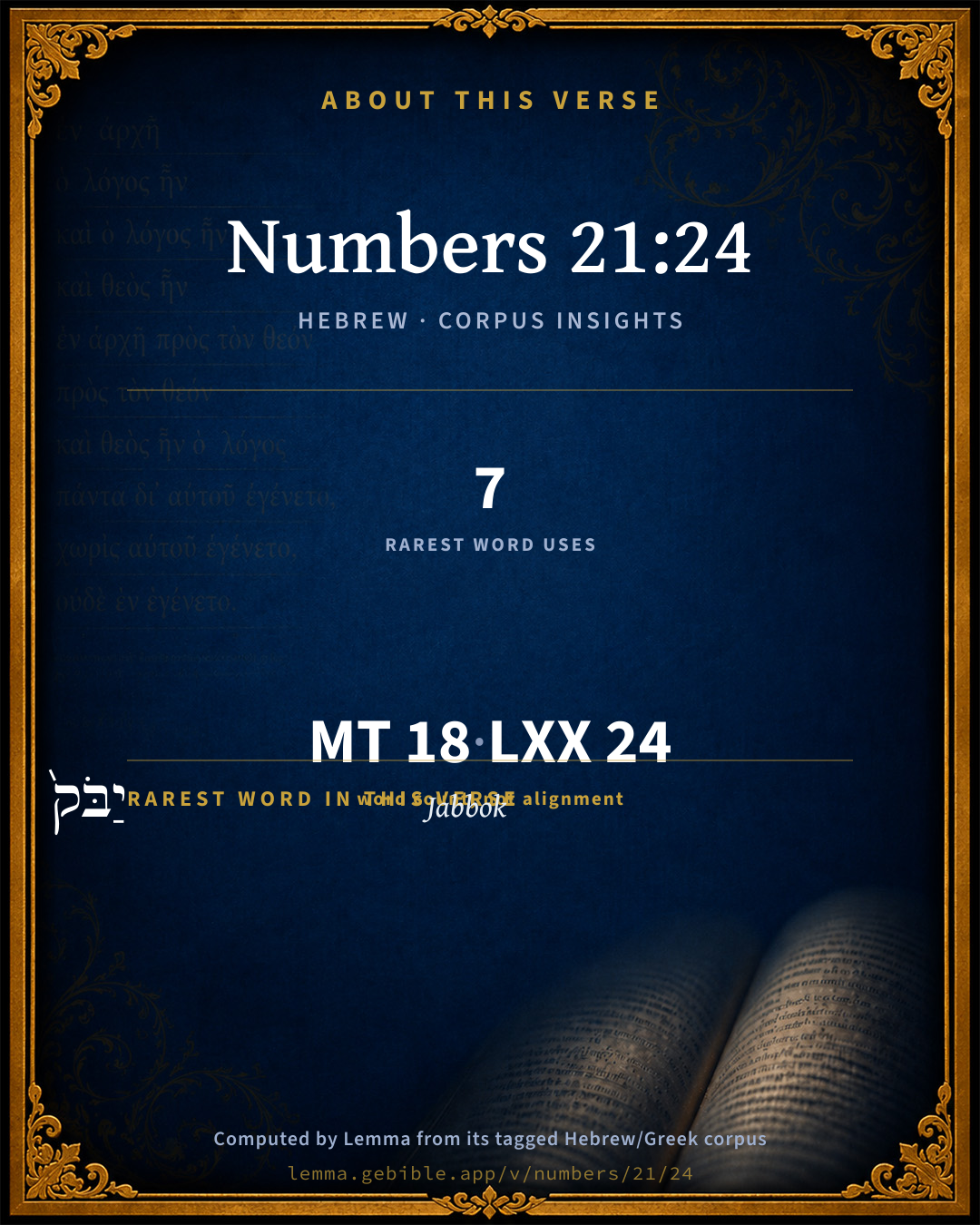
The rarest word here is יַבֹּק֙ Jabbok H2999 — appearing just 7 times in the whole Hebrew Bible.

Shared distinctive vocabulary

יַבֹּק֙ Jabbok H2999 occurs in 7 verses of the Hebrew Bible. Also found in:

Grammatical profile

  • 2 verbs
  • 11 nouns
  • 1 adjective
  • 2 prepositions
  • 1 conjunction
  • 1 particle

Verb forms

  • וַיַּכֵּ֥הוּ Hiphil · Sequential Imperfect
  • וַיִּירַ֨שׁ Qal · Sequential Imperfect

Repetition

Words recur within this verse — often emphatic in Hebrew:

  • עַד until H5704 ×2
  • בְּנֵ֣י son H1121 ×2
  • עַמּ֔וֹן Ammon H5983 ×2

Hebrew & Septuagint length

In English translation the verse runs 35 words from the Hebrew and 38 from the Septuagint (LXX English) — closely comparable.

A rough comparison of the two English renderings, which tokenize alike — not a word-level alignment.

Word counts can differ between the Hebrew and the Greek without any difference in meaning — e.g. the Hebrew direct-object marker אֵת has no separate Greek word, and Greek often adds the article ὁ.

In the original languages it is 18 Hebrew tokens and 24 Greek tokens — but the two are counted differently (Hebrew bundles its prefixes and suffixes into one token; the Greek is in lemma form), so that isn’t a like-for-like length.

Cross-references

18

Topical passages linked to Numbers 21:24 in the Treasury of Scripture Knowledge — connected by theme and wording, ordered by reader-vote popularity; previews shown in the World English Bible.

  • Amos 2:9 Yet I destroyed the Amorite before them, Whose height was like the height of the cedars, And he was strong as the oaks; Yet I destroyed his fruit from above, and his roots from beneath.
  • Genesis 32:22 He rose up that night, and took his two wives, and his two handmaids, and his eleven sons, and passed over the ford of the Jabbok.
  • Joshua 24:8 I brought you into the land of the Amorites, that lived beyond the Jordan: and they fought with you; and I gave them into your hand, and you possessed their land; and I destroyed them from before you.
  • Nehemiah 9:22 Moreover you gave them kingdoms and peoples, which you did allot after their portions: so they possessed the land of Sihon, even the land of the king of Heshbon, and the land of Og king of Bashan.
  • Psalms 136:19 Sihon king of the Amorites; For his loving kindness endures forever;
  • Numbers 21:13 From there they traveled, and encamped on the other side of the Arnon, which is in the wilderness, that comes out of the border of the Amorites: for the Arnon is the border of Moab, between Moab and the Amorites.
  • Numbers 32:1–4 Now the children of Reuben and the children of Gad had a very great multitude of cattle: and when they saw the land of Jazer, and the land of Gilead, that behold, the place was a place for cattle;
  • Numbers 32:33–42 Moses gave to them, even to the children of Gad, and to the children of Reuben, and to the half-tribe of Manasseh the son of Joseph, the kingdom of Sihon king of the Amorites, and the kingdom of Og king of Bashan, the land, according to the cities of it with [their] borders, even the cities of the land round about.
  • Deuteronomy 2:31–37 Yahweh said to me, Behold, I have begun to deliver up Sihon and his land before you: begin to possess, that you may inherit his land.
  • Deuteronomy 3:16 To the Reubenites and to the Gadites I gave from Gilead even to the valley of the Arnon, the middle of the valley, and the border [of it], even to the river Jabbok, which is the border of the children of Ammon;
  • Deuteronomy 29:7 When you came to this place, Sihon the king of Heshbon, and Og the king of Bashan, came out against us to battle, and we struck them:
  • Joshua 9:10 and all that he did to the two kings of the Amorites, who were beyond the Jordan, to Sihon king of Heshbon, and to Og king of Bashan, who was at Ashtaroth.
  • Joshua 12:1–3 Now these are the kings of the land, whom the children of Israel struck, and possessed their land beyond the Jordan toward the sunrise, from the valley of the Arnon to Mount Hermon, and all the Arabah eastward:
  • Joshua 13:8–10 With him the Reubenites and the Gadites received their inheritance, which Moses gave them, beyond the Jordan eastward, even as Moses the servant of Yahweh gave them:
  • Judges 11:21–23 Yahweh, the God of Israel, delivered Sihon and all his people into the hand of Israel, and they struck them: so Israel possessed all the land of the Amorites, the inhabitants of that country.
  • Judges 12:1–2 The men of Ephraim were gathered together, and passed northward; and they said to Jephthah, Why did you pass over to fight against the children of Ammon, and didn't call us to go with you? we will burn your house on you with fire.
  • Judges 21:8 They said, What one is there of the tribes of Israel who didn't come up to Yahweh to Mizpah? Behold, there came none to the camp from Jabesh Gilead to the assembly.
  • Psalms 135:10–12 Who struck many nations, And killed mighty kings,

Cross-references courtesy of OpenBible.info (CC BY 4.0).

Hebrew and Greek witnesses Masoretic Hebrew ↔ Greek Septuagint

The same verse in the two great witnesses to the Old Testament, shown verse-for-verse.

These are two independent witnesses, not word-aligned to each other, and the Septuagint is shown in lemma (dictionary) form.

Hebrew Numbers 21:24 Masoretic · Westminster Leningrad Codex

וַיַּכֵּ֥הוּ יִשְׂרָאֵ֖ל לְפִי חָ֑רֶב וַיִּירַ֨שׁ אֶת אַרְצ֜וֹ מֵֽאַרְנֹ֗ן עַד יַבֹּק֙ עַד בְּנֵ֣י עַמּ֔וֹן כִּ֣י עַ֔ז גְּב֖וּל בְּנֵ֥י עַמּֽוֹן

Israel struck him with the edge of the sword, and possessed his land from the Arnon to the Jabbok, even to the children of Ammon; for the border of the children of Ammon was strong.

World English Bible · Public Domain

Greek LXX Numbers 21:24 Septuagint · lemma form

καί πατάσσω αὐτός ἰσραήλ φόνος μάχαιρα καί κατακυριεύω ὁ γῆ αὐτός ἀπό αρνων ἕως ιαβοκ ἕως υἱός αμμαν ὅτι ιαζηρ ὅριον υἱός αμμων εἰμί

And Israel struck him with the slaughter of the sword, and they became possessors of his land, from Arnon to Jaboc, as far as the children of Amman, for Jazer is the borders of the children of Amman.

LXX2012 (modern English Septuagint) · Public Domain

On this verse, The Cambridge Bible for Schools and Colleges discusses the Septuagint’s reading. Read the note in Commentary ↓

Hebrew: Westminster Leningrad Codex (CC BY 4.0). Greek: Septuagint (public domain); English from LXX2012 (modern English Septuagint) (Public Domain). How the Septuagint differs from the Hebrew →

Targum (Aramaic paraphrase)

2

The Targum is the ancient Jewish Aramaic paraphrase of the Hebrew Scriptures — an interpretive translation, not the Hebrew text itself. Onkelos (literal) and Pseudo-Jonathan (expansive) render the Torah, and Jonathan the Prophets. Coverage is partial: where no permissively-licensed English translation exists for a verse, only the Aramaic is shown. This is verse-level text, not a word-by-word alignment to the Hebrew.

  1. Targum Onkelos Torah (Genesis–Deuteronomy)
    וּמְחָהִי יִשְׂרָאֵל לְפִתְגַם דְחָרֶב וִירֵת יָת אַרְעֵיהּ מֵאַרְנוֹנָא עַד יוּבְקָא עַד בְּנֵי עַמוֹן אֲרֵי תַקִיף תְּחוּמָא דִבְנֵי עַמוֹן

    (no public-domain English translation for this verse)

    Targum Onkelos — Aramaic: “Onkelos Genesis” (public domain); “Onkelos Exodus” (public domain); “Onkelos Leviticus” (public domain); “Onkelos Numbers” (public domain); “Onkelos Deuteronomy” (public domain). English: “Sefaria Community Translation” (CC0 1.0 (public-domain dedication)); “J.W. Etheridge. The Targums of Onkelos and Jonathan Ben Uzziel on the Pentateuch. London: Longmans, Green, 1862” (public domain). Text via Sefaria.

  2. Targum Pseudo-Jonathan Torah (Genesis–Deuteronomy)
    וּמְחוֹהִי יִשְרָאֵל בִּשְׁמָתָא דַיְיָ דְקַטְלָא כְּפִתְגַם דְחָרֶב וְיָרִית יַת אַרְעֵיהּ מֵאַרְנוֹנָא עַד יוּבְקָא עַד תְּחוּם בְּנֵי עַמוֹן אֲרוּם תַּקִיף הֲוָת רַבַּת תְּחוּם בְּנֵי עַמוֹן וְעַד כְּדוֹן אִית לְהוֹן אָרְכָּא

    And Israel smote him with the anathema of the Lord, that he would destroy (him) with the edge of the sword; and he took possession of his country, from Arnon unto the Jabbok, unto the border of the children of Ammon; because Rabbath, which is the limit of the children of Ammon, was strong; and so far was their boundary.

    Targum Pseudo-Jonathan — Aramaic: “Targum Jonathan on Genesis” (public domain); “Targum Jonathan on Exodus” (public domain); “Targum Jonathan on Leviticus” (public domain); “Targum Jonathan on Numbers” (public domain); “Targum Jonathan on Deuteronomy” (public domain). English: “The Targum of Jonathan ben Uzziel, trans. J. W. Etheridge, London, 1862” (public domain). Text via Sefaria.

Commentary

Notes on Numbers 21:24 from classic Christian and Jewish commentators (each source and its license shown beneath its notes). The classic Christian expositions comment on the surrounding passage and are grouped to its opening verse, so a note may address several verses; the Jewish commentaries on the Tanakh (Rashi and others) are per-verse, so they appear only where the commentator wrote on this verse.

Lemma curates 59 commentaries, every one of them public domain or Creative Commons licensed, each selected and text-cleaned for this edition rather than reprinted as found. About our sources →

Joseph Benson's Commentary

Num 21:24. From Arnon — Or, which reached from Arnon; and so here is a description or limitation of Sihon’s conquest and kingdom, that it extended only from Arnon unto the children of Ammon — And then the following words, for the border of the children of Ammon was strong, come in very fitly, not as a reason why the Israelites did not conquer the Ammonites, for they were absolutely forbidden to meddle with them, (Deu 3:8,) but as a reason why Sihon could not enlarge his conquests to the Ammonites, as he had done to the Moabites. Jabbok — A river by which the countries of Ammon and Moab were in part bounded and divided. Strong — Either by the advantage of the river, or by their strong holds in their frontiers.

Joseph Benson's Commentary on the Old and New Testaments (1811–1818) — public domain. Text from a community e-Sword module.

Geneva Bible (1599)

Geneva Bible translators

For the people were tall and strong like giants, Deut. 2:20.

The river.

Geneva Bible (1599) marginal notes — public domain. Text via Bolls.life.

Jamieson, Fausset & Brown

Robert Jamieson, A. R. Fausset & David Brown

from Arnon unto Jabbok--now the Zurka. These rivers formed the southern and northern boundaries of his usurped territory.

for the border of . . . Ammon was strong--a reason stated for Sihon not being able to push his invasion further.

Jamieson, Fausset & Brown — Commentary Critical and Explanatory on the Whole Bible (1871) — public domain (CC PDM 1.0). Text via the HelloAO Bible API.

Ellicott's Commentary for English Readers

(24) For the border of the children of Ammon was strong.—These words assign the reason why the conquests of the Amorites were arrested, not why the children of Israel did not take possession of the land of the Ammonites, with whom they were forbidden to meddle, and whose land they were not to occupy. (See Deu_2:19.)

A Bible Commentary for English Readers, edited by Charles John Ellicott (1878–1897) — public domain. Text from a community e-Sword module.

The Cambridge Bible for Schools and Colleges

gen. ed. J. J. S. Perowne

24. from Arnon unto Jabbok, even unto the children of Ammon] This gives three boundaries of Sihon’s kingdom, the Jordan being the western boundary. Arnon was on the south (Num_21:13), Jabbok on the north, and the Ammonites on the east, whither the Amorites had driven them. The Jabbok flows into the Jordan nearly 25 miles north of the Dead Sea. The district here described is now known as the Belka‘ (see G. A. Smith, H. G. [Note: . G. Historical Geography of the Holy Land.] 535 f.).

for the border of the children of Ammon was strong] This may be intended to explain why Sihon’s territory extended no further on the east, or why the Israelites did not push their conquests further. The natural features of the country would afford no special obstacle, but the border fortresses might be impregnable. The Heb. adjective, however, is peculiar; ‘az (עַז) usually denotes ‘fierce,’ ‘cruel,’ rather than strong. The LXX. read the word as ‘Jazer,’ a town mentioned in Num_21:32, Num_32:3; Num_32:35; and it is possible that ‘for strong (כי עז) was the border, &c.’ should be emended to ‘at Jazer (ביעזר) was the border, &c.’ a statement which finds a parallel in Jos_13:25. The words may have been a comment by the writer or a compiler on the preceding clause.

The Cambridge Bible for Schools and Colleges (gen. ed. J. J. S. Perowne; Cambridge University Press, 1878–1918) — public domain. Text from a community e-Sword module.

John Gill's Exposition

Wherefore they that speak in proverbs say,.... The historical writers of those times, among the Amorites, who were usually poets, and wrote the history of the wars between the Moabites and Amorites in verse; as Homer among the Greeks wrote the wars of Troy; and the compositions of those ancient bards were short and compendious, and wrapped up in proverbial sayings, and enigmatical and figurative expressions, that they might be the better retained in memory, and therefore were called proverbialists. Jarchi says, they were Balaam and Beor that took up their parables, and said:

come into Heshbon; which words are the beginning of the song, and in which the Amorites are represented as inviting Sihon, and his nobles, to enter Heshbon, which he had taken, and make it his royal seat; or as encouraging one another to go into it and repair it, having suffered much at the taking of it, which seems to be confirmed by what follows:

let the city of Sihon be built and prepared; that is, let us set about rebuilding of the city, and let us fit it up for Sihon our king, and let it be called his city, and made the place of his residence, his palace, and where his court may be kept.

John Gill's Exposition of the Whole Bible (1746–1763) — public domain (CC PDM 1.0). Text via the HelloAO Bible API.

Albert Barnes' Notes on the Bible

Jabbok (now Wady Zerka: compare Gen 32:22) runs eastward under Rabbah of the children of Ammon, thence westward, and reaches the Jordan, 45 miles north of the Arnon. It was between Rabbah and Gerasa that it formed the Ammonite boundary.

Albert Barnes' Notes on the Bible (1834–1885) — public domain. Text from a community e-Sword/MySword module.

Haydock's Catholic Bible Commentary

Garrison, either against Sehon, or against the Hebrews, whom God did not, as yet, authorize to attack the Ammonites, (Calmet) though the latter knew it not. (Haydock)

George Leo Haydock (1774–1849), Haydock's Catholic Family Bible and Commentary, 1859 edition — public domain. Excludes Psalms (Douay-Rheims chapter numbering differs from Protestant) and Deuterocanonical books (Catholic canon only).

Matthew Poole's English Annotations

From Arnon; or which reached from Arnon, &c. such supplements being very usual; and so here is contained a description or limitation of Sihon’s conquest and kingdom, that it extended only from Arnon—unto the children of Ammon; and then the following words, for the border of the children of Ammon was strong, come in very fitly, not as a reason why the Israelites did not or could not conquer the Ammonites, for they were absolutely forbidden to meddle with them, Deu 3:8; but as a reason why Sihon could not enlarge his conquests and empire to the Ammonites, as he had done to the Moabites.

Jabbok; a river by which the countries of Ammon and Moab were in part bounded and divided.

Was strong; either by the advantage of the river, or by their strong holds in their frontiers.

Matthew Poole's English Annotations on the Holy Bible (1683–1685) — public domain. Text from a community e-Sword/MySword module.

Whedon's Commentary on the Bible

Daniel D. Whedon

24. Jabbok — This is one of the two important streams flowing into the Jordan on the east. It was the scene of Jacob’s wrestling with the angel, and of his meeting with Esau. See Gen_30:22; Jos_12:2, notes.

Unto the children of Ammon — This difficult passage is thus explained. The Ammonites at one time possessed the whole country between the rivers Arnon and Jabbok. Being driven out by Sihon they took possession of the eastern plain and the eastern defiles of Gilead, around the sources and upper branches of the Jabbok. For this reason the border of the children of Ammon was strong, that is, well fortified, so that Sihon had only been able to push his conquests to the upper Jabbok, not into the territory of the Ammonites which Israel was forbidden by Jehovah to enter. See Deu_2:19.

Daniel D. Whedon (gen. ed.), Commentary on the Old and New Testaments (1874–1909) — public domain. Text from a community e-Sword module.

The Pulpit Commentary

And Israel smote him with the edge of the sword. This was the first time that generation had seen war, if we except the uncertain episode of the king of Arad, and they could have had no weapons but such as their fathers had brought out of Egypt. It was, therefore, a critical moment in their history when they met the forces of Sihon, confident from their recent victory over Moab. We may suppose that Joshua was their military leader now, as before and after. From Arnon unto Jabbok. The Jabbok, which formed the boundary of Sihon on the north towards the kingdom of Og, and on the east towards the Ammonites, is the modern Zerka: it runs in a large curve northeast, north-west, and west, until it fails into Jordan, forty-five miles north of the mouth of the Arnon. Even unto the children of Ammon: for the border of the children of Ammon was strong. This is perhaps intended to explain rather why the Amorites had not extended their conquests any further, than why the Israelites made no attempt to cross the border of Ammon; they had another and more sufficient reason. (see Deu_2:19) Rabbah of Ammon, which stood upon the right (here the eastern) bank of the Upper Jabbok, was an extremely strong place which effectually protected the country behind it, even until the reign of David. (see on 2Sa 11, 12)

The Pulpit Commentary (1880–1919), ed. H.D.M. Spence-Jones & Joseph S. Exell — public domain. Text from a community e-Sword module.

John Wesley's Explanatory Notes

From Arnon - Or, which reached from Arnon; and so here is a description or limitation of Sihon's conquest and kingdom, that is, extended only from Arnon, unto the children of Ammon; and then the following words, for the border of the children of Ammon was strong, come in very fitly, not as a reason why the Israelites did not conquer the Ammonites, for they were absolutely forbidden to meddle with them, Deut. iii, 8, but as a reason why Sihon could not enlarge his conquests to the Ammonites, as he had done to the Moabites. Jabbok - A river by which the countries of Ammon and Moab were in part bounded and divided. Strong - Either by the advantage of the river, or by their strong holds in their frontiers.

John Wesley, Explanatory Notes Upon the Whole Bible (1754–1765) — public domain. Text via the GEBible commentary corpus.

unfoldingWord translationNotes

Door43 World Missions Community

Israel attacked

Here "Israel" refers to the people of Israel. AT: "The Israelites attacked" (See: Metonymy)

with the edge of the sword

"with the sharp part of the sword." The "edge of the sword" is associated with death and complete destruction. AT: "and completely defeated them" (See: Metonymy)

took their land

"conquered the land of the Amorites." Here the word "their" refers to the Amorites.

the people of Ammon ... the Amorites

"the Ammonites ... the Amorites" or "the people of Ammon ... the people of Amor." These names are similar, but they refer to two different people groups.

was fortified

"was strongly defended." The Israelites did not attack the Ammonites.

Heshbon and all of its villages

Here "its" is possessive to show that a relationship existed between the city of Heshbon and these nearby villages. AT: "Heshbon and the nearby villages that it controlled"

Sihon had taken all his land

Here "his" refers to the king of Moab.

translationWords

Israel

sword

people group

Ammon

stronghold

unfoldingWord translationNotes — © Distant Shores Media and the Door43 World Missions Community, licensed CC BY-SA 4.0. Source: git.door43.org/Door43/en_tn.

Rashi

Rabbi Shlomo Yitzchaki (Rashi)

כי עז FOR [THE BOUNDARY OF THE CHILDREN OF AMMON] WAS STRONG — And what constituted its strength? The warning of the Holy One, blessed be He, who had said to them (the Israelites), (Deuteronomy 2:19), Harass them not, etc.”.

Rashi on the Tanakh — English translations: “The Judaica Press complete Tanach with Rashi, translated by A. J. Rosenberg” (CC BY 4.0); “Pentateuch with Rashi's commentary by M. Rosenbaum and A.M. Silbermann, 1929-1934” (public domain); “The Metsudah Tanach series, Lakewood, N.J” (CC BY 4.0); and “The Book of Joshua, Metsudah Publications, 1997” (CC BY 4.0). Text via Sefaria.

Lesson kit

Teaching starters — assembled from the data on this page, not authored interpretation. Every prompt links to the verse data it draws on. Edit before teaching.

Numbers, in the Pentateuch, opens this verse with 18 words (15 distinct Hebrew lemmas). Its most distinctive word is Yabbôq (“Jabbok”). A historical commentator’s framing appears above. Read the whole chapter for the surrounding context.

Discussion questions

  1. What does “Jabbok” (Yabbôq) contribute to the verse as a whole?
  2. How does Genesis 32:22, which shares the word «Jabbok», read alongside this verse?
  3. What does the repetition of “until” (2× in this one verse) do in this verse?
  4. These translations render this verse differently. What is at stake in choosing one wording over another?
  5. «וַיַּכֵּ֥הוּ» is a Hiphil Sequential Imperfect verb. How does that grammatical form shape the action described?
  6. Compare how Joseph Benson's Commentary and Geneva Bible (1599) read this verse. Where do they agree or differ?

Things to notice

Reading settings

Reading text

Shown beneath each verse's original-language words.

Old Testament
Old Testament edition

Read the OT as the Masoretic Hebrew (MT) or the Greek Septuagint (LXX).

English shown for the Greek Septuagint (in the Hebrew ↔ Greek comparison).

Comparing translations? Open the Compare panel on any verse page to stack up to four side by side.