
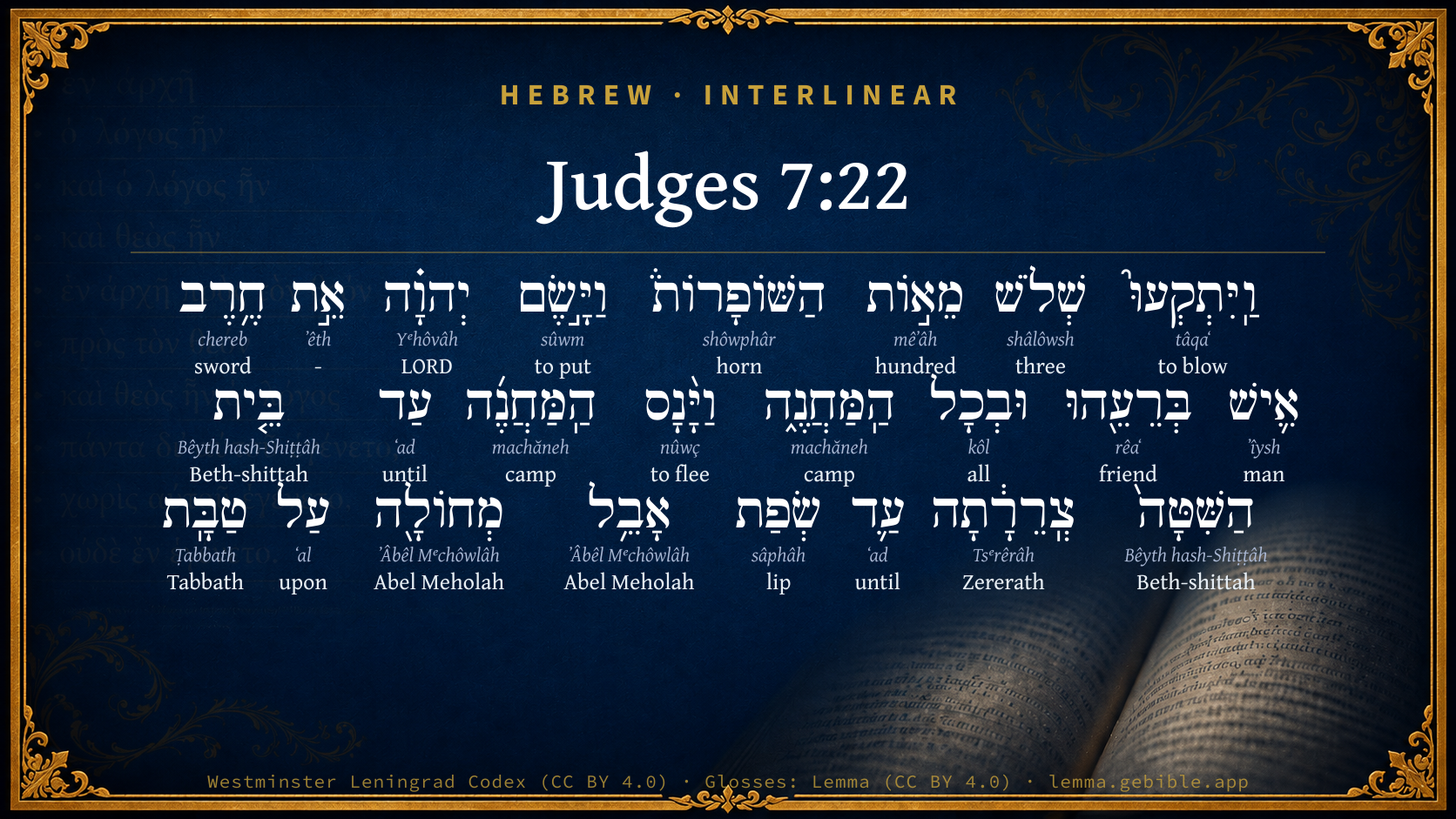
Judges 7:22

Hebrew (Westminster Leningrad Codex) Judges 7:22 appears in the Hebrew Old Testament. The text above is from the Westminster Leningrad Codex. Each word links to its Strong’s number, a concise gloss, and parsing drawn from the Open Scriptures Hebrew Bible morphology. Click any word for its full Brown-Driver-Briggs (BDB) entry.
Download image
Cite this verse

Judges 7:22 (World English Bible). Public Domain. Lemma interlinear Bible study tool, https://lemma.gebible.app/v/judges/7/22.

Show BibTeX & RIS
BibTeX
RIS
English Translation
They blew the three hundred trumpets, and Yahweh set every man's sword against his fellow, and against all the host; and the host fled as far as Beth-shittah toward Zererah, as far as the border of Abel Meholah, by Tabbath.
World English Bible · Public Domain
Highlights Full analysis ↓
Download a study sheet

One document with this verse’s original text, its word-by-word gloss line, the meaning frame, cross-references with their text, attributed commentary, and full source and license credits — printable, and it pastes into notes with its structure intact.

This verse Autodidact and up

Study sheet (.html) Plain text (.txt)

A passage Seminary Student

Up to 50 verses in one chapter. A passage sheet keeps up to 6 commentary sources and 12 cross-references per verse, in the order this page ranks them, and says so on the sheet whenever that leaves anything out. Ask for a single verse and you get the Autodidact verse sheet above.

Everything on this page stays free to read, with no account — the sheet is a download of what is already on screen, not access to it.

Want to remove ads? Support Godless Engineer
Compare translations 3

The same verse in 3 English versions, stacked beneath the original-language interlinear above. Click any original word for its lexicon entry.

Each is an independent rendering of the whole verse — the interlinear is not word-aligned to these translations.

Highlighted words mark where these versions differ — a whole-verse word diff, not a word-by-word alignment.

  • World English Bible Public Domain
    They blew the three hundred trumpets, and Yahweh set every man's sword against his fellow, and against all the host; and the host fled as far as Beth-shittah toward Zererah, as far as the border of Abel Meholah, by Tabbath.
  • King James Version Public Domain
    And the three hundred blew the trumpets, and the LORD set every man's sword against his fellow, even throughout all the host: and the host fled to Bethshittah in Zererath, and to the border of Abelmeholah, unto Tabbath.
  • unfoldingWord Literal Text CC BY-SA 4.0
    And they blew the 300 shofars, and Yahweh set the sword of a man against his comrade and against all of the camp. And the camp fled unto Beth Shittah, toward Zererah, unto the edge of Abel Meholah, by Tabbath.

unfoldingWord Literal Text — © unfoldingWord, licensed CC BY-SA 4.0. Word-aligned USFM3 via Door43 (git.door43.org/unfoldingWord/en_ult).

Versions to compare (up to 4)

3 of 4 selected

Show all 18 translations

Every available English version of this verse, each an independent rendering of the whole verse.

  • World English Bible Public Domain
    They blew the three hundred trumpets, and Yahweh set every man's sword against his fellow, and against all the host; and the host fled as far as Beth-shittah toward Zererah, as far as the border of Abel Meholah, by Tabbath.
  • Berean Standard Bible Public Domain
    And when the three hundred rams’ horns sounded, the LORD set all the men in the camp against one another with their swords. The army fled to Beth-shittah toward Zererah as far as the border of Abel-meholah near Tabbath.
  • Majority Standard Bible Public Domain
    And when the three hundred rams’ horns sounded, the LORD set all the men in the camp against one another with their swords. The army fled to Beth-shittah toward Zererah as far as the border of Abel-meholah near Tabbath.
  • King James Version Public Domain
    And the three hundred blew the trumpets, and the LORD set every man's sword against his fellow, even throughout all the host: and the host fled to Bethshittah in Zererath, and to the border of Abelmeholah, unto Tabbath.
  • American Standard Version (1901) Public Domain
    And they blew the three hundred trumpets, and Jehovah set every man's sword against his fellow, and against all the host; and the host fled as far as Beth-shittah toward Zererah, as far as the border of Abel-meholah, by Tabbath.
  • Revised Version (1885) Public Domain
    And they blew the three hundred trumpets, and the LORD set every man’s sword against his fellow, and against all the host: and the host fled as far as Beth-shittah toward Zererah, as far as the border of Abel-meholah, by Tabbath.
  • Geneva Bible (1599) Public Domain
    And the three hundreth blewe with trumpets, and the Lord set euery mans sworde vpon his neighbour, and vpon all the hoste: so the hoste fled to Beth-hashittah in Zererah, and to the border of Abel-meholah, vnto Tabbath.
  • Douay-Rheims (1899) Public Domain
    And the three hundred men nevertheless persisted sounding the trumpets. And the Lord sent the sword into all the camp, and they killed one another,
  • Young's Literal Translation Public Domain
    and the three hundred blow the trumpets, and Jehovah setteth the sword of each against his companion, even through all the camp; and the camp fleeth unto Beth-Shittah, at Zererath, unto the border of Abel-Meholah, by Tabbath.
  • Literal Standard Version CC BY-SA 4.0
    and the three hundred blow the horns, and YHWH sets the sword of each against his companion, even through all the camp; and the camp flees to Beth-Shittah, at Zererath, to the border of Abel-Meholah, by Tabbath.
  • Unlocked Literal Bible CC BY-SA 4.0
    When they blew the three hundred trumpets, Yahweh set every Midianite man's sword against his comrades and against all their army. The army fled as far as Beth Shittah toward Zererah, as far as the border of Abel Meholah, near Tabbath.
  • unfoldingWord Literal Text CC BY-SA 4.0
    And they blew the 300 shofars, and Yahweh set the sword of a man against his comrade and against all of the camp. And the camp fled unto Beth Shittah, toward Zererah, unto the edge of Abel Meholah, by Tabbath.
  • Darby Bible Public Domain
    When they blew the three hundred trumpets, the LORD set every man's sword against his fellow and against all the army; and the army fled as far as Beth-shit'tah toward Zer'erah, as far as the border of A'bel-meho'lah, by Tabbath.
  • World Messianic Bible Public Domain
    They blew the three hundred shofars, and the LORD set every man’s sword against his fellow and against all the army; and the army fled as far as Beth Shittah toward Zererah, as far as the border of Abel Meholah, by Tabbath.
  • Webster's Bible Public Domain
    And the three hundred blew the trumpets, and the LORD set every man's sword against his fellow, even throughout all the host: and the host fled to Beth-shittah in Zereroth, and to the border of Abel-meholah, to Tabbath.
  • Free Bible Version CC BY-SA 4.0
    When they blew the three hundred trumpets, the Lord made all the men in the camp attack one other with their swords. The enemy army fled to Beth-shittah near Zererah, all the way to the border of Abel Meholah near Tabbath.
  • Bible in Basic English Public Domain
    And the three hundred gave a loud note on their horns, and every man's sword was turned by the Lord against his brother all through the army; and the army went in flight as far as Beth-shittah in the direction of Zeredah, to the edge of Abel-meholah by Tabbath.
  • JPS Tanakh (1917) Public Domain
    And they blew the three hundred horns, and the LORD set every man's sword a against his fellow, even throughout all the host; and the host fled as far as Beth-shittah toward Zererah, as far as the border of Abel-meholah, by Tabbath.

Literal Standard Version (2020), Covenant Press — licensed CC BY-SA 4.0. Text via the HelloAO Bible API (eBible.org). Unlocked Literal Bible (unfoldingWord) — licensed CC BY-SA 4.0. Text via the HelloAO Bible API (eBible.org). unfoldingWord Literal Text — © unfoldingWord, licensed CC BY-SA 4.0. Word-aligned USFM3 via Door43 (git.door43.org/unfoldingWord/en_ult). Free Bible Version, Dr. Jonathan Gallagher — licensed CC BY-SA 4.0. Text via the HelloAO Bible API (eBible.org).

Word by word

More ways to search: Search by grammar → Find every occurrence → Compare this word →

Practice this passage: Drill this verse → Learn its vocabulary →

צְֽרֵרָ֔תָה
Tsᵉrêrâh
H6888
“Zererath · toward”
Noun, Proper + Suffix, Demonstrative
Part of Speech
Noun
Type
Proper
Full BDB Definition

Origin: apparently by erroneous transcription for H6868

TWOT: None

Zererath = "oppression" - a town or territory in Manasseh and the home of Jeroboam
  1. וַֽיִּתְקְעוּ֮ tâqaʻ H8628 “and · to blow” Conjunction + Verb, Qal, Sequential Imperfect, 3rd Person, Masculine, Plural
  2. שְׁלֹשׁ shâlôwsh H7969 “three” Adjective, Cardinal number, Feminine, Singular, Absolute
  3. מֵא֣וֹת mêʼâh H3967 “hundred” Adjective, Cardinal number, Both, Plural, Absolute
  4. הַשּׁוֹפָרוֹת֒ shôwphâr H7782 “the · horns” Particle, Definite Article + Noun, Common, Masculine, Plural, Absolute
  5. וַיָּ֣שֶׂם sûwm H7760 “and · to put” Conjunction + Verb, Qal, Sequential Imperfect, 3rd Person, Masculine, Singular
  6. יְהוָ֗ה Yᵉhôvâh H3068 “LORD” Noun, Proper
  7. אֵ֣ת ʼêth H853 “-” Particle, Direct Object
  8. חֶ֥רֶב chereb H2719 “sword of” Noun, Common, Feminine, Singular, Construct
  9. אִ֛ישׁ ʼîysh H376 “man” Noun, Common, Masculine, Singular, Absolute
  10. בְּרֵעֵ֖הוּ rêaʻ H7453 “in/at · friend · his” Preposition + Noun, Common, Masculine, Singular, Construct + Suffix, Personal, 3rd Person, Masculine, Singular
  11. וּבְכָל kôl H3605 “and · in/at · all of” Conjunction + Preposition + Noun, Common, Masculine, Singular, Construct
  12. הַֽמַּחֲנֶ֑ה machăneh H4264 “the · camp” Particle, Definite Article + Noun, Common, Both, Singular, Absolute
  13. וַיָּ֨נָס nûwç H5127 “and · to flee” Conjunction + Verb, Qal, Sequential Imperfect, 3rd Person, Masculine, Singular
  14. הַֽמַּחֲנֶ֜ה machăneh H4264 “the · camp” Particle, Definite Article + Noun, Common, Both, Singular, Absolute
  15. עַד ʻad H5704 “until” Preposition
  16. בֵּ֤ית Bêyth hash-Shiṭṭâh H1029 “Beth-shittah” Noun, Proper
  17. הַשִּׁטָּה֙ Bêyth hash-Shiṭṭâh H1029 “Beth-shittah” Noun, Proper
  18. עַ֛ד ʻad H5704 “until” Preposition
  19. שְׂפַת sâphâh H8193 “lip of” Noun, Common, Feminine, Singular, Construct
  20. אָבֵ֥ל ʼÂbêl Mᵉchôwlâh H65 “Abel Meholah” Noun, Proper
  21. מְחוֹלָ֖ה ʼÂbêl Mᵉchôwlâh H65 “Abel Meholah” Noun, Proper
  22. עַל ʻal H5921 “upon” Preposition
  23. טַבָּֽת Ṭabbath H2888 “Tabbath” Noun, Proper

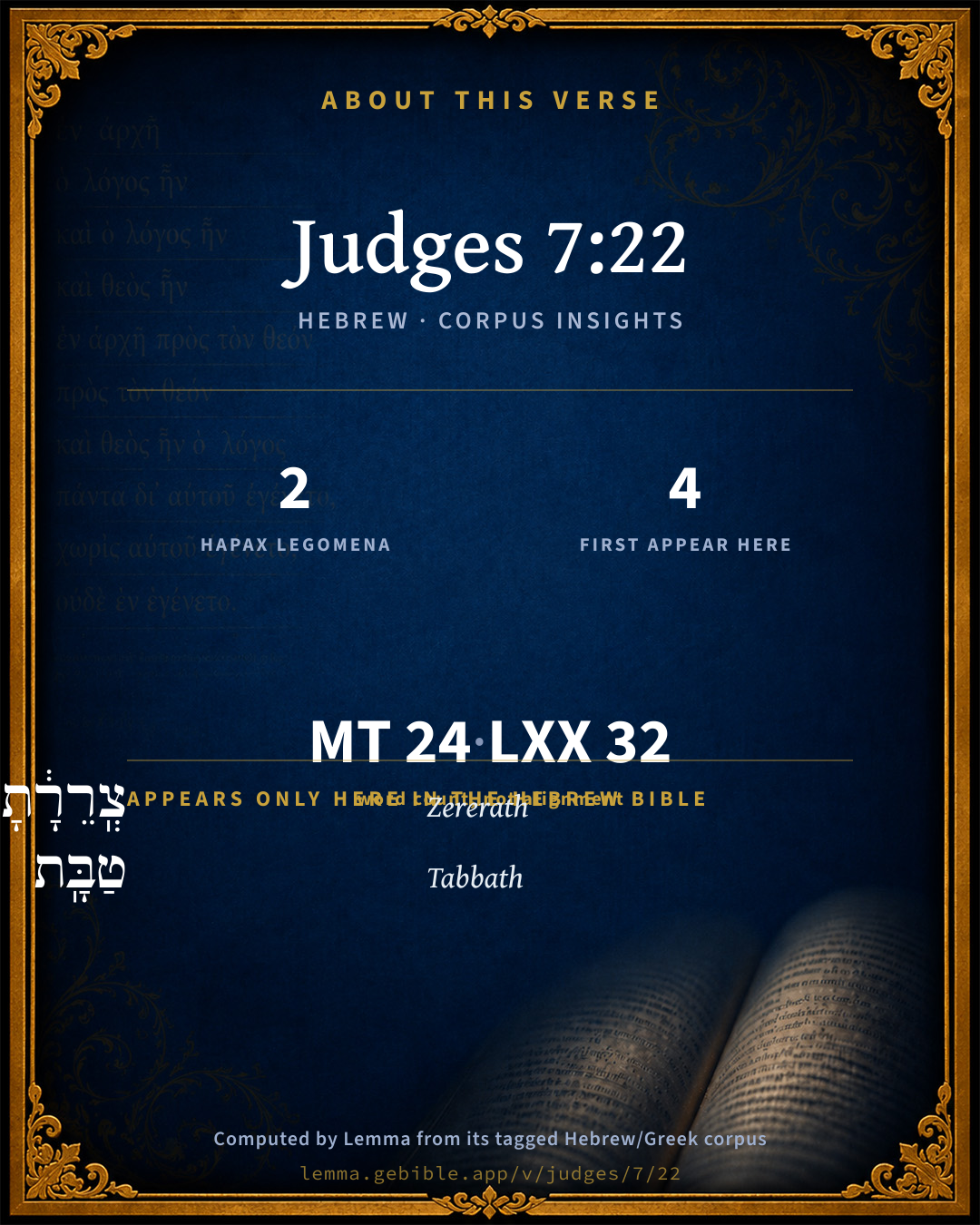
About this verse

These counts appear in no published source. They are computed here, from the morphology-tagged text and Lemma’s own curated glosses. What Lemma adds →

24
words
20
distinct lemmas
Historical
section

Notable vocabulary

2 hapax legomena — words that appear only here in the entire Hebrew Bible:

  • צְֽרֵרָ֔תָה Zererath H6888
  • טַבָּֽת Tabbath H2888

First appearance in Scripture

These words make their first canonical appearance in the Hebrew Bible here:

  • בֵּ֤ית Beth-shittah H1029
  • צְֽרֵרָ֔תָה Zererath H6888
  • אָבֵ֥ל Abel Meholah H65
  • טַבָּֽת Tabbath H2888

Grammatical profile

  • 3 verbs
  • 15 nouns
  • 2 adjectives
  • 3 prepositions
  • 1 particle

Verb forms

  • וַֽיִּתְקְעוּ֮ Qal · Sequential Imperfect
  • וַיָּ֣שֶׂם Qal · Sequential Imperfect
  • וַיָּ֨נָס Qal · Sequential Imperfect

Repetition

Words recur within this verse — often emphatic in Hebrew:

  • הַֽמַּחֲנֶ֑ה camp H4264 ×2
  • עַד until H5704 ×2
  • בֵּ֤ית Beth-shittah H1029 ×2
  • אָבֵ֥ל Abel Meholah H65 ×2

Hebrew & Septuagint length

In English translation the verse runs 40 words from the Hebrew and 22 from the Septuagint (LXX English) — the Septuagint runs noticeably shorter here. See the side-by-side →

A rough comparison of the two English renderings, which tokenize alike — not a word-level alignment.

Word counts can differ between the Hebrew and the Greek without any difference in meaning — e.g. the Hebrew direct-object marker אֵת has no separate Greek word, and Greek often adds the article ὁ.

In the original languages it is 24 Hebrew tokens and 32 Greek tokens — but the two are counted differently (Hebrew bundles its prefixes and suffixes into one token; the Greek is in lemma form), so that isn’t a like-for-like length.

Cross-references

11

Topical passages linked to Judges 7:22 in the Treasury of Scripture Knowledge — connected by theme and wording, ordered by reader-vote popularity; previews shown in the World English Bible.

  • 1 Kings 4:12 Baana the son of Ahilud, in Taanach and Megiddo, and all Beth-shean which is beside Zarethan, beneath Jezreel, from Beth-shean to Abel Meholah, as far as beyond Jokmeam;
  • Joshua 6:4 Seven priests shall bear seven trumpets of rams' horns before the ark: and the seventh day you shall compass the city seven times, and the priests shall blow the trumpets.
  • Joshua 6:16 It happened at the seventh time, when the priests blew the trumpets, Joshua said to the people, Shout; for Yahweh has given you the city.
  • Joshua 6:20 So the people shouted, and [the priests] blew the trumpets; and it happened, when the people heard the sound of the trumpet, that the people shouted with a great shout, and the wall fell down flat, so that the people went up into the city, every man straight before him, and they took the city.
  • 1 Kings 19:16 and Jehu the son of Nimshi shall you anoint to be king over Israel; and Elisha the son of Shaphat of Abel Meholah shall you anoint to be prophet in your room.
  • 2 Chronicles 20:23 For the children of Ammon and Moab stood up against the inhabitants of Mount Seir, utterly to kill and destroy them: and when they had made an end of the inhabitants of Seir, everyone helped to destroy another.
  • Psalms 83:9 Do to them as you did to Midian, As to Sisera, as to Jabin, at the river Kishon;
  • Isaiah 9:4 For the yoke of his burden, and the staff of his shoulder, the rod of his oppressor, you have broken as in the day of Midian.
  • Isaiah 19:2 I will stir up the Egyptians against the Egyptians: and they shall fight everyone against his brother, and everyone against his neighbor; city against city, [and] kingdom against kingdom.
  • 1 Samuel 14:16–20 The watchmen of Saul in Gibeah of Benjamin looked; and, behold, the multitude melted away, and they went [here] and there.
  • 2 Corinthians 4:7 But we have this treasure in clay vessels, that the exceeding greatness of the power may be of God, and not from ourselves.

Cross-references courtesy of OpenBible.info (CC BY 4.0).

Hebrew and Greek witnesses Masoretic Hebrew ↔ Greek Septuagint

The same verse in the two great witnesses to the Old Testament, shown verse-for-verse.

Here the Septuagint runs noticeably shorter than the Hebrew — LXX2012 (modern English Septuagint) 22 words vs World English Bible 40. A rough length comparison of the two English translations, not a word-level alignment — read both below.

These are two independent witnesses, not word-aligned to each other, and the Septuagint is shown in lemma (dictionary) form.

Hebrew Judges 7:22 Masoretic · Westminster Leningrad Codex

וַֽיִּתְקְעוּ֮ שְׁלֹשׁ מֵא֣וֹת הַשּׁוֹפָרוֹת֒ וַיָּ֣שֶׂם יְהוָ֗ה אֵ֣ת חֶ֥רֶב אִ֛ישׁ בְּרֵעֵ֖הוּ וּבְכָל הַֽמַּחֲנֶ֑ה וַיָּ֨נָס הַֽמַּחֲנֶ֜ה עַד בֵּ֤ית הַשִּׁטָּה֙ צְֽרֵרָ֔תָה עַ֛ד שְׂפַת אָבֵ֥ל מְחוֹלָ֖ה עַל טַבָּֽת

They blew the three hundred trumpets, and Yahweh set every man's sword against his fellow, and against all the host; and the host fled as far as Beth-shittah toward Zererah, as far as the border of Abel Meholah, by Tabbath.

World English Bible · Public Domain

Greek LXX Judges 7:22 Septuagint · lemma form

καί σαλπίζω ἐν ὁ τριακόσιοι κερατίνη καί τίθημι κύριος ὁ ῥομφαία ἀνήρ ἐν ὁ πλησίον αὐτός ἐν πᾶς ὁ παρεμβολή καί φεύγω ὁ παρεμβολή ἕως βηθσεεδτα γαραγαθα ἕως χεῖλος αβωμεουλα ἐπί ταβαθ

And they sounded with the three hundred horns; and the Lord set every man's sword in all the host against his neighbor.

LXX2012 (modern English Septuagint) · Public Domain

On this verse, Ellicott's Commentary for English Readers discusses the Septuagint’s reading. Read the note in Commentary ↓

Hebrew: Westminster Leningrad Codex (CC BY 4.0). Greek: Septuagint (public domain); English from LXX2012 (modern English Septuagint) (Public Domain). How the Septuagint differs from the Hebrew →

Targum (Aramaic paraphrase)

1

The Targum is the ancient Jewish Aramaic paraphrase of the Hebrew Scriptures — an interpretive translation, not the Hebrew text itself. Onkelos (literal) and Pseudo-Jonathan (expansive) render the Torah, and Jonathan the Prophets. Coverage is partial: where no permissively-licensed English translation exists for a verse, only the Aramaic is shown. This is verse-level text, not a word-by-word alignment to the Hebrew.

  1. Targum Jonathan Prophets (Joshua–Malachi)
    וּתְקָעוּ תְּלַת מְאָה שׁוֹפָרַיָא וְשַׁוִי יְיָ יַת חֶרֶב גְבַר בְּחַבְרֵיהּ וּבְכָל מַשְׁרִיתָא וְאַפְּכַת מַשְׁרִיתָא עַד בֵּית שִׁיטָה לִצְרֵירַת עַד כֵּיף מֵישַׁר אָבֵל מְחוֹלָה לְטַבָּת:

    (no public-domain English translation for this verse)

    Targum Jonathan — Aramaic: “Mikraot Gedolot” (public domain). English: “Sefaria Community Translation” (CC0 1.0 (public-domain dedication)); “London "Chaldee Paraphrase," 1871” (public domain). Text via Sefaria.

Commentary

Notes on Judges 7:22 from classic Christian and Jewish commentators (each source and its license shown beneath its notes). The classic Christian expositions comment on the surrounding passage and are grouped to its opening verse, so a note may address several verses; the Jewish commentaries on the Tanakh (Rashi and others) are per-verse, so they appear only where the commentator wrote on this verse.

Lemma curates 59 commentaries, every one of them public domain or Creative Commons licensed, each selected and text-cleaned for this edition rather than reprinted as found. About our sources →

Trapp's Complete Commentary

John Trapp

Jdg 7:22 And the three hundred blew the trumpets, and the LORD set every man’s sword against his fellow, even throughout all the host: and the host fled to Bethshittah in Zererath, [and] to the border of Abelmeholah, unto Tabbath.

Ver. 22. And the Lord set every man’s sword against his fellow.] For being smitten by God with a spirit of giddiness, they took their friends for their foes: and, like those terrigenae fratres, they slaughtered one another in the place. See the like, 1Sa 14:15-20 2Ch 20:23.

And the host fled to Bethshittah, &c.] Places unknown to us out of Scripture, save only Abelmeholah, {a} which was in the half tribe of Manasseh within Canaan, {1Ki 4:12} and so, likely, were the rest. But whithersoever they fled, in running from death they ran to it.

{a} This Abelmeholah was afterwards the habitation of the prophet Elisha. {1Ki 19:16}

John Trapp, A Commentary or Exposition upon All the Books of the Old and New Testament (1647–1656) — public domain. Text from a community e-Sword module.

Geneva Bible (1599)

Geneva Bible translators

The Lord caused the Midianites to kill one another.

Geneva Bible (1599) marginal notes — public domain. Text via Bolls.life.

Adam Clarke's Commentary

Verse 22. Fled to Beth-shittah] This is no where else mentioned in Scripture.

Zererath] This and Tabbath are nowhere else to be found.

Abel-meholah] This was the birth-place of the prophet Elisha, 1Kg 19:16. It was beyond Jordan, in the tribe of Manasseh, 1Kg 4:12. The Zartanah, mentioned in this last quoted verse, was probably the same as Zererath. Its situation corresponds well with Abel-meholah.

Adam Clarke's Commentary on the Bible (1810–1826) — public domain. Text from a community e-Sword/MySword module.

Ellicott's Commentary for English Readers

(22) Blew the trumpets.—They continued to blow incessantly, to add to the panic.

The Lord set every man’s sword against his fellow.—We have an exact parallel to this in the mutual slaughter of the Ammonites, Moabites, and Edomites, when stricken with a similar panic before the army of Jehoshaphat, in 2Ch_20:21-22; and on a smaller scale in the camp of the Philistines at Gibeah (1 Samuel 14). The tremendous tragedy of their flight can only be appreciated by the vivid impression which it made on the national imagination (Isa_9:4; Isa_10:26). In Psa_83:13-14, it is compared to the whirling flight of dry weeds before a rush of flame and wind, recalling the Arab imprecation, “May you be whirled like the akukb (‘wild artichoke,’ ‘a wheel,’ ‘a rolling thing’) before the wind, until you are caught in the thorns or plunged into the sea” (Thomson, Land and Book, Judges 36).

Beth-shittah.—It should be rather, Beth hash-shit-tah, “the house of the acacia”—a place named from the trees which are still abundant in that neighbourhood, just as we have such names as Burntash, Seven-oaks, Nine Elms, &c. (Comp. Abel-Shittim, Num_33:49; Joshua 21.) If Beth hash-shittah was the village Shultah, with which Robinson (Bibl. Reg., 3:219) identifies it, some of the host must have fled northwards. It is improbable that it was another name for Beth-shean, though the LXX. have Bethsead in some MSS. It is, however, by no means unlikely that some of the marauders would fly towards the fords of the Jordan near Bethshean (comp. Jos. Antt. v. 6, § 5), as others fled south to the fords near Succoth, which lay to the south of the Jabbok.

In.—Rather, towards, as in the margin.

Zererath.—Rather, Zererah. This is omitted in the Vulgate; the LXX. have the extraordinary reading Tagaragatha, or in some MSS. “and he led them.” The final th is no part of the name, but the mode of connecting the name with the particle of motion. Zererath is not again mentioned, but the distinction between the Hebrew letters r (ר) and d (ד) is so slight that the reading Zeredath may here be correct; and if so, it may be the Zeredath in Ephraim, which was the birthplace of Jeroboam (1Ki_11:26), and the Zaretan of Jos_3:16, 1Ki_7:46, which is sixteen miles north of Jericho.

To the border.—Literally, as in the margin, to the lip, or brink, as in Gen_22:17; Exo_4:30. It does not, however, necessarily prove that Abel-meholah was on the edge of the Jordan valley.

Abel-meholah.—“The meadow of the dance.” It was in Ephraim, and was the native place of Elisha (1Ki_19:16; see, too, 1Ki_4:12). Eusebius and Jerome place it ten miles south of Bethshean, at Wady Maleb. Abel means “a moist, grassy meadow.”

Unto Tabbath.—Literally, upon Tabbath. The name seems to mean “famous,” but the site is unknown, unless it be the remarkable bank called Tubukhat Fahil,

A Bible Commentary for English Readers, edited by Charles John Ellicott (1878–1897) — public domain. Text from a community e-Sword module.

The Cambridge Bible for Schools and Colleges

gen. ed. J. J. S. Perowne

22. The Midianites, roused suddenly from sleep, gave the alarm and tried to fly (Jdg_7:21); now, believing themselves to be completely surrounded, and cumbered by their tents and cattle, they turn their swords against one another (cf. 1Sa_14:20, 2Ki_3:23), and the flight becomes general. For and against all the host read in all the host, LXX, Peshitto

The Midianites no doubt fled down the valley eastwards, and made for the Jordan fords, but the places named as marking the course of the flight cannot be identified with certainty. The accumulation of names (note the double as far as) is perhaps due to the fusion of two narratives. Beth-shittah (‘house of the acacia’) has been identified with the present Shiṭṭâh, 6 m. E. of Zer‘în (Jezreel), but this is too near the site of the camp. Zerçrah is perhaps to be read Zerçdah (with many MSS.) 1Ki_11:26, which is generally identified with Zarĕthan, 2Ch_4:17 compared with 1Ki_7:46; this will bring the place considerably to the south, near to Adam (Jos_3:16) = the ford Dâmiyeh. But the identification is not certain, for in 1Ki_4:12 Zarĕthan is beside Beth-shean, the modern Bçsân, and below Jezreel; the two names are perhaps confused, possibly the northern was Zerçdah, the southern Zarĕthan. Abel-meholah (1Ki_4:12; 1Ki_19:16) is identified by Eusebius, Onom. Sacr., 227, 35 with Bethmaiĕla, a village in the Jordan valley, 10 Roman miles from Scythopolis (= Beth-shean). The lip of Abel-meholah (see marg.) was no doubt the cliff where the valley ended in a steep descent to the river. Tabbath is quite unknown.

The Cambridge Bible for Schools and Colleges (gen. ed. J. J. S. Perowne; Cambridge University Press, 1878–1918) — public domain. Text from a community e-Sword module.

John Gill's Exposition

And the three hundred men blew the trumpets,.... Kept blowing them to continue and increase the terror of the enemy, and still held the lamps in their hands, and stood as torch bearers to light the Midianites and their associates to destroy one another, as follows:

and the Lord set every man's sword against his fellow throughout the host; and so slew one another; either suspecting treachery, as Grotius, and so in revenge, wrath, and indignation, drew their swords on each other; or through the terror and amazement they were in at the sounds they heard, and the blazing torches dazzling their eyes, they knew not what they did, or who they fell upon, taking their friends for foes, supposing the Israelites were got into their camp; and the rather they might be led into this mistake, since there were people of different languages among them, as Josephus (m) observes; but the thing was of God, it was he that took away their reason and judgment from them, and infatuated them, and filled their imaginations with such strange apprehensions of things; and threw into their minds such terror and amazement, and directed them to point their swords at one another:

and the host fled to Bethshittah in Zererath; that is, which was left of it, which had not destroyed each other; the first of these places should be read Bethhashittah; and perhaps had its name from the "shittah" or "shittim" trees which might grow near it in plenty, or the houses in it might be built of shittim wood; or it may be here stood a temple formerly dedicated to some deity of this name, and near it a grove of the above trees. Zererath, Kimchi observes, is written with two "reshes", or R's, to distinguish it from another place called Tzeredah; but where either of these places mentioned were cannot be particularly said; though it is highly probable they were in the tribe of Manasseh, and in the way to Jordan, whither in all probability the Midianites would steer their course to escape to their own land:

and to the border of Abelmeholah unto Tabbath; the former of these was the birth place of Elisha the prophet, Kg1 19:16 and it appears very plainly that it was in the tribe of Manasseh, being mentioned with other places in that tribe, Kg1 4:12. Jerome (n) under this word says, there was in his time a village in Aulon, or the plain, ten miles from Scythopolis to the south, which was called Bethahula; and the Targum is,"to the border of the plain of Abelmeholah;''but of Tabbath we nowhere else read.

(m) Antiqu. l. 5. c. 6. sect. 5. (n) De loc. Heb. fol. 88. M.

John Gill's Exposition of the Whole Bible (1746–1763) — public domain (CC PDM 1.0). Text via the HelloAO Bible API.

Albert Barnes' Notes on the Bible

Beth-shittah - - “House of the acacias,” the same trees which gave their name to “Shittim” Num 33:49 in the plains of Maab, and which grew plentifully also, in the peninsula of Sinai Exo 25:5 perhaps “Shuttah”, in the valley of Jezreel; or it may be another name of Scythopolis, or Beth-shan (compare 1Ki 4:12). “Zererath or Zeredath”, near Succoth Jdg 8:5, the same as “Zeredah” in Ephraim the birth-place of Jeroboam 1Ki 11:26, and “Zartauah” 1Ki 4:12. “Abel-meholah” (field of the dance), the birth-place of Elisha 1Ki 19:16 is in the Jordan valley, 10 miles from Scythopolis, if identified with Bethmaela: if the same as Abelmea, it lay between Nablous and Scythopolis. (But see 1Ki 19:16 note.) “Tabbath” was apparently lower down the Jordan valley, i. e. further south.

Albert Barnes' Notes on the Bible (1834–1885) — public domain. Text from a community e-Sword/MySword module.

Matthew Poole's English Annotations

They slew one another, either because they suspected treachery, and so fell upon those they first met with; which they might more easily do, because they consisted of several nations, as may be gathered from Jdg 6:3, and Josephus affirms; or because the darkness of the night made them unable to distinguish friends from foes; or because the suddenness of the thing struck them with horror and amazement; or because God infatuated them, as he hath done many others. Compare 1Sa 14:20; 2Ch 20:23.

Abel-meholah; of which see 1Ki 4:12; 19:16.

Matthew Poole's English Annotations on the Holy Bible (1683–1685) — public domain. Text from a community e-Sword/MySword module.

Whedon's Commentary on the Bible

Daniel D. Whedon

22. Every man’s sword against his fellow — Midianite slaughtered Midianite, so that the sword of the enemy did service for the Lord and for Gideon.

Beth-shittah — Possibly the modern Shutta, between Jezreel and the Jordan. Near this the Midianites must have passed in their flight towards the Jordan.

Zererath — Identical with Zarthan, (1Ki_7:46,) and Zereda-thah. 2Ch_4:17. It was situated in the Jordan valley, and not far from Beth-shean, but its exact locality has not been found. The same must be said of Abel-meholah and Tabbath.

Daniel D. Whedon (gen. ed.), Commentary on the Old and New Testaments (1874–1909) — public domain. Text from a community e-Sword module.

The Pulpit Commentary

Blew the trumpets, etc. Hearing the confusion, the three companies blew their trumpets, probably more loudly than before, to give the impression of a hot pursuit being at hand. The Midianites, thinking the enemy were upon them, and not being able in the dark to distinguish friend from foe, mistook their flying comrades for pursuing Israelites, and fell upon and slew one another. In like manner the Philistines had done when attacked by Jonathan and his armour-bearer, (1Sa_14:20) and the Ammonites, Moabites, and Edomites when attacked by Jehoshaphat. (2Ch_20:23) Beth-shittah. House of acacias. The exact situation of it, and of Zererath and Tabbath, is unknown. They must have been villages lying on the route from the plain of Esdraelon to the banks of Jordan, probably between Little Hermon on the north and Mount Gilboa on the south, where there was a very ancient high road from Jezreel to the Jordan by Beth-sham Indeed it is highly probable that Shuta, a village mentioned by Robinson, marks the site, as it retains the name of Beth-shittah. For Zererath some read, with some of the old versions and manuscripts, Zeredath (r and d being scarcely distinguishable in Hebrew), and identify it with Zarthan near Succoth, mentioned Jos_3:16 and 1Ki_4:12 1Ki_7:46. Abel-meholah (the meadow of the dance) was the birthplace of Elisha, (1Ki_19:16) and is mentioned in conjunction with Beth-shan, Jezreel, and Zartana in 1Ki_4:12. Eusebius tells us that in his time Abel-meholah was called Beth-maiela, and situated ten miles below Beth-shan, or Scy-thopolis. There was also, he says, close by an Abelmaiela.

Ver. 22-ch. Jud_1:8:1) but now, seeing the extreme importance of seizing the fords of Jordan, so as to stop the escape of the Midianites, he sent messengers in all haste to the men of Ephraim, who accordingly "took the waters unto Beth-barah and Jordan." The waters seem to mean a number of streams running from the hill country of Ephraim into the Jordan, and which had to be crossed by the Midianites before they could reach the Jordan fords. The site of Beth-barah is unknown. It is not thought to be the same as Bethabara beyond Jordan, where John was baptising. (Joh_1:28) Beth-barah must have been on the west of Jordan.

The Pulpit Commentary (1880–1919), ed. H.D.M. Spence-Jones & Joseph S. Exell — public domain. Text from a community e-Sword module.

John Wesley's Explanatory Notes

Against his fellow - They slew one another, because they suspected treachery, and so fell upon those they first met with; which they might more easily do, because they consisted of several nations, because the darkness of the night made them unable to distinguish friends from foes, because the suddenness of the thing struck them with horror and amazement; and because God had infatuated them, as he had done many others.

John Wesley, Explanatory Notes Upon the Whole Bible (1754–1765) — public domain. Text via the GEBible commentary corpus.

Keil & Delitzsch

C. F. Keil & F. Delitzsch

Whilst the 300 men blew their trumpets, "Jehovah set the sword of one against the other, and against the whole camp," i.e., caused one to turn his sword against the other and against all the camp, that is to say, not merely man against man, but against every one in the camp, so that there arose a terrible slaughter throughout the whole camp. The first clause, "and the three hundred blew the trumpets," simply resumes the statement in Jdg 7:20, "the three companies blew the trumpets," for the purpose of appending to it the further progress of the attack, and the result of the battle. Bertheau inserts in a very arbitrary manner the words, "the second time." His explanation of the next clause ("then the 300 fighting men of Gideon drew the sword at Jehovah's command, every man against his man") is still more erroneous, since it does violence to the constant usage of the expression בּרעהוּ אישׁ (see Sa1 14:20; Ch2 20:23; Isa 3:5; Zac 8:10). "And all the camp of the Midianites fled to Beth-shittah to Zeredah, to the shore of Abel-meholah, over Tabbath." The situation of these places, which are only mentioned here, with the exception of Abel-meholah, the home of Elisha (Kg1 19:16; Kg1 4:12), has not yet been determined. According to the Syriac, the Arabic, and some of the MSS, we should read Zeredathah instead of Zererathah, and Zeredathah is only another form for Zarthan (comp. Kg1 7:46 with Ch2 4:17). This is favoured by the situation of Zarthan in the valley of the Jordan, probably near the modern Kurn Sartabeh (see p. 35), inasmuch as in all probability Beth-shittah and Abel-meholah are to be sought for in the valley of the Jordan; and according to Jdg 7:24, the enemy fled to the Jordan. Beth-shittah, i.e., acacia-house, is not the same place as the village of Shutta mentioned by Robinson (iii. p. 219), since this village, according to Van de Velde's map, was to the north of Gilboa. For although Shutta is favoured by the circumstance, that from a very ancient time there was a road running from Jezreel along the valley, between the so-called Little Hermon (Duhy) and the mountains of Gilboa, and past Beisan to the Jordan; and the valley of Jalud, on the northern side of which Shutta was situated, may be regarded as the opening of the plain of Jezreel into the valley of the Jordan (see v. Raumer, Pal. p. 41, and Rob. iii. p. 176); and v. Raumer conjectures from this, that "the flight of the Midianites was apparently directed to Bethsean, on account of the nature of the ground," - this assumption is rendered very questionable by the fact that the flying foe did not cross the Jordan in the neighbourhood of Beisan, but much farther to the south, viz., according to Jdg 8:4, in the neighbourhood of Succoth, which was on the south side of the Nahr Zerka (Jabbok). From this we are led to conjecture, that they were not encamped in the north-eastern part of the plain of Jezreel, in the neighbourhood of Jezreel (Zerin) and Shunem (Solam), but in the south-eastern part of this plain, and that after they had been beaten there they fled southwards from Gilboa, say from the district of Ginaea (Jenin) to the Jordan. In this case we have to seek for Abel-shittah on the south-east of the mountains of Gilboa, to the north of Zeredathah (Zarthan). From this point they fled on still farther to the "shore of Abel-meholah." שׂפה does not mean boundary, but brink; here the bank of the Jordan, like היּרדּן שׂפת in Kg2 2:13. The bank or strand of Abel-meholah is that portion of the western bank of the Jordan or of the Ghor, above which Abel-meholah was situated. According to the Onom. (s. v. Ἀβελμαελαί, Abelmaula), this place was in the Aulon (or Ghor), ten Roman miles to the south of Scythopolis (Beisan), and was called at that time Βηθμαιελά or Bethaula. According to this statement, Abel-meholah would have to be sought for near Churbet es Shuk, in the neighbourhood of the Wady Maleh (see V. de Velde, Mem. p. 280). And lastly, Tabbath must have been situated somewhere to the south of Abel-meholah.

Keil & Delitzsch — Biblical Commentary on the Old Testament (1861–1891) — public domain (CC PDM 1.0). Text via the HelloAO Bible API. (Old Testament only.)

unfoldingWord translationNotes

Door43 World Missions Community

three hundred trumpets

"300 trumpets" (See: Numbers)

Yahweh set every Midianite man's sword against his comrades

Here "sword" refers to their attack with the use of the sword. AT: "Yahweh caused every Midianite man to fight against his fellow soldiers" (See: Metonymy)

Beth Shittah ... Zererah ... Abel Meholah ... Tabbath

These are the names of towns and cities. (See: How to Translate Names)

The men of Israel from Naphtali, Asher, and all Manasseh were called out

This can be stated in active form. AT: "Gideon called out the Israelites from the tribes of Naphtali, Asher, and all Mannasseh" (See: Active or Passive)

translationWords

trumpet

Yahweh

Midian

sword

Israel

Naphtali

Asher

Manasseh

unfoldingWord translationNotes — © Distant Shores Media and the Door43 World Missions Community, licensed CC BY-SA 4.0. Source: git.door43.org/Door43/en_tn.

Lesson kit

Teaching starters — assembled from the data on this page, not authored interpretation. Every prompt links to the verse data it draws on. Edit before teaching.

Judges, in the Historical, opens this verse with 24 words (20 distinct Hebrew lemmas). Its most distinctive word is Tsᵉrêrâh (“Zererath”). The Greek Septuagint runs shorter here. A historical commentator’s framing appears above. Read the whole chapter for the surrounding context.

Discussion questions

  1. What does “Zererath” (Tsᵉrêrâh) contribute to the verse as a whole?
  2. 2 words here appear nowhere else in the Hebrew Bible. Why might the author reach for such rare wording?
  3. 4 words make their first appearance in Scripture here. What does this debut establish?
  4. How does 1 Kings 4:12, which shares this passage’s theme, read alongside this verse?
  5. What does the repetition of “camp” (2× in this one verse) do in this verse?
  6. The Septuagint runs shorter here than the Hebrew. What might account for the difference?
  7. The translations on this page render this verse differently — a whole-verse word diff, not a word-by-word alignment. What might account for the different wordings?
  8. «וַֽיִּתְקְעוּ֮» is a Qal Sequential Imperfect verb. How does that grammatical form shape the action described?

Things to notice

  • 2 words in this verse appear nowhere else in the Hebrew Bible.
  • 4 words make their first canonical appearance in Scripture here.
  • This verse counts 24 Hebrew ↔ 32 Greek words.
  • These translations choose different wording for 29 words in this verse.
  • “camp” occurs 2× in this single verse.

Reading settings

Reading text

Shown beneath each verse's original-language words.

Old Testament
Old Testament edition

Read the OT as the Masoretic Hebrew (MT) or the Greek Septuagint (LXX).

English shown for the Greek Septuagint (in the Hebrew ↔ Greek comparison).

Comparing translations? Open the Compare panel on any verse page to stack up to four side by side.