
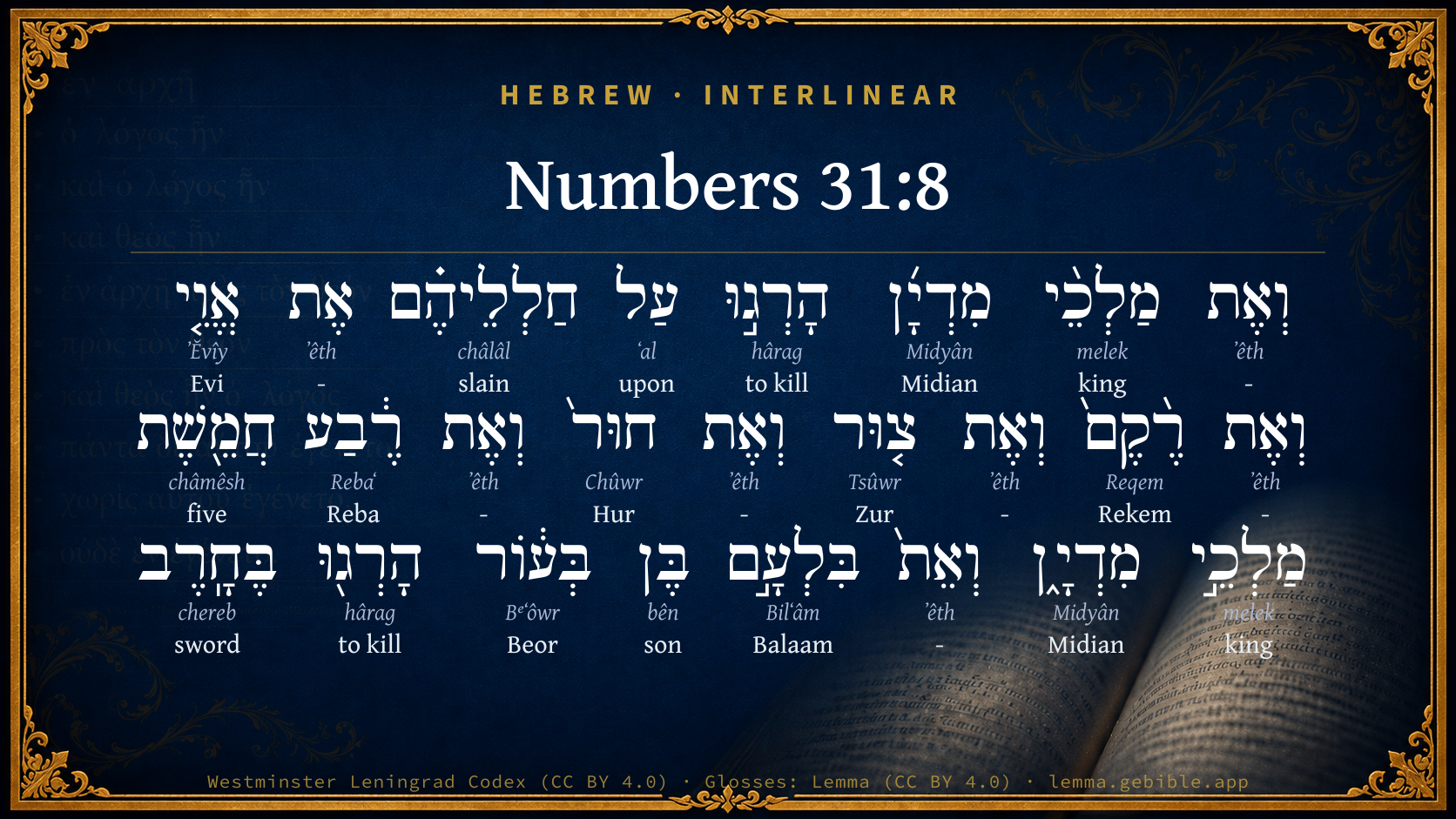
Numbers 31:8

Hebrew (Westminster Leningrad Codex) Numbers 31:8 appears in the Hebrew Old Testament. The text above is from the Westminster Leningrad Codex. Each word links to its Strong’s number, a concise gloss, and parsing drawn from the Open Scriptures Hebrew Bible morphology. Click any word for its full Brown-Driver-Briggs (BDB) entry.
Download image
Cite this verse

Numbers 31:8 (World English Bible). Public Domain. Lemma interlinear Bible study tool, https://lemma.gebible.app/v/numbers/31/8.

Show BibTeX & RIS
BibTeX
RIS
English Translation
They killed the kings of Midian with the rest of their slain: Evi, and Rekem, and Zur, and Hur, and Reba, the five kings of Midian: Balaam also the son of Beor they killed with the sword.
World English Bible · Public Domain
Highlights
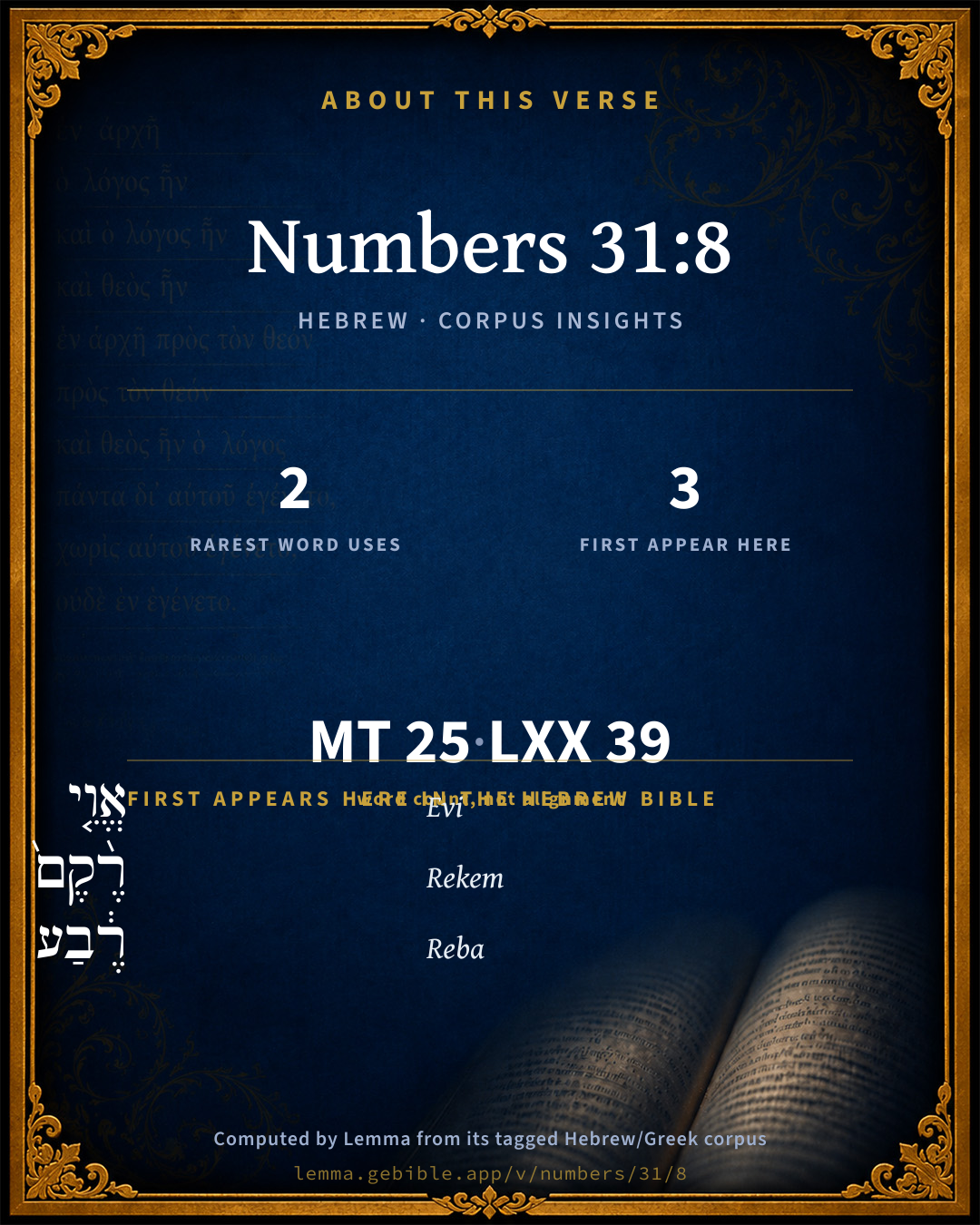
  • 3 first appearances in the Hebrew Bible
Full analysis ↓
Download a study sheet

One document with this verse’s original text, its word-by-word gloss line, the meaning frame, cross-references with their text, attributed commentary, and full source and license credits — printable, and it pastes into notes with its structure intact.

This verse Autodidact and up

Study sheet (.html) Plain text (.txt)

A passage Seminary Student

Up to 50 verses in one chapter. A passage sheet keeps up to 6 commentary sources and 12 cross-references per verse, in the order this page ranks them, and says so on the sheet whenever that leaves anything out. Ask for a single verse and you get the Autodidact verse sheet above.

Everything on this page stays free to read, with no account — the sheet is a download of what is already on screen, not access to it.

Want to remove ads? Support Godless Engineer
Compare translations 3

The same verse in 3 English versions, stacked beneath the original-language interlinear above. Click any original word for its lexicon entry.

Each is an independent rendering of the whole verse — the interlinear is not word-aligned to these translations.

Highlighted words mark where these versions differ — a whole-verse word diff, not a word-by-word alignment.

  • World English Bible Public Domain
    They killed the kings of Midian with the rest of their slain: Evi, and Rekem, and Zur, and Hur, and Reba, the five kings of Midian: Balaam also the son of Beor they killed with the sword.
  • King James Version Public Domain
    And they slew the kings of Midian, beside the rest of them that were slain; namely, Evi, and Rekem, and Zur, and Hur, and Reba, five kings of Midian: Balaam also the son of Beor they slew with the sword.
  • unfoldingWord Literal Text CC BY-SA 4.0
    And they slew the kings of Midian with their pierced ones: Evi and Rekem and Zur and Hur and Reba, the five kings of Midian; and they slew Balaam the son of Beor by the sword.

unfoldingWord Literal Text — © unfoldingWord, licensed CC BY-SA 4.0. Word-aligned USFM3 via Door43 (git.door43.org/unfoldingWord/en_ult).

Versions to compare (up to 4)

3 of 4 selected

Show all 18 translations

Every available English version of this verse, each an independent rendering of the whole verse.

  • World English Bible Public Domain
    They killed the kings of Midian with the rest of their slain: Evi, and Rekem, and Zur, and Hur, and Reba, the five kings of Midian: Balaam also the son of Beor they killed with the sword.
  • Berean Standard Bible Public Domain
    Among the slain were Evi, Rekem, Zur, Hur, and Reba—the five kings of Midian. They also killed Balaam son of Beor with the sword.
  • Majority Standard Bible Public Domain
    Among the slain were Evi, Rekem, Zur, Hur, and Reba—the five kings of Midian. They also killed Balaam son of Beor with the sword.
  • King James Version Public Domain
    And they slew the kings of Midian, beside the rest of them that were slain; namely, Evi, and Rekem, and Zur, and Hur, and Reba, five kings of Midian: Balaam also the son of Beor they slew with the sword.
  • American Standard Version (1901) Public Domain
    And they slew the kings of Midian with the rest of their slain: Evi, and Rekem, and Zur, and Hur, and Reba, the five kings of Midian: Balaam also the son of Beor they slew with the sword.
  • Revised Version (1885) Public Domain
    And they slew the kings of Midian with the rest of their slain; Evi, and Rekem, and Zur, and Hur, and Reba, the five kings of Midian: Balaam also the son of Beor they slew with the sword.
  • Geneva Bible (1599) Public Domain
    They slue also the Kings of Midian among them that were slaine: Eui and Rekem, and Zur, and Hur and Reba fiue kings of Midian, and they slue Balaam the sonne of Beor with the sworde:
  • Douay-Rheims (1899) Public Domain
    And their kings Evi, and Recem, and Sur, and Hur, and Rebe, five princes of the nation: Balaam also the son of Beer they killed with the sword.
  • Young's Literal Translation Public Domain
    and the kings of Midian they have slain, besides their pierced ones, Evi, and Rekem, and Zur, and Hur, and Reba, five kings of Midian; and Balaam son of Beor, they have slain with the sword.
  • Literal Standard Version CC BY-SA 4.0
    and they have slain the kings of Midian besides their pierced ones: Evi, and Rekem, and Zur, and Hur, and Reba—five kings of Midian; and they have slain Balaam son of Beor with the sword.
  • Unlocked Literal Bible CC BY-SA 4.0
    They killed the kings of Midian with the rest of their dead: Evi, Rekem, Zur, Hur, and Reba, the five kings of Midian. They also killed Balaam son of Beor, with the sword.
  • unfoldingWord Literal Text CC BY-SA 4.0
    And they slew the kings of Midian with their pierced ones: Evi and Rekem and Zur and Hur and Reba, the five kings of Midian; and they slew Balaam the son of Beor by the sword.
  • Darby Bible Public Domain
    And they slew the kings of Midian, besides the others slain, Evi, and Rekem, and Zur, and Hur, and Reba, five kings of Midian; and Balaam the son of Beor they slew with the sword.
  • World Messianic Bible Public Domain
    They killed the kings of Midian with the rest of their slain: Evi, Rekem, Zur, Hur, and Reba, the five kings of Midian. They also killed Balaam the son of Beor with the sword.
  • Webster's Bible Public Domain
    And they slew the kings of Midian, besides the rest of them that were slain; namely, Evi, and Rekem, and Zur, and Hur, and Reba, five kings of Midian: Balaam also the son of Beor they slew with the sword.
  • Free Bible Version CC BY-SA 4.0
    Among those killed were the five kings of Midian, Evi, Rekem, Zur, Hur, and Reba. They also killed Balaam, son of Beor, with the sword.
  • Bible in Basic English Public Domain
    They put the kings of Midian to death with the rest, Evi and Reken and Zur and Hur and Reba, the five kings of Midian: and Balaam, the son of Beor, they put to death with the sword.
  • JPS Tanakh (1917) Public Domain
    And they slew the kings of Midian with the rest of their slain: Evi, and Rekem, and Zur, and Hur, and Reba, the five kings of Midian; Balaam also the son of Beor they slew with the sword.

Literal Standard Version (2020), Covenant Press — licensed CC BY-SA 4.0. Text via the HelloAO Bible API (eBible.org). Unlocked Literal Bible (unfoldingWord) — licensed CC BY-SA 4.0. Text via the HelloAO Bible API (eBible.org). unfoldingWord Literal Text — © unfoldingWord, licensed CC BY-SA 4.0. Word-aligned USFM3 via Door43 (git.door43.org/unfoldingWord/en_ult). Free Bible Version, Dr. Jonathan Gallagher — licensed CC BY-SA 4.0. Text via the HelloAO Bible API (eBible.org).

Word by word

More ways to search: Search by grammar → Find every occurrence → Compare this word →

Practice this passage: Drill this verse → Learn its vocabulary →

אֱוִ֤י
ʼĔvîy
H189
“Evi”
Noun, Proper
Part of Speech
Noun
Type
Proper
Full BDB Definition

Origin: probably from H183

TWOT: None

Evi = "my desire" - one of five chiefs of Midian
  1. וְאֶת ʼêth H853 “and · -” Conjunction + Particle, Direct Object
  2. מַלְכֵ֨י melek H4428 “kings of” Noun, Common, Masculine, Plural, Construct
  3. מִדְיָ֜ן Midyân H4080 “Midian” Noun, Proper
  4. הָרְג֣וּ hârag H2026 “to kill” Verb, Qal, Perfect, 3rd Person, Common, Plural
  5. עַל ʻal H5921 “upon” Preposition
  6. חַלְלֵיהֶ֗ם châlâl H2491 “slain · their” Adjective, Adjective, Masculine, Plural, Construct + Suffix, Personal, 3rd Person, Masculine, Plural
  7. אֶת ʼêth H853 “-” Particle, Direct Object
  8. וְאֶת ʼêth H853 “and · -” Conjunction + Particle, Direct Object
  9. רֶ֨קֶם֙ Reqem H7552 “Rekem” Noun, Proper
  10. וְאֶת ʼêth H853 “and · -” Conjunction + Particle, Direct Object
  11. צ֤וּר Tsûwr H6698 “Zur” Noun, Proper
  12. וְאֶת ʼêth H853 “and · -” Conjunction + Particle, Direct Object
  13. חוּר֙ Chûwr H2354 “Hur” Noun, Proper
  14. וְאֶת ʼêth H853 “and · -” Conjunction + Particle, Direct Object
  15. רֶ֔בַע Rebaʻ H7254 “Reba” Noun, Proper
  16. חֲמֵ֖שֶׁת châmêsh H2568 “five” Adjective, Cardinal number, Masculine, Singular, Construct
  17. מַלְכֵ֣י melek H4428 “kings of” Noun, Common, Masculine, Plural, Construct
  18. מִדְיָ֑ן Midyân H4080 “Midian” Noun, Proper
  19. וְאֵת֙ ʼêth H853 “and · -” Conjunction + Particle, Direct Object
  20. בִּלְעָ֣ם Bilʻâm H1109 “Balaam” Noun, Proper
  21. בֶּן bên H1121 “son of” Noun, Common, Masculine, Singular, Construct
  22. בְּע֔וֹר Bᵉʻôwr H1160 “Beor” Noun, Proper
  23. הָרְג֖וּ hârag H2026 “to kill” Verb, Qal, Perfect, 3rd Person, Common, Plural
  24. בֶּחָֽרֶב chereb H2719 “in/at the · sword” Preposition, Determined + Noun, Common, Feminine, Singular, Absolute

About this verse

These counts appear in no published source. They are computed here, from the morphology-tagged text and Lemma’s own curated glosses. What Lemma adds →

25
words
16
distinct lemmas
Pentateuch
section

Notable vocabulary

The rarest word here is אֱוִ֤י Evi H189 — appearing just 2 times in the whole Hebrew Bible.

First appearance in Scripture

These words make their first canonical appearance in the Hebrew Bible here:

  • אֱוִ֤י Evi H189
  • רֶ֨קֶם֙ Rekem H7552
  • רֶ֔בַע Reba H7254

Shared distinctive vocabulary

אֱוִ֤י Evi H189 occurs in 2 verses of the Hebrew Bible. Also found in:

Grammatical profile

  • 2 verbs
  • 13 nouns
  • 2 adjectives
  • 1 preposition
  • 7 particles

Verb forms

  • הָרְג֣וּ Qal · Perfect
  • הָרְג֖וּ Qal · Perfect

Repetition

Words recur within this verse — often emphatic in Hebrew:

  • מַלְכֵ֨י king H4428 ×2
  • מִדְיָ֜ן Midian H4080 ×2
  • הָרְג֣וּ to kill H2026 ×2

Hebrew & Septuagint length

In English translation the verse runs 37 words from the Hebrew and 41 from the Septuagint (LXX English) — closely comparable.

A rough comparison of the two English renderings, which tokenize alike — not a word-level alignment.

Word counts can differ between the Hebrew and the Greek without any difference in meaning — e.g. the Hebrew direct-object marker אֵת has no separate Greek word, and Greek often adds the article ὁ.

In the original languages it is 25 Hebrew tokens and 39 Greek tokens — but the two are counted differently (Hebrew bundles its prefixes and suffixes into one token; the Greek is in lemma form), so that isn’t a like-for-like length.

Cross-references

13

Topical passages linked to Numbers 31:8 in the Treasury of Scripture Knowledge — connected by theme and wording, ordered by reader-vote popularity; previews shown in the World English Bible.

  • Joshua 13:21–22 and all the cities of the plain, and all the kingdom of Sihon king of the Amorites, who reigned in Heshbon, whom Moses struck with the chiefs of Midian, Evi, and Rekem, and Zur, and Hur, and Reba, the princes of Sihon, who lived in the land.
  • Numbers 25:15 The name of the Midianite woman who was slain was Cozbi, the daughter of Zur; he was head of the people of a fathers' house in Midian.
  • Jude 1:11 Woe to them! For they went in the way of Cain, and ran riotously in the error of Balaam for hire, and perished in Korah's rebellion.
  • Revelation 2:14 But I have a few things against you, because you have there some who hold the teaching of Balaam, who taught Balak to throw a stumbling block before the children of Israel, to eat things sacrificed to idols, and to commit sexual immorality.
  • Numbers 22:4 Moab said to the elders of Midian, Now will this multitude lick up all that is round about us, as the ox licks up the grass of the field. Balak the son of Zippor was king of Moab at that time.
  • Numbers 22:10 Balaam said to God, Balak the son of Zippor, king of Moab, has sent to me, [saying],
  • Numbers 24:25 Balaam rose up, and went and returned to his place; and Balak also went his way.
  • Numbers 25:18 for they vex you with their wiles, with which they have deceived you in the matter of Peor, and in the matter of Cozbi, the daughter of the prince of Midian, their sister, who was slain on the day of the plague in the matter of Peor.
  • Psalms 9:16 Yahweh has made himself known. He has executed judgment. The wicked is snared by the work of his own hands. Meditation. Selah.
  • Psalms 10:2 In arrogance, the wicked hunt down the weak; They are caught in the schemes that they devise.
  • 1 Timothy 6:9–10 But those who are determined to be rich fall into a temptation and a snare and many foolish and harmful lusts, such as drown men in ruin and destruction.
  • 2 Peter 2:15 forsaking the right way, they went astray, having followed the way of Balaam the son of Beor, who loved the wages of wrong-doing;
  • Revelation 19:20 The beast was taken, and with him the false prophet who worked the signs in his sight, with which he deceived those who had received the mark of the beast and those who worshiped his image. These two were thrown alive into the lake of fire that burns with sulfur.

Cross-references courtesy of OpenBible.info (CC BY 4.0).

Hebrew and Greek witnesses Masoretic Hebrew ↔ Greek Septuagint

The same verse in the two great witnesses to the Old Testament, shown verse-for-verse.

These are two independent witnesses, not word-aligned to each other, and the Septuagint is shown in lemma (dictionary) form.

Hebrew Numbers 31:8 Masoretic · Westminster Leningrad Codex

וְאֶת מַלְכֵ֨י מִדְיָ֜ן הָרְג֣וּ עַל חַלְלֵיהֶ֗ם אֶת אֱוִ֤י וְאֶת רֶ֨קֶם֙ וְאֶת צ֤וּר וְאֶת חוּר֙ וְאֶת רֶ֔בַע חֲמֵ֖שֶׁת מַלְכֵ֣י מִדְיָ֑ן וְאֵת֙ בִּלְעָ֣ם בֶּן בְּע֔וֹר הָרְג֖וּ בֶּחָֽרֶב

They killed the kings of Midian with the rest of their slain: Evi, and Rekem, and Zur, and Hur, and Reba, the five kings of Midian: Balaam also the son of Beor they killed with the sword.

World English Bible · Public Domain

Greek LXX Numbers 31:8 Septuagint · lemma form

καί ὁ βασιλεύς μαδιαν ἀποκτείνω ἅμα ὁ τραυματίας αὐτός καί ὁ ευιν καί ὁ σουρ καί ὁ ροκομ καί ὁ ουρ καί ὁ ροβοκ πέντε βασιλεύς μαδιαν καί ὁ βαλααμ υἱός βεωρ ἀποκτείνω ἐν ῥομφαία σύν ὁ τραυματίας αὐτός

And they killed the kings of Madian together with their slain subjects; even Evi and Rocon, and Sur, and Ur, and Roboc, five kings of Madian; and they killed with the sword Balaam the son of Beor with their other slain.

LXX2012 (modern English Septuagint) · Public Domain

On this verse, The Pulpit Commentary discusses the Septuagint’s reading. Read the note in Commentary ↓

Hebrew: Westminster Leningrad Codex (CC BY 4.0). Greek: Septuagint (public domain); English from LXX2012 (modern English Septuagint) (Public Domain). How the Septuagint differs from the Hebrew →

Targum (Aramaic paraphrase)

2

The Targum is the ancient Jewish Aramaic paraphrase of the Hebrew Scriptures — an interpretive translation, not the Hebrew text itself. Onkelos (literal) and Pseudo-Jonathan (expansive) render the Torah, and Jonathan the Prophets. Coverage is partial: where no permissively-licensed English translation exists for a verse, only the Aramaic is shown. This is verse-level text, not a word-by-word alignment to the Hebrew.

  1. Targum Onkelos Torah (Genesis–Deuteronomy)
    וְיָת מַלְכֵי מִדְיָן קְטָלוּ עַל קְטִילֵיהוֹן יָת אֱוִי וְיָת רֶקֶם וְיָת צוּר וְיָת חוּר וְיָת רֶבַע חַמְשָׁא מַלְכֵי מִדְיָן וְיָת בִּלְעָם בַּר בְּעוֹר קְטָלוּ בְּחַרְבָּא

    (no public-domain English translation for this verse)

    Targum Onkelos — Aramaic: “Onkelos Genesis” (public domain); “Onkelos Exodus” (public domain); “Onkelos Leviticus” (public domain); “Onkelos Numbers” (public domain); “Onkelos Deuteronomy” (public domain). English: “Sefaria Community Translation” (CC0 1.0 (public-domain dedication)); “J.W. Etheridge. The Targums of Onkelos and Jonathan Ben Uzziel on the Pentateuch. London: Longmans, Green, 1862” (public domain). Text via Sefaria.

  2. Targum Pseudo-Jonathan Torah (Genesis–Deuteronomy)
    וְיַת מַלְכֵי מִדְיָנָאֵי קְטָלוּ עַל קְטוּלֵי מַשִׁרְיַיתְהוֹן יַת אֱוִי וְיַת רֶקֶם וְיַת צוּר הוּא בָּלָק וְיַת חוּר וְיַת רֶבַע חֲמֵשֶׁת מַלְכֵי מִדְיָן וְיַת בִּלְעָם בַּר בְּעוֹר קְטָלוּ בְּסַיְיפָא וַהֲוָה כֵּיוַן דְחָמָא בִּלְעָם חַיָיבָא יַת פִּינְחָס כַּהֲנָא רָדִיף מִן בַּתְרוֹי עָבַד מִלְתָא דְקוּסְמִין וּפָרַח בְּאַוִיר שְׁמַיָא מִן יַד אִידְכַּר פִּינְחָס שְׁמָא רַבָּא וְקַדִישָׁא וּפָרַח בַּתְרוֹי וְאַחְדֵיהּ בְּרֵישֵׁיהּ וְאַחְתֵיהּ שְׁלַף סַיְיפָא וּבְעָא לְמִקְטְלֵיהּ פָּתַח פּוּמֵיהּ בְּמִילֵי תַחֲנוּנִין וַאֲמַר לְפִינְחָס אִין תְּקַיֵים יַת נַפְשִׁי מִשְׁתַּבַּעְנָא לָךְ דְכָל יוֹמִין דַאֲנָא קְיַים לֵית אֲנָא מְלַטֵיט יַת עַמָךְ עָנֵי וַאֲמַר לֵיהּ הֲלָא אַנְתְּ הוּא לָבָן אֲרַמָאָה דְבָעִית לְמֵישֵׁיצַיָא יַת יַעֲקב אָבוּנָן וּנְחָתַת לְמִצְרַיִם בְּגִין לְמוֹבְדָא זַרְעָא וּמִן בָּתַר דִנְפָקוּ מִמִצְרַיִם גָרֵיתָא בְּהוֹן עֲמָלֵק רַשִׁיעָא וּכְדוֹן אִיתְגְרָתָא אִיתְגְרָא לְמֵילוֹט יַתְהוֹן וְכֵיוַן דְחָמִיתָא דְלָא אַהַנְיַן עוֹבָדָךְ וְלָא קַבֵּיל מֵימְרָא דַיְיָ מִינָךְ אִמְלִיכַת מַלְכָּא בִּישָׁא יַת בָּלָק לְמוּקְמָא יַת בְּנָתֵיהּ בְּפַרְשַׁת אוֹרְחָתָא לְמִטְעַיָא יַתְהוֹן וּנְפָלוּ בְּגִין כֵּן מִנְהוֹן עֶשְרִין וְאַרְבְּעָא אַלְפִין בְּגִין כֵּן לֵית אֶפְשַׁר תּוּב לִמְקַיְימָא יַת נַפְשָׁךְ וּמִן יַד שָׁלַף סַיְיפֵיהּ מִן תְּיָקָא וְקַטְלֵיהּ

    and they slew the kings of the Midianites with the slain of their armies, Evi, Rekem, Zur, who is Balak, and Hur and Reba, five kings of Midian; and Bileam bar Beor they killed with the sword. And it was when Bileam the guilty saw Phinehas the priest pursuing him, he made use of his magical arts, (lit., made words of enchantment,) and flew in the air of the heavens; but Phinehas forthwith pronounced the Great and Holy Name, and flew after him, and seized him by his head, and bringing him down drew the sword, and sought to kill him; but he opened his mouth with words of deprecation, and said to Phinehas: If thou wilt spare my life, I swear to thee that all the days I live I will not curse thy people. He answered him, and said: Art thou not Laban the Amarite who didst seek to destroy Jakob our father, who wentest down into Mizraim, to destroy his children, and, after they had come out of Mizraim, didst send the wicked Amalek against them; and hast thou not now been sent to curse them? But after thou hadst seen that thy works did not prosper, and that the Word of the Lord would not hear thee, thou didst give the evil counsel to Balak to set his daughters in the way to make them go wrong, when there fell of them twentyfour thousand. Therefore, it cannot be that thy life may be spared; and at once he drew the sword and slew him.

    Targum Pseudo-Jonathan — Aramaic: “Targum Jonathan on Genesis” (public domain); “Targum Jonathan on Exodus” (public domain); “Targum Jonathan on Leviticus” (public domain); “Targum Jonathan on Numbers” (public domain); “Targum Jonathan on Deuteronomy” (public domain). English: “The Targum of Jonathan ben Uzziel, trans. J. W. Etheridge, London, 1862” (public domain). Text via Sefaria.

Commentary

Notes on Numbers 31:8 from classic Christian and Jewish commentators (each source and its license shown beneath its notes). The classic Christian expositions comment on the surrounding passage and are grouped to its opening verse, so a note may address several verses; the Jewish commentaries on the Tanakh (Rashi and others) are per-verse, so they appear only where the commentator wrote on this verse.

Lemma curates 59 commentaries, every one of them public domain or Creative Commons licensed, each selected and text-cleaned for this edition rather than reprinted as found. About our sources →

Trapp's Complete Commentary

John Trapp

Num 31:8 And they slew the kings of Midian, beside the rest of them that were slain; [namely], Evi, and Rekem, and Zur, and Hur, and Reba, five kings of Midian: Balaam also the son of Beor they slew with the sword.

Ver. 8. And Zur.] The father of Cozbi, that noble harlot. Dignitas in indigno est ornamentum in luto. Sedes prima, et vita ima, is but golden rubbish, eminent infamy, noble dishonour.

Balaam, also, the son of Beor.] {See Trapp on "Num 24:25"} Oh that God would cause the false prophets, and the unclean spirit (for whom they act, and by whom they are acted) to pass out of our land, according to his promise! {Zec 13:2}

John Trapp, A Commentary or Exposition upon All the Books of the Old and New Testament (1647–1656) — public domain. Text from a community e-Sword module.

MacLaren's Expositions of Holy Scripture

Alexander MacLaren

Numbers

AN UNFULFILLED DESIRE

Num 23:10. - Num 31:8.

Ponder these two pictures. Take the first scene. A prophet, who knows God and His will, is standing on the mountain top, and as he looks down over the valley beneath him, with its acacia-trees and swift river, there spread the tents of Israel. He sees them, and knows that they are ‘a people whom the Lord hath blessed.’ Brought there to curse, ‘he blesses them altogether’; and as he gazes upon their ordered ranks and sees somewhat of the wondrous future that lay before them, his mind is filled with the thought of all the blessedness of that righteous nation, and the sigh of longing comes to his lips, ‘May I be with them in life and death; may I have no higher honour, no calmer end, than to lie down and die as one of the chosen people, with memories of a divine hand that has protected me all through the past, and quiet hopes of the same hand holding me up in the great darkness!’ A devout aspiration, a worthy desire!

Look at the other picture. Midian has seduced Israel to idolatry and its constant companion, sensual sin. The old lawgiver has for his last achievement to punish the idolater. ‘Avenge the children of Israel of the Midianites, afterwards thou shalt be gathered to thy people.’ So each tribe gives its contingent to the fight, and under the fierce and prompt Phinehas, whose javelin had already smitten one of the chief offenders, they go forth. Fire and sword, devastation and victory, mark their track. The princes of Midian fall before the swift rush of the desert-born invaders. And-sad, strange company!-among them is the ‘man who saw the vision of the Almighty, and knew the knowledge of the Most High’ ! he who had taught Moab the purest lessons of morality, and Midian, alas! the practice of the vilest profligacy; he who saw from afar ‘the sceptre arise out of Israel and the Star from Jacob’; he who longed to ‘die the death of the righteous’ ! The onset of the avenging host, with the ‘shout of a king’ in their midst; the terror of the flight, the riot of havoc and bloodshed, and, finally, the quick thrust of the sharp Israelite sword in some strong hand, and the grey hairs all dabbled with his blood-these were what the man came to who had once breathed the honest desire, ‘Let me die the death of the righteous, and let my last end be like his’ !

I. There is surely a solemn lesson for us all here-as touching the danger of mere vague religious desires and convictions which we do not allow to determine our conduct.

Balaam had evidently much knowledge. Look at these points-

{a} His knowledge of the covenant-name of God.

{b} His knowledge of a pure morality and a spiritual worship far beyond sacrificial notions, and in some respects higher than the then Old Testament standpoint.

{c} The knowledge {which is implied in the text} of a future state, which had gone far into the background, even if it had not been altogether lost, among the Israelites. Is it not remarkable that the religious ideas of this man were in advance of Israel’s at this time; that there seems to have lingered among these ‘outsiders’ more of a pure faith than in Israel itself?

What a lesson here as to the souls led by God and enlightened by Him beyond the pale of Judaism!

But all this knowledge, of what use was it to Balaam? He knows about God: does he seek to serve Him? He preaches morality to Moab, and he teaches Midian to ‘teach the children of Israel to commit fornication.’ He knows something of the blessedness of a ‘righteous man’ s’ death, and perhaps sees faintly the shining gates beyond-but how does it all end? What a gulf between knowledge and life!

What is the use of correct ideas about God? They may be the foundations of holy thoughts, and they are meant to be so. I am not setting up emotion above principle, or fancying that there can be religion without theology; but for what are all our thoughts about God given us?

{a} That they may influence our hearts.

{b} That they may subdue our wills.

{c} That they may mould our practical life.

If they do not do that-then what do they do?

They constitute a positive hindrance-like the dead lava-blocks that choke the mouth of a crater, or the two deposits on the bottom of a boiler, soot outside and crust inside, which keep the fire from getting at the water. They have lost their power because they are so familiar. They are weakened by not being practised. The very organs of intelligence are, as it were, ossified. Self-complacency lays hold on the possession of these ideas and shields itself against all appeals with the fact of possessing them. Many a man mistakes, in his own case, the knowledge of the truth for obedience to the truth. All this is seen in everyday life, and with reference to all manner of convictions, but it is most apparent and most fatal about Christian truth. I appeal to the many who hear and know all about ‘the word,’ What more is needed? That you should do what you know {‘Be not hearers only’}; that you should yield your whole being to Christ, the living Word.

II. Balaam is an example of convictions which remain inefficacious.

It was not without some sense of his own character, and some forebodings of what was possibly brooding over him, that he uttered these words of the text. But they were transitory emotions, and they passed away.

I suppose that every man who hears the gospel proclaimed is, at some time or other, conscious of dawning thoughts which, if followed, would lead him to decision for Christ. I suppose that every man among us is conscious of thoughts visiting him many a time when he least expects them, which, if honestly obeyed, would work an entire revolution in his life.

I do not wish to speak as if unbelieving men were the only people who were unfaithful to their consciences, but rather to deal with what is a besetting sin of us all, though it reaches its highest aggravation in reference to the gospel.

Such stings of conviction come to us all, but how are they deadened?

{a} By simple neglect. Pay no attention to them; do not do anything in consequence, and they will gradually disappear. The voice unheard will cease to speak. Non-obedience to conscience will in the end almost throttle conscience.

{b} By angry rejection.

{c} By busy occupation with the outer world.

{d} By sinful occupation with it.

Then consider that such dealing with our convictions leaves us far worse men than before, and if continued will end in utter insensibility.

What should we do with such convictions? Reverently follow them. And in so doing they will grow and increase, and lead us at last to God and peace.

Special application of all this to our attitude towards Christian truth.

III. Balaam is an instance of wishes that are never fulfilled.

He wished to die ‘as the righteous.’ How did he die? miserably; and why?

{1} Because his wish was deficient in character.

It was one among a great many, feeble and not predominant, occasioned by circumstances, and so fading when these disappeared. Like many men’s relation to the gospel who would like to be Christians, and are not. These vagrant wishes are nothing; mere ‘catspaws’ of wind, not a breeze. They are not real, even while they last, and so they come to nothing.

{2} Because it was partially wrong in its object.

He was willing to die the death, but not to live the life, of the righteous; like many men who would be very glad to ‘go to heaven when they die,’ but who will not be Christians while they live.

Now, God forbid that I should say that his wish was wrong! But only it was not enough. Such a wish led to no action.

Now, God hears the faintest wish; He does not require that we should will strongly, but He does require that we should desire, and that we should act according to our desires.

Let the close be a brief picture of a righteous death. And oh! if you feel that it is blessed, then let that desire lead you to Christ, and all will be well. Remember that Bunyan saw a byway to hell at the door of the celestial city. Remember how Balaam ended, and stands gibbeted in the New Testament as an evil man, and the type of false teachers. Finally, beware of knowledge which is not operative in conduct, of convictions which are neglected and pass away, of vague desires which come to nought.

Alexander MacLaren, Expositions of Holy Scripture (1904–1910) — public domain. Text from a community e-Sword module.

Tyndale Open Study Notes

Tyndale Open Resources

31:8 Balaam son of Beor deserved to die because his counsel “caused the people of Israel to rebel against the Lord at Mount Peor” (31:16). Balaam was punished for his villainous deeds (cp. 2 Pet 2:15; Jude 1:11).

Tyndale Open Study Notes — © Tyndale Open Resources, licensed CC BY-SA 4.0. Text via the HelloAO Bible API.

Geneva Bible (1599)

Geneva Bible translators

The false prophet who gave counsel how to cause the Israelites to offend their God.

Geneva Bible (1599) marginal notes — public domain. Text via Bolls.life.

Jamieson, Fausset & Brown

Robert Jamieson, A. R. Fausset & David Brown

the kings of Midian--so called, because each was possessed of absolute power within his own city or district; called also dukes or princes of Sihon (Jos 13:21), having been probably subject to that Amorite ruler, as it is not uncommon in the East to find a number of governors or pachas tributary to one great king.

Zur--father of Cozbi (Num 25:15).

Balaam also . . . they slew with the sword--This unprincipled man, on his dismissal from Balak, set out for his home in Mesopotamia (Num 24:25). But, either diverging from his way to tamper with the Midianites, he remained among them without proceeding farther, to incite them against Israel and to watch the effects of his wicked counsel; or, learning in his own country that the Israelites had fallen into the snare which he had laid and which he doubted not would lead to their ruin, he had, under the impulse of insatiable greed, returned to demand his reward from the Midianites. He was an object of merited vengeance. In the immense slaughter of the Midianitish people--in the capture of their women, children, and property and in the destruction of all their places of refuge--the severity of a righteous God fell heavily on that base and corrupt race. But, more than all others, Balaam deserved and got the just reward of his deeds. His conduct had been atrociously sinful, considering the knowledge he possessed, and the revelations he had received, of the will of God. For any one in his circumstances to attempt defeating the prophecies he had himself been the organ of uttering, and plotting to deprive the chosen people of the divine favor and protection, was an act of desperate wickedness, which no language can adequately characterize.

Jamieson, Fausset & Brown — Commentary Critical and Explanatory on the Whole Bible (1871) — public domain (CC PDM 1.0). Text via the HelloAO Bible API.

Adam Clarke's Commentary

Verse 8. Balaam - they slew with the sword.] This man had probably committed what St. John calls the sin unto death - a sin which God punishes with temporal death, while at the same time he extends mercy to the soul. See Clarke on Nu 24:25.

Adam Clarke's Commentary on the Bible (1810–1826) — public domain. Text from a community e-Sword/MySword module.

Ellicott's Commentary for English Readers

(8) And they slew the kings of Midian . . . —Those persons who are here described as kings appear to have been chiefs of the more powerful Midianitish tribes, just in the same way as Zur is represented in Num_25:15. They are described in Jos_13:21 as “princes” or “chiefs,” and as “dukes” or “princes” of Sihon, by which expression it appears that they were his vassals.

Balaam also the son of Beor they slew with the sword.—The death of Balaam by the sword of the Israelites presents a strange and instructive contrast to the prayer which he uttered that he might die the death of the righteous (Num_23:10). Few of the ancient prophecies are more remarkable, as Bishop Wordsworth has observed, than those of Balaam for “spirituality of conception and sublimity of expression.” And if, as some think, we are to understand Mic_6:8 as containing the actual words which were addressed by Balaam to Balak, few men possessed a clearer perception of moral truth than that which is expressed in the words, “He hath shewed thee, O man, what is good; and what doth the Lord require of thee, but to do justly, and to love mercy, and to walk humbly with thy God? “And yet, notwithstanding the light which Balaam possessed, the sublimity of the prophecies which he uttered, and the purity of the motives by which he professed to be actuated, he “loved the wages of unrighteousness,” and gave himself up to do Satan’s bidding in “casting a stumbling-block before the children of Israel,” and miserably perished amongst the enemies of God and of His people. Bishop Wordsworth draws a striking and instructive contrast between Balaam and Moses, both of whom had visions of Christ and prophesied of Him, whilst one loved the wages of unrighteousness, and the other did all for God’s glory.

A Bible Commentary for English Readers, edited by Charles John Ellicott (1878–1897) — public domain. Text from a community e-Sword module.

The Cambridge Bible for Schools and Colleges

gen. ed. J. J. S. Perowne

8. The five names of the kings may have been derived from an historical kernel of the story. They occur in the same order in Jos_13:21; but there the tradition is different, since they are not only ‘princes of Midian’ but ‘chiefs of Sihon,’ who were slain in the battle against Sihon. There, as here, Balaam is mentioned in conjunction with them.

Zur] is mentioned in Num_25:15 as the head of a Midianite family.

Balaam also] See on Num_25:6.

The Cambridge Bible for Schools and Colleges (gen. ed. J. J. S. Perowne; Cambridge University Press, 1878–1918) — public domain. Text from a community e-Sword module.

John Gill's Exposition

And they slew the kings of Midian, beside the rest of them that were slain,.... Besides the males of the common people, they slew their kings, who were petty kings or princes, perhaps under the king of Moab, or had reassumed their titles and government after the death of Sihon the king of the Amorites, who, in his time, were called dukes of Sihon, Jos 13:21, namely:

Evi, and Rekem, and Zur, and Hur, and Reba, five kings of Midian; the Targum of Jonathan says of Zur, this is Balak, which is not probable; it is more likely, what Aben Ezra observes, that he was the father of Cosbi, whom Phinehas slew, Num 25:15.

Balaam also, the son of Beor, they slew with the sword; so that he died not a natural death, but a violent one, not such an one as he desired, the death of the righteous, but of bloody and deceitful men, who do not live out half their days; for if the Jewish writers (c) are to be credited, he was but thirty four years of age when he was slain, which is not quite half the age of man, that being seventy, Psa 90:10, it appears by this that he was among the Midianites at the time of this war; either he stayed here till this time, when he went from Balak with an intention to go into his own country; or he had returned hither, being either sent for, by the princes of Midian, on this occasion; or, as some say, as Aben Ezra observes, that he came to Midian after he returned to his place, on hearing the plague that came upon Israel through his counsel, to receive the money of the elders of Midian for it; and so Chaskuni.

(c) Shalshalet Hakabala, fol. 7. 2.

John Gill's Exposition of the Whole Bible (1746–1763) — public domain (CC PDM 1.0). Text via the HelloAO Bible API.

Albert Barnes' Notes on the Bible

And they slew ... were slain ... - Render: And the kings of Midian they put to death, beside those that fell in the battle; namely, etc. From which it would seem that beside these five, put to death after the battle, there were other Midianite kings who perished fighting. The five chieftains here mentioned were vassals of Sihon the Amorite Jos 13:21.

Albert Barnes' Notes on the Bible (1834–1885) — public domain. Text from a community e-Sword/MySword module.

Haydock's Catholic Bible Commentary

Recem; by which name Petra, the capital of Arabia Petrea, is known. This petty king probably took his title from this city, over which he presided. (Calmet) --- All the five had been, perhaps, tributary to Sehon, Josue xiii. 21. (Haydock) --- Sur, the wretched parent of Cozbi, chap. xxv. 15. (Calmet) --- Balaam. Some think he was a native of Madian, though he had resided in Mesopotamia. He had either stopped in this country, or hearing of the calamities of the Hebrews, had returned to receive the reward of his pernicious counsel. Thus he was overtaken by God’s just judgment, and he fell into the pit which his avarice had dug for him, chap. xxiv. 25. (Haydock) --- Probably he was busy with his incantations; for this sort of men is generally cowardly. He had no sword, chap. xxii. 29. (Salien)

George Leo Haydock (1774–1849), Haydock's Catholic Family Bible and Commentary, 1859 edition — public domain. Excludes Psalms (Douay-Rheims chapter numbering differs from Protestant) and Deuterocanonical books (Catholic canon only).

Matthew Poole's English Annotations

The kings, called dukes or princes of Sihon, Jos 13:21, because they were subject to him while he lived, but upon his death they resumed their kingly power.

Zur, the father of Cozbi, Num 25:15.

Balaam also.

Object. He was gone and returned to his own place, Num 24:25, which was Aram or Mesopotamia, Num 23:7.

Answ. Either he did go thitherward, but in his journey made some stay in Midian, where he was overtaken by Divine vengeance; or understanding the success of his wicked counsel left with Balaam, in the sin and slaughter of the Israelites, he returned, partly to enjoy the reputation and reward of his counsel which he had lost before, and partly to employ his hellish arts against Israel, now they were, as he thought, forsaken by their God, and exposed to his malice. Here Balaam dies the death of the wicked, and not of the righteous, as he desired, Num 23:10.

Matthew Poole's English Annotations on the Holy Bible (1683–1685) — public domain. Text from a community e-Sword/MySword module.

Whedon's Commentary on the Bible

Daniel D. Whedon

8. Slew the kings of Midian — “Our translators have not exhibited the distinction between the two Hebrew words here employed. Render thus: And the kings of Midian they put to death, besides those that fell in battle; namely, etc. From which it would seem that besides these five, put to death after battle, there were other Midianitish kings who perished fighting; and also that Balaam (chap. xxii-xxiv, notes) did not fall in battle, but was judicially executed.” — Canon Cook.

Five kings — Vassals of Sihon, the Amorite. Jos_13:21, note. These, together with Balaam, were reserved for a more formal execution because they were instigators (Num_31:16) of the wicked plot to draw Israel into the pollution of idolatry and whoredom.

Daniel D. Whedon (gen. ed.), Commentary on the Old and New Testaments (1874–1909) — public domain. Text from a community e-Sword module.

The Pulpit Commentary

They slew the kings of Midian, beside the rest of them that were slain. This is more accurately rendered by the Septuagint, touv basileiv, apekteinan ama toiv traumatiaiv : "they put to death (grh) the kings, in addition to those who fell in battle" (from llj, to pierce, or wound). These five kings, who are mentioned here as having been slain in cold blood after the battle, are said in Jos_13:21 to have been vassals (ykeysin) of the Amoritish king Sihon, and to have dwelt "in the country." From this it has been concluded by some that the Midianites at this time destroyed included only certain tribes which had settled down within the territory afterwards assigned to Reuben, and had become tributary to Sihon. This would account for the fact that the present victory was so easy and so complete, and also for the otherwise inexplicable fact that the Midianites appear again as a formidable power some two centuries later. Zur. The father of Cozbi. (Num_25:15) Balsam also...they slew with the sword. Not in battle, but, as the context implies, by way of judicial execution. (see on Num_24:25 Jos_13:22)

Vers. 8, 16. The death of Balaam.

I How CLEAR IT IS MADE THAT BALAAM DID NOT DIE THE DEATH OF THE RIGHTEOUS! He was slain among those who were slain by the vengeance of God. He might, of course, have died in circumstances more peaceful and less indicative of his wickedness, and yet died the death of the wicked all the same. But now the manner of his end is left in no doubt. He had not only suffered himself to be drawn into opposition to the people of God, he had not only been disobedient to God himself, but it seems that he had been the chief provoking agent in bringing destruction on a portion of the present generation of Israel. Moreover, the very people whom he thought to help he had unconsciously led to their own ruin. He certainly could not have done all this if he had not found the materials ready to hand actual idolatry in Midian, and the spirit of lust and idolatry in Israel. But it was he who saw with a sort of Satanic quickness all that could be done with the material. A man cannot cause an explosion unless he has explosive substances to deal with, but we reckon him responsible who applies the exploding agent. One sinner not only destroyeth much good, but, as we see here, produceth much evil Wicked men should learn from the history of Balaam that they may do a great deal more harm than they are conscious of. How much better it is to be on the other side, striving to draw men, even though it be with few apparent results, into the paths of purity, self-denial, and love!

II FROM THE CHARACTER OF BALAAM WE SEE HOW REAL AND DESPERATE SPIRITUAL INSENSIBILITY MAY BE. Rightly considered, the whole conduct of Balaam is a great deal more perplexing than is the speaking of his ass. There we have to do just with the momentary occupation of the vocal organs of a brute by the speech of a human being. For a moment or two the ass was honoured beyond its natural faculties. But here is a man, raised above other men in many respects, acting in a way most humiliating to humanity. Favoured again and again with light which came to him in different ways, he remained in gross darkness with respect to the character of God as a whole. He saw not the folly, the absurdity, of the path in which he was treading. The conduct of Balaam in the essential principles of it has often been repeated, and is being repeated still. We are all spiritually blind unless God be pleased to open our eyes. Seeing the things of God by the light of nature, and judging of them by natural reason, we come to some strange and impotent conclusions. Balaam"s indifference to the interferences of God is not one whit more marvelous than the unmoved, matter-of-fact way in which we can bear to have truths presented to our minds which, if they concern us to any extent, concern us more than all outward circumstances taken together. It is easy to say as one reads of Balaam, "What a fool! what an enigma! what a bundle of contradictions! what a mixture in his life of unwilling obedience to God and most obstinate persistence in his own path!" Take care lest it be said to one thus speaking, "Thou art the man." There is not a man of the world living in a land of open Bibles but whose conduct might be so described as to appear quite as perplexing as that of Balaam here.

III A MAN MAY ENJOY GREAT PRIVILEGES, AND YET BE RUINED AT LAST. A seeing man may be quite safe in a dangerous path, and on the darkest night, with a little lamp, if it is enough to show him where his feet are to be placed. But a blind man will fall into the pit by noonday. A firmament radiant with a score of suns would avail nothing to such a one. A man may live in a land of Bibles, churches, and every conceivable variety of gospel ministrations, and yet die, after a long contact with all these, knowing nothing of his own state as a sinner, or of the power of Christ as a Saviour. Another man, in the midst of Africa, with no more than a torn leaf of the New Testament, might come to know the one thing needful, and be effectually led to repentance, faith, salvation, and eternal life. Privileges, as we call them, are nothing in themselves; all depends on how they are received. It was the same seed that was sown in the four different kinds of ground. One seed sown in the good ground will bring forth more than a cartload scattered by the wayside.

IV BALAAM KNEW JUST ENOUGH OF THE TRUTH TO MISLEAD HIM, NOT ENOUGH TO LEAD HIM RIGHT. He apprehended the real power of Jehovah without apprehending his character as a whole. He had made the discovery that if Israel fell away into the worship of any other god, it would be very severely dealt with. Doubtless he had found his way into some intercourse with the Israelites, and been made acquainted with their past history, particularly with the commandment of God at Sinai against idolatry, and the sufferings which came upon the people because of the golden calf. But he did not know that in the midst of the most faithless and apostate of generations there would still be preserved a faithful seed; he did not reckon on the energetic and efficacious zeal of a Phinehas. And thus the great mischief to many arises not so much from total indifference to God as from misleading conceptions of him. It is only too easy for us to miss the full view which a sinner ought to have of God, and remain all our lifetime with erroneous and most limited conceptions. Some make too much of God"s anger with sin, forgetting his love, his mercy, his patience, his revelation of himself as a Father; others make too much of his mercy, forgetting his unyielding righteousness, and the need of a radical change in man a change in his motives, purposes, sympathies, and delights. Nothing is more perilous than to see so much of one side of the Divine character as not to see the rest. We must see it as it is revealed in Scripture. There the living God moves before us in his actions. We see his actions, and they cannot be understood unless as the harmonious outflow of all his character. Y.

The Pulpit Commentary (1880–1919), ed. H.D.M. Spence-Jones & Joseph S. Exell — public domain. Text from a community e-Sword module.

Rashi

Rabbi Shlomo Yitzchaki (Rashi)

חמשת מלכי מדין THE FIVE KINGS OF MIDIAN — But can I not see that Scripture has enumerated five; why, then, does it feel compelled to say that there were five? But it is to tell you that even as they had all been alike in the plot, so, too, they were treated alike in the punishment that befell them (cf. Rashi on Genesis 25:22, where, as here, the total of the names mentioned is stated) (Sifrei Bamidbar 157:5). — Balaam had gone there to receive the reward for the 24,000 whom he had made to fall of Israel through his counsel and now also he left Midian to meet Israel and gave them bad advice: viz., he said to them, “If, when you were 600,000 you were unable to overcome them, now you come to war against them with 12,000?” They gave him his full reward and did not stint it (they slew him) (Sifrei Bamidbar 157:5).

בחרב [BALAAM ALSO … THEY SLEW] WITH THE SWORD — He came against Israel exchanging his metier (the sword) for their metier (the mouth), for they conquer only through their mouth — through prayer and petition, and he came and availed himself of their craft to curse them with his mouth. They, therefore, also came against him and exchanged their craft for the craft of the heathen peoples who come with the sword, as it is said, (Genesis 27:40) “And by thy sword shalt thou live” (cf. Rashi on Numbers 22:23).

Rashi on the Tanakh — English translations: “The Judaica Press complete Tanach with Rashi, translated by A. J. Rosenberg” (CC BY 4.0); “Pentateuch with Rashi's commentary by M. Rosenbaum and A.M. Silbermann, 1929-1934” (public domain); “The Metsudah Tanach series, Lakewood, N.J” (CC BY 4.0); and “The Book of Joshua, Metsudah Publications, 1997” (CC BY 4.0). Text via Sefaria.

Lesson kit

Teaching starters — assembled from the data on this page, not authored interpretation. Every prompt links to the verse data it draws on. Edit before teaching.

Numbers, in the Pentateuch, opens this verse with 25 words (16 distinct Hebrew lemmas). Its most distinctive word is ʼĔvîy (“Evi”). A historical commentator’s framing appears above. Read the whole chapter for the surrounding context.

Discussion questions

  1. The word ʼĔvîy carries the sense “Evi.” How does it shape the verse?
  2. 3 words here appear for the first time in Scripture. What is being introduced at this debut?
  3. Joshua 13:21 shares the word «Evi» with this verse. How do the two illuminate each other?
  4. “king” occurs 2× in this one verse. What is the effect of the repetition?
  5. These translations render this verse differently; the difference is in the English rendering, not the original. What questions does that raise?
  6. The verb «הָרְג֣וּ» is Qal Perfect. How does its form color the action?
  7. Reading how Trapp's Complete Commentary and MacLaren's Expositions of Holy Scripture read this verse, where do the two commentators agree and where do they part?

Things to notice

Reading settings

Reading text

Shown beneath each verse's original-language words.

Old Testament
Old Testament edition

Read the OT as the Masoretic Hebrew (MT) or the Greek Septuagint (LXX).

English shown for the Greek Septuagint (in the Hebrew ↔ Greek comparison).

Comparing translations? Open the Compare panel on any verse page to stack up to four side by side.