
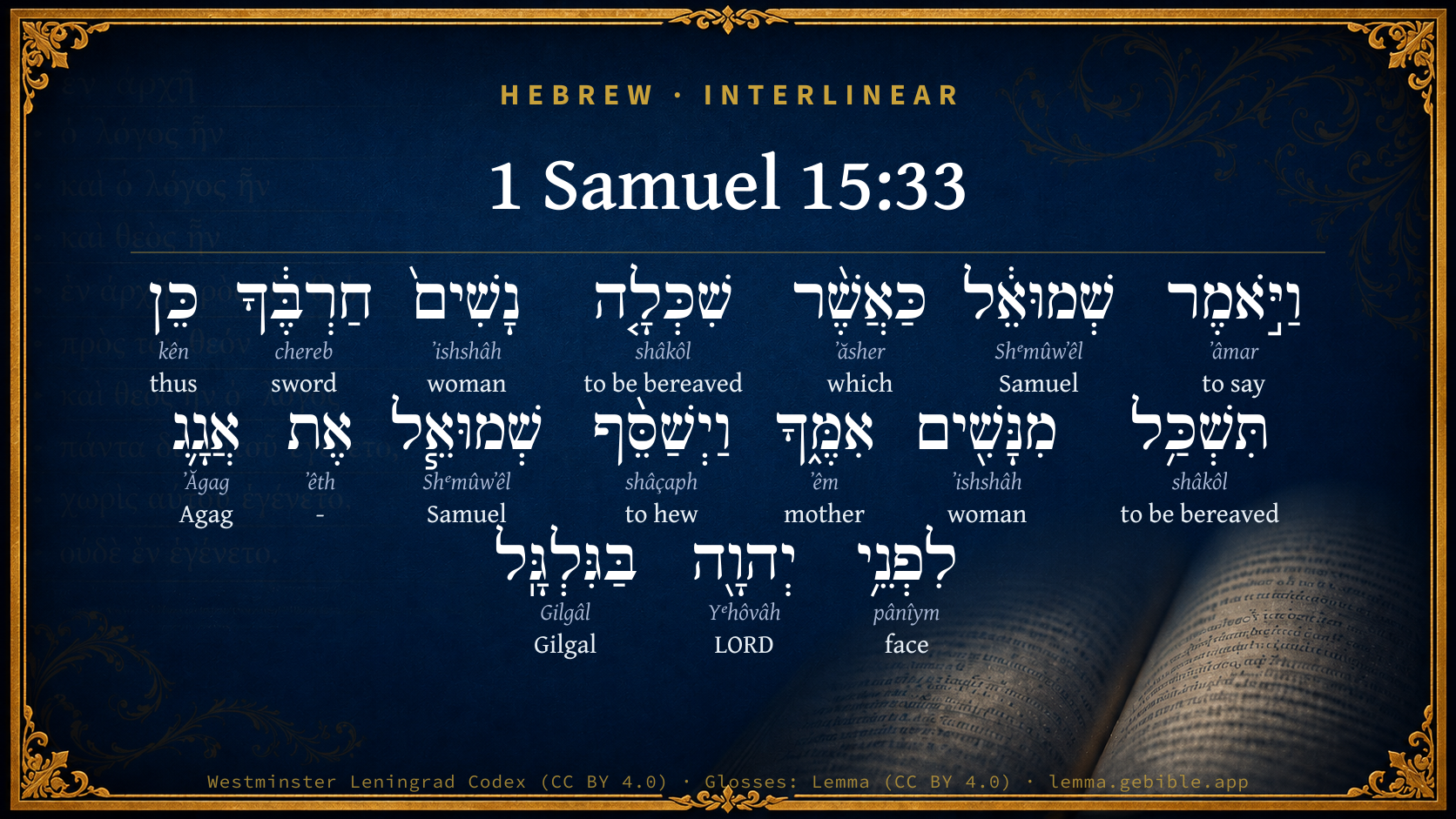
1 Samuel 15:33

Hebrew (Westminster Leningrad Codex) 1 Samuel 15:33 appears in the Hebrew Old Testament. The text above is from the Westminster Leningrad Codex. Each word links to its Strong’s number, a concise gloss, and parsing drawn from the Open Scriptures Hebrew Bible morphology. Click any word for its full Brown-Driver-Briggs (BDB) entry.
Download image
Cite this verse

1 Samuel 15:33 (World English Bible). Public Domain. Lemma interlinear Bible study tool, https://lemma.gebible.app/v/1-samuel/15/33.

Show BibTeX & RIS
BibTeX
RIS
English Translation
Samuel said, As your sword has made women childless, so shall your mother be childless among women. Samuel hewed Agag in pieces before Yahweh in Gilgal.
World English Bible · Public Domain
Highlights
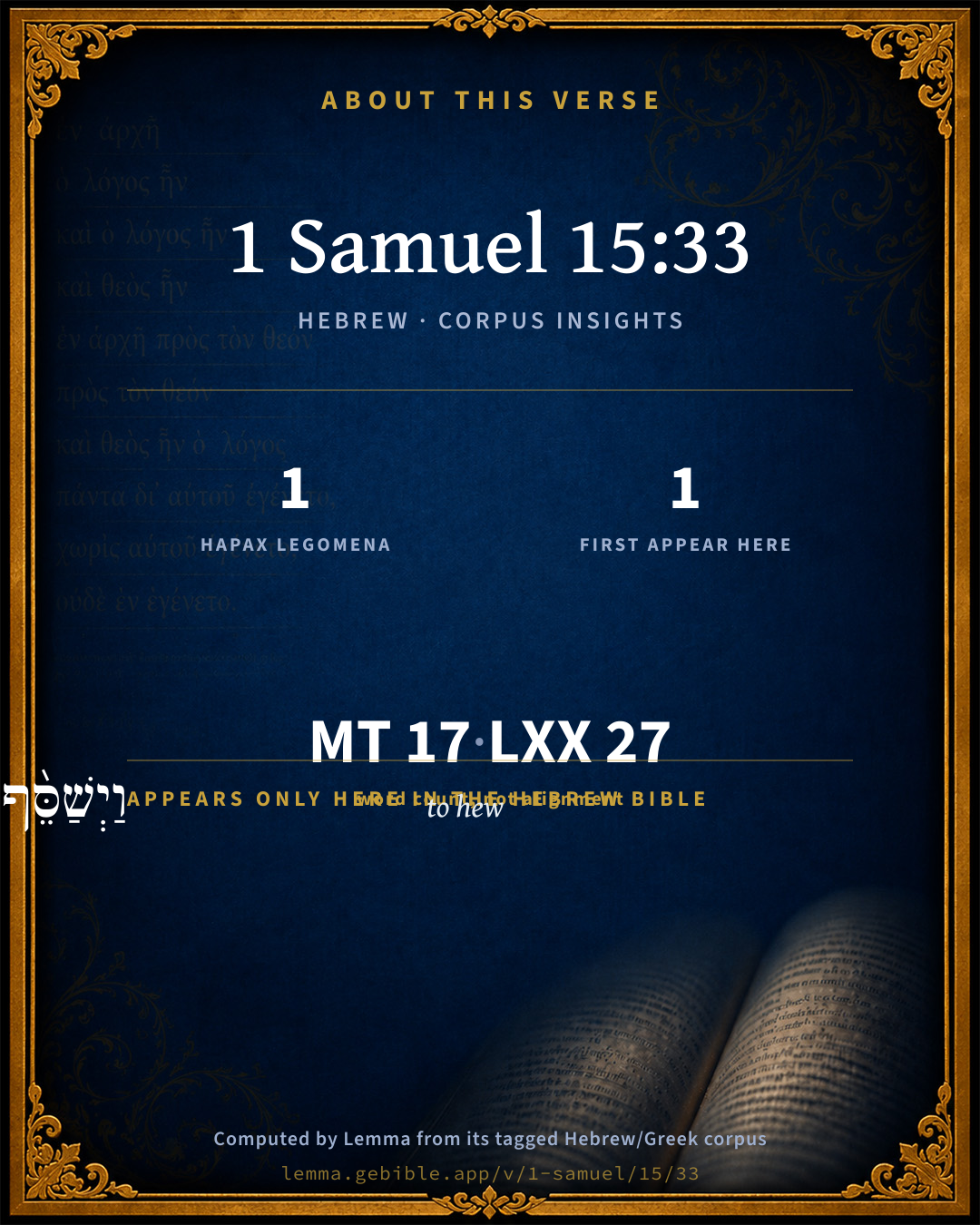
  • 1 hapax legomenon — only here in the Hebrew Bible
  • 1 first appearance in the Hebrew Bible
Full analysis ↓
Download a study sheet

One document with this verse’s original text, its word-by-word gloss line, the meaning frame, cross-references with their text, attributed commentary, and full source and license credits — printable, and it pastes into notes with its structure intact.

This verse Autodidact and up

Study sheet (.html) Plain text (.txt)

A passage Seminary Student

Up to 50 verses in one chapter. A passage sheet keeps up to 6 commentary sources and 12 cross-references per verse, in the order this page ranks them, and says so on the sheet whenever that leaves anything out. Ask for a single verse and you get the Autodidact verse sheet above.

Everything on this page stays free to read, with no account — the sheet is a download of what is already on screen, not access to it.

Want to remove ads? Support Godless Engineer
Compare translations 3

The same verse in 3 English versions, stacked beneath the original-language interlinear above. Click any original word for its lexicon entry.

Each is an independent rendering of the whole verse — the interlinear is not word-aligned to these translations.

Highlighted words mark where these versions differ — a whole-verse word diff, not a word-by-word alignment.

  • World English Bible Public Domain
    Samuel said, As your sword has made women childless, so shall your mother be childless among women. Samuel hewed Agag in pieces before Yahweh in Gilgal.
  • King James Version Public Domain
    And Samuel said, As the sword hath made women childless, so shall thy mother be childless among women. And Samuel hewed Agag in pieces before the LORD in Gilgal.
  • unfoldingWord Literal Text CC BY-SA 4.0
    But Samuel said, “Just as your sword has made women childless, so your mother will be childless among women.” And Samuel hacked Agag to pieces to the face of Yahweh at Gilgal.

unfoldingWord Literal Text — © unfoldingWord, licensed CC BY-SA 4.0. Word-aligned USFM3 via Door43 (git.door43.org/unfoldingWord/en_ult).

Versions to compare (up to 4)

3 of 4 selected

Show all 18 translations

Every available English version of this verse, each an independent rendering of the whole verse.

  • World English Bible Public Domain
    Samuel said, As your sword has made women childless, so shall your mother be childless among women. Samuel hewed Agag in pieces before Yahweh in Gilgal.
  • Berean Standard Bible Public Domain
    But Samuel declared: “As your sword has made women childless, so your mother will be childless among women.” And Samuel hacked Agag to pieces before the LORD at Gilgal.
  • Majority Standard Bible Public Domain
    But Samuel declared: “As your sword has made women childless, so your mother will be childless among women.” And Samuel hacked Agag to pieces before the LORD at Gilgal.
  • King James Version Public Domain
    And Samuel said, As the sword hath made women childless, so shall thy mother be childless among women. And Samuel hewed Agag in pieces before the LORD in Gilgal.
  • American Standard Version (1901) Public Domain
    And Samuel said, As thy sword hath made women childless, so shall thy mother be childless among women. And Samuel hewed Agag in pieces before Jehovah in Gilgal.
  • Revised Version (1885) Public Domain
    And Samuel said, As thy sword hath made women childless, so shall thy mother be childless among women. And Samuel hewed Agag in pieces before the LORD in Gilgal.
  • Geneva Bible (1599) Public Domain
    And Samuel sayde, As thy sworde hath made women childlesse, so shall thy mother bee childelesse among other women. And Samuel hewed Agag in pieces before the Lord in Gilgal.
  • Douay-Rheims (1899) Public Domain
    And Samuel said: As thy sword hath made women childless, so shall thy mother be childless among women. And Samuel hewed him in pieces before the Lord in Galgal.
  • Young's Literal Translation Public Domain
    And Samuel saith, `As thy sword bereaved women -- so is thy mother bereaved above women;' and Samuel heweth Agag in pieces before Jehovah in Gilgal.
  • Literal Standard Version CC BY-SA 4.0
    And Samuel says, “As your sword bereaved women—so is your mother bereaved above women”; and Samuel hews Agag in pieces before YHWH in Gilgal.
  • Unlocked Literal Bible CC BY-SA 4.0
    Samuel replied, “As your sword has made women childless, so shall your mother be childless among women.” Then Samuel chopped Agag to pieces before Yahweh at Gilgal.
  • unfoldingWord Literal Text CC BY-SA 4.0
    But Samuel said, “Just as your sword has made women childless, so your mother will be childless among women.” And Samuel hacked Agag to pieces to the face of Yahweh at Gilgal.
  • Darby Bible Public Domain
    And Samuel said, As thy sword has made women childless, so shall thy mother be childless above women. And Samuel hewed Agag in pieces before Jehovah in Gilgal.
  • World Messianic Bible Public Domain
    Samuel said, “As your sword has made women childless, so your mother will be childless among women!” Then Samuel cut Agag in pieces before the LORD in Gilgal.
  • Webster's Bible Public Domain
    And Samuel said, As thy sword hath made women childless, so shall thy mother be childless among women. And Samuel hewed Agag in pieces before the LORD in Gilgal.
  • Free Bible Version CC BY-SA 4.0
    But Samuel said, “In the same way that your sword has made women childless, so too your mother will be childless among women.” Samuel cut Agag to pieces before the Lord at Gilgal.
  • Bible in Basic English Public Domain
    And Samuel said, As your sword has made women without children, so now your mother will be without children among women. And Agag was cut up by Samuel, bone from bone, before the Lord in Gilgal.
  • JPS Tanakh (1917) Public Domain
    And Samuel said: As thy sword hath made women childless, so shall thy mother be childless among women. And Samuel hewed Agag in pieces before the LORD in Gilgal.

Literal Standard Version (2020), Covenant Press — licensed CC BY-SA 4.0. Text via the HelloAO Bible API (eBible.org). Unlocked Literal Bible (unfoldingWord) — licensed CC BY-SA 4.0. Text via the HelloAO Bible API (eBible.org). unfoldingWord Literal Text — © unfoldingWord, licensed CC BY-SA 4.0. Word-aligned USFM3 via Door43 (git.door43.org/unfoldingWord/en_ult). Free Bible Version, Dr. Jonathan Gallagher — licensed CC BY-SA 4.0. Text via the HelloAO Bible API (eBible.org).

Word by word

More ways to search: Search by grammar → Find every occurrence → Compare this word →

Practice this passage: Drill this verse → Learn its vocabulary →

וַיְשַׁסֵּ֨ף
shâçaph
H8158
“and · to hew”
Conjunction + Verb, Piel, Sequential Imperfect, 3rd Person, Masculine, Singular
Part of Speech
Conjunction + Verb
Stem
Piel
Form
Sequential Imperfect
Person
3rd Person
Gender
Masculine
Number
Singular
Full BDB Definition

Origin: a primitive root

TWOT: 2428

(Piel) to hew in pieces, cut in pieces - meaning dubious
  1. וַיֹּ֣אמֶר ʼâmar H559 “and · to say” Conjunction + Verb, Qal, Sequential Imperfect, 3rd Person, Masculine, Singular
  2. שְׁמוּאֵ֔ל Shᵉmûwʼêl H8050 “Samuel” Noun, Proper
  3. כַּאֲשֶׁ֨ר ʼăsher H834 “like/as · which” Preposition + Particle, Relative
  4. שִׁכְּלָ֤ה shâkôl H7921 “to be bereaved” Verb, Piel, Perfect, 3rd Person, Feminine, Singular
  5. נָשִׁים֙ ʼishshâh H802 “women” Noun, Common, Feminine, Plural, Absolute
  6. חַרְבֶּ֔ךָ chereb H2719 “sword · your” Noun, Common, Feminine, Singular, Construct + Suffix, Personal, 2nd Person, Masculine, Singular
  7. כֵּן kên H3651 “thus” Particle, Demonstrative
  8. תִּשְׁכַּ֥ל shâkôl H7921 “to be bereaved” Verb, Qal, Imperfect, 3rd Person, Feminine, Singular
  9. מִנָּשִׁ֖ים ʼishshâh H802 “from · women” Preposition + Noun, Common, Feminine, Plural, Absolute
  10. אִמֶּ֑ךָ ʼêm H517 “mother · your” Noun, Common, Feminine, Singular, Construct + Suffix, Personal, 2nd Person, Masculine, Singular
  11. שְׁמוּאֵ֧ל Shᵉmûwʼêl H8050 “Samuel” Noun, Proper
  12. אֶת ʼêth H853 “-” Particle, Direct Object
  13. אֲגָ֛ג ʼĂgag H90 “Agag” Noun, Proper
  14. לִפְנֵ֥י pânîym H6440 “to/for · face(s) of” Preposition + Noun, Common, Both, Plural, Construct
  15. יְהוָ֖ה Yᵉhôvâh H3068 “LORD” Noun, Proper
  16. בַּגִּלְגָּֽל Gilgâl H1537 “in/at the · Gilgal” Preposition, Determined + Noun, Proper

About this verse

These counts appear in no published source. They are computed here, from the morphology-tagged text and Lemma’s own curated glosses. What Lemma adds →

17
words
14
distinct lemmas
Historical
section

Notable vocabulary

1 hapax legomenon — a word that appears only here in the entire Hebrew Bible:

  • וַיְשַׁסֵּ֨ף to hew H8158

First appearance in Scripture

This word makes its first canonical appearance in the Hebrew Bible here:

  • וַיְשַׁסֵּ֨ף to hew H8158

Shared distinctive vocabulary

אֲגָ֛ג Agag H90 occurs in 6 verses of the Hebrew Bible. Also found in:

Grammatical profile

  • 4 verbs
  • 10 nouns
  • 3 particles

Verb forms

  • וַיֹּ֣אמֶר Qal · Sequential Imperfect
  • שִׁכְּלָ֤ה Piel · Perfect
  • תִּשְׁכַּ֥ל Qal · Imperfect
  • וַיְשַׁסֵּ֨ף Piel · Sequential Imperfect

Repetition

Words recur within this verse — often emphatic in Hebrew:

  • שְׁמוּאֵ֔ל Samuel H8050 ×2
  • שִׁכְּלָ֤ה to be bereaved H7921 ×2
  • נָשִׁים֙ woman H802 ×2

Hebrew & Septuagint length

In English translation the verse runs 26 words from the Hebrew and 32 from the Septuagint (LXX English) — closely comparable.

A rough comparison of the two English renderings, which tokenize alike — not a word-level alignment.

Word counts can differ between the Hebrew and the Greek without any difference in meaning — e.g. the Hebrew direct-object marker אֵת has no separate Greek word, and Greek often adds the article ὁ.

In the original languages it is 17 Hebrew tokens and 27 Greek tokens — but the two are counted differently (Hebrew bundles its prefixes and suffixes into one token; the Greek is in lemma form), so that isn’t a like-for-like length.

Cross-references

12

Topical passages linked to 1 Samuel 15:33 in the Treasury of Scripture Knowledge — connected by theme and wording, ordered by reader-vote popularity; previews shown in the World English Bible.

  • Judges 1:7 Adoni-bezek said, "Seventy kings, having their thumbs and their great toes cut off, gathered [their food] under my table: as I have done, so God has requited me." They brought him to Jerusalem, and he died there.
  • Genesis 9:6 Whoever sheds man's blood, by man will his blood be shed, for in the image of God made he man.
  • Matthew 7:2 For with whatever judgment you judge, you will be judged; and with whatever measure you measure, it will be measured to you.
  • James 2:13 For judgment is without mercy to him who has shown no mercy. Mercy triumphs over judgment.
  • Revelation 16:6 For they poured out the blood of the saints and the prophets, and you have given them blood to drink. They deserve this."
  • Revelation 18:6 Return to her just as she returned, and repay her double as she did, and according to her works. In the cup which she mixed, mix to her double.
  • Exodus 17:11 It happened, when Moses held up his hand, that Israel prevailed; and when he let down his hand, Amalek prevailed.
  • Numbers 14:45 Then the Amalekite came down, and the Canaanite who lived in that mountain, and struck them and beat them down, even to Hormah.
  • Numbers 25:7–8 When Phinehas, the son of Eleazar, the son of Aaron the priest, saw it, he rose up from the midst of the congregation, and took a spear in his hand;
  • 1 Kings 18:40 and Elijah said to them, Take the prophets of Baal; don't let one of them escape. They took them; and Elijah brought them down to the brook Kishon, and killed them there.
  • Isaiah 34:6 The sword of Yahweh is filled with blood, it is made fat with fatness, with the blood of lambs and goats, with the fat of the kidneys of rams; for Yahweh has a sacrifice in Bozrah, and a great slaughter in the land of Edom.
  • Jeremiah 48:10 Cursed be he who does the work of Yahweh negligently; and cursed be he who keeps back his sword from blood.

Cross-references courtesy of OpenBible.info (CC BY 4.0).

Hebrew and Greek witnesses Masoretic Hebrew ↔ Greek Septuagint

The same verse in the two great witnesses to the Old Testament, shown verse-for-verse.

These are two independent witnesses, not word-aligned to each other, and the Septuagint is shown in lemma (dictionary) form.

Hebrew 1 Samuel 15:33 Masoretic · Westminster Leningrad Codex

וַיֹּ֣אמֶר שְׁמוּאֵ֔ל כַּאֲשֶׁ֨ר שִׁכְּלָ֤ה נָשִׁים֙ חַרְבֶּ֔ךָ כֵּן תִּשְׁכַּ֥ל מִנָּשִׁ֖ים אִמֶּ֑ךָ וַיְשַׁסֵּ֨ף שְׁמוּאֵ֧ל אֶת אֲגָ֛ג לִפְנֵ֥י יְהוָ֖ה בַּגִּלְגָּֽל

Samuel said, As your sword has made women childless, so shall your mother be childless among women. Samuel hewed Agag in pieces before Yahweh in Gilgal.

World English Bible · Public Domain

Greek LXX 1 Samuel 15:33 Septuagint · lemma form

καί εἶπον σαμουηλ πρός αγαγ καθότι ἀτεκνόω γυνή ὁ ῥομφαία σύ οὕτως ἀτεκνόω ἐκ γυνή ὁ μήτηρ σύ καί σφάζω σαμουηλ ὁ αγαγ ἐνώπιον κύριος ἐν γαλγαλ

And Samuel said to Agag, As your sword has bereaved women of their children, so shall your mother be made childless among women: and Samuel killed Agag before the Lord in Galgal.

LXX2012 (modern English Septuagint) · Public Domain

Hebrew: Westminster Leningrad Codex (CC BY 4.0). Greek: Septuagint (public domain); English from LXX2012 (modern English Septuagint) (Public Domain). How the Septuagint differs from the Hebrew →

Targum (Aramaic paraphrase)

1

The Targum is the ancient Jewish Aramaic paraphrase of the Hebrew Scriptures — an interpretive translation, not the Hebrew text itself. Onkelos (literal) and Pseudo-Jonathan (expansive) render the Torah, and Jonathan the Prophets. Coverage is partial: where no permissively-licensed English translation exists for a verse, only the Aramaic is shown. This is verse-level text, not a word-by-word alignment to the Hebrew.

  1. Targum Jonathan Prophets (Joshua–Malachi)
    וַאֲמַר שְׁמוּאֵל כְּמָא דְאִתְכְּלַת נְשַׁיָא חַרְבָּךְ כֵּן תִּתְכַּל מִנְשַׁיָא אִמָךְ וּפָשַׁח שְׁמוּאֵל יַת אֲגָג קֳדָם יְיָ בְּגִלְגָלָא:

    (no public-domain English translation for this verse)

    Targum Jonathan — Aramaic: “Mikraot Gedolot” (public domain). English: “Sefaria Community Translation” (CC0 1.0 (public-domain dedication)); “London "Chaldee Paraphrase," 1871” (public domain). Text via Sefaria.

Commentary

Notes on 1 Samuel 15:33 from classic Christian and Jewish commentators (each source and its license shown beneath its notes). The classic Christian expositions comment on the surrounding passage and are grouped to its opening verse, so a note may address several verses; the Jewish commentaries on the Tanakh (Rashi and others) are per-verse, so they appear only where the commentator wrote on this verse.

Lemma curates 59 commentaries, every one of them public domain or Creative Commons licensed, each selected and text-cleaned for this edition rather than reprinted as found. About our sources →

Trapp's Complete Commentary

John Trapp

1Sa 15:33 And Samuel said, As thy sword hath made women childless, so shall thy mother be childless among women. And Samuel hewed Agag in pieces before the LORD in Gilgal.

Ver. 33. As thy sword hath made women childless.] Thine and thy predecessors’, in whose footsteps thou hast trodden; being Mali corvi, malum ovum, {a} neither good egg, nor good bird.

And Samuel hewed Agag.] With his own hands likely, as Phinehas stabbed Zimri, and Elias slew the Baalites, not out of a desire of revenge, but a zeal for justice: such as was that in Charles V, who, hearing that his general Farnesius had ravished certain gentlewomen, said, If I had the villain here, I would despatch him with mine own hand. {b}

{a} A. Lap.

{b} Parei Med. Hist. Prof.

John Trapp, A Commentary or Exposition upon All the Books of the Old and New Testament (1647–1656) — public domain. Text from a community e-Sword module.

The Biblical Illustrator

Joseph S. Exell

1Sa_15:33

And Samuel hewed Agag to pieces before the Lord in Gilgal.

The vindictive justice of God

God, who viewed Agag as an enemy to Himself and to His people, would not release him from the punishment he deserved; but inspired Samuel to give him a just recompense of reward. This striking instance of the Divine conduct teaches us that God is more disposed to punish His enemies than sinners are to punish theirs.

I. I am to show that sinners are disposed to punish their enemies. This will appear both from their character and conduct.

1. It appears from their character, as drawn by the Searcher of hearts. God perfectly knows their real feelings, and has clearly described them in His word. And according to His infallible description, they are entirely selfish. They possess not the least spark of holy love, but are under the entire dominion of selfishness. Though their selfishness disposes them to love those who love them, yet it no less disposes them to hate those who hate them, whether they are friendly or unfriendly to God. Esau hated Jacob because Jacob had injured his interest. Sinners, who are under the reigning power of selfishness, are not only hateful, but they hats one another.

2. It more clearly appears from their conduct than from their character, that they are disposed to punish their enemies. They have been in all ages imbruing their hands in each others blood. Nations have destroyed nations, and filled the earth with violence. I proceed, therefore, to the principal point proposed, which is, to show.

II. That God is more disposed to punish His enemies than sinners are to punish theirs. God knows that sinners are His enemies, and hate His existence, His perfections, His designs, and His whole government. He knows that they hate Him without a cause, as He has always treated them perfectly right. He knows that they are enemies to one another, and be all intelligent creatures. He viewed Agag as an enemy to all righteousness; and He views all sinners in the same light. It may be inquired, why God was more disposed to punish Agag than Saul was? and why in all cases, he is more disposed to punish His enemies, than sinners are to punish their enemies? To this I answer--

1. It is because He hates the conduct, of His enemies simply considered, but sinners do not hate the conduct of their enemies simply considered. Though their enemies may act sinfully, it is not their sinfulness that, they hate. It is only because their sinfulness is pointed against them, and does them hurt, that they hurt it.

2. God is more disposed to punish His enemies than sinners are to punish theirs, because His hatred to His enemies cannot be turned into love. The hatred of sinners can be turned into love, because they do not hate the character, but only the conduct of their enemies, which they view as detrimental to themselves.

3. Gods hatred of His enemies is perfectly just, but sinners hatred of their enemies is always unjust. They never hate them for what they ought to be hated, but only for the injury which they receive from them. They do not hate them for selfishness, which is the only thing for which they ought to be hated; and therefore their very hatred is selfish and wicked, for which they really deserve to be punished.

4. There is another reason why God is more disposed to punish His enemies, than sinners are to punish theirs; and that is, His regard to the good of the universe, which sinners totally disregard in punishing their enemies. They are disposed to punish their enemies for their own sake, and not for the good of others.

They are disposed to punish, merely to gratify their own feelings, whether it tends to help or hurt any other person or being besides themselves.

1. If sinners are less disposed to punish their sinful enemies than God is to punish His enemies, then their tender mercies are unholy and criminal.

2. If God is more disposed to punish His enemies than sinners ere to punish theirs, then none can truly love God without loving His vindictive justice. This is an essential tribute of His nature; and He can no more divest Himself of it than He can divest Himself of any other essential attribute than He possesses. He has as plainly revealed His vindictive justice in His word, and as strikingly displayed it in His providence, as anyone of His glorious perfections.

3. If God be more disposed to punish His enemies than sinners are to, punish theirs, then His present conduct in punishing sinners is a strong evidence that He will punish the finally impenitent.

4. If God is more disposed to punish His enemies than sinners are to punish theirs, then all real saints are willing that God should punish His enemies as much and as long as they deserve to be punished. Samuel was willing to punish Agag, end hew him in pieces before the Lord, and at His command. Every good man has that within him which approves and loves the justice of God in punishing sin. Every good man is holy, as God is holy, and loves what God loves, and hates what, God hates.

5. If God is more disposed to punish His enemies than sinners are to punish theirs, then sinners must have a new heart, in order to enter into and enjoy the kingdom of heaven.

6. If God is more disposed to punish His enemies than sinners are to punish theirs, then sinners have no ground to depend upon the patience of God. Sinners are extremely apt to depend upon the patience of God, supposing that He does and will wait upon them, because He pities them, and is unwilling to punish them. Because sentence against an evil work is not executed speedily, therefore the heart of the sons of men is fully set in them to do evil. (N. Emmons, D. D.)

The Biblical Illustrator, edited by Joseph S. Exell (c. 1880s–1900s) — public domain. Text from a community e-Sword module.

Jamieson, Fausset & Brown

Robert Jamieson, A. R. Fausset & David Brown

Samuel hewed Agag--This cruel tyrant met the retribution of a righteous Providence. Never has it been unusual for great or official personages in the East to perform executions with their own hands. Samuel did it "before the Lord" in Gilgal, appointing that same mode of punishment (hitherto unknown in Israel) to be used towards him, which he had formerly used towards others.

Next: 1 Samuel Chapter 16

Jamieson, Fausset & Brown — Commentary Critical and Explanatory on the Whole Bible (1871) — public domain (CC PDM 1.0). Text via the HelloAO Bible API.

Adam Clarke's Commentary

Verse 33. As thy sword hath made women childless] It appears that Agag had forfeited his life by his own personal transgressions, and that his death now was the retribution of his cruelties.

And Samuel hewed Agag in pieces]

1. What Samuel did here he did in his magisterial capacity; and,

2. It is not likely he did it by his own sword, but by that of an executioner. What kings, magistrates, and generals do, in an official way, by their subjects, servants, or soldiers, they are said to do themselves; qui facit per alterum, facit per se.

Adam Clarke's Commentary on the Bible (1810–1826) — public domain. Text from a community e-Sword/MySword module.

Ellicott's Commentary for English Readers

(33) Samuel hewed Agag in pieces.—It has been suggested, with some probability, that these words refer to a peculiar form of putting to death, like the quartering in vogue during the Middle Ages.

A Bible Commentary for English Readers, edited by Charles John Ellicott (1878–1897) — public domain. Text from a community e-Sword module.

The Cambridge Bible for Schools and Colleges

gen. ed. J. J. S. Perowne

33. As thy sword, &c.] By the law of retaliation Agag’s life was forfeit. Cp. Jdg_1:7.

hewed Agag in pieces before the Lord] A solemn execution of the Divine sentence which Saul had neglected. The word rendered “hewed in pieces” is a different one from that used in 1Sa_11:7, and occurs nowhere else. It may perhaps mean no more than “executed” (Sept. ἔσφαξε). The E. V. follows the Vulg.: “in frusta concidit.”

The Cambridge Bible for Schools and Colleges (gen. ed. J. J. S. Perowne; Cambridge University Press, 1878–1918) — public domain. Text from a community e-Sword module.

John Gill's Exposition

Then Samuel went to Ramah,.... His native place, and where was his usual residence:

and Saul went up to his house to Gibeah of Saul; which was also his birth place, and where was his father's house, and where he had his palace, and kept his court; and took its name from him, to distinguish it from another Gibeah; and so Josephus (w) says it was called Gabathsaoule, and was about thirty furlongs or four miles from Jerusalem.

(w) De Bello Jud. l. 5. c. 2. sect. 1.

John Gill's Exposition of the Whole Bible (1746–1763) — public domain (CC PDM 1.0). Text via the HelloAO Bible API.

Albert Barnes' Notes on the Bible

Hewed in pieces - Only found in this passage. Samuel thus executed the חרם chērem 1Sa 15:3 which Saul had violated, and so both saved the nation from the guilt of a broken oath, and gave a final example to Saul, but apparently in vain, of uncompromising obedience to the commandments of God. There is something awful in the majesty of the prophet rising above and eclipsing that of the king (compare 1Ki 21:20; Jer 38:14 ff; Dan 2:46; Dan 4:27).

Albert Barnes' Notes on the Bible (1834–1885) — public domain. Text from a community e-Sword/MySword module.

Haydock's Catholic Bible Commentary

Pieces. Josephus adds, by the hand of others. (Menochius) --- But zeal put the sword into his own hand; and he imitated the Levites and Phinees, (Exodus xxxii. 27.) to shew Saul how preposterous had been his pity, when the Lord had spoken plainly. (Calmet) --- Lord, as a sort of victim, Isaias xxxiv. 6. (Menochius)

George Leo Haydock (1774–1849), Haydock's Catholic Family Bible and Commentary, 1859 edition — public domain. Excludes Psalms (Douay-Rheims chapter numbering differs from Protestant) and Deuterocanonical books (Catholic canon only).

Matthew Poole's English Annotations

Thy sword hath made women childless; whereby it appears that he was a cruel tyrant, and guilty of really bloody actions, and that towards God’s people, though it be not related elsewhere. And this seems to be added for the fuller vindication of God’s justice, and to show, that although God did at this time remember and revenge a crime committed by this man’s ancestors four hundred years ago, yet he did not punish an innocent son for his father’s crimes, but one that allowed and persisted in the same evil courses.

Samuel hewed Agag in pieces by Divine instinct, and in pursuance of God’s express and particular command, above, 1Sa 15:3, which being sinfully neglected by Saul, is now executed by Samuel. See the like example 1Ki 18:40. But these are no precedents for private persons to take the sword of justice into their hands; for we must live by thee laws of God, and not by extraordinary examples.

Before the Lord; either before the ark, which, it seems, Saul carried with him in this, as he did in his former expedition, 1Sa 14:18; or before God’s altar; or in the public assembly.

Matthew Poole's English Annotations on the Holy Bible (1683–1685) — public domain. Text from a community e-Sword/MySword module.

Whedon's Commentary on the Bible

Daniel D. Whedon

33. As thy sword hath made women childless — These words indicate that Agag had been given to cruelties, and that both he and his people had kept up the old practice of destroying the weak and feeble that might fall in their way. Deu_25:19. His punishment was retributive, like that of Adoni-bezek. Jdg_1:7.

Daniel D. Whedon (gen. ed.), Commentary on the Old and New Testaments (1874–1909) — public domain. Text from a community e-Sword module.

The Pulpit Commentary

As thy sword hath made women childless. Agag"s life had been spent in freebooting expeditions, in which he had shed blood ruthlessly, and so justice required his execution in requital of his deeds to others. Samuel hewed Agag in pieces. The verb occurs only here, and probably refers to some particular method of execution, like the quartering of the middle ages. Being in the Piel conjugation, it would mean not so much that Samuel put Agag to death himself as that he commanded it to be done.

The Pulpit Commentary (1880–1919), ed. H.D.M. Spence-Jones & Joseph S. Exell — public domain. Text from a community e-Sword module.

John Wesley's Explanatory Notes

As, &c. - Whereby it appears, that he was a tyrant, and guilty of many bloody actions. And this seems to be added for the fuller vindication of God's justice, and to shew, that although God did at this time revenge a crime committed by this man's ancestors 400 years ago, yet he did not punish an innocent son for his father's crimes, but one that persisted in the same evil courses. Hewed - This he did by divine instinct, and in pursuance of God's express command, which being sinfully neglected by Saul, is now executed by Samuel. But these are no precedents for private persons to take the sword of justice into their hands. For we must live by the laws of God, and not by extraordinary examples.

John Wesley, Explanatory Notes Upon the Whole Bible (1754–1765) — public domain. Text via the GEBible commentary corpus.

Keil & Delitzsch

C. F. Keil & F. Delitzsch

But Samuel pronounced the sentence of death upon him: "As thy sword hath made women childless, so be thy mother childless before women!" מנּשׁים is to be understood as a comparative: more childless than (other) women, i.e., the most childless of women, namely, because her son was the king. From these words of Samuel, it is very evident that Agag had carried on his wars with great cruelty, and had therefore forfeited his life according to the lex talionis. Samuel then hewed him in pieces "before the Lord at Gilgal," i.e., before the altar of Jehovah there; for the slaying of Agag being the execution of the ban, was an act performed for the glory of God.

Keil & Delitzsch — Biblical Commentary on the Old Testament (1861–1891) — public domain (CC PDM 1.0). Text via the HelloAO Bible API. (Old Testament only.)

Rashi

Rabbi Shlomo Yitzchaki (Rashi)

As your sword bereaved women. To render them widows from their husbands, for you would cut off the membrum virile of the youths of Yisroel.

[Shmuel] cut. He cut him into four pieces. This word has no likeness [in Scripture]. The Targum renders וַיְשַׁסֵּף as וּפָשַׁח. And in our Gemara we find, 'he broke off [מפשח] a branch, and gave us several twigs,' meaning that he split.

Rashi on the Tanakh — English translations: “The Judaica Press complete Tanach with Rashi, translated by A. J. Rosenberg” (CC BY 4.0); “Pentateuch with Rashi's commentary by M. Rosenbaum and A.M. Silbermann, 1929-1934” (public domain); “The Metsudah Tanach series, Lakewood, N.J” (CC BY 4.0); and “The Book of Joshua, Metsudah Publications, 1997” (CC BY 4.0). Text via Sefaria.

Lesson kit

Teaching starters — assembled from the data on this page, not authored interpretation. Every prompt links to the verse data it draws on. Edit before teaching.

1 Samuel, in the Historical, opens this verse with 17 words (14 distinct Hebrew lemmas). Its most distinctive word is shâçaph (“to hew”). A historical commentator’s framing appears above. Read the whole chapter for the surrounding context.

Discussion questions

  1. What does “to hew” (shâçaph) contribute to the verse as a whole?
  2. This verse holds 1 word here found nowhere else in the Hebrew Bible. What might the rare word draw attention to?
  3. The word “to hew” first appears here in Scripture. What is being introduced at this debut?
  4. Numbers 24:7 shares the word «Agag» with this verse. How do the two illuminate each other?
  5. “Samuel” occurs 2× in this one verse. What is the effect of the repetition?
  6. The translations on this page render this verse differently — a whole-verse word diff, not a word-by-word alignment. What might account for the different wordings?
  7. The verb «וַיֹּ֣אמֶר» is Qal Sequential Imperfect. How does its form color the action?
  8. Reading how Trapp's Complete Commentary and The Biblical Illustrator read this verse, where do the two commentators agree and where do they part?

Things to notice

  • 1 word in this verse appears nowhere else in the Hebrew Bible.
  • 1 word makes its first canonical appearance in Scripture here.
  • This verse counts 17 Hebrew ↔ 27 Greek words.
  • These translations choose different wording for 10 words in this verse.
  • “Samuel” occurs 2× in this single verse.

Reading settings

Reading text

Shown beneath each verse's original-language words.

Old Testament
Old Testament edition

Read the OT as the Masoretic Hebrew (MT) or the Greek Septuagint (LXX).

English shown for the Greek Septuagint (in the Hebrew ↔ Greek comparison).

Comparing translations? Open the Compare panel on any verse page to stack up to four side by side.