
2 Samuel 20:10

Hebrew (Westminster Leningrad Codex) 2 Samuel 20:10 appears in the Hebrew Old Testament. The text above is from the Westminster Leningrad Codex. Each word links to its Strong’s number, a concise gloss, and parsing drawn from the Open Scriptures Hebrew Bible morphology. Click any word for its full Brown-Driver-Briggs (BDB) entry.
Download image
Cite this verse

2 Samuel 20:10 (World English Bible). Public Domain. Lemma interlinear Bible study tool, https://lemma.gebible.app/v/2-samuel/20/10.

Show BibTeX & RIS
BibTeX
RIS
English Translation
But Amasa took no heed to the sword that was in Joab's hand: so he struck him therewith in the body, and shed out his bowels to the ground, and didn't strike him again; and he died. Joab and Abishai his brother pursued after Sheba the son of Bichri.
World English Bible · Public Domain
Download a study sheet

One document with this verse’s original text, its word-by-word gloss line, the meaning frame, cross-references with their text, attributed commentary, and full source and license credits — printable, and it pastes into notes with its structure intact.

This verse Autodidact and up

Study sheet (.html) Plain text (.txt)

A passage Seminary Student

Up to 50 verses in one chapter. A passage sheet keeps up to 6 commentary sources and 12 cross-references per verse, in the order this page ranks them, and says so on the sheet whenever that leaves anything out. Ask for a single verse and you get the Autodidact verse sheet above.

Everything on this page stays free to read, with no account — the sheet is a download of what is already on screen, not access to it.

Want to remove ads? Support Godless Engineer
Compare translations 3

The same verse in 3 English versions, stacked beneath the original-language interlinear above. Click any original word for its lexicon entry.

Each is an independent rendering of the whole verse — the interlinear is not word-aligned to these translations.

Highlighted words mark where these versions differ — a whole-verse word diff, not a word-by-word alignment.

  • World English Bible Public Domain
    But Amasa took no heed to the sword that was in Joab's hand: so he struck him therewith in the body, and shed out his bowels to the ground, and didn't strike him again; and he died. Joab and Abishai his brother pursued after Sheba the son of Bichri.
  • King James Version Public Domain
    But Amasa took no heed to the sword that was in Joab's hand: so he smote him therewith in the fifth rib, and shed out his bowels to the ground, and struck him not again; and he died. So Joab and Abishai his brother pursued after Sheba the son of Bichri.
  • unfoldingWord Literal Text CC BY-SA 4.0
    But Amasa did not guard himself against the sword that in the hand of Joab. And he struck him with it in the stomach, and his intestines poured out to the ground, and he did not do again to him, and he died. And Joab and Abishai his brother pursued after Sheba, the son of Bichri.

unfoldingWord Literal Text — © unfoldingWord, licensed CC BY-SA 4.0. Word-aligned USFM3 via Door43 (git.door43.org/unfoldingWord/en_ult).

Versions to compare (up to 4)

3 of 4 selected

Show all 18 translations

Every available English version of this verse, each an independent rendering of the whole verse.

  • World English Bible Public Domain
    But Amasa took no heed to the sword that was in Joab's hand: so he struck him therewith in the body, and shed out his bowels to the ground, and didn't strike him again; and he died. Joab and Abishai his brother pursued after Sheba the son of Bichri.
  • Berean Standard Bible Public Domain
    Amasa was not on guard against the dagger in Joab’s hand, and Joab stabbed him in the stomach and spilled out his intestines on the ground. And Joab did not need to strike him again, for Amasa was dead. Then Joab and his brother Abishai pursued Sheba son of Bichri.
  • Majority Standard Bible Public Domain
    Amasa was not on guard against the dagger in Joab’s hand, and Joab stabbed him in the stomach and spilled out his intestines on the ground. And Joab did not need to strike him again, for Amasa was dead. Then Joab and his brother Abishai pursued Sheba son of Bichri.
  • King James Version Public Domain
    But Amasa took no heed to the sword that was in Joab's hand: so he smote him therewith in the fifth rib, and shed out his bowels to the ground, and struck him not again; and he died. So Joab and Abishai his brother pursued after Sheba the son of Bichri.
  • American Standard Version (1901) Public Domain
    But Amasa took no heed to the sword that was in Joab's hand: so he smote him therewith in the body, and shed out his bowels to the ground, and struck him not again; and he died. And Joab and Abishai his brother pursued after Sheba the son of Bichri.
  • Revised Version (1885) Public Domain
    But Amasa took no heed to the sword that was in Joab’s hand: so he smote him therewith in the belly, and shed out his bowels to the ground, and struck him not again; and he died. And Joab and Abishai his brother pursued after Sheba the son of Bichri.
  • Geneva Bible (1599) Public Domain
    But Amasa tooke no heede to the sworde that was in Ioabs hande: for therewith he smote him in the fift rib, and shed out his bowels to the ground, and smote him not the second time: so he dyed. then Ioab and Abishai his brother followed after Sheba the sonne of Bichri.
  • Douay-Rheims (1899) Public Domain
    But Amasa did not take notice of the sword, which Joab had, and he struck him in the side, and shed out his bowels to the ground, and gave him not a second wound, and he died. And Joab, and Abisai his brother pursued after Seba the son of Bochri.
  • Young's Literal Translation Public Domain
    and Amasa hath not been watchful of the sword that `is' in the hand of Joab, and he smiteth him with it unto the fifth `rib', and sheddeth out his bowels to the earth, and he hath not repeated `it' to him, and he dieth; and Joab and Abishai his brother have pursued after Sheba son of Bichri.
  • Literal Standard Version CC BY-SA 4.0
    and Amasa has not been watchful of the sword that [is] in the hand of Joab, and he strikes him with it to the fifth [rib], and sheds out his bowels to the earth, and he has not repeated [it] to him, and he dies; and Joab and his brother Abishai have pursued after Sheba son of Bichri.
  • Unlocked Literal Bible CC BY-SA 4.0
    Amasa did not notice the dagger that was in Joab's left hand. Joab stabbed Amasa in the stomach and his bowels spilled out to the ground. Joab did not strike him again, and Amasa died. So Joab and Abishai his brother pursued Sheba son of Bikri.
  • unfoldingWord Literal Text CC BY-SA 4.0
    But Amasa did not guard himself against the sword that in the hand of Joab. And he struck him with it in the stomach, and his intestines poured out to the ground, and he did not do again to him, and he died. And Joab and Abishai his brother pursued after Sheba, the son of Bichri.
  • Darby Bible Public Domain
    And Amasa had taken no notice of the sword that was in Joab's hand: so he smote him with it in the belly and shed out his bowels to the ground, and struck him not again; and he died. And Joab and Abishai his brother pursued after Sheba the son of Bichri.
  • World Messianic Bible Public Domain
    But Amasa took no heed to the sword that was in Joab’s hand. So he struck him with it in the body and shed out his bowels to the ground, and didn’t strike him again; and he died. Joab and Abishai his brother pursued Sheba the son of Bichri.
  • Webster's Bible Public Domain
    But Amasa took no heed to the sword that was in Joab's hand: so he smote him in the fifth rib, and shed out his bowels to the ground, and struck him not again; and he died. So Joab and Abishai his brother pursued after Sheba the son of Bichri.
  • Free Bible Version CC BY-SA 4.0
    Amasa wasn't prepared for the dagger in Joab's left hand. Joab stabbed him in the belly and his intestines poured out onto the ground. Joab didn't need to stab him twice, because Amasa was already dead. Then Joab and his brother Abishai set off in pursuit of Sheba.
  • Bible in Basic English Public Domain
    But Amasa did not see danger from the sword which was now in Joab's left hand, and Joab put it through his stomach so that his inside came out on to the earth, and he did not give him another blow. So Joab and his brother Abishai went on after Sheba, the son of Bichri.
  • JPS Tanakh (1917) Public Domain
    But Amasa took no heed to the sword that was in Joab's hand; so he smote him therewith in the groin, and shed out his bowels to the ground, and struck him not again; and he died. And Joab and Abishai his brother pursued after Sheba the son of Bichri.

Literal Standard Version (2020), Covenant Press — licensed CC BY-SA 4.0. Text via the HelloAO Bible API (eBible.org). Unlocked Literal Bible (unfoldingWord) — licensed CC BY-SA 4.0. Text via the HelloAO Bible API (eBible.org). unfoldingWord Literal Text — © unfoldingWord, licensed CC BY-SA 4.0. Word-aligned USFM3 via Door43 (git.door43.org/unfoldingWord/en_ult). Free Bible Version, Dr. Jonathan Gallagher — licensed CC BY-SA 4.0. Text via the HelloAO Bible API (eBible.org).

Word by word

More ways to search: Search by grammar → Find every occurrence → Compare this word →

Practice this passage: Drill this verse → Learn its vocabulary →

הַחֹ֜מֶשׁ
chômesh
H2570
“the · belly”
Particle, Definite Article + Noun, Common, Masculine, Singular, Absolute
Part of Speech
Particle + Noun
Type
Common
Gender
Masculine
Number
Singular
State
Absolute
Full BDB Definition

Origin: from an unused root probably meaning, to be stout

TWOT: TWOT- 687a

belly, abdomen, fifth ribs
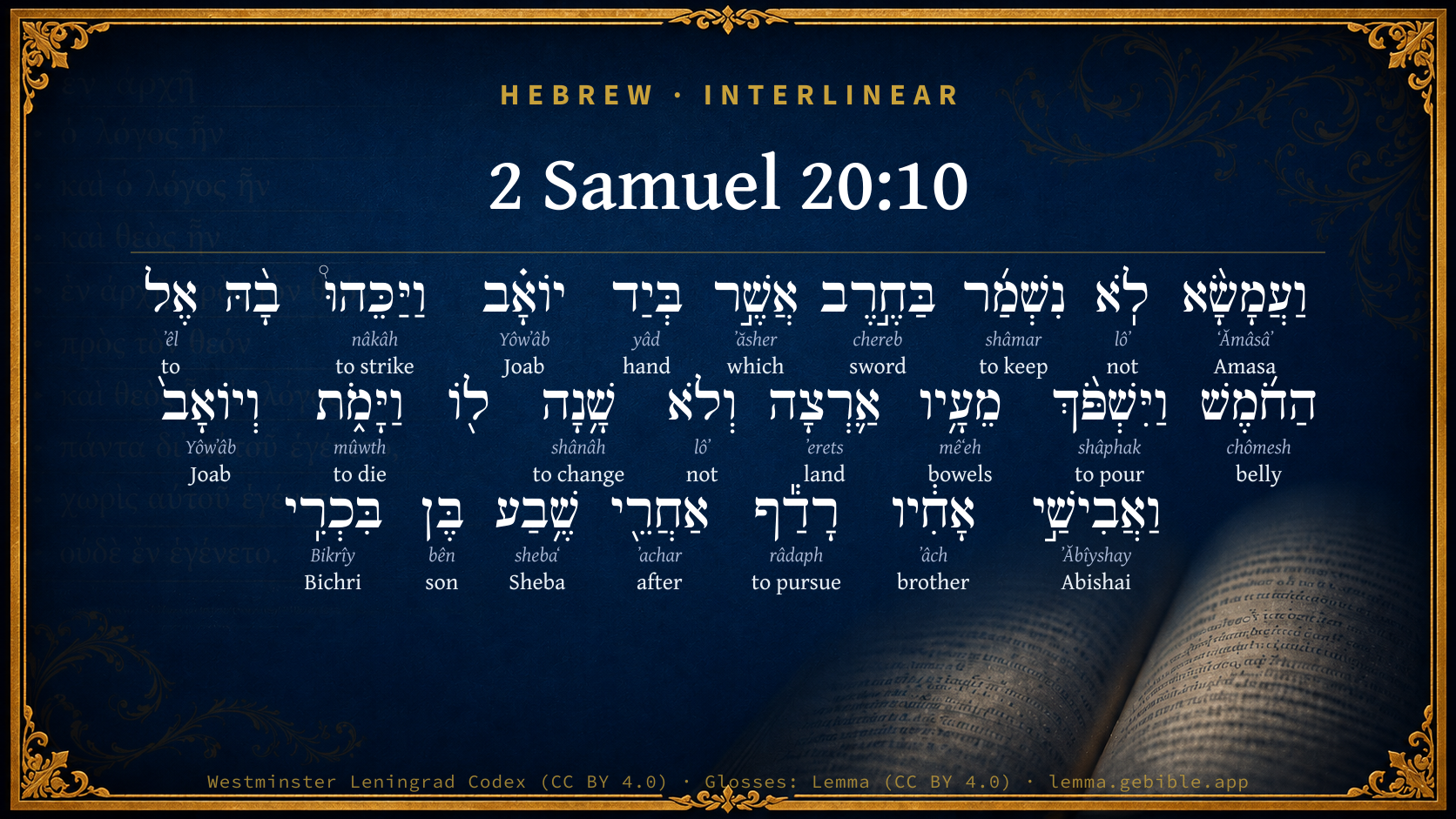
  1. וַעֲמָשָׂ֨א ʻĂmâsâʼ H6021 “and · Amasa” Conjunction + Noun, Proper
  2. לֹֽא lôʼ H3808 “not” Particle, Negative
  3. נִשְׁמַ֜ר shâmar H8104 “to keep” Verb, Niphal, Perfect, 3rd Person, Masculine, Singular
  4. בַּחֶ֣רֶב chereb H2719 “in/at the · sword” Preposition, Determined + Noun, Common, Feminine, Singular, Absolute
  5. אֲשֶׁ֣ר ʼăsher H834 “which” Particle, Relative
  6. בְּיַד yâd H3027 “in/at · hand of” Preposition + Noun, Common, Both, Singular, Construct
  7. יוֹאָ֗ב Yôwʼâb H3097 “Joab” Noun, Proper
  8. וַיַּכֵּהוּ֩ nâkâh H5221 “and · to strike · him” Conjunction + Verb, Hiphil, Sequential Imperfect, 3rd Person, Masculine, Singular + Suffix, Personal, 3rd Person, Masculine, Singular
  9. אֶל ʼêl H413 “to” Preposition
  10. וַיִּשְׁפֹּ֨ךְ shâphak H8210 “and · to pour” Conjunction + Verb, Qal, Sequential Imperfect, 3rd Person, Masculine, Singular
  11. מֵעָ֥יו mêʻeh H4578 “bowels · his” Noun, Common, Masculine, Plural, Construct + Suffix, Personal, 3rd Person, Masculine, Singular
  12. אַ֛רְצָה ʼerets H776 “land · toward” Noun, Common, Both, Singular, Absolute + Suffix, Demonstrative
  13. וְלֹא lôʼ H3808 “and · not” Conjunction + Particle, Negative
  14. שָׁ֥נָה shânâh H8138 “to change” Verb, Qal, Perfect, 3rd Person, Masculine, Singular
  15. וַיָּמֹ֑ת mûwth H4191 “and · to die” Conjunction + Verb, Qal, Sequential Imperfect, 3rd Person, Masculine, Singular
  16. וְיוֹאָב֙ Yôwʼâb H3097 “and · Joab” Conjunction + Noun, Proper
  17. וַאֲבִישַׁ֣י ʼĂbîyshay H52 “and · Abishai” Conjunction + Noun, Proper
  18. אָחִ֔יו ʼâch H251 “brother · his” Noun, Common, Masculine, Singular, Construct + Suffix, Personal, 3rd Person, Masculine, Singular
  19. רָדַ֕ף râdaph H7291 “to pursue” Verb, Qal, Perfect, 3rd Person, Masculine, Singular
  20. אַחֲרֵ֖י ʼachar H310 “after” Preposition
  21. שֶׁ֥בַע shebaʻ H7652 “Sheba” Adjective, Cardinal number, Feminine, Singular, Absolute
  22. בֶּן bên H1121 “son of” Noun, Common, Masculine, Singular, Construct
  23. בִּכְרִֽי Bikrîy H1075 “Bichri” Noun, Proper

About this verse

These counts appear in no published source. They are computed here, from the morphology-tagged text and Lemma’s own curated glosses. What Lemma adds →

26
words
22
distinct lemmas
Historical
section

Notable vocabulary

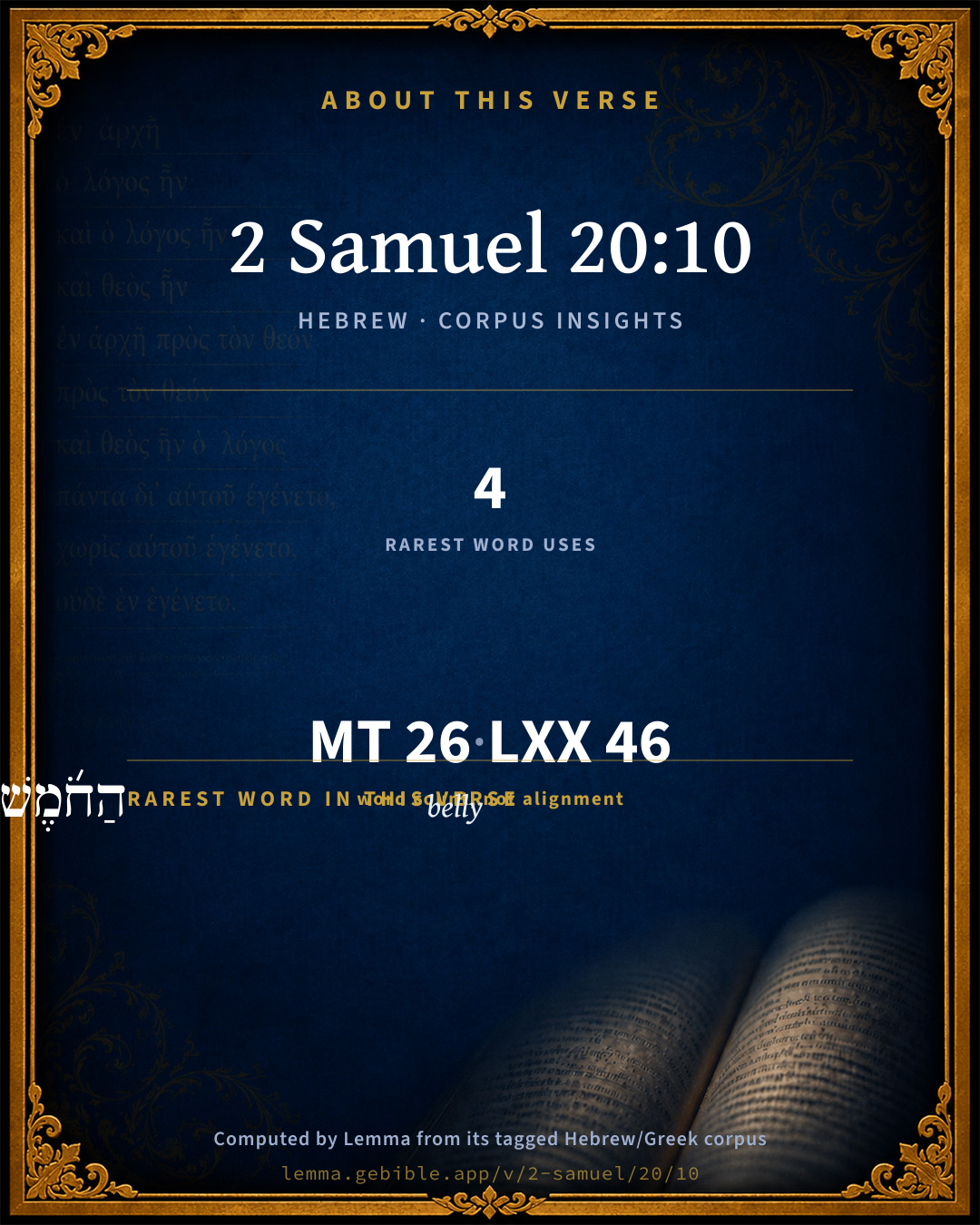
The rarest word here is הַחֹ֜מֶשׁ belly H2570 — appearing just 4 times in the whole Hebrew Bible.

Shared distinctive vocabulary

הַחֹ֜מֶשׁ belly H2570 occurs in 4 verses of the Hebrew Bible. Also found in:

Grammatical profile

  • 6 verbs
  • 12 nouns
  • 1 adjective
  • 4 prepositions
  • 3 particles

Verb forms

  • נִשְׁמַ֜ר Niphal · Perfect
  • וַיַּכֵּהוּ֩ Hiphil · Sequential Imperfect
  • וַיִּשְׁפֹּ֨ךְ Qal · Sequential Imperfect
  • שָׁ֥נָה Qal · Perfect
  • וַיָּמֹ֑ת Qal · Sequential Imperfect
  • רָדַ֕ף Qal · Perfect

Repetition

Words recur within this verse — often emphatic in Hebrew:

  • יוֹאָ֗ב Joab H3097 ×2
  • לֹֽא not H3808 ×2

Hebrew & Septuagint length

In English translation the verse runs 49 words from the Hebrew and 54 from the Septuagint (LXX English) — closely comparable.

A rough comparison of the two English renderings, which tokenize alike — not a word-level alignment.

Word counts can differ between the Hebrew and the Greek without any difference in meaning — e.g. the Hebrew direct-object marker אֵת has no separate Greek word, and Greek often adds the article ὁ.

In the original languages it is 26 Hebrew tokens and 46 Greek tokens — but the two are counted differently (Hebrew bundles its prefixes and suffixes into one token; the Greek is in lemma form), so that isn’t a like-for-like length.

Cross-references

10

Topical passages linked to 2 Samuel 20:10 in the Treasury of Scripture Knowledge — connected by theme and wording, ordered by reader-vote popularity; previews shown in the World English Bible.

  • 2 Samuel 2:23 However he refused to turn aside: therefore Abner with the hinder end of the spear struck him in the body, so that the spear came out behind him; and he fell down there, and died in the same place: and it happened, that as many as came to the place where Asahel fell down and died stood still.
  • 2 Samuel 3:27 When Abner was returned to Hebron, Joab took him aside into the midst of the gate to speak with him quietly, and struck him there in the body, so that he died, for the blood of Asahel his brother.
  • Judges 3:21 Ehud put forth his left hand, and took the sword from his right thigh, and thrust it into his body:
  • 1 Samuel 26:8 Then said Abishai to David, God has delivered up your enemy into your hand this day: now therefore please let me strike him with the spear to the earth at one stroke, and I will not strike him the second time.
  • 2 Samuel 20:9 Joab said to Amasa, Is it well with you, my brother? Joab took Amasa by the beard with his right hand to kiss him.
  • 1 Kings 2:5–6 Moreover you know also what Joab the son of Zeruiah did to me, even what he did to the two captains of the hosts of Israel, to Abner the son of Ner, and to Amasa the son of Jether, whom he killed, and shed the blood of war in peace, and put the blood of war on his sash that was about his loins, and in his shoes that were on his feet.
  • 1 Kings 2:31–34 The king said to him, Do as he has said, and fall on him, and bury him; that you may take away the blood, which Joab shed without cause, from me and from my father's house.
  • 1 Chronicles 12:2 They were armed with bows, and could use both the right hand and the left in slinging stones and in shooting arrows from the bow: they were of Saul's brothers of Benjamin.
  • Acts 1:18–19 Now this man obtained a field with the reward for his wickedness, and falling headlong, his body burst open, and all his intestines gushed out.
  • Genesis 4:8 Cain said to Abel, his brother, "Let's go into the field." It happened, when they were in the field, that Cain rose up against Abel, his brother, and killed him.

Cross-references courtesy of OpenBible.info (CC BY 4.0).

Hebrew and Greek witnesses Masoretic Hebrew ↔ Greek Septuagint

The same verse in the two great witnesses to the Old Testament, shown verse-for-verse.

These are two independent witnesses, not word-aligned to each other, and the Septuagint is shown in lemma (dictionary) form.

Hebrew 2 Samuel 20:10 Masoretic · Westminster Leningrad Codex

וַעֲמָשָׂ֨א לֹֽא נִשְׁמַ֜ר בַּחֶ֣רֶב אֲשֶׁ֣ר בְּיַד יוֹאָ֗ב וַיַּכֵּהוּ֩ בָ֨הּ אֶל הַחֹ֜מֶשׁ וַיִּשְׁפֹּ֨ךְ מֵעָ֥יו אַ֛רְצָה וְלֹא שָׁ֥נָה ל֖וֹ וַיָּמֹ֑ת וְיוֹאָב֙ וַאֲבִישַׁ֣י אָחִ֔יו רָדַ֕ף אַחֲרֵ֖י שֶׁ֥בַע בֶּן בִּכְרִֽי

But Amasa took no heed to the sword that was in Joab's hand: so he struck him therewith in the body, and shed out his bowels to the ground, and didn't strike him again; and he died. Joab and Abishai his brother pursued after Sheba the son of Bichri.

World English Bible · Public Domain

Greek LXX 2 Samuel 20:10 Septuagint · lemma form

καί αμεσσαϊ οὐ φυλάσσω ὁ μάχαιρα ὁ ἐν ὁ χείρ ιωαβ καί παίζω αὐτός ἐν αὐτός ιωαβ εἰς ὁ ψόα καί ἐκχέω ὁ κοιλία αὐτός εἰς ὁ γῆ καί οὐ δευτερόω αὐτός καί ἀποθνήσκω καί ιωαβ καί αβεσσα ὁ ἀδελφός αὐτός διώκω ὀπίσω σαβεε υἱός βοχορι

And Amessai observed not the dagger that was in the hand of Joab: and Joab struck him with it on the loins, and his bowels were shed out upon the ground, and he did not repeat the blow, and he died: and Joab and Abessai his brother pursued after Sabee the son of Bochori.

LXX2012 (modern English Septuagint) · Public Domain

On this verse, Adam Clarke's Commentary discusses the Septuagint’s reading. Read the note in Commentary ↓

Hebrew: Westminster Leningrad Codex (CC BY 4.0). Greek: Septuagint (public domain); English from LXX2012 (modern English Septuagint) (Public Domain). How the Septuagint differs from the Hebrew →

Targum (Aramaic paraphrase)

1

The Targum is the ancient Jewish Aramaic paraphrase of the Hebrew Scriptures — an interpretive translation, not the Hebrew text itself. Onkelos (literal) and Pseudo-Jonathan (expansive) render the Torah, and Jonathan the Prophets. Coverage is partial: where no permissively-licensed English translation exists for a verse, only the Aramaic is shown. This is verse-level text, not a word-by-word alignment to the Hebrew.

  1. Targum Jonathan Prophets (Joshua–Malachi)
    וַעֲמָשָׂא לָא אִסְתְּמַר בְּחַרְבָּא דִי בְיַד יוֹאָב וּמְחָהִי בָהּ בִּסְטַר יַרְכֵיהּ וּשְׁפַךְ מֵיעוֹהִי לְאַרְעָא וְלָא תְנָא לֵיהּ וּמִית וְיוֹאָב וַאֲבִישַׁי אֲחוֹהִי רְדַף בָּתַר שֶׁבַע בַר בִּכְרִי:

    (no public-domain English translation for this verse)

    Targum Jonathan — Aramaic: “Mikraot Gedolot” (public domain). English: “Sefaria Community Translation” (CC0 1.0 (public-domain dedication)); “London "Chaldee Paraphrase," 1871” (public domain). Text via Sefaria.

Commentary

Notes on 2 Samuel 20:10 from classic Christian and Jewish commentators (each source and its license shown beneath its notes). The classic Christian expositions comment on the surrounding passage and are grouped to its opening verse, so a note may address several verses; the Jewish commentaries on the Tanakh (Rashi and others) are per-verse, so they appear only where the commentator wrote on this verse.

Lemma curates 59 commentaries, every one of them public domain or Creative Commons licensed, each selected and text-cleaned for this edition rather than reprinted as found. About our sources →

Jamieson, Fausset & Brown

Robert Jamieson, A. R. Fausset & David Brown

AMASA IS SLAIN. (Sa2 20:10-13)

smote him . . . in the fifth rib--the seat of the liver and bowels, where wounds are mortal.

struck him not again--that is, despatched him at the first blow.

Jamieson, Fausset & Brown — Commentary Critical and Explanatory on the Whole Bible (1871) — public domain (CC PDM 1.0). Text via the HelloAO Bible API.

Trapp's Complete Commentary

John Trapp

2Sa 20:10 But Amasa took no heed to the sword that [was] in Joab’s hand: so he smote him therewith in the fifth [rib], and shed out his bowels to the ground, and struck him not again; and he died. So Joab and Abishai his brother pursued after Sheba the son of Bichri.

Ver. 10. So he smote him therewith in the fifth rib.] Was not David in some sort guilty of this murder of Amasa, by not having all this while punished Joab for the like butchery acted upon Abner? Hemingius telleth of a felon who was found guilty of murdering seven men: and while the judge was considering what punishment heavy enough to inflict upon him, a certain advocate stepped forth, and offered to prove that the judge himself was guilty of the six last of those murders, because he had not punished ths felon for the first.

John Trapp, A Commentary or Exposition upon All the Books of the Old and New Testament (1647–1656) — public domain. Text from a community e-Sword module.

Joseph Benson's Commentary

2Sa 20:10. Amasa took no heed to the sword — Which, falling out, as it seemed, casually, he supposed that Joab intended only to put into its scabbard, and therefore took no care to defend himself against the stroke. So Joab and Abishai pursued after Sheba — He boldly and immediately resumed his former place, and marched at the head of the army. It may appear strange that Amasa’s soldiers did not attempt to revenge his death; but it must be observed that not many of them were yet come up, as the following verses show, and Joab’s interest and authority with the military men were very great, especially with David’s guards, who were here present, and who had neither confidence in nor affection for Amasa, as having been the general of the rebellious army; and, as they probably thought, not fit to be put into a place of such great trust.

Joseph Benson's Commentary on the Old and New Testaments (1811–1818) — public domain. Text from a community e-Sword module.

Tyndale Open Study Notes

Tyndale Open Resources

20:10 Amasa . . . died: For the second time, Joab killed a commander of the opposing army by treachery (the first was Abner, 3:26-27). Twice, David tried to merge feuding parties by absorbing the military leader of the opposing side (see 3:6-13; 17:25; 19:13); twice Joab scuttled David’s plans by treacherously murdering the rival commander (see also 3:22-30).

Tyndale Open Study Notes — © Tyndale Open Resources, licensed CC BY-SA 4.0. Text via the HelloAO Bible API.

Geneva Bible (1599)

Geneva Bible translators

Hebrew, doubled not his stroke.

Geneva Bible (1599) marginal notes — public domain. Text via Bolls.life.

Adam Clarke's Commentary

Verse 10. In the fifth rib] I believe חמש chomesh, which we render here and elsewhere the fifth rib, means any part of the abdominal region. The Septuagint translate it την ψοαν, the groin; the Targum, the right side of the thigh, i.e., (the phrase of the Targumist being interpreted,) the privy parts. That it means some part of the abdominal region, is evident from what follows, And shed out his bowels to the ground. It appears from this that, in plain English, he ripped up his belly.

Adam Clarke's Commentary on the Bible (1810–1826) — public domain. Text from a community e-Sword/MySword module.

Ellicott's Commentary for English Readers

(10) In the fifth rib= Abdomen. (See Note on 2Sa_2:23.)

So Joab and Abishai.—Joab here comes forward as the commander of the pursuit without previous mention. He may have accompanied Abishai from Jerusalem, or he may have joined him on the route; but, now, having murdered Amasa, he assumes his old place as commander-in-chief, doubtless with the connivance of his brother.

A Bible Commentary for English Readers, edited by Charles John Ellicott (1878–1897) — public domain. Text from a community e-Sword module.

The Cambridge Bible for Schools and Colleges

gen. ed. J. J. S. Perowne

10. in the fifth rib] In the belly. See note on ch. 2Sa_2:23.

strake him not again] Cp. 1Sa_26:8. Strake is an archaism for struck. Cp. ch. 2Sa_12:15; Act_27:17.

So Joab] Better, But Joab, &c. Covered with the stains of murder (1Ki_2:5), Joab started in pursuit of Sheba, leaving his victim where he fell.

The Cambridge Bible for Schools and Colleges (gen. ed. J. J. S. Perowne; Cambridge University Press, 1878–1918) — public domain. Text from a community e-Sword module.

John Gill's Exposition

But Amasa took no heed to the sword that was in Joab's hand,.... In his left hand, for with his right hand he took him by the beard; he might see the sword drop out of the scabbard, and Joab take it up, which he supposed he did in order to put it into its sheath again, having no suspicion of his wicked design, and therefore not at all upon his guard to prevent it:

so he smote him therewith in the fifth rib; in the same place where Abner smote Asahel, and Joab Abner; See Gill on Sa2 2:23 and See Gill on Sa2 3:27, he must strike him, as some observe, on the left side, because he was embracing him; and the stroke must be deadly, because he struck him in the pericardium, which surrounds the heart round with water, to refrigerate it; for the lower part of the heart reaches to the fifth rib; see Joh 19:34 (u):

and shed out his bowels to the ground; which fell out through the incision made by the sword:

and struck him not again: he gave him such a home thrust, there was no need to repeat it, he dispatched him at once:

and he died; and thus, though he was pardoned by David, and promoted to honour by him, yet the providence of God would not suffer him to go unpunished for joining with Absalom in an unnatural rebellion against his uncle:

so Joab and Abishai his brother pursued after Sheba the son of Bichri: for Amasa being slain, Joab without any ceremony reassumed his post as general, and, with his brother Abishai under him, made all the haste they could in pursuit of the rebel.

(u) Weemse's Portrait of Man, p. 25.

John Gill's Exposition of the Whole Bible (1746–1763) — public domain (CC PDM 1.0). Text via the HelloAO Bible API.

Haydock's Catholic Bible Commentary

Struck him with his left hand. (Haydock) --- Side. The same word is, elsewhere, translated groin; Septuagint, "loin." Moderns commonly render "in the fifth rib," chap. ii. 23., and iii. 27., and iv. 6. (Calmet) --- Josephus, "the belly."

George Leo Haydock (1774–1849), Haydock's Catholic Family Bible and Commentary, 1859 edition — public domain. Excludes Psalms (Douay-Rheims chapter numbering differs from Protestant) and Deuterocanonical books (Catholic canon only).

Matthew Poole's English Annotations

The sword that was in Joab’s hand; which falling out, as it seemed, casually, he supposed that Joab intended only to put it into its scabbard, and therefore took no care to defend himself against the stroke.

In the fifth rib: See Poole on "2Sa 2:23". Struck him not again; he despatched him at one stroke, or gave him his death’s wound at the first blow, and needed not to smite him again.

Joab now boldly resumed his former place, and marched in the head of the army. It is not strange that Amasa’s soldiers did not fight to revenge his death; partly because not many of them were yet come up, but came by degrees, as the following verses show; and partly because Joab’s interest and authority with the military men was very great, especially with David’s guards, who were here present, and who had no kindness for Amasa, as having been the general of the rebellious army; and, as they might think, was not fit to be put into a place of so great power and trust.

Matthew Poole's English Annotations on the Holy Bible (1683–1685) — public domain. Text from a community e-Sword/MySword module.

Whedon's Commentary on the Bible

Daniel D. Whedon

10. Took no heed to the sword — He probably saw him pick up his sword as it fell from his girdle, and, though still in his hand, he suspected no foul intention.

In the fifth rib — Rather, in the abdomen. See note on 2Sa_2:23.

Joab and Abishai… pursued — They felt themselves now responsible for the success of the army.

Daniel D. Whedon (gen. ed.), Commentary on the Old and New Testaments (1874–1909) — public domain. Text from a community e-Sword module.

The Pulpit Commentary

In the fifth fib; in the abdomen (see note on. (2Sa_2:23) He struck him not again. When his sword fell out of its sheath, Joab picked it up with his left hand, which was not the hand for action, and as he could not put it into its place without taking it into his right hand, his continuing to hold it while he took his cousin"s beard in his fight hand and kissed him, was too natural to awaken any suspicion. But holding down Amasa"s head, he struck him with his left hand so fiercely that no second blow was necessary; and then continued his march forward as if what had occurred was a matter of little importance.

The Pulpit Commentary (1880–1919), ed. H.D.M. Spence-Jones & Joseph S. Exell — public domain. Text from a community e-Sword module.

John Wesley's Explanatory Notes

The sword - Which falling out, as it seemed, casually, he supposed that Joab intended only to put it into its scabbard, and therefore took no care to defend himself against the stroke. So Joab - Who now boldly resumed his former place, and marched in the head of the army. It is not strange, that Amasa's soldiers did not fight to revenge his death; partly, because not many of them were yet come up, as the following verses shew; and partly, because Joab's interest and authority with the military-men was very great; especially, with David's guards, who were here present, and who had no kindness for Amasa, as having been the general of the rebellious army; and, as they might think, not fit to be put into a place of so great trust.

John Wesley, Explanatory Notes Upon the Whole Bible (1754–1765) — public domain. Text via the GEBible commentary corpus.

Lesson kit

Teaching starters — assembled from the data on this page, not authored interpretation. Every prompt links to the verse data it draws on. Edit before teaching.

2 Samuel, in the Historical, opens this verse with 26 words (22 distinct Hebrew lemmas). Its most distinctive word is chômesh (“belly”). A historical commentator’s framing appears above. Read the whole chapter for the surrounding context.

Discussion questions

  1. What does “belly” (chômesh) contribute to the verse as a whole?
  2. 2 Samuel 2:23 shares the word «belly» with this verse. How do the two illuminate each other?
  3. “Joab” occurs 2× in this one verse. What is the effect of the repetition?
  4. These translations render this verse differently; the difference is in the English rendering, not the original. What questions does that raise?
  5. The verb «נִשְׁמַ֜ר» is Niphal Perfect. How does its form color the action?
  6. Reading how Jamieson, Fausset & Brown and Trapp's Complete Commentary read this verse, where do the two commentators agree and where do they part?

Things to notice

Reading settings

Reading text

Shown beneath each verse's original-language words.

Old Testament
Old Testament edition

Read the OT as the Masoretic Hebrew (MT) or the Greek Septuagint (LXX).

English shown for the Greek Septuagint (in the Hebrew ↔ Greek comparison).

Comparing translations? Open the Compare panel on any verse page to stack up to four side by side.