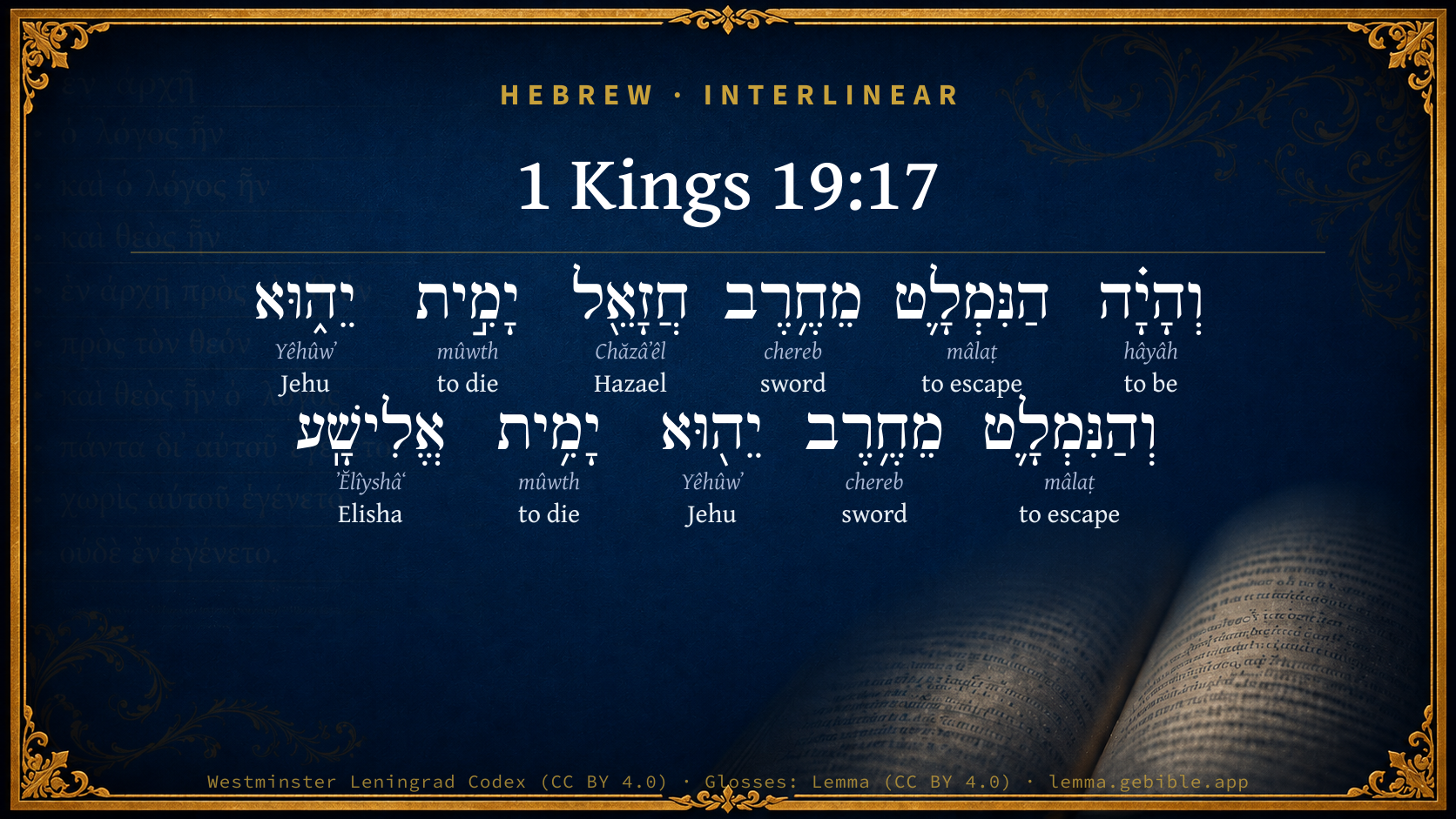
1 Kings 19:17

Hebrew (Westminster Leningrad Codex) 1 Kings 19:17 appears in the Hebrew Old Testament. The text above is from the Westminster Leningrad Codex. Each word links to its Strong’s number, a concise gloss, and parsing drawn from the Open Scriptures Hebrew Bible morphology. Click any word for its full Brown-Driver-Briggs (BDB) entry.
Download image
Cite this verse

1 Kings 19:17 (World English Bible). Public Domain. Lemma interlinear Bible study tool, https://lemma.gebible.app/v/1-kings/19/17.

Show BibTeX & RIS
BibTeX
RIS
English Translation
It shall happen, that he who escapes from the sword of Hazael shall Jehu kill; and he who escapes from the sword of Jehu shall Elisha kill.
World English Bible · Public Domain
Download a study sheet

One document with this verse’s original text, its word-by-word gloss line, the meaning frame, cross-references with their text, attributed commentary, and full source and license credits — printable, and it pastes into notes with its structure intact.

This verse Autodidact and up

Study sheet (.html) Plain text (.txt)

A passage Seminary Student

Up to 50 verses in one chapter. A passage sheet keeps up to 6 commentary sources and 12 cross-references per verse, in the order this page ranks them, and says so on the sheet whenever that leaves anything out. Ask for a single verse and you get the Autodidact verse sheet above.

Everything on this page stays free to read, with no account — the sheet is a download of what is already on screen, not access to it.

Want to remove ads? Support Godless Engineer
Compare translations 3

The same verse in 3 English versions, stacked beneath the original-language interlinear above. Click any original word for its lexicon entry.

Each is an independent rendering of the whole verse — the interlinear is not word-aligned to these translations.

Highlighted words mark where these versions differ — a whole-verse word diff, not a word-by-word alignment.

  • World English Bible Public Domain
    It shall happen, that he who escapes from the sword of Hazael shall Jehu kill; and he who escapes from the sword of Jehu shall Elisha kill.
  • King James Version Public Domain
    And it shall come to pass, that him that escapeth the sword of Hazael shall Jehu slay: and him that escapeth from the sword of Jehu shall Elisha slay.
  • unfoldingWord Literal Text CC BY-SA 4.0
    And it will happen that the one escaping from the sword of Hazael, Jehu will kill. And the one escaping from the sword of Jehu, Elisha will kill.

unfoldingWord Literal Text — © unfoldingWord, licensed CC BY-SA 4.0. Word-aligned USFM3 via Door43 (git.door43.org/unfoldingWord/en_ult).

Versions to compare (up to 4)

3 of 4 selected

Show all 18 translations

Every available English version of this verse, each an independent rendering of the whole verse.

  • World English Bible Public Domain
    It shall happen, that he who escapes from the sword of Hazael shall Jehu kill; and he who escapes from the sword of Jehu shall Elisha kill.
  • Berean Standard Bible Public Domain
    Then Jehu will put to death whoever escapes the sword of Hazael, and Elisha will put to death whoever escapes the sword of Jehu.
  • Majority Standard Bible Public Domain
    Then Jehu will put to death whoever escapes the sword of Hazael, and Elisha will put to death whoever escapes the sword of Jehu.
  • King James Version Public Domain
    And it shall come to pass, that him that escapeth the sword of Hazael shall Jehu slay: and him that escapeth from the sword of Jehu shall Elisha slay.
  • American Standard Version (1901) Public Domain
    And it shall come to pass, that him that escapeth from the sword of Hazael shall Jehu slay; and him that escapeth from the sword of Jehu shall Elisha slay.
  • Revised Version (1885) Public Domain
    And it shall come to pass, that him that escapeth from the sword of Hazael shall Jehu slay: and him that escapeth from the sword of Jehu shall Elisha slay;
  • Geneva Bible (1599) Public Domain
    And him that escapeth from the sworde of Hazael, shall Iehu slay: and him that escapeth from the sword of Iehu, shall Elisha slay.
  • Douay-Rheims (1899) Public Domain
    And it shall come to pass, that whosoever shall escape the sword of Hazael, shall be slain by Jehu: and whosoever shall escape the sword of Jehu, shall be slain by Eliseus.
  • Young's Literal Translation Public Domain
    `And it hath been, him who is escaped from the sword of Hazael, put to death doth Jehu, and him who is escaped from the sword of Jehu put to death doth Elisha;
  • Literal Standard Version CC BY-SA 4.0
    And it has been, he who has escaped from the sword of Hazael, Jehu puts to death, and he who has escaped from the sword of Jehu, Elisha puts to death;
  • Unlocked Literal Bible CC BY-SA 4.0
    It will happen that Jehu will kill whoever escapes from the sword of Hazael, and that Elisha will kill whoever escapes from the sword of Jehu.
  • unfoldingWord Literal Text CC BY-SA 4.0
    And it will happen that the one escaping from the sword of Hazael, Jehu will kill. And the one escaping from the sword of Jehu, Elisha will kill.
  • Darby Bible Public Domain
    And it shall come to pass, [that] him that escapeth the sword of Hazael shall Jehu slay; and him that escapeth the sword of Jehu shall Elisha slay.
  • World Messianic Bible Public Domain
    He who escapes from the sword of Hazael, Jehu will kill; and he who escapes from the sword of Jehu, Elisha will kill.
  • Webster's Bible Public Domain
    And it shall come to pass, that him that escapeth the sword of Hazael shall Jehu slay: and him that escapeth from the sword of Jehu shall Elisha slay.
  • Free Bible Version CC BY-SA 4.0
    Jehu will execute anyone who escapes the sword of Hazael, and Elisha will execute anyone who escapes the sword of Jehu.
  • Bible in Basic English Public Domain
    And it will come about that the man who gets away safe from the sword of Hazael, Jehu will put to death; and whoever gets away safe from the sword of Jehu, Elisha will put to death.
  • JPS Tanakh (1917) Public Domain
    And it shall come to pass, that him that escapeth from the sword of Hazael shall Jehu slay; and him that escapeth from the sword of Jehu shall Elisha slay.

Literal Standard Version (2020), Covenant Press — licensed CC BY-SA 4.0. Text via the HelloAO Bible API (eBible.org). Unlocked Literal Bible (unfoldingWord) — licensed CC BY-SA 4.0. Text via the HelloAO Bible API (eBible.org). unfoldingWord Literal Text — © unfoldingWord, licensed CC BY-SA 4.0. Word-aligned USFM3 via Door43 (git.door43.org/unfoldingWord/en_ult). Free Bible Version, Dr. Jonathan Gallagher — licensed CC BY-SA 4.0. Text via the HelloAO Bible API (eBible.org).

Word by word

More ways to search: Search by grammar → Find every occurrence → Compare this word →

Practice this passage: Drill this verse → Learn its vocabulary →

חֲזָאֵ֖ל
Chăzâʼêl
H2371
“Hazael”
Noun, Proper
Part of Speech
Noun
Type
Proper
Full BDB Definition

Origin: from H2372 and H410

TWOT: None

Hazael = "one who sees God" - a king of Syria; sent by his master, Ben-hadad, to the prophet Elisha, to seek a remedy for Ben-hadad's leprosy; apparently later killed Ben-hadad, assumed the throne, and soon became engaged in a war with the kings of Judah and Israel for the possession of the city of Ramoth-gilead
  1. וְהָיָ֗ה hâyâh H1961 “and · to be” Conjunction + Verb, Qal, Sequential Perfect, 3rd Person, Masculine, Singular
  2. הַנִּמְלָ֛ט mâlaṭ H4422 “the · escaping” Particle, Definite Article + Verb, Niphal, Participle Active, Masculine, Singular, Absolute
  3. מֵחֶ֥רֶב chereb H2719 “from · sword of” Preposition + Noun, Common, Feminine, Singular, Construct
  4. יָמִ֣ית mûwth H4191 “to die” Verb, Hiphil, Imperfect, 3rd Person, Masculine, Singular
  5. יֵה֑וּא Yêhûwʼ H3058 “Jehu” Noun, Proper
  6. וְהַנִּמְלָ֛ט mâlaṭ H4422 “and · the · escaping” Conjunction + Particle, Definite Article + Verb, Niphal, Participle Active, Masculine, Singular, Absolute
  7. מֵחֶ֥רֶב chereb H2719 “from · sword of” Preposition + Noun, Common, Feminine, Singular, Construct
  8. יֵה֖וּא Yêhûwʼ H3058 “Jehu” Noun, Proper
  9. יָמִ֥ית mûwth H4191 “to die” Verb, Hiphil, Imperfect, 3rd Person, Masculine, Singular
  10. אֱלִישָֽׁע ʼĔlîyshâʻ H477 “Elisha” Noun, Proper

About this verse

These counts appear in no published source. They are computed here, from the morphology-tagged text and Lemma’s own curated glosses. What Lemma adds →

11
words
7
distinct lemmas
Historical
section

Notable vocabulary

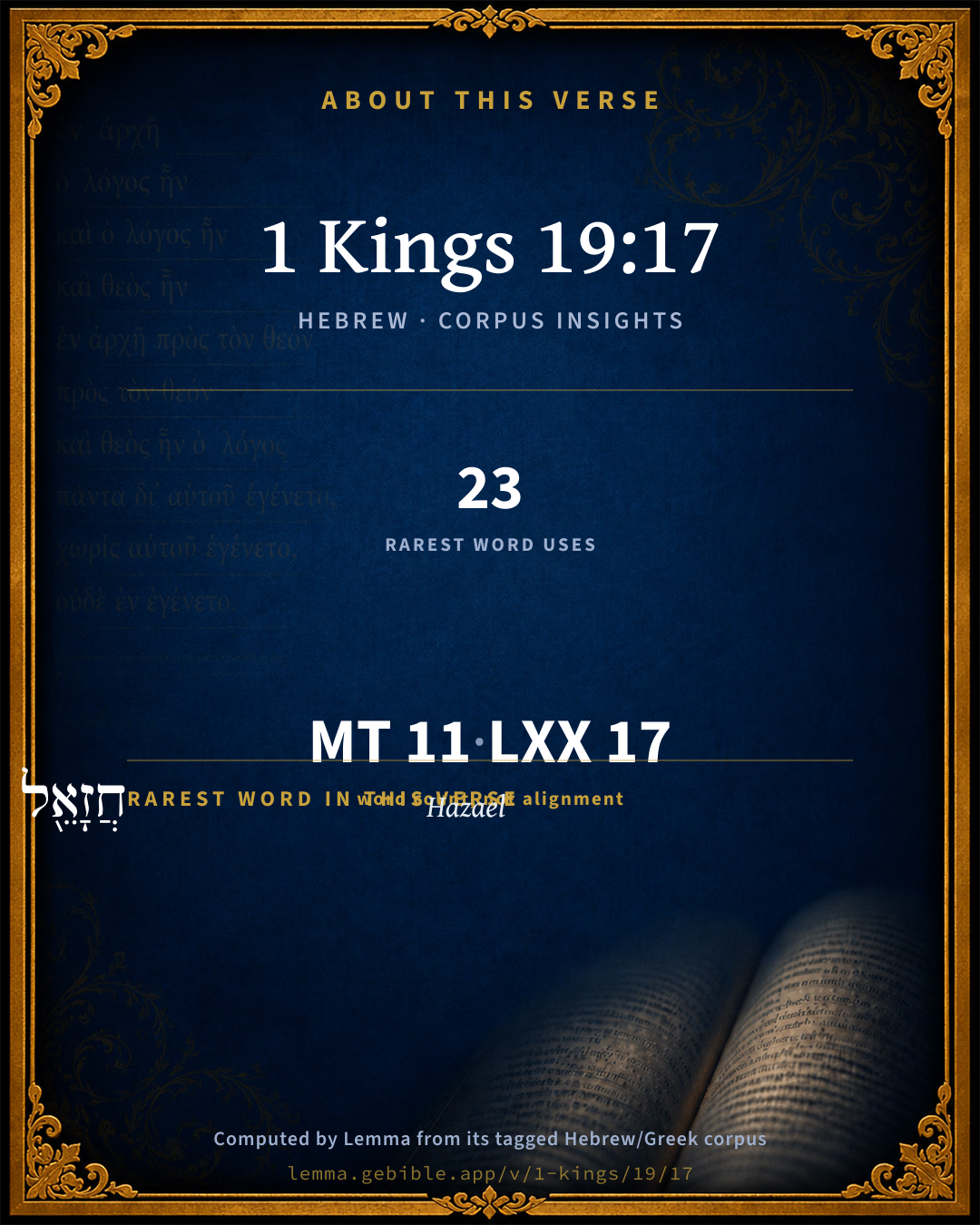
The rarest word here is חֲזָאֵ֖ל Hazael H2371 — appearing just 23 times in the whole Hebrew Bible.

Shared distinctive vocabulary

חֲזָאֵ֖ל Hazael H2371 occurs in 21 verses of the Hebrew Bible. Also found in:

Grammatical profile

  • 5 verbs
  • 6 nouns

Verb forms

  • וְהָיָ֗ה Qal · Sequential Perfect
  • הַנִּמְלָ֛ט Niphal · Participle Active
  • יָמִ֣ית Hiphil · Imperfect
  • וְהַנִּמְלָ֛ט Niphal · Participle Active
  • יָמִ֥ית Hiphil · Imperfect

Repetition

Words recur within this verse — often emphatic in Hebrew:

  • הַנִּמְלָ֛ט to escape H4422 ×2
  • מֵחֶ֥רֶב sword H2719 ×2
  • יָמִ֣ית to die H4191 ×2
  • יֵה֑וּא Jehu H3058 ×2

Hebrew & Septuagint length

In English translation the verse runs 27 words from the Hebrew and 30 from the Septuagint (LXX English) — closely comparable.

A rough comparison of the two English renderings, which tokenize alike — not a word-level alignment.

Word counts can differ between the Hebrew and the Greek without any difference in meaning — e.g. the Hebrew direct-object marker אֵת has no separate Greek word, and Greek often adds the article ὁ.

In the original languages it is 11 Hebrew tokens and 17 Greek tokens — but the two are counted differently (Hebrew bundles its prefixes and suffixes into one token; the Greek is in lemma form), so that isn’t a like-for-like length.

Cross-references

13

Topical passages linked to 1 Kings 19:17 in the Treasury of Scripture Knowledge — connected by theme and wording, ordered by reader-vote popularity; previews shown in the World English Bible.

  • 2 Kings 8:12 Hazael said, Why weeps my lord? He answered, Because I know the evil that you will do to the children of Israel: their strongholds will you set on fire, and their young men will you kill with the sword, and will dash in pieces their little ones, and rip up their women with child.
  • 2 Kings 13:3 The anger of Yahweh was kindled against Israel, and he delivered them into the hand of Hazael king of Syria, and into the hand of Benhadad the son of Hazael, continually.
  • 2 Kings 13:22 Hazael king of Syria oppressed Israel all the days of Jehoahaz.
  • 2 Kings 10:32 In those days Yahweh began to cut off from Israel: and Hazael struck them in all the borders of Israel;
  • Hosea 6:5 Therefore I have cut them to pieces with the prophets; I killed them with the words of my mouth. Your judgments are like a flash of lightning.
  • 2 Kings 2:23–24 He went up from there to Bethel; and as he was going up by the way, there came forth young lads out of the city, and mocked him, and said to him, Go up, you baldy; go up, you baldhead.
  • 2 Kings 9:14–10:25 So Jehu the son of Jehoshaphat the son of Nimshi conspired against Joram. (Now Joram was keeping Ramoth-gilead, he and all Israel, because of Hazael king of Syria;
  • Isaiah 11:4 but with righteousness shall he judge the poor, and decide with equity for the humble of the earth; and he shall strike the earth with the rod of his mouth; and with the breath of his lips shall he kill the wicked.
  • Isaiah 24:17–18 Fear, and the pit, and the snare, are on you, O inhabitant of the earth.
  • Jeremiah 1:10 behold, I have this day set you over the nations and over the kingdoms, to pluck up and to break down and to destroy and to overthrow, to build and to plant.
  • Amos 2:14 Flight will perish from the swift; And the strong won't strengthen his force; Neither shall the mighty deliver himself;
  • Amos 5:19 As if a man fled from a lion, And a bear met him; Or he went into the house and leaned his hand on the wall, And a snake bit him.
  • Revelation 19:21 The rest were killed with the sword of him who sat on the horse, the sword which came forth out of his mouth. All the birds were filled with their flesh.

Cross-references courtesy of OpenBible.info (CC BY 4.0).

Hebrew and Greek witnesses Masoretic Hebrew ↔ Greek Septuagint

The same verse in the two great witnesses to the Old Testament, shown verse-for-verse.

These are two independent witnesses, not word-aligned to each other, and the Septuagint is shown in lemma (dictionary) form.

Hebrew 1 Kings 19:17 Masoretic · Westminster Leningrad Codex

וְהָיָ֗ה הַנִּמְלָ֛ט מֵחֶ֥רֶב חֲזָאֵ֖ל יָמִ֣ית יֵה֑וּא וְהַנִּמְלָ֛ט מֵחֶ֥רֶב יֵה֖וּא יָמִ֥ית אֱלִישָֽׁע

It shall happen, that he who escapes from the sword of Hazael shall Jehu kill; and he who escapes from the sword of Jehu shall Elisha kill.

World English Bible · Public Domain

Greek LXX 1 Kings 19:17 Septuagint · lemma form

καί εἰμί ὁ σώζω ἐκ ῥομφαία αζαηλ θανατόω ιου καί ὁ σώζω ἐκ ῥομφαία ιου θανατόω ελισαιε

And it shall come to pass, that him that escapes from the sword of Azael, Ju shall kill; and him that escapes from the sword of Ju, Elisaie shall kill.

LXX2012 (modern English Septuagint) · Public Domain

Hebrew: Westminster Leningrad Codex (CC BY 4.0). Greek: Septuagint (public domain); English from LXX2012 (modern English Septuagint) (Public Domain). How the Septuagint differs from the Hebrew →

Targum (Aramaic paraphrase)

1

The Targum is the ancient Jewish Aramaic paraphrase of the Hebrew Scriptures — an interpretive translation, not the Hebrew text itself. Onkelos (literal) and Pseudo-Jonathan (expansive) render the Torah, and Jonathan the Prophets. Coverage is partial: where no permissively-licensed English translation exists for a verse, only the Aramaic is shown. This is verse-level text, not a word-by-word alignment to the Hebrew.

  1. Targum Jonathan Prophets (Joshua–Malachi)
    וִיהֵי דְיִשְׁתֵּיזֵיב מֵחַרְבָּא דַחֲזָאֵל יִקְטוֹל יֵהוּא וּדְיִשְׁתֵּיזֵיב מֵחַרְבָּא דְיֵהוּא יִקְטוֹל אֱלִישָׁע:

    (no public-domain English translation for this verse)

    Targum Jonathan — Aramaic: “Mikraot Gedolot” (public domain). English: “Sefaria Community Translation” (CC0 1.0 (public-domain dedication)); “London "Chaldee Paraphrase," 1871” (public domain). Text via Sefaria.

Commentary

Notes on 1 Kings 19:17 from classic Christian and Jewish commentators (each source and its license shown beneath its notes). The classic Christian expositions comment on the surrounding passage and are grouped to its opening verse, so a note may address several verses; the Jewish commentaries on the Tanakh (Rashi and others) are per-verse, so they appear only where the commentator wrote on this verse.

Lemma curates 59 commentaries, every one of them public domain or Creative Commons licensed, each selected and text-cleaned for this edition rather than reprinted as found. About our sources →

Trapp's Complete Commentary

John Trapp

1Ki 19:17 And it shall come to pass, [that] him that escapeth the sword of Hazael shall Jehu slay: and him that escapeth from the sword of Jehu shall Elisha slay.

Ver. 17. Shall Elisha slay.] Elisha then hath his sword as well as Jehu and Hazael, though of another nature; viz., prayers, {a} threatenings, curses, which did all most certainly and infallibly come to pass. And whensoever Elisha unsheatheth and brandisheth his sword, it is a fair warning that the sword of Jehu and Hazael are at hand. See Hos 6:5 Jer 1:10.

{a} They that can stand against or escape the power of two kings, shall yet fall by the hand of prayer.

John Trapp, A Commentary or Exposition upon All the Books of the Old and New Testament (1647–1656) — public domain. Text from a community e-Sword module.

Joseph Benson's Commentary

1Ki 19:17. Him that escapeth the sword of Hazael shall Jehu slay — This is not to be understood, as if the sword of Hazael should do execution before the sword of Jehu, and the sword of Jehu before that of Elisha: it only signifies, that God had appointed these three persons to punish the apostate Israelites for their idolatries, and that one or other of them should infallibly execute his judgments upon them: Hazael, however, began to slay them before Jehu was king, 2Ki 8:28-29; though his cruelty was much increased afterward. Jehu destroyed those, whom Hazael did not, as King Joram himself, and Ahaziah, and all the near relations of Ahab. Elisha is said to slay them, either because he brought down, by his prayers, destruction upon the forty-two children of Beth-el, that idolatrous city, 2Ki 2:24; or because by God’s appointment he inflicted the famine, 2Ki 8:1; or rather, as the prophets are said to pull down and destroy, what they foretel and declare shall be pulled down, because he threatened and predicted destructive judgments to come upon them. He slew them with the sword that came out of his month, the word of God: like the Branch from the stem of Jesse, he smote them with the rod of his mouth, and with the breath of his lips he slew the wicked, Isa 11:4.

Joseph Benson's Commentary on the Old and New Testaments (1811–1818) — public domain. Text from a community e-Sword module.

Adam Clarke's Commentary

Verse 17. Shall Elisha slay.] We do not find that Elisha either used the sword, or commissioned it to be used, though he delivered solemn prophecies against this disobedient people: and this is probably the sense in which this should be understood, as Elisha was prophet before Hazael was king, and Hazael was king before Jehu; and the heavy famine which he brought on the land took place before the reign either of Jehu or Hazael. The meaning of the prophecy may be this: Hazael, Jehu, and Elisha, shall be the ministers of my vengeance against this disobedient and rebellious people. The order of time, here, is not to be regarded.

Adam Clarke's Commentary on the Bible (1810–1826) — public domain. Text from a community e-Sword/MySword module.

Ellicott's Commentary for English Readers

(17) Him that escapeth the sword of Hazael.—The vengeance wrought by Hazael and Jehu on the faithlessness of Israel speaks for itself; it is marked in bloody letters on the history (2 Kings 10). But Elisha’s mission was obviously not one of such vengeance. He had to destroy enmity, but not to slay the enemies of God. The difficulty, such as it is, is one of the many marks of historic accuracy in the whole passage. Probably Elisha’s mission is here described in the terms in which Elijah would best understand it. His spirit was for war; he could hardly have conceived how the completion of his mission was to be wrought out by the weapons of peace in the hand of his successor. (Comp. 2Co_10:3-6.)

A Bible Commentary for English Readers, edited by Charles John Ellicott (1878–1897) — public domain. Text from a community e-Sword module.

The Cambridge Bible for Schools and Colleges

gen. ed. J. J. S. Perowne

17. shall Elisha slay] Here we come upon evidence that the language of these verses (15–18) is not to be pressed into a literal interpretation. In the second book of Kings the compiler gives us all that he thought needful of the life of Elisha, and there is nothing in it which accords with a literal acceptance of this verse. We read of none that were slain by the hand of Elijah’s successor. But his voice and his labours for the overthrow of false worship, and for making known, both to Israel and to the nations round about, that there was ‘no God in all the earth but in Israel’ (2Ki_6:15) were constant, and by this ‘sword of his mouth’ he overthrew the foes of Jehovah. In this sense he fulfilled the declaration in the text, his work coming in and being effectual in places and ways where Hazael and Jehu wrought no deliverance.

The Cambridge Bible for Schools and Colleges (gen. ed. J. J. S. Perowne; Cambridge University Press, 1878–1918) — public domain. Text from a community e-Sword module.

John Gill's Exposition

And it shall come to pass, that him that escapeth the sword of Hazael shall Jehu slay,.... Which suggests that many should be slain in Israel by them both, as were by Hazael, Kg2 10:32 and by Jehu, Kg2 9:24,

and him that escapeth from the sword of Jehu shall Elisha slay; which may be understood either literally of the forty two children cursed by him, in consequence of which they were destroyed by bears, Kg2 2:24 or rather figuratively by his prophecies, see Hos 6:5 who foretold the slaughters made by Hazael and Jehu, as well as others, see Kg2 8:12, these several things were not done in the order in which they are here put; for what Elisha did was before Hazael and Jehu, and Jehu before Hazael; these words therefore do not respect the exact order of time in which they should be done, only that each should do the part appointed and assigned unto him, and what could not be so well done by the other; thus Hazael was to destroy those that came out to war; and Jehu Ahab's family that did not; and Elisha the children of idolatrous parents at Bethel, that came not within the reach of either; though it may be observed, that Hazael began to distress Israel before Jehu appeared, Kg2 8:28 and the prophecies of Elisha might not have their full accomplishment until after Hazael and Jehu had done what was appointed for them.

John Gill's Exposition of the Whole Bible (1746–1763) — public domain (CC PDM 1.0). Text via the HelloAO Bible API.

Albert Barnes' Notes on the Bible

Compare the marginal references.

Shall Elisha slay - i. e., With a spiritual slaying by the “word of the Lord,” which is “sharper than any two-edged sword,” and may be said to slay those whose doom it pronounces (compare the marginal reference; Jer 1:10). Elisha does not seem, like Elijah, to have executed God’s judgments on the guilty.

Albert Barnes' Notes on the Bible (1834–1885) — public domain. Text from a community e-Sword/MySword module.

Haydock's Catholic Bible Commentary

Shall be slain by Eliseus. Eliseus did not kill any of the idolaters with the material sword; but he is here joined with Hazael and Jehu, the great instruments of God in punishing the idolatry of Israel, because he foretold to the former his exaltation to the kingdom of Syria, and the vengeance he would execute against Israel, and anointed the latter by one of his disciples to be king of Israel, with commission to extirpate the house of Achab. (Challoner) --- They left nothing imperfect in the vengeance, 4 Kings viii., and ix. Eliseus sent bears to destroy forty-two children of Bethel; (4 Kings ii. 23.; Calmet) and Abulensis (q. 23.) thinks that he might put many false prophets to death, as the Scripture does not mention every thing, (Menochius) and as Elias had done himself. (Haydock) --- Eliseus may also be the name of some general. (Du Hamel)

George Leo Haydock (1774–1849), Haydock's Catholic Family Bible and Commentary, 1859 edition — public domain. Excludes Psalms (Douay-Rheims chapter numbering differs from Protestant) and Deuterocanonical books (Catholic canon only).

Matthew Poole's English Annotations

Here the order of times seems to be perverted; for Elisha was prophet before Jehu or Hazael were kings, and Hazael was king before Jehu. But that is of no moment as to the substance of the thing threatened, which is only this, that one or other of these should infallibly execute God’s judgments upon the apostatical Israelites. Elisha is said to slay them, either because he slew those forty-two children, 2Ki 2:24, besides others whom upon like occasions he might destroy; or because he by God’s appointment inflicted the famine, 2Ki 6:31; or rather, by the sword which came out of his mouth, as Isa 49:2; Rev 1:16; 19:15,21, by his cutting prophecies and threatenings of God’s judgments; the prophets being said to pull down and to destroy what they only declare and foretell shall be pulled down, &c. Hazael began to slay them before Jehu was king, 2Ki 8:28, though his cruelty was much increased afterward, 2Ki 10:32; 13:1-3; and Jehu destroyed those whom Hazael did not, king Joram himself, and Ahaziah, and his forty-two brethren, 2Ki 9:24,27; 10:14, all the near relations of wicked Ahab.

Matthew Poole's English Annotations on the Holy Bible (1683–1685) — public domain. Text from a community e-Sword/MySword module.

Whedon's Commentary on the Bible

Daniel D. Whedon

17. Hazael… Jehu… Elisha — These are to be the ministers of Divine vengeance against the house of Ahab — the swords of a Jew and a Gentile king, and the word of Elijah’s successor. Around these three names cluster the destinies of Israel for a whole generation, and hence their significance in this revelation to Elijah.

Daniel D. Whedon (gen. ed.), Commentary on the Old and New Testaments (1874–1909) — public domain. Text from a community e-Sword module.

The Pulpit Commentary

And it Shall come to pass, that him that escapeth the sword of Hazael (See 2Ki_8:12, 28 10:32 13:3, 22) shall Jehu 2Ki_9:24-33 2Ki_9:10. passim: (Cf. Isa_66:16) and him that escapeth from the sword of Jehu shall Elisha slay. Elijah might reasonably interpret the commission to "anoint" Hazael, etc., as a figure, seeing there is an undoubted figure of speech here. Elisha was a man of peace. His sword was the "sword of the Spirit, the word of God." It was by "the breath of his lips he slew the wicked" (Isa_2:4; 2Th_2:8; Hos_6:5) Not only are vers. 16, 17 an interpretation, in some sort, of the vision, but they are an answer to Elijah"s complaint (vers. 10, 14). The "children of Israel" who had forsaken the covenant should be punished by Hazael (cf. 2Ki_8:12, "I know what thou wilt do unto the children of Israel"; the king and queen who had thrown down the altars and slain the prophets should be slain, one by the sword of Syria, the other at the command of Jehu; while to his allegation that the prophets were extinct and he was left alone is opposed the ordination of a successor, and the mention of the "seven thousand" in ver. 18.

The Pulpit Commentary (1880–1919), ed. H.D.M. Spence-Jones & Joseph S. Exell — public domain. Text from a community e-Sword module.

John Wesley's Explanatory Notes

Shall Elisha slay - One or other of these should infallibly execute God's judgments upon the apostate Israelites. Elisha is said to slay them, either, because he slew those forty two children, 2 Kings ii, 24, besides others whom upon like occasions he might destroy; or, because he by God's appointment inflicted the famine, 2 Kings viii, 1, or rather, by the sword which came out of his mouth: the prophets being said to pull down and to destroy what they declare and foretel shall be pulled down. Hazael began to slay them before Jehu was king, though his cruelty was much increased afterward. Jehu destroyed those whom Hazael did not, as king Joram himself, and Ahaziah, and all the near relations of Ahab.

John Wesley, Explanatory Notes Upon the Whole Bible (1754–1765) — public domain. Text via the GEBible commentary corpus.

unfoldingWord translationNotes

Door43 World Missions Community

It will happen

This phrase is used to introduce what will happen when Elijah does what Yahweh has told him to do. "What will happen is"

whoever escapes from the sword of Hazael

"Sword" is metonymy for for killing as in battle. AT: "whomever Hazael does not kill with the sword" (See: Metonymy)

I will leave for myself

Here the words "I" and "myself" refer to Yahweh. AT: "I will save from death" (See: Reflexive Pronouns)

seven thousand people

"7,000 people" (See: Numbers)

whose knees have not bent down to Baal, and whose mouths have not kissed him

"Bending down" and "kissing" are metonymies for actions people did to worship idols. They are combined for emphasis. AT: "who have not bowed down and kissed Baal" or "who have not worshiped Baal" (See: Metonymy and Parallelism)

translationWords

sword

kingdom of Israel

Baal

kiss

unfoldingWord translationNotes — © Distant Shores Media and the Door43 World Missions Community, licensed CC BY-SA 4.0. Source: git.door43.org/Door43/en_tn.

Rashi

Rabbi Shlomo Yitzchaki (Rashi)

Elisha will kill. We do not find that Elisha killed anyone but the forty-two children through the bears in Yericho.

Rashi on the Tanakh — English translations: “The Judaica Press complete Tanach with Rashi, translated by A. J. Rosenberg” (CC BY 4.0); “Pentateuch with Rashi's commentary by M. Rosenbaum and A.M. Silbermann, 1929-1934” (public domain); “The Metsudah Tanach series, Lakewood, N.J” (CC BY 4.0); and “The Book of Joshua, Metsudah Publications, 1997” (CC BY 4.0). Text via Sefaria.

Lesson kit

Teaching starters — assembled from the data on this page, not authored interpretation. Every prompt links to the verse data it draws on. Edit before teaching.

1 Kings, in the Historical, opens this verse with 11 words (7 distinct Hebrew lemmas). Its most distinctive word is Chăzâʼêl (“Hazael”). A historical commentator’s framing appears above. Read the whole chapter for the surrounding context.

Discussion questions

  1. What does “Hazael” (Chăzâʼêl) contribute to the verse as a whole?
  2. How does 1 Kings 19:15, which shares the word «Hazael», read alongside this verse?
  3. What does the repetition of “to escape” (2× in this one verse) do in this verse?
  4. These translations render this verse differently; the difference is in the English rendering, not the original. What questions does that raise?
  5. «וְהָיָ֗ה» is a Qal Sequential Perfect verb. How does that grammatical form shape the action described?
  6. Compare how Trapp's Complete Commentary and Joseph Benson's Commentary read this verse. Where do they agree or differ?

Things to notice

Reading settings

Reading text

Shown beneath each verse's original-language words.

Old Testament
Old Testament edition

Read the OT as the Masoretic Hebrew (MT) or the Greek Septuagint (LXX).

English shown for the Greek Septuagint (in the Hebrew ↔ Greek comparison).

Comparing translations? Open the Compare panel on any verse page to stack up to four side by side.