
2 Samuel 20:8

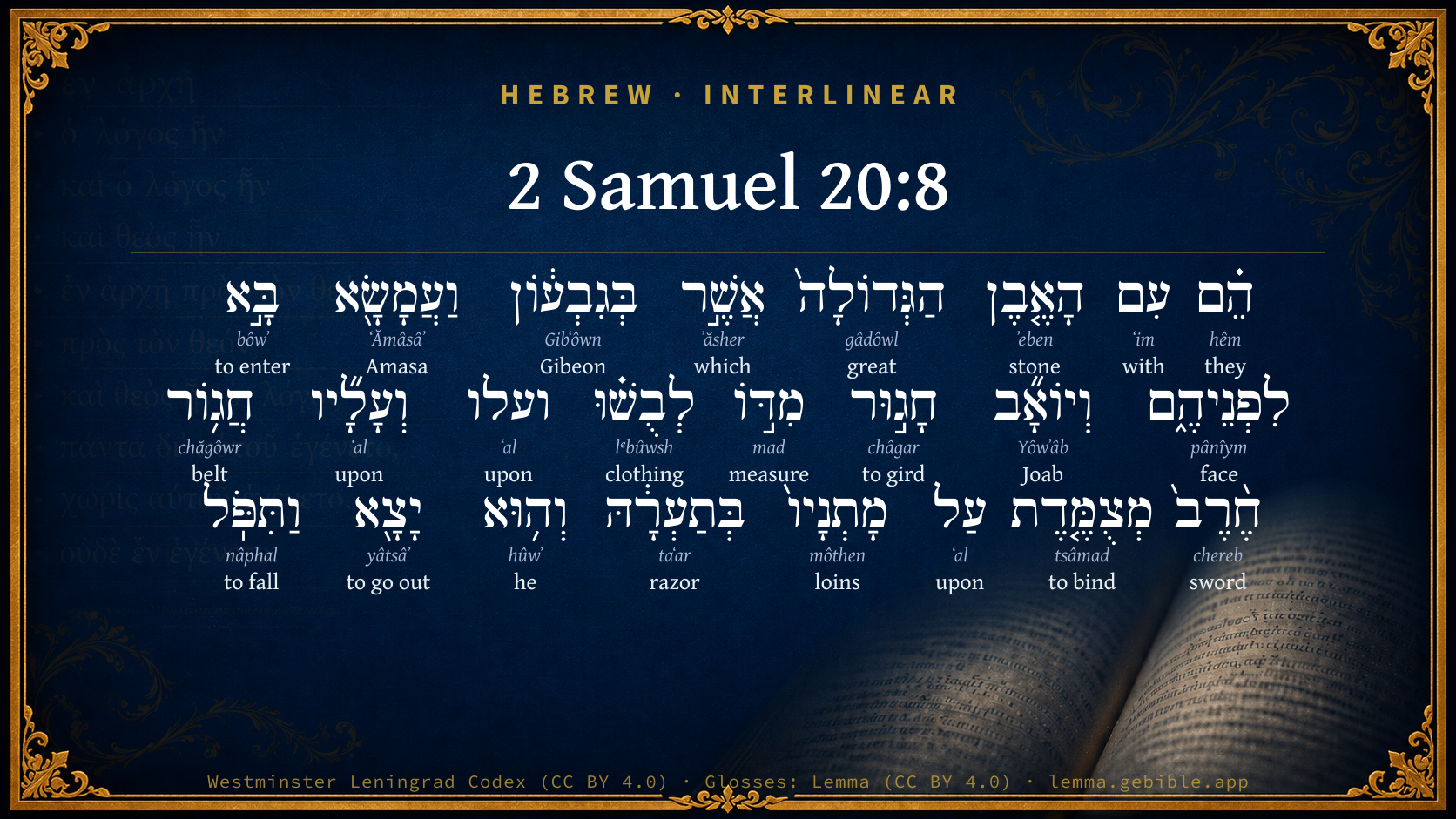
Hebrew (Westminster Leningrad Codex) 2 Samuel 20:8 appears in the Hebrew Old Testament. The text above is from the Westminster Leningrad Codex. Each word links to its Strong’s number, a concise gloss, and parsing drawn from the Open Scriptures Hebrew Bible morphology. Click any word for its full Brown-Driver-Briggs (BDB) entry.
Download image
Cite this verse

2 Samuel 20:8 (World English Bible). Public Domain. Lemma interlinear Bible study tool, https://lemma.gebible.app/v/2-samuel/20/8.

Show BibTeX & RIS
BibTeX
RIS
English Translation
When they were at the great stone which is in Gibeon, Amasa came to meet them. Joab was girded with his apparel of war that he had put on, and thereon was a sash with a sword fastened on his loins in the sheath of it; and as he went forth it fell out.
World English Bible · Public Domain
Download a study sheet

One document with this verse’s original text, its word-by-word gloss line, the meaning frame, cross-references with their text, attributed commentary, and full source and license credits — printable, and it pastes into notes with its structure intact.

This verse Autodidact and up

Study sheet (.html) Plain text (.txt)

A passage Seminary Student

Up to 50 verses in one chapter. A passage sheet keeps up to 6 commentary sources and 12 cross-references per verse, in the order this page ranks them, and says so on the sheet whenever that leaves anything out. Ask for a single verse and you get the Autodidact verse sheet above.

Everything on this page stays free to read, with no account — the sheet is a download of what is already on screen, not access to it.

Want to remove ads? Support Godless Engineer
Compare translations 3

The same verse in 3 English versions, stacked beneath the original-language interlinear above. Click any original word for its lexicon entry.

Each is an independent rendering of the whole verse — the interlinear is not word-aligned to these translations.

Highlighted words mark where these versions differ — a whole-verse word diff, not a word-by-word alignment.

  • World English Bible Public Domain
    When they were at the great stone which is in Gibeon, Amasa came to meet them. Joab was girded with his apparel of war that he had put on, and thereon was a sash with a sword fastened on his loins in the sheath of it; and as he went forth it fell out.
  • King James Version Public Domain
    When they were at the great stone which is in Gibeon, Amasa went before them. And Joab's garment that he had put on was girded unto him, and upon it a girdle with a sword fastened upon his loins in the sheath thereof; and as he went forth it fell out.
  • unfoldingWord Literal Text CC BY-SA 4.0
    They near the great stone that in Gibeon, and Amasa came to their faces. Now Joab was girded his garment his clothing, and on him a belt of a sword strapped on his waist in its sheath. And he, he went out, and it fell.

unfoldingWord Literal Text — © unfoldingWord, licensed CC BY-SA 4.0. Word-aligned USFM3 via Door43 (git.door43.org/unfoldingWord/en_ult).

Versions to compare (up to 4)

3 of 4 selected

Show all 18 translations

Every available English version of this verse, each an independent rendering of the whole verse.

  • World English Bible Public Domain
    When they were at the great stone which is in Gibeon, Amasa came to meet them. Joab was girded with his apparel of war that he had put on, and thereon was a sash with a sword fastened on his loins in the sheath of it; and as he went forth it fell out.
  • Berean Standard Bible Public Domain
    And while they were at the great stone in Gibeon, Amasa joined them. Now Joab was dressed in military attire, with a dagger strapped to his belt. And as he stepped forward, he slipped the dagger from its sheath.
  • Majority Standard Bible Public Domain
    And while they were at the great stone in Gibeon, Amasa joined them. Now Joab was dressed in military attire, with a dagger strapped to his belt. And as he stepped forward, he slipped the dagger from its sheath.
  • King James Version Public Domain
    When they were at the great stone which is in Gibeon, Amasa went before them. And Joab's garment that he had put on was girded unto him, and upon it a girdle with a sword fastened upon his loins in the sheath thereof; and as he went forth it fell out.
  • American Standard Version (1901) Public Domain
    When they were at the great stone which is in Gibeon, Amasa came to meet them. And Joab was girded with his apparel of war that he had put on, and thereon was a girdle with a sword fastened upon his loins in the sheath thereof; and as he went forth it fell out.
  • Revised Version (1885) Public Domain
    When they were at the great stone which is in Gibeon, Amasa came to meet them. And Joab was girded with his apparel of war that he had put on, and thereon was a girdle with a sword fastened upon his loins in the sheath thereof; and as he went forth it fell out.
  • Geneva Bible (1599) Public Domain
    When they were at the great stone, which is in Gibeon, Amasa went before them, and Ioabs garment, that hee had put on, was girded vnto him, and vpon it was a sword girded, which hanged on his loynes in the sheath, and as hee went, it vsed to fall out.
  • Douay-Rheims (1899) Public Domain
    And when they were at the great stone which is in Gabaon, Amasa coming met them. And Joab had on a close coat of equal length with his habit, and over it was girded with a sword hanging down to his flank, in a scabbard, made in such manner as to come out with the least motion and strike.
  • Young's Literal Translation Public Domain
    they `are' near the great stone that `is' in Gibeon, and Amasa hath gone before them, and Joab `is' girded; his long robe he hath put on him, and upon it a girdle -- a sword `is' fastened upon his loins in its sheath; and he hath gone out, and it falleth.
  • Literal Standard Version CC BY-SA 4.0
    they [are] near the great stone that [is] in Gibeon, and Amasa has gone before them, and Joab [is] girded; he has put his long robe on him, and on it a girdle—a sword [is] fastened on his loins in its sheath; and he has gone out, and it falls.
  • Unlocked Literal Bible CC BY-SA 4.0
    When they were at the great stone which is at Gibeon, Amasa came to meet them. Joab was wearing the battle armor that he had put on, which included a belt around his waist with a sheathed sword fastened to it. As he walked forward, the sword fell out.
  • unfoldingWord Literal Text CC BY-SA 4.0
    They near the great stone that in Gibeon, and Amasa came to their faces. Now Joab was girded his garment his clothing, and on him a belt of a sword strapped on his waist in its sheath. And he, he went out, and it fell.
  • Darby Bible Public Domain
    When they were at the great stone which is in Gibeon, Amasa came before them. And Joab was girded with his coat, his dress, and upon it was the girdle of the sword which was fastened on his loins in its sheath; and as he went forth it fell out.
  • World Messianic Bible Public Domain
    When they were at the great stone which is in Gibeon, Amasa came to meet them. Joab was clothed in his apparel of war that he had put on, and on it was a sash with a sword fastened on his waist in its sheath; and as he went along it fell out.
  • Webster's Bible Public Domain
    When they were at the great stone which is in Gibeon, Amasa went before them. And Joab's garment that he had put on was girded to him, and upon it a girdle with a sword fastened upon his loins in its sheath; and as he went forth it fell out.
  • Free Bible Version CC BY-SA 4.0
    While they were at the large rock in Gibeon, Amasa caught up with them. Joab was dressed for battle. Over his clothes was a belt around his waist with a dagger in its sheath. As he moved forward, it fell out.
  • Bible in Basic English Public Domain
    When they were at the great stone which is in Gibeon, Amasa came face to face with them. Now Joab had on his war-dress, and round him a band from which his sword was hanging in its cover; and while he was walking, it came out, falling to the earth.
  • JPS Tanakh (1917) Public Domain
    When they were at the great stone which is in Gibeon, Amasa came to meet them. And Joab was girded with his apparel of war that he had put on, and thereon was a girdle with a sword fastened upon his loins in the sheath thereof; and as he went forth it fell out.

Literal Standard Version (2020), Covenant Press — licensed CC BY-SA 4.0. Text via the HelloAO Bible API (eBible.org). Unlocked Literal Bible (unfoldingWord) — licensed CC BY-SA 4.0. Text via the HelloAO Bible API (eBible.org). unfoldingWord Literal Text — © unfoldingWord, licensed CC BY-SA 4.0. Word-aligned USFM3 via Door43 (git.door43.org/unfoldingWord/en_ult). Free Bible Version, Dr. Jonathan Gallagher — licensed CC BY-SA 4.0. Text via the HelloAO Bible API (eBible.org).

Word by word

More ways to search: Search by grammar → Find every occurrence → Compare this word →

Practice this passage: Drill this verse → Learn its vocabulary →

מְצֻמֶּ֤דֶת
tsâmad
H6775
“bound”
Verb, Pual, Participle Passive, Feminine, Singular, Absolute
Part of Speech
Verb
Stem
Pual
Form
Participle Passive
Gender
Feminine
Number
Singular
State
Absolute
Full BDB Definition

Origin: a primitive root

TWOT: 1927

to bind, join, fasten - (Niphal) to join, join or attach oneself to - (Pual) to be fastened, be bound - (Hiphil) to combine, fit together, hitch up
  1. הֵ֗ם hêm H1992 “they” Pronoun, Personal, 3rd Person, Masculine, Plural
  2. עִם ʻim H5973 “with” Preposition
  3. הָאֶ֤בֶן ʼeben H68 “the · stone” Particle, Definite Article + Noun, Common, Feminine, Singular, Absolute
  4. הַגְּדוֹלָה֙ gâdôwl H1419 “the · great” Particle, Definite Article + Adjective, Adjective, Feminine, Singular, Absolute
  5. אֲשֶׁ֣ר ʼăsher H834 “which” Particle, Relative
  6. בְּגִבְע֔וֹן Gibʻôwn H1391 “in/at · Gibeon” Preposition + Noun, Proper
  7. וַעֲמָשָׂ֖א ʻĂmâsâʼ H6021 “and · Amasa” Conjunction + Noun, Proper
  8. בָּ֣א bôwʼ H935 “to enter” Verb, Qal, Perfect, 3rd Person, Masculine, Singular
  9. לִפְנֵיהֶ֑ם pânîym H6440 “to/for · face(s) · their” Preposition + Noun, Common, Both, Plural, Construct + Suffix, Personal, 3rd Person, Masculine, Plural
  10. וְיוֹאָ֞ב Yôwʼâb H3097 “and · Joab” Conjunction + Noun, Proper
  11. חָג֣וּר châgar H2296 “girded” Verb, Qal, Participle Passive, Masculine, Singular, Absolute
  12. מִדּ֣וֹ mad H4055 “measure · his” Noun, Common, Masculine, Singular, Construct + Suffix, Personal, 3rd Person, Masculine, Singular
  13. לְבֻשׁ֗וּ lᵉbûwsh H3830 “clothing · his” Noun, Common, Masculine, Singular, Construct + Suffix, Personal, 3rd Person, Masculine, Singular
  14. ועלו ʻal H5921 “and · upon · him” Conjunction + Preposition + Suffix, Personal, 3rd Person, Masculine, Singular
  15. וְעָלָ֞יו ʻal H5921 “and · upon · him” Conjunction + Preposition + Suffix, Personal, 3rd Person, Masculine, Singular
  16. חֲג֥וֹר chăgôwr H2290 “belt of” Noun, Common, Masculine, Singular, Construct
  17. חֶ֨רֶב֙ chereb H2719 “sword” Noun, Common, Feminine, Singular, Absolute
  18. עַל ʻal H5921 “upon” Preposition
  19. מָתְנָיו֙ môthen H4975 “loins · his” Noun, Common, Masculine, Dual, Construct + Suffix, Personal, 3rd Person, Masculine, Singular
  20. בְּתַעְרָ֔הּ taʻar H8593 “in/at · razor · her” Preposition + Noun, Common, Both, Singular, Construct + Suffix, Personal, 3rd Person, Feminine, Singular
  21. וְה֥וּא hûwʼ H1931 “and · he” Conjunction + Pronoun, Personal, 3rd Person, Masculine, Singular
  22. יָצָ֖א yâtsâʼ H3318 “to go out” Verb, Qal, Perfect, 3rd Person, Masculine, Singular
  23. וַתִּפֹּֽל nâphal H5307 “and · to fall” Conjunction + Verb, Qal, Sequential Imperfect, 3rd Person, Feminine, Singular

About this verse

These counts appear in no published source. They are computed here, from the morphology-tagged text and Lemma’s own curated glosses. What Lemma adds →

24
words
22
distinct lemmas
Historical
section

Notable vocabulary

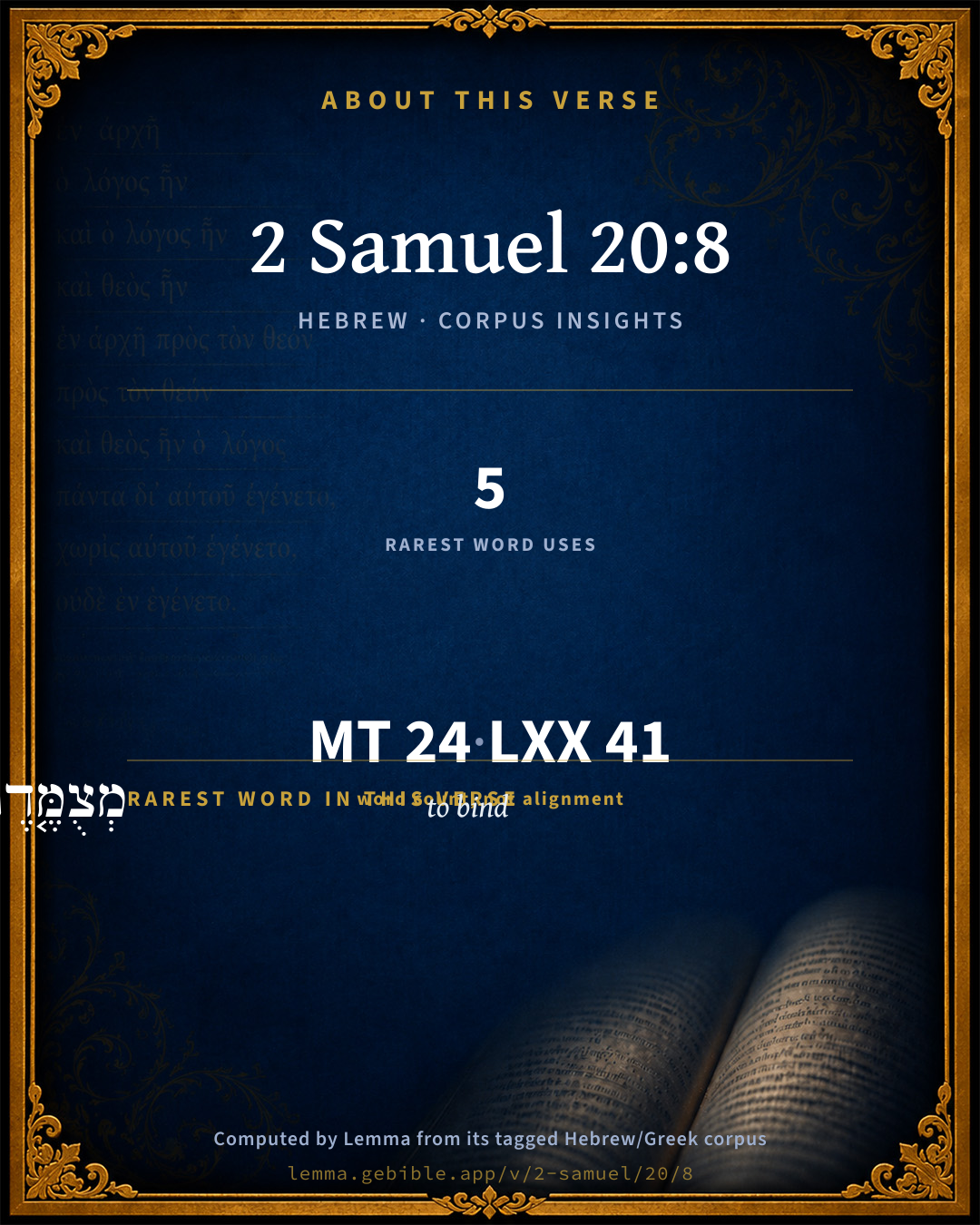
The rarest word here is מְצֻמֶּ֤דֶת to bind H6775 — appearing just 5 times in the whole Hebrew Bible.

Shared distinctive vocabulary

מְצֻמֶּ֤דֶת to bind H6775 occurs in 5 verses of the Hebrew Bible. Also found in:

Grammatical profile

  • 5 verbs
  • 11 nouns
  • 1 adjective
  • 2 pronouns
  • 4 prepositions
  • 1 particle

Verb forms

  • בָּ֣א Qal · Perfect
  • חָג֣וּר Qal · Participle Passive
  • מְצֻמֶּ֤דֶת Pual · Participle Passive
  • יָצָ֖א Qal · Perfect
  • וַתִּפֹּֽל Qal · Sequential Imperfect

Repetition

A word recurs within this verse — often emphatic in Hebrew:

  • ועלו upon H5921 ×3

Hebrew & Septuagint length

In English translation the verse runs 54 words from the Hebrew and 55 from the Septuagint (LXX English) — closely comparable.

A rough comparison of the two English renderings, which tokenize alike — not a word-level alignment.

Word counts can differ between the Hebrew and the Greek without any difference in meaning — e.g. the Hebrew direct-object marker אֵת has no separate Greek word, and Greek often adds the article ὁ.

In the original languages it is 24 Hebrew tokens and 41 Greek tokens — but the two are counted differently (Hebrew bundles its prefixes and suffixes into one token; the Greek is in lemma form), so that isn’t a like-for-like length.

Cross-references

3

Topical passages linked to 2 Samuel 20:8 in the Treasury of Scripture Knowledge — connected by theme and wording, ordered by reader-vote popularity; previews shown in the World English Bible.

  • 2 Samuel 3:30 So Joab and Abishai his brother killed Abner, because he had killed their brother Asahel at Gibeon in the battle.
  • 2 Samuel 2:13 Joab the son of Zeruiah, and the servants of David, went out, and met them by the pool of Gibeon; and they sat down, the one on the one side of the pool, and the other on the other side of the pool.
  • 2 Samuel 20:4–5 Then said the king to Amasa, Call me the men of Judah together within three days, and be here present.

Cross-references courtesy of OpenBible.info (CC BY 4.0).

Hebrew and Greek witnesses Masoretic Hebrew ↔ Greek Septuagint

The same verse in the two great witnesses to the Old Testament, shown verse-for-verse.

These are two independent witnesses, not word-aligned to each other, and the Septuagint is shown in lemma (dictionary) form.

Hebrew 2 Samuel 20:8 Masoretic · Westminster Leningrad Codex

הֵ֗ם עִם הָאֶ֤בֶן הַגְּדוֹלָה֙ אֲשֶׁ֣ר בְּגִבְע֔וֹן וַעֲמָשָׂ֖א בָּ֣א לִפְנֵיהֶ֑ם וְיוֹאָ֞ב חָג֣וּר מִדּ֣וֹ לְבֻשׁ֗וּ ועלו וְעָלָ֞יו חֲג֥וֹר חֶ֨רֶב֙ מְצֻמֶּ֤דֶת עַל מָתְנָיו֙ בְּתַעְרָ֔הּ וְה֥וּא יָצָ֖א וַתִּפֹּֽל

When they were at the great stone which is in Gibeon, Amasa came to meet them. Joab was girded with his apparel of war that he had put on, and thereon was a sash with a sword fastened on his loins in the sheath of it; and as he went forth it fell out.

World English Bible · Public Domain

Greek LXX 2 Samuel 20:8 Septuagint · lemma form

καί αὐτός παρά ὁ λίθος ὁ μέγας ὁ ἐν γαβαων καί αμεσσαϊ εἰςἔρχομαι ἔμπροσθεν αὐτός καί ιωαβ περιζώννυμι μανδύας ὁ ἔνδυμα αὐτός καί ἐπί αὐτός περιζώννυμι μάχαιρα ζευγνύω ἐπί ὁ ὀσφύς αὐτός ἐν κολεός αὐτός καί ὁ μάχαιρα ἐκἔρχομαι καί πίπτω

And they were by the great stone that is in Gabaon: and Amessai went in before them: and Joab had upon him a military cloak over his apparel, and over it he was girded with a dagger fastened upon his loins in its scabbard: and the dagger came out, it even came out and fell.

LXX2012 (modern English Septuagint) · Public Domain

On this verse, The Pulpit Commentary discusses the Septuagint’s reading. Read the note in Commentary ↓

Hebrew: Westminster Leningrad Codex (CC BY 4.0). Greek: Septuagint (public domain); English from LXX2012 (modern English Septuagint) (Public Domain). How the Septuagint differs from the Hebrew →

Targum (Aramaic paraphrase)

1

The Targum is the ancient Jewish Aramaic paraphrase of the Hebrew Scriptures — an interpretive translation, not the Hebrew text itself. Onkelos (literal) and Pseudo-Jonathan (expansive) render the Torah, and Jonathan the Prophets. Coverage is partial: where no permissively-licensed English translation exists for a verse, only the Aramaic is shown. This is verse-level text, not a word-by-word alignment to the Hebrew.

  1. Targum Jonathan Prophets (Joshua–Malachi)
    אִינוּן עִם אַבְנָא רַבְּתָא דִי בְגִבְעוֹן וַעֲמָשָׂא אֲתָא לְאַפֵּיהוֹן וְיוֹאָב אֲסִיר מְזָרֵיז לְבוּשׁוֹהִי וַעֲלוֹהִי אִסְפַּנְקֵי חֶרֶב מְזָרְזָא עַל חַרְצֵיהּ בִּנְדָנָהּ וְהוּא אָזִיל וּפְסָע:

    (no public-domain English translation for this verse)

    Targum Jonathan — Aramaic: “Mikraot Gedolot” (public domain). English: “Sefaria Community Translation” (CC0 1.0 (public-domain dedication)); “London "Chaldee Paraphrase," 1871” (public domain). Text via Sefaria.

Commentary

Notes on 2 Samuel 20:8 from classic Christian and Jewish commentators (each source and its license shown beneath its notes). The classic Christian expositions comment on the surrounding passage and are grouped to its opening verse, so a note may address several verses; the Jewish commentaries on the Tanakh (Rashi and others) are per-verse, so they appear only where the commentator wrote on this verse.

Lemma curates 59 commentaries, every one of them public domain or Creative Commons licensed, each selected and text-cleaned for this edition rather than reprinted as found. About our sources →

Trapp's Complete Commentary

John Trapp

2Sa 20:8 When they [were] at the great stone which [is] in Gibeon, Amasa went before them. And Joab’s garment that he had put on was girded unto him, and upon it a girdle [with] a sword fastened upon his loins in the sheath thereof; and as he went forth it fell out.

Ver. 8. And as he went forth, it fell out.] He had taught it, as it were, at a certain motion or posture of his body, to fall out of the scabbard, that taking it up in his hand again, he might inter salutandum smite Amasa, suspecting no harm.

John Trapp, A Commentary or Exposition upon All the Books of the Old and New Testament (1647–1656) — public domain. Text from a community e-Sword module.

Joseph Benson's Commentary

2Sa 20:8. Amasa went before them — As their commander-in-chief. Having gathered some forces, and given due orders for the rest to follow him, he returned to Jerusalem, and by the king’s command went after those mentioned 2Sa 20:7, and being come up to them at the place where they waited for him, he put himself at the head of Joab’s men, and the Cherethites and the Pelethites, and such as he had brought along with him, and marched before them as their general. Joab’s garment was girded unto him — After the manner of travellers and soldiers: for he had now no armour on, but only such a garment as soldiers wore, closely girt to him. Upon it a girdle with a sword — A belt, in which a sword hung by his side. As he went forth — To meet and salute Amasa, who was coming toward him to do him honour; it fell out — Having, probably, been designedly so hung by Joab, that upon some particular motion of his body, it might drop out of the sheath, and he might take it up without awaking Amasa’s suspicion.

Joseph Benson's Commentary on the Old and New Testaments (1811–1818) — public domain. Text from a community e-Sword module.

Geneva Bible (1599)

Geneva Bible translators

Which was his coat, that he used to wear in the wars.

Geneva Bible (1599) marginal notes — public domain. Text via Bolls.life.

Jamieson, Fausset & Brown

Robert Jamieson, A. R. Fausset & David Brown

Amasa went before them--Having collected some forces, he by a rapid march overtook the expedition at Gibeon, and assumed the place of commander; in which capacity, he was saluted, among others, by Joab.

Joab's garment, that he had put on was girded unto him--in the fashion of travellers and soldiers.

a sword . . . and as he went forth it fell out--that is, out of the scabbard. According to JOSEPHUS, he let it drop on purpose as he was accosting Amasa, that stooping, as it were accidentally, to pick it up, he might salute the new general with the naked sword in his hand, without exciting any suspicion of his design.

He went forth--in a ceremonious manner to meet Amasa, now commander-in-chief, in order to seem to render to that officer, whom he considered as usurping his post, a conspicuous honor and homage.

Jamieson, Fausset & Brown — Commentary Critical and Explanatory on the Whole Bible (1871) — public domain (CC PDM 1.0). Text via the HelloAO Bible API.

Adam Clarke's Commentary

Verse 8. Joab's garment] It appears that this was not a military garment; and that Joab had no arms but a short sword, which he had concealed in his girdle; and this sword, or knife, was so loose in its sheath that it could be easily drawn out. It is thought farther, that Joab, in passing to Amasa, stumbled, (for so some of the versions, and able critics, understand the words it fell out.) and that the sword fell down when he stumbled; that he took it up with his left hand as if he had no bad intention; and then, taking Amasa by the beard with his right hand, pretending to kiss him, he, with his sword in his left hand, ripped up his bowels. This seems to be the meaning of this very obscure verse. It is worthy of remark that in the Eastern country it is the beard, not the man, which is usually kissed.

Adam Clarke's Commentary on the Bible (1810–1826) — public domain. Text from a community e-Sword/MySword module.

Ellicott's Commentary for English Readers

(8) Went before.—Translate, met. (Comp. Note on 2Sa_19:6.)

As he went forth it fell out.—The object of this verse is to explain how Joab, in consequence of the arrangement of his dress, was able to stab Amasa without his purpose being suspected. He had a girdle bound round his military coat, and in this he had stuck a dagger so arranged that it might fall out as he advanced. He then picked this up naturally in his left hand, and stretching out his right hand to greet Amasa, his movements gave rise to no suspicion.

A Bible Commentary for English Readers, edited by Charles John Ellicott (1878–1897) — public domain. Text from a community e-Sword module.

The Cambridge Bible for Schools and Colleges

gen. ed. J. J. S. Perowne

8. the great stone which is in Gibeon] Some isolated rock, well known as a landmark.

went before them] Lit. came before them, i.e. met them, apparently as he was returning to Jerusalem, after raising an army in Benjamin as well as in Judah.

And Joab’s garment, &c.] This description of Joab’s dress is intended to explain how he contrived to stab Amasa without his design being suspected. In the girdle which he wore over his military dress was stuck a dagger. As he met Amasa he contrived to let this fall out of its sheath on the ground. He picked it up in his left hand, and the movement being apparently purely accidental, excited no alarm in Amasa’s mind.

as he went forth it fell out] As he went out to meet Amasa. But it does not appear whence Joab went out, and the words may also be rendered, and it (the sheath) came out (from the girdle), and it (the sword) fell down. The Sept. has a simpler reading, involving a slight change in the Heb. text: and the sword came out and fell down.

The Cambridge Bible for Schools and Colleges (gen. ed. J. J. S. Perowne; Cambridge University Press, 1878–1918) — public domain. Text from a community e-Sword module.

John Gill's Exposition

When they were at the great stone which is in Gibeon,.... Which, according to Josephus (r), was forty furlongs, or five miles from Jerusalem: what this great stone was, whether an obelisk, or what, is not certain; one of the greatest stones we read of was that which Semiramis cut out of the mountains of Armenia, which was an hundred thirty feet long, and twenty five broad and thick (s). This place was appointed for the rendezvous of David's forces, and hither Amasa came with what he had assembled together, and joined them, and took the command of them: for it follows:

Amasa went before them; as the general of them:

and Joab's garment that he had put on was girded unto him; who went along with his brother Abishai at the head of his own men, to which he was obliged by virtue of his commission; or went of himself to serve the common cause, and perhaps chiefly with a design to murder Amasa, whom he envied, because he was put into his post as general, and therefore accoutred himself for it; he put on, not a coat of mail, but a common garment which he girt about him, that it might be no incumbrance to him or hinderance of him, in doing what he intended, but that he might more expeditiously execute it:

and upon it a girdle with a sword fastened upon his loins in the sheath thereof; the sword in the belt was not on his thigh, but on his loins, on the outside of his clothes, and was put into a sheath too large, and placed in such a position, that with the least motion, when he pleased, it would easily drop out of it, without drawing it, and so give no suspicion of his design:

and as he went forth; to meet Amasa, just as he came to him:

it fell out; the sword fell out of the sheath to the ground.

(r) Antiqu. l. 7. c. 11. sect. 7. (s) Diodor. Sic. l. 2. p. 100. Vid. ib. p. 53. Herodot. Euterpe, c. 111.

John Gill's Exposition of the Whole Bible (1746–1763) — public domain (CC PDM 1.0). Text via the HelloAO Bible API.

Albert Barnes' Notes on the Bible

Amasa went before them - Rather, “advanced to meet them.” Amasa was no doubt returning to Jerusalem, according to his orders 2Sa 20:4, and was probably much surprised to meet the army in march. Joab’s resolution was quickly taken.

And Joab’s garment ... - Render, “And Joab was girded with his military garment, as his clothing, and upon it” - i. e., the military garment - (or “him”), “the girdle of a sword fastened on his loins in its sheath, and as he went forth” (to meet Amasa) “it fell” out of the sheath. What appears to have happened is that, by accident or design, Joab’s sword fell out of the scabbard on the ground as he was going to meet Amasa, and that he picked it up with his left hand so as to have his right hand free for the customary salutation 2Sa 20:9. This awakened no suspicion in Amasa’s mind. Compare the case of Ehud, Jdg 3:21.

Albert Barnes' Notes on the Bible (1834–1885) — public domain. Text from a community e-Sword/MySword module.

Haydock's Catholic Bible Commentary

Stone, where Abner and Joab had formerly joined battle, chap. ii. (Menochius) --- Habit, or body. --- Flank; they usually hand at the thigh, Psalm xliv. 4. --- Strike: the scabbard was very wide; so that, when it was hanging very high, it would easily fall out, when he stooped; and thus afford Joab an opportunity of stabbing Amasa, without suspicion. (Calmet) --- Protestants, "Joab’s garment, that he had put on, was girded unto him, and upon it a girdle with a sword, fastened upon his loins, in the sheath thereof, and as he went forth, it fell out."

George Leo Haydock (1774–1849), Haydock's Catholic Family Bible and Commentary, 1859 edition — public domain. Excludes Psalms (Douay-Rheims chapter numbering differs from Protestant) and Deuterocanonical books (Catholic canon only).

Matthew Poole's English Annotations

Amasa went before them; having gathered some forces, and given due orders for the rest to follow him, he returned to Jerusalem, and by the king’s command went after those mentioned 2Sa 20:7; and being come up to them at the place where they waited for him, he put himself into the head of Joab’s men, and the Cherethites and the Pelethites, and such as he had brought along with him, and marched before them as their chief and general.

Girded unto him, after the manner of travellers and soldiers.

As he went forth to meet and salute Amasa, who was coming towards him to do him honour.

It fell out; things having (it is likely) been so contrived by Joab, that upon the least motion of his body his sword should drop out, and he might take it up without raising Amasa’s suspicion.

Matthew Poole's English Annotations on the Holy Bible (1683–1685) — public domain. Text from a community e-Sword/MySword module.

Whedon's Commentary on the Bible

Daniel D. Whedon

8. The great stone — Some old landmark well known at the time of the writer, but now not recognised or identified by travellers, perhaps because long since removed.

Gibeon — Where occurred the sore battle between Abner and Joab. 2Sa_2:12-17.

Amasa went before them — At this place he had probably ordered the men of Judah, whom he had been summoning, to rendezvous; and now, arriving at the place himself, and finding David’s servants there under command of Abishai, he went before them all; that is, assumed command of the entire host. This was more than Joab’s jealousy could endure, and he felt that now was the opportune moment for revenge.

And Joab’s garment that he had… on — A better translation is, And Joab was girt about with his military coat as his upper garment, and upon it a sword-girdle fastened on his loins, in its sheath, and he went forth and it fell; that is, the sword fell out.

Daniel D. Whedon (gen. ed.), Commentary on the Old and New Testaments (1874–1909) — public domain. Text from a community e-Sword module.

The Pulpit Commentary

The great stone which is in Gibeon. Gibeon is situated in the mountains of Ephraim, in the tribe of Benjamin, northwest of Jerusalem. The great stone was probably some isolated rock well known in the neighbourhood. Amasa went before them; Hebrew, Amasa came before them; that is, came in view with the levy of men he had raised in Judah. And Joab"s garment, etc.; more correctly, and Joab was girded with his military coat as his garment, and over it was the strap of his sword in its sheath, and it (masculine, equivalent to "the sheath") came out, and it (feminine, equivalent to "the sword") fell. This change of gender is very harsh, and has caused the Authorized Version to apply the masculine verb to Joab, and translate, and as he went forth it fell; but a very slight change, supported by the Septuagint, gives us a more satisfactory sense, namely, and it (the sword) came out and fell. It is generally assumed that all this was arranged beforehand on Joab"s part, who had so placed his sword that he could shake it out of the sheath. More probably it was an accident, of which he took instant advantage. He had felt that his position was insecure, and that if David had the support of Amasa, and a powerful band of the men of Judah at Jerusalem, he would probably order his execution for slaying Absalom; and Amasa would carry out the command willingly enough, as he thereby would secure the high position offered him. We know David"s feelings towards Joab from his dying command to Solomon, (1Ki_2:5) and probably he had given various indications of his deep seated resentment. Joab, therefore, determined to stop Amasa"s growth in power, and also to give David a rough lesson. And this accident gave him an early opportunity, which he used with ruthless energy.

The Pulpit Commentary (1880–1919), ed. H.D.M. Spence-Jones & Joseph S. Exell — public domain. Text from a community e-Sword module.

John Wesley's Explanatory Notes

Amasa went - Having gathered some forces, and given due orders for the rest to follow him, he returned to Jerusalem, and by the king's command went after those mentioned ver. 7, and being come up to them at the place where they waited for him, he put himself in the head of Joab's men, and the Cherethites and the Pelethites, and such as he had brought along with him, and marched before them as their general. Girded - After the manner of travelers and soldiers. Went forth - To meet and salute Amasa, who was coming towards him to do him honour. It fell - Things having (it is likely) been so contrived by Joab, that upon the least motion of his body, his sword should drop out, and he might take it up without raising Amasa's suspicion.

John Wesley, Explanatory Notes Upon the Whole Bible (1754–1765) — public domain. Text via the GEBible commentary corpus.

unfoldingWord translationNotes

Door43 World Missions Community

When they were

"When Joab and the men of Judah were"

belt

a strip of leather or other material used to hold clothing or weapons in place

sheathed sword

This means the sword was in its protective covering.

the sword fell out

Joab let the sword fall out to fool Amasa into thinking that he Joab was unarmed, so that Amasa would allow him to walk closer to him. AT: "he allowed the sword to fall on the ground so Amasa would think he was unarmed" (See: Assumed Knowledge and Implicit Information)

translationWords

Gibeon

Joab

armor

sword

unfoldingWord translationNotes — © Distant Shores Media and the Door43 World Missions Community, licensed CC BY-SA 4.0. Source: git.door43.org/Door43/en_tn.

Rashi

Rabbi Shlomo Yitzchaki (Rashi)

Close to his loins. Very close to his body along the width of his loins, this was not the usual way of carrying a sword. He did so to make it easy for it to fall out so it would not be necessary to take it out of its sheath.

He started out [towards Amosoh.]. Towards Amosoh.

And it fell out. The sword [fell out] from its sheath because it was smooth and sharp and was not hanging on the side of his thigh but it was along the width of his loins. As soon as he [Yoav] leaned forward towards the ground it [the sword] fell out of its sheath and he grabbed it with his right hand without Amosoh noticing anything.

Rashi on the Tanakh — English translations: “The Judaica Press complete Tanach with Rashi, translated by A. J. Rosenberg” (CC BY 4.0); “Pentateuch with Rashi's commentary by M. Rosenbaum and A.M. Silbermann, 1929-1934” (public domain); “The Metsudah Tanach series, Lakewood, N.J” (CC BY 4.0); and “The Book of Joshua, Metsudah Publications, 1997” (CC BY 4.0). Text via Sefaria.

Lesson kit

Teaching starters — assembled from the data on this page, not authored interpretation. Every prompt links to the verse data it draws on. Edit before teaching.

2 Samuel, in the Historical, opens this verse with 24 words (22 distinct Hebrew lemmas). Its most distinctive word is tsâmad (“to bind”). A historical commentator’s framing appears above. Read the whole chapter for the surrounding context.

Discussion questions

  1. How does “to bind” (tsâmad) shape what this verse is saying?
  2. How does Numbers 25:3, which shares the word «to bind», read alongside this verse?
  3. What does the repetition of “upon” (3× in this one verse) do in this verse?
  4. These translations render this verse differently; the difference is in the English rendering, not the original. What questions does that raise?
  5. «בָּ֣א» is a Qal Perfect verb. How does that grammatical form shape the action described?
  6. Compare how Trapp's Complete Commentary and Joseph Benson's Commentary read this verse. Where do they agree or differ?

Things to notice

Reading settings

Reading text

Shown beneath each verse's original-language words.

Old Testament
Old Testament edition

Read the OT as the Masoretic Hebrew (MT) or the Greek Septuagint (LXX).

English shown for the Greek Septuagint (in the Hebrew ↔ Greek comparison).

Comparing translations? Open the Compare panel on any verse page to stack up to four side by side.