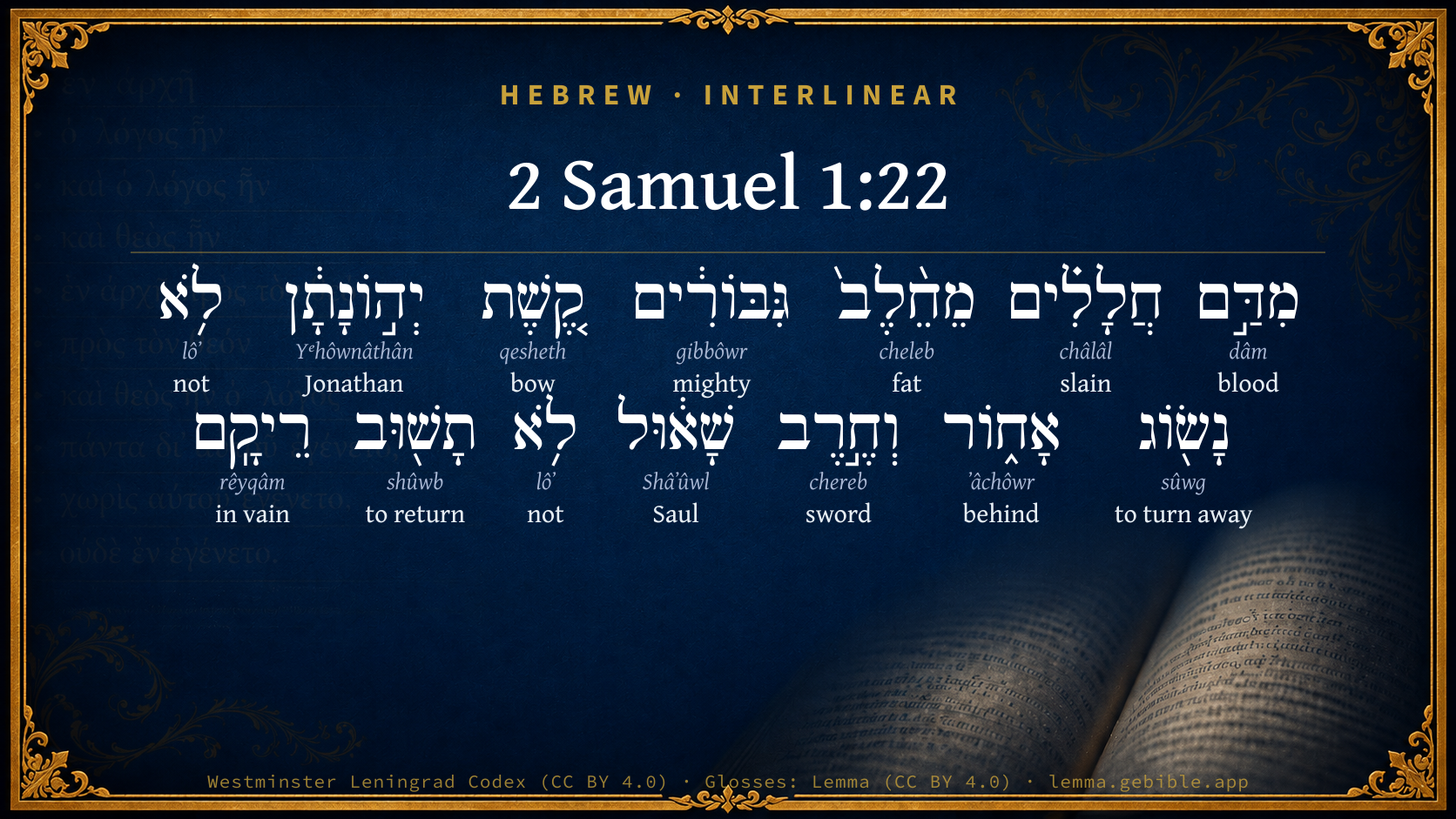
2 Samuel 1:22

Hebrew (Westminster Leningrad Codex) 2 Samuel 1:22 appears in the Hebrew Old Testament. The text above is from the Westminster Leningrad Codex. Each word links to its Strong’s number, a concise gloss, and parsing drawn from the Open Scriptures Hebrew Bible morphology. Click any word for its full Brown-Driver-Briggs (BDB) entry.
Download image
Cite this verse

2 Samuel 1:22 (World English Bible). Public Domain. Lemma interlinear Bible study tool, https://lemma.gebible.app/v/2-samuel/1/22.

Show BibTeX & RIS
BibTeX
RIS
English Translation
From the blood of the slain, from the fat of the mighty, The bow of Jonathan didn't turn back, The sword of Saul didn't return empty.
World English Bible · Public Domain
Highlights
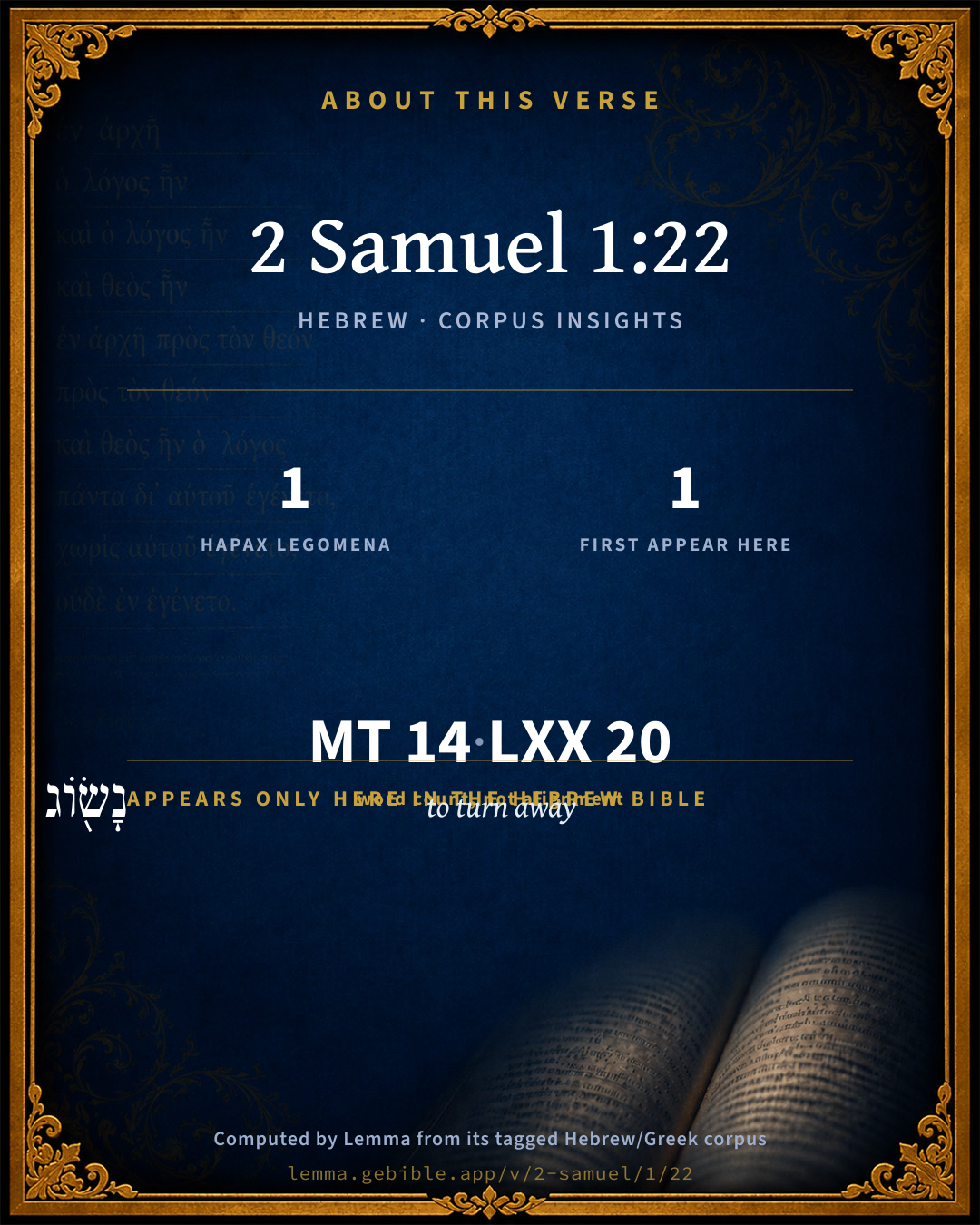
  • 1 hapax legomenon — only here in the Hebrew Bible
  • 1 first appearance in the Hebrew Bible
Full analysis ↓
Download a study sheet

One document with this verse’s original text, its word-by-word gloss line, the meaning frame, cross-references with their text, attributed commentary, and full source and license credits — printable, and it pastes into notes with its structure intact.

This verse Autodidact and up

Study sheet (.html) Plain text (.txt)

A passage Seminary Student

Up to 50 verses in one chapter. A passage sheet keeps up to 6 commentary sources and 12 cross-references per verse, in the order this page ranks them, and says so on the sheet whenever that leaves anything out. Ask for a single verse and you get the Autodidact verse sheet above.

Everything on this page stays free to read, with no account — the sheet is a download of what is already on screen, not access to it.

Want to remove ads? Support Godless Engineer
Compare translations 3

The same verse in 3 English versions, stacked beneath the original-language interlinear above. Click any original word for its lexicon entry.

Each is an independent rendering of the whole verse — the interlinear is not word-aligned to these translations.

Highlighted words mark where these versions differ — a whole-verse word diff, not a word-by-word alignment.

  • World English Bible Public Domain
    From the blood of the slain, from the fat of the mighty, The bow of Jonathan didn't turn back, The sword of Saul didn't return empty.
  • King James Version Public Domain
    From the blood of the slain, from the fat of the mighty, the bow of Jonathan turned not back, and the sword of Saul returned not empty.
  • unfoldingWord Literal Text CC BY-SA 4.0
    From the blood of the slain, from the fat of the mighty, the bow of Jonathan did not turn itself back, and the sword of Saul did not return empty.

unfoldingWord Literal Text — © unfoldingWord, licensed CC BY-SA 4.0. Word-aligned USFM3 via Door43 (git.door43.org/unfoldingWord/en_ult).

Versions to compare (up to 4)

3 of 4 selected

Show all 18 translations

Every available English version of this verse, each an independent rendering of the whole verse.

  • World English Bible Public Domain
    From the blood of the slain, from the fat of the mighty, The bow of Jonathan didn't turn back, The sword of Saul didn't return empty.
  • Berean Standard Bible Public Domain
    From the blood of the slain, from the fat of the mighty, the bow of Jonathan did not retreat, and the sword of Saul did not return empty.
  • Majority Standard Bible Public Domain
    From the blood of the slain, from the fat of the mighty, the bow of Jonathan did not retreat, and the sword of Saul did not return empty.
  • King James Version Public Domain
    From the blood of the slain, from the fat of the mighty, the bow of Jonathan turned not back, and the sword of Saul returned not empty.
  • American Standard Version (1901) Public Domain
    From the blood of the slain, from the fat of the mighty, The bow of Jonathan turned not back, And the sword of Saul returned not empty.
  • Revised Version (1885) Public Domain
    From the blood of the slain, from the fat of the mighty, the bow of Jonathan turned not back, and the sword of Saul returned not empty.
  • Geneva Bible (1599) Public Domain
    The bow of Ionathan neuer turned backe, neither did the sword of Saul returne emptie from the blood of the slaine, and from the fatte of the mightie.
  • Douay-Rheims (1899) Public Domain
    From the blood of the slain, from the fat of the valiant, the arrow of Jonathan never turned back, and the sword of Saul did not return empty.
  • Young's Literal Translation Public Domain
    From the blood of the wounded, From the fat of the mighty, The bow of Jonathan Hath not turned backward; And the sword of Saul doth not return empty.
  • Literal Standard Version CC BY-SA 4.0
    From the blood of the wounded, || From the fat of the mighty, || The bow of Jonathan || Has not turned backward; And the sword of Saul does not return empty.
  • Unlocked Literal Bible CC BY-SA 4.0
    From the blood of those who have been killed, from the bodies of the mighty, the bow of Jonathan did not turn back, and the sword of Saul did not return empty.
  • unfoldingWord Literal Text CC BY-SA 4.0
    From the blood of the slain, from the fat of the mighty, the bow of Jonathan did not turn itself back, and the sword of Saul did not return empty.
  • Darby Bible Public Domain
    From the blood of the slain, from the fat of the mighty, The bow of Jonathan turned not back, And the sword of Saul returned not empty.
  • World Messianic Bible Public Domain
    From the blood of the slain, from the fat of the mighty, Jonathan’s bow didn’t turn back. Saul’s sword didn’t return empty.
  • Webster's Bible Public Domain
    From the blood of the slain, from the fat of the mighty, the bow of Jonathan turned not back, and the sword of Saul returned not empty.
  • Free Bible Version CC BY-SA 4.0
    Jonathan with his bow did not retreat from attacking the enemy; Saul with his sword did not return empty-handed from shedding blood.
  • Bible in Basic English Public Domain
    From the blood of the dead, from the fat of the strong, the bow of Jonathan was not turned back, the sword of Saul did not come back unused.
  • JPS Tanakh (1917) Public Domain
    From the blood of the slain, from the fat of the mighty, the bow of Jonathan turned not back, and the sword of Saul returned not empty.

Literal Standard Version (2020), Covenant Press — licensed CC BY-SA 4.0. Text via the HelloAO Bible API (eBible.org). Unlocked Literal Bible (unfoldingWord) — licensed CC BY-SA 4.0. Text via the HelloAO Bible API (eBible.org). unfoldingWord Literal Text — © unfoldingWord, licensed CC BY-SA 4.0. Word-aligned USFM3 via Door43 (git.door43.org/unfoldingWord/en_ult). Free Bible Version, Dr. Jonathan Gallagher — licensed CC BY-SA 4.0. Text via the HelloAO Bible API (eBible.org).

Word by word

More ways to search: Search by grammar → Find every occurrence → Compare this word →

Practice this passage: Drill this verse → Learn its vocabulary →

נָשׂ֖וֹג
sûwg
H7734
“to turn away”
Verb, Niphal, Perfect, 3rd Person, Masculine, Singular
Part of Speech
Verb
Stem
Niphal
Form
Perfect
Person
3rd Person
Gender
Masculine
Number
Singular
Full BDB Definition

Origin: a primitive root

TWOT: 1469

to move, go, turn back, turn away - (Niphal) to turn oneself away
  1. מִדַּ֣ם dâm H1818 “from · blood of” Preposition + Noun, Common, Masculine, Singular, Construct
  2. חֲלָלִ֗ים châlâl H2491 “slain” Adjective, Adjective, Masculine, Plural, Absolute
  3. מֵחֵ֨לֶב֙ cheleb H2459 “from · fat of” Preposition + Noun, Common, Masculine, Singular, Construct
  4. גִּבּוֹרִ֔ים gibbôwr H1368 “mighty” Adjective, Adjective, Masculine, Plural, Absolute
  5. קֶ֚שֶׁת qesheth H7198 “bow of” Noun, Common, Feminine, Singular, Construct
  6. יְה֣וֹנָתָ֔ן Yᵉhôwnâthân H3083 “Jonathan” Noun, Proper
  7. לֹ֥א lôʼ H3808 “not” Particle, Negative
  8. אָח֑וֹר ʼâchôwr H268 “behind” Noun, Common, Masculine, Singular, Absolute
  9. וְחֶ֣רֶב chereb H2719 “and · sword of” Conjunction + Noun, Common, Feminine, Singular, Construct
  10. שָׁא֔וּל Shâʼûwl H7586 “Saul” Noun, Proper
  11. לֹ֥א lôʼ H3808 “not” Particle, Negative
  12. תָשׁ֖וּב shûwb H7725 “to return” Verb, Qal, Imperfect, 3rd Person, Feminine, Singular
  13. רֵיקָֽם rêyqâm H7387 “in vain” Adverb

About this verse

These counts appear in no published source. They are computed here, from the morphology-tagged text and Lemma’s own curated glosses. What Lemma adds →

14
words
13
distinct lemmas
Historical
section

Notable vocabulary

1 hapax legomenon — a word that appears only here in the entire Hebrew Bible:

  • נָשׂ֖וֹג to turn away H7734

First appearance in Scripture

This word makes its first canonical appearance in the Hebrew Bible here:

  • נָשׂ֖וֹג to turn away H7734

Shared distinctive vocabulary

רֵיקָֽם in vain H7387 occurs in 16 verses of the Hebrew Bible. Also found in:

Grammatical profile

  • 2 verbs
  • 7 nouns
  • 2 adjectives
  • 1 adverb
  • 2 particles

Verb forms

  • נָשׂ֖וֹג Niphal · Perfect
  • תָשׁ֖וּב Qal · Imperfect

Repetition

A word recurs within this verse — often emphatic in Hebrew:

Hebrew & Septuagint length

In English translation the verse runs 26 words from the Hebrew and 29 from the Septuagint (LXX English) — closely comparable.

A rough comparison of the two English renderings, which tokenize alike — not a word-level alignment.

Word counts can differ between the Hebrew and the Greek without any difference in meaning — e.g. the Hebrew direct-object marker אֵת has no separate Greek word, and Greek often adds the article ὁ.

In the original languages it is 14 Hebrew tokens and 20 Greek tokens — but the two are counted differently (Hebrew bundles its prefixes and suffixes into one token; the Greek is in lemma form), so that isn’t a like-for-like length.

Cross-references

4

Topical passages linked to 2 Samuel 1:22 in the Treasury of Scripture Knowledge — connected by theme and wording, ordered by reader-vote popularity; previews shown in the World English Bible.

  • 1 Samuel 18:4 Jonathan stripped himself of the robe that was on him, and gave it to David, and his clothing, even to his sword, and to his bow, and to his sash.
  • Isaiah 34:6–7 The sword of Yahweh is filled with blood, it is made fat with fatness, with the blood of lambs and goats, with the fat of the kidneys of rams; for Yahweh has a sacrifice in Bozrah, and a great slaughter in the land of Edom.
  • Deuteronomy 32:42 I will make my arrows drunk with blood, My sword shall devour flesh; With the blood of the slain and the captives, From the head of the leaders of the enemy.
  • 1 Samuel 14:6–14 Jonathan said to the young man who bore his armor, Come, and let us go over to the garrison of these uncircumcised: it may be that Yahweh will work for us; for there is no restraint to Yahweh to save by many or by few.

Cross-references courtesy of OpenBible.info (CC BY 4.0).

Hebrew and Greek witnesses Masoretic Hebrew ↔ Greek Septuagint

The same verse in the two great witnesses to the Old Testament, shown verse-for-verse.

These are two independent witnesses, not word-aligned to each other, and the Septuagint is shown in lemma (dictionary) form.

Hebrew 2 Samuel 1:22 Masoretic · Westminster Leningrad Codex

מִדַּ֣ם חֲלָלִ֗ים מֵחֵ֨לֶב֙ גִּבּוֹרִ֔ים קֶ֚שֶׁת יְה֣וֹנָתָ֔ן לֹ֥א נָשׂ֖וֹג אָח֑וֹר וְחֶ֣רֶב שָׁא֔וּל לֹ֥א תָשׁ֖וּב רֵיקָֽם

From the blood of the slain, from the fat of the mighty, The bow of Jonathan didn't turn back, The sword of Saul didn't return empty.

World English Bible · Public Domain

Greek LXX 2 Samuel 1:22 Septuagint · lemma form

ἀπό αἷμα τραυματίας ἀπό στέαρ δυνατός τόξον ιωναθαν οὐ ἀποστρέφω κενός εἰς ὁ ὀπίσω καί ῥομφαία σαούλ οὐ ἀνακάμπτω κενός

From the blood of the slain, and from the fat of the mighty, the bow of Jonathan returned not empty; and the sword of Saul turned not back empty.

LXX2012 (modern English Septuagint) · Public Domain

Hebrew: Westminster Leningrad Codex (CC BY 4.0). Greek: Septuagint (public domain); English from LXX2012 (modern English Septuagint) (Public Domain). How the Septuagint differs from the Hebrew →

Targum (Aramaic paraphrase)

1

The Targum is the ancient Jewish Aramaic paraphrase of the Hebrew Scriptures — an interpretive translation, not the Hebrew text itself. Onkelos (literal) and Pseudo-Jonathan (expansive) render the Torah, and Jonathan the Prophets. Coverage is partial: where no permissively-licensed English translation exists for a verse, only the Aramaic is shown. This is verse-level text, not a word-by-word alignment to the Hebrew.

  1. Targum Jonathan Prophets (Joshua–Malachi)
    מִדַם קְטִילִין מִתְּרַב גִבָּרִין גִירֵי קַשְׁתָּא דִיהוֹנָתָן לָא מְסַתַּחֲרִין לַאֲחוֹרָא וְחַרְבָּא דְשָׁאוּל לָא תַיְבָא רֵיקָן:

    (no public-domain English translation for this verse)

    Targum Jonathan — Aramaic: “Mikraot Gedolot” (public domain). English: “Sefaria Community Translation” (CC0 1.0 (public-domain dedication)); “London "Chaldee Paraphrase," 1871” (public domain). Text via Sefaria.

Commentary

Notes on 2 Samuel 1:22 from classic Christian and Jewish commentators (each source and its license shown beneath its notes). The classic Christian expositions comment on the surrounding passage and are grouped to its opening verse, so a note may address several verses; the Jewish commentaries on the Tanakh (Rashi and others) are per-verse, so they appear only where the commentator wrote on this verse.

Lemma curates 59 commentaries, every one of them public domain or Creative Commons licensed, each selected and text-cleaned for this edition rather than reprinted as found. About our sources →

Trapp's Complete Commentary

John Trapp

2Sa 1:22 From the blood of the slain, from the fat of the mighty, the bow of Jonathan turned not back, and the sword of Saul returned not empty.

Ver. 22. From the blood of the slain.] The sword is in Scripture said to "devour flesh" and to "drink blood." Saul and Jonathan were not wont to be worsted, however it hath now fallen out. Hunniades fought five times upon one day with the Turks, and five times foiled them, and put them to flight. Our Black Prince was ever victorious.

John Trapp, A Commentary or Exposition upon All the Books of the Old and New Testament (1647–1656) — public domain. Text from a community e-Sword module.

The Biblical Illustrator

Joseph S. Exell

2Sa_1:20; 2Sa_1:22

Tell it not in Gath.

The elegy

We are far from assigning She peculiar complexion of this elegy to that mere commonplace thing which goes by the name, though most wrongfully, of charity; but which should rather be characterised as perilous unfaithfulness to God, to the interests of religion, and to the safety of men's souls--a charity which is, however, very popular with a certain class of persons who are ever ready to throw its mantle over the defects of others, provided that they can manage, at the same time, to effect concealment beneath its folds for some indulged sins of their own. Nor can we perceive in this composition the utterance of a spirit of flattery, which, to answer an end, can speak good things of a bad man with cool effrontery, and with perfect consciousness of the falsehood which the lips are uttering. There was no end to be answered here which would serve as a temptation; and how little sympathy there was in David's mind with such a practice, we may gather from those repeated expressions of abhorrence in regard to it which meet us in his writings. Still less do we discover in these words of David nothing more than a tribute to the claims which death is allowed to put forth for a respectful mention of the departed. We cannot regard it as a mere exemplification of the doctrine, good enough within certain limits, that when a man is dead his failings are not to be made the subject of remark.

I. In accounting for the peculiar tone of this funeral-song, in its allusion to Saul, the history seems to justify us in regarding the elegy itself as the testimony which David desired to bear to the completeness with which he forgave Saul every injury which he had inflicted on him. We discover the traces of an unusually close imitation of the Divine character and procedure in the manner in which David here refers to Saul? Do we not see at work the heart of one who has completely blotted out the impression of the cruel persecution which Saul had carried on against him--who had cast behind his back all personal offence--who had no desire to remember any more one of the many occasions on which his own spirit had been riven by the ill-treatment and jealousy of him for whom he had repeatedly hazarded his own life? In regard to one aspect of moral character, and that one the manifestation of which involves a difficult encounter with, and a great victory over predominant self, David's example serves to show what measures of resemblance to God--of bearing the image of the heavenly--may be, by Divine grace, attained by man. It serves to show bow we may be imitators of God; how we may walk worthy of the Lord, unto all pleasing.

2. The entireness with which David had forgiven Saul is testified in the absence from this death-song of any reference to the painfulness of the pest. This circumstance, on which we have been dwelling, may not of itself fully account for another feature of the elegy. There is not only the absence of condemnatory allusion, but there is the presence of a considerable amount of matter of a positively and uniformly commendatory character. It happens with descriptions of character, as it does with delineations of outward nature--they are taken from particular points of view, and must, of course, vary greatly, and differ from each other according to the standpoint selected for making the observation or forming the sketch. In order to identify with the actual scenery a representation by the pencil of some inviting landscape, or of any particular objects which give it interest, we must take the trouble to find out the precise spot at which the artist stood, and forth from which he looked abroad when he sketched the picture. Thus, too, in estimating the truthfulness of sketches of individual character, we are not at liberty to take up our position exactly where we like; the only fair way of forming a judgment of the portraiture is to find out the standpoint at which the author of the sketch fixed himself, and, adopting it as our own, we must, from that position, make our observation. Any other course would obviously be unjust.

3. The true key to the elegy which David here pronounced is the point of view from which he looked at Saul--the position, in relation to the departed monarch, which he occupied at the moment. He simply noted down the features of the character and aspects of conduct which met his eye where he stood; and if we will go and stand side by side with him, looking as he looked, and feeling as he felt, we shall at once acknowledge the accuracy of his portraiture. There are some circumstances which are peculiarly favourable for forming a full and accurate estimate of an individual; there are others, however, which only permit us to take a limited view at best, and looking from the midst of these, the eye most generally allows itself to be engrossed with one or two characteristic features, which come very near ourselves, and which appear, for that very reason, separated in a measure from all the rest. At such a point David now stood.

4. In such manifestations of natural feeling as we discover in this and other passages of the same order, there is much that is encouraging, in a practical point of view. We find our spirits brought into contact with men of like passions with ourselves. In David, as he uttered this elegy, we see a man who could weep, just as we weep; who could break down with the pressure of sudden bereavement, just as we break down; who, under the influence of sorrows, looked at men and things just as, under the same influence, we look at them. He does not stand apart from us as a being of higher nature, whose superiority should awe us, and keep us at a discouraging distance; but he comes near to us, and wins our interested attention. We can feel at home with him; we can read his heart as that of a fellow-creature; we can understand him as a man. He stands on the level of a common humanity with every reader of the narrative. It is human nature which we recognise at work--a nature like our own. It is a man shedding tears as we shed them, and doing exactly the same things as, we are disposed to think, we should have done under the same circumstances: And we argue from this point, and argue hopefully. We say to the discouraged spirit, You see that David and you are alike as regards human nature. Divine grace has the same material on which to work in your case as in his, the same views of things in general, the same emotions under particular dispensations--then why should not Divine grace do for you what it did for him? meeting you on the same level as that at which it met him, why should it not conduct you to the same point to which it elevated him? Reverting from the elegy, however, to the man over whom it was pronounced, it is important that we should bear in mind that our destiny in the next world will be decided, not by the estimate which survivors may, under any circumstances, form of our character and conduct, but by the view which the eye of Omniscience has taken of us, from the beginning to the termination of our earthly existence. It will not be the record of our life which will meet us at God's tribunal, but the pages of the book of God's remembrance will be opened then, presenting the most exact transcript of each portion of our existence, however minute. The account to which every man will be summoned will comprehend the things done in his body in the whole course of life. How affecting is the contrast which, alas! there is too much reason to fear would sometimes be presented between what survivors are doing and saying in reference to individuals who have left the world, and the actual condition of the souls of those individuals, if for a moment we could be admitted to make ourselves certainly acquainted with it. How many an one would be lifting up his eyes in hell, being in torment, as having lived without God in the world, whose manly form the artist's chisel has preserved from being forgotten, and whose earthly virtues are graven on the marble beneath. This is an awful truth; but it is one which is too much and too fatally overlooked. Our fellow-creatures may forgive us, but we may yet go into eternity unpardoned by God. And this, not because man is kinder to his fellow than God is to His creatures. No! but because of the unwillingness of sinful man to seek pardon in that way in which alone God dispenses it, and in which, while He passes by transgression, His law is honoured, His truth is maintained, and the respect due to His moral government is ensured. In the atonement effected by the Son of God, to which all sacrifice pointed, and which was made known from the earliest time with sufficient clearness to meet the case of sinful men, that way of forgiveness is discovered--God, for Christ's sake, forgives men their trespasses. To this propitiation all are invited, with the assurance that none who come in faith and repentance shall be rejected. (J. A. Miller.)

David's lament over Saul

David lamented the king's death, and was sad with genuine and noble sorrow. There are events in life which make the commonest men almost sublime: how much more do such events elevate the princeliest men until they sing as angels or burn as seraphs? David's life has up to this point charmed us by its simplicity and heroism: to-day we see it in its highest mood of veneration and magnanimity.

I. One of the first lessons impressed upon us by this lament relates to David's noble-minded forgetfulness of all personal injury. Do not some of us cherish the memory of our personal injuries, even after death has dug the awful gulf of the grave between the present and the past? Death is not to obliterate moral distinctions; but why should we judge when the man who injured us has passed on to the dread invisible--the very seat of the Just One?

II. The lament shows how David was enabled to take the highest and brightest view of human character. He did not detract from the valour of Saul. Some people delay their praise too long. They keep back their affection until they have to suggest an epitaph. Make your love longer, even if you make your epitaphs shorter.

III. The lament impresses us with the beauty of a zealous and tender care for the reputation of the Lord's anointed. Death is not the only fall. Men fall morally. The mighty men of the church fall like stars from heaven. The great preacher becomes a debauchee. The trusted professor is caught in fraud. The feet of the strong are tripped up. And there are men who delight in telling these things in Gath and Askelon!

IV. The lament shows how bitter is the distress which follows the irreparable losses of life. We do not always give full value to the positive side of life. We hold advantages and blessings as if we had a right to them. It is so in the very commonest things. It is so in nature: in family life: in church relations: sunshine; water; bread; friendship; ministry. The application of the whole:

(1) Let us so live, that death will be but a momentary separation.

(2) In commending the wonderful love of Jonathan, let us remember that there is a Friend that sticketh closer than a brother. (J. Parker, D. D.)

2Sa_1:22

The bow of Jonathan turned not back.

Successful archery

The old archers took the bow, put one end of it down beside the foot, elevated the other end, and it was the rule that the bow should be just the size of the archer; if it were just his size then he would go into battle with confidence. Let me say that your power to project good into the world will correspond exactly to your own spiritual statue. (T. De Witt Talmage.)

The Biblical Illustrator, edited by Joseph S. Exell (c. 1880s–1900s) — public domain. Text from a community e-Sword module.

Joseph Benson's Commentary

2Sa 1:22. The bow of Jonathan returned not back — Without effect. The arrows shot from his bow did not miss their mark, but pierced deep into the fat and flesh, the heart and bowels, and shed the blood of the mighty. The sword of Saul returned not empty — Always did great execution (as we now speak) upon those with whom he fought.

Joseph Benson's Commentary on the Old and New Testaments (1811–1818) — public domain. Text from a community e-Sword module.

Tyndale Open Study Notes

Tyndale Open Resources

1:22 the blood of their enemies: Saul and Jonathan were known as military heroes (see 1 Sam 11:1-11; 14:1-23, 47-48), though neither to the degree that David was (1 Sam 18:7; 21:11).

Tyndale Open Study Notes — © Tyndale Open Resources, licensed CC BY-SA 4.0. Text via the HelloAO Bible API.

The Cambridge Bible for Schools and Colleges

gen. ed. J. J. S. Perowne

22. From the blood, &c.] In the figurative language of poetry arrows are represented as drinking blood, the sword as eating flesh. See Deu_32:42; Isa_34:6; Jer_46:10.

the bow of Jonathan] His favourite weapon, by the gift of which he sealed his friendship with David. See 1Sa_18:4; 1Sa_20:20. Was it a reminiscence of that gift which made David call this elegy the Bow?

The Cambridge Bible for Schools and Colleges (gen. ed. J. J. S. Perowne; Cambridge University Press, 1878–1918) — public domain. Text from a community e-Sword module.

John Gill's Exposition

From the blood of the slain, from the fat of the mighty, the bow of Jonathan turned not back,.... That is, it always did execution, the arrows shot frown it pierced into men, shed their blood, and slew them; even they entered into the fat of the mighty, or mighty ones, that were fat, and brought them down; so the arrows of the Medes and Persians, the expert men among them, are said not to return in vain, Jer 50:9,

and the sword of Saul returned not empty; but was the means of slaying many; though Abarbinel observes also that this may be interpreted of the blood of the slain, and of the fat of the mighty men of Israel; and that though Saul and Jonathan saw many of these fall before their eyes, yet "for" or "because" of their blood, they were not intimidated and restrained from fighting; the bow of the one, and the shield of the other, turned not back on that account.

John Gill's Exposition of the Whole Bible (1746–1763) — public domain (CC PDM 1.0). Text via the HelloAO Bible API.

Haydock's Catholic Bible Commentary

From. Hebrew, "without the blood of soldiers, without the fat of the valiant, the bow of Jonathan had never returned." (Kennicott) --- Fat. The entrails. It might also denote the most valiant of the soldiers, as we read of "the fat or marrow of corn" for the best, Psalm lxxx. 17. (Calmet) --- Jonathan attacked the most courageous, and laid them dead at his feet. (Haydock) --- Empty. Saul carried destruction wherever he went. Et nos tela, pater, ferrumque haud debile dextra,

Spargimus & nostro sequitur de vulnere sanguis. (Virgil, Æneid xii. 50.)

George Leo Haydock (1774–1849), Haydock's Catholic Family Bible and Commentary, 1859 edition — public domain. Excludes Psalms (Douay-Rheims chapter numbering differs from Protestant) and Deuterocanonical books (Catholic canon only).

Matthew Poole's English Annotations

Turned not back, to wit, without effect: compare Isa 45:23; 55:2. Their arrows shot from their bows, and their swords, did seldom miss, and commonly pierced fat, and flesh, and blood, and reached even to the heart and bowels.

Empty, i.e. not filled and glutted with blood: for the sword is metaphorically said to have a mouth, which we translate an edge; and to devour, 2Sa 2:26; 11:25; Jer 2:30; 46:10. And this their former successfulness is here mentioned as an aggravation of their last infelicity.

Matthew Poole's English Annotations on the Holy Bible (1683–1685) — public domain. Text from a community e-Sword/MySword module.

Whedon's Commentary on the Bible

Daniel D. Whedon

22. Turned not back — This verse celebrates the heroism and unusual success of the mighty dead as warriors.

Daniel D. Whedon (gen. ed.), Commentary on the Old and New Testaments (1874–1909) — public domain. Text from a community e-Sword module.

The Pulpit Commentary

From the blood of the slain. In old time, Saul and Jonathan had been victorious warriors, who had returned from the battlefield stained with the blood of their enemies: from this battle they return no more, and their weapons have lost their old renown.

The Pulpit Commentary (1880–1919), ed. H.D.M. Spence-Jones & Joseph S. Exell — public domain. Text from a community e-Sword module.

John Wesley's Explanatory Notes

Not back - Without effect: their arrows shot from their bow, and their swords did seldom miss, and commonly pierced fat, and flesh, and blood, and reached even to the heart and bowels. Returned not, &c. - But filled and glutted with blood: for the sword is metaphorically said to have a mouth, which we translate an edge; and to devour. And this their former successfulness is mentioned as an aggravation of their last infelicity.

John Wesley, Explanatory Notes Upon the Whole Bible (1754–1765) — public domain. Text via the GEBible commentary corpus.

Keil & Delitzsch

C. F. Keil & F. Delitzsch

Such was the ignominy experienced upon Gilboa by those who had always fought so bravely, that their bow and sword did not turn back until it was satisfied with the blood and fat of the slain. The figure upon which the passage is founded is, that arrows drink the blood of the enemy, and a sword devours their flesh (vid., Deu 32:42; Isa 34:5-6; Jer 46:10). The two principal weapons are divided between Saul and Jonathan, so that the bow is assigned to the latter and the sword to the former.

Keil & Delitzsch — Biblical Commentary on the Old Testament (1861–1891) — public domain (CC PDM 1.0). Text via the HelloAO Bible API. (Old Testament only.)

Rashi

Rabbi Shlomo Yitzchaki (Rashi)

Would not be pulled back. Was not used to being pulled back.

Rashi on the Tanakh — English translations: “The Judaica Press complete Tanach with Rashi, translated by A. J. Rosenberg” (CC BY 4.0); “Pentateuch with Rashi's commentary by M. Rosenbaum and A.M. Silbermann, 1929-1934” (public domain); “The Metsudah Tanach series, Lakewood, N.J” (CC BY 4.0); and “The Book of Joshua, Metsudah Publications, 1997” (CC BY 4.0). Text via Sefaria.

Lesson kit

Teaching starters — assembled from the data on this page, not authored interpretation. Every prompt links to the verse data it draws on. Edit before teaching.

2 Samuel, in the Historical, opens this verse with 14 words (13 distinct Hebrew lemmas). Its most distinctive word is sûwg (“to turn away”). A historical commentator’s framing appears above. Read the whole chapter for the surrounding context.

Discussion questions

  1. How does “to turn away” (sûwg) shape what this verse is saying?
  2. This verse holds 1 word here found nowhere else in the Hebrew Bible. What might the rare word draw attention to?
  3. The word “to turn away” first appears here in Scripture. What is being introduced at this debut?
  4. Genesis 31:42 shares the word «in vain» with this verse. How do the two illuminate each other?
  5. “not” occurs 2× in this one verse. What is the effect of the repetition?
  6. The translations on this page render this verse differently — a whole-verse word diff, not a word-by-word alignment. What might account for the different wordings?
  7. The verb «נָשׂ֖וֹג» is Niphal Perfect. How does its form color the action?
  8. Reading how Trapp's Complete Commentary and The Biblical Illustrator read this verse, where do the two commentators agree and where do they part?

Things to notice

  • 1 word in this verse appears nowhere else in the Hebrew Bible.
  • 1 word makes its first canonical appearance in Scripture here.
  • This verse counts 14 Hebrew ↔ 20 Greek words.
  • These translations choose different wording for 7 words in this verse.
  • “not” occurs 2× in this single verse.

Reading settings

Reading text

Shown beneath each verse's original-language words.

Old Testament
Old Testament edition

Read the OT as the Masoretic Hebrew (MT) or the Greek Septuagint (LXX).

English shown for the Greek Septuagint (in the Hebrew ↔ Greek comparison).

Comparing translations? Open the Compare panel on any verse page to stack up to four side by side.