
Exodus 17:13

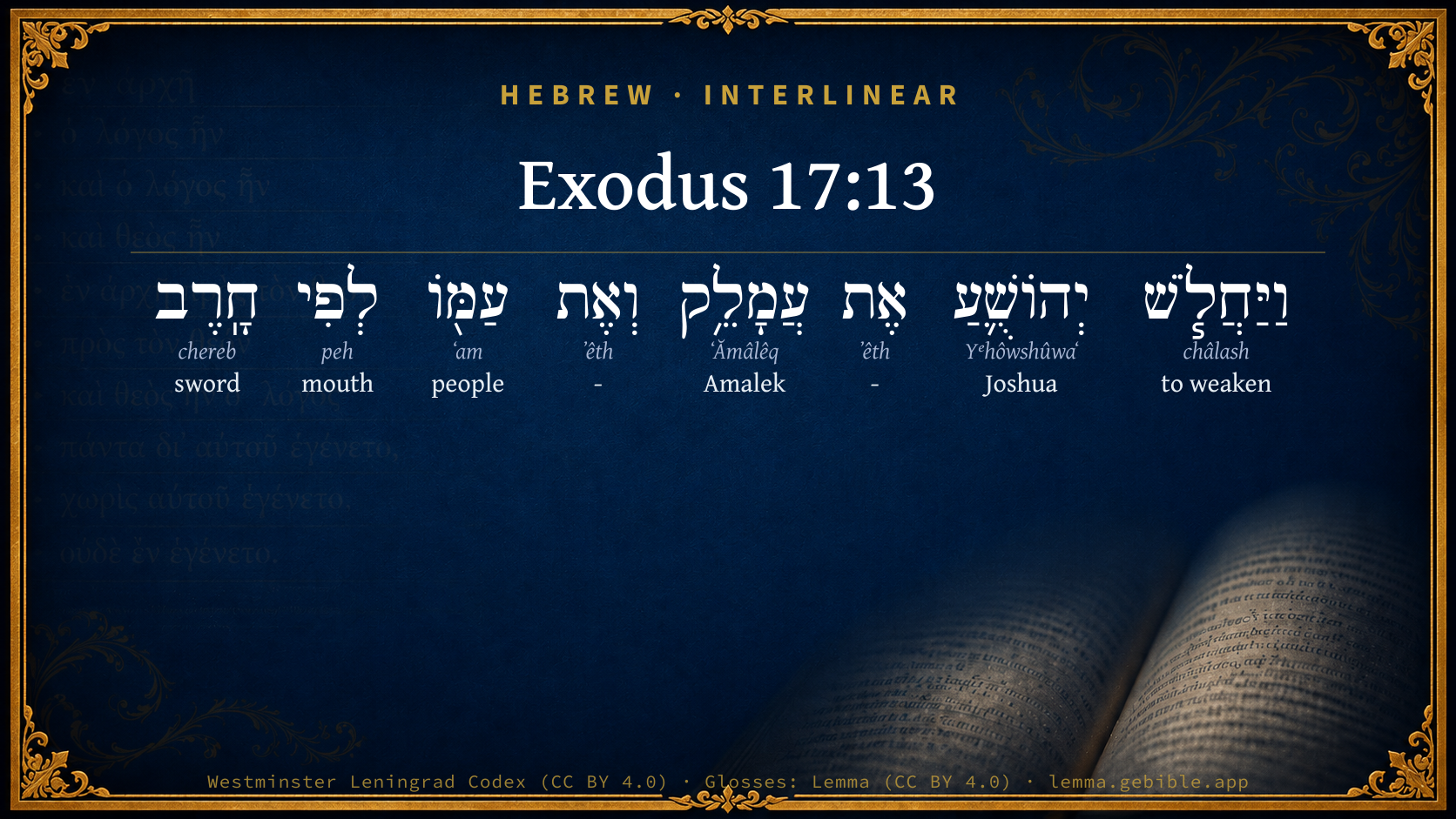
Hebrew (Westminster Leningrad Codex) Exodus 17:13 appears in the Hebrew Old Testament. The text above is from the Westminster Leningrad Codex. Each word links to its Strong’s number, a concise gloss, and parsing drawn from the Open Scriptures Hebrew Bible morphology. Click any word for its full Brown-Driver-Briggs (BDB) entry.
Download image
Cite this verse

Exodus 17:13 (World English Bible). Public Domain. Lemma interlinear Bible study tool, https://lemma.gebible.app/v/exodus/17/13.

Show BibTeX & RIS
BibTeX
RIS
English Translation
Joshua defeated Amalek and his people with the edge of the sword.
World English Bible · Public Domain
Highlights
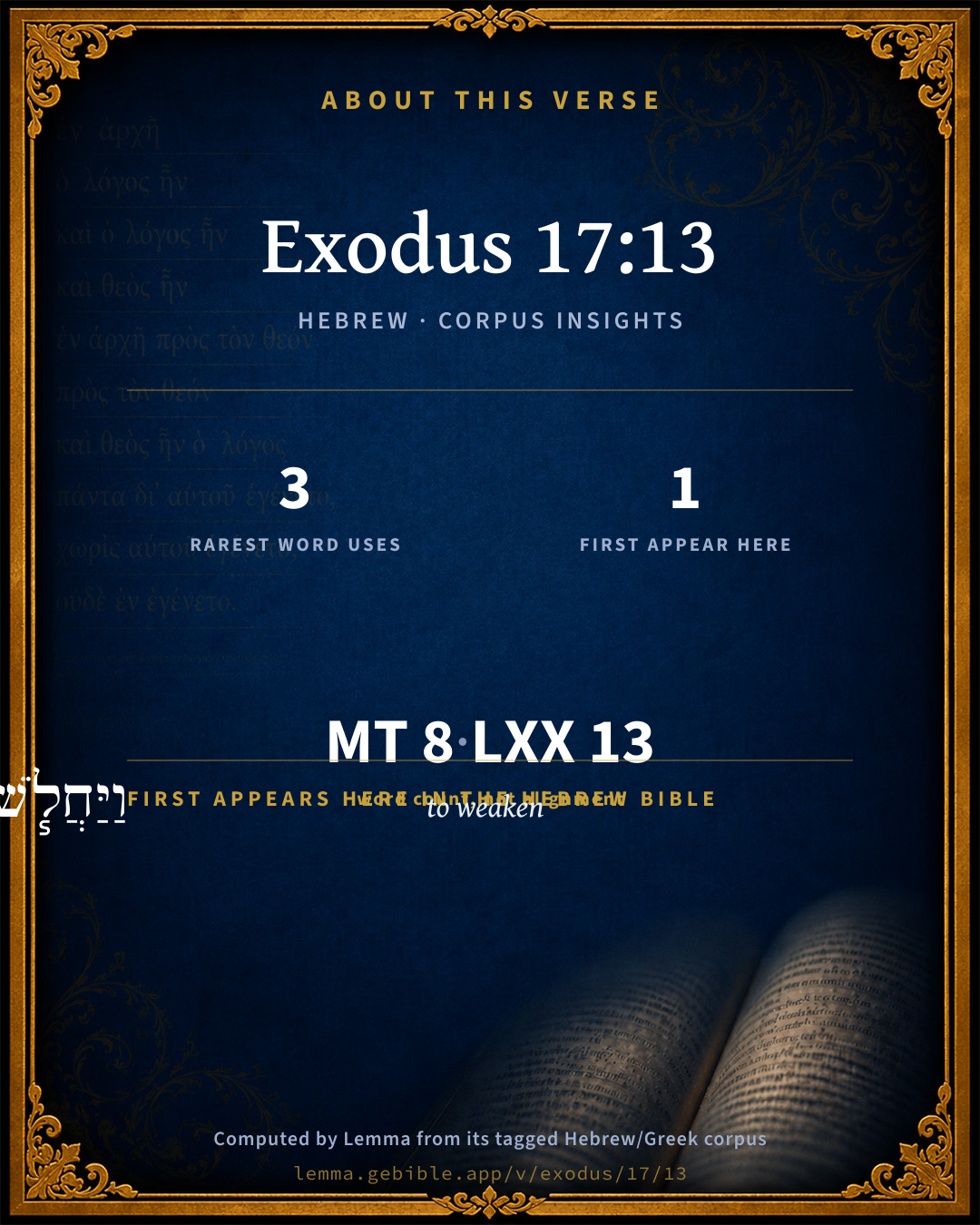
  • 1 first appearance in the Hebrew Bible
Full analysis ↓
Download a study sheet

One document with this verse’s original text, its word-by-word gloss line, the meaning frame, cross-references with their text, attributed commentary, and full source and license credits — printable, and it pastes into notes with its structure intact.

This verse Autodidact and up

Study sheet (.html) Plain text (.txt)

A passage Seminary Student

Up to 50 verses in one chapter. A passage sheet keeps up to 6 commentary sources and 12 cross-references per verse, in the order this page ranks them, and says so on the sheet whenever that leaves anything out. Ask for a single verse and you get the Autodidact verse sheet above.

Everything on this page stays free to read, with no account — the sheet is a download of what is already on screen, not access to it.

Want to remove ads? Support Godless Engineer
Compare translations 3

The same verse in 3 English versions, stacked beneath the original-language interlinear above. Click any original word for its lexicon entry.

Each is an independent rendering of the whole verse — the interlinear is not word-aligned to these translations.

Highlighted words mark where these versions differ — a whole-verse word diff, not a word-by-word alignment.

  • World English Bible Public Domain
    Joshua defeated Amalek and his people with the edge of the sword.
  • King James Version Public Domain
    And Joshua discomfited Amalek and his people with the edge of the sword.
  • unfoldingWord Literal Text CC BY-SA 4.0
    And Joshua defeated Amalek and his people with the edge of the sword.

unfoldingWord Literal Text — © unfoldingWord, licensed CC BY-SA 4.0. Word-aligned USFM3 via Door43 (git.door43.org/unfoldingWord/en_ult).

Versions to compare (up to 4)

3 of 4 selected

Show all 18 translations

Every available English version of this verse, each an independent rendering of the whole verse.

  • World English Bible Public Domain
    Joshua defeated Amalek and his people with the edge of the sword.
  • Berean Standard Bible Public Domain
    So Joshua overwhelmed Amalek and his army with the sword.
  • Majority Standard Bible Public Domain
    So Joshua overwhelmed Amalek and his army with the sword.
  • King James Version Public Domain
    And Joshua discomfited Amalek and his people with the edge of the sword.
  • American Standard Version (1901) Public Domain
    And Joshua discomfited Amalek and his people with the edge of the sword.
  • Revised Version (1885) Public Domain
    And Joshua discomfited Amalek and his people with the edge of the sword.
  • Geneva Bible (1599) Public Domain
    And Ioshua discomfited Amalek and his people with the edge of the sword.
  • Douay-Rheims (1899) Public Domain
    And Josue put Amalec and his people to flight, by the edge of the sword.
  • Young's Literal Translation Public Domain
    and Joshua weakeneth Amalek and his people by the mouth of the sword.
  • Literal Standard Version CC BY-SA 4.0
    and Joshua weakens Amalek and his people by the mouth of the sword.
  • Unlocked Literal Bible CC BY-SA 4.0
    So Joshua defeated the people of Amalek with the sword.
  • unfoldingWord Literal Text CC BY-SA 4.0
    And Joshua defeated Amalek and his people with the edge of the sword.
  • Darby Bible Public Domain
    And Joshua broke the power of Amalek and his people with the edge of the sword.
  • World Messianic Bible Public Domain
    Joshua defeated Amalek and his people with the edge of the sword.
  • Webster's Bible Public Domain
    And Joshua discomfited Amalek and his people with the edge of the sword.
  • Free Bible Version CC BY-SA 4.0
    As a result Joshua defeated the Amalekite army.
  • Bible in Basic English Public Domain
    And Joshua overcame Amalek and his people with the sword.
  • JPS Tanakh (1917) Public Domain
    And Joshua discomfited Amalek and his people with the edge of the sword.

Literal Standard Version (2020), Covenant Press — licensed CC BY-SA 4.0. Text via the HelloAO Bible API (eBible.org). Unlocked Literal Bible (unfoldingWord) — licensed CC BY-SA 4.0. Text via the HelloAO Bible API (eBible.org). unfoldingWord Literal Text — © unfoldingWord, licensed CC BY-SA 4.0. Word-aligned USFM3 via Door43 (git.door43.org/unfoldingWord/en_ult). Free Bible Version, Dr. Jonathan Gallagher — licensed CC BY-SA 4.0. Text via the HelloAO Bible API (eBible.org).

Word by word

More ways to search: Search by grammar → Find every occurrence → Compare this word →

Practice this passage: Drill this verse → Learn its vocabulary →

About this verse

These counts appear in no published source. They are computed here, from the morphology-tagged text and Lemma’s own curated glosses. What Lemma adds →

8
words
7
distinct lemmas
Pentateuch
section

Notable vocabulary

The rarest word here is וַיַּחֲלֹ֧שׁ to weaken H2522 — appearing just 3 times in the whole Hebrew Bible.

First appearance in Scripture

This word makes its first canonical appearance in the Hebrew Bible here:

  • וַיַּחֲלֹ֧שׁ to weaken H2522

Shared distinctive vocabulary

וַיַּחֲלֹ֧שׁ to weaken H2522 occurs in 3 verses of the Hebrew Bible. Also found in:

Grammatical profile

  • 1 verb
  • 5 nouns
  • 2 particles

Verb forms

  • וַיַּחֲלֹ֧שׁ Qal · Sequential Imperfect

Hebrew & Septuagint length

In English translation the verse runs 12 words from the Hebrew and 14 from the Septuagint (LXX English) — closely comparable.

A rough comparison of the two English renderings, which tokenize alike — not a word-level alignment.

Word counts can differ between the Hebrew and the Greek without any difference in meaning — e.g. the Hebrew direct-object marker אֵת has no separate Greek word, and Greek often adds the article ὁ.

In the original languages it is 8 Hebrew tokens and 13 Greek tokens — but the two are counted differently (Hebrew bundles its prefixes and suffixes into one token; the Greek is in lemma form), so that isn’t a like-for-like length.

Cross-references

5

Topical passages linked to Exodus 17:13 in the Treasury of Scripture Knowledge — connected by theme and wording, ordered by reader-vote popularity; previews shown in the World English Bible.

  • Joshua 10:42 All these kings and their land did Joshua take at one time, because Yahweh, the God of Israel, fought for Israel.
  • Joshua 10:28 Joshua took Makkedah on that day, and struck it with the edge of the sword, and the king of it: he utterly destroyed them and all the souls who were therein; he left none remaining; and he did to the king of Makkedah as he had done to the king of Jericho.
  • Joshua 10:32 and Yahweh delivered Lachish into the hand of Israel; and he took it on the second day, and struck it with the edge of the sword, and all the souls who were therein, according to all that he had done to Libnah.
  • Joshua 10:37 and they took it, and struck it with the edge of the sword, and the king of it, and all the cities of it, and all the souls who were therein; he left none remaining, according to all that he had done to Eglon; but he utterly destroyed it, and all the souls who were therein.
  • Joshua 11:12 All the cities of those kings, and all the kings of them, did Joshua take, and he struck them with the edge of the sword, and utterly destroyed them; as Moses the servant of Yahweh commanded.

Cross-references courtesy of OpenBible.info (CC BY 4.0).

Hebrew and Greek witnesses Masoretic Hebrew ↔ Greek Septuagint

The same verse in the two great witnesses to the Old Testament, shown verse-for-verse.

These are two independent witnesses, not word-aligned to each other, and the Septuagint is shown in lemma (dictionary) form.

Hebrew Exodus 17:13 Masoretic · Westminster Leningrad Codex

וַיַּחֲלֹ֧שׁ יְהוֹשֻׁ֛עַ אֶת עֲמָלֵ֥ק וְאֶת עַמּ֖וֹ לְפִי חָֽרֶב

Joshua defeated Amalek and his people with the edge of the sword.

World English Bible · Public Domain

Greek LXX Exodus 17:13 Septuagint · lemma form

καί τρέπω ἰησοῦς ὁ αμαληκ καί πᾶς ὁ λαός αὐτός ἐν φόνος μάχαιρα

And Joshua routed Amalec and all his people with the slaughter of the sword.

LXX2012 (modern English Septuagint) · Public Domain

Hebrew: Westminster Leningrad Codex (CC BY 4.0). Greek: Septuagint (public domain); English from LXX2012 (modern English Septuagint) (Public Domain). How the Septuagint differs from the Hebrew →

Targum (Aramaic paraphrase)

2

The Targum is the ancient Jewish Aramaic paraphrase of the Hebrew Scriptures — an interpretive translation, not the Hebrew text itself. Onkelos (literal) and Pseudo-Jonathan (expansive) render the Torah, and Jonathan the Prophets. Coverage is partial: where no permissively-licensed English translation exists for a verse, only the Aramaic is shown. This is verse-level text, not a word-by-word alignment to the Hebrew.

  1. Targum Onkelos Torah (Genesis–Deuteronomy)
    וְתַבַּר יְהוֹשֻׁעַ יָת עֲמָלֵק וְיָת עַמֵהּ לְפִתְגָם דְחָרֶב:

    (no public-domain English translation for this verse)

    Targum Onkelos — Aramaic: “Onkelos Genesis” (public domain); “Onkelos Exodus” (public domain); “Onkelos Leviticus” (public domain); “Onkelos Numbers” (public domain); “Onkelos Deuteronomy” (public domain). English: “Sefaria Community Translation” (CC0 1.0 (public-domain dedication)); “J.W. Etheridge. The Targums of Onkelos and Jonathan Ben Uzziel on the Pentateuch. London: Longmans, Green, 1862” (public domain). Text via Sefaria.

  2. Targum Pseudo-Jonathan Torah (Genesis–Deuteronomy)
    וּתְבַר יְהוֹשֻׁעַ יַת עֲמָלֵק דְּקָטַע רֵישֵׁי גִיבָּרַיָא דְּעַמֵּיהּ עַל פּוּם מֵימְרָא דַיְיָ בִּקְטִילַת סַיְיפָא

    And Jehoshua shattered Amalek, and cut off the heads, of the strong men of his people, by the mouth of the Word of the Lord, with the slaughter of the sword.

    Targum Pseudo-Jonathan — Aramaic: “Targum Jonathan on Genesis” (public domain); “Targum Jonathan on Exodus” (public domain); “Targum Jonathan on Leviticus” (public domain); “Targum Jonathan on Numbers” (public domain); “Targum Jonathan on Deuteronomy” (public domain). English: “The Targum of Jonathan ben Uzziel, trans. J. W. Etheridge, London, 1862” (public domain). Text via Sefaria.

Commentary

Notes on Exodus 17:13 from classic Christian and Jewish commentators (each source and its license shown beneath its notes). The classic Christian expositions comment on the surrounding passage and are grouped to its opening verse, so a note may address several verses; the Jewish commentaries on the Tanakh (Rashi and others) are per-verse, so they appear only where the commentator wrote on this verse.

Lemma curates 59 commentaries, every one of them public domain or Creative Commons licensed, each selected and text-cleaned for this edition rather than reprinted as found. About our sources →

Trapp's Complete Commentary

John Trapp

Exo 17:13 And Joshua discomfited Amalek and his people with the edge of the sword.

Ver. 13. And Joshua discomfited.] How should he do otherwise when he fought with such weapons Prayers are the bombardae et instrumenta bellica Christianorum, saith Luther i the great guns and warlike weapons of the saints. The Romans in a great distress were driven to take the weapons out of the temples of their gods, and overcame.

John Trapp, A Commentary or Exposition upon All the Books of the Old and New Testament (1647–1656) — public domain. Text from a community e-Sword module.

The Biblical Illustrator

Joseph S. Exell

Exo_17:13

Joshua discomfited Amalek.

Winning Gods battles

I. Amalek, as we learn from Deu_25:18, had smitten the hindmost, even all that were feeble. The stragglers are always a temptation to the foe. The hindmost and the feeble are sure to be the first attacked, and therefore should have special care.

II. Joshua discomfited Amalek, not Moses or some other friend. Let us keep our bitterness for sin, and our swords for the Kings enemies.

III. Amalek is not to be beaten without a fight. The struggle against sin is real, as we shall find to our cost if we are not wary.

IV. Moses was for each minding his own work. Joshua to fight, and himself to take the top of the hill.

V. Moses on the hill is an emblem of public prayer. There is a mystery about prayer that we cannot unravel, fine of the bravest of Christian soldiers, scarred with many a fight, said, I will therefore that men pray everywhere, lifting up holy hands.

VI. How much even the mightiest of men are dependent upon others much weaker than themselves. It was well for the fortunes of the day that Moses was not alone.

VII. An altar marked the place of battle, and glory was given to the Lord of Hosts. The soldiers of the Cross should call the battle-fields where they have won their bravest fights by the name of Him to whom they ascribe all might and majesty. (T. Champness.)

The battle of Amalek, an instructive war

I. As the record of a war distinguished from most modern wars.

1. It was purely defensive on the Hebrew side.

2. It was Divinely sanctioned on the Hebrew side.

3. It was evidently judicial on the Hebrew side.

II. As the record of a war suggesting principles of general application.

1. The propagating influence of evil. I find the primal cause of this war in the injury which Jacob perpetrated upon his brother Esau (Gen_27:18-19). God only knows the influence of one evil act.

2. The Divine liberty allowed to wicked men. Full freedom to work out revengeful passions.

3. The variety of instrumentality by which God works out His designs. The Eternal ever works by means.

4. The dependence of mans progress on his relation to heaven.

5. The importance of transmitting to posterity the agency of God in history (see verse 14).

III. As the record of a war symbolizing the moral struggle in which the good are engaged.

1. That the good have spiritual enemies to contend with.

2. That the victory which the good are to obtain over their enemies depends on the help of others.

3. That whatever may be the amount of help obtained in the struggle, the victory must ever be ascribed to God. (Homilist.)

Israel and Amalek

I. The Christians example.

1. To fight.

(1) An aggressive fight Go

(2) To be done wisely. Choose you out men.

(3) Earnestly Fight. No parley.

(4) Continually.

2. To pray.

(1) For those who fight.

(2) Earnestly. Not growing weary.

(3) Confidently. The rod--symbol of past mercies.

(4) Unitedly.

II. The Christians encouragement.

1. Christ, our Captain--

(1) With us, to cheer.

(2) With us, to direct.

(3) With us, to defend.

2. Christ, our intercessor.

(1) Prays, while we work.

(2) Prays continually.

(3) Prays successfully.

III. The Christians prospect.

1. Of certain victory.

2. certain glory. (B. D. Macmillan.)

Amalek and Israel

I. The battle was forced upon the victors.

II. The battle was hotly contested.

III. The vanquished owed defeat, and the victors victory, to Divine power through human intercession.

Lessons:

1. As soon as we become followers of Christ, war is forced upon us.

2. Every Christian possesses a Divine rod which, wielded, will bring him Divine help (Heb_4:16).

3. Christians in their conflict have an Intercessor on the hill, and a Leader in the valley. Christ makes intercession (Heb_7:25); and the Holy Spirit helps our infirmities (Rom_8:26), and guides into all truth (Joh_16:13). (W. Harris.)

Lessons

1. Hands of creature-instruments may be helpful under God, to give His Church success against its enemies.

2. Such hands lifted up to heaven in prayer, and for encouragement, God doth assist unto prevalency.

3. Hands hanging down and feeble in prayer, may give opportunity unto enemies to prevail.

4. Such languishings after strong strugglings, God sometimes orders upon His choicest servants.

5. Doubtful may be the fight of Israel as to success against its enemies for a time (verse 11).

6. Heaviness of flesh and spirit in contending with God for Israel may sometimes befall Moses (Mat_26:41; Mat_26:43).

7. Suitable support under such delinquencies are very requisite for Gods servants. Christ the stone to us.

8. Good helpers to strengthen hearts and hands in faintings are specially useful.

9. By such helps souls may be stedfast and faithful unto God unto time of victory (verse 12).

10. Moses praying and Joshua fighting, Amalek must fail, when prayer puts the edge on the sword it is furbished to the slaughter.

11. It is Gods just ordering that they who first oppress with the sword, shall perish by the sword (verse 13). (G. Hughes, B. D.)

The Biblical Illustrator, edited by Joseph S. Exell (c. 1880s–1900s) — public domain. Text from a community e-Sword module.

Joseph Benson's Commentary

Exo 17:13-14. Though God gave the victory, yet it is said Joshua discovered Amalek, because Joshua was a type of Christ, and of the same name, and in him it is that we are more than conquerors. The Lord said, Write this for a memorial — This is the first mention of writing we find in Scripture.

Joseph Benson's Commentary on the Old and New Testaments (1811–1818) — public domain. Text from a community e-Sword module.

Jamieson, Fausset & Brown

Robert Jamieson, A. R. Fausset & David Brown

Joshua discomfited Amalek--Victory at length decided in favor of Israel, and the glory of the victory, by an act of national piety, was ascribed to God (compare Jo1 5:4).

Jamieson, Fausset & Brown — Commentary Critical and Explanatory on the Whole Bible (1871) — public domain (CC PDM 1.0). Text via the HelloAO Bible API.

Adam Clarke's Commentary

Verse 13. Joshua discomfited Amalek and his people] Amalek might have been the name of the ruler of this people continued down from their ancestor, (See Clarke on Ex 17:8,) as Pharaoh was the name of all succeeding kings in Egypt. If this were the case, then Amalek and his people mean the prince and the army that fought under him. But if Amalek stand here for the Amalekites, then his people must mean the confederates he had employed on this occasion.

Adam Clarke's Commentary on the Bible (1810–1826) — public domain. Text from a community e-Sword/MySword module.

The Cambridge Bible for Schools and Colleges

gen. ed. J. J. S. Perowne

13. discomfited] rather, disabled, or (in a fig. sense) prostrated (RVm.); lit. weakened1[157]. The verb occurs otherwise in Heb. only Job_14:10 a (‘man dieth and is powerless’), and Isa_14:12 (חלש על cannot mean ‘lay low’: read probably, ‘(lying) powerless on the corpses’): but it is found in the Targums; the cognate adj. weak occurs in Joel 4:10, and is common in Aramaic; and the substantive weakness in Exo_32:18.

[157] Read the transitive form וַיְחַלֵּשׁ, as in the Targ. of Job_12:21.

with the edge of the sword] lit. according to the mouth of the sword, i.e. as the sword devours (2Sa_11:25), = without quarter. So always. ‘With the edge’ is not correct.

The Cambridge Bible for Schools and Colleges (gen. ed. J. J. S. Perowne; Cambridge University Press, 1878–1918) — public domain. Text from a community e-Sword module.

John Gill's Exposition

And Joshua discomfited Amalek and his people with the edge of the sword. Amalek being distinguished from "his people", has led some to think that Amalek was the name of the king, or general of the army, and that it was a common name to the kings of that nation, as Pharaoh was to the kings of Egypt; but for this there is no foundation in the Scriptures: as Amelek signifies the Amalekites, his people may design the confederates and auxiliaries, the other people, as Ben Gersom expresses it, they brought with them to fight against Israel. And so Jerom (z) says, by him another Canaanite dwelt, who also fought against Israel in the wilderness, of whom it is so written, and Amalek and the Canaanite dwelt in the valley, Num 14:25 and who were all, the one as the other, at least the greatest part of them, cut to pieces by the edge of the sword of Joshua and the Israelites, who obtained a complete victory over them; as the spiritual Israel of God will at last over all their spiritual enemies, sin, Satan, the world, and death.

(z) Ut supra. (De Locis Hebr. fol. 87. M.)

John Gill's Exposition of the Whole Bible (1746–1763) — public domain (CC PDM 1.0). Text via the HelloAO Bible API.

Albert Barnes' Notes on the Bible

With the edge of the sword - This expression always denotes a great slaughter of the enemy.

Albert Barnes' Notes on the Bible (1834–1885) — public domain. Text from a community e-Sword/MySword module.

Matthew Poole's English Annotations

Either,

1. The king of the Amalekites, and his people. Or,

2. The people of the Amalekites, and those other people who were leagued with them.

Matthew Poole's English Annotations on the Holy Bible (1683–1685) — public domain. Text from a community e-Sword/MySword module.

The Pulpit Commentary

Amalek and his peoplei.e. "the Amalekites proper, and the tribes subject to them, who fought on their side."

The Pulpit Commentary (1880–1919), ed. H.D.M. Spence-Jones & Joseph S. Exell — public domain. Text from a community e-Sword module.

John Wesley's Explanatory Notes

Though God gave the victory, yet it is said Joshua discomfited Amalek, because Joshua was a type of Christ, and of the same name, and in him it is that we are more than conquerors.

John Wesley, Explanatory Notes Upon the Whole Bible (1754–1765) — public domain. Text via the GEBible commentary corpus.

Rashi

Rabbi Shlomo Yitzchaki (Rashi)

ויחלש יהושע AND JOSHUA DISCOMFITED [AMALEK] (more lit., he weakened Amalek) — he cut off the heads of his mighty men and left only the weak amongst them, and he did not kill all of them (leaving the weak men alive: thus Amalek was made weak, and powerless for further mischief). From this we may learn that they acted according to the expressed pronouncement of the Shechina (otherwise they would, in the stress of battle, not have so discriminated) (Mekhilta).

Rashi on the Tanakh — English translations: “The Judaica Press complete Tanach with Rashi, translated by A. J. Rosenberg” (CC BY 4.0); “Pentateuch with Rashi's commentary by M. Rosenbaum and A.M. Silbermann, 1929-1934” (public domain); “The Metsudah Tanach series, Lakewood, N.J” (CC BY 4.0); and “The Book of Joshua, Metsudah Publications, 1997” (CC BY 4.0). Text via Sefaria.

Lesson kit

Teaching starters — assembled from the data on this page, not authored interpretation. Every prompt links to the verse data it draws on. Edit before teaching.

Exodus, in the Pentateuch, opens this verse with 8 words (7 distinct Hebrew lemmas). Its most distinctive word is châlash (“to weaken”). A historical commentator’s framing appears above. Read the whole chapter for the surrounding context.

Discussion questions

  1. How does “to weaken” (châlash) shape what this verse is saying?
  2. The word “to weaken” first appears here in Scripture. What is being introduced at this debut?
  3. Job 14:10 shares the word «to weaken» with this verse. How do the two illuminate each other?
  4. These translations render this verse differently. What is at stake in choosing one wording over another?
  5. The verb «וַיַּחֲלֹ֧שׁ» is Qal Sequential Imperfect. How does its form color the action?
  6. Reading how Trapp's Complete Commentary and The Biblical Illustrator read this verse, where do the two commentators agree and where do they part?

Things to notice

Reading settings

Reading text

Shown beneath each verse's original-language words.

Old Testament
Old Testament edition

Read the OT as the Masoretic Hebrew (MT) or the Greek Septuagint (LXX).

English shown for the Greek Septuagint (in the Hebrew ↔ Greek comparison).

Comparing translations? Open the Compare panel on any verse page to stack up to four side by side.