Exodus 20:22

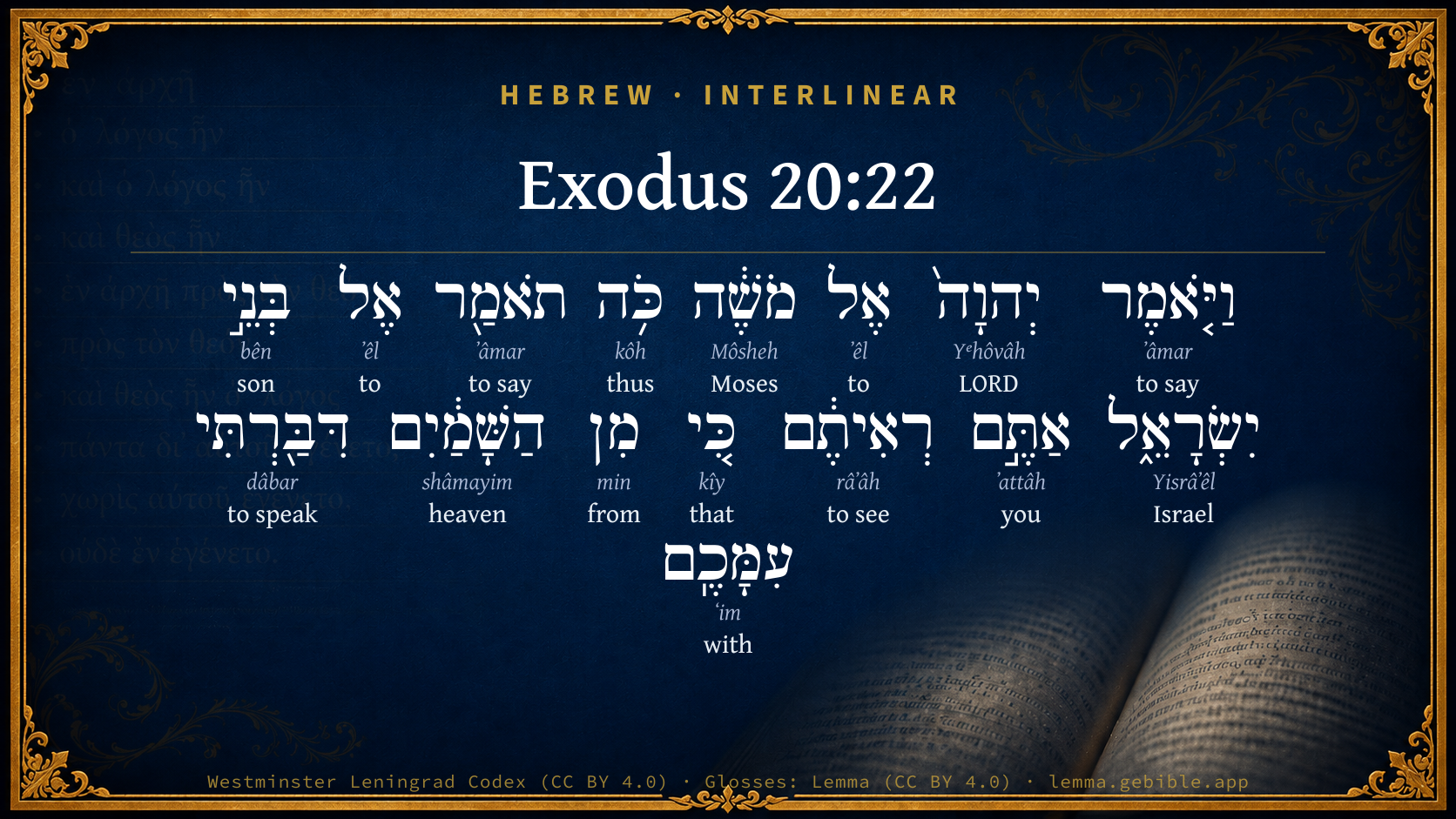
Hebrew (Westminster Leningrad Codex) Exodus 20:22 appears in the Hebrew Old Testament. The text above is from the Westminster Leningrad Codex. Each word links to its Strong’s number, a concise gloss, and parsing drawn from the Open Scriptures Hebrew Bible morphology. Click any word for its full Brown-Driver-Briggs (BDB) entry.
Download image
Cite this verse

Exodus 20:22 (World English Bible). Public Domain. Lemma interlinear Bible study tool, https://lemma.gebible.app/v/exodus/20/22.

Show BibTeX & RIS
BibTeX
RIS
English Translation
Yahweh said to Moses, "This is what you shall tell the children of Israel: 'You yourselves have seen that I have talked with you from heaven.
World English Bible · Public Domain
Download a study sheet

One document with this verse’s original text, its word-by-word gloss line, the meaning frame, cross-references with their text, attributed commentary, and full source and license credits — printable, and it pastes into notes with its structure intact.

This verse Autodidact and up

Study sheet (.html) Plain text (.txt)

A passage Seminary Student

Up to 50 verses in one chapter. A passage sheet keeps up to 6 commentary sources and 12 cross-references per verse, in the order this page ranks them, and says so on the sheet whenever that leaves anything out. Ask for a single verse and you get the Autodidact verse sheet above.

Everything on this page stays free to read, with no account — the sheet is a download of what is already on screen, not access to it.

Want to remove ads? Support Godless Engineer
Compare translations 3

The same verse in 3 English versions, stacked beneath the original-language interlinear above. Click any original word for its lexicon entry.

Each is an independent rendering of the whole verse — the interlinear is not word-aligned to these translations.

Highlighted words mark where these versions differ — a whole-verse word diff, not a word-by-word alignment.

  • World English Bible Public Domain
    Yahweh said to Moses, "This is what you shall tell the children of Israel: 'You yourselves have seen that I have talked with you from heaven.
  • King James Version Public Domain
    And the LORD said unto Moses, Thus thou shalt say unto the children of Israel, Ye have seen that I have talked with you from heaven.
  • unfoldingWord Literal Text CC BY-SA 4.0
    And Yahweh said to Moses, “You shall speak thus to the sons of Israel: ‘You yourselves have seen that I have talked with you from heaven.

unfoldingWord Literal Text — © unfoldingWord, licensed CC BY-SA 4.0. Word-aligned USFM3 via Door43 (git.door43.org/unfoldingWord/en_ult).

Versions to compare (up to 4)

3 of 4 selected

Show all 18 translations

Every available English version of this verse, each an independent rendering of the whole verse.

  • World English Bible Public Domain
    Yahweh said to Moses, "This is what you shall tell the children of Israel: 'You yourselves have seen that I have talked with you from heaven.
  • Berean Standard Bible Public Domain
    Then the LORD said to Moses, “This is what you are to tell the Israelites: ‘You have seen for yourselves that I have spoken to you from heaven.
  • Majority Standard Bible Public Domain
    Then the LORD said to Moses, “This is what you are to tell the Israelites: ‘You have seen for yourselves that I have spoken to you from heaven.
  • King James Version Public Domain
    And the LORD said unto Moses, Thus thou shalt say unto the children of Israel, Ye have seen that I have talked with you from heaven.
  • American Standard Version (1901) Public Domain
    And Jehovah said unto Moses, Thus thou shalt say unto the children of Israel, Ye yourselves have seen that I have talked with you from heaven.
  • Revised Version (1885) Public Domain
    And the LORD said unto Moses, Thus thou shalt say unto the children of Israel, Ye yourselves have seen that I have talked with you from heaven.
  • Geneva Bible (1599) Public Domain
    And the Lord sayde vnto Moses, Thus thou shalt say vnto the children of Israel, Ye haue seene that I haue talked with you from heauen.
  • Douay-Rheims (1899) Public Domain
    And the Lord said to Moses: Thus shalt thou say to the children of Israel: You have seen that I have spoken to you from heaven.
  • Young's Literal Translation Public Domain
    And Jehovah saith unto Moses, `Thus dost thou say unto the sons of Israel: Ye -- ye have seen that from the heavens I have spoken with you;
  • Literal Standard Version CC BY-SA 4.0
    And YHWH says to Moses, “Thus you say to the sons of Israel: You have seen that I have spoken with you from the heavens;
  • Unlocked Literal Bible CC BY-SA 4.0
    Yahweh said to Moses, “This is what you must tell the Israelites: 'You yourselves have seen that I have talked with you from heaven.
  • unfoldingWord Literal Text CC BY-SA 4.0
    And Yahweh said to Moses, “You shall speak thus to the sons of Israel: ‘You yourselves have seen that I have talked with you from heaven.
  • Darby Bible Public Domain
    And Jehovah said to Moses, Thus shalt thou say to the children of Israel: Ye have seen that I have spoken with you from the heavens.
  • World Messianic Bible Public Domain
    The LORD said to Moses, “This is what you shall tell the children of Israel: ‘You yourselves have seen that I have talked with you from heaven.
  • Webster's Bible Public Domain
    And the LORD said to Moses, Thus thou shalt say to the children of Israel; Ye have seen that I have talked with you from heaven.
  • Free Bible Version CC BY-SA 4.0
    The Lord told Moses, “This is what you are to say to the Israelites: ‘You saw for yourselves that I spoke with you from heaven.
  • Bible in Basic English Public Domain
    And the Lord said to Moses, Say to the children of Israel, You yourselves have seen that my voice has come to you from heaven
  • JPS Tanakh (1917) Public Domain
    (20-19) And the LORD said unto Moses: Thus thou shalt say unto the children of Israel: Ye yourselves have seen that I have talked with you from heaven.

Literal Standard Version (2020), Covenant Press — licensed CC BY-SA 4.0. Text via the HelloAO Bible API (eBible.org). Unlocked Literal Bible (unfoldingWord) — licensed CC BY-SA 4.0. Text via the HelloAO Bible API (eBible.org). unfoldingWord Literal Text — © unfoldingWord, licensed CC BY-SA 4.0. Word-aligned USFM3 via Door43 (git.door43.org/unfoldingWord/en_ult). Free Bible Version, Dr. Jonathan Gallagher — licensed CC BY-SA 4.0. Text via the HelloAO Bible API (eBible.org).

Word by word

More ways to search: Search by grammar → Find every occurrence → Compare this word →

Practice this passage: Drill this verse → Learn its vocabulary →

הַשָּׁמַ֔יִם
shâmayim
H8064
“the · heaven(s)”
Particle, Definite Article + Noun, Common, Masculine, Plural, Absolute
Part of Speech
Particle + Noun
Type
Common
Gender
Masculine
Number
Plural
State
Absolute
Full BDB Definition

Origin: from an unused root meaning to be lofty

TWOT: 2407a

heaven, heavens, sky - visible heavens, sky - as abode of the stars - as the visible universe, the sky, atmosphere, etc - Heaven (as the abode of God)
  1. וַיֹּ֤אמֶר ʼâmar H559 “and · to say” Conjunction + Verb, Qal, Sequential Imperfect, 3rd Person, Masculine, Singular
  2. יְהוָה֙ Yᵉhôvâh H3068 “LORD” Noun, Proper
  3. אֶל ʼêl H413 “to” Preposition
  4. מֹשֶׁ֔ה Môsheh H4872 “Moses” Noun, Proper
  5. כֹּ֥ה kôh H3541 “thus” Adverb
  6. תֹאמַ֖ר ʼâmar H559 “to say” Verb, Qal, Imperfect, 2nd Person, Masculine, Singular
  7. אֶל ʼêl H413 “to” Preposition
  8. בְּנֵ֣י bên H1121 “sons of” Noun, Common, Masculine, Plural, Construct
  9. יִשְׂרָאֵ֑ל Yisrâʼêl H3478 “Israel” Noun, Proper
  10. אַתֶּ֣ם ʼattâh H859 “you” Pronoun, Personal, 2nd Person, Masculine, Plural
  11. רְאִיתֶ֔ם râʼâh H7200 “to see” Verb, Qal, Perfect, 2nd Person, Masculine, Plural
  12. כִּ֚י kîy H3588 “that” Conjunction
  13. מִן min H4480 “from” Preposition
  14. דִּבַּ֖רְתִּי dâbar H1696 “to speak” Verb, Piel, Perfect, 1st Person, Common, Singular
  15. עִמָּכֶֽם ʻim H5973 “with · you” Preposition + Suffix, Personal, 2nd Person, Masculine, Plural

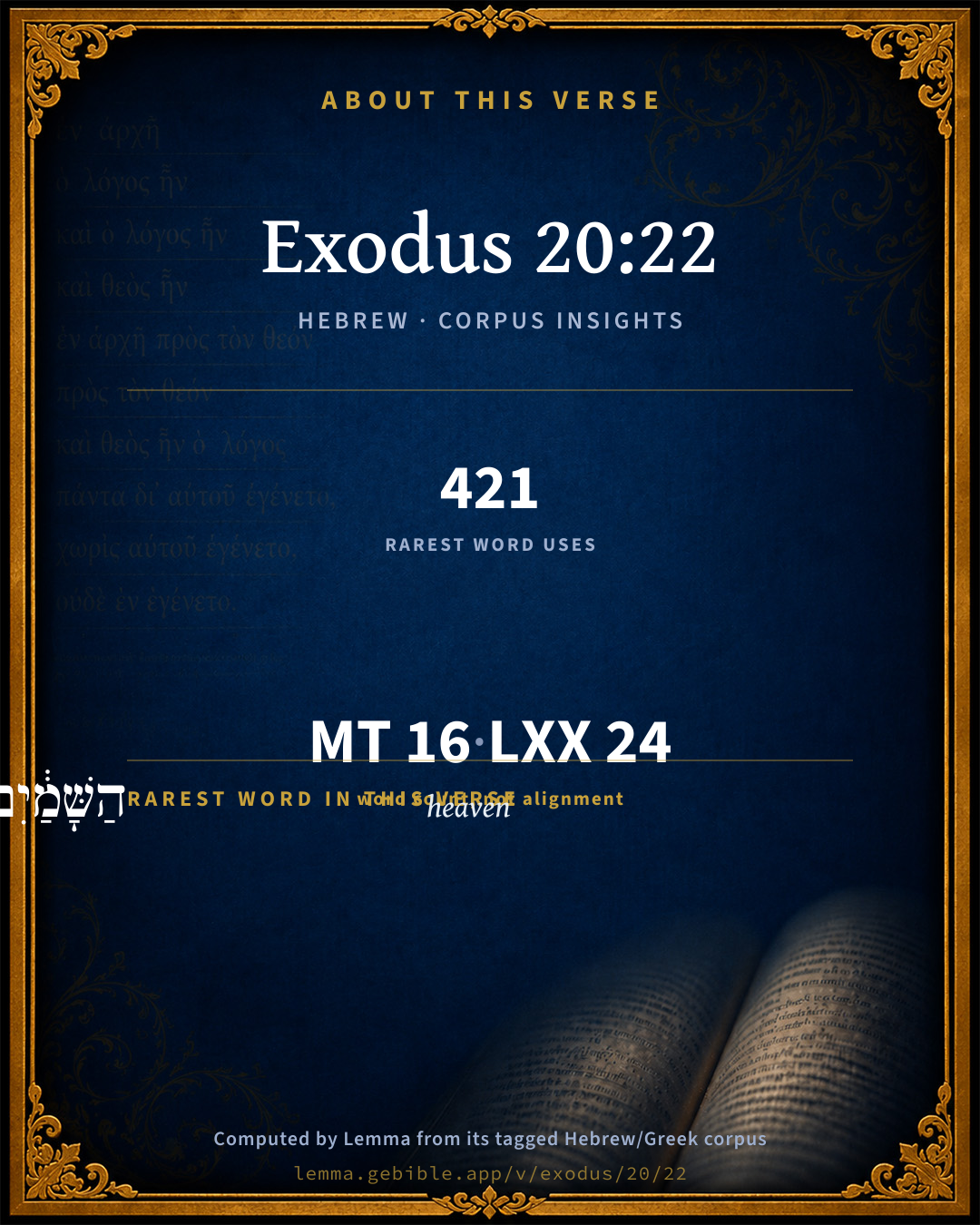
About this verse

These counts appear in no published source. They are computed here, from the morphology-tagged text and Lemma’s own curated glosses. What Lemma adds →

16
words
14
distinct lemmas
Pentateuch
section

Grammatical profile

  • 4 verbs
  • 5 nouns
  • 1 pronoun
  • 4 prepositions
  • 1 conjunction
  • 1 adverb

Verb forms

  • וַיֹּ֤אמֶר Qal · Sequential Imperfect
  • תֹאמַ֖ר Qal · Imperfect
  • רְאִיתֶ֔ם Qal · Perfect
  • דִּבַּ֖רְתִּי Piel · Perfect

Repetition

Words recur within this verse — often emphatic in Hebrew:

  • וַיֹּ֤אמֶר to say H559 ×2
  • אֶל to H413 ×2

Hebrew & Septuagint length

In English translation the verse runs 26 words from the Hebrew and 36 from the Septuagint (LXX English) — closely comparable.

A rough comparison of the two English renderings, which tokenize alike — not a word-level alignment.

Word counts can differ between the Hebrew and the Greek without any difference in meaning — e.g. the Hebrew direct-object marker אֵת has no separate Greek word, and Greek often adds the article ὁ.

In the original languages it is 16 Hebrew tokens and 24 Greek tokens — but the two are counted differently (Hebrew bundles its prefixes and suffixes into one token; the Greek is in lemma form), so that isn’t a like-for-like length.

Cross-references

2

Topical passages linked to Exodus 20:22 in the Treasury of Scripture Knowledge — connected by theme and wording, ordered by reader-vote popularity; previews shown in the World English Bible.

  • Nehemiah 9:13 You came down also on Mount Sinai, and spoke with them from heaven, and gave them right ordinances and true laws, good statutes and commandments,
  • Deuteronomy 4:36 Out of heaven he made you to hear his voice, that he might instruct you: and on earth he made you to see his great fire; and you heard his words out of the midst of the fire.

Cross-references courtesy of OpenBible.info (CC BY 4.0).

Hebrew and Greek witnesses Masoretic Hebrew ↔ Greek Septuagint

The same verse in the two great witnesses to the Old Testament, shown verse-for-verse.

These are two independent witnesses, not word-aligned to each other, and the Septuagint is shown in lemma (dictionary) form.

Hebrew Exodus 20:22 Masoretic · Westminster Leningrad Codex

וַיֹּ֤אמֶר יְהוָה֙ אֶל מֹשֶׁ֔ה כֹּ֥ה תֹאמַ֖ר אֶל בְּנֵ֣י יִשְׂרָאֵ֑ל אַתֶּ֣ם רְאִיתֶ֔ם כִּ֚י מִן הַשָּׁמַ֔יִם דִּבַּ֖רְתִּי עִמָּכֶֽם

Yahweh said to Moses, "This is what you shall tell the children of Israel: 'You yourselves have seen that I have talked with you from heaven.

World English Bible · Public Domain

Greek LXX Exodus 20:22 Septuagint · lemma form

εἶπον δέ κύριος πρός μωυσῆς ὅδε εἶπον ὁ οἶκος ἰακώβ καί ἀναἀγγέλλω ὁ υἱός ἰσραήλ σύ ὁράω ὅτι ἐκ ὁ οὐρανός λαλέω πρός σύ

And the Lord said to Moses, Thus shall you say to the house of Jacob, and you shall report it to the children of Israel, You⌃ have seen that I have spoken to you from heaven.

LXX2012 (modern English Septuagint) · Public Domain

On this verse, Lange's Commentary on the Holy Scriptures discusses the Septuagint’s reading. Read the note in Commentary ↓

Hebrew: Westminster Leningrad Codex (CC BY 4.0). Greek: Septuagint (public domain); English from LXX2012 (modern English Septuagint) (Public Domain). How the Septuagint differs from the Hebrew →

Targum (Aramaic paraphrase)

2

The Targum is the ancient Jewish Aramaic paraphrase of the Hebrew Scriptures — an interpretive translation, not the Hebrew text itself. Onkelos (literal) and Pseudo-Jonathan (expansive) render the Torah, and Jonathan the Prophets. Coverage is partial: where no permissively-licensed English translation exists for a verse, only the Aramaic is shown. This is verse-level text, not a word-by-word alignment to the Hebrew.

  1. Targum Onkelos Torah (Genesis–Deuteronomy)
    וְאִם מַדְבַּח אַבְנִין תַּעְבֵּד קֳדָמַי לָא תִבְנֵי יָתְהוֹן פְּסִילָן לָא תְרִים חַרְבָּךְ עֲלַהּ וּתְחַלְלִנַהּ:

    (no public-domain English translation for this verse)

    Targum Onkelos — Aramaic: “Onkelos Genesis” (public domain); “Onkelos Exodus” (public domain); “Onkelos Leviticus” (public domain); “Onkelos Numbers” (public domain); “Onkelos Deuteronomy” (public domain). English: “Sefaria Community Translation” (CC0 1.0 (public-domain dedication)); “J.W. Etheridge. The Targums of Onkelos and Jonathan Ben Uzziel on the Pentateuch. London: Longmans, Green, 1862” (public domain). Text via Sefaria.

  2. Targum Pseudo-Jonathan Torah (Genesis–Deuteronomy)
    וְאִם מַדְבַּח אַבְנִין תַּעֲבֵיד לִשְׁמִי לָא תִבְנֵי יַתְהוֹן חֲצִיבִין דְּאִין אֲרֵימַת פַּרְזְלָא דְמִנֵיהּ מִתְעֲבֵיד סְיָיפָא עַל אַבְנָא אַפִיסְתָּא יָתָהּ

    But if thou wilt make an altar of stones unto My Name, thou shalt not build them sculptured; for if thou lift up iron, from which the sword is made, upon the stone, thou wilt profane it.

    Targum Pseudo-Jonathan — Aramaic: “Targum Jonathan on Genesis” (public domain); “Targum Jonathan on Exodus” (public domain); “Targum Jonathan on Leviticus” (public domain); “Targum Jonathan on Numbers” (public domain); “Targum Jonathan on Deuteronomy” (public domain). English: “The Targum of Jonathan ben Uzziel, trans. J. W. Etheridge, London, 1862” (public domain). Text via Sefaria.

Commentary

Notes on Exodus 20:22 from classic Christian and Jewish commentators (each source and its license shown beneath its notes). The classic Christian expositions comment on the surrounding passage and are grouped to its opening verse, so a note may address several verses; the Jewish commentaries on the Tanakh (Rashi and others) are per-verse, so they appear only where the commentator wrote on this verse.

Lemma curates 59 commentaries, every one of them public domain or Creative Commons licensed, each selected and text-cleaned for this edition rather than reprinted as found. About our sources →

Matthew Henry's Commentary

Moses having gone into the thick darkness, where God was, God there spoke in his hearing only, privately and without terror, all that follows hence to the end of ch. 23, which is mostly an exposition of the ten commandments; and he was to transmit it by word of mouth first, and afterwards in writing, to the people. The laws in these verses related to God's worship.

I. They are here forbidden to make images for worship (Exo 20:22, Exo 20:23): You have seen that I have talked with you from heaven (such was his wonderful condescension, much more than for some mighty prince to talk familiarly with a company of poor beggars); now you shall not make gods of silver.

1. This repetition of the second commandment comes in here, either (1.) As pointing to that which God had chiefly in view in giving them this law in this manner, that is, their peculiar addictedness to idolatry, and the peculiar sinfulness of that crime. Ten commandments God had given them, but Moses is ordered to inculcate upon them especially the first two. They must not forget any of them, but they must be sure to remember those. Or, (2.) As pointing to that which might properly be inferred from God's speaking to them as he had done. He had given them sufficient demonstration of his presence among them; they needed not to make images of him, as if he were absent. Besides, they had only seen that he talked with them; they had seen no manner of similitude, so that they could not make any image of God; and his manifesting himself to them only by a voice plainly showed them that they must not make any such image, but keep up their communion with God by his word, and not otherwise.

2. Two arguments are here hinted against image-worship: - (1.) That thereby they would affront God, intimated in that, You shall not make with me gods. Though they pretended to worship them but as representations of God, yet really they made them rivals with God, which he would not endure. (2.) That thereby they would abuse themselves, intimated in that, "You shall not make unto you gods; while you think by them to assist your devotion, you will really corrupt it, and put a cheat upon yourselves." At first, it should seem, they made their images for worship of gold and silver, pretending, by the richness of those metals, to honour God, and, by the brightness of them, to affect themselves with his glory; but, even in these, they changed the truth of God into a lie, and so, by degrees, were justly given up to such strong delusions as to worship images of wood or stone.

II. They are here directed in making altars for worship: it is meant of occasional altars, such as they reared now in the wilderness, before the tabernacle was erected, and afterwards upon special emergencies, for present use, such as Gideon built (Jdg 6:24), Manoah (Jdg 13:19), Samuel (Sa1 7:17), and many others. We may suppose, now that the people of Israel were, with this glorious discovery which God had made of himself to them, that many of them would incline, in this pang of devotion, to offer sacrifice to God; and, it being necessary to a sacrifice that there be an alter, they are here appointed,

1. To make their altars very plain, either of earth or of unhewn stone, Exo 20:24, Exo 20:25. That they might not be tempted to think of a graven image, they must not so much as hew into shape the stones that they made their altars of, but pile them up as they were, in the rough. This rule being prescribed before the establishment of the ceremonial law, which appointed altars much more costly, intimates that, after the period of that law, plainness should be accepted as the best ornament of the external services of religion, and that gospel-worship should not be performed with external pomp and gaiety. The beauty of holiness needs no paint, nor do those do any service to the spouse of Christ that dress her in the attire of a harlot, as the church of Rome does: an altar of earth does best.

2. To make their altars very low (Exo 20:26), so that they might not go up by steps to them. That the higher the altar was, and the nearer heaven, the more acceptable the sacrifice was, was a foolish fancy of the heathen, who therefore chose high places; in opposition to this, and to show that it is the elevation of the heart, not of the sacrifice, that God looks at, they were here ordered to make their altars low. We may suppose that the altars they reared in the wilderness, and other occasional altars, were designed only for the sacrifice of one beast at a time; but the altar in Solomon's temple, which was to be made much longer and broader, that it might contain many sacrifices at once, was made ten cubits high, that the height might bear a decent proportion to the length and breadth; and to that it was requisite they should go up by steps, which yet, no doubt, were so contrived as to prevent the inconvenience here spoken of, the discovering of their nakedness thereon.

III. They are here assured of God's gracious acceptance of their devotions, wherever they were paid according to his will (Exo 20:24): In all places where I record my name, or where my name is recorded (that is, where I am worshipped in sincerity), I will come unto thee, and I will bless thee. Afterwards, God chose one particular place wherein to record his name: but that being taken away now under the gospel, when men are encouraged to pray every where, this promise revives in its full extent, that, wherever God's people meet in his name to worship him, he will be in the midst of them, he will honour them with his presence, and reward them with the gifts of his grace; there he will come unto them, and will bless them, and more than this we need not desire for the beautifying of our solemn assemblies.

Matthew Henry's Commentary on the Whole Bible (1708–1710) — public domain (CC PDM 1.0). Text via the HelloAO Bible API.

Ellicott's Commentary for English Readers

LAWS CONCERNING RELIGION.

(22) Ye have seen that I have talked with you from heaven.—It was important to identify the giver of the Book of the Covenant with the deliverer of the Ten Commandments, and accordingly this was done in the opening words of the Book.

THE BOOK OF THE COVENANT.

(22-26) In the remainder of Exodus 20, and in the three chapters which follow, we have a series of laws delivered by God to Moses, immediately after the delivery of the Decalogue, which constituted the second stage of the revelation, and stood midway between the first great enunciation of abstract principles in the Ten Commandments and the ultimate minute and complicated elaboration of rules to meet all cases which fills the three Books of Leviticus, Numbers, and Deuteronomy. This intermediate revelation appears to have been at once committed to writing, and in its written shape was known as “the Book of the Covenant “ (Exo_24:7), and regarded with special veneration.

“The Book of the Covenant” is wanting in system and arrangement, but is not wholly unsystematic. It commences with some laws concerning the worship of God (Exo_20:22-26), proceeds from the Divine to the human, and treats in its second section (Exo_21:1-32) of “the rights of persons,” then concerns itself with “the rights of property” (Exo_21:33 to Exo_22:15), and, finally, winds up with “miscellaneous laws” (Exo_22:16 to Exo_23:19), partly on things Divine, partly on things human—the things Divine being reserved to the last, so that the end of the legislation is in close harmony with the beginning. Altogether, the enactments contained in the short space of three chapters are some seventy; and the “Book of the Covenant” is thus no mere tentative sketch; but a very wonderful condensation of the essence of all the more important matters which Moses afterwards put forth by Divine inspiration in the long space of nearly forty years.

A Bible Commentary for English Readers, edited by Charles John Ellicott (1878–1897) — public domain. Text from a community e-Sword module.

The Cambridge Bible for Schools and Colleges

gen. ed. J. J. S. Perowne

22. Thus thou shalt say] Cf. Exo_19:3.

from heaven] As their position in the Heb. shews, these are the emphatic words in the sentence: their intention is to shew that the Israelites’ God is exalted far above the earth, and that consequently (v. 23) no material gods are to be venerated by them. Cf. Deu_4:36.

22–26. The collection opens with directions respecting the manner which God is to be worshipped (other directions about religious observances follow in Exo_22:20; Exo_22:29-31, Exo_23:10-19).

Chapters Exo_20:22 to Exo_23:33

The Book of the Covenant

The ‘Book of the Covenant’ (see Exo_24:7 in explanation of the name) is the oldest piece of Hebrew legislation that we possess. The laws contained in it are spoken of in Exo_24:3 as consisting of two elements, the words (or commands) and the judgements: the judgements (see on Exo_21:1) are the provisions relating to civil and criminal law, prescribing what is to be done when particular cases arise, and comprised in Exo_21:2 to Exo_22:17; the words are positive injunctions of moral, religious, and ceremonial law, introduced mostly by Thou shalt or shalt not, and comprised in Exo_20:23-26, Exo_22:18 to Exo_23:19 : Exo_23:20-33 is a hortatory epilogue, consisting chiefly of promises intended to suggest motives for the observance of the preceding laws. The laws themselves were doubtless taken by E from some already existing source: the ‘judgements’ in Exo_21:2 to Exo_22:17 seem to have undergone no alteration of form: but the ‘words’ which follow can hardly be in their original order; moral, religious, and ceremonial injunctions being intermingled sometimes singly, sometimes in groups (see the following summary), without any apparent system (notice also Exo_23:4 f., evidently interrupting the connexion between vv. 1–3 and 6–8); and in parts (as Exo_22:21-22; Exo_22:24, Exo_23:9 b, Exo_23:23-25 a, Exo_23:31-33 : see the notes) slight parenetic additions have probably been made by the compiler of J E.

The laws themselves may be grouped as follows:

i. Enactments relating to civil and criminal law:

1. Rights of Hebrew slaves (male and female), Exo_21:2-11.

2. Capital offences, viz. murder (in distinction from manslaughter), striking or cursing a parent, and man-stealing, Exo_21:12-17.

3. Penalties for bodily injuries, caused (a) by human beings, Exo_21:18-27, (b) by animals (a vicious ox, for instance), or neglect of reason able precautions (as leaving a pit open), Exo_21:28-36.

4. Theft of ox or sheep, and burglary, Exo_22:1-4.

5. Compensation for damage done by straying cattle [but see note], or fire spreading accidentally to another man’s field, Exo_22:5-6.

6. Compensation for loss or injury in various cases of deposit or loan, Exo_22:7-15.

7. Compensation for seduction, Exo_22:16-17.

ii (a). Regulations relating to worship and religious observances:

1. Prohibition of images, and regulations for the construction of altars, Exo_20:23-26.

2. Sacrifice to ‘other gods’ to be punished with the ‘ban,’ Exo_22:20.

3. God not to be reviled, nor a ruler cursed, Exo_22:28.

4. Firstfruits, and firstborn males (of men, oxen, and sheep), to be given to Jehovah, Exo_22:29-30.

5. Flesh torn of beasts not to be eaten, Exo_22:31.

6 & 7. The seventh year to be a fallow year, and the seventh day a day of rest (in each case, for a humanitarian motive), Exo_23:10-12.

8. God’s commands to be honoured, and ‘other gods’ not to be invoked, Exo_23:13.

9. The three annual Pilgrimages to be observed (all males to appear before Jehovah at each), Exo Exo_23:14-17.

10. A festal sacrifice not to be offered with leavened bread, nor its fat to remain unburnt till the following morning, Exo_23:18.

11. Firstfruits to be brought to the house of Jehovah, Exo_23:19 a.

12. A kid not to be boiled in its mother’s milk, Exo_23:19 b.

ii (b). Injunctions of a moral, and, especially, of a humanitarian character:

1. Sorcery and bestiality to be punished with death, Exo_22:18-19.

2. The ‘sojourner,’ the widow, and the orphan, not to be oppressed, Exo_22:21-24.

3. Interest not to be taken from the poor, Exo_22:25.

4. A garment taken in pledge to be returned before sun-down, Exo_22:26-27.

5. Veracity and impartiality, the duties of a witness, Exo_23:1-3.

6. An enemy’s beast to be preserved from harm, Exo_23:4-5.

7. Justice to be administered impartially, and no bribe to be taken, Exo_23:6-9.

These three groups of laws may have been taken originally from distinct collections. The terse form in which many of the laws in ii (a) and ii (b) are cast resembles that which prevails in Leviticus 19 (H). The regulations respecting worship contained in Exo_23:10-19, together with the allied ones embedded in Exo_13:3-7; Exo_13:11-13, are repeated in Exo_34:18-26, in the section (Exo_34:10-26) sometimes called the ‘Little Book of the Covenant,’ with slight verbal differences, and with the addition in Exo_34:11-17 of more specific injunctions against idolatry (see the synoptic table, pp. 370–2).

The laws contained in the ‘Book of the Covenant’ are, as has been already said, no doubt older than the narrative (E) in which they are incorporated: they represent, to use Cornill’s expression, the ‘consuetudinary law of the early monarchy,’ and include (cf. the notes on tôrâh, p. 162, and mishpâṭ, Exo_22:1) the formulated decisions which, after having been begun by Moses (Exo_18:16; cf. p. 161), had gradually accumulated up to that age. The stage of society for which the Code was designed, and the characteristics of the Code itself, are well indicated by W. R. Smith (OTJC.2[180] p. 340 ff). ‘The society contemplated in it is of very simple structure. The basis of life is agricultural. Cattle and agricultural produce are the main elements wealth; and the laws of property deal almost exclusively with them (see Exo_21:28 to Exo_22:10). The principles of criminal and civil justice are those still current among the Arabs of the desert, viz. retaliation and pecuniary compensation. Murder is dealt with by the law of blood-revenge; but the innocent man-slayer may seek asylum at God’s altar (cf. 1Ki_1:50; 1Ki_2:18; 1Ki_2:29).’ Man-stealing, offences against parents, and witchcraft are also punishable by death. Personal injuries fall mostly, like murder, under the law of retaliation (Exo Exo_21:24 f.). These are the only cases in which a punishment affecting the person is prescribed: in other cases the punishment takes as a rule the form of compensation. ‘Degrading punishments, as imprisonment or the bastinado, are unknown; and loss of liberty is inflicted only on a thief who cannot pay a fine (Exo_22:3 b). The slave retains definite rights. He recovers his freedom after 7 years, unless he prefers to remain a bondman, and to seal his determination by a solemn symbolical act (Exo_21:6).’ He cannot appeal to the lex talionis against his master: to beat one’s own slave to death is not a capital crime; but for minor injuries he can claim his liberty (Exo_21:20 f., 26 f.). ‘Women do not enjoy full social equality with men. The daughter was her father’s property, who received a price for surrendering her to her husband (Exo_21:7); and so a daughter’s dishonour is compensated by law as a pecuniary loss to her father (Exo_22:16 f.).’ A woman slave was a slave for life, except when she had been bought to be her master’s concubine, and he withheld the recognized rights which she thus acquired (Exo_21:11). Concubine-slaves had also other rights (Exo_21:8-10). Various cases of injury to property are specified: the penalty is usually simple compensation, though naturally it is greater, if deliberate purpose (as in the case of theft, Exo_22:1), or culpable negligence, can be proved. Cases of misappropriation of property are settled by a decision given at a sanctuary (Exo_22:9).

[180] W. R. Smith, Old Testament in the Jewish Church, ed. 2, 1892.

From the point of view of ethics and religion, the regard paid in the Code to the claims of humanity and justice is observable. An emphatic voice is raised against those crying vices of Oriental Government, the maladministration of justice, and the oppression of the poor. Even an enemy, in his need, is to receive consideration and help (Exo_23:4-5). ‘The gêr, or foreigner living in Israel under the protection of a family or the community, though he has no legal status (cf. on Exo_22:21), is not to be oppressed. The Sabbath is enforced as an ordinance of humanity; and to the same end the produce of every field or vineyard must be left to the poor one year in seven. The precepts of religious worship are simple. He who sacrifices to any god but Jehovah falls under the ‘ban’ (Exo_22:20). The only ordinance of ceremonial sanctity is to abstain from the flesh of animals torn by wild beasts (Exo_22:31). Altar are to be of the simplest possible construction. The sacred dues are the firstlings and firstfruits; and the former must be presented at a sanctuary on the eighth day. This regulation presupposes a plurality of sanctuaries, which also agrees with the terms of Exo_20:24.’ The only sacrifices mentioned are burnt- and peace-offerings. The three pilgrimages, at which every male is to appear before Jehovah with a gift, celebrate three periods of the agricultural year, the beginning and close of harvest, and the end of the vintage. The only points of sacrificial ritual insisted on are the two rules that the blood of a festal sacrifice is not to be offered with leavened bread, and that the fat must be burnt before the next morning. The simplicity of the ceremonial regulations in this Code stands in striking contrast to the detailed and systematic development which they receive in the later legislation of P.

Some of the laws strike us as severe (Exo_21:15-16; Exo_21:21, Exo_22:18; Exo_22:20); but we must remember the stage of civilization for which they were designed: they were adapted, not for people in every stage of society, but for people living as the Israelites were circumstanced at the time when they were drawn up. They also, it is to be observed, are in many cases clearly intended to impose restrictions upon abuse of authority, or arbitrary violence. We may remember also that far severer punishments, such as mutilation and torture, were common not only in many other ancient nations, but even, till comparatively recent times, in Christian Europe; and in England, till 1835, death was the penalty for many trivial forms of theft. Of course some of the laws—notably the one about witches—have been terribly misapplied in times when the progressive character of revelation and the provisional character of Israel’s laws were not realized. But they were adapted on the whole to make Israel a just, humane, and God-fearing people, and to prepare the way, when the time was ripe, for something better.

The laws of J and E (except the section dealing with the compensations to be paid for various injuries, Exo_21:18 to Exo_22:15), expanded, and, in some cases, modified to suit the requirements of a later age, form a substantial element in the Deuteronomic legislation (Deuteronomy 5-28; see the synoptic table in LOT. p. 73 ff.): to some of the moral and religious injunctions there are also parallels (referred to in the notes) in the ‘Law of Holiness’ (Leviticus 17-26). The ceremonial laws appear in a partially developed form in Dt., and in a more fully developed form, with many minutely defined regulations, in the Priests’ Code (for an example in Exodus itself, contrast Exo_23:15 with Exo_12:14-20). A discussion of the differences between the laws of JE and the later codes belongs more to the commentaries on Lev., Numb., and Dt., than to one on Exodus; and they have been noticed here only in special cases. A detailed comparison of the different regulations will be found in McNeile, pp. xxxix–xlvi, li–lvi.

The promulgation of a new code of laws was often among ancient nations ascribed to the command of the national deity. Thus among he Cretans, Minos, the ‘companion of great Zeus’ (Διὸς μεγάλου ὀαριστής, Od. 19:179), was said to have held converse with Zeus, and to have received his laws from him in a cave of the Dictaean mountain (cf. [Plato], Minos, 319 b—320 b); his laws and those of Lycurgus are called ‘the laws of Zeus’ and ‘Apollo’ respectively (Plato, Legg. i. 632 D); and Numa’s laws were ascribed to the goddess Egeria (Dion. Hal. ii. 60 f.). The closest parallel is however afforded, on Semitic ground, by Hạmmurabi, who expressly speaks of his code as consisting of ‘righteous laws’ delivered to him by Shamash, the sun-god (see below, p. 418 ff.).

The Cambridge Bible for Schools and Colleges (gen. ed. J. J. S. Perowne; Cambridge University Press, 1878–1918) — public domain. Text from a community e-Sword module.

Trapp's Complete Commentary

John Trapp

Exo 20:22 And the LORD said unto Moses, Thus thou shalt say unto the children of Israel, Ye have seen that I have talked with you from heaven.

Ver. 22. From heaven.] For wheresoever God is, heaven is: as where the king is, there is the court.

John Trapp, A Commentary or Exposition upon All the Books of the Old and New Testament (1647–1656) — public domain. Text from a community e-Sword module.

The Biblical Illustrator

Joseph S. Exell

Exo_20:22-23

Ye shall not make Me gods of silver.

Gods voice, but not a form

Gods voice. Indicative of the Divine personality.

II. Gods abhorrence of idolatry. Our loftiest conceptions, embodied in the most costly and precious material forms, must fall short of Infinite perfectness.

III. Gods love of simplicity. Altars of earth, and altars of unhewn stone. The simplest is often the purest and the divinest. Mans superb altars lead to degrading conceptions of the Infinite.

IV. Gods respect to appearances. Neither shalt thou go up by steps unto Mine altar, that thy nakedness be not discovered thereon. Let all things be done decently and in order, is the injunction of two economies.

V. Gods superiority to splendid structures. In all places where Gods name is recorded there He will come, and there He will bless. (W. Burrows, B. A.)

Public worship

1. The end for which God reveals Himself is, that we should worship Him.

2. Gods revelation of Himself should be kept in perpetual memory by acts of public worship.

3. God, having made a spiritual revelation of Himself, should not be worshipped under any symbolic form.

I. Public worship involves cost.

II. Public worship can dispense with elaborate ritual.

III. Public worship carefully excludes all idea of merit on the part of the worshipper.

IV. Public worship is not confined to set places.

V. Public worship does not depend on the material or intellectual qualifications of the worshipper.

VI. Public worship must be conducted with proper decency.

VII. Public worship, when properly conducted, is uniformly attended with a blessing.

1. The Divine presence.

2. The Divine benediction. (J. W. Burn.)

The Biblical Illustrator, edited by Joseph S. Exell (c. 1880s–1900s) — public domain. Text from a community e-Sword module.

Whedon's Commentary on the Bible

Daniel D. Whedon

22. The Lord said unto Moses — In what manner God communicated these statutes to Moses the reader is not informed. From Num_12:6-8, it appears that Moses was honoured with a distinctness of spiritual access to God as was no other prophet. It was not a seeing of God’s face, (Exo_30:20,) but often came through visible symbols, like the burning bush, (Exo_3:2,) and a passing form of glory, (Exo_33:21-23; Exo_34:6,) which made his face to shine with supernatural light, (Exo_34:29-30.) These special theophanies did not exclude the ministration of angels, and the excellency of the Mosaic legislation, when viewed as a whole, exhibits so many marks of divine origin that we hesitate not to accept the literal truth of the statements of this verse.

I have talked with you from heaven — Reference to the supernatural promulgation of the ten commandments. That speaking from heaven shook the earth. Comp. Heb_12:26. It was the entering in of a higher Power into the history of men, marking a distinctive crisis in the progress of heavenly mediation, and utilizing the elements of nature to deepen the impressions of the words that were spoken.

THE BOOK OF THE COVENANT, Exo_20:22 to Exo_23:33.

Here follows a collection of sundry laws which were compiled by Moses, and doubtless represent the oldest written legislation of the Pentateuch. This compilation probably constituted “the book of the covenant” which is mentioned in Exo_24:7. Kalisch classifies the laws under three heads: (1.) Those touching the rights of persons, Exo_21:1-32; (2.) Those touching the rights of property, Exo_21:33 to Exo_23:14; and (3.) General moral laws. Exo_22:15 to Exo_23:19. These are followed by sundry exhortations. Exo_23:20-33. The various precepts, however, are scarcely susceptible of such a classification, or of any systematic arrangement. They take a wide range, and deal with some twenty-eight distinct subjects. Beginning with a prohibition of idolatrous images, (23,) we have laws touching the construction of altars, (24-26,) the relations of servants and masters, (Exo_21:1-11,) personal assaults and injuries, (12-27,) goring oxen, (28-32,) losses of cattle, (33-36,) cattle-stealing, (Exo_22:1-4,) cattle feeding in others’ fields, (5,) kindling destructive fires, (6,) stolen or damaged trusts, (7-15,) seduction, (16-17,) witchcraft, (18,) lying with beasts, (19,) idolatrous sacrifices, (20,) treatment of foreigners, (21,) treatment of widows and the fatherless, (22-24,) loaning money, (25,) pledges, (26-27,) reviling God and rulers, (28,) devotion of firstlings, (29, 30,) abstinence from torn flesh, (31,) perversions of honour and justice, (Exo_23:1-3,) favour toward enemies, (4-5,) judgment of the poor, (6,) maintaining justice, (7, 8,) oppression of strangers, (9,) sabbath laws, (10-12,) other gods, (13,) three annual feasts, (14-17,) sacrifice and offerings, (18, 19.) This body of legislation is followed in Exo_23:20-33, by a number of prophetic promises, designed to encourage and strengthen the hearts of the people. Many of the laws and precepts here collected together were doubtless older than the time of Moses, but as Israel was now becoming a body politic, and about to occupy a prominent place among the nations, such a body of laws as was contained in this book of the covenant required formal codification.

Daniel D. Whedon (gen. ed.), Commentary on the Old and New Testaments (1874–1909) — public domain. Text from a community e-Sword module.

The Preacher's Complete Homiletical Commentary

Joseph S. Exell (gen. ed.)

CRITICAL NOTES.—

Exo_20:23. Ye shall not make with Me gods of silver, neither, &c.] We prefer the Massoretic punctuation of this verse, which reveals a delicate appreciation of the meaning, although it entails on us an ellipsis which makes the text appear stiff, and tasks the reader a little to supply the unexpressed idea. “Ye shall not make … with Me: gods of silver and gods of gold ye shall not make for your selves.” “With Me:” i.e., “to associate with Me.” Supply “anything”—which in fact has not unfrequently to be understood. Then read: “Ye shall not make [anything] to associate with Me:” as much as to say “to put in My place,” “to represent Me.” Without the vowel points, ’itti = “with me,” and ’othi = “ME” are indistinguishable: “Ye shall not make ME, i.e., “anything to stand for Me,” “be called by My name;” which brings us to the same thing again. The division of the verse made in the authorised version is unhappy. It leaves an utterly unintelligible antithesis between “with Me” and “unto you;” as though the “gods of silver” were the more likely to be associated with God, and those of “gold” to be appropriated to man. Understood as above suggested, there is something majestic and impressive in the very vagueness of the earlier half of the verse. Not merely are the Israelites forbidden to make IMAGES of God: they are told not to make anything to be in any way put in the place of God, as even remotely representing HIM.

MAIN HOMILETICS ON THE PARAGRAPH.—Exo_20:22-26

GOD’S VOICE BUT NOT A FORM

Moses went into the thick darkness, and held converse with God, and then came forth to declare the Divine regulations unto the people. And thus he was unto the people as a mediator. The ministration of the Gospel is more glorious than the ministration of the law. Moses was the law’s mediator; but Christ Jesus is the mediator in the Gospel covenant. The one the servant; the other the Son in the Divine house, which house is constituted by believing people.

I. God’s voice. How wonderful that God should speak with men! We know not what manner of a voice it was. We cannot tell how the people were made to understand that God talked from heaven. But this we are told that He did speak from heaven. The voice of God is indicative of the Divine personality. Some men’s ears are too dull to hear the Divine voice, so they give themselves up to Pantheism in some cases, and in others to Polytheism. God’s voice may truly be heard in the myriad voices of earth; but there is still a separate voice. He talks from heaven. The Infinite speaks, but reveals no form.

II. God’s abhorrence of idolatry. The command is again repeated, and after a very short interval; and thus the people must have been impressed with the sinfulness of idolatry. We can suppose that the Infinite even might have come forth from the thick darkness and revealed Himself in some wonderful form; but the fact that God refrains makes impressive the lesson—Ye shall not make unto you gods of silver, neither shall ye make unto you gods of gold. Our loftiest conceptions, embodied in the most costly and precious material forms, must fall short of Infinite perfectness.

III. God’s love of simplicity. Altars of earth, and altars of unhewn stone. The simplest is often the purest and the divinest. If we are to have our altars, let them be of such a character that they shall be helps and not hindrances to a true comprehension of the spirituality of the Divine nature. Man’s superb altars lead to degrading conceptions of the Infinite.

IV. God’s respect to appearances. “Neither shalt thou go up by steps unto Mine altar, that thy nakedness be not discovered thereon.” Let all things be done decently and in order, is the injunction of two economies. There is a reverence for places and for structures which is idolatrous superstition; and there is an irreverence which betokens a low state of the emotional nature, and which even God does not approve. There may be excessive and soul-destroying ritualism; and there may be excessive and God-dishonouring baldness

V. God’s superiority to splendid structures. In all places where God’s name is recorded there He will come, and there He will bless. It was by Divine appointment that the Temple was built; and yet, before the erection of that superb structure, God teaches that wherever He is devoutly and sincerely worshipped there will His Divine blessing descend. And better than curiously wrought marble, or precious stones; better than telling and striking architectural designs; better than golden adornments, is the Divine blessing. God is not confined to any particular buildings. Wherever His people meet, there they behold His mercy seat.—W. Burrows, B.A.

PUBLIC WORSHIP.—Exo_20:22-26

The Book of the Covenant (cf. Chron. Exo_24:4; Exo_24:7), extending from Exo_20:22 to Exo_23:33, appropriately follows God’s revelation of Himself, and appropriately opens with regulations for public worship. Upon which, by way of introduction, we remark—

1. That the end for which God reveals Himself is, that we should worship Him. “Ye have seen” (Exo_20:22-24, cf. Chron. Exo_20:1-4).

2. That God’s revelation of Himself should be kept in perpetual memory by acts of public worship (Exo_20:24-25). So the revelation of Jesus Christ (Luk_22:19; 1Co_11:24).

3. That God having made a spiritual revelation of Himself, He should not be worshipped under any symbolic form. This text further teaches us—

I. That public worship involves cost. Exo_20:24. Let the Christian who complains of the expense of his religion, the collections, the pew rents, &c., remember

(1) what it cost the Jew to be religious;

(2) what it cost God to make him a Christian (Joh_3:16; Rom_8:32).

II. That public worship can dispense with elaborate ritual. The altars were to be of earth or of unhewn stone, the simplest and plainest possible.

III. That public worship carefully excludes all idea of merit on the part of the worshipper. Here all art and ability of man was to be carefully dispensed with, lest the worshipper should arrogate any virtue to himself. In after years, when the Israelites were indoctrinated into this spirit, this literal command was repealed.

IV. That public worship is not confined to set places. Altars of this description could be set up anywhere and everywhere. Public worship should be celebrated in every place that God appoints for the purpose. God now guides His Church by His providence. That providence points to our neglected populations. What an argument for Home and Foreign Missions! “In every place where I record My name.”

V. That public worship does not depend on the material or intellectual qualification of the worshipper. If altars required wealth to erect them or art to adorn them, then only the wealthy or the intelligent could worship. What a plea for common worship! Not the minister alone, or the choir, but all should engage in the worship of God’s house.

VI. That public worship must be conducted with proper decency. Exo_20:26.

1. It is a sin to serve God with less attention and decorum than man.

2. It is a folly to encourage it in others. To invite men “to come in their working clothes” is an affront to the intelligent artizan.

VII. That public worship, when properly conducted, is uniformly attended with a blessing.

1. The Divine presence;

2. The Divine benediction (Exo_20:24). In conclusion, Joh_4:20-24; Mat_18:20.—J. W. Burn.

ILLUSTRATIONS

BY

THE REV. WILLIAM ADAMSON

Moral Restraints! Exo_20:22-26. No doubt, says Guthrie, the Law restrains us. But all chains are not fetters, nor are all walls the gloomy precincts of a prison. It is a blessed chain by which the ship, now buried in the trough, and now rising on the top of the sea, rides at anchor and outlives the storm. The condemned criminal in Newgate would give worlds to break his chain, but the sailor trembles lest his should snap. And when the grey morning breaks on the wild lee-shore, all strewn with wrecks and corpses, he blesses God for the good iron that stood the strain.

“Laws do not put the least restraint

Upon our freedom, but maintain it;

Or, if it does, ’tis for our good,

To give us freer latitude.”

—Butler.

The Preacher's Complete Homiletical Commentary (gen. ed. Joseph S. Exell; Funk & Wagnalls, c. 1892) — public domain (pre-1929). A full-Bible homiletical/sermon-outline anthology covering 65 of 66 books (2 John is absent from the source module). Text from a community e-Sword module.

Lange's Commentary on the Holy Scriptures

b.—The first compendious law of sacrifice

Exo_20:22-26

22And Jehovah said unto Moses, Thus shalt thou say unto the children of Israel, Ye have seen that I have talked with you from heaven. 23Ye shall not make with 24me gods of silver, neither shall ye make unto you gods of gold.4 Ah altar of earth thou shalt make unto me, and shalt sacrifice thereon thy burnt-offerings, and thy peace-offerings, thy sheep, and thine oxen: in all places where I record my name I will come unto thee, and I will bless thee. 25And if thou wilt make [thou make] me an altar of stone, thou shalt not build it of hewn stone; for if thou lift up thy tool upon it, thou hast polluted it. 26Neither shalt thou go up by steps unto mine altar, that thy nakedness be not discovered thereon.

TEXTUAL AND GRAMMATICAL

[Exo_20:23. If we follow the Masoretic punctuation, the literal translation would be: “Ye shall not make with me; gods of silver and gods of gold ye shall not make unto you.” With this division of the verse, an object must be supplied in the first clause, e.g., “Ye shall not make anything,” i.e., any gods, “with me,” i.e., to be objects of worship together with me. In favor of this construction also is the consideration that in the rendering of the A. V. an unwarranted distinction seems to be made between “gods of silver” and “gods of gold.” On the other hand, however, the parallelism of the clauses favors the rendering of the A. V. The latter is adopted by LXX. (where, however, we find ὑμῖν instead of σὺν ἐμοί) and Vulg. (where אתּי is left entirely untranslated). But the majority of scholars prefer the other division.—Tr.]

EXEGETICAL AND CRITICAL

We have to do here with an altogether peculiar section, the germ of all Leviticus, or even of the whole ritual law. This is too little recognized when Keil gives as one division: chaps. Exo_20:22 to Exo_24:2, under the title, “Leading Features in the Covenant Constitution,” and then makes the subdivision: (1) The general form of Israel’s worship of God; (2) The laws of Israel. Knobel has observed the turning-point in one respect at all events: “The frightful phenomena amidst which Jehovah announces the fundamental law of the theocracy, fill the people with terror; hence another mode of revelation is employed for the further divine disclosures. They beg that Moses rather than God should speak with them, inasmuch as they are filled with mortal dread, and fear for their lives. In this way the author explains why Jehovah revealed the other laws to Moses, and through him brought them to the people, whereas He had addressed the ten commandments immediately to the people.” How little more was needed in order to discern the genesis of the hierarchical mediatorship.

Exo_20:22-23. Have talked with you from heaven.—This is the basis for the negative part of the theocratic ritual, and at the same time the explanation of the worship of images and idols. This rests on the fancy that Jehovah cannot approach men from heaven, and that man cannot hear the word of Jehovah from heaven; that therefore images of gods and heavenly objects are necessary as media between the Deity and mankind. It is to be inferred from the foregoing that this prohibition does not exclude the mediatorship of Moses, still less the mediatorship of Christ in the New Covenant, for it is through this real mediation that heaven is to be brought to earth, and humanity united in the Holy Ghost. Furthermore, it is to be noticed that this prohibition is given here as a law respecting worship, whereas in the decalogue it has a fundamental ethical significance. Hence we read here: “Ye shall not make אִתִּי, with me,” by which is designated the adoration of images in religious services, as involving the germ of idolatry. It is here incidentally suggested that images are prohibited because Jehovah was veiled in a cloud, and, “as a heavenly being, can be pictured by no earthly material.” (Keil.)

Exo_20:24. The positive law of worship. Regarding it as certain that there had been already a traditional service of God, connected with sacrificial rites, we cannot fail to discern here a design to counteract extravagances, and to present in the simplest possible form this ritual devoted to theocratic worship. It may be taken as significant for the service of the Church also, that this fundamental, simple regulation did not exclude further developments, or even modifications. Of course the modifications of this outward manifestation of piety must have an inward ground. How then did the altar of the tabernacle grow out of the low altar of earth or of unhewn stones? First, it is to be considered that the altar of the tabernacle was threefold: the altar of burnt-offering in the court (Exo_27:1); the altar of incense in the sanctuary (Exo_30:1); and the mercy-seat in the Holy of holies (Exo_26:34; Exo_25:21). The altar of burnt-offering was of acacia wood, overlaid with copper, and three cubits high. The altar of incense, also of acacia wood, was overlaid with gold; finally, the mercy-seat was of pure gold. This gradation points back from the gold through the gilding and the copper to the starting-point, the altar of earth or of stone. This primitive form continued to be the normal type for the altars which, notwithstanding the fixed centre in the exclusive place of worship, were always prescribed for extraordinary places of revelation (Deu_27:5; Jos_8:30; Jdg_6:26). Not only the right, but also the duty, of marking by altars real places of revelations, was therefore reserved; the worship in high places easily followed as an abuse. Only in opposition to this abuse was the central sanctuary the exclusive place of worship; but it was to be expected that a permanent altar in the sanctuary could not continue to be so much like a natural growth, but had to be symbolically conformed to its surroundings in the sanctuary.

An altar of earth.—“The altar, as an elevation built of earth or unhewn stones, symbolizes the elevation of man to the God who is enthroned on high, in heaven” (Keil). Most especially it is a monument of the place where God is revealed; then a symbol of the response of a human soul yielding to the divine call, Gen_12:7; Gen_22:9; Gen_28:18; Exo_3:12, etc. Hence it is said: “In all places where I cause my name to be remembered.” “Generally,” says Knobel, “the passage is referred to the altar of the tabernacle, which subsequently was to stand now hers, now there. But this will not do. For (1) The author in no way points to this single, particular altar, but speaks quite generally of any sacrificial worship of Jehovah, and gives no occasion to bring in the tabernacle here contrary to the connection. (2) The altar of burnt-offering in the tabernacle was not made of earth, but consisted of boards overlaid with copper (Exo_27:1 sq). (3) Jehovah could not say that He would come to Israel at every place where the tabernacle stood, because He dwelt in the tabernacle, and in it went with Israel (Exo_13:21 sq., etc.).” But though the tabernacle denotes the legal and symbolical residence of Jehovah, yet that does not mean that Jehovah in a human way and perpetually dwells in the tabernacle. The tabernacle was only the place where He was generally to be found, more than elsewhere, and for the whole people; but Jehovah was not confined to the tabernacle. The designation of the altar of burnt-offering as one of copper shows that a rising scale was formed: from the earth to stone, and from stone to copper, and from this still higher to gold plate and to solid gold. So in the way of self-surrender, of offerings under the fire of God’s self-revelation, out of the man of earth is formed the second man, the child of golden light. On the original form of altars, earth enclosed with turf, vid. Knobel, p. 211. As simple as the original form of the altar are the original forms of offerings: burnt-offerings and thank-offerings. Both constitute the first ramification of the Passover, which in the Levitical ritual branches out still further.

Exo_20:25. An altar of stone.—The aspiration of religious men after more imposing forms of worship is not prohibited by Jehovah, but it is restricted. The stone altar was to be no splendid structure. By any sharp iron (חֶרֶב, generally sword) the stone is desecrated—i.e., under these circumstances; for how can the worshipper, when receiving a new revelation from God, be thinking of decking the altar? “The precept occurs again in Deu_27:5 sq.; and altars of unhewn stone are mentioned in Jos_8:31; 1Ki_18:32; 1Ma_4:47. They were found also elsewhere, e.g., in Trebizond.” (Knobel.) The opinion that hewn stone was looked on as spurious can hardly be maintained, considering the recognition of culture and art in other relations. But vid. Knobel, p. 212.5 Connected with the first restriction in regard to the splendor of the stone altar is the second: Neither … by steps.—The more steps, the more imposing the altar; therefore no steps! The reason is: “that thy nakedness be not uncovered before it.” Before it, as being the symbol of God’s presence. [But the Hebrew says: “on it.”—Tr.] As the sacrifice symbolically covers the sin of man before God, so the nakedness of the offerer should remain covered, as a reminder of his sinfulness before God and before His altar. The ethical side of the thought is this: that a knowledge of this exposure might disturb the reverence of the offerer. But inasmuch as the later altar of the ritual service in the tabernacle was three cubits high, and therefore probably needed steps (Lev_9:22), the priests had to put on trowsers (Exo_28:42).

Footnotes:

[4][Exo_20:23. If we follow the Masoretic punctuation, the literal translation would be: “Ye shall not make with me; gods of silver and gods of gold ye shall not make unto you.” With this division of the verse, an object must be supplied in the first clause, e.g., “Ye shall not make anything,” i.e., any gods, “with me,” i.e., to be objects of worship together with me. In favor of this construction also is the consideration that in the rendering of the A. V. an unwarranted distinction seems to be made between “gods of silver” and “gods of gold.” On the other hand, however, the parallelism of the clauses favors the rendering of the A. V. The latter is adopted by LXX. (where, however, we find ὑμῖν instead of σὺν ἐμοί) and Vulg. (where אתּי is left entirely untranslated). But the majority of scholars prefer the other division.—Tr.]

[5][“It would seem that the stone which was unhewn, therefore uninjured and unfashioned, found in the condition in which the Creator left it, was regarded as unadulterated and pure, and was therefore required to be used. Similar are the reasons for the commands not to offer castrated animals (Lev_22:24), to receive into the congregation a mutilated man (Deu_23:1), to propagate mongrel beasts and grain (Lev_19:19), nor to put on the clothes of the opposite sex (Deu_22:5).” Knobel, l.c.—Tr.]

Lange's Commentary on the Holy Scriptures (Critical, Doctrinal, and Homiletical), ed. John Peter Lange, English translation edited by Philip Schaff (1864–1880) — public domain. Text from a community e-Sword module.

Tyndale Open Study Notes

Tyndale Open Resources

20:22-26 The Lord is transcendent, as shown by his speaking to the people in a disembodied voice from heaven (20:22). This would have two effects upon their practice: They were not to use silver or gold to make gods in human form (idols, 20:23), and they were not to carve stones for an altar (20:25). Perhaps this is because they would be tempted to carve stone gods in the process. The altar was to be made of earth (20:24) and uncut stones (20:25). • The prohibition against revealing one’s nakedness (20:26) might have been to separate Israelite religious practice from the nature worship around them. Sexual activity was an integral part of many Canaanite rituals.

Tyndale Open Study Notes — © Tyndale Open Resources, licensed CC BY-SA 4.0. Text via the HelloAO Bible API.

Jamieson, Fausset & Brown

Robert Jamieson, A. R. Fausset & David Brown

the Lord said unto Moses--It appears from Deu 4:14-16, that this injunction was a conclusion drawn from the scene on Sinai--that as no similitude of God was displayed then, they should not attempt to make any visible figure or form of Him.

Jamieson, Fausset & Brown — Commentary Critical and Explanatory on the Whole Bible (1871) — public domain (CC PDM 1.0). Text via the HelloAO Bible API.

Adam Clarke's Commentary

Verse 22. I have talked with you from heaven.] Though God manifested himself by the fire, the lightning, the earthquake, the thick darkness, c., yet the ten words, or commandments were probably uttered from the higher regions of the air, which would be an additional proof to the people that there was no imposture in this case for though strange appearances and voices might be counterfeited on earth, as was often, no doubt, done by the magicians of Egypt; yet it would be utterly impossible to represent a voice, in a long continued series of instruction, as proceeding from heaven itself, or the higher regions of the atmosphere. This, with the earthquake and repeated thunders, (see on Ex 20:18), would put the reality of this whole procedure beyond all doubt; and this enabled Moses, De 5:26, to make such an appeal to the people on a fact incontrovertible and of infinite importance, that God had indeed talked with them face to face.

Adam Clarke's Commentary on the Bible (1810–1826) — public domain. Text from a community e-Sword/MySword module.

John Gill's Exposition

An altar of earth thou shall make unto me,.... This was a temporary precept, and only in force until the tabernacle was built, and respects occasional altars, erected while on their travels, and were to be made of turfs of earth, and so easily and quickly thrown up, as their case and circumstances required, and as easily thrown down, as it was proper they should, after they had no more use for them, lest they should be abused to superstitious uses; for afterwards the altar for burnt offerings was made of Shittim wood covered with brass, and that in the temple was wholly a brazen one, Exo 27:1 this precept seems to suggest the plainness and simplicity in which God would be worshipped, in opposition to the pomp and gaudy show of idolaters intimated in the preceding verse; though Tertullian (t) relates of the Romans in the times of Numa Pomptitus, that they had neither images, nor temples, nor capitols, only altars made of turfs of earth hastily thrown up; and this altar of earth might be, as Ainsworth observes, a figure of the earthly or human nature of Christ, who is the altar, whereof believers in him have a right to eat, Heb 13:10.

and shalt sacrifice thereon thy burnt offerings, and thy peace offerings, thy sheep, and thine oxen; which were the creatures offered in the said sacrifices, as also in the sin offerings and trespass offerings, which, though not mentioned, are included:

in all places where I record my name; or, "cause it to be mentioned", or "remembered" (u); where he manifested himself, displayed the glory of his nature and perfection; or, as the Targum of Jonathan expresses it, caused his Shechinah or divine Majesty to dwell, or gave any intimations of his presence, as at the altar now erected to him, and at the sacrifices offered up thereon, and afterwards in the tabernacle, between the cherubim over the mercy seat, and ark of the testimony; which was removed to various places before the temple was built at Jerusalem, where he took up his residence, and his name was called upon, made mention of, and recorded for many generations: but that being destroyed and worship there at an end, men may now worship God in any place, so be it they do it in spirit and in truth; and wherever the name of God is truly called upon, and the glory of his divine perfection, as displayed in the salvation of sinners by Christ, is set forth, and Christ and him crucified is preached; and mention is made of his name as the only one in which salvation is; of his glorious person and offices, of his righteousness, blood, and sacrifice, for justification, remission of sins, and atonement; and his ordinances are administered, which are memorials of his love and grace; there Jehovah grants his presence:

I will come unto thee: not locally or by change of place, nor by his omnipresence merely, so he is everywhere; nor in any visible way, but in a spiritual manner, by the communications of his grace and favour, see Joh 14:21, and I will bless thee; with his presence, than which nothing is more desirable and delightful; with the supplies of his grace, with peace and pardon, with a justifying righteousness, with a right and title to eternal life, with enlarged views of these blessings and of interest in them.

(t) Apologet. c. 25. (u) "memorare faciam nomen meum", Pagninus, Montanus; "ubi recordari faciam nomen meum, seu ubi faciam ut recordemini nominis mei", Piscator.

John Gill's Exposition of the Whole Bible (1746–1763) — public domain (CC PDM 1.0). Text via the HelloAO Bible API.

Albert Barnes' Notes on the Bible

Nothing could be more appropriate as the commencement of the book of the covenant than these regulations for public worship. The rules for the building of altars must have been old and accepted, and are not inconsistent with the directions for the construction of the altar of the court of the tabernacle, Exo 27:1-8 (compare Jos 22:26-28).

Albert Barnes' Notes on the Bible (1834–1885) — public domain. Text from a community e-Sword/MySword module.

Haydock's Catholic Bible Commentary

Seen: no visible form; (Calmet) but I have spoken from the top of Sinai. (Haydock)

George Leo Haydock (1774–1849), Haydock's Catholic Family Bible and Commentary, 1859 edition — public domain. Excludes Psalms (Douay-Rheims chapter numbering differs from Protestant) and Deuterocanonical books (Catholic canon only).

Matthew Poole's English Annotations

Ye have seen, i.e. heard, as Exo 20:18. He may use the word seen here, to intimate that this was all they could see of God, to wit, his voice and speech, and that they saw no image of him, as is expressed in a parallel place, and therefore should make no resemblances of him, as it here follows.

From heaven, i.e. from the lower heaven, to wit, the air, or the clouds, which were over the top of mount Sinai, Deu 4:36; Neh 9:13; and so the word heaven is oft understood, as Gen 1:20; Job 35:11; Psa 79:2. And so this place may be reconciled with Heb 12:25, where this is said to be spoken upon earth.

Matthew Poole's English Annotations on the Holy Bible (1683–1685) — public domain. Text from a community e-Sword/MySword module.

Dummelow's Commentary on the Holy Bible

J. R. Dummelow

The Book of the Covenant

This section comprises a number of laws designed to regulate the life of an agricultural community living under comparatively simple conditions. The laws are mainly of a civil order with a small admixture of rudimentary religious enactment (see e.g. Exo_20:23-26; Exo_23:10-19;). The principle of their arrangement is not clear, but the three sections Exo_21:23-36; Exo_22:1-27; Exo_23:1-8 seem to be amplifications of the sixth, eighth, and ninth commandments of the Decalogue respectively. The Book of the Covenant occupies an intermediate position between the brief and general principles enunciated in the Decalogue and the minute and detailed legislation set forth elsewhere in the Pentateuch. For the relationship between the legislation of Moses and that of earlier civilisations, see Intro. § 2, and art. 'Laws of Hammurabi.'

23. RV is preferable, 'Ye shall not make other gods with me; gods of silver, or gods of gold, ye shall not make unto you.' This is a repetition of the first and second commandments.

24. An altar of earth] i.e. of the simplest form and material, as a precaution against idolatrous representations: cp. Exo_20:25 Deu_27:5, Deu_27:6. On the different kinds of sacrifice see Leviticus 1-7, and on Lev_18:12. Record my name] lit. 'cause my name to be remembered,' by some special manifestation of power or grace. A plurality of sacrificial places is here expressly sanctioned, and the historical books of OT. record numerous instances of altars being erected and sacrifice offered in many different places down to the reformation of king Josiah, which took place in the year 621 b.c. In the book of Deuteronomy a plurality of sacrificial places is condemned, and worship restricted to a central sanctuary: see on Deu_12:4, Deu_12:13.;

25. See on Exo_20:24.

26. With the same object, to prevent exposure of the person, it is afterwards prescribed that the priests be provided with linen drawers while officiating at the altar: see Exo_28:42, Exo_28:43. The top of the altar of burnt offering, which was four and a half ft. high, was reached, according to tradition, by means of a sloping ramp of earth: cp. Exo_27:5, and see on Lev_9:22.

J. R. Dummelow, A Commentary on the Holy Bible (Macmillan, 1909) — public domain. Text from a community e-Sword module.

The Pulpit Commentary

Vers. 22-26. THE BOOK OF THE COVENANT, (chap. 20. ver. 22, to chap. 22. ver. 23). The Decalogue is followed by a series of laws, civil, social, and religious, which occupy the remainder of ch. 20. and the whole of the three following chapters (ch. 21., 22. and 23.). It appears from ch. 24 that these laws, received by Moses on Sinai, immediately after thedelivery of the ten commandments, were at once committed to writing and collected into a book, which was known as "the Book of the Covenant", (Exo_24:7) and was regarded as a specially sacred volume. The document, as it has come down to us, "cannot be regarded as a strictly systematic whole" (Canon Cook): yet still, it is not wholly unsystematic,but aims in some degree at an orderly arrangement. First and foremost are placed the laws which concern the worship of God, which are two in number:

1. Against idols;

2. Concerning altars. (Exo_20:23-26)

Then follow the laws respecting what our legal writers call "the rights of persons which occupy thirty-two verses of ch. 21. and fall under some twenty different heads, beginning with the rights of slaves, and terminating with the compensation to be made for injuries to the person caused by cattle. The third section is upon "the rights of property," and extends from Exo_21:33, to Exo_22:15, including some ten or twelve enactments. After this we can only say that the laws are mixed, some being concerned with Divine things (as ch. 22:20, 29, 30; and ch. 23. 10-19): others with human, and these last being of various kinds, all, however, more or less "connected with the civil organization of the state" (Kalisch). In the fourth section the enactments seem to fall under about twenty-five heads. The result is that the "Book of the Covenant" contains, in little more than three chapters, about seventy distinct laws.

Ye have seen that I have talked with you from heaven. The book opened with this reminder, which at once recalled its author and declared its authority. "I, who give these laws, am the same who spake the ten commandments amid the thunders of Sinai. Reverence the laws accordingly.

HOMILIES BY J. ORR

Vers. 22-20. The law of the altar.

I THE OBJECT Or WORSHIP. The true God, not gods of silver, or gods of gold (ver. 23). The God who had talked with them from heaven had appeared in no visible form. "Ye heard the voice of the words, but saw no similitude; only ye heard a voice". (Deu_4:12) Let the sole object of our worship be the invisible, spiritual, infinite, yet revealed God. God"s revelations of himself lay the basis of right worship. God has spoken. How reverently should we hear!

II THE PLACE Or WORSHIP. "In all places where I record my name" (ver. 24). God records his name by making a revelation of himself, as at Bethel, Peniel, etc. Whatever places he chose for the building of his altar, till the time came for the erection of a permanent sanctuary, there would he meet with them. Religion is now set free from places. Wherever (Joh_4:23) two or three are met in Christ"s name, there will he be in the midst of them. (Mat_18:20)

III THE ALTAR OF WORSHIP. To be built of unhewn stonei.e. , of natural materials (ver. 25). It was the altar of propitiation. Man is viewed as one whose sins are yet unexpiated. His art, in that state, would have polluted the altar. Art came in afterwards (ch. 25. etc.). Nothing of man"s own avails for propitiation.

IV THE MATERIALS OF WORSHIP. Animal sacrifices (ver. 24). For purposes of atonement as symbols of personal consecration (burnt offerings) as pledges of peace and renewed fellowship (peace offerings). Not in the first, but in the other meanings of sacrifice, we are still summoned to bring them in our worship sacrifices" of self-surrender, (Rom_12:1) of the broken spirit, (Psa_51:17) of praise and thanksgiving. (1Pe_1:5)

V THE MANNER WORSHIP (ver. 26). Reverence and decency. J.O.

HOMILIES BY G. A. GOODHART

Ver. 22-26. I will go unto the altar of God.

The directions given shadow forth the essentials of genuine worship. Amongst the heathen the idol is the central figure, the human symbol of the unseen God. The true God will admit no such symbol; it is a barrier against, not a step towards, the worship he desires. In true worship there must be utter self-suppression. "Obedience is better than sacrifice;" it is only through obedience that the sacrifice becomes acceptable. In this light consider

I THE ALTAR. To be made of earth or unhewn stones. The simple unadorned material as provided by God himself. Anything beyond this, any touch of human handicraft, pollutes it. The principle which underlies this fact: sacrifices offered in the appointed way are acceptable; if we try to better the appointed way to put something of our own into the sacrifice as a ground for acceptance we spoil all. Self-obtrusion, however well-intended, is pollution. The altar is the expression of God"s will: try to improve it, and it becomes instead an expression of the will of the would-be improver. "I give thee this, O God; it is not worth much, but I give it thee in this self-chosen manner, and surely that adds to its value." Not a bit: it deprives it of all value. The altar of self is not the altar of God; sacrifices offered upon it may perhaps soothe the worshipper, they cannot propitiate the Deity. The pillar, e.g. , of a St. Simeon Stylites does not add to the value of his prayers; they have a better chance of reaching heaven from the contrite heart at the foot of the pillar. (cf. Col_2:22, Col_2:23)

II THE APPROACHES. If the offering be made with a pure motive, it must also be offered in a pure and reverent manner. The special direction, no doubt, aimed against the enthusiastic indecencies associated with idolatry. Still, it illustrates a principle: "All things," in the worship of God, should be done "decently and in order." God looks first at character, but he requires also that character be matched by conduct. The Corinthian Christians (1Co_11:14) infringed the principle, if not the precept. Many amongst modern worshippers infringe it also, e.g. , by indecencies of dress, behavior, etc., in a place of worship or when engaged in prayer.

Conclusion. Two things required of us, humility and reverence; inward and outward self-suppression. Do we want a motive? Mine altar" (ver. 26). Remember who it is whom we worship. What place left for self when the heart is fixed on God? G.

The Pulpit Commentary (1880–1919), ed. H.D.M. Spence-Jones & Joseph S. Exell — public domain. Text from a community e-Sword module.

John Wesley's Explanatory Notes

Moses being gone into the thick darkness where God was, God there spoke in his hearing only, all that follows from hence to the end of chap.

23, which is mostly an exposition of the ten commandments; and he was to transmit it to the people. The laws in these verses relate to God's worship. Ye have seen that I have talked with you from heaven - Such was his wonderful condescension; ye shall not make gods of silver - This repetition of the second commandment comes in here, because they were more addicted to idolatry than to any other sin.

John Wesley, Explanatory Notes Upon the Whole Bible (1754–1765) — public domain. Text via the GEBible commentary corpus.

Keil & Delitzsch

C. F. Keil & F. Delitzsch

The General Form of Divine Worship in Israel. - As Jehovah had spoken to the Israelites from heaven, they were not to make gods of earthly materials, such as silver and gold, by the side of Him, but simply to construct an altar of earth or unhewn stones without steps, for the offering up of His sacrifices at the place where He would reveal Himself. "From heaven" Jehovah came down upon Sinai enveloped in the darkness of a cloud; and thereby He made known to the people that His nature was heavenly, and could not be imitated in any earthly material. "Ye shall not make with Me," place by the side of, or on a par with Me," "gods of silver and gold," - that is to say, idols primarily intended to represent the nature of God, and therefore meant as symbols of Jehovah, but which became false gods from the very fact that they were intended as representations of the purely spiritual God.

Keil & Delitzsch — Biblical Commentary on the Old Testament (1861–1891) — public domain (CC PDM 1.0). Text via the HelloAO Bible API. (Old Testament only.)

Kretzmann's Popular Commentary

Paul E. Kretzmann

The Precept Concerning the Altar

v. 22. And the Lord said unto Moses, Thus thou shalt say unto the children of Israel, Ye have seen that I have talked with you from heaven. This fact proved the superiority. the authority of the Lord, His right to express His demands as He was now preparing to do. No false God would have had this power, and the incident was bound to establish Jehovah as the true God in the sight of Israel.

v. 23. Ye shall not make with Me gods of silver, neither shall ye make unto you gods of gold. The children of Israel were not to make and place on a level with Jehovah, for purposes of worship, idols of any kind, which they would then regard as their gods. The Making and worshiping of such images, every form of idolatry, was absolutely prohibited.

v. 24. An altar of earth thou shalt make unto Me, and shalt sacrifice thereon thy burnt offerings and thy peace-offerings, thy sheep and thine oxen. Such offerings were a type and figure of the heart of man, as it arose in true worship to the throne of God, for which reason also plain ground, the soil as the Lord created it, was the material which He preferred, that being found practically everywhere where the children of Israel would assemble for worship. In all places where I record My name I will come unto thee, and I will bless thee. God is confined neither to Temple nor to Tabernacle, but is able to reveal His glorious majesty at any place which He may choose. And wherever this takes place, those who are fortunate enough to be witnesses of such a revelation will become partakers of God’s blessings. It is this fact which is of such great value to us believers of the New Testament, since we have the assurance that the presence of the Lord in the Word and in the Sacraments guarantees to us His blessings.

v. 25. And if thou wilt make Me an altar of stone, if the children of Israel should prefer such an altar, thou shalt not build it of hewn stone; for it thou lift up thy tool upon it, thou hast polluted it, literally: for thy sharpness thou swingest above it, and thou desecratest It. Ornamentation of the altar of the Lord under the circumstances in which the Israelites found themselves would have redounded to their own glory, and not to that of the Lord.

v. 26. Neither shalt thou go up by steps unto Mine altar, that thy nakedness be not discovered thereon, as would happen with the loose-fitting. clothes then worn. Since the consciousness of sin came to man with the feeling of shame, therefore the revealing of nakedness is equivalent to a shameless exhibition of sin, and thus not permissible in the worship of Jehovah.

Paul E. Kretzmann, Popular Commentary of the Bible (1921–1924) — public domain. Text from a community e-Sword module.

unfoldingWord translationNotes

Door43 World Missions Community

This is what you must tell the Israelites

"Tell the Israelites this"

You yourselves have seen that I have talked with you from heaven

"You have heard me speak to you from heaven"

You will not make for yourselves other gods alongside me

"You must not make idols as other gods instead of me"

gods of silver or gods of gold

"gods made out of silver or gold" or "idols made out of silver or gold"

translationWords

Israel

heaven

false god

silver

gold

unfoldingWord translationNotes — © Distant Shores Media and the Door43 World Missions Community, licensed CC BY-SA 4.0. Source: git.door43.org/Door43/en_tn.

Rashi

Rabbi Shlomo Yitzchaki (Rashi)

ואם מזבח אבנים AND IF (according to Rashi, AND WHEN) [THOU WILT MAKE ME] AN ALTAR OF STONES — Rabbi Ishmael said: Every time the word אם it used in the Torah it refer to some action the doing of which is optional, except in three instances. Here: ואם מזבח אבנים תעשה לי — you see that this אם is used in the sense of כאשר, “when”, the meaning being: “And when thou makest me an altar of stone, לא תבנה אתהן גזית THOU SHALT NOT BUILD IT OF HEWN STONE, for, as a matter of fact, it is obligatory upon thee to build an altar of stone, as it is said, (Deuteronomy 27:6) “of whole stones thou shalt build [the altar of the Lord thy God]”. Similarly, (Exodus 22:24) אם כסף תלוה את עמי is obligatory and signifies: “when (אם) thou lendest My people money”, and not, “if thou lendest”, because it is said, (Deuteronomy 15:8) “And thou shalt surely lend him”; consequently this אם also is used in the sense of כאשר “when”. Similarly, (Leviticus 2:14) ואם תקריב מנחת בכורים, for this refers to the meal-offering of the Omer which is obligatory and therefore the trantlation is, “And when (ואם) thou offerest the meal-offering of first-fruits”, and not, “if thou offerest”. You must therefore admit that these instances of אם are not conditional, meaning “if”, but they are absolute, and that they are used in the sense of כאשר, “when” (Mekhilta; Yalkut Shimoni on Torah 306; cf. Rashi on Leviticus 2:14).

גזית — This has the meaning of cutting (גזיזה), the stones being thus called because one hews them and cuts them with an iron tool (Mekhilta).

כי חרבך הנפת עליה — This word כי is used here in the sense of פן, which signifies “perhaps it may be” (and it does not mean “because”) — “perhaps it may happen that thou liftest up thy iron tool above it”.

ותחללה THEN THOU HAST PROFANED IT — Thus you may learn that if thou liftest up thy iron tool above it thou profanest it. The reason of this is, because the altar is created (its purpose is) to lengthen man’s days and iron has been created (one of its purposes is) to shorten man’s days, it is not right that an object which shortens man’s life should be lifted up above that which lengthens it (Mekhilta, Middoth 3:4). And a further reason is: because the altar makes peace between Israel and their Father in Heaven, and therefore there should not come upon it anything that cuts and destroys. Now, the following statement follows logically, à fortiori: How is it in the case of stones which cannot see nor hear nor speak? Because that they promote peace Scripture ordains, “Thou shalt not lift up against them any iron tool!” Then in the case of one who makes peace between a man and his wife, between family and family, between a man and his fellow, how much more certain is it that punishment will not come upon him (Mekhilta).

Rashi on the Tanakh — English translations: “The Judaica Press complete Tanach with Rashi, translated by A. J. Rosenberg” (CC BY 4.0); “Pentateuch with Rashi's commentary by M. Rosenbaum and A.M. Silbermann, 1929-1934” (public domain); “The Metsudah Tanach series, Lakewood, N.J” (CC BY 4.0); and “The Book of Joshua, Metsudah Publications, 1997” (CC BY 4.0). Text via Sefaria.

Ramban (Nachmanides)

Rabbi Moshe ben Nachman (Ramban / Nachmanides)

AND IF THOU MAKE ME AN ALTAR OF STONE. The meaning of the word v’im (and if) in an obligatory commandment (and if)? Ramban proceeds to answer this question. is: If the time comes that you will be worthy to inherit the Land and to build Me an altar of stone, beware that thou shalt not build it of hewn stones, for you may think to make it so to enhance the beauty of the structure. In his commentaries, Rabbi Abraham ibn Ezra’s opinion is that [the verse here refers] to the altar of the covenant [mentioned] in the section of V’eileh Hamishpatim. The sense of the expression, ‘and if’ thou make Me an altar of stone is thus as follows: “Make Me now an altar of earth, and if you will merit it, then you shall make Me an altar of stone for the altar of the covenant.” See Ibn Ezra here.By way of the Truth, [the mystic lore of the Cabala], the verses are in methodical arrangement: “Ye yourselves have seen that from heaven I have talked with you with My Great Name, and ye shall not make before My face gods of silver, or of gold. But I permit you to make an altar to Me alone and to sacrifice thereon burnt-offerings, and also peace-offerings, in every place where I cause My Name to be mentioned for I will come unto thee and bless thee — with blessings of heaven above, blessings of the deep that coucheth beneath.” The word azkir (I will cause it to be mentioned) is associated with the expression: He hath been mindful of us, He will bless.

FOR IF THOU LIFTETH UP ‘CHARB’CHA’ (THY IRON TOOL) UPON IT THOU HAST PROFANED IT. This is to prohibit the touching of the stones of the altar with an iron tool, just as He said, Thou shalt build the altar of the Eternal thy G-d of unhewn stones; thou shalt lift up no iron tool upon them., Verse 5. He mentioned iron here by the term cherev (sword), because all iron tools that have sharp edges are called cherev. Thus it is said of a sword, And Ehud made him ‘cherev’ (a sword) which had two edges; and of a blade it is said, Take thee a sharp ‘cherev’ (sword). Of hatchet and hammers with which a building is demolished it is said, And he shall break down thy towers ‘b’charbothav’ (with his axes)., 26:9. Similarly, an iron tool with which stones are cut is called cherev.According to our Rabbis, the reason for the commandment [against building an altar of stones which have been touched by iron] is the glorification of the altar: [It is not right] that that which shortens life [i.e., iron] is to be lifted up against that which prolongs life. Rabbi Abraham ibn Ezra said that this is in order that the chips of the stones should not remain in the dunghills, while part of them [i.e., the stones] is built into G-d’s altar, or that the chips should not be taken to make an altar for the idols, since their worshippers might do so, hoping that perhaps this will bring them success. And the Rabbi [Moshe ben Maimon] wrote in Moreh Nebuchim that this prohibition is an extraordinary precaution against making stones into certain shapes, thus being hewn stones, for such was the custom of the heathens [to build their altars with hewn stones]. But I say that the reason for the commandment is that a sword is made out of iron and is the destroyer of the world. In fact, this is why it is called cherev (sword) [which is of the same root as churban (destruction)]. And since Esau whom G-d hated is the inheritor of the sword — for to him it was said, And by thy sword shalt thou live — and the sword is his power in heaven and upon the earth — for with [the power of] Mars and the stars [which influence] bloodshed, the sword succeeds, and with them Esau’s might is shown — therefore it must not be brought into the House of G-d. It is this reason which Scripture mentions expressly: “You should not build [the altar] of hewn stones, for in lifting up any iron to make them, you have lifted up your murderous sword, and increased victims; and thus you have profaned it.” It was for this reason that there was no iron in the Tabernacle, for even its pins, which would have been better if made of iron, were made of copper. Similarly, in the Sanctuary there were no vessels of iron except the ritual slaughtering-knives, for slaughtering [of the sacrifice] was not an act of “worship” [requiring a priest]. Scripture prohibited only the building of an altar with hewn stones if touched by iron, for so it is clearly stated, when thou lifteth up thy sword upon it thou has profaned it, and still more clearly, thou shalt lift up no iron tool upon it., Verse 5. But if he comes to chisel them with silver tools or the shamir, which our Rabbis have mentioned, it is permissible, even though the stones are not whole. This law will refute the reasoning of Rabbi Abraham ibn Ezra. The reason advanced by the Rabbi [Moshe ben Maimon] is also incorrect on account of this law.Now [when building the Sanctuary], Solomon added a stricture in the commandment, i.e., that no tool of iron was heard in the House while it was in building even though it was permissible, [the prohibition applying only to the altar]. Thus we were taught in the Mechilta: “Thou shalt not build it of hewn stones. You are not allowed to build the altar of hewn stones, but you may build the Sanctuary and the Holy of Holies of hewn stones. And how do I explain the verse, And there was neither hammer nor axe nor any tool of iron heard in the House, while it was in building? They were not heard ‘in the House,’ but outside of the House they were heard.” What happened was thus as follows: They would remove the stones from their mountains with iron tools and chisel them there with iron, just as they also cut with iron the trees and the cypresses, Verse 31. which were in the House. And so it is written, And they quarried great stones, costly stones, to lay the foundation of the House with hewn stone., Verse 31. When they brought them to the House to build the walls, they did not fix them with iron, nor did they lift up any iron tool upon them as is the custom of builders. And that which Scripture says, It was built of whole stones from the quarry, does not mean that they were whole and complete; they were whole only insomuch as they had no notch deep enough for the nail to halt over on passing upon the edge, but they were smooth and even. The meaning of the word masa (I Kings 6:7) is generally translated “at the quarry.” Ramban interprets masa to mean “great,” and the sense of the verse is: “it was built of whole large stones.” is “great”; for when they moved them from the mountain, they did not divide the rocks into many stones as is the custom of the builders, and they did not fix them there, nor did they set them into the building with hammers or axes as any other building is built. Solomon did not want it to be built [with any iron tool], or that the sound of iron be even heard in the whole Mount of the House. All these strictures were for the purpose of removing iron from it. This is according to the opinion of Rabbi Yirmiyah in Tractate Sotah. But according to Rabbi Yehudah, the hewn stones were for Solomon’s own house, not for the Sanctuary. According to his opinion, the verse stating, And they quarried great stones, costly stones, to lay the foundation of the house with hewn stone, Verse 31. means that they also quarried hewn stones which were for his own house. So also it appears from the plain meaning of Scripture, that he built the court with hewn stone, as it is written, And he built the inner court with three rows of hewn stone, and he placed himself under restriction [to build with unhewn stone] only in the Sanctuary and the Holy of Holies. All this was for the sake of removing iron from the Sanctuary. And regarding the iron without weight which David prepared, that was to make instruments of it [with which] to cut the trees and to quarry the stones.

Ramban (Nachmanides) on the Tanakh — English translation: “Commentary on the Torah by Ramban (Nachmanides). Translated and annotated by Charles B. Chavel. New York, Shilo Pub. House, 1971-1976” (CC BY 4.0). Text via Sefaria.

Lesson kit

Teaching starters — assembled from the data on this page, not authored interpretation. Every prompt links to the verse data it draws on. Edit before teaching.

Exodus, in the Pentateuch, opens this verse with 16 words (14 distinct Hebrew lemmas). Its most distinctive word is shâmayim (“heaven”). A historical commentator’s framing appears above. Read the whole chapter for the surrounding context.

Discussion questions

  1. What does “heaven” (shâmayim) contribute to the verse as a whole?
  2. Nehemiah 9:13 shares this passage’s theme. How do the two illuminate each other?
  3. “to say” occurs 2× in this one verse. What is the effect of the repetition?
  4. The translations on this page render this verse differently — a whole-verse word diff, not a word-by-word alignment. What might account for the different wordings?
  5. The verb «וַיֹּ֤אמֶר» is Qal Sequential Imperfect. How does its form color the action?
  6. Reading how Matthew Henry's Commentary and Ellicott's Commentary for English Readers read this verse, where do the two commentators agree and where do they part?

Things to notice

Reading settings

Reading text

Shown beneath each verse's original-language words.

Old Testament
Old Testament edition

Read the OT as the Masoretic Hebrew (MT) or the Greek Septuagint (LXX).

English shown for the Greek Septuagint (in the Hebrew ↔ Greek comparison).

Comparing translations? Open the Compare panel on any verse page to stack up to four side by side.