Isaiah 34:5

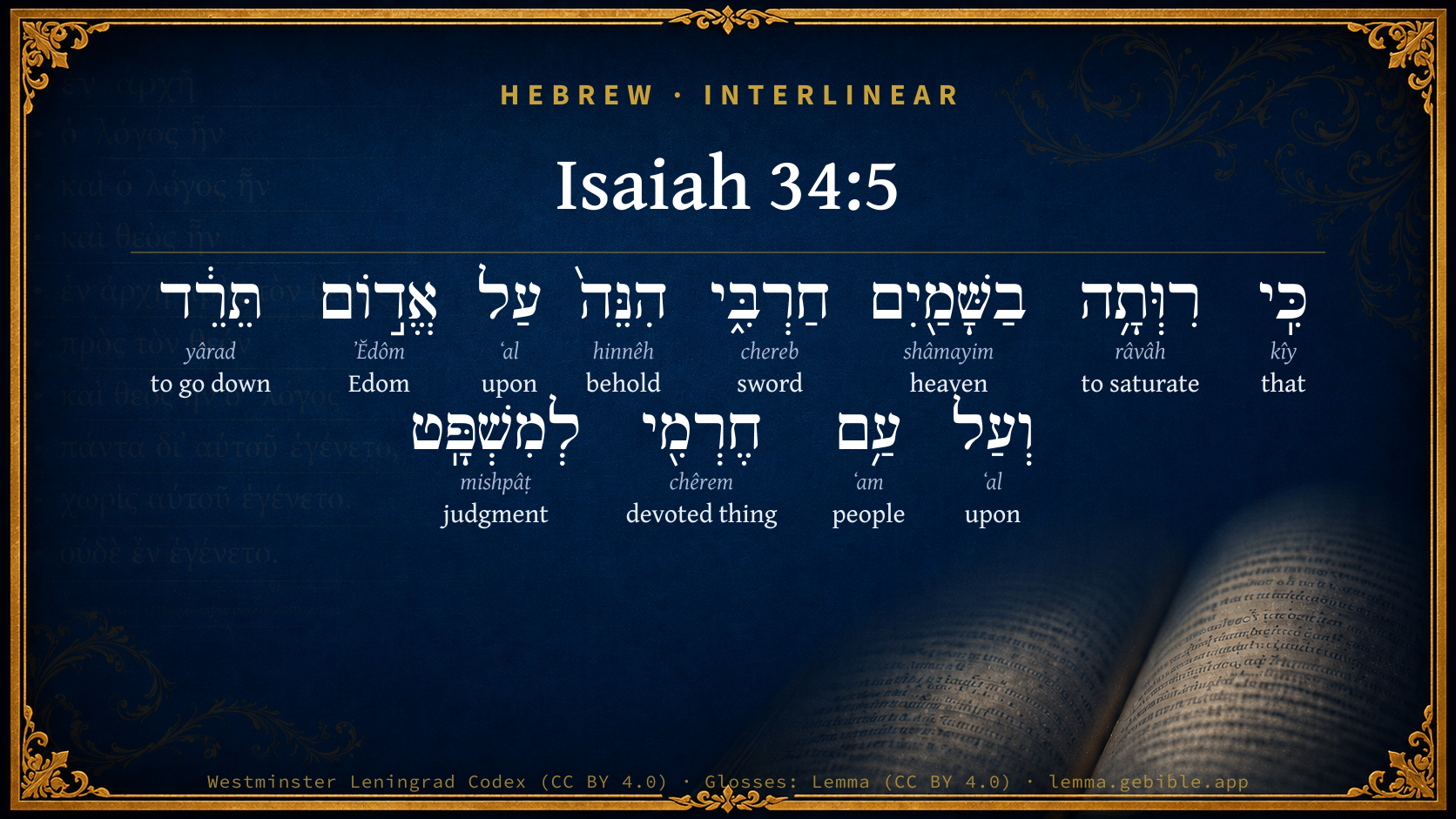
Hebrew (Westminster Leningrad Codex) Isaiah 34:5 appears in the Hebrew Old Testament. The text above is from the Westminster Leningrad Codex. Each word links to its Strong’s number, a concise gloss, and parsing drawn from the Open Scriptures Hebrew Bible morphology. Click any word for its full Brown-Driver-Briggs (BDB) entry.
Download image
Cite this verse

Isaiah 34:5 (World English Bible). Public Domain. Lemma interlinear Bible study tool, https://lemma.gebible.app/v/isaiah/34/5.

Show BibTeX & RIS
BibTeX
RIS
English Translation
For my sword has drunk its fill in the sky: behold, it shall come down on Edom, and on the people of my curse, to judgment.
World English Bible · Public Domain
Download a study sheet

One document with this verse’s original text, its word-by-word gloss line, the meaning frame, cross-references with their text, attributed commentary, and full source and license credits — printable, and it pastes into notes with its structure intact.

This verse Autodidact and up

Study sheet (.html) Plain text (.txt)

A passage Seminary Student

Up to 50 verses in one chapter. A passage sheet keeps up to 6 commentary sources and 12 cross-references per verse, in the order this page ranks them, and says so on the sheet whenever that leaves anything out. Ask for a single verse and you get the Autodidact verse sheet above.

Everything on this page stays free to read, with no account — the sheet is a download of what is already on screen, not access to it.

Want to remove ads? Support Godless Engineer
Compare translations 3

The same verse in 3 English versions, stacked beneath the original-language interlinear above. Click any original word for its lexicon entry.

Each is an independent rendering of the whole verse — the interlinear is not word-aligned to these translations.

Highlighted words mark where these versions differ — a whole-verse word diff, not a word-by-word alignment.

  • World English Bible Public Domain
    For my sword has drunk its fill in the sky: behold, it shall come down on Edom, and on the people of my curse, to judgment.
  • King James Version Public Domain
    For my sword shall be bathed in heaven: behold, it shall come down upon Idumea, and upon the people of my curse, to judgment.
  • unfoldingWord Literal Text CC BY-SA 4.0
    “For my sword has slaked in the heavens; behold, it will descend upon Edom, yes, on the people of my devoting to judgment.”

unfoldingWord Literal Text — © unfoldingWord, licensed CC BY-SA 4.0. Word-aligned USFM3 via Door43 (git.door43.org/unfoldingWord/en_ult).

Versions to compare (up to 4)

3 of 4 selected

Show all 18 translations

Every available English version of this verse, each an independent rendering of the whole verse.

  • World English Bible Public Domain
    For my sword has drunk its fill in the sky: behold, it shall come down on Edom, and on the people of my curse, to judgment.
  • Berean Standard Bible Public Domain
    When My sword has drunk its fill in the heavens, then it will come down upon Edom, upon the people I have devoted to destruction.
  • Majority Standard Bible Public Domain
    When My sword has drunk its fill in the heavens, then it will come down upon Edom, upon the people I have devoted to destruction.
  • King James Version Public Domain
    For my sword shall be bathed in heaven: behold, it shall come down upon Idumea, and upon the people of my curse, to judgment.
  • American Standard Version (1901) Public Domain
    For my sword hath drunk its fill in heaven: behold, it shall come down upon Edom, and upon the people of my curse, to judgment.
  • Revised Version (1885) Public Domain
    For my sword hath drunk its fill in heaven: behold, it shall come down upon Edom, and upon the people of my curse, to judgment.
  • Geneva Bible (1599) Public Domain
    For my sword shalbe drunken in the heauen: beholde, it shall come downe vpon Edom, euen vpon the people of my curse to iudgement.
  • Douay-Rheims (1899) Public Domain
    For my sword is inebriated in heaven: behold it shall come down upon Idumea, and upon the people of my slaughter unto judgment.
  • Young's Literal Translation Public Domain
    For soaked in the heavens was My sword, Lo, on Edom it cometh down, On the people of My curse for judgment.
  • Literal Standard Version CC BY-SA 4.0
    For My sword was soaked in the heavens, || Behold, it comes down on Edom, || On the people of My curse for judgment.
  • Unlocked Literal Bible CC BY-SA 4.0
    For when my sword will have drunk its fill in heaven; look, it will now come down on Edom, on the people I am setting apart for destruction.
  • unfoldingWord Literal Text CC BY-SA 4.0
    “For my sword has slaked in the heavens; behold, it will descend upon Edom, yes, on the people of my devoting to judgment.”
  • Darby Bible Public Domain
    For my sword is bathed in the heavens; behold, it shall come down upon Edom, and upon the people of my ban, to judgment.
  • World Messianic Bible Public Domain
    For my sword has drunk its fill in the sky. Behold, it will come down on Edom, and on the people of my curse, for judgment.
  • Webster's Bible Public Domain
    For my sword shall be bathed in heaven: behold, it shall come down upon Edom, and upon the people of my curse, to judgment.
  • Free Bible Version CC BY-SA 4.0
    After my sword has finished what it has to do in the heavens, it will come down on Edom, on the people I have doomed for destruction.
  • Bible in Basic English Public Domain
    For my sword in heaven is full of wrath: see, it is coming down on Edom, in punishment on the people of my curse.
  • JPS Tanakh (1917) Public Domain
    For My sword hath drunk its fill in heaven; behold, it shall come down upon Edom, and upon the people of My ban, to judgment.

Literal Standard Version (2020), Covenant Press — licensed CC BY-SA 4.0. Text via the HelloAO Bible API (eBible.org). Unlocked Literal Bible (unfoldingWord) — licensed CC BY-SA 4.0. Text via the HelloAO Bible API (eBible.org). unfoldingWord Literal Text — © unfoldingWord, licensed CC BY-SA 4.0. Word-aligned USFM3 via Door43 (git.door43.org/unfoldingWord/en_ult). Free Bible Version, Dr. Jonathan Gallagher — licensed CC BY-SA 4.0. Text via the HelloAO Bible API (eBible.org).

Word by word

More ways to search: Search by grammar → Find every occurrence → Compare this word →

Practice this passage: Drill this verse → Learn its vocabulary →

רִוְּתָ֥ה
râvâh
H7301
“to saturate”
Verb, Piel, Perfect, 3rd Person, Feminine, Singular
Part of Speech
Verb
Stem
Piel
Form
Perfect
Person
3rd Person
Gender
Feminine
Number
Singular
Full BDB Definition

Origin: a primitive root

TWOT: 2130

to be satiated or saturated, have or drink one's fill - (Qal) to take one's fill - (Piel) - to be drunk, be intoxicated - to drench, water abundantly, saturate - (Hiphil) to saturate, water, cause to drink
  1. כִּֽי kîy H3588 “that” Conjunction
  2. בַשָּׁמַ֖יִם shâmayim H8064 “in/at the · heaven(s)” Preposition, Determined + Noun, Common, Masculine, Dual, Absolute
  3. חַרְבִּ֑י chereb H2719 “sword · my” Noun, Common, Feminine, Singular, Construct + Suffix, Personal, 1st Person, Common, Singular
  4. הִנֵּה֙ hinnêh H2009 “behold” Particle, Demonstrative
  5. עַל ʻal H5921 “upon” Preposition
  6. אֱד֣וֹם ʼĔdôm H123 “Edom” Noun, Proper
  7. תֵּרֵ֔ד yârad H3381 “to go down” Verb, Qal, Imperfect, 3rd Person, Feminine, Singular
  8. וְעַל ʻal H5921 “and · upon” Conjunction + Preposition
  9. עַ֥ם ʻam H5971 “people of” Noun, Common, Masculine, Singular, Construct
  10. חֶרְמִ֖י chêrem H2764 “devoted thing · my” Noun, Common, Masculine, Singular, Construct + Suffix, Personal, 1st Person, Common, Singular
  11. לְמִשְׁפָּֽט mishpâṭ H4941 “to/for · judgment” Preposition + Noun, Common, Masculine, Singular, Absolute

About this verse

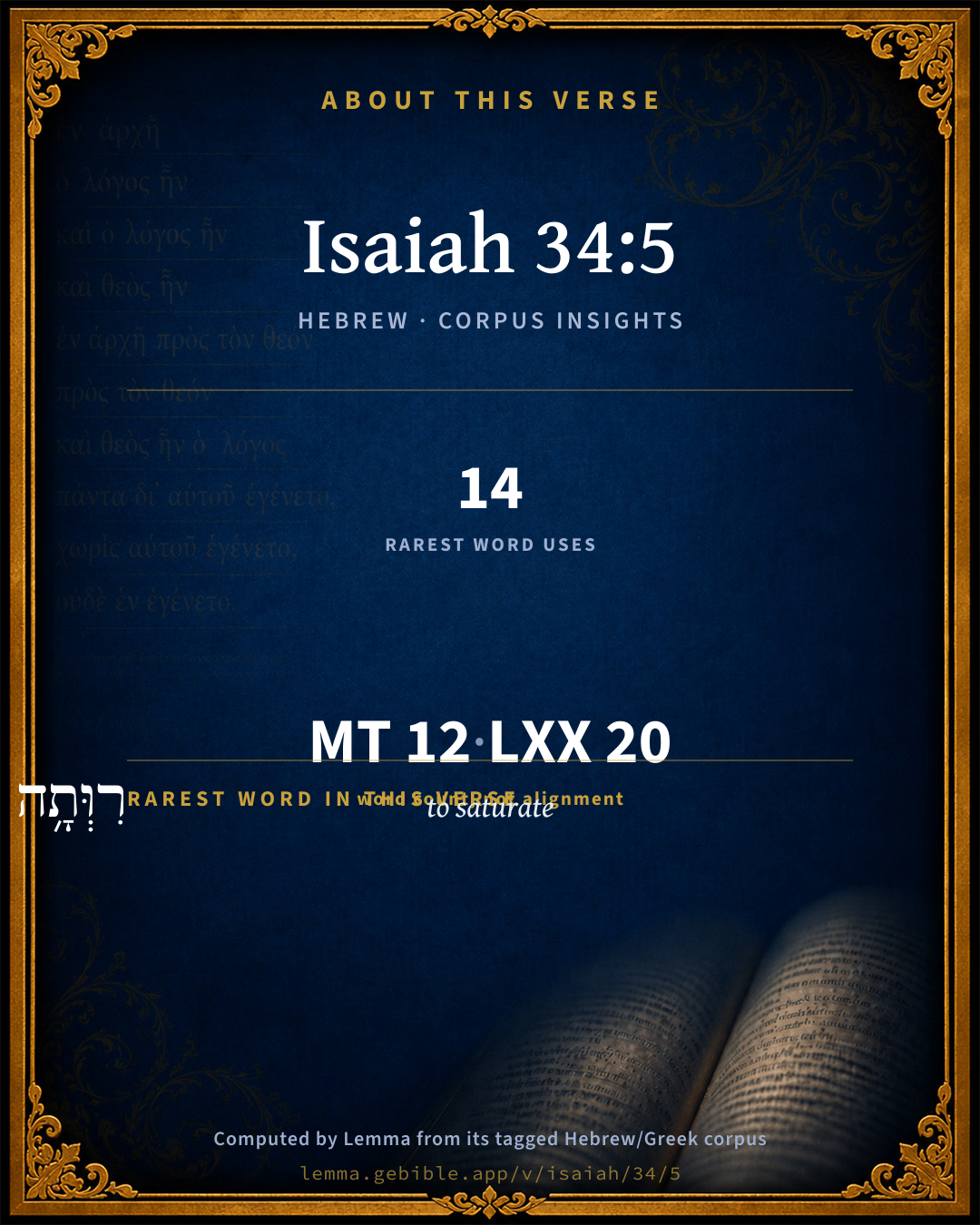
These counts appear in no published source. They are computed here, from the morphology-tagged text and Lemma’s own curated glosses. What Lemma adds →

12
words
11
distinct lemmas
Prophets
section

Notable vocabulary

The rarest word here is רִוְּתָ֥ה to saturate H7301 — appearing just 14 times in the whole Hebrew Bible.

Shared distinctive vocabulary

רִוְּתָ֥ה to saturate H7301 occurs in 14 verses of the Hebrew Bible. Also found in:

Grammatical profile

  • 2 verbs
  • 6 nouns
  • 2 prepositions
  • 1 conjunction
  • 1 particle

Verb forms

  • רִוְּתָ֥ה Piel · Perfect
  • תֵּרֵ֔ד Qal · Imperfect

Repetition

A word recurs within this verse — often emphatic in Hebrew:

Hebrew & Septuagint length

In English translation the verse runs 26 words from the Hebrew and 24 from the Septuagint (LXX English) — closely comparable.

A rough comparison of the two English renderings, which tokenize alike — not a word-level alignment.

Word counts can differ between the Hebrew and the Greek without any difference in meaning — e.g. the Hebrew direct-object marker אֵת has no separate Greek word, and Greek often adds the article ὁ.

In the original languages it is 12 Hebrew tokens and 20 Greek tokens — but the two are counted differently (Hebrew bundles its prefixes and suffixes into one token; the Greek is in lemma form), so that isn’t a like-for-like length.

Cross-references

23

Topical passages linked to Isaiah 34:5 in the Treasury of Scripture Knowledge — connected by theme and wording, ordered by reader-vote popularity; previews shown in the World English Bible.

  • Jeremiah 46:10 For that day is [a day] of the Lord, Yahweh of Hosts, a day of vengeance, that he may avenge him of his adversaries: and the sword shall devour and be satiate, and shall drink its fill of their blood; for the Lord, Yahweh of hosts, has a sacrifice in the north country by the river Euphrates.
  • Isaiah 63:1 Who is this who comes from Edom, with dyed garments from Bozrah? this who is glorious in his clothing, marching in the greatness of his strength? I who speak in righteousness, mighty to save.
  • Amos 1:11–12 Thus says Yahweh: "For three transgressions of Edom, yes, for four, I will not turn away its punishment; Because he pursued his brother with the sword, And cast off all pity, And his anger raged continually, And he kept his wrath forever;
  • Malachi 1:4 Whereas Edom says, "We are beaten down, but we will return and build the waste places;" thus says Yahweh of Hosts, "They shall build, but I will throw down; and men will call them 'The Wicked Land,' even the people against whom Yahweh shows wrath forever."
  • Jeremiah 49:7–22 Of Edom. Thus says Yahweh of Hosts: Is wisdom no more in Teman? is counsel perished from the prudent? is their wisdom vanished?
  • Ezekiel 25:12–14 Thus says the Lord Yahweh: Because Edom has dealt against the house of Judah by taking vengeance, and has greatly offended, and revenged himself on them;
  • Deuteronomy 29:18–21 lest there should be among you man, or woman, or family, or tribe, whose heart turns away this day from Yahweh our God, to go to serve the gods of those nations; lest there should be among you a root that bears gall and wormwood;
  • Deuteronomy 32:14 Butter of the herd, and milk of the flock, With fat of lambs, Rams of the breed of Bashan, and goats, With the finest of the wheat; Of the blood of the grape you drank wine.
  • Deuteronomy 32:41–42 If I whet my glittering sword, My hand take hold on judgment; I will render vengeance to my adversaries, Will recompense those who hate me.
  • Psalms 17:13 Arise, Yahweh, Confront him, cast him down. Deliver my soul from the wicked by your sword;
  • Psalms 137:7 Remember, Yahweh, against the children of Edom, The day of Jerusalem; Who said, "Raze it! Raze it even to its foundation!"
  • Isaiah 24:6 Therefore has the curse devoured the earth, and those who dwell therein are found guilty: therefore the inhabitants of the earth are burned, and few men left.
  • Jeremiah 47:6 You sword of Yahweh, how long will it be before you be quiet? put up yourself into your scabbard; rest, and be still.
  • Ezekiel 21:3–5 and tell the land of Israel, Thus says Yahweh: Behold, I am against you, and will draw forth my sword out of its sheath, and will cut off from you the righteous and the wicked.
  • Ezekiel 21:9–11 Son of man, prophesy, and say, Thus says Yahweh: Say, A sword, a sword, it is sharpened, and also furbished;
  • Obadiah 1:1–14 The vision of Obadiah. This is what the Lord Yahweh says about Edom. We have heard news from Yahweh, and an ambassador is sent among the nations, saying, "Arise, and let's rise up against her in battle.
  • Zephaniah 2:12 You Cushites also, you will be killed by my sword.
  • Matthew 25:41 Then he will say also to those on the left hand, 'Depart from me, you cursed, into the eternal fire which is prepared for the devil and his angels;
  • Deuteronomy 27:15–26 Cursed be the man who makes an engraved or molten image, an abomination to Yahweh, the work of the hands of the craftsman, and sets it up in secret. All the people shall answer and say, Amen.
  • 1 Corinthians 16:22 If any man doesn't love the Lord Jesus Christ, let him be accursed. Come, Lord!
  • Galatians 3:10 For as many as are of the works of the law are under a curse. For it is written, "Cursed is everyone who doesn't continue in all things that are written in the book of the law, to do them."
  • 2 Peter 2:14 having eyes full of adultery, and who can't cease from sin; enticing unsettled souls; having a heart trained in greed; children of cursing;
  • Revelation 1:16 He had seven stars in his right hand. Out of his mouth proceeded a sharp two-edged sword. His face was like the sun shining at its brightest.

Cross-references courtesy of OpenBible.info (CC BY 4.0).

Hebrew and Greek witnesses Masoretic Hebrew ↔ Greek Septuagint

The same verse in the two great witnesses to the Old Testament, shown verse-for-verse.

These are two independent witnesses, not word-aligned to each other, and the Septuagint is shown in lemma (dictionary) form.

Hebrew Isaiah 34:5 Masoretic · Westminster Leningrad Codex

כִּֽי רִוְּתָ֥ה בַשָּׁמַ֖יִם חַרְבִּ֑י הִנֵּה֙ עַל אֱד֣וֹם תֵּרֵ֔ד וְעַל עַ֥ם חֶרְמִ֖י לְמִשְׁפָּֽט

For my sword has drunk its fill in the sky: behold, it shall come down on Edom, and on the people of my curse, to judgment.

World English Bible · Public Domain

Greek LXX Isaiah 34:5 Septuagint · lemma form

μεθύω ὁ μάχαιρα ἐγώ ἐν ὁ οὐρανός ἰδού ἐπί ὁ ιδουμαία καταβαίνω καί ἐπί ὁ λαός ὁ ἀπώλεια μετά κρίσις

My sword has been made drunk in heaven: behold, it shall come down upon Idumea, and with judgment upon the people doomed to destruction.

LXX2012 (modern English Septuagint) · Public Domain

On this verse, Albert Barnes' Notes on the Bible discusses the Septuagint’s reading. Read the note in Commentary ↓

Hebrew: Westminster Leningrad Codex (CC BY 4.0). Greek: Septuagint (public domain); English from LXX2012 (modern English Septuagint) (Public Domain). How the Septuagint differs from the Hebrew →

Targum (Aramaic paraphrase)

1

The Targum is the ancient Jewish Aramaic paraphrase of the Hebrew Scriptures — an interpretive translation, not the Hebrew text itself. Onkelos (literal) and Pseudo-Jonathan (expansive) render the Torah, and Jonathan the Prophets. Coverage is partial: where no permissively-licensed English translation exists for a verse, only the Aramaic is shown. This is verse-level text, not a word-by-word alignment to the Hebrew.

  1. Targum Jonathan Prophets (Joshua–Malachi)
    אֲרֵי תִתְגְלֵי בִשְׁמַיָא חַרְבִּי הָא עַל אֱדוֹם תִּתְגְלֵי וְעַל עַמָא דְחַיָבִית לְדִינָא:

    Because my sword is revealed in heaven; behold, it shall be uncovered upon Edom, and upon the people which I have condemned to judgment.

    Targum Jonathan — Aramaic: “Mikraot Gedolot” (public domain). English: “Sefaria Community Translation” (CC0 1.0 (public-domain dedication)); “London "Chaldee Paraphrase," 1871” (public domain). Text via Sefaria.

Commentary

Notes on Isaiah 34:5 from classic Christian and Jewish commentators (each source and its license shown beneath its notes). The classic Christian expositions comment on the surrounding passage and are grouped to its opening verse, so a note may address several verses; the Jewish commentaries on the Tanakh (Rashi and others) are per-verse, so they appear only where the commentator wrote on this verse.

Lemma curates 59 commentaries, every one of them public domain or Creative Commons licensed, each selected and text-cleaned for this edition rather than reprinted as found. About our sources →

Trapp's Complete Commentary

John Trapp

Isa 34:5 For my sword shall be bathed in heaven: behold, it shall come down upon Idumea, and upon the people of my curse, to judgment.

Ver. 5. For my sword shall be bathed in heaven.] Heb., Drunk, or drenched - i.e., In coelo decretum est ut inebrietur; whencesoever the sword comes, it is bathed in heaven, hath its commission from God (Jer 47:6-7; see Jer 46:9), and as a drunken man reeleth to and fro, so the sword, when once in commission, roveth up and down, and rideth circuit usually. {Eze 14:17}

Behold, it shall come down upon Idumea,] i.e., Upon the Edomites, who were assidui et acerrimi hostes Iudaeorum, bitter enemies to the Jews, though both nations came from Isaac, both were circumcised; so are now the Romish Edomites to the Churches of Christ, with whose blood they are red all over. {Rev 17:6} The Hebrews understand here by Idumea, Rome.

John Trapp, A Commentary or Exposition upon All the Books of the Old and New Testament (1647–1656) — public domain. Text from a community e-Sword module.

The Biblical Illustrator

Joseph S. Exell

Isa_34:5

My sword shall be bathed in heaven

The sword bathed in heaven

The text draws back the curtain which separates the visible world from the invisible.

It reveals celestial regions, in which there are also great struggles going on. It lifts up our eyes to the grander movements of the world of spirits; and then it declares that the sword which is to be used in fighting what seem to be the petty wars of the Hebrews and the Edomites, is the same sword which has been used in these celestial conflicts; that the means and instruments of righteousness upon the earth must be the same with the means and instruments of righteousness in the heavens.

I. ALL GOOD STRUGGLE IN THE WORLD IS REALLY GODS BATTLE, and ought to recognise itself as such. Every special victory of human progress--the victory over slavery, superstition, social wrong, nay, even thevictory over tough matter, the subduing of the hard stuff of nature to spiritual uses,--each of these is but a step in the great onward march of God taking possession of His own. Fight your battle with the sword bathed in heaven; so you shall make it victorious, and grow strong and great yourself in fighting it.

II. One of the most marvellous things about Jesus is the UNION OF FIRE AND PATIENCE. He saw His Fathers house turned into a place of merchandise, and instantly the whip of small cords was in His hands, and He was cleansing the sacred place with His impassioned indignation. And yet He walked day after day through the streets of Jerusalem, and saw the sin, and let the sinners sin on with only the remonstrance of His pure presence and His pitying gaze. Only in Gods own time and in Gods own way can the battles of the Lord be fought. There is no self-will in Jesus. He is one with His Father, and lives by His Fathers will. His sword was always bathed in heaven.

III. THE BATTLE WHICH GOES ON WITHIN OURSELVES IS GODS BATTLE, and is of supreme importance. If the battle be Gods, it must be fought only with Gods weapons. You want to get rid of your selfishness. You must not kill it with the sword of another selfishness, which thenceforth shall rule in its place. Selfishness can only be cast out by self-forget-fulness and consecration. To count sin Gods enemy, and to fight it with all His purity and strength, that is what it means for us that our sword should be bathed m heaven. (Phillips Brooks, D. D.)

The Biblical Illustrator, edited by Joseph S. Exell (c. 1880s–1900s) — public domain. Text from a community e-Sword module.

Joseph Benson's Commentary

Isa 34:5-6. For my sword shall be bathed — In the blood of these people; in heaven — Where God dwells; in which this is said to be done, because it was there decreed and appointed. Or, it shall, as it were, be sharpened and made ready in heaven, to bathe itself on earth. It shall come down upon Idumea — Upon the Edomites, who, though they were nearly related to the Israelites, yet were their implacable enemies. But these are named for all the enemies of God’s church, of whom they were an eminent type. The people of my curse — Whom I have devoted to utter destruction, as the word properly signifies. The sword of the Lord is filled with blood — Shall drink its fill of blood. The metaphor is taken from a great glutton, who is almost insatiable, With the blood of lambs, &c. — By lambs, and goats, and rams, he means people of all ranks and conditions, high and low, rich and poor. Dr. Waterland renders the verse, “When my sword in heaven is bathed, behold it shall sink deep into Idumea, into the people whom I have devoted to judgment.” For the Lord hath a sacrifice — So the prophet terms this bloody work, because it was done by God’s command, and for the honour of his justice and righteous government, and therefore was a service acceptable to him; in Bozrah — A chief city of Edom, (Isa 63:1,) and a type of those cities which should be most hostile to God’s people.

Joseph Benson's Commentary on the Old and New Testaments (1811–1818) — public domain. Text from a community e-Sword module.

Lange's Commentary on the Holy Scriptures

2. THE JUDGMENT ON EDOM, AS REPRESENTATION OF THE WHOLE IN ONE PARTICULAR EXAMPLE OF SPECIAL INTEREST TO ISRAEL

Isa_34:5-15

5          6For my sword shall be bathed in heaven:

Behold, it shall come down upon Idumea,

And upon the people of my curse, to judgment.

6     The sword of the Lord is filled with blood,

It is made fat with fatness,

And with the blood of lambs and goats,

With the fat of the kidneys of rams:

For the Lord hath a sacrifice in Bozrah,

And a great slaughter in the land of Idumea.

7     And the 7 8unicorns shall come down with them,

And the bullocks with the bulls;

And their land shall be 9soaked with blood,

And their dust made fat with fatness.

8     10For it is the day of the Lord’s vengeance,

And the year of recompences for the controversy of Zion.

9     And the streams thereof shall be turned into pitch,

And the dust thereof into brimstone,

And the land thereof shall become burning pitch.

10     It shall not be quenched night nor day;

The smoke thereof shall go up for ever:

From generation to generation it shall lie waste;

None shall pass through it for ever and ever.

11     But the 11cormorant and the 12bittern shall possess it;

The owl also and the raven shall dwell in it:

And he shall stretch out upon it the line of confusion,

And the stones of emptiness.

12     13They shall call the nobles thereof to the kingdom,

But none shall be there,

And all her princes shall be 14nothing.

13     15And thorns shall come up in her palaces,

Nettles and brambles in the fortresses thereof.

And it shall be an habitation of 16dragons,

And a court for 17 18owls.

14     19The wild beasts of the desert shall also meet with 20the wild beasts of the island,

And the 21satyr shall cry to his fellow;

The 22screech owl also shall rest there,

And find for herself a place of rest.

15     There shall the 23great owl make her nest, and lay,

And hatch, and gather under her shadow:

There shall the vultures also be gathered,

Every one with her mate.

TEXTUAL AND GRAMMATICAL

Isa_34:5. Only by great ingenuity can כִּי be explained to mean “for.” Hence Knobel construes it as pleonastic, connecting the discourse, and appeals, e. g. to Isaiah 8:23. But there exists a plain causal connection between Isa_34:4-5, only the res causans is in verse 4 and not in Isa_34:5. Hence כִּי here=“because” and not “for.” Because the sword of God has become drunken in heaven it comes down to earth (comp. Gen_3:14; Gen_33:11; Exo_1:19, etc.).—רִוָּה (comp. Isa_16:9) is direct causative Piel = ebrietatem facere, “to produce drunkenness.” As, e. g., הִשְׁמִין not only means “fatten,” i. e., others, but also “make, produce, grow fat,” i. e., grow fat one’s-self, so this verb means not only “make others drunk” (Jer_31:14; Psa_65:11), but also “make one’s-self drunk.”—למשׁפט=in behoof of accomplishing judgment; comp. Hab_1:12; Eze_44:24 K’ri; comp. Isa_41:1; Isa_54:17, in another sense Isa_5:7; Isa_32:1; Isa_28:26.

Isa_34:6. Drechslek refers ליהוה to מלאה: the sword is to the Lord (the Lord has His sword) full of blood. But then it would need to read הַחֶרֶב, as the sword has already been mentioned. Would one translate; “Jehovah has a sword that is full of blood,” that again does not suit the previous mention of the sword verse 5, though this translation would best suit the three other instances of the use of ליהוה in this section (verses 2, 6, 9). The context requires the rendering “the sword of the Lord is full of blood.” For verses 6, 7 manifestly tell what the sword, (that Isa_34:5 was to come on Edom), when actually come, has done to Edom. This is intimated by describing the sword after the execution. Thus the same sword as Isa_34:5 is meant. The article is wanting because חרב ליהוה, (instead of חרב יהוה, which occurs only 1Ch_21:12) seems to be vox solennis, (Jdg_7:20; Jer_12:12; Jer_47:6).—הֻדַּשְׁנָה instead of הֻתְדַּשְּׁנָה, Hothpaal, from דאן, comp. verse 7; Isa_30:23; Green’s Gram., § 96, a.——That מִן before דַּם is to be explained according to Isa_2:6, does not seem probable. Rather it seems that the notion of causality, that lies in הדשנה מחלב, has passed over to what follows: such as was before intimated, the sword has become from the blood of the sacrificial beasts.—כַּר again only Isa_16:1.—עַתּוּד again only Isa_1:11; Isa_14:9—אילים again in Isa_1:11; Isa_60:7. זֶבַח and טֶבַח (verse 3) correspond in sense and sound. On זבח see list.

Isa_34:8. The Plural שׁלומים occurs only here: comp. the sing. Hos_9:7; Mic_7:3.—If the pointing לְרִיב is correct, then רִיב is to be construed as substantive. For as such it is in the construct state and has given its tone to the governing noun; then ל does not stand directly before the tone syllable. But if it is a verb, then it has the tone, and ל in that case receives pretonic kamets (comp. לָרִיב Isa_3:13). As noun ריב means causae actio, defensio, in the same sense as the verb with following accusative (Isa_1:17; Isa_51:22) is used (comp. Isa_19:20).

Isa_34:10. לְנֵצַח נְצָחִים (the Masoretic form of writing נֵצַח occurs four times; Psa_49:20; 1Sa_15:29; 1Ch_29:11) occurs only here.—תהו ;קַו, see list.

Isa_34:12. חֹרֶיהָ is put absolutely before.—מלובה ,אפם; see list.

Isa_34:13. ארמון comp. Isa_23:13; Isa_25:2; Isa_32:14.—קמושׁ ;סירים; and חוח (kindred חָח Isa_37:29) occur only here in Isaiah, מבצר, locus munitus Isa_17:3; Isa_25:12.—נָוֶה see list.

Isa_34:13-15. שׂעיר ,איים ,ציים ,בנות ,יענה ,תגים comp. on Isa_13:21-22.—חָצִיד (=חָצֵר locus septus) occurs again in Isaiah only Isa_35:7 (see Comm. in loc.).—פָנַשׁ in Isaiah only here.—אַךְ has here also its restrictive sense. When Gesenius (Thes. p. 89) says: that the vis restringendi relates non at proximum sed ad sequens quoddam vocabulum, and translates here accordingly: non nisi spectra ibi habitant, non nisi vultures ibi congregantur, the two statements exclude each other. For where only spectra dwell, the vulture cannot also dwell, and vice versa. To express that, the אַךְ must be joined to לילית and דיות (Isa_34:14-15). But both times it is joined to שָׁם. Hence it appears that the Prophet would say: only there does the lilith rest, only there does the vulture congregate: i.e., there is no other place so suitable for them.—הרניע again Isa_51:4 in another sense; in Isa_28:12 we had the noun מרגעה “resting place.” Also מנוח “resting place,” only here in Isaiah; comp. Gen_8:9; Lam_1:3.

EXEGETICAL AND CRITICAL

1. If the Prophet would not deal only in indefinite generalities in regard to the judgment on the nations of the earth, he must give prominence to the case of one nation instar omnium. Among neighboring nations Moab, and Edom, and Amnion, were most detested by the Israelites (comp. Deu_23:3-6; Eze_35:5; sqq.; Amo_1:11 : Oba_1:10 sqq.; Psa_137:7, etc.). As Isaiah elsewhere, in a similar connection, mentions the Moabites by way of exemplification (Isa_25:10 sqq.), it is natural he should give similar prominence also to Edom, as he does here and Isa_63:1 sqq. Now, because the sword of Jehovah has already become drunken in heaven with blood, it descends to earth, because it finds no more work above.

2. For my swored—of Zion.

Isa_34:5-8. The relation of this section to what precedes is this: the Prophet has said (Isa_34:2-3), what the. Lordpurposes to do on earth. החרימם and נתנם Isa_34:2 are to be understood of acts of the will, not of performance: Isa_34:3 describes prophetically what shall once take place on earth in consequence of that divine decree. Isa_34:4 pictures the judgment that shall be executed on the heavens, but here the Prophet combines intention and performance. He contemplates the judgment of God as beginning in heaven, and continued on earth.

[On the construction of כִּי see Text, and Gram. “It may be construed in its proper sense, either with Isa_34:3 (Hitzig), or with the whole of the preceding description. All this shall certainly take place for my sword (the speaker being God Himself) is steeped,” etc.—J. A. Alex.,in loc.].

The expression is a bold poetic one. Isaiah speaks of the sword of the Lord again Isa_27:1; Isa_66:16. But only here does he personify it. He may, as regards the sense, have in mind Deu_32:41-43. Inevitable and irresistible are the judgments of the Lord. This the Prophet expresses by saying that the sword of the Lord, intoxicated with the judgment accomplished on “the host of the high ones that are on high” (Isa_24:21), and thirsting for more blood, descends to earth, and that first on Edom, as the nation that above all has become an object of the divine ban. (חֵרֶם the segregatio ad internecionem, 1Ki_20:42; Isa_43:28). Isa_34:6-7 describe the effects of the execution. The sword of the Lord is not only full of blood, but is fattened, dropping fat. As in the second clause of Isa_34:6, the Edomites are regarded as a sacrifice, they are here compared to sheep, goats and rams.

Bozra stands for Edom also Isa_63:1. Concerning this city see on Jer. 69:13.

The enumeration of buffaloes, bullocks and bulls (Isa_34:7) denotes that the entire nation shall perish, great and small, high and low. רְאֵם (only here in Isaiah, elsewhere only Num_23:22; Deu_33:17; Job_39:9 sq.; Psa_22:22; Psa_29:6; Psa_92:11). It is now universally understood to mean the buffalo (see Herz.R.–Encycl, xl. p. 28). פָרִים see on Isa_1:11. אביר meaning “bull” occurs only Isa_10:13 K’thibh. ירד meaning “to fell” trees, beasts or men, is peculiar to Isaiah (see Isa_32:19). For Jer_48:15; Jer_50:27; Jer_51:40 the use of the word is not quite the same. In consequence of the slaughter the earth itself is drunk with blood, and fat with fat, comp. on Isa_34:5-6. The parallelism reigns not only in these verses, but in the entire complexity of Isa_34:6-8. For the description of the judgment in Isa_34:6 a. and Isa_34:7 correspond, and the reasons assigned Isa_34:6 b. and Isa_34:8. But progress appears in the thought because Isa_34:8 gives particularly the object of the “sacrifice” and the “slaughter.” The Lord will thereby satisfy His vengeance, and give Zion justice by a righteous recompense.

The expression for the day of the Lord’setc., recalls Isa_2:12 and Isa_63:4. But the Prophet seems moreover to have in mind Deu_32:35; Deu_32:41. For in those passages, as here, the notions of vengeance and recompense underlie the discourse.

But beside this, our passage lay before Jeremiah. For Jer_46:10 is penetrated with elements drawn from Isa_34:5-8. The following considerations show that our passage is the source from which Jer. drew. 1) The grand, drastic boldness and loftiness of the language of our passage, of which the words of Jer., after the fashion of that Prophet, are but a tempered imitation. 2) Isaiah uses the expression רִוְּתָה twice (Isa_34:5; Isa_34:7); Jer. says, רָוְתָה It is much more likely that Jeremiah would dilute the strong expression of a predecessor, in his well-known fashion (see my comm. on Jer. Introd. § 3) than that an author living much later in the exile, should intensify the normal but weaker expression of Jeremiah 3) Jer. says יוֹם נְקָמָה, Isaiah; יוֹם Now in general נקם is the older form of the word, and is used only in Lev_26:25; Deu_32:35; Deu_32:41; Deu_32:43; Jdg_16:28; Psa_58:11; Pro_6:34; Mic_5:14, and in Isa. (Isa_35:4; Isa_47:3; Isa_59:17; Isa_61:2; Isa_63:4). In the exceptions Eze_24:8; Eze_25:12, נְקֹם נָקָם is evidently said for the sake of the effect of sound; in Eze_25:15 the expression וַיִנָקְמוּ נקם is used along with נְקָמָה. On the other hand נְקָמָה is the form exclusively used by Jeremiah, and in Ezekiel it is the prevalent form (the exceptions being given above) and beside these is used only here and there (Num_31:2-3; Lam_3:60; Psa_149:7). But it is not probable that a writer later than Jeremiah has introduced the old form into a passage borrowed from Jeremiah.

3. And the streams—emptiness.

Isa_34:9-11. Edom was situated at the southern point of the Dead Sea. The following description recalls the pitchy and sulphurous character of this sea and its surroundings. It seems as if the Prophet would allude to that event which, recorded in Gen_19:24-25; Gen_19:28, had impressed that character on the region. At least the sulphur, the overturning (הפך) and the ascending smoke are traits that he seems to have borrowed from that passage. זֶפֶת occurs again only Exo_2:3. נפרית we had already where Isa_30:33 the breath of God is called “a stream of brimstone.” When the streams are flowing pitch and the dust of the land is sulphur, the whole land will become a fearful place of conflagration. Day and night (the expression occurs Deu_28:66, beside comp. Isa_4:5; Isa_21:8; Isa_60:11), forever, for it is the flame of the last judgment, the burning shall continue. The burning land is the subject of תבכה which is used intensively also Isa_43:17; Isaiah 46:24.

Isa_34:10. On דור as defining time see on Isa_13:20. מדור לדור occurs only here. חַרַבexarescere, exsiccari, comp. Isa_19:5-6; Isa_44:27; Isa_60:12. אֵין עֹבֵר again only Isa_60:15. It does not agree well to say of the same land that it shall become an everlasting burning, and that it shall be a pathless desert. But the Prophet describes the future by means of the present, and contemplates the earth as an Edom cursed of God, and thinks of the latter as a scorched desert land. [The same may be said of the similarly inconsistent descriptions in all that follows in this section.—Tr.].

Isa_34:11. As such the land is inhabited only by beasts of the desert. [On the names of beings enumerated in this and the following verses see J. A. Alex.,comm, in loc, especially on לילית Isa_34:14.—Tr.]. קאת (from קוא “to vomit”) is the pelican (Lev_11:18; Deu_14:17; Zep_2:14), קפד “the porcupine” (see on Isa_14:23; Zep_2:14). נשׁוף “the owl” (only here in Isa. comp. Lev_9:17; Deu_14:16),—ערב “the raven” (in Isaiah only here). As right building can only be done by means of measuring line and plummet (Job_38:5), so shall right destruction be directed by aid of the same implements. The image is the same as Amo_7:7-9, comp. 2Ki_21:23; Lam_2:8. “The stone” is the weight that makes the line plumb. The expression אבני בהו is ἄπ. λεγ.; and בהו Isaiah uses no where else (see Gen_1:2; Jer_4:23).

[“The sense of the whole metaphor may then be—that God has laid this work out for Himself and will perform it (Barnes),—that even in destroying He will proceed deliberately, and by rule (Knobel), which last thought is well expressed in Rosenmueller’s paraphrase (ad mensuram vastabitur, ad regulam depopulabitur).”—J. A. Alexander.]

4. They shall call—with her mate.

Isa_34:12-15. The Prophet now describes the desolation as it affects the territory of the nobility of Edom, both as to their persons and their castles. חריה being nominative absolute, the words must be translated: “as to her nobles, there are none there that call out a monarchy (election of king, accession to regency).” As the presence of the nobility is the necessary condition of a king’s election, and not vice versa, I regard this translation as more correct than the other which is also grammatically possible, viz.: “there is no kingdom that they may proclaim.” Moreover it is logically more correct that in the phrase with וְ the word put before absolutely should be the subject. Royalty in Edom was not inherited, but Esau’s descendants formed a high nobility from which the king proceeded by election (Gen_36:15 sqq.; 31 sqq.). חֹרliber, ingenuus, nobilis Isaiah uses only here. Comp. Ecc_10:17; Jer_27:20 and often.

[On חריה J. A. Alexander gives a copious synopsis of interpretations and then adds: “This great variety of explanations, and the harshness of construction with which most of them are chargeable, may serve as an excuse for the suggestion of a new one, not as certainly correct, but as possibly entitled to consideration.” Beside the meaning nobles, הֹרִים in several places “no less certainly means holes or caves (see 1Sa_14:11; Job_30:6; Nah_2:13). Now it is matter of history not only that Edom was full of caverns, but that these were inhabited and that the aboriginal inhabitants, expelled by Esau, were expressly called Horites (חֹרִים) as being inhabitants of caverns (Isa_14:6; Isa_36:20; Deu_2:12; Deu_2:22). This being the case, the entire depopulation of the country, and especially the destruction of its princes, might be naturally and poetically expressed by saying that the kingdom of Edom should be thenceforth a kingdom of deserted caverns.” For the appropriateness of description see in Robinson’s “Researches” the account of Petra.—Tr.].

Isa_34:13. The ruin of the nobility is followed by that of their palaces. They are said to mount up (עלתה) but only ironically, for they appear great and high only by the rank wild growth on them.

Not only beasts of the desert, but also repulsive demons of the desert disport themselves in the desolate ruins of Edom. The Prophet mentions a female being, the ghost-like, restlessly wandering (comp. Mat_12:43) Lilith, but which just there in those dreadful places finds a congenial resting place. The name לִילית certainly comes from לַיִל “the night,” and denotes a being of the night, a spectre. According to the Talmud Lilith is the chief of the nocturnal Schedim, of the לִילִין or טְלָנִין (comp. Buxtorf,Lex. rabb., p. 1140 and 877), and bears the name אַנִּרַת בַּת קַחְלַתi. e., “Agrath the (female) dancer.” Comp. Kohut,Jüd. Angel, und Dämonol, 1866, p. 61 and 86 sqq. Certainly Lilith is a production of popular superstition, to which various attributes and forms of appearance are ascribed. Comp. Buxtorf,l. c.Bochart,Hieroz. III. p. 829, ed.Rosenmueller, Gesen.Thes. p. 749. [Smith’sDiet, of Bible, under the word Owl]. לילית is ἄπ. λεγ.

[“In itself it means nothing more nor less than nocturnal, and would seem to be applicable to an animal or to any other object belonging to the night.” “This gratuitous interpretation of the Hebrew word” (viz., as referring to the superstitions mentioned above) “was unfortunately sanctioned by Bochart and Vitringa, and adopted with eagerness by the modern Germans who rejoice in every opportunity of charging a mistake in physics, or a vulgar superstition on the Scriptures. This disposition is the more apparent here, because the writers of this school usually pique themselves upon the critical discernment with which they separate the exegetical inventions of the Rabbins from the genuine meaning of the Hebrew text. Gesenius for example, will not even grant that the doctrine of a personal Messiah is so much as mentioned in the writings of Isaiah, although no opinion has been more universally maintained by the Jews, from the date of their oldest uncanonical books. In this case, their unanimous and uninterrupted testimony goes for nothing, because it would establish an unwelcome identity between the Messiah of the Old and New Testament. But when the object is to fasten on the Scriptures an odious and contemptible superstition, the utmost deference is paid, not only to the silly legends of the Jews, but to those of the Greeks, Romans, Zabians and Russians.” “Beside the fact that לילית means nocturnal, and that its application to a spectre is entirely gratuitous, we may argue here, as in Isaiah 13:25, that ghosts as well as demons would be wholly out of place in a list of wild and solitary animals. Is this a natural succession of ideas? Is it one that ought to be assumed without necessity?” … “Of all the figures that could be employed, that of resting seems to be the least appropriate in the description of a spectre.” … The quotation of Mat_12:43 in this connection is “strange” and “incongruous,” “where the evil spirit is expressly said to pass through dry places seeking rest and finding none.” … “The sense 19 sufficiently secured by mating לילית mean a nocturnal bird (Aben Ezra), or more specificially, an owl (Cocceius), or screech-owl (Lowth). But the word admits of a still more satisfactory interpretation, in exact agreement with the exposition which has already been given of the preceding terms as general descriptions rather than specific names. If these terms represent the animals occupying Idumea, first as belonging to the wilderness (ציים), then as distinguished by their fierce and melancholy cries (איים), and then as shaggy in appearance (שׂעיר), nothing can be more natural than that the fourth epithet should also be expressive of their habits as a class … nocturnal or belonging to the night.”—J. A. Alexander,in loc.—Tr.].

Isa_34:15. Bochart in his Hieroz., II. p. 194 sqq., has proved that קפוז means arrow-snake. In lonely places, out of danger it harbors and lays its eggs. מִלֵט Piel=“to cause slipping away,” like the Hiph. Isa_66:7; the imperf., with Vav consecutive makes what must hypotactically be regarded as a repeated fact, appear paratactically as occurring once. בקע “to cleave,” for by cleaving open the young are brought forth, comp. Isa_35:6; Isa_58:8; Isa_59:5. דגר “to cherish” (only here and Jer_17:11), cherishes the young in its shadow (i. e., of its own body)—דיה “vulture,” again only Deu_14:13. The expression אשׁה רעותה only here and Isa_34:16 in Isaiah. Drechsler justly construes it as asyndeton, and as in apposition with the subject, as must be done also Isa_34:16.

[“As to the particular species of animals referred to in this whole passage, there is no need, as Calvin well observes, of troubling ourselves much about them. (Non est cur in iis magnopere torqueamur). The general sense evidently is that a human population should be succeeded by wild and lonely animals—implying total and continued desolation.”—J. A. Alexander. For rich illustration of the subject from modern travellers see Barnes’ Notes on Isaiah, in loc.—Tr.].

DOCTRINAL AND ETHICAL

1. On Isa_34:1-4. Because Rev_6:12-17 has express reference to this passage, some would conclude that the Prophet here has in view only that special event of the world’s judgment (the opening of the sixth seal). But that is not justified. For other passages of the New Testament that do not specially relate to the opening of the sixth seal are based on this passage (Mat_24:29; 2Pe_3:7 sqq.; Rev_14:11; Rev_19:11 sqq.). It appears from this that the present passage is, as it were, a magazine from which New Testament prophecy has drawn its material for more than one event of fulfilment.

2. On Isa_34:16. The word of God can bear the closest scrutiny. Indeed it desires and demands it. If men would only examine the Scriptures diligently and with an unclouded mind and love of truth, “whether these things are so,” as did the Bereans (Act_17:11; Joh_5:39)!

3. On Isa_35:3. “The Christian church is the true Lazaretto in which may be found a crowd of weary, sick, lame and wretched people. Therefore, Christ is the Physician Himself (Mat_9:12) who binds up and heals those suffering from neglect (Eze_34:16; Isa_61:1). And His word cures all (Wis_16:12). His servants, too, are commissioned officially to admonish the rude, to comfort the timid, to bear the weak, and be patient with all (1Th_5:14). Therefore, whoever feels weak, let him betake himself to this Bethania; there he will find counsel for his soul,” Cramer.

4. [On Isa_35:8-9. “They who enter the path that leads to life, find there no cause of alarm. Their fears subside; their apprehensions of punishment on account of their sins die away, and they walk that path with security and confidence. There is nothing in that way to alarm them; and though there are many foes—fitly represented by lions and wild beasts—lying about the way, yet no one is permitted to ‘go up thereon.’ This is a most beautiful image of the safety of the people of God, and of their freedom from all enemies that could annoy them.” “The path here referred to is appropriately designed only for the redeemed of the Lord. It is not for the profane, the polluted, the hypocrite. It is not for those who live for this world, or for those who love pleasure more than they love God. The church should not be entered except by those, who have evidence that they are redeemed. None should make a profession of religion who have no evidence that they belong to “the redeemed,” and who are not disposed to walk in the way of holiness. But for all such it is a highway on which they are to travel. It is made by leveling hills and elevating valleys; across the sandy desert and through the wilderness of this world, infested with the enemies of God and His people. It is made straight and plain, so that none need err; it is defended from enemies, so that all may be safe; because ‘He,’ their Leader and Redeemer, shall go with them and guard that way.” Barnes in loc.]

Footnotes:

[6]Because my sword has become drunken.

[7]Or, rhinoceros.

[8]buffaloes.

[9]Or, drunken.

[10]For a day of vengeance has Jehovah.

[11]Or, pelican.

[12]porcupine.

[13]Its nobles—there are none to proclaim the monarchy.

[14]no more.

[15]And its palaces soar aloft in thorns.

[16]jackal.

[17]Or, ostriches.

[18]Heb. daughters of the owl.

[19]Heb. ziim.

[20]Heb. Ijim.

[21]shaggy monster.—J. A. A.

[22]Or, night monster.

[23]arrowsnake.

Lange's Commentary on the Holy Scriptures (Critical, Doctrinal, and Homiletical), ed. John Peter Lange, English translation edited by Philip Schaff (1864–1880) — public domain. Text from a community e-Sword module.

Tyndale Open Study Notes

Tyndale Open Resources

34:5 Edom here represents what all the nations would experience, just as Moab was singled out in ch 25.

Tyndale Open Study Notes — © Tyndale Open Resources, licensed CC BY-SA 4.0. Text via the HelloAO Bible API.

Geneva Bible (1599)

Geneva Bible translators

They had an opinion of holiness, because they came of the Patriarch Isaac, but in effect were accursed of God, and enemies unto his Church, as the Papists are.

I have determined in my secret counsel, and in the heavens to destroy them till my sword be weary with shedding of blood.

Geneva Bible (1599) marginal notes — public domain. Text via Bolls.life.

Jamieson, Fausset & Brown

Robert Jamieson, A. R. Fausset & David Brown

sword-- (Jer 46:10). Or else, knife for sacrifice for God does not here appear as a warrior with His sword, but as one about to sacrifice victims doomed to slaughter [VITRINGA]. (Eze 39:17).

bathed--rather "intoxicated," namely, with anger (so Deu 32:42). "In heaven" implies the place where God's purpose of wrath is formed in antithesis to its "coming down" in the next clause.

Idumea--originally extending from the Dead Sea to the Red Sea; afterwards they obtained possession of the country east of Moab, of which Bozrah was capital. Petra or Selah, called Joktheel (Kg2 14:7), was capital of South Edom (see on Isa 16:1). David subjugated Edom (Sa2 8:13-14). Under Jehoram they regained independence (Ch2 21:8). Under Amaziah they were again subdued, and Selah taken (Kg2 14:7). When Judah was captive in Babylon, Edom, in every way, insulted over her fallen mistress, killed many of those Jews whom the Chaldeans had left, and hence was held guilty of fratricide by God (Esau, their ancestor, having been brother to Jacob): this was the cause of the denunciations of the prophets against Edom Isa 63:1, &c.; Jer 49:7; Eze 25:12-14; Eze 35:3-15; Joe 3:19; Amo 1:11-12; Oba 1:8, Oba 1:10, Oba 1:12-18; Mal 1:3-4). Nebuchadnezzar humbled Idumea accordingly (Jer 25:15-21).

of my curse--that is, doomed to it.

to judgment--that is, to execute it.

Jamieson, Fausset & Brown — Commentary Critical and Explanatory on the Whole Bible (1871) — public domain (CC PDM 1.0). Text via the HelloAO Bible API.

Adam Clarke's Commentary

Verse 5. For my sword shall be bathed in heaven - "For my sword is made bare in the heavens"] There seems to be some impropriety in this, according to the present reading: "My sword is made drunken, or is bathed in the heavens;" which forestalls, and expresses not in its proper place, what belongs to the next verse: for the sword of JEHOVAH was not to be bathed or glutted with blood in the heavens, but in Botsra and the land of Edom. In the heavens it was only prepared for slaughter. To remedy this, Archbishop Secker proposes to read, for בשמים bashshamayim, בדמם bedamim; referring to Jer 46:10. But even this is premature, and not in its proper place. The Chaldee, for רותה rivvethah, has תתגלי tithgalli, shall be revealed or disclosed: perhaps he read תראה teraeh or נראתה nirathah. Whatever reading, different I presume from the present, he might find in his copy, I follow the sense which he has given of it.

Adam Clarke's Commentary on the Bible (1810–1826) — public domain. Text from a community e-Sword/MySword module.

Ellicott's Commentary for English Readers

(5) My sword shall be bathed in heaven . . .—Literally, hath drunk to the full. The words find an echo in Deu_32:41-42, and Jer_46:10. There, however, the sword is soaked, or made drunk with blood. Here it is “bathed in heaven,” and this seems to require a different meaning. We read in Greek poets, of the “dippings” by which steel was tempered. May not the “bathing” of Isaiah have a like significance?

It shall come down upon Idumea . . .—Better, for Edom, . . . here and in the next verse. No reason can be assigned for this exceptional introduction of the Greek form.

A Bible Commentary for English Readers, edited by Charles John Ellicott (1878–1897) — public domain. Text from a community e-Sword module.

The Cambridge Bible for Schools and Colleges

gen. ed. J. J. S. Perowne

5. my sword (see on ch. Isa_27:1) shall be bathed] Better: is drunk; i.e. not “with blood” (which suggests an idea foreign to this passage) but “with fury,” in preparation for its work, which is on earth.

Idumea] Read Edom with R.V. The A.V. uses this Greek form here and in Isa_34:6, and in Eze_35:15; Eze_36:5, without any justification.

the people of my curse] The last word is strictly ban (ḥçrem, cf. Isa_34:2): “the people on whom I have laid the ban.”

5–8. The slaughter of the inhabitants of Edom.

The Cambridge Bible for Schools and Colleges (gen. ed. J. J. S. Perowne; Cambridge University Press, 1878–1918) — public domain. Text from a community e-Sword module.

John Gill's Exposition

For my sword shall be bathed in heaven,.... That is, the sword of the Lord, as it is called in the next verse Isa 34:6, and it is he that is speaking; it designs the vengeance of the Lord, the punishment he will inflict on the wicked, said to be "bathed in heaven", because determined and prepared there; the allusion may be to the bathing of swords in some sort of liquor, to harden or brighten them, and so fit them for use. Kimchi renders it, "my sword" which is "in heaven shall be bathed", that is, in the blood of the slain; "heaven" may denote the whole Roman Papal jurisdiction, as it does the whole Roman Pagan empire in Rev 12:7 and may design the principal men in it, those that are in the highest places and offices, in whom the sword of the Lord shall be first drenched, and be as it were satiated and inebriated with the blood of them:

behold, it shall come down upon Idumea; with great weight, force, and vengeance, having a commission from heaven to execute. Idumea is here particularly mentioned, because the Edomites were implacable enemies to the Jews, and so are here put for all the enemies of God's church and people, all the antichristian states, particularly Rome, which the Jews, as Jerom observes, understand by Edom or Idumea here:

upon the people of my curse to judgment; a very descriptive character of the Papists, the people of God's curse, and righteously so; those who have anathematized his people, and cursed them with bell, book, and candle, are anathematized by him, devoted to destruction, and doomed to be accursed, sentenced to ruin, and on whom judgment shall pass, and shall be executed; they shall hear, "go, ye cursed", both here and hereafter, at the fall of Babylon, and at the general judgment. The Targum is,

"because my sword is revealed in heaven; behold, upon Edom it is revealed, and upon the people whom I have condemned to judgment.''

John Gill's Exposition of the Whole Bible (1746–1763) — public domain (CC PDM 1.0). Text via the HelloAO Bible API.

Albert Barnes' Notes on the Bible

For my sword shall be bathed in heaven - A sword is an instrument of vengeance, and is often so used in the Scriptures, because it was often employed in capital punishments (see the note at Isa 27:1). This passage bas given much perplexity to commentators, on account of the apparent want of meaning of the expression that the sword would be bathed in heaven. Lowth reads it:

For my sword is made bare in the heavens;

Following in this the Chaldee which reads תתגלי tı̂thgallı̂y, ‘shall be revealed.’ But there is no authority from manuscripts for this change in the Hebrew text. The Vulgate renders it, Quoniam inebriatus est in coelo gladius meuse - ‘My sword is intoxicated in heaven.’ The Septuagint renders it in the same way, Ἐμεθύσθη ἡ μάχαιρά μον ἐν τῷ οὐρανῷ Emethusthē hē machaira mou en tō ouranō; and the Syriac and Arabic in the same manner. The Hebrew word רוּתה rivetâh, from רוה râvâh, means properly to drink to the full; to be satisfied, or sated with drink; and then to be full or satiated with intoxicating liquor, to be drunk. It is applied to the sword, as satiated or made drunk with blood, in Jer 46:10 :

And the sword shall devour,

And it shall be satiate, and made drunk with their blood.

And thus in Deu 32:42, a similar figure is used respecting arrows, the instruments also of war and vengeance:

I will make mine arrows drunk with blood;

And my sword shall devour flesh.

A similar figure is often used in Oriental writers, where the sword is represented as glutted, satiated, or made drunk with blood (see Rosenmuller on Deu 32:42). Thus Bohaddinus, in the lift of Saladin, in describing a battle in which there was a great slaughter, says, ‘The swords drank of their blood until they were intoxicated.’ The idea here is, however, not that the sword of the Lord was made drunk with blood in heaven, but that it was intoxicated, or made furious with wrath; it was excited as an intoxicated man is who is under ungovernable passions; it was in heaven that the wrath commenced, and the sword of divine justice rushed forth as if intoxicated, to destroy all before it. There are few figures, even in Isaiah, that are more bold than this.

It shall come down upon Idumea - (see the Analysis of the chapter for the situation of Idumea, and for the causes why it was to be devoted to destruction).

Upon the people of my curse - The people devoted to destruction.

Albert Barnes' Notes on the Bible (1834–1885) — public domain. Text from a community e-Sword/MySword module.

Haydock's Catholic Bible Commentary

Heaven. Casting down the rebel angels. (St. Jerome) --- The resolution to destroy the Idumeans, for their cruelty to the Jews, has been taken long ago. All these expressions allude to the last judgment. (Calmet) --- Idumea. Under the name of Idumea or Edom, a people that were enemies of God and his Church. (Challoner) --- Assaradon fell upon Edom two years after Sennacherib’s death. (Calmet) --- No strong place like Bosra, shall rescue any from destruction at the last day. (Worthington)

George Leo Haydock (1774–1849), Haydock's Catholic Family Bible and Commentary, 1859 edition — public domain. Excludes Psalms (Douay-Rheims chapter numbering differs from Protestant) and Deuterocanonical books (Catholic canon only).

Matthew Poole's English Annotations

Shall be bathed in the blood of these people; Heb. is or shall be made drunk. In heaven; either,

1. In my church, which is called heaven, Dan 8:10; Rev 4:1; 12:1, in and against which these enemies are said to be gathered together. Or,

2. In the highest heaven, where God dwells; in which this is said to be done, because it was there decreed and appointed to be done.

Upon Idumea; upon the Edomites, who, though they were nearly related to the Israelites, and were circumcised as well as they; yet were their most inveterate and implacable enemies, watching all opportunities, and being ready to join with all those that attempted, to destroy them; whereof we have many intimations and instances in Scripture. But these are not named exclusively, but rather comprehensively, and synecdochically, for all the enemies of God’s church, of whom they were a considerable part, and an eminent type.

Upon the people of my curse; to whom my curse belongs; or, whom I have cursed, and devoted to utter destruction, as this Hebrew word properly signifies.

Matthew Poole's English Annotations on the Holy Bible (1683–1685) — public domain. Text from a community e-Sword/MySword module.

Whedon's Commentary on the Bible

Daniel D. Whedon

5-7. For my sword — Poetical instrument of vengeance, and its use an ethical necessity against conscious wrong doers.

Be bathed — Or, made drunk, (Septuagint and Vulgate;) a figure from Deu_32:42, and kept up in Revelation, from wine of the wrath of God.

In heaven — The seat of the divine plans upon Idumaea, or Edom, representatively, used for all peoples and nations warring against Jehovah’s cause. Nothing can expiate their crimes of incorrigible rebellion but their sacrifice. As all sin requires this, through use of the blood and fat of victims, so Edom, in one of its chief localities, Bozrah, for example, situated in its eastern hills, (not the “Bozrah” of the north, in the Hauran,) shall witness a great sacrificial slaughter, thorough, final, making clean sweep of men and animals, even wild, fierce, strong, young and old animals, all representing every class of men ranked among God’s potent and malignant foes.

Unicorns — Is of doubtful meaning. Delitzsch and Gesenius translate it buffalo; Bochart, gazelle. Neither is satisfactory. The original word, R’em, means a roaring, untamed animal of great strength and fierceness, and answers as much to wild bull (possibly buffalo bull) as to any thing else which present knowledge of the ancient natural history in of Palestine can supply. The rhinoceros may have rarely touched that territory in the warm jungles of the Ghor near the Dead Sea, but of this there is no other knowledge than what is possibly implied in the word itself. All these go down together, and in this way does Jehovah avenge Edom, a people figuratively comprehending all his enemies.

Daniel D. Whedon (gen. ed.), Commentary on the Old and New Testaments (1874–1909) — public domain. Text from a community e-Sword module.

The Pulpit Commentary

My sword shall be bathed in heaven; rather, has been bathed, or has been made drunken (eneyusyh , LXX) in heaven. Some suppose a reference to the old" war in heaven," when the sword of Divine justice was drawn against the devil and his angels. Others regard the sword now to be used against the Idumeans as first, in heaven, "made drunken" with the Divine anger. It shall come down upon Idumea. (comp. Isa_63:1-6) The Edomites first showed themselves enemies of Israel when they refused to allow the Israelites, under Moses, "a passage through their border". (Num_20:14-21) David subdued them; (2Sa_9:1-4) but they revolted from Jehoram, (2Ch_21:8-10) and were thenceforward among the most bitter adversaries of the southern kingdom. They "smote Judah" in the reign of Ahaz, (2Ch_28:17) and were always ready to "shed the blood of the children of Israel by the force of the sword in the time of their calamity". (Eze_35:5) Amos speaks of them very much in the same tone as Isaiah. (Amo_1:11, Amo_1:12) They ultimately "filled up the measure of their iniquities" by open rejoicing when Jerusalem was destroyed, and the people led away captive by Nebuchadnezzar. (Psa_137:7 Oba_1:10-14 Lam_4:21, 22 Eze_35:10-13) In the present passage we must regard the Edomites as representative of the enemies of God"s people generally (see the introductory paragraph). The people of my curse; i.e. "the people on whom I have laid a curse the Edomites. Esau was to "serve" Jacob, (Gen_25:23 Gen_27:40) Edom to be "a possession" for Judah. (Num_24:18) God had said of Edom, probably before Isaiah uttered the present prophecy, "For three transgressions of Edom, and for four, I will not turn away the punishment thereof... but I will send a fire upon Teman, which shall devour the palaces of Bozrah". (Amo_1:11, Amo_1:12) Thus Edom was under a curse.

The Pulpit Commentary (1880–1919), ed. H.D.M. Spence-Jones & Joseph S. Exell — public domain. Text from a community e-Sword module.

John Wesley's Explanatory Notes

Bathed - In the blood of these people. Heaven - Where God dwells; in which this is said to be done, because it was there decreed and appointed. Idumea - Upon the Edomites, who, tho' they were nearly related to the Israelites, yet were their implacable enemies. But these are named for all the enemies of God's church, of whom they were an eminent type. The people - Whom I have cursed, and devoted to utter destruction, as the word properly signifies.

John Wesley, Explanatory Notes Upon the Whole Bible (1754–1765) — public domain. Text via the GEBible commentary corpus.

Keil & Delitzsch

C. F. Keil & F. Delitzsch

If we bear this in mind, we shall not be surprised that the prophet gives the following reason for the passing away of the present heavens. "For my sword has become intoxicated in the heaven; behold, it comes down upon Edom, and upon the people of my ban to judgment. The sword of Jehovah fills itself with blood, is fattened with fat, with blood of lambs and he-goats, with kidney-fat of rams; for Jehovah has a sacrifice in Bozrah, and a great slaughter in the land of Edom. And buffaloes fall with them, and bullocks together with bulls; and their land become intoxicated with blood, and their dust fattened with fat." Just as in chapter 63 Jehovah is represented as a treader of the wine-press, and the nations as the grapes; so here He is represented as offering sacrifice, and the nations as the animals offered (zebhach: cf., Zep 1:7; Jer 46:10); Eze 39:17.: all three passages founded upon this). Jehovah does not appear here in person as judge, as He does there, but His sword appears; just as in Gen 3:24, the "sword which turned every way" is mentioned as an independent power standing by the side of the cherub. The sword is His executioner, which has no sooner drunk deeply of wrath in heaven, i.e., in the immediate sphere of the Deity (rivvethâh, an intensive form of the kal, like pittēăch, Isa 48:8; Ewald, 120, d), than it comes down in wild intoxication upon Edom, the people of the ban of Jehovah, i.e., the people upon whom He has laid the ban, and there, as His instrument of punishment, fills itself with blood, and fattens itself with fat. הדּשׁנה is the hothpaal = התדּשׁנה, with the ת of the preformative syllable assimilated (compare הזּכּוּ in Isa 1:16, and אדּמּה in Isa 14:14). The penultimate has the tone, the nâh being treated as in the plural forms of the future. The dropping of the dagesh in the שׁ eht ni hse is connected with this. The reading מחלב, in Isa 34:6, is an error that has been handed down in modern copies (in opposition to both codices and ancient editions); for חלב (primary form, chilb) is the only form met with in the Old Testament. The lambs, he-goats, and rams, represent the Edomitish nation, which is compared to these smaller sacrificial animals. Edom and Bozrah are also placed side by side in Isa 63:1. The latter was one of the chief cities of the Edomites (Gen 36:33; Amo 1:12; Jer 49:13, Jer 49:22) - not the Bozrah in Auranitis (Haurân), however, which is well known in church history, but Bozrah in the mountains of Edom, upon the same site as the village of Buzaire (i.e., Minor Bozrah), which is still surrounded by its ruins. In contrast with the three names of the smaller animals in Isa 34:6, the three names of oxen in Isa 34:7 represent the lords of Edom. They also will fall, smitten by the sword (yâredū: cf., Jer 50:27; Jer 51:40; also Jer 48:15). The feast of the sword is so abundant, that even the earth and the dust of the land of Edom are satiated with blood and fat.

Keil & Delitzsch — Biblical Commentary on the Old Testament (1861–1891) — public domain (CC PDM 1.0). Text via the HelloAO Bible API. (Old Testament only.)

J. A. Alexander on Isaiah

Joseph Addison Alexander

All this shall certainly take place, “for my sword (the speaker being God himself) is steeped (saturated, soaked) in heaven.” The phrase in heaven probably refers to the divine Determination and foreknowledge. In the sight of God the sword, although not yet actually used, was already dripping blood. The sword is mentioned as a natural and common though poetical expression for any instrument of vengeance. “Behold, upon Edom it shall come down.” The name Edom is here applied to the inveterate enemies of the church at large, and not to any one of them exclusively. The fulfillment of those threatenings cannot be traced in the history of ancient Edom. They ceased to be a people not by extirpation but by incorporation with the Jews. The name Idumea, as employed by Josephus, includes a large part of Judea. The Herods, the last royal family of Judah, were of Idumean origin. “And upon the people of my curse or doom” (i.e., the people whom I have doomed to destruction. (See v. 2.)

Joseph Addison Alexander, The Prophecies of Isaiah (1846–1847; New York: Scribner, 1870–1878) — public domain. Text from a community e-Sword module.

Scofield Reference Notes

C. I. Scofield

Idumea

See; Isa 34:1-8, (See Scofield "Gen 36:1")

The Scofield Reference Bible (1917 edition), notes by C. I. Scofield — public domain. Text from a community e-Sword module.

Kretzmann's Popular Commentary

Paul E. Kretzmann

Idumea as a Type of Hostility Against God

v. 5. For My sword shall be bathed in heaven, intoxicated, as it were, as it prepares to execute His punishment; behold, it shall come down upon Idumea, as in a drunken frenzy, and upon the people of My curse, those doomed to experience His condemnation, to judgment. The Lord has an unparalleled slaughter and sacrifice in mind, to be carried out upon Edom, the apostate brother nation of Israel, and upon all those who followed Edom in his enmity against the chosen of the Lord.

v. 6. The sword of the Lord is filled with blood, glutted with heavy slaughter; it is made fat with fatness, as it engages in bringing sacrifice, and with the blood of lambs and goats, with the fat of the kidneys of rams, those parts being named which were especially devoted to God in the sacrifices, 2Sa 1:22; for the Lord hath a sacrifice in Bozrah, the capital of Auranitis, east of Jordan, for thus far Edom had extended its dominion at that time, and a great slaughter in the land of Idumea, whose territory extended from the southern end of the Dead Sea to the Elanitic Gulf.

v. 7. And the unicorns, the Asiatic buffaloes, shall come down with them, and the bullocks with the bulls, representing the sacrificial animals of the herds, the powerful men in Edom to be slain with the ordinary people; and their land shall be soaked with blood and their dust made fat with fatness, the entire country, as it were, glutted, drunken with the great amount of blood and fat of the slain.

v. 8. For it is the day of the Lord’s vengeance and the year of recompenses for the controversy of Zion, the time when Jehovah will retaliate on those who have contended with Zion, in order to give justice to Zion, the people of His choice. Isa 43:4; Deu 32:35-41.

v. 9. And the streams thereof, of Idumea, shall be turned into pitch, in agreement with the volcanic and sulphurous character of the country near the Dead Sea, and the dust thereof into brimstone, which is still found in large quantities in that neighborhood, and the land thereof shall become burning pitch, a place where a fearful fire would rage.

v. 10. It shall not be quenched night nor day, the smoke thereof shall go up forever; from generation to generation it shall lie waste, as the result of the terrible volcanic upheavals by which its fertility was destroyed; none shall pass through it forever and ever. The first act of the final destruction is shown in the fact that to this day one may travel for days through former Idumea without finding one inhabited city, and the final act will come with the fire of eternity. Cf Rev 14:11; Rev 18:18; Rev 19:3.

v. 11. But the cormorant, the pelican, and the bittern, the porcupine, shall possess it; the owl also and the raven shall dwell in it, the description of the desolation wrought agreeing with that in other parts of the prophets, Isa 13:20-22; Isa 14:23; Zep 2:14; and He, Jehovah, shall stretch out upon it the line of confusion, His measuring-line being used with deliberate’ intent in working ruin, and the stones, the weights at the end of the plumb-lines, of emptiness, resulting in utter destruction. With the same rigorous exactness which marks the carpenter’s construction the Lord carries out His program of destruction, thus reducing Edom to a state of desolation.

v. 12. They shall call the nobles thereof to the kingdom, but none shall be there, literally, "As to her nobles, there are none there that call out a monarchy," that is, none are left to elect a new king or to succeed to the throne, and all her princes shall be nothing, none being there, none could be elected by the nobility to assume the power of a reigning monarch.

v. 13. And thorns shall come up in her palaces, growing up in the midst of their ruins, nettles and brambles in the fortresses thereof, where formerly magnificent castles stood; and it shall be an habitation of dragons, wild cats or dogs, and a court for owls, a place where ostriches will find their food.

v. 14. The wild beasts of the desert shall also meet with the wild beasts of the island, the marten rivaling the jackal in his attempts to find food, and the satyr, spirit of the desert, shall cry to his fellow; the screech-owl, a night-specter believed to be dwelling in the wilderness, also shall rest there and find for herself a place of rest, for this evil spirit felt at home in the midst of desolation.

v. 15. There shall the great owl, rather, the arrow-snake, make her nest, and lay, and hatch, and gather under her shadow, cherishing her young in the shadow of the ruins; there shall the vultures also be gathered, every one with her mate. In short, all the animal dwellers of the wilderness, whose shaggy appearance by day and whose melancholy cries by night made them objects inspiring fear and superstition, would be found in the desolate wastes of the former rich Idumean cities. Moreover, the people who would then compare prophecy and fulfillment would find that they agree most exactly.

v. 10. Seek ye out of the Book of the Lord, the prophecies as preserved by the command of Jehovah, who inspired them, and read, such searching being commanded to this day; no one of these shall fail, every point brought out in the prophecy would find its fulfillment, none shall want her mate, the corresponding prediction; for My mouth, it hath commanded, and His spirit, His breath, as God inspired his servants to write, it hath gathered them, so that the prophecy came to pass literally.

v. 17. And He, Jehovah, hath cast the lot for them, for all the wild beasts of the desert, and His hand hath divided it unto them by line, distributed it to them, given it to them for a possession; they shall possess it forever, from generation to generation shall they dwell therein, these doleful creatures occupying the. land which had been the pride of Edom. Thus Jehovah ever is the Protector of His children over against all enemies.

Paul E. Kretzmann, Popular Commentary of the Bible (1921–1924) — public domain. Text from a community e-Sword module.

unfoldingWord translationNotes

Door43 World Missions Community

when my sword will have drunk its fill in heaven

Yahweh describes himself as a warrior bearing a sword. The phrase "drunk its fill" speaks of Yahweh's sword as if it were a person who has eaten and become satisfied. Yahweh uses this imagery to emphasize that there will be a lot of destruction in heaven and to state its completion. AT: "when I am finished destroying things in heaven" (See: Metaphor and Personification)

look

This word is used here to draw the listener's attention and to have them imagine the things being said. AT: "listen" or "and then"

it will now come down on Edom, on the people I am setting apart for destruction

The word "it" refers to Yahweh's sword. This continues the metaphor about Yahweh destroying things with a sword. AT: "I will come to punish the people of Edom, the people whom I have set aside for me to destroy" (See: Metaphor)

on Edom

Edom refers to the people who live there. AT: "on the people of Edom" (See: Metonymy)

The sword of Yahweh is dripping with blood and covered with fat ... of rams

This speaks of Yahweh killing the people as if he were a priest sacrificing animals. He does this by describing the sword of a priest. AT: "Yahweh sacrifices them as a priest sacrifices animals, whose sword drips with the blood and fat of lambs, goats, and rams" (See: Metaphor)

For Yahweh has a sacrifice in Bozrah and a great slaughter in the land of Edom

The words "sacrifice" and "slaughter" may be expressed here as verbs. AT: "For Yahweh will sacrifice many people in Bozrah and kill many people in the land of Edom" (See: Abstract Nouns)

Bozrah

This is an important city in Edom. (See: How to Translate Names)

translationWords

sword

heaven

Edom

Yahweh

blood

lamb

goat

ewe

sacrifice

unfoldingWord translationNotes — © Distant Shores Media and the Door43 World Missions Community, licensed CC BY-SA 4.0. Source: git.door43.org/Door43/en_tn.

Rashi

Rabbi Shlomo Yitzchaki (Rashi)

For My sword has become sated in the heaven To slay the heavenly princes, and afterward it shall descend on the nation Ishmael ([mss. and Kli Paz:] Edom) ([Warsaw ed.:] Babylonians) below, for no nation suffers until its prince suffers in heaven.

the nation with whom I contend (עַם חֶרמִי), the nation with whom I battle. This is a Mishnaic expression: (Keth. 17b) They taught this in connection with time of strife (חֵרוּם). Comp. (I Kings 20:42) “The man with whom I contend (אִישׁ חֶרְמִי),” referring to Ahab.

Rashi on the Tanakh — English translations: “The Judaica Press complete Tanach with Rashi, translated by A. J. Rosenberg” (CC BY 4.0); “Pentateuch with Rashi's commentary by M. Rosenbaum and A.M. Silbermann, 1929-1934” (public domain); “The Metsudah Tanach series, Lakewood, N.J” (CC BY 4.0); and “The Book of Joshua, Metsudah Publications, 1997” (CC BY 4.0). Text via Sefaria.

Ibn Ezra

Rabbi Abraham ibn Ezra

For my sword, etc. This verse confirms my remark concerning the heavenly decrees.

עם חרמי The people of my doom. The people which I desire to see doomed to punishment.

Ibn Ezra on the Tanakh — English translations: “Sefaria Community Translation” (CC0 1.0 (public-domain dedication)); “Yalkut, Sifsei Chachomim Chumash, Metsudah Publications, 2009” (CC BY 4.0); and “Commentary of Ibn Ezra on Isaiah - trans. by M. Friedlander, 1873” (public domain). Text via Sefaria.

Lesson kit

Teaching starters — assembled from the data on this page, not authored interpretation. Every prompt links to the verse data it draws on. Edit before teaching.

Isaiah, in the Prophets, opens this verse with 12 words (11 distinct Hebrew lemmas). Its most distinctive word is râvâh (“to saturate”). A historical commentator’s framing appears above. Read the whole chapter for the surrounding context.

Discussion questions

  1. How does “to saturate” (râvâh) shape what this verse is saying?
  2. How does Psalms 36:8, which shares the word «to saturate», read alongside this verse?
  3. What does the repetition of “upon” (2× in this one verse) do in this verse?
  4. These translations render this verse differently. What is at stake in choosing one wording over another?
  5. «רִוְּתָ֥ה» is a Piel Perfect verb. How does that grammatical form shape the action described?
  6. Compare how Trapp's Complete Commentary and The Biblical Illustrator read this verse. Where do they agree or differ?

Things to notice

Reading settings

Reading text

Shown beneath each verse's original-language words.

Old Testament
Old Testament edition

Read the OT as the Masoretic Hebrew (MT) or the Greek Septuagint (LXX).

English shown for the Greek Septuagint (in the Hebrew ↔ Greek comparison).

Comparing translations? Open the Compare panel on any verse page to stack up to four side by side.