
Ezekiel 5:2

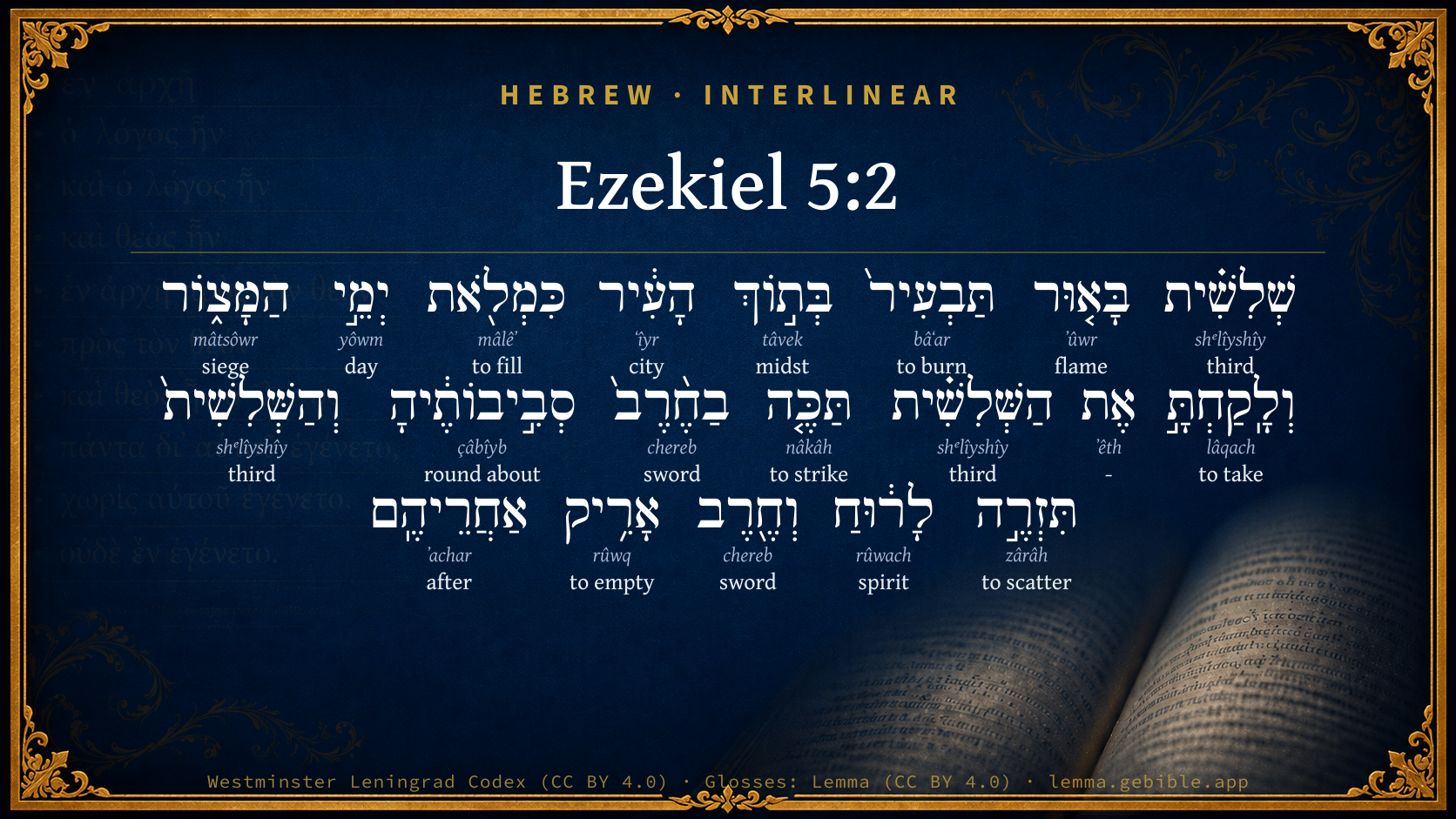
Hebrew (Westminster Leningrad Codex) Ezekiel 5:2 appears in the Hebrew Old Testament. The text above is from the Westminster Leningrad Codex. Each word links to its Strong’s number, a concise gloss, and parsing drawn from the Open Scriptures Hebrew Bible morphology. Click any word for its full Brown-Driver-Briggs (BDB) entry.
Download image
Cite this verse

Ezekiel 5:2 (World English Bible). Public Domain. Lemma interlinear Bible study tool, https://lemma.gebible.app/v/ezekiel/5/2.

Show BibTeX & RIS
BibTeX
RIS
English Translation
A third part shall you burn in the fire in the midst of the city, when the days of the siege are fulfilled; and you shall take a third part, and strike with the sword round about it; and a third part you shall scatter to the wind, and I will draw out a sword after them.
World English Bible · Public Domain
Download a study sheet

One document with this verse’s original text, its word-by-word gloss line, the meaning frame, cross-references with their text, attributed commentary, and full source and license credits — printable, and it pastes into notes with its structure intact.

This verse Autodidact and up

Study sheet (.html) Plain text (.txt)

A passage Seminary Student

Up to 50 verses in one chapter. A passage sheet keeps up to 6 commentary sources and 12 cross-references per verse, in the order this page ranks them, and says so on the sheet whenever that leaves anything out. Ask for a single verse and you get the Autodidact verse sheet above.

Everything on this page stays free to read, with no account — the sheet is a download of what is already on screen, not access to it.

Want to remove ads? Support Godless Engineer
Compare translations 3

The same verse in 3 English versions, stacked beneath the original-language interlinear above. Click any original word for its lexicon entry.

Each is an independent rendering of the whole verse — the interlinear is not word-aligned to these translations.

Highlighted words mark where these versions differ — a whole-verse word diff, not a word-by-word alignment.

  • World English Bible Public Domain
    A third part shall you burn in the fire in the midst of the city, when the days of the siege are fulfilled; and you shall take a third part, and strike with the sword round about it; and a third part you shall scatter to the wind, and I will draw out a sword after them.
  • King James Version Public Domain
    Thou shalt burn with fire a third part in the midst of the city, when the days of the siege are fulfilled: and thou shalt take a third part, and smite about it with a knife: and a third part thou shalt scatter in the wind; and I will draw out a sword after them.
  • unfoldingWord Literal Text CC BY-SA 4.0
    Burn a third of it with fire in the midst of the city when the days of the siege are completed, and take a third of the hair and strike it with the sword all around the city. Then scatter a third of it to the wind, and I will draw out a sword to chase after the people.

unfoldingWord Literal Text — © unfoldingWord, licensed CC BY-SA 4.0. Word-aligned USFM3 via Door43 (git.door43.org/unfoldingWord/en_ult).

Versions to compare (up to 4)

3 of 4 selected

Show all 18 translations

Every available English version of this verse, each an independent rendering of the whole verse.

  • World English Bible Public Domain
    A third part shall you burn in the fire in the midst of the city, when the days of the siege are fulfilled; and you shall take a third part, and strike with the sword round about it; and a third part you shall scatter to the wind, and I will draw out a sword after them.
  • Berean Standard Bible Public Domain
    When the days of the siege have ended, you are to burn up a third of the hair inside the city; you are also to take a third and slash it with the sword all around the city; and you are to scatter a third to the wind. For I will unleash a sword behind them.
  • Majority Standard Bible Public Domain
    When the days of the siege have ended, you are to burn up a third of the hair inside the city; you are also to take a third and slash it with the sword all around the city; and you are to scatter a third to the wind. For I will unleash a sword behind them.
  • King James Version Public Domain
    Thou shalt burn with fire a third part in the midst of the city, when the days of the siege are fulfilled: and thou shalt take a third part, and smite about it with a knife: and a third part thou shalt scatter in the wind; and I will draw out a sword after them.
  • American Standard Version (1901) Public Domain
    A third part shalt thou burn in the fire in the midst of the city, when the days of the siege are fulfilled; and thou shalt take a third part, and smite with the sword round about it; and a third part thou shalt scatter to the wind, and I will draw out a sword after them.
  • Revised Version (1885) Public Domain
    A third part shalt thou burn in the fire in the midst of the city, when the days of the siege are fulfilled; and thou shalt take a third part, and smite with the sword round about it; and a third part thou shalt scatter to the wind, and I will draw out a sword after them.
  • Geneva Bible (1599) Public Domain
    Thou shalt burne with fire the thirde part in the middes of the citie, when the dayes of the siege are fulfilled, and thou shalt take the other thirde part, and smite about it with a knife, and the last thirde part thou shalt scatter in the winde, and I will drawe out a sworde after them.
  • Douay-Rheims (1899) Public Domain
    A third part thou shalt burn with fire in the midst of the city, according to the fulfilling of the days of the siege: and thou shalt take a third part, and cut it in pieces with the knife all round about: and the other third part thou shalt scatter in the wind, and I will draw out the sword after them.
  • Young's Literal Translation Public Domain
    A third part with fire thou dost burn in the midst of the city, at the fulness of the days of the siege; and thou hast taken the third part, thou dost smite with a weapon round about it; and the third part thou dost scatter to the wind, and a weapon I draw out after them.
  • Literal Standard Version CC BY-SA 4.0
    You burn a third part with fire in the midst of the city, at the fullness of the days of the siege; and you have taken the third part, you strike with a weapon around it; and the third part you scatter to the wind, and I draw out a weapon after them.
  • Unlocked Literal Bible CC BY-SA 4.0
    Burn a third of it with fire in the midst of the city when the days of the siege are completed, and take a third of the hair and strike it with the sword all around the city. Then scatter a third of it to the wind, and I will draw out a sword to chase after the people.
  • unfoldingWord Literal Text CC BY-SA 4.0
    Burn a third of it with fire in the midst of the city when the days of the siege are completed, and take a third of the hair and strike it with the sword all around the city. Then scatter a third of it to the wind, and I will draw out a sword to chase after the people.
  • Darby Bible Public Domain
    A third part shalt thou burn in the fire in the midst of the city, when the days of the siege are fulfilled; and thou shalt take a third part, [and] smite about it with a knife; and a third part thou shalt scatter to the wind, and I will draw out a sword after them.
  • World Messianic Bible Public Domain
    A third part you shall burn in the fire in the middle of the city, when the days of the siege are fulfilled. You shall take a third part, and strike with the sword around it. A third part you shall scatter to the wind, and I will draw out a sword after them.
  • Webster's Bible Public Domain
    Thou shalt burn with fire a third part in the midst of the city, when the days of the siege are fulfilled: and thou shalt take a third part, and smite about it with a knife: and a third part thou shalt scatter in the wind; and I will draw out a sword after them.
  • Free Bible Version CC BY-SA 4.0
    Once the days of the siege have finished, burn up one third of the hair inside the city; slash at another third with a sword around the city; and scatter another third in the wind. I will let loose a sword behind them to chase them.
  • Bible in Basic English Public Domain
    You are to have a third part burned with fire inside the town, when the days of the attack are ended; and a third part you are to take and give blows with the sword round about it; and give a third part for the wind to take away, and let loose a sword after them.
  • JPS Tanakh (1917) Public Domain
    A third part shalt thou burn in the fire in the midst of the city, when the days of the siege are fulfilled; and thou shalt take a third part, and smite it with the sword round about her; and a third part thou shalt scatter to the wind, and I will draw out a sword after them.

Literal Standard Version (2020), Covenant Press — licensed CC BY-SA 4.0. Text via the HelloAO Bible API (eBible.org). Unlocked Literal Bible (unfoldingWord) — licensed CC BY-SA 4.0. Text via the HelloAO Bible API (eBible.org). unfoldingWord Literal Text — © unfoldingWord, licensed CC BY-SA 4.0. Word-aligned USFM3 via Door43 (git.door43.org/unfoldingWord/en_ult). Free Bible Version, Dr. Jonathan Gallagher — licensed CC BY-SA 4.0. Text via the HelloAO Bible API (eBible.org).

Word by word

More ways to search: Search by grammar → Find every occurrence → Compare this word →

Practice this passage: Drill this verse → Learn its vocabulary →

בָּא֤וּר
ʼûwr
H217
“in/at the · flame”
Preposition, Determined + Noun, Common, Masculine, Singular, Absolute
Part of Speech
Preposition + Noun
Type
Common
Gender
Masculine
Number
Singular
State
Absolute
Full BDB Definition

Origin: from H215

TWOT: 52d

flame, light of fire
  1. שְׁלִשִׁ֗ית shᵉlîyshîy H7992 “third” Adjective, Ordinal number, Feminine, Singular, Absolute
  2. תַּבְעִיר֙ bâʻar H1197 “to burn” Verb, Hiphil, Imperfect, 2nd Person, Masculine, Singular
  3. בְּת֣וֹךְ tâvek H8432 “in/at · midst of” Preposition + Noun, Common, Masculine, Singular, Construct
  4. הָעִ֔יר ʻîyr H5892 “the · city” Particle, Definite Article + Noun, Common, Feminine, Singular, Absolute
  5. כִּמְלֹ֖את mâlêʼ H4390 “like/as · to fill” Preposition + Verb, Qal, Infinitive Construct
  6. יְמֵ֣י yôwm H3117 “days of” Noun, Common, Masculine, Plural, Construct
  7. הַמָּצ֑וֹר mâtsôwr H4692 “the · siege” Particle, Definite Article + Noun, Common, Masculine, Singular, Absolute
  8. וְלָֽקַחְתָּ֣ lâqach H3947 “and · to take” Conjunction + Verb, Qal, Sequential Perfect, 2nd Person, Masculine, Singular
  9. אֶת ʼêth H853 “-” Particle, Direct Object
  10. הַשְּׁלִשִׁ֗ית shᵉlîyshîy H7992 “the · third” Particle, Definite Article + Noun, Common, Feminine, Singular, Absolute
  11. תַּכֶּ֤ה nâkâh H5221 “to strike” Verb, Hiphil, Imperfect, 2nd Person, Masculine, Singular
  12. בַחֶ֨רֶב֙ chereb H2719 “in/at the · sword” Preposition, Determined + Noun, Common, Feminine, Singular, Absolute
  13. סְבִ֣יבוֹתֶ֔יהָ çâbîyb H5439 “surroundings · her” Noun, Common, Both, Plural, Construct + Suffix, Personal, 3rd Person, Feminine, Singular
  14. וְהַשְּׁלִשִׁית֙ shᵉlîyshîy H7992 “and · the · third” Conjunction + Particle, Definite Article + Noun, Common, Feminine, Singular, Absolute
  15. תִּזְרֶ֣ה zârâh H2219 “to scatter” Verb, Qal, Imperfect, 2nd Person, Masculine, Singular
  16. לָר֔וּחַ rûwach H7307 “to/for the · spirit” Preposition, Determined + Noun, Common, Both, Singular, Absolute
  17. וְחֶ֖רֶב chereb H2719 “and · sword” Conjunction + Noun, Common, Feminine, Singular, Absolute
  18. אָרִ֥יק rûwq H7324 “to empty” Verb, Hiphil, Imperfect, 1st Person, Common, Singular
  19. אַחֲרֵיהֶֽם ʼachar H310 “after · them” Preposition + Suffix, Personal, 3rd Person, Masculine, Plural

About this verse

These counts appear in no published source. They are computed here, from the morphology-tagged text and Lemma’s own curated glosses. What Lemma adds →

20
words
17
distinct lemmas
Prophets
section

Notable vocabulary

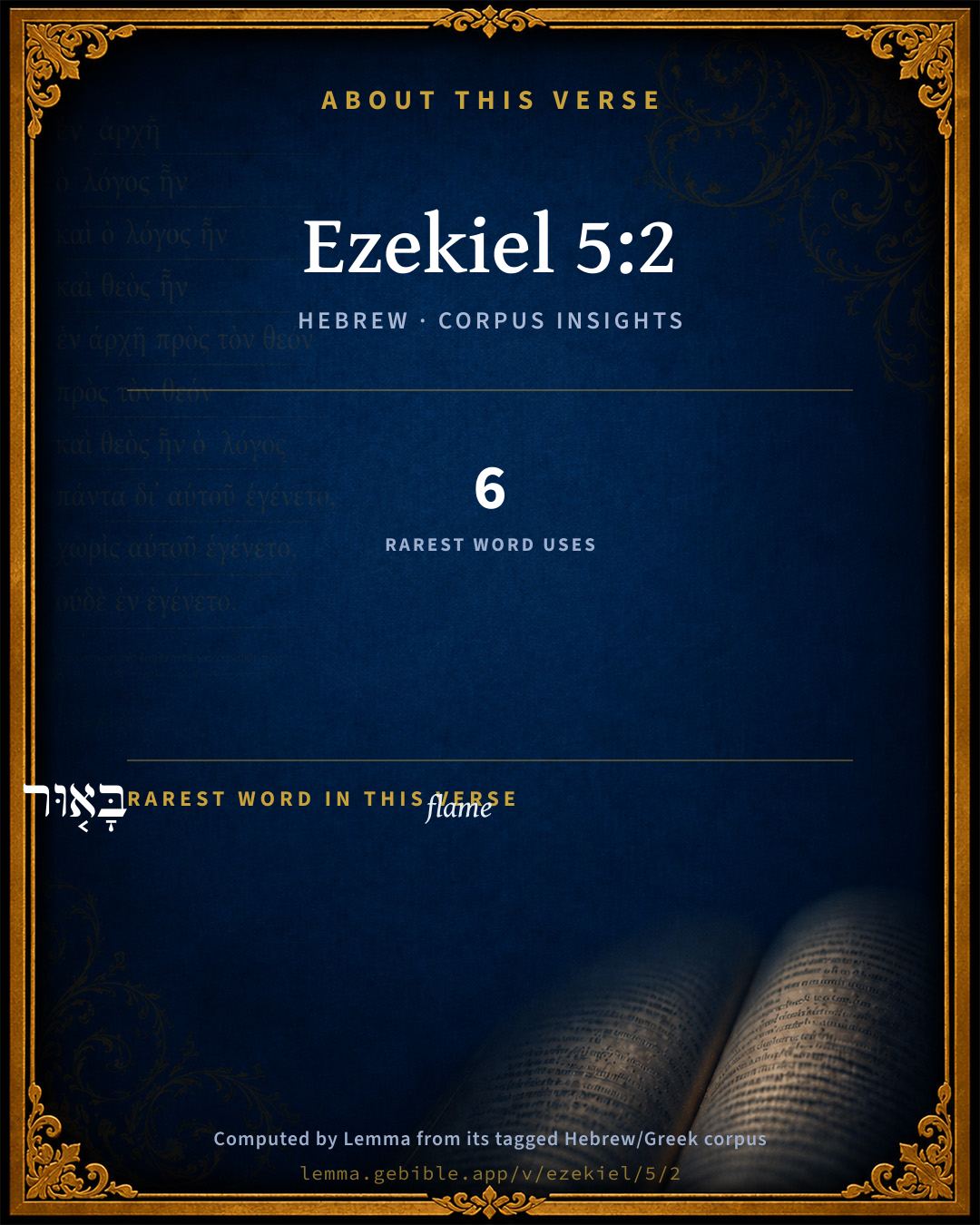
The rarest word here is בָּא֤וּר flame H217 — appearing just 6 times in the whole Hebrew Bible.

Shared distinctive vocabulary

בָּא֤וּר flame H217 occurs in 6 verses of the Hebrew Bible. Also found in:

Grammatical profile

  • 6 verbs
  • 11 nouns
  • 1 adjective
  • 1 preposition
  • 1 particle

Verb forms

  • תַּבְעִיר֙ Hiphil · Imperfect
  • כִּמְלֹ֖את Qal · Infinitive Construct
  • וְלָֽקַחְתָּ֣ Qal · Sequential Perfect
  • תַּכֶּ֤ה Hiphil · Imperfect
  • תִּזְרֶ֣ה Qal · Imperfect
  • אָרִ֥יק Hiphil · Imperfect

Repetition

Words recur within this verse — often emphatic in Hebrew:

  • שְׁלִשִׁ֗ית third H7992 ×3
  • בַחֶ֨רֶב֙ sword H2719 ×2

Hebrew & Septuagint length

In English translation the verse runs 57 words from the Hebrew and 72 from the Septuagint (LXX English) — closely comparable.

A rough comparison of the two English renderings, which tokenize alike — not a word-level alignment.

Word counts can differ between the Hebrew and the Greek without any difference in meaning — e.g. the Hebrew direct-object marker אֵת has no separate Greek word, and Greek often adds the article ὁ.

Cross-references

10

Topical passages linked to Ezekiel 5:2 in the Treasury of Scripture Knowledge — connected by theme and wording, ordered by reader-vote popularity; previews shown in the World English Bible.

  • Ezekiel 5:12 A third part of you shall die with the pestilence, and with famine shall they be consumed in the midst of you; and a third part shall fall by the sword round about you; and a third part I will scatter to all the winds, and will draw out a sword after them.
  • Leviticus 26:33 I will scatter you among the nations, and I will draw out the sword after you: and your land will be a desolation, and your cities shall be a waste.
  • Ezekiel 4:1–8 You also, son of man, take a tile, and lay it before you, and portray on it a city, even Jerusalem:
  • Ezekiel 12:14 I will scatter toward every wind all who are round about him to help him, and all his bands; and I will draw out the sword after them.
  • Jeremiah 9:16 I will scatter them also among the nations, whom neither they nor their fathers have known; and I will send the sword after them, until I have consumed them.
  • Jeremiah 15:2 It shall happen, when they tell you, Where shall we go forth? then you shall tell them, Thus says Yahweh: Such as are for death, to death; and such as are for the sword, to the sword; and such as are for the famine, to the famine; and such as are for captivity, to captivity.
  • Jeremiah 9:21–22 For death is come up into our windows, it is entered into our palaces; to cut off the children from outside, [and] the young men from the streets.
  • Jeremiah 24:10 I will send the sword, the famine, and the pestilence, among them, until they be consumed from off the land that I gave to them and to their fathers.
  • Jeremiah 38:2 Thus says Yahweh, He who remains in this city shall die by the sword, by the famine, and by the pestilence; but he who goes forth to the Chaldeans shall live, and his life shall be to him for a prey, and he shall live.
  • Amos 9:2–3 Though they dig into Sheol, there my hand will take them; and though they climb up to heaven, there I will bring them down.

Cross-references courtesy of OpenBible.info (CC BY 4.0).

Hebrew and Greek witnesses Masoretic Hebrew ↔ Greek Septuagint

The same verse in the two great witnesses to the Old Testament, shown verse-for-verse.

These are two independent witnesses, not word-aligned to each other, and the Septuagint is shown in lemma (dictionary) form.

Hebrew Ezekiel 5:2 Masoretic · Westminster Leningrad Codex

שְׁלִשִׁ֗ית בָּא֤וּר תַּבְעִיר֙ בְּת֣וֹךְ הָעִ֔יר כִּמְלֹ֖את יְמֵ֣י הַמָּצ֑וֹר וְלָֽקַחְתָּ֣ אֶת הַשְּׁלִשִׁ֗ית תַּכֶּ֤ה בַחֶ֨רֶב֙ סְבִ֣יבוֹתֶ֔יהָ וְהַשְּׁלִשִׁית֙ תִּזְרֶ֣ה לָר֔וּחַ וְחֶ֖רֶב אָרִ֥יק אַחֲרֵיהֶֽם

A third part shall you burn in the fire in the midst of the city, when the days of the siege are fulfilled; and you shall take a third part, and strike with the sword round about it; and a third part you shall scatter to the wind, and I will draw out a sword after them.

World English Bible · Public Domain

Greek LXX Ezekiel 5:2 Septuagint · lemma form

ὁ τέταρτος ἐν πῦρ ἀνακαίω ἐν μέσος ὁ πόλις κατά ὁ πλήρωσις ὁ ἡμέρα ὁ συγκλεισμός καί λαμβάνω ὁ τέταρτος καί κατακαίω αὐτός ἐν μέσος αὐτός καί ὁ τέταρτος κατακόπτω ἐν ῥομφαία κύκλος αὐτός καί ὁ τέταρτος διασκορπίζω ὁ πνεῦμα καί μάχαιρα ἐκκενόω ὀπίσω αὐτός

A fourth part you shall burn in the fire in the midst of the city, at the fulfillment of the days of the siege: and you shall take a fourth part, and burn it up in the midst of it: and a fourth part you shall cut with a sword round about it: and a fourth part you shall scatter to the wind; and I will draw out a sword after them.

LXX2012 (modern English Septuagint) · Public Domain

On this verse, John Gill's Exposition discusses the Septuagint’s reading. Read the note in Commentary ↓

Hebrew: Westminster Leningrad Codex (CC BY 4.0). Greek: Septuagint (public domain); English from LXX2012 (modern English Septuagint) (Public Domain). How the Septuagint differs from the Hebrew →

Targum (Aramaic paraphrase)

1

The Targum is the ancient Jewish Aramaic paraphrase of the Hebrew Scriptures — an interpretive translation, not the Hebrew text itself. Onkelos (literal) and Pseudo-Jonathan (expansive) render the Torah, and Jonathan the Prophets. Coverage is partial: where no permissively-licensed English translation exists for a verse, only the Aramaic is shown. This is verse-level text, not a word-by-word alignment to the Hebrew.

  1. Targum Jonathan Prophets (Joshua–Malachi)
    תִּלְתָּא בְּנוּרָא תַדְלֵיק בְּגוֹ קַרְתָּא כְּמִשְׁלַם יְמֵי צַיְרָא וְתִסַב יַת תִּלְתָּא תִּקְטֵיל בְּחַרְבָּא סָחֲרָנָהָא וְתִלְתָּא יִתְבַּדְרוּן וּדְקַטְלִין בְּחַרְבָּא אֱגָרֵי בַּתְרֵיהוֹן:

    (no public-domain English translation for this verse)

    Targum Jonathan — Aramaic: “Mikraot Gedolot” (public domain). English: “Sefaria Community Translation” (CC0 1.0 (public-domain dedication)); “London "Chaldee Paraphrase," 1871” (public domain). Text via Sefaria.

Commentary

Notes on Ezekiel 5:2 from classic Christian and Jewish commentators (each source and its license shown beneath its notes). The classic Christian expositions comment on the surrounding passage and are grouped to its opening verse, so a note may address several verses; the Jewish commentaries on the Tanakh (Rashi and others) are per-verse, so they appear only where the commentator wrote on this verse.

Lemma curates 59 commentaries, every one of them public domain or Creative Commons licensed, each selected and text-cleaned for this edition rather than reprinted as found. About our sources →

Jamieson, Fausset & Brown

Robert Jamieson, A. R. Fausset & David Brown

Three classes are described. The sword was to destroy one third of the people; famine and plague another third ("fire" in Eze 5:2 being explained in Eze 5:12 to mean pestilence and famine); that which remained was to be scattered among the nations. A few only of the last portion were to escape, symbolized by the hairs bound in Ezekiel's skirts (Eze 5:3; Jer 40:6; Jer 52:16). Even of these some were to be thrown into the fiery ordeal again (Eze 5:4; Jer 41:1-2, &c.; Jer 44:14, &c.). The "skirts" being able to contain but few express that extreme limit to which God's goodness can reach.

Jamieson, Fausset & Brown — Commentary Critical and Explanatory on the Whole Bible (1871) — public domain (CC PDM 1.0). Text via the HelloAO Bible API.

Trapp's Complete Commentary

John Trapp

Eze 5:2 Thou shalt burn with fire a third part in the midst of the city, when the days of the siege are fulfilled: and thou shalt take a third part, [and] smite about it with a knife: and a third part thou shalt scatter in the wind; and I will draw out a sword after them.

Ver. 2. Thou shalt burn with fire a third part,] i.e., With famine, pestilence, and other mischiefs, during the siege of Jerusalem. Pythagoras gave this precept among others, Unguium, criniumque praesegmina ne contemnito. But God findeth so little worth in wicked people that he regardeth them not, but casteth them as excrements to the dunghill, yea, to hell. {Psa 9:17}

And smite about it with a knife.] They shall be slain with that sharp knife or sword, {Eze 5:1} after that the city is taken.

Thou shalt scatter in the wind.] Sundry of them shall flee for their lives; but in running from death they shall but run to it. {Amo 9:1-4; Amo 2:13-16}

John Trapp, A Commentary or Exposition upon All the Books of the Old and New Testament (1647–1656) — public domain. Text from a community e-Sword module.

Joseph Benson's Commentary

Eze 5:2-4. Thou shall burn a third part in the midst of the city — In the midst of that portraiture of the city, which the prophet was commanded to make, chap. Eze 4:1. This signified the destruction of the inhabitants within the city by famine and pestilence; for both famine and pestilence may be said to burn, as they make great havoc, and consume as fast as fire. Thou shalt take a third part, and smite about it with a knife — To show that a third part of the inhabitants should be slain with the sword; either in the sallies they made out of the city against the enemy, or when the city was taken by assault. A third part thou shalt scatter in the wind — This signified that a part of them should be dispersed into various countries, as the chaff is dispersed by the wind; I will draw out a sword after them — My vengeance shall pursue them in their dispersions, and they shall be everywhere exposed to suffer violence and injury. Also take a few and bind them in thy skirts — The Hebrew is, in thy wings. This signified that a small part of them should be preserved in the land; and accordingly we find that Nebuzar-adan, captain-general of the king of Babylon, left a few of them in the land under Gedaliah, as we read Jer 40:5-6. Then take of them again, and cast them into the midst of the fire — This expressed the calamity and destruction which should arise from this small remnant differing among themselves: some espousing the part of Gedaliah, who had been set over them by the Babylonians, and was a good man; and others joining themselves to Ishmael, one of the blood of David, but a wicked man; who formed a conspiracy against Gedaliah, and treacherously slew him, which was the occasion of the utter ruin of that poor remainder of the Jews, which were left in their native country. For thereupon some of them went down into Egypt, where they were all consumed according to Jeremiah’s prophecy against them, Jer 44:11, &c., and the rest who remained in the land were entirely carried away captive by Nebuzar- adan, Jer 52:30.

Joseph Benson's Commentary on the Old and New Testaments (1811–1818) — public domain. Text from a community e-Sword module.

Tyndale Open Study Notes

Tyndale Open Resources

5:2 Ezekiel was to burn one third of the hair to represent those who would die of famine during the siege. He was to chop another third of the hair with a sword to represent those who would die violent deaths. He was to scatter the final third to the wind to represent those who would be sent into exile.

Tyndale Open Study Notes — © Tyndale Open Resources, licensed CC BY-SA 4.0. Text via the HelloAO Bible API.

Geneva Bible (1599)

Geneva Bible translators

To wit, of that city which he had portrayed upon the brick, Ezek. 4:1. By the fire and pestilence he meaneth the famine, wherewith one part perished during the siege of Nebuchadnezzar. By the sword, those that were slain whom Zedekiah fled, and those that were carried away captive. And by the scattering into the wind, those that fled into Egypt, and into other parts after the city was taken.

Geneva Bible (1599) marginal notes — public domain. Text via Bolls.life.

Adam Clarke's Commentary

Verse 2. See Clarke on Eze 5:1.

Adam Clarke's Commentary on the Bible (1810–1826) — public domain. Text from a community e-Sword/MySword module.

Ellicott's Commentary for English Readers

(2) Burn with fire a third art in the midst of the city.—It is better to suppose this done only in description than to imagine that the prophet carried it out in act upon the tile on which the city (Jerusalem) was portrayed. The meaning of this verse is explained in Eze_5:12, and is made plainer by translating the same word uniformly “sword,” instead of changing to “knife.” The third, which is scattered, plainly signifies the small part of the people who, escaping destruction, shall be scattered among the heathen. A similar prophecy, referring however to a later time, may be found in Zec_13:8-9. The expression, “when the days of the siege are fulfilled,” of course refers to the symbolic siege of the prophet. The words, “I will draw out a sword after them,” are taken from Lev_26:33, and are repeated in Eze_5:12, and again in Eze_12:14. The suffering from the Divine judgments should still follow them in their exile. Plain prophecy is here mixed with the symbolism.

A Bible Commentary for English Readers, edited by Charles John Ellicott (1878–1897) — public domain. Text from a community e-Sword module.

The Cambridge Bible for Schools and Colleges

gen. ed. J. J. S. Perowne

2. third part in the midst of the city] If we could suppose that the prophet were strict in his symbolism the “city” here would be that graven upon the brick (ch. Eze_4:1). There is no reason to suppose that he has this in his mind.

smite about it with a knife] Rather: and smite it with the sword round about it, i.e. around the city (Eze_5:12). This is the fate of many of those who seek to escape before and after the capture of the city.

draw out a sword] Comp. Jer_9:16, “I will scatter them among the heathen … and will send the sword after them.” Lam_1:3, “Judah dwelleth among the heathen, she findeth no rest; all her pursuers overtook her between the straits.” The phrase again Lev_26:33.

The Cambridge Bible for Schools and Colleges (gen. ed. J. J. S. Perowne; Cambridge University Press, 1878–1918) — public domain. Text from a community e-Sword module.

John Gill's Exposition

Thou, shall burn with fire a third part in the midst of the city,.... Of Jerusalem, as portrayed upon the tile, Eze 4:1; or the prophet was now in Chaldea. The burning of the third part of the hair with fire denotes such who were destroyed by the pestilence and famine during the siege; see Lam 5:10; or it denotes the burning of the city itself, when the siege was over; since it follows:

when the days of the siege are fulfilled; for, when it was taken, it was burnt with fire, Jer 52:13;

and thou shall take a third part, and smite about it with a knife; which designs those that fled out of the city whim it was broken up, and were pursued after, and overtook by the Chaldean army, and cut off by the sword, Jer 52:7;

and a third part thou shall scatter in the wind; which intends those that fled, and were dispersed into several countries, as Moab, Ammon, and especially Egypt, whither many went along with Johanan the son of Kareah, Jer 43:5;

and I will draw out a sword after them; and destroy them; which, as it was threatened, Jer 42:16; so it was accomplished when Egypt was subdued by Nebuchadnezzar. The Septuagint and Arabic versions, in every clause, read a "fourth part", instead of a "third"; but wrongly.

John Gill's Exposition of the Whole Bible (1746–1763) — public domain (CC PDM 1.0). Text via the HelloAO Bible API.

Albert Barnes' Notes on the Bible

“The third part burnt in the midst of the city” represents those who perished within the city during the siege; “the third part smitten about it” (the city) “with” the sword, those who were killed about the city during the same period: “the third part scattered to the wind” those who after the siege were dispersed in foreign lands.

In the midst of the city - The prophet is in exile, and is to do this in the midst of Jerusalem. His action being ideal is fitly assigned to the place which the prophecy concerns.

When the days of the siege are fulfilled - i. e., “when the days of the figurative representation of the siege are fulfilled.”

Albert Barnes' Notes on the Bible (1834–1885) — public domain. Text from a community e-Sword/MySword module.

Haydock's Catholic Bible Commentary

Third. Septuagint and Theodotion read "a fourth," as also [in] ver. 12., (Calmet) thus assigning half to be burnt by death (pestilence) and famine. The other half of the people falls a prey to the sword and to captivity. The pestilence, famine, and the sword, were the three usual scourges left to David’s choice, (2 Kings xxiv.) which here destroy each a fourth part, while the rest become captives. Yet even of this third or fourth part, many engage in civil broils, and perish. St. Jerome hints that the Septuagint is interpolated from Theodotion, ver. 12, and that their version only comprised the pentateuch. But the other books went at least under the same title; and there must be some mistake in the words asterisked, since they occur in the Hebrew, Vulgate, &c., third being only substituted for fourth: "And a fourth part of thee shall fall by the sword." The Hebrew is rather less degrading to the Jews, as there would be thus at most one-third preserved, instead of a part only of one-fourth. See Deuteronomy xxvii. 4., and Jeremias lii. 28. --- Take. Septuagint add here, "a fourth part; and shalt burn it in the midst of it; and a fourth thou shalt cut," &c. (Haydock) --- He was thus to deal with a part of the hair during 390 days, (Menochius) or at the end of them. (R. Salom.) --- Round, in the cities near Jerusalem, (Worthington) or round the picture of it, chap. iv. 1.

George Leo Haydock (1774–1849), Haydock's Catholic Family Bible and Commentary, 1859 edition — public domain. Excludes Psalms (Douay-Rheims chapter numbering differs from Protestant) and Deuterocanonical books (Catholic canon only).

Matthew Poole's English Annotations

This verse tells you into how many parts the hair was to be divided, and how to be disposed of, and so plain it needs little explication.

With fire; so either pestilence, or famine, with the displeasure of God, and the burning of the city and of the citizens, is noted.

The city, described on the tile, Eze 4:1, a type of what should be done in Jerusalem.

When the days of the siege are fulfilled; when the three hundred and ninety days of thy lying against the portrayed city shall be ended; for when Jerusalem shall be taken at the end of the siege, the city shall be burnt; and who can say that none of the inhabitants were burnt, as the two false prophets Ahab and Zedekiah? Jer 29:22. To be sure many that hid themselves under ground, in vaults and cellars, were burnt with the burning of the city.

A third part; it is not necessary this part should be equal to the former, if it be proportional it is enough; perhaps it might be somewhat less then the first third.

Smite about it with a knife; for these were such as fell, in either defending the walls, or sallying out during the siege, or were found in arms when the city was taken, or were overtaken in their flight with their most unhappy king or by law martial were adjudged to die by the conqueror. These many, yet weak ones, women and children, which died in the siege by famine and pestilence, might be a greater third.

A third part; those that fell to the Chaldeans, or fled to Egypt, or other countries, though they escape somewhat longer, yet carrying like sins are at last overtaken with like evils.

Thou shalt scatter; though these disposed of themselves, yet there was God’s hand also in it; he scattered those that of their own accord did flee.

In the wind; violent, uncertain, and troublesome should their enemies prove to them.

I will draw out; God will pursue them.

A sword; figuratively it is wasting punishment, literally it was fulfilled, Jer 42:16,17,22; 43:10,11; 44:27. Thereof, i.e. of the last third which were to be dispersed. A few, or small quantity. In number; or, by number, as it may be read; tell out a small parcel of the hair. Bind them in thy skirts; as men tie up in a handkerchief, or in the skirt of their garment, what they would not lose. So some few shall be kept, God will not cut off the whole house of Israel, but reserves a remnant.

Matthew Poole's English Annotations on the Holy Bible (1683–1685) — public domain. Text from a community e-Sword/MySword module.

Whedon's Commentary on the Bible

Daniel D. Whedon

2. Burn… when the days of the siege are fulfilled — This would indicate that, although so closely following the command to lie upon his side (Eze_4:4, etc.), the acting out of this symbolic picture must be delayed until his one hundred and ninety days of silent and motionless watching of the besieged city are finished. The hair will then be burned on the tile in the midst of the besieged city (Eze_4:1).

Smite about it with a knife — “It” refers to the city, as is seen from Eze_5:12. The prophet must throw the second lot of hair “about the city” and smite it as it falls. The meaning is that those who escape from the famine and pestilence within the city will fall by the sword outside the gates.

I will draw out a sword — Those who do not fall in the city or its suburbs, but fly to distant places, will not escape. Jehovah’s sword — in the hand of the heathen — will still follow them (Jer_9:16).

Daniel D. Whedon (gen. ed.), Commentary on the Old and New Testaments (1874–1909) — public domain. Text from a community e-Sword module.

The Pulpit Commentary

Thou shalt burn with fire, etc. The symbolism receives its interpretation in ver. 12. A third part of the people (we need not expect numerical exactness) was to perish in the city of pestilence and famine, another to fall by the sword in their attempts to escape, yet another third was to be scattered to the far off land of their exile, and even there the sword was to follow them. The words, in the midst of the city, and the days of the siege, find their most natural explanation in Eze_4:1, Eze_4:5, Eze_4:6.

The Pulpit Commentary (1880–1919), ed. H.D.M. Spence-Jones & Joseph S. Exell — public domain. Text from a community e-Sword module.

John Wesley's Explanatory Notes

A third part - Described on the tile, chap. iv, 1, a type of what should be done in Jerusalem. The days - When the three hundred and ninety days of thy lying against the portrayed city shall be ended. With a knife - To signify them that fall by the sword. Scatter - To typify them that fell to the Chaldeans, or fled to Egypt, or other countries.

John Wesley, Explanatory Notes Upon the Whole Bible (1754–1765) — public domain. Text via the GEBible commentary corpus.

Rashi

Rabbi Shlomo Yitzchaki (Rashi)

in the midst of the city that you inscribed on the brick, as the completion of the days of the siege. This is a sign that a third of them will perish in the heat of hunger in its midst, which is like fire, in the same way that it says (Lam. 5:10): “Our skin is parched as by a furnace because of the heat of hunger.”

and strike it.

with a sword all around it Around that brick, symbolizing those who flee from the city, whom the Chaldeans will overtake and slay in the environs of Jerusalem.

and a third you shall scatter to the wind symbolizing the exiles who will go to Egypt, viz. Johanan son of Kareach and his associates, and there I shall unsheathe a sword [in pursuit] after them, for Nebuchadnezzar went and destroyed Egypt, and there they were slain.

Rashi on the Tanakh — English translations: “The Judaica Press complete Tanach with Rashi, translated by A. J. Rosenberg” (CC BY 4.0); “Pentateuch with Rashi's commentary by M. Rosenbaum and A.M. Silbermann, 1929-1934” (public domain); “The Metsudah Tanach series, Lakewood, N.J” (CC BY 4.0); and “The Book of Joshua, Metsudah Publications, 1997” (CC BY 4.0). Text via Sefaria.

Lesson kit

Teaching starters — assembled from the data on this page, not authored interpretation. Every prompt links to the verse data it draws on. Edit before teaching.

Ezekiel, in the Prophets, opens this verse with 20 words (17 distinct Hebrew lemmas). Its most distinctive word is ʼûwr (“flame”). A historical commentator’s framing appears above. Read the whole chapter for the surrounding context.

Discussion questions

  1. The word ʼûwr carries the sense “flame.” How does it shape the verse?
  2. Isaiah 24:15 shares the word «flame» with this verse. How do the two illuminate each other?
  3. “third” occurs 3× in this one verse. What is the effect of the repetition?
  4. These translations render this verse differently; the difference is in the English rendering, not the original. What questions does that raise?
  5. The verb «תַּבְעִיר֙» is Hiphil Imperfect. How does its form color the action?
  6. Reading how Jamieson, Fausset & Brown and Trapp's Complete Commentary read this verse, where do the two commentators agree and where do they part?

Things to notice

Reading settings

Reading text

Shown beneath each verse's original-language words.

Old Testament
Old Testament edition

Read the OT as the Masoretic Hebrew (MT) or the Greek Septuagint (LXX).

English shown for the Greek Septuagint (in the Hebrew ↔ Greek comparison).

Comparing translations? Open the Compare panel on any verse page to stack up to four side by side.