
Psalms 17:13

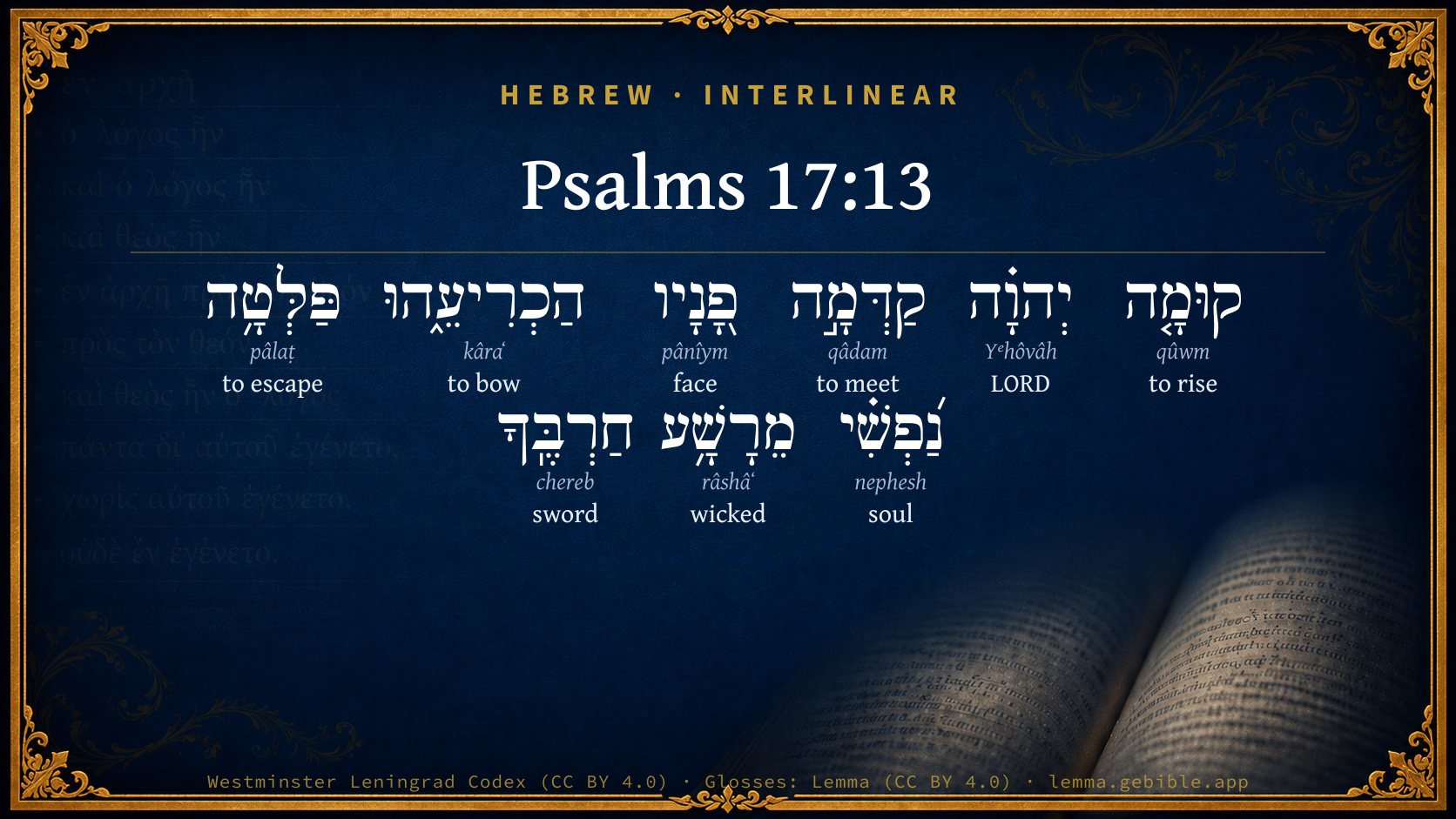
Hebrew (Westminster Leningrad Codex) Psalms 17:13 appears in the Hebrew Old Testament. The text above is from the Westminster Leningrad Codex. Each word links to its Strong’s number, a concise gloss, and parsing drawn from the Open Scriptures Hebrew Bible morphology. Click any word for its full Brown-Driver-Briggs (BDB) entry.
Download image
Cite this verse

Psalms 17:13 (World English Bible). Public Domain. Lemma interlinear Bible study tool, https://lemma.gebible.app/v/psalms/17/13.

Show BibTeX & RIS
BibTeX
RIS
English Translation
Arise, Yahweh, Confront him, cast him down. Deliver my soul from the wicked by your sword;
World English Bible · Public Domain
Download a study sheet

One document with this verse’s original text, its word-by-word gloss line, the meaning frame, cross-references with their text, attributed commentary, and full source and license credits — printable, and it pastes into notes with its structure intact.

This verse Autodidact and up

Study sheet (.html) Plain text (.txt)

A passage Seminary Student

Up to 50 verses in one chapter. A passage sheet keeps up to 6 commentary sources and 12 cross-references per verse, in the order this page ranks them, and says so on the sheet whenever that leaves anything out. Ask for a single verse and you get the Autodidact verse sheet above.

Everything on this page stays free to read, with no account — the sheet is a download of what is already on screen, not access to it.

Want to remove ads? Support Godless Engineer
Compare translations 3

The same verse in 3 English versions, stacked beneath the original-language interlinear above. Click any original word for its lexicon entry.

Each is an independent rendering of the whole verse — the interlinear is not word-aligned to these translations.

Highlighted words mark where these versions differ — a whole-verse word diff, not a word-by-word alignment.

  • World English Bible Public Domain
    Arise, Yahweh, Confront him, cast him down. Deliver my soul from the wicked by your sword;
  • King James Version Public Domain
    Arise, O LORD, disappoint him, cast him down: deliver my soul from the wicked, which is thy sword:
  • unfoldingWord Literal Text CC BY-SA 4.0
    Arise, Yahweh, confront his face, make him bow down! Rescue my soul from the wicked your sword!

unfoldingWord Literal Text — © unfoldingWord, licensed CC BY-SA 4.0. Word-aligned USFM3 via Door43 (git.door43.org/unfoldingWord/en_ult).

Versions to compare (up to 4)

3 of 4 selected

Show all 18 translations

Every available English version of this verse, each an independent rendering of the whole verse.

  • World English Bible Public Domain
    Arise, Yahweh, Confront him, cast him down. Deliver my soul from the wicked by your sword;
  • Berean Standard Bible Public Domain
    Arise, O LORD, confront them! Bring them to their knees; deliver me from the wicked by Your sword,
  • Majority Standard Bible Public Domain
    Arise, O LORD, confront them! Bring them to their knees; deliver me from the wicked by Your sword,
  • King James Version Public Domain
    Arise, O LORD, disappoint him, cast him down: deliver my soul from the wicked, which is thy sword:
  • American Standard Version (1901) Public Domain
    Arise, O Jehovah, Confront him, cast him down: Deliver my soul from the wicked by thy sword;
  • Revised Version (1885) Public Domain
    Arise, O LORD, confront him, cast him down: deliver my soul from the wicked by thy sword;
  • Geneva Bible (1599) Public Domain
    Vp Lord, disappoint him: cast him downe: deliuer my soule from the wicked with thy sworde,
  • Douay-Rheims (1899) Public Domain
    Arise, O Lord, disappoint him and supplant him; deliver my soul from the wicked one: thy sword
  • Young's Literal Translation Public Domain
    Arise, O Jehovah, go before his face, Cause him to bend. Deliver my soul from the wicked, Thy sword,
  • Literal Standard Version CC BY-SA 4.0
    Arise, O YHWH, go before his face, || Cause him to bend. Deliver my soul from the wicked, Your sword,
  • Unlocked Literal Bible CC BY-SA 4.0
    Arise, Yahweh! Attack them! Throw them down on their faces! Rescue my life from the wicked by your sword!
  • unfoldingWord Literal Text CC BY-SA 4.0
    Arise, Yahweh, confront his face, make him bow down! Rescue my soul from the wicked your sword!
  • Darby Bible Public Domain
    Arise, Jehovah, anticipate him, cast him down: deliver my soul from the wicked, thy sword;
  • World Messianic Bible Public Domain
    Arise, LORD, confront him. Cast him down. Deliver my soul from the wicked by your sword,
  • Webster's Bible Public Domain
    Arise, O LORD disappoint him, cast him down: deliver my soul from the wicked, who is thy sword:
  • Free Bible Version CC BY-SA 4.0
    Lord, stand up and confront them! Force them to back down! By your sword rescue me from the wicked!
  • Bible in Basic English Public Domain
    Up! Lord, come out against him, make him low, with your sword be my saviour from the evil-doer.
  • JPS Tanakh (1917) Public Domain
    Arise, O LORD, confront him, cast him down; deliver my soul from the wicked, by Thy sword;

Literal Standard Version (2020), Covenant Press — licensed CC BY-SA 4.0. Text via the HelloAO Bible API (eBible.org). Unlocked Literal Bible (unfoldingWord) — licensed CC BY-SA 4.0. Text via the HelloAO Bible API (eBible.org). unfoldingWord Literal Text — © unfoldingWord, licensed CC BY-SA 4.0. Word-aligned USFM3 via Door43 (git.door43.org/unfoldingWord/en_ult). Free Bible Version, Dr. Jonathan Gallagher — licensed CC BY-SA 4.0. Text via the HelloAO Bible API (eBible.org).

Word by word

More ways to search: Search by grammar → Find every occurrence → Compare this word →

Practice this passage: Drill this verse → Learn its vocabulary →

פַּלְּטָ֥ה
pâlaṭ
H6403
“escape”
Verb, Piel, Imperative, 2nd Person, Masculine, Singular + Suffix, h
Part of Speech
Verb
Stem
Piel
Form
Imperative
Person
2nd Person
Gender
Masculine
Number
Singular
Full BDB Definition

Origin: a primitive root

TWOT: 1774

to escape, save, deliver, slip away - (Qal) to escape - (Piel) - to bring into security, deliver - to cause to escape, cast forth - to be delivered - to slip away - (Hiphil) to bring into security, bring to safety
  1. קוּמָ֤ה qûwm H6965 “rise” Verb, Qal, Imperative, 2nd Person, Masculine, Singular + Suffix, h
  2. יְהוָ֗ה Yᵉhôvâh H3068 “LORD” Noun, Proper
  3. קַדְּמָ֣ה qâdam H6923 “meet” Verb, Piel, Imperative, 2nd Person, Masculine, Singular + Suffix, h
  4. פָ֭נָיו pânîym H6440 “face(s) · his” Noun, Common, Both, Plural, Construct + Suffix, Personal, 3rd Person, Masculine, Singular
  5. הַכְרִיעֵ֑הוּ kâraʻ H3766 “bow · him” Verb, Hiphil, Imperative, 2nd Person, Masculine, Singular + Suffix, Personal, 3rd Person, Masculine, Singular
  6. נַ֝פְשִׁ֗י nephesh H5315 “soul · my” Noun, Common, Both, Singular, Construct + Suffix, Personal, 1st Person, Common, Singular
  7. מֵרָשָׁ֥ע râshâʻ H7563 “from · wicked” Preposition + Adjective, Adjective, Masculine, Singular, Absolute
  8. חַרְבֶּֽךָ chereb H2719 “sword · your” Noun, Common, Feminine, Singular, Construct + Suffix, Personal, 2nd Person, Masculine, Singular

About this verse

These counts appear in no published source. They are computed here, from the morphology-tagged text and Lemma’s own curated glosses. What Lemma adds →

9
words
9
distinct lemmas
Wisdom
section

Notable vocabulary

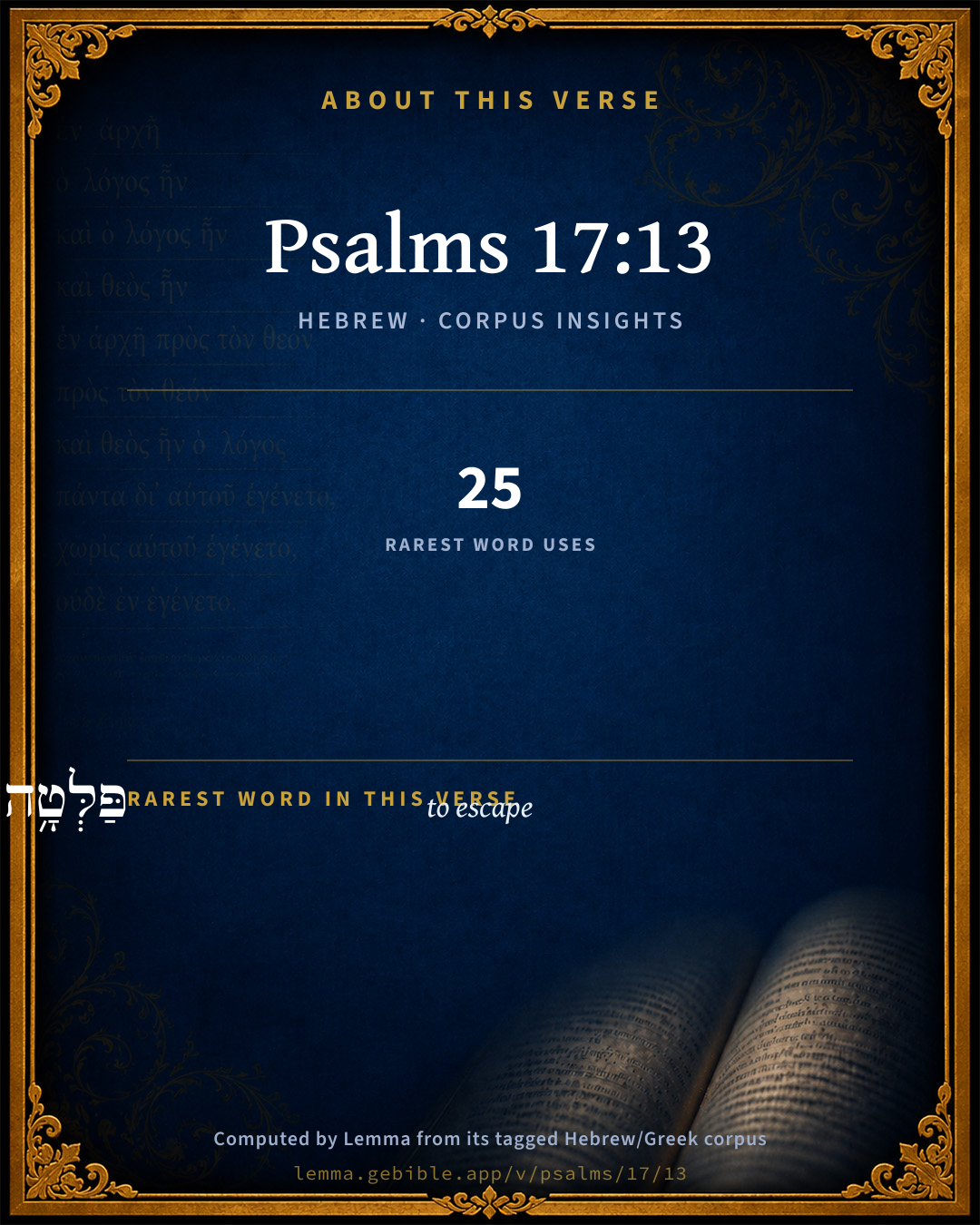
The rarest word here is פַּלְּטָ֥ה to escape H6403 — appearing just 25 times in the whole Hebrew Bible.

Shared distinctive vocabulary

פַּלְּטָ֥ה to escape H6403 occurs in 23 verses of the Hebrew Bible. Also found in:

Grammatical profile

  • 4 verbs
  • 4 nouns
  • 1 adjective

Verb forms

  • קוּמָ֤ה Qal · Imperative
  • קַדְּמָ֣ה Piel · Imperative
  • הַכְרִיעֵ֑הוּ Hiphil · Imperative
  • פַּלְּטָ֥ה Piel · Imperative

Hebrew & Septuagint length

In English translation the verse runs 16 words from the Hebrew and 18 from the Septuagint (LXX English) — closely comparable.

A rough comparison of the two English renderings, which tokenize alike — not a word-level alignment.

Word counts can differ between the Hebrew and the Greek without any difference in meaning — e.g. the Hebrew direct-object marker אֵת has no separate Greek word, and Greek often adds the article ὁ.

Cross-references

14

Topical passages linked to Psalms 17:13 in the Treasury of Scripture Knowledge — connected by theme and wording, ordered by reader-vote popularity; previews shown in the World English Bible.

  • Psalms 3:7 Arise, Yahweh! Save me, my God! For you have struck all of my enemies on the cheek bone. You have broken the teeth of the wicked.
  • Psalms 7:6 Arise, Yahweh, in your anger. Lift up yourself against the rage of my adversaries. Awake for me. You have commanded judgment.
  • Psalms 44:26 Rise up to help us. Redeem us for your loving kindness' sake.
  • Psalms 7:11–13 God is a righteous judge, Yes, a God who has indignation every day.
  • Psalms 22:20 Deliver my soul from the sword, My precious life from the power of the dog.
  • Psalms 44:23 Wake up! Why do you sleep, Lord? Arise! Don't reject us forever.
  • Acts 4:28 to do whatever your hand and your council foreordained to happen.
  • Psalms 119:126 It is time to act, Yahweh, For they break your law.
  • Isaiah 10:5 Ho Assyrian, the rod of my anger, the staff in whose hand is my indignation!
  • Isaiah 10:15 Shall the axe boast itself against him who hews therewith? Shall the saw magnify itself against him who wields it? as if a rod should wield those who lift it up, [or] as if a staff should lift up [him who is] not wood.
  • Isaiah 51:9 Awake, awake, put on strength, arm of Yahweh; awake, as in the days of old, the generations of ancient times. Isn't it you who did cut Rahab in pieces, who pierced the monster?
  • Isaiah 13:5 They come from a far country, from the uttermost part of heaven, even Yahweh, and the weapons of his indignation, to destroy the whole land.
  • Isaiah 37:26 Have you not heard how I have done it long ago, and formed it of ancient times? now have I brought it to pass, that it should be your to lay waste fortified cities into ruinous heaps.
  • Habakkuk 1:12 Aren't you from everlasting, Yahweh my God, my Holy One? We will not die. Yahweh, you have appointed him for judgment. You, Rock, have established him to punish.

Cross-references courtesy of OpenBible.info (CC BY 4.0).

Hebrew and Greek witnesses Masoretic Hebrew ↔ Greek Septuagint

The same verse in the two great witnesses to the Old Testament, shown verse-for-verse.

You’re reading Greek Psalm 16 (Hebrew Psalm 17). The Septuagint counts the superscription, so verse numbers can differ from the Hebrew — chapter-level alignment, not verse-by-verse. Numbering follows Rahlfs.

These are two independent witnesses, not word-aligned to each other, and the Septuagint is shown in lemma (dictionary) form.

Hebrew Psalms 17:13 Masoretic · Westminster Leningrad Codex

קוּמָ֤ה יְהוָ֗ה קַדְּמָ֣ה פָ֭נָיו הַכְרִיעֵ֑הוּ פַּלְּטָ֥ה נַ֝פְשִׁ֗י מֵרָשָׁ֥ע חַרְבֶּֽךָ

Arise, Yahweh, Confront him, cast him down. Deliver my soul from the wicked by your sword;

World English Bible · Public Domain

Greek LXX Greek Psalm 16:13 Septuagint · lemma form

ἀναἵστημι κύριος προφθάνω αὐτός καί ὑποσκελίζω αὐτός ῥύομαι ὁ ψυχή ἐγώ ἀπό ἀσεβής ῥομφαία σύ ἀπό ἐχθρός ὁ χείρ σύ

Arise, O Lord, prevent them, and cast them down: deliver my soul from the ungodly: draw your sword,

LXX2012 (modern English Septuagint) · Public Domain

On this verse, J. A. Alexander on Psalms discusses the Septuagint’s reading. Read the note in Commentary ↓

Hebrew: Westminster Leningrad Codex (CC BY 4.0). Greek: Septuagint (public domain); English from LXX2012 (modern English Septuagint) (Public Domain). How the Septuagint differs from the Hebrew →

Commentary

Notes on Psalms 17:13 from classic Christian and Jewish commentators (each source and its license shown beneath its notes). The classic Christian expositions comment on the surrounding passage and are grouped to its opening verse, so a note may address several verses; the Jewish commentaries on the Tanakh (Rashi and others) are per-verse, so they appear only where the commentator wrote on this verse.

Lemma curates 59 commentaries, every one of them public domain or Creative Commons licensed, each selected and text-cleaned for this edition rather than reprinted as found. About our sources →

Jamieson, Fausset & Brown

Robert Jamieson, A. R. Fausset & David Brown

disappoint--literally, "come before," or, "encounter him." Supply "with" before "sword" (Psa 17:13), and "hand" (Psa 17:14). These denote God's power.

Jamieson, Fausset & Brown — Commentary Critical and Explanatory on the Whole Bible (1871) — public domain (CC PDM 1.0). Text via the HelloAO Bible API.

Trapp's Complete Commentary

John Trapp

Psa 17:13 Arise, O LORD, disappoint him, cast him down: deliver my soul from the wicked, [which is] thy sword:

Ver. 13. Arise, O Lord, disappoint him] Anticipa faciem eius, that is, that raging and ravening lion; step between me and him, and stop his fury, defeat his purpose, and disable his power.

Which is thy sword] As Assyria is called tho rod of his wrath. Attila styled himself, Orbis flagellum, the wrath of God and the scourge of the world. So Tamerlane was commonly called, the wrath of God and terror of the world. Some render it, by thy sword, i.e. or thy might and power; see Job 40:19?; or, by thy word execute thy judgment.

John Trapp, A Commentary or Exposition upon All the Books of the Old and New Testament (1647–1656) — public domain. Text from a community e-Sword module.

The Treasury of David

Charles H. Spurgeon

Ver. 13. Arise, O Lord. The more furious the attack, the more fervent the Psalmist's prayer. His eye rests singly upon the Almighty, and he feels that God has but to rise from the seat of his patience, and the work will be performed at once. Let the lion spring upon us, if Jehovah steps between we need no better defence. When God meets our foe face to face in battle, the conflict will soon be over.

Disappoint him. Be beforehand with him, outwit and outrun him. Appoint it otherwise than he has appointed, and so disappoint him.

Cast him down. Prostrate him. Make him sink upon his knees. Make him bow as the conquered bows before the conqueror. What a glorious sight will it be to behold Satan prostrate beneath the foot of our glorious Lord! Haste, glorious day!

Deliver my soul from the wicked, which is thy sword. He recognizes the most profane and oppressive as being under the providential rule of the King of kings, and used as a sword in the divine hand. What can a sword do unless it be wielded by a hand? No more could the wicked annoy us, unless the Lord permitted them so to do. Most translators are, however, agreed that this is not the correct reading, but that it should be as Calvin puts it, "Deliver my soul from the ungodly man by thy sword." Thus David contrasts the sword of the Lord with human aids and reliefs, and rests assured that he is safe enough under the patronage of heaven.

Ver. 13. The wicked, which is thy sword. The devil and his instruments both are God's instruments, therefore "the wicked" are called his "sword, "his "axe" (Ps 17:13 Isa 10:15); now let God alone to wield the one, and handle the other. He is but a bungler that hurts and hackles his own legs with his own axe; which God should do if his children should be the worse for Satan's temptations. Let the devil choose his way, God is a match for him at every weapon. If he will try it by force of arms, and assaults the saints by persecution, as the "Lord of hosts" he will oppose him. If by policy and subtlety, he is ready there also. The devil and his whole council are but fools to God; nay, their wisdom foolishness. William Gurnall.

Ver. 13-14. Thy sword... thy hand. Thou canst as easily command and manage them, as a man may wield his sword, or move his hand. Wilt thou suffer thine own sword, thine own hand, to destroy thine own servant? J. Howe

None.

Psalms 17:14*

Ver. 13-14. Thy sword... thy hand. Thou canst as easily command and manage them, as a man may wield his sword, or move his hand. Wilt thou suffer thine own sword, thine own hand, to destroy thine own servant?

J. Howe

Ver. 14 (first clause). How wonderful are the dispensations of the providence of God, who can use even the wicked to promote the present happiness and the final salvation of his saints! J. Edwards, M.A., 1856.

Charles H. Spurgeon's The Treasury of David (1869–1885) — public domain. Psalms only. Text from a community e-Sword/MySword module.

Joseph Benson's Commentary

Psa 17:13. Arise, O Lord, disappoint him — Hebrew, קדמה פניו, kadmah panaiv, prevent his face; that is, Go forth against him, and meet and face him in battle, as enemies are wont to do. Or, prevent the execution of his mischievous designs against me: stop him in his attempt, and give him the first blow. The wicked, which is thy sword — Or thy hand, as it follows, Psa 17:14, that is, thy instrument to execute vengeance upon thine enemies, or to chastise and exercise thy people; for which latter reason the Assyrian is termed God’s rod, Isa 10:5, as being raised up and appointed for the correction of God’s people, Hab 1:12. The sense therefore is, Do not punish me by this rod: let me fall into thy hands, and not into the hands of wicked men, 2Sa 24:14. The words, however, may be rendered, Let thy sword deliver me from the wicked: thy hand, O Lord, from men: Psa 17:14, from those men, who are of this world: the sword and hand of Jehovah being frequently used to denote his power and vengeance.

Joseph Benson's Commentary on the Old and New Testaments (1811–1818) — public domain. Text from a community e-Sword module.

J. A. Alexander on Psalms

Joseph Addison Alexander

13. (Psa 17:13) Arise, Jehovah, go before his face, make him bow, save my soul from the wicked (with) thy sword. On the meaning of the prayer that God would arise, see above on Psa 3:8 (7).—Go before his face: the same Hebrew phrase occurs below (Psa 95:2), in the sense of coming into one's presence. Here the context gives it the more emphatic sense of meeting, encountering, withstanding. Make him bend or bow, as the conquered bows beneath the conqueror.—The construction of thy sword seems to be the same with that of their mouth in Psa 17:10. The Septuagint puts thy sword in apposition with my soul, the Vulgate with the word immediately preceding, men (who are) thy sword, as the Assyrian is said to be the rod in God's hand (Isa 10:5). But such a representation of the enemy as God's chosen instruments, instead of enforcing, would enfeeble the petition. The verb translated save is a causative strictly meaning make to escape.

Joseph Addison Alexander, The Psalms Translated and Explained (1850) — public domain. Text from a community e-Sword module.

Tyndale Open Study Notes

Tyndale Open Resources

17:13-14 The psalmist confidently prays for the Lord’s victory, knowing that God possesses more power than the evildoers. The psalmist finds his joy in the Lord’s inheritance (16:5), whereas the wicked search for joy in this world.

Tyndale Open Study Notes — © Tyndale Open Resources, licensed CC BY-SA 4.0. Text via the HelloAO Bible API.

Geneva Bible (1599)

Geneva Bible translators

Stop his rage.

Or, which is thy sword.

Geneva Bible (1599) marginal notes — public domain. Text via Bolls.life.

Adam Clarke's Commentary

Verse 13. Arise, O Lord, disappoint him] When he arises to spring upon and tear me to pieces, arise thou, O Lord; disappoint him of his prey; seize him, and cast him down.

Deliver my soul] Save my life.

From the wicked, which is thy sword] Saul is still meant, and we may understand the words as either implying the sword, the civil power, with which God had intrusted him, and which he was now grievously abusing; or, it may mean, deliver me by THY sword - cut him off who wishes to cut me off. On this ground the next verse should be read from men, BY thy hand. So the margin. The hand of God not only meaning his power, but his providence.

Adam Clarke's Commentary on the Bible (1810–1826) — public domain. Text from a community e-Sword/MySword module.

John Calvin's Commentaries

13. Arise, O Jehovah. The more furiously David was persecuted by his enemies, he beseeches God the more earnestly to afford him immediate aid; for he uses the word face to denote the swift impetuosity of his adversary, to repress which there was need of the greatest haste. By these words, the Holy Spirit teaches us, that when death shows itself to be just at hand, God is provided with remedies perfectly prepared, by which he can effect our deliverance in a moment. The Psalmist not only attributes to God the office of delivering his people; he at the same time arms him with power to crush and break in pieces the wicked. He does not, however, wish them to be cast down farther than was necessary to their being humbled, that they might cease from their outrageous and injurious conduct towards him, as we may gather from the following clause, where he again beseeches God to deliver his soul David would have been contented to see them continuing in the possession of their outward ease and prosperity, had they not abused their power by practising injustice and cruelty. Let us know then, that God consults the good of his people when he overthrows the ungodly, and breaks their strength; when he does this, it is for the purpose of delivering from destruction the poor innocents who are molested by these wretched men. “Qui sont molestez par ces malheureux.” — Fr.

“It may be questioned whether David, in this or the next clause, intended to represent wicked men as the sword and the hand of God; that is, the instruments which he employed to correct his servants; or whether his meaning was to pray that God would interpose his own hand and sword to defend him and punish his enemies. The latter sense is adopted by some interpreters; but as the former is a perfectly Scriptural sentiment, and requires the supposition of no ellipsis, it appears to me to be most likely what is intended. Vide Isaiah 10:5.” — Walford. Many of the most eminent critics, however, adopt the translation which Calvin has given, as Hammond, Houbigant, Ainsworth, Bishops Lowth, Horsley, Home, and Hare, Dr Boothroyd, Dr Adam Clarke, Dathe, and Venema. The reading in Tyndale’s Bible is, “Deliver my soul with thy sword from the ungodly.”

John Calvin's Commentaries (1540-1563) — public domain. Text from the Calvin Translation Society English edition (1840s-50s) via the Christian Classics Ethereal Library (ccel.org). Calvin's coverage is partial (roughly two-thirds of the Bible); uncommented books and verses are honest gaps, never fabricated. The 19th-century editor's footnotes and remarks are omitted so the notes are faithfully Calvin's own voice.

Ellicott's Commentary for English Readers

(13) Disappoint.—Rather, go to meet, as a champion defending some one.

Which is thy sword.—This thought, making the wicked God’s weapons of wrath (Isa_10:5), is arbitrarily introduced by the Authorised Version, and is quite out of keeping with the context. Translate “with thy sword,” either understanding a preposition, or treating the accusative as an adverb of manner; as an adverb of time and place it is common. Similarly in the next verse, “with thy hand from men of the world.”

A Bible Commentary for English Readers, edited by Charles John Ellicott (1878–1897) — public domain. Text from a community e-Sword module.

The Cambridge Bible for Schools and Colleges

gen. ed. J. J. S. Perowne

13. Arise, O Lord (Psa_3:7), confront him, meet him face to face as he prepares to spring (or, as R.V. marg., forestall him), make him bow down, crouching in abject submission (Psa_18:39). The same word is used of the lion in repose, Gen_49:9; Num_24:9.

13, 14. from the wicked, which is thy sword: from men which are thy hand] This rendering, which is in part that of Jerome, is retained in R.V. marg. For the thought that God uses even the wicked as His instruments see Isa_10:5, where the Assyrian is called the rod of Jehovah’s anger. But R.V. text is preferable: from the wicked by thy sword; from men, by thy hand. Cp. Psa_7:12.

The Cambridge Bible for Schools and Colleges (gen. ed. J. J. S. Perowne; Cambridge University Press, 1878–1918) — public domain. Text from a community e-Sword module.

John Gill's Exposition

Arise, O Lord,.... See Psa 3:7;

disappoint him, or "prevent his face" (k); be beforehand with him, and so disappoint him, when he is about to seize his prey; who is comparable to the lion, or to the young lion; meaning the chief of his enemies, it may be Saul;

cast him down; everyone of them that set themselves to cast down others to the earth. Jarchi's note is,

"cut off his feet,''

that he may bow down and fall;

deliver my soul from the wicked, which is thy sword; so Jarchi, Aben Ezra, Kimchi, and Ben Melech, render the words; that is, from wicked men, whom God makes use of as instruments to afflict and chastise his people: so the Assyrian monarch is called the "rod" of his anger, with whom he scourged his people Israel, Isa 10:5. Compare with this Psa 22:20. The words are rendered by some, "deliver my soul from the wicked by thy swords" (l); meaning not the sword of the Spirit, the Word of God by which Christ was delivered from the wicked one, when tempted by him in the wilderness; but the avenging justice of God, the sword of the Lord, which, being whetted and taken hold on, and used by him, brings vengeance on his enemies, and salvation to his people; see Deu 32:41. The Targum paraphrases the clause thus,

"deliver my soul from the wicked, who deserves to be slain by thy sword.''

(k) "praeveni faciem ejus", Pagninus, Montanus, Vatablus, Musculus, Gejerus; "anticipa faciem ejus", Junius & Tremellius, Piscator. (l) "gladio tuo ab improbis", Junius & Tremellius; Gejerus; so Ainsworth.

John Gill's Exposition of the Whole Bible (1746–1763) — public domain (CC PDM 1.0). Text via the HelloAO Bible API.

Albert Barnes' Notes on the Bible

Arise, O Lord - See the notes at Psa 3:7.

Disappoint him - Margin, “prevent his face.” The marginal reading expresses the sense of the Hebrew. The word used in the original means “to anticipate, to go before, to prevent;” and the prayer here is that God would come “before” his enemies; that is, that he would cast himself in their way “before” they should reach him. The enemy is represented as marching upon him with his face intently fixed, seeking his destruction; and he prays that God would interpose, or that He would come to his aid “before” his enemy should come up to him.

Cast him down - That is, as it is in the Hebrew, make him bend or bow, as one who is conquered bows before a conqueror.

Deliver my soul from the wicked - Save my life; save me from the designs of the wicked.

Which is thy sword - The Aramaic Paraphrase renders this, “Deliver my soul from the wicked man, who deserves to be slain with thy sword.” The Latin Vulgate: “Deliver my soul from the wicked man; thy spear from the enemies of thy hand.” So the Septuagint: “Deliver my soul from the wicked; thy sword from the enemies of thy hand.” The Syriac, “Deliver my soul from the wicked, and from the sword.” DeWette renders it, “Deliver my soul from the wicked by thy sword.” Prof. Alexander, “Save my soul from the wicked (with) thy sword.” So Luther, “With thy sword.” The Hebrew will undoubtedly admit of this latter construction, as in a similar passage in Psa 17:10; and this construction is found in the margin: “By thy sword.” The sentiment that the wicked ARE the “sword” of God, or the instruments, though unconsciously to themselves, of accomplishing his purposes, or that he makes them the executioners of his will, is undoubtedly favored by such passages as Isa 10:5-7 (see the notes at those verses), and should be properly recognized. But such a construction is not necessary in the place before us, and it does not well agree with the connection, for it is not easy to see why the psalmist should make the fact that the wicked were instruments in the hand of God in accomplishing his purposes a “reason” why He should interpose and deliver him from them. It seems to me, therefore, that the construction of DeWette and others, “Save me from the wicked “by” thy sword,” is the true one. The psalmist asked that God would interfere by his own hand, and save him from danger. The same construction, if it be the correct one, is required in the following verse.

Albert Barnes' Notes on the Bible (1834–1885) — public domain. Text from a community e-Sword/MySword module.

Matthew Poole's English Annotations

Disappoint him, Heb. prevent his face, i.e. go forth against him, and meet and face him in battle, as enemies use to do. Or, prevent the execution of his mischievous designs against me; stop him in his attempt, and give him the first blow.

Which is thy sword; or, thy hand, as it follows, Psa 17:14, i.e. thy instrument to execute vengeance upon thine enemies, or to chastise and exercise thy people; for which reason the Assyrian is called God’s rod, Isa 10:5, as being ordained for correction, Hab 1:12. The sense is, Do not punish me by this rod; let me fall into thy hands, and not into the hands of wicked men, 2Sa 24:14. Or, by (which preposition is understood Psa 2:12, and oft elsewhere) thy sword, i.e. by thy power.

Matthew Poole's English Annotations on the Holy Bible (1683–1685) — public domain. Text from a community e-Sword/MySword module.

Whedon's Commentary on the Bible

Daniel D. Whedon

13. Arise, O Lord, disappoint him—Literally, Rise, O Jehovah, meet his face. The lion couched, with his eye on the prey, is before us in Psa_17:11-12. God only can step between and face the monster. It may also be equal to “smite his face.” Psa_3:7.

Thy sword—Not which is “thy sword,” but by thy sword.

Daniel D. Whedon (gen. ed.), Commentary on the Old and New Testaments (1874–1909) — public domain. Text from a community e-Sword module.

The Pulpit Commentary

Arise, O Lord. (comp. Psa_7:6 Psa_9:19 Psa_10:12 Psa_44:26, etc.) Having described the character of the wicked man, and pointed out his ill desert (vers. 9-12), the psalmist now invokes God"s vengeance upon him. "Right" requires equally the succour of the godly and the punishment of the ungodly man. Disappoint him, cast him down; literally, get before him, bow him down; i.e. intercept his spring, and bow him down to the earth. (see Psa_18:39) Deliver my soul from the wicked. This will be the result of the interposition. When the ungodly are cast down, the righteous are delivered out of their hand. Which is thy sword. A true statement, (see Isa_10:5) but scarcely what the writer intended in this place, where he is regarding the wicked as altogether opposed to God. It is best to translate, with the Revised Version, Deliver my soul from the wicked by thy sword.

The Pulpit Commentary (1880–1919), ed. H.D.M. Spence-Jones & Joseph S. Exell — public domain. Text from a community e-Sword module.

John Wesley's Explanatory Notes

Sword - Thy instrument to execute vengeance upon thine enemies. Do not punish me with this rod: let me fall into thy hands, and not into the hands of men.

John Wesley, Explanatory Notes Upon the Whole Bible (1754–1765) — public domain. Text via the GEBible commentary corpus.

Keil & Delitzsch

C. F. Keil & F. Delitzsch

The phrase קדּם פּני, antevertere faciem alicujus, means both to appear before any one with reverence, Psa 95:2 (post-biblical: to pay one's respects to any one) and to meet any one as an enemy, rush on him. The foe springs like a lion upon David, may Jahve - so he prays - as his defence cross the path of the lion and intercept him, and cast him down so that he, being rendered harmless, shall lie there with bowed knees (כּרע, of the lion, Gen 49:9; Num 24:9). He is to rescue his soul from the ungodly חרבּך. This חרבך, and also the ידך which follows, can be regarded as a permutative of the subject (Bצttcher, Hupfeld, and Hitzig), an explanation which is commended by Psa 44:3 and other passages. But it is much more probable that more exact definitions of this kind are treated as accusatives, vid., on Psa 3:5. At any rate "sword" and "hand" are meant as the instruments by which the פּלּט, rescuing, is effected. The force of פּלּטה extends into Psa 17:14, and mimatiym (with a Chateph under the letter that is freed from reduplication, like ממכון, Psa 33:14) corresponds to מרשׁע, as ידך to חרבּך. The word ממתים (plural of מת, men, Deu 2:34, whence מתם, each and every one), which of itself gives no complete sense, is repeated and made complete after the interruption cause by the insertion of ידך ה, - a remarkable manner of obstructing and then resuming the thought, which Hofmann (Schriftbeweis ii. 2. 495) seeks to get over by a change in the division of the verse and in the interpunction. חלד, either from חלד Syriac to creep, glide, slip away (whence חלדּה a weasel, a mole) or from חלד Talmudic to cover, hide, signifies: this temporal life which glides by unnoticed (distinct from the Arabic chald, chuld, an abiding stay, endless duration); and consequently חדל, limited existence, from חדל to have an end, alternates with חלד as a play upon the letters, comp. Psa 49:2 with Isa 38:11. The combination מחלד מתים resembles Psa 10:18; Psa 16:4. What is meant, is: men who have no other home but the world, which passeth away with the lust thereof, men ἐκ τοῦ κόσμου τούτου, or υίοὶ τοῦ αἰῶνος τούτου. The meaning of the further description חלקם בּחיּים (cf. Ecc 9:9) becomes clear from the converse in Psa 16:5. Jahve is the חלק of the godly man; and the sphere within which the worldling claims his חלק is החיּים, this temporal, visible, and material life. This is everything to him; whereas the godly man says: טּוב חסדּך מחיּים, Psa 63:4. The contrast is not so much between this life and the life to come, as between the world (life) and God. Here we see into the inmost nature of the Old Testament faith. To the Old Testament believer, all the blessedness and glory of the future life, which the New Testament unfolds, is shut up in Jahve. Jahve is his highest good, and possessing Him he is raised above heaven and earth, above life and death. To yield implicitly to Him, without any explicit knowledge of a blessed future life, to be satisfied with Him, to rest in Him, to hide in Him in the face of death, is the characteristic of the Old Testament faith. חלקם בחיים expresses both the state of mind and the lot of the men of the world. Material things which are their highest good, fall also in abundance to their share. The words "whose belly Thou fillest with Thy treasure" (Chethb: וּצפינך the usual participial form, but as a participle an Aramaising form) do not sound as though the poet meant to say that God leads them to repentance by the riches of His goodness, but on the contrary that God, by satisfying their desires which are confined to the outward and sensuous only, absolutely deprives them of all claim to possessions that extend beyond the world and this present temporal life. Thus, then, צפוּן in this passage is used exactly as צפוּנים is used in Job 20:26 (from צפן to hold anything close to one, to hold back, to keep by one). Moreover, there is not the slightest alloy of murmur or envy in the words. The godly man who lacks these good things out of the treasury of God, has higher delights; he can exclaim, Psa 31:20 : "how great is Thy goodness which Thou hast laid up (צפנתּ) for those who fear Thee!" Among the good things with which God fills the belly and house of the ungodly (Job 22:17.) are also children in abundance; these are elsewhere a blessing upon piety (Psa 127:3., Psa 128:3.), but to those who do not acknowledge the Giver they are a snare to self-glorifying, Job 21:11 (cf. Wisdom Job 4:1). בּנים is not the subject, but an accusative, and has been so understood by all the old translators from the original text, just as in the phrase שׁבע ימים to be satisfied with, or weary of, life. On עוללים vid., on Psa 8:3. יתר (from יתר to stretch out in length, then to be overhanging, towering above, projecting, superfluous, redundant) signifies here, as in Job 22:20, riches and the abundance of things possessed.

Keil & Delitzsch — Biblical Commentary on the Old Testament (1861–1891) — public domain (CC PDM 1.0). Text via the HelloAO Bible API. (Old Testament only.)

unfoldingWord translationNotes

Door43 World Missions Community

Rescue my life from the wicked by your sword ... Rescue me from men by your hand, Yahweh, from men of this world

These two clauses have similar meanings. The repetition adds intensity to the writer's words. (See: Parallelism)

by your sword ... by your hand

Here "sword" and "hand" both represent the power of Yahweh. (See: Metonymy)

You will fill the bellies of your treasured ones with riches

The ancient text is hard to understand. Possible meanings are 1) "treasured" is a metaphor for loved, and "your treasured ones" refers to the people whom God loves. AT: "you will fill the bellies of the people you love with riches" or 2) "your treasured ones" refers to treasures that God gives to people, the "men of this world" AT: "you will fill their bellies with rich treasures" (See: Metaphor)

You will fill the bellies ... with riches

Here "fill the bellies ... with riches" is a metaphor for giving them many valuable things. Possible meanings are 1) "You will give many riches to the people you love" or 2) "you will give the men of this world many riches" (See: Metaphor)

translationWords

Yahweh

evil

sword

hand

world

children

unfoldingWord translationNotes — © Distant Shores Media and the Door43 World Missions Community, licensed CC BY-SA 4.0. Source: git.door43.org/Door43/en_tn.

Rashi

Rabbi Shlomo Yitzchaki (Rashi)

confront him The enemy.

bring him down to his knees Beat his legs, and he will kneel and fall.

rescue my soul from every wicked man who is Your sword, for You give him the power to rule, to requite those who are bound to You.

Rashi on the Tanakh — English translations: “The Judaica Press complete Tanach with Rashi, translated by A. J. Rosenberg” (CC BY 4.0); “Pentateuch with Rashi's commentary by M. Rosenbaum and A.M. Silbermann, 1929-1934” (public domain); “The Metsudah Tanach series, Lakewood, N.J” (CC BY 4.0); and “The Book of Joshua, Metsudah Publications, 1997” (CC BY 4.0). Text via Sefaria.

Radak

Rabbi David Kimhi (Radak)

Arise, O Lord: – when he comes to pursue and tear me.

Confront him and cast him down: – so that he shall not have the strength to harm me.

Deliver my soul from the wicked, Thy sword: – i.e. from the wicked which is Thy sword, as it is said (Isaiah 10:5): “Ho, Assyrian, the rod of Mine anger,” etc.; for the sword, and escape from it, is all from Thee; as it is written, “I have wounded, and I heal” (Deut. 32:39).

Radak on the Tanakh — English translations: “Sefaria Community Translation” (CC0 1.0 (public-domain dedication)); “Eliyahu Munk, HaChut Hameshulash” (CC BY 4.0); “Rabbi Mike Feuer, Jerusalem Anthology” (CC BY 4.0); and “R. David Kimhi on the first book of Psalms, Translated by R.G. Finch, London, 1919” (public domain). Text via Sefaria.

Lesson kit

Teaching starters — assembled from the data on this page, not authored interpretation. Every prompt links to the verse data it draws on. Edit before teaching.

Psalms, in the Wisdom, opens this verse with 9 words (9 distinct Hebrew lemmas). Its most distinctive word is pâlaṭ (“to escape”). A historical commentator’s framing appears above. Read the whole chapter for the surrounding context.

Discussion questions

  1. How does “to escape” (pâlaṭ) shape what this verse is saying?
  2. 2 Samuel 22:2 shares the word «to escape» with this verse. How do the two illuminate each other?
  3. The translations on this page render this verse differently — a whole-verse word diff, not a word-by-word alignment. What might account for the different wordings?
  4. The verb «קוּמָ֤ה» is Qal Imperative. How does its form color the action?
  5. Reading how Jamieson, Fausset & Brown and Trapp's Complete Commentary read this verse, where do the two commentators agree and where do they part?

Things to notice

Reading settings

Reading text

Shown beneath each verse's original-language words.

Old Testament
Old Testament edition

Read the OT as the Masoretic Hebrew (MT) or the Greek Septuagint (LXX).

English shown for the Greek Septuagint (in the Hebrew ↔ Greek comparison).

Comparing translations? Open the Compare panel on any verse page to stack up to four side by side.