
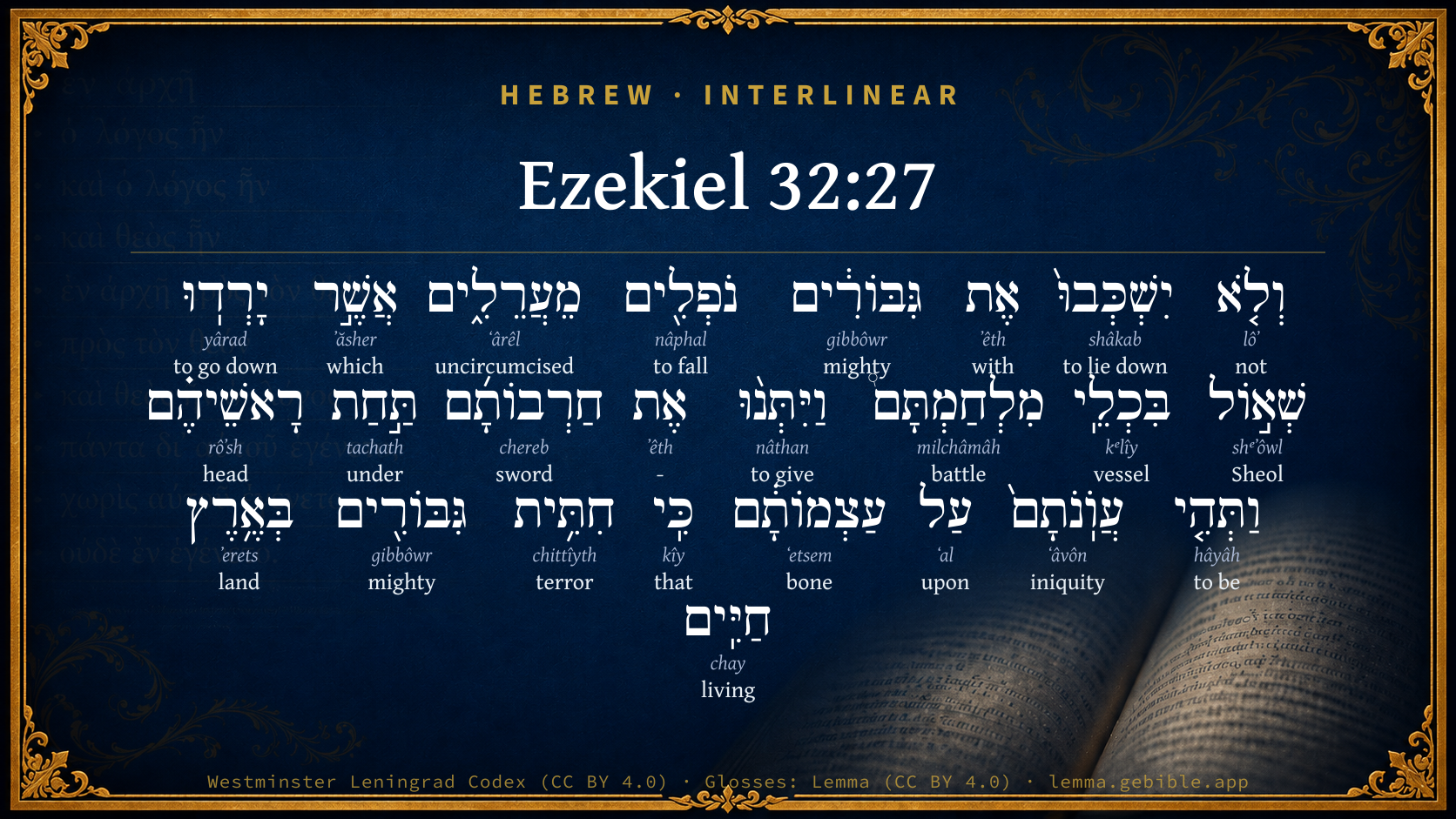
Ezekiel 32:27

Hebrew (Westminster Leningrad Codex) Ezekiel 32:27 appears in the Hebrew Old Testament. The text above is from the Westminster Leningrad Codex. Each word links to its Strong’s number, a concise gloss, and parsing drawn from the Open Scriptures Hebrew Bible morphology. Click any word for its full Brown-Driver-Briggs (BDB) entry.
Download image
Cite this verse

Ezekiel 32:27 (World English Bible). Public Domain. Lemma interlinear Bible study tool, https://lemma.gebible.app/v/ezekiel/32/27.

Show BibTeX & RIS
BibTeX
RIS
English Translation
They shall not lie with the mighty who are fallen of the uncircumcised, who are gone down to Sheol with their weapons of war, and have laid their swords under their heads, and their iniquities are on their bones; for [they were] the terror of the mighty in the land of the living.
World English Bible · Public Domain
Download a study sheet

One document with this verse’s original text, its word-by-word gloss line, the meaning frame, cross-references with their text, attributed commentary, and full source and license credits — printable, and it pastes into notes with its structure intact.

This verse Autodidact and up

Study sheet (.html) Plain text (.txt)

A passage Seminary Student

Up to 50 verses in one chapter. A passage sheet keeps up to 6 commentary sources and 12 cross-references per verse, in the order this page ranks them, and says so on the sheet whenever that leaves anything out. Ask for a single verse and you get the Autodidact verse sheet above.

Everything on this page stays free to read, with no account — the sheet is a download of what is already on screen, not access to it.

Want to remove ads? Support Godless Engineer
Compare translations 3

The same verse in 3 English versions, stacked beneath the original-language interlinear above. Click any original word for its lexicon entry.

Each is an independent rendering of the whole verse — the interlinear is not word-aligned to these translations.

Highlighted words mark where these versions differ — a whole-verse word diff, not a word-by-word alignment.

  • World English Bible Public Domain
    They shall not lie with the mighty who are fallen of the uncircumcised, who are gone down to Sheol with their weapons of war, and have laid their swords under their heads, and their iniquities are on their bones; for [they were] the terror of the mighty in the land of the living.
  • King James Version Public Domain
    And they shall not lie with the mighty that are fallen of the uncircumcised, which are gone down to hell with their weapons of war: and they have laid their swords under their heads, but their iniquities shall be upon their bones, though they were the terror of the mighty in the land of the living.
  • unfoldingWord Literal Text CC BY-SA 4.0
    They do not lie with the fallen warriors of the uncircumcised who have gone down to Sheol with all their weapons of war, and with their swords placed under their heads and their iniquities over their bones. For they were the terror of warriors in the land of the living.

unfoldingWord Literal Text — © unfoldingWord, licensed CC BY-SA 4.0. Word-aligned USFM3 via Door43 (git.door43.org/unfoldingWord/en_ult).

Versions to compare (up to 4)

3 of 4 selected

Show all 18 translations

Every available English version of this verse, each an independent rendering of the whole verse.

  • World English Bible Public Domain
    They shall not lie with the mighty who are fallen of the uncircumcised, who are gone down to Sheol with their weapons of war, and have laid their swords under their heads, and their iniquities are on their bones; for [they were] the terror of the mighty in the land of the living.
  • Berean Standard Bible Public Domain
    They do not lie down with the fallen warriors of old, who went down to Sheol with their weapons of war, whose swords were placed under their heads, whose shields rested on their bones, although the terror of the mighty was once in the land of the living.
  • Majority Standard Bible Public Domain
    They do not lie down with the fallen warriors of old, who went down to Sheol with their weapons of war, whose swords were placed under their heads, whose shields rested on their bones, although the terror of the mighty was once in the land of the living.
  • King James Version Public Domain
    And they shall not lie with the mighty that are fallen of the uncircumcised, which are gone down to hell with their weapons of war: and they have laid their swords under their heads, but their iniquities shall be upon their bones, though they were the terror of the mighty in the land of the living.
  • American Standard Version (1901) Public Domain
    And they shall not lie with the mighty that are fallen of the uncircumcised, that are gone down to Sheol with their weapons of war, and have laid their swords under their heads, and their iniquities are upon their bones; for `they were' the terror of the mighty in the land of the living.
  • Revised Version (1885) Public Domain
    And they shall not lie with the mighty that are fallen of the uncircumcised, which are gone down to hell with their weapons of war, and have laid their swords under their heads, and their iniquities are upon their bones; for they were the terror of the mighty in the land of the living.
  • Geneva Bible (1599) Public Domain
    And they shall not lie with the valiant of the vncircumcised, that are fallen, which are gone down to the graue, with their weapons of warre, and haue laied their swords vnder their heads, but their iniquitie shalbe vpon their bones: because they were the feare of the mighty in the lande of the liuing.
  • Douay-Rheims (1899) Public Domain
    And they shall not sleep with the brave, and with them that fell uncircumcised, that went down to hell with their weapons, and laid their swords under their heads, and their iniquities were in their bones, because they were the terror of the mighty in the land of the living.
  • Young's Literal Translation Public Domain
    And they lie not with the mighty, Who are falling of the uncircumcised, Who have gone down to sheol with their weapons of war, And they put their swords under their heads, And their iniquities are on their bones, For the terror of the mighty `is' in the land of the living.
  • Literal Standard Version CC BY-SA 4.0
    And they do not lie with the mighty, || Who are falling of the uncircumcised, || Who have gone down to Sheol with their weapons of war, || And they put their swords under their heads, || And their iniquities are on their bones, || For the terror of the mighty [is] in the land of the living.
  • Unlocked Literal Bible CC BY-SA 4.0
    They do not lie with the fallen warriors of the uncircumcised who have gone down to Sheol with all their weapons of war, and with their swords placed under their heads and their iniquities over their bones. For they were the terror of warriors in the land of the living.
  • unfoldingWord Literal Text CC BY-SA 4.0
    They do not lie with the fallen warriors of the uncircumcised who have gone down to Sheol with all their weapons of war, and with their swords placed under their heads and their iniquities over their bones. For they were the terror of warriors in the land of the living.
  • Darby Bible Public Domain
    And they lie not with the mighty, [that are] fallen of the uncircumcised, who are gone down to Sheol with their weapons of war; and whose swords are laid under their heads, and whose iniquities are upon their bones, though they were the terror of the mighty in the land of the living.
  • World Messianic Bible Public Domain
    They will not lie with the mighty who are fallen of the uncircumcised, who have gone down to Sheol with their weapons of war and have laid their swords under their heads. Their iniquities are on their bones; for they were the terror of the mighty in the land of the living.
  • Webster's Bible Public Domain
    And they shall not lie with the mighty that are fallen of the uncircumcised, who are gone down to the grave, with their weapons of war: and they have laid their swords under their heads, but their iniquities shall be upon their bones, though they were the terror of the mighty in the land of the living.
  • Free Bible Version CC BY-SA 4.0
    But they're not laid to rest with the fallen warriors of long ago who went down into Sheol with their weapons of war. Their swords were placed underneath their heads and their shields over their bones, although these powerful warriors once terrorized others when they were alive.
  • Bible in Basic English Public Domain
    And they have been put to rest with the fighting men who came to their end in days long past, who went down to the underworld with their instruments of war, placing their swords under their heads, and their body-covers are over their bones; for their strength was a cause of fear in the land of the living.
  • JPS Tanakh (1917) Public Domain
    And they that are inferior to the uncircumcised shall not lie with the mighty that are gone down to the nether-world with their weapons of war, whose swords are laid under their heads, and whose iniquities are upon their bones; because the terror of the mighty was in the land of the living.

Literal Standard Version (2020), Covenant Press — licensed CC BY-SA 4.0. Text via the HelloAO Bible API (eBible.org). Unlocked Literal Bible (unfoldingWord) — licensed CC BY-SA 4.0. Text via the HelloAO Bible API (eBible.org). unfoldingWord Literal Text — © unfoldingWord, licensed CC BY-SA 4.0. Word-aligned USFM3 via Door43 (git.door43.org/unfoldingWord/en_ult). Free Bible Version, Dr. Jonathan Gallagher — licensed CC BY-SA 4.0. Text via the HelloAO Bible API (eBible.org).

Word by word

More ways to search: Search by grammar → Find every occurrence → Compare this word →

Practice this passage: Drill this verse → Learn its vocabulary →

חִתִּ֥ית
chittîyth
H2851
“terror of”
Noun, Common, Feminine, Singular, Construct
Part of Speech
Noun
Type
Common
Gender
Feminine
Number
Singular
State
Construct
Full BDB Definition

Origin: from H2865

TWOT: 784f

terror
  1. וְלֹ֤א lôʼ H3808 “and · not” Conjunction + Particle, Negative
  2. יִשְׁכְּבוּ֙ shâkab H7901 “to lie down” Verb, Qal, Imperfect, 3rd Person, Masculine, Plural
  3. אֶת ʼêth H854 “with” Preposition
  4. גִּבּוֹרִ֔ים gibbôwr H1368 “mighty” Adjective, Adjective, Masculine, Plural, Absolute
  5. נֹפְלִ֖ים nâphal H5307 “falling” Verb, Qal, Participle Active, Masculine, Plural, Absolute
  6. מֵעֲרֵלִ֑ים ʻârêl H6189 “from · uncircumcised” Preposition + Adjective, Adjective, Masculine, Plural, Absolute
  7. אֲשֶׁ֣ר ʼăsher H834 “which” Particle, Relative
  8. יָרְדֽוּ yârad H3381 “to go down” Verb, Qal, Perfect, 3rd Person, Common, Plural
  9. שְׁא֣וֹל shᵉʼôwl H7585 “Sheol” Noun, Proper
  10. בִּכְלֵֽי kᵉlîy H3627 “in/at · vessels of” Preposition + Noun, Common, Masculine, Plural, Construct
  11. מִלְחַמְתָּם֩ milchâmâh H4421 “battle · their” Noun, Common, Feminine, Singular, Construct + Suffix, Personal, 3rd Person, Masculine, Plural
  12. וַיִּתְּנ֨וּ nâthan H5414 “and · to give” Conjunction + Verb, Qal, Sequential Imperfect, 3rd Person, Masculine, Plural
  13. אֶת ʼêth H853 “-” Particle, Direct Object
  14. חַרְבוֹתָ֜ם chereb H2719 “swords · their” Noun, Common, Feminine, Plural, Construct + Suffix, Personal, 3rd Person, Masculine, Plural
  15. תַּ֣חַת tachath H8478 “under” Preposition
  16. רָאשֵׁיהֶ֗ם rôʼsh H7218 “heads · their” Noun, Common, Masculine, Plural, Construct + Suffix, Personal, 3rd Person, Masculine, Plural
  17. וַתְּהִ֤י hâyâh H1961 “and · to be” Conjunction + Verb, Qal, Sequential Imperfect, 3rd Person, Feminine, Singular
  18. עֲוֺֽנֹתָם֙ ʻâvôn H5771 “iniquities · their” Noun, Common, Both, Plural, Construct + Suffix, Personal, 3rd Person, Masculine, Plural
  19. עַל ʻal H5921 “upon” Preposition
  20. עַצְמוֹתָ֔ם ʻetsem H6106 “bones · their” Noun, Common, Feminine, Plural, Construct + Suffix, Personal, 3rd Person, Masculine, Plural
  21. כִּֽי kîy H3588 “that” Conjunction
  22. גִּבּוֹרִ֖ים gibbôwr H1368 “mighty” Adjective, Adjective, Masculine, Plural, Absolute
  23. בְּאֶ֥רֶץ ʼerets H776 “in/at · land of” Preposition + Noun, Common, Both, Singular, Construct
  24. חַיִּֽים chay H2416 “living” Adjective, Adjective, Masculine, Plural, Absolute

About this verse

These counts appear in no published source. They are computed here, from the morphology-tagged text and Lemma’s own curated glosses. What Lemma adds →

25
words
24
distinct lemmas
Prophets
section

Notable vocabulary

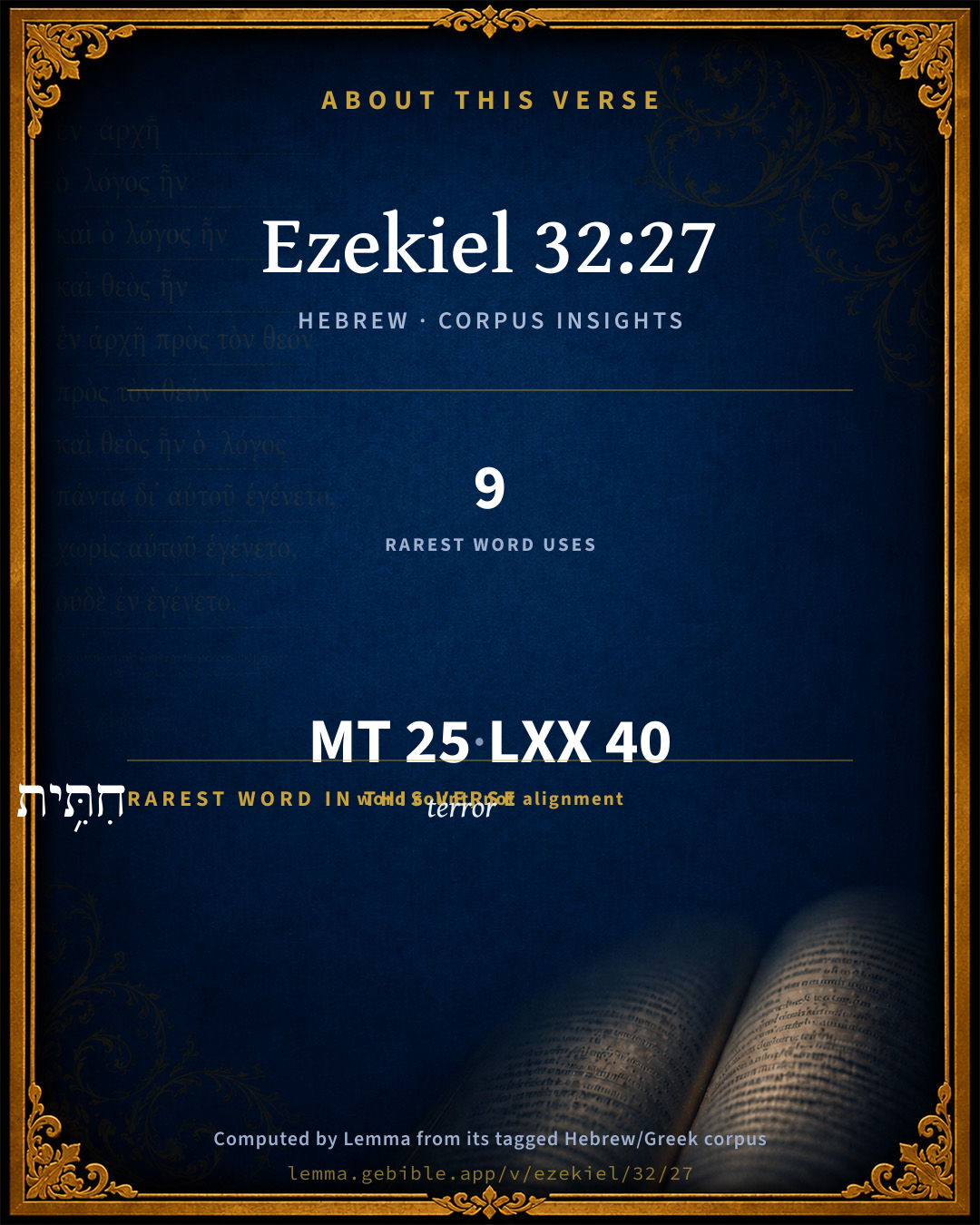
The rarest word here is חִתִּ֥ית terror H2851 — appearing just 9 times in the whole Hebrew Bible.

Shared distinctive vocabulary

חִתִּ֥ית terror H2851 occurs in 8 verses of the Hebrew Bible. Also found in:

Grammatical profile

  • 5 verbs
  • 9 nouns
  • 4 adjectives
  • 3 prepositions
  • 1 conjunction
  • 3 particles

Verb forms

  • יִשְׁכְּבוּ֙ Qal · Imperfect
  • נֹפְלִ֖ים Qal · Participle Active
  • יָרְדֽוּ Qal · Perfect
  • וַיִּתְּנ֨וּ Qal · Sequential Imperfect
  • וַתְּהִ֤י Qal · Sequential Imperfect

Repetition

A word recurs within this verse — often emphatic in Hebrew:

  • גִּבּוֹרִ֔ים mighty H1368 ×2

Hebrew & Septuagint length

In English translation the verse runs 53 words from the Hebrew and 44 from the Septuagint (LXX English) — closely comparable.

A rough comparison of the two English renderings, which tokenize alike — not a word-level alignment.

Word counts can differ between the Hebrew and the Greek without any difference in meaning — e.g. the Hebrew direct-object marker אֵת has no separate Greek word, and Greek often adds the article ὁ.

In the original languages it is 25 Hebrew tokens and 40 Greek tokens — but the two are counted differently (Hebrew bundles its prefixes and suffixes into one token; the Greek is in lemma form), so that isn’t a like-for-like length.

Cross-references

13

Topical passages linked to Ezekiel 32:27 in the Treasury of Scripture Knowledge — connected by theme and wording, ordered by reader-vote popularity; previews shown in the World English Bible.

  • Isaiah 14:18–19 All the kings of the nations, all of them, sleep in glory, everyone in his own house.
  • Job 3:13–15 For now should I have lain down and been quiet. I should have slept, then I would have been at rest,
  • Job 20:11 His bones are full of his youth, But youth shall lie down with him in the dust.
  • Psalms 109:18 He clothed himself also with cursing as with his garment. It came into his inward parts like water, Like oil into his bones.
  • Ezekiel 32:21 The strong among the mighty shall speak to him out of the midst of Sheol with those who help him: they are gone down, they lie still, even the uncircumcised, slain by the sword.
  • Psalms 49:14 They are appointed as a flock for Sheol. Death shall be their shepherd. The upright shall have dominion over them in the morning. Their beauty shall decay in Sheol, Far from their mansion.
  • Psalms 92:7 Though the wicked spring up as the grass, And all the evil-doers flourish, They will be destroyed forever.
  • Psalms 92:9 For, behold, your enemies, Yahweh, For, behold, your enemies shall perish. All the evil-doers will be scattered.
  • Proverbs 14:32 The wicked is brought down in his calamity, But in death, the righteous has a refuge.
  • Isaiah 54:17 No weapon that is formed against you shall prosper; and every tongue that shall rise against you in judgment you shall condemn. This is the heritage of the servants of Yahweh, and their righteousness which is of me, says Yahweh.
  • Ezekiel 18:20 The soul who sins, he shall die: the son shall not bear the iniquity of the father, neither shall the father bear the iniquity of the son; the righteousness of the righteous shall be on him, and the wickedness of the wicked shall be on him.
  • John 8:24 I said therefore to you that you will die in your sins; for unless you believe that I am he, you will die in your sins."
  • 2 Corinthians 10:4 for the weapons of our warfare are not of the flesh, but mighty before God to the throwing down of strongholds,

Cross-references courtesy of OpenBible.info (CC BY 4.0).

Hebrew and Greek witnesses Masoretic Hebrew ↔ Greek Septuagint

The same verse in the two great witnesses to the Old Testament, shown verse-for-verse.

These are two independent witnesses, not word-aligned to each other, and the Septuagint is shown in lemma (dictionary) form.

Hebrew Ezekiel 32:27 Masoretic · Westminster Leningrad Codex

וְלֹ֤א יִשְׁכְּבוּ֙ אֶת גִּבּוֹרִ֔ים נֹפְלִ֖ים מֵעֲרֵלִ֑ים אֲשֶׁ֣ר יָרְדֽוּ שְׁא֣וֹל בִּכְלֵֽי מִלְחַמְתָּם֩ וַיִּתְּנ֨וּ אֶת חַרְבוֹתָ֜ם תַּ֣חַת רָאשֵׁיהֶ֗ם וַתְּהִ֤י עֲוֺֽנֹתָם֙ עַל עַצְמוֹתָ֔ם כִּֽי חִתִּ֥ית גִּבּוֹרִ֖ים בְּאֶ֥רֶץ חַיִּֽים

They shall not lie with the mighty who are fallen of the uncircumcised, who are gone down to Sheol with their weapons of war, and have laid their swords under their heads, and their iniquities are on their bones; for [they were] the terror of the mighty in the land of the living.

World English Bible · Public Domain

Greek LXX Ezekiel 32:27 Septuagint · lemma form

καί κοιμάω μετά ὁ γίγας ὁ πίπτω ἀπό αἰών ὅς καταβαίνω εἰς ᾅδης ἐν ὅπλον πολεμικός καί τίθημι ὁ μάχαιρα αὐτός ὑπό ὁ κεφαλή αὐτός καί γίγνομαι ὁ ἀνομία αὐτός ἐπί ὁ ὀστέον αὐτός ὅτι ἐκφοβέω γίγας ἐν γῆ ζωή

And they are laid with the giants that fell of old, who went down to Hades with their weapons of war: and they laid their swords under their heads, but their iniquities were upon their bones, because they terrified all men during their life.

LXX2012 (modern English Septuagint) · Public Domain

On this verse, The Cambridge Bible for Schools and Colleges discusses the Septuagint’s reading. Read the note in Commentary ↓

Hebrew: Westminster Leningrad Codex (CC BY 4.0). Greek: Septuagint (public domain); English from LXX2012 (modern English Septuagint) (Public Domain). How the Septuagint differs from the Hebrew →

Targum (Aramaic paraphrase)

1

The Targum is the ancient Jewish Aramaic paraphrase of the Hebrew Scriptures — an interpretive translation, not the Hebrew text itself. Onkelos (literal) and Pseudo-Jonathan (expansive) render the Torah, and Jonathan the Prophets. Coverage is partial: where no permissively-licensed English translation exists for a verse, only the Aramaic is shown. This is verse-level text, not a word-by-word alignment to the Hebrew.

  1. Targum Jonathan Prophets (Joshua–Malachi)
    וְלָא יִשְׁכְּבוּן עִם גִבָּרַיָא דְאִתְקְטָלוּ מֵחַיָבַיָא דְאִתְּחָתוּ לִשְׁאוֹל בְּמָנֵי קְרָבֵיהוֹן וִיחָבוּ יַת סַיְפֵיהוֹן תְּחוֹת רֵישֵׁיהוֹן וַהֲווֹ חוֹבֵיהוֹן עַל גָרְמֵיהוֹן אֲרֵי אִתְמְסִירוּ לִתְּבַר גִבָּרַיָא עַל דְשַׁלִיטוּ בְּאַרְעָא דְיִשְׂרָאֵל:

    (no public-domain English translation for this verse)

    Targum Jonathan — Aramaic: “Mikraot Gedolot” (public domain). English: “Sefaria Community Translation” (CC0 1.0 (public-domain dedication)); “London "Chaldee Paraphrase," 1871” (public domain). Text via Sefaria.

Commentary

Notes on Ezekiel 32:27 from classic Christian and Jewish commentators (each source and its license shown beneath its notes). The classic Christian expositions comment on the surrounding passage and are grouped to its opening verse, so a note may address several verses; the Jewish commentaries on the Tanakh (Rashi and others) are per-verse, so they appear only where the commentator wrote on this verse.

Lemma curates 59 commentaries, every one of them public domain or Creative Commons licensed, each selected and text-cleaned for this edition rather than reprinted as found. About our sources →

The Cambridge Bible for Schools and Colleges

gen. ed. J. J. S. Perowne

27. they shall not lie] LXX. Syr. omit the neg.: and they are laid with the giants. Ew. would retain the neg., reading as an interrogation with an affirmative sense: and shall they not lie with …?, which is not very natural.

fallen of the uncircumcised] LXX. fallen of old. This reading has considerable probability, although the other reading might stand. Some scholars would also alter “fallen” (nophelim) into Nephilim (cf. R. V. Gen_6:4); an unnecessary change. For “hell” read Sheòl.

they have laid their swords] they laid (indeterminate subj.)—equivalent to the passive: and their swords were laid.

but their … shall be] and their iniquities were. The reference is still to the “mighty;” to change the subject spoken of, making the clause refer to Meshech and Tubal, is most unnatural.

though they were the terror] because the terror of the mighty was in the land. The clause explains the preceding, as for ex. why their iniquities were upon their bones, and would certainly be easier if the reading had been: because the terror of their might was, as the Syr. reads, precisely as in Eze_32:29-30. So Hitz. Corn. (Possibly geburam should be read; cf. Hos_13:2, and often with fem. nouns.)

Eze_32:27 is difficult. The reading “they shall not lie with the mighty” suggests the idea that the mighty who fell of old, and went down to Sheòl in full armour, and had their swords laid under their heads, occupy a more honourable place in Sheòl than such a rout as Meshech and Tubal, who are counted unworthy to lie beside them. This idea is not probable in itself, and cannot be reconciled with other parts of the verse. The last clause “because the terror of the mighty (or, of their might) was in the land of the living” ascribes the same sin to these mighty as is charged against Asshur and the rest (Eze_32:23-24, &c.), and for which they bear their shame. Again, the phrase “their iniquities were upon their bones” can have no other meaning than that their evil and violence were interred with their bones, and continued to cleave to them—that they went down unhouselled, disappointed, unaneled, cut off in the blossom of their sin. The conjecture of Corn. “their shields were upon their bones” is altogether destitute of probability. LXX. renders “giants,” as it does Gen_6:4, and possibly it thought of the antediluvian race. The prophet may have had this race in his mind, but more probably his reference is a wider one (cf. Eze_32:12, Eze_39:18; Eze_39:20). Even if he referred to the giants before the Flood, it is anything but likely, with Genesis 6 before him and with his moral temper, that he would assign an honourable place in Sheòl to those violent desperadoes. The weird touch “went down to Sheòl in their weapons of war, and had their swords laid under their heads,” probably means that the manner of their death and burial was in keeping with the violence and bloodshed which was the occupation of their life. The usages and sentiments of chivalry were not yet known to Ezekiel. The clause should, therefore, probably be read positively.

The Cambridge Bible for Schools and Colleges (gen. ed. J. J. S. Perowne; Cambridge University Press, 1878–1918) — public domain. Text from a community e-Sword module.

Trapp's Complete Commentary

John Trapp

Eze 32:27 And they shall not lie with the mighty [that are] fallen of the uncircumcised, which are gone down to hell with their weapons of war: and they have laid their swords under their heads, but their iniquities shall be upon their bones, though [they were] the terror of the mighty in the land of the living.

Ver. 27. Which are gone down to hell with their weapons of war.] They died not gloriously as conquerors, nor were buried triumphantly with their arms under their heads, as valiant warriors were wont to be; sed ingloria vita recessit, but they died like dogs and were basely buried, and yet that was not the worst of it either.

But their iniquities shall be upon their bones.] They shall rue for their cruelty and bloodshed. These shall be as a murdering weapon in their bones {Psa 42:10} throughout all eternity.

John Trapp, A Commentary or Exposition upon All the Books of the Old and New Testament (1647–1656) — public domain. Text from a community e-Sword module.

The Biblical Illustrator

Joseph S. Exell

Eze_32:27

Gone down to hell with their weapons of war.

Teaching from ancient tombs

I. The utter helplessness of mortality.

1. What might is there that call withstand death! From armies, thrones, castles, courts, and empires, death hath plucked his prey.

2. The universality of deaths empire.

(1) We walk not an untrodden path; It is the way of all flesh.

(2) Though it is the way of all flesh, yet we must each walk that path alone, and yet not alone (Psa_23:4).

3. What a picture is here drawn of all enmity against God! Rebellion against God is madness (Psa_2:1-12).

4. What a contrast the grave of the Saviour presents to these! Victorious death in that bright Easter morn was subdued and crushed. Ours is the triumph also. Though mortality be helpless, and must bow to the dust, yet humanity is triumphant, and shall rise again.

II. The fond tenacity of memory. Memory surrounds the living with relics of the dead and mementoes of the past. Even the dead are surrounded with tokens of their circumstances, character, and career. Above the grave stands the grey tombstone, with the simple inscription, To the memory. What memories are you preparing for your deathbed and the grave? Our moral actions, mental emotions, and impressions we cannot bury in everlasting oblivion. Our character is our true epitaph cut deeply into our tomb. (R. S. Latimer.)

.

The Biblical Illustrator, edited by Joseph S. Exell (c. 1880s–1900s) — public domain. Text from a community e-Sword module.

Geneva Bible (1599)

Geneva Bible translators

Which died not by cruel death, but by the course of nature, and are honorably buried with their coat armor, and signs of honor.

Geneva Bible (1599) marginal notes — public domain. Text via Bolls.life.

Jamieson, Fausset & Brown

Robert Jamieson, A. R. Fausset & David Brown

they shall not lie with the mighty--that is, they shall not have separate tombs such as mighty conquerors have: but shall all be heaped together in one pit, as is the case with the vanquished [GROTIUS]. HAVERNICK reads it interrogatively, "Shall they not lie with the mighty that are fallen?" But English Version is supported by the parallel (Isa 14:18-19), to which Ezekiel refers, and which represents them as not lying as mighty kings lie in a grave, but cast out of one, as a carcass trodden under foot.

with . . . weapons of war--alluding to the custom of burying warriors with their arms (1 Maccabees 13:29). Though honored by the laying of "their swords under their heads," yet the punishment of "their iniquities shall be upon their bones." Their swords shall thus attest their shame, not their glory (Mat 26:52), being the instruments of their violence, the penalty of which they are paying.

Jamieson, Fausset & Brown — Commentary Critical and Explanatory on the Whole Bible (1871) — public domain (CC PDM 1.0). Text via the HelloAO Bible API.

Adam Clarke's Commentary

Verse 27. Gone down to hell with their weapons of war] Are buried in their armour and with their weapons lying by their sides. It was a very ancient practice, in different nations, to bury a warrior's weapons in the same grave with himself.

Adam Clarke's Commentary on the Bible (1810–1826) — public domain. Text from a community e-Sword/MySword module.

Ellicott's Commentary for English Readers

(27) And they shall not lie.—If this be the correct translation, then a distinction is implied between these nations and the others. The others have been honourably buried “with their weapons of war,” while these come to a more disgraceful end. It is better, however, to take it as a question (which the Hebrew fully admits): “Shall they not?” &c.

Their iniquities shall be upon their bones—i.e., they shall die in their iniquity. As we say in English, their sins shall be upon their heads.

A Bible Commentary for English Readers, edited by Charles John Ellicott (1878–1897) — public domain. Text from a community e-Sword module.

John Gill's Exposition

And they shall not lie with the mighty that are fallen of the uncircumcised,.... That is, shall not lie in such state, or be buried with such pomp and magnificence, and have such sepulchral monuments erected to their memory, as other heroes among the Heathens have had; such as the mighty kings of Assyria and Persia before mentioned:

which are gone down to hell, or "the grave",

with their weapons of war; which were never taken from them, and which they held in their hands to the last, being never conquered, and died at last a natural death, and not by the sword; or which were carried in state before their hearse at the time of interment, as is the custom to this day so to do at the funeral of great warriors, generals, and officers:

and they have laid their swords under their heads; as a sign and token, as Jarchi says, that the sword did not rule over them, that they did not fall by it; either their statues and sepulchral monuments were adorned with these, and other instruments of war, as was the grave of Misenus by Aeneas (d); and as is still the custom where the heads of such mighty ones are laid, to engrave them on them: or, literally, their swords and other weapons of war were put in their graves under their heads; as it was usual, in former times, in some places to put swords, shields, and other armour, in the graves of military men, as were in the grave of Theseus, on the bier of Alexander the great, and others, as reported by Plutarch, Diodorus Siculus, and Sophocles (e): now the Scythians were not buried: after this grand and pompous manner:

but their iniquities shall be upon their bones; or the punishment of their sin should be, that their bones should lie unburied and scattered about, or be dug up and broke to pieces, and treated with inhumanity and contempt, as a just reward for their savageness, and cruelty:

though they were the terror of the mighty in the land of the living: not only the terror of the common people, but even of the most powerful kings and mighty warriors.

(d) Vid. Virgil. Aeneid. l. 6. & Seneca, l. 4. controvers. 4. (e) Vid. Lydium de Re Militari, l. 6. c. 7. p. 250, 251. & Kirchman, de Funer. Roman. l. 3. c. 18.

John Gill's Exposition of the Whole Bible (1746–1763) — public domain (CC PDM 1.0). Text via the HelloAO Bible API.

Albert Barnes' Notes on the Bible

And they shall not lie - Better, “Shall they not lie?” or, “Are they not laid?” The custom of burying warriors with their swords, shields, or helmets, raider their heads is well known, and common to most warlike nations.

But their iniquities ... - They, rested in all the glories of a warrior’s sepulture, but their sins followed them to the grave.

Albert Barnes' Notes on the Bible (1834–1885) — public domain. Text from a community e-Sword/MySword module.

Haydock's Catholic Bible Commentary

Not. Some copies of Septuagint omit the negation. Others render the Hebrew, "Have they not slept?" &c. These nations were deprived of military honours, dying like cowards; and therefore their swords were not placed with them in the grave. (Calmet) --- It was customary to inter such things as the deceased had like the most. (Serv. in Virgil’s Æneid x. Arma quibus lætatus habe tus, &c. Simon (1 Machabees xiii. 29.) placed arms and representations of ships on the pillars at Modin, in honour of his kindred. If Elam, &c., had not received such distinction, why should the Egyptian repine? Were they any better? (Calmet) --- The country and king of the Elamites, Assyrians, and other infidels, shall be destroyed. (Worthington)

George Leo Haydock (1774–1849), Haydock's Catholic Family Bible and Commentary, 1859 edition — public domain. Excludes Psalms (Douay-Rheims chapter numbering differs from Protestant) and Deuterocanonical books (Catholic canon only).

Matthew Poole's English Annotations

They shall not lie with the mighty; the leaders of these Scythians were not buried with a pomp like that of Asshur or Elam, but, surprised by the fraud of Halyattes and Cyaxares, were cut off with all their multitude, and tumbled into pits with the rabble. With their weapons; a ceremony observed in pompous funerals of great captains, to have their weapons and their armour carried before the hearse.

Laid their swords under their heads; either when carried out to be buried, or laid under their head in their graves; or perhaps under the statues of them placed on the tops of their tombs: these barbarous Scythians were not so buried.

Their iniquity, the exemplary punishment of their iniquity,

shall be upon their bones; shall be seen upon their bones unburied, and cast out on the earth by the just judgment of God.

Though they were the terror; because they were Cruel, bloody, ravenous, and mischievously tyrannical while they lived.

The mighty; Cyaxares and the Persians, that durst not again attempt Nineveh, till the Scythians were fallen.

Matthew Poole's English Annotations on the Holy Bible (1683–1685) — public domain. Text from a community e-Sword/MySword module.

The Pulpit Commentary

And they shall not lie with the mighty. The words seem at first to contradict Ver. 26. The LXX meets the difficulty by omitting the negative; Ewald and Havernick, by taking it as an interrogative, "Shall they not lie," etc.? Probably the explanation is laying stress on the word "mighty." Meshech and Tubal have a lower place in Hades; they are buried without the honors of war. Their swords are not placed beneath their heads (for the practice thus referred to, see Died. Sic., 18:26; Arrian, 1:5; Virg., "AEn.," 6:233). For the Scythians, who worshipped the sword (Herod., L 62), this would be the extremest ignominy. In this way their iniquities should be upon their bones as they lay dishonored.

Ver. 27 ("Their iniquities shall be upon their bones"). Indelible sin.

The idea seems to be that the guilty Egyptians shall not have honorable burial like that of the kings and princes who have been laid in the tombs with their weapons of war by their side a token that they may yet roam as great fighting heroes through the dim regions of the nether world. The Egyptians are forbidden this prospect. They who of all people cared for the preservation of the bodies of the dead, by embalming and burying in huge pyramids, are to have their bones flung in a heap like a confused mass of corpses hurriedly gathered together from a battle-field. This is a punishment of sin.

I SIN ONCE COMMITTED REMAINS WITH THE SINNER. Our own deeds are our lasting possession. We may lose all else and still not lose them. In the exciting moment of temptation the foolish fancy is entertained that the sin may be quickly committed and then left behind. The sinner will flee from his guilt and leave it in the dark depths of some distant forest. Alas! this is impossible. The awful thing pursues its maker into the wilderness, into the city, into the sacred sanctuary of the home.

II SIN ENTERS DEEPLY INTO THE NATURE OF THE SINNER. It is not merely a deed of the hand. If it were that only it would have no moral character. But it springs from the inner being, and it comes home to roost. Though the flesh be scraped from the bones, still the sin remains, as though cleaving to the very skeleton it is so close a companion, its seat is so terribly centered within.

III SIN PURSUES THE SINNER AFTER DEATH. The sinner does not carry his wealth with him, but he carries his wickedness. His estate must be left behind, his iniquity will accompany him. His body he must cast off, but he cannot cast off his sin. The man and his sin will enter into the dread world of the dead together, there to be judged by God, there to reap the consequences of their fearful partnership.

IV NO HUMAN EXPERIENCE CAN REMOVE SIN. Iniquities lying on the very bones of the dead! Who shall tear them off and fling them away? Tears will not wash them out, for tears cannot undo the past. Amendment will not destroy them, for even if that be possible, it is wholly a thing of the future, it does not touch the record of the past.

V CHRIST BLOTS OUT SIN THAT IS OTHERWISE INDELIBLE. He cannot deny history, turn back the wheels of time and unknit the web of the past. But he can and he does offer pardon. When sin is forgiven God will remember it no more against the sinner. (Jer_31:34) With pardon Christ also brings a new heart and life. The new inner life has had nothing to do with the old sin. It makes a fresh start unhampered with the ugly burden of the past. This great result is brought about on Christ"s side by his death and resurrection, (Rom_4:25) and on our side through penitence and faith. (Act_3:19)

The Pulpit Commentary (1880–1919), ed. H.D.M. Spence-Jones & Joseph S. Exell — public domain. Text from a community e-Sword module.

John Wesley's Explanatory Notes

They - The leaders of these Scythians were not buried with a pomp like that of Ashur, or Elan, but surprised by Halyattes and Cyaxares, were cut off with all their multitude, and tumbled into pits with the rabble. With their weapons - A ceremony observed in pompous funerals of great captains, to have their weapons, and their armour carried before the hearse. Laid their swords - In their graves, as if they could sleep the sweeter there, when they laid their heads on such a pillow: These barbarous Scythians were not so buried. Their iniquity - The exemplary punishment of their iniquity shall be seen upon their bones unburied.

John Wesley, Explanatory Notes Upon the Whole Bible (1754–1765) — public domain. Text via the GEBible commentary corpus.

Rashi

Rabbi Shlomo Yitzchaki (Rashi)

But they will not lie These who were mentioned [will not lie] with the mighty who died a natural death, for they will be inferior to and worse than the uncircumcised who died a natural death and descended with their weapons into the Grave.

and they laid i.e., those who buried them [laid]...their swords under their heads as a sign to make it known that the sword did not prevail over them.

and their iniquities were upon their bones Nothing was lacking from their iniquity, for the slaying sword did not expiate it, because they were not slain. Now what is the iniquity? That the destruction wrought by these mighty men was in the land of the living.

Rashi on the Tanakh — English translations: “The Judaica Press complete Tanach with Rashi, translated by A. J. Rosenberg” (CC BY 4.0); “Pentateuch with Rashi's commentary by M. Rosenbaum and A.M. Silbermann, 1929-1934” (public domain); “The Metsudah Tanach series, Lakewood, N.J” (CC BY 4.0); and “The Book of Joshua, Metsudah Publications, 1997” (CC BY 4.0). Text via Sefaria.

Lesson kit

Teaching starters — assembled from the data on this page, not authored interpretation. Every prompt links to the verse data it draws on. Edit before teaching.

Ezekiel, in the Prophets, opens this verse with 25 words (24 distinct Hebrew lemmas). Its most distinctive word is chittîyth (“terror”). A historical commentator’s framing appears above. Read the whole chapter for the surrounding context.

Discussion questions

  1. What does “terror” (chittîyth) contribute to the verse as a whole?
  2. How does Ezekiel 26:17, which shares the word «terror», read alongside this verse?
  3. What does the repetition of “mighty” (2× in this one verse) do in this verse?
  4. The translations on this page render this verse differently — a whole-verse word diff, not a word-by-word alignment. What might account for the different wordings?
  5. «יִשְׁכְּבוּ֙» is a Qal Imperfect verb. How does that grammatical form shape the action described?
  6. Compare how The Cambridge Bible for Schools and Colleges and Trapp's Complete Commentary read this verse. Where do they agree or differ?

Things to notice

Reading settings

Reading text

Shown beneath each verse's original-language words.

Old Testament
Old Testament edition

Read the OT as the Masoretic Hebrew (MT) or the Greek Septuagint (LXX).

English shown for the Greek Septuagint (in the Hebrew ↔ Greek comparison).

Comparing translations? Open the Compare panel on any verse page to stack up to four side by side.