
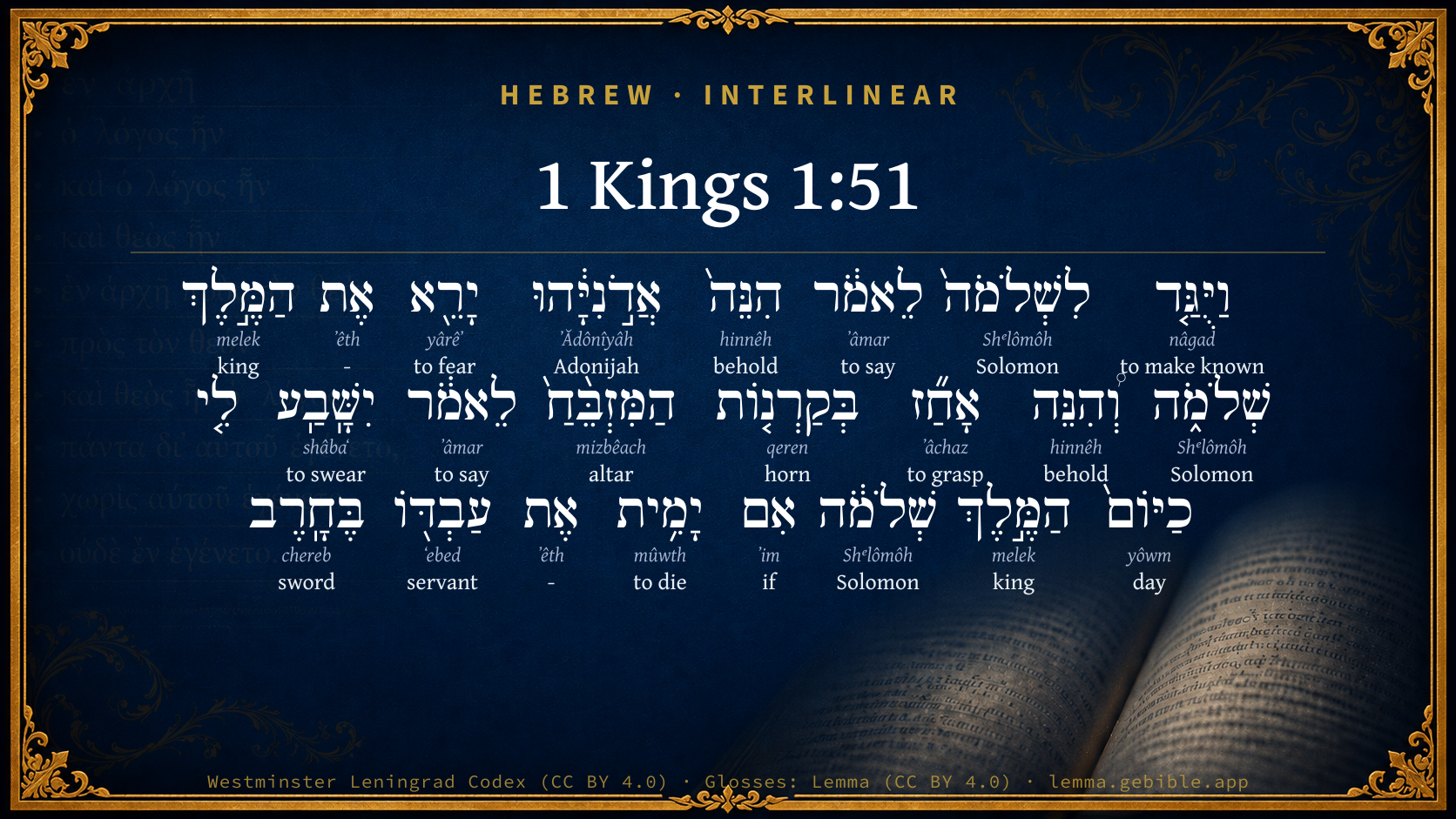
1 Kings 1:51

Hebrew (Westminster Leningrad Codex) 1 Kings 1:51 appears in the Hebrew Old Testament. The text above is from the Westminster Leningrad Codex. Each word links to its Strong’s number, a concise gloss, and parsing drawn from the Open Scriptures Hebrew Bible morphology. Click any word for its full Brown-Driver-Briggs (BDB) entry.
Download image
Cite this verse

1 Kings 1:51 (World English Bible). Public Domain. Lemma interlinear Bible study tool, https://lemma.gebible.app/v/1-kings/1/51.

Show BibTeX & RIS
BibTeX
RIS
English Translation
It was told Solomon, saying, Behold, Adonijah fears king Solomon; for, behold, he has laid hold on the horns of the altar, saying, Let king Solomon swear to me first that he will not kill his servant with the sword.
World English Bible · Public Domain
Download a study sheet

One document with this verse’s original text, its word-by-word gloss line, the meaning frame, cross-references with their text, attributed commentary, and full source and license credits — printable, and it pastes into notes with its structure intact.

This verse Autodidact and up

Study sheet (.html) Plain text (.txt)

A passage Seminary Student

Up to 50 verses in one chapter. A passage sheet keeps up to 6 commentary sources and 12 cross-references per verse, in the order this page ranks them, and says so on the sheet whenever that leaves anything out. Ask for a single verse and you get the Autodidact verse sheet above.

Everything on this page stays free to read, with no account — the sheet is a download of what is already on screen, not access to it.

Want to remove ads? Support Godless Engineer
Compare translations 3

The same verse in 3 English versions, stacked beneath the original-language interlinear above. Click any original word for its lexicon entry.

Each is an independent rendering of the whole verse — the interlinear is not word-aligned to these translations.

Highlighted words mark where these versions differ — a whole-verse word diff, not a word-by-word alignment.

  • World English Bible Public Domain
    It was told Solomon, saying, Behold, Adonijah fears king Solomon; for, behold, he has laid hold on the horns of the altar, saying, Let king Solomon swear to me first that he will not kill his servant with the sword.
  • King James Version Public Domain
    And it was told Solomon, saying, Behold, Adonijah feareth king Solomon: for, lo, he hath caught hold on the horns of the altar, saying, Let king Solomon swear unto me today that he will not slay his servant with the sword.
  • unfoldingWord Literal Text CC BY-SA 4.0
    And it was declared to Solomon, saying, “Behold, Adonijah fears King Solomon. And behold, he has grasped the horns of the altar, saying, ‘Let King Solomon swear to me as today if he will kill his servant with the sword.’”

unfoldingWord Literal Text — © unfoldingWord, licensed CC BY-SA 4.0. Word-aligned USFM3 via Door43 (git.door43.org/unfoldingWord/en_ult).

Versions to compare (up to 4)

3 of 4 selected

Show all 18 translations

Every available English version of this verse, each an independent rendering of the whole verse.

  • World English Bible Public Domain
    It was told Solomon, saying, Behold, Adonijah fears king Solomon; for, behold, he has laid hold on the horns of the altar, saying, Let king Solomon swear to me first that he will not kill his servant with the sword.
  • Berean Standard Bible Public Domain
    It was reported to Solomon: “Behold, Adonijah fears King Solomon, and he has taken hold of the horns of the altar, saying, ‘Let King Solomon first swear to me not to put his servant to the sword.’”
  • Majority Standard Bible Public Domain
    It was reported to Solomon: “Behold, Adonijah fears King Solomon, and he has taken hold of the horns of the altar, saying, ‘Let King Solomon first swear to me not to put his servant to the sword.’”
  • King James Version Public Domain
    And it was told Solomon, saying, Behold, Adonijah feareth king Solomon: for, lo, he hath caught hold on the horns of the altar, saying, Let king Solomon swear unto me today that he will not slay his servant with the sword.
  • American Standard Version (1901) Public Domain
    And it was told Solomon, saying, Behold, Adonijah feareth king Solomon; for, lo, he hath laid hold on the horns of the altar, saying, Let king Solomon swear unto me first that he will not slay his servant with the sword.
  • Revised Version (1885) Public Domain
    And it was told Solomon, saying, Behold, Adonijah feareth king Solomon: for, lo, he hath laid hold on the horns of the altar, saying, Let king Solomon swear unto me this day that he wilt not slay his servant with the sword.
  • Geneva Bible (1599) Public Domain
    And one tolde Salomon, saying, Beholde, Adonijah doeth feare King Salomon: for lo, he hath caught holde on the hornes of the altar, saying, Let King Salomon sweare vnto me this day, that he will not slay his seruant with the sword.
  • Douay-Rheims (1899) Public Domain
    And they told Solomon, saying: Behold Adonias, fearing king Solomon, hath taken hold of the horn of the altar, saying: Let king Solomon swear to me this day, that he will not kill his servant with the sword.
  • Young's Literal Translation Public Domain
    And it is declared to Solomon, saying, `Lo, Adonijah feareth king Solomon, and lo, he hath laid hold on the horns of the altar, saying, Let king Solomon swear to me as to-day -- he doth not put to death his servant by the sword.'
  • Literal Standard Version CC BY-SA 4.0
    And it is declared to Solomon, saying, “Behold, Adonijah fears King Solomon, and behold, he has laid hold on the horns of the altar, saying, Let King Solomon swear to me as today—he does not put his servant to death by the sword.”
  • Unlocked Literal Bible CC BY-SA 4.0
    Then it was told Solomon, saying, “See, Adonijah is afraid of King Solomon, for he has laid hold on the horns of the altar, saying, 'Let King Solomon swear to me first that he will not kill his servant with the sword.'”
  • unfoldingWord Literal Text CC BY-SA 4.0
    And it was declared to Solomon, saying, “Behold, Adonijah fears King Solomon. And behold, he has grasped the horns of the altar, saying, ‘Let King Solomon swear to me as today if he will kill his servant with the sword.’”
  • Darby Bible Public Domain
    And it was told Solomon saying, Behold, Adonijah fears king Solomon; for behold, he has caught hold of the horns of the altar, saying, Let king Solomon swear to me this day that he will not put his servant to death with the sword.
  • World Messianic Bible Public Domain
    Solomon was told, “Behold, Adonijah fears King Solomon; for, behold, he is hanging onto the horns of the altar, saying, ‘Let King Solomon swear to me first that he will not kill his servant with the sword.’”
  • Webster's Bible Public Domain
    And it was told Solomon, saying, Behold, Adonijah feareth king Solomon: for lo, he hath caught hold on the horns of the altar, saying, Let king Solomon swear to me to-day that he will not slay his servant with the sword.
  • Free Bible Version CC BY-SA 4.0
    Solomon was told, “Adonijah is terrified of Your Majesty. He has grabbed hold of the horns of the altar, saying, ‘Let King Solomon swear today that he won't kill me, his servant!’”
  • Bible in Basic English Public Domain
    And they gave Solomon word of it, saying, See, Adonijah goes in such fear of King Solomon, that he has put his hands on the horns of the altar, saying, Let King Solomon first give me his oath that he will not put his servant to death with the sword.
  • JPS Tanakh (1917) Public Domain
    And it was told Solomon, saying: 'Behold, Adonijah feareth king Solomon; for, lo, he hath laid hold on the horns of the altar, saying: Let king Solomon swear unto me first of all that he will not slay his servant with the sword.'

Literal Standard Version (2020), Covenant Press — licensed CC BY-SA 4.0. Text via the HelloAO Bible API (eBible.org). Unlocked Literal Bible (unfoldingWord) — licensed CC BY-SA 4.0. Text via the HelloAO Bible API (eBible.org). unfoldingWord Literal Text — © unfoldingWord, licensed CC BY-SA 4.0. Word-aligned USFM3 via Door43 (git.door43.org/unfoldingWord/en_ult). Free Bible Version, Dr. Jonathan Gallagher — licensed CC BY-SA 4.0. Text via the HelloAO Bible API (eBible.org).

Word by word

More ways to search: Search by grammar → Find every occurrence → Compare this word →

Practice this passage: Drill this verse → Learn its vocabulary →

אֲדֹ֣נִיָּ֔הוּ
ʼĂdônîyâh
H138
“Adonijah”
Noun, Proper
Part of Speech
Noun
Type
Proper
Full BDB Definition

Origin: from H113 and H3050

TWOT: None

Adonijah = "my lord is Jehovah" - fourth son of David and Solomon's rival for the throne - Levite sent by Jehoshaphat to teach the Law - a chief of the people who co-operated with Nehemiah
  1. וַיֻּגַּ֤ד nâgad H5046 “and · to make known” Conjunction + Verb, Hophal, Sequential Imperfect, 3rd Person, Masculine, Singular
  2. לִשְׁלֹמֹה֙ Shᵉlômôh H8010 “to/for · Solomon” Preposition + Noun, Proper
  3. לֵאמֹ֔ר ʼâmar H559 “to say” Preposition + Verb, Qal, Infinitive Construct
  4. הִנֵּה֙ hinnêh H2009 “behold” Particle, Demonstrative
  5. יָרֵ֖א yârêʼ H3372 “to fear” Verb, Qal, Perfect, 3rd Person, Masculine, Singular
  6. אֶת ʼêth H853 “-” Particle, Direct Object
  7. הַמֶּ֣לֶךְ melek H4428 “the · king” Particle, Definite Article + Noun, Common, Masculine, Singular, Absolute
  8. שְׁלֹמֹ֑ה Shᵉlômôh H8010 “Solomon” Noun, Proper
  9. וְ֠הִנֵּה hinnêh H2009 “and · behold” Conjunction + Particle, Demonstrative
  10. אָחַ֞ז ʼâchaz H270 “to grasp” Verb, Qal, Perfect, 3rd Person, Masculine, Singular
  11. בְּקַרְנ֤וֹת qeren H7161 “in/at · horns of” Preposition + Noun, Common, Both, Plural, Construct
  12. הַמִּזְבֵּ֨חַ֙ mizbêach H4196 “the · altar” Particle, Definite Article + Noun, Common, Masculine, Singular, Absolute
  13. לֵאמֹ֔ר ʼâmar H559 “to say” Preposition + Verb, Qal, Infinitive Construct
  14. יִשָּֽׁבַֽע shâbaʻ H7650 “to swear” Verb, Niphal, Jussive, 3rd Person, Masculine, Singular
  15. כַיּוֹם֙ yôwm H3117 “like/as the · day” Preposition, Determined + Noun, Common, Masculine, Singular, Absolute
  16. הַמֶּ֣לֶךְ melek H4428 “the · king” Particle, Definite Article + Noun, Common, Masculine, Singular, Absolute
  17. שְׁלֹמֹ֔ה Shᵉlômôh H8010 “Solomon” Noun, Proper
  18. אִם ʼim H518 “if” Conjunction
  19. יָמִ֥ית mûwth H4191 “to die” Verb, Hiphil, Imperfect, 3rd Person, Masculine, Singular
  20. אֶת ʼêth H853 “-” Particle, Direct Object
  21. עַבְדּ֖וֹ ʻebed H5650 “servant · his” Noun, Common, Masculine, Singular, Construct + Suffix, Personal, 3rd Person, Masculine, Singular
  22. בֶּחָֽרֶב chereb H2719 “in/at the · sword” Preposition, Determined + Noun, Common, Feminine, Singular, Absolute

About this verse

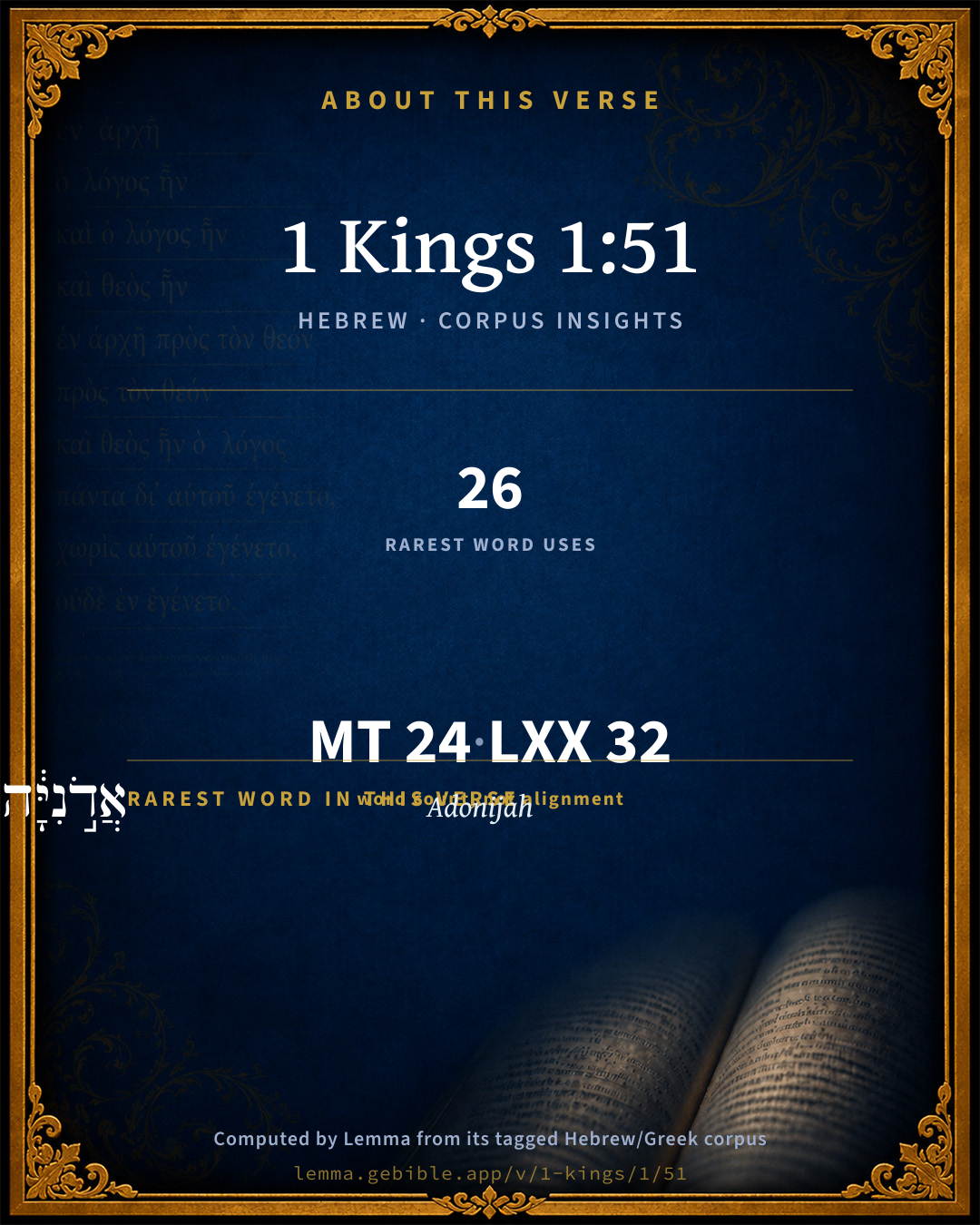
These counts appear in no published source. They are computed here, from the morphology-tagged text and Lemma’s own curated glosses. What Lemma adds →

24
words
17
distinct lemmas
Historical
section

Shared distinctive vocabulary

אֲדֹ֣נִיָּ֔הוּ Adonijah H138 occurs in 26 verses of the Hebrew Bible. Also found in:

Grammatical profile

  • 7 verbs
  • 11 nouns
  • 1 preposition
  • 1 conjunction
  • 4 particles

Verb forms

  • וַיֻּגַּ֤ד Hophal · Sequential Imperfect
  • לֵאמֹ֔ר Qal · Infinitive Construct
  • יָרֵ֖א Qal · Perfect
  • אָחַ֞ז Qal · Perfect
  • לֵאמֹ֔ר Qal · Infinitive Construct
  • יִשָּֽׁבַֽע Niphal · Jussive
  • יָמִ֥ית Hiphil · Imperfect

Repetition

Words recur within this verse — often emphatic in Hebrew:

  • לִשְׁלֹמֹה֙ Solomon H8010 ×3
  • לֵאמֹ֔ר to say H559 ×2
  • הִנֵּה֙ behold H2009 ×2
  • הַמֶּ֣לֶךְ king H4428 ×2

Hebrew & Septuagint length

In English translation the verse runs 40 words from the Hebrew and 37 from the Septuagint (LXX English) — closely comparable.

A rough comparison of the two English renderings, which tokenize alike — not a word-level alignment.

Word counts can differ between the Hebrew and the Greek without any difference in meaning — e.g. the Hebrew direct-object marker אֵת has no separate Greek word, and Greek often adds the article ὁ.

In the original languages it is 24 Hebrew tokens and 32 Greek tokens — but the two are counted differently (Hebrew bundles its prefixes and suffixes into one token; the Greek is in lemma form), so that isn’t a like-for-like length.

Hebrew and Greek witnesses Masoretic Hebrew ↔ Greek Septuagint

The same verse in the two great witnesses to the Old Testament, shown verse-for-verse.

These are two independent witnesses, not word-aligned to each other, and the Septuagint is shown in lemma (dictionary) form.

Hebrew 1 Kings 1:51 Masoretic · Westminster Leningrad Codex

וַיֻּגַּ֤ד לִשְׁלֹמֹה֙ לֵאמֹ֔ר הִנֵּה֙ אֲדֹ֣נִיָּ֔הוּ יָרֵ֖א אֶת הַמֶּ֣לֶךְ שְׁלֹמֹ֑ה וְ֠הִנֵּה אָחַ֞ז בְּקַרְנ֤וֹת הַמִּזְבֵּ֨חַ֙ לֵאמֹ֔ר יִשָּֽׁבַֽע לִ֤י כַיּוֹם֙ הַמֶּ֣לֶךְ שְׁלֹמֹ֔ה אִם יָמִ֥ית אֶת עַבְדּ֖וֹ בֶּחָֽרֶב

It was told Solomon, saying, Behold, Adonijah fears king Solomon; for, behold, he has laid hold on the horns of the altar, saying, Let king Solomon swear to me first that he will not kill his servant with the sword.

World English Bible · Public Domain

Greek LXX 1 Kings 1:51 Septuagint · lemma form

καί ἀναἀγγέλλω ὁ σαλωμών λέγω ἰδού αδωνίας φοβέω ὁ βασιλεύς σαλωμών καί καταἔχω ὁ κέρας ὁ θυσιαστήριον λέγω ὄμνυμι ἐγώ σήμερον ὁ βασιλεύς σαλωμών εἰ οὐ θανατόω ὁ δοῦλος αὐτός ἐν ῥομφαία

And it was reported to Solomon, saying, Behold, Adonias fears king Solomon, and holds the horns of the altar, saying, Let Solomon swear to me this day, that he will not kill his servant with the sword.

LXX2012 (modern English Septuagint) · Public Domain

Hebrew: Westminster Leningrad Codex (CC BY 4.0). Greek: Septuagint (public domain); English from LXX2012 (modern English Septuagint) (Public Domain). How the Septuagint differs from the Hebrew →

Targum (Aramaic paraphrase)

1

The Targum is the ancient Jewish Aramaic paraphrase of the Hebrew Scriptures — an interpretive translation, not the Hebrew text itself. Onkelos (literal) and Pseudo-Jonathan (expansive) render the Torah, and Jonathan the Prophets. Coverage is partial: where no permissively-licensed English translation exists for a verse, only the Aramaic is shown. This is verse-level text, not a word-by-word alignment to the Hebrew.

  1. Targum Jonathan Prophets (Joshua–Malachi)
    וְאִתְחַוָא לִשְׁלֹמֹה לְמֵימָר הָא אֲדֹנִיָהוּ דָחִיל מִן קֳדָם מַלְכָּא שְׁלֹמֹה וְהָא אֲחָד בְּקַרְנַת מַדְבְּחָא לְמֵימַר יְקַיֵם לִי כְּיוֹמָא דֵין מַלְכָּא שְׁלֹמֹה דְלָא יְקַטֵיל יַת עַבְדֵיהּ בְּחַרְבָּא:

    (no public-domain English translation for this verse)

    Targum Jonathan — Aramaic: “Mikraot Gedolot” (public domain). English: “Sefaria Community Translation” (CC0 1.0 (public-domain dedication)); “London "Chaldee Paraphrase," 1871” (public domain). Text via Sefaria.

Commentary

Notes on 1 Kings 1:51 from classic Christian and Jewish commentators (each source and its license shown beneath its notes). The classic Christian expositions comment on the surrounding passage and are grouped to its opening verse, so a note may address several verses; the Jewish commentaries on the Tanakh (Rashi and others) are per-verse, so they appear only where the commentator wrote on this verse.

Lemma curates 59 commentaries, every one of them public domain or Creative Commons licensed, each selected and text-cleaned for this edition rather than reprinted as found. About our sources →

Trapp's Complete Commentary

John Trapp

1Ki 1:51 And it was told Solomon, saying, Behold, Adonijah feareth king Solomon: for, lo, he hath caught hold on the horns of the altar, saying, Let king Solomon swear unto me to day that he will not slay his servant with the sword.

Ver. 51. Hath caught hold on the horns.] Hither fled malefactors, as to a place of security, {Exo 21:14} though there was no law for it.

John Trapp, A Commentary or Exposition upon All the Books of the Old and New Testament (1647–1656) — public domain. Text from a community e-Sword module.

The Cambridge Bible for Schools and Colleges

gen. ed. J. J. S. Perowne

51. Let king Solomon swear unto me to day] The word translated to day signifies rather ‘first of all,’ i.e. before I will venture to come away from my place of safety. The same word is found twice in the narrative of the sale of Esau’s birthright, Gen_25:31; Gen_25:33. When Esau has asked for pottage, Jacob says “Sell me first of all (A.V. this day) thy birthright” and afterwards “Swear to me first of all.”

The Cambridge Bible for Schools and Colleges (gen. ed. J. J. S. Perowne; Cambridge University Press, 1878–1918) — public domain. Text from a community e-Sword module.

John Gill's Exposition

And it was told Solomon,.... By some of his courtiers:

saying, behold, Adonijah feareth King Solomon; lest he should take away his life:

for, lo, he hath caught hold on the horns of the altar; which was the last resort of the guilty when they despaired of mercy otherwise:

saying, let King Solomon swear unto me this day that he will not slay his servant with the sword; he owns Solomon to be king, and himself his subject and servant; this no doubt he did to conciliate his favour, nor did he think his life safe, unless Solomon promised with an oath, that he would not take it away.

John Gill's Exposition of the Whole Bible (1746–1763) — public domain (CC PDM 1.0). Text via the HelloAO Bible API.

Haydock's Catholic Bible Commentary

Altar. At Gabaon, (2 Paralipomenon i. 3.) or at Sion. All nations seemed to grant the right of an asylum to sacred places; but only in favour of the innocent, Exodus xxi. 14. (Calmet)

George Leo Haydock (1774–1849), Haydock's Catholic Family Bible and Commentary, 1859 edition — public domain. Excludes Psalms (Douay-Rheims chapter numbering differs from Protestant) and Deuterocanonical books (Catholic canon only).

Matthew Poole's English Annotations

He owns Solomon as his king, and himself as his servant and subject; and being sensible of his great guilt, and of the jealousy which kings have of their competitors, could not be satisfied without Solomon’s oath.

Matthew Poole's English Annotations on the Holy Bible (1683–1685) — public domain. Text from a community e-Sword/MySword module.

The Pulpit Commentary

And it was told Solomon, saying, Behold Adonijah feareth King Solomon, for lo, he hath caught hold on the horns of the altar, saying, let king Solomon this repetition of the title is striking. Both courtiers and criminals hasten to give the young king his new honours. In Adonijah"s mouth it is also a virtual abdication of his claim to the throne and a direct acknowledgment of the new monarch. But see on vers. 1 and 35. swear unto me today Cf. 2Sa_19:23. This is one of many passages which show how lightly the Jews esteemed promises in comparison with oaths. The sentiment possibly took its rise in the oaths sworn by the Divine Being (Gen_22:16 Gen_24:7; Exo_16:16, etc.) though it is possible, on the other hand, that these asseverations were made in deference to the popular sentiment. Be that as it may, the oath held a much more conspicuous and important place in the Jewish than the Christian economy. See Gen_21:23 Gen_31:23; Num_14:2 Num_30:2; Jud_1:15:12 21:1; 1Sa_14:28; Jer_5:2, and, to omit other passages, 1Ki_1:13 1Ki_2:8, 1Ki_2:23, 1Ki_2:42. Even our Lord, who rebuked the habit (Mat_5:34-37 Mat_23:16-22) respected the adjuration of Caiaphas, and St. Paul frequently appeals to God (Act_26:29; 2Co_1:23 2Co_11:31; Php_1:8) The Christian religion, as it has gradually begotten a reverence for truth, has made the simple word into a bond that he will not slay his servant Cf. "I will be King," ver. 5. with the sword the usual form of capital punishment, 1 Kings if. 8, 25, 31, 46. Adonijah indirectly confesses that he had merited death.

The Pulpit Commentary (1880–1919), ed. H.D.M. Spence-Jones & Joseph S. Exell — public domain. Text from a community e-Sword module.

John Wesley's Explanatory Notes

His servants - He owns Solomon as his king, and himself as his servant and subject; and being sensible of his guilt, and of the jealousy which kings have of their competitors, could not be satisfied without Solomon's oath.

John Wesley, Explanatory Notes Upon the Whole Bible (1754–1765) — public domain. Text via the GEBible commentary corpus.

Keil & Delitzsch

C. F. Keil & F. Delitzsch

When this was reported to Solomon, together with the prayer of Adonijah that the king would swear to him that he would not put him to death with the sword (אם before ימית, a particle used in an oath), he promised him conditional impunity: "If he shall be brave (בּן־חיל, vir probus), none of his hair shall fall to the earth," equivalent to not a hair of his head shall be injured (cf. Sa1 14:45); "but if evil be found in him," i.e., if he render himself guilty of a fresh crime, "he shall die."

Keil & Delitzsch — Biblical Commentary on the Old Testament (1861–1891) — public domain (CC PDM 1.0). Text via the HelloAO Bible API. (Old Testament only.)

Lesson kit

Teaching starters — assembled from the data on this page, not authored interpretation. Every prompt links to the verse data it draws on. Edit before teaching.

1 Kings, in the Historical, opens this verse with 24 words (17 distinct Hebrew lemmas). Its most distinctive word is ʼĂdônîyâh (“Adonijah”). A historical commentator’s framing appears above. Read the whole chapter for the surrounding context.

Discussion questions

  1. How does “Adonijah” (ʼĂdônîyâh) shape what this verse is saying?
  2. 2 Samuel 3:4 shares the word «Adonijah» with this verse. How do the two illuminate each other?
  3. “Solomon” occurs 3× in this one verse. What is the effect of the repetition?
  4. The translations on this page render this verse differently — a whole-verse word diff, not a word-by-word alignment. What might account for the different wordings?
  5. The verb «וַיֻּגַּ֤ד» is Hophal Sequential Imperfect. How does its form color the action?
  6. Reading how Trapp's Complete Commentary and The Cambridge Bible for Schools and Colleges read this verse, where do the two commentators agree and where do they part?

Things to notice

Reading settings

Reading text

Shown beneath each verse's original-language words.

Old Testament
Old Testament edition

Read the OT as the Masoretic Hebrew (MT) or the Greek Septuagint (LXX).

English shown for the Greek Septuagint (in the Hebrew ↔ Greek comparison).

Comparing translations? Open the Compare panel on any verse page to stack up to four side by side.