Song of Solomon 3:8

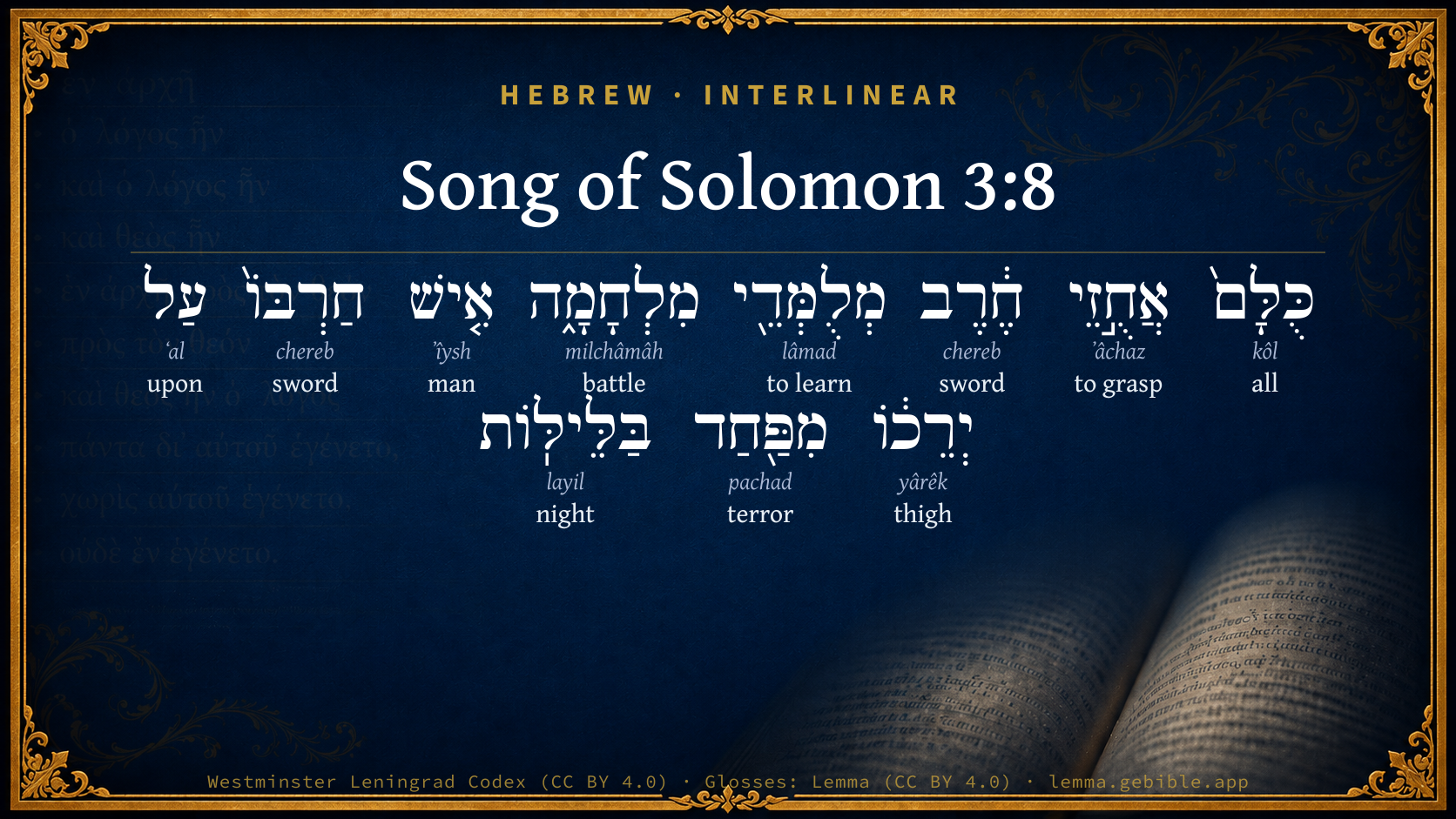
Hebrew (Westminster Leningrad Codex) Song of Solomon 3:8 appears in the Hebrew Old Testament. The text above is from the Westminster Leningrad Codex. Each word links to its Strong’s number, a concise gloss, and parsing drawn from the Open Scriptures Hebrew Bible morphology. Click any word for its full Brown-Driver-Briggs (BDB) entry.
Download image
Cite this verse

Song of Solomon 3:8 (World English Bible). Public Domain. Lemma interlinear Bible study tool, https://lemma.gebible.app/v/song-of-solomon/3/8.

Show BibTeX & RIS
BibTeX
RIS
English Translation
They all handle the sword, and are expert in war. Every man has his sword on his thigh, Because of fear in the night.
World English Bible · Public Domain
Download a study sheet

One document with this verse’s original text, its word-by-word gloss line, the meaning frame, cross-references with their text, attributed commentary, and full source and license credits — printable, and it pastes into notes with its structure intact.

This verse Autodidact and up

Study sheet (.html) Plain text (.txt)

A passage Seminary Student

Up to 50 verses in one chapter. A passage sheet keeps up to 6 commentary sources and 12 cross-references per verse, in the order this page ranks them, and says so on the sheet whenever that leaves anything out. Ask for a single verse and you get the Autodidact verse sheet above.

Everything on this page stays free to read, with no account — the sheet is a download of what is already on screen, not access to it.

Want to remove ads? Support Godless Engineer
Compare translations 3

The same verse in 3 English versions, stacked beneath the original-language interlinear above. Click any original word for its lexicon entry.

Each is an independent rendering of the whole verse — the interlinear is not word-aligned to these translations.

Highlighted words mark where these versions differ — a whole-verse word diff, not a word-by-word alignment.

  • World English Bible Public Domain
    They all handle the sword, and are expert in war. Every man has his sword on his thigh, Because of fear in the night.
  • King James Version Public Domain
    They all hold swords, being expert in war: every man hath his sword upon his thigh because of fear in the night.
  • unfoldingWord Literal Text CC BY-SA 4.0
    All of them are grasping a sword, studied war. Each one his sword at his thigh, against the terrors in the nights.

unfoldingWord Literal Text — © unfoldingWord, licensed CC BY-SA 4.0. Word-aligned USFM3 via Door43 (git.door43.org/unfoldingWord/en_ult).

Versions to compare (up to 4)

3 of 4 selected

Show all 18 translations

Every available English version of this verse, each an independent rendering of the whole verse.

  • World English Bible Public Domain
    They all handle the sword, and are expert in war. Every man has his sword on his thigh, Because of fear in the night.
  • Berean Standard Bible Public Domain
    All are skilled with the sword, experienced in warfare. Each has his sword at his side prepared for the terror of the night.
  • Majority Standard Bible Public Domain
    All are skilled with the sword, experienced in warfare. Each has his sword at his side prepared for the terror of the night.
  • King James Version Public Domain
    They all hold swords, being expert in war: every man hath his sword upon his thigh because of fear in the night.
  • American Standard Version (1901) Public Domain
    They all handle the sword, `and' are expert in war: Every man hath his sword upon his thigh, Because of fear in the night.
  • Revised Version (1885) Public Domain
    They all handle the sword, and are expert in war: every man hath his sword upon his thigh, because of fear in the night.
  • Geneva Bible (1599) Public Domain
    They all handle the sworde, and are expert in warre, euery one hath his sword vpon his thigh for the feare by night.
  • Douay-Rheims (1899) Public Domain
    All holding swords, and most expert in war: every man's sword upon his thigh, because of fears in the night.
  • Young's Literal Translation Public Domain
    All of them holding sword, taught of battle, Each his sword by his thigh, for fear at night.
  • Literal Standard Version CC BY-SA 4.0
    All of them holding sword, taught of battle, || Each his sword by his thigh, for fear at night.
  • Unlocked Literal Bible CC BY-SA 4.0
    All of them are skilled with a sword and are experienced in warfare. Every man has his sword at his side, armed against the terrors of the night.
  • unfoldingWord Literal Text CC BY-SA 4.0
    All of them are grasping a sword, studied war. Each one his sword at his thigh, against the terrors in the nights.
  • Darby Bible Public Domain
    They all hold the sword, Experts in war; Each hath his sword upon his thigh Because of alarm in the nights.
  • World Messianic Bible Public Domain
    They all handle the sword, and are expert in war. Every man has his sword on his thigh, because of fear in the night.
  • Webster's Bible Public Domain
    They all hold swords, being expert in war: every man hath his sword upon his thigh because of fear in the night.
  • Free Bible Version CC BY-SA 4.0
    All of them are expert swordsmen who have battle experience. They each carry a sword strapped to the thigh, ready for any night-time attacks.
  • Bible in Basic English Public Domain
    All of them armed with swords, trained in war; every man has his sword at his side, because of fear in the night.
  • JPS Tanakh (1917) Public Domain
    They all handle the sword, and are expert in war; every man hath his sword upon his thigh, because of dread in the night.

Literal Standard Version (2020), Covenant Press — licensed CC BY-SA 4.0. Text via the HelloAO Bible API (eBible.org). Unlocked Literal Bible (unfoldingWord) — licensed CC BY-SA 4.0. Text via the HelloAO Bible API (eBible.org). unfoldingWord Literal Text — © unfoldingWord, licensed CC BY-SA 4.0. Word-aligned USFM3 via Door43 (git.door43.org/unfoldingWord/en_ult). Free Bible Version, Dr. Jonathan Gallagher — licensed CC BY-SA 4.0. Text via the HelloAO Bible API (eBible.org).

Word by word

More ways to search: Search by grammar → Find every occurrence → Compare this word →

Practice this passage: Drill this verse → Learn its vocabulary →

יְרֵכ֔וֹ
yârêk
H3409
“thigh · his”
Noun, Common, Feminine, Singular, Construct + Suffix, Personal, 3rd Person, Masculine, Singular
Part of Speech
Noun
Type
Common
Gender
Feminine
Number
Singular
State
Construct
Full BDB Definition

Origin: from an unused root meaning to be soft

TWOT: 916a

thigh, side, loin, base - thigh - outside of thigh (where sword was worn) - loins (as the seat of procreative power) - side (flank) (of object) - base
  1. כֻּלָּם֙ kôl H3605 “all · their” Noun, Common, Masculine, Singular, Construct + Suffix, Personal, 3rd Person, Masculine, Plural
  2. אֲחֻ֣זֵי ʼâchaz H270 “grasped” Verb, Qal, Participle Passive, Masculine, Plural, Construct
  3. חֶ֔רֶב chereb H2719 “sword” Noun, Common, Feminine, Singular, Absolute
  4. מְלֻמְּדֵ֖י lâmad H3925 “learned” Verb, Pual, Participle Passive, Masculine, Plural, Construct
  5. מִלְחָמָ֑ה milchâmâh H4421 “battle” Noun, Common, Feminine, Singular, Absolute
  6. אִ֤ישׁ ʼîysh H376 “man” Noun, Common, Masculine, Singular, Absolute
  7. חַרְבּוֹ֙ chereb H2719 “sword · his” Noun, Common, Feminine, Singular, Construct + Suffix, Personal, 3rd Person, Masculine, Singular
  8. עַל ʻal H5921 “upon” Preposition
  9. מִפַּ֖חַד pachad H6343 “from · terror” Preposition + Noun, Common, Masculine, Singular, Absolute
  10. בַּלֵּילּֽוֹת layil H3915 “in/at the · nights” Preposition, Determined + Noun, Common, Masculine, Plural, Absolute

About this verse

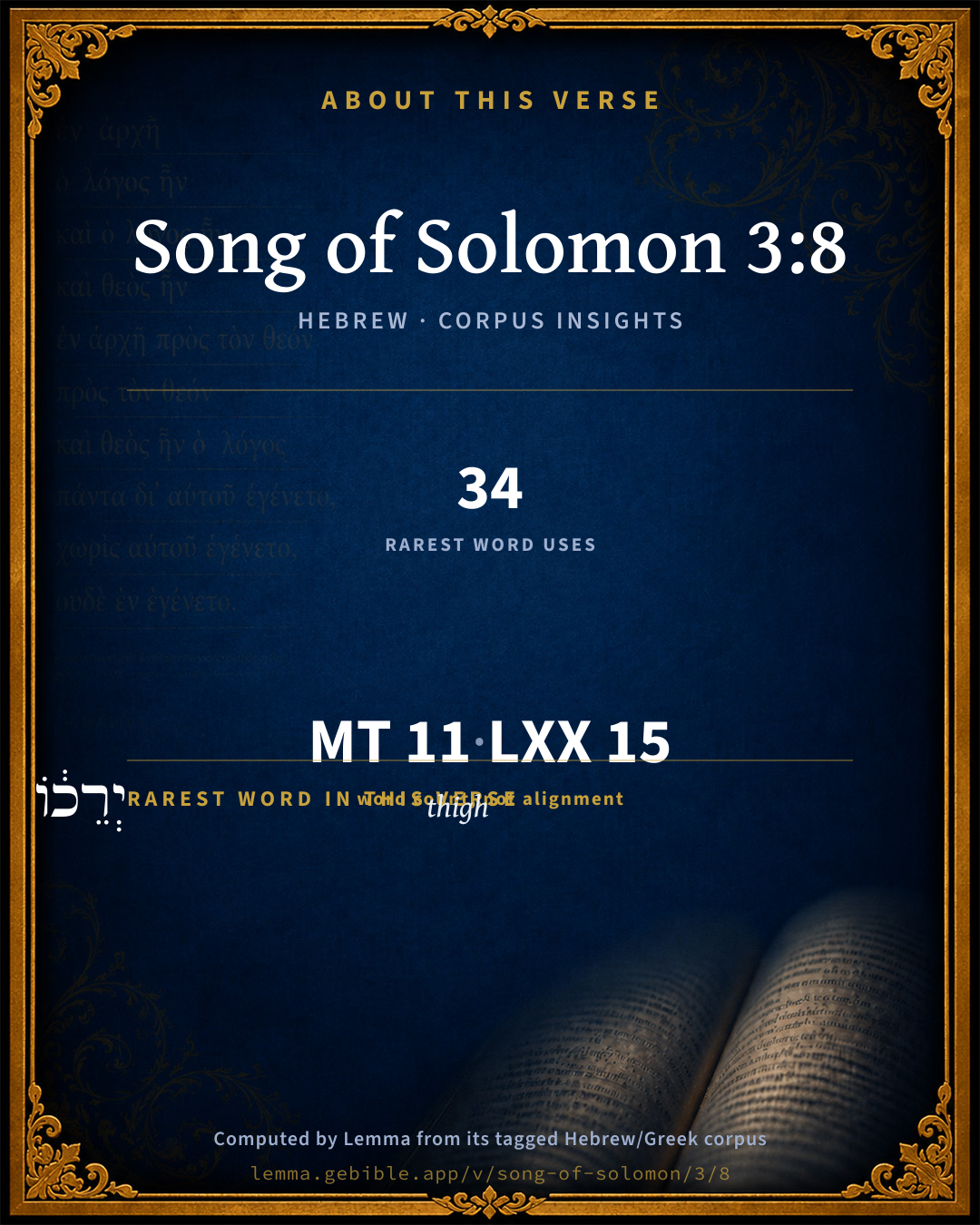
These counts appear in no published source. They are computed here, from the morphology-tagged text and Lemma’s own curated glosses. What Lemma adds →

11
words
10
distinct lemmas
Wisdom
section

Shared distinctive vocabulary

יְרֵכ֔וֹ thigh H3409 occurs in 32 verses of the Hebrew Bible. Also found in:

Grammatical profile

  • 2 verbs
  • 8 nouns
  • 1 preposition

Verb forms

  • אֲחֻ֣זֵי Qal · Participle Passive
  • מְלֻמְּדֵ֖י Pual · Participle Passive

Repetition

A word recurs within this verse — often emphatic in Hebrew:

  • חֶ֔רֶב sword H2719 ×2

Hebrew & Septuagint length

In English translation the verse runs 24 words from the Hebrew and 22 from the Septuagint (LXX English) — closely comparable.

A rough comparison of the two English renderings, which tokenize alike — not a word-level alignment.

Word counts can differ between the Hebrew and the Greek without any difference in meaning — e.g. the Hebrew direct-object marker אֵת has no separate Greek word, and Greek often adds the article ὁ.

In the original languages it is 11 Hebrew tokens and 15 Greek tokens — but the two are counted differently (Hebrew bundles its prefixes and suffixes into one token; the Greek is in lemma form), so that isn’t a like-for-like length.

Cross-references

7

Topical passages linked to Song of Solomon 3:8 in the Treasury of Scripture Knowledge — connected by theme and wording, ordered by reader-vote popularity; previews shown in the World English Bible.

  • Psalms 45:3 Gird your sword on your thigh, mighty one: Your splendor and your majesty.
  • Nehemiah 4:21–22 So we worked in the work: and half of them held the spears from the rising of the morning until the stars appeared.
  • Psalms 91:5 You shall not be afraid of the terror by night, Nor of the arrow that flies by day;
  • Psalms 149:5–9 Let the saints rejoice in honor. Let them sing for joy on their beds.
  • Isaiah 27:3 I Yahweh am its keeper; I will water it every moment: lest any hurt it, I will keep it night and day.
  • Ephesians 6:16–18 above all, taking up the shield of faith, with which you will be able to quench all the fiery darts of the evil one.
  • 1 Thessalonians 5:6–8 so then let's not sleep, as the rest do, but let's watch and be sober.

Cross-references courtesy of OpenBible.info (CC BY 4.0).

Hebrew and Greek witnesses Masoretic Hebrew ↔ Greek Septuagint

The same verse in the two great witnesses to the Old Testament, shown verse-for-verse.

These are two independent witnesses, not word-aligned to each other, and the Septuagint is shown in lemma (dictionary) form.

Hebrew Song of Solomon 3:8 Masoretic · Westminster Leningrad Codex

כֻּלָּם֙ אֲחֻ֣זֵי חֶ֔רֶב מְלֻמְּדֵ֖י מִלְחָמָ֑ה אִ֤ישׁ חַרְבּוֹ֙ עַל יְרֵכ֔וֹ מִפַּ֖חַד בַּלֵּילּֽוֹת

They all handle the sword, and are expert in war. Every man has his sword on his thigh, Because of fear in the night.

World English Bible · Public Domain

Greek LXX Song of Solomon 3:8 Septuagint · lemma form

πᾶς καταἔχω ῥομφαία διδάσκω πόλεμος ἀνήρ ῥομφαία αὐτός ἐπί μηρός αὐτός ἀπό θάμβος ἐν νύξ

They all hold a sword, being expert in war: every man has his sword upon his thigh because of fear by night.

LXX2012 (modern English Septuagint) · Public Domain

Hebrew: Westminster Leningrad Codex (CC BY 4.0). Greek: Septuagint (public domain); English from LXX2012 (modern English Septuagint) (Public Domain). How the Septuagint differs from the Hebrew →

Commentary

Notes on Song of Solomon 3:8 from classic Christian and Jewish commentators (each source and its license shown beneath its notes). The classic Christian expositions comment on the surrounding passage and are grouped to its opening verse, so a note may address several verses; the Jewish commentaries on the Tanakh (Rashi and others) are per-verse, so they appear only where the commentator wrote on this verse.

Lemma curates 59 commentaries, every one of them public domain or Creative Commons licensed, each selected and text-cleaned for this edition rather than reprinted as found. About our sources →

Trapp's Complete Commentary

John Trapp

Son 3:8 They all hold swords, [being] expert in war: every man [hath] his sword upon his thigh because of fear in the night.

Ver. 8. They all hold swords, being expert in war.] They not only bear arms, but can handle them. Young Jether wore a sword, but he durst not draw it, {Jdg 8:20} or strike with it when he should have killed Zeba and Zalmunna. Themistocles said of the Eretrians, a cowardly people, that they were like the sword fish, which hath a sword indeed, but wants a heart. {a} Such white livered soldiers, such faint hearted swordmen our Solomon hath no need of; our Gideon will not employ them so far as to break a pitcher or to bear a torch. {Jdg 7:3} The fearful and unbelieving shall never set foot in his kingdom, much less be esquires of his body; those in that office must hold fast the faithful word, that sword of the Spirit, that twoedged sword, far beyond that of Goliath, and yet David said there was none to that, that they may be able and apt by sound doctrines both to exhort the tractable and to "convince the gainsayer." {Tit 1:9} Those that either cannot or will not do thus, are no way fit to be of Christ’s guard, because they are more likely to betray him into the hands of his enemies than to defend him from them, to act a Judas’s part than a Peter’s, who manfully cut off Malchus’s ear, and chose rather to be held temerarious than timorous. Jeremiah complains of the pastors of his time that they were "not valiant for the truth," {Jer 9:3} they had no spiritual metal in them; but as harts and stags have great horns and strength, but want courage, so it was with these. St Augustine professeth this was it that heartened him, and made him to triumph in his former Manicheeism, that he met with feeble opponents, and such as his nimble wit was easily able to overturn. If gainsayers be not powerfully convinced, how will they set up their crests and cry victoria! If they be not stoned with arguments, {b} how will they start up and outstare the truth! There must be, therefore, skill and will in all her champions. They must also every man have his sword upon his thigh, and be ready for an assault. Seneca reports of Caesar that he had quickly sheathed his sword, but never took it off. And Suetonius tells us that he would never tell his soldiers of any set time of removal or onset, that he might never find them unready, {c} Christ expects the like care and courage in his ministers, lest the proverb be verified on them, ungirt, unblest.

And because of fear in the night.] Lest evil should befall Solomon, as it did Ishbosheth, who was slain upon his bed by the sons of Rimmon; lest deeds of darkness be done in a land of light, and while the watchmen slack their duty, the rulers of the darkness of this world break in and play their pranks. While men slept, tares were sown by the evil man. {Mat 13:25}

{a} Mαχαιραν μεν εχει, καρδιαν δε ου - Plutarch.

{b} Haeretici argumentis lapidandi. - Hilar.

{c} Scilicet ut paratum et intentum momentis omnibus, &c.

John Trapp, A Commentary or Exposition upon All the Books of the Old and New Testament (1647–1656) — public domain. Text from a community e-Sword module.

Geneva Bible (1599)

Geneva Bible translators

He alludeth to the watch which kept the Temple.

Geneva Bible (1599) marginal notes — public domain. Text via Bolls.life.

Adam Clarke's Commentary

Verse 8. They all hold swords] They are swordsmen. Every man has a sword, and is well instructed how to use it.

Adam Clarke's Commentary on the Bible (1810–1826) — public domain. Text from a community e-Sword/MySword module.

Ellicott's Commentary for English Readers

(8) Because of fear—i.e., because of the alarms common at night. For fear in the sense of object of fear, comp. Psa_91:5; Pro_3:25.

A Bible Commentary for English Readers, edited by Charles John Ellicott (1878–1897) — public domain. Text from a community e-Sword module.

The Cambridge Bible for Schools and Colleges

gen. ed. J. J. S. Perowne

8. They all hold swords] This is a circumstantial and descriptive clause, and their holding swords is not meant to be explained by expert in war, as the insertion of ‘being’ in the A.V. might suggest. Rather it should be rendered, Threescore valiant men—all of them with swords in their hands, and trained to war, each with his sword upon his thigh because of fear in the night, i.e. to ward off danger that might arise in the night. The mention of ‘night’ here probably suggested the translation of miṭṭâh as ‘bed.’ The Heb. word translated ‘hold’ in the A.V. has the form of a passive participle, but must be translated as active. Cp. Ges.-K. Gramm. § 50 f.

The Cambridge Bible for Schools and Colleges (gen. ed. J. J. S. Perowne; Cambridge University Press, 1878–1918) — public domain. Text from a community e-Sword module.

Matthew Poole's English Annotations

Hath his sword upon his thigh; is prepared and ready to fight, as this phrase notes, Exo 32:27; Psa 45:3. Because of fear in the night; to prevent those dangers and mischiefs which are most frequent and most dreadful in the night season.

The night may note either,

1. The time of tribulation, temptation, or desertion. Or,

2. The whole time of this life, which may well be called night, in respect of that ignorance, and error, and other kinds of darkness wherewith it is attended, as the future life is compared to a day, this life being the only time wherein such a guard is necessary.

Matthew Poole's English Annotations on the Holy Bible (1683–1685) — public domain. Text from a community e-Sword/MySword module.

Whedon's Commentary on the Bible

Daniel D. Whedon

8. Expert in war — Better, the valiant of Israel. There was probably no time in the history of Israel when robbers did not infest the country. These were, and still are, mostly Arabs. Ishmael dwelt in the presence of his brethren, and kept them always on the lookout. Hence, the royal escort included such a guard as is here described. The fear in the night is, of course, these nightly marauders. The phrase seems to refer to the selected bodyguard of mighty men formed by David, and perhaps continued by Solomon.

Daniel D. Whedon (gen. ed.), Commentary on the Old and New Testaments (1874–1909) — public domain. Text from a community e-Sword module.

The Pulpit Commentary

They all handle the sword, and are expert in war: every man hath his sword upon his thigh because of fear in the night. The guard of warriors round the litter secured the bride from any sudden alarm as she travelled through the wilderness, and so gave her quiet rest. The journey from Shunem to Jerusalem would be about fifty miles in a direct course, and it was therefore necessary to pass at least one, if not two, nights on the way; the course being through a wild and solitary region. The Church of God may be often called to pass through dangers and enemies, but he that loveth her will provide against her destruction she shall have rest in the love of. her Lord. He will surround her with his strength. "My peace I give unto thee provided by me, coming from myself, the fruit of my self-sacrificing love.

The Pulpit Commentary (1880–1919), ed. H.D.M. Spence-Jones & Joseph S. Exell — public domain. Text from a community e-Sword module.

John Wesley's Explanatory Notes

Every man - Is prepared and ready to fight, to prevent those dangers which are frequent in the night season. The night may denote the whole time of this life, which may well be called night in respect of that ignorance and error wherewith it is attended, (as the future life is compared to day) this life being the only time wherein such a guard is necessary.

John Wesley, Explanatory Notes Upon the Whole Bible (1754–1765) — public domain. Text via the GEBible commentary corpus.

unfoldingWord translationNotes

Door43 World Missions Community

General Information:

The description of sixty men carrying Solomon's bed up from the wilderness to Jerusalem, begun in Song of Songs 3:6, continues.

Connecting Statement:

A description of the bed itself begins in verse 9. You could use words in your language that show that this is background information. (See: Background Information)

are experienced in warfare

"can fight battles well"

armed against

"so that he can fight against"

terrors of the night

The abstract noun "terrors" is a metonym for evil people who frighten others by attacking them. AT: "evil people who attack others at night" (See: Abstract Nouns and Metonymy)

sedan chair

This is a chair or couch for important people to sit or lie on. It rests on long poles that people can use to carry it

translationWords

sword

terror

king

Solomon

Lebanon

unfoldingWord translationNotes — © Distant Shores Media and the Door43 World Missions Community, licensed CC BY-SA 4.0. Source: git.door43.org/Door43/en_tn.

Rashi

Rabbi Shlomo Yitzchaki (Rashi)

skilled in warfare the war of Torah, and similarly, the priests who surround it, who camp around the Tabernacle, skilled in the order of their service.

each one with his sword his weapons. These are the Masorah and the mnemonics, by which they preserve the correct version [of the Oral Law] and the masorah (the traditional spelling and reading of the Scriptures), lest it be forgotten.

because of fear at night lest they forget it, and troubles will befall them, and so Scripture says (Ps. 2:12): “Arm yourselves with the grain [of Torah] lest He become angry and you perish on the way.”

Rashi on the Tanakh — English translations: “The Judaica Press complete Tanach with Rashi, translated by A. J. Rosenberg” (CC BY 4.0); “Pentateuch with Rashi's commentary by M. Rosenbaum and A.M. Silbermann, 1929-1934” (public domain); “The Metsudah Tanach series, Lakewood, N.J” (CC BY 4.0); and “The Book of Joshua, Metsudah Publications, 1997” (CC BY 4.0). Text via Sefaria.

Lesson kit

Teaching starters — assembled from the data on this page, not authored interpretation. Every prompt links to the verse data it draws on. Edit before teaching.

Song of Solomon, in the Wisdom, opens this verse with 11 words (10 distinct Hebrew lemmas). Its most distinctive word is yârêk (“thigh”). A historical commentator’s framing appears above. Read the whole chapter for the surrounding context.

Discussion questions

  1. How does “thigh” (yârêk) shape what this verse is saying?
  2. Genesis 24:2 shares the word «thigh» with this verse. How do the two illuminate each other?
  3. “sword” occurs 2× in this one verse. What is the effect of the repetition?
  4. The translations on this page render this verse differently — a whole-verse word diff, not a word-by-word alignment. What might account for the different wordings?
  5. The verb «אֲחֻ֣זֵי» is Qal Participle Passive. How does its form color the action?
  6. Reading how Trapp's Complete Commentary and Geneva Bible (1599) read this verse, where do the two commentators agree and where do they part?

Things to notice

Reading settings

Reading text

Shown beneath each verse's original-language words.

Old Testament
Old Testament edition

Read the OT as the Masoretic Hebrew (MT) or the Greek Septuagint (LXX).

English shown for the Greek Septuagint (in the Hebrew ↔ Greek comparison).

Comparing translations? Open the Compare panel on any verse page to stack up to four side by side.