
Ezekiel 28:7

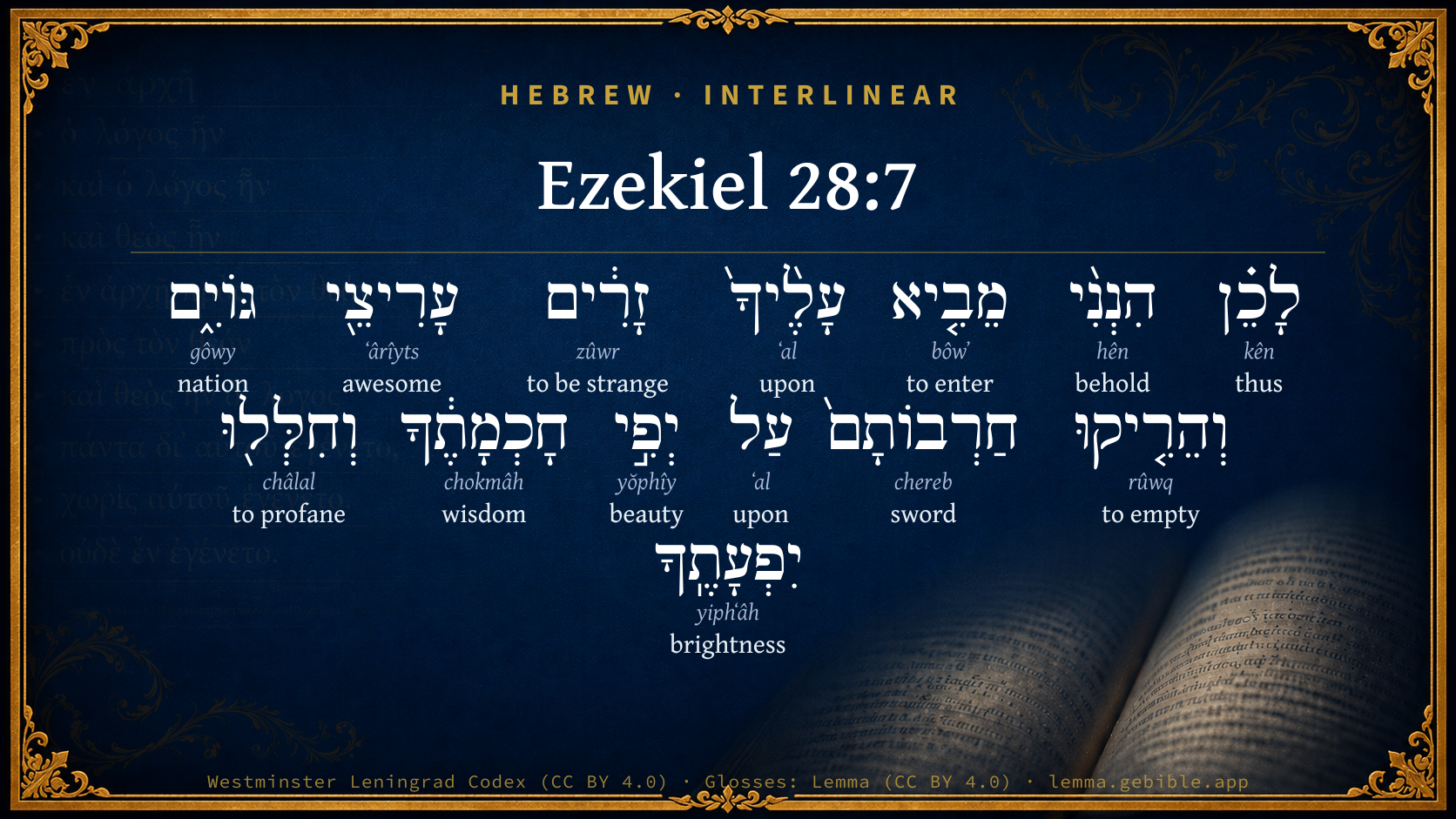
Hebrew (Westminster Leningrad Codex) Ezekiel 28:7 appears in the Hebrew Old Testament. The text above is from the Westminster Leningrad Codex. Each word links to its Strong’s number, a concise gloss, and parsing drawn from the Open Scriptures Hebrew Bible morphology. Click any word for its full Brown-Driver-Briggs (BDB) entry.
Download image
Cite this verse

Ezekiel 28:7 (World English Bible). Public Domain. Lemma interlinear Bible study tool, https://lemma.gebible.app/v/ezekiel/28/7.

Show BibTeX & RIS
BibTeX
RIS
English Translation
therefore, behold, I will bring strangers on you, the terrible of the nations; and they shall draw their swords against the beauty of your wisdom, and they shall defile your brightness.
World English Bible · Public Domain
Highlights
  • 1 first appearance in the Hebrew Bible
Full analysis ↓
Download a study sheet

One document with this verse’s original text, its word-by-word gloss line, the meaning frame, cross-references with their text, attributed commentary, and full source and license credits — printable, and it pastes into notes with its structure intact.

This verse Autodidact and up

Study sheet (.html) Plain text (.txt)

A passage Seminary Student

Up to 50 verses in one chapter. A passage sheet keeps up to 6 commentary sources and 12 cross-references per verse, in the order this page ranks them, and says so on the sheet whenever that leaves anything out. Ask for a single verse and you get the Autodidact verse sheet above.

Everything on this page stays free to read, with no account — the sheet is a download of what is already on screen, not access to it.

Want to remove ads? Support Godless Engineer
Compare translations 3

The same verse in 3 English versions, stacked beneath the original-language interlinear above. Click any original word for its lexicon entry.

Each is an independent rendering of the whole verse — the interlinear is not word-aligned to these translations.

Highlighted words mark where these versions differ — a whole-verse word diff, not a word-by-word alignment.

  • World English Bible Public Domain
    therefore, behold, I will bring strangers on you, the terrible of the nations; and they shall draw their swords against the beauty of your wisdom, and they shall defile your brightness.
  • King James Version Public Domain
    Behold, therefore I will bring strangers upon thee, the terrible of the nations: and they shall draw their swords against the beauty of thy wisdom, and they shall defile thy brightness.
  • unfoldingWord Literal Text CC BY-SA 4.0
    I will therefore bring foreigners against you, terrifying men from other nations. They will bring their swords against the beauty of your wisdom, and they will profane your splendor.

unfoldingWord Literal Text — © unfoldingWord, licensed CC BY-SA 4.0. Word-aligned USFM3 via Door43 (git.door43.org/unfoldingWord/en_ult).

Versions to compare (up to 4)

3 of 4 selected

Show all 18 translations

Every available English version of this verse, each an independent rendering of the whole verse.

  • World English Bible Public Domain
    therefore, behold, I will bring strangers on you, the terrible of the nations; and they shall draw their swords against the beauty of your wisdom, and they shall defile your brightness.
  • Berean Standard Bible Public Domain
    behold, I will bring foreigners against you, the most ruthless of nations. They will draw their swords against the beauty of your wisdom and will defile your splendor.
  • Majority Standard Bible Public Domain
    behold, I will bring foreigners against you, the most ruthless of nations. They will draw their swords against the beauty of your wisdom and will defile your splendor.
  • King James Version Public Domain
    Behold, therefore I will bring strangers upon thee, the terrible of the nations: and they shall draw their swords against the beauty of thy wisdom, and they shall defile thy brightness.
  • American Standard Version (1901) Public Domain
    therefore, behold, I will bring strangers upon thee, the terrible of the nations; and they shall draw their swords against the beauty of thy wisdom, and they shall defile thy brightness.
  • Revised Version (1885) Public Domain
    therefore behold, I will bring strangers upon thee, the terrible of the nations: and they shall draw their swords against the beauty of thy wisdom, and they shall defile thy brightness.
  • Geneva Bible (1599) Public Domain
    Behold, therefore I wil bring strangers vpon thee, euen the terrible nations: and they shall drawe their swordes against the beautie of thy wisedome, and they shall defile thy brightnes.
  • Douay-Rheims (1899) Public Domain
    Therefore behold, I will bring upon thee strangers the strongest of the nations: and they shall draw their swords against the beauty of thy wisdom, and they shall defile thy beauty.
  • Young's Literal Translation Public Domain
    Therefore, lo, I am bringing in against thee strangers, The terrible of the nations, And they have drawn out their swords Against the beauty of thy wisdom, And they have pierced thy brightness.
  • Literal Standard Version CC BY-SA 4.0
    Therefore, behold, I am bringing in strangers against you, || The terrible of the nations, || And they have drawn out their swords || Against the beauty of your wisdom, || And they have pierced your brightness.
  • Unlocked Literal Bible CC BY-SA 4.0
    I will therefore bring foreigners against you, terrifying men from other nations. They will bring their swords against the beauty of your wisdom, and they will profane your splendor.
  • unfoldingWord Literal Text CC BY-SA 4.0
    I will therefore bring foreigners against you, terrifying men from other nations. They will bring their swords against the beauty of your wisdom, and they will profane your splendor.
  • Darby Bible Public Domain
    therefore behold, I will bring strangers upon thee, the terrible of the nations; and they shall draw their swords against the beauty of thy wisdom, and they shall tarnish thy brightness.
  • World Messianic Bible Public Domain
    therefore, behold, I will bring strangers on you, the terrible of the nations. They will draw their swords against the beauty of your wisdom. They will defile your brightness.
  • Webster's Bible Public Domain
    Behold, therefore I will bring strangers upon thee, the terrible of the nations: and they shall draw their swords against the beauty of thy wisdom, and they shall defile thy brightness.
  • Free Bible Version CC BY-SA 4.0
    watch as I bring foreigners to attack you. They are more cruel than any other nation. They will use their swords to destroy you and your wonderful wisdom; they will humble your proud glory.
  • Bible in Basic English Public Domain
    See, I am sending against you strange men, feared among the nations: they will let loose their swords against your bright wisdom, they will make your glory a common thing.
  • JPS Tanakh (1917) Public Domain
    Therefore, behold, I will bring strangers upon thee, the terrible of the nations; and they shall draw their swords against the beauty of thy wisdom, and they shall defile thy brightness.

Literal Standard Version (2020), Covenant Press — licensed CC BY-SA 4.0. Text via the HelloAO Bible API (eBible.org). Unlocked Literal Bible (unfoldingWord) — licensed CC BY-SA 4.0. Text via the HelloAO Bible API (eBible.org). unfoldingWord Literal Text — © unfoldingWord, licensed CC BY-SA 4.0. Word-aligned USFM3 via Door43 (git.door43.org/unfoldingWord/en_ult). Free Bible Version, Dr. Jonathan Gallagher — licensed CC BY-SA 4.0. Text via the HelloAO Bible API (eBible.org).

Word by word

More ways to search: Search by grammar → Find every occurrence → Compare this word →

Practice this passage: Drill this verse → Learn its vocabulary →

יִפְעָתֶֽךָ
yiphʻâh
H3314
“brightness · your”
Noun, Common, Feminine, Singular, Construct + Suffix, Personal, 2nd Person, Masculine, Singular
Part of Speech
Noun
Type
Common
Gender
Feminine
Number
Singular
State
Construct
Full BDB Definition

Origin: from H3313

TWOT: 892a

splendour, brightness, shining
  1. לָכֵ֗ן kên H3651 “to/for · thus” Preposition + Adverb
  2. הִנְנִ֨י hên H2005 “behold · me” Particle, Demonstrative + Suffix, Personal, 1st Person, Common, Singular
  3. מֵבִ֤יא bôwʼ H935 “entering” Verb, Hiphil, Participle Active, Masculine, Singular, Absolute
  4. עָלֶ֨יךָ֙ ʻal H5921 “upon · you” Preposition + Suffix, Personal, 2nd Person, Masculine, Singular
  5. זָרִ֔ים zûwr H2114 “strange” Adjective, Adjective, Masculine, Plural, Absolute
  6. עָרִיצֵ֖י ʻârîyts H6184 “awesome of” Adjective, Adjective, Masculine, Plural, Construct
  7. גּוֹיִ֑ם gôwy H1471 “nations” Noun, Common, Masculine, Plural, Absolute
  8. וְהֵרִ֤יקוּ rûwq H7324 “and · to empty” Conjunction + Verb, Hiphil, Sequential Perfect, 3rd Person, Common, Plural
  9. חַרְבוֹתָם֙ chereb H2719 “swords · their” Noun, Common, Feminine, Plural, Construct + Suffix, Personal, 3rd Person, Masculine, Plural
  10. עַל ʻal H5921 “upon” Preposition
  11. יְפִ֣י yŏphîy H3308 “beauty of” Noun, Common, Masculine, Singular, Construct
  12. חָכְמָתֶ֔ךָ chokmâh H2451 “wisdom · your” Noun, Common, Feminine, Singular, Construct + Suffix, Personal, 2nd Person, Masculine, Singular
  13. וְחִלְּל֖וּ châlal H2490 “and · to profane” Conjunction + Verb, Piel, Sequential Perfect, 3rd Person, Common, Plural

About this verse

These counts appear in no published source. They are computed here, from the morphology-tagged text and Lemma’s own curated glosses. What Lemma adds →

14
words
13
distinct lemmas
Prophets
section

Notable vocabulary

The rarest word here is יִפְעָתֶֽךָ brightness H3314 — appearing just 2 times in the whole Hebrew Bible.

First appearance in Scripture

This word makes its first canonical appearance in the Hebrew Bible here:

  • יִפְעָתֶֽךָ brightness H3314

Shared distinctive vocabulary

יִפְעָתֶֽךָ brightness H3314 occurs in 2 verses of the Hebrew Bible. Also found in:

Grammatical profile

  • 3 verbs
  • 5 nouns
  • 2 adjectives
  • 2 prepositions
  • 1 adverb
  • 1 particle

Verb forms

  • מֵבִ֤יא Hiphil · Participle Active
  • וְהֵרִ֤יקוּ Hiphil · Sequential Perfect
  • וְחִלְּל֖וּ Piel · Sequential Perfect

Repetition

A word recurs within this verse — often emphatic in Hebrew:

  • עָלֶ֨יךָ֙ upon H5921 ×2

Hebrew & Septuagint length

In English translation the verse runs 31 words from the Hebrew and 29 from the Septuagint (LXX English) — closely comparable.

A rough comparison of the two English renderings, which tokenize alike — not a word-level alignment.

Word counts can differ between the Hebrew and the Greek without any difference in meaning — e.g. the Hebrew direct-object marker אֵת has no separate Greek word, and Greek often adds the article ὁ.

Cross-references

10

Topical passages linked to Ezekiel 28:7 in the Treasury of Scripture Knowledge — connected by theme and wording, ordered by reader-vote popularity; previews shown in the World English Bible.

  • Ezekiel 31:12 Strangers, the terrible of the nations, have cut him off, and have left him: on the mountains and in all the valleys his branches are fallen, and his boughs are broken by all the watercourses of the land; and all the peoples of the earth are gone down from his shadow, and have left him.
  • Ezekiel 30:11 He and his people with him, the terrible of the nations, shall be brought in to destroy the land; and they shall draw their swords against Egypt, and fill the land with the slain.
  • Ezekiel 32:12 By the swords of the mighty will I cause your multitude to fall; the terrible of the nations are they all: and they shall bring to nothing the pride of Egypt, and all the multitude of it shall be destroyed.
  • Habakkuk 1:6–8 For, behold, I raise up the Chaldeans, that bitter and hasty nation, that march through the breadth of the earth, to possess dwelling places that are not theirs.
  • Deuteronomy 28:49–50 Yahweh will bring a nation against you from far, from the end of the earth, as the eagle flies; a nation whose language you shall not understand;
  • Isaiah 23:8–9 Who has purposed this against Tyre, the giver of crowns, whose merchants are princes, whose traffickers are the honorable of the earth?
  • Isaiah 25:3–4 Therefore shall a strong people glorify you; a city of awesome nations shall fear you.
  • Ezekiel 26:7–14 For thus says the Lord Yahweh: Behold, I will bring on Tyre Nebuchadrezzar king of Babylon, king of kings, from the north, with horses, and with chariots, and with horsemen, and a company, and much people.
  • Daniel 7:7 After this I saw in the night-visions, and, behold, a fourth animal, awesome and powerful, and strong exceedingly; and it had great iron teeth; it devoured and broke in pieces, and stamped the residue with its feet: and it was diverse from all the animals that were before it; and it had ten horns.
  • Amos 3:6 Does the trumpet alarm sound in a city, Without the people being afraid? Does evil happen to a city, And Yahweh hasn't done it?

Cross-references courtesy of OpenBible.info (CC BY 4.0).

Hebrew and Greek witnesses Masoretic Hebrew ↔ Greek Septuagint

The same verse in the two great witnesses to the Old Testament, shown verse-for-verse.

These are two independent witnesses, not word-aligned to each other, and the Septuagint is shown in lemma (dictionary) form.

Hebrew Ezekiel 28:7 Masoretic · Westminster Leningrad Codex

לָכֵ֗ן הִנְנִ֨י מֵבִ֤יא עָלֶ֨יךָ֙ זָרִ֔ים עָרִיצֵ֖י גּוֹיִ֑ם וְהֵרִ֤יקוּ חַרְבוֹתָם֙ עַל יְפִ֣י חָכְמָתֶ֔ךָ וְחִלְּל֖וּ יִפְעָתֶֽךָ

therefore, behold, I will bring strangers on you, the terrible of the nations; and they shall draw their swords against the beauty of your wisdom, and they shall defile your brightness.

World English Bible · Public Domain

Greek LXX Ezekiel 28:7 Septuagint · lemma form

ἀντί οὗτος ἰδού ἐγώ ἐπιἄγω ἐπί σύ ἀλλότριος λοιμός ἀπό ἔθνος καί ἐκκενόω ὁ μάχαιρα αὐτός ἐπί σύ καί ἐπί ὁ κάλλος ὁ ἐπιστήμη σύ καί ὑποστρωννύω ὁ κάλλος σύ εἰς ἀπώλεια

because of this, behold, I will bring on you strange plagues from the nations; and they shall draw their swords against you, and against the beauty of your knowledge,

LXX2012 (modern English Septuagint) · Public Domain

Hebrew: Westminster Leningrad Codex (CC BY 4.0). Greek: Septuagint (public domain); English from LXX2012 (modern English Septuagint) (Public Domain). How the Septuagint differs from the Hebrew →

Targum (Aramaic paraphrase)

1

The Targum is the ancient Jewish Aramaic paraphrase of the Hebrew Scriptures — an interpretive translation, not the Hebrew text itself. Onkelos (literal) and Pseudo-Jonathan (expansive) render the Torah, and Jonathan the Prophets. Coverage is partial: where no permissively-licensed English translation exists for a verse, only the Aramaic is shown. This is verse-level text, not a word-by-word alignment to the Hebrew.

  1. Targum Jonathan Prophets (Joshua–Malachi)
    בְּכֵן הָא אֲנָא מַיְתֵי עֲלָךְ נוּכְרָאִין תַּקִיפֵי עַמְמַיָא וְיִשְׁלְפוּן סַיְפֵיהוֹן עַל תִּקוּן חוּכְמְתָךְ וִיחַבְּלוּן זִיו אֵימָתָךְ:

    (no public-domain English translation for this verse)

    Targum Jonathan — Aramaic: “Mikraot Gedolot” (public domain). English: “Sefaria Community Translation” (CC0 1.0 (public-domain dedication)); “London "Chaldee Paraphrase," 1871” (public domain). Text via Sefaria.

Commentary

Notes on Ezekiel 28:7 from classic Christian and Jewish commentators (each source and its license shown beneath its notes). The classic Christian expositions comment on the surrounding passage and are grouped to its opening verse, so a note may address several verses; the Jewish commentaries on the Tanakh (Rashi and others) are per-verse, so they appear only where the commentator wrote on this verse.

Lemma curates 59 commentaries, every one of them public domain or Creative Commons licensed, each selected and text-cleaned for this edition rather than reprinted as found. About our sources →

Trapp's Complete Commentary

John Trapp

Eze 28:7 Behold, therefore I will bring strangers upon thee, the terrible of the nations: and they shall draw their swords against the beauty of thy wisdom, and they shall defile thy brightness.

Ver. 7. Behold, therefore I will briny strangers upon thee.] Who shall not at all regard thy great wisdom, but grasp after thy wealth, and suck thy blood for it. Neither will they favour thee the more because thou art a king, but slay thee the rather, and say, Hunc ipsum quaerimus, This we seek ourselves, This is the right bird, as that soldier said who slew the most valiant King of Sweden at the battle of Lutzen.

John Trapp, A Commentary or Exposition upon All the Books of the Old and New Testament (1647–1656) — public domain. Text from a community e-Sword module.

Jamieson, Fausset & Brown

Robert Jamieson, A. R. Fausset & David Brown

therefore--apodosis.

strangers . . . terrible of the nations--the Chaldean foreigners noted for their ferocity (Eze 30:11; Eze 31:12).

against the beauty of thy wisdom--that is, against thy beautiful possessions acquired by thy wisdom on which thou pridest thyself (Eze 28:3-5).

defile thy brightness--obscure the brightness of thy kingdom.

Jamieson, Fausset & Brown — Commentary Critical and Explanatory on the Whole Bible (1871) — public domain (CC PDM 1.0). Text via the HelloAO Bible API.

Adam Clarke's Commentary

Verse 7. I will bring strangers upon thee] The Chaldeans.

Adam Clarke's Commentary on the Bible (1810–1826) — public domain. Text from a community e-Sword/MySword module.

Ellicott's Commentary for English Readers

(7) Against the beauty of thy wisdom.—The figure seems incongruous, but it is to be remembered that the expression is only a form of designating Tyre itself. The description of the Chaldæans as “the terrible of the nations” is repeated in Eze_30:11; Eze_31:12 (comp. also Eze_26:7 and Isa_47:6; Hab_1:6). The term, however, is by no means necessarily confined to them.

A Bible Commentary for English Readers, edited by Charles John Ellicott (1878–1897) — public domain. Text from a community e-Sword module.

John Gill's Exposition

Behold, therefore, I will bring strangers upon thee,.... The Chaldean army, who not only lived at a distance from Tyre, but were unknown to them, not trading with them; nor are they mentioned among the merchants of Tyre: these, in the mystical sense, may design the angels that shall pour out the vials on the antichristian states, the kings of Protestant nations:

the terrible of the nations; as the Babylonians were, very formidable to the world, having conquered many countries, and their armies consisting of men of all nations, mighty, courageous, and expert in war; and alike formidable will the Protestant princes be to the antichristian powers, when they shall with their united strength attack them:

and they shall draw their swords against the beauty of thy wisdom; their beautiful city and spacious buildings, the palaces of their king and nobles, their walls and towers erected with so much art and skill; or their forces, the men of war within their city, which made their beauty complete, so well skilled in military affairs, Eze 27:10, or their ships, and the merchandise of them, and the curious things brought in them: even everything that was rich and valuable, the effect of their art and wisdom: all which may be applied to the city of Rome, when it will be taken, ransacked, and burnt, Rev 18:8,

and they shall defile thy brightness; profane thy crown, cast down thy throne, destroy thy kingdom, and all that is great and glorious in thee; thus the whore of Rome shall be made bare and desolate, Rev 17:16. The Targum renders it,

"the brightness of thy terror;''

which shall no more strike the nations, or affect them.

John Gill's Exposition of the Whole Bible (1746–1763) — public domain (CC PDM 1.0). Text via the HelloAO Bible API.

Matthew Poole's English Annotations

Will bring; cause to come.

Strangers; a foreign people, called strangers for their multitude, and to intimate how little regard they would have to the Tyrian glory; these strangers were the Babylonian forces. The terrible of the nations; a fierce, violent, and cruel nation, Hab 1:7,8.

The beauty of thy wisdom; those beautiful things, in which thy wisdom appeared; either thy noble, regular, and strong buildings, or thy beautiful well-stored arsenal and army, or the unparalleled rarities, which all but rudest soldiers would esteem, and spare these monuments of thy wisdom. Defile; pour contempt and stain.

Thy brightness; thy royal dignity, depose thee from thy throne, and kill thy authority and thy person.

Matthew Poole's English Annotations on the Holy Bible (1683–1685) — public domain. Text from a community e-Sword/MySword module.

Whedon's Commentary on the Bible

Daniel D. Whedon

7. The terrible of the nations — This is a strong name for the Chaldean army, which shall destroy the beautiful works produced by Tyrian wisdom and prove that the prince is not God, but man (Eze_30:11; Eze_32:12; Hab_1:6-10). She is intrenched “in the heart of the seas” (Eze_28:8), but that which she supposes to be her greatest protection shall be her grave.

Daniel D. Whedon (gen. ed.), Commentary on the Old and New Testaments (1874–1909) — public domain. Text from a community e-Sword module.

The Pulpit Commentary

I will bring strangers, etc. These are, of course, the hosts of many nations that made up the Chaldean army. (comp. the parallel of Eze_30:11 and Eze_31:12) The beauty of thy wisdom is that of the city on which the prince looked as having been produced by his policy.

The Pulpit Commentary (1880–1919), ed. H.D.M. Spence-Jones & Joseph S. Exell — public domain. Text from a community e-Sword module.

John Wesley's Explanatory Notes

The beauty - Those beautiful things, in which thy wisdom appeared.

John Wesley, Explanatory Notes Upon the Whole Bible (1754–1765) — public domain. Text via the GEBible commentary corpus.

Rashi

Rabbi Shlomo Yitzchaki (Rashi)

and they will draw their swords [This is to be understood] according to its apparent meaning. [According to] Midrash Aggadah (see Mechilta to Exod. 15:9; Tan. Va’era 9), it means homosexuality, for he was used sexually as women are. Three pretended to be gods and were sexually molested like women: Joash the son of Ahaziah, as it is said (II Chron. 24:24): “and upon Joash they exacted judgment,” Hiram, and Nebuchadnezzar.

your brightness [Heb. יִפְעָתֶךָ,] your brightness, an expression of the appearance of the countenance. The Medrash interprets it as “the beauty of your time (יְפֵה עִתֶּךָ).”

Rashi on the Tanakh — English translations: “The Judaica Press complete Tanach with Rashi, translated by A. J. Rosenberg” (CC BY 4.0); “Pentateuch with Rashi's commentary by M. Rosenbaum and A.M. Silbermann, 1929-1934” (public domain); “The Metsudah Tanach series, Lakewood, N.J” (CC BY 4.0); and “The Book of Joshua, Metsudah Publications, 1997” (CC BY 4.0). Text via Sefaria.

Lesson kit

Teaching starters — assembled from the data on this page, not authored interpretation. Every prompt links to the verse data it draws on. Edit before teaching.

Ezekiel, in the Prophets, opens this verse with 14 words (13 distinct Hebrew lemmas). Its most distinctive word is yiphʻâh (“brightness”). A historical commentator’s framing appears above. Read the whole chapter for the surrounding context.

Discussion questions

  1. How does “brightness” (yiphʻâh) shape what this verse is saying?
  2. The word “brightness” first appears here in Scripture. What is being introduced at this debut?
  3. Ezekiel 28:17 shares the word «brightness» with this verse. How do the two illuminate each other?
  4. “upon” occurs 2× in this one verse. What is the effect of the repetition?
  5. These translations render this verse differently. What is at stake in choosing one wording over another?
  6. The verb «מֵבִ֤יא» is Hiphil Participle Active. How does its form color the action?
  7. Reading how Trapp's Complete Commentary and Jamieson, Fausset & Brown read this verse, where do the two commentators agree and where do they part?

Things to notice

  • 1 word makes its first canonical appearance in Scripture here.
  • These translations choose different wording for 15 words in this verse.
  • “upon” occurs 2× in this single verse.
  • 13 distinct Hebrew lemmas span 14 words in this verse.

Reading settings

Reading text

Shown beneath each verse's original-language words.

Old Testament
Old Testament edition

Read the OT as the Masoretic Hebrew (MT) or the Greek Septuagint (LXX).

English shown for the Greek Septuagint (in the Hebrew ↔ Greek comparison).

Comparing translations? Open the Compare panel on any verse page to stack up to four side by side.