Joshua 13:22

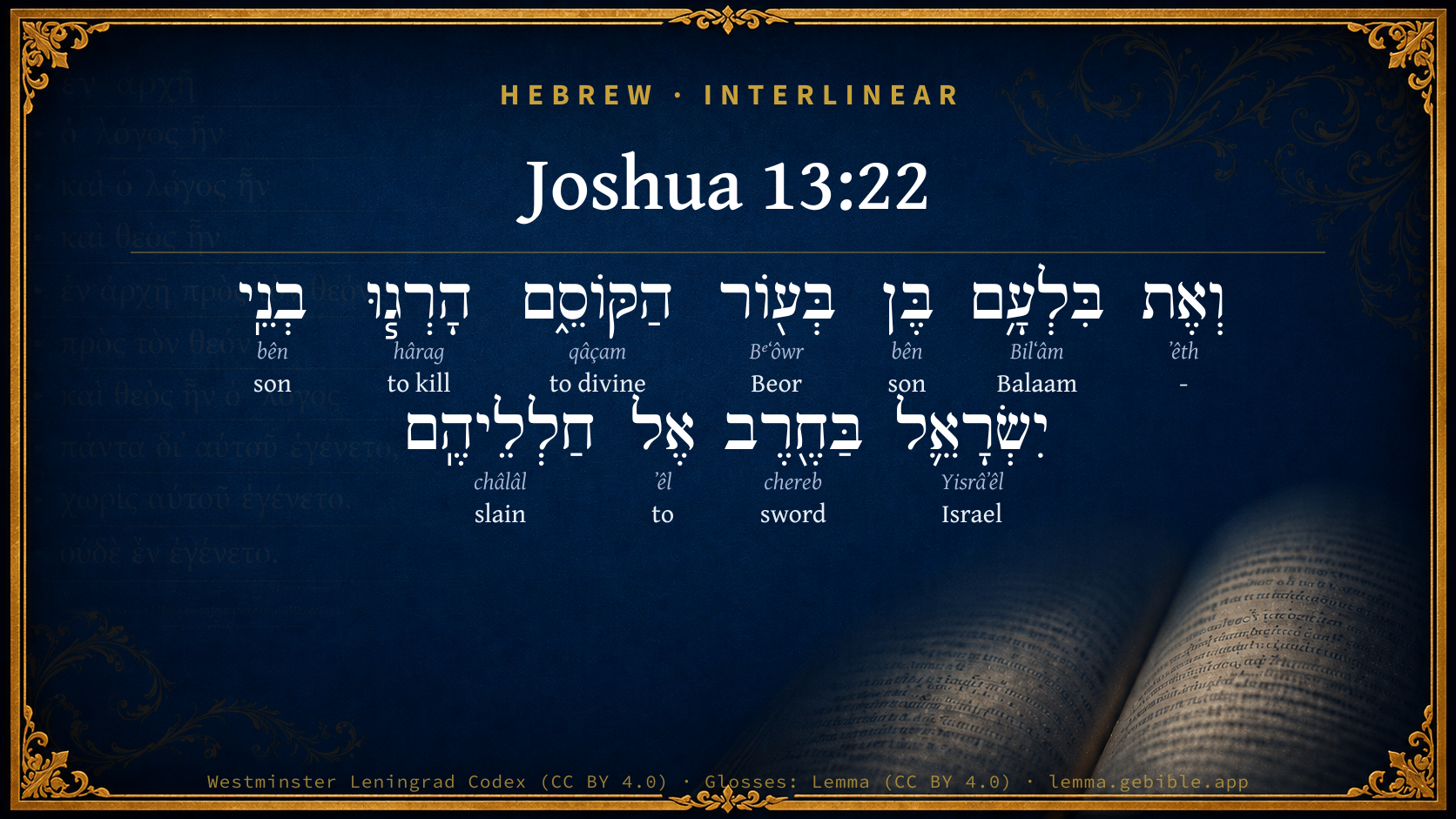
Hebrew (Westminster Leningrad Codex) Joshua 13:22 appears in the Hebrew Old Testament. The text above is from the Westminster Leningrad Codex. Each word links to its Strong’s number, a concise gloss, and parsing drawn from the Open Scriptures Hebrew Bible morphology. Click any word for its full Brown-Driver-Briggs (BDB) entry.
Download image
Cite this verse

Joshua 13:22 (World English Bible). Public Domain. Lemma interlinear Bible study tool, https://lemma.gebible.app/v/joshua/13/22.

Show BibTeX & RIS
BibTeX
RIS
English Translation
Balaam also the son of Beor, the soothsayer, did the children of Israel kill with the sword among the rest of their slain.
World English Bible · Public Domain
Download a study sheet

One document with this verse’s original text, its word-by-word gloss line, the meaning frame, cross-references with their text, attributed commentary, and full source and license credits — printable, and it pastes into notes with its structure intact.

This verse Autodidact and up

Study sheet (.html) Plain text (.txt)

A passage Seminary Student

Up to 50 verses in one chapter. A passage sheet keeps up to 6 commentary sources and 12 cross-references per verse, in the order this page ranks them, and says so on the sheet whenever that leaves anything out. Ask for a single verse and you get the Autodidact verse sheet above.

Everything on this page stays free to read, with no account — the sheet is a download of what is already on screen, not access to it.

Want to remove ads? Support Godless Engineer
Compare translations 3

The same verse in 3 English versions, stacked beneath the original-language interlinear above. Click any original word for its lexicon entry.

Each is an independent rendering of the whole verse — the interlinear is not word-aligned to these translations.

Highlighted words mark where these versions differ — a whole-verse word diff, not a word-by-word alignment.

  • World English Bible Public Domain
    Balaam also the son of Beor, the soothsayer, did the children of Israel kill with the sword among the rest of their slain.
  • King James Version Public Domain
    Balaam also the son of Beor, the soothsayer, did the children of Israel slay with the sword among them that were slain by them.
  • unfoldingWord Literal Text CC BY-SA 4.0
    And the sons of Israel slew with the sword Balaam, the son of Beor, the diviner, with the slain.

unfoldingWord Literal Text — © unfoldingWord, licensed CC BY-SA 4.0. Word-aligned USFM3 via Door43 (git.door43.org/unfoldingWord/en_ult).

Versions to compare (up to 4)

3 of 4 selected

Show all 18 translations

Every available English version of this verse, each an independent rendering of the whole verse.

  • World English Bible Public Domain
    Balaam also the son of Beor, the soothsayer, did the children of Israel kill with the sword among the rest of their slain.
  • Berean Standard Bible Public Domain
    The Israelites also killed the diviner Balaam son of Beor along with the others they put to the sword.
  • Majority Standard Bible Public Domain
    The Israelites also killed the diviner Balaam son of Beor along with the others they put to the sword.
  • King James Version Public Domain
    Balaam also the son of Beor, the soothsayer, did the children of Israel slay with the sword among them that were slain by them.
  • American Standard Version (1901) Public Domain
    Balaam also the son of Beor, the soothsayer, did the children of Israel slay with the sword among the rest of their slain.
  • Revised Version (1885) Public Domain
    Balaam also the son of Beor, the soothsayer, did the children of Israel slay with the sword among the rest of their slain.
  • Geneva Bible (1599) Public Domain
    And Balaam the sonne of Beor the soothsayer did the children of Israel slay with the sword, among them that were slaine.
  • Douay-Rheims (1899) Public Domain
    Balaam also the son of Beer the soothsayer, the children of Israel slew with the sword among the rest that were slain.
  • Young's Literal Translation Public Domain
    And Balaam, son of Beor, the diviner, have the sons of Israel slain with the sword, among their wounded ones.
  • Literal Standard Version CC BY-SA 4.0
    And the sons of Israel have slain Balaam, son of Beor, the diviner, with the sword, among their wounded ones.
  • Unlocked Literal Bible CC BY-SA 4.0
    The people of Israel also killed with the sword Balaam son of Beor, who practiced divination, among the rest of those they had killed.
  • unfoldingWord Literal Text CC BY-SA 4.0
    And the sons of Israel slew with the sword Balaam, the son of Beor, the diviner, with the slain.
  • Darby Bible Public Domain
    And Balaam the son of Beor, the diviner, did the children of Israel kill with the sword among them that were slain by them.
  • World Messianic Bible Public Domain
    The children of Israel also killed Balaam the son of Beor, the soothsayer, with the sword, among the rest of their slain.
  • Webster's Bible Public Domain
    Balaam also the son of Beor, the sooth-sayer, did the children of Israel slay with the sword, among them that were slain by them.
  • Free Bible Version CC BY-SA 4.0
    At the same time the Israelites killed Balaam, son of Beor, the fortune-teller, along with the others who were slaughtered.
  • Bible in Basic English Public Domain
    And Balaam, the son of Beor, the prophet, the children of Israel put to death with the sword.
  • JPS Tanakh (1917) Public Domain
    Balaam also the son of Beor, the soothsayer, did the children of Israel slay with the sword among the rest of their slain.

Literal Standard Version (2020), Covenant Press — licensed CC BY-SA 4.0. Text via the HelloAO Bible API (eBible.org). Unlocked Literal Bible (unfoldingWord) — licensed CC BY-SA 4.0. Text via the HelloAO Bible API (eBible.org). unfoldingWord Literal Text — © unfoldingWord, licensed CC BY-SA 4.0. Word-aligned USFM3 via Door43 (git.door43.org/unfoldingWord/en_ult). Free Bible Version, Dr. Jonathan Gallagher — licensed CC BY-SA 4.0. Text via the HelloAO Bible API (eBible.org).

Word by word

More ways to search: Search by grammar → Find every occurrence → Compare this word →

Practice this passage: Drill this verse → Learn its vocabulary →

About this verse

These counts appear in no published source. They are computed here, from the morphology-tagged text and Lemma’s own curated glosses. What Lemma adds →

11
words
10
distinct lemmas
Historical
section

Notable vocabulary

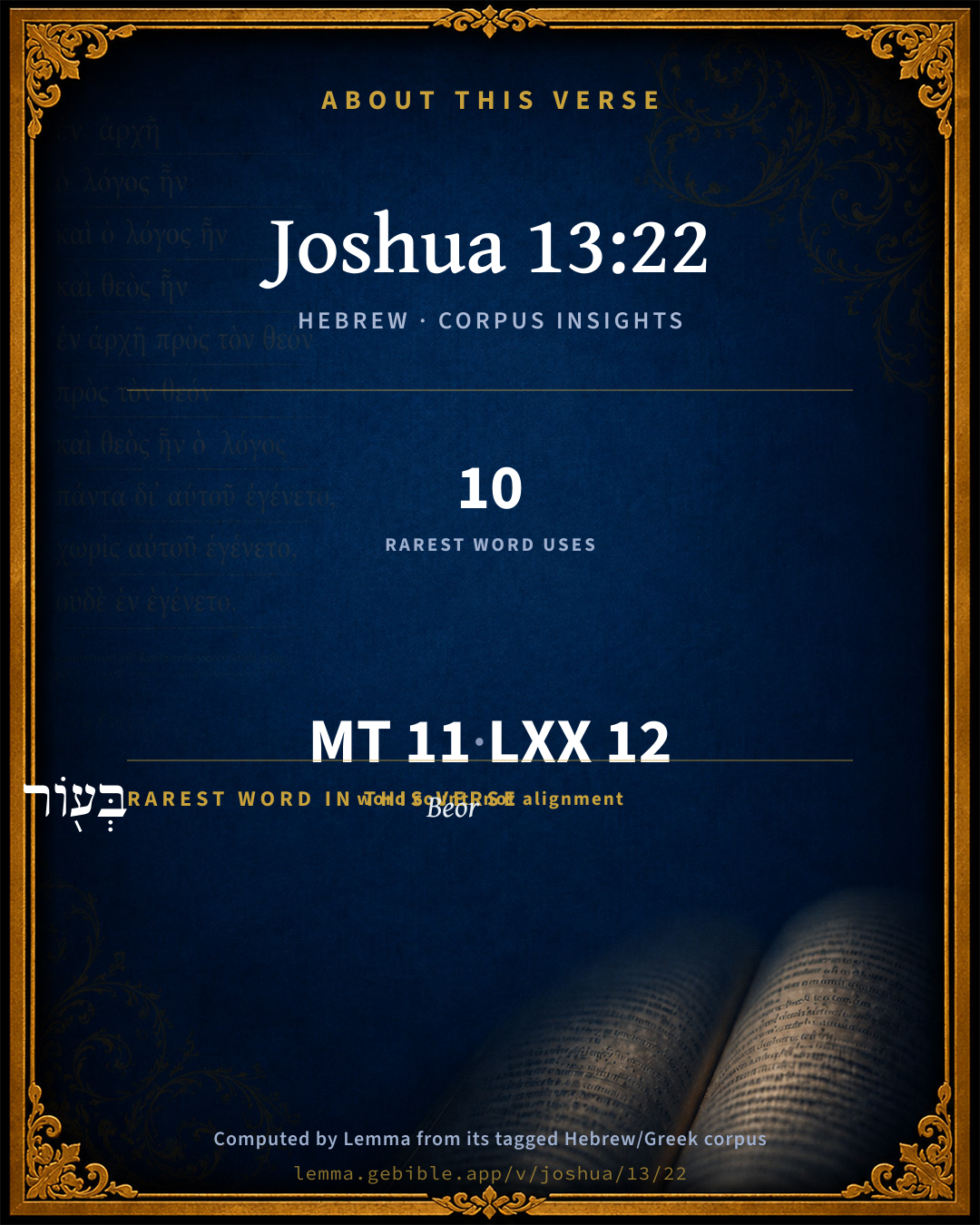
The rarest word here is בְּע֖וֹר Beor H1160 — appearing just 10 times in the whole Hebrew Bible.

Shared distinctive vocabulary

בְּע֖וֹר Beor H1160 occurs in 10 verses of the Hebrew Bible. Also found in:

Grammatical profile

  • 2 verbs
  • 6 nouns
  • 1 adjective
  • 1 preposition
  • 1 particle

Verb forms

  • הַקּוֹסֵ֑ם Qal · Participle Active
  • הָרְג֧וּ Qal · Perfect

Repetition

A word recurs within this verse — often emphatic in Hebrew:

Hebrew & Septuagint length

In English translation the verse runs 23 words from the Hebrew and 13 from the Septuagint (LXX English) — the Septuagint runs noticeably shorter here. See the side-by-side →

A rough comparison of the two English renderings, which tokenize alike — not a word-level alignment.

Word counts can differ between the Hebrew and the Greek without any difference in meaning — e.g. the Hebrew direct-object marker אֵת has no separate Greek word, and Greek often adds the article ὁ.

In the original languages it is 11 Hebrew tokens and 12 Greek tokens — but the two are counted differently (Hebrew bundles its prefixes and suffixes into one token; the Greek is in lemma form), so that isn’t a like-for-like length.

Cross-references

7

Topical passages linked to Joshua 13:22 in the Treasury of Scripture Knowledge — connected by theme and wording, ordered by reader-vote popularity; previews shown in the World English Bible.

  • Numbers 31:8 They killed the kings of Midian with the rest of their slain: Evi, and Rekem, and Zur, and Hur, and Reba, the five kings of Midian: Balaam also the son of Beor they killed with the sword.
  • 2 Peter 2:15 forsaking the right way, they went astray, having followed the way of Balaam the son of Beor, who loved the wages of wrong-doing;
  • Jude 1:11 Woe to them! For they went in the way of Cain, and ran riotously in the error of Balaam for hire, and perished in Korah's rebellion.
  • Revelation 2:14 But I have a few things against you, because you have there some who hold the teaching of Balaam, who taught Balak to throw a stumbling block before the children of Israel, to eat things sacrificed to idols, and to commit sexual immorality.
  • Numbers 22:5–7 He sent messengers to Balaam the son of Beor, to Pethor, which is by the River, to the land of the children of his people, to call him, saying, Behold, there is a people come out from Egypt: behold, they cover the surface of the earth, and they abide over against me.
  • Numbers 24:1 When Balaam saw that it pleased Yahweh to bless Israel, he didn't go, as at the other times, to meet with enchantments, but he set his face toward the wilderness.
  • Revelation 19:20 The beast was taken, and with him the false prophet who worked the signs in his sight, with which he deceived those who had received the mark of the beast and those who worshiped his image. These two were thrown alive into the lake of fire that burns with sulfur.

Cross-references courtesy of OpenBible.info (CC BY 4.0).

Hebrew and Greek witnesses Masoretic Hebrew ↔ Greek Septuagint

The same verse in the two great witnesses to the Old Testament, shown verse-for-verse.

Here the Septuagint runs noticeably shorter than the Hebrew — LXX2012 (modern English Septuagint) 13 words vs World English Bible 23. A rough length comparison of the two English translations, not a word-level alignment — read both below.

These are two independent witnesses, not word-aligned to each other, and the Septuagint is shown in lemma (dictionary) form.

Hebrew Joshua 13:22 Masoretic · Westminster Leningrad Codex

וְאֶת בִּלְעָ֥ם בֶּן בְּע֖וֹר הַקּוֹסֵ֑ם הָרְג֧וּ בְנֵֽי יִשְׂרָאֵ֛ל בַּחֶ֖רֶב אֶל חַלְלֵיהֶֽם

Balaam also the son of Beor, the soothsayer, did the children of Israel kill with the sword among the rest of their slain.

World English Bible · Public Domain

Greek LXX Joshua 13:22 Septuagint · lemma form

καί ὁ βαλααμ ὁ ὁ βεωρ ὁ μάντις ἀποκτείνω ἐν ὁ ῥοπή

And Balaam the son of Baeor the prophet they killed in the battle.

LXX2012 (modern English Septuagint) · Public Domain

On this verse, Haydock's Catholic Bible Commentary discusses the Septuagint’s reading. Read the note in Commentary ↓

Hebrew: Westminster Leningrad Codex (CC BY 4.0). Greek: Septuagint (public domain); English from LXX2012 (modern English Septuagint) (Public Domain). How the Septuagint differs from the Hebrew →

Targum (Aramaic paraphrase)

1

The Targum is the ancient Jewish Aramaic paraphrase of the Hebrew Scriptures — an interpretive translation, not the Hebrew text itself. Onkelos (literal) and Pseudo-Jonathan (expansive) render the Torah, and Jonathan the Prophets. Coverage is partial: where no permissively-licensed English translation exists for a verse, only the Aramaic is shown. This is verse-level text, not a word-by-word alignment to the Hebrew.

  1. Targum Jonathan Prophets (Joshua–Malachi)
    וְיַת בִּלְעָם בַּר בְּעוֹר קִסְמָא קְטָלוּ בְּנֵי יִשְׂרָאֵל בְּחַרְבָּא עַל קְטִילֵיהוֹן:

    (no public-domain English translation for this verse)

    Targum Jonathan — Aramaic: “Mikraot Gedolot” (public domain). English: “Sefaria Community Translation” (CC0 1.0 (public-domain dedication)); “London "Chaldee Paraphrase," 1871” (public domain). Text via Sefaria.

Commentary

Notes on Joshua 13:22 from classic Christian and Jewish commentators (each source and its license shown beneath its notes). The classic Christian expositions comment on the surrounding passage and are grouped to its opening verse, so a note may address several verses; the Jewish commentaries on the Tanakh (Rashi and others) are per-verse, so they appear only where the commentator wrote on this verse.

Lemma curates 59 commentaries, every one of them public domain or Creative Commons licensed, each selected and text-cleaned for this edition rather than reprinted as found. About our sources →

Trapp's Complete Commentary

John Trapp

Jos 13:22 Balaam also the son of Beor, the soothsayer, did the children of Israel slay with the sword among them that were slain by them.

Ver. 22. Balaam also the son of Beor.] The spellman of Satan: though by his words he might seem a friend to Israel, yet was he worthily cut off by them for his wicked counsel. So shall all such perish as "turn aside, like Balaam, unto their crooked ways: but peace shall be upon Israel." {Psa 125:5} See Jdg 1:11.

John Trapp, A Commentary or Exposition upon All the Books of the Old and New Testament (1647–1656) — public domain. Text from a community e-Sword module.

Joseph Benson's Commentary

Jos 13:22. Were slain by them — This was recorded before, (Num 31:8,) and is here repeated, because the defeating of Balaam’s purpose to curse Israel, and the turning that curse into a blessing, was such an instance of the power and goodness of God, as was fit to be had in everlasting rememberance.

Joseph Benson's Commentary on the Old and New Testaments (1811–1818) — public domain. Text from a community e-Sword module.

Tyndale Open Study Notes

Tyndale Open Resources

13:22 Balaam son of Beor had initiated a successful plan to seduce Israel into sexually expressed idolatry (Num 31:16), even though God had forbidden Balaam to curse Israel (Num 22–25).

Tyndale Open Study Notes — © Tyndale Open Resources, licensed CC BY-SA 4.0. Text via the HelloAO Bible API.

Geneva Bible (1599)

Geneva Bible translators

So that both they which obeyed wicked counsel and the wicked counselor perished by the just judgment of God.

Geneva Bible (1599) marginal notes — public domain. Text via Bolls.life.

The Cambridge Bible for Schools and Colleges

gen. ed. J. J. S. Perowne

22. Balaam also] The mention of these “vassals of Sihon” leads the historian to record also at this point the death of Balaam, which took place at the same time as that of these vassals (Num_31:8). He is here called a “soothsayer” (kosem); “the fals divynor” (Wyclif); like (a) the diviners of the Philistines (1Sa_6:2), and (b) the necromancers (1Sa_28:8-9) whom Saul had “cut off.”

The late Professor Blunt has drawn attention to the fact that (a) in the original mission to Balaam, the elders of Midian were concerned as much as the elders of Moab (Num_22:7); that all mention of Midian is then dropped, and “the princes of Balak” and “the servants of Balak” are the titles given to the messengers, and in the prophet’s fruitless struggle to curse the people whom God had blessed, Balak and the Moabites engrossed all his attention.

(b) Balaam then disappears, on his way apparently to his own country, Pethor in Mesopotamia (Num_24:25), while the historian pursues his narrative through several long chapters, which are taken up with entirely different matter.

(c) Then comes an account of an attack made upon the Midianites in revenge for their having seduced the people of Israel by the wiles of their women, at the close of which we find a notice that “Balaam also the son of Beor they slew with the sword” (Num_31:8).

(d) It seems, then, that the Prophet did not after all immediately return to Mesopotamia, but paid a visit to the Midianites, who were equally concerned in bringing him where he was, and there suggested the enticements of the licentious orgies of Baal-Peor, into which Israel fell. But his stay was unseasonably protracted, and Moses coming upon the Midianites slew them and him together.

(e) Here an undesigned coincidence lies (a) in the elders of Moab and the elders of Midian going to Balaam; (b) in Midian being then mentioned no more, while Balaam having been sent away from Moab, apparently that he might go home, is subsequently found a corpse amongst the slaughtered Midianites. See Blunt’s Undesigned Coincidences, pp. 86, 87.

The Cambridge Bible for Schools and Colleges (gen. ed. J. J. S. Perowne; Cambridge University Press, 1878–1918) — public domain. Text from a community e-Sword module.

John Gill's Exposition

And the border of the children of Reuben was Jordan, and the border thereof,.... As their border eastward was Aroer on the river Arnon, so their border westward was the river Jordan:

this was the inheritance of the children of Reuben, after their families, the cities and the villages thereof; which Moses gave them on the other side Jordan; and next follow an account of the inheritance of the tribe of Gad in those parts.

John Gill's Exposition of the Whole Bible (1746–1763) — public domain (CC PDM 1.0). Text via the HelloAO Bible API.

Haydock's Catholic Bible Commentary

Slain. Septuagint, "they slew Balaam....with the sword in the moment," Numbers xxii. 5., and xxxi. 8. (Haydock)

George Leo Haydock (1774–1849), Haydock's Catholic Family Bible and Commentary, 1859 edition — public domain. Excludes Psalms (Douay-Rheims chapter numbering differs from Protestant) and Deuterocanonical books (Catholic canon only).

Matthew Poole's English Annotations

The soothsayer; so he was in truth, though a prophet (2Pe 2:16) in title and profession. See Num 24:25.

Matthew Poole's English Annotations on the Holy Bible (1683–1685) — public domain. Text from a community e-Sword/MySword module.

Whedon's Commentary on the Bible

Daniel D. Whedon

22. Balaam… the soothsayer — A Syrian prophet and diviner whom Balak hired to curse Israel, but whose curses were supernaturally turned to blessings in his mouth. His history and oracles are detailed in Numbers 22-24.

Daniel D. Whedon (gen. ed.), Commentary on the Old and New Testaments (1874–1909) — public domain. Text from a community e-Sword module.

The Pulpit Commentary

The soothsayer. Or diviner, one who pretended to foretell future events. Balaam, it would seem, instead of returning to his own land, went to visit the Midianites, whose elders had joined in the invitation given by Moab, (Num_22:7) and persuaded them to entice the Israelites into idolatry and licentiousness. (see Nu 25) For this crime he met with the punishment he had deserved, and was involved in the destruction which fell on the Midianites by God"s express command, in consequence of their treachery. (Num_25:16-18. See Blunt, "Undesigned Coincidences," Part I 24)

HOMILIES BY E. DE PRESSENSE Ver. 22. God is patient in the exercise of His justice as well as in His compassions, for He is the Lord, with whom "a thousand years are as one day." He knows that His threatenings, like His promises, cannot fail. Of this we have a striking proof, both in the punishment which came upon Balsam, during the war for the conquest of Canaan, and in the blessing of Caleb.

I For many years Balsam had been untrue to his own conscience, in going back to the idolatries of Canaan, after having been made for one day the organ of the most glorious oracles of the true God. He is thus an illustration of the truth that the baser passions of the heart, if not subdued, will always quench the clearest light of the intellect. Balsam chose wittingly the evil part. He plunged again into the corrupt practices of the heathen. For a long time it seemed to the eyes of men, who judge only by the appearance, that he had made the right choice. Was it not better to sit under his own vine and fig tree, and enjoy the riches heaped upon him by Balak, than to join the Israelites in their dreary desert pilgrimage, beneath a blazing sky, and over the burning sand? Had not Balsam acted wisely? Unquestionably he had if the rule of true philosophy be, "Let us eat and drink, for tomorrow we die;" that is to say, if God does not reign in righteousness forever and ever. But when the old soothsayer fell beneath the sword of those Israelites whose warfare he had not been willing to share, he understood too late that it was these despised people who had alone been wise, and that, in spite of all the light he had received, he had lived and acted like a fool. How many are there now living who recognise with their minds the truth of the gospel, but who are unwilling to give up their sinful indulgences, until there rises upon them the terrible day of the Lord. Happy those for whom this day of awakening comes before death, so that they do not go down to the grave with their hearts made gross by merely material prosperity, only to be aroused by the stroke of Divine retribution. Let us remember the punishment of Balaam, which came surely, though it seemed to tarry, when the prosperity of the wicked seems to us a stumbling block.

II The promises of God"s love are not less faithful and sure than His threatenings, though they also may seem slow of fulfilment. This is illustrated in the history of Caleb, who courageously served his people through a long lifetime, bringing back a good report of the land garrisoned by the enemy, which Moses sent him to explore. "Therefore Moses sware on that day, saying, Surely the land whereon thy feet have trodden shall be thine inheritance and thy children"s forever, because thou hast wholly followed the Lord thy God," (ver. 9). This promise was not forgotten. Caleb received, as an inheritance, that hill of Hebron which was assured to him in the name of the God whom he served. Thus the promises of God are yea and amen. E. DE P.

HOMILIES BY R. GLOVER Ver. 22. Balaam.

A study of pathetic interest; one of the great "might-have-beens" of the world. One capable of winning an immortal fame, but actually finding only an immortal infamy. The Judas of the Old Testament: one travelling on the right road till within sight of heaven, and then turning aside to perdition. Consider

I THE GREATNESS OF THE MAN. Evidently his position is one of great dignity and influence. He has raised himself to priest-kingship among the Midianitish tribes. He is considered to have such power in divination and forecast that he is brought all the way from a city in Mesopotamia to the borders of Canaan to "curse Israel." This reputation would lead you to expect to find him at least a man possessed of great spiritual insight; able at least to guess well concerning all moral probabilities, He has, moreover, reached a clear knowledge of God; has not become entangled by any service of the lower deities whose degrading worship was so prevalent; showing that he was a spiritually minded man, who had gone on and on following the light which reached him, until that light exceeded that of any one else among his people. His divination is no black art carried on by appeals to demons but by pure sacrifices offered to the supreme God. He had evidently been accustomed to utter exactly what God imparted. Pleasant or painful, what God sent him he said. And his honesty and courage are conspicuous in his actual declarations concerning Israel. When we have put together these qualities: spirituality sufficient to discover and serve the true God; great strength of integrity; the keen perception which can discern the essential differences and destinies of things; the fear of God to which "the secret of the Lord is always revealed you get a character of the first quality, one that has in it the making of a Moses or an Abraham, one who could and should have been one of the grandest of the prophets of the Lord. If only he had reached the full development of his spiritual powers, Midian might have been another Israel, for generations a source of highest good. Doubtless till middle life this course of high righteousness, consecration to and communion with God had gone on. But beginning well and running well, he falls at last into ignominy and shame. Mark

II THE PROCESS OF HIS FALL. It must not be dated strictly from the temptation before which he fell. There is always, or almost always, some declension before a fall. No one falls into crime by one stumble. Can we trace the process? The writer of the Apocalypse, with his power of going straight to the mark, sums up in one word: He loved the wages of iniquity; not iniquity, but what iniquity could give him. First the selling of his spiritual power was a declension. To seek God"s light in order to get man"s money was an activity damaging to his conscience. Whether it be the sale of masses, absolutions, indulgences, or oracles, the vitiation is in each case the same. A seemingly slender line divides Samuel"s acceptance of an honorarium from Balaam"s eager desire for it. But seeming alike, they essentially differ. In Balaam"s case the greed got headway, and instead of the prophet"s simple acceptance of gifts as a means of living, there was a valuing of all his spiritual powers and privileges only for their market value. It is an awful thing when a Christian minister values his creed and his experience only as a means of making money. Then hankering after money, he soon loses the fine edge of honour. When once God refused to give him leave to go with the messengers of Balak, there should have been no reopening of the question. But so anxious is he for the "rewards of divination," that on their second embassy he goes to God for a second time, for the chance of finding Him permit what He had already refused. Declining to accept a reluctant service, God at once permits and punishes a less honourable course. Again and again he tries to get permission to curse Israel, just in order to get gold. That desire to get a different light from what God has given him is degrading and demoralising. Each dishonourable and dishonouring attempt to get God"s anathemas to hurl against a righteous nation fails to hurt Israel, but terribly damages himself; until, hunting after some means of possessing himself of Balak"s gold, in the pursuit he falls down, and down in degradation until, God refusing to inspire him with evil, his heart is ready to welcome and utter an inspiration from below. And his character is so disintegrated in this hankering after money, that at last he gives the most diabolical advice that man could give; viz., that instead of fighting Israel, they should endeavour to corrupt them. (Num_31:16) The licentious feasts, the heathen orgies are of his counselling, and but for Phinehas might have been as disastrous to Israel as their intent was diabolical. What a fall, from the level of highest character, influence, and opportunity, down to the level of a Satanic crime. The love of money is daily making wrecks equally disastrous and irreparable. Beware of it.

III Lastly observe THE RETRIBUTION. Likely enough he got his reward, and was for a moment as pleased as Achan. But had he satisfaction in it?

(1) Israel, in whose future well being he recognised the source of the world"s best help, is crippled, degraded, weakened through his advice, and that would pain him.

(2) Midian is all but completely annihilated. All the males and most of the women are slain (Numbers 31).

(3) Balaam himself has but a short lived enjoyment of his wealth, for he also is slain. (Num_31:8)

(4) The loss of life probably pained less than the everlasting infamy that made what hitherto had been an honoured name a proverb for the vilest form of treacherous wickedness. These penalties are obvious. In the world of spirits there must have been others more serious still. May we fear dishonourable gold, as that which makes the heaviest of all millstones to drown men in perdition! G.

The Pulpit Commentary (1880–1919), ed. H.D.M. Spence-Jones & Joseph S. Exell — public domain. Text from a community e-Sword module.

John Wesley's Explanatory Notes

Were slain by them - This was recorded before, Num. xxxi, 8, and is here repeated, because the defeating of Balaam's purpose to curse Israel, and the turning that curse into a blessing, was such an instance of the power and goodness of God, as was fit to be had in everlasting remembrance.

John Wesley, Explanatory Notes Upon the Whole Bible (1754–1765) — public domain. Text via the GEBible commentary corpus.

unfoldingWord translationNotes

Door43 World Missions Community

this is their boundary

The Jordan River was the western border of the land that the tribe of Reuben received.

This was the inheritance of the tribe of Reuben

The land that Moses assigned to the tribe of Reuben is spoken of as if it were an inheritance that the tribe of Reuben received as a permanent possession. (See: Metaphor)

given to each of their clans

This can be stated in active form. AT: "that Moses gave to each of their clans" (See: Active or Passive)

translationWords

Israel

sword

Balaam

divination

tribe

Jordan River

inherit

clan

unfoldingWord translationNotes — © Distant Shores Media and the Door43 World Missions Community, licensed CC BY-SA 4.0. Source: git.door43.org/Door43/en_tn.

Lesson kit

Teaching starters — assembled from the data on this page, not authored interpretation. Every prompt links to the verse data it draws on. Edit before teaching.

Joshua, in the Historical, opens this verse with 11 words (10 distinct Hebrew lemmas). Its most distinctive word is Bᵉʻôwr (“Beor”). The Greek Septuagint runs shorter here. A historical commentator’s framing appears above. Read the whole chapter for the surrounding context.

Discussion questions

  1. How does “Beor” (Bᵉʻôwr) shape what this verse is saying?
  2. Genesis 36:32 shares the word «Beor» with this verse. How do the two illuminate each other?
  3. “son” occurs 2× in this one verse. What is the effect of the repetition?
  4. Compared with the Hebrew, the Septuagint runs shorter here. What questions does that raise?
  5. These translations render this verse differently; the difference is in the English rendering, not the original. What questions does that raise?
  6. The verb «הַקּוֹסֵ֑ם» is Qal Participle Active. How does its form color the action?
  7. Reading how Trapp's Complete Commentary and Joseph Benson's Commentary read this verse, where do the two commentators agree and where do they part?

Things to notice

Reading settings

Reading text

Shown beneath each verse's original-language words.

Old Testament
Old Testament edition

Read the OT as the Masoretic Hebrew (MT) or the Greek Septuagint (LXX).

English shown for the Greek Septuagint (in the Hebrew ↔ Greek comparison).

Comparing translations? Open the Compare panel on any verse page to stack up to four side by side.