
Psalms 78:64

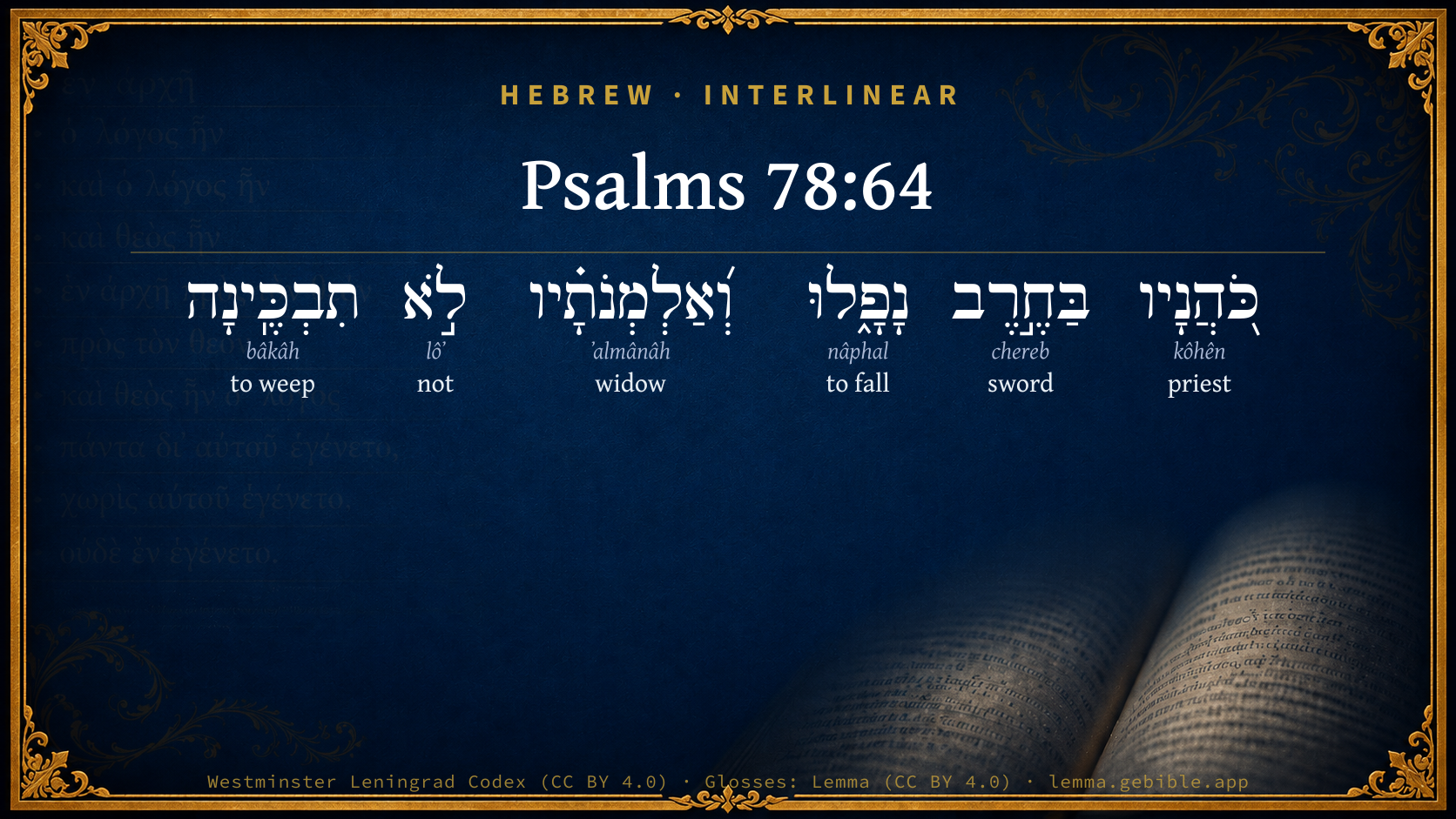
Hebrew (Westminster Leningrad Codex) Psalms 78:64 appears in the Hebrew Old Testament. The text above is from the Westminster Leningrad Codex. Each word links to its Strong’s number, a concise gloss, and parsing drawn from the Open Scriptures Hebrew Bible morphology. Click any word for its full Brown-Driver-Briggs (BDB) entry.
Download image
Cite this verse

Psalms 78:64 (World English Bible). Public Domain. Lemma interlinear Bible study tool, https://lemma.gebible.app/v/psalms/78/64.

Show BibTeX & RIS
BibTeX
RIS
English Translation
Their priests fell by the sword, And their widows couldn't weep.
World English Bible · Public Domain
Download a study sheet

One document with this verse’s original text, its word-by-word gloss line, the meaning frame, cross-references with their text, attributed commentary, and full source and license credits — printable, and it pastes into notes with its structure intact.

This verse Autodidact and up

Study sheet (.html) Plain text (.txt)

A passage Seminary Student

Up to 50 verses in one chapter. A passage sheet keeps up to 6 commentary sources and 12 cross-references per verse, in the order this page ranks them, and says so on the sheet whenever that leaves anything out. Ask for a single verse and you get the Autodidact verse sheet above.

Everything on this page stays free to read, with no account — the sheet is a download of what is already on screen, not access to it.

Want to remove ads? Support Godless Engineer
Compare translations 3

The same verse in 3 English versions, stacked beneath the original-language interlinear above. Click any original word for its lexicon entry.

Each is an independent rendering of the whole verse — the interlinear is not word-aligned to these translations.

Highlighted words mark where these versions differ — a whole-verse word diff, not a word-by-word alignment.

  • World English Bible Public Domain
    Their priests fell by the sword, And their widows couldn't weep.
  • King James Version Public Domain
    Their priests fell by the sword; and their widows made no lamentation.
  • unfoldingWord Literal Text CC BY-SA 4.0
    His priests fell by the sword, and his widows did not weep.

unfoldingWord Literal Text — © unfoldingWord, licensed CC BY-SA 4.0. Word-aligned USFM3 via Door43 (git.door43.org/unfoldingWord/en_ult).

Versions to compare (up to 4)

3 of 4 selected

Show all 18 translations

Every available English version of this verse, each an independent rendering of the whole verse.

  • World English Bible Public Domain
    Their priests fell by the sword, And their widows couldn't weep.
  • Berean Standard Bible Public Domain
    His priests fell by the sword, but their widows could not lament.
  • Majority Standard Bible Public Domain
    His priests fell by the sword, but their widows could not lament.
  • King James Version Public Domain
    Their priests fell by the sword; and their widows made no lamentation.
  • American Standard Version (1901) Public Domain
    Their priests fell by the sword; And their widows made no lamentation.
  • Revised Version (1885) Public Domain
    Their priests fell by the sword; and their widows made no lamentation.
  • Geneva Bible (1599) Public Domain
    Their Priestes fell by the sworde, and their widowes lamented not.
  • Douay-Rheims (1899) Public Domain
    Their priests fell by the sword: and their widows did not mourn.
  • Young's Literal Translation Public Domain
    His priests by the sword have fallen, And their widows weep not.
  • Literal Standard Version CC BY-SA 4.0
    His priests have fallen by the sword, || And their widows do not weep.
  • Unlocked Literal Bible CC BY-SA 4.0
    Their priests fell by the sword, and their widows could not weep.
  • unfoldingWord Literal Text CC BY-SA 4.0
    His priests fell by the sword, and his widows did not weep.
  • Darby Bible Public Domain
    Their priests fell by the sword, and their widows made no lamentation.
  • World Messianic Bible Public Domain
    Their priests fell by the sword, and their widows couldn’t weep.
  • Webster's Bible Public Domain
    Their priests fell by the sword; and their widows made no lamentation.
  • Free Bible Version CC BY-SA 4.0
    Their priests were killed by the sword; their widows were unable to mourn.
  • Bible in Basic English Public Domain
    Their priests were put to death by the sword, and their widows made no weeping for them.
  • JPS Tanakh (1917) Public Domain
    Their priests fell by the sword; and their widows made no lamentation.

Literal Standard Version (2020), Covenant Press — licensed CC BY-SA 4.0. Text via the HelloAO Bible API (eBible.org). Unlocked Literal Bible (unfoldingWord) — licensed CC BY-SA 4.0. Text via the HelloAO Bible API (eBible.org). unfoldingWord Literal Text — © unfoldingWord, licensed CC BY-SA 4.0. Word-aligned USFM3 via Door43 (git.door43.org/unfoldingWord/en_ult). Free Bible Version, Dr. Jonathan Gallagher — licensed CC BY-SA 4.0. Text via the HelloAO Bible API (eBible.org).

Word by word

More ways to search: Search by grammar → Find every occurrence → Compare this word →

Practice this passage: Drill this verse → Learn its vocabulary →

About this verse

These counts appear in no published source. They are computed here, from the morphology-tagged text and Lemma’s own curated glosses. What Lemma adds →

6
words
6
distinct lemmas
Wisdom
section

Shared distinctive vocabulary

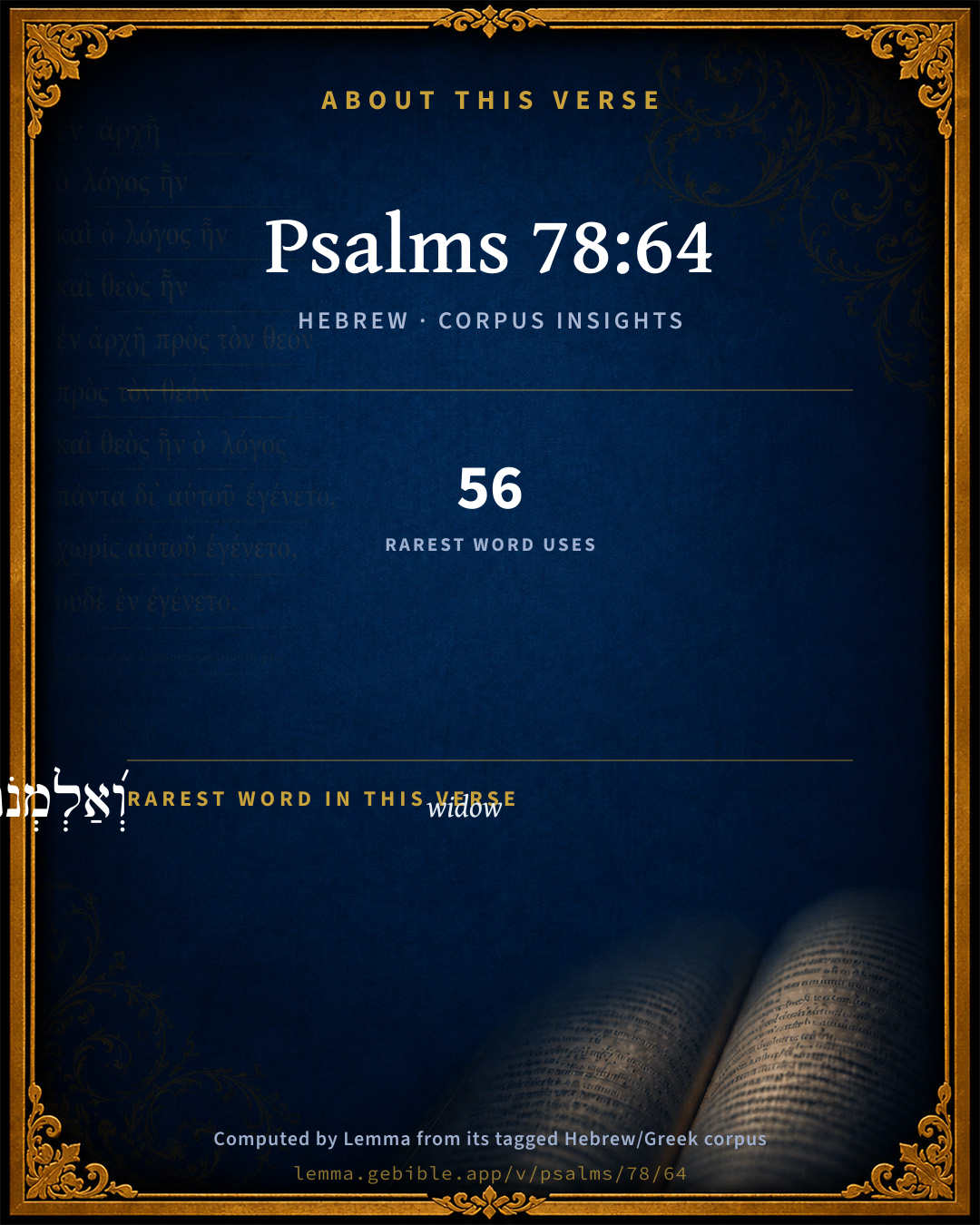
וְ֝אַלְמְנֹתָ֗יו widow H490 occurs in 54 verses of the Hebrew Bible. Also found in:

Grammatical profile

  • 2 verbs
  • 3 nouns
  • 1 particle

Verb forms

  • נָפָ֑לוּ Qal · Perfect
  • תִבְכֶּֽינָה Qal · Imperfect

Hebrew & Septuagint length

In English translation the verse runs 11 words from the Hebrew and 14 from the Septuagint (LXX English) — closely comparable.

A rough comparison of the two English renderings, which tokenize alike — not a word-level alignment.

Word counts can differ between the Hebrew and the Greek without any difference in meaning — e.g. the Hebrew direct-object marker אֵת has no separate Greek word, and Greek often adds the article ὁ.

Cross-references

7

Topical passages linked to Psalms 78:64 in the Treasury of Scripture Knowledge — connected by theme and wording, ordered by reader-vote popularity; previews shown in the World English Bible.

  • 1 Samuel 4:17 He who brought the news answered, Israel is fled before the Philistines, and there has been also a great slaughter among the people, and your two sons also, Hophni and Phinehas, are dead, and the ark of God is taken.
  • Job 27:15 Those who remain of him shall be buried in death. His widows shall make no lamentation.
  • 1 Samuel 4:11 The ark of God was taken; and the two sons of Eli, Hophni and Phinehas, were slain.
  • Ezekiel 24:23 Your tires shall be on your heads, and your shoes on your feet: you shall not mourn nor weep; but you shall pine away in your iniquities, and moan one toward another.
  • 1 Samuel 2:33–34 The man of yours, [whom] I shall not cut off from my altar, [shall be] to consume your eyes, and to grieve your heart; and all the increase of your house shall die in the flower of their age.
  • 1 Samuel 4:19–20 His daughter-in-law, Phinehas' wife, was with child, near to be delivered: and when she heard the news that the ark of God was taken, and that her father-in-law and her husband were dead, she bowed herself and brought forth; for her pains came on her.
  • 1 Samuel 22:18–19 The king said to Doeg, Turn you, and fall on the priests. Doeg the Edomite turned, and he fell on the priests, and he killed on that day eighty-five persons who wore a linen ephod.

Cross-references courtesy of OpenBible.info (CC BY 4.0).

Hebrew and Greek witnesses Masoretic Hebrew ↔ Greek Septuagint

The same verse in the two great witnesses to the Old Testament, shown verse-for-verse.

You’re reading Greek Psalm 77 (Hebrew Psalm 78). The Septuagint counts the superscription, so verse numbers can differ from the Hebrew — chapter-level alignment, not verse-by-verse. Numbering follows Rahlfs.

These are two independent witnesses, not word-aligned to each other, and the Septuagint is shown in lemma (dictionary) form.

Hebrew Psalms 78:64 Masoretic · Westminster Leningrad Codex

כֹּ֭הֲנָיו בַּחֶ֣רֶב נָפָ֑לוּ וְ֝אַלְמְנֹתָ֗יו לֹ֣א תִבְכֶּֽינָה

Their priests fell by the sword, And their widows couldn't weep.

World English Bible · Public Domain

Greek LXX Greek Psalm 77:64 Septuagint · lemma form

ὁ ἱερεύς αὐτός ἐν ῥομφαία πίπτω καί ὁ χήρα αὐτός οὐ κλαίω

Their priests fell by the sword; and their widows shall not be wept for.

LXX2012 (modern English Septuagint) · Public Domain

Hebrew: Westminster Leningrad Codex (CC BY 4.0). Greek: Septuagint (public domain); English from LXX2012 (modern English Septuagint) (Public Domain). How the Septuagint differs from the Hebrew →

Commentary

Notes on Psalms 78:64 from classic Christian and Jewish commentators (each source and its license shown beneath its notes). The classic Christian expositions comment on the surrounding passage and are grouped to its opening verse, so a note may address several verses; the Jewish commentaries on the Tanakh (Rashi and others) are per-verse, so they appear only where the commentator wrote on this verse.

Lemma curates 59 commentaries, every one of them public domain or Creative Commons licensed, each selected and text-cleaned for this edition rather than reprinted as found. About our sources →

Trapp's Complete Commentary

John Trapp

Psa 78:64 Their priests fell by the sword; and their widows made no lamentation.

Ver. 64. Their priests fell by the sword] Hophni and Phineas did, 1Sa 4:11, both in one day, as had been foretold, 1Sa 2:34.

And their widows made no lamentation] As being themselves either killed with grief, as Phineas’s wife, or carried captive. Here were ingentia beneficia, flagitia, supplicia.

John Trapp, A Commentary or Exposition upon All the Books of the Old and New Testament (1647–1656) — public domain. Text from a community e-Sword module.

J. A. Alexander on Psalms

Joseph Addison Alexander

64. (Psa 78:64) His priests by the sword fell, and his widows weep not. The priests are particularly mentioned because, at the time specially referred to, the chief magistracy was vested in a sacerdotal family, and because Hophni and Phinehas, the sons of Eli, were among the first victims of the great calamity in question. See 1 Samuel 4; 1 Samuel 11, 17. In the last clause there seems to be allusion to the death of Phinehas's wife, whose sorrow for her husband and herself was lost in sorrow for the departing glory of Israel (1Sa 4:21). In a wider sense, the words may represent the whole class of Israelitish widows as not weeping for their husbands, either because they were engrossed by their own perils and personal sufferings, or, as some interpreters suppose, because the bodies of the slain were absent, and there could not therefore be a formal mourning in accordance with the oriental usage. The last words of this verse are copied in Job 27:15.

Joseph Addison Alexander, The Psalms Translated and Explained (1850) — public domain. Text from a community e-Sword module.

Geneva Bible (1599)

Geneva Bible translators

Either they were slain before, or taken prisoners of their enemies, and so were forbidden.

Geneva Bible (1599) marginal notes — public domain. Text via Bolls.life.

Adam Clarke's Commentary

Verse 64. Their priests fell by the sword] Hophni and Phinehas, who were slain in that unfortunate battle against the Philistines in which the ark of the Lord was taken, 1Sa 4:11.

A Chaldee Targum on this passage says, "In the time in which the ark of the Lord was taken by the Philistines, Hophni and Phinehas, the two priests, fell by the sword at Shiloh; and when the news was brought, their wives made no lamentation, for they both died the same day."

Adam Clarke's Commentary on the Bible (1810–1826) — public domain. Text from a community e-Sword/MySword module.

Ellicott's Commentary for English Readers

(64) And their widows . . .—Undoubtedly referring to the fact that the wife of Phinehas died in premature labour, and so could not attend the funeral of her husband with the customary lamentations, which in Oriental countries are so loud and marked. The Prayer-Book version, therefore, gives the right feeling—“there were no widows to make lamentations.”

A Bible Commentary for English Readers, edited by Charles John Ellicott (1878–1897) — public domain. Text from a community e-Sword module.

The Cambridge Bible for Schools and Colleges

gen. ed. J. J. S. Perowne

64. and their widows &c.] This line recurs word for word in Job_27:15. In the universal distress the customary rites of mourning were not performed, even for a husband (2Sa_11:26-27).

The Cambridge Bible for Schools and Colleges (gen. ed. J. J. S. Perowne; Cambridge University Press, 1878–1918) — public domain. Text from a community e-Sword module.

John Gill's Exposition

Then the Lord awaked as one out of sleep,.... He seemed to be asleep, while he suffered the ark to be taken, and the Israelites to be slain; and he may be said to awake when he exerted his power in smiting the Philistines, and causing their idol to fall before his ark; see Psa 7:6,

and like a mighty man that shouteth by reason of wine; who having taken a free draught of generous wine, not to excess, goes forth with great courage and cheerfulness to meet his adversary, shouting as he goes, being sure of victory; which must be applied to God with decency, consistent with the glory of his majesty, and the perfections of his nature; and seems designed to express his power and readiness to help his people, and avenge himself on his enemies; see Isa 42:13.

John Gill's Exposition of the Whole Bible (1746–1763) — public domain (CC PDM 1.0). Text via the HelloAO Bible API.

Albert Barnes' Notes on the Bible

Their priests fell by the sword - Compare 1Sa 4:11. It was considered a special calamity that the ministers of religion were cut down in war.

And their widows made no lamentation - That is, the public troubles were so great, the danger was still so imminent, the calamities thickened so fast, that there was no opportunity for public mourning by formal processions of women, and loud lamentations, such as were usual on these occasions. See the notes at Job 27:15. The meaning is not that there was a want of affection or attachment on the part of the friends of the slain, or that there was no real grief, but that there was no opportunity for displaying it in the customary manner.

Albert Barnes' Notes on the Bible (1834–1885) — public domain. Text from a community e-Sword/MySword module.

Matthew Poole's English Annotations

Their priests, Hophni and Phinehas, and others.

No lamentation; no funeral solemnities; either because they were prevented by their own death, as the wife of Phinehas was, or disturbed by the invasion of the enemy; or so overwhelmed with the sense of the public calamity, that the resentment of their private losses was swallowed up by it. See Job 27:15; Eze 24:23.

Matthew Poole's English Annotations on the Holy Bible (1683–1685) — public domain. Text from a community e-Sword/MySword module.

The Treasury of David

Charles H. Spurgeon

Ver. 64. Their priests fell by the sword. Hophni and Phineas were slain; they were among the chief in sin, and, therefore, they perished with the rest. Priesthood is no shelter for transgressors; the jewelled breastplate cannot turn aside the arrows of judgment.

And their widows made no lamentation. Their private griefs were swallowed up in the greater national agony, because the ark of God was taken. As the maidens had no heart for the marriage song, so the widows had no spirit, even to utter the funeral wail. The dead were buried too often and too hurriedly to allow of the usual rites of lamentation. This was the lowest depth; from this point things will take a gracious turn.

Ver. 64. Their widows made no lamentation. This implies the extent of the destruction, and is full of meaning to one who has been in an Oriental city, during a plague or other devastating calamity. At first the cry of wailing, which always follows a death in ordinary circumstances, is loud and frequent: but such cries do not increase, but subside, with the increase of the calamity and desolation. Death becomes a familiar object in every house; and every one, absorbed in his own losses, has little sympathy to spare for others. Hence the loudest lamentations cease to be noticed, or to draw consoling friends to the house of mourning; and therefore, as well as from the stupefaction of feeling which scenes of continual horror never fail to produce, a new death is received in silence, or only with sighs and tears. In fact, all the usual observances are suspended. The dead are carried out and buried without mourning ceremonies, and without the presence of surviving friends, by men who make it an employment to take away the dead on the backs of mules or asses, from the homes they leave desolate. We have seen this. Kitto's "Pictorial Bible." 1856.

Ver. 64. Their widows made no lamentation. The meaning is, either

1. That being overwhelmed with sorrow they could not weep; or, 2. That being in captivity amongst the Philistines they were not suffered to lament the death of their husbands; or, 3. That dying with grief they lived not to make any lamentations for them at their funerals; or, 4. That they were so taken up and oppressed with their own miseries, and especially with the miseries of the church and people of God in general, that they had not leisure to bewail their husbands; of both which last we have a clear instance in the wife of Phinehas in particular, 1Sa 4:19-20, who dying, made no mention of her husband. Arthus Jackson.

Ver. 64. The daughter-in-law of Eli, when she was at once travailing, and in that travail dying, to make up the full sum of God's judgment upon that wicked house, as one insensible of the death of her father, of her husband, of herself, in comparison of this loss, calls her (then unseasonable) son Ichabod, and with her last breath says, "The glory is departed from Israel, the ark is taken." Joseph Hall.

Charles H. Spurgeon's The Treasury of David (1869–1885) — public domain. Psalms only. Text from a community e-Sword/MySword module.

Whedon's Commentary on the Bible

Daniel D. Whedon

64. Their priests fell—Probably those who had, in great numbers, accompanied the ark into the camp with Hophni and Phinehas. 1Sa_4:11; 1Sa_4:17.

Their widows made no lamentation—As the bodies received no formal burial, the usual forms of funeral mourning were not observed. See Jer_22:18

Daniel D. Whedon (gen. ed.), Commentary on the Old and New Testaments (1874–1909) — public domain. Text from a community e-Sword module.

The Pulpit Commentary

Their priests fell by the sword. As Hophni and Phinehas at the taking of the ark, (1Sa_4:11) and, no doubt, many others on other occasions. And their widows made no lamentation. The solemn funeral dirge could not take place, since the bodies remained on the battlefield.

The Pulpit Commentary (1880–1919), ed. H.D.M. Spence-Jones & Joseph S. Exell — public domain. Text from a community e-Sword module.

John Wesley's Explanatory Notes

Priests - Hophni and Phinehas. No lamentation - No funeral solemnities; either because they were prevented by their own death, as the wife of Phinehas was, or disturbed by the invasion of the enemy.

John Wesley, Explanatory Notes Upon the Whole Bible (1754–1765) — public domain. Text via the GEBible commentary corpus.

unfoldingWord translationNotes

Door43 World Missions Community

Their priests fell by the sword

Here the word "sword" represents soldiers who fought with swords. The phrase "fell by the sword" is an idiom that means to die in battle. AT: "Their priests died in battle" or "Enemies killed their priests with swords" (See: Metonymy and Idiom)

their widows could not weep

Possible meanings are 1) someone forced the widows not to weep or 2) so many priests died that there was no time for proper funerals.

widows

women whose husbands have died

the Lord awakened as one from sleep

The Lord not acting for a period of time is spoken of as if he were asleep, and his beginning to act is spoken of as if he awakened. AT: "the Lord began to act as if he had awakened from sleep" (See: Metaphor)

like a warrior who shouts because of wine

Possible meanings are 1) like a warrior who had drunk too much wine and has become angry because he was awakened and so wants to fight or 2) like a warrior who drank much wine but is now able to think and fight well because he has slept.

translationWords

priest

sword

lord

soldier

wine

adversary

eternity

shame

unfoldingWord translationNotes — © Distant Shores Media and the Door43 World Missions Community, licensed CC BY-SA 4.0. Source: git.door43.org/Door43/en_tn.

Rashi

Rabbi Shlomo Yitzchaki (Rashi)

His priests fell by the sword Hophni and Phinehas.

but his widows did not weep Even his widow was not allowed to bewail him, for she too died on the day of the tidings, as it is said (I Sam. 4: 19): “And she knelt and gave birth, for her pains had suddenly come upon her.”

Rashi on the Tanakh — English translations: “The Judaica Press complete Tanach with Rashi, translated by A. J. Rosenberg” (CC BY 4.0); “Pentateuch with Rashi's commentary by M. Rosenbaum and A.M. Silbermann, 1929-1934” (public domain); “The Metsudah Tanach series, Lakewood, N.J” (CC BY 4.0); and “The Book of Joshua, Metsudah Publications, 1997” (CC BY 4.0). Text via Sefaria.

Lesson kit

Teaching starters — assembled from the data on this page, not authored interpretation. Every prompt links to the verse data it draws on. Edit before teaching.

Psalms, in the Wisdom, opens this verse with 6 words (6 distinct Hebrew lemmas). Its most distinctive word is ʼalmânâh (“widow”). A historical commentator’s framing appears above. Read the whole chapter for the surrounding context.

Discussion questions

  1. What does “widow” (ʼalmânâh) contribute to the verse as a whole?
  2. How does Genesis 38:11, which shares the word «widow», read alongside this verse?
  3. These translations render this verse differently. What is at stake in choosing one wording over another?
  4. «נָפָ֑לוּ» is a Qal Perfect verb. How does that grammatical form shape the action described?
  5. Compare how Trapp's Complete Commentary and J. A. Alexander on Psalms read this verse. Where do they agree or differ?

Things to notice

Reading settings

Reading text

Shown beneath each verse's original-language words.

Old Testament
Old Testament edition

Read the OT as the Masoretic Hebrew (MT) or the Greek Septuagint (LXX).

English shown for the Greek Septuagint (in the Hebrew ↔ Greek comparison).

Comparing translations? Open the Compare panel on any verse page to stack up to four side by side.