
Isaiah 14:19

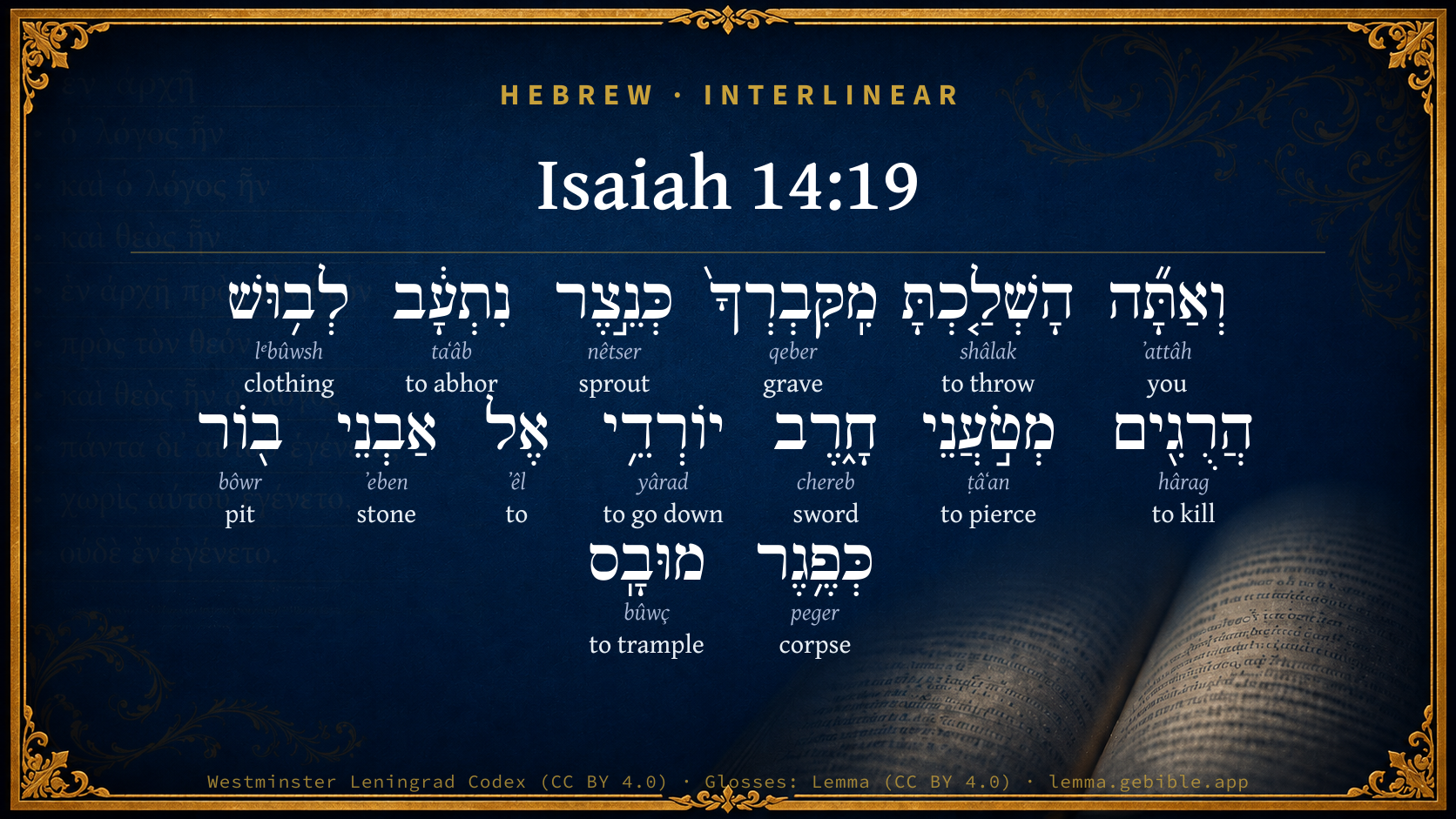
Hebrew (Westminster Leningrad Codex) Isaiah 14:19 appears in the Hebrew Old Testament. The text above is from the Westminster Leningrad Codex. Each word links to its Strong’s number, a concise gloss, and parsing drawn from the Open Scriptures Hebrew Bible morphology. Click any word for its full Brown-Driver-Briggs (BDB) entry.
Download image
Cite this verse

Isaiah 14:19 (World English Bible). Public Domain. Lemma interlinear Bible study tool, https://lemma.gebible.app/v/isaiah/14/19.

Show BibTeX & RIS
BibTeX
RIS
English Translation
But you are cast forth away from your tomb like an abominable branch, clothed with the slain, who are thrust through with the sword, who go down to the stones of the pit; as a dead body trodden under foot.
World English Bible · Public Domain
Highlights Full analysis ↓
Download a study sheet

One document with this verse’s original text, its word-by-word gloss line, the meaning frame, cross-references with their text, attributed commentary, and full source and license credits — printable, and it pastes into notes with its structure intact.

This verse Autodidact and up

Study sheet (.html) Plain text (.txt)

A passage Seminary Student

Up to 50 verses in one chapter. A passage sheet keeps up to 6 commentary sources and 12 cross-references per verse, in the order this page ranks them, and says so on the sheet whenever that leaves anything out. Ask for a single verse and you get the Autodidact verse sheet above.

Everything on this page stays free to read, with no account — the sheet is a download of what is already on screen, not access to it.

Want to remove ads? Support Godless Engineer
Compare translations 3

The same verse in 3 English versions, stacked beneath the original-language interlinear above. Click any original word for its lexicon entry.

Each is an independent rendering of the whole verse — the interlinear is not word-aligned to these translations.

Highlighted words mark where these versions differ — a whole-verse word diff, not a word-by-word alignment.

  • World English Bible Public Domain
    But you are cast forth away from your tomb like an abominable branch, clothed with the slain, who are thrust through with the sword, who go down to the stones of the pit; as a dead body trodden under foot.
  • King James Version Public Domain
    But thou art cast out of thy grave like an abominable branch, and as the raiment of those that are slain, thrust through with a sword, that go down to the stones of the pit; as a carcase trodden under feet.
  • unfoldingWord Literal Text CC BY-SA 4.0
    But you, you have been cast from your grave like an abhorred branch, clothed the slain, the pierced of the sword, the ones going down to the stones of the pit, like a trampled corpse.

unfoldingWord Literal Text — © unfoldingWord, licensed CC BY-SA 4.0. Word-aligned USFM3 via Door43 (git.door43.org/unfoldingWord/en_ult).

Versions to compare (up to 4)

3 of 4 selected

Show all 18 translations

Every available English version of this verse, each an independent rendering of the whole verse.

  • World English Bible Public Domain
    But you are cast forth away from your tomb like an abominable branch, clothed with the slain, who are thrust through with the sword, who go down to the stones of the pit; as a dead body trodden under foot.
  • Berean Standard Bible Public Domain
    But you are cast out of your grave like a rejected branch, covered by those slain with the sword, and dumped into a rocky pit like a carcass trampled underfoot.
  • Majority Standard Bible Public Domain
    But you are cast out of your grave like a rejected branch, covered by those slain with the sword, and dumped into a rocky pit like a carcass trampled underfoot.
  • King James Version Public Domain
    But thou art cast out of thy grave like an abominable branch, and as the raiment of those that are slain, thrust through with a sword, that go down to the stones of the pit; as a carcase trodden under feet.
  • American Standard Version (1901) Public Domain
    But thou art cast forth away from thy sepulchre like an abominable branch, clothed with the slain, that are thrust through with the sword, that go down to the stones of the pit; as a dead body trodden under foot.
  • Revised Version (1885) Public Domain
    But thou art cast forth away from thy sepulchre like an abominable branch, clothed with the slain, that are thrust through with the sword, that go down to the stones of the pit; as a carcase trodden under foot.
  • Geneva Bible (1599) Public Domain
    But thou art cast out of thy graue like an abominable branch: like the raiment of those that are slaine, and thrust thorowe with a sword, which goe downe to the stones of the pit, as a carkeise troden vnder feete.
  • Douay-Rheims (1899) Public Domain
    But thou art cast out of thy grave, as an unprofitable branch defiled, and wrapped up among them that were slain by the sword, and art gone down to the bottom of the pit, as a rotten carcass.
  • Young's Literal Translation Public Domain
    And -- thou hast been cast out of thy grave, As an abominable branch, raiment of the slain, Thrust through ones of the sword, Going down unto the sons of the pit, As a carcase trodden down.
  • Literal Standard Version CC BY-SA 4.0
    And you have been cast out of your grave, || As an abominable branch, raiment of the slain, || Thrust through ones of the sword, || Going down to the sons of the pit, || As a carcass trodden down.
  • Unlocked Literal Bible CC BY-SA 4.0
    But you are cast out of your grave like a branch thrown away. The dead cover you like a garment, those pierced by the sword, who go down to the stones of the pit.
  • unfoldingWord Literal Text CC BY-SA 4.0
    But you, you have been cast from your grave like an abhorred branch, clothed the slain, the pierced of the sword, the ones going down to the stones of the pit, like a trampled corpse.
  • Darby Bible Public Domain
    but thou art cast out of thy grave like an abominable branch, covered with the slain -- those thrust through with the sword, that go down to the stones of the pit: like a carcase trodden under foot.
  • World Messianic Bible Public Domain
    But you are cast away from your tomb like an abominable branch, clothed with the slain who are thrust through with the sword, who go down to the stones of the pit; like a dead body trodden under foot.
  • Webster's Bible Public Domain
    But thou art cast out of thy grave like an abominable branch, and as the raiment of those that are slain, thrust through with a sword, that go down to the stones of the pit; as a carcass trodden under feet.
  • Free Bible Version CC BY-SA 4.0
    But you are thrown out of your grave like a branch nobody wants, buried underneath the bodies of those killed by the sword. You are like a corpse trodden underfoot. You are tossed into a pit full of rocks—
  • Bible in Basic English Public Domain
    But you, like a birth before its time, are stretched out with no resting-place in the earth; clothed with the bodies of the dead who have been put to the sword, who go down to the lowest parts of the underworld; a dead body, crushed under foot.
  • JPS Tanakh (1917) Public Domain
    But thou art cast forth away from thy grave like an abhorred offshoot, in the raiment of the slain, that are thrust through with the sword, that go down to the pavement of the pit, as a carcass trodden under foot.

Literal Standard Version (2020), Covenant Press — licensed CC BY-SA 4.0. Text via the HelloAO Bible API (eBible.org). Unlocked Literal Bible (unfoldingWord) — licensed CC BY-SA 4.0. Text via the HelloAO Bible API (eBible.org). unfoldingWord Literal Text — © unfoldingWord, licensed CC BY-SA 4.0. Word-aligned USFM3 via Door43 (git.door43.org/unfoldingWord/en_ult). Free Bible Version, Dr. Jonathan Gallagher — licensed CC BY-SA 4.0. Text via the HelloAO Bible API (eBible.org).

Word by word

More ways to search: Search by grammar → Find every occurrence → Compare this word →

Practice this passage: Drill this verse → Learn its vocabulary →

מְטֹ֣עֲנֵי
ṭâʻan
H2944
“pierced”
Verb, Pual, Participle Passive, Masculine, Plural, Construct
Part of Speech
Verb
Stem
Pual
Form
Participle Passive
Gender
Masculine
Number
Plural
State
Construct
Full BDB Definition

Origin: a primitive root

TWOT: 817

(Pual) to pierce
  1. וְאַתָּ֞ה ʼattâh H859 “and · you” Conjunction + Pronoun, Personal, 2nd Person, Masculine, Singular
  2. הָשְׁלַ֤כְתָּ shâlak H7993 “to throw” Verb, Hophal, Perfect, 2nd Person, Masculine, Singular
  3. מִֽקִּבְרְךָ֙ qeber H6913 “from · grave · your” Preposition + Noun, Common, Masculine, Singular, Construct + Suffix, Personal, 2nd Person, Masculine, Singular
  4. כְּנֵ֣צֶר nêtser H5342 “like/as · sprout” Preposition + Noun, Common, Masculine, Singular, Absolute
  5. נִתְעָ֔ב taʻâb H8581 “abhoring” Verb, Niphal, Participle Active, Masculine, Singular, Absolute
  6. לְב֥וּשׁ lᵉbûwsh H3830 “clothing of” Noun, Common, Masculine, Singular, Construct
  7. הֲרֻגִ֖ים hârag H2026 “killed” Verb, Qal, Participle Passive, Masculine, Plural, Absolute
  8. חָ֑רֶב chereb H2719 “sword” Noun, Common, Feminine, Singular, Absolute
  9. יוֹרְדֵ֥י yârad H3381 “going down” Verb, Qal, Participle Active, Masculine, Plural, Construct
  10. אֶל ʼêl H413 “to” Preposition
  11. אַבְנֵי ʼeben H68 “stones of” Noun, Common, Feminine, Plural, Construct
  12. ב֖וֹר bôwr H953 “pit” Noun, Common, Masculine, Singular, Absolute
  13. כְּפֶ֥גֶר peger H6297 “like/as · corpse” Preposition + Noun, Common, Masculine, Singular, Absolute
  14. מוּבָֽס bûwç H947 “trampled” Verb, Hophal, Participle Passive, Masculine, Singular, Absolute

About this verse

These counts appear in no published source. They are computed here, from the morphology-tagged text and Lemma’s own curated glosses. What Lemma adds →

15
words
15
distinct lemmas
Prophets
section

Notable vocabulary

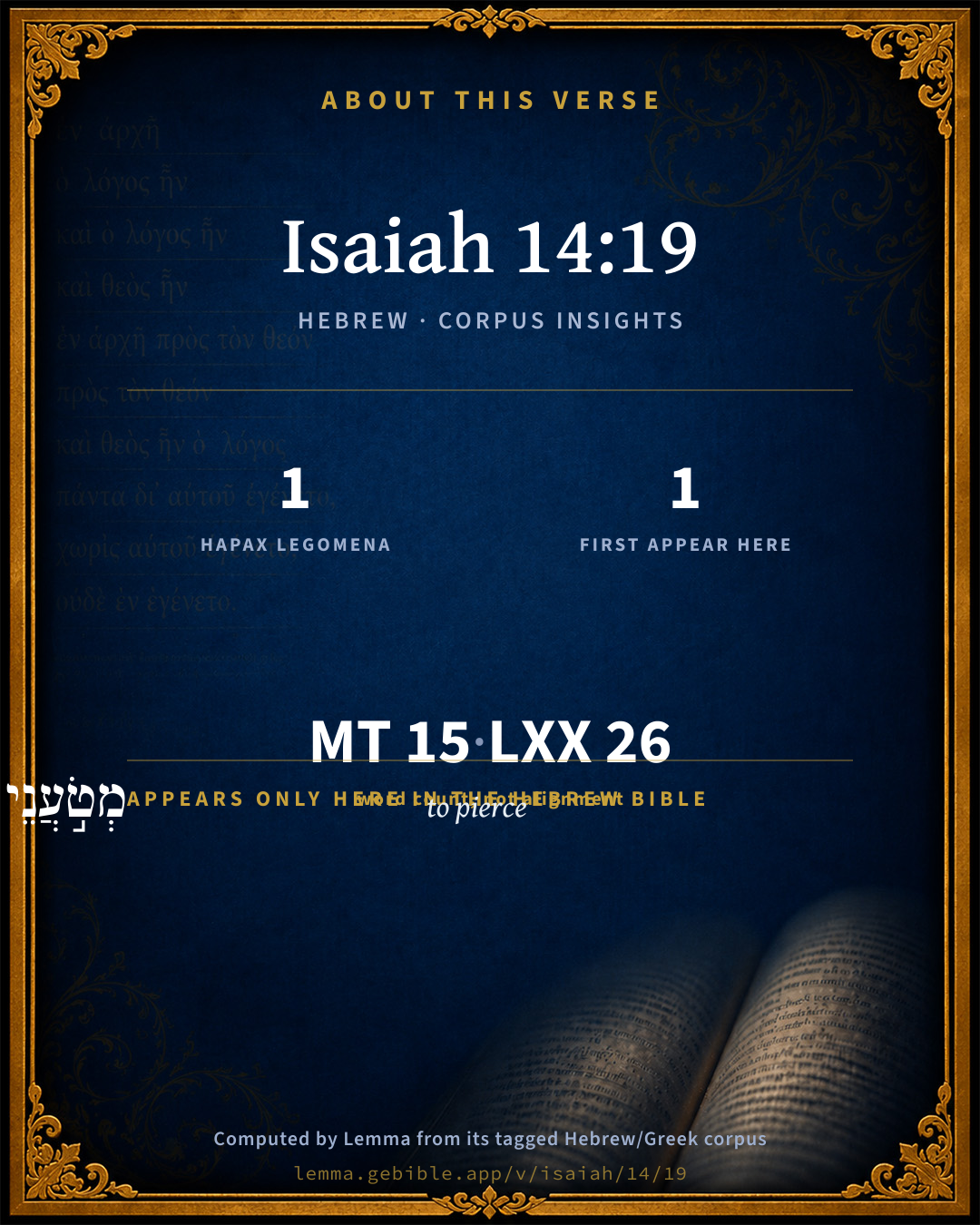
1 hapax legomenon — a word that appears only here in the entire Hebrew Bible:

  • מְטֹ֣עֲנֵי to pierce H2944

First appearance in Scripture

This word makes its first canonical appearance in the Hebrew Bible here:

  • מְטֹ֣עֲנֵי to pierce H2944

Shared distinctive vocabulary

כְּנֵ֣צֶר sprout H5342 occurs in 4 verses of the Hebrew Bible. Also found in:

Grammatical profile

  • 6 verbs
  • 7 nouns
  • 1 pronoun
  • 1 preposition

Verb forms

  • הָשְׁלַ֤כְתָּ Hophal · Perfect
  • נִתְעָ֔ב Niphal · Participle Active
  • הֲרֻגִ֖ים Qal · Participle Passive
  • מְטֹ֣עֲנֵי Pual · Participle Passive
  • יוֹרְדֵ֥י Qal · Participle Active
  • מוּבָֽס Hophal · Participle Passive

Hebrew & Septuagint length

In English translation the verse runs 40 words from the Hebrew and 27 from the Septuagint (LXX English) — the Septuagint runs noticeably shorter here. See the side-by-side →

A rough comparison of the two English renderings, which tokenize alike — not a word-level alignment.

Word counts can differ between the Hebrew and the Greek without any difference in meaning — e.g. the Hebrew direct-object marker אֵת has no separate Greek word, and Greek often adds the article ὁ.

In the original languages it is 15 Hebrew tokens and 26 Greek tokens — but the two are counted differently (Hebrew bundles its prefixes and suffixes into one token; the Greek is in lemma form), so that isn’t a like-for-like length.

Cross-references

11

Topical passages linked to Isaiah 14:19 in the Treasury of Scripture Knowledge — connected by theme and wording, ordered by reader-vote popularity; previews shown in the World English Bible.

  • Jeremiah 41:7 It was so, when they came into the midst of the city, that Ishmael the son of Nethaniah killed them, [and cast them] into the midst of the pit, he, and the men who were with him.
  • Jeremiah 41:9 Now the pit in which Ishmael cast all the dead bodies of the men whom he had killed, by the side of Gedaliah (the same was who which Asa the king had made for fear of Baasha king of Israel), Ishmael the son of Nethaniah filled it with those who were killed.
  • 1 Kings 21:19 You shall speak to him, saying, Thus says Yahweh, Have you killed and also taken possession? You shall speak to him, saying, Thus says Yahweh, In the place where dogs licked the blood of Naboth shall dogs lick your blood, even yours.
  • 1 Kings 21:24 Him who dies of Ahab in the city the dogs shall eat; and him who dies in the field shall the birds of the sky eat.
  • 2 Kings 9:25 Then said [Jehu] to Bidkar his captain, Take up, and cast him in the portion of the field of Naboth the Jezreelite; for remember how that, when I and you rode together after Ahab his father, Yahweh laid this burden on him:
  • 2 Kings 9:34–36 When he was come in, he ate and drink; and he said, See now to this cursed woman, and bury her; for she is a king's daughter.
  • Isaiah 22:16–18 "What are you doing here? and who has you here, that you have hewed out a tomb here? Cutting him out a tomb on high, chiseling a habitation for himself in the rock!"
  • Jeremiah 8:1–2 At that time, says Yahweh, they shall bring out the bones of the kings of Judah, and the bones of his princes, and the bones of the priests, and the bones of the prophets, and the bones of the inhabitants of Jerusalem, out of their graves;
  • Jeremiah 16:6 Both great and small shall die in this land; they shall not be buried, neither shall men lament for them, nor cut themselves, nor make themselves bald for them;
  • Jeremiah 22:19 He shall be buried with the burial of a donkey, drawn and cast forth beyond the gates of Jerusalem.
  • Ezekiel 32:23 whose graves are set in the uttermost parts of the pit, and her company is round about her grave; all of them slain, fallen by the sword, who caused terror in the land of the living.

Cross-references courtesy of OpenBible.info (CC BY 4.0).

Hebrew and Greek witnesses Masoretic Hebrew ↔ Greek Septuagint

The same verse in the two great witnesses to the Old Testament, shown verse-for-verse.

Here the Septuagint runs noticeably shorter than the Hebrew — LXX2012 (modern English Septuagint) 27 words vs World English Bible 40. A rough length comparison of the two English translations, not a word-level alignment — read both below.

These are two independent witnesses, not word-aligned to each other, and the Septuagint is shown in lemma (dictionary) form.

Hebrew Isaiah 14:19 Masoretic · Westminster Leningrad Codex

וְאַתָּ֞ה הָשְׁלַ֤כְתָּ מִֽקִּבְרְךָ֙ כְּנֵ֣צֶר נִתְעָ֔ב לְב֥וּשׁ הֲרֻגִ֖ים מְטֹ֣עֲנֵי חָ֑רֶב יוֹרְדֵ֥י אֶל אַבְנֵי ב֖וֹר כְּפֶ֥גֶר מוּבָֽס

But you are cast forth away from your tomb like an abominable branch, clothed with the slain, who are thrust through with the sword, who go down to the stones of the pit; as a dead body trodden under foot.

World English Bible · Public Domain

Greek LXX Isaiah 14:19 Septuagint · lemma form

σύ δέ ῥίπτω ἐν ὁ ὄρος ὡς νεκρός βδελύσσω μετά πολύς θνήσκω ἐκκεντέω μάχαιρα καταβαίνω εἰς ᾅδης ὅς τρόπος ἱμάτιον ἐν αἷμα φύρομαι οὐ εἰμί καθαρός

But you shall be cast forth on the mountains, as a loathed carcass, with many dead who have been pierced with swords, going down to the grave.

LXX2012 (modern English Septuagint) · Public Domain

On this verse, Albert Barnes' Notes on the Bible discusses the Septuagint’s reading. Read the note in Commentary ↓

Hebrew: Westminster Leningrad Codex (CC BY 4.0). Greek: Septuagint (public domain); English from LXX2012 (modern English Septuagint) (Public Domain). How the Septuagint differs from the Hebrew →

Targum (Aramaic paraphrase)

1

The Targum is the ancient Jewish Aramaic paraphrase of the Hebrew Scriptures — an interpretive translation, not the Hebrew text itself. Onkelos (literal) and Pseudo-Jonathan (expansive) render the Torah, and Jonathan the Prophets. Coverage is partial: where no permissively-licensed English translation exists for a verse, only the Aramaic is shown. This is verse-level text, not a word-by-word alignment to the Hebrew.

  1. Targum Jonathan Prophets (Joshua–Malachi)
    וְאַתְּ אִתְרְכִיתְּנָא מִקִבְרָךְ כְּחָט טְמִיר חֲפֵי קְטִילִין מְטַעֲנֵי חֶרֶב נַחֲתִין לְגוֹב אַבְנֵי בֵּית אַבְדָנָא כִּפְגַר מְדַשְׁדָשׁ:

    But thou art cast out of thy grave as a hidden branch, as those hidden among the slain, as those pierced by the sword, as those that are descending the lowest pit of the place of destruction, as a carcass trodden under foot.

    Targum Jonathan — Aramaic: “Mikraot Gedolot” (public domain). English: “Sefaria Community Translation” (CC0 1.0 (public-domain dedication)); “London "Chaldee Paraphrase," 1871” (public domain). Text via Sefaria.

Commentary

Notes on Isaiah 14:19 from classic Christian and Jewish commentators (each source and its license shown beneath its notes). The classic Christian expositions comment on the surrounding passage and are grouped to its opening verse, so a note may address several verses; the Jewish commentaries on the Tanakh (Rashi and others) are per-verse, so they appear only where the commentator wrote on this verse.

Lemma curates 59 commentaries, every one of them public domain or Creative Commons licensed, each selected and text-cleaned for this edition rather than reprinted as found. About our sources →

Trapp's Complete Commentary

John Trapp

Isa 14:19 But thou art cast out of thy grave like an abominable branch, [and as] the raiment of those that are slain, thrust through with a sword, that go down to the stones of the pit; as a carcase trodden under feet.

Ver. 19. But thou art cast out of thy grave,] i.e., Cast out and kept from thy grave. {a} This befell Belshazzar upon the surprisal of the city. {Dan 5:30} And the like also befell Alexander the Great dying at the same city; and our William the Conqueror, who having utterly sacked the city of Mants in France, and in the destruction thereof got his own, died shortly after at Rouen, where his corpse lay three days unburied - his interment being hindered by one that claimed the ground to be his. {b}

Like an abominable branch.] The matter is here set forth by three notable similitudes, such as this prophet is full of.

{a} Insepulta sepultura turpissime abiectus es. - Scult.

{b} Daniel’s History, 42, 50.

John Trapp, A Commentary or Exposition upon All the Books of the Old and New Testament (1647–1656) — public domain. Text from a community e-Sword module.

Geneva Bible (1599)

Geneva Bible translators

Thou wast not buried in the sepulchre of thy fathers, thy tyranny was so abhorred.

Geneva Bible (1599) marginal notes — public domain. Text via Bolls.life.

Jamieson, Fausset & Brown

Robert Jamieson, A. R. Fausset & David Brown

cast out of--not that he had lain in the grave and was then cast out of it, but "cast out without a grave," such as might have been expected by thee ("thy").

branch--a useless sucker starting up from the root of a tree, and cut away by the husbandman.

raiment of those . . . slain--covered with gore, and regarded with abhorrence as unclean by the Jews. Rather, "clothed (that is, covered) with the slain"; as in Job 7:5, "My flesh is clothed with worms and clods of dust" [MAURER].

thrust through--that is, "the slain who have been thrust through," &c.

stones of . . . pit--whose bodies are buried in sepulchres excavated amidst stones, whereas the king of Babylon is an unburied "carcass trodden under foot."

Jamieson, Fausset & Brown — Commentary Critical and Explanatory on the Whole Bible (1871) — public domain (CC PDM 1.0). Text via the HelloAO Bible API.

Adam Clarke's Commentary

Verse 19. Like an abominable branch - "Like the tree abominated"] That is, as an object of abomination and detestation; such as the tree is on which a malefactor has been hanged. "It is written," saith St. Paul, Ga 3:13, "Cursed is every man that hangeth on a tree," from De 21:23. The Jews therefore held also as accursed and polluted the tree itself on which a malefactor had been executed, or on which he had been hanged after having been put to death by stoning. "Non suspendunt super arbore, quae radicibus solo adhaereat; sed super ligno eradicato, ut ne sit excisio molesta: nam lignum, super quo fuit aliquis suspensus, cum suspendioso sepelitur; ne maneat illi malum nomen, et dicant homines, Istud est lignum, in quo suspensus est ille, ὁ δεινα. Sic lapis, quo aliquis fuit lapidatus; et gladius, quo fuit occisus is qui est occisus; et sudarium sive mantile, quo fuit aliquis strangulates; omnia haec cum iis, qui perierunt, sepeliuntur." Maimonides, apud Casaub. in Baron. Exercitat. xvi. An. 34, Num. 134. "Cum itaque homo suspensu maximae esset abominationi - Judaei quoque prae caeteris abominabantur lignum quo fuerat suspensus, ita ut illud quoque terra tegerent, tanquam rem abominabilem. Unde interpres Chaldaeus haec verba transtulit כחט טמור kechat temir, sicut virgultum absconditum, sive sepultum." Kalinski, Vaticinta Observationibus Illustrata, p. 342.

"The Jews never hang any malefactor upon a tree that is growing in the earth, but upon a post fixed in the ground, that it might never be said, 'That is the tree on which such a one was hanged;' for custom required that the tree should be buried with the malefactor. In like manner the stone by which a criminal was stoned to death, or the sword by which he was beheaded, or the napkin or handkerchief by which he was strangled, should be buried with him in the same grave." "For as the hanged man was considered the greatest abomination, so the very post or wood on which he was hanged was deemed a most abominable thing, and therefore buried under the earth."

Agreeably to which Theodoret, Hist. Ecclesiast. i. 17, 18, in his account of the finding of the cross by Helena, says, "That the three crosses were buried in the earth near the place of our Lord's sepulchre." And this circumstance seems to confirm the relation of the discovery of the cross of Christ. The crosses were found where the custom required they should be buried.

The raiment of those that are slain - "Clothed with the slain"] Thirty-five MSS., (ten ancient,) and three editions, have the word fully written, לבוש lebush. It is not a noun, but the participle passive; thrown out among the common slain and covered with the dead bodies. So Isa 14:11, the earth-worm is said to be his bed-covering. This reading is confirmed by two ancient MSS. in my own collection.

Adam Clarke's Commentary on the Bible (1810–1826) — public domain. Text from a community e-Sword/MySword module.

Ellicott's Commentary for English Readers

(19) Like an abominable branch.—The noun is the same as in Isa_11:1; Isa_60:21. The idea seems to be that of a scion or shoot which is mildewed and blasted, and which men fling away as loathsome.

As the raiment of those that are slain . . .—The image reminds us of the “garments rolled in blood “of Isa_9:5, gathered after the battle, and “cast forth” to be burnt. In such raiment, not in stately robes nor kingly grave-clothes, would the great ruler be found. To lie thus unburied, “a prey to dogs and vultures” (Homer, Iliad, i. 4), was, as with the Homeric heroes, the shame of all shames.

That go down to the stones of the pit.—By some critics these words are joined with the following verse: Those that go down . . . with them thou shalt not be joined in burial, i.e., shalt have no proper sepulchre. As the passage stands, “the stones of the pit” represent the burial-place into which the carcases of the slain were indiscriminately thrown.

A Bible Commentary for English Readers, edited by Charles John Ellicott (1878–1897) — public domain. Text from a community e-Sword module.

The Cambridge Bible for Schools and Colleges

gen. ed. J. J. S. Perowne

19. cast out of thy grave] Better as in R.V., cast forth away from thy sepulchre, i.e. flung out unburied. The idea that the body had been disinterred is inconsistent with Isa_14:20.

like an abominable branch] A worthless scion of the family.

and as the raiment of those that are slain] Render as R.V. clothed with (i.e. “surrounded by”) the slain, on the field of battle.

that go down to the stones of the pit] A difficult expression. In its present position it is most naturally understood of the hasty and ignominious burial of a dead enemy by casting stones on the body (cf. 2Sa_18:17). The rhythm, however, demands a short line at this point, and this phrase is much too long. Hence some propose to transfer the words to the beginning of Isa_14:20, where they would open a new strophe, thus:—

“Those that are buried in graves of stone, with them shalt thou not be united in sepulture.”

On this view they must be a synonym for honourable sepulture, and the “stones of the pit” would denote stone-built tombs. This seems a less natural sense. A reference to the pit of Sheol (Isa_14:15) is hardly to be expected in this place.

The Cambridge Bible for Schools and Colleges (gen. ed. J. J. S. Perowne; Cambridge University Press, 1878–1918) — public domain. Text from a community e-Sword module.

John Gill's Exposition

But thou art cast out of thy grave,.... Or rather "from" it (d); that is, he was not suffered to be put into it, or to have a burial, as the following words show, at least not to be laid in the grave designed for him; though the Jews (e), who apply this to Nebuchadnezzar, have a fabulous story that he was taken out of his grave by his son, to confirm this prophecy; and which their commentators, Aben Ezra, Jarchi, Kimchi, and Abendana, tell in this manner: that when Nebuchadnezzar was driven from men, and was with the beasts of the field for seven years, the people made his son Evilmerodach king; but when Nebuchadnezzar came to his right mind, and returned to his palace at Babylon, and found his son upon the throne, he put him in prison, where he lay till Nebuchadnezzar died, when the people took him out to make him king; but he refused to be king, saying, he did not believe his father was dead; and that if he should come again, as before, and find him, he would kill him; upon which they took him out of his grave, to show him that he was dead: but the sense here is not that the king of Babylon should be taken out of his grave, after he was laid in it, but that he should be hindered from being put into it; which very likely was the case of Belshazzar.

Like an abominable branch; cut off from a tree as useless and hurtful, and cast upon the ground, where it lies and rots, and is good for nothing, neither for fuel, nor anything else, but is neglected and despised of all:

and as the raiment of those that are slain; in battle, which being rolled in blood, nobody cares to take up and wear, nor even touch; for such persons were accounted unclean by the ceremonial law, and by the touch of them uncleanness was contracted; and perhaps with a view to this the simile is used, to express the very mean and abject condition this monarch should be in:

thrust through with a sword; which was added for explanation sake, to show in which way the persons were slain whose raiment is referred to; the clothes of such being stained with blood, when those that died by other means might not have their raiment so defiled. The word (f) rendered "thrust through", is only used in this place, and in Gen 45:17 where it is rendered "lade", or put on a burden; but, as the several Jewish commentators before mentioned observe (g), in the Arabic language it signifies to pierce or thrust through with sword or spear, and so it is used in the Arabic version of Joh 19:34,

that go down to the stones of the pit; into which dead bodies after a battle are usually cast, and which have often stones at the bottom; and into which being cast, stones are also thrown over them:

as a carcass trodden underfoot; which is frequently the case of those that fall in battle; and very probably was the case of Belshazzar, when slain by the Chaldeans, whose body in a tumult might be neglected and trodden upon, and afterwards have no other burial than that of a common soldier in a pit; and instead of having a sepulchral monument erected over him, as kings used to have, had nothing but a heap of stones thrown upon him.

(d) "a sepulchro tuo", Gataker. (e) Seder Olam Rabba c. 28. fol. 81. (f) Strong's Concondance assigns two numbers to this word, 02943 and 02944. The word is the same in the Hebrew, differing only in the tense. This case is a Pual and the one in Genesis is a Qal. Wigrim's Englishman's Hebrew Concondance also has them in separate categories. There appears to be no good reason for this. Editor. (g) "confodit cum instrumentis, hasta, gladiis", Castel. col. 1546. So it is used in the Arabic version of Lam. iv. 9. and in the Chaldee language it signifies to pierce through and wound; as in the Targum on Jer. li. 4.

John Gill's Exposition of the Whole Bible (1746–1763) — public domain (CC PDM 1.0). Text via the HelloAO Bible API.

Albert Barnes' Notes on the Bible

But thou art cast out of thy grave - Thou art not buried like other kings in a magnificent sepulchre, but art cast out like the common dead. This was a mark of the highest infamy (see Isa 34:3; Eze 29:5; Jer 22:19). Nothing was considered more disgraceful than to be denied the privileges of an honorable burial (see the note at Isa 53:9). On the fulfillment of this prophecy, see the note at Isa 14:20.

As an abominable branch - (נתעב כנצר kenêtser nı̂te'āb). The Septuagint renders this, ‘And thou shalt be cast upon the mountains as a dead body that is abominable, with many dead that are slain by the sword, descending to Hades.’ The Chaldee, ‘And thou shalt be cast out of thy sepulchre as a branch that is hid.’ Lowth supposes that by ‘abominable branch’ there is allusion to a tree on which a malefactor was hanged, that was regarded as detestable, and cursed. But there are obvious objections to this interpretation. One is, that the word “branch (netser)” is never applied to a tree. It means “a shoot, a slip, a scion” (note, Isa 11:1). Another objection is, that there seems here to be no necessary allusion to such a tree; or to anything that would lead to it. Jerome says, that the word “netser” denotes a shoot or sucker that starts up at the root of a plant or tree, and that is useless to the farmer, and which he therefore cuts off. So, says he, the king of Babylon shall be cast off - as the farmer throws away the useless sucker. This is probably the correct idea. The word “abominable” means, therefore, not only that which is “useless,” but indicates that the shoot or sucker is “troublesome” to the farmer. It is an object that he “hates,” and which he gets clear of as soon as possible. So the king of Babylon would be cast out as useless, hateful, abominable; to be thrown away, as the noxious shoot is, as unfit for use, and unworthy to be preserved.

As the raiment of those that are slain - As a garment that is all defiled with gore, and that is cast away and left to rot. The garments of those slain in battle, covered with blood and dirt, would be cast away as polluted and worthless, and so would be the king of Babylon. Among the Hebrews such garments were regarded with special abhorrence (Rosenmuller); perhaps from the dread which they had of touching a dead body, and of course of anything that was found on a dead body.

Thrust through with a sword - That is, the slain thrust through. The effect of this was to pollute the garment with blood, and to render it useless.

That go down to the stones of the pit - The ‘pit’ here means the grave or sepulchre Isa 14:15. The phrase ‘stones of the pit,’ conveys the idea that the grave or sepulchre was usually either excavated from the solid rock, or constructed of stones. The idea is simply, that those who were slain with the sword were buried in the usual manner, though their bloody garments defiled were cast away. But the king of Babylon should not have even the honor of such a burial as was given to those who fell in battle.

As a carcase trodden under foot - Unburied; as the body of a brute that is exposed to the air, and denied the honor of a sepulchre.

Albert Barnes' Notes on the Bible (1834–1885) — public domain. Text from a community e-Sword/MySword module.

Haydock's Catholic Bible Commentary

Grave. Strangers seized the crown of Baltassar, and neglected his sepulchre: or if we explain it of Nabuchodonosor, his tomb was probably plundered, (Calmet) as the Persians did not spare that of Belus. In the reign of Alexander, the tombs of the kings were covered with water, and filled with serpents. (Arrian. vii.)

George Leo Haydock (1774–1849), Haydock's Catholic Family Bible and Commentary, 1859 edition — public domain. Excludes Psalms (Douay-Rheims chapter numbering differs from Protestant) and Deuterocanonical books (Catholic canon only).

Matthew Poole's English Annotations

Cast out of thy grave; or, cast from thy grave or burying place; which very probably happened to Belshazzar, who was slain in the night, Dan 5:30, when his people had neither opportunity nor heart to bestow an honourable interment upon him, and the conquerors would not suffer them to do it.

Like an abominable branch; like a useless and rotten twig of a tree, which he that pruneth the trees cutteth off, and casteth away with abhorrency, and suffers to lie rotting more and more upon the ground; or, like a degenerate plant of a noble vine, which is abominable.

As the raiment of those that are slain; which, being cut and mangled, and besmeared with mire, and defiled with blood, was cast away with contempt, and abominated as an unclean thing, as it was in divers respects, in that age and state of the church.

That go down to the stones of the pit; which persons being slain, they, together with their garments, are cast into some pit. He saith, to the stones of the pit, either because such bodies are commonly thrown into the next pits, and pits were frequently made by digging stones out of their quarries; or because there usually are a great number of stones in the bottoms of pits, either naturally, or being cast in thither upon, divers occasions; and when dead bodies are cast in thither, men use to throw a heap of stones upon them.

As a carcass trodden under feet; neglected, like such a carcass. Or this might literally happen to Belshazzar’s dead body, through military fury and contempt, or from other causes.

Matthew Poole's English Annotations on the Holy Bible (1683–1685) — public domain. Text from a community e-Sword/MySword module.

Whedon's Commentary on the Bible

Daniel D. Whedon

19. Cast out of thy grave — A neglected carcass, far from thy grandly-built sepulchre. How horrible the contrast in this case!

Abominable branch — A shoot or branch cut off as an abhorred thing; cast away for burning.

Stones of the pit — A place of burial either excavated or built up with stones. Even common soldiers, when slain, were not denied this.

Daniel D. Whedon (gen. ed.), Commentary on the Old and New Testaments (1874–1909) — public domain. Text from a community e-Sword module.

The Pulpit Commentary

But thou art cast out (see ver. 13). Again "thou" is emphatic. Translate, But thou thou art cast out. The Babylonian monarch did not rest in the tomb which he had prepared for himself. His body was "cast out left, apparently, where it fell in battle. If there is allusion to any individual, it is probably to Belshazzar. (Dan_5:30) Like an abominable branch. As a shoot from a tree, which is disapproved, and so condemned and cut away. As the raiment of those that are slam. The garments of the slain, soaked in blood, (Isa_9:5) were useless, and were consequently flung away or left to rot uncured for. So was it with the corpse of the great king. That go down to the stones of the pit. This clause is thought to be misplaced. It deranges the meter and damages the sense. Corpses were not interred on fields of battle in the East (Herod., 3:26). They were left to be "trodden underfoot." It is best, with Ewald and Mr. Cheyne, to transfer the clause to the commencement of the next verse. Thus the fourth stanza is relieved, and the fifth properly filled out.

The Pulpit Commentary (1880–1919), ed. H.D.M. Spence-Jones & Joseph S. Exell — public domain. Text from a community e-Sword module.

John Wesley's Explanatory Notes

Cast out - Or, cast from thy grave or burying-place. Which very probably happened to Belshazzar, when his people had neither opportunity nor heart to bestow an honourable interment upon him, and the conquerors would not suffer them to do it. Like - Like a rotten twig of a tree, which he that prunes the trees, casts away. Raiment - Which, being mangled, and besmeared with mire, and blood, was cast away with contempt. Go down - Who being slain, are cast into some pit. He saith, to the stones of the pit, because when dead bodies are cast in thither, men use to throw an heap of stones upon them. Trodden - Neglected, like such a carcase. And this might literally happen to Belshazzar's dead body.

John Wesley, Explanatory Notes Upon the Whole Bible (1754–1765) — public domain. Text via the GEBible commentary corpus.

J. A. Alexander on Isaiah

Joseph Addison Alexander

With the customary burial of kings he now contrasts the treatment of the Babylonian’s body. “And thou art cast out from thy grave, like a despised branch, the raiment of the slain, pierced with the sword, going down to the stones of the pit, (even) like a trampled carcass (as thou art).” That the terms of the prediction were literally fulfilled in the last king of Babylon, is highly probable, from the hatred with which this impious king (as Xenophon calls him) was regarded by the people. Such a supposition is not precluded by the same historian’s statement that Cyrus gave a general permission to bury the dead; for his silence in relation to the king rather favors the conclusion that he was made an exception, either by the people or the conqueror. There is no need however of seeking historical details in this passage, which is rather a prediction of the downfall of the empire than of the fate of any individual monarch.

Joseph Addison Alexander, The Prophecies of Isaiah (1846–1847; New York: Scribner, 1870–1878) — public domain. Text from a community e-Sword module.

Rashi

Rabbi Shlomo Yitzchaki (Rashi)

like a despised sapling Like a sapling of a tree, which is despised by its owner, who digs it up and uproots it and takes it out. So were you cast out of your grave. The Sages stated (Lev. Rabbah 18:2): When he became an animal and a wild beast for seven years, the populace crowned Evil-Merodach, and when he was restored to his kingdom, he took him and imprisoned him in the dungeon until the day of his death. When he died, they took Evil-Merodach out of prison to crown him king, but he did not accept it upon himself. He said, If he returns to his kingdom, he will kill me. They said to him, He is dead and buried. But he did not believe them until they took him out of his grave and dragged him.

[in] the garb of the slain With filthy apparel, like that of the slain.

of those pierced by the sword Heb. מְטֹעֲנֵי, pierced by spears (sic). “Pierced” in Arabic is ‘mut’an.’

who descend to the stones of the pit to the depths of the pit, the place where stones sink there, you have descended.

like a trampled corpse Heb. מוּבָס. Jonathan renders: trampled, like (Ps. 44:6), “We will trample (נָבוּס) those who rise up against us”; (infra verse 25) “And on my mountains I will trample him (אֲבוּסֶנוּ)”; (Ezekiel 16: 6) “Trampled (מִתְבּוֹסֶסֶת) in your blood,” trampled like the mud of the streets.

Rashi on the Tanakh — English translations: “The Judaica Press complete Tanach with Rashi, translated by A. J. Rosenberg” (CC BY 4.0); “Pentateuch with Rashi's commentary by M. Rosenbaum and A.M. Silbermann, 1929-1934” (public domain); “The Metsudah Tanach series, Lakewood, N.J” (CC BY 4.0); and “The Book of Joshua, Metsudah Publications, 1997” (CC BY 4.0). Text via Sefaria.

Ibn Ezra

Rabbi Abraham ibn Ezra

There is an old tradition that when Nebuchadnezzar had died, and was buried, he was dragged out of his grave again, because the people of his kingdom were in doubt whether he really was dead, and feared he might again return to them as he had done before., and Dan. iv. This is perhaps really the fact; there is at least no doubt, that this verse refers to Nebuchadnezzar, who was the first of the Babylonian kings that reigned over Israel. This we may infer also from the words Prepare slaughter for his sons (ver. 21)., etc., was not to begin with the king addressed here, but with one of his descendants.

כנצר As a bough.

מטועני Pierced. Comp. طَعَنَ (טען) to pierce in Arabic. According to some,—who in a rather circuitous way derive it from טען to load, comp. טענו load (Gen. 45:17)—full.

מובס Trodden, A verb ע״ו; (root בוס.

Ibn Ezra on the Tanakh — English translations: “Sefaria Community Translation” (CC0 1.0 (public-domain dedication)); “Yalkut, Sifsei Chachomim Chumash, Metsudah Publications, 2009” (CC BY 4.0); and “Commentary of Ibn Ezra on Isaiah - trans. by M. Friedlander, 1873” (public domain). Text via Sefaria.

Lesson kit

Teaching starters — assembled from the data on this page, not authored interpretation. Every prompt links to the verse data it draws on. Edit before teaching.

Isaiah, in the Prophets, opens this verse with 15 words (15 distinct Hebrew lemmas). Its most distinctive word is ṭâʻan (“to pierce”). The Greek Septuagint runs shorter here. A historical commentator’s framing appears above. Read the whole chapter for the surrounding context.

Discussion questions

  1. What does “to pierce” (ṭâʻan) contribute to the verse as a whole?
  2. This verse holds 1 word here found nowhere else in the Hebrew Bible. What might the rare word draw attention to?
  3. The word “to pierce” first appears here in Scripture. What is being introduced at this debut?
  4. Isaiah 11:1 shares the word «sprout» with this verse. How do the two illuminate each other?
  5. Compared with the Hebrew, the Septuagint runs shorter here. What questions does that raise?
  6. These translations render this verse differently. What is at stake in choosing one wording over another?
  7. The verb «הָשְׁלַ֤כְתָּ» is Hophal Perfect. How does its form color the action?
  8. Reading how Trapp's Complete Commentary and Geneva Bible (1599) read this verse, where do the two commentators agree and where do they part?

Things to notice

Reading settings

Reading text

Shown beneath each verse's original-language words.

Old Testament
Old Testament edition

Read the OT as the Masoretic Hebrew (MT) or the Greek Septuagint (LXX).

English shown for the Greek Septuagint (in the Hebrew ↔ Greek comparison).

Comparing translations? Open the Compare panel on any verse page to stack up to four side by side.