Exodus 20:25

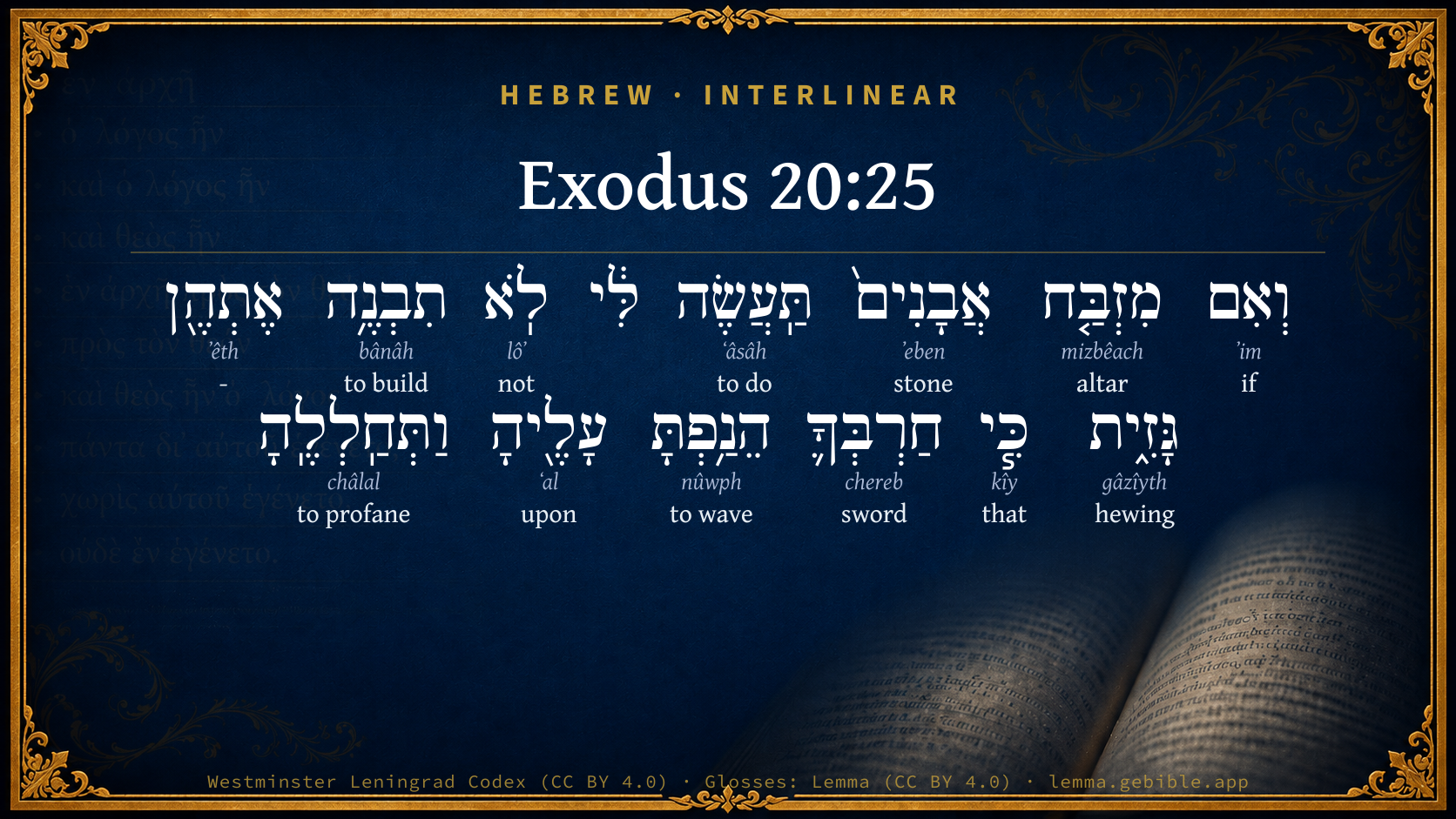
Hebrew (Westminster Leningrad Codex) Exodus 20:25 appears in the Hebrew Old Testament. The text above is from the Westminster Leningrad Codex. Each word links to its Strong’s number, a concise gloss, and parsing drawn from the Open Scriptures Hebrew Bible morphology. Click any word for its full Brown-Driver-Briggs (BDB) entry.
Download image
Cite this verse

Exodus 20:25 (World English Bible). Public Domain. Lemma interlinear Bible study tool, https://lemma.gebible.app/v/exodus/20/25.

Show BibTeX & RIS
BibTeX
RIS
English Translation
If you make me an altar of stone, you shall not build it of hewn stones; for if you lift up your tool on it, you have polluted it.
World English Bible · Public Domain
Highlights
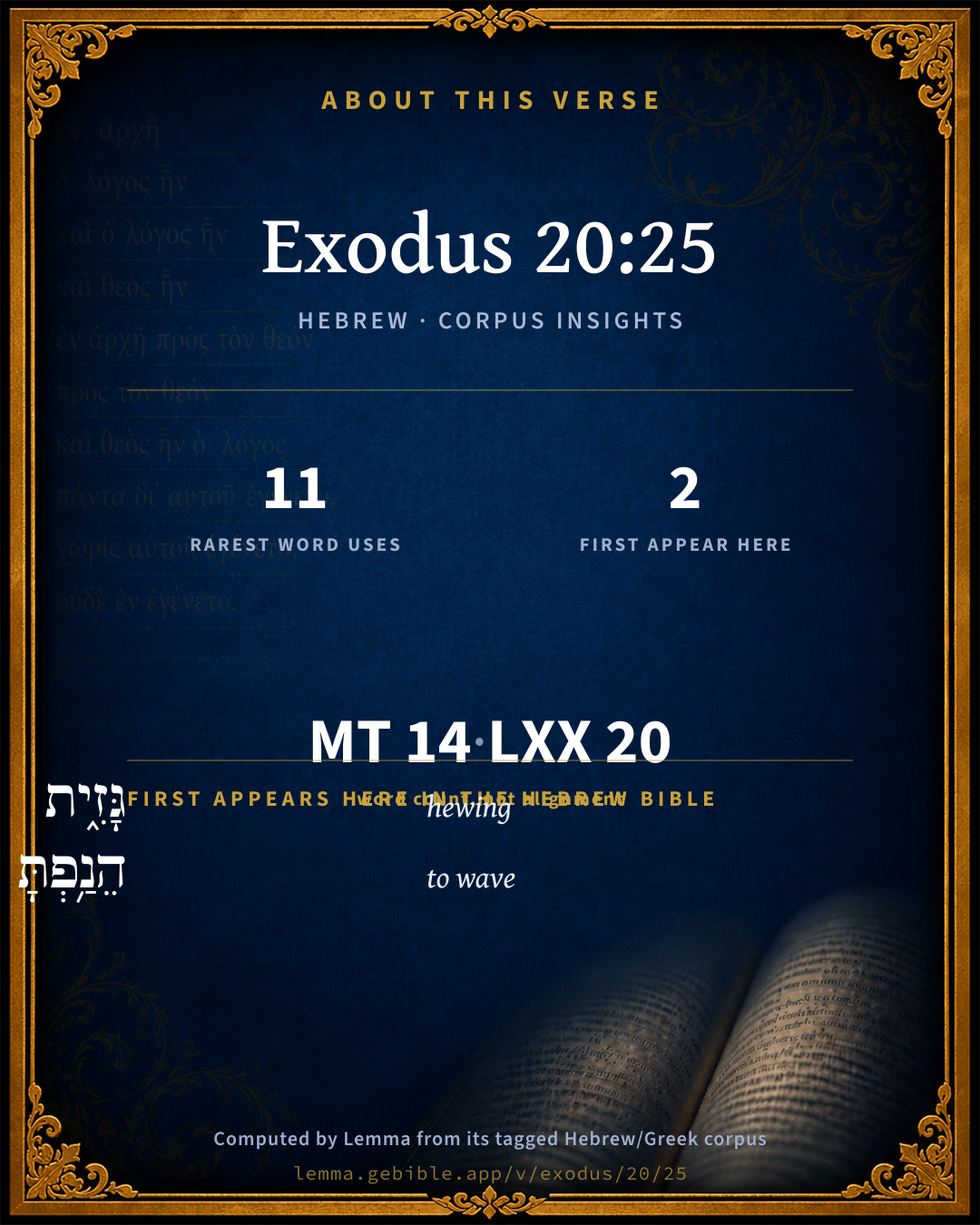
  • 2 first appearances in the Hebrew Bible
Full analysis ↓
Download a study sheet

One document with this verse’s original text, its word-by-word gloss line, the meaning frame, cross-references with their text, attributed commentary, and full source and license credits — printable, and it pastes into notes with its structure intact.

This verse Autodidact and up

Study sheet (.html) Plain text (.txt)

A passage Seminary Student

Up to 50 verses in one chapter. A passage sheet keeps up to 6 commentary sources and 12 cross-references per verse, in the order this page ranks them, and says so on the sheet whenever that leaves anything out. Ask for a single verse and you get the Autodidact verse sheet above.

Everything on this page stays free to read, with no account — the sheet is a download of what is already on screen, not access to it.

Want to remove ads? Support Godless Engineer
Compare translations 3

The same verse in 3 English versions, stacked beneath the original-language interlinear above. Click any original word for its lexicon entry.

Each is an independent rendering of the whole verse — the interlinear is not word-aligned to these translations.

Highlighted words mark where these versions differ — a whole-verse word diff, not a word-by-word alignment.

  • World English Bible Public Domain
    If you make me an altar of stone, you shall not build it of hewn stones; for if you lift up your tool on it, you have polluted it.
  • King James Version Public Domain
    And if thou wilt make me an altar of stone, thou shalt not build it of hewn stone: for if thou lift up thy tool upon it, thou hast polluted it.
  • unfoldingWord Literal Text CC BY-SA 4.0
    And if you make me an altar of stones, you shall not build them of cut stones, for causing your tool to move over it will defile it.

unfoldingWord Literal Text — © unfoldingWord, licensed CC BY-SA 4.0. Word-aligned USFM3 via Door43 (git.door43.org/unfoldingWord/en_ult).

Versions to compare (up to 4)

3 of 4 selected

Show all 18 translations

Every available English version of this verse, each an independent rendering of the whole verse.

  • World English Bible Public Domain
    If you make me an altar of stone, you shall not build it of hewn stones; for if you lift up your tool on it, you have polluted it.
  • Berean Standard Bible Public Domain
    Now if you make an altar of stones for Me, you must not build it with stones shaped by tools; for if you use a chisel on it, you will defile it.
  • Majority Standard Bible Public Domain
    Now if you make an altar of stones for Me, you must not build it with stones shaped by tools; for if you use a chisel on it, you will defile it.
  • King James Version Public Domain
    And if thou wilt make me an altar of stone, thou shalt not build it of hewn stone: for if thou lift up thy tool upon it, thou hast polluted it.
  • American Standard Version (1901) Public Domain
    And if thou make me an altar of stone, thou shalt not build it of hewn stones; for if thou lift up thy tool upon it, thou hast polluted it.
  • Revised Version (1885) Public Domain
    And if thou make me an altar of stone, thou shalt not build it of hewn stones: for if thou lift up thy tool upon it, thou hast polluted it.
  • Geneva Bible (1599) Public Domain
    But if thou wilt make mee an altar of stone, thou shalt not buylde it of hewen stones: for if thou lift vp thy toole vpon them, thou hast polluted them.
  • Douay-Rheims (1899) Public Domain
    And if thou make an altar of stone unto me, thou shalt not build it of hewn stones: for if thou lift up a tool upon it, it shall be defiled.
  • Young's Literal Translation Public Domain
    `And if an altar of stones thou dost make to Me, thou dost not build them of hewn work; when thy tool thou hast waved over it, then thou dost pollute it;
  • Literal Standard Version CC BY-SA 4.0
    And if you make an altar of stones for Me, you do not build them of hewn work; when you have waved your tool over it, then you defile it;
  • Unlocked Literal Bible CC BY-SA 4.0
    If you make me an altar of stone, you must not build it of cut stones, for if you use your tools on it, you will have defiled it.
  • unfoldingWord Literal Text CC BY-SA 4.0
    And if you make me an altar of stones, you shall not build them of cut stones, for causing your tool to move over it will defile it.
  • Darby Bible Public Domain
    And if thou make me an altar of stone, thou shalt not build it of hewn stone; for if thou lift up thy sharp tool upon it, thou hast profaned it.
  • World Messianic Bible Public Domain
    If you make me an altar of stone, you shall not build it of cut stones; for if you lift up your tool on it, you have polluted it.
  • Webster's Bible Public Domain
    And if thou wilt make me an altar of stone, thou shalt not build it of hewn stone: for if thou shalt lift up thy tool upon it, thou hast polluted it.
  • Free Bible Version CC BY-SA 4.0
    Now if you make an altar out of stones for me, you must not build it with cut stones, because if you use a chisel to cut the stone, you make it unholy.
  • Bible in Basic English Public Domain
    And if you make me an altar of stone do not make it of cut stones: for the touch of an instrument will make it unclean.
  • JPS Tanakh (1917) Public Domain
    (20-22) And if thou make Me an altar of stone, thou shalt not build it of hewn stones; for if thou lift up thy tool upon it, thou hast profaned it.

Literal Standard Version (2020), Covenant Press — licensed CC BY-SA 4.0. Text via the HelloAO Bible API (eBible.org). Unlocked Literal Bible (unfoldingWord) — licensed CC BY-SA 4.0. Text via the HelloAO Bible API (eBible.org). unfoldingWord Literal Text — © unfoldingWord, licensed CC BY-SA 4.0. Word-aligned USFM3 via Door43 (git.door43.org/unfoldingWord/en_ult). Free Bible Version, Dr. Jonathan Gallagher — licensed CC BY-SA 4.0. Text via the HelloAO Bible API (eBible.org).

Word by word

More ways to search: Search by grammar → Find every occurrence → Compare this word →

Practice this passage: Drill this verse → Learn its vocabulary →

גָּזִ֑ית
gâzîyth
H1496
“hewing”
Noun, Common, Feminine, Singular, Absolute
Part of Speech
Noun
Type
Common
Gender
Feminine
Number
Singular
State
Absolute
Full BDB Definition

Origin: from H1491

TWOT: 335a

a cutting, hewing
  1. וְאִם ʼim H518 “and · if” Conjunction + Conjunction
  2. מִזְבַּ֤ח mizbêach H4196 “altar of” Noun, Common, Masculine, Singular, Construct
  3. אֲבָנִים֙ ʼeben H68 “stones” Noun, Common, Feminine, Plural, Absolute
  4. תַּֽעֲשֶׂה ʻâsâh H6213 “to do” Verb, Qal, Imperfect, 2nd Person, Masculine, Singular
  5. לֹֽא lôʼ H3808 “not” Particle, Negative
  6. תִבְנֶ֥ה bânâh H1129 “to build” Verb, Qal, Imperfect, 2nd Person, Masculine, Singular
  7. אֶתְהֶ֖ן ʼêth H853 “- · them” Particle, Direct Object + Suffix, Personal, 3rd Person, Feminine, Plural
  8. כִּ֧י kîy H3588 “that” Conjunction
  9. חַרְבְּךָ֛ chereb H2719 “sword · your” Noun, Common, Feminine, Singular, Construct + Suffix, Personal, 2nd Person, Masculine, Singular
  10. הֵנַ֥פְתָּ nûwph H5130 “to wave” Verb, Hiphil, Perfect, 2nd Person, Masculine, Singular
  11. עָלֶ֖יהָ ʻal H5921 “upon · her” Preposition + Suffix, Personal, 3rd Person, Feminine, Singular
  12. וַתְּחַֽלְלֶֽהָ châlal H2490 “and · to profane · her” Conjunction + Verb, Piel, Sequential Imperfect, 2nd Person, Masculine, Singular + Suffix, Personal, 3rd Person, Feminine, Singular

About this verse

These counts appear in no published source. They are computed here, from the morphology-tagged text and Lemma’s own curated glosses. What Lemma adds →

14
words
13
distinct lemmas
Pentateuch
section

Notable vocabulary

The rarest word here is גָּזִ֑ית hewing H1496 — appearing just 11 times in the whole Hebrew Bible.

First appearance in Scripture

These words make their first canonical appearance in the Hebrew Bible here:

  • גָּזִ֑ית hewing H1496
  • הֵנַ֥פְתָּ to wave H5130

Shared distinctive vocabulary

גָּזִ֑ית hewing H1496 occurs in 11 verses of the Hebrew Bible. Also found in:

Grammatical profile

  • 4 verbs
  • 4 nouns
  • 2 prepositions
  • 2 conjunctions
  • 2 particles

Verb forms

  • תַּֽעֲשֶׂה Qal · Imperfect
  • תִבְנֶ֥ה Qal · Imperfect
  • הֵנַ֥פְתָּ Hiphil · Perfect
  • וַתְּחַֽלְלֶֽהָ Piel · Sequential Imperfect

Hebrew & Septuagint length

In English translation the verse runs 29 words from the Hebrew and 31 from the Septuagint (LXX English) — closely comparable.

A rough comparison of the two English renderings, which tokenize alike — not a word-level alignment.

Word counts can differ between the Hebrew and the Greek without any difference in meaning — e.g. the Hebrew direct-object marker אֵת has no separate Greek word, and Greek often adds the article ὁ.

In the original languages it is 14 Hebrew tokens and 20 Greek tokens — but the two are counted differently (Hebrew bundles its prefixes and suffixes into one token; the Greek is in lemma form), so that isn’t a like-for-like length.

Cross-references

2

Topical passages linked to Exodus 20:25 in the Treasury of Scripture Knowledge — connected by theme and wording, ordered by reader-vote popularity; previews shown in the World English Bible.

  • Deuteronomy 27:5–6 There shall you build an altar to Yahweh your God, an altar of stones: you shall lift up no iron [tool] on them.
  • Joshua 8:31 as Moses the servant of Yahweh commanded the children of Israel, as it is written in the book of the law of Moses, an altar of uncut stones, on which no man had lifted up any iron: and they offered thereon burnt offerings to Yahweh, and sacrificed peace-offerings.

Cross-references courtesy of OpenBible.info (CC BY 4.0).

Hebrew and Greek witnesses Masoretic Hebrew ↔ Greek Septuagint

The same verse in the two great witnesses to the Old Testament, shown verse-for-verse.

These are two independent witnesses, not word-aligned to each other, and the Septuagint is shown in lemma (dictionary) form.

Hebrew Exodus 20:25 Masoretic · Westminster Leningrad Codex

וְאִם מִזְבַּ֤ח אֲבָנִים֙ תַּֽעֲשֶׂה לִּ֔י לֹֽא תִבְנֶ֥ה אֶתְהֶ֖ן גָּזִ֑ית כִּ֧י חַרְבְּךָ֛ הֵנַ֥פְתָּ עָלֶ֖יהָ וַתְּחַֽלְלֶֽהָ

If you make me an altar of stone, you shall not build it of hewn stones; for if you lift up your tool on it, you have polluted it.

World English Bible · Public Domain

Greek LXX Exodus 20:25 Septuagint · lemma form

ἐάν δέ θυσιαστήριον ἐκ λίθος ποιέω ἐγώ οὐ οἰκοδομέω αὐτός τμητός ὁ γάρ ἐγχειρίδιον σύ ἐπιβάλλω ἐπί αὐτός καί μιαίνω

And if you will make to me an altar of stones, you shall not build them hewn stones; for you have lifted up your tool upon them, and they are defiled.

LXX2012 (modern English Septuagint) · Public Domain

Hebrew: Westminster Leningrad Codex (CC BY 4.0). Greek: Septuagint (public domain); English from LXX2012 (modern English Septuagint) (Public Domain). How the Septuagint differs from the Hebrew →

Commentary

Notes on Exodus 20:25 from classic Christian and Jewish commentators (each source and its license shown beneath its notes). The classic Christian expositions comment on the surrounding passage and are grouped to its opening verse, so a note may address several verses; the Jewish commentaries on the Tanakh (Rashi and others) are per-verse, so they appear only where the commentator wrote on this verse.

Lemma curates 59 commentaries, every one of them public domain or Creative Commons licensed, each selected and text-cleaned for this edition rather than reprinted as found. About our sources →

Trapp's Complete Commentary

John Trapp

Exo 20:25 And if thou wilt make me an altar of stone, thou shalt not build it of hewn stone: for if thou lift up thy tool upon it, thou hast polluted it.

Ver. 25. Thou hast polluted.] Not polished it. So in preaching. {1Co 2:4-5} Epistolae ornamentum est ornamentis carere: Plainness commends an epistle. {a} Nimio mundo studentes, ab immundo propius absunt. {b} Some mar all by over doing it.

{a} Politian.

{b} Colerus.

John Trapp, A Commentary or Exposition upon All the Books of the Old and New Testament (1647–1656) — public domain. Text from a community e-Sword module.

The Biblical Illustrator

Joseph S. Exell

Exo_20:25

Thou shalt not build it of hewn stone.

The altar of unhewn stone: simplicity of worship

I. Ritualism is not a necessity of worship. There can be worship at the rough altar of unhewn stones, as well as in the temple where wealth has lavished its contributions and art exhausted its genius. Worship is not a form, but a spirit; not a service, but a life. And a life has many functions.

II. Meritoriousness must be excluded from worship. No too1 to be used in constructing this altar. To culture the soul in true devotion, as God requires, is a harder task than to give money, etc.

III. Universality is a characteristic of worship.

1. Not confined to places.

2. Not confined to persons. As mere earthen altars will do, where is the man who cannot build them? (Homilist.)

The Jewish altar as typical of Christ

One can hardly help connecting the words with Daniels vision of a stone cut out of the mountain without hands, which was a vision of Christ. The rough stone fashioned by no human instrumentality, this alone might be an altar of the Lord. It was forbidden that man should attempt by devices of his own to adorn the altar; if he made the endeavour, he utterly profaned and polluted the structure: and in all this, was it not, as though it had been said expressly to man, Thou shalt have a Mediator, an Altar, on which thine offerings being laid, shall be consumed by the fires of Divine acceptance; but if thou shouldst attempt to add anything of thine own to the worthiness of this Mediator, if thou wouldst carve the altar, or ornament it with human merit or righteousness, the effect shall be that for yourself the altar shall be stripped of all virtue, and no flame break forth from the heavens to burn up the oblation? Now, we believe, that so soon as man had fallen, God instituted a system of sacrifice, and taught those who had sullied their immortality that its lustre should be restored through a propitiation for sin. As we conclude that God first ordained sacrifice, we may also conclude that it was under His direction that the first altars were reared. Observe two things: an altar supported the gift, and an altar sanctified the gift. We believe that in both these respects Christ Jesus may be designated as an altar, whether you consider His Person or the work which He effects on our behalf.

1. If we look first at the Person of the Mediator, shall we not find the two properties of the altar, that it supported and sanctified the oblation which Christ made to the Almighty? The Person of Christ Jesus, as you know, was a Divine Person, whilst in it were gathered two natures, the human and the Divine. It was the human nature which was sacrificed, the Divine being inaccessible to suffering and incapable of pain. So that if you simply look at the Person of the Mediator, and consider that it was the design of the altar to support the gift that was presented in sacrifice, you must see that the Divine nature so bore up the human, that it so served as a platform on which the oblation might be laid when the fire of Gods justice came down in its purity and its intenseness, that with as much reason as Christ Jesus is described as a sacrifice, may He also be described as an altar.

2. Not, however, that the altar only sustained the gift; it also sanctified the gift; and the fitness of considering the Divine nature in the Person of Christ as the altar on which the human was presented, will be still more apparent if you bring into account this sanctifying virtue. We have already stated that the Divine nature was of necessity incapable of suffering, and that it was, therefore, the human which made the Redeemer accessible to anguish; but it was the Divinity which gave worth to the sufferings of the humanity, and rendered them efficacious to the taking away sin. The Divine was to the human what the altar was to the sacrifice: it sanctified the gift and made it acceptable. Yes, blessed Saviour we most thankfully own that through Thee, and Thee only, can we offer unto God any acceptable service. And here we would remind you of a very emphatic question put by our Lord to the Pharisees--Whether is greater, the gift, or the altar that sanctifieth the gift? We have to allude to the supposed efficacy in repentance, and the presumed virtue in the tears which the sinful may shed over their offences against God. The guilt of sin is removed by Christs blood, not by mans tears. It is the altar that sanctifieth the gift. I depreciate not repentance, I strip it not of moral excellence, nor of moral prevalence, but we affirm that without the altar the gift would be unavailing, without Christ the most contrite would perish with the most hardy. (H. Melvill, B. D.)

.

The Biblical Illustrator, edited by Joseph S. Exell (c. 1880s–1900s) — public domain. Text from a community e-Sword module.

Geneva Bible (1599)

Geneva Bible translators

Hebrew, it, that is, the stone.

Geneva Bible (1599) marginal notes — public domain. Text via Bolls.life.

Jamieson, Fausset & Brown

Robert Jamieson, A. R. Fausset & David Brown

thou shalt not build it of hewn stone, &c.--that is, carved with figures and ornaments that might lead to superstition.

Jamieson, Fausset & Brown — Commentary Critical and Explanatory on the Whole Bible (1871) — public domain (CC PDM 1.0). Text via the HelloAO Bible API.

Adam Clarke's Commentary

Verse 25. Thou shalt not build it of hewn stone] Because they were now in a wandering state, and had as yet no fixed residence; and therefore no time should be wasted to rear costly altars, which could not be transported with them, and which they must soon leave. Besides, they must not lavish skill or expense on the construction of an altar; the altar of itself, whether costly or mean, was nothing in the worship; it was only the place on which the victim should be laid, and their mind must be attentively fixed on that God to whom the sacrifice was offered, and on the sacrifice itself, as that appointed by the Lord to make an atonement for their sins.

Adam Clarke's Commentary on the Bible (1810–1826) — public domain. Text from a community e-Sword/MySword module.

Ellicott's Commentary for English Readers

(25) If thou wilt make me an altar of stone.—Among civilised nations altars were almost always of stone, which superseded earth, as more durable. God does not absolutely prohibit the employment of stone altars by the Israelites, who are found to use them upon certain occasions (Jos_8:31; 1Ki_18:32). He is content to forbid the shaping of the stones by an implement, that so they may not give rise to idolatry. (See Note on Exo_20:24.)

Thou hast polluted it.—Nature is God’s handiwork, and, therefore, pure and holy. Man, by contact with it, imparts to it of his impurity. The altar, whereby sin was to be expiated, required to be free from all taint of human corruption. For the construction of the altar afterwards sanctioned, see the comment on Exo_27:1.

A Bible Commentary for English Readers, edited by Charles John Ellicott (1878–1897) — public domain. Text from a community e-Sword module.

The Cambridge Bible for Schools and Colleges

gen. ed. J. J. S. Perowne

25. tool] The word (ḥéreb) commonly rendered ‘sword,’ occasionally used of other sharp instruments, Jos_5:2-3 (‘knives’): in Deu_27:5 E (Jos_8:31) the word is replaced by ‘iron.’ Cf. 1Ma_4:47. The prohibition may be a survival either from a time when instruments of iron were not in general use, or from the time when the altar was a natural rock or boulder (cf. on v. 24), supposed to be the abode of numen or deity, and it was imagined that to alter its shape would have the effect of driving the numen from it (Nowack, Arch. ii. 17; DB. i. 76a, EB. i. 124). But naturally this is not the belief which actuates the prohibition here. An altar of stones, seemingly unhewn, was built by Elijah (1Ki_18:32).

it (twice)] The pron. (which is fem. in the Heb.) refers not to ‘altar but to ‘stone’: it is the stone which is profaned by being worked with a tool.

The Cambridge Bible for Schools and Colleges (gen. ed. J. J. S. Perowne; Cambridge University Press, 1878–1918) — public domain. Text from a community e-Sword module.

Haydock's Catholic Bible Commentary

Defiled; because done in opposition to God’s order, who required, on this occasion, the utmost simplicity, to prevent any undue veneration. Iron was not used about the tabernacle or temple, as brass was more common. Altars raised in haste, like that, Deuteronomy xxvii. and Josue viii. 30, and that which was designed for the ratification of the covenant, (chap. xxiv. 4,) were required to be of this construction, unpolished and simple, as was the altar erected, 1 Machabees iv. 47. But other altars were not built after this model. (Calmet)

George Leo Haydock (1774–1849), Haydock's Catholic Family Bible and Commentary, 1859 edition — public domain. Excludes Psalms (Douay-Rheims chapter numbering differs from Protestant) and Deuterocanonical books (Catholic canon only).

Matthew Poole's English Annotations

An altar of stone in those rocky parts might be as easy for them to make as one of earth. Hewn stone would require both time, and cost, and art. The reasons of this precept are in part the same with the former, Exo 20:24.

If thou lift up thy tool upon it, thou hast polluted it, by thy disobedience to my express command now given; and howsoever they think to gratify me by this curiosity, I shall not look upon it as a sacred thing, by which the sacrifices offered on it shall be sanctified, but as a profane thing which will defile them. So little doth God value or approve the inventions of men in his worship, how colourable soever they be.

Matthew Poole's English Annotations on the Holy Bible (1683–1685) — public domain. Text from a community e-Sword/MySword module.

Whedon's Commentary on the Bible

Daniel D. Whedon

25. If thou wilt make me an altar of stone — Such an altar would be as simple and easy of construction as one of turf, and more so in places where stones abounded. But to preserve its simplicity, and to deter from attempts to imitate the sculptured embellishments of heathen altars, they were forbidden to make use of hewn stone, or to wield a graver’s tool upon it. The natural stone, untouched by art or man’s device, was most like the earth itself, and most appropriate for the sanctity and simplicity of the altar-service. Any attempt to cut or carve the stones would be a polluting of holy things. The framework of acacia wood, overlaid with brass, was a subsequent and special provision for the altar of the tabernacle. See Exo_27:1-8.

Daniel D. Whedon (gen. ed.), Commentary on the Old and New Testaments (1874–1909) — public domain. Text from a community e-Sword module.

The Pulpit Commentary

And if thou wilt make me an altar of stonei.e. , if, notwithstanding my preference expressed for an altar of earth, thou wilt insist on making me one of stone, as more permanent, and so more honourable, then I require that the stones shall be rough stones shaped by nature, not stones chiselled into shape by the art of man. For if thou lift up thy tool upon it thou hast polluted it. It is conjectured with reason that we have here an old traditional idea, which God thought fit under the existing circumstances to sanction. The real object was that altars should not be elaborately carved with objects that might superinduce idolatry. The widely prevalent notion, that nature is sacred, and that all man"s interference with nature is a defilement, was made use of economically, to produce the desired result. No tool being allowed to be used, no forms of living creatures could be engraved, and so no idolatry of them could grow up.

The Pulpit Commentary (1880–1919), ed. H.D.M. Spence-Jones & Joseph S. Exell — public domain. Text from a community e-Sword module.

Lesson kit

Teaching starters — assembled from the data on this page, not authored interpretation. Every prompt links to the verse data it draws on. Edit before teaching.

Exodus, in the Pentateuch, opens this verse with 14 words (13 distinct Hebrew lemmas). Its most distinctive word is gâzîyth (“hewing”). A historical commentator’s framing appears above. Read the whole chapter for the surrounding context.

Discussion questions

  1. The word gâzîyth carries the sense “hewing.” How does it shape the verse?
  2. 2 words make their first appearance in Scripture here. What does this debut establish?
  3. How does 1 Kings 5:17, which shares the word «hewing», read alongside this verse?
  4. These translations render this verse differently. What is at stake in choosing one wording over another?
  5. «תַּֽעֲשֶׂה» is a Qal Imperfect verb. How does that grammatical form shape the action described?
  6. Compare how Trapp's Complete Commentary and The Biblical Illustrator read this verse. Where do they agree or differ?

Things to notice

Reading settings

Reading text

Shown beneath each verse's original-language words.

Old Testament
Old Testament edition

Read the OT as the Masoretic Hebrew (MT) or the Greek Septuagint (LXX).

English shown for the Greek Septuagint (in the Hebrew ↔ Greek comparison).

Comparing translations? Open the Compare panel on any verse page to stack up to four side by side.