Joshua 24:12

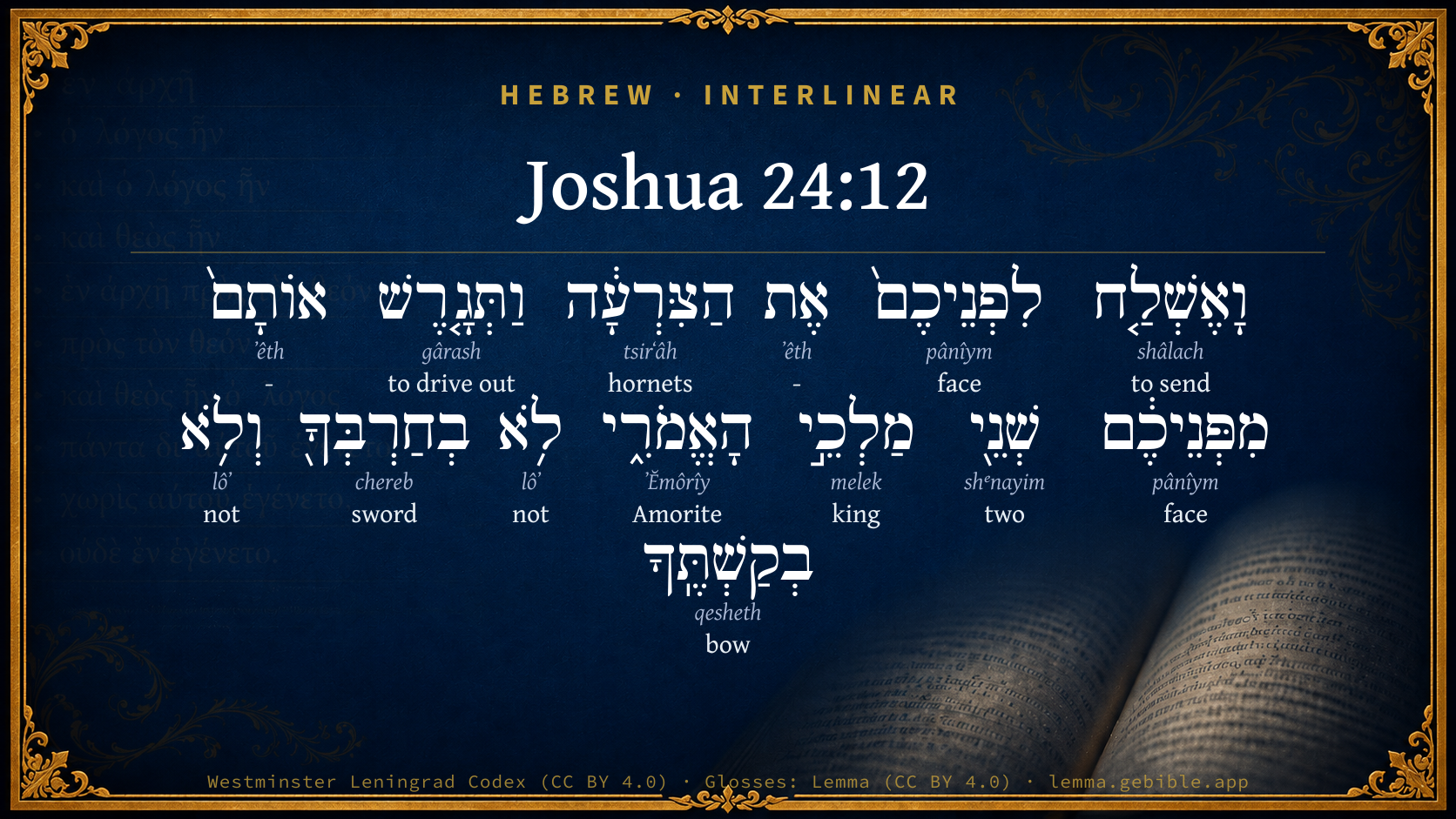
Hebrew (Westminster Leningrad Codex) Joshua 24:12 appears in the Hebrew Old Testament. The text above is from the Westminster Leningrad Codex. Each word links to its Strong’s number, a concise gloss, and parsing drawn from the Open Scriptures Hebrew Bible morphology. Click any word for its full Brown-Driver-Briggs (BDB) entry.
Download image
Cite this verse

Joshua 24:12 (World English Bible). Public Domain. Lemma interlinear Bible study tool, https://lemma.gebible.app/v/joshua/24/12.

Show BibTeX & RIS
BibTeX
RIS
English Translation
I sent the hornet before you, which drove them out from before you, even the two kings of the Amorites; not with your sword, nor with your bow.
World English Bible · Public Domain
Download a study sheet

One document with this verse’s original text, its word-by-word gloss line, the meaning frame, cross-references with their text, attributed commentary, and full source and license credits — printable, and it pastes into notes with its structure intact.

This verse Autodidact and up

Study sheet (.html) Plain text (.txt)

A passage Seminary Student

Up to 50 verses in one chapter. A passage sheet keeps up to 6 commentary sources and 12 cross-references per verse, in the order this page ranks them, and says so on the sheet whenever that leaves anything out. Ask for a single verse and you get the Autodidact verse sheet above.

Everything on this page stays free to read, with no account — the sheet is a download of what is already on screen, not access to it.

Want to remove ads? Support Godless Engineer
Compare translations 3

The same verse in 3 English versions, stacked beneath the original-language interlinear above. Click any original word for its lexicon entry.

Each is an independent rendering of the whole verse — the interlinear is not word-aligned to these translations.

Highlighted words mark where these versions differ — a whole-verse word diff, not a word-by-word alignment.

  • World English Bible Public Domain
    I sent the hornet before you, which drove them out from before you, even the two kings of the Amorites; not with your sword, nor with your bow.
  • King James Version Public Domain
    And I sent the hornet before you, which drave them out from before you, even the two kings of the Amorites; but not with thy sword, nor with thy bow.
  • unfoldingWord Literal Text CC BY-SA 4.0
    And I sent the hornet to your faces, and it dispossessed them out from your faces, the two kings of the Amorite, not by your sword and not by your bow.

unfoldingWord Literal Text — © unfoldingWord, licensed CC BY-SA 4.0. Word-aligned USFM3 via Door43 (git.door43.org/unfoldingWord/en_ult).

Versions to compare (up to 4)

3 of 4 selected

Show all 18 translations

Every available English version of this verse, each an independent rendering of the whole verse.

  • World English Bible Public Domain
    I sent the hornet before you, which drove them out from before you, even the two kings of the Amorites; not with your sword, nor with your bow.
  • Berean Standard Bible Public Domain
    I sent the hornet ahead of you, and it drove out the two Amorite kings before you, but not by your own sword or bow.
  • Majority Standard Bible Public Domain
    I sent the hornet ahead of you, and it drove out the two Amorite kings before you, but not by your own sword or bow.
  • King James Version Public Domain
    And I sent the hornet before you, which drave them out from before you, even the two kings of the Amorites; but not with thy sword, nor with thy bow.
  • American Standard Version (1901) Public Domain
    And I sent the hornet before you, which drove them out from before you, even the two kings of the Amorites; not with thy sword, nor with thy bow.
  • Revised Version (1885) Public Domain
    And I sent the hornet before you, which drave them out from before you, even the two kings of the Amorites; not with thy sword, nor with thy bow.
  • Geneva Bible (1599) Public Domain
    And I sent hornets before you, which cast them out before you, euen the two kings of the Amorites, and not with thy sword, nor with thy bow.
  • Douay-Rheims (1899) Public Domain
    And I sent before you hornets: and I drove them out from their places, the two kings of the Amorrhites, not with thy sword nor with thy bow.
  • Young's Literal Translation Public Domain
    And I send before you the hornet, and it casteth them out from your presence -- two kings of the Amorite -- not by thy sword, nor by thy bow.
  • Literal Standard Version CC BY-SA 4.0
    And I send the hornet before you, and it casts them out from your presence—two kings of the Amorite—not by your sword, nor by your bow.
  • Unlocked Literal Bible CC BY-SA 4.0
    I sent the hornet before you, which drove them and the two kings of the Amorites out before you. It did not happen by your sword or by your bow.
  • unfoldingWord Literal Text CC BY-SA 4.0
    And I sent the hornet to your faces, and it dispossessed them out from your faces, the two kings of the Amorite, not by your sword and not by your bow.
  • Darby Bible Public Domain
    And I sent the hornet before you, which drove them out from before you, [as] the two kings of the Amorites; not with thy sword, nor with thy bow.
  • World Messianic Bible Public Domain
    I sent the hornet before you, which drove them out from before you, even the two kings of the Amorites; not with your sword, nor with your bow.
  • Webster's Bible Public Domain
    And I sent the hornet before you, which drove them out from before you, even the two kings of the Amorites; but not with thy sword, nor with thy bow.
  • Free Bible Version CC BY-SA 4.0
    But I handed them over to you to defeat. And I sent the hornet before you to drive out the two kings of the Amorites. You did not win using your swords or your bows!
  • Bible in Basic English Public Domain
    And I sent the hornet before you, driving out the two kings of the Amorites before you, not with your sword and your bow.
  • JPS Tanakh (1917) Public Domain
    And I sent the hornet before you, which drove them out from before you, even the two kings of the Amorites; not with thy sword, nor with thy bow.

Literal Standard Version (2020), Covenant Press — licensed CC BY-SA 4.0. Text via the HelloAO Bible API (eBible.org). Unlocked Literal Bible (unfoldingWord) — licensed CC BY-SA 4.0. Text via the HelloAO Bible API (eBible.org). unfoldingWord Literal Text — © unfoldingWord, licensed CC BY-SA 4.0. Word-aligned USFM3 via Door43 (git.door43.org/unfoldingWord/en_ult). Free Bible Version, Dr. Jonathan Gallagher — licensed CC BY-SA 4.0. Text via the HelloAO Bible API (eBible.org).

Word by word

More ways to search: Search by grammar → Find every occurrence → Compare this word →

Practice this passage: Drill this verse → Learn its vocabulary →

הַצִּרְעָ֔ה
tsirʻâh
H6880
“the · hornets”
Particle, Definite Article + Noun, Common, Feminine, Singular, Absolute
Part of Speech
Particle + Noun
Type
Common
Gender
Feminine
Number
Singular
State
Absolute
Full BDB Definition

Origin: from H6879

TWOT: 1971b

hornets
  1. וָאֶשְׁלַ֤ח shâlach H7971 “and · to send” Conjunction + Verb, Qal, Sequential Imperfect, 1st Person, Common, Singular
  2. לִפְנֵיכֶם֙ pânîym H6440 “to/for · face(s) · your” Preposition + Noun, Common, Both, Plural, Construct + Suffix, Personal, 2nd Person, Masculine, Plural
  3. אֶת ʼêth H853 “-” Particle, Direct Object
  4. וַתְּגָ֤רֶשׁ gârash H1644 “and · to drive out” Conjunction + Verb, Piel, Sequential Imperfect, 3rd Person, Feminine, Singular
  5. אוֹתָם֙ ʼêth H853 “- · them” Particle, Direct Object + Suffix, Personal, 3rd Person, Masculine, Plural
  6. מִפְּנֵיכֶ֔ם pânîym H6440 “from · face(s) · your” Preposition + Noun, Common, Both, Plural, Construct + Suffix, Personal, 2nd Person, Masculine, Plural
  7. שְׁנֵ֖י shᵉnayim H8147 “two” Adjective, Cardinal number, Masculine, Dual, Construct
  8. מַלְכֵ֣י melek H4428 “kings of” Noun, Common, Masculine, Plural, Construct
  9. הָאֱמֹרִ֑י ʼĔmôrîy H567 “the · Amorite” Particle, Definite Article + Noun, Gentilic, Masculine, Singular, Absolute
  10. לֹ֥א lôʼ H3808 “not” Particle, Negative
  11. בְחַרְבְּךָ֖ chereb H2719 “in/at · sword · your” Preposition + Noun, Common, Feminine, Singular, Construct + Suffix, Personal, 2nd Person, Masculine, Singular
  12. וְלֹ֥א lôʼ H3808 “and · not” Conjunction + Particle, Negative
  13. בְקַשְׁתֶּֽךָ qesheth H7198 “in/at · bow · your” Preposition + Noun, Common, Feminine, Singular, Construct + Suffix, Personal, 2nd Person, Masculine, Singular

About this verse

These counts appear in no published source. They are computed here, from the morphology-tagged text and Lemma’s own curated glosses. What Lemma adds →

14
words
11
distinct lemmas
Historical
section

Notable vocabulary

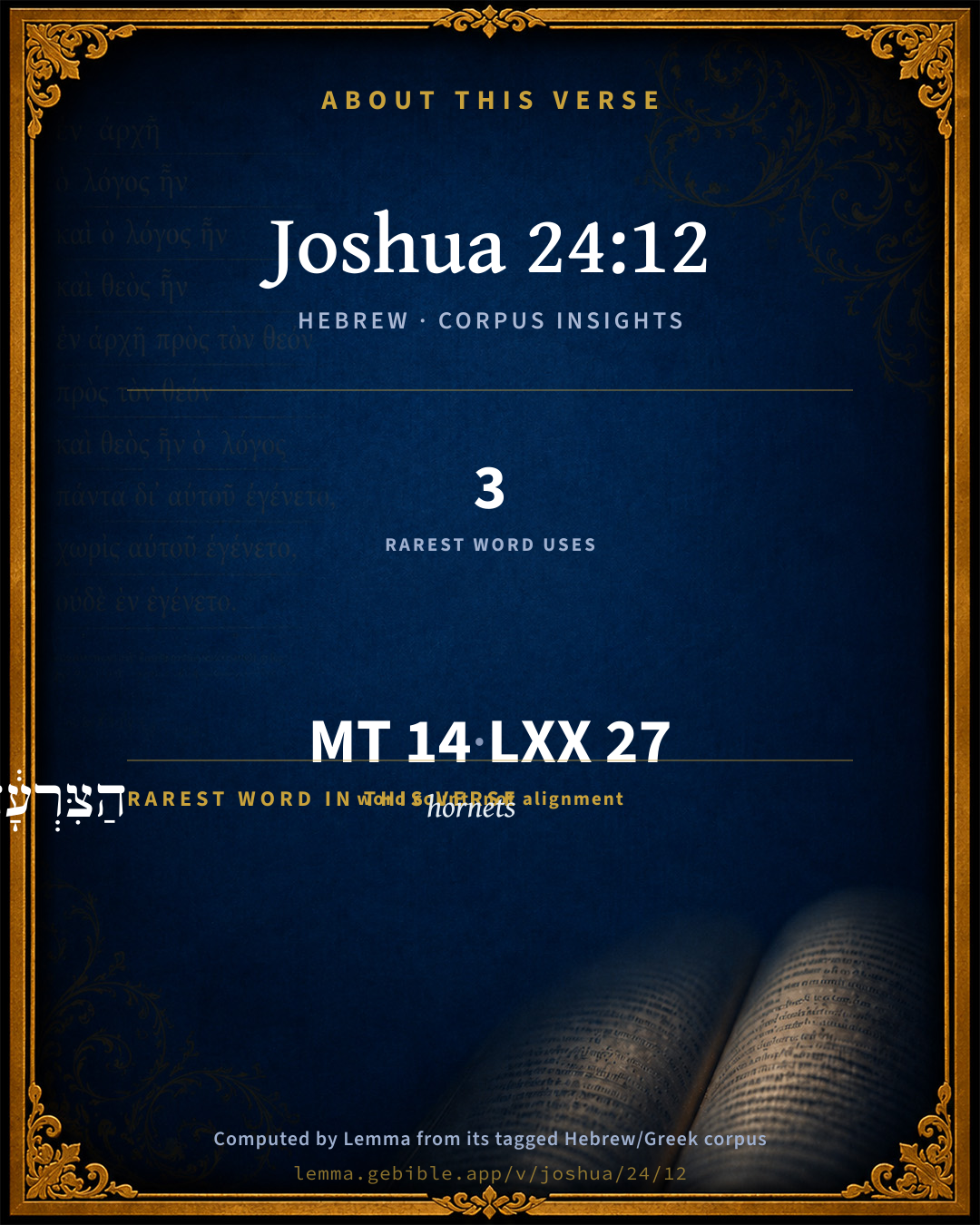
The rarest word here is הַצִּרְעָ֔ה hornets H6880 — appearing just 3 times in the whole Hebrew Bible.

Shared distinctive vocabulary

הַצִּרְעָ֔ה hornets H6880 occurs in 3 verses of the Hebrew Bible. Also found in:

Grammatical profile

  • 2 verbs
  • 7 nouns
  • 1 adjective
  • 4 particles

Verb forms

  • וָאֶשְׁלַ֤ח Qal · Sequential Imperfect
  • וַתְּגָ֤רֶשׁ Piel · Sequential Imperfect

Repetition

Words recur within this verse — often emphatic in Hebrew:

  • לִפְנֵיכֶם֙ face H6440 ×2
  • לֹ֥א not H3808 ×2

Hebrew & Septuagint length

In English translation the verse runs 28 words from the Hebrew and 30 from the Septuagint (LXX English) — closely comparable.

A rough comparison of the two English renderings, which tokenize alike — not a word-level alignment.

Word counts can differ between the Hebrew and the Greek without any difference in meaning — e.g. the Hebrew direct-object marker אֵת has no separate Greek word, and Greek often adds the article ὁ.

In the original languages it is 14 Hebrew tokens and 27 Greek tokens — but the two are counted differently (Hebrew bundles its prefixes and suffixes into one token; the Greek is in lemma form), so that isn’t a like-for-like length.

Cross-references

3

Topical passages linked to Joshua 24:12 in the Treasury of Scripture Knowledge — connected by theme and wording, ordered by reader-vote popularity; previews shown in the World English Bible.

  • Exodus 23:28 I will send the hornet before you, which will drive out the Hivite, the Canaanite, and the Hittite, from before you.
  • Deuteronomy 7:20 Moreover Yahweh your God will send the hornet among them, until those who are left, and hide themselves, perish from before you.
  • Psalms 44:3–6 For they didn't get the land in possession by their own sword, Neither did their own arm save them; But your right hand, and your arm, and the light of your face, Because you were favorable to them.

Cross-references courtesy of OpenBible.info (CC BY 4.0).

Hebrew and Greek witnesses Masoretic Hebrew ↔ Greek Septuagint

The same verse in the two great witnesses to the Old Testament, shown verse-for-verse.

These are two independent witnesses, not word-aligned to each other, and the Septuagint is shown in lemma (dictionary) form.

Hebrew Joshua 24:12 Masoretic · Westminster Leningrad Codex

וָאֶשְׁלַ֤ח לִפְנֵיכֶם֙ אֶת הַצִּרְעָ֔ה וַתְּגָ֤רֶשׁ אוֹתָם֙ מִפְּנֵיכֶ֔ם שְׁנֵ֖י מַלְכֵ֣י הָאֱמֹרִ֑י לֹ֥א בְחַרְבְּךָ֖ וְלֹ֥א בְקַשְׁתֶּֽךָ

I sent the hornet before you, which drove them out from before you, even the two kings of the Amorites; not with your sword, nor with your bow.

World English Bible · Public Domain

Greek LXX Joshua 24:12 Septuagint · lemma form

καί ἐκ ἀποστέλλω πρότερος σύ ὁ σφηκία καί ἐκβάλλω αὐτός ἀπό πρόσωπον σύ δώδεκα βασιλεύς ὁ ἀμορραῖος οὐ ἐν ὁ ῥομφαία σύ οὐδέ ἐν ὁ τόξον σύ

And he sent forth the hornet before you; and he drove them out from before you, even twelve kings of the Amorites, not with your sword, nor with your bow.

LXX2012 (modern English Septuagint) · Public Domain

Hebrew: Westminster Leningrad Codex (CC BY 4.0). Greek: Septuagint (public domain); English from LXX2012 (modern English Septuagint) (Public Domain). How the Septuagint differs from the Hebrew →

Targum (Aramaic paraphrase)

1

The Targum is the ancient Jewish Aramaic paraphrase of the Hebrew Scriptures — an interpretive translation, not the Hebrew text itself. Onkelos (literal) and Pseudo-Jonathan (expansive) render the Torah, and Jonathan the Prophets. Coverage is partial: where no permissively-licensed English translation exists for a verse, only the Aramaic is shown. This is verse-level text, not a word-by-word alignment to the Hebrew.

  1. Targum Jonathan Prophets (Joshua–Malachi)
    וּשְׁלָחִית קֳדָמֵיכוֹן יַת עַרְעִיתָא וְתָרְכֵית יַתְהוֹן מִן קֳדָמֵיכוֹן תְּרֵין מַלְכֵי אֱמוֹרָאֵי לָא בְחַרְבָּךְ וְלָא בְקַשְׁתָּךְ:

    (no public-domain English translation for this verse)

    Targum Jonathan — Aramaic: “Mikraot Gedolot” (public domain). English: “Sefaria Community Translation” (CC0 1.0 (public-domain dedication)); “London "Chaldee Paraphrase," 1871” (public domain). Text via Sefaria.

Commentary

Notes on Joshua 24:12 from classic Christian and Jewish commentators (each source and its license shown beneath its notes). The classic Christian expositions comment on the surrounding passage and are grouped to its opening verse, so a note may address several verses; the Jewish commentaries on the Tanakh (Rashi and others) are per-verse, so they appear only where the commentator wrote on this verse.

Lemma curates 59 commentaries, every one of them public domain or Creative Commons licensed, each selected and text-cleaned for this edition rather than reprinted as found. About our sources →

Trapp's Complete Commentary

John Trapp

Jos 24:12 And I sent the hornet before you, which drave them out from before you, [even] the two kings of the Amorites; [but] not with thy sword, nor with thy bow.

Ver. 12. And I sent the hornet before you.] Crabrones, sive muscam venenatam: Metaphorice de terrore illis incusso, saith Piscator; It is to be metaphorically taken for stinging terrors, struck into the hearts of these Canaanites. But why not literally rather?

But not with thy sword.] But with my hornets.

John Trapp, A Commentary or Exposition upon All the Books of the Old and New Testament (1647–1656) — public domain. Text from a community e-Sword module.

The Biblical Illustrator

Joseph S. Exell

Jos_24:12

Not with thy sword, nor with thy bow.

Not with sword or bow

A very necessary reminder, applicable to both the hour of conflict and victory. Both seasons have their own dangers. There is no final conflict or victory in this life; only when death has finished our course should we be hopeless or exultant. Each contest is but a single event of a series, and the one, though leading to others, does not of necessity determine the character of them all. Defeat to-day does not mean defeat to-morrow, any more than success to-day means the same in the next encounter with the hidden powers of darkness. No man is safe on this side the grave. So for each, for all, these words may be for encouragement and direction. The cause of failure may be discovered, and the remedy be pointed out, or the way which shall lead to entire possession of the fulness of Gods blessedness may be known, as each and all shall remember that it is not by thy sword or thy bow.

I. Lifes conflict must be met by human effort and energy. The promise of the land as an inheritance to the people of Israel is most distinct. Everywhere God said He would give it. Was there not some reason, then, in the expectation that they should have the land without any very special trouble? Is there so much to be wondered at in the disappointment of the spies when they saw they had to fight? One would have thought that the people would have walked in at one side while the inhabitants walked out at the other. God could have done it without the intervention of human effort at all. But this is not the point. What God did, as we learn from the history of this period, was, He used the sword and the bow of the people to secure to them the promise He had given to their fathers. And though no such stipulation is anywhere directly stated, yet universally we find that the human effort and skill are needful to the attainment of the gift of God. And it is just so with all that has to do with God. He has endowed us with certain powers which He calls upon us to exercise. When, then, on the one hand we sit down quietly and say, God has promised and will perform--there is nothing for me to do, or when we refuse to do anything because of our great weakness, or when we fail to call upon our powers of mind and heart to rise against the inroads of our spiritual enemies, or quietly submit when we are taken captive in the snares of the devil, we are just putting ourselves outside the pale of the directions which God has given us. So, too, when we ask God to work for us, and make supplication to Him to remove trouble or give us light and peace, if we say, God can and will work, and we do nothing ourselves, then we are forgetting this part of Gods ways. It is not by longing, wishing, desiring, however ardent, that God fulfils His loving purposes towards us; but by prayer, girding up our minds, and resolute, undaunted courage, that we must meet our foe--with thy sword and with thy bow. But what is the energy and activity here indicated? You will observe that God has not endowed man with any natural modes of offence or defence. The smallest insect is apparently better equipped for the dangers of its life than we are. But God has given man a stronger force than all. Will--moral force--the power of doing--are his; so that though unarmed he is more fully equipped against the multifarious dangers of his way. Nothing can assault him, but he can adopt such means as shall protect--such measures as shall totally defeat the foe. He has the sword and the bow. Moral dangers must be met by moral means, e.g., conscience must be kept clear, its voice must be listened to, and when heard the will must without hesitation obey. Spiritual blessings must be obtained by spiritual effort. God has promised them, He will give; but you must overcome the obstacles. Will you have the promise? then adopt the means needful. If you would scale the mountains, you look for a guide, and take provisions, and put on suitable dress. Put on the whole armour of God. Just as the poor shipwrecked one lays hold of the floating spar for very life, so you must lay hold of God, and laying hold of Him, do what He tells you. Cannot! No such word ought to be used. I can, I will! these are your sword and bow, and if you would extract blessing out of everything it must be by their use, and only thus will you gain the end you desire. But then it must be thy sword and thy bow. There is a speciality here. It is the act of the individual, the perseverance of the man.

II. Lifes conflict is not won by the human effort and energy. The greatest effort cannot obtain the victory; the most stupendous energy cannot save from defeat. It is one thing to meet the foe, it is another thing to win the day. And so our text tells us that it is not by thy sword nor by thy bow. You must fight, but God gives the victory. It is not won by your fighting, but by Gods aid. It is not secured by your prowess, but by Gods strength. It is all God, not you. (H. W. Butcher.)

The Biblical Illustrator, edited by Joseph S. Exell (c. 1880s–1900s) — public domain. Text from a community e-Sword module.

Tyndale Open Study Notes

Tyndale Open Resources

24:12 Israel’s successes were not because of their swords or bows or other military advantage; all were God’s doing.

Tyndale Open Study Notes — © Tyndale Open Resources, licensed CC BY-SA 4.0. Text via the HelloAO Bible API.

Jamieson, Fausset & Brown

Robert Jamieson, A. R. Fausset & David Brown

I sent the hornet before you--a particular species of wasp which swarms in warm countries and sometimes assumes the scourging character of a plague; or, as many think, it is a figurative expression for uncontrollable terror (see on Exo 23:28).

Jamieson, Fausset & Brown — Commentary Critical and Explanatory on the Whole Bible (1871) — public domain (CC PDM 1.0). Text via the HelloAO Bible API.

Adam Clarke's Commentary

Verse 12. I sent the hornet before you] See Clarke on Ex 23:28.

Adam Clarke's Commentary on the Bible (1810–1826) — public domain. Text from a community e-Sword/MySword module.

Ellicott's Commentary for English Readers

(12) The hornet.—There appears no reason for taking this word in any other than a literal sense. The possibility of what is recorded here has been abundantly illustrated by events reported in our own times.

The two kings of the Amorites.—Apparently, but not necessarily, Sihon and Og are intended. There were kings of the Amorites on both sides of Jordan.

A Bible Commentary for English Readers, edited by Charles John Ellicott (1878–1897) — public domain. Text from a community e-Sword module.

The Cambridge Bible for Schools and Colleges

gen. ed. J. J. S. Perowne

12. And I sent the hornet before you] “Misique ante vos crabrones” Vulg.: “And I sent before çou hors fleeçis,” Wyclif, or “flies with venemouse tongis.” In Exo_23:28, we find it predicted “And I will send hornets before thee, which shall drive out the Hivite, the Canaanite, and the Hittite, from before thee;” and in Deu_7:20, “Moreover the Lord thy God will send the hornet among them, until they that are left, and hide themselves from thee, be destroyed.” Elsewhere the bees appear as an image of terrible foes. Comp. Deu_1:44, “And the Amorites, which dwelt in that mountain, came out against you, and chased you, as bees do, and destroyed you in Seir, even unto Hormah.” Psa_118:12, “They compassed me about like bees” Not only were bees exceedingly numerous in Palestine, but hornets in particular infested some parts of the country. Some would understand the word here in its literal sense, but it more probably expresses under a vivid image the consternation, with which Jehovah would inspire the enemies of the Israelites. Comp. Deu_2:25; Jos_2:11.

not with thy sword] Compare the same thought in Psa_44:3.

The Cambridge Bible for Schools and Colleges (gen. ed. J. J. S. Perowne; Cambridge University Press, 1878–1918) — public domain. Text from a community e-Sword module.

John Gill's Exposition

And I sent the hornet before you,.... Of which See Gill on Exo 23:28,

which drave them out from before you, even the two kings of the Amorites; who were Sihon and Og, and not only them, and the Amorites under them, but the other nations, Hivites, Hittites, &c.

but not with thy sword, nor with thy bow; but by insects of the Lord's sending to them, which, as Kimchi says, so blinded their eyes, that they could not see to fight, and so Israel came upon them, and slew them; in which the hand of the Lord was manifestly seen, and to whose power, and not, their own, the destruction of their enemies was to be ascribed.

John Gill's Exposition of the Whole Bible (1746–1763) — public domain (CC PDM 1.0). Text via the HelloAO Bible API.

Haydock's Catholic Bible Commentary

Hornets. St. Augustine explains this of the rumours, or devils, which terrified the people of the country. But it is generally understood literally, Wisdom xii. 8. (Menochius) (Exodus xxiii. 28.) (Calmet) --- The two, &c., not only the nations on the west, but also those on the east side of the Jordan, who fell, not so much by the valour of the Israelites, as by the terror and judgments of God. (Haydock) --- The resistance which they made was hardly worth mentioning.

George Leo Haydock (1774–1849), Haydock's Catholic Family Bible and Commentary, 1859 edition — public domain. Excludes Psalms (Douay-Rheims chapter numbering differs from Protestant) and Deuterocanonical books (Catholic canon only).

Matthew Poole's English Annotations

The hornet; either,

1. Figuratively, i.e. terrors and plagues, or other destroying judgments. Or,

2. Properly so called. See Poole "Exo 23:28". And this being done before Joshua’s entrance into Canaan, it is not strange if it be not mentioned in this book or record of Joshua’s actions.

Not with thy sword, nor with thy bow; for though thou didst fight with them, and prevail against them in battle, yet this was not because thou hadst more force or courage than they; but because by my hornet, which I sent like a harbinger before thee, I had both broken their spirits, and greatly diminished their numbers, and particularly cut off those giants or others who were like to give time most trouble and difficulty; whence it comes to pass that we read of so few giants in that land,

which was called the land of giants, Deu 3:3.

Matthew Poole's English Annotations on the Holy Bible (1683–1685) — public domain. Text from a community e-Sword/MySword module.

Whedon's Commentary on the Bible

Daniel D. Whedon

12. And I sent the hornet before you — The figurative interpretation of the hornet makes it a vivid metaphor for enemies armed with fearful weapons, or for pungent and stinging terrors. But we are inclined to the literal interpretation, which was evidently held by the author of the Wisdom of Solomon, (Jos_12:8,) that a species of wasp, which swarms in warm climates, became an intolerable plague, and drove many of the Canaanites from their land. The ancient historians Pliny, Justin, and AElian recount instances in which whole tribes have been driven away by frogs, mice, wasps, and other small animals.

Not with thy sword — Not with weapons only, but with divine help. The purpose of this review of providential interpositions in behalf of the Hebrews is to awaken emotions of gratitude, and to secure perfect holiness and obedience to the divine law. This duty the dying chieftain now proceeds to enforce.

Daniel D. Whedon (gen. ed.), Commentary on the Old and New Testaments (1874–1909) — public domain. Text from a community e-Sword module.

The Pulpit Commentary

The hornet. Commentators are divided as to whether this statement is to be taken literally or figuratively. The mention of hornets in the prophecies in Exo_23:28,de Exo_7:20 is not conclusive. In the former passage the hornet seems to be connected with the fear that was to be felt at their advance. The latter passage is not conclusive on either side. The probability is since we have no mention of hornets in the history that what is meant is that kind of unreasonable and panic fear which seems, to persons too far off to discern the assailants, to be displayed by persons attacked by these apparently insignificant insects. The image is a lively and natural one, and it well expresses the dismay which, as we read, seized the inhabitants of the land when their foes, formidable rather from Divine protection then from their number or warlike equipments, had crossed the Jordan. (see Jos_2:9-11 Jos_5:1 Jos_6:1) Where the figure came from is not far to seek. Joshua was quoting the prophecies of Moses mentioned above. The two kings of the Amorites. Sihon and Og, who were driven out, beside the tribes on the other side Jordan who have just been mentioned.

The Pulpit Commentary (1880–1919), ed. H.D.M. Spence-Jones & Joseph S. Exell — public domain. Text from a community e-Sword module.

John Wesley's Explanatory Notes

Sent the hornet - When they were actually engaged in battle with the Canaanites. These dreadful swarms which first appeared in their war with Sihon and Og, tormented them with their stings and terrified them with their noise, so that they became an easy prey to Israel. God had promised to do this for them, Exod. xxiii, 27, 28, and here Joshua observes the fulfilling the promise.

John Wesley, Explanatory Notes Upon the Whole Bible (1754–1765) — public domain. Text via the GEBible commentary corpus.

Lesson kit

Teaching starters — assembled from the data on this page, not authored interpretation. Every prompt links to the verse data it draws on. Edit before teaching.

Joshua, in the Historical, opens this verse with 14 words (11 distinct Hebrew lemmas). Its most distinctive word is tsirʻâh (“hornets”). A historical commentator’s framing appears above. Read the whole chapter for the surrounding context.

Discussion questions

  1. How does “hornets” (tsirʻâh) shape what this verse is saying?
  2. How does Exodus 23:28, which shares the word «hornets», read alongside this verse?
  3. What does the repetition of “face” (2× in this one verse) do in this verse?
  4. These translations render this verse differently. What is at stake in choosing one wording over another?
  5. «וָאֶשְׁלַ֤ח» is a Qal Sequential Imperfect verb. How does that grammatical form shape the action described?
  6. Compare how Trapp's Complete Commentary and The Biblical Illustrator read this verse. Where do they agree or differ?

Things to notice

Reading settings

Reading text

Shown beneath each verse's original-language words.

Old Testament
Old Testament edition

Read the OT as the Masoretic Hebrew (MT) or the Greek Septuagint (LXX).

English shown for the Greek Septuagint (in the Hebrew ↔ Greek comparison).

Comparing translations? Open the Compare panel on any verse page to stack up to four side by side.