
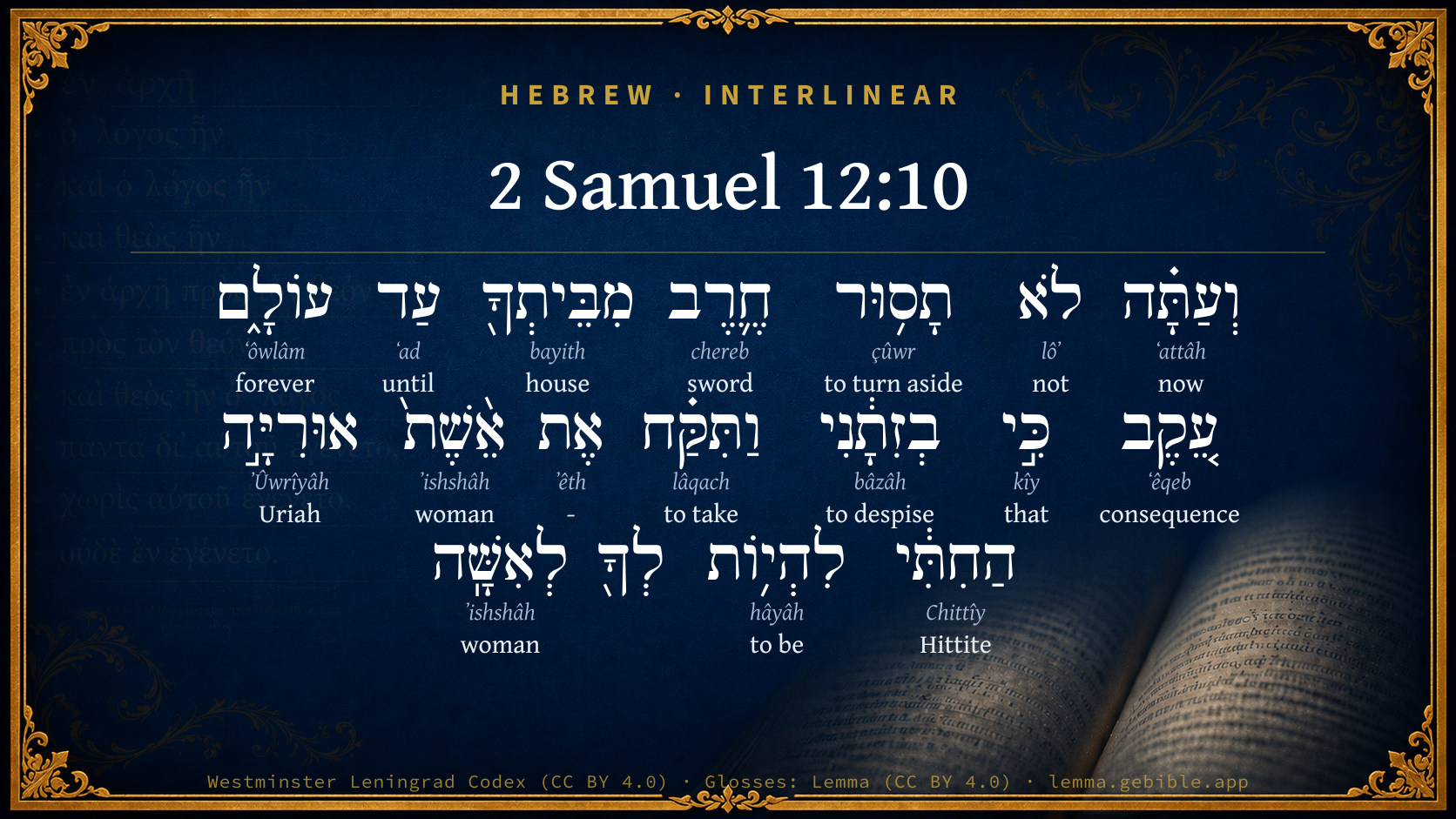
2 Samuel 12:10

Hebrew (Westminster Leningrad Codex) 2 Samuel 12:10 appears in the Hebrew Old Testament. The text above is from the Westminster Leningrad Codex. Each word links to its Strong’s number, a concise gloss, and parsing drawn from the Open Scriptures Hebrew Bible morphology. Click any word for its full Brown-Driver-Briggs (BDB) entry.
Download image
Cite this verse

2 Samuel 12:10 (World English Bible). Public Domain. Lemma interlinear Bible study tool, https://lemma.gebible.app/v/2-samuel/12/10.

Show BibTeX & RIS
BibTeX
RIS
English Translation
Now therefore the sword will never depart from your house, because you have despised me, and have taken the wife of Uriah the Hittite to be your wife.'
World English Bible · Public Domain
Download a study sheet

One document with this verse’s original text, its word-by-word gloss line, the meaning frame, cross-references with their text, attributed commentary, and full source and license credits — printable, and it pastes into notes with its structure intact.

This verse Autodidact and up

Study sheet (.html) Plain text (.txt)

A passage Seminary Student

Up to 50 verses in one chapter. A passage sheet keeps up to 6 commentary sources and 12 cross-references per verse, in the order this page ranks them, and says so on the sheet whenever that leaves anything out. Ask for a single verse and you get the Autodidact verse sheet above.

Everything on this page stays free to read, with no account — the sheet is a download of what is already on screen, not access to it.

Want to remove ads? Support Godless Engineer
Compare translations 3

The same verse in 3 English versions, stacked beneath the original-language interlinear above. Click any original word for its lexicon entry.

Each is an independent rendering of the whole verse — the interlinear is not word-aligned to these translations.

Highlighted words mark where these versions differ — a whole-verse word diff, not a word-by-word alignment.

  • World English Bible Public Domain
    Now therefore the sword will never depart from your house, because you have despised me, and have taken the wife of Uriah the Hittite to be your wife.'
  • King James Version Public Domain
    Now therefore the sword shall never depart from thine house; because thou hast despised me, and hast taken the wife of Uriah the Hittite to be thy wife.
  • unfoldingWord Literal Text CC BY-SA 4.0
    And now, the sword will not turn away from your house to forever, because you despised me and took the wife of Uriah the Hittite to be a wife for you.’

unfoldingWord Literal Text — © unfoldingWord, licensed CC BY-SA 4.0. Word-aligned USFM3 via Door43 (git.door43.org/unfoldingWord/en_ult).

Versions to compare (up to 4)

3 of 4 selected

Show all 18 translations

Every available English version of this verse, each an independent rendering of the whole verse.

  • World English Bible Public Domain
    Now therefore the sword will never depart from your house, because you have despised me, and have taken the wife of Uriah the Hittite to be your wife.'
  • Berean Standard Bible Public Domain
    Now, therefore, the sword will never depart from your house, because you have despised Me and have taken the wife of Uriah the Hittite to be your own.’
  • Majority Standard Bible Public Domain
    Now, therefore, the sword will never depart from your house, because you have despised Me and have taken the wife of Uriah the Hittite to be your own.’
  • King James Version Public Domain
    Now therefore the sword shall never depart from thine house; because thou hast despised me, and hast taken the wife of Uriah the Hittite to be thy wife.
  • American Standard Version (1901) Public Domain
    Now therefore the sword shall never depart from thy house, because thou hast despised me, and hast taken the wife of Uriah the Hittite to be thy wife.
  • Revised Version (1885) Public Domain
    Now therefore, the sword shall never depart from thine house; because thou hast despised me, and hast taken the wife of Uriah the Hittite to be thy wife.
  • Geneva Bible (1599) Public Domain
    Now therefore the sworde shall neuer depart from thine house, because thou hast despised me, and taken the wife of Vriah the Hittite to be thy wife.
  • Douay-Rheims (1899) Public Domain
    Therefore the sword shall never depart from thy house, because thou hast despised me, and hast taken the wife of Urias the Hethite to be thy wife.
  • Young's Literal Translation Public Domain
    `And now, the sword doth not turn aside from thy house unto the age, because thou hast despised Me, and dost take the wife of Uriah the Hittite to be to thee for a wife;
  • Literal Standard Version CC BY-SA 4.0
    And now, the sword does not turn aside from your house for all time, because you have despised Me, and take the wife of Uriah the Hittite to be for a wife for yourself;
  • Unlocked Literal Bible CC BY-SA 4.0
    So now the sword will never leave your house, because you have despised me and have taken the wife of Uriah the Hittite as your wife.'
  • unfoldingWord Literal Text CC BY-SA 4.0
    And now, the sword will not turn away from your house to forever, because you despised me and took the wife of Uriah the Hittite to be a wife for you.’
  • Darby Bible Public Domain
    Now therefore the sword shall never depart from thy house; because thou hast despised me, and hast taken the wife of Urijah the Hittite to be thy wife.
  • World Messianic Bible Public Domain
    Now therefore the sword will never depart from your house, because you have despised me and have taken Uriah the Hittite’s wife to be your wife.’
  • Webster's Bible Public Domain
    Now therefore the sword shall never depart from thy house; because thou hast despised me, and hast taken the wife of Uriah the Hittite to be thy wife.
  • Free Bible Version CC BY-SA 4.0
    So your descendants will always face the sword that kills because you treated me with contempt and stole Uriah's wife.
  • Bible in Basic English Public Domain
    So now the sword will never be turned away from your family; because you have had no respect for me, and have taken the wife of Uriah the Hittite to be your wife.
  • JPS Tanakh (1917) Public Domain
    Now therefore, the sword shall never depart from thy house; because thou hast despised Me, and hast taken the wife of Uriah the Hittite to be thy wife.

Literal Standard Version (2020), Covenant Press — licensed CC BY-SA 4.0. Text via the HelloAO Bible API (eBible.org). Unlocked Literal Bible (unfoldingWord) — licensed CC BY-SA 4.0. Text via the HelloAO Bible API (eBible.org). unfoldingWord Literal Text — © unfoldingWord, licensed CC BY-SA 4.0. Word-aligned USFM3 via Door43 (git.door43.org/unfoldingWord/en_ult). Free Bible Version, Dr. Jonathan Gallagher — licensed CC BY-SA 4.0. Text via the HelloAO Bible API (eBible.org).

Word by word

More ways to search: Search by grammar → Find every occurrence → Compare this word →

Practice this passage: Drill this verse → Learn its vocabulary →

עֵ֚קֶב
ʻêqeb
H6118
“consequence”
Noun, Common, Masculine, Singular, Absolute
Part of Speech
Noun
Type
Common
Gender
Masculine
Number
Singular
State
Absolute
Full BDB Definition

Origin: from H6117 in the sense of H6119

TWOT: 1676e

consequence (noun masculine) - consequence - consequence, gain, reward - end - as a consequence, because, consequently (adverb) - as a consequence of, that, because (conjunction)
  1. וְעַתָּ֗ה ʻattâh H6258 “and · now” Conjunction + Adverb
  2. לֹא lôʼ H3808 “not” Particle, Negative
  3. תָס֥וּר çûwr H5493 “to turn aside” Verb, Qal, Imperfect, 3rd Person, Feminine, Singular
  4. חֶ֛רֶב chereb H2719 “sword” Noun, Common, Feminine, Singular, Absolute
  5. מִבֵּיתְךָ֖ bayith H1004 “from · house · your” Preposition + Noun, Common, Masculine, Singular, Construct + Suffix, Personal, 2nd Person, Masculine, Singular
  6. עַד ʻad H5704 “until” Preposition
  7. עוֹלָ֑ם ʻôwlâm H5769 “forever” Noun, Common, Masculine, Singular, Absolute
  8. כִּ֣י kîy H3588 “that” Conjunction
  9. בְזִתָ֔נִי bâzâh H959 “to despise · me” Verb, Qal, Perfect, 2nd Person, Masculine, Singular + Suffix, Personal, 1st Person, Common, Singular
  10. וַתִּקַּ֗ח lâqach H3947 “and · to take” Conjunction + Verb, Qal, Sequential Imperfect, 2nd Person, Masculine, Singular
  11. אֶת ʼêth H853 “-” Particle, Direct Object
  12. אֵ֨שֶׁת֙ ʼishshâh H802 “woman of” Noun, Common, Feminine, Singular, Construct
  13. אוּרִיָּ֣ה ʼÛwrîyâh H223 “Uriah” Noun, Proper
  14. הַחִתִּ֔י Chittîy H2850 “the · Hittite” Particle, Definite Article + Noun, Gentilic, Masculine, Singular, Absolute
  15. לִהְי֥וֹת hâyâh H1961 “to be” Preposition + Verb, Qal, Infinitive Construct
  16. לְאִשָּֽׁה ʼishshâh H802 “to/for · woman” Preposition + Noun, Common, Feminine, Singular, Absolute

About this verse

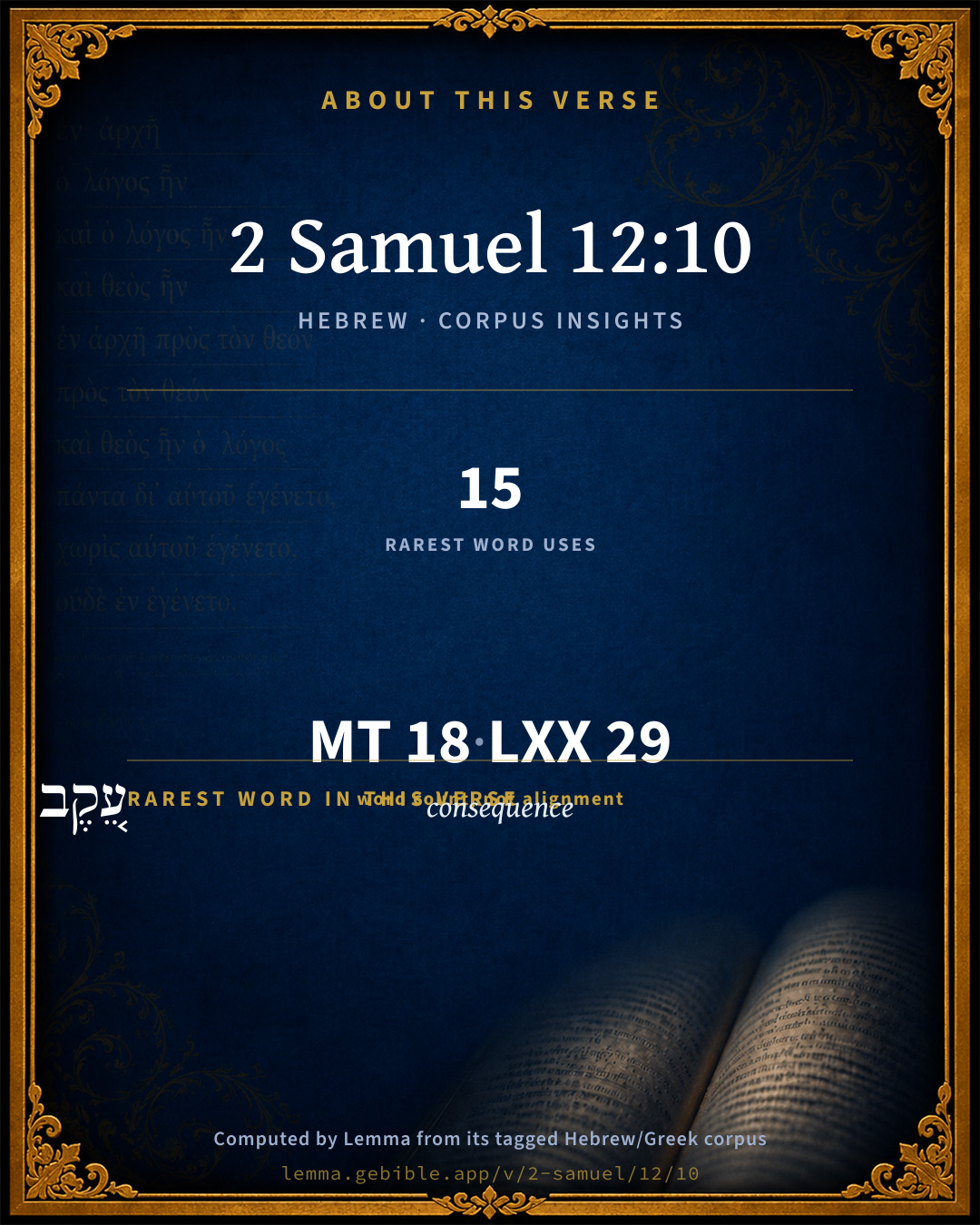
These counts appear in no published source. They are computed here, from the morphology-tagged text and Lemma’s own curated glosses. What Lemma adds →

18
words
16
distinct lemmas
Historical
section

Notable vocabulary

The rarest word here is עֵ֚קֶב consequence H6118 — appearing just 15 times in the whole Hebrew Bible.

Shared distinctive vocabulary

עֵ֚קֶב consequence H6118 occurs in 15 verses of the Hebrew Bible. Also found in:

Grammatical profile

  • 4 verbs
  • 8 nouns
  • 2 prepositions
  • 1 conjunction
  • 1 adverb
  • 2 particles

Verb forms

  • תָס֥וּר Qal · Imperfect
  • בְזִתָ֔נִי Qal · Perfect
  • וַתִּקַּ֗ח Qal · Sequential Imperfect
  • לִהְי֥וֹת Qal · Infinitive Construct

Repetition

A word recurs within this verse — often emphatic in Hebrew:

  • אֵ֨שֶׁת֙ woman H802 ×2

Hebrew & Septuagint length

In English translation the verse runs 28 words from the Hebrew and 33 from the Septuagint (LXX English) — closely comparable.

A rough comparison of the two English renderings, which tokenize alike — not a word-level alignment.

Word counts can differ between the Hebrew and the Greek without any difference in meaning — e.g. the Hebrew direct-object marker אֵת has no separate Greek word, and Greek often adds the article ὁ.

In the original languages it is 18 Hebrew tokens and 29 Greek tokens — but the two are counted differently (Hebrew bundles its prefixes and suffixes into one token; the Greek is in lemma form), so that isn’t a like-for-like length.

Cross-references

14

Topical passages linked to 2 Samuel 12:10 in the Treasury of Scripture Knowledge — connected by theme and wording, ordered by reader-vote popularity; previews shown in the World English Bible.

  • 2 Samuel 18:14–15 Then said Joab, I may not wait thus with you. He took three darts in his hand, and thrust them through the heart of Absalom, while he was yet alive in the midst of the oak.
  • Matthew 26:52 Then Jesus said to him, "Put your sword back into its place, for all those who take the sword will die by the sword.
  • Romans 2:4 Or do you despise the riches of his goodness, forbearance, and patience, not knowing that the goodness of God leads you to repentance?
  • Genesis 20:3 But God came to Abimelech in a dream of the night, and said to him, "Behold, you are a dead man, because of the woman whom you have taken. For she is a man's wife."
  • Numbers 11:20 but a whole month, until it come out at your nostrils, and it be loathsome to you; because that you have rejected Yahweh who is among you, and have wept before him, saying, Why came we forth out of Egypt?
  • 1 Samuel 2:30 Therefore Yahweh, the God of Israel, says, I said indeed that your house, and the house of your father, should walk before me forever: but now Yahweh says, Be it far from me; for those who honor me I will honor, and those who despise me shall be lightly esteemed.
  • 2 Samuel 13:28–29 Absalom commanded his servants, saying, Mark you now, when Amnon's heart is merry with wine; and when I tell you, Smite Amnon, then kill him; don't be afraid; haven't I commanded you? be courageous, and be valiant.
  • 2 Samuel 18:33 The king was much moved, and went up to the chamber over the gate, and wept: and as he went, thus he said, my son Absalom, my son, my son Absalom! would I had died for you, Absalom, my son, my son!
  • 1 Kings 2:23–25 Then king Solomon swore by Yahweh, saying, God do so to me, and more also, if Adonijah has not spoken this word against his own life.
  • Proverbs 6:32–33 He who commits adultery with a woman is void of understanding. He who does it destroys his own soul.
  • Amos 7:9 The high places of Isaac will be desolate, the sanctuaries of Israel will be laid waste; and I will rise against the house of Jeroboam with the sword."
  • Malachi 1:6–7 "A son honors his father, and a servant his master. If I am a father, then where is my honor? And if I am a master, where is the respect due me? Says Yahweh of Hosts to you, priests, who despise my name. You say, 'How have we despised your name?'
  • Matthew 6:24 "No one can serve two masters, for either he will hate the one and love the other; or else he will be devoted to one and despise the other. You can't serve both God and Mammon.
  • 1 Thessalonians 4:8 Therefore he who rejects doesn't reject man, but God, who has also given his Holy Spirit to you.

Cross-references courtesy of OpenBible.info (CC BY 4.0).

Hebrew and Greek witnesses Masoretic Hebrew ↔ Greek Septuagint

The same verse in the two great witnesses to the Old Testament, shown verse-for-verse.

These are two independent witnesses, not word-aligned to each other, and the Septuagint is shown in lemma (dictionary) form.

Hebrew 2 Samuel 12:10 Masoretic · Westminster Leningrad Codex

וְעַתָּ֗ה לֹא תָס֥וּר חֶ֛רֶב מִבֵּיתְךָ֖ עַד עוֹלָ֑ם עֵ֚קֶב כִּ֣י בְזִתָ֔נִי וַתִּקַּ֗ח אֶת אֵ֨שֶׁת֙ אוּרִיָּ֣ה הַחִתִּ֔י לִהְי֥וֹת לְךָ֖ לְאִשָּֽׁה

Now therefore the sword will never depart from your house, because you have despised me, and have taken the wife of Uriah the Hittite to be your wife.'

World English Bible · Public Domain

Greek LXX 2 Samuel 12:10 Septuagint · lemma form

καί νῦν οὐ ἀποἵστημι ῥομφαία ἐκ ὁ οἶκος σύ ἕως αἰών ἀντί ὅς ὅτι ἐκουδενόω ἐγώ καί λαμβάνω ὁ γυνή ὁ ουριας ὁ χετταῖος ὁ εἰμί σύ εἰς γυνή

Now therefore the sword shall not depart from your house for ever, because you have set me at nothing, and you have taken the wife of Urias the Chettite, to be your wife.

LXX2012 (modern English Septuagint) · Public Domain

Hebrew: Westminster Leningrad Codex (CC BY 4.0). Greek: Septuagint (public domain); English from LXX2012 (modern English Septuagint) (Public Domain). How the Septuagint differs from the Hebrew →

Targum (Aramaic paraphrase)

1

The Targum is the ancient Jewish Aramaic paraphrase of the Hebrew Scriptures — an interpretive translation, not the Hebrew text itself. Onkelos (literal) and Pseudo-Jonathan (expansive) render the Torah, and Jonathan the Prophets. Coverage is partial: where no permissively-licensed English translation exists for a verse, only the Aramaic is shown. This is verse-level text, not a word-by-word alignment to the Hebrew.

  1. Targum Jonathan Prophets (Joshua–Malachi)
    וּכְעַן לָא תִפְסוֹק חַרְבָּא מִן אֱנַשׁ בֵּיתָךְ עַד עַלְמָא חֲלָף דַאֲשַׁטְתַּנִי וּנְסֵבְתָּא יַת אִתַּת אוּרִיָה חִתָּאָה לְמֶהֱוֵי לָךְ לְאִתּוּ:

    (no public-domain English translation for this verse)

    Targum Jonathan — Aramaic: “Mikraot Gedolot” (public domain). English: “Sefaria Community Translation” (CC0 1.0 (public-domain dedication)); “London "Chaldee Paraphrase," 1871” (public domain). Text via Sefaria.

Commentary

Notes on 2 Samuel 12:10 from classic Christian and Jewish commentators (each source and its license shown beneath its notes). The classic Christian expositions comment on the surrounding passage and are grouped to its opening verse, so a note may address several verses; the Jewish commentaries on the Tanakh (Rashi and others) are per-verse, so they appear only where the commentator wrote on this verse.

Lemma curates 59 commentaries, every one of them public domain or Creative Commons licensed, each selected and text-cleaned for this edition rather than reprinted as found. About our sources →

Trapp's Complete Commentary

John Trapp

2Sa 12:10 Now therefore the sword shall never depart from thine house; because thou hast despised me, and hast taken the wife of Uriah the Hittite to be thy wife.

Ver. 10. Now therefore the sword shall never depart from thine house.] Never, that is, so long as thou livest, as 1Sa 1:22 Gen 43:9. Or, which I like better, From one generation to another, even for many ages. And so this threatening was performed in the slaughter of Amnon, Absalom, Adonijah, the five sons of Jehoshaphat, {2Ch 21:17} all the sons of Joram except Ahaziah, afterwards killed also, {2Ch 22:7} all the king’s seed killed by Athaliah but Joash, and he also afterwards by his servants, {2Ch 24:1-27} his son Amaziah slain, {2Ch 25:27} and Josiah, {2Ch 35:24} and the sons of Zedekiah. {2Ki 25:7} {a}

Because thou hast despised me.] In thinking to sin secretly, not considering mine all-seeing eye, nor caring though I looked on.

And hast taken the wife of Uriah the Hittite.] To conceal your adultery, and to cover your shame, which you mainly minded in that marriage, whereunto you made way by the murder of that good man.

{a} Weems.

John Trapp, A Commentary or Exposition upon All the Books of the Old and New Testament (1647–1656) — public domain. Text from a community e-Sword module.

Joseph Benson's Commentary

2Sa 12:10. The sword shall never depart from thy house — During the residue of thy life. As long as he lived, at times there should be destruction made in his family by the sword, which was awfully fulfilled in the violent deaths of his children, Amnon and Absalom, and, about the time of his death, Adonijah.

Joseph Benson's Commentary on the Old and New Testaments (1811–1818) — public domain. Text from a community e-Sword module.

Tyndale Open Study Notes

Tyndale Open Resources

12:10 from this time on (literally forever): Contrast God’s gracious “forever” promises of 7:13-29. • The reminder of what David had done with the sword (12:9) and what role the sword would play in his family recalls David’s cavalier response to Joab’s report of the deaths of Uriah and other innocent Israelites (11:25).

Tyndale Open Study Notes — © Tyndale Open Resources, licensed CC BY-SA 4.0. Text via the HelloAO Bible API.

Ellicott's Commentary for English Readers

(10) Shall never depart.—This word, in both its positive and negative forms, for ever and never, is constantly used to express the longest time possible in connection with the subject of which it is used. Here it must mean “as long as David lives;” and the punishment denounced found its realisation in a long succession of woes, from the murder of Amnon to the execution of Adonijah.

A Bible Commentary for English Readers, edited by Charles John Ellicott (1878–1897) — public domain. Text from a community e-Sword module.

The Cambridge Bible for Schools and Colleges

gen. ed. J. J. S. Perowne

10. the sword shall never depart from thine house] The Heb. word for never is a relative term, which must be explained by the context. Here it may be understood as equivalent to “all the days of thy life.” Cp. 1Sa_1:22; 1Sa_27:12. The prophecy was fulfilled by Amnon’s murder (ch. 2Sa_13:28); Absalom’s death as a rebel (ch. 2Sa_18:14); and Adonijah’s execution as a traitor (1Ki_2:25). In all these deeds may be traced the bitter fruit of David’s sin. Amnon no doubt excused his lust by alleging his father’s example: Absalom’s rebellion was indirectly the consequence of Amnon’s act: Adonijah died for presuming to appear as the rival of Bath-sheba’s son.

The Cambridge Bible for Schools and Colleges (gen. ed. J. J. S. Perowne; Cambridge University Press, 1878–1918) — public domain. Text from a community e-Sword module.

John Gill's Exposition

Thus saith the Lord,.... For what he said was not of himself, but under a spirit of prophecy:

behold, I will raise up evil against thee out of thine own house: that is, evil persons, who should be guilty of evil things, and that as a chastisement of him for the sins he had committed, and those out of his own family, as Amnon and Absalom:

and I will take thy wives before thine eyes; which is so expressed, because it was done in his lifetime, and he knowing it, but not able to hinder it, though he did not, strictly speaking, see it with his eyes:

and give them unto thy neighbour; or friend, meaning his son Absalom, as they were:

and he shall lie with thy wives in the sight of this sun; pointing to the sun in the firmament, and which might be then shining in the room where they were: and which is represented by Homer (u) as seeing all things, "and eyes" are ascribed to it here in the original; the meaning is, that this fact should be done in the daytime, openly and publicly, and was fulfilled, when by the advice of Ahithophel a tent was spread on the top of the house, and Absalom went in to his father's concubines in the sight of all Israel, Sa2 16:22.

(u) Odyss. 11. ver. 119. & 12. ver. 380.

John Gill's Exposition of the Whole Bible (1746–1763) — public domain (CC PDM 1.0). Text via the HelloAO Bible API.

Haydock's Catholic Bible Commentary

House. What a dismal scene opens itself to our view during the remaining part of David’s reign! (Haydock) --- Scarcely one of his successors was free from war; even Solomon was disturbed by the rebellion of Jeroboam, &c., and many of David’s family and descendants came to an untimely end, ver. 6. (Calmet) --- Six sons of Josaphat, all Joram’s, except one, Josias, the children of Sedecias, &c., 4 Kings xxv., &c. (Worthington)

George Leo Haydock (1774–1849), Haydock's Catholic Family Bible and Commentary, 1859 edition — public domain. Excludes Psalms (Douay-Rheims chapter numbering differs from Protestant) and Deuterocanonical books (Catholic canon only).

Matthew Poole's English Annotations

Shall never depart from thine house, during the residue of thy life; as appears from the following history.

Matthew Poole's English Annotations on the Holy Bible (1683–1685) — public domain. Text from a community e-Sword/MySword module.

Whedon's Commentary on the Bible

Daniel D. Whedon

10. The sword shall never depart from thine house — This prediction was most terribly fulfilled, as the subsequent history will show, especially from the murder of Amnon by his brother to the slaughter of the sons of Zedekiah before their father’s eyes.

Daniel D. Whedon (gen. ed.), Commentary on the Old and New Testaments (1874–1909) — public domain. Text from a community e-Sword module.

The Pulpit Commentary

The sword shall never depart from thine house; that is, thy crime shall not be expiated by one slaughter, but by many, so that thy punishment shall cease only at thine own death. This sentence was fulfilled in Amnon"s murder, (2Sa_13:28) who had been encouraged in his crime by his father"s example. Upon this followed Absalom"s rebellion and; (2Sa_18:14) and finally, when in his last hours David made Solomon his successor, he knew that he was virtually passing sentence on Adonijah, the eldest of his surviving sons. But what a fearful choice! for had he not done so, then Bathsheba and her four sons would doubtless have been slain, whereas there was some hope that Solomon might spare his brother. That Adonijah was unworthy we gather from the fact that he had ceased to be cohen, and that this office was conferred, after Absalom"s rebellion, on Ira the Jairite, (2Sa_20:26) Solomon being then too young to hold such a position. Until he committed this crime, David"s family had probably dwelt in concord, and it was his own wickedness which broke up their unity, and introduced among them strife, mutual hatred, and the shedding of blood.

Vers. 10-12. (THE PALACE.)

The penalties of sin.

therefore the sword shall never depart from thine house," etc.

1. Sin is connected with suffering. The connection is real, intimate, inevitable. Nothing is more clearly manifest or more generally admitted; yet nothing is more practically disregarded. Men commit sin under the delusion that they can do so with impunity. But "they that plough iniquity, and sow wickedness, reap the same" (Job_4:8; Gal_6:7)

2. Sin serves to account for suffering; explains and justifies its existence under the righteous and beneficent government of God. The subsequent sufferings of David would have been inexplicable if his great transgression had not been recorded. "The remainder of David"s life was as disastrous as the beginning had been prosperous" (Hale). Personal suffering, however, often appears disproportionate to personal transgression; (1Sa_4:3) and its reason in such cases must be sought in hereditary or other relationships, and in the purposes to which it is subservient. The penalties of sin (such as David suffered) take place

I BY DIVINE INFLICTION. "Behold, I will raise up evil against thee," etc. (ver. 11; 2Sa_9:2-7) They are:

1. Necessitated by the justice of God. "Justice is that causality in God which connects suffering with actual sin" (Schleiermacher). He who "despises the commandment of the Lord" ought to be punished.

2. Declared by the Word of God, both in the Law and the prophets. The word of Nathan was a sentence, as well as a prediction of judgment.

3. Effectuated by the power of God, which operates, not only by extraordinary agencies, but also, and most commonly, in the ordinary course of things, and by way of natural consequence; directs and controls the actions of men to the accomplishment of special results; and often makes use of the sins of one man to punish those of another. Natural law is the regular method of Divine activity. In accordance therewith the violation of moral law is followed by internal misery and external calamity, which are closely associated (Isa_45:7; Amo_3:4) "Vengeance is mine," etc.

II WITH SIGNIFICANT SEVERITY; which appears in:

1. The peculiarity of their form. Not only do they follow sin by way of natural consequence, but also the manner of their infliction corresponds with that of its commission; as that which is reaped resembles that which is. (1Sa_4:1-11) "The seeds of our own punishment are sown at the same time we commit sin" (Hesiod). Having sinned with the sword, his house would be ravaged with the sword; and having sinned by the indulgence of impure passion, he would be troubled in like manner. "Amnon, Absalom, Adonijah! Amnon thought, "Has my father indulged in it? Absalom relied on the resentment of the people on account of the double.crime. Adonijah fell because he wished to make the best of the precedence of his birth in opposition to him who had been begotten with Bathsheba" (Thenius).

The gods are just, and of our pleasant vices Make instruments to plague us.

There is a tendency in the sin of one to perpetuate itself in others over whom his influence extends, and so to recoil upon himself.

2. The publicity of their exhibition. "For thou didst it secretly," etc. (ver. 12). Falsehood and injustice seek darkness; truth and justice seek light. The evil, which is concealed for the sake of public honour, is followed by public shame.

3. The extent and perpetuity of their infliction. "The sword shall never depart from thine house." "The fortunes of David turned upon this one sin, which, according to Scripture, itself eclipsed every other" (Blunt). "One sin led to another; the bitter spring of sin grew in time to a river of destruction that flowed over the whole land, and even endangered his throne and life" (Baumgarten). Who can tell the far reaching effects of one transgression? (Ecc_9:18)

III FOR MANIFOLD PURPOSES.

1. To manifest the justice of God and uphold the authority of his Law.

2. To exhibit the evil of sin, and deter the sinner himself and others from itscommission.

3. To humble, prove, chastise, instruct, purify, and confirm the sufferer. "Ifhe commit iniquity, I will chasten him," etc. (2Sa_7:14; Deu_8:3, Deu_8:5; Job_5:17; Psa_94:12; Heb_12:6) This last effect is wrought only on those who turn to God in penitence and trust. The forgiveness of sin and restoration to righteousness do not counteract, except in a limited degree, the natural consequences of past transgression; but they transform punishment into chastisement, and alleviate the pressure of suffering and sorrow by Divine fellowship, and the inward peace, strength, and hope which it imparts. "In general the forgiveness of sin has only this result punishment is changed into fatherly chastisement, the rod into the correction of love. Outwardly the consequences of sin remain the same; their internal character is changed. If it were otherwise, the forgiveness of sins might too readily be attributed to caprice" (Hengstenberg). "The personal forgiveness indulged to the King of Israel, in consideration of his penitence, did not break the connection between causes and their effects. This connection is stamped on the unchanging laws of God in nature; and it becomes every man, instead of arraigning the appointment, to bring support to his domestic happiness by the instrumentality of a good example" (W. White). His family, his kingdom, and even his own character, were permanently affected by his sin. "Broken in spirit by the consciousness of how deeply he had sinned against God and against men; humbled in the eyes of his subjects, and his influence with them weakened by the knowledge of his crimes; and even his authority in his own household, and his claim to the reverence of his sons, relaxed by the loss of character; David appears henceforth a much altered man. He is as one who goes down to the grave mourning. His active history is past henceforth he is passive merely. All that was high and firm and noble in his character goes out of view, and all that is weak and low and wayward comes out in strong relief. The balance of his character is broken. Alas for him! The bird which once rose to heights unattained before by mortal wing, filling the air with its joyful songs, now lies with maimed wing upon the ground, pouring forth its doleful cries to God" (Kitto, "Daily Bible Illust."). D.

Despisers of God.

hast despised me." In the dreadful sins of which David had been guilty he had treated God with contempt. He had treated as of no account all the kindness of God to him; had disregarded his claims; shown contempt practically for his authority, his precepts, his observance of his conduct, his justice and its penalties, his favour, his voice in the conscience. The charge brought against David may be brought against many who are not guilty of gross and flagrant crimes like his.

I WHO ARE GUILTY OF DESPISING GOD?

1. All sin involves contempt of him. It shows:

(1) Indifference as to his Being and perfections. If the sinner does not boldly say, "no God," he practically ignores him, leaves him out of account in his conduct, and treats his presence and observation of him, his hatred to sin, his threatened judgments, as of no importance, not worthy of serious consideration. (see Psa_10:13)

(2) Contempt for his authority.

(3) Despisal of his kindness. (Rom_2:4)

(4) Contempt of his wisdom, as expressed in his laws. As if the sinner thought he could guide and govern himself better than God.

(5) Disesteem of his favour and friendship.

2. Certain kinds of sin may be mentioned as showing such contempt.

(1) Unthankfulness and discontent. As if God"s gifts were not worth having.

(2) Rejection of Christ and salvation his best gifts, in which he appears more fully and manifestly than in aught else. "He that despiseth me despiseth him that sent me". (Luk_10:16) "Hath done despite unto the Spirit of grace". (Heb_10:29)

(3) Neglect of the Holy Scriptures. In them God comes to instruct us, to make us partakers of his own wisdom, to make known his will, etc. To neglect them is to show contempt of him.

(4) Negligence as to his service. As to the hours and exercises of devotion. God invites us to converse with him, to make known our requests, with the promise of gracious answers. To disregard prayer, or offer unreal worship, is to treat him with contempt: He is most worthy to be praised. To decline to praise him, or to praise in words only, is to despise him. In the sacrament of the Lord"s Supper he comes specially near to us, to commune with us in Christ, to feed us with the body and blood of his Son. To turn away from the holy feast, or come with hypocrisy, or with hearts or hands stained with unrepented sin, is to treat him with contempt. And in more active life, to be slovenly, slothful, indifferent; to offer him a half-hearted service; to present him with niggard offerings; is to show grievous disrespect to him. (see Mal_1:6-8)

(5) Contempt for his people, or any of them. As if the godly were necessarily fanatical. Or because they may be feeble, or inexperienced, (Mat_18:10) or poor. (Jam_2:6) Or because they differ from us in judgment or observances. (Rom_14:3, Rom_14:10) "He that despiseth you, despiseth me". (Luk_10:16)

II THEIR FOLLY AND WICKEDNESS. Considering:

1. Who is despised. "Me. The infinite Majesty, the Source and Sustainer of all beings, the Giver of all good, the Creator, Preserver, and Benefactor of those who despise him, without whom they have nothing and can do nothing; perfect in all that is good, and worthy of all esteem and love; who

2. is reverenced, adored, loved, and served by the loftiest intelligences, by all the wise and good in all worlds; the Father of our Lord Jesus Christ, in whom all that is glorious in holiness and love appears, revealing the glorious excellences of God.

3. Who is the despiser. "Thou. So ignorant, so needy, so dependent, so greatly blessed, so sinful, so perverted in mind and heart, and incapable, while untaught of God, of judging aright as to the best things. It is the creature despising his Creator, folly despising wisdom, weakness despising Omnipotence, the lost despising his Deliverer, the destitute despising him who would enrich him with everlasting riches.

1. The contrast between him who is despised and the things which arevalued. God is rejected and treated as of little or no account; while things which are worthless or injurious, or which if valuable have only a limited and transient worth, are highly prized and pursued as if of supreme worth and importance.

2. What is involved in despising God. It is to despise ourselves, our own souls and their salvation, the true riches and honour, our true and everlasting happiness, eternal life, all that most deserves to be valued.

III THEIR DOOM.

1. To be themselves despised. "They that despise me shall be lightly esteemed". (1Sa_2:30) They shall rise "to shame and everlasting contempt", (Dan_12:2) exposed and regarded as fools, and treated as worthless. "Reprobate silver shall men call them, because the Lord hath rejected them". (Jer_6:30)

2. To find by wretched experience how real and how essential to their happiness is he whom they have slighted. To learn the value of his favour by the irreparable loss of it. The sin of despising him they will no longer be able to commit. But the doom may be averted by repentance, as David"s case teaches (ver. 13). G.W.

The Pulpit Commentary (1880–1919), ed. H.D.M. Spence-Jones & Joseph S. Exell — public domain. Text from a community e-Sword module.

John Wesley's Explanatory Notes

Never depart - During the residue of thy life.

John Wesley, Explanatory Notes Upon the Whole Bible (1754–1765) — public domain. Text via the GEBible commentary corpus.

Lesson kit

Teaching starters — assembled from the data on this page, not authored interpretation. Every prompt links to the verse data it draws on. Edit before teaching.

2 Samuel, in the Historical, opens this verse with 18 words (16 distinct Hebrew lemmas). Its most distinctive word is ʻêqeb (“consequence”). A historical commentator’s framing appears above. Read the whole chapter for the surrounding context.

Discussion questions

  1. The word ʻêqeb carries the sense “consequence.” How does it shape the verse?
  2. How does Genesis 22:18, which shares the word «consequence», read alongside this verse?
  3. What does the repetition of “woman” (2× in this one verse) do in this verse?
  4. These translations render this verse differently. What is at stake in choosing one wording over another?
  5. «תָס֥וּר» is a Qal Imperfect verb. How does that grammatical form shape the action described?
  6. Compare how Trapp's Complete Commentary and Joseph Benson's Commentary read this verse. Where do they agree or differ?

Things to notice

Reading settings

Reading text

Shown beneath each verse's original-language words.

Old Testament
Old Testament edition

Read the OT as the Masoretic Hebrew (MT) or the Greek Septuagint (LXX).

English shown for the Greek Septuagint (in the Hebrew ↔ Greek comparison).

Comparing translations? Open the Compare panel on any verse page to stack up to four side by side.