
Jeremiah 44:28

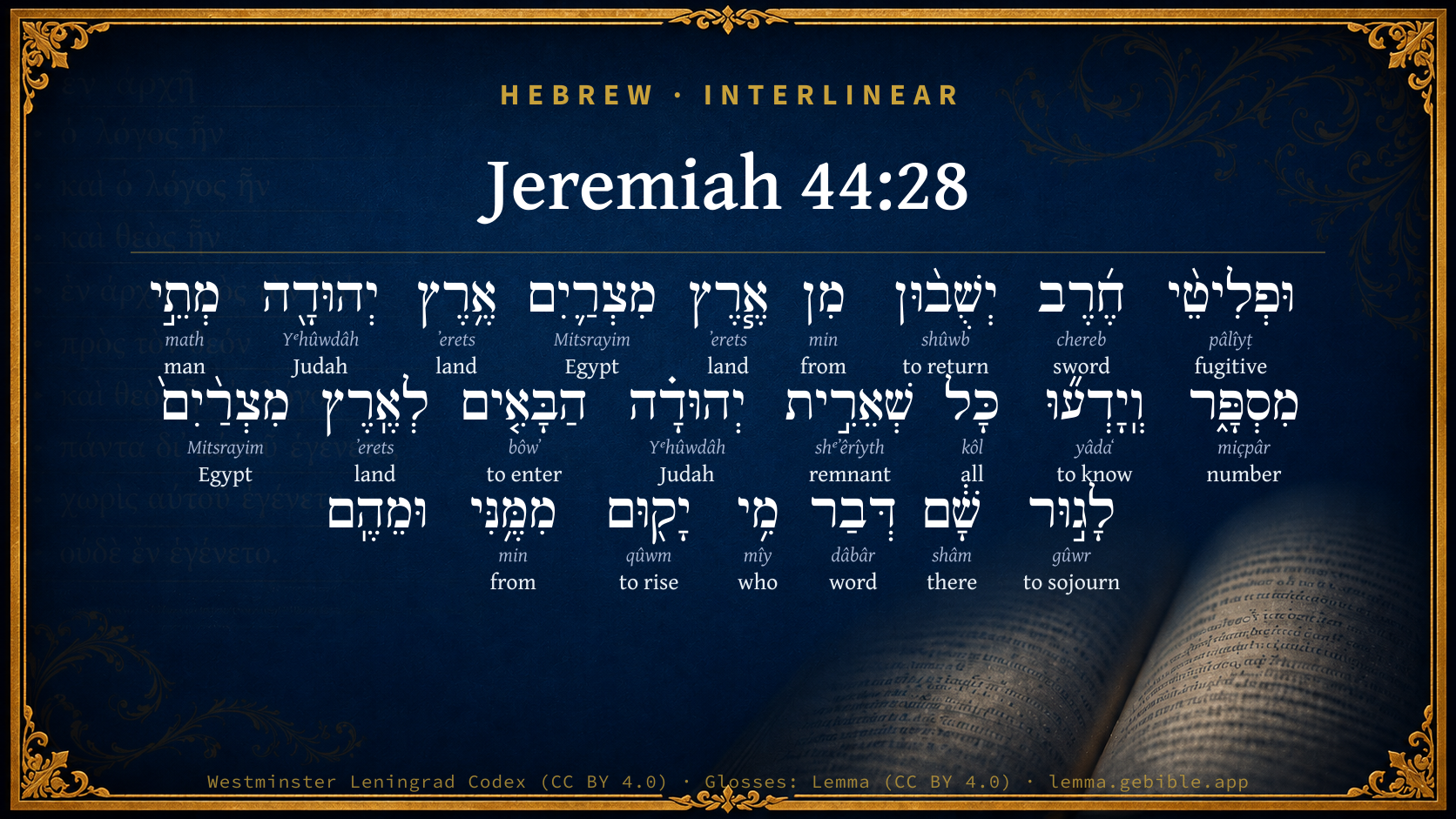
Hebrew (Westminster Leningrad Codex) Jeremiah 44:28 appears in the Hebrew Old Testament. The text above is from the Westminster Leningrad Codex. Each word links to its Strong’s number, a concise gloss, and parsing drawn from the Open Scriptures Hebrew Bible morphology. Click any word for its full Brown-Driver-Briggs (BDB) entry.
Download image
Cite this verse

Jeremiah 44:28 (World English Bible). Public Domain. Lemma interlinear Bible study tool, https://lemma.gebible.app/v/jeremiah/44/28.

Show BibTeX & RIS
BibTeX
RIS
English Translation
Those who escape the sword shall return out of the land of Egypt into the land of Judah, few in number; and all the remnant of Judah, who have gone into the land of Egypt to sojourn there, shall know whose word shall stand, mine, or theirs.
World English Bible · Public Domain
Download a study sheet

One document with this verse’s original text, its word-by-word gloss line, the meaning frame, cross-references with their text, attributed commentary, and full source and license credits — printable, and it pastes into notes with its structure intact.

This verse Autodidact and up

Study sheet (.html) Plain text (.txt)

A passage Seminary Student

Up to 50 verses in one chapter. A passage sheet keeps up to 6 commentary sources and 12 cross-references per verse, in the order this page ranks them, and says so on the sheet whenever that leaves anything out. Ask for a single verse and you get the Autodidact verse sheet above.

Everything on this page stays free to read, with no account — the sheet is a download of what is already on screen, not access to it.

Want to remove ads? Support Godless Engineer
Compare translations 3

The same verse in 3 English versions, stacked beneath the original-language interlinear above. Click any original word for its lexicon entry.

Each is an independent rendering of the whole verse — the interlinear is not word-aligned to these translations.

Highlighted words mark where these versions differ — a whole-verse word diff, not a word-by-word alignment.

  • World English Bible Public Domain
    Those who escape the sword shall return out of the land of Egypt into the land of Judah, few in number; and all the remnant of Judah, who have gone into the land of Egypt to sojourn there, shall know whose word shall stand, mine, or theirs.
  • King James Version Public Domain
    Yet a small number that escape the sword shall return out of the land of Egypt into the land of Judah, and all the remnant of Judah, that are gone into the land of Egypt to sojourn there, shall know whose words shall stand, mine, or their's.
  • unfoldingWord Literal Text CC BY-SA 4.0
    Then the survivors of the sword will return from the land of Egypt to the land of Judah, only a small number of them. So all the remnant of Judah who went to the land of Egypt to live there will know whose word will stand—mine or theirs.

unfoldingWord Literal Text — © unfoldingWord, licensed CC BY-SA 4.0. Word-aligned USFM3 via Door43 (git.door43.org/unfoldingWord/en_ult).

Versions to compare (up to 4)

3 of 4 selected

Show all 18 translations

Every available English version of this verse, each an independent rendering of the whole verse.

  • World English Bible Public Domain
    Those who escape the sword shall return out of the land of Egypt into the land of Judah, few in number; and all the remnant of Judah, who have gone into the land of Egypt to sojourn there, shall know whose word shall stand, mine, or theirs.
  • Berean Standard Bible Public Domain
    Those who escape the sword will return from Egypt to Judah, few in number, and the whole remnant of Judah who went to dwell in the land of Egypt will know whose word will stand, Mine or theirs!
  • Majority Standard Bible Public Domain
    Those who escape the sword will return from Egypt to Judah, few in number, and the whole remnant of Judah who went to dwell in the land of Egypt will know whose word will stand, Mine or theirs!
  • King James Version Public Domain
    Yet a small number that escape the sword shall return out of the land of Egypt into the land of Judah, and all the remnant of Judah, that are gone into the land of Egypt to sojourn there, shall know whose words shall stand, mine, or their's.
  • American Standard Version (1901) Public Domain
    And they that escape the sword shall return out of the land of Egypt into the land of Judah, few in number; and all the remnant of Judah, that are gone into the land of Egypt to sojourn there, shall know whose word shall stand, mine, or theirs.
  • Revised Version (1885) Public Domain
    And they that escape the sword shall return out of the land of Egypt into the land of Judah, few in number; and all the remnant of Judah, that are gone into the land of Egypt to sojourn there, shall know whose word shall stand, mine, or theirs.
  • Geneva Bible (1599) Public Domain
    Yet a small nomber that escape the sworde, shall returne out of the lande of Egypt into the lande of Iudah: and all the remnant of Iudah that are gone into the lande of Egypt to dwell there, shall know whose words shall stad, mine or theirs.
  • Douay-Rheims (1899) Public Domain
    And a few men that shall flee from the sword, shall return out of the land of Egypt into the land of Juda: and all the remnant of Juda that are gone into the land of Egypt to dwell there, shall know whose word shall stand, mine, or theirs.
  • Young's Literal Translation Public Domain
    `And the escaped of the sword turn back out of the land of Egypt to the land of Judah, few in number, and known have all the remnant of Judah who are coming into the land of Egypt to sojourn there, whose word is established, Mine or theirs.
  • Literal Standard Version CC BY-SA 4.0
    And the escaped of the sword turn back out of the land of Egypt to the land of Judah, few in number, and all the remnant of Judah, who are coming into the land of Egypt to sojourn there, have known whose word is established, Mine or theirs.
  • Unlocked Literal Bible CC BY-SA 4.0
    Then the survivors of the sword will return from the land of Egypt to the land of Judah, only a small number of them. So all the remnant of Judah who went to the land of Egypt to live there will know whose word will stand—mine or theirs.
  • unfoldingWord Literal Text CC BY-SA 4.0
    Then the survivors of the sword will return from the land of Egypt to the land of Judah, only a small number of them. So all the remnant of Judah who went to the land of Egypt to live there will know whose word will stand—mine or theirs.
  • Darby Bible Public Domain
    And they that escape the sword shall return out of the land of Egypt into the land of Judah, a very small company; and all the remnant of Judah, that have come into the land of Egypt to sojourn there, shall know whose word shall stand, mine or theirs.
  • World Messianic Bible Public Domain
    Those who escape the sword will return out of the land of Egypt into the land of Judah few in number. All the remnant of Judah, who have gone into the land of Egypt to live there, will know whose word will stand, mine or theirs.
  • Webster's Bible Public Domain
    Yet a small number that escape the sword shall return from the land of Egypt into the land of Judah, and all the remnant of Judah, that have gone into the land of Egypt to sojourn there, shall know whose words shall stand, mine, or theirs.
  • Free Bible Version CC BY-SA 4.0
    Those who manage to avoid being killed by the sword will go back to Judah from Egypt. But there will only be a few of them, and then all who were left from Judah and went to live in Egypt will know who's telling the truth—me or them!
  • Bible in Basic English Public Domain
    And those who get away safe from the sword will come back from the land of Egypt to the land of Judah, a very small number; and all the rest of Judah, who have gone into the land of Egypt and are living there, will see whose word has effect, mine or theirs.
  • JPS Tanakh (1917) Public Domain
    And they that escape the sword shall return out of the land of Egypt into the land of Judah, few in number; and all the remnant of Judah, that are gone into the land of Egypt to sojourn there, shall know whose word shall stand, Mine, or theirs.

Literal Standard Version (2020), Covenant Press — licensed CC BY-SA 4.0. Text via the HelloAO Bible API (eBible.org). Unlocked Literal Bible (unfoldingWord) — licensed CC BY-SA 4.0. Text via the HelloAO Bible API (eBible.org). unfoldingWord Literal Text — © unfoldingWord, licensed CC BY-SA 4.0. Word-aligned USFM3 via Door43 (git.door43.org/unfoldingWord/en_ult). Free Bible Version, Dr. Jonathan Gallagher — licensed CC BY-SA 4.0. Text via the HelloAO Bible API (eBible.org).

Word by word

More ways to search: Search by grammar → Find every occurrence → Compare this word →

Practice this passage: Drill this verse → Learn its vocabulary →

מְתֵ֣י
math
H4962
“men of”
Noun, Common, Masculine, Plural, Construct
Part of Speech
Noun
Type
Common
Gender
Masculine
Number
Plural
State
Construct
Full BDB Definition

Origin: from the same as H4970

TWOT: 1263

male, man - males, men - few men (in prose) - less emphasis on sex - men (poetic) - less emphasis on sex
  1. וּפְלִיטֵ֨י pâlîyṭ H6412 “and · fugitives of” Conjunction + Noun, Common, Masculine, Plural, Construct
  2. חֶ֜רֶב chereb H2719 “sword” Noun, Common, Feminine, Singular, Absolute
  3. יְשֻׁב֨וּן shûwb H7725 “to return” Verb, Qal, Imperfect, 3rd Person, Masculine, Plural + Suffix, n
  4. מִן min H4480 “from” Preposition
  5. אֶ֧רֶץ ʼerets H776 “land of” Noun, Common, Both, Singular, Construct
  6. מִצְרַ֛יִם Mitsrayim H4714 “Egypt” Noun, Proper
  7. אֶ֥רֶץ ʼerets H776 “land of” Noun, Common, Both, Singular, Construct
  8. יְהוּדָ֖ה Yᵉhûwdâh H3063 “Judah” Noun, Proper
  9. מִסְפָּ֑ר miçpâr H4557 “number” Noun, Common, Masculine, Singular, Absolute
  10. וְֽיָדְע֞וּ yâdaʻ H3045 “and · to know” Conjunction + Verb, Qal, Sequential Perfect, 3rd Person, Common, Plural
  11. כָּל kôl H3605 “all of” Noun, Common, Masculine, Singular, Construct
  12. שְׁאֵרִ֣ית shᵉʼêrîyth H7611 “remnant of” Noun, Common, Feminine, Singular, Construct
  13. יְהוּדָ֗ה Yᵉhûwdâh H3063 “Judah” Noun, Proper
  14. הַבָּאִ֤ים bôwʼ H935 “the · entering” Particle, Definite Article + Verb, Qal, Participle Active, Masculine, Plural, Absolute
  15. לְאֶֽרֶץ ʼerets H776 “to/for · land of” Preposition + Noun, Common, Both, Singular, Construct
  16. מִצְרַ֨יִם֙ Mitsrayim H4714 “Egypt” Noun, Proper
  17. לָג֣וּר gûwr H1481 “to sojourn” Preposition + Verb, Qal, Infinitive Construct
  18. שָׁ֔ם shâm H8033 “there” Adverb
  19. דְּבַר dâbâr H1697 “word of” Noun, Common, Masculine, Singular, Construct
  20. מִ֥י mîy H4310 “who” Particle, Interrogative
  21. יָק֖וּם qûwm H6965 “to rise” Verb, Qal, Imperfect, 3rd Person, Masculine, Singular
  22. מִמֶּ֥נִּי min H4480 “from · me” Preposition + Suffix, Personal, 1st Person, Common, Singular

About this verse

These counts appear in no published source. They are computed here, from the morphology-tagged text and Lemma’s own curated glosses. What Lemma adds →

24
words
18
distinct lemmas
Prophets
section

Notable vocabulary

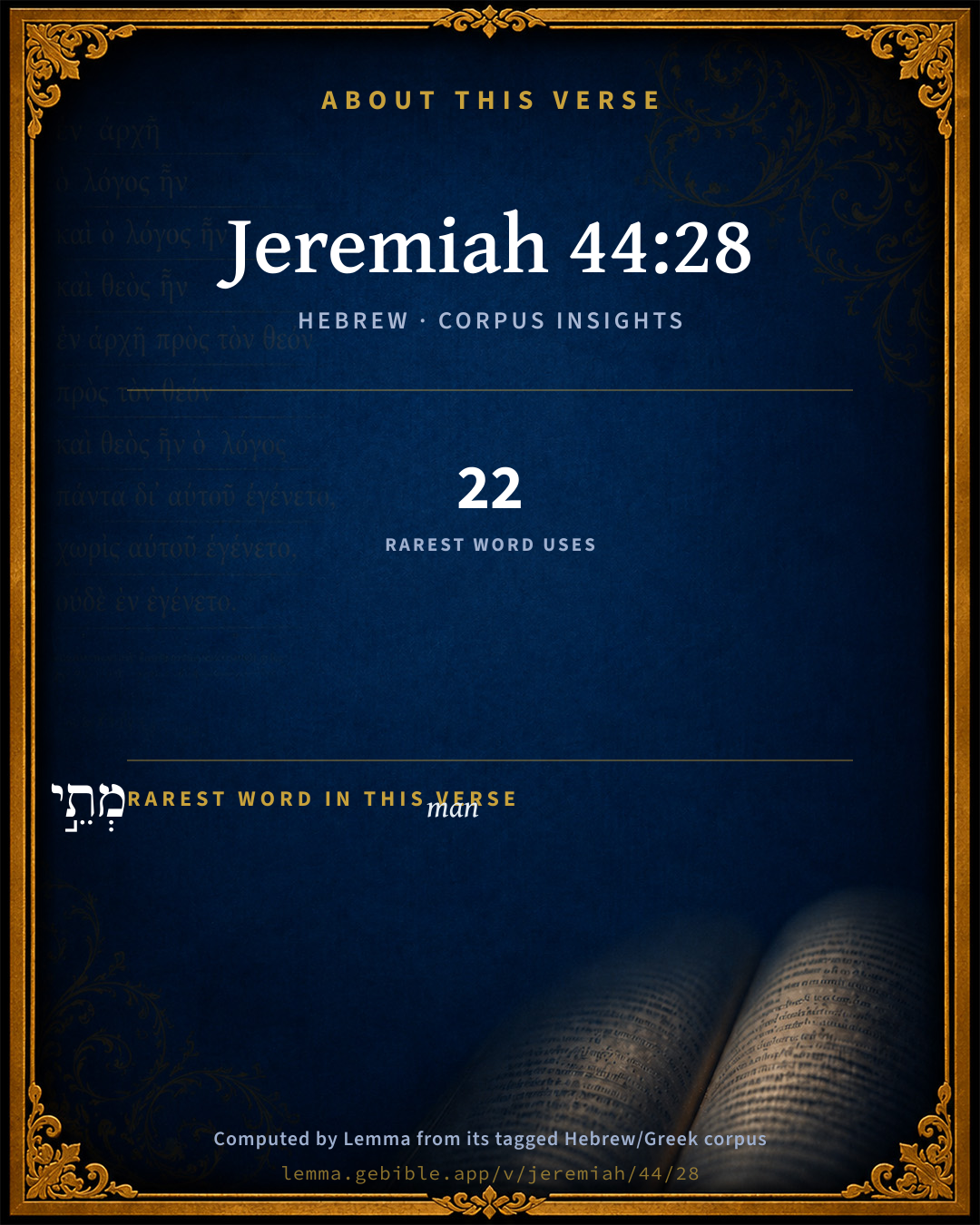
The rarest word here is מְתֵ֣י man H4962 — appearing just 22 times in the whole Hebrew Bible.

Shared distinctive vocabulary

מְתֵ֣י man H4962 occurs in 21 verses of the Hebrew Bible. Also found in:

Grammatical profile

  • 5 verbs
  • 14 nouns
  • 3 prepositions
  • 1 adverb
  • 1 particle

Verb forms

  • יְשֻׁב֨וּן Qal · Imperfect
  • וְֽיָדְע֞וּ Qal · Sequential Perfect
  • הַבָּאִ֤ים Qal · Participle Active
  • לָג֣וּר Qal · Infinitive Construct
  • יָק֖וּם Qal · Imperfect

Repetition

Words recur within this verse — often emphatic in Hebrew:

  • אֶ֧רֶץ land H776 ×3
  • מִצְרַ֛יִם Egypt H4714 ×2
  • יְהוּדָ֖ה Judah H3063 ×2
  • מִן from H4480 ×2

Cross-references

16

Topical passages linked to Jeremiah 44:28 in the Treasury of Scripture Knowledge — connected by theme and wording, ordered by reader-vote popularity; previews shown in the World English Bible.

  • Jeremiah 44:14 so that none of the remnant of Judah, who have gone into the land of Egypt to sojourn there, shall escape or be left, to return into the land of Judah, to which they have a desire to return to dwell there: for none shall return save such as shall escape.
  • Isaiah 10:19 The remnant of the trees of his forest shall be few, so that a child may write them.
  • Isaiah 27:12–13 It shall happen in that day, that Yahweh will beat off [his fruit] from the flood of the River to the brook of Egypt; and you shall be gathered one by one, you children of Israel.
  • Jeremiah 44:25–26 Thus says Yahweh of Hosts, the God of Israel, saying, You and your wives have both spoken with your mouths, and with your hands have fulfilled it, saying, We will surely perform our vows that we have vowed, to burn incense to the queen of the sky, and to pour out drink-offerings to her: establish then your vows, and perform your vows.
  • Psalms 33:11 The counsel of Yahweh stands fast forever, The thoughts of his heart to all generations.
  • Isaiah 28:16–18 therefore thus says the Lord Yahweh, Behold, I lay in Zion for a foundation a stone, a tried stone, a precious corner -[stone] of sure foundation: he who believes shall not be in haste.
  • Isaiah 46:10–11 declaring the end from the beginning, and from ancient times things that are not [yet] done; saying, My counsel shall stand, and I will do all my pleasure;
  • Jeremiah 44:29 This shall be the sign to you, says Yahweh, that I will punish you in this place, that you may know that my words shall surely stand against you for evil:
  • Lamentations 3:37–38 Who is he who says, and it comes to pass, when the Lord doesn't command it?
  • Zechariah 1:6 But my words and my decrees, which I commanded my servants the prophets, didn't they overtake your fathers? "Then they repented and said, 'Just as Yahweh of Hosts determined to do to us, according to our ways, and according to our practices, so he has dealt with us.'"
  • Numbers 14:28–29 Tell them, As I live, says Yahweh, surely as you have spoken in my ears, so will I do to you:
  • Numbers 14:41 Moses said, Why now do you disobey the commandment of Yahweh, seeing it shall not prosper?
  • Isaiah 14:24–27 Yahweh of Hosts has sworn, saying, Surely, as I have thought, so shall it happen; and as I have purposed, so shall it stand:
  • Jeremiah 44:16–17 As for the word that you have spoken to us in the name of Yahweh, we will not listen to you.
  • Matthew 24:35 Heaven and earth will pass away, but my words will not pass away.
  • Isaiah 10:22 For though your people, Israel, be as the sand of the sea, [only] a remnant of them shall return: a destruction [is] determined, overflowing with righteousness.

Cross-references courtesy of OpenBible.info (CC BY 4.0).

Hebrew and Greek witnesses Masoretic Hebrew ↔ Greek Septuagint

The same verse in the two great witnesses to the Old Testament, shown verse-for-verse.

These are two independent witnesses, not word-aligned to each other, and the Septuagint is shown in lemma (dictionary) form.

Hebrew Jeremiah 44:28 Masoretic · Westminster Leningrad Codex

וּפְלִיטֵ֨י חֶ֜רֶב יְשֻׁב֨וּן מִן אֶ֧רֶץ מִצְרַ֛יִם אֶ֥רֶץ יְהוּדָ֖ה מְתֵ֣י מִסְפָּ֑ר וְֽיָדְע֞וּ כָּל שְׁאֵרִ֣ית יְהוּדָ֗ה הַבָּאִ֤ים לְאֶֽרֶץ מִצְרַ֨יִם֙ לָג֣וּר שָׁ֔ם דְּבַר מִ֥י יָק֖וּם מִמֶּ֥נִּי וּמֵהֶֽם

Those who escape the sword shall return out of the land of Egypt into the land of Judah, few in number; and all the remnant of Judah, who have gone into the land of Egypt to sojourn there, shall know whose word shall stand, mine, or theirs.

World English Bible · Public Domain

Greek LXX Structure differs

In the Septuagint, Jeremiah is about an eighth shorter than the Hebrew and arranges its material differently — the Oracles Against the Nations (Hebrew chapters 46–51) appear in the middle of the Greek book, after 25:13. Because the chapter and verse boundaries do not line up, a verse-for-verse comparison with the Hebrew is not shown.

A verse-for-verse comparison isn’t shown here because the chapters and verses don’t line up. Switch to the LXX edition with the MT / LXX toggle above to read the Greek directly.

Hebrew: Westminster Leningrad Codex (CC BY 4.0). Greek: Septuagint (public domain); English from a public-domain English Septuagint. How the Septuagint differs from the Hebrew →

Targum (Aramaic paraphrase)

1

The Targum is the ancient Jewish Aramaic paraphrase of the Hebrew Scriptures — an interpretive translation, not the Hebrew text itself. Onkelos (literal) and Pseudo-Jonathan (expansive) render the Torah, and Jonathan the Prophets. Coverage is partial: where no permissively-licensed English translation exists for a verse, only the Aramaic is shown. This is verse-level text, not a word-by-word alignment to the Hebrew.

  1. Targum Jonathan Prophets (Joshua–Malachi)
    וּמְשֵׁיזְבֵי חַרְבָּא יְתוּבוּן מִן אַרְעָא דְמִצְרַיִם לְאַרְעָא דְבֵית יְהוּדָה עַם דְמִנְיָן וְיֵדְעוּן כָּל שְׁאָרָא דְבֵית יְהוּדָה דְאָתָן לְאַרְעָא דְמִצְרַיִם לְאִתּוֹתָבָא תַמָן פִּתְגָם דְמַן יִתְקַיֵם אִם דִילִי וְאִם דִילְהוֹן:

    (no public-domain English translation for this verse)

    Targum Jonathan — Aramaic: “Mikraot Gedolot” (public domain). English: “Sefaria Community Translation” (CC0 1.0 (public-domain dedication)); “London "Chaldee Paraphrase," 1871” (public domain). Text via Sefaria.

Commentary

Notes on Jeremiah 44:28 from classic Christian and Jewish commentators (each source and its license shown beneath its notes). The classic Christian expositions comment on the surrounding passage and are grouped to its opening verse, so a note may address several verses; the Jewish commentaries on the Tanakh (Rashi and others) are per-verse, so they appear only where the commentator wrote on this verse.

Lemma curates 59 commentaries, every one of them public domain or Creative Commons licensed, each selected and text-cleaned for this edition rather than reprinted as found. About our sources →

Trapp's Complete Commentary

John Trapp

Jer 44:28 Yet a small number that escape the sword shall return out of the land of Egypt into the land of Judah, and all the remnant of Judah, that are gone into the land of Egypt to sojourn there, shall know whose words shall stand, mine, or theirs.

Ver. 28. Yet a small number.] Methe mispar, men of number, a poor few: still God reserveth a remnant for royal use.

Shall know whose word shall stand.] Because they are so peremptory and resolute, I shall try it out with them. I shall be as cross as they, yet still in a way of justice.

John Trapp, A Commentary or Exposition upon All the Books of the Old and New Testament (1647–1656) — public domain. Text from a community e-Sword module.

Geneva Bible (1599)

Geneva Bible translators

We see therefore that God hath a perpetual care over his, wheresoever they are scattered: for though they be but two or three, yet he will deliver them when he destroyeth his enemies.

Geneva Bible (1599) marginal notes — public domain. Text via Bolls.life.

Jamieson, Fausset & Brown

Robert Jamieson, A. R. Fausset & David Brown

small number--(see on Jer 44:14; and Jer 42:17; Isa 27:13); compare "all-consumed" (Jer 44:27). A band easily counted, whereas they were expecting to return triumphantly in large numbers.

shall know--most of them experimentally, and to their cost.

whose words . . . mine, or theirs--Hebrew, "that from Me and them." Jehovah's words are His threats of destruction to the Jews; theirs, the assertion that they expected all goods from their gods (Jer 44:17), &c. "Mine"; by which I predict ruin to them. "Theirs"; by which they give themselves free scope in iniquity.

shall stand-- (Psa 33:11).

Jamieson, Fausset & Brown — Commentary Critical and Explanatory on the Whole Bible (1871) — public domain (CC PDM 1.0). Text via the HelloAO Bible API.

John Calvin's Commentaries

He at length adds that a few would escape. He had said before, (Jeremiah 44:14) that there would be none, but added at the end of the verse, “but such as shall escape.” We said that this second clause is to be explained of the Jews who had been driven into exile in Babylon. But if it be applied to exiles in Egypt the meaning will be different. For the Prophet then said that none would escape, that none would remain alive: he thus doubtless took away every hope of deliverance with regard to those in Egypt. But he added, “but such as shall escape,” that is, such as should stealthily escape from the sword, as though they had never migrated into Egypt. And then in this different sense must necessarily be taken what the Prophet adds now, They who escape shall return But we must bear in mind that those remaining alive would not be numbered among the exiles, for they must have withdrawn themselves so as no longer to form a part of that people. They had before become fugitives, but when they departed from Egypt, that second flight made them to be no longer a residue in that land.

When, therefore, the Prophet declares that none of the residue would escape, we must understand the words as meaning, that there would be Jews no more in Egypt, as their memory would be obliterated. But when, in the second place, he mentions evaders, פליטים, pelithim, (the word which we have rendered, “They who shall escape,”) he means that those who escaped had now ceased to be counted among the residue, having in a manner of their own accord separated themselves from them, so that they were no longer to be reckoned among the fugitive exiles in Egypt. Then he says, that those who escape from the sword would return into the land of Judah; an event wholly different from what they looked for, for they expected to return to their own country in a triumphant manner. They intended indeed to dwell in Egypt only for a time; and they hoped to come afterwards into a free possession of the land, when the Chaldeans had gone far away. Thus they had promised to themselves a new kingdom, and were not disposed to return except in great pomp. As, then, such a restoration had been imagined by them, the Prophet says, that a few only would return into the land of Judah; and then that they would return, not to possess the land and enjoy it as their own inheritance, but that they would return, because there would be no safe corner where they might hide themselves. We hence see that this return is set up in opposition to the false imagination in which the Jews indulged; and he says that a few only would return.

And at length he adds, All the remnant of Judah who had entered into the land of Egypt, shall know whose word shall stand, mine, or theirs Here at length the sentence is completed, for I have said that it was the Prophet’s object to convince the Jews of their foolish and impious presumption, when in their perverseness they contended against God, as though he had said, “What do you mean, ye wretched beings? Is the truth of God to give way, or can you frustrate his purpose by your madness and obstinacy? And surely God will prove stronger than you.” He now then fully explains his meaning. By saying, all shall know, he does not refer to true and sincere knowledge, but to experience, that is, they shall at length really find out whose word is firm, mine or theirs.

This passage deserves special attention; we hence learn that we ought to acquiesce in God’s word, and wholly to receive it, and especially to beware of that diabolical obstinacy which the Prophet here condemns; for when we fight to the last, we must at the end necessarily fall; though we may a hundred times complain and clamor, yet God’s word will stand firm and will never yield to us. It follows, —

John Calvin's Commentaries (1540-1563) — public domain. Text from the Calvin Translation Society English edition (1840s-50s) via the Christian Classics Ethereal Library (ccel.org). Calvin's coverage is partial (roughly two-thirds of the Bible); uncommented books and verses are honest gaps, never fabricated. The 19th-century editor's footnotes and remarks are omitted so the notes are faithfully Calvin's own voice.

John Gill's Exposition

Yet a small number that shall escape the sword,.... The sword of the king of Babylon, and the other judgments, and which would be but very few; "men of number" (k), as in the Hebrew text, which might easily be numbered; Jeremiah the prophet, and Baruch the son of Neriah, and some few righteous persons among them, as Kimchi and Abarbinel observe:

shall return out of the land of Egypt into the land of Judah; they shall make their escape out of the land of Egypt, whither they did not go willingly; and, by one providence or another, shall come back to their native country, the land of Judea, When the rest will not; which must be a distinguishing your to them:

and all the remnant of Judah, that are gone into the land of Egypt to sojourn there, shall know what words shall stand, mine or theirs; those that are left of the sword, famine, and pestilence, shall know experimentally, by facts laid down, whose words have their effect and accomplishment, stand firm and sure; whether theirs, that promised impunity and safety, peace and prosperity, in their idolatrous practices; or the Lord's, which threatened with ruin and destruction. The Lord is true, and every man a liar; whatever devices are in a man's heart, the counsel of the Lord, that shall stand.

(k) "viri numeri", Montanus, &c.

John Gill's Exposition of the Whole Bible (1746–1763) — public domain (CC PDM 1.0). Text via the HelloAO Bible API.

Matthew Poole's English Annotations

This justifieth the restrained interpretation of none of the remnant, Jer 44:14; for here it is plainly said that some should escape and return; but for the rest, they should there perish, and by that it would appear whether God’s word or theirs should stand, and have its accomplishment; they promising themselves security, God threatening them with utter ruin and destruction.

Matthew Poole's English Annotations on the Holy Bible (1683–1685) — public domain. Text from a community e-Sword/MySword module.

Whedon's Commentary on the Bible

Daniel D. Whedon

28. A small number… shall return — Literally, and fugitives from the sword shall return from the land of Egypt to the land of Judah, men of numbers, etc. The last phrase suggests the fewness of those who shall escape — so few that they can be counted.

Whose words… mine, or theirs — Literally, the word from me or from them. The allusion is to the particular word given above.

Daniel D. Whedon (gen. ed.), Commentary on the Old and New Testaments (1874–1909) — public domain. Text from a community e-Sword module.

The Pulpit Commentary

Yet a small number, etc. Isaiah"s doctrine of the remnant. In the midst of judgment, God remembers mercy, and his ancient covenant. A remnant is saved as the nucleus of a regenerate people.

The remnant of the remnant.

Of the Jews who escaped the sword of Nebuchadnezzar in the invasion of their land, "a remnant "fled to Egypt; of this body of refugees "a remnant" was to survive the dangers that would destroy the greater part. Thus but a small number would return to Jerusalem in safety. For their folly in fleeing to Egypt the fugitives would suffer a second desolation, while the captives in Babylon and the patient poor people who remained in the land of their fathers would be spared. Yet even out of this further calamity some few would be brought in safety.

I JUDGMENT IS TEMPERED WITH MERCY. Many are spared at the first blow. Some of these are only hardened in wickedness. A second blow falls. Still some are spared. God is reluctant to give his people up. If he can find room for any mercy in the midst of the severest judgment, he will exercise it.

II GOD"S JUDGMENT IS DISCRIMINATING. Even now it must be so; for "shall not the Judge of all the earth do right?" But we do not yet know its purposes and its methods, and therefore to us it looks as though it could not take note of individual deserts. Ultimately we shall see how God has overlooked no exceptional case. Noah is picked out of the drowning world. Lot is remembered in Sodom. Elijah is provided for in the general drought. We can look for no such evidences of an interfering Providence in earthly things now, perhaps, but the truth they illustrate holds good, and must work its blessed results in the day of final account. Natural selection does not always result in the survival of the morally fittest on earth. On the contrary, the good may become martyrs, the bad triumphant tyrants. But we see only the opening acts of the drama. The final catastrophe will reveal the justice that regulates.

III LEFT TO THEMSELVES, NO MEN COULD ESCAPE THE DOOM OF SIN. In the eternal judgment there could not even. be a remnant of a remnant, "All have sinned, and come short of the glory of God." All would, therefore, receive the wages of sin.

IV BY THE REDEMPTION OF CHRIST ALL WHO HAVE SINNED MAY BE SAVED. This is large enough to deliver, not merely a remnant of a remnant, but every man who has fallen, however low he lies in the mire.

V AT FIRST BUT A REMNANT OF A REMNANT ARE SAVED BY CHRIST. The question whether few were to be saved was not to be answered for the satisfaction of idle curiosity. (Luk_13:23) But that only a few sought the grace of Christ at first is a historical fact. The number has grown wonderfully, and yet how large a part of the world must be accounted still dark and dead in sin! But the few are saved that they may win the many. The first disciples became apostles. The small remnant laid the foundation of a great nation. The Church is called to evangelize the world.

Human and Divine confidence.

I IN WHAT THEY ARE ALIKE.

1. In the assurance with which they are expressed. Here are men, in their worldly wisdom, perfectly certain that the course they have adopted will turn out right. It is always important to notice the assured unquestioning spirit in which men will set out on their enterprises. They do not seem to see the failures, disgraces, and humiliations of others; such overwhelming troubles are not to come nigh them. And all this is great testimony to the use of faith to men. God means men to be confident. The confidence which he ever expresses himself is meant to find a correspondent confidence in us. We need never be dubious in matters of a spiritual kind, however dubious we have to be as to certain external results. If we only act in the right, divinely ordained way, then we can continually be confident that all will come right.

2. In the time of waiting needful to justify the confidence. God speaks words, the truth and profound significance of which it may take not merely generations but even millenniums to make manifest to the whole world. Everything immediately apparent to the outward eye may contradict what he says. And something of his own wisdom and insight into the future he gives to men of the right spirit, so that they may work for results which are to be developed through long periods. He makes it possible for men to go on believing, hopeful and patient through all discouragements, and even to die in the faith that what they have sown others will reap. Thus faith which God makes to stand in the beginning he strengthens and establishes even to the end. And that faith which makes men themselves to utter confident dogmatic words will not be shaken all at once. Time is to try all things the wisdom of the wise and the folly of the fools, the result of that which is sown to the Spirit and that which is sown to the flesh.

II IN WHAT THEY DIFFER. In respect of real and deep insight into the future. The man who is confident in worldly wisdom is simply confident in the doctrine of chances. His chance of stability and success is equally good with that of others. Some must fail, but some must succeed. But God would have us ever to understand that success el this sort is only a deferred failure. If men could only see far enough, success and honour and safety would be utterly transmuted into failure, disgrace, and ruin. But God"s confidence is based on certain and complete knowledge. The end of all unsettlement and change must be something stable and continuous, and when God sees men reckoning themselves on a true foundation, which after all is miserably brief and frail, he can only assert the truth. If men will not believe, the only thing remaining is to wait. The utter downfall of the Jewish nation from such a height to such a depth was predicted even in the days of their outward glory. The Word of God stands because he can discern the certain exhaustion of purely human resources even when those resources show themselves in exuberant exercise and impressive achievement. Y.

The Pulpit Commentary (1880–1919), ed. H.D.M. Spence-Jones & Joseph S. Exell — public domain. Text from a community e-Sword module.

Lesson kit

Teaching starters — assembled from the data on this page, not authored interpretation. Every prompt links to the verse data it draws on. Edit before teaching.

Jeremiah, in the Prophets, opens this verse with 24 words (18 distinct Hebrew lemmas). Its most distinctive word is math (“man”). A historical commentator’s framing appears above. Read the whole chapter for the surrounding context.

Discussion questions

  1. How does “man” (math) shape what this verse is saying?
  2. How does Genesis 34:30, which shares the word «man», read alongside this verse?
  3. What does the repetition of “land” (3× in this one verse) do in this verse?
  4. The translations on this page render this verse differently — a whole-verse word diff, not a word-by-word alignment. What might account for the different wordings?
  5. «יְשֻׁב֨וּן» is a Qal Imperfect verb. How does that grammatical form shape the action described?
  6. Compare how Trapp's Complete Commentary and Geneva Bible (1599) read this verse. Where do they agree or differ?

Things to notice

Reading settings

Reading text

Shown beneath each verse's original-language words.

Old Testament
Old Testament edition

Read the OT as the Masoretic Hebrew (MT) or the Greek Septuagint (LXX).

English shown for the Greek Septuagint (in the Hebrew ↔ Greek comparison).

Comparing translations? Open the Compare panel on any verse page to stack up to four side by side.