
Judges 8:10

Hebrew (Westminster Leningrad Codex) Judges 8:10 appears in the Hebrew Old Testament. The text above is from the Westminster Leningrad Codex. Each word links to its Strong’s number, a concise gloss, and parsing drawn from the Open Scriptures Hebrew Bible morphology. Click any word for its full Brown-Driver-Briggs (BDB) entry.
Download image
Cite this verse

Judges 8:10 (World English Bible). Public Domain. Lemma interlinear Bible study tool, https://lemma.gebible.app/v/judges/8/10.

Show BibTeX & RIS
BibTeX
RIS
English Translation
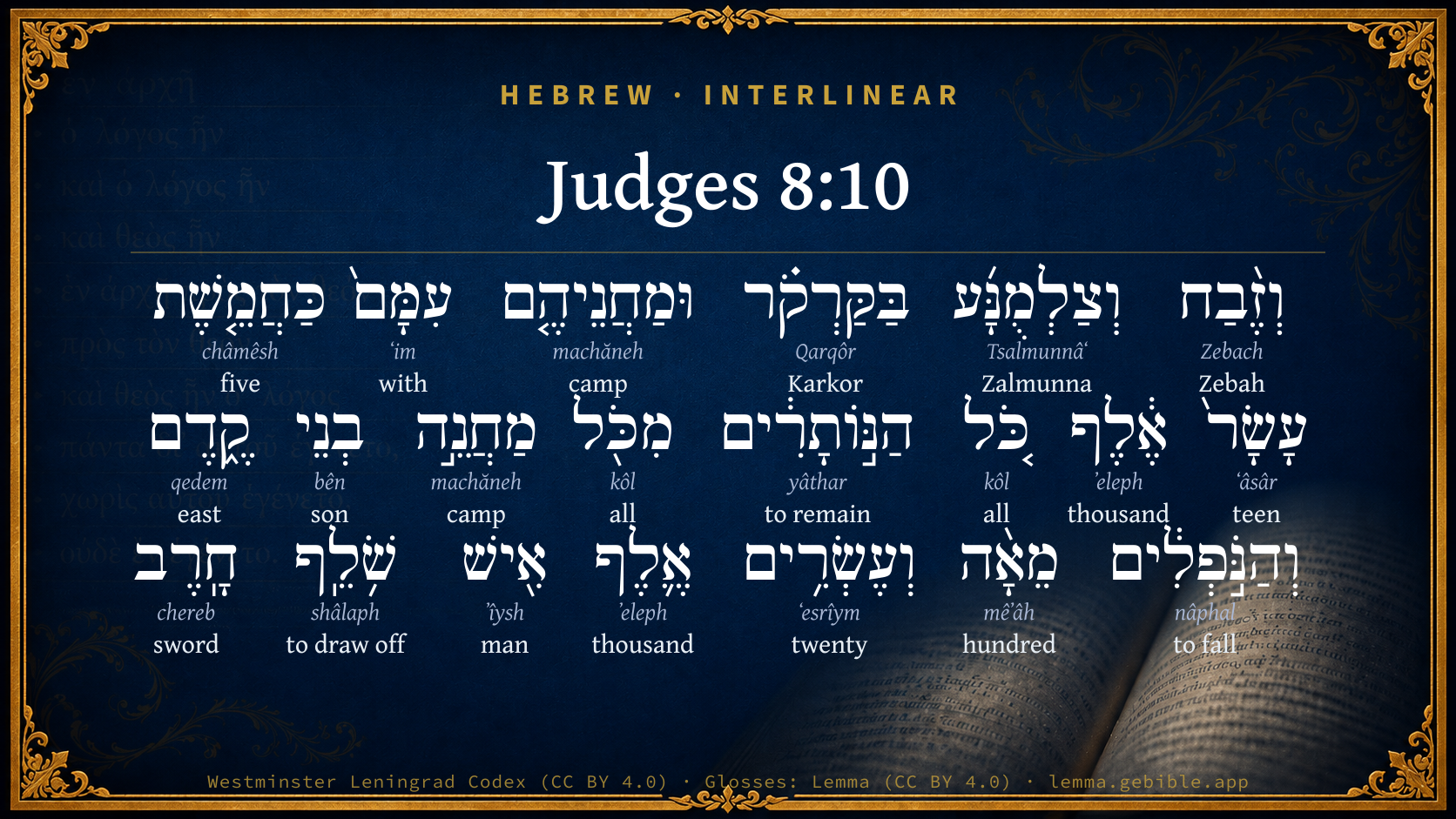
Now Zebah and Zalmunna were in Karkor, and their hosts with them, about fifteen thousand men, all who were left of all the host of the children of the east; for there fell one hundred twenty thousand men who drew sword.
World English Bible · Public Domain
Highlights
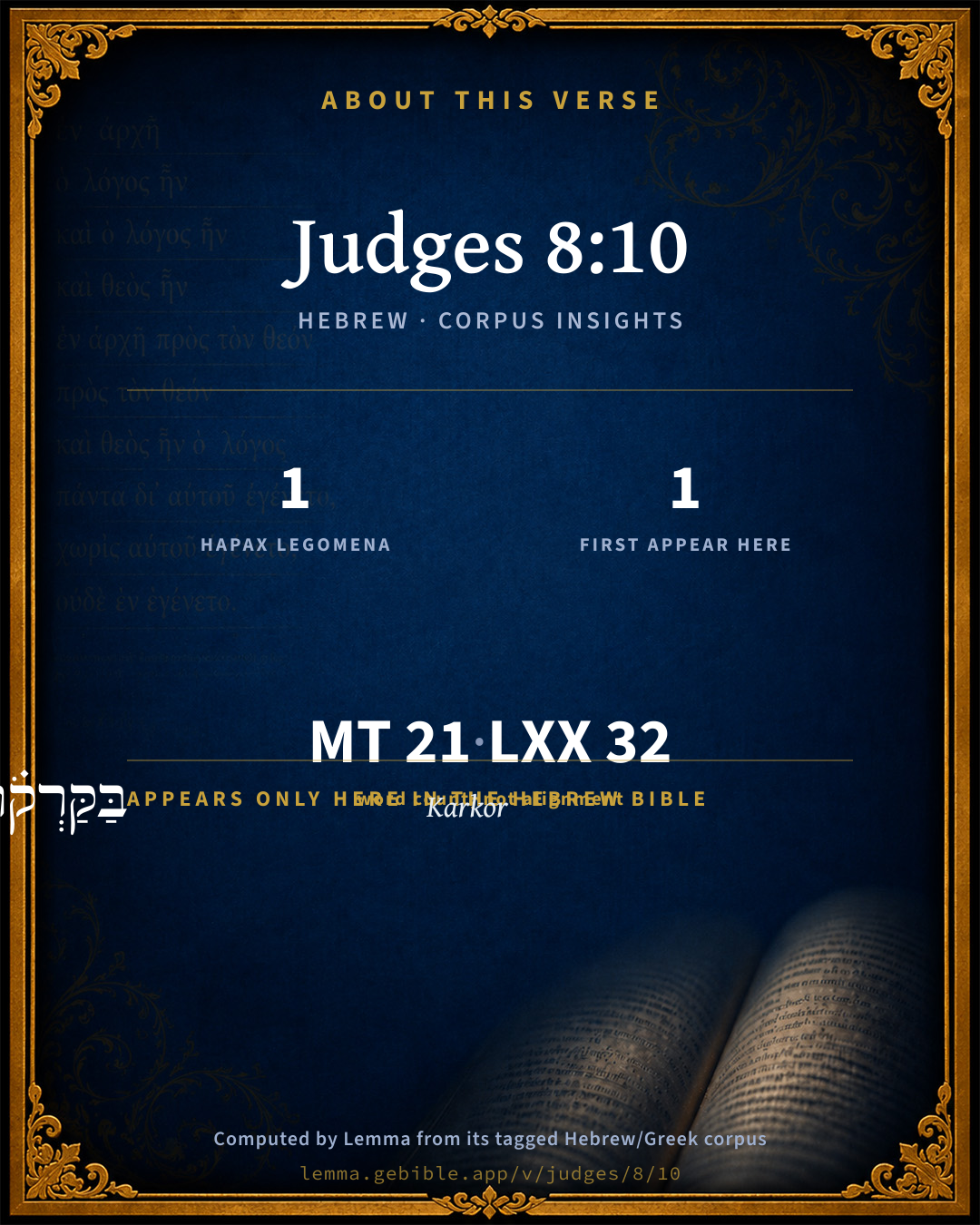
  • 1 hapax legomenon — only here in the Hebrew Bible
  • 1 first appearance in the Hebrew Bible
Full analysis ↓
Download a study sheet

One document with this verse’s original text, its word-by-word gloss line, the meaning frame, cross-references with their text, attributed commentary, and full source and license credits — printable, and it pastes into notes with its structure intact.

This verse Autodidact and up

Study sheet (.html) Plain text (.txt)

A passage Seminary Student

Up to 50 verses in one chapter. A passage sheet keeps up to 6 commentary sources and 12 cross-references per verse, in the order this page ranks them, and says so on the sheet whenever that leaves anything out. Ask for a single verse and you get the Autodidact verse sheet above.

Everything on this page stays free to read, with no account — the sheet is a download of what is already on screen, not access to it.

Want to remove ads? Support Godless Engineer
Compare translations 3

The same verse in 3 English versions, stacked beneath the original-language interlinear above. Click any original word for its lexicon entry.

Each is an independent rendering of the whole verse — the interlinear is not word-aligned to these translations.

Highlighted words mark where these versions differ — a whole-verse word diff, not a word-by-word alignment.

  • World English Bible Public Domain
    Now Zebah and Zalmunna were in Karkor, and their hosts with them, about fifteen thousand men, all who were left of all the host of the children of the east; for there fell one hundred twenty thousand men who drew sword.
  • King James Version Public Domain
    Now Zebah and Zalmunna were in Karkor, and their hosts with them, about fifteen thousand men, all that were left of all the hosts of the children of the east: for there fell an hundred and twenty thousand men that drew sword.
  • unfoldingWord Literal Text CC BY-SA 4.0
    Now Zebah and Zalmunna in Karkor and their camps with them, about 15, 000, all of the remaining from all of the camp of the sons of the east, and the having fallen 120, 000 men drawing the sword.

unfoldingWord Literal Text — © unfoldingWord, licensed CC BY-SA 4.0. Word-aligned USFM3 via Door43 (git.door43.org/unfoldingWord/en_ult).

Versions to compare (up to 4)

3 of 4 selected

Show all 18 translations

Every available English version of this verse, each an independent rendering of the whole verse.

  • World English Bible Public Domain
    Now Zebah and Zalmunna were in Karkor, and their hosts with them, about fifteen thousand men, all who were left of all the host of the children of the east; for there fell one hundred twenty thousand men who drew sword.
  • Berean Standard Bible Public Domain
    Now Zebah and Zalmunna were in Karkor with their army of about fifteen thousand men—all that were left of the armies of the people of the east. A hundred and twenty thousand swordsmen had already fallen.
  • Majority Standard Bible Public Domain
    Now Zebah and Zalmunna were in Karkor with their army of about fifteen thousand men—all that were left of the armies of the people of the east. A hundred and twenty thousand swordsmen had already fallen.
  • King James Version Public Domain
    Now Zebah and Zalmunna were in Karkor, and their hosts with them, about fifteen thousand men, all that were left of all the hosts of the children of the east: for there fell an hundred and twenty thousand men that drew sword.
  • American Standard Version (1901) Public Domain
    Now Zebah and Zalmunna were in Karkor, and their hosts with them, about fifteen thousand men, all that were left of all the host of the children of the east; for there fell a hundred and twenty thousand men that drew sword.
  • Revised Version (1885) Public Domain
    Now Zebah and Zalmunna were in Karkor, and their hosts with them, about fifteen thousand men, all that were left of all the host of the children of the east: for there fell an hundred and twenty thousand men that drew sword.
  • Geneva Bible (1599) Public Domain
    Now Zebah and Zalmunna were in Karkor, and their hostes with them, about fifteene thousande, all that were left of all the hostes of them of the East: for there was slaine an hundreth and twentie thousand men, that drew swordes.
  • Douay-Rheims (1899) Public Domain
    But Zebee and Salmana were resting with all their army. For fifteen thousand men were left of all the troops of the eastern people, and one hundred and twenty thousand warriors that drew the sword, were slain.
  • Young's Literal Translation Public Domain
    And Zebah and Zalmunna `are' in Karkor, and their camps with them, about fifteen thousand, all who are left of all the camp of the sons of the east; and those falling `are' a hundred and twenty thousand men, drawing sword.
  • Literal Standard Version CC BY-SA 4.0
    And Zebah and Zalmunna [are] in Karkor, and their camps with them, about fifteen thousand, all who are left of all the camp of the sons of the east; and those falling [are] one hundred and twenty thousand men, drawing sword.
  • Unlocked Literal Bible CC BY-SA 4.0
    Now Zebah and Zalmunna were in Karkor with their army, about fifteen thousand men, all who remained out of the entire army of the people of the East, for there had fallen 120,000 men who drew the sword.
  • unfoldingWord Literal Text CC BY-SA 4.0
    Now Zebah and Zalmunna in Karkor and their camps with them, about 15, 000, all of the remaining from all of the camp of the sons of the east, and the having fallen 120, 000 men drawing the sword.
  • Darby Bible Public Domain
    Now Zebah and Zalmun'na were in Karkor with their army, about fifteen thousand men, all who were left of all the army of the people of the East; for there had fallen a hundred and twenty thousand men who drew the sword.
  • World Messianic Bible Public Domain
    Now Zebah and Zalmunna were in Karkor, and their armies with them, about fifteen thousand men, all who were left of all the army of the children of the east; for there fell one hundred twenty thousand men who drew sword.
  • Webster's Bible Public Domain
    Now Zebah and Zalmunna were in Karkor, and their hosts with them, about fifteen thousand men, all that were left of all the hosts of the children of the east: for there fell a hundred and twenty thousand men that drew sword.
  • Free Bible Version CC BY-SA 4.0
    Zebah and Zalmunna were in Karkor with their armies of around fifteen thousand men. These were all who remained of the armies of the people of the East—one hundred and twenty thousand swordsmen had already been killed.
  • Bible in Basic English Public Domain
    Now Zebah and Zalmunna were in Karkor and their armies with them, about fifteen thousand men, those of all the army of the children of the east who were still living; for a hundred and twenty thousand of their swordsmen had been put to death.
  • JPS Tanakh (1917) Public Domain
    Now Zebah and Zalmunna were in Karkor, and their hosts with them, about fifteen thousand men, all that were left of all the host of the children of the east; for there fell a hundred and twenty thousand men that drew sword.

Literal Standard Version (2020), Covenant Press — licensed CC BY-SA 4.0. Text via the HelloAO Bible API (eBible.org). Unlocked Literal Bible (unfoldingWord) — licensed CC BY-SA 4.0. Text via the HelloAO Bible API (eBible.org). unfoldingWord Literal Text — © unfoldingWord, licensed CC BY-SA 4.0. Word-aligned USFM3 via Door43 (git.door43.org/unfoldingWord/en_ult). Free Bible Version, Dr. Jonathan Gallagher — licensed CC BY-SA 4.0. Text via the HelloAO Bible API (eBible.org).

Word by word

More ways to search: Search by grammar → Find every occurrence → Compare this word →

Practice this passage: Drill this verse → Learn its vocabulary →

בַּקַּרְקֹ֗ר
Qarqôr
H7174
“in/at the · Karkor”
Preposition, Determined + Noun, Proper
Part of Speech
Preposition + Noun
Type
Proper
Full BDB Definition

Origin: from H6979

TWOT: None

Karkor = "foundation" - a place east of the Jordan in Gilead where Zebah and Zalmunna were again routed by Gideon
  1. וְזֶ֨בַח Zebach H2078 “and · Zebah” Conjunction + Noun, Proper
  2. וְצַלְמֻנָּ֜ע Tsalmunnâʻ H6759 “and · Zalmunna” Conjunction + Noun, Proper
  3. וּמַחֲנֵיהֶ֤ם machăneh H4264 “and · camps · their” Conjunction + Noun, Common, Both, Plural, Construct + Suffix, Personal, 3rd Person, Masculine, Plural
  4. עִמָּם֙ ʻim H5973 “with · them” Preposition + Suffix, Personal, 3rd Person, Masculine, Plural
  5. כַּחֲמֵ֤שֶׁת châmêsh H2568 “like/as · five” Preposition + Adjective, Cardinal number, Masculine, Singular, Construct
  6. עָשָׂר֙ ʻâsâr H6240 “teen” Adjective, Cardinal number, Masculine, Singular, Absolute
  7. אֶ֔לֶף ʼeleph H505 “thousand” Adjective, Cardinal number, Both, Singular, Absolute
  8. כֹּ֚ל kôl H3605 “all of” Noun, Common, Masculine, Singular, Construct
  9. הַנּ֣וֹתָרִ֔ים yâthar H3498 “the · remaining” Particle, Definite Article + Verb, Niphal, Participle Active, Masculine, Plural, Absolute
  10. מִכֹּ֖ל kôl H3605 “from · all of” Preposition + Noun, Common, Masculine, Singular, Construct
  11. מַחֲנֵ֣ה machăneh H4264 “camp of” Noun, Common, Both, Singular, Construct
  12. בְנֵי bên H1121 “sons of” Noun, Common, Masculine, Plural, Construct
  13. קֶ֑דֶם qedem H6924 “east” Noun, Common, Masculine, Singular, Absolute
  14. וְהַנֹּ֣פְלִ֔ים nâphal H5307 “and · the · falling” Conjunction + Particle, Definite Article + Verb, Qal, Participle Active, Masculine, Plural, Absolute
  15. מֵאָ֨ה mêʼâh H3967 “hundred” Adjective, Cardinal number, Both, Singular, Absolute
  16. וְעֶשְׂרִ֥ים ʻesrîym H6242 “and · twenty” Conjunction + Adjective, Cardinal number, Both, Plural, Absolute
  17. אֶ֛לֶף ʼeleph H505 “thousand” Adjective, Cardinal number, Both, Singular, Absolute
  18. אִ֖ישׁ ʼîysh H376 “man” Noun, Common, Masculine, Singular, Absolute
  19. שֹׁ֥לֵֽף shâlaph H8025 “drawing off” Verb, Qal, Participle Active, Masculine, Singular, Absolute
  20. חָֽרֶב chereb H2719 “sword” Noun, Common, Feminine, Singular, Absolute

About this verse

These counts appear in no published source. They are computed here, from the morphology-tagged text and Lemma’s own curated glosses. What Lemma adds →

21
words
18
distinct lemmas
Historical
section

Notable vocabulary

1 hapax legomenon — a word that appears only here in the entire Hebrew Bible:

  • בַּקַּרְקֹ֗ר Karkor H7174

First appearance in Scripture

This word makes its first canonical appearance in the Hebrew Bible here:

  • בַּקַּרְקֹ֗ר Karkor H7174

Shared distinctive vocabulary

וְזֶ֨בַח Zebah H2078 occurs in 9 verses of the Hebrew Bible. Also found in:

Grammatical profile

  • 3 verbs
  • 11 nouns
  • 6 adjectives
  • 1 preposition

Verb forms

  • הַנּ֣וֹתָרִ֔ים Niphal · Participle Active
  • וְהַנֹּ֣פְלִ֔ים Qal · Participle Active
  • שֹׁ֥לֵֽף Qal · Participle Active

Repetition

Words recur within this verse — often emphatic in Hebrew:

  • וּמַחֲנֵיהֶ֤ם camp H4264 ×2
  • אֶ֔לֶף thousand H505 ×2
  • כֹּ֚ל all H3605 ×2

Hebrew & Septuagint length

In English translation the verse runs 41 words from the Hebrew and 42 from the Septuagint (LXX English) — closely comparable.

A rough comparison of the two English renderings, which tokenize alike — not a word-level alignment.

Word counts can differ between the Hebrew and the Greek without any difference in meaning — e.g. the Hebrew direct-object marker אֵת has no separate Greek word, and Greek often adds the article ὁ.

In the original languages it is 21 Hebrew tokens and 32 Greek tokens — but the two are counted differently (Hebrew bundles its prefixes and suffixes into one token; the Greek is in lemma form), so that isn’t a like-for-like length.

Cross-references

15

Topical passages linked to Judges 8:10 in the Treasury of Scripture Knowledge — connected by theme and wording, ordered by reader-vote popularity; previews shown in the World English Bible.

  • Judges 7:12 The Midianites and the Amalekites and all the children of the east lay along in the valley like locusts for multitude; and their camels were without number, as the sand which is on the sea-shore for multitude.
  • Judges 20:2 The chiefs of all the people, even of all the tribes of Israel, presented themselves in the assembly of the people of God, four hundred thousand footmen who drew sword.
  • Judges 20:15 The children of Benjamin were numbered on that day out of the cities twenty-six thousand men who drew the sword, besides the inhabitants of Gibeah, who were numbered seven hundred chosen men.
  • Judges 20:17 The men of Israel, besides Benjamin, were numbered four hundred thousand men who drew sword: all these were men of war.
  • Judges 20:25 Benjamin went forth against them out of Gibeah the second day, and destroyed down to the ground of the children of Israel again eighteen thousand men; all these drew the sword.
  • Judges 20:35 Yahweh struck Benjamin before Israel; and the children of Israel destroyed of Benjamin that day twenty-five thousand one hundred men: all these drew the sword.
  • Judges 20:46 So that all who fell that day of Benjamin were twenty-five thousand men who drew the sword; all these [were] men of valor.
  • 2 Kings 3:26 When the king of Moab saw that the battle was too severe for him, he took with him seven hundred men who drew sword, to break through to the king of Edom; but they could not.
  • Isaiah 9:4 For the yoke of his burden, and the staff of his shoulder, the rod of his oppressor, you have broken as in the day of Midian.
  • Judges 6:5 For they came up with their cattle and their tents; they came in as locusts for multitude; both they and their camels were without number: and they came into the land to destroy it.
  • Judges 7:22 They blew the three hundred trumpets, and Yahweh set every man's sword against his fellow, and against all the host; and the host fled as far as Beth-shittah toward Zererah, as far as the border of Abel Meholah, by Tabbath.
  • 2 Chronicles 13:17 Abijah and his people killed them with a great slaughter: so there fell down slain of Israel five hundred thousand chosen men.
  • 2 Chronicles 28:6 For Pekah the son of Remaliah killed in Judah one hundred twenty thousand in one day, all of them valiant men; because they had forsaken Yahweh, the God of their fathers.
  • 2 Chronicles 28:8 The children of Israel carried away captive of their brothers two hundred thousand, women, sons, and daughters, and took also away much spoil from them, and brought the spoil to Samaria.
  • Isaiah 37:36 The angel of Yahweh went forth, and struck in the camp of the Assyrians one hundred and eighty-five thousand; and when men arose early in the morning, behold, these were all dead bodies.

Cross-references courtesy of OpenBible.info (CC BY 4.0).

Hebrew and Greek witnesses Masoretic Hebrew ↔ Greek Septuagint

The same verse in the two great witnesses to the Old Testament, shown verse-for-verse.

These are two independent witnesses, not word-aligned to each other, and the Septuagint is shown in lemma (dictionary) form.

Hebrew Judges 8:10 Masoretic · Westminster Leningrad Codex

וְזֶ֨בַח וְצַלְמֻנָּ֜ע בַּקַּרְקֹ֗ר וּמַחֲנֵיהֶ֤ם עִמָּם֙ כַּחֲמֵ֤שֶׁת עָשָׂר֙ אֶ֔לֶף כֹּ֚ל הַנּ֣וֹתָרִ֔ים מִכֹּ֖ל מַחֲנֵ֣ה בְנֵי קֶ֑דֶם וְהַנֹּ֣פְלִ֔ים מֵאָ֨ה וְעֶשְׂרִ֥ים אֶ֛לֶף אִ֖ישׁ שֹׁ֥לֵֽף חָֽרֶב

Now Zebah and Zalmunna were in Karkor, and their hosts with them, about fifteen thousand men, all who were left of all the host of the children of the east; for there fell one hundred twenty thousand men who drew sword.

World English Bible · Public Domain

Greek LXX Judges 8:10 Septuagint · lemma form

καί ζεβεε καί σελμανα ἐν καρκαρ καί ὁ παρεμβολή αὐτός μετά αὐτός ὡσεί δέκα πέντε χιλιάς πᾶς ὁ καταλείπω ἀπό πᾶς παρεμβολή ἀλλόφυλος καί ὁ πίπτω ἑκατόν εἴκοσι χιλιάς ἀνήρ σπάω ῥομφαία

And Zebee and Salmana were in Carcar, and their host was with them, about fifteen thousand, all that were left of all the host of the aliens; and they that fell were one hundred and twenty thousand men that drew the sword.

LXX2012 (modern English Septuagint) · Public Domain

Hebrew: Westminster Leningrad Codex (CC BY 4.0). Greek: Septuagint (public domain); English from LXX2012 (modern English Septuagint) (Public Domain). How the Septuagint differs from the Hebrew →

Targum (Aramaic paraphrase)

1

The Targum is the ancient Jewish Aramaic paraphrase of the Hebrew Scriptures — an interpretive translation, not the Hebrew text itself. Onkelos (literal) and Pseudo-Jonathan (expansive) render the Torah, and Jonathan the Prophets. Coverage is partial: where no permissively-licensed English translation exists for a verse, only the Aramaic is shown. This is verse-level text, not a word-by-word alignment to the Hebrew.

  1. Targum Jonathan Prophets (Joshua–Malachi)
    וְזֶבַח וְצַלְמֻנָע בַּקַרְקֹר וּמַשִׁרְיָתֵיהוֹן עִמְהוֹן כַּחֲמֵשֶׁת עֲסַר אַלְפִין כֹּל דְאִשְׁתָּאֲרוּ מִכֹּל מַשִׁרְיַת בְּנֵי מַדִנְחָא וּדְאִתְקַטָלוּ מְאָה וְעַשְׂרִין אַלְפִין גַבְרָא שְׁלִיפֵי חַרְבָּא:

    (no public-domain English translation for this verse)

    Targum Jonathan — Aramaic: “Mikraot Gedolot” (public domain). English: “Sefaria Community Translation” (CC0 1.0 (public-domain dedication)); “London "Chaldee Paraphrase," 1871” (public domain). Text via Sefaria.

Commentary

Notes on Judges 8:10 from classic Christian and Jewish commentators (each source and its license shown beneath its notes). The classic Christian expositions comment on the surrounding passage and are grouped to its opening verse, so a note may address several verses; the Jewish commentaries on the Tanakh (Rashi and others) are per-verse, so they appear only where the commentator wrote on this verse.

Lemma curates 59 commentaries, every one of them public domain or Creative Commons licensed, each selected and text-cleaned for this edition rather than reprinted as found. About our sources →

Jamieson, Fausset & Brown

Robert Jamieson, A. R. Fausset & David Brown

ZEBAH AND ZALMUNNA TAKEN. (Jdg. 8:10-27)

Now Zebah and Zalmunna were in Karkor--a town on the eastern confines of Gad. The wreck of the Midianite army halted there.

Jamieson, Fausset & Brown — Commentary Critical and Explanatory on the Whole Bible (1871) — public domain (CC PDM 1.0). Text via the HelloAO Bible API.

Trapp's Complete Commentary

John Trapp

Jdg 8:10 Now Zebah and Zalmunna [were] in Karkor, and their hosts with them, about fifteen thousand [men], all that were left of all the hosts of the children of the east: for there fell an hundred and twenty thousand men that drew sword.

Ver. 10. Were in Karkor.] A city beyond Jordan, where they thought themselves safe, and feared not a pursuer: but vengeance would not suffer them to live. {Act 28:4}

John Trapp, A Commentary or Exposition upon All the Books of the Old and New Testament (1647–1656) — public domain. Text from a community e-Sword module.

Joseph Benson's Commentary

Jdg 8:10. There fell a hundred and twenty thousand men — Such a terrible execution did they make among themselves, and so easy a prey were they to Israel. That drew the sword — That is, persons expert and exercised in war, besides the retainers to them.

Joseph Benson's Commentary on the Old and New Testaments (1811–1818) — public domain. Text from a community e-Sword module.

Geneva Bible (1599)

Geneva Bible translators

A city Eastward beyond Jordan.

Geneva Bible (1599) marginal notes — public domain. Text via Bolls.life.

Adam Clarke's Commentary

Verse 10. Zebah and Zalmunna were in Karkor] If this were a place, it is nowhere else mentioned in Scripture. Some contend that קרקר karkor signifies rest; and thus the Vulgate understood it: Zebah and Zalmunna requiescebant, rested, with all their army. And this seems the most likely, for it is said, Jdg 8:11, that Gideon smote the host, for the host was secure.

Adam Clarke's Commentary on the Bible (1810–1826) — public domain. Text from a community e-Sword/MySword module.

Ellicott's Commentary for English Readers

(10) In Karkor.—This was the scene of the third battle, or massacre. When they had reached this distant point they probably felt secure. Karkor means, “a safe enclosure,” and the Vulg., regarding it as an ordinary noun, renders it, “where Zebah and Zalmunna were resting.” Eusebius and Jerome identify Karkor with a fortress named Karkaria, a day’s journey north of Petra; but, from the mention of Nobah and Jogbehah in the next verse, this seems to be too far south. If so, it may be Karkagheisch, not far from Amman (Rabbath Ammon), mentioned by Burckhardt. It was, however, “at a very great distance” (Jos., Antt. viii. 6, § 5 from the original scene of battle.

A Bible Commentary for English Readers, edited by Charles John Ellicott (1878–1897) — public domain. Text from a community e-Sword module.

The Cambridge Bible for Schools and Colleges

gen. ed. J. J. S. Perowne

10. Karkor] Site unknown, probably near the edge of the Syrian desert.

all that were left … drew sword] These words have the appearance of an attempt to bring the present narrative into harmony with the account of the panic and flight in Jdg_7:22-25. The exaggerated numbers recall those of Numbers 31 (overthrow of Midian); that drew sword is an expression which often goes with large figures, e.g. Jdg_20:2; Jdg_20:15; Jdg_20:17; Jdg_20:46; 2Sa_24:9 etc.

The Cambridge Bible for Schools and Colleges (gen. ed. J. J. S. Perowne; Cambridge University Press, 1878–1918) — public domain. Text from a community e-Sword module.

John Gill's Exposition

Now Zebah and Zalmunna were in Karkor..... Jerom (u) under this word says, there was in his time a castle called Carcuria, a day's journey from Petra, which was the metropolis of Idumea; but whether the same with this is not clear:

and their host with them, about fifteen thousand men; to which number Gideon and his three hundred men were very unequal; and yet, faint and weary as they were, closely pursued them, attacked and conquered them. Josephus (w) very wrongly makes this number to be about 18,000:

all that were left of the hosts of the children of the east; the Arabians, who with the Amalekites joined the Midianites in this expedition; and perhaps the remainder of the army chiefly consisted of Arabians, the others having mostly suffered in the valley of Jezreel, and at the fords of Jordan:

for there fell an hundred and twenty thousand men that drew sword; besides infirm men, women, and children, which may reasonably be supposed; so that this host consisted of 135,000 fighting men.

(u) De loc. Heb. fol. 90. B. (w) Antiqu. l. 5. c. 6. sect. 5.

John Gill's Exposition of the Whole Bible (1746–1763) — public domain (CC PDM 1.0). Text via the HelloAO Bible API.

Albert Barnes' Notes on the Bible

Zebah and Zalmunna seem to have fled nearly due east to Karkor, which was probably an enclosure of some kind (perhaps a walled sheepfold, compare Num 31:32 note). Its site is unknown; but it was near Nobah, in the half-tribe of Manasseh in Gilead Num 32:40, and Jogbehah was in the tribe of Gad Num 32:34-35. Gideon, perhaps taking a circuit so as to come upon them from the east, fell suddenly upon them, apparently at night, surprised them, and smote them.

Albert Barnes' Notes on the Bible (1834–1885) — public domain. Text from a community e-Sword/MySword module.

Haydock's Catholic Bible Commentary

Resting, as the Hebrew word Korkor, signifies. (Bochart) --- Protestants have, in Karor," as if it were the name of a place. (Haydock)

George Leo Haydock (1774–1849), Haydock's Catholic Family Bible and Commentary, 1859 edition — public domain. Excludes Psalms (Douay-Rheims chapter numbering differs from Protestant) and Deuterocanonical books (Catholic canon only).

Matthew Poole's English Annotations

i.e. Persons expert and exercised in war, besides the retainers to them, Jdg 6:5.

Matthew Poole's English Annotations on the Holy Bible (1683–1685) — public domain. Text from a community e-Sword/MySword module.

Whedon's Commentary on the Bible

Daniel D. Whedon

10. Karkor — A city or district some distance east of the Jordan, but now unknown.

Fifteen thousand — The remnant of the one hundred and thirty-five thousand that had spread themselves like locusts in the plains of Israel.

A hundred and twenty thousand had either killed themselves in the suicidal night encounter, (Jdg_8:22,) or had fallen before the victorious Israelites. No wonder this defeat of Midian was remembered long in Israel. Compare Psa_83:11; Isaiah 9:4, 10, 26.

Daniel D. Whedon (gen. ed.), Commentary on the Old and New Testaments (1874–1909) — public domain. Text from a community e-Sword module.

The Pulpit Commentary

Karkor. Or, rather, the Karkor. We are still on unknown ground. The situation assigned to it by Eusebius and Jerome, as being the same as a castle called Carcaria, near Petra, is quite out of the question, as being greatly too far south. As an appellative it suggests the idea of a walled-in space (kir= a wall; kir-kir= a space walled all round; cf. the Latin carcer, a prison); possibly an enclosed sheep or cattle fold on a large scale, (see Num_32:36: "built ... folds for sheep affording some protection to the Midianite soldiers.

The Pulpit Commentary (1880–1919), ed. H.D.M. Spence-Jones & Joseph S. Exell — public domain. Text from a community e-Sword module.

John Wesley's Explanatory Notes

That drew sword - That is, persons expert and exercised in war, besides the retainers to them.

John Wesley, Explanatory Notes Upon the Whole Bible (1754–1765) — public domain. Text via the GEBible commentary corpus.

Kretzmann's Popular Commentary

Paul E. Kretzmann

The End of Zebah and Zalmunna

v. 10. Now Zebah and Zalmunna were in Karkor, near the headwaters of the Jabbok, and their hosts with them, about fifteen thousand men, all that were left of all the hosts of the children of the East; for there fell an hundred and twenty thousand men that drew sword, namely, in the battle in the Plain of Jezreel and in the pursuit.

v. 11. And Gideon went up by the way of them that dwelt in tents on the east of Nobah and Jogbehah, the easternmost cities of Gad, and smote the host, attacking, apparently, from the northeast, from which direction the enemy did not expect an assault; for the host was secure.

v. 12. And when Zebah and Zalmunna fled, he pursued after them, and took the two kings of Midian, Zebah and Zalmunna, and discomfited all the host; terror seized upon them, so that they offered no resistance, and the army surrendered.

v. 13. And Gideon, the son of Joash, returned from battle before the sun was up, or, from the ascent or pass of Hecheres, in the hills east of Succoth,

v. 14. and caught a young man of the men, the inhabitants, of Succoth, and enquired of him, in order to find out certain facts about the city; and he described unto him the princes of Succoth and the elders thereof, wrote down their names for Gideon, even threescore and seventeen men.

v. 15. And he, Gideon,came unto the men of Succoth and said, Behold Zebah and Zalmunna, whom he led along with him captive, with whom ye did upbraid me, concerning whom they had spoken to him in a jeering manner, saying, Are the hands of Zebah and Zalmunna now in thine hand that we should give bread unto thy men that are weary?

v. 16. And he took the elders of the city, and thorns of the wilderness and briers, and with them he taught the men of Succoth, by giving them a well-deserved flogging he taught all the inhabitants of the city a lesson, especially concerning the penalties of treasonable selfishness.

v. 17. And he beat down the tower of Penuel, and slew the men of the city, in a just punishment of their faithlessness and treason.

v. 18. Then said he unto Zebah and Zalmunna, after his return to his own tribe, What manner of men were they whom ye slew at Tabor? He wanted a description of their face and form, their general appearance. And they answered, As thou art, so were they; each one resembled the children of a king. This was in reference to a raid which had been made by the Midianites before Gideon had been called to enter upon this campaign of vengeance.

v. 19. And he said, They were my brethren, even the sons of my mother, the very nearest blood-relatives. As the Lord liveth, if ye had saved them alive, I would not slay you, he would have been inclined to spare their lives, but this one cruel action made it impossible for him to do so.

v. 20. And he said unto Jether, his first-born, apparently still a lad, Up, and slay them. But the youth drew not his sword; for he feared, because he was yet a youth, not yet accustomed to slaying men.

v. 21. Then Zebah and Zalmunna said, Rise thou and fall upon us; for as the man is, so is his strength; their execution was a task, not for a weak lad, but for a full-grown man. And Gideon arose and slew Zebah and Zalmunna, and took away the ornaments, little moon-shaped pendants, that were on their camels’ necks. In this way was the just punishment of God upon the oppressors put into execution.

Paul E. Kretzmann, Popular Commentary of the Bible (1921–1924) — public domain. Text from a community e-Sword module.

unfoldingWord translationNotes

Door43 World Missions Community

Now

This word is used here to mark a break in the story line. Here the narrator starts to tell a new part of the story.

Zebah and Zalmunna

See how you translated these names in Judges 8:5.

Karkor

This is the name of a city. (See: How to Translate Names)

fifteen thousand men

"15,000 men" (See: Numbers)

had fallen

This is a polite way of referring to people who died in battle. AT: "had been killed" or "had died in battle" (See: Euphemism)

120,000 men

"one hundred thousand men" (See: Numbers)

men who drew the sword

Here drawing the sword represents using the sword in battle. Possible meanings are 1) this phrase refers to soldiers who use swords in battle. AT: "swordsmen" or "men who fought with swords" or 2) this phrase refers to any soldiers. AT: "soldiers" (See: Metonymy)

translationWords

sword

unfoldingWord translationNotes — © Distant Shores Media and the Door43 World Missions Community, licensed CC BY-SA 4.0. Source: git.door43.org/Door43/en_tn.

Rashi

Rabbi Shlomo Yitzchaki (Rashi)

At Karkor. The name of a place.

Rashi on the Tanakh — English translations: “The Judaica Press complete Tanach with Rashi, translated by A. J. Rosenberg” (CC BY 4.0); “Pentateuch with Rashi's commentary by M. Rosenbaum and A.M. Silbermann, 1929-1934” (public domain); “The Metsudah Tanach series, Lakewood, N.J” (CC BY 4.0); and “The Book of Joshua, Metsudah Publications, 1997” (CC BY 4.0). Text via Sefaria.

Lesson kit

Teaching starters — assembled from the data on this page, not authored interpretation. Every prompt links to the verse data it draws on. Edit before teaching.

Judges, in the Historical, opens this verse with 21 words (18 distinct Hebrew lemmas). Its most distinctive word is Qarqôr (“Karkor”). A historical commentator’s framing appears above. Read the whole chapter for the surrounding context.

Discussion questions

  1. How does “Karkor” (Qarqôr) shape what this verse is saying?
  2. 1 word here appears nowhere else in the Hebrew Bible. Why might the author reach for such rare wording?
  3. This is the first place “Karkor” appears in Scripture (first appears here). What does its debut here establish?
  4. How does Judges 8:5, which shares the word «Zebah», read alongside this verse?
  5. What does the repetition of “camp” (2× in this one verse) do in this verse?
  6. The translations on this page render this verse differently — a whole-verse word diff, not a word-by-word alignment. What might account for the different wordings?
  7. «הַנּ֣וֹתָרִ֔ים» is a Niphal Participle Active verb. How does that grammatical form shape the action described?
  8. Compare how Jamieson, Fausset & Brown and Trapp's Complete Commentary read this verse. Where do they agree or differ?

Things to notice

  • 1 word in this verse appears nowhere else in the Hebrew Bible.
  • 1 word makes its first canonical appearance in Scripture here.
  • This verse counts 21 Hebrew ↔ 32 Greek words.
  • These translations choose different wording for 23 words in this verse.
  • “camp” occurs 2× in this single verse.

Reading settings

Reading text

Shown beneath each verse's original-language words.

Old Testament
Old Testament edition

Read the OT as the Masoretic Hebrew (MT) or the Greek Septuagint (LXX).

English shown for the Greek Septuagint (in the Hebrew ↔ Greek comparison).

Comparing translations? Open the Compare panel on any verse page to stack up to four side by side.