
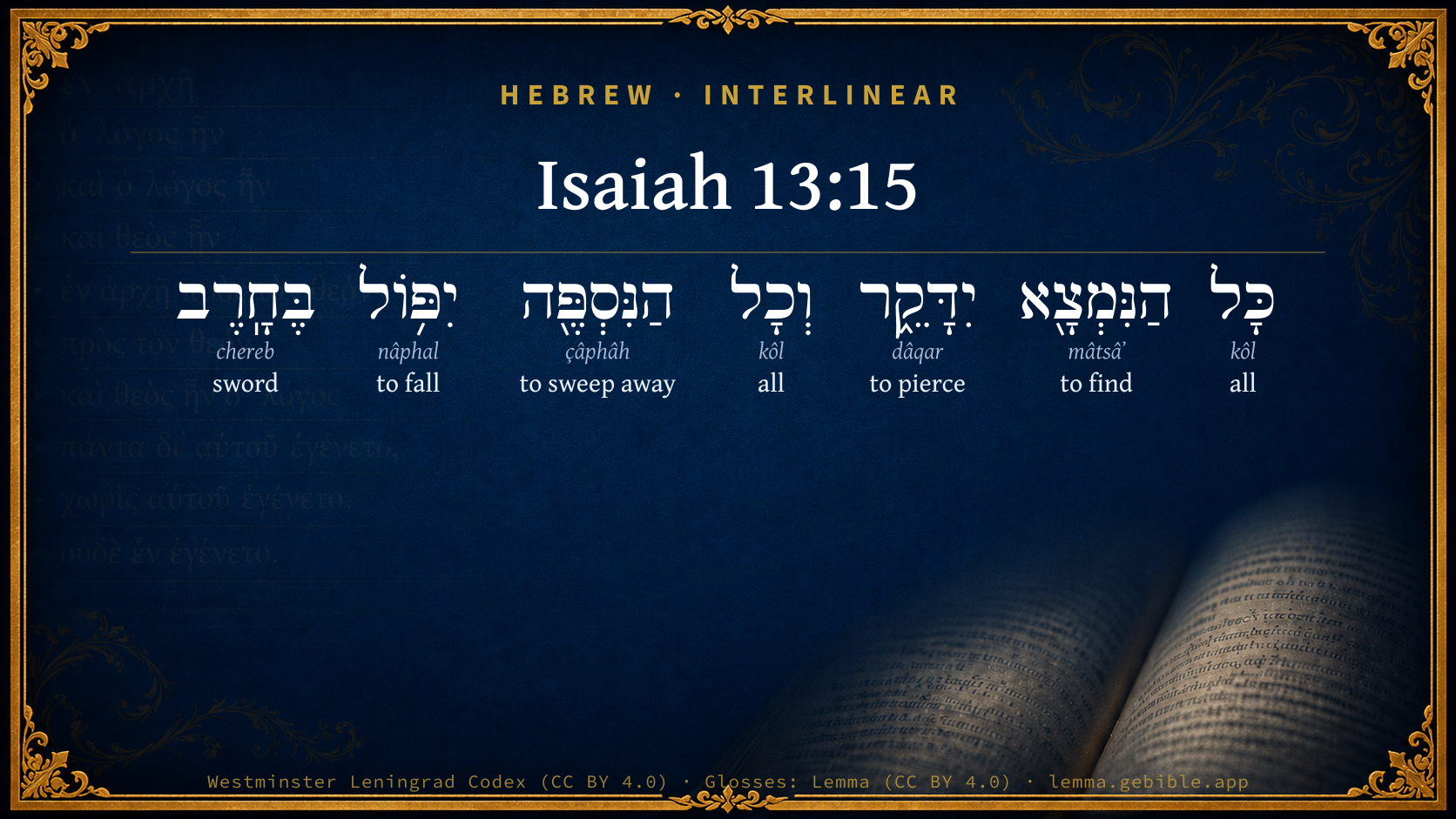
Isaiah 13:15

Hebrew (Westminster Leningrad Codex) Isaiah 13:15 appears in the Hebrew Old Testament. The text above is from the Westminster Leningrad Codex. Each word links to its Strong’s number, a concise gloss, and parsing drawn from the Open Scriptures Hebrew Bible morphology. Click any word for its full Brown-Driver-Briggs (BDB) entry.
Download image
Cite this verse

Isaiah 13:15 (World English Bible). Public Domain. Lemma interlinear Bible study tool, https://lemma.gebible.app/v/isaiah/13/15.

Show BibTeX & RIS
BibTeX
RIS
English Translation
Everyone who is found shall be thrust through; and everyone who is taken shall fall by the sword.
World English Bible · Public Domain
Download a study sheet

One document with this verse’s original text, its word-by-word gloss line, the meaning frame, cross-references with their text, attributed commentary, and full source and license credits — printable, and it pastes into notes with its structure intact.

This verse Autodidact and up

Study sheet (.html) Plain text (.txt)

A passage Seminary Student

Up to 50 verses in one chapter. A passage sheet keeps up to 6 commentary sources and 12 cross-references per verse, in the order this page ranks them, and says so on the sheet whenever that leaves anything out. Ask for a single verse and you get the Autodidact verse sheet above.

Everything on this page stays free to read, with no account — the sheet is a download of what is already on screen, not access to it.

Want to remove ads? Support Godless Engineer
Compare translations 3

The same verse in 3 English versions, stacked beneath the original-language interlinear above. Click any original word for its lexicon entry.

Each is an independent rendering of the whole verse — the interlinear is not word-aligned to these translations.

Highlighted words mark where these versions differ — a whole-verse word diff, not a word-by-word alignment.

  • World English Bible Public Domain
    Everyone who is found shall be thrust through; and everyone who is taken shall fall by the sword.
  • King James Version Public Domain
    Every one that is found shall be thrust through; and every one that is joined unto them shall fall by the sword.
  • unfoldingWord Literal Text CC BY-SA 4.0
    Every one found will be stabbed, and every one swept up will fall by the sword.

unfoldingWord Literal Text — © unfoldingWord, licensed CC BY-SA 4.0. Word-aligned USFM3 via Door43 (git.door43.org/unfoldingWord/en_ult).

Versions to compare (up to 4)

3 of 4 selected

Show all 18 translations

Every available English version of this verse, each an independent rendering of the whole verse.

  • World English Bible Public Domain
    Everyone who is found shall be thrust through; and everyone who is taken shall fall by the sword.
  • Berean Standard Bible Public Domain
    Whoever is caught will be stabbed, and whoever is captured will die by the sword.
  • Majority Standard Bible Public Domain
    Whoever is caught will be stabbed, and whoever is captured will die by the sword.
  • King James Version Public Domain
    Every one that is found shall be thrust through; and every one that is joined unto them shall fall by the sword.
  • American Standard Version (1901) Public Domain
    Every one that is found shall be thrust through; and every one that is taken shall fall by the sword.
  • Revised Version (1885) Public Domain
    Every one that is found shall be thrust through; and every one that is taken shall fall by the sword.
  • Geneva Bible (1599) Public Domain
    Euery one that is founde, shall be striken through: and whosoeuer ioyneth himselfe, shall fal by the sworde.
  • Douay-Rheims (1899) Public Domain
    Every one that shall be found, shall be slain: and every one that shall come to their aid, shall fall by the sword.
  • Young's Literal Translation Public Domain
    Every one who is found is thrust through, And every one who is added falleth by sword.
  • Literal Standard Version CC BY-SA 4.0
    Everyone who is found is thrust through, || And everyone who is added falls by sword.
  • Unlocked Literal Bible CC BY-SA 4.0
    Every one who is found will be killed, and every one who is captured will die by the sword.
  • unfoldingWord Literal Text CC BY-SA 4.0
    Every one found will be stabbed, and every one swept up will fall by the sword.
  • Darby Bible Public Domain
    All that are found shall be thrust through; and every one that is in league [with them] shall fall by the sword.
  • World Messianic Bible Public Domain
    Everyone who is found will be thrust through. Everyone who is captured will fall by the sword.
  • Webster's Bible Public Domain
    Every one that is found shall be thrust through; and every one that is joined to them shall fall by the sword.
  • Free Bible Version CC BY-SA 4.0
    Anyone who is captured will be stabbed to death; anyone who is caught will be killed by the sword.
  • Bible in Basic English Public Domain
    Everyone who is overtaken will have a spear put through him, and everyone who goes in flight will be put to the sword.
  • JPS Tanakh (1917) Public Domain
    Every one that is found shall be thrust through; and every one that is caught shall fall by the sword.

Literal Standard Version (2020), Covenant Press — licensed CC BY-SA 4.0. Text via the HelloAO Bible API (eBible.org). Unlocked Literal Bible (unfoldingWord) — licensed CC BY-SA 4.0. Text via the HelloAO Bible API (eBible.org). unfoldingWord Literal Text — © unfoldingWord, licensed CC BY-SA 4.0. Word-aligned USFM3 via Door43 (git.door43.org/unfoldingWord/en_ult). Free Bible Version, Dr. Jonathan Gallagher — licensed CC BY-SA 4.0. Text via the HelloAO Bible API (eBible.org).

Word by word

More ways to search: Search by grammar → Find every occurrence → Compare this word →

Practice this passage: Drill this verse → Learn its vocabulary →

About this verse

These counts appear in no published source. They are computed here, from the morphology-tagged text and Lemma’s own curated glosses. What Lemma adds →

7
words
6
distinct lemmas
Prophets
section

Notable vocabulary

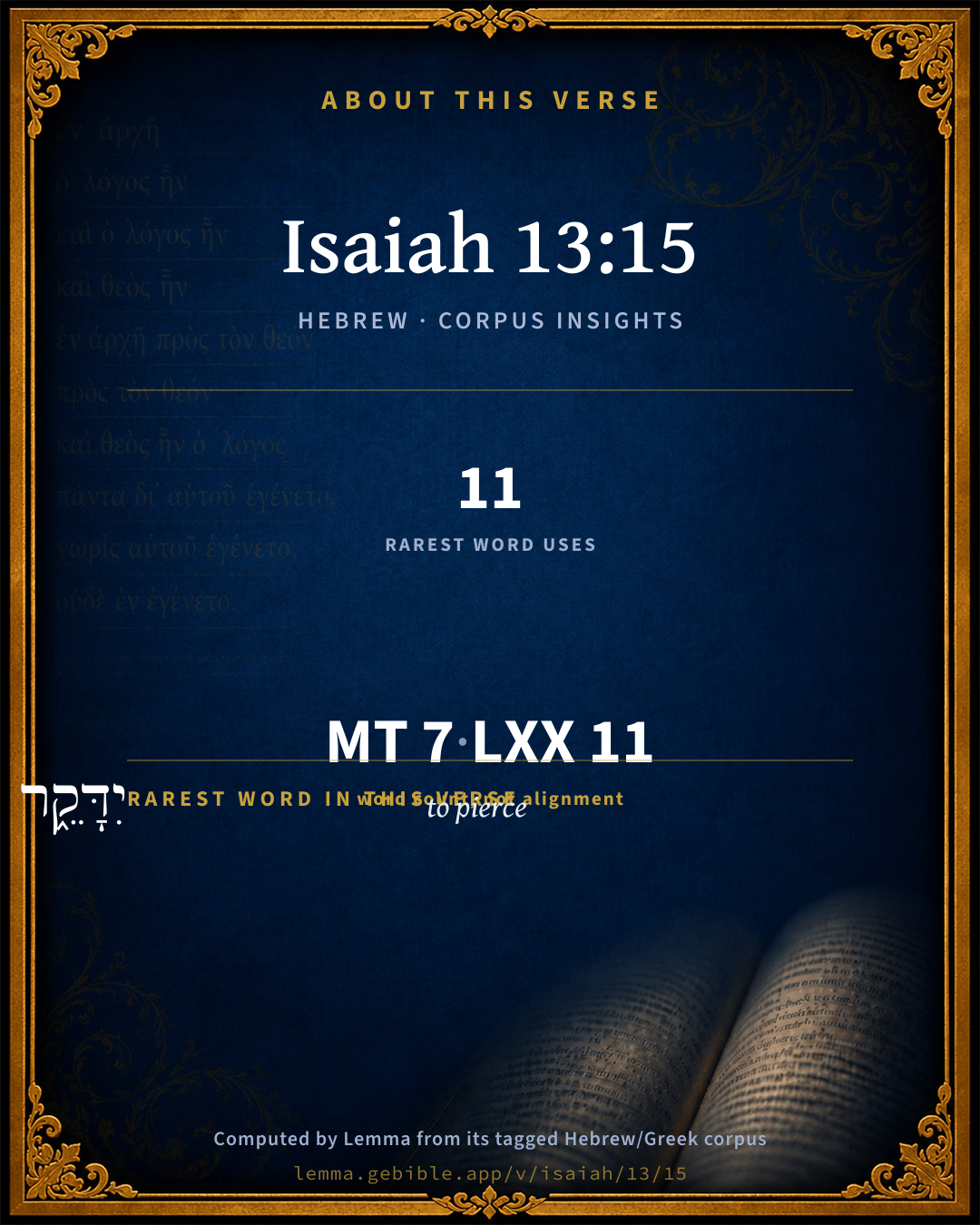
The rarest word here is יִדָּקֵ֑ר to pierce H1856 — appearing just 11 times in the whole Hebrew Bible.

Shared distinctive vocabulary

יִדָּקֵ֑ר to pierce H1856 occurs in 10 verses of the Hebrew Bible. Also found in:

Grammatical profile

  • 4 verbs
  • 3 nouns

Verb forms

  • הַנִּמְצָ֖א Niphal · Participle Active
  • יִדָּקֵ֑ר Niphal · Imperfect
  • הַנִּסְפֶּ֖ה Niphal · Participle Active
  • יִפּ֥וֹל Qal · Imperfect

Repetition

A word recurs within this verse — often emphatic in Hebrew:

Hebrew & Septuagint length

In English translation the verse runs 18 words from the Hebrew and 19 from the Septuagint (LXX English) — closely comparable.

A rough comparison of the two English renderings, which tokenize alike — not a word-level alignment.

Word counts can differ between the Hebrew and the Greek without any difference in meaning — e.g. the Hebrew direct-object marker אֵת has no separate Greek word, and Greek often adds the article ὁ.

In the original languages it is 7 Hebrew tokens and 11 Greek tokens — but the two are counted differently (Hebrew bundles its prefixes and suffixes into one token; the Greek is in lemma form), so that isn’t a like-for-like length.

Cross-references

6

Topical passages linked to Isaiah 13:15 in the Treasury of Scripture Knowledge — connected by theme and wording, ordered by reader-vote popularity; previews shown in the World English Bible.

  • Isaiah 14:19–22 But you are cast forth away from your tomb like an abominable branch, clothed with the slain, who are thrust through with the sword, who go down to the stones of the pit; as a dead body trodden under foot.
  • Isaiah 47:9–14 but these two things shall come to you in a moment in one day, the loss of children, and widowhood; in their full measure shall they come on you, in the multitude of your sorceries, and the great abundance of your enchantments.
  • Jeremiah 50:25 Yahweh has opened his armory, and has brought forth the weapons of his indignation; for the Lord, Yahweh of Hosts, has a work [to do] in the land of the Chaldeans.
  • Jeremiah 50:27 Kill all her bulls; let them go down to the slaughter: woe to them! for their day is come, the time of their visitation.
  • Jeremiah 50:35–42 A sword is on the Chaldeans, says Yahweh, and on the inhabitants of Babylon, and on her princes, and on her wise men.
  • Jeremiah 51:3–4 Against [him who] bends let the archer bend his bow, and against [him who] lifts himself up in his coat of mail: and don't you spare her young men; destroy you utterly all her host.

Cross-references courtesy of OpenBible.info (CC BY 4.0).

Hebrew and Greek witnesses Masoretic Hebrew ↔ Greek Septuagint

The same verse in the two great witnesses to the Old Testament, shown verse-for-verse.

These are two independent witnesses, not word-aligned to each other, and the Septuagint is shown in lemma (dictionary) form.

Hebrew Isaiah 13:15 Masoretic · Westminster Leningrad Codex

כָּל הַנִּמְצָ֖א יִדָּקֵ֑ר וְכָל הַנִּסְפֶּ֖ה יִפּ֥וֹל בֶּחָֽרֶב

Everyone who is found shall be thrust through; and everyone who is taken shall fall by the sword.

World English Bible · Public Domain

Greek LXX Isaiah 13:15 Septuagint · lemma form

ὅς γάρ ἄν ἁλίσκω ἡττάω καί ὅστις συνἄγω εἰμί μάχαιρα πίπτω

For whoever shall be taken shall be overcome; and they that are gathered together shall fall by the sword.

LXX2012 (modern English Septuagint) · Public Domain

On this verse, Adam Clarke's Commentary discusses the Septuagint’s reading. Read the note in Commentary ↓

Hebrew: Westminster Leningrad Codex (CC BY 4.0). Greek: Septuagint (public domain); English from LXX2012 (modern English Septuagint) (Public Domain). How the Septuagint differs from the Hebrew →

Targum (Aramaic paraphrase)

1

The Targum is the ancient Jewish Aramaic paraphrase of the Hebrew Scriptures — an interpretive translation, not the Hebrew text itself. Onkelos (literal) and Pseudo-Jonathan (expansive) render the Torah, and Jonathan the Prophets. Coverage is partial: where no permissively-licensed English translation exists for a verse, only the Aramaic is shown. This is verse-level text, not a word-by-word alignment to the Hebrew.

  1. Targum Jonathan Prophets (Joshua–Malachi)
    כָּל דְיִשְׁתְּכַח בָּהּ יִתְקְטֵל וְכָל דְיֵעוּל לִכְרַכֵּי צִיָרָא יִתְקְטֵל בְּחַרְבָּא:

    Every one that shall be found in her shall be slain, and every one that shall enter into the fortified cities shall be slain by the sword.

    Targum Jonathan — Aramaic: “Mikraot Gedolot” (public domain). English: “Sefaria Community Translation” (CC0 1.0 (public-domain dedication)); “London "Chaldee Paraphrase," 1871” (public domain). Text via Sefaria.

Commentary

Notes on Isaiah 13:15 from classic Christian and Jewish commentators (each source and its license shown beneath its notes). The classic Christian expositions comment on the surrounding passage and are grouped to its opening verse, so a note may address several verses; the Jewish commentaries on the Tanakh (Rashi and others) are per-verse, so they appear only where the commentator wrote on this verse.

Lemma curates 59 commentaries, every one of them public domain or Creative Commons licensed, each selected and text-cleaned for this edition rather than reprinted as found. About our sources →

Trapp's Complete Commentary

John Trapp

Isa 13:15 Every one that is found shall be thrust through; and every one that is joined [unto them] shall fall by the sword.

Ver. 15. Every one that is found shall be thrust through.] This maketh them flee for it. Quis enim vult mori? prorsus nemo. Life is sweet, and men will rather flee than die.

Every one that is joined unto them.] Or, That is decrepid, worn out with old age. See 2Ch 36:17.

John Trapp, A Commentary or Exposition upon All the Books of the Old and New Testament (1647–1656) — public domain. Text from a community e-Sword module.

Jamieson, Fausset & Brown

Robert Jamieson, A. R. Fausset & David Brown

found--in the city.

joined--"intercepted" [MAURER]. "Every one that has withdrawn himself," namely, to hide in the houses [GESENIUS].

Jamieson, Fausset & Brown — Commentary Critical and Explanatory on the Whole Bible (1871) — public domain (CC PDM 1.0). Text via the HelloAO Bible API.

Adam Clarke's Commentary

Verse 15. Every one that is found - "Every one that is overtaken"] That is, none shall escape from the slaughter; neither they who flee singly, dispersed and in confusion; nor they who endeavour to make their retreat in a more regular manner, by forming compact bodies: they shall all be equally cut off by the sword of the enemy. The Septuagint have understood it in this sense, which they have well expressed: -

Ὁς γαρ αν ἁλῳ ἡττηθησεται,

Και οἱτινες συνηγμενοι εισι πεσουνται μαχαιρα.

"Whosoever is caught shall be overthrown,

And all that are collected together shall fall by the sword."

Where, for ηττηθησεται, MS. Pachom has εκκενθησεται, et οιγ Cod. Marchal. in margine, et MS. I. D. II. εκκεντηθησεται, which seems to be right, being properly expressive of the Hebrew.

Adam Clarke's Commentary on the Bible (1810–1826) — public domain. Text from a community e-Sword/MySword module.

Ellicott's Commentary for English Readers

(15) Every one that is joined unto them.—Better, every one that is caught. The first clause of the verse refers to those that are in the city at the time of its capture, the second to those who are taken as they endeavour to escape.

A Bible Commentary for English Readers, edited by Charles John Ellicott (1878–1897) — public domain. Text from a community e-Sword module.

The Cambridge Bible for Schools and Colleges

gen. ed. J. J. S. Perowne

15. Every one that is found] Chiefly the natives of Babylon, who had no land to flee to. The phrase ‘every one that is joined unto them’ is better translated, every one that is caught.

The Cambridge Bible for Schools and Colleges (gen. ed. J. J. S. Perowne; Cambridge University Press, 1878–1918) — public domain. Text from a community e-Sword module.

John Gill's Exposition

Every one that is found shall be thrust through,.... With a sword, spear, or lance, and be slain; that is, everyone that is found in the city of Babylon; and so the Targum adds,

"and everyone that is found in it shall be slain;''

so Kimchi, in the midst of it, or without; in the street, as Jarchi. The orders of Cyrus (h) were, that those that were found without (in the streets) should be slain; and to proclaim in the Syriac language, that those that were within doors should continue there, but, if they were found without, they should be put to death; which orders were executed, and well agrees with this prophecy:

and everyone that is joined unto them shall fall by the sword; or "added" unto them; any of other nations that joined them as auxiliaries, see Rev 18:4 or "that is gathered"; so the Septuagint, "they that are gathered"; that are gathered together in a body to resist the enemy, and defend themselves. Some render the word, "every one that is consumed", with age; neither old nor young, as follows, should be spared. The Targum is,

"everyone that enters into the fortified cities,''

flees there for safety and protection.

(h) Xenophon. Cyropaedia, l. 7. sect. 23.

John Gill's Exposition of the Whole Bible (1746–1763) — public domain (CC PDM 1.0). Text via the HelloAO Bible API.

Albert Barnes' Notes on the Bible

Every one that is found - In Babylon, or that is overtaken in fleeing from it. This is a description of the capture of the city, and of the slaughter that would ensue, when the invaders would spare neither age nor sex.

Every one that is joined unto them - Their allies and friends. There shall be a vast, indiscriminate slaughter of all that are found in the city, and of those that attempt to flee from it. Lowth renders this, ‘And all that are collected in a body;’ but the true sense is given in our translation. The Chaldee renders it, ‘And every one who enters into fortified cities shall be slain with the sword.’

Albert Barnes' Notes on the Bible (1834–1885) — public domain. Text from a community e-Sword/MySword module.

Matthew Poole's English Annotations

That is found in Babylon, at the taking of it; the expectation whereof made them flee away with all speed.

Matthew Poole's English Annotations on the Holy Bible (1683–1685) — public domain. Text from a community e-Sword/MySword module.

The Pulpit Commentary

Every one that is found... every one that is joined unto them; i.e. all the population, both native and foreign.

The Pulpit Commentary (1880–1919), ed. H.D.M. Spence-Jones & Joseph S. Exell — public domain. Text from a community e-Sword module.

John Wesley's Explanatory Notes

Found - In Babylon, at the taking of it.

John Wesley, Explanatory Notes Upon the Whole Bible (1754–1765) — public domain. Text via the GEBible commentary corpus.

Keil & Delitzsch

C. F. Keil & F. Delitzsch

"Every one that is found is pierced through, and every one that is caught falls by the sword." By "every one that is found," we understand those that are taken in the city by the invading conquerors; and by "every one that is caught," those that are overtaken in their flight (sâphâh, abripere, Isa 7:20). All are put to the sword. - The third and fourth disasters are plunder and ravage. Isa 13:16 "And their infants are dashed to pieces before their eyes, their houses plundered, and their wives ravished." Instead of tisshâgalnâh, the keri has the euphemistic term tisshâcabnâh (concubitum patientur), a passive which never occurs in the Old Testament text itself. The keri readings shuccabt in Jer 3:2, and yishcâbennâh in Deu 28:30, also do violence to the language, which required עם שכב and את (the latter as a preposition in Gen 19:34) for the sake of euphemism; or rather they introduce a later (talmudic) usage of speech into the Scriptures (see Geiger, Urschrift, pp. 407-8). The prophet himself intentionally selects the base term shâgal, though, as the queen's name Shegal shows, it must have been regarded in northern Palestine and Aramaean as by no means a disreputable word. In this and other passages of the prophecy Knobel scents a fanaticism which is altogether strange to Isaiah.

Keil & Delitzsch — Biblical Commentary on the Old Testament (1861–1891) — public domain (CC PDM 1.0). Text via the HelloAO Bible API. (Old Testament only.)

J. A. Alexander on Isaiah

Joseph Addison Alexander

The flight of the strangers from Babylon is not without reason, for every one found (there) shall be stabbed (or thrust through), and every one joined (or joining himself to the Babylonians) shall fall by the sword. All interpreters agree that a general massacre is here described, although they differ as to the precise sense and connection of the clauses.

Joseph Addison Alexander, The Prophecies of Isaiah (1846–1847; New York: Scribner, 1870–1878) — public domain. Text from a community e-Sword module.

unfoldingWord translationNotes

Door43 World Missions Community

Every one who is found will be killed ... every one who is captured will die by the sword

These two phrases mean basically the same thing. This can be stated in active form. AT: "The enemy will kill with the sword everyone they find" (See: Parallelism and Active or Passive)

Their infants also will be dashed in pieces

This can be stated in active form. AT: "The enemy will also dash their infants to pieces" or "The enemy will beat their infants until they die" (See: Active or Passive)

before their eyes

Here the people are represented by their "eyes" to emphasize what they see. It can be stated clearly that the parents are unable to help their infants. AT: "in front of them" or "while their parents helplessly watch" (See: Assumed Knowledge and Implicit Information and Synecdoche)

Their houses will be plundered

This means that everything valuable will be stolen from their houses. This can be stated in active form. AT: "The enemy will plunder the people's houses" or "The enemy will steal everything valuable from the people's houses" (See: Active or Passive)

their wives raped

This means that the enemies will attack the women and force them to have sex with them. The words "will be" are understood. This can also be expressed with an active form. AT: "their wives will be raped" or "their enemies will rape their wives" (See: Ellipsis and Active or Passive)

translationWords

sword

unfoldingWord translationNotes — © Distant Shores Media and the Door43 World Missions Community, licensed CC BY-SA 4.0. Source: git.door43.org/Door43/en_tn.

Rashi

Rabbi Shlomo Yitzchaki (Rashi)

Everyone who is found outside, shall be stabbed.

and anyone who takes refuge with the people of the city to be included with them in the siege, shall fall by the sword when the city capitulates. נִסְפֶּה is an expression similar to (Deut. 29:18): “To add the unintentional sins to the lustful ones (סְפוֹת)”; (infra 29:1) “Add year upon year (סְפוּ)”; (Jer. 7:21) “Add (סְפוּ) to your sacrifices.” [akojjlir in O.F.], to join.

Rashi on the Tanakh — English translations: “The Judaica Press complete Tanach with Rashi, translated by A. J. Rosenberg” (CC BY 4.0); “Pentateuch with Rashi's commentary by M. Rosenbaum and A.M. Silbermann, 1929-1934” (public domain); “The Metsudah Tanach series, Lakewood, N.J” (CC BY 4.0); and “The Book of Joshua, Metsudah Publications, 1997” (CC BY 4.0). Text via Sefaria.

Ibn Ezra

Rabbi Abraham ibn Ezra

He will be pierced. He will find no mercy.

נספה That is joined. Participle Niphal.

Ibn Ezra on the Tanakh — English translations: “Sefaria Community Translation” (CC0 1.0 (public-domain dedication)); “Yalkut, Sifsei Chachomim Chumash, Metsudah Publications, 2009” (CC BY 4.0); and “Commentary of Ibn Ezra on Isaiah - trans. by M. Friedlander, 1873” (public domain). Text via Sefaria.

Lesson kit

Teaching starters — assembled from the data on this page, not authored interpretation. Every prompt links to the verse data it draws on. Edit before teaching.

Isaiah, in the Prophets, opens this verse with 7 words (6 distinct Hebrew lemmas). Its most distinctive word is dâqar (“to pierce”). A historical commentator’s framing appears above. Read the whole chapter for the surrounding context.

Discussion questions

  1. How does “to pierce” (dâqar) shape what this verse is saying?
  2. How does Numbers 25:8, which shares the word «to pierce», read alongside this verse?
  3. What does the repetition of “all” (2× in this one verse) do in this verse?
  4. The translations on this page render this verse differently — a whole-verse word diff, not a word-by-word alignment. What might account for the different wordings?
  5. «הַנִּמְצָ֖א» is a Niphal Participle Active verb. How does that grammatical form shape the action described?
  6. Compare how Trapp's Complete Commentary and Jamieson, Fausset & Brown read this verse. Where do they agree or differ?

Things to notice

Reading settings

Reading text

Shown beneath each verse's original-language words.

Old Testament
Old Testament edition

Read the OT as the Masoretic Hebrew (MT) or the Greek Septuagint (LXX).

English shown for the Greek Septuagint (in the Hebrew ↔ Greek comparison).

Comparing translations? Open the Compare panel on any verse page to stack up to four side by side.